After giving these orders he once more told Voltis about the necessity of such executions by pointing to the Fuehrer Order. He then again gave me, as well as Voltis, the basic order for the future to carry out such executions, for even an advance kommando could not exclude itself from such executions. Voltis and I then left Nebe. It was clear to me that I could not get around the order which Nebe directly had given to Voltis that as far as the reprisal actions are concerned only men could be considered, not women and children -- only able bodied men. Outside of that I did not bother for the preparation of this execution, for I was depressed that my hope had come to nothing -namely, that I might not be concerned with execution orders. Furthermore, I felt depressed because Voltis who was my inferior, had been given order directly and I resented it. Voltis carried out the executions ordered by Nebe on the next morning, that is, on the 7th of July. As far as I remember it lasted about one to one and one-half hours. How Voltis chose the men to be executed was, and is, unknown to me. I merely know because I was partly present at the execution that always ten men would be brought there to the execution place at a time with a truck from Minsk. There was a tank ditch. The ten men were put at that ditch and in a military manner were shot by rifles by the execution commando , which included about 40 men. Three men always shot at a victim because a part of the kommando was busy getting the people and blocking off the area. As I said, I was only partly present. No doctor was present because my special kommando did not have a doctor at all. But as far as I was present I convinced myself that the victims were dead. But any way, this was the job of the leader of the commando, Voltis.
The number of victims amounted to about fifty to sixty. I cannot give the exact number. I then told Nebe about the execution of the order as I had been ordered. At the same time I said good-bye to him because on the some day I was to advance in the direction of Polosk.
QWere the valuables and clothing taken away from the victims in Minsk?
ANo, such a thought did not even occur to me or my kommando. The victims were buried in their things without having had anything taken away from them, that is, they were covered with earth by the men of the kommando.
QWhen did you get to Polosk, and did you carry out any executions there?
AFrom the 7th of July on, that is, the day of our departure from Minsk, we tried to join the fighting troops directly. How many days we spent on the way towards Polosk I do not exactly remember. At any rate, the roads were partly very bad, and the vehicles had to proceed second gear almost constantly. When we had reached the fighting troops we were about two days in the front lines until the tanks finally passed through the city. I went into the city with my commando immediately, and even before the infantry. Still we arrived too late, for the streets had already been set on fire by the Communist arson units and the NKVD building too, was up in flames.
A (Continued) We were only able to enter for a moment on the first floor. This must have been between the 10th and 12th of July. We only spent one day in Polosk. I had the Ethnic Germans interrogated, whom we found among the Russian prisoners of war and had then asked about general conditions in the Soviet Union. We picked out two interpreters from among these ethnic Germans in Polosk. I did not prepare any executions nor did I carry any out. In order not to yet in a forced situation where I would have to undertake executions I proceeded on the next day in the direction of Vitebsk, which had been captured by the Germans on the 11 July. After my arrival in Vitobsk I wired a report to Nebe about the events in Polosk. In order to obviate his criticism about nonexecutions I emphasized that the city had been completely burned out and that the population was hardly there any more, and that was why I immediately proceeded, but this was somewhat exaggerated. In reality the conditions in Polosk were about the same as those in Minsk, that is to say, a considerable part of the population was, of course, still there, and certainly not all houses had been burned.
QWitness, when did you arrive in Vitobsk? What general conditions did you find there and did you carry out any executions?
AI cannot give the exact date of the arrival of my special commando in Vitobesk. At any rate we spent several days on the road between Polosk and Vitobsk. We probably arrived there about the 15th of July. The general conditions in Vitobsk were already somewhat orderly because the city had been in German hands since the 11th of July. I would have preferred just as I did in Polosk to advance very soon in the direction of Smolensk, but at that time during the advance of the 9th Army between Vitobsk and Smolensk we had been brought to a stop. The Ninth Army had advanced north of the Dnjepr and then waded ahead north of the Dnjepr to the smaller part of the city of Smolensk but could really not get near there, whereas the neighboring army advancing South of the Dnjepr already penetrated into the southern part of the city on the 16th of July.
Even after this, part of the city was still fought over in the following days. Therefore Army Command 9 did not give me permission and an order for the time being to proceed in my advance from Vitobsk. Therefore, in this interval in Vitobsk, I occupied Voltis,who was such an active man, with the forming of a Jewish Council registering and marking the Jews and drafting them for labor service with the army agencies. Furthermore, I kept my men busy with making out SD reports. I gave the order to solve the Jewish question in the white Ruthenian area. The number of Jews in Vitobsk was proportionally quite large. In all the White Ruthenian area about one and a half million Jews were living. We gathered material about the Jewish question with the cooperation of the Mayor of Vitobsk who was installed by us and with other members of the White Ruthenian intelligencia. I went over the entire material and made out a detailed report to Nebe. In this report I pointed out that an execution of Jews by small Einsatz commandos seemed impossible to me of execution. Instead, I suggested that the Jews be collected in ghettos and proposed that they wait there until the end of the war when they would then be re-settled. In this report I again made the attempt, which was not very hopeful, to point to the Fuehrer order in reference to it's impossibility of execution and to try to manage something in that respect. Furthermore, I thought I could find an escuse not to have to undertake executions in Vitobsk. Furthermore, from the situation reports which have become known to me in Nurnberg, I have seen that Nebe used this report of mine in his reports to Berlin.
QDoesn't the fact that Nebe used your reports contradict his usual strict conduct about executions?
ANo, even Nebe would have been glad to be rid of this order. Nevertheless, he continued his pressure on us, the pressure which was applied to him from Berlin.
The use of my report on the part of Nebe was for him either an almost hopeless attempt to achieve a change in the Fuehrer Order or - whatsis more probable - with this report he wanted to excuse the bad execution of the Fuehrer Order up to this date.
QHow did Nebe react towards you as a result of your report?
AUnfortunately, nothing changed about his strict demand about executions. For until his report would have an effect perhaps up on top, a lot of time had to pass by, even considering that such a change might occur, and for this long a time he probably did not dare to remain inactive. At any rate, a short time after sending my report, I received a very severe message from Nebe in which he demanded a detailed report about Vitobsk, and especially about the execution of Jews. I considered it certain that it was just my report which induced him to send me this message, because probably in it he saw a renewed attempt on my part not to have to undertake the executions.
QWhat did you do then?
AI no longer saw my possibility and I no longer had any possibility to evade the execution of this order. I therefore gave Voltis the order to prepare a Jewish action and limited the order exclusively to able-bodied men and I directed that a labor detachment was to be set up and its members were then to be shot. Voltis did not stick very closely to this order, for even before the action which had been ordered and without my knowledge he had a number of Jews shot in the streets in Vitobsk because they had refused to appear at work which had been ordered of them. Voltis in this connection acted on the basis of the order which Nebe had given to him in Minsk. When Voltis reported this execution to me 1 reported to Nebe about Vitobsk by telling him about and announcing the action which I had ordered in order to quiet him down. One or two days later in my presence the announced execution was carried out. As far as I remember about 80 able-bodied men were shot in the same manner as they had been shot in Minsk.
Voltis was the commanding officer of the execution commando.
QWere any valuables or clothing taken away from the victims either before or after the execution?
ANo, this did not occur to me. The Jewish men when they were brought in were shot in their clothing and were then covered with earth by men of the commando.
QWitness, I ask you now to give the Tribunal the exact picture of your own inner attitude which you had when you saw that execution in Vitobsk?
AI testified before about the execution in Minsk, where Nebe gave a direct order to Voltis who was subordinate to me about preparing and executing this execution, whereas I merely had to report to Nebe that the execution had been carried out.
But in Vitobsk the case was different. Here I was myself under the immediate compulsion of an order on the part of Nebe, and this was because of this radio message. I myself gave Voltis that order to prepare and carry out this execution and differently from Minsk I attended the entire execution which lasted about two hours. By my presence I wanted to show the men of my execution commando that I would not ask of then any more than I would ask of myself. If I am now asked about my inner attitude which I then hold, I can only say that it was absolutely split. On the other hand there was the strict order of my superior about carrying out the Fuehrer Order and as a soldier I had to obey. On the other hand I considered the execution of this order cruel and humanly impossible. My very presence at this execution convinced me of this in a final manner. I still know that I wanted to make the situation easier for my men who were certainly moved by the same feelings. When ten men were shot there was always a pause until the next had been brought in. During these pauses I let my men sit down and rest and I joined them. I still know that I said exactly about the following words to them at that time: "As such it is no job for German men and soldiers to shoot defenseless people but the Fuehrer has ordered these shootings because he is convinced that these men otherwise would shoot at us as partisans or would shoot at our comrades and our women and children were also to be protected if we undertake this executions.
This we would have to remember when we carried out this order." Furthermore, I tried by talking about neutral subjects to make the difficult spiritual situation easier and to overcome it. As for myself personally I did not know any way out of this repulsive situation. Had I refused to carry out the order of Nebe it was clear that I would be put before a Court Martial and would be sentenced to death because of disobedience since it was a specific Fuehrer order. A false report did not occur to me. I would have considered it unworthy of myself. Apart from this my personal altitude about giving a false report, it would- have been discovered very soon and it would have brought the same results as an open refusal to obey, namely, my sentence to death. BY THE PRESIDENT:
QWell, witness, you gave us two explanations there. Now on which one do you depend. You said first that you did not contemplate a false report because that was unworthy of you and clashed with your principles, then you say you did not give a false report because they would have discovered it anyway and then you would still be in the same position as you were before. How, these two do not coincide. Which one do you give us as the real reason?
AYour Honor, today I cannot exactly put myself in a situation, which one of those two thoughts dominated at the time, but they were both very close and both faced me barring a way out.
QBut those two reasons can't be reconciled. It is like a person who must decide whether to steal a hundred dollars or not and this is the conflict in his mind: If I steal this money I am being dishonest and I would not be true to myself. It is not correct, it is not moral, that is one reason, and then for the second reason I may get caught and they might send me to jail and if we take the second reason that completely eliminates the first reason because he doesn't consider it upon principle or morality at all.
QI would assume that already the feeling that a false: report was unworthy of me induced me not to take such a way out. BY DR. LUMMERT:
QWitness, in your report about your then inner feelings during the execution in Vitobsk I ask you to continue. BY THE PRESIDENT: Pardon me, Judge Dixon seems to recall that the witness stated he sent a false report on the fire in Polosk. Did you send a false report on the fire in that town?
AYour Honor, I think in this case it was only a small coloring, not a false report. I think my soldierly conscience was not violated very seriously here if I changed the fact that the city was burned and the population had left and colored it in such a form that in it I found an escuse for my conduct.
THE PRESIDENT:Very well.
DR. LUMMERT:Hay I say something? As far as I remember the witness said that the report was somewhat exaggerated.
QWitness, please continue.
AThe total impression of this execution of defenseless men was shocking. When I came back to my office I was seized by stomach cramps and I had to vomit. I , therefore, renewed my earnest decision to avoid a further such situation with all possible means. In this I did succeed with my being recalled which happened about one month later. Vitobsk is the first and last case of an execution which was ordered by me and carried out. It probably took place on the 19th of 20th of July 1941. The total number of men shot in Vitobsk by my special commando amounted to about 100, as far as I recollect. This includes the 20 which were shot by Voltis who had refused to appear for work and the 80 who were shot during the execution about one or two days later.

QWitness, when did you leave Vitobsk and where did you go with your special commando 7a then?
AAbout the time of the execution an advance commando of Einsatz Commando 9 had arrived in Vitobsk. At the same time I received the news from Army Command 9 that the advance through the railroad station area of Smolensk north of the Dnjepr was close at hand. Therefore, I left Vitobask and with my special commando I was in the artillery field position of the troops for several days. Then with the head of the company we advanced into the northern part of Smolensk where we immediately started to interrogate prisoners as soon as the fighting had stopped. I remained in Smolensk only one dry . Smolensk was then under heavy artillery bombardment, and since the public buildings were located in the southern pert of the city and therefore belonged to the area, of Special Commando 7b I was not competent there. I, therefore, limited myself to report to Nebe by radio that I had only undertaken temporary security measures. Later I heard that on the same day men of the advance commando Moscow were already in Smolensk. I now received from Army Commando 9 a mission for partisan counter-intelligence for the area Northwest of Smolensk and I stationed my commandos at a large lake, at Lake Loswitha, at a former estate. On order of the Army Commando 9. a short time later, I had to send a sub-commando to Welish where strong partisan units had set themselves up in the vicinity. I gave this independent mission of gathering intelligence about partisans to Hauptsturmfuehrer Voltis, the only trained officer of my commando.
DR. LUMMERT:Your Honor, I think this would be an excellent time to recess.
THE PRESIDENT:The Tribunal will be in recess until 1:45.
(The Tribunal adjourned for the noon recess).
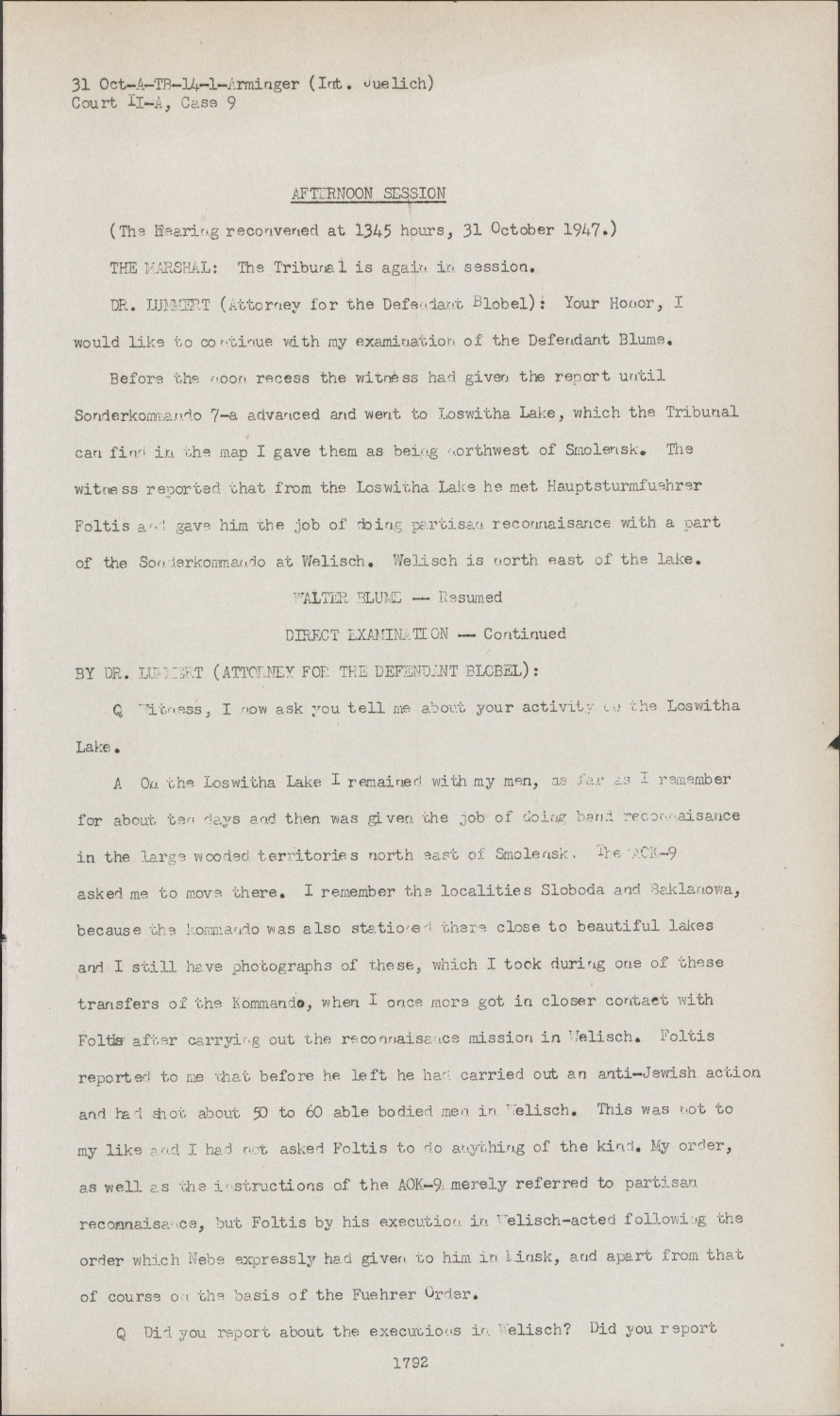
AFTERNOON SESSION (The Hearing reconvened at 1345 hours, 31 October 1947.)
THE MARSHAL:The Tribunal is again in session.
DR.LUMMERT (Attorney for the Defendant Blobel): Your Honor, I would like to continue with my examination of the Defendant Blume.
Before the noon recess the witness had given the report until Sonderkommando 7-a advanced and went to Loswitha Lake, which the Tribunal can firm in the map I gave them as being northwest of Smolensk. The witness reported that from the Loswitha Lake he met Hauptsturmfuehrer Foltis and gave him the job of doing partisan reconnaisance with a part of the Sonderkommando at Welisch. Welisch is north east of the lake.
WALTER BLUME -- Resumed DIRECT EXAMINATION -- Continued BY DR. LUMMERT (ATTORNEY FOR THE DEFENDANT BLOBEL):
QWitness, I now ask you tell me about your activity of the Loswitha Lake.
AOn the Loswitha Lake I remained with my men, as for as I remember for about ten days and then was given the job of doing band reconnaisance in the large wooded territories north east of Smolensk. The AOK-9 asked me to move there. I remember the localities Sloboda and Baklanowa, because the kommando was also stationed there close to beautiful lakes and I still have photographs of these, which I took during one of these transfers of the Kommando, when I once mere got in closer contact with Foltis after carrying out the reconnaisance mission in Welisch. Foltis reported to me that before he left he had carried out an anti-Jewish action and had dot about 50 to 60 able bodied men in Welisch. This was not to my like and I had not asked Foltis to do anything of the kind. My order, as well as the instructions of the AOK-9 merely referred to partisan reconnaisance, but Foltis by his execution, in Welisch-acted following the order which Nebe expressly had given to him in Minsk, and apart from that of course of the basis of the Fuehrer Order.
QDid you report about the executions is Welisch? Did you report
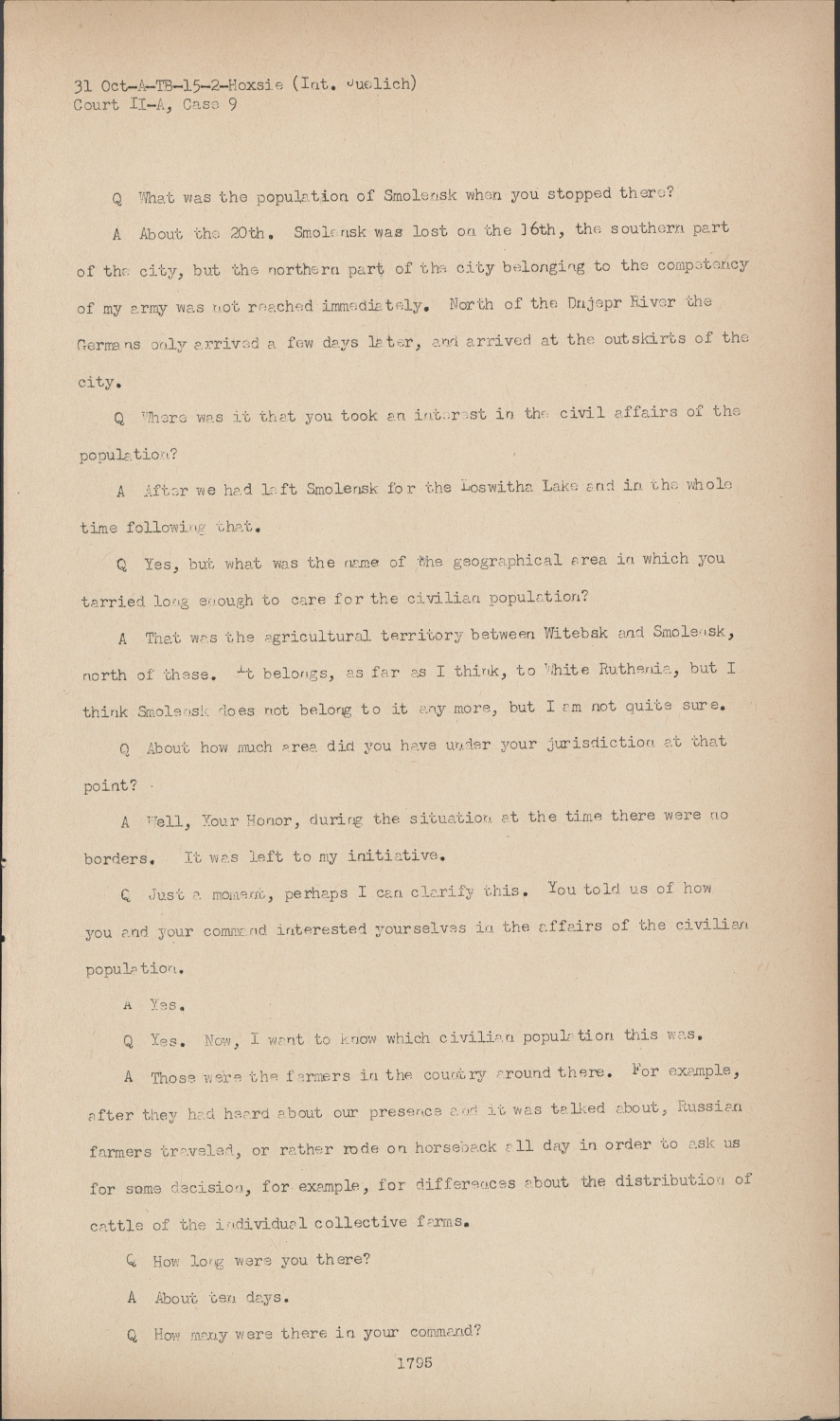
QWhat was the population of Smolensk when you stopped there?
AAbout the 20th. Smolensk was lost on the 16th, the southern part of the city, but the northern part of the city belonging to the competency of my army was not reached immediately. North of the Dnjepr River the Germans only arrived a few days later, and arrived at the outskirts of the city.
QThere was it that you took an interest in the civil affairs of the population?
AAfter we had left Smolensk for the Loswitha Lake and in the whole time following that.
QYes, but what was the name of the geographical area in which you tarried long enough to care for the civilian population?
AThat was the agricultural territory between Witebsk and Smolensk, north of these. It belongs, as far as I think, to White Ruthenia, but I think Smolensk does not belong to it any more, but I am not quits sure.
QAbout how much area did you have under your jurisdiction at that point?
AWell, Your Honor, during the situation at the time there were no borders. It was left to my initiative.
QJust a moment, perhaps I can clarify this. You told us of how you and your command interested yourselves in the affairs of the civilian population.
AYes,
QYes. Now, I want to know which civilian population this was.
AThose were the farmers in the country around there. For example, after they had heard about our presence and it was talked about, Russian farmers traveled, or rather rode on horseback all day in order to ask us for some decision, for example, for differences about the distribution of cattle of the individual collective farms.
QHow long were you there?
AAbout ten days.
QHow many were there in your command?
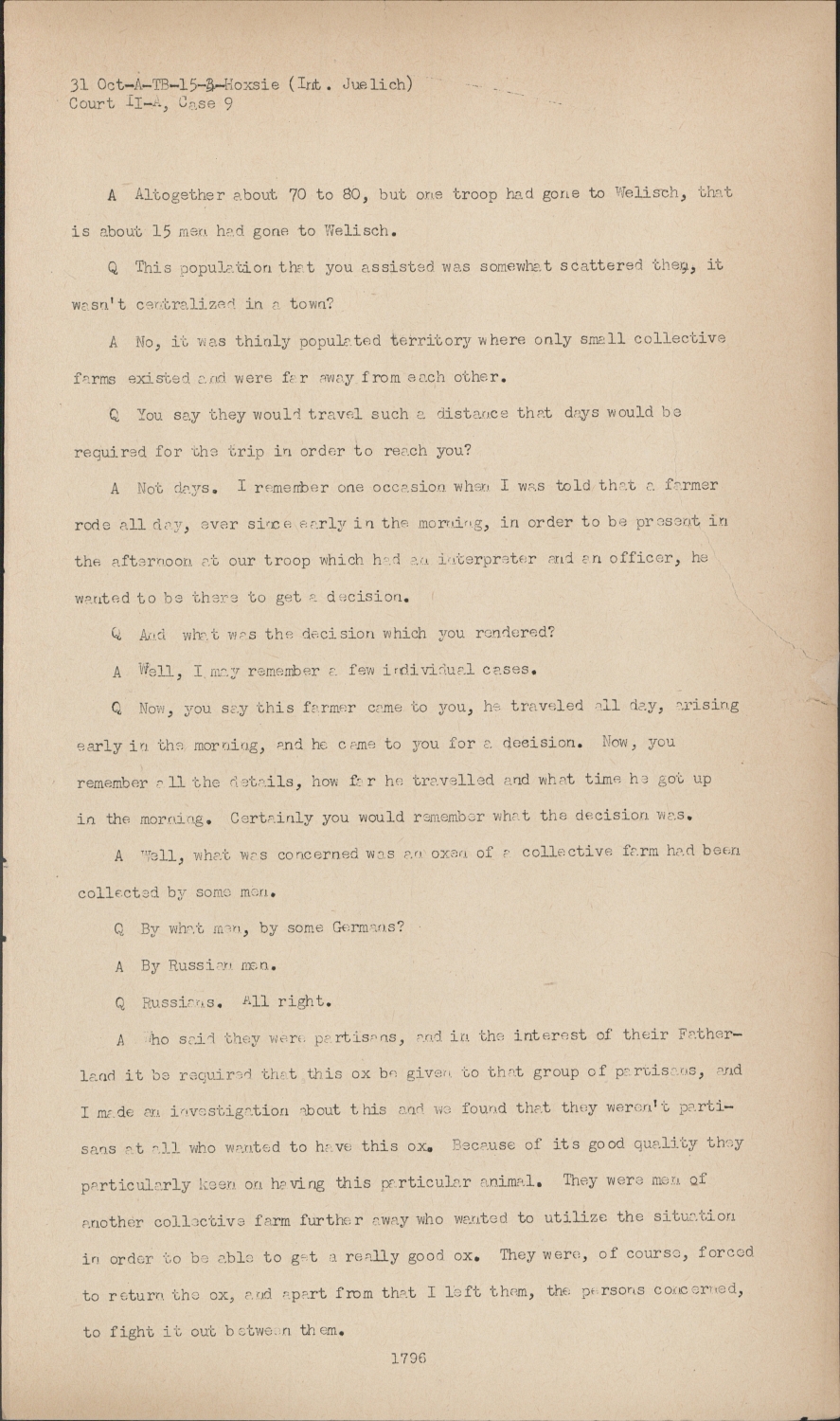
AAltogether about 70 to 80, but one troop had gone to Welisch, that is about 15 men had gone to Welisch.
QThis population that you assisted was somewhat scattered then, it wasn't centralized in a town?
ANo, it was thinly populated territory where only small collective farms existed and were far away from each other.
QYou say they would travel such a distance that days would be required for the trip in order to reach you?
ANot days. I remember one occasion when I was told that a farmer rode all day, ever since early in the morning, in order to be present in the afternoon at our troop which had an interpreter and an officer, he wanted to be there to get a decision.
QAnd what was the decision which you rendered?
AWall, I may remember a few individual cases.
QNow, you say this farmer came to you, he traveled all day, arising early in the morning, and he came to you for a decision. Now, you remember all the details, how far he travelled and what time he got up in the morning. Certainly you would remember what the decision was.
AWell, what was concerned was an oxen of a collective farm had been collected by some men.
QBy what man, by some Germans?
ABy Russian, men.
QRussians, All right.
AWho said they were partisans, and in the interest of their Fatherland it be required that this ox be given to that group of partisans, and I made an investigation about this and we found that they weren't partisans at all who wanted to have this ox. Because of its good quality they particularly keen on having this particular animal. They were men of another collective farm further away who wanted to utilize the situation in order to be able to get a really good ox. They were, of course, forced to return the ox, and apart from that I left them, the persons concerned, to fight it out between them.
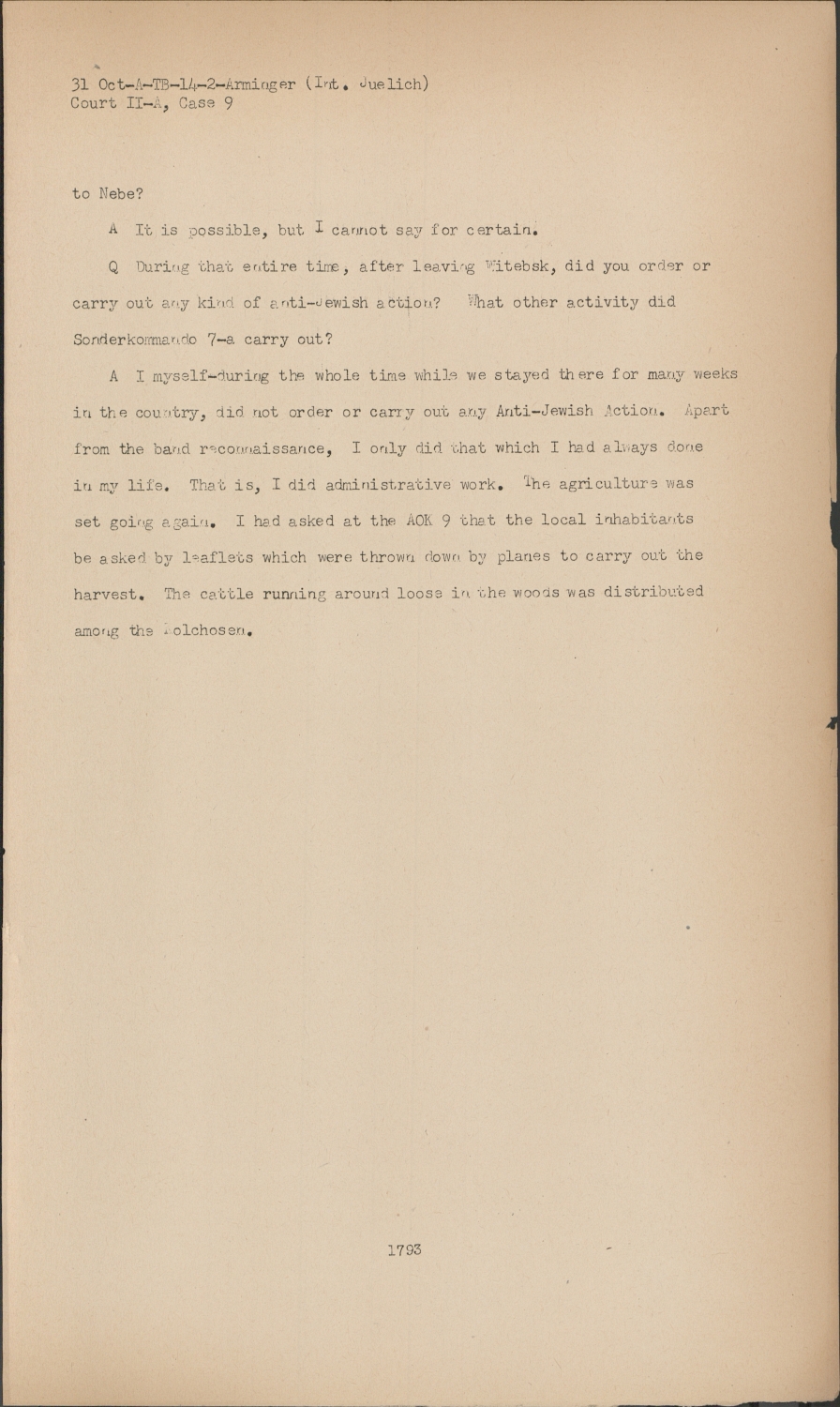
to Nebe?
AIt is possible, but I cannot say for certain.
QDuring that entire time, after leaving Witebsk, did you order or carry out any kind of anti-Jewish action? What other activity did Sonderkommando 7-a carry out?
AI myself-during the whole time while we stayed there for many weeks in the country, did not order or carry out any Anti-Jewish Action. Apart from the band reconnaissance, I only did what which I had always done in my life. That is, I did administrative work. The agriculture was set going again. I had asked at the AOK 9 that the local inhabitants be asked by leaflets which were thrown down, by planes to carry out the harvest. The cattle running around loose in the woods was distributed among the Kolchosen.
The harvest work was organized and small factories started to work. Education and schooling, religious life, medical care of the population, family life, etc., was reported on. Apart from that, within a short time, as the only authority in the whole district, the population, even asked us to deal with their private differences, particularly concerning the distribution of cattle. An officer with an interpreter for that purpose had to be at their disposal every day.
The relation toward the population was the best possible, because I asked my men to behave in the most correct manner. The inhabitants on the Loswitha Lake, for example, brought me all kinds of fowl, etc., and did not want to be paid for it and emphasized that it was a point of honor to them to be able to give me such presents. They also asked me to permit them to give me the harvest reef, and this happened.
During these weeks occasional individual shootings occurred. These were only armed partisans and Communist agents who had asked the farmers to destroy the stores of the harvest. In all, during the approximately four weeks for the entire Sonderkommando 7a at the most twenty partisans and saboteurs were shot, and the shooting, apart from actual fighting, was only done after detailed interrogation and examination of the subject matter. These shootings, I considered them end still consider them to me to be fully justified. Apart from that the interrogations often had the result that the persons concerned, were released because either it was proved that they were innocent or it was proved that the evidence against them was not sufficient.
These twenty shootings at the utmost concern the time after leaving the town of Smolensk, until I was transferred in the middle of August. In the previous weeks, that is from Wilna to Smolensk, no such shootings occurred because at that time we had 'not been assigned to fight against partisans. BY THE PRESIDENT:
QWhat is the population of Smolensk; what was it at that time?
AYour Honor, I do not understand.
QNow, this farmer travelled all day to tell you about an ox which had been taken by some Russians, is that right?
AWell, it did not take all day, of course.
QYou told us he get up early in the morning and travelled all day to come to you for a decision.
AOh, I only understand now. The farmer did, yes.
QAll right, And he told you that some Russians had taken his ox.
AYes.
QYes. Now, you dropped everything, forgot all about the war, and started out to find this ox, is that right?
AYes.
QAll right. Now, did you find the ox?
AYes.
QThere did you find the ox?
AThere he had been taken to by these men who had taken it under this pretext, end we made investigations about this.
QAnd did you find the people who had taken the ox?
AYes, your Honor, I said so.
QAnd were they Russians or not?
AYes, they were Russians.
QThey were Russians?
AYes.
QAnd they had in effect stolen this ox?
AYes,
QYes, and what did you do to the Russians?
AI already said, I left them to fight it out. I left the two groups to fight it out.
QWell then, you didn't render any decision?
AWell, insofar as I had the ox brought back where it belonged.
QBut you left it between them to fight it out, you say?
AWell, I didn't have a prison. What could I have done with the people?
QThen you didn't render any decision?
ANot insofar, no.
QAll right, what else did you do for the civilian population? You told us that you helped the civilian population. This is one kind of case you told us about, about finding an ox, and then you left it to them to fight it out. Now, what else did you do for the civilian population?
AFor these people, all that mattered was the question how they could survive the winter. Two things were necessary for this, a house and something to eat.
QWell, they had a house; they had their house.
APartly. Some houses had been destroyed owing to the war.
QAll right.
AAnd these people do not act without orders. It was like this. If a Russian lost his house, he did riot have the courage to go into another house which had been vacated by people who-let us say - had fled. These men had to try to get a decision from some authority to permit them to move into these houses. These people came to us. Another case
QAnd you rendered a decision whether they could move into certain houses which had. been abandoned?
AYes. They were not satisfied until they had this decision in writing.
QYes. You would make up the decision in writing?
AYes.
QYou were authorized to do that?
AWell, I just took the authority.
QAll right. And you were there ten days?
AYes.
QAnd in these ten days how many decisions did you make about houses and oxen?
AThere were different things too, your Honor.
QWell, mention some other thing that you decided.
AFor example, it was very important to these people to be entitled to have one item of cattle for their own use on their collective farms.

That was their source of food for the entire winter, but they did not dare to do this because
QSo that during the ten days you were sort of Solomon to the population of that area?
AI am glad, your Honor, that I was able to be something different during those ten days than in the previous ones.
THE PRESIDENT:Proceed.
31 Oct 1947_A_MSD_16_1_Hoxsie (Juelich)
THE WITNESS:However, on the Loswitha Lake in particular, if I may add this, I had also shootings carried out. There was a troop of men who had come from the Russian side, the East side, and had been sent to ask the farmers not to bring in the harvest and that the harvest be destroyed in order to make it difficult for the troop to feed themselves. In this case, after a detailed examination by experts, When the facts had been established, these three men whom we had seized I had shot.
THE PRESIDENT:Was this also during this ten days?
THE WITNESS:Yes.
THE PRESIDENT:So that you didn't devote all your time to making decisions for the population; you also continued your regular job?
THE WITNESS:Of course, your Honor, I said that before.
THE PRESIDENT:Very well, proceed.
BY DR. LUMMERT:
QWitness, you said that this activity which you just described lasted about ten days. Do you mean the stay on the Loswitha Lake?
AYes.
QYou already testified that from the Loswitha Lake you went to Sloboda for a few days and then fora few days to Baklanowa. In these two places did you carry out the same activity?
AYes, except for Baklanowa where, as I shall describe soon, conditions were such that it was not possible.
QWitness, you mentioned before that during the four weeks approximately after your leaving Smolensk your Sonderkommando 7a altogether at the most had about 20 partisans and saboteurs shot, and you then said that in the previous weeks, namely between Wilna and Smolensk, no such shootings occurred, because at the time you had not been assigned to do partisan combatting. May I now ask on one occasion during these five weeks were there any shootings?
AYes, there was a spy. It was concerning one we found in Witebsk.
QAt the time was there a detailed interrogation before the shooting?
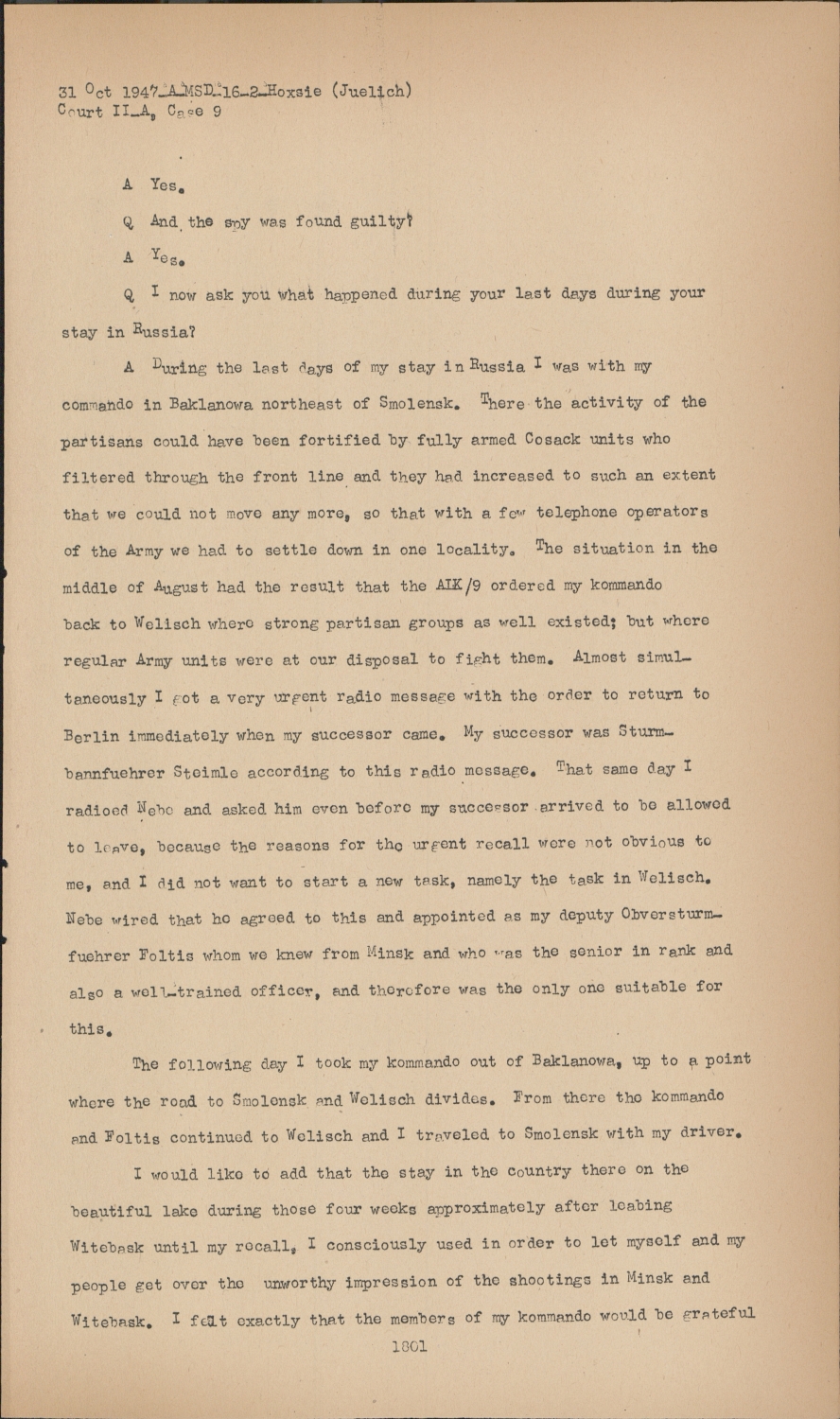
31 Oct 1947_A_MSD_16_2_Hoxsie (Juelich)
AYes.
QAnd, the spy was found guilty?
AYes.
QI now ask you what happened during your last days during your stay in Russia?
ADuring the last days of my stay in Russia I was with my commando in Baklanowa northeast of Smolensk. There the activity of the partisans could have been fortified by fully armed Cosack units who filtered through the front line and they had increased to such an extent that we could not move any more, so that with a few telephone operators of the Army we had to settle down in one locality. The situation in the middle of August had the result that the ALK/9 ordered my kommando back to Welisch where strong partisan groups as well existed? but where regular Army units were at our disposal to fight them. Almost simultaneously I got a very urgent radio message with the order to return to Berlin immediately when my successor came. My successor was Sturmbannfuehrer Steimle according to this radio message. That same day I radioed Nebe and asked him even before my successor arrived to be allowed to leave, because the reasons for the urgent recall were not obvious to me, and I Add not want to start a new task, namely the task in Welisch. Nebe wired that he agreed to this and appointed as my deputy Obversturmfuehrer Foltis whom we knew from Minsk and who was the senior in rank and also a well-trained officer, and therefore was the only one suitable for this.
The following day I took my kommando out of Baklanowa, up to a point where the road to Smolensk and Welisch divides. From there the kommando and Foltis continued to Welisch and I traveled to Smolensk with my driver.
I would like to add that the stay in the country there on the beautiful lake during those four weeks approximately after leabing Witebask until my recall, I consciously used in order to let myself and people get over the unworthy impression of the shootings in Minsk and Witebask. I felt exactly that the members of my kommando would be grateful 31 Oct 1947_A_MSD_16_3_Hoxsie (Juelich) to me for this, and also that no executions would he carried out.
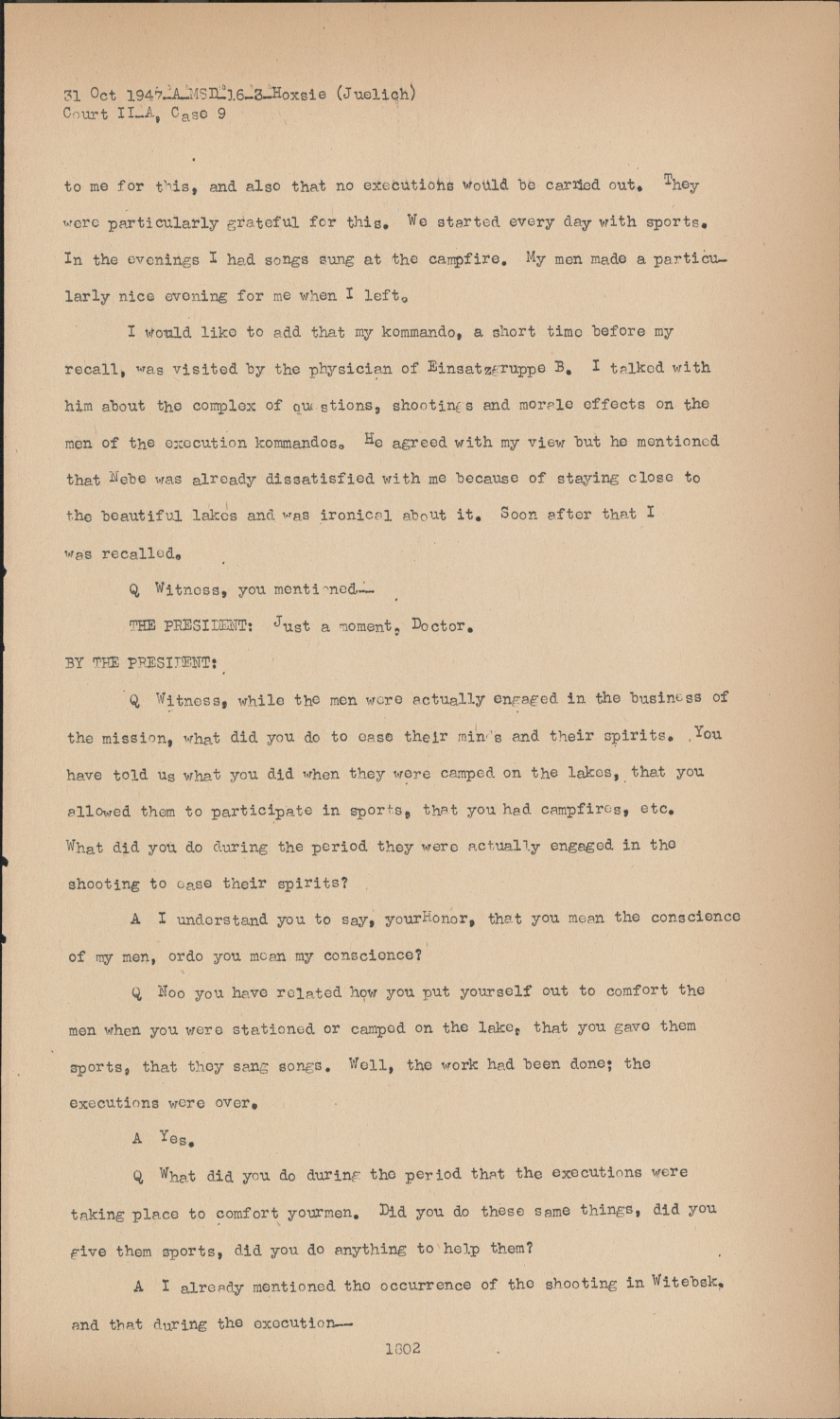
They were particularly grateful for this. We started every day with sports. In the evenings I had songs sung at the campfire. My men made a particularly nice evening for me when I left.
I Would like to add that my kommando, a short time before my recall, was visited by the physician of Einsatzgruppe B. I talked with him about the complex of questions, shootings and morale effects on the men of the execution kommandos. He agreed with my view but he mentioned that Nebe was already dissatisfied with me because of staying close to the beautiful lakes and was ironical about it. Soon after that I was recalled.
QWitness, you mentioned
THE PRESIDENT:Just a moment. Doctor. BY THE PRESIDENT:
QWitness, while the men were actually engaged in the business, of the mission, what did you do to ease their minds and their spirits. You have told us what you did when they were camped on the lakes, that you allowed them to participate in sports, that you had campfires, etc. What did you do during the period they were actually engaged in the shooting to ease their spirits?
AI understand you to say, yourHonor, that you mean the conscience of my men, ordo you mean my conscience?
QNoo you have related how you put yourself out to comfort the men when you were stationed or camped on the lake, that you gave them sports, that they sang songs. Well, the work had been done; the executions were over.
AYes.
QWhat did you do during the period that the executions were taking place to comfort yourmen. Did you do these same things, did you give them sports, did you do anything to help them?
AI already mentioned the occurrence of the shooting in Witebsk. and that during the execution-