QAll right. I would like to discuss with you now your activities in the Sonderkommando 4-a. Were reports sent from your Sonderkommando to Eintsatzgruppe C?
AYes, reports were sent.
QWho made these reports?
AThe reports, the simple SD reports and all the operational situation reports which were compiled either by Mueller or Radtzky or other leaders, -- they were submitted to the Group.
QDid you read these reports before they were sent off to Einsatzgruppe C?
AAs far as that was possible, yes.
QDid I understand you correctly, that you said that these reports also contained information on the activities of the Teilkommandos, is that correct?
ASub-commandos and other units, and everything that happened in this sector, was compiled in these reports.
QYou said in your direct testimony that the staff leader of Einsatzgruppe C, who was also leader of Office No. 4, Hoffmann, received this information and out of this information he made his reports to the RSHA. Is that correct?
AYes, that was Hoffman's task.
QDo you know whether defendant Rasch read these reports which were made by his staff leader before they were sent on to the RSHA?
AI don't know. I was very seldom with this Group.
QYou have described in great detail the ways and means, how Hoffmann made his reports, and about Hoffmann's activities in Einsatzgruppen, how strong he was, how much he exaggerated ... I can presume you also know what Rasch did, as you were so well informed about Hoffmann's activities in this respect.

AMy knowledge I received from Dr. Krieger, Oberregierungsrat (Government Councillor), from the time when Dr. Rasch with part of his Commando, was in Novo Ukrainka, and this Dr. Krieger compiled these reports in Shitomir and Obersturmbannfuehrer Meier added his own reports and his own figures. This I experienced myself; and I also experienced myself how these people compiled these reports, which were meant to go to Berlin.
QDid you over see Hoffmann make such a report?
AI also saw Hoffman making his reports,but I don't know whether Rasch ever read them. I do think he must have received knowledge of them.
QYou have stated here that the reports which Hoffmann made strongly exaggerated the numbers of executions carried out -- of course, as far as Sonderkommando 4-a is concerned. Is that correct?
AAs I see from these documents now, they can only have been compiled according to sectors as they were compiled by Special commandos and summed up of the events of various smaller locations and are reported as such, and those reports were then only very roughly compiled to give other events of other kinds, which these leaders reported.
QYou did know how Hoffmann made his reports, that is what you just told us ... did you ever voice any opposition against this way of reporting to Berlin?
AThere was an occasion of a report which Hoffmann in Kiev wanted when I told him that these matters had to be reported to Berlin, and this would have a completely wrong picture and Berlin would not believe it -- but it was too late. He already reported it.
QDid you report to Dr. Rasch about these astonishing facts?
ANo, I hardly ever saw Dr. Rasch. First of all he was in Shitomir all the time, then in Novo Ukrainka - he was in Novo Ukrainka first, then he came to Shitomir, then he held a raw with the Reich-Fuehrer, then he was in Berlin, and practically Hoffmann was the leader of the whole Group.
QSo you took no official steps in order to rectify these numbers?
ATo take official steps would have meant to report via the Group to the RSHA.
QDid you do that, Mr. Blobel?
ANo, I did not.
QDid I understand you correctly, that you said that you consider a number of ten to fifteen thousand people executed by Sonderkommando 4-a as the correct number?
ANo, I said that the figures ten to fifteen thousand in which the Commando took part, from one man to the whole sub-commando. This is my estimate according to the documents, according to which events have been made known to me which I did not know in this form. BY THE PRESIDENT:
QWitness, have you seen these documents before you were interrogated on June 6, 1947?
AInterrogation? Not before my interrogation.
QThen how could you have made this estimate from the documents?
AThe estimate, as I told Herr Wartenberg, was an estimate which I recollected from my own memory and I cannot vouch for the number. BY MR. HOCHWALD:
QYou heard of the order which was handed down by the Higher SS and Police leader Jeckeln to Rasch in Shitomir, did you?
AYes, the Gruppe staff passed on these reports. I think it must have been Dr. Krieger or some such person. That was before I fell ill in Shitomir.
QSo you received official information about this order, did you?
AYes, it was reported to us that the Higher police leader had been there, and that very strict measures against the Jews were ordered by him as the measure carried out up to now displeased him, he was not in agreement with such measures carried out up to then.
QDid you consider this order binding for you?
ABinding? That is a thought that has to be considered. One had to receive special orders, special executive orders.
QCan you tell me whether you considered this order binding for you? ... Will you please answer first with yes or no, and then you may explain whatever you want to.
ABinding in so far as if I was forced to an order I had to comply with it.
QSo you did consider it binding for you?
AIf it was in the way of an order, that was issued yes, binding.
QHow did you understand the order of Jeckeln about the stronger measures against the Jews? What kind of stronger measures were they?
AIt could only be the question of a so-called totality order, to apprehend the Jews living in that area for labor and those whom they didn't like were probably to be shot.
QAm I to understand from your answer that you say that Jews were to be used for labor, and if they should not comply with these reports they would be shot, is that what you want to say?
AThe order contained an order to select them, to select men of the Jewish population according to their ability to work, those who would be able to work and those who would not.
QWhat was to happen in the people who were not able to work?
AAccording to this order they were to be shot.
QYou carried out this order, did you not?
ANo one passed on the order to me to this effect.
QExcuse me, I didn't understand your answer, will you repeat it, please?
ANo such order was given to me.
QAbout three or four questions back you answered, you considered this order binding for you, and now you tell the Tribunal that nobody gave you this order, inspite of the fact that you admitted here that you were officially informed about the order. Will you explain this discrepancy between your answer, no, and your answer about two minutes ago?
AWell, that depended on conditions. In this territory, the Commander-in-Chief of AOK-VI had to approve of any operation, and on the same level of command was the higher SS and Police Leader: if these two authorities of command were in agreement with each other then the operation was carried out, because an operation was never allowed to interfere with the fighting units from any activity, and these two men had to agree upon them.
QRash was your superior, was he not?
ARasch was my superior in Group-C.
QHe handed down this order to you, is that correct?
ARasch not personally. Rasch was in Nove Ukrainka for a discussion of this order which came to us.
QAll right, but you got it from the Einsatzgruppe-C, through the Group Staff Chief, of which was Rasch, is that correct.
AYes, via the Group-staff.
QYou said that this order was binding for you. Now you explain again that this order was not binding for you. As you didn't know whether Field Marshal Richenau and Jekeln had agreed upon this order. Is that what I have to understand from your answer?
AYes, the Higher SS and Police Leader gave the order of the Reich Fuehrer to Dr. Rasch of this particular sector, the Commander-inChief of AOK-VI, was in charge who in any case had to give his agreement for any operation.
QDid you request the approval of Field Marshal Reichenau for the carrying out of this order?
AI have not talked to Field Marshal Reichenau, about this order, and at this time I did not go to AOK-VI for the reason that Group-C maintained the connection between AOK-VI itself and didn't want any overlapping of these particular channel commands.
QDid you disregard the order of Jeckelm for the simple reason that you didn't know whether the order was approved by Reichenau, but at the same time you state here that you never heard from Reichenau whether he had approved of the order or not. Is that correct? Is that what you are going to tell the Tribunal?
AI never heard about the fact that Jeckeln and Reichenau discussed these orders, because I was not present myself.
QDid you ascertain, in whatever form it might have been, whether this order was valid or not?
AIf the Group-staff had passed on this matter, then the order must have been valid but in the carrying out depended on other factors.
QSo that your ultimate answer is that the order was valid, but you did not carry it out, is that correct?
AI never received an order for carrying out these assignements.
QI do not want to repeat all these questions again, I do think it is perfectly clear to the Tribunal what you said.
I do think this ground covers it. Did you communicate this order to the offices of your teilkommandos?
AThey found out about it themselves. That was at the time when I was ill.
QBy whom were they informed.
AProbably by Group-C, or when they entered the orderly room they received the information, I think, and they might have discussed the matter with Dr. Krieger, or some other member of Group Staff C.
QThey were informed just by chance, no official channel, nor from the commander, Standartenfuehrer Blobel or nothing from his office Just by chance when they came to the office they were told by a clerk, we have received the order from Himmler to kill all the Jews who were unable to work, is that what you are going to imply?
AWell, the general frame order must have been announced to the Leaders in that form, I believe, and when orders were carried out these leaders were dependent on the Wehrmacht leader, or the Army leader in this particular sector, and these commanders of the Army unit could only receive orders from their own superiors.
QYou want to tell the Tribunal that the order of Jeckeln was valid for you but not valid for your subordinate officers, Is that just what you were going to say. Possibly you can be a little bit more specific, a little bit. I asked you very specifically a question which is extremely easy to answer, so probably you can be a little bit more specific than you are just now?
A whether this order was also valid and binding for these subcommanders or only for myself? Did I understand you correctly?
QYes.
AIt was a staff order of the Reichfuehrer, by the higher SS and Police leader, and was passed onto Group-C, and it was valid for Group C and its subordinate commanders.
QSo it was valid also for your subordinate officers, is that correct?
AYes, it, was squally binding.
QWhen you were back after your illness, and a new officer was attached to Sonderkommando-4-A, did you inform him officially about this order?
AWho was I supposed to have informs officially, you mean the sub-commando Leaders?
QLet's say, a new officer came to your commend, Sonderkommando-4-A, after the order had been issued, and after you returned to active duty after your illness again, he came in and reported to you, did you inform this officer, or did you inform him about his task with Sonderkommanndo-4-A did you inform him about the order of Jeckeln?
A yes, the man had to be informal, about the different things that had happened in the sector, and about new orders which had been gives, and this major frame order which was give out by Jeckeln was also made known to him.
QSo you did inform him, is that correct?
QThat was the new leader?
AThere was no new leader. It would have been my task to say so.
QThat was your impression about the order of Jeckeln when you received it? Did you consider such an order justified and in accordance with the laws of war?
AThe order for me was wrong.
QWhy?
ABecause it concerned people who had nothing to do with the happenings, because selections were first to be made which were supposes to be valid, and this was in direct contradiction to the general humane conception.
QDid you have a revulsion to carry out this order?
AYes, personally, yes, and others, too.
QDid you ever report to Rasch about this order?
AI was not in a position to report about these orders to Rasch, I could not even discuss them with him.
QSo you didn't do anything in order to be relieved from the carrying out of this order, and you did also not report to Rasch that you are not willing?
to carry out this order and you did also not report to Rasch thatyou were not willing to carry out this order, is that correct?
A.I was not quits as stupid as all that. I didn't want to show him my active mind, what was in my mind, there were other possibilities.
Q.Did you use the other possibilities, can you say?
A.The happy circumstances that my sub-commandos Were actually stationed in this front sector under the army units, and that one could evade the Supreme Power of the Higher SS and Police leader.
Q. and by that fact, you were able to avoid the carrying out of this order, is that what you want to say?
A.Yes, that is one of the facts which was so favorable, which put us in such a position.
Q.So you never carried out the order in spite of the fact it was valid for you, is that what you want to say?
A.No, it was not carried out by us directly, and indirectly.
Q.Indirectly, of course, it was the effect of that operation the Higher SS and police Leader was engaged in, with the AOK-VI when these two gentleman had that discussion.
Q.And in this case this order was carried out by you and your unit, is that right?
A.When the units were detailed to such assignment, they were carried out as the document here proves.
Q.And if that is what in this case Reichenau and Jeckeln agreed upon it was in accordance with the laws of war and the laws of humanity, is that what you want to say?
A.No, that is not what I want to say.
Q.You don't want to answer this question. Do you know whether thedefendant Radetsky know about the order of Jeckeln?
A.Whether he heard about this order during his work, or any reports, it is possible, but it is not necessarily so.
Q.You told the Tribunal just a few moments ago that your officers know about the order, or must have know about the order. Why do you say now that Radetsky, who was one of your officers, possibly didn't know about it?
A.Because Radetsky was not the chief of the Sub-kommndo.
Q.That is Radetsky?
A.Yes, but he had nothing to do with the executive power. I can not say, he might have heard the report or discussion or talks of other leaders. As it was supposed to be asked, he might have discussed them with other leaders, that is.
Q.You don't know anything then?
A.I can say that he might have informed himself and probably did not just pass over the events.
Q.Who gave the order for the killing of the insane?
A.I never hoard of that order.
Q.It was never carried out by you and your unit?
A.No, SK-4-A never experienced such activity, and never carried out such orders.
Q.I shall refer to document II-C, page 52. Document NO 2832, Prosecution's Exhibit No. 79, I an sorry, it is page 55 Your Honor, I want to quote from Page 61 of the German, where were you on the 23rd and 24th of October? Were you ill or were you in your office?
A.On the 23rd and 24th of October I was in Kiev, where I had my head injury.
Q.Were you on duty, or were you ill?
A.I was not on duty. The whole unit or kommando was just being restored.
Q.Were you not on duty?
A.No.
Q.Did you see any reports of your teilkommandos when you returned to duty?
A.We had only one sub-kommando in Charkow, and on 23rd and 24th there was a sub-kommando stationed there for a short while. The whole SK-4-A had marched away in the direction of Lubny.
Q.Did you find the page which I wanted to quote from, in Document No-2832?
A.Yes, I have it.
Q.That is page 55 of Document Book II-C, Your Honor. Page 6l of the German. There is the last sentence of the third paragraph from below. It says, on the same day, and it is the 24th of October, through the request of the director of the mental asylum at Czernikow, liquidation of 270 incurables was complied with, and if you read the whole paragraph you will see that that is a report of the teilkommando of the Sonderkommando-4-A. Do you want still to maintain that insane were never killed by units under your command?
A.Yes, I stick to my opinion, that Sonderkommando or a unit of SK-4-A never killed any insane people in Czernikow or anywhere else.
Q.What is your explanation then to this report?
A.Yesterday in my direct examination I said that this territory and this sector, and those reports came from EK-5, which was stationed there, and which was assigned to this sector, SK-4-A had no platoons. I can say it only had a sub-kommando and advanced kommando, which on the 18th, that can be seen from this document they marched off to Lubny.
Q.Do I understand then from your answer that this report is a mistake, is that right, and your memory is correct?
A.No, that is mistaking the kommandos.
Q.It is a mistake, is it not?
A.No, it is mistaking the kommandos, but it is a fact that the EK-5 is to have supposed to have carried out the task of SK-4-A, as it is mentioned here as SK-4-A, and that is the same also, referring to the number of the document, and I have named the location yesterday of the village where SK-4-A could never have been assigned, and these locations belonged in the field of activity of this EK-5.
Q.Herr Blobel, you commented yesterday on the document which is to be found in Document Book II-a, Your Honor, it is on page 81 of the English, and page 84 of the German. It is Document NO-2938, Prosecution's Exhibit No. 44 -- 81, Your Honor, and I shall quote from the first and second paragraphs on this page; under heading "Page 13 of the original cont'd." You commented yesterday on this document, which states that on 2nd July, 1160 Jews were shot as a reprisal,that this Was a justified measure, and I want to quote what you said yesterday:
"I only had disgust for such enemies when I heard about these occurrences, because the most primitive people only did such things, and therefore, I considered the measures for a punishment of these criminals completely justified."
DR. HEIM:Mr. President, I would like to ask the Prosecutor to read the question again, as the translation is very bad and only came through in parts.
Mr. HOCHWALD: The question was not finished as yet, as a ratter of fact. You, Herr Blobel, commented on the facts which I stated here in the document, namely, that 1160 Jews were shot as a reprisal, and that these measures were justified, by say in: "I only had a disgust for such enemies when I heard about these occurrences because the most primitive people only did such things, and, therefore, I considered the measures for the punishment of these criminals completely justified." If you now examine the document more closely you will see that it has said here that a total of 10 German members of the wehrmacht were killed; as a reprisal 1160 Jews were shot. Do you want to imply that the shooting of 116 Jews for one German soldier is a justifiable measure?
A.During my testimony yesterday I spoke about the events which occurred in Sokal which I saw with my own eyes, and I drew my conclusion from this observation of mine. In Lucks, there were four German airmen who had been massacred, and then two-thousand Ukranians were slaughtered by the Russians, and whether these reprisals which was carried out and ordered by the Field Marshall -- were in agreement with the measures which are agreed upon by International Law, that I can not say in detail myself. I can not establish that formally myself, whether this number 116, or other figures, whether it is cor rect, as the correct figure of reprisals, I don't know, but that is entirely within the sphere of competency of the commander-in-Chief.

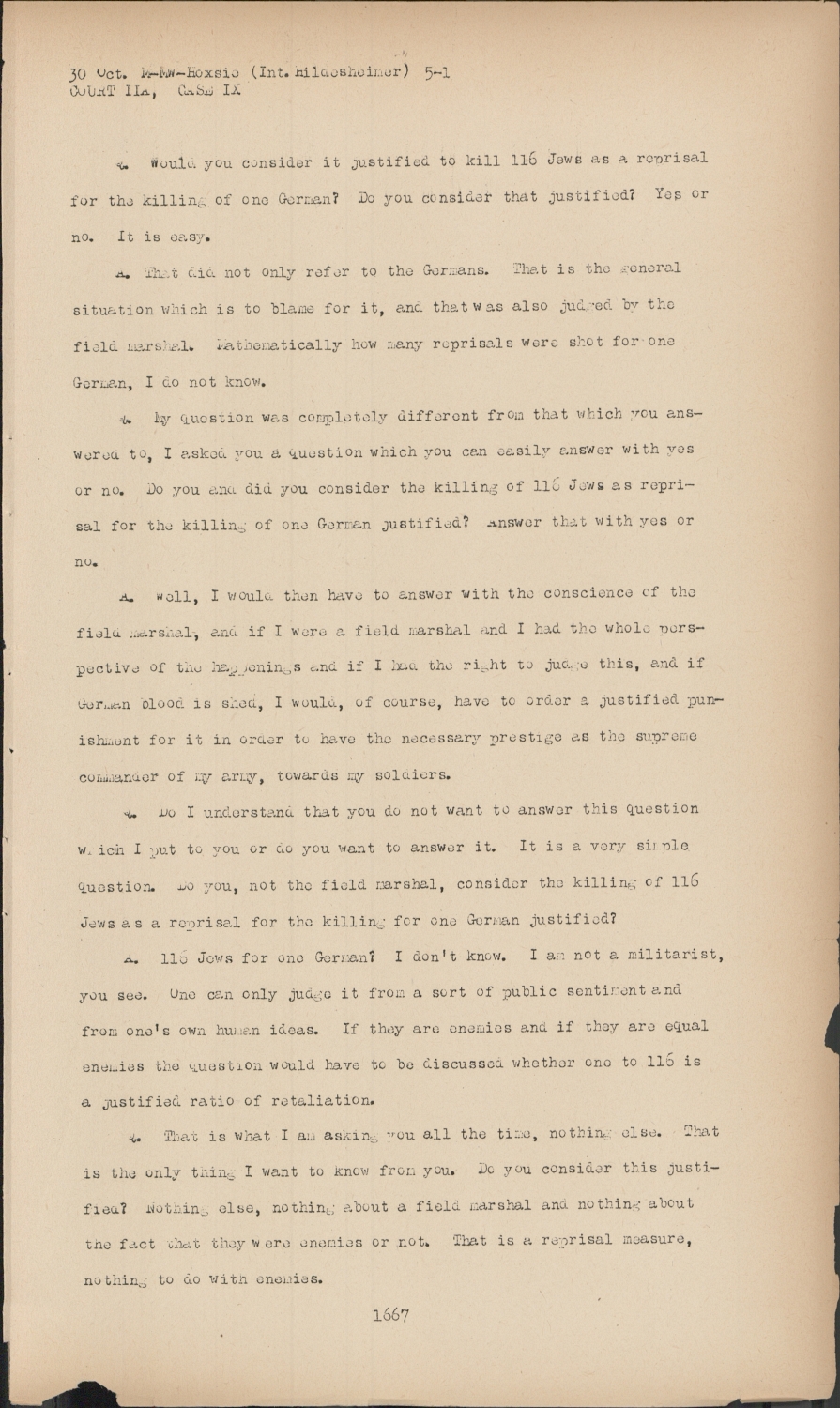
Q.Would you consider it justified to kill 116 Jews as a reprisal for the killing of one German? Do you consider that justified? Yes or no. It is easy.
A.That did not only refer to the Germans. That is the general situation which is to blame for it, and that was also judged by the field marshal. Mathematically how many reprisals were shot for one German, I do not know.
Q.My question was completely different from that which you answered to, I asked you a question which you can easily answer with yes or no. Do you and did you consider the killing of lie Jews as reprisal for the killing of one German justified? Answer that with yes or no.
A.Well, I would then have to answer with the conscience of the field marshal, and if I were a field marshal and I had the whole perspective of the happenings and if I had the right to judge this, and if German blood is shed, I would, of course, have to order a justified punishment for it in order to have the necessary prestige as the supreme commander of my army, towards my soldiers.
Q.Do I understand that you do not want to answer this question which I put to you or do you want to answer it. It is a very simple question. Do you, not the field marshal, consider the killing of 116 Jews as a reprisal for the killing for one German justified?
A. 116 Jews for one German? I don't know. I am not a militarist, you see. One can only judge it from a sort of public sentiment and from one's own human ideas. If they are enemies and if they are equal enemies the question would have to be discussed whether one to 116 is a justified ratio of retaliation.
Q.That is what I am asking you all the time, nothing else. That is the only thing I want to know from you. Do you consider this justified? Nothing else, nothing about a field marshal and nothing about the fact that they were enemies or not. That is a reprisal measure, nothing to do with enemies.
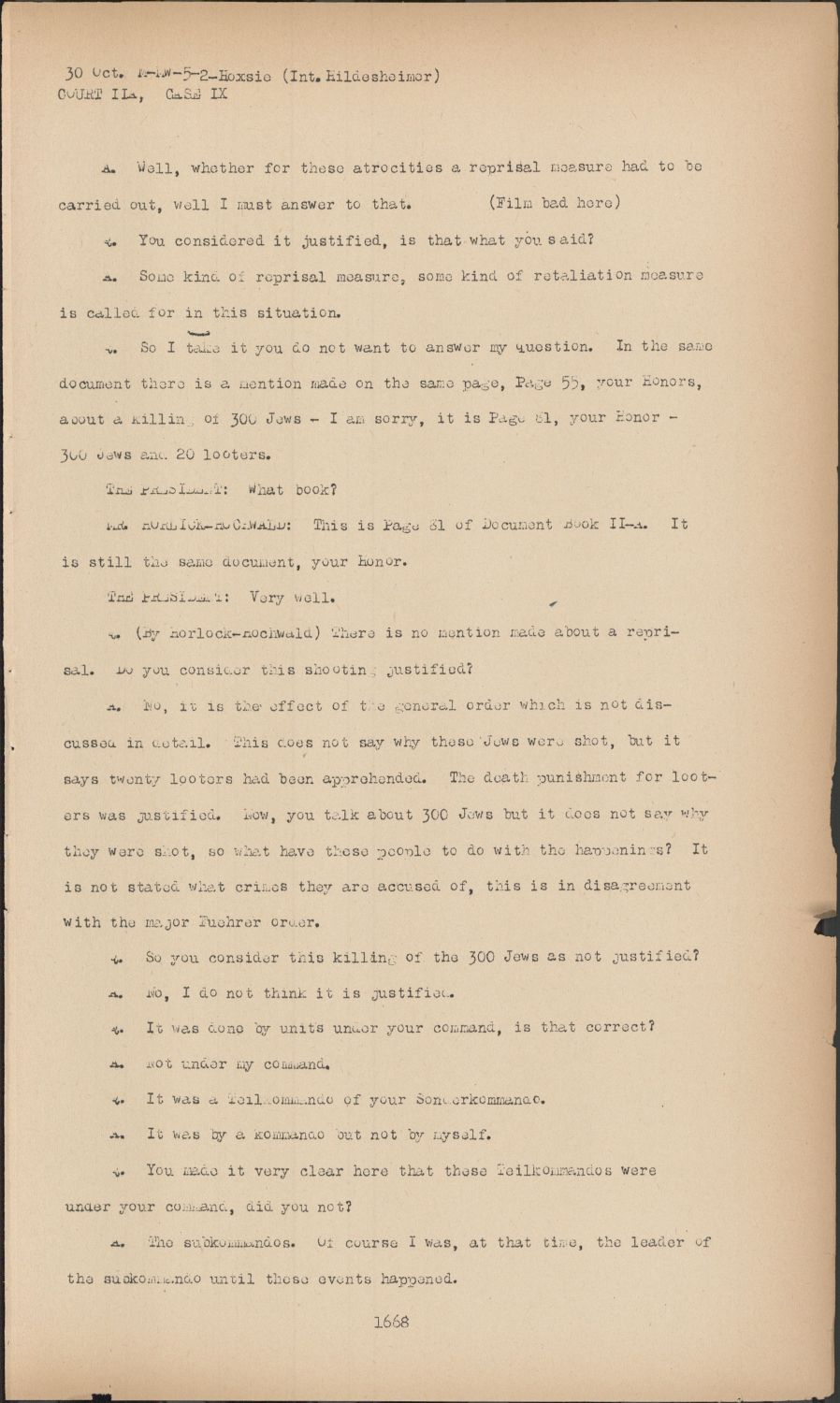
A.Well, whether for these atrocities a reprisal measure had to be carried out, well I must answer to that. (Film had here)
Q.You considered it justified, is that what you said?
A.Some kind of reprisal measure, some kind of retaliation measure is called for in this situation.
Q.So I take it you do not want to answer my question. In the same document there is a mention made on the same page, Page 55, your Honors, about a Killing of 300 Jews - I am sorry, it is Page 81, your Honor 300 Jews and 20 looters.
THE PRESIDENT:What book?
MR.HORLICK-HOCWALD: This is Page 61 of Document Book II-a. It is still the same document, your honor.
THE PRESIDENT:Very well.
Q. (By Horlock-Hochwald) There is no mention made about a reprisal. Do you consider this shooting justified?
A.No, it is the effect of the general order which is not discussed in detail. This does not say why these Jews were shot, but it says twenty looters had beer apprehended. The death punishment for looters was justified. Now, you talk about 300 Jews but it does not say why they ware shot, so what have these people to do with the happenings? It is not stated what crimes they are accused of, this is in disagreement with the major Fuehrer order.
Q.So you consider this killing of the 300 Jews as not justified?
A.No, I do not think it is justified.
Q.It was done by units under your command, is that correct?
A.Not under my command.
Q.It was a Teilkommando of your Sonderkommando.
A.It was by a kommando but not by myself.
Q.You made it very clear here that these Teilkommandos were under your command, did you not?
A.The subkommandos. Of course I was, at that time, the leader of the subkommando until these events happened.
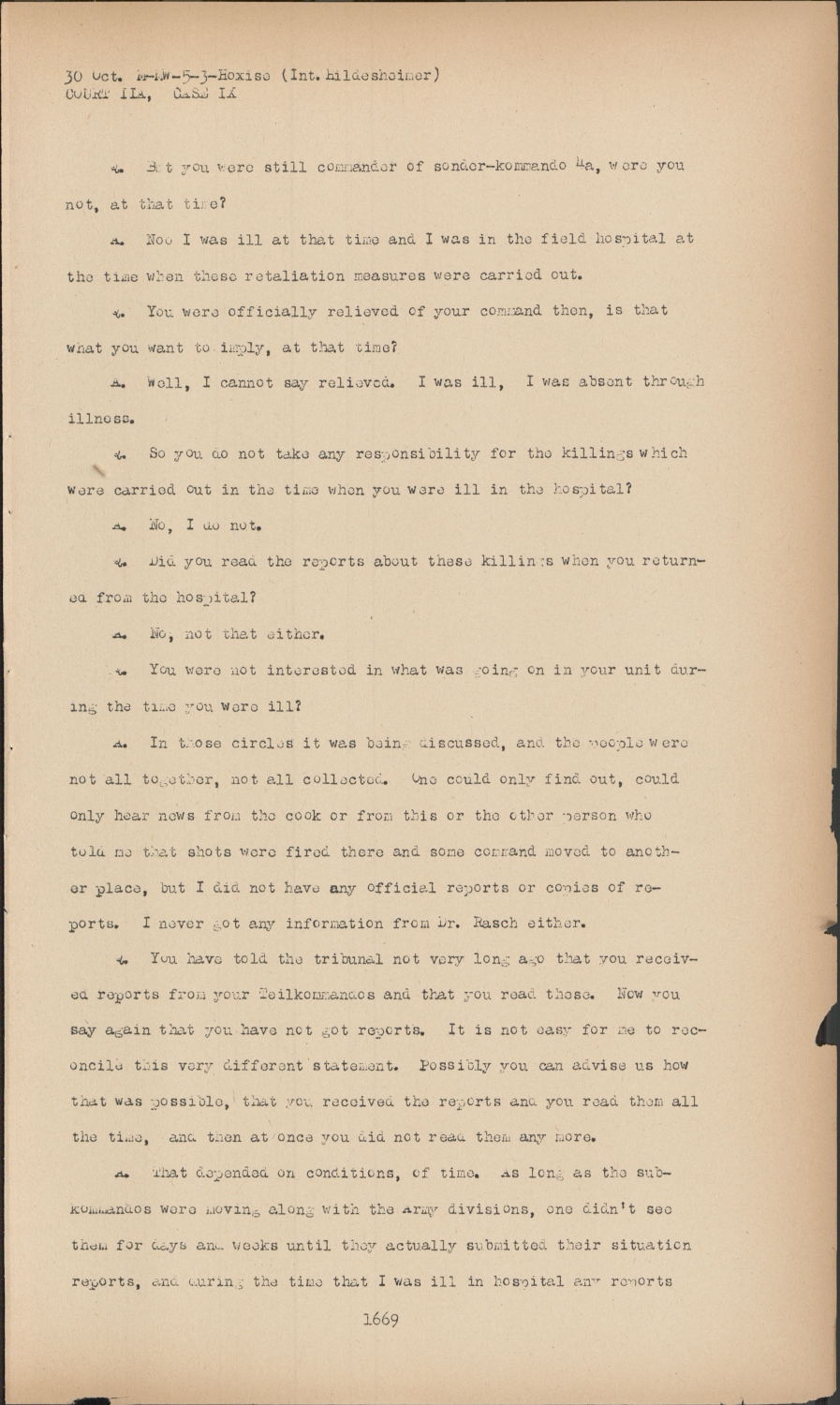
Q.But you were still command or of sonder-kommando 4a, were you not, at that time?
A.Noo I was ill at that time and I was in the field hospital at the time when these retaliation measures were carried out.
Q.You were officially relieved of your command then, is that what you want to imply, at that time?
A. well, I cannot say relieved. I was ill, I was absent through illness.
Q.So you do not take any responsibility for the killings which were carried out in the time when you were ill in the hospital?
A.No, I do not.
Q.Did you read the reports about these killings when you returned from the hospital?
A.No, not that either.
Q.You were not interested in what was going On in your unit during the time you Were ill?
A.In those circles it was being discussed, and the people were not all together, not all collected. One could only find out, could only hear news from the cook or from this or the other person who told me that shots were fired there and some command moved to another place, but I did not have any official reports or copies of reports. I never got any information from Dr. Rasch either.
Q.You have told the tribunal not very long ago that you received reports from your Teilkommandos and that you read those. Now you say again that you have not got reports. It is not easy for me to reconcile this very different statement. Possibly you can advise us how that was possible, that you received the reports and you read them all the time, and then at once you did not read them any more.
A.That depended on conditions, of time, As long as the subKommandos were moving along with the army divisions, one didn't see them for days and weeks until they actually submitted their situation reports, and during the time that I was ill in hospital and reports of any kind or copies of such reports were not submitted, or at least not submitted to me.
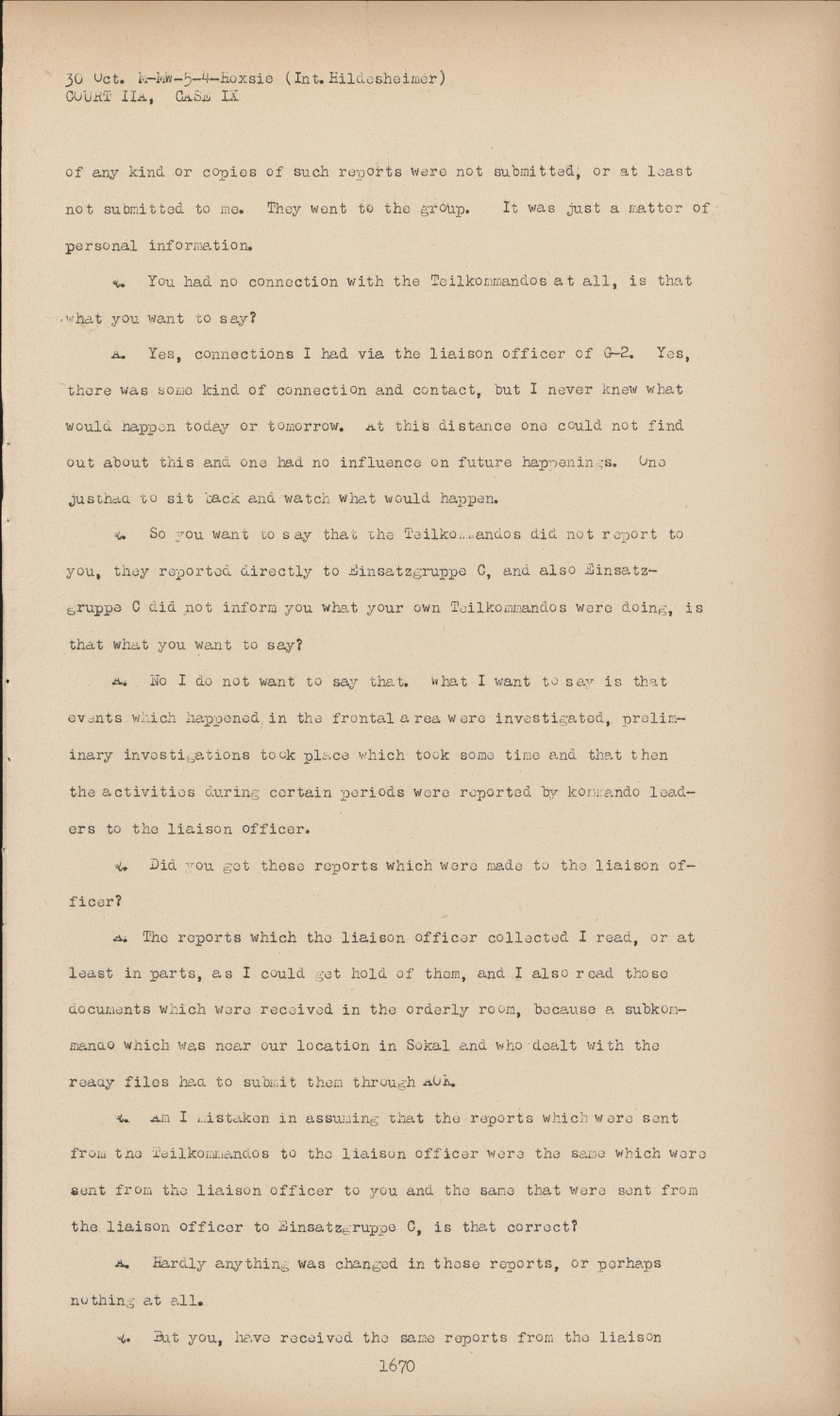
They went to the group. It was just a matter of personal information.
Q.You had no connection with the Teilkommandos at all, is that what you want to say?
A.Yes, connections I had via the liaison officer of G-2. Yes, there was some kind of connection and contact, but I never knew what would happen today or tomorrow. At this distance one could not find out about this and one had no influence on future happenings. One justhad to sit back and watch what would happen.
Q.So you want to say that the Teilkommandos did not report to you, they reported directly to Einsatzgruppe C, and also Einsatzgruppe C did not inform you what your own Teilkommandos were doing, is that what you want to say?
A.No I do not want to say that. what I want to say is that events which happened in the frontal area were investigated, preliminary investigations took place which took some time and that then the activities during certain periods were reported by kommando leaders to the liaison officer.
Q.Did you get those reports which were made to the liaison officer?
A.The reports which the liaison officer collected I read, or at least in parts, as I could get hold of them, and I also read those documents which were received in the orderly room, because a subkommando which was near our location in Sokal and who dealt with the ready files had to submit then through AUK.
Q.Am I mistaken in assuming that the reports which were sent from the Teilkommandos to the liaison officer were the same which were sent from the liaison officer to you and the same that were sent from the liaison officer to Einsatzgruppe C, is that correct?
A.Hardly anything was changed in those reports, or perhaps nothing at all.
Q.But you, have received the same reports from the liaison officer as Einsatzgruppe C, is that right?
A.The reports, the situation reports, yes. It could not have been otherwise, could it?
Q.So let us now conclude a little bit. These reports which are in evidence are reports which were made at the RSHA from reports which were sent from Einsatzgruppe C to RSHA. These reports, as far as Sonderkommando 4a and its Teilkommandos were concerned, were based, as you just explained to the Tribunal now, on the reports of the liaison officer. The liaison officer had received his information from the Teilkommandos. He gave this information to you and to Einsatzgruppe C. Is it not true then, that you have received in your office exactly the same reports as these which are in evidence now?
A.That have been submitted here? No, not at all, not by any means. The original reports were concerned with all the little details. They were filed, discussed, and then there were additional operational reports. The liaison officer collected all these individual detailed reports. The Leader IV of Group C compiled and collected all the operational reports, because they had been too much detailed. Every little case would have been mentioned, and I don't know what Berlin would have done with all these detailed reports.
Q.Well, as a matter of fact Berlin got its reportof executions from the same source as you received your reports, from the Teilkommandos, is that right or not? The source was the same , is that right?
A.Yes. The sources may have been of a different nature. For the Group C also got the situation reports of the Higher SS and Police Leader through their own liaison officer and also situation reports fromother agencies which went through the channel of reports.
Q.But Mr. Blobel -- you have described to the Tribunal very clearly that the sources for the information of the activities of Teilkommandos came from the Teilkommandos to the liaison officer. The liaison officer forwarded them to the Einsatzgruppe C and to you. TheEinsatzgruppe C, on the other hand, forwarded them to the RSHA, so is it not true that, as far as Sonderkommando 4a and its Teilkommandos and subunits are concerned, the source of information which you received was absolutely the same as the source of information for these reports which are in evidence? Is that clear, or not? I do not speak about the Higher Police Leader and I do not speak about Field Marshal von Reichenau. I just speak -- at very most , I just speak about a small unit. I just speak about Sonderkommando 4a.
A.That was one of the sources
Q.All right. You have also commented here on another document. I refer, your Honors, to Document Book II-A, Page 89 of the English Page 93 of the German. This is Document NO-3149,Presecution's Exhibit 46. This document states that 1107 Jews were killed by Sonderkommando 4a for the simple reason that it was difficult to get food for them. You have commented on this document here by stating that this report could possibly not be correct as a small Teilkommando would have been physically unable to carry out so many executions in such a short time, is that right?