During my interrogation by Mr. Wertenberg, I did not remember this. I had been in the hospital in Garmisch for two years and came to prison right from my hospital bed, and on the second day after my arrival I was questioned about all these matters. Von Radetzky I always remembered as being the highest ranking officer, so that Mr. Wartenberg and I both assumed that von Radetzky must have taken over the command during my absence. But I had forgotten at that time that Radetzky was an interpreter and on a war emergency status. It would have been absolutely senseless to use an officer on a war emergency status and have him do police duties such as Dr.Funk did.
Dr. Rasch was the commander of Einsatzgruppe C. He doubtless led Special Kommando 4-A during my absence too, but he certainly must have given his consent to Jeckeln that Obersturmbannfuehrer Mayer should assume command. A Dr. Beyer at that time, during my absence was detailed to the SK from the Group in order to conduct an investigation about a dispute between myself and an Army officer.
I must emphasize once again that the appointment of Radetzky,that the mentioning of Radetzky in my affidavit, as my deputy,is not correct. It is to be traced back to an error on my part. This mistake can be explained by the face that after all this time had passed, and because of my weakened condition, I could not remember all the details. Mr. Wartenberg and I sort of discussed who could this have been, who could have been my deputy, and as a result of this discussion in this manner this paragraph 9 mentioned the name of Radetzky.
QAnother question. In another document it is said that the Defendant von Radetzky was commanding officer of the Advance Kommando Lutsk. please comment on this.
MR.HORLICK-HOCHWALD: If Dr. Ratz intends to ask the witness questions about a document, it seems to be only fair if he shows the witness the document and informs the Tribunal and the Prosecution to which document he refers.
THE PRESIDENT:That is proper.
DR. RATZ:Your Honors, this is an affidavit in Document Book III-C, page 47 of the German book. This is Document NO-4765, Exhibit 137.
MR. HOCHWALD:Page 30 of the English Document Book, your Honor. BY DR. RATZ:
QWitness, I want to ask you whether von Radetzky was the commanding officer of Advance Kommando Lutsk?
AFrom Sokal an advance kommando of SK-4-A went to Lutsk. This was done as ordered by the Commander-in-Chief of AOK 6 northerly route, a middle route and southerly route. The commanding officer of this subkommando was this Dr. Funk. He was the senior ranking officer. He had to report to the division commander there and to receive his orders about security measures. von Radetzky was then sent along with the safe blasting unit. They dealt with cutting and welding instruments, finger-printing material etc., and it was his job to capture enemy documents. In Lutsk they found maps and charts of a Russian General Staff which were very important for the Army command. A courier called for this material, and as far as I remember it was Haeffner who was then liaison officer with Army Command 6. Radetzky was, therefore, free and independent of Dr. Funk with his six men and drivers. He had a special mission and was not tied down to any one locality, and I never heard that Redetzky participated in an execution in Lutsk, as I can say with my honest conviction he never participated in any execution.
QAnother question: Why shouldn't Radetzky be in command of the other men of Special Kommando 4-a?
AIn Sokal, after the kommando arrived there and after the kommandos had been distributed there as per orders, I took Radetzky aside and I told him that as a wearer of the uniform and as a Hauptsturmfuehrer, he could not act as the commanding officer of the other leaders since, first of all, the others had previous police training and he was only assigned to the kommando as an interpreter on a war emergency status. The officers who had been trained in police measures, who had been criminal commissars by vocation and who were leaders of the Executive Service with Special Kommando 4-a were given the command of the sub-kommandos in the nature of a training course, whereas Radetzky and Mueller were interpreters and were too busy themweilves with interpreting jobs. Radetzky knew the Russian language and was competent for the Russian reports and Mueller knew the Ukrainian country since many years, especially as a business man, and was competent to deal with Ukrainian documents.
QWhat do you know about the use of Radetzky as liaison officer to the Army command 6?
A When Haeffner was liaison officer, Radetzky had established contact with Army command 6, which continued to be mutually exchanged in order to exchange reports. With Army Command 6 there was a Department of Economics and in this department, there was much more material to be found than in this small special kommando, and Radetzky evaluated this material in his reports. Later on, around September 1941, even laterit must have been later -- Radetzky was appointed by the group as permanent liaison officer to the Army command 6. As liaison officer, he operate between Army command 6 and Einsatzgruppe C, but he was listed in the personnel file under SK 4a. At that time he was active for SK 4-a and he lead the supply unit; as a liaison officer,his main job was to regulate the communications between Army command 6,Group C and the Army Group, but in detail I don't know about his activity.
QWitness, do you know anything about Radetzky's further activity as liaison officer to the Army Command 6 when Radetzky was detailed as liaison officer to Army Command 6?
AThe officers of the executive service were sent back to Berlin on the 26th of September, 1941. Until that time Carlton was liaison officer, because Army Command 6 was up in the north and he was close to it with his sub-kommando. When the leaders of the Executive Service were relieved, Radetzky was ordered to Army Command 6, for there was a great lack of officers and SK 4-a no longer had any officers and Radetzky after these leaders left, was ordered to report to the Army Command 6 by car, but the car broke down and he was brought into Kiev with a Horch car. I was in the sick room and the Chief of Staff Hoffmann visited me and asked me for a report about the conditions in Kiev and, since the Higher SS and Police leaders had ordered the action, we could not report about the total situation. One might merely have mentioned that the SK 4-a had been participating with 15 men. Therefore, I rejected Hoffmann's demand. I told him this would distort the picture, but, as I already said, I already had reports, but still he would not let well enough alone. However, Hoffmann did not receive any reports from me that day, but the possibility exists that subsequently on the next day Hoffmann did ask again and then dictated the report in his orderly room and might have had it signed. It was around this time that Radetzky broke down in his Horch car on his trip to the Army Command 6 and was then brought back to Kiev.
Q What do you know about the activity which Radetzky continued to perform?
A After he was ordered out of Kiev to report to the Army Command 6, Radetzky always stayed with the Army Command. I saw him again when in the beginning of December, or on the 27th or 28th of November, we left Kiev, that is, around the turn of the month, we marched through Poltawa and I had to report to the Field Marshal in order to get an order to march into the front territory.
The front area could not be entered without having definite orders to that effect on the marching papers and one could not leave the front area either. At that time Radetzky told me about a furlough, but this did not depend on me, but it had to be granted by the Einsatzgruppe because the latter needed a new liaison officer to Army Command 6 and, as far as I recall, in the middle, or, in the last third of December, 1941, he left on furlough; but I can't remember that I ever saw him again. In this connection, I can emphasize once more that Radetzky never received any orders from me to conduct executions or to participate in such. What happened during my absence I don't know from my own knowledge.
QNow a final question, Witness, in order to come back to Radetzky's position as going under a war emergency status, what position did Radetzky have in this status?
ARadetzky had come to us on an emergency status and specifically a as an interpreter. This could be seen clearly from his pay. Just like other interpreters on a war emergency status, Radetzky drew per diem pay, whereas the criminal kommissars, the criminal offices drew salaries at home. The Special Kommando consisted of officials of the State Police, of the Criminal Police, and of the SD, and further of active people of the sphere of the SS or so-called people ordered to the Waffen SS and furthermore of people on an officer emergency status. He did not have a rank as an official and as a man on an emergency status, he merely had the right to wear the uniform, according to his rank which he held in an SS formation and this does not mean anything and it separates him from the active leaders. That he was an SS-Hauptsturmfuehrer in the Security Police also separates him from the other people and among the drivers who were the uniform of Untersturmfuehrer that did not show,because in the General SS they held this rank and therefore it was not decisive in the SK 4-a what rank you held in the SS, hut what rank you held as a civil servant. If Radetzky was an honorary officer of an SS unit, he would have had to have been six or seven years with the SS in order to become an SS Untersturmfuehrer, but all told, the SS Hauptsturmfuehrer Radetzky did not have an equivalent rank and was not supposed to be considered in the same nature as Dr. Funk or Dr. Janssen, who held a civil service rating, that is, criminal commissar or officer of the Executive Service.
Radetsky was merely used there on the basis of his own personal knowledge.
DR. HEMM:I have no further questions.
THE PRESIDENT:Does any other defense counsel wish to cross-examine the witness Blobel? If not, the Prosecution may begin its cross examination.
CROSS EXAMINATION BY DR. HOCHWALD: May it please the Tribunal.
QMr. Blobel, what was your rank in May 1941?
AMy rank was SS Standartenfuehrer.
QThat is the rank of a full colonel, is it not?
AWell, at that time it was not designated as full colonel, it was just Standartenfuehrer in the SD.
QIs that rank equivalent to a full colonel in the German army? Is it?
ANo, not in this connection. This concept only arose after the war. It was not equivalent to a Standartanfuehrer in the Waffen SS, where this designation had army privileges.
QIf I understand you correctly, it was approximately the rank of a lieutenant or a captain, -- or, what was it? I would like to know what equivalent it was.
AWell, in 1941 there was no equivalent. It was merely the agency leader of SD Unit, who could be an Obersturmbannfuehrer.
QLet me rephrase my question now. When you came to the east as a Standartenfuehrer and you met a major or a lieutenant colonel of the army, who of you had the higher rank when you were both in uniform?
AThey were two types of uniform, and two types of rank. I had the rank of SS Standartenfuehrer in the SD, and the other was a major in the Wehrmacht.
QMr. Blobel, I don't think that you answered my question. It was a very simple question ... when you met a major or a lieutenant colonel of the army, and you were yourself in the uniform of a Standartenfuehrer - who of you was the higher ranking man? It's not a question whether uniforms were different.
ANone. Because the officer of the Wehrmacht had his rank, and I was a Standartenfuehrer SS. I was addressed as such.
QAll right. In Germany officers used to salute each other, and the lower ranging officer saluted the higher ranking officer first. So when you, being a Standartenfuehrer, being in a uniform of the SS met a lieutenant colonel of the Wehrmacht, was he supposed to salute you first?
AWe both saluted each other as officers. They could see that it was not an equivalent rank.
QThat is not the question. How long have you been wearing a uniform?
AAs long as we were out in the field.
QWill you give me an answer, please? How long have you been wearing a uniform in your career as an SS man?
ACut in the eastern campaign always, and in the service with the SD, temporarily.
QAll right. How many years was that?
AFrom about 1935, 1936 on.
QSo let us say approcimately ten years?
AYes.
QFor having been in uniform ten years, your knowledge of military and SS regulations is very scanty. It take it from your information that you do not know whether a Standartenfuehrer was in the rank of a colonel or was not.

We will ascertain that in another way.
Mr. Blobel, when you were first sent from Berlin to Pretsch in May 1941, did you know that you were supposed to take over a Command of an Einsatzkommando, or a Sonderkommando?
ANo, I did not know that previously. I only heard that in Pretsch.
QWhy do you think you were sent to Pretsch? Did you have an idea what you were going to do there?
ANo, I did not know it at all. I could just as well have been called to hear Heydrich or a conference with him, as he used to have them, or it could be anything. It was not known.
QIt could not be only a meeting, could it?
AYes, it could be a conference.
QWhen you arrived in Schmiedeberg or in Pretsch, had you to report to Rasch?
AYes, I had to report to Rasch. Rasch told us that the officers who had to report to him, were under his command, and on the same day on which I met Rasch there we were all ordered to report to the officers school in Pretsch.
QAnd on the same day there was the speech of Streckenbach?
AYes, that was the day of Streckenbach's speech.
QDid you meet Rasch before you came to this meeting where Streckenbach spoke? What, exactly, did Rasch tell you , ... that you were under his command, you said? What kind of command? Did he tell you something about Einsatzgruppen? Did he tell you that you would be the leader of a Sonderkommando? What did he tell you?
ADr. Rasch didn't tell me anything. He didn't know anything himself.
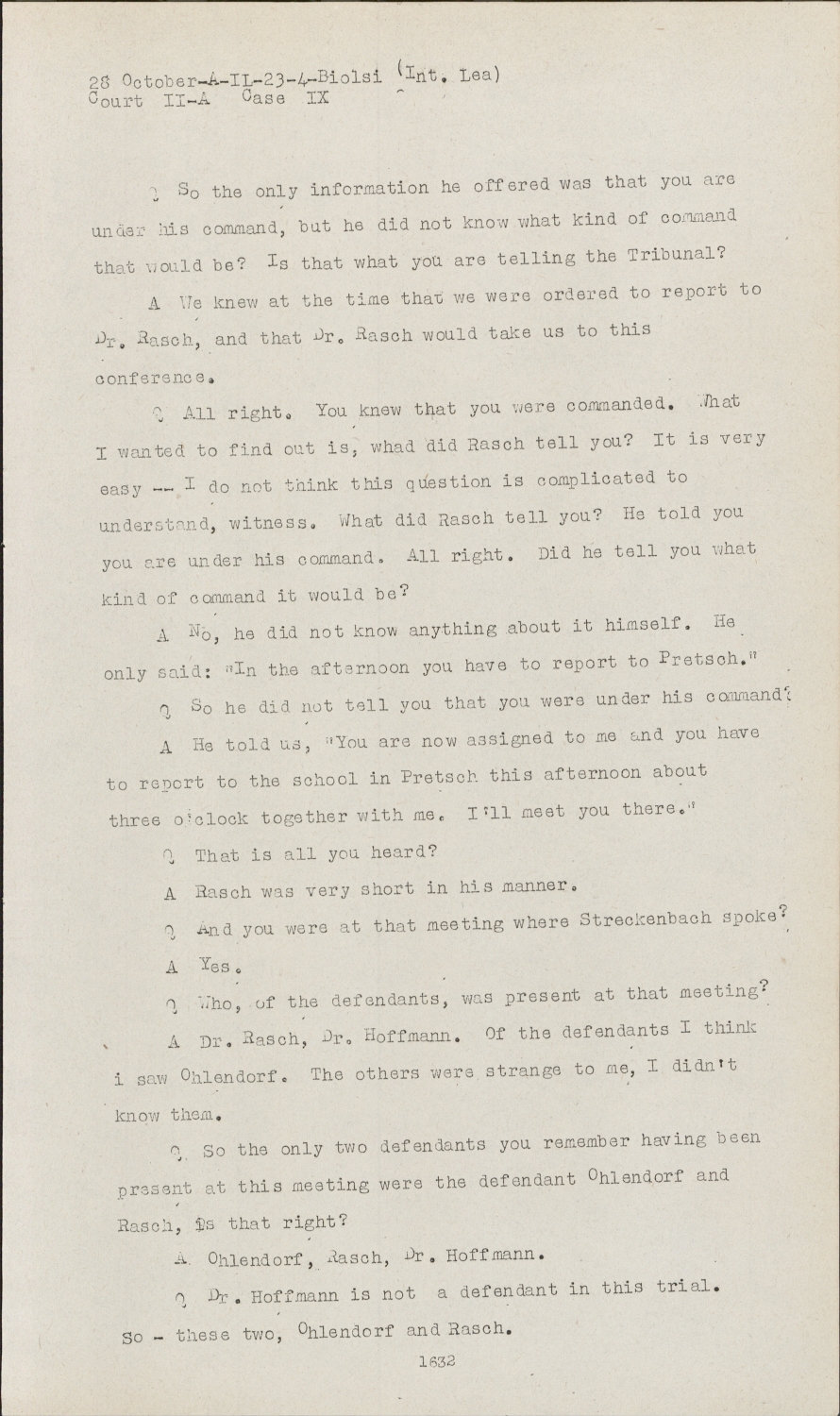
QSo the only information he offered was that you are under his command, but he did not know what kind of command that would be? Is that what you. are telling the Tribunal?
AWe knew at the time that we were ordered to report to Dr. Rasch, and that Dr. Rasch would take us to this conference.
QAll right. You knew that you were commanded. What I wanted to find out is, what did Rasch tell you? It is very easy -- I do not think this question is complicated to understand, witness. What did Rasch tell you? He told you you are under his command. All right. Did he tell you what kind of command it would be?
ANo, he did not know anything about it himself. He only said: "In the afternoon you have to report to Pretsch."
QSo he did not tell you that you were under his command?
AHe told us, "You are now assigned to me and you have to report to the school in Pretsch this afternoon about three o'clock together with me. I'll meet you there."
QThat is all you heard?
ARasch was very short in his manner.
QAnd you were at that meeting where Streckenbach spoke?
AYes.
QWho, of the defendants, was present at that meeting?
ADr. Rasch, Dr. Hoffmann. Of the defendants I think i saw Ohlendorf. The others ware strange to me, I didn't know them.
QSo the only two defendants you remember having been present at this meeting were the defendant Ohlendorf and Rasch, is that right?
AOhlendorf, Rasch, Dr.Hoffmann.
QDr. Hoffmann is not a defendant in this trial. So - these two, Ohlendorf and Rasch.
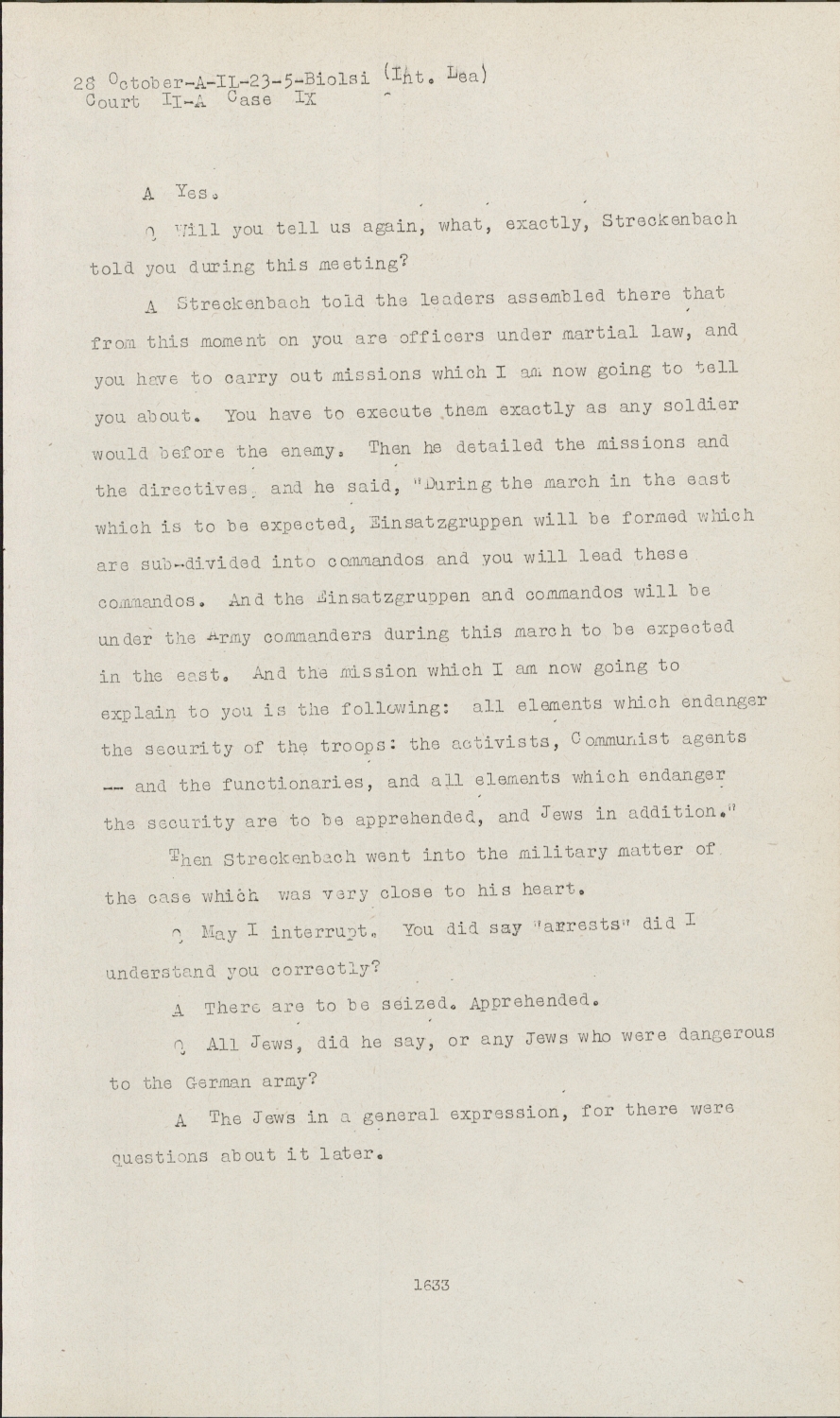
AYes.
QWill you tell us again, what, exactly, Streckenbach told you during this meeting?
AStreckenbach told the leaders assembled there that from this moment on you are officers under martial law, and you have to carry out missions which I am now going to tell you about. You have to execute them exactly as any soldier would before the enemy. Then he detailed the missions and the directives and he said. "During the march in the east which is to be expected, Einsatzgruppen will be formed which are sub-divided into commandos and you will lead these commandos. And the Einsatzgruppen and commandos will be under the Army commanders during this march to be expected in the east. And the mission which I am now going to explain to you is the following: all elements which endanger the security of the troops: the activists, Communist agents - and the functionaries, and all elements which endanger the security are to be apprehended, and Jews in addition.
Then Streckenbach went into the military matter of the case which was very close to his heart.
QMay I interrupt. You did say 'arrests' did I understand you correctly?
AThere are to be seized. Apprehended,
QAll Jews, did he say, or any Jews who were dangerous to the German army?
AThe Jews in a general expression, for there were questions about it later.
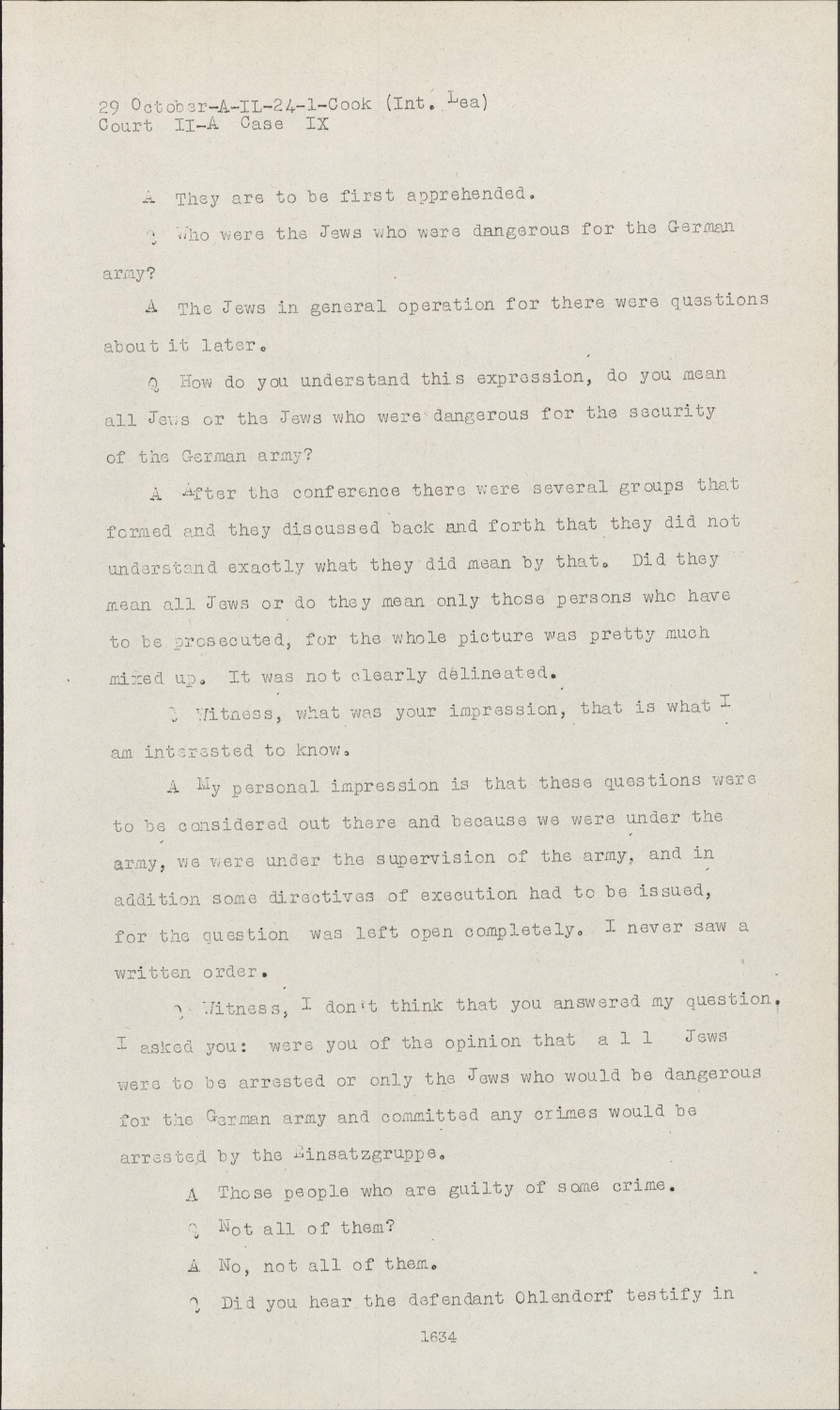
AThey are to be first apprehended.
QWho were the Jews who were dangerous for the German army?
AThe Jews in general operation for there were questions about it later.
QHow do you understand this expression, do you mean all Jews or the Jews who were dangerous for the security of the German army?
AAfter the conference there were several groups that formed and they discussed back and forth that they did not understand exactly what they did mean by that. Did they mean all Jews or do they mean only these persons who have to be prosecuted, for the whole picture was pretty much mixed up. It was not clearly delineated.
QWitness, what was your impression, that is what I am interested to know.
AMy personal impression is that these questions were to be considered out there and because we were under the army, we were under the supervision of the army, and in addition some directives of execution had to be issued, for the question was left open completely. I never saw a written order.
QWitness, I don't think that you answered my question. I asked you: were you of the opinion that all Jews were to be arrested or only the Jews who would be dangerous for the German army and committed any crimes would be. arrested by the Einsatzgruppe.
AThose people who are guilty of some crime.
QNot all of them?
ANo, not all of them.
QDid you hear the defendant Ohlendorf testify in this court room?
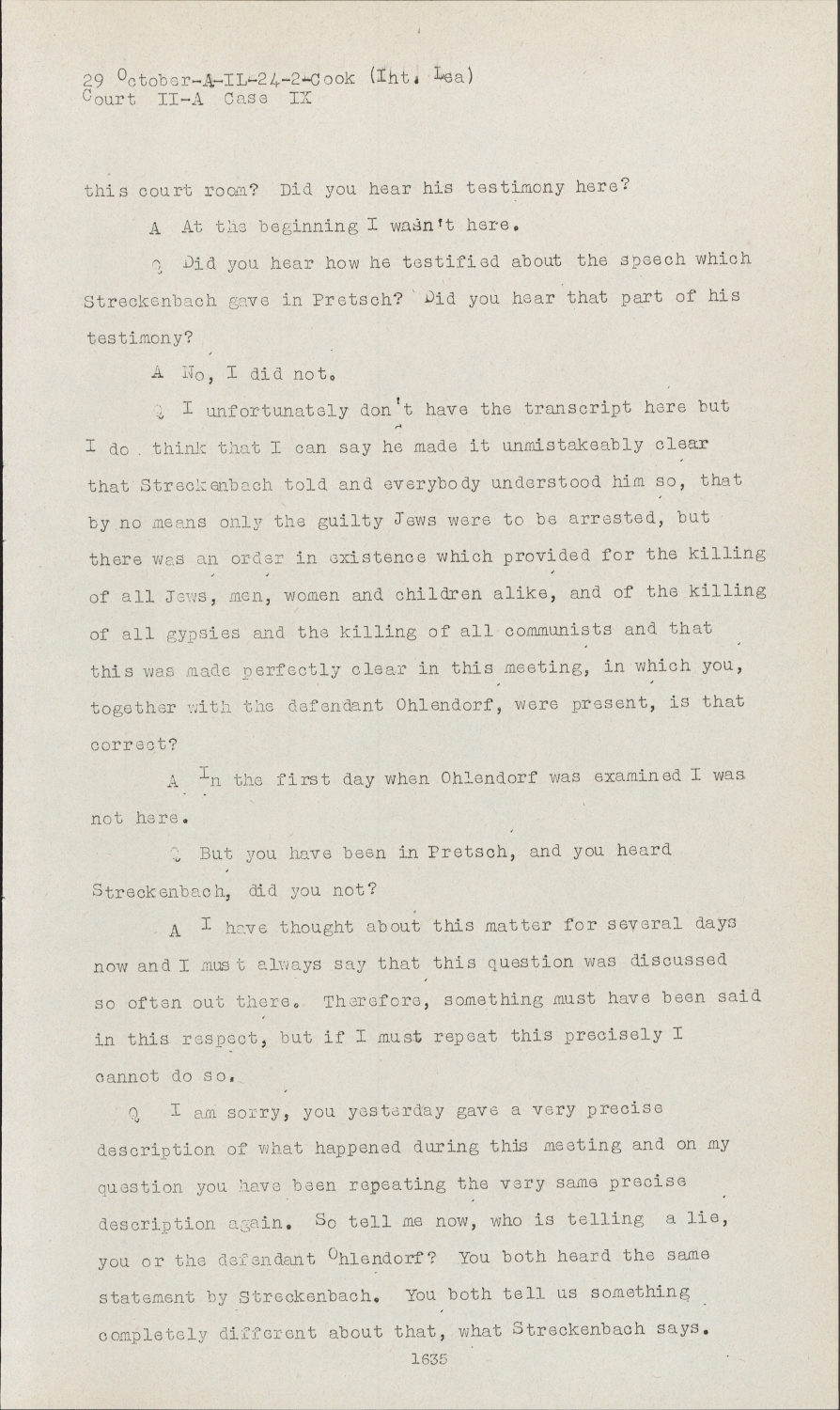
Did you hear his testimony here?
AAt the beginning I wasn't here.
QDid you hear how he testified about the speech which Streckenbach gave in Pretsch? Did you hear that part of his testimony?
ANo, I did not.
QI unfortunately don't have the transcript here but I do think that I can say he made it unmistakeably clear that Streckenbach told and everybody understood him so, that by no means only the guilty Jews were to be arrested, but there was an order in existence which provided for the killing of all Jews, men, women and children alike, and of the killing of all gypsies and the killing of all communists and that this was made perfectly clear in this meeting, in which you, together with the defendant Ohlendorf, were present, is that correct?
AIn the first day when Ohlendorf was examined I was not here.
QBut you have been in Pretsch, and you heard Streckenbach, did you not?
AI have thought about this matter for several days now and I must always say that this question was discussed so often out there. Therefore, something must have been said in this respect, but if I must repeat this precisely I cannot do so.
QI am sorry, you yesterday gave a very precise description of what happened during this meeting and on my question you have been repeating the very same precise description again. So tell me now, who is telling a lie, you or the defendant Ohlendorf? You both heard the same statement by Streckenbach. You both tell us something completely different about that, what Streckenbach says.
Will you tell me now, can you remember what Streckenbach said, did it escape your attention that he said all Jews were to be killed?
AIf Streckenbach had meant all Jews, with the expression "And Jews" we were to understand it that way at that time.
QThere is another very important differentiation between the testimony of Ohlendorf and yours. The defendant Ohlendorf told the Tribunal very openly and his testimony is corroborated by the testimony of four of your co-defendants, who testified after him, that it was an order to kill all Jews, not arrest them. It is entirely different. Will you explain that, why the differentiation between killing and arresting escaped your memory?
DR. HEIM:FOR BLOBEL: Your Honor, I ask that the Prosecution be directed that if he is recalling testimony of witnesses here, he should read the testimony. The Prosecution is not so much asking the witness questions but he is beginning to argue.
THE PRESIDENT:First let us clear up the initial point. The Prosecution asked the witness to relate what had happened at that meeting with Streckenbach, and the witness indicated those who came within the order, he listed spies, saboteurs and various others and then he ended with the phrase "and Jews". Now it is not necessary to labor that point. The Tribunal understands from that that whatever the witness was instructed to do with regard to certain categories, that it included all Jews. Now that is the first point, that is clear. The second point is what was the witness instructed to do with these categories which includes "and Jews", that is where we are at present. So you may proceed from that point, Mr. Hochwald, as to what he was instructed to do with regard to these various classifications, among which there was the item "and Jews."
DR. HOCHWALD:I only want to remark the fact that I was not able to present the witness with the transcript. I have sent for the transcript and by mistake another part of the transcript was sent to me, otherwise I would have had the transcript in English and German available.
THE PRESIDENT:Yes, but he has not yet answered that question specifically. So get an answer to that and then you can begin to make whatever comparisons the situation logically calls for. BY MR. HOCHWALD:
QYes, will you tell the Tribunal, witness, whether you heard from Streckenbach, whether all Jews should be killed or whether they should be only arrested?
ANo, the arrests did not mean the end so far as Streckenbach was concerned, but these execution, measures would also have to be conducted and these did include Jews also, "and the Jews", that's how I remember and I meant that the entire Jewry was meant by this. BY THE PRESIDENT: Now, you haven't answered the question, witness. You have already disposed of the first part that it includes all Jews, so it isn't necessary to repeat that. We understand that, but whatever the instructions were, were they to include all Jews. Now what Mr. Hochwald asked you, is what were you to do with all Jews, added to the other classifications, of course. Now that is what he wants you to answer.
AThat was with reference to the shooting order, to shoot. BY MR. HOCHWALD:
QSo you understood the order of Streckenbach that all Jews were to be shot, is that right?

AYes.
QThat about the gypsies?
AWhether gypsies were mentioned I cannot tell you any more. This is all strange to me.
QWhat about the communist functionaries?
AThe communist functionaries and bolshevist agents and agitators were emphasized especially as the carriers of these political circles which would hinder the advance of the German army.
QWas it said that all those communist functionaries were to be killed?
AThat was without doubt to be understood in such a way that these cases had to be gone into and to be worked out that in order to apprehend these people the documentary evidence and the naming of people were to be found in this. And then it was concluded that these activists were the leaders of the communist party in that country.
QWill you tell then the Tribunal whether it was according to Streckenbach's statement sufficient that whenever somebody was found who was a communist the order was to kill him?
ANo, the man must have committed a crime and it must be proven.
QAnd you do not remember anything about the gypsies.
ANo, that is strange to me.
QSo, may I take it now from your statement that you knew when you left Pretsch that all Jews, whether they committed a crime or did not commit a crime, were to be killed by your unit, or that in the case of communists there was a difference made, as to whether a communist was guilty of a crime or not, is that what I take from your testimony.
AThe order about the execution of Jews was expressed in general terms and the apprehension of other people and their sentencing also was ordered by that order.
QSo you were told then by Streckenbach specifically that at least a part of your function would be to kill defenseless people, is that correct?
AYes, with the order about the Jewry, yes, if it says "The Jewry" there were definitely defenseless people among them and one could not assume that they were all to be considered as criminals.
QYou told the Tribunal several times that you did not and your unit did not commit any acts which were against the laws of war and the laws of humanity. Do you consider the killing of people, just for the simple reason that they were Jews, in accordance with the laws of war and in accordance with the laws of humanity?
ANo, not at all. Not with this conclusion.
QBut you had your order from Streckenbach. Will you comment on that. Will you explain to the Tribunal and to me, how it is possible that you made this statement just now. It was an order that you received?
A If all Jews were meant by that, I could not...
Q May I interrupt you. It took approximately half an hour to get you to say on this that all Jews were meant with these words, so we are so far that you said you knew that all Jews were to be killed. Please explain now the question I asked you. You told the Tribunal that no acts were committed by you and your unit, which are against the law and the laws of humanity. My question is, did you consider the killing of defenseless people, just for the simple reason that they were members of another race in conformity with the law of nations, and the laws of war, and. the law of humanity.Will you answer this question, please?
A No, No.
THE PRESIDENT:The trouble there, Mr. Hochwald, you put him a question and after you put these questions, then you said, will you answer the question please. Now he said, nein, nein., and. I don't know whether he gave one "no" for the first question, and the second "no" for the second question, or both "no's" for the second question, or both "no's" for the first question. Just ask one question at a time, please.
MR. HOCHWALD:I beg your pardon, Your Honor. BY MR. HOCHWALD:
Q The question then was do you consider the killing of defenseless people just for the simple reason that they were members or another race, that is , in conformity with laws of war end laws of humanity?
AThe killing of people because they were Jews - only because they are Jews, I don't consider in accordance with the conception of international law, and not according to the laws of humanity either.
QAll right, you said that no such acts were committed by you and by your units. How do you reconcile the fact that you received the order from Streckenbach to kill all Jews on the one hand and on the other hand that you never carried out any acts which are against the laws of war and the laws of humanity. How did you reconcile these two statements?
AWhen we received this order we always waited for the executive regulations which were to be issued by the chief of command 6 and I was under his command. This was the framework in which I was included in this order, and the opinion of this man was decisive.
QYou are speaking about Field Marshal von Reichenau, are you not?
AYes.
QDid you ever receive from Field Marshal Reichenau an order to disregard this order which was handed down by Streckenbach, but came, as we have been very often told here, from the head of the State and Highest Commander, Adolf, Hitler?
AThe order of Streckenbach itself was not disputed in this form at the Army Command 6, but he had a written order.
QWho relieved you then from the order which you had received, from Streckenbach, if Field Marshal von Reichenau did not even know about the order?
AField Marshal von Reichenau had an order which included almost exactly the same, and he had it in his document, and Major Paulsen read it to no when I reported to him.
QDo I understand you correctly that you said that you were ordered also by Field Marshal von Reichenau to kill all the Jews?
ANo, the Field Marshal did not give it in this form, but the Field Marshal had to see to it that the orders of his subordinate commanders were examined and that they were followed.
QYou have just said that Field Marshal Reichenau had approximately the same order as it was handed down by Streckenbach, and this order was read to you. I do think that we agree that one of the most important part of this order, was the order to kill hundreds of thousands of defenseless people.
The question to you is: Did Field Marshal Reichenau hand down the order for the killing of all Jews to you?
AIn this order it said -- "as it is to be expected -
QWill you answer this question first, with a yes or no, then you can explain the whole thing, but I would be glad if you could so answer, yes or no. It is a very easy question, if you can say in this order the killing of all Jews was provided for?
ANo, this order was not given to me by Reichenau. For the reason that the order which was in von Reichenau's hands and which read: "That during the advance of the German Wehrmacht the political people who would endanger the security of the Wehrmacht and then it enumerates: the agents, the saboteurs, the agitators, and so forth and - among them Jews - among: them Jews, were to be dealt with by the police officers.
QI don't know, but I do think you did not answer my question. Is it true, on do I understand you correctly that you said that in the order which was given you by Field Marshal Reichenau, the killing of all Jews was not provided for?
AThe totality of the order to apprehend and to kill all Jews was not given in this form.
QSo you still had the order which was handed down by Streckenbach and was an order of Hitler. Who relieved you of this order?
ANo one took this order from me, but the decisive factor was that I was now under Field Marshal von Reichenau's command, to whom I was subordinated, and I had to comply with his orders.
QIs it not true that the order for the killing of all Jews came from a Higher Authority than Field Marshal von Reichenau was?
AYes, when that order was given we carried this order along with us.
Q Did you carry out the order you received from Streckenbach?