QIn which territory was the SK 4A active?
AThe SK 4A was active in the operations in the fighting territory near the front. During the advance the borders often varied owing to the enemy action,but if the front did not move for some time, the areas over-lapped owing to the constant movement from the rear area so that the rear army territory some times reached into the combat area almost to the front.
QWhat was the consequence of this over-lapping of the territory just described?
AThat apart from the Command Agencies of the fighting units, the agencies or the offices of the rear army territory and the rest of the operational territory were operating. At the same time the activities of these offices had to be carried out in the same territory. For example, the agricultural leaders were operating very near the fighting units. It was the same with the police and security tasks of the higher SS and police leader and the units intended for the army, such as the security division of the army, the secret field police, local kommandanturas with their local Ukranian security units and the Ukranian militia units as part of the security units. Also the front units with their security behind the front line or in the area near the front. In the same territory, the higher SS and police leader had his police regiments of the regular police and the Ukranian militia also subordinate to him. The sub kommandos were in the areas near the combat line subdivided into smaller divisions.
QWhat was the consequence of all of these agencies working in the same place?
AThe result was something similar. In the same territory the higher SS and police leader was with his advanced regiments and the regular police and the Ukranian militia units who were subordinate to him, and on the other hand the army with the subordinate units, security divisions and the Ukranian militia units, also the secret field police and the local commandanturas and the Ukranian security departments. And behind the combat area the front units with the army and their security units.
All of these agencies were active for the security in the same territory at the same time.
QIn what manner and in which territory were the sub-kommandos active at that time?
AAt that time the sub-kommandos were with the combat units in the combat territory. Some of them had been attached to troops when combating the destruction mentioned before and often they came across opponents who were not military.
QWere the Part Kommandos independent in carrying out their tasks?
ANo, no the Part Kommandos were not at all independent, they had to follow orders, which were given by leaders of the army through G-2 of the front or security division or by the army on their own responsibility orders directly from their leaders or to the higher SS or police leaders via group C, in doubtful cases, however, the G-2 decided where these kommandos had to be and to whom they were to be attached.
QThe G-2 officers of the division you just mentioned, did they have to follow orders?
AYes, these G-2 officers received orders from G-2 of the AOK 6, on the basis of information from the AOK itself, or upon instigation of the higher SS and police leader in agreement with the commander in chief of the AOK 6. There was an exchange of information between G-2 of the divisions and the G-2 of the AOK 6.
QWith regard to the assignment in Ukranian territory was there a special department with the AOK 6?
AFor investigation about Ukranian concerns in the AOK 6 there was a special Ukranian department of about 160 men who with a far reaching organization was active among the Ukranian population.
QWho was in charge of this department and what was its special task?
AThis section which was lead by German officers was active far beyond the combat area and particularly the task to solve the military and housing problems and also to bring the cultural ideas from the occupied territory to the enemy territory.
QWith the Part Kommandos were there also members of this section?
ANo, the liaison officers which the sub-kommandos get by and by came from the civilian population but were of minor importance.
QPlease tell us briefly from which agency did the sub-kommandos receive their orders?
AThe sub-kommandos had to follow the orders of the leaders of the army and of the fighting units and also of the security divisions. Also they received orders from the AOK 6 and from the higher SS and police leaders, the latter through Group C and of the office of the SK 4A. Other orders of the Group "C" were given directly according to the situation and to the events. In emergency cases every leader of the SK had to decide for himself.
QPlease give us a short description of this over-lapping of the various sectors and the crowding of agencies which gave orders at the same time and in what they resulted.
AThe over-lapping I mentioned before occurred in the entire territory of the army area. Reports about endangering the security came repeatedly to the Einsatz Fuehrer of the army near the front. The measures were carried out by the army leaders themselves, that is, measures according to the army orders were carried out independently or with the instructions of the competent Department "C" of the front divisions or the security divisions. The latter were executive organs to whom the local commandanturas with their Ukranian security units and the militia units which I have already mentioned, were attached. They were all subordinate. The local commandanturas were simultaneously informed by the higher SS and the police leader and carried out measures in the same territory.
QOwing to this what were the relations with the higher SS and the police leader on the one hand and the Commander in Chief of the AOK C, Field Marshal Von Reichenau on the other hand?
AThis over-lapping of offices and orders had the result that the higher SS and police leader got total power, even as far as the area near the combat territory. In carrying out security measures in this area the commander in chief of the AOK 6, Von Reichenau, with the higher SS and police leader, Jackeln, agreed on their orders. The latter was generally feared because he did not allow any objection to his orders.
QWhat measures were taken by the higher authorities to stop these conditions in this territory?
AThe Commanders in Chief made posters which said that any action which might in any way affect the German army, intended or actually carried out, would be punished by death. Streets and territory were searched by Army units. The Commander in Chief gave daily orders to all army units and recommended that strict measures should be taken against these people.
QWas the SK 4A participating in this and if so, in what way?
AApart from the current security tasks and the events mentioned, the SK 4A was ordered to control the movement from the East to the west and also to take measures to protect the harvest. In the same way for investigation about Ukranian national opponents and their armies.
QWhat other units were used to fight the increasing resistance of the civilian population?
ABesides the army units, the Ukranian militia and army units, the police units of the higher SS and police leader and also the Ukranian militia units of the higher SS and police leader.
QPlease describe the manner in which your tasks were carried out and give details.
AThe searching for Russian parachutists in the area near the combat area was one of the tasks. To seize the people who gave the information and their means of information were to be seized. Such persons had to be given to the G-2 section immediately to be interrogated. Apart from the military reconnaissance they had to transmit political information. The number of such persons who took part in this was very large on the whole and extended from place to place.
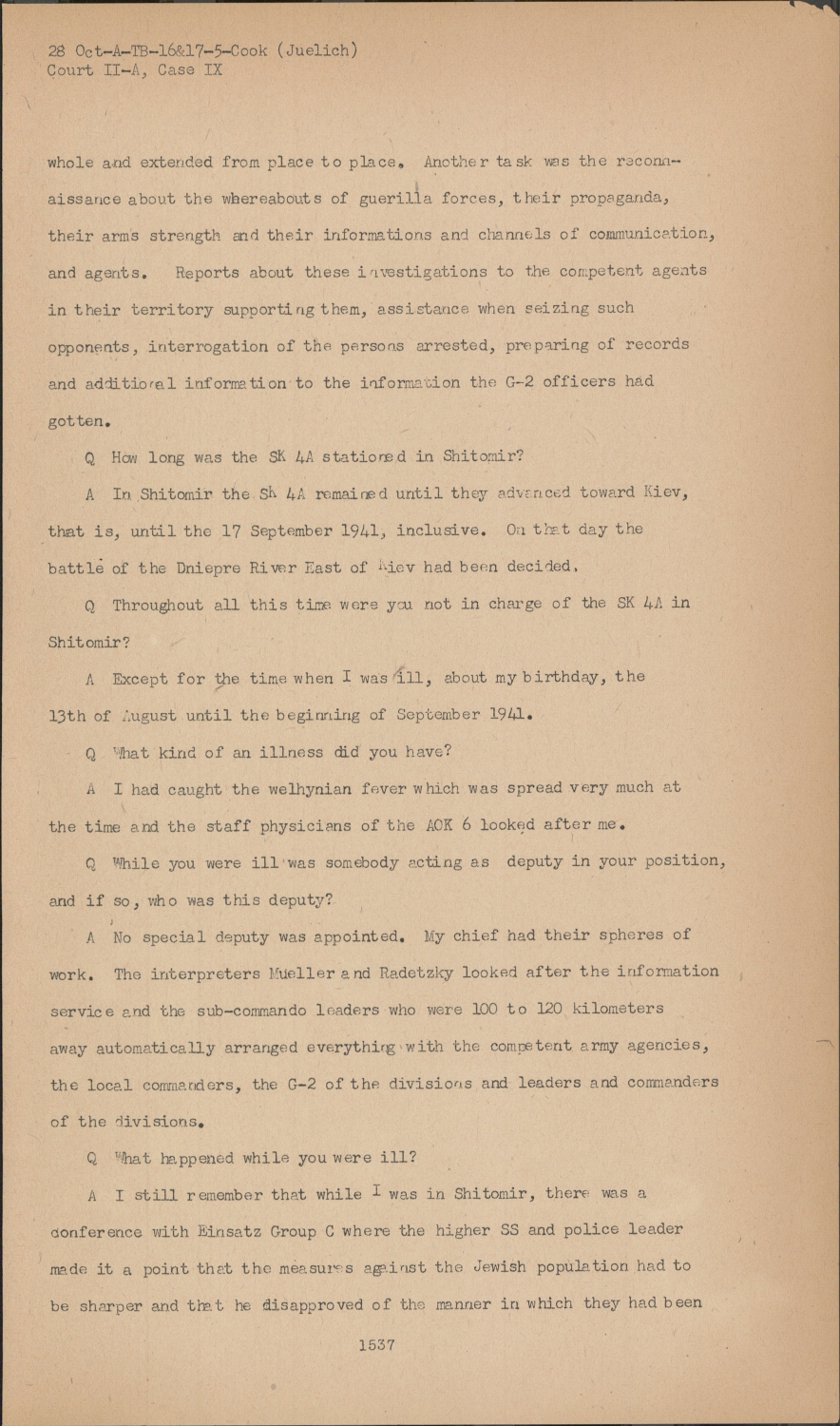
Another task was the reconnaissance about the whereabout of guerilla forces, their propaganda, their arms strength and their informations and channels of communication, and agents. Reports about these investigations to the competent agents in their territory supporting them, assistance when seizing such opponents, interrogation of the persons arrested, preparing of records and additional information to the information the G-2 officers had gotten.
QHow long was the SK 4A stationed in Shitomir?
AIn Shitomir the SK 4A remained until they advanced toward Kiev, that is, until the 17 September 1941, inclusive. On that day the battle of the Dniepre River East of Kiev had been decided.
QThroughout all this time were you not in charge of the SK 4A in Shitomir?
AExcept for the time when I was ill, about my birthday, the 13th of August until the beginning of September 1941.
QWhat kind of an illness did you have?
AI had caught the welhynian fever which was spread very much at the time and the staff physicians of the AOK 6 looked after me.
QWhile you were ill was somebody acting as deputy in your position, and if so, who was this deputy?
ANo special deputy was appointed. My chief had their spheres of work. The interpreters Mueller and Radetzky looked after the information service and the sub-commando leaders who were 100 to 120 kilometers away automatically arranged everything with the competent army agencies, the local commanders, the G-2 of the divisions and leaders and commanders of the divisions.
QWhat happened while you were ill?
AI still remember that while I was in Shitomir, there was a conference with Einsatz Group C where the higher SS and police leader made it a point that the measures against the Jewish population had to be sharper and that he disapproved of the manner in which they had been carried out until now because it was too mild.
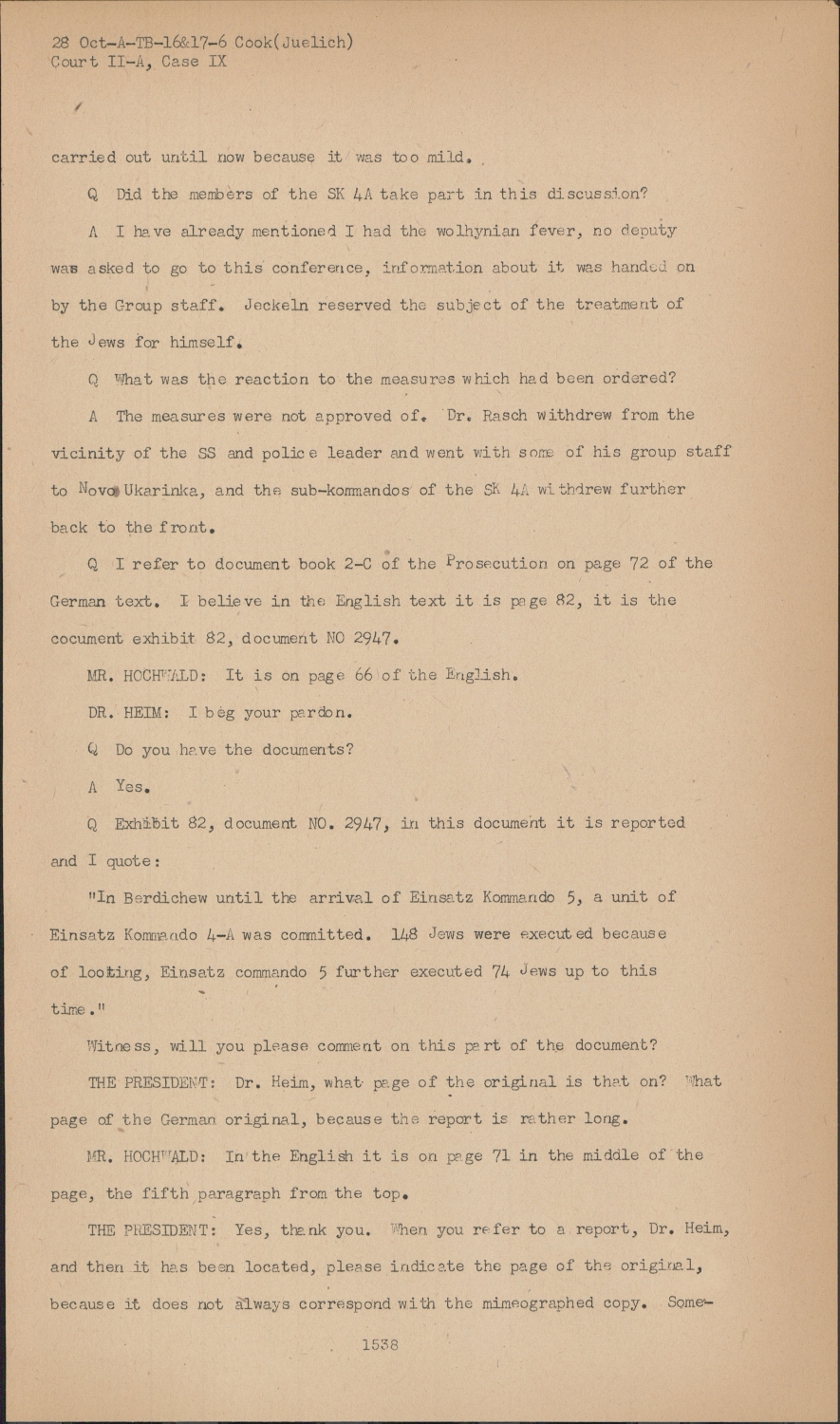
QDid the members of the SK 4A take part in this discussion?
AI have already mentioned I had the wolhynian fever, no deputy was asked to go to this conference, information about it was handed on by the Group staff. Jeckeln reserved the subject of the treatment of the Jews for himself.
QWhat was the reaction to the measures which had been ordered?
AThe measures were not approved of. Dr. Rasch withdrew from the vicinity of the SS and police leader and went with some of his group staff to Novo Ukarinka, and the sub-kommandos of the SK 4A withdrew further back to the front.
QI refer to document book 2-C of the Prosecution on page 72 of the German text. I believe in the English text it is page 82, it is the document exhibit 82, document NO 2947.
MR. HOCHWALD:It is on page 66 of the English.
DR. HEIM:I beg your pardon.
QDo you have the documents?
AYes.
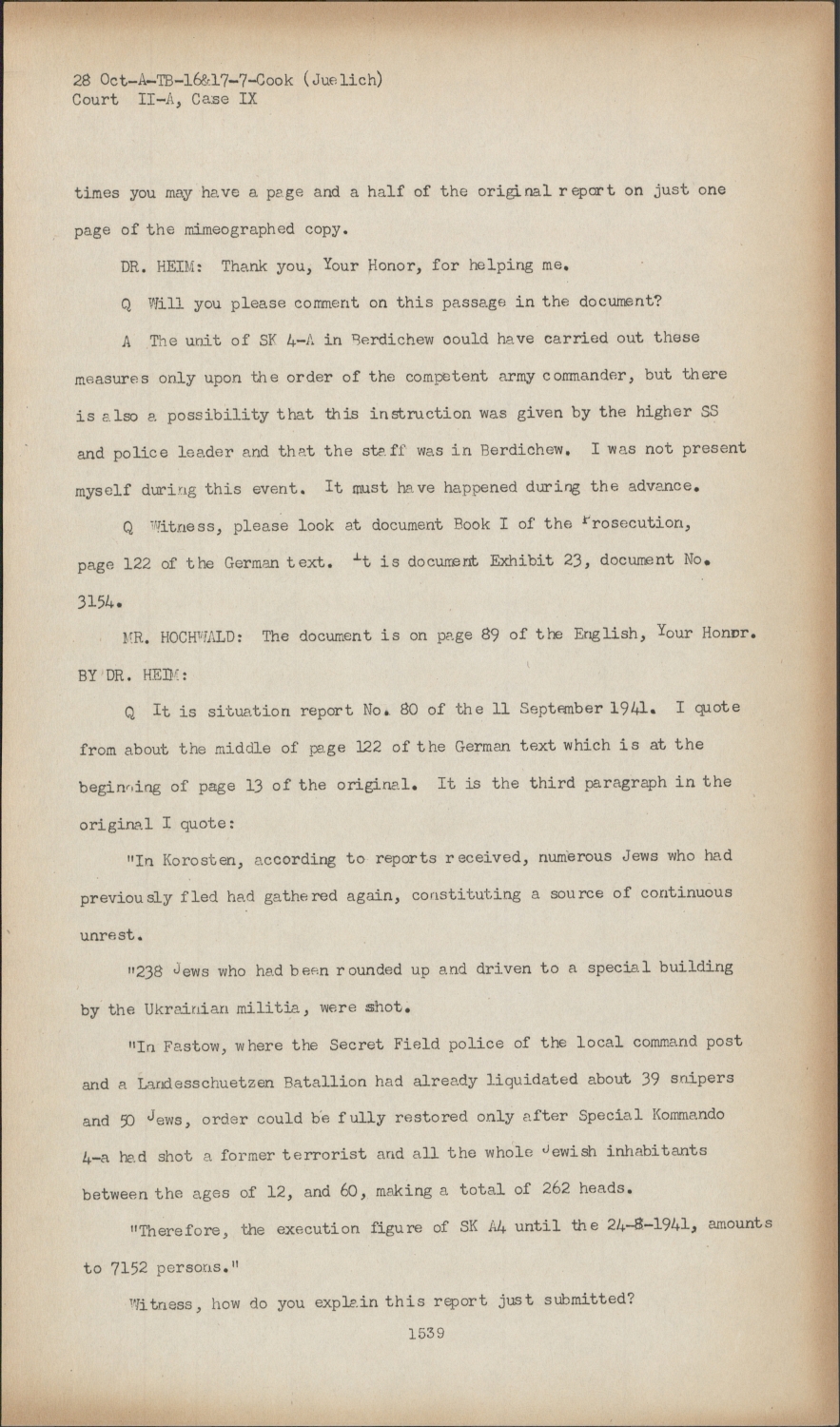
QExhibit 82, document NO. 2947, in this document it is reported and I quote:
"In Berdichew until the arrival of Einsatz Kommando 5, a unit of Einsatz Kommando 4-A was committed. 148 Jews were executed because of looting, Einsatz commando 5 further executed 74 Jews up to this time."
Witness, will you please comment on this part of the document?
THE PRESIDENT:Dr. Heim, what page of the original is that on? What page of the German original, because the report is rather long.
MR. HOCHWALD:In the English it is on page 71 in the middle of the page, the fifth paragraph from the top.
THE PRESIDENT:Yes, thank you. when you refer to a report, Dr. Heim, and then it has been located, please indicate the page of the original, because it does not always correspond with the mimeographed copy. Some times you may have a page and a half of the original report on just one page of the mimeographed copy.
DR. HEIM:Thank you, Your Honor, for helping me.
QWill you please comment on this passage in the document?
AThe unit of SK 4-A in Berdichew could have carried out these measures only upon the order of the competent army commander, but there is also a possibility that this instruction was given by the higher SS and police leader and that the staff was in Berdichew. I was not present myself during this event. It must heave happened during the advance.
QWitness, please look at document Book I of the Prosecution, page 122 of the German text. It is document Exhibit 23, document No. 3154.
MR. HOCHWALD:The document is on page 89 of the English, Your Honor. BY DR. HEIM:
QIt is situation report No. 80 of the 11 September 1941. I quote from about the middle of page 122 of the German text which is at the beginning of page 13 of the original. It is the third paragraph in the original I quote:
"In Korosten, according to reports received, numerous Jews who had previously fled had gathered again, constituting a source of continuous unrest.
"238 Jews who had been rounded up and driven to a special building by the Ukrainian militia, were shot.
"In Fastow, where the Secret Field police of the local command post and a Landesschuetzen Batallion had already liquidated about 39 snipers and 50 Jews, order could be fully restored only after Special Kommando 4-a had shot a former terrorist and all the whole Jewish inhabitants between the ages of 12, and 60, making a total of 262 heads.
"Therefore, the execution figure of SK A4 until the 24-8-1941, amounts to 7152 persons."
Witness, how do you explain this report just submitted?
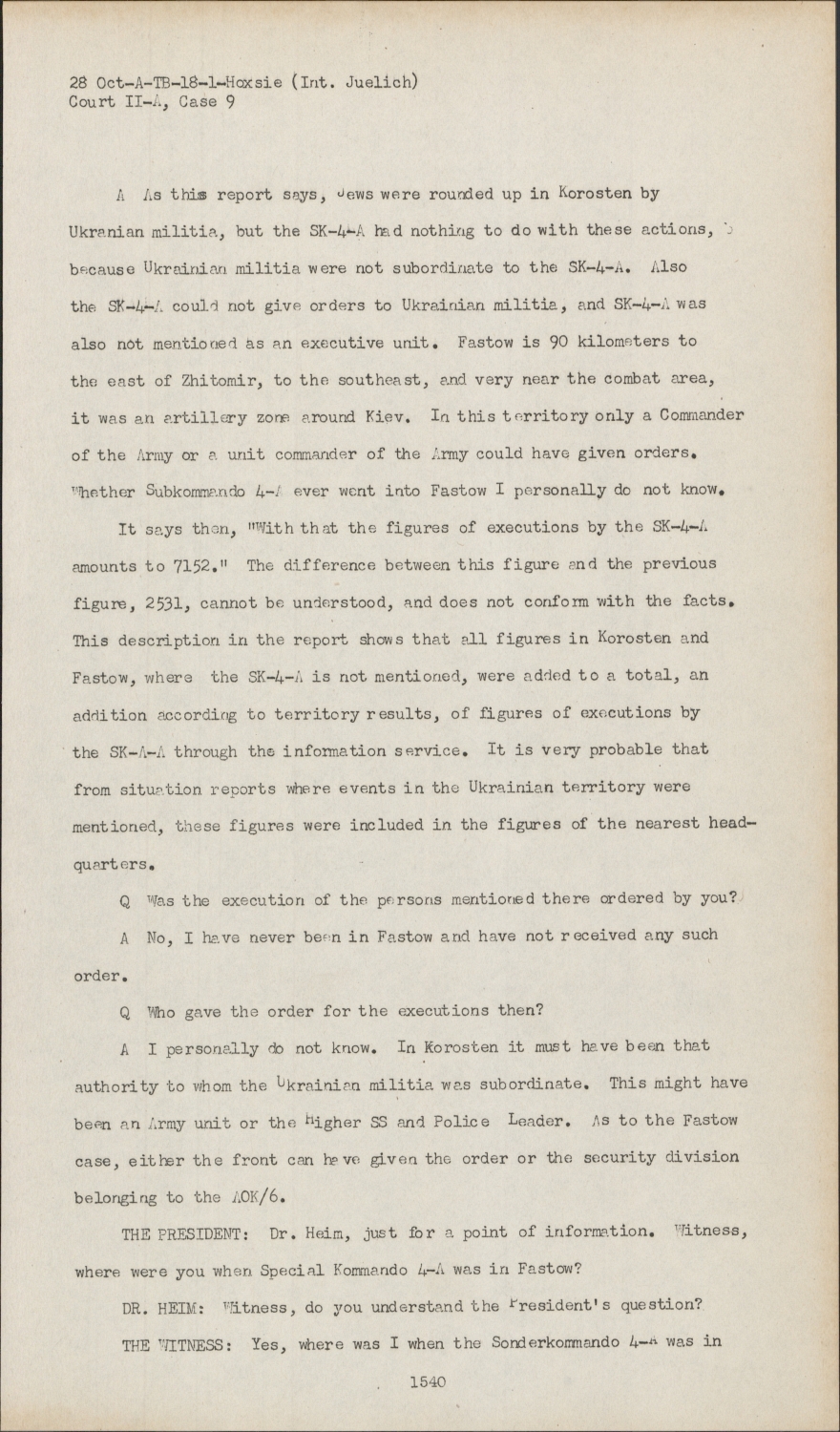
AAs this report says, Jews were rounded up in Korosten by Ukranian militia, but the SK-4-A had nothing to do with these actions, because Ukrainian militia were not subordinate to the SK-4-A. Also the SK-4-A could not give orders to Ukrainian militia, and SK-4-A was also not mentioned as an executive unit. Fastow is 90 kilometers to the east of Zhitomir, to the southeast, and very near the combat area, it was an artillery zone around Kiev. In this territory only a Commander of the Army or a unit commander of the Army could have given orders. Whether Subkommando 4-A ever went into Fastow I personally do not know.
It says then, "With that the figures of executions by the SK-4-A amounts to 7152." The difference between this figure and the previous figure, 2531, cannot be understood, and does not conform with the facts. This description in the report shows that all figures in Korosten and Fastow, where the SK-4-A is not mentioned, were added to a total, an addition according to territory results, of figures of executions by the SK-4-A through the information service. It is very probable that from situation reports where events in the Ukrainian territory were mentioned, these figures were included in the figures of the nearest headquarters.
QWas the execution of the persons mentioned there ordered by you?
ANo, I have never been in Fastow and have not received any such order.
QWho gave the order for the executions then?
AI personally do not know. In Korosten it must have been that authority to whom the Ukrainian militia was subordinate. This might have been an Army unit or the Higher SS and Police Leader. As to the Fastow case, either the front can have given the order or the security division belonging to the AOK/6.
THE PRESIDENT:Dr. Heim, just for a point of information. Witness, where were you when Special commando 4-A was in Fastow?
DR. HEIM:Witness, do you understand the President's question?
THE WITNESS:Yes, where was I when the Sonderkomando 4-A was in Fastow.
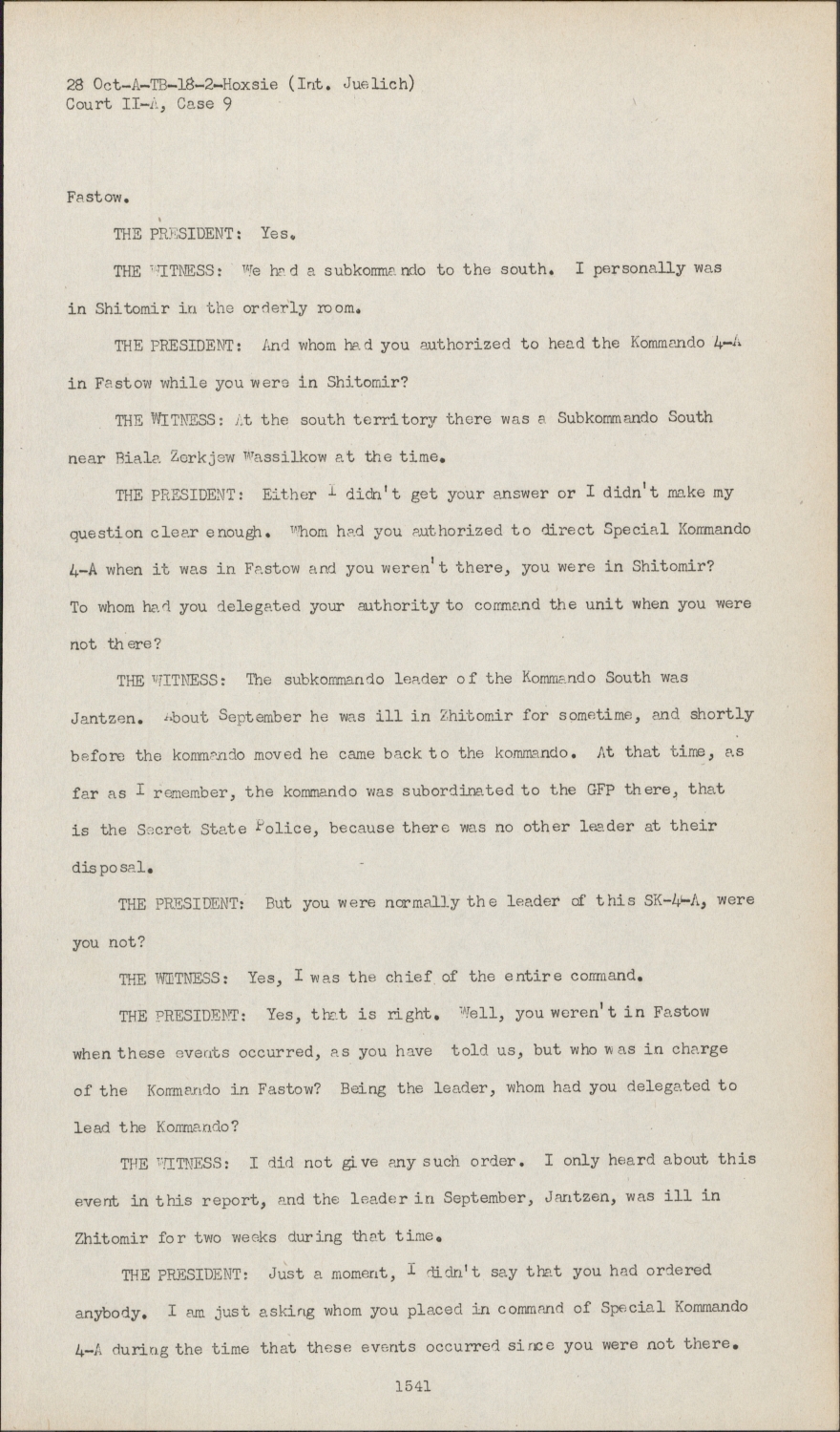
THE PRESIDENT:Yes.
THE WITNESS:We had a subkommando to the south. I personally was in Shitomir in the orderly room.
THE PRESIDENT:And whom had you authorized to head the Kommando 4-A in Fastow while you were in Shitomir?
THE WITNESS:At the south territory there was a Subkommando South near Biala Zerkjew Wassilkow at the time.
THE PRESIDENT:Either I didn't get your answer or I didn't make my question clear enough. Whom had you authorized to direct Special Kommando 4-A when it was in Fastow and you weren't there, you were in Shitomir? To whom had you delegated your authority to command the unit when you were not there?
THE WITNESS:The subkommando leader of the commando South was Jantzen. About September he was ill in Zhitomir for sometime, and shortly before the kommando moved he came back to the kommando. At that time, as far as I remember, the kommando was subordinated to the GFP there, that is the Secret State Police, because there was no other leader at their disposal.
THE PRESIDENT:But you were normally the leader of this SK-4-A, were you not?
THE WITNESS:Yes, I was the chief of the entire command.
THE PRESIDENT:Yes, that is right. Well, you weren't in Fastow when these events occurred, as you have told us, but who was in charge of the Kommando in Fastow? Being the leader, whom had you delegated to lead the Kommando?
THE WITNESS:I did not give any such order. I only heard about this event in this report, and the leader in September, Jantzen, was ill in Zhitomir for two weeks during that time.
THE PRESIDENT:Just a moment, I didn't say that you had ordered anybody. I am just asking whom you placed in command of Special Kommando 4-A during the time that these events occurred since you were not there.
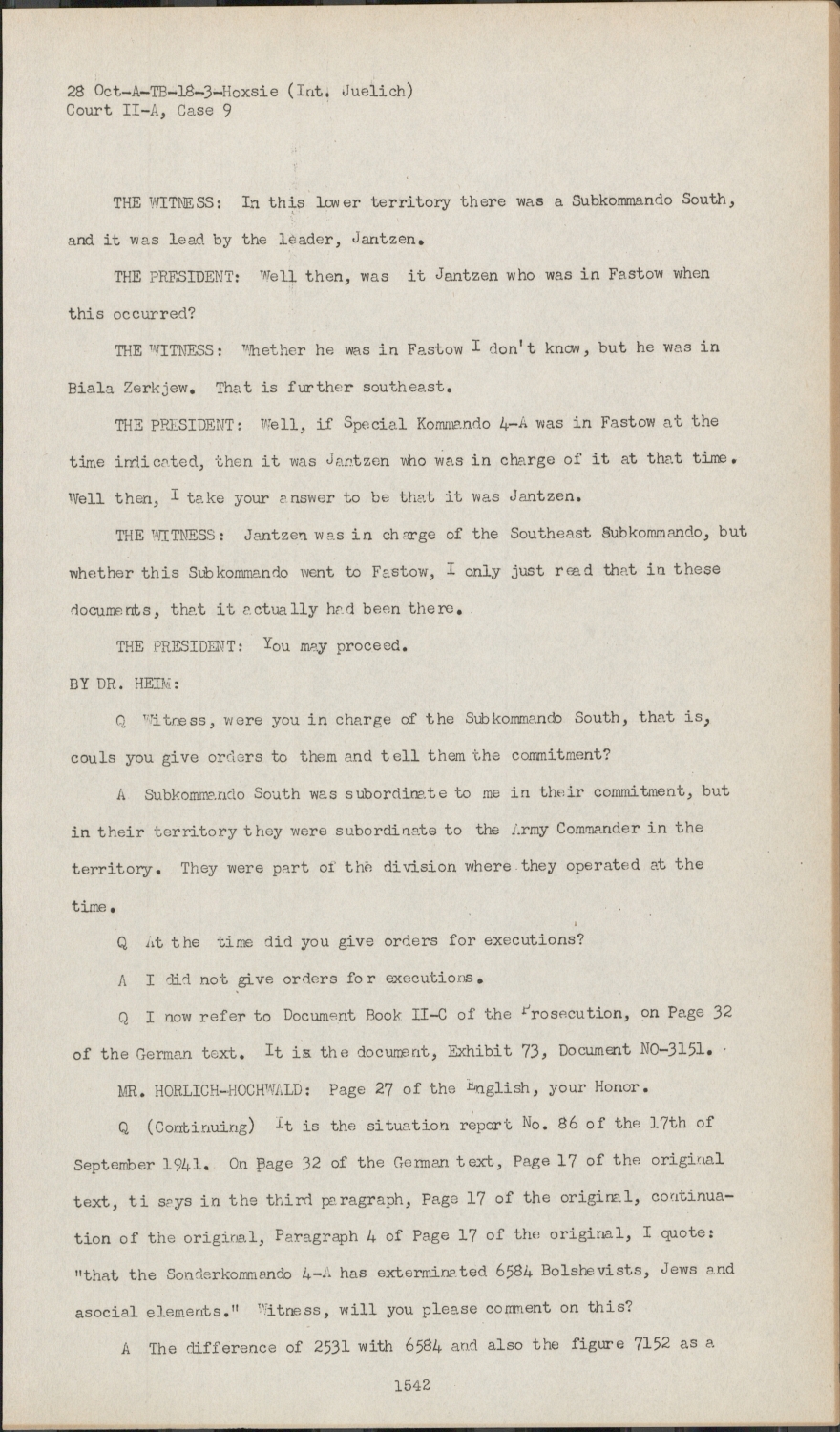
THE WITNESS:In this lower territory there was a Subkommando South, and it was lead by the leader, Jantzen.
THE PRESIDENT:Well then, was it Jantzen who was in Fastow when this occurred?
THE WITNESS:Whether he was in Fastow I don't know,but he was in Biala Zerkjew. That is further southeast.
THE PRESIDENT:Well, if Special Kommando 4-A was in Fastow at the time indicated, then it was Jantzen who was in charge of it at that time. Well then, I take your answer to be that it was Jantzen.
THE WITNESS:Jantzen was in charge of the Southeast Subkommando, but whether this Subkommando went to Fastow, I only just read that in these documents, that it actually had been there.
THE PRESIDENT:You may proceed. BY DR. HEIM:
QWitness, were you in charge of the Subkommando South, that is, couls you give orders to them and tell them the commitment?
ASubkommando South was subordinate to me in their commitment, but in their territory they were subordinate to the Army Commander in the territory. They were part of the division where they operated at the time.
QAt the time did you give orders for executions?
AI did not give orders for executions.
QI now refer to Document Book II-C of the Prosecution, on Page 32 of the German text. It is the document, Exhibit 73, Document NO-3151.
MR.HORLICH-HOCHWALD: Page 27 of the English, your Honor.
Q (Continuing) It is the situation report No. 86 of the 17th of September 1941. On Page 32 of the German text, Page 17 of the original text, ti says in the third paragraph, Page 17 of the original, continuation of the original, Paragraph 4 of Page 17 of the original, I quote: "that the Sonderkommando 4-A has exterminated 6584 Bolshevists, Jews and asocial elements." Witness, will you please comment on this?
AThe difference of 2531 with 6584 and also the figure 7152 as a total are incorrect.
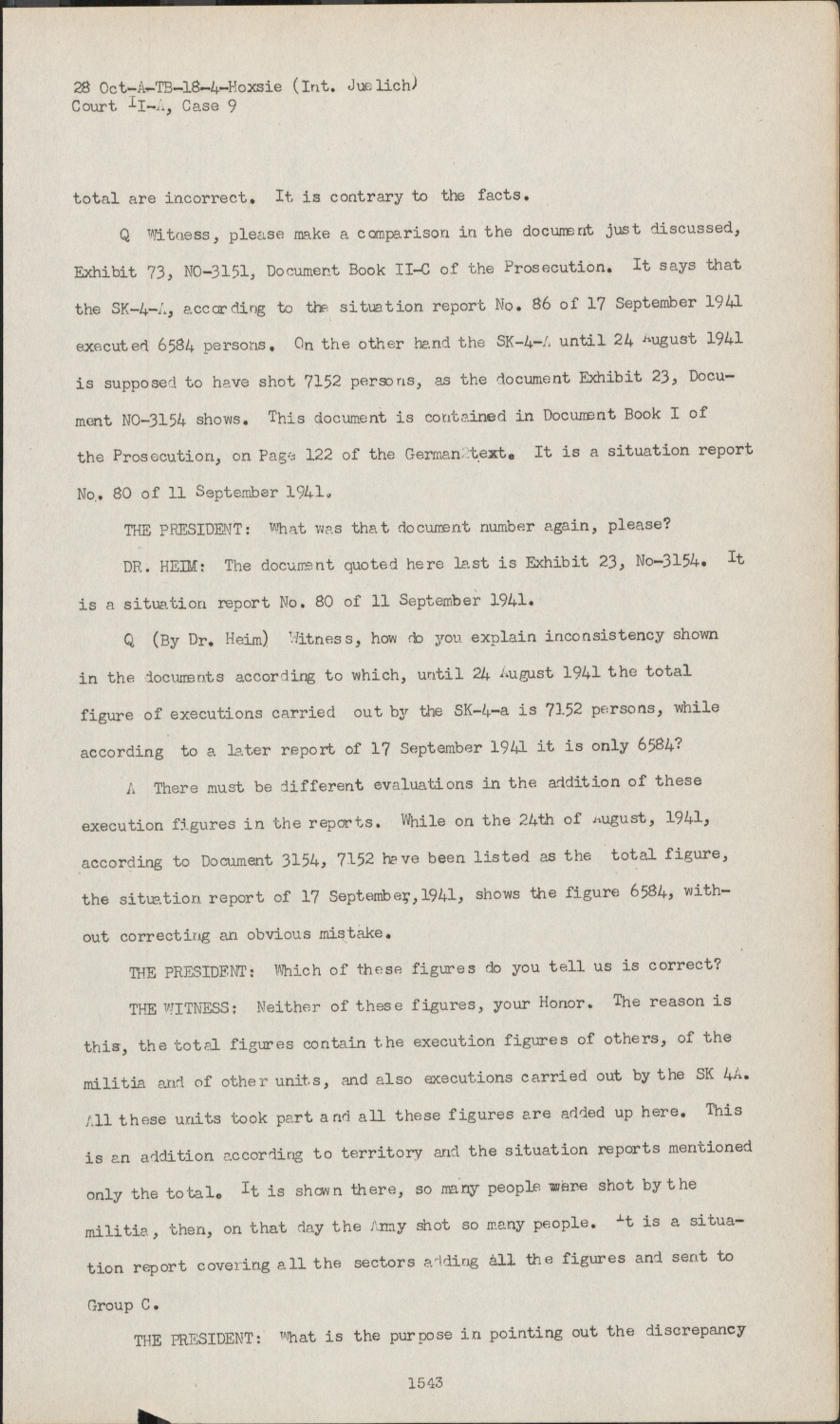
It is contrary to the facts.
QWitness, please make a comparison in the document just discussed, the SK-4-A, according to the situation report No. 86 of 17 September 1941 executed 6584 persons. On the other hand the SK-4-A until 24 August 1941 is supposed to have shot 7152 persons, as the document Exhibit 23, Document NO-3154 shows. This document is contained in Document Book I of the Prosecution, on Page 122 of the German text. It is a situation report No. 80 of 11 September 1941.
THE PRESIDENT:What was that document number again, please?
DR. HEIM:The document quoted here last is Exhibit 23, No-3154. It is a situation report No. 80 of 11 September 1941.
Q (By Dr. Heim) Witness, how do you explain inconsistency shown in the documents according to which, until 24 August 1941 the total figure of executions carried out by the SK-4-a is 7152 persons, while according to a later report of 17 September 1941 it is only 6584?
AThere must be different evaluations in the addition of these execution figures in the reports. While on the 24th of August, 1941, according to Document 3154, 7152 have been listed as the total figure, the situation report of 17 September,1941, shows the figure 6584, without correcting an obvious mistake.
THE PRESIDENT:Which of these figures do you tell us is correct?
THE WITNESS:Neither of these figures, your Honor. The reason is this, the total figures contain the execution figures of others, of the militia and of other units, and also executions carried out by the SK 4A. All these units took part and all these figures are added up here. This is an addition according to territory and the situation reports mentioned only the total. It is shown there, so many people were shot by the militia, then, on that day the Army shot so many people. At is a situation report covering all the sectors adding all the figures and sent to Group C.
THE PRESIDENT:What is the purpose in pointing out the discrepancy in these figures between the two reports?
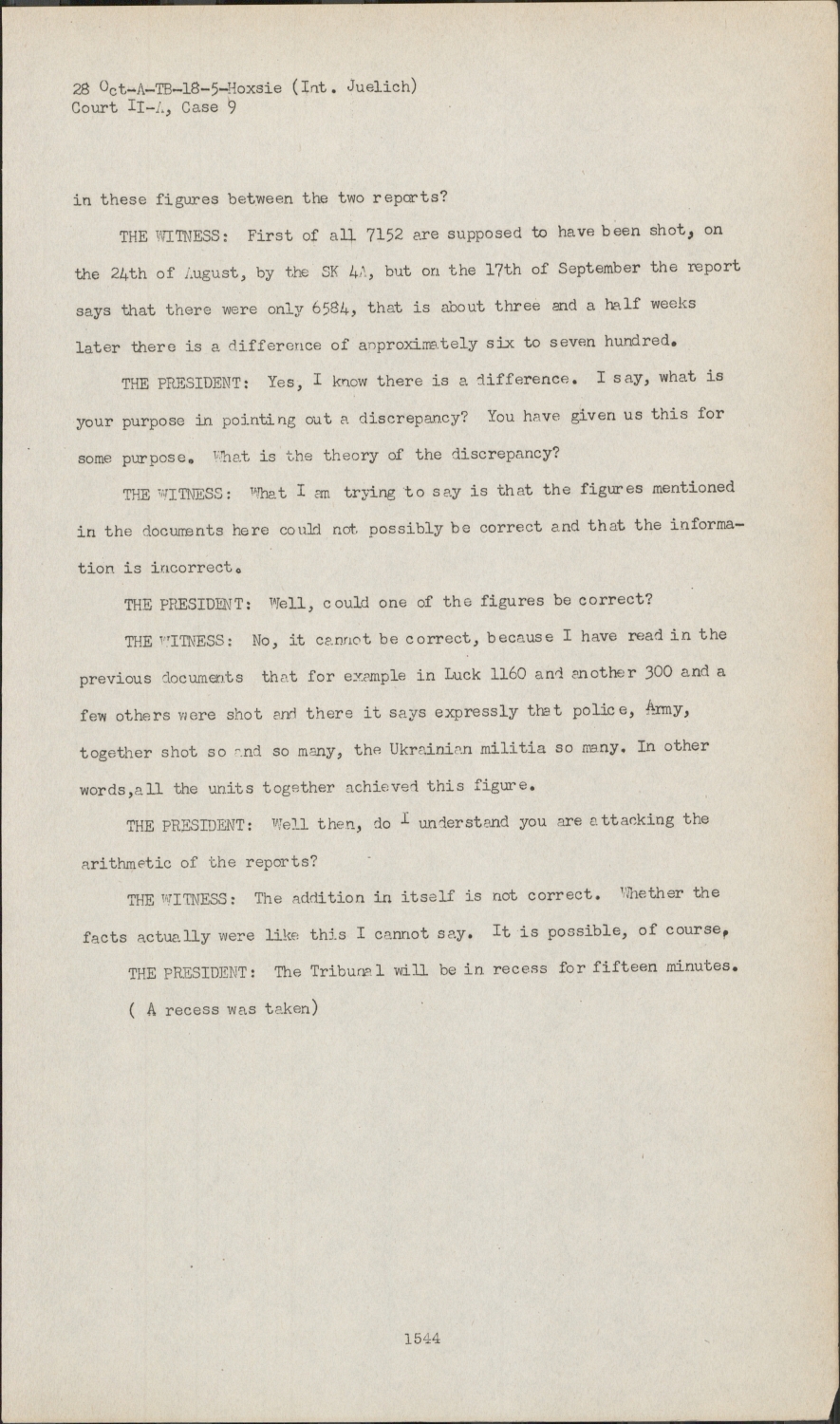
THE WITNESS:First of all 7152 are supposed to have been shot, on the 24th of August, by the SK 4A, but on the 17th of September the report says that there were only 6584, that is about three and a half weeks later there is a difference of approximately six to seven hundred.
THE PRESIDENT:Yes, I know there is a difference. I say, what is your purpose in pointing out a discrepancy? You have given us this for some purpose. What is the theory of the discrepancy?
THE WITNESS:What I am trying to say is that the figures mentioned in the documents here could not possibly be correct and that the information is incorrect.
THE PRESIDENT:Well, could one of the figures be correct?
THE WITNESS:No, it cannot be correct, because I have read in the previous documents that for example in Luck 1160 and another 300 and a few others were shot and there it says expressly that police, Army, together shot so and so many, the Ukrainian militia so many. In other words,all the units together achieved this figure.
THE PRESIDENT:Well then, do I understand you are attacking the arithmetic of the reports?
THE WITNESS:The addition in itself is not correct. Whether the facts actually were like this I cannot say. It is possible, of course.
THE PRESIDENT:The Tribunal will be in recess for fifteen minutes.
( A recess was taken)
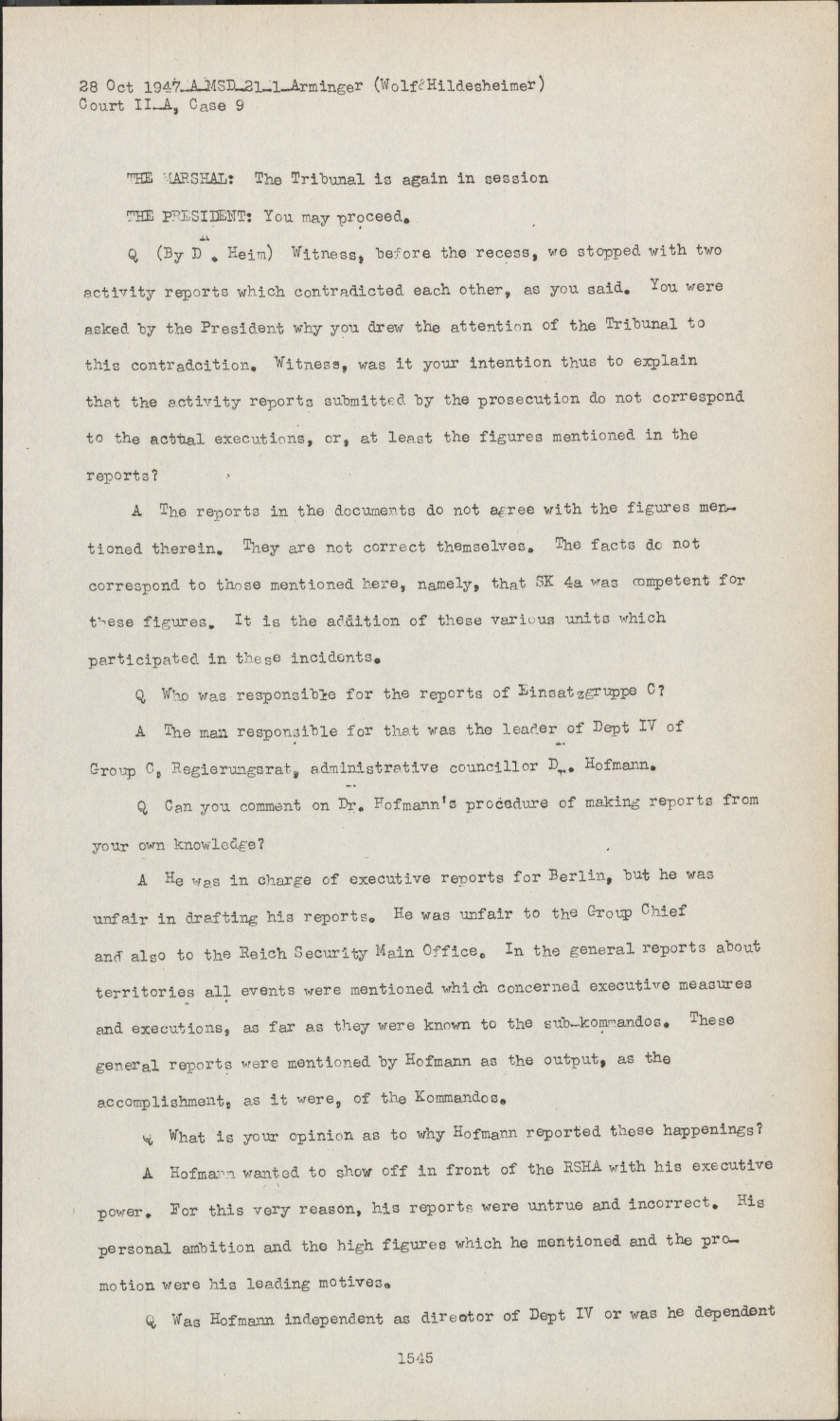
THE MARSHAL:The Tribunal is again in session
THE PRESIDENT:You may proceed.
Q (By Dr. Heim) Witness, before the recess, we stopped with two activity reports which contradicted each other, as you said. You were asked by the President why you drew the attention of the Tribunal to this contradcition. Witness, was it your intention thus to explain that the activity reports submitted by the prosecution do not correspond to the actual executions, or, at least the figures mentioned in the reports?
AThe reports in the documents do not agree with the figures mentioned therein. They are not correct themselves. The facts do not correspond to those mentioned here, namely, that SK 4a was competent for these figures. It is the addition of these various units which participated in these incidents.
QWho was responsible for the reports of Einsatzgruppe C?
AThe man responsible for that was the leader of Dept IV of Group C, Regierungsrat, administrative councillor Dr. Hofmann.
QCan you comment on Dr. Hofmann's procedure of making reports from your own knowledge?
AHe was in charge of executive reports for Berlin, but he was unfair in drafting his reports. He was unfair to the Group Chief and also to the Reich Security Main Office. In the general reports about territories all events were mentioned which concerned executive measures and executions, as far as they were known to the sub-kommandos. These general reports were mentioned by Hofmann as the output, as the accomplishment, as it were, of the Kommandos.
QWhat is your opinion as to why Hofmann reported these happenings?
AHofmann wanted to show off in front of the RSHA with his executive power. For this very reason, his reports were untrue and incorrect. His personal ambition and the high figures which he mentioned and the promotion were his leading motives.
QWas Hofmann independent as director of Dept IV or was he dependent on the commander of the RSHA?
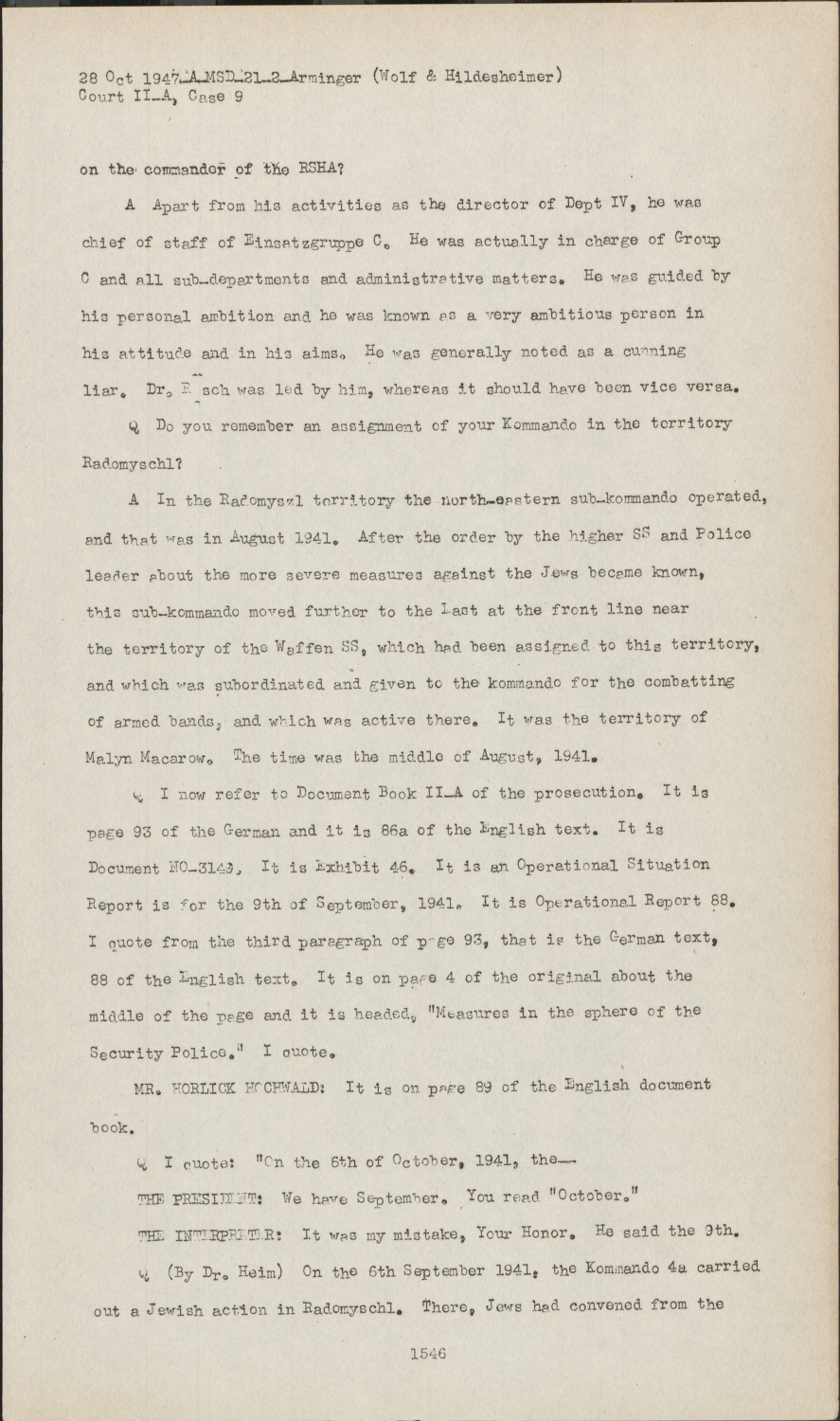
AApart from his activities as the director of Dept IV, he was chief of staff of Einsatzgruppe C. He was actually in charge of Group C and all sub-departments and administrative matters. He was guided by his personal ambition and he was known as a very ambitious person in his attitude and in his aims. He was generally noted as a cunning liar. Dr. Rasch was led by him, whereas it should have been vice versa.
QDo you remember an assignment of your Kommando in the territory Radomyschl?
AIn the Radomyszl territory the north-eastern sub-kommando operated, and that was in August 1941. After the order by the higher SS and Police leader about the more severe measures against the Jews became known, this sub-kommando moved further to the last at the front line near the territory of the Waffen SS, which had been assigned to this territory, and which was subordinated and given to the kommando for the combatting of armed bands, and which was active there. It was the territory of Malyn Macarow. The time was the middle of August, 1941.
QI now refer to Document Book II-A of the prosecution. It is page 93 of the German and it is 86a of the English text. It is Document NO-3149. It is Exhibit 46. It is an Operational Situation Report is for the 9th of September, 1941. It is Operational Report 88. I quote from the third paragraph of page 93, that is the German text, 88 of the English text. It is on page 4 of the original about the middle of the page and it is headed, "Measures in the sphere of the Security Police." I quote.
MR. HORLICK HOCHWALD:It is on page 89 of the English document book.
QI quote: "On the 6th of October, 1941, the-
THE PRESIDENT:We have September. You read "October."
THE INTERPRETER:It was my mistake, Your Honor. He said the 9th.
Q (By Dr. Heim) On the 6th September 1941, the Kommando 4a carried out a Jewish action in Radomyschl. There, Jews had convened from the entire vicinity.

The Jewish apartments, therefore, were overfilled. On the average 15 people lived in one room. Sanitary conditions, therefore, had become untenable. Every day several Jewish corpses had been taken away from the houses. Food for the Jews as well as for children could not be issued. As a consequence of this increasing danger, contagious diseases existed. Therefore, 1,107 Jews were shot by Kommando 4a and 561 more Jews were shot by the Udrainian militia." That is the end of my quotation. I ask you, Witness, does this report correspond, to the facts?
AI cannot give you my own picture of the circumstances. Rad_ omyschl was was 50 to 60 kilometres east of Shitomir. Therefore, even if this report corresponds to the facts, the competence was in the hands of the local commander or the medical departments of the Army. The spreading of disease in the units of the Army was very prevalent at the time. I myself was suffering from Wolhynian fever at that time.
QCould you order such an action at all?
AThe order for such an action could only be given by AOK/6, the competent Army authorities in agreement with the supreme commander of the AOK/6 and the SS Police Leaders. BY THE PRESIDENT:
QWitness, Dr. Heim asked you a question which you did not answer. After he read from the report in question he said to you, "Is this report in agreement with the facts?" Now will you please answer that question put to you by your own counsel?
AWhether the facts agree with the report, I cannot say, at least, not from my own experience. At a later date I heard a report about conditions in Radomyschl, in which it said that an action by the Higher SS and Police Leaders had been carried out.
QThen, from what you learned later, is this report in agreement with the facts?
AWhether the sanitary conditions and the Jews who lived under them are as described here, whether that was so in individual cases, I don't know.
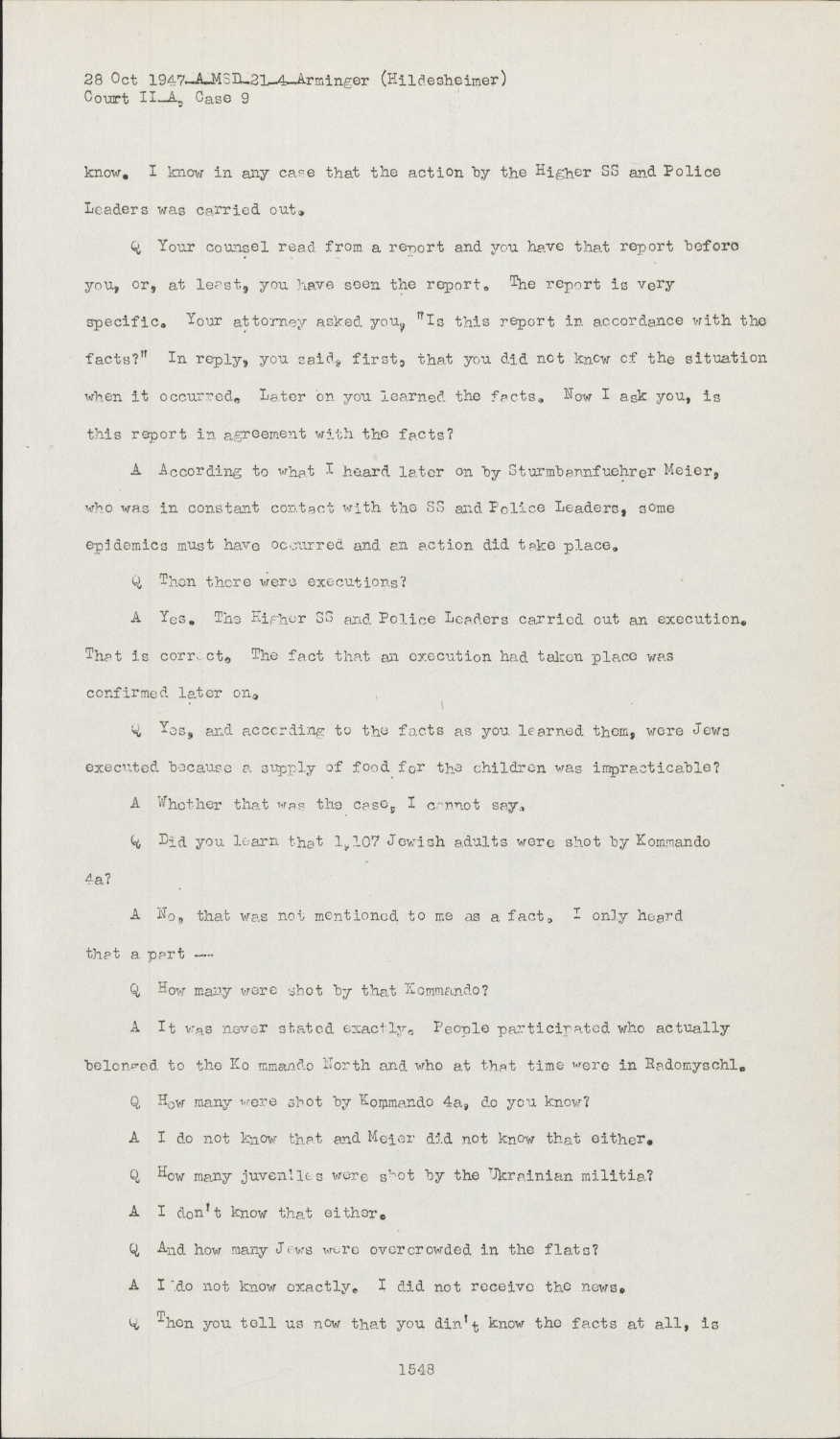
I know in any case that the action by the Higher SS and Police Leaders was carried out.
QYour counsel read from a report and you have that report before you, or, at least, you have seen the report. The report is very specific. Your attorney asked you, "Is this report in accordance with the facts?" In reply, you said, first, that you did not know of the situation when it occurred. Later on you learned the facts. Now I ask you, is this report in agreement with the facts?
AAccording to what I heard later on by Sturmbannfuehrer Meier, who was in constant contact with the SS and Police Leaders, some epidemics must have occurred and an action did take place.
QThen there were executions?
AYes. The Higher SS and Police Leaders carried out an execution. That is correct. The fact that an execution had taken place was confirmed later on.
QYes, and according to the facts as you learned them, were Jews executed because a supply of food for the children was impracticable?
AWhether that was the case, I cannot say.
QDid you learn that 1,107 Jewish adults were shot by Kommando 4a?
ANo, that was not mentioned to me as a fact. I only heard that a part
QHow many were shot by that Kommando?
AIt was never stated exactly. People participated who actually belonged to the Ko mmando North and who at that time were in Radomyschl.
QHow many were shot by Kommando 4a, do you know?
AI do not know that and Meier did not know that either.
QHow many juveniles were shot by the Ukrainian militia?
AI don't know that either.
QAnd how many Jews were overcrowded in the flats?
AI do not know exactly. I did not receive the news.
QThen you tell us now that you din't know the facts at all, is that right?
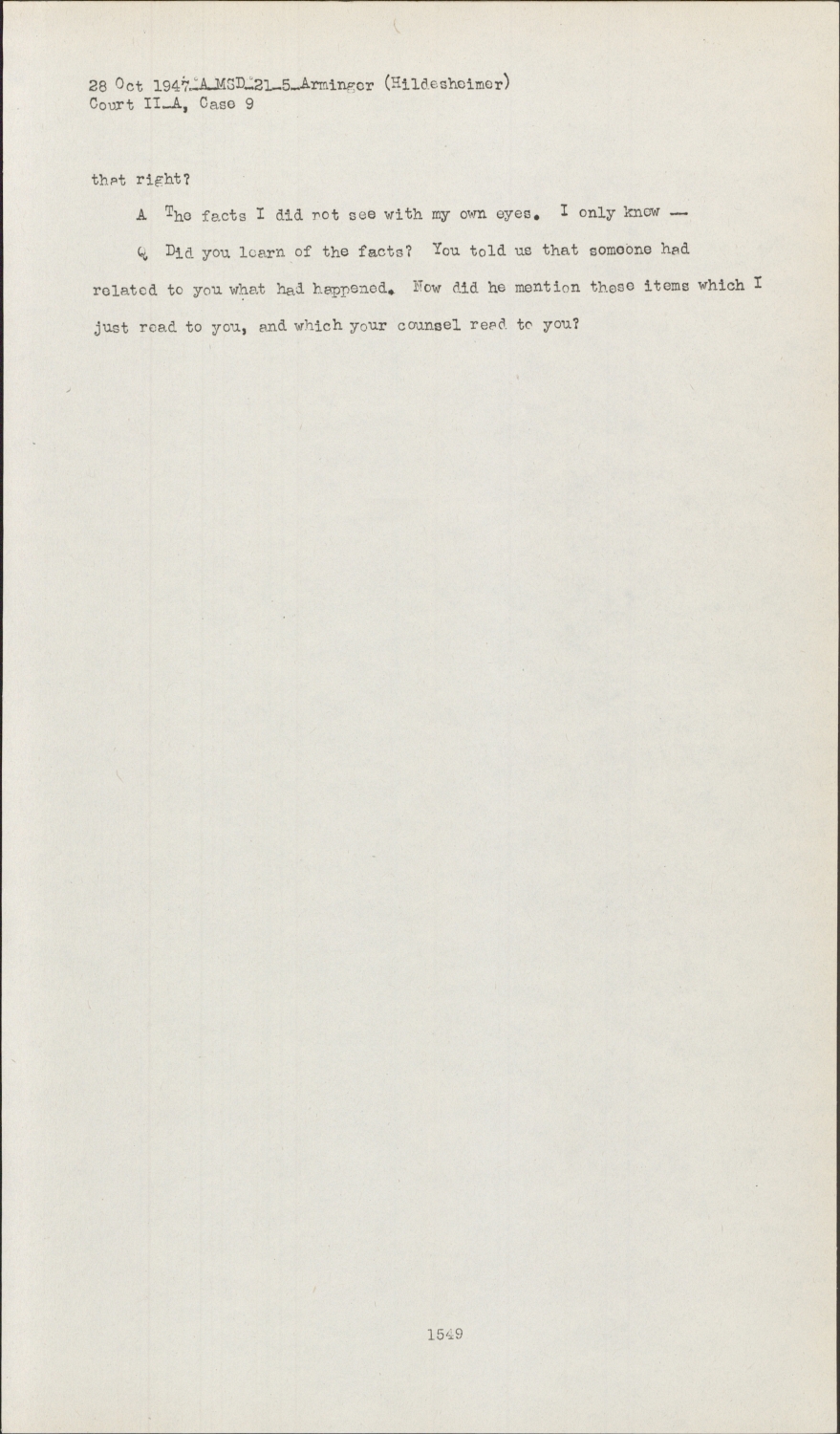
AThe facts I did not see with my own eyes. I only know -
QDid you learn of the facts? You told us that someone had related to you what had happened. Now did he mention these items which I just read to you, and which your counsel read to you?

AYes, I heard about it, and I heard, about intolerable circumstances, that the Higher Police
QNow, now, witness, let us be a little specific. I asked you a series of questions. I'll repeat them. First you tell us that you do not know of the facts of your own personal knowledge because you were not there. Now let us agree upon that. Were you there, or not there?
AI wasn't there.
QVery well. Then you tell us that someone related to you what had happened, is that right?
AYes, that's correct.
QYes. Now, did he tell you that 1107 Jewish adults were shot by Commando 4-A?
ANo, that was not reported to me.
QAll right. Did he tell you that 561 juveniles were shot by the Ukrainian Militia?
A No, that was not put to me either.
QDid he tell you that there were on the average of 15 persons living in a room?
ANo.
QDid he tell you that a supply of food for the Jews, as well as for the children, was impracticable?
AMeier tole me -
QAnswer that question. Did he tell you this.... that there wasn't enough food for the children?
ANo, not that, either.
QAll right. Then you don't know anything about these facts, do you?
AThe facts in themselves I only -- are only known to me in as far as that action was carried out in this town which was reported to me by Meier.
QYour counsel read a certain report to you and asked you whether you agreed with the facts. Now you tell us that you were not there, and the person who spoke about the episode did not tell you any of the facts which I read from the report. That's right, isn't it?
A Yes.
QSo therefore you are not in a position to make any comment on this at all, are you? You cannot tell whether this report is correct or not?
AI can only repeat what I heard from Meier, and how it happened later.
QWell, out I read to you from this report and you said, as against each item, that Meier had not told you that. So, therefore, you have no knowledge of these facts at all, not even from hearsay; so, therefore, you cannot tell whether this report is correct or not, can you?
AThat is quite correct, Mr. President.
QYes. All right. Proceed.
DR. HEIM:Your Honor, may I draw your attention to the fact that the witness save me the following answer: "From my own, knowledge I can give no picture of the circumstances as they happened." And, putting it in one sentence, he continued: "But if it is based on actual facts, the local commander was responsible."
THE PRESIDENT:Well, naturally, if he said he wasn't there, he knew nothing about it, and he gave no order, his conclusion is that he is not responsible. The point that seems rather strange to me is that you would ask him whether this report agreed with the facts when he tells us that he knew nothing about the facts.
DR. HEIM:Your Honor, it becomes evident from the report that allegedly executions were carried out by SK 4-a. I merely wanted to know from the witness whether it corresponds to the facts that these executions were carried out by the SK 4-a.
THE PRESIDENT:Very well.
BY DR. HEIM:
QWitness, I have another question to put to you. Did you, as the commander of SK 4-a, have anything to do with the executions mentioned in this document?
AThe order for such an action must have come from the competent authority and the AOK/6 and I have nothing to do with the action and the circumstances as described in the document. I was told about them afterwards. I was told about the participation of a number of men ordered by the local police commander. BY THE PRESIDENT:
QWho was in command in the field, of Commando 4-a at this time?
AThe entire Commando was under my charge.
QAnd who was in charge of the particular unit which was operating in this town - Radomyszl?
AThis unit under the leaders Carlsen and Hans, but they were not actually present in Radomyszl at the time of the date of this document.
QWho was in charge at the time of the date in the document, September 6th?
ACommanders Carlsen and Hans.
QWere they under you?
AYes, they were subordinated to me; to the Staff 4-a, and to myself, as I was the Commando Leader.
QVery well. BY DR. HEIM:
QWitness, did you learn before the executions were carried out, the fact that a group of the SK 4-a had participated in this action?
ANo, that was not known to me. I only learned that very much later from Sturmbannfuehrer Meier, who was in the office of the Higher Police and SS leader and who, based on these facts, made an examination, an investigation at SK 4-a in Shitomir, for the reason of finding out whether the sub-commando witch was stationed in the northern territory was authorized to get an additional supply from the country itself.