The Tribunal finds the defendant guilty under Counts I and II of the Indictment.
The Tribunal also finds that the defendant was a member of the criminal organizations SS and SD under conditions defined by the Judgment of the International Military Tribunal and is therefore guilty under count III of the Indictment.
JUDGE DIXON:
LOTHAR FENDLER SS-Major Fendler studied dentistry from 1932 to 1934 and served in the Wehrmacht from 1934 to 1936.
He then joined the SD.
Fendler served in Sonderkommando 4b, Einsatzgruppe C, from May 1941 to October 2, 1941. During this time, the Sonderkommando was engaged, as all other kommandos of the Einsatzgruppe, in the execution of the Fuehrer Order. The reports show that, during the time that Fendler was with the unit in question, many executions occurred:
Report No. 24 - IIA/31, NO-2938 Report No. 19 - IIC/49, NO-2934 Report No. 111- IIA/44, NO-3155 Fendler denies participation in these executions, but he goes further and asserts complete ignorance of them.
In fact, according to his story, he did not learn of the Fuehrer execution order until after he had severed all connections with the Sonderkommando.
Fendler submits that his work with the kommando was restricted to Department III and that he was concerned only with the gathering of information. Defendant after defendant has asserted that, in doing Department III work, he was utterly ignorant of the functions performed by the other departments, but one cannot help but observe that Department III did not operate within the confines of a high stone wall separating it from the rest of the kommando. An Einsatzkommando in the field usually consisted of from 80 to 100 men and 7 to 10 officers.
Sonderkommando 4b had a staff of 7 officers. Fendler lived, ate and associated with these officers. He was Department III, some other officer was Department IV, and still another officer was Department V or VI, and so on. It is absurd to assume that Fendler could not know what these other officers were doing, especially in view of the fact that Fendler was the second senior officer in the kommando.
It is not contended by the Prosecution, nor does the evidence show that Fendler, himself, ever conducted an execution, but it is maintained that he was part of an organization committed to an extermination program.
Fendler asserts that Department IV alone conducted the executions and, therefore, within the water-tight compartment of his own Department III, he did not know what was happening in Department IV.
The International Military Tribunal, in considering the relationship between the SD (which is Department III) and the Gestapo (which is Department IV), said:
"One of the principal functions of the local SD units was to serve as the Intelligence Agency for the local Gestapo units.
In the occupied territories, the formal relationship between local units of the Gestapo, Criminal Police and SD was slightly closer."
Fendler asserts over and over that he only learned by accident of executions and that, generally, he did not know what was taking place. Fendler's assertion runs counter to normal every day experience because it is simply incredible that a high-ranking officer in a unit would not know of the principal occupation of that unit.
The defendant stated that he learned of the extermination order only after he had left the kommando and was at Kiev on his way home. He was asked:
"So that you had to travel five hundred kilometers and two days' distance from the very heart of this execution district before you learned that executions were being performed upon Jews because they were Jews, is that right?"
And his answer was "yes".
The defendant explained that one of his principal occupations in the kommando was making out morale reports on the population. He was asked whether, when he learned of the pogrom which had occurred in Tarnopol, where about 600 people were murdered, he included this fact in his report. He replied in the negative. He was asked why he would not include so momentous an event as the murdering of 600 people in the streets in a report which he was compiling on the morale of the population, and he replied he did not have a chance:
"Q. Well, how much time would it take in an SD report which you were compelled to make and which it was your job to make, to say that there were excesses in Tarnopol to the extent that 600 Jews were murdered, - or you didn't want to say murdered, - were killed by the population.
How much time would it take to include that, with your fingers on the typewriter, into a report?
How much time would it take to say that?
A. Two seconds.
Q. Well, then, why didn't you have the two seconds to write that?
A. Because I made no report.
Q. Why didn't you make a report?
A. Because I was given the order by the kommando leader to evaluate this material."
Fendler denies that he ever functioned as deputy to the kommando leader and stated that, when he acted as an advance kommando leader, he occupied himself only with the obtaining of intelligence files left behind by the Bolshevists. But, in evaluating these reports, it is inevitable that he would need to tell someone what he found. In fact, he did admit that this information usually was "utilized for individual reports". The Army was also informed "in a written form or orally".
In order to prove that the work of every officer was specialized and thus would not know what the others were doing, the defendant stated that his unit never divided its forces. Thus, one officer would not need to do the job of others. However, since this would establish that, by sheer proximity, the officers could not help but know each other's business, the defendant later stated that the unit was not always together because of the distance it had to travel.
The defendant knew that executions were taking place. He admitted that the procedure which determined the so-called guilt of a person which resulted in his being condemned to death was "too summary". But there is no evidence that he ever did anything about it. As the second highest ranking officer in the kommando, his views could have been heard in complaint or protest against what he now says was a too summary procedure, but he chose to let the injustice go uncorrected.
He was asked:
"Do I understand you correctly that you were of the opinion that there was an insufficient safe guard for the suspected person, as there was no trial, that his rights as a defendant were not sufficiently safeguarded?
Is that what you want to say, that that was your opinion; was that your opinion?"
And he replied:
"That was my theoretical opinion, Mr. Prosecutor."
The defendant is presumed to be innocent until proved guilty, and the Tribunal is not prepared to say that the evidence in this case rises to that degree of certainty which could conclusively establish that the defendant was guilty of planning the killing of people or ordering their death. It does, however, show that the defendant took a consenting part in the criminal activities in the sense intended in Control Council Law No. 10, although there are some mitigating circumstances. From the evidence in the case the Tribunal finds the defendant guilty under Counts I and II of the Indictment. The Tribunal finds the defendant was a member of the criminal organizations SS and SD under the conditions defined by the Judgment of the International Military Tribunal and is, therefore, guilty under Count III of the Indictment.
THE PRESIDENT:
WALDEMAR VPM RADETZKY Von Radetzky was born in Moscow, attended school at Riga and joined the Latvian Army in 1932.
After discharge in 1933 he worked with an import firm until November 1939 and then moved to German-occupied Posen, being employed from November 1939 until January 1940 at the Advisory Office for Immigrants and from January 1940 until May 1941 at the Office of Repatriation of Ethnic Germans. In May 1941 he was assigned for emergency service with the RSHA and then transferred to Pretzsch as an interpreter to the newly formed Sonderkommando 4a. He traveled with the Sonderkommando to Hrubgoschow and from there to Ludzk where he was assigned to a Teilkommando of the same organization.
In December 1941, he took leave and reported back to Sonderkommando 4a in Charkow in March 1942. He remained with this unit until December 1942 and, at the same time, acted as liaison officer between the Einsatzkommando and German and Hungarian army units. In January 1943, the area under the jurisdiction of the 2nd Army was subordinated to the area of the Einsatzgruppe and the defendant's reports and activities were controlled by Einsatzgruppe B. In the winter of 1943, he returned to Berlin.
The defendant stated in his pre-trial affidavit that, during the time he served with Sonderkommando 4a, he was officially informed that the kommando participated in a number of executions in the areas assigned.
The documentation in this case amply substantiates the statement that such executions did occur. A the trial the defendant claimed that executions were entirely beyond his sphere of activities, and his job was simply to make reports. One could well believe, if one were to accept as fact the statements of the various defendants who functioned in the so-called Department III that these kommandos were engaged in a scientific expedition studying the flora and fauna of the land through which they traveled, obtaining data on agriculture and economy, but in some way or other avoiding all contact with the grim enterprise to which the units were committed. It is not known what blinders these defendants wore that they could be in the very midst of the carnage caused by their own associates and yet remain entirely unaffected thereby. Again we come to the question of credibility. The witness was asked whether, in making a report on the economy of the country he would indicate that the labor supply had been affected because of the execution of Jews. He replied in the negative and the following ensued:
"Q. Making a report on the economy you would naturally have to talk about labor and, if a great number of those constituting the labor element were executed, that would affect seriously the economy of the country on which you were reporting, and you would need to include that in your reports, would you not?
A. The situation which we found was that the entire economy had been ruined and had to be built up.
There was no shop in which you could buy anything.
Q. The economy wasn't helped by shooting off further labor supply, was it?
A. No.
Q. Did you report this in your reports?
A. I may say the following.
Q. Did you make this statement in your reports, that, because Jews were being killed and there by the labor market being affected adversely, that the economy was made worse?
Did you report that?
A. As far as I remember I reported about the fact that the Jews in the Ukraine constituted an essential part of trade.
Q. And did you report that Jews were being decimated?
A. No.
Q. You didn't put in any report that Jews were being killed and this affected the economy of the Ukraine?
A. No, in this shape I did not report about it. I only reported about the fact that the Jews were an import ant economic potential, but I did not report to the effect as you mention it.
Q. ..... You say that you did include in your report the statement that the Jews constituted an important economic potential.
Did you then add that this important economic potential was rapidly disappearing because of the executions?
A. No, I did not report that.
Q. And yet you want to tell the Tribunal seriously that you made a report on the economy of the Ukraine?
A. Yes."
In his pre-trial affidavit the defendant stated that he had been employed as an interpreter. He amplified later that he was drafted into the Einsatz-organization because of his ability in languages. His witness Kraege confirmed this. Yet, at the trial, von Radetzky denied acting in the job for which apparently he was best adapted.
It can only be assumed that he made this denial because, by admitting the translating functions, he would be admitting that he knew of executions which followed certain investigations. Asked how it was that he was able to side-step his job of interpreter he replied that his work day was filled up with his job of expert in the SD Department.
"Q. Well, how did you become and expert in De partment III?
You had not had SD training?
A. No, I did not have that, I said-
Q. Well, then, how did you become an expert so quickly?
A. I was appointed for this because of my training in economics and my knowledge of languages.
Q. Well now, we come back to languages again.
If you were appointed because of your linguistic accomplishments, and your com manding officer needed an interpreter why wouldn't he naturally turn to you who was already known to be a good translator and interpreter?
A. There were other interpreters in the kom mando, and the Commander used these inter preters.
Q. Then you were not used as an interpreter?
A. I was never used as an interpreter by the Commander.
I was never used in interro gations as interpreter, either."
Von Radetzky could have had also other reasons for denying he was an interpreter. Report No. 156, commenting on the activities of a teilkommando of Sonderkommando 4a at Lubny, stated that -
"On the 18 October 1941 the Teilkommando of SK 4a at Lubny took over the evaluation of the NKWD Files."
and thus, "......it was possible, with the aid of the files acquired, to arrest a consi derable number of NKWD agents and several leading Communists.
34 agents and Communists and 73 Jews were shot."
Report No. 37 states:
"In Zhitomir itself, Gruppenstab and Vorauskommando 4a in cooperation have, up to date, shot all in all, approximately 400 Jews, Communists and informants for the NKWD."
Since the proof that certain individuals had been informers of the NKWD could only be established through the medium of the interpreter the documents would point to you Radetzky as that interpreter since he admitted being with this advance commando. Hence the possible motive for denying the interpreter's position.
Other reports also show the need for an interpreter:
Report No. 24 - IIA/81, NO-2938 Report No.187 - IIIC/34, NO-3237 Report No.111 - IIA/45, NO-3155 Report No. 111 would indicate still another reason why von Radetzky would deny his interpreter's role:
"On 26 September, the Security Police took up its activities in Kiev.
That day, 7 interrogation-kommandos of Einsatzkommando 4a started their work in the civilian prisoner camp, in the prisoner of war camp, in the Jewish Camp, and in the city itself.
Thus, among other things in the camp for civilian prisoners and prisoners of war, 10 political commissars were found and interrogated in detail.
Conforming to the old Communist tactics these guys denied all political activity.
Only when confronted with trustworthy witnesses, five Commissars yielded and confessed, i.e. they admitted the position they had held, but did not make any statements beyond this.
They were shot on 27 September."
(Emphasis supplied).
The defendant testified that, in his capacity as liaison officer, he obtained supplies for the komnando. When asked what supplies were involved he replied: "Food and fuel". He was then asked about ammunition. He replied that he did not remember. It was then put to him:
"Witness, you either remember or you don't remember.
If you remember food and fuel, you can remember whether you ordered ammunition or not.
Did you order ammunition?"
and he now replied with a definite "No". He was then asked why it was that he at first said he could not remember if he had ever obtained ammunition for his kommando:
"Q. Do you remember now very definitely that you did not order ammunition?
A. Yes.
Q. Do you say now definitely that you did not order ammunition?
A. I an certain that I would remember if ever I had obtained ammunition for the kommando."
The defendant Blobel, commander of Sonderkommando 4a, said in his pre-trial affidavit, that, during his absence, von Radetzky took over. Blobel repudiated this statement on the witness stand, but he also denied that von Radetzky could ever have been even a teilkommando or vorkommando leader. But the documentary evidence clearly establishes that von Radetzky was active as a sub-kommando leader.
In fact, von Radetzky explained that all those who had officer rank in his kommando could qualify as leaders and, to that extent, he also was "a leader of the kommando."
On September 10, 1941, a plan was reached between the officers of Sonderkommando 4a and rear army HQ "to liquidate the Jews of Zhitomir completely and radically."
Questioned about this meeting, the defendant testified that he was not present at it but that he had been ordered to negotiate with the field command about the furnishing of vehicles. He stated that he was of the impression that the Jews were to be resettled in Rowno. It is difficult to believe that the defendant did not know what "resettlement" meant in Einsatzgruppen circles.
The Prosecution contends that von Radetzky was in charge of Sonderkommando 4a during Blobel's absence. Although there is evidence that Blobel was often absent because of illness, the Tribunal cannot find beyond a reasonable doubt that, during those absences, von Radetzky took over the kommando.
Report No. 14 tells of a reprisal operation carried out at Ludzk by a sub-unit of Sonderkommando 4a. Gustav Kraege stated in an affidavit that von Radetzky was one of the officers of this sub-unit. Von Radetzky stated he was present in Ludzk during the time of this execution but denied having been commander of this unit, although he stated he was the highest ranking officer in the sub-kommando.
When Kraege appeared in court as a witness he sought to repudiate his statement about ascribing the chiefship of the sub-kommando to von Radetzky but he did admit that, at the time he was actually in Ludzk, he believed that von Radetzky was commanding, since Radetzky gave him his direct orders.
Although von Radetzky endeavored throughout the trial to deny knowledge of the extermination of Jews he finally admitted this knowledge.
The Tribunal finds that it is established beyond a reasonable doubt that the defendant knew that Jews were executed by Sonderkommando 4a because they were Jews, and it finds further that von Radetzky took a consenting part in these executions.
The Tribunal further finds, in contradistinction to the defendant's statement, that he did at times command a sub-kommando.
The defendant maintained that he entered the einsatz service involuntarily and remained in it against his will, submitting that on eleven different occasions he endeavored to be relieved from this service. It must be remarked, however, that whether he became a member of the einsatz forces voluntarily or involuntarily, he did his work zestfully. It can be said in mitigation that, according to his testimony, he did on occasion endeavor to assist potential victims of the Fuehrer-Order and in one particular instance issued passes which allowed some persons to escape from the camp in which they were being held. Nonetheless, the Tribunal is convinced that the evidence establishes beyond a resonable doubt that von Radetzky took a consenting part in War Crimes and Crimes against Humanity and, therefore, finds him guilty under Counts I and II of the Indictment.
Insofar as Count III is concerned, much evidence was introduced on behalf of the defendant to show that he did not enter the SS or SD organizations voluntarily, but was drafted. It is not sufficient however, in order to absolve oneself from the charge of membership in a criminal organization to show that one entered its ranks involuntarily.
Attention is directed to that part of the International Military Tribunal Decision which says that it charges with criminal membership in the SS those persons who became or remained members of the organization with knowledge that it was being used for criminal purposes, "or who were personally implicated as members of the organization in the commission of such crimes." The decision excludes those who were drafted into membership by the State in such a way as to give them no choice in the matter but adds that this exception does not apply to those who committed the acts declared criminal by Article 6 of the Charter. Thus, the question whether von Radetzky entered the SS voluntarily or involuntarily becomes moot in view of the finding of the Tribunal that he is guilty under Counts I find II of the Indictment, thereby proving conclusively his personal implication in the acts established as criminal by the Charter. The same finding holds true with regard to the defendant's membership in the SD.
The Tribunal finds, from all the evidence in this case, that the defendant was a member of the criminal organizations SS and SD under the conditions defined by the Judgment of the International Military Tribunal and is, therefore, guilty under Count III of the Indictment.
THE PRESIDENT:The Tribunal will be in recess fifteen minutes.
(A recess was taken.)
AFTERNOON SESSION (The hearing reconvened at 1505 hours.)
THE MARSHAL:The Tribunal is again in session.
THE PRESIDENT:The defendant, Eduard Strauch.
SS-Lieutenant Colonel Eduard Strauch is a graduate lawyer. He joined the Allgemeine SS on December 1, 1931. In 1934 he joined the SD.
The Prosecution contends that Eduard Strauch became commander of Einsatzkommando 2 on November 4, 1941. This is denied by the defendant who, in effect, claims he was never in charge of this kommando. The defendant explains that when an area passed into the hands of the Civilian Administration from the military the einsatz units ceased to exist and were replaced by:
(1) the chief commanders (Befehlshaber) of the Security Police and SD in the case of the Einsatzgruppen and (2) the commandants (kommandeure) of the Security Police and SD in the case of the einsatz kommandos and the SD.
Defense Counsel claims these offices had no connection with the military at all, yet in seeking to make this point he gave the illustration of the Chief of Offices (Befehlshaber) of the SIPO and SD, Ostland with headquarters at Riga, the area of the Civilian Administration, maintaining his headquarters as Chief of Einsatzgruppe A in Krasnowlisk, within the Army area. By this very illustration, which was supposed to show the contrary, it is very clear how one could act in a civilian administrative capacity and be head of an einsatz unit at the same time.
An analysis of the records shows that Eduard Strauch took over the command of Einsatzkommando 2, Latvia, on November 4, 1941, and that in February 1942 he became commander of the Security Police and SD in White Ruthenia, situated at Minsk. From some time in July 1943 until he left Russia, he served as Intelligence Officer in an anti-Guerrilla warfare unit.
Strauch's guilt has been established by numerous documents. Strauch seeks to deny that he cooperated with Jeckeln, Higher SS and Police Leader in the Jewish operation of November 30, 1941, because he only had 20 men under him. But it is an extraordinary conincidence indeed that one officer and exactly 20 men of Einsatzkommando 2 participated in that operation which resulted in the death of 10,600 Jews in Riga.
Report No. 186, dated March 27, 1946 shows Strauch was commander of the Security Police and the SS for White Ruthenia during this period. The report chronicled the death of 15,000 Jews in Tscherwen.
Report No. 183, dated March 20, 1942, states:
"In the period from 5 to the 28 February the main field office Wilajka shot 29 Jews, 4 Communists, 5 partisans, 5 public enemies, and 4 persons for sabotage.
Another 16 persons were arrested."
This operation was conducted by Hoffmann who was Strauch's deputy, and who kept Strauch informed of his operations, as Strauch admitted on the witness stand.
The Commissioner General for White Ruthenia reported on July 31, 1942 to the Reich Commissar in Riga as follows:
"During detailed consultations with the SS-Brigadefuehrer Zenner and the extremely capable Chief of the SD, SS-Obersturmbannfuehrer Dr. jur.
Strauch, we found that we had liqui dated approximately 55,000 Jews in White Ruthenia during the last 10 weeks.
In the Minsk-Land area, the Jewry was completely exterminated, without endangering the allocation of labor in any way."
Strauch first attempted to deny the authenticity of this letter and then abandoned that position, claiming that Kube exaggerated the figures. The Tribunal is convinced that the letter is authentic, and that the statements contained therein represent the truth even if not accepting the absolute accuracy of the figures down to the last digit.
By his own words Strauch was an unrelenting and merciless oppressor of the Jews, and displayed considerable indignation when anyone sought to defend them.
In a letter dated 25 July 1943, he related a plan whereby 5,000 Jews of the Minsk Ghetto were to be "resettled". The Jews, jowever, learned that the resettlement meant execution and Strauch bitterly attacked those responsible for this "treachery". He said:
"We had no choice but to herd the Jews together by force."
On July 20, 1943 he wrote a letter narrating how he had subjected 70 Jews to special treatment and expressing his resentment because complaint had arisen from the fact that he had had the gold fillings removed from the mouths of these Jews before they were killed.
Adolf Ruebe, a master sergeant in the SS, submitted an affidavit on Strauch which further emphasizes Strauch's guilt which is complete:
"About the middle of February 1943 the kommando of the KdS Minsk went to Sluzk, under the leadership of Ober sturmbannfuehrer, Eduard Strauch.
At about 6 o'clock in the morning the kommando was called together.
A Haupt sturmfuehrer made a speech in which he told us that the Jewish Ghetto in Sluzk would be liquidated this day and that he ejected the highest discipline from every member of the kommando.
A cer tain number of the men were assigned to carry out the shootings.
Another group got the order to guard those who were supposed to be shot.
The older people, including me, were supposed to be available at the entrance of the Ghetto.
A man in the uniform of a political leader made a speech ad dressed to the Jews, informing them that they would be resettled.
The Jews were then put on the trucks.
As a rule the individual trucks were given different destinations, such as OT (Organization Todt), Reichsbahn, etc.
But, as a matter of fact, all the trucks headed straight towards the execution place which was some kilometers outside of Sluzk.
There the mass graves had already been prepared.
In the same vicinity there were mass graves which originated from a shooting of Jews in summer 1942.
The Jews were taken into the ditches where they were murdered by separate shots from behind.
At approxi mately 3 o'clock in the afternoon the executions were completed, Obersturmbann fuehrer Strauch and Brigadefuehrer von Gottberg were present at the executions."
In response to a question regarding the Jewish problem in White Ruthenia, Strauch replied that the Fuehrer-Order was valid in White Ruthenia, as everywhere else. He testified that he had a conference with Kube and that Kube told him Jews were needed and he could not do without those Jews, since they should be used in bring in the harvest, working in an armament factory and doing other jobs. The defendant thereupon talked to Heydrich and was directed to postpone the execution of the Fuehrer-Order until the harvest was brought in.
The defendant testified that, in February-May 1942, 7,000 Jews had been killed. When Strauch arrived, Kube asked him not to continue this system, and the defendant said that he could not begin to shoot Jews on the first day of his arrival.
Responding to a question as to the number of Jews executed during the defendant's time of service he replied:
"You mean my time? Oh yes, well, if I count those Jews who were later killed by Gottberg, when I was G-2, when I count them along with the others, then I would say 17,000."
He admitted that, to his own knowledge,aa Jew had to be killed just because he was a Jew.
The defendant admitted that he saw probably 60 to 90 executions. Regarding the affair of Sluzk, he testified that the number executed there was about 1,200 and not 2,000 as mentioned in the Kube letter. He stated that he was present during part of the execution and witnessed about 200 being killed. He also saw about 200 women and children lining up to be shot.
From all the evidence in the case, the Tribunal finds the defendant guilty under Counts I and II of the Indictment.
The Tribunal also finds that the defendant was a member of the criminal organizations SS and SD under conditions defined by the Judgment of the Internation Military Tribunal and is, therefore, guilty under Count III of the Indictment.
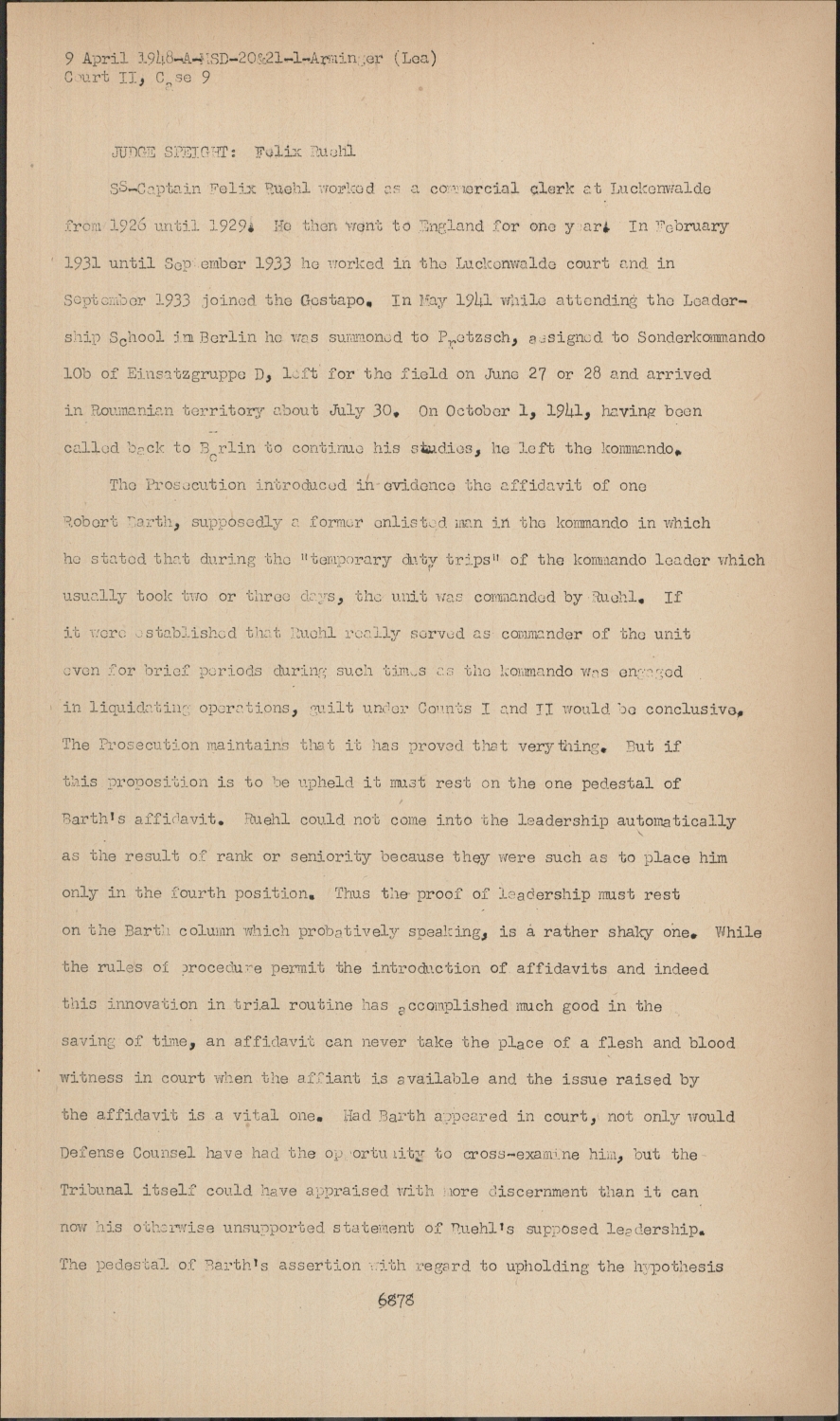
JUDGE SPEIGHT:Felix Ruehl SS-Captain Felix Ruehl worked as a commercial clerk at Luckenwalde from 1926 until 1929.
He then went to England for one year. In February 1931 until September 1933 he worked in the Luckenwalde court and in September 1933 joined the Gestapo. In May 1941 while attending the Leadership School in Berlin he was summoned to Pretzsch, assigned to Sonderkommando 10b of Einsatzgruppe D, left for the field on June 27 or 28 and arrived in Roumanian territory about July 30. On October 1, 1941, having been called back to Berlin to continue his studies, he left the kommando.
The Prosecution introduced in evidence the affidavit of one Robert Barth, supposedly a former onlisted man in the kommando in which he stated that during the "temporary duty trips" of the kommando leader which usually took two or three days, the unit was commanded by Ruehl. If it were established that Ruehl really served as commander of the unit even for brief periods during such times as the kommando was engaged in liquidating operations, guilt under Counts I and II would be conclusive. The Prosecution maintains that it has proved that verything. But if this proposition is to be upheld it must rest on the one pedestal of Barth's affidavit. Ruehl could not come into the leadership automatically as the result of rank or seniority because they were such as to place him only in the fourth position. Thus the proof of leadership must rest on the Barth column which probatively speaking, is a rather shaky one. While the rules of procedure permit the introduction of affidavits and indeed this innovation in trial routine has accomplished much good in the saving of time, an affidavit can never take the place of a flesh and blood witness in court when the affiant is available and the issue raised by the affidavit is a vital one. Had Barth appeared in court, not only would Defense Counsel have had the opportunity to cross-examine him, but the Tribunal itself could have appraised with more discernment than it can now his otherwise unsupported statement of Ruehl's supposed leadership. The pedestal of Barth's assertion with regard to upholding the hypothesis of Ruehl's leadership must withstand the successive hammer blows of, first, the unexplained absence of the affiant, secondly, Ruehl's low rank in the hierarchy of the unit and, thirdly, the fact that normally an administrative officer would not have executive functions.
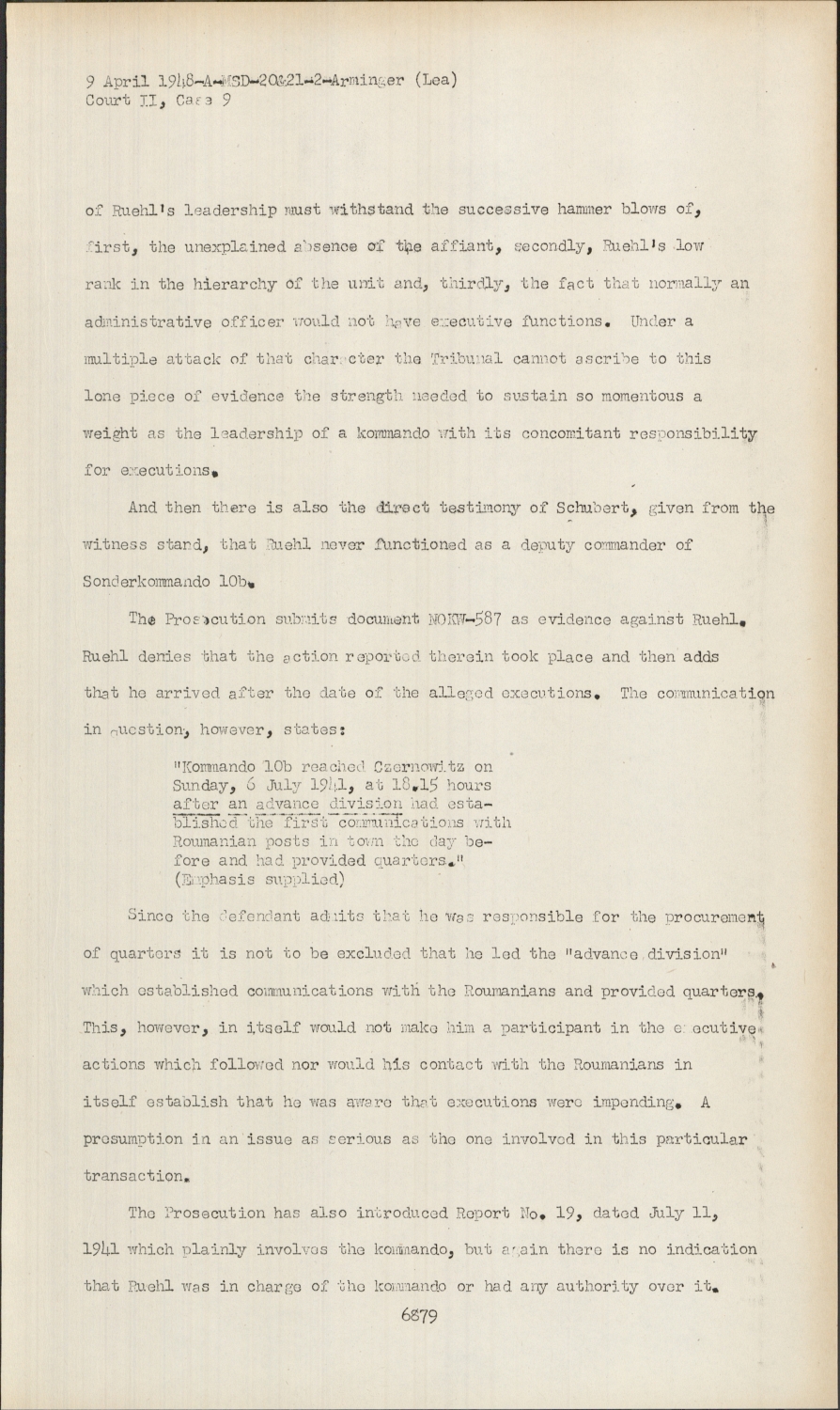
Under a multiple attack of that character the Tribunal cannot ascribe to this lone piece of evidence the strength needed to sustain so momentous a weight as the leadership of a kommando with its concomitant responsibility for executions.
And then there is also the direct testimony of Schubert, given from the witness stand, that Ruehl never functioned as a deputy commander of Sonderkommando 10b.
The Prosecution submits document NOKW-587 as evidence against Ruehl. Ruehl denies that the action reported therein took place and then adds that he arrived after the date of the alleged executions. The communication in question, however, states:
"Kommando 10b reached Czernowitz on Sunday, 6 July 1941, at 18.
15 hours after an advance division had esta blished the first communications with Roumanian posts in town the day be fore and had provided quarters."
(Emphasis supplied)
Since the defendant admits that he was responsible for the procurement of quarters it is not to be excluded that he led the "advance division" which established communications with the Roumanians and provided quarters. This, however, in itself would not make him a participant in the executive actions which followed nor would his contact with the Roumanians in itself establish that he was aware that executions were impending. A presumption in an issue as serious as the one involved in this particular transaction.
The Prosecution has also introduced Report No. 19, dated July 11, 1941 which plainly involves the kommando, but again there is no indication that Ruehl was in charge of the kommando or had any authority over it.
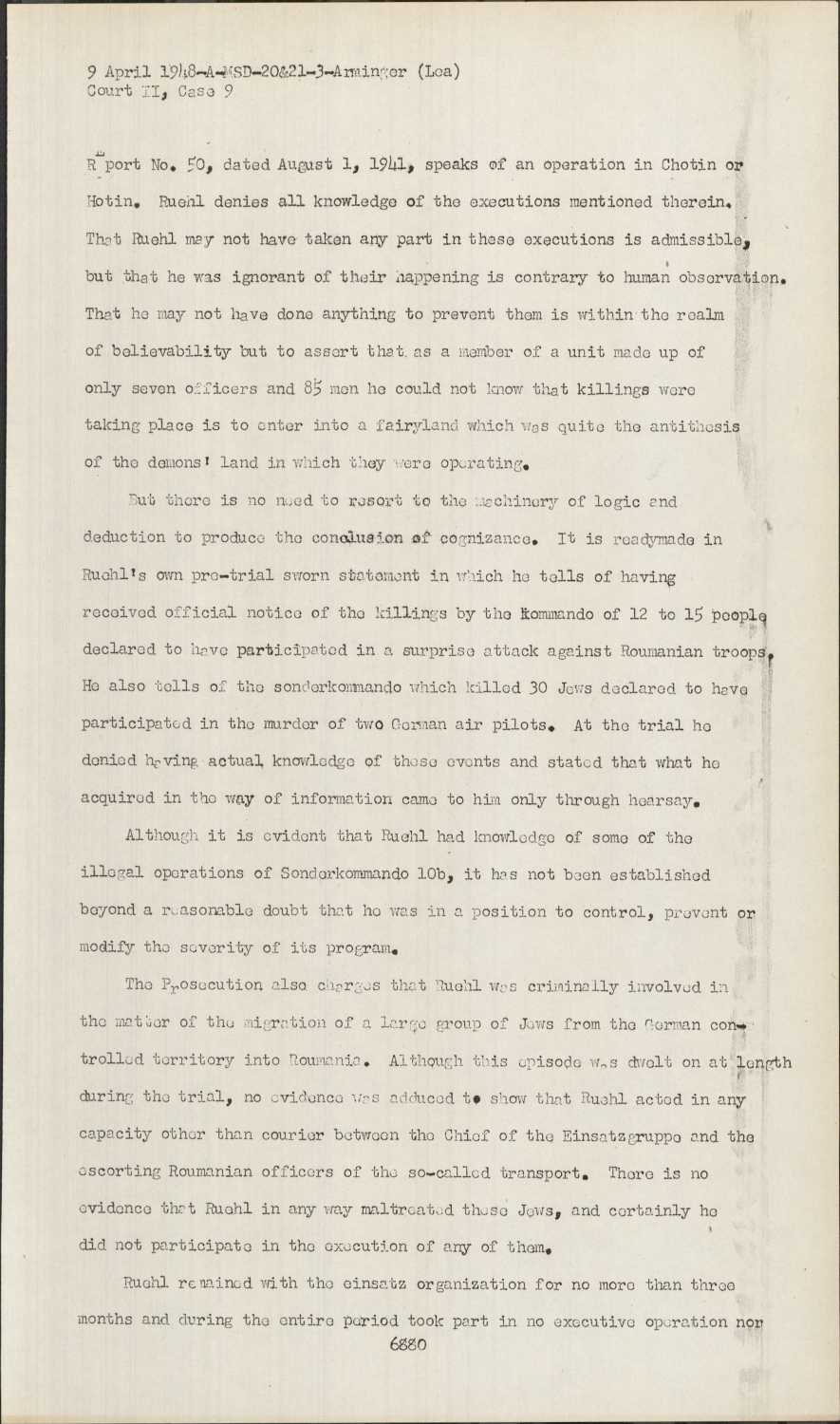
Report No. 50, dated August 1, 1941, speaks of an operation in Chotin or Hotin. Ruehl denies all knowledge of the executions mentioned therein. That Ruehl may not have taken any part in these executions is admissible, but that he was ignorant of their happening is contrary to human observation. That he may not have done anything to prevent them is within the realm of believability but to assert that as a member of a unit made up of only seven officers and 85 men he could not know that killings were taking place is to enter into a fairyland which was quite the antithesis of the demons' land in which they were operating.
But there is no need to resort to the machinery of logic and deduction to produce the conclusion of cognizance. It is readymade in Ruehl's own pre-trial sworn statement in which he tells of having received official notice of the killings by the kommando of 12 to 15 people declared to have participated in a surprise attack against Roumanian troops. He also tells of the sonderkommando which killed 30 Jews declared to have participated in the murder of two German air pilots. At the trial he denied having actual knowledge of these events and stated that what he acquired in the way of information came to him only through hearsay.
Although it is evident that Ruehl had knowledge of some of the illegal operations of Sonderkommando 10b, it has not been established beyond a reasonable doubt that he was in a position to control, prevent or modify the severity of its program.
The Prosecution also charges that Ruehl was criminally involved in the matter of the migration of a large group of Jews from the German controlled territory into Roumania. Although this episode was dwelt on at length during the trial, no evidence was adduced to show that Ruehl acted in any capacity other than courier between the Chief of the Einsatzgruppe and the escorting Roumanian officers of the so-called transport. There is no evidence that Ruehl in any way maltreated these Jews, and certainly he did not participate in the execution of any of them.
Ruehl remained with the einsatz organization for no more than three months and during the entire period took part in no executive operation nor did his low rank place him automatically into a position where his lack of objection in any way contributed to the success of any executive operation.
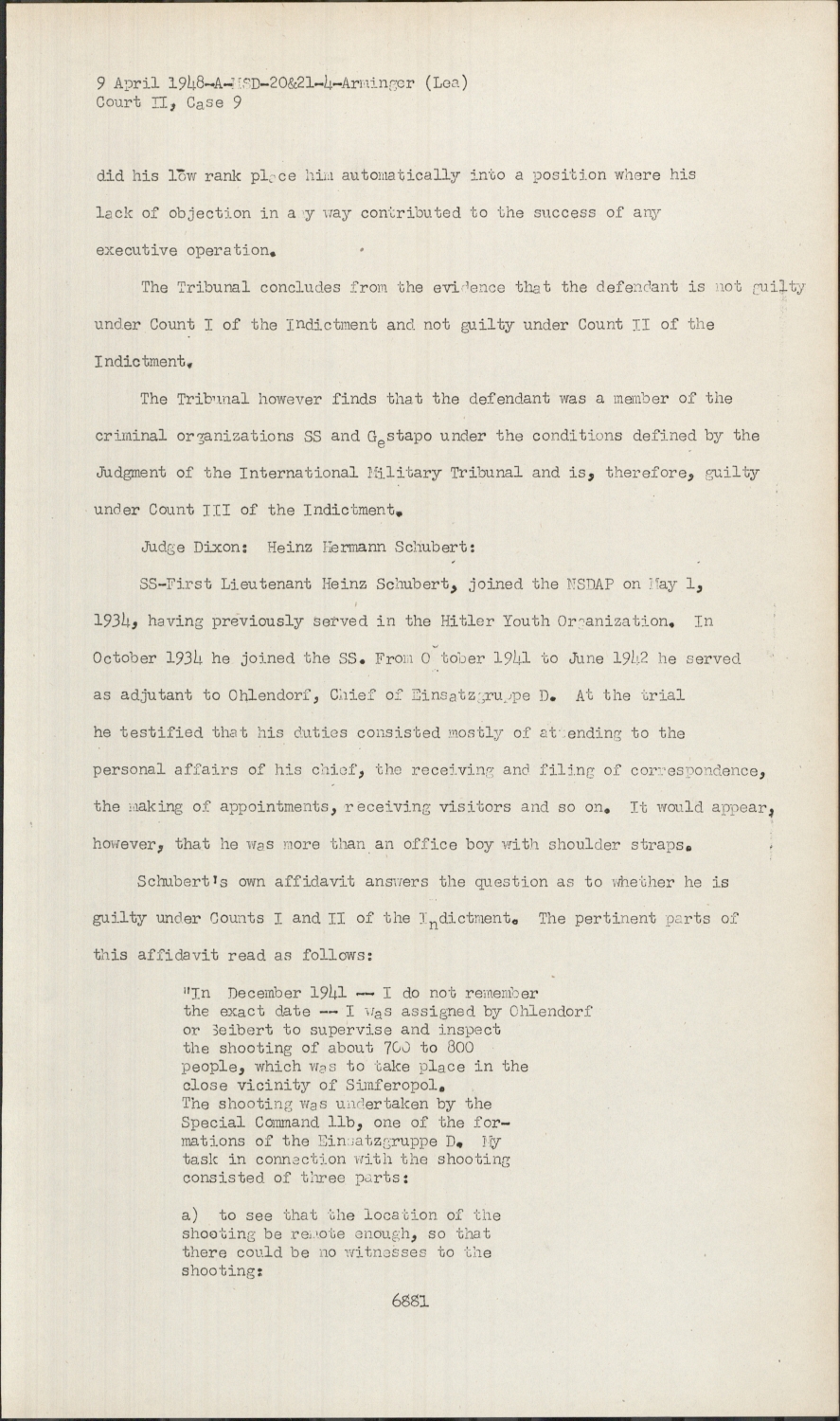
The Tribunal concludes from the evidence that the defendant is not guilty under Count I of the Indictment and not guilty under Count II of the Indictment.
The Tribunal however finds that the defendant was a member of the criminal organizations SS and Gestapo under the conditions defined by the Judgment of the International Military Tribunal and is, therefore, guilty under Count III of the Indictment.
Judge Dixon: Heinz Hermann Schubert:
SS-First Lieutenant Heinz Schubert, joined the NSDAP on May 1, 1934, having previously served in the Hitler Youth Organization. In October 1934 he joined the SS. From October 1941 to June 1942 he served as adjutant to Ohlendorf, Chief of Einsatzgruppe D. At the trial he testified that his duties consisted mostly of attending to the personal affairs of his chief, the receiving and filing of correspondence, the making of appointments, receiving visitors and so on. It would appear, however, that he was more than an office boy with shoulder straps.
Schubert's own affidavit answers the question as to whether he is guilty under Counts I and II of the Indictment. The pertinent parts of this affidavit read as follows:
"In December 1941 -- I do not remember the exact date -- I was assigned by Ohlendorf or Seibert to supervise and inspect the shooting of about 700 to 800 people, which was to take place in the close vicinity of Simferopol.
The shooting was undertaken by the Special Command lib, one of the for mations of the Einsatzgruppe D. My task in connection with the shooting consisted of three parts:
a) to see that the location of the shooting be remote enough, so that there could be no witnesses to the shooting: