"I was requested to make statements con cerning the number of executions, which in my estimation were carried out by the kommando according to orders during my time as leader of the Sonderkommando 4b.To this I must state the following:
In the absence of records I am no longer able to give such information.
An estimated number would lack any basis of fact.
For this reason and those reasons stated above, I cannot give such an estimate."
This statement that he was unable even to estimate the number of executions performed by the kommando during the time he was its chief is practically conclusive, if words have any meaning, that the number was a very large one. There is additional reason for this conclusion, in suite of his mentioning specifically three or four executions. His long eight-page description of executions is written in a manner and style which reveals irrefutably that mass killings former a regular routine to him and were not unusual events. A few sentences taken from this volunteered statement are quite illuminating on this point:
"The executions were effected by shooting from the nearest sure-aim distance.
That distance, as I recall it, was not more than 8-10 paces.
The seeumption that the shootings were effected 'by revolver' does not correspond with the facts.
I have already explained that during my interrogation of the 14/7/47.
"I must once again energetically repudiate the assumption that the shootings were carried out in a mean manner, e.g., in the form of mass shootings by machine gun bursts from a considerable distance or by shooting in the neck or in an otherwise lowdown manner."
"After quiet reflection I am bound to state that I cannot say exactly which of the two weapons was used in the individual cases.
The Sonderkommando 4b was equipped partly with sub-machine guns--I believe predominantly with these--and partly with rifles.
"Moral sufferings for the victims as well as for the members of the execution command were to be avoided as far as possible.
Thus great care was to be taken that a person waiting to be executed would not be eve witness to a preceding shooting, and that the corpses of people shot would be removed before a further execution took place."
"I myself watched a few executions. Where possible this was done in a manner so as to surprise the execution command by my sudden appearance.
During this I saw nothing which indicated that the consi derations enumerated were "being dis regarded."
"Occasionally officers or authorized persons also attended the executions as representatives or deputies of their appropriate offices."
"I still remember that the absolutely necessary insuring of instantaneous death without previous mere wounding was brought up during those discussions, and that it was emphasized to aim at the head as a sure guarantee for instantaneous death."
"I recall that the executions were effected from one side of the hill or the access to the groove, and that the corpses, after the conclusion of each execution, were carried to a grave prepared on the other side."
"As far as I remember in the executions which I attended, one to three persons were led to the place of execution at intervals and shot together."
"In those executions which I attended, death was instantaneous.
Immediately after the execution the leader and the medical orderly went to the dead and personally satisfied themselves that they were really dead.
I do not recall either ever having heard a cry of pain."
"As to the composition of the execution command, the rule existed that under no circumstances so-called 'shooting kom mandos' were formed, that is to say, that for the different executions not always the same men were to be used.
The leader of each execution command varied his choice of non according to these directives and assigned them on the day before the execution."
These borrowing details, announced with the insouciance of an expert with long experience, belies the defendant's assertion on the witness stand teat his kommando conducted only four executions with aamaximum of sixty deaths.
As above indicated, the defendant claimed that every executee was given the benefit of a hearing, but no evidence was adduced to indicate the character of the charges brought against the arrestees except the general statement that they were partisans, saboteurs, looters or Communist activists.
Nor was there any evidence that these persons recieved a trial. Furthermore, the large number of victims and the haste with which they were executed would demonstrate, considering the time element, the impossibility of trials for all of them. As a matter of fact the defendant testified that Streckenbach pointed out to him that in the East there would be no "formal court proceedings such as we were accustomed to carrying out in the Homeland, in the Police Courts, or another court." And on the contrary, he was instructed that the procedure was to follow the decree of the highest political authorities and it is a matter of record that all einsatz units had received the Fuehrer decree. The Fuehrer-Order, of course, provided for no trial whatsoever. The Tribunal is convinced that the civilians shot by Sonderkommando 4b under Haensch's leadership did not receive the trial intended by the Rules of War and International Law. The credible evidence shows, further that if there were any proceedings they were entirely of an ephemeral nature.
The defendant testified that he was thoroughly familiar with the cases of the sixty persons executed by his kommando:
"Yes, I knew exactly about the individual cases -- that is to say, the decision in both those executions in the Gorlovka district.
I also knew about the other executions and I was able to convince myself that these were only cases which occurred in accordance with law and order, and where the people concerned were actually proven violators against the laws of war and against security of the people."
Later he said that sub-kommando leaders could make independent decisions, but when he was asked:
"Would you have been able to reverse the decision of the sub-kommando leader if you would havebeen of the opinion that the execution of a certain indi vidual was not justified?"
he replied:
"Yes, without any trouble. If I had become convinced that something was not quite in order, I certainly would have been able to do that."
It developed then that the sixty who were executed by his kommando were killed under his orders:
"Q. There were sixty people killed under your orders?
A. Yes."
He was new asked whether he investigated these sixty cases before he pronounced the death sentence.
"Q. Now, how many of these sixty cases did you investigate yourself, or revised the evidence on?
A. The evidence? I only looked through the evidence and made a final decision for about twenty-five cases, and seven that -Q. All right.
A. (Continuing) came thereafter.
Q. That is thirty-two that you investigated yourself?
A. Yes.
Q. So that means that twenty-eight went to their deaths under your orders without your having reviewed the evidence?
A. No.
Q. Sixty were killed under your orders?
A. Yes.
Q. Thirty-two you investigated?
A. Yes."
In spite of this very definite pronouncement, the defendant later went on to say that no investigated the sixty cases. The defendant's manner of testifying, his shifting and evasive attitude while discussing this subject, convince the Tribunal that he did not tell the entire truth about the sixty alleged investigations. The defendant stated that some of the killings had been ordered by the Army, but that he reviewed those cases also. It developed, however, that no written report was made so that it is not clear, if he had no personal knowledge of the facts and received no written report, how he could review the cases. His explanation, which is obviously no explanation, follows:
"....these cases of executions which I was questioned on in Barvenkova became known to me when by accident I happened to the place, and the corresponding report about the respective orders of the Army units were given to me for information.
Today, I cannot state exactly, from memory or with certainty, that the subcommander received this order from the military officer, who had the right to give this order, and he was also told the crime itself which had been committed by the defendants.
I Considered this type of handling not correct, and I expressed my opinion to this effect at the AOK, namely, that in my opinion the Army when it conducted the investigation and made the decision itself should carry out the execution by its own kommandos."
Much of the defendant's testimony, even if believable, does not exculpate him. Much is simply not worthy of belief. For instance, when he says that Streckenbach, who was the man responsible for the announcement of the Fuehrer-Order in Pretzsch, said nothing to him about this momentous program as he was about to depart for the East, Haensch utters an obvious falsehood. when he says that in his conversation with Heydrich, Heydrich was silent about the Fuehrer-Order, he declares what is incredible. And even, more incredible is his statement that the very Chief of the Einsatzgruppe, under whom he was to operate, remained mute on the subject of the Order of the head of the State, the very Order which brought the Einsatzgruppen into being. And then one can only dismiss as fantastic the declaration of the defendant that his predecessor who had admittedly executed thousands of Jews under the Fuehrer-Order, and whose program Haensch was to continue, said nothing to Haensch about that program. And when Haensch boldly uttered that the first time he ever had any inkling of the Fuehrer-Order was when he arrived in Nuremberg six years later, he entered into a category of incredulousness which defies characterization.
The guilt of the defendant in the commission of War Crimes and Crimes against Humanity has been clearly and conclusively established. From all the evidence in the case the Tribunal finds the defendant guilty under Counts I and II of the Indictment.
The tribunal Also finds that the defendant was a member of the criminal organizations SS and SD under the conditions defined by the Judgment of the International Military Tribunal and is, therefore, guilty under Count III of the Indictment.
JUDGESPAIGHT: (reading) GUSTAV NOSSKE SS-Lieutenant Colonel Nosske studied banking, economics and law, passed his examinations as assessor in 1934 and entered the Administration of Justice at Halle.
In June 1935 he became employed in the National Ministry of the Interior at Aachen and then transferred to the Gestapo. From June 19, 1941, until March 1942, he served as commander of Einsatzkommando 12.
He testified that he morally opposed the Fuehrer-Order but did not put it into effect because it was his good fortune never to have been in a position where he had to execute the order. When he was asked if he had been called upon to shoot 500 Jews under the Fuehrer-Order whether he would have done as, he replied:
"If I had been in a situation where the Einsatzgruppe chief would have been in a position to reprimand me for disobeying the Hitler order, and had stressed it, then probably I would have done it."
Later, he said that if he were confronted with such a situation he would take the matter up with his conscience:
"Q. .....you are before 500 innocent people, men, women, and children -- Jews -- and you are presented with this order to kill them.
Now, are you going to confer with your conscience and, if so, what is going to be your conclusion?
A. I would have taken it upon my conscience.
Q. And you would have killed them?
A. I would have probably done it."
But he did face situations which were not hypothetical.
Report No. 61, referring to Einsatzkommando 12, says:
"......Only in Babtschinzy resistance was partially shown toward and orderly harvesting caused at the instigation of Jewish inhabitants and such Jews, who had only come to this terrigoty a few months ago.
By spying on the population, those Jews had already created a basis for numerous deportations to Siberia.
As a counter-measure, 94 Jews were executed."
The defendant on the witness stand admitted that this execution was carried out by one of his detachments, but declared that the execution was legal because the executees had sabotaged farm machinery and crops. The defendant's explanation is in flat contradiction to the report which specifically states that the 94 Jews were killed as a counter-measure. The phrase "counter-measure" carries no implication of guilt on the part of the victims and killing such victims can only be a crime.
The defendant said he did not learn of the execution until after it had taken place, but admits that it was done by members of his kommando. He admitted further the possibility that the Fuehrer-Order figured in the decision of the sub-kommando leader to perform the execution. He asserts that his sub-komnando leader conducted investigations before shooting the Jews, but he made no independent inquiries to determine whether the executions were warranted. Taking him at his word, his acceptance without inquiry of the killing of 94 persons was a demonstration of criminal and wanton indifference which might well have induced his men to further illegal and unjustified executions.
The defendant spoke of a period when he was absent from the kommando, but admitted that there were shootings under his authority even though he did not know the number.
"Then comes the period of time from the end of August until October where the command of the kommando was taken over by somebody else, and I am not at all certain about the figure of those shot, and I am not sure how many were shot on my responsibility during that time."
The defendant explained that in January and February of 1942 the severe weather prevented any activities on the part of his kommando. It is a fact that Report No. 178 said:
"Kommando 12 had to limit its activities to the villages and closer vicinity of the branched-off sub-kommando posts, because of extreme cold and snowstorms and unpassable streets."
But it also said:
"From the 16 to 28 February 1942, 1,515 persons were shot, 729 of these were Jews.
271 Communists, 74 partisans, 421 Gypsies, as asocials and saboteurs."
While all these killings are not to be charged to Sonderkommando 12, it does refute the statement that Sonderkommando 12 was entirely immobilized during the period in question. Nor was it immobilized, according to Report No. 165, which, covering events in January 1942, said:
"Besides, 2 further Teilkommandos were established with the assistance of men of the Einsatzkommando 12 for the purpose of combing out the northern Crimea."
Then there was the episode of the Roumanian Jews. The prosecution contended that the defendant was involved in a forced migration of Jews from German-controlled territory into Roumania, and that in the operation some of the Jews were shot. The defendant admitted that he had led some 6,000 to 7,000 Jews across the Dnjestr River, but denied that in this movement any of the Jews were shot. In fact he endeavored to convey the impression that in this particular affair a great favor had been done the Jews in repatriating them. A witness, Harsch, called to testify on the subject stated that he witnessed the arrival of the Jews on the Roumanian side of the river, and that once they had gained that point they evinced their gratitude to the German escort by crying "Heil Hitler". Although this contingent of Jews escaped the German firing squad by leaving German territory, it is not so certain what fate awaited them in Roumania. The defendant Nosske, in this regard, testified, as stated before in the General Opinion:
"I assume that the Roumanians wanted to get rid of them and sent them into the German territory so that we would have to shoot them and we would have the trouble of shooting them.
We didn't want to do the work for the Roumanians."
The witness Harsch said that later he saw these same Jews within barbed wire enclosures on Roumanian territory.
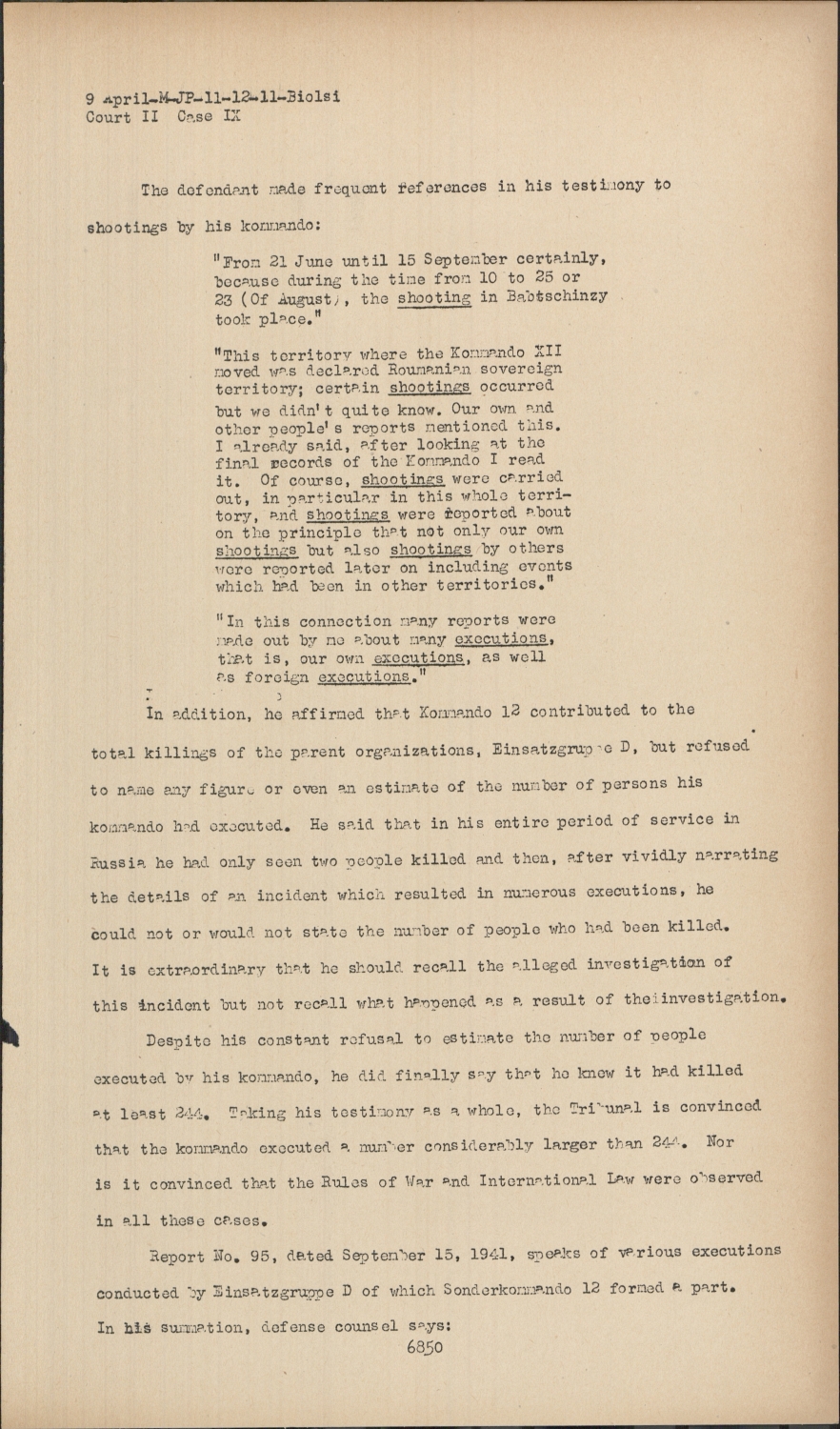
The defendant made frequent references in his testimony to shootings by his kommando:
"From 21 June until 15 September certainly, because during the time from 10 to 25 or 23 (Of August), the shooting in Babtschinzy took place."
"This territory where the Kommando XII moved was declared Roumanian sovereign territory; certain shootings occurred but we didn't quite know.
Our own and other people's reports mentioned this.
I already said, after looking at the final records of the Kommando I read it.
Of course, shootings were carried out, in particular in this whole terri tory, and shootings were reported about on the principle that not only our own shootings but also shootings by others were reported later on including events which had been in other territories."
"In this connection many reports were made out by me about many executions, that is, our own executions, as well as foreign executions."
In addition, he affirmed that Kommando 12 contributed to the total killings of the parent organizations, Einsatzgruppe D, but refused to name any figure or even an estimate of the number of persons his kommando had executed. He said that in his entire period of service in Russia he had only seen two people killed and then, after vividly narrating the details of an incident which resulted in numerous executions, he could not or would not state the number of people who had been killed. It is extraordinary that he should recall the alleged investigation of this incident but not recall what happened as a result of the investigation.
Despite his constant refusal to estimate the number of people executed by his kommando, he did finally say that he knew it had killed at least 244. Taking his testimony as a whole, the Tribunal is convinced that the kommando executed a number considerably larger than 244. Nor is it convinced that the Rules of War and International Law were observed in all these cases.
Report No. 95, dated September 15, 1941, speaks of various executions conducted by Einsatzgruppe D of which Sonderkommando 12 formed a part. In his summation, defense counsel says:
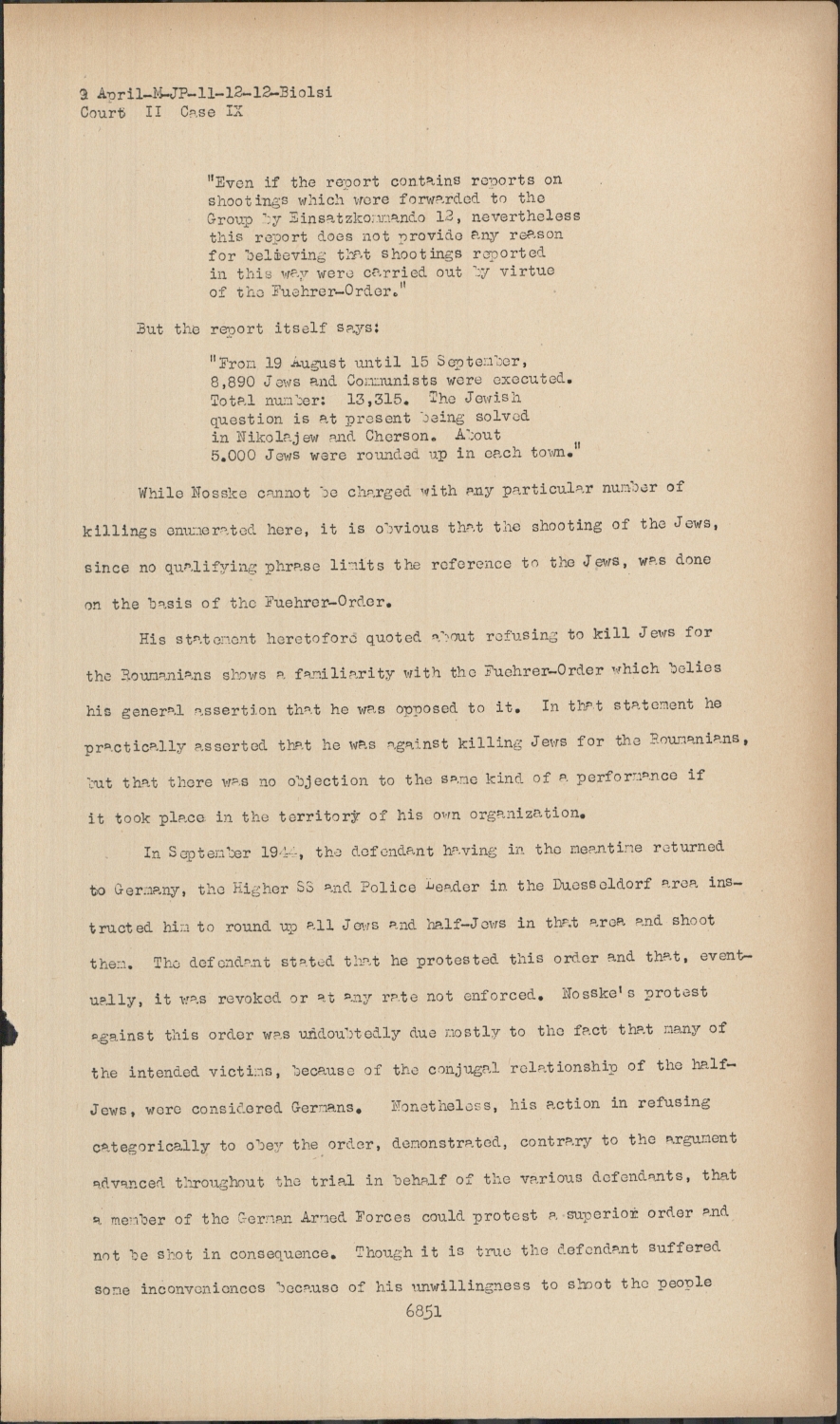
"Even if the report contains reports on shootings which were forwarded to the Group by Einsatzkommando 12, nevertheless this report does not provide any reason for believing that shootings reported in this way were carried out by virtue of the Fuehrer-Order."
But the report itself says:
"From 19 August until 15 September, 8,890 Jews and Communists were executed.
Total number: 13,315. The Jewish question is at present being solved in Nikolajew and Cherson.
About 5.000 Jews were rounded up in each town."
While Nosske cannot be charged with any particular number of killings enumerated here, it is obvious that the shooting of the Jews, since no qualifying phrase limits the reference to the Jews, was done on the basis of the Fuehrer-Order.
His statement heretofore quoted about refusing to kill Jews for the Roumanians shows a familiarity with the Fuehrer-Order which belies his general assertion that he was opposed to it. In that statement he practically asserted that he was against killing Jews for the Roumanians, but that there was no objection to the same kind of a performance if it took place in the territory of his own organization.
In September 1944, the defendant having in the meantime returned to Germany, the Higher SS and Police Leader in the Duesseldorf area instructed him to round up all Jews and half-Jews in that area and shoot them. The defendant stated that he protested this order and that, eventually, it was revoked or at any rate not enforced. Nosske's protest against this order was undoubtedly due mostly to the fact that many of the intended victims, because of the conjugal relationship of the halfJews, were considered Germans. Nonetheless, his action in refusing categorically to obey the order, demonstrated, contrary to the argument advanced throughout the trial in behalf of the various defendants, that a member of the German Armed Forces could protest a superior order and not be shot in consequence. Though it is true the defendant suffered some inconveniences because of his unwillingness to shoot the people of Duesseldorf, he was not shot or even degraded.
From all the evidence in the case the Tribunal finds that the defendant is guilty under Counts I and II of the Indictment.
The Tribunal also finds the defendant was a member of the criminal organizations SS, SD and Gestapo under the conditions defined by the Judgment of the International Military Tribunal and is, therefore, guilty under Count III of the Indictment.
THE PRESIDENT:The Tribunal will be in recess until one forty-five o'clock.
(The Tribunal recessed until 1345 hours.)
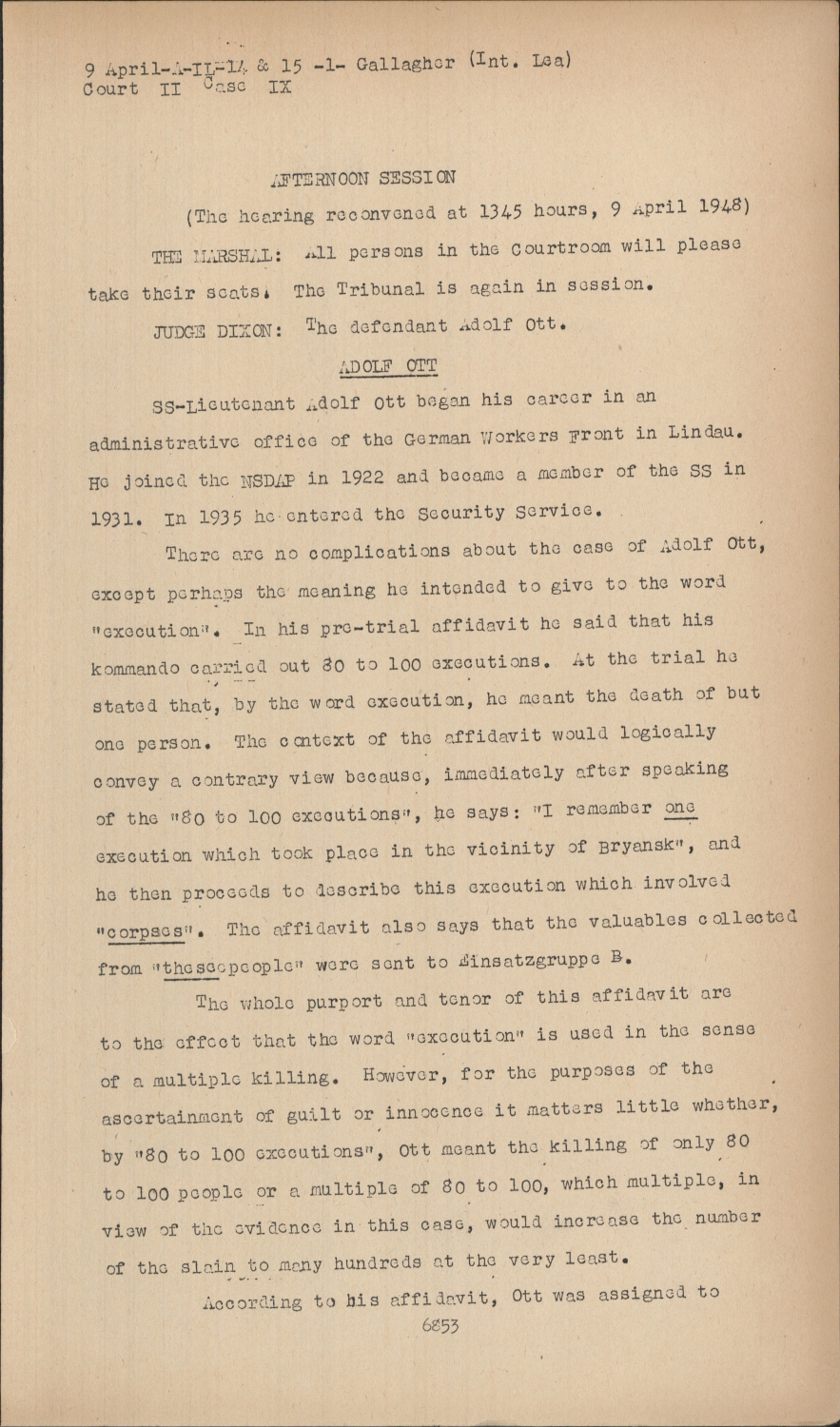
AFTERNOON SESSION (The hearing reconvened at 1345 hours, 9 April 1948)
THE MARSHAL:All persons in the Courtroom will please take their seats. The Tribunal is again in session.
JUDGE DIXON:The defendant Adolf Ott.
ADOLF OTT SS-Lieutenant Adolf Ott began his career in an administrative office of the German workers Front in Lindau.
He joined the NSDAP in 1922 and became a member of the SS in 1931. In 1935 he entered the Security Service.
There are no complications about the case of Adolf Ott, except perhaps the meaning he intended to give to the word "execution". In his pre-trial affidavit he said that his kommando carried out 80 to 100 executions. At the trial he stated that, by the word execution, he meant the death of but one person. The context of the affidavit would logically convey a contrary view because, immediately after speaking of the "80 to 100 executions", he says: "I remember one execution which took place in the vicinity of Bryansk", and he then proceeds to describe this execution which involved "corpses". The affidavit also says that the valuables collected from "theseepeople" were sent to Einsatzgruppe B.
The whole purport and tenor of this affidavit are to the effect that the word "execution" is used in the sense of a multiple killing. However, for the purposes of the ascertainment of guilt or innocence it matters little whether, by "80 to 100 executions", Ott meant the killing of only 80 to 100 people or a multiple of 80 to 100, which multiple, in view of the evidence in this case, would increase the number of the slain to many hundreds at the very least.
According to his affidavit, Ott was assigned to Sonderkommando 7b on February 15, 194-2, and, according to his testimony in court, he arrived at the headquarters of the kommando in Bryansk on February 19.
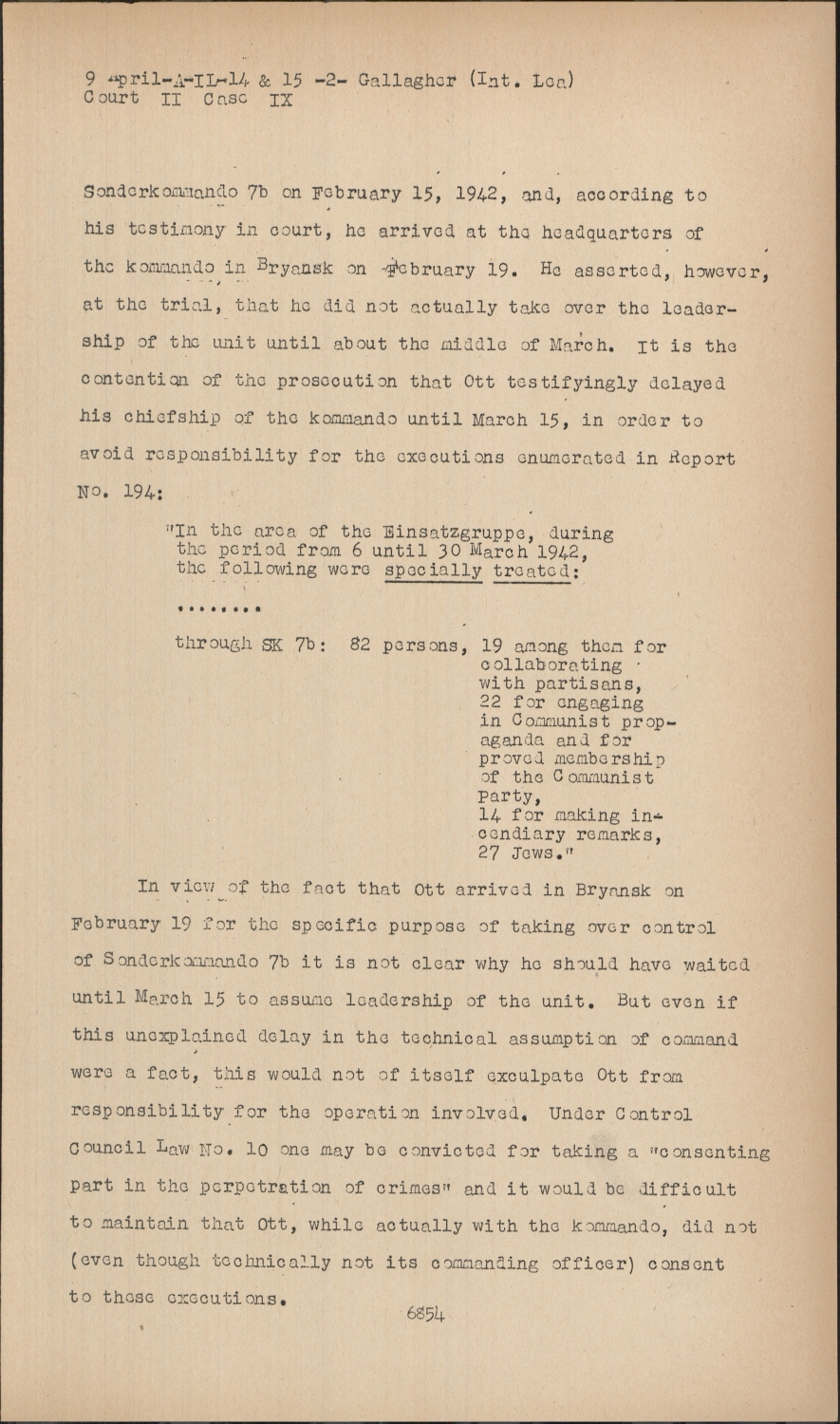
He asserted, however, at the trial, that he did not actually take over the leadership of the unit until about the middle of March. It is the contention of the prosecution that Ott testifyingly delayed his chief ship of the kommando until March 15, in order to avoid responsibility for the executions enumerated in Report No. 194:
"In the area of the Einsatzgruppe, during the period from 6 until 30 March 1942, the following were specially treated:
........
through SK 7b: 82 persons, 19 among then for collaborating with partisans, 22 for engaging in Communist prop aganda and for proved membership of the Communist Party, 14 for making in cendiary remarks, 27 Jews."
In view of the fact that ott arrived in Bryansk on February 19 for the specific purpose of taking over control of Sonderkommando 7b it is not clear why he should have waited until March 15 to assume leadership of the unit. But even if this unexplained delay in the technical assumption of command were a fact, this would not of itself exculpate Ott from responsibility for the operation involved. Under Control council Law No. 10 one may be convicted for taking a "consenting part in the perpetration of crimes" and it would be difficult to maintain that Ott, while actually with the kommando, did not (even though technically not its commanding officer) consent to these executions, In addition, it is to be observed that the report declared that the 82 persons enumerated therein were killed between March 6 and March 30.
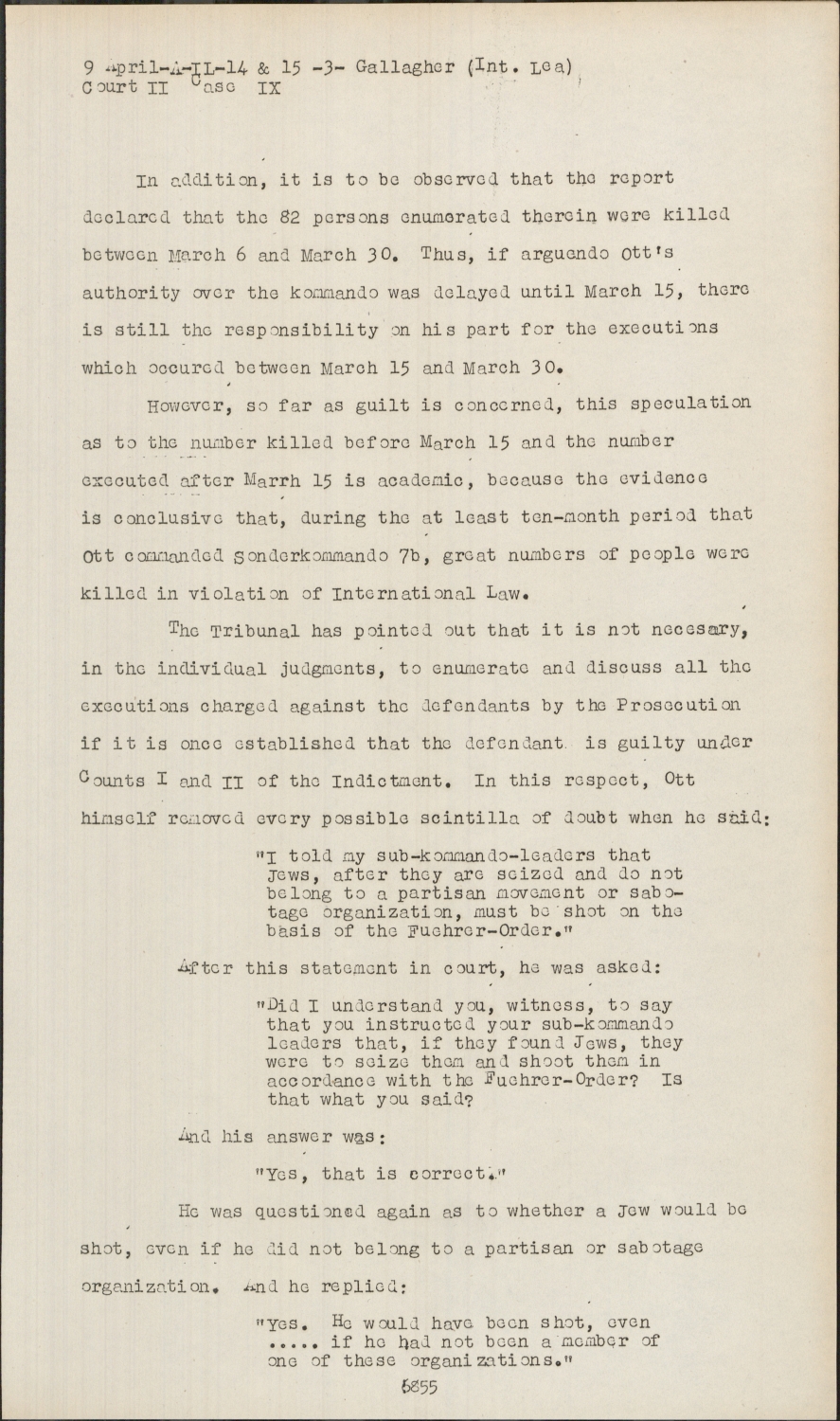
Thus, if arguendo Ott's authority over the kommando was delayed until March 15, there is still the responsibility on his part for the executions which occured between March 15 and March 30.
However, so far as guilt is concerned, this speculation as to the number killed before March 15 and the number executed after March 15 is academic, because the evidence is conclusive that, during the at least ten-month period that Ott commanded sonderkommando 7b, great numbers of people were killed in violation of international Law.
The Tribunal has pointed out that it is not necesary, in the individual judgments, to enumerate and discuss all the executions charged against the defendants by the Prosecution if it is once established that the defendant is guilty under Counts I and II of the Indictment. In this respect, Ott himself removed every possible scintilla of doubt when he said:
"I told my sub-kommando-leaders that Jews, after they are seized and do not belong to a partisan movement or sabo tage organization, must be shot on the basis of the Fuehrer-Order."
After this statement in court, he was asked:
"Did I understand you, witness, to say that you instructed your sub-kommando leaders that, if they found Jews, they were to seize them and shoot them in accordance with the Fuehrer-Order?
Is that what you said?
And his answer was:
"Yes, that is correct."
He was questioned again as to whether a Jew would be shot, even if he did not belong to a partisan or sabotage organization. And he replied:
"Yes. He would have been shot, even ..... if he had not been a member of one of these organizations."
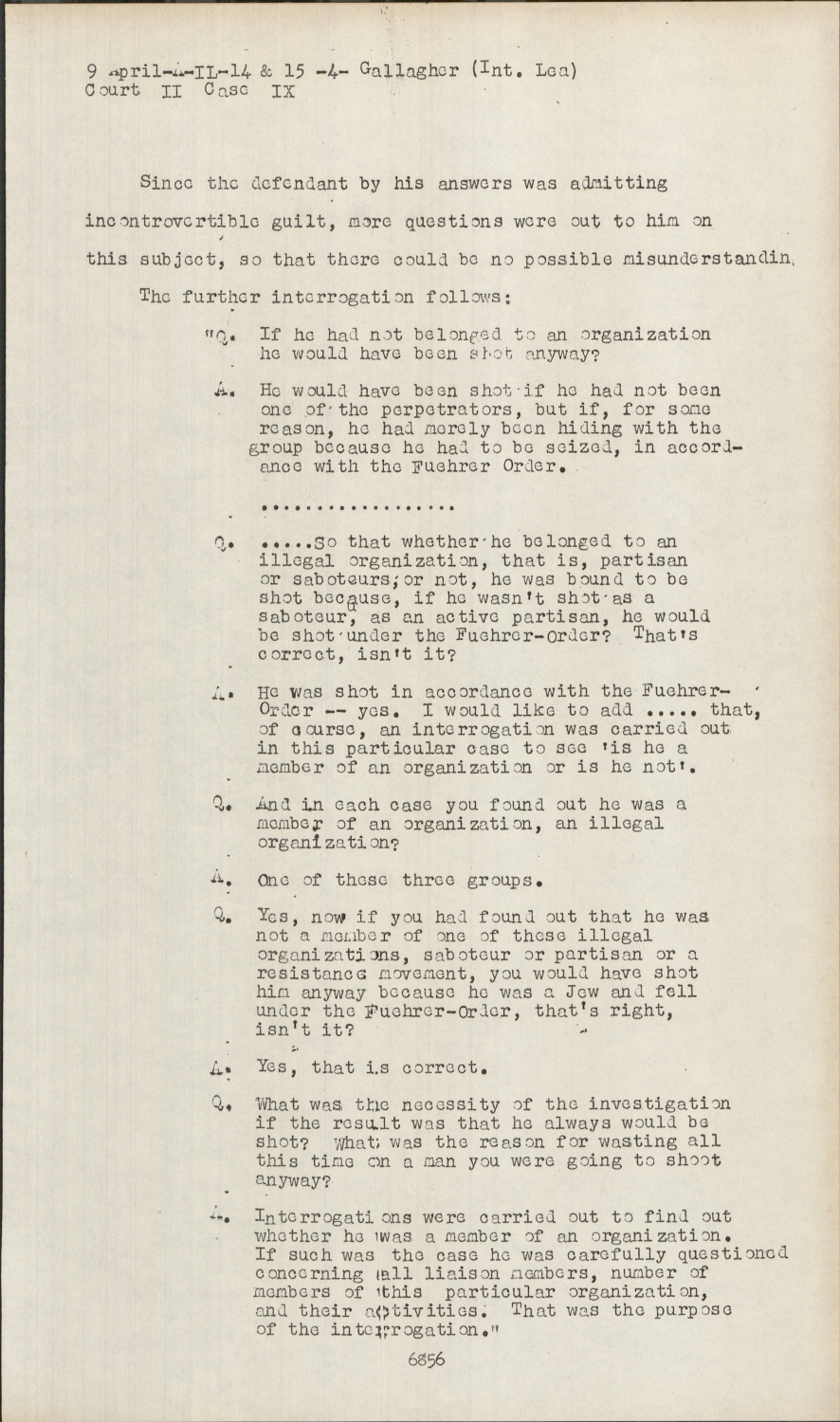
Since the defendant by his answers was admitting incontrovertible guilt, more questions were out to him on this subject, so that there could be no possible misunderstanding The further interrogation follows:
"Q. If he had not belonged to an organization he would have been shot anyway?
A. He would have been shot if he had not been one of the perpetrators, but if, for some reason, he had merely been hiding with the group because he had to be seized, in accord ance with the Fuehrer Order.
..................
Q. .....so that whether he belonged to an illegal organization, that is, partisan or saboteurs; or not, he was bound to be shot because, if he wasn't shot as a saboteur, as an active partisan, he would be shot under the Fuehrer-order?
That's correct, isn't it?
A. He was shot in accordance with the Fuehrer Order -- yes.
I would like to add..... that, of a course, an interrogation was carried out in this particular case to see 'is he a member of an organization or is he not'.Q. And in each case you found out he was a member of an organization, an illegal organization?
A. One of these three groups.
Q. Yes, now if you had found out that he was not a member of one of these illegal organizations, saboteur or partisan or a resistance movement, you would have shot him anyway because he was a Jew and fell under the Fuehrer-Order, that's right, isn't it?
A. Yes, that is correct.
Q. What was the necessity of the investigation if the result was that he always would be shot?
What; was the reason for wasting all this time on a man you were going to shoot anyway?
A. Interrogations were carried out to find out whether he was a member of an organization.
If such was the case he was carefully questioned concerning tall liaison members, number of members of this particular organization, and their activities.
That was the purpose of the interrogation."
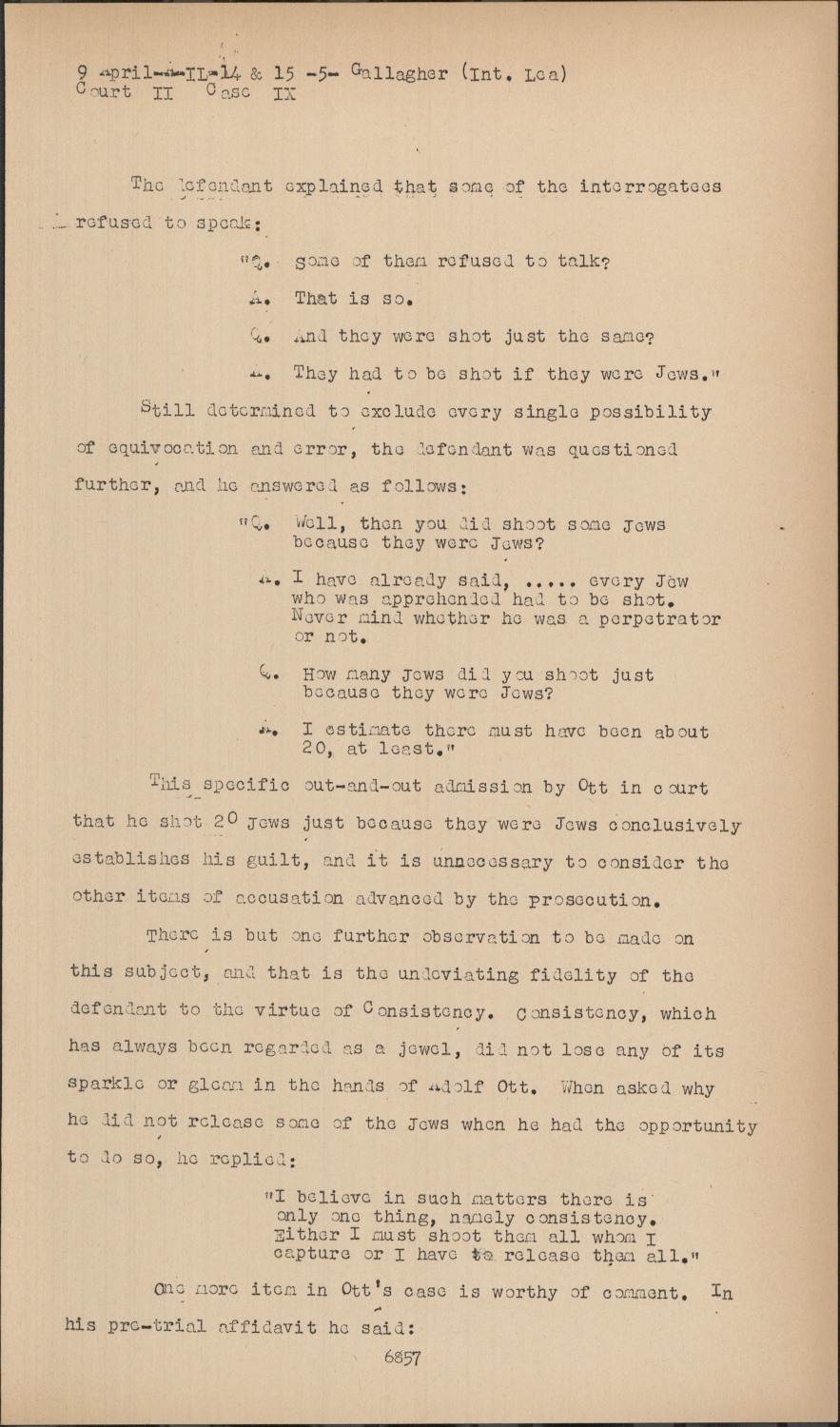
The defendant explained that some of the interrogatees refused to speak:
"Q. Some of them refused to talk?
A. That is so.
Q. They were shot just the same?
A. They had to be shot if they were Jews."
Still determined to exclude every single possibility of equivocation and error, the defendant was questioned further, and he answered as follows:
"Q. Well, then you did shoot some Jews because they were Jews?
A. I have already said, ..... every Jew who was apprehended had to be shot.
Never mind whether he was a perpetrator or not.
Q. How many Jews did you shoot just because they were Jews?
A. I estimate there must have been about 20, at least."
This specific out-and-out admission by Ott in court that he shot 20 Jews just because they were Jews conclusively establishes his guilt, and it is unnecessary to consider the other items of accusation advanced by the prosecution.
There is but one further observation to be made on this subject, and that is the undeviating fidelity of the defendant to the virtue of Consistency. consistency, which has always been regarded as a jewel, did not lose any of its sparkle or glean in the hands of Adolf Ott. When asked why he did not release some of the Jews when he had the opportunity to do so, he replied:
"I believe in such matters there is only one thing, namely consistency.
Either I must shoot then all whom I capture or I have to release them all."
One more item in Ott's case is worthy of comment. In his pre-trial affidavit he said:
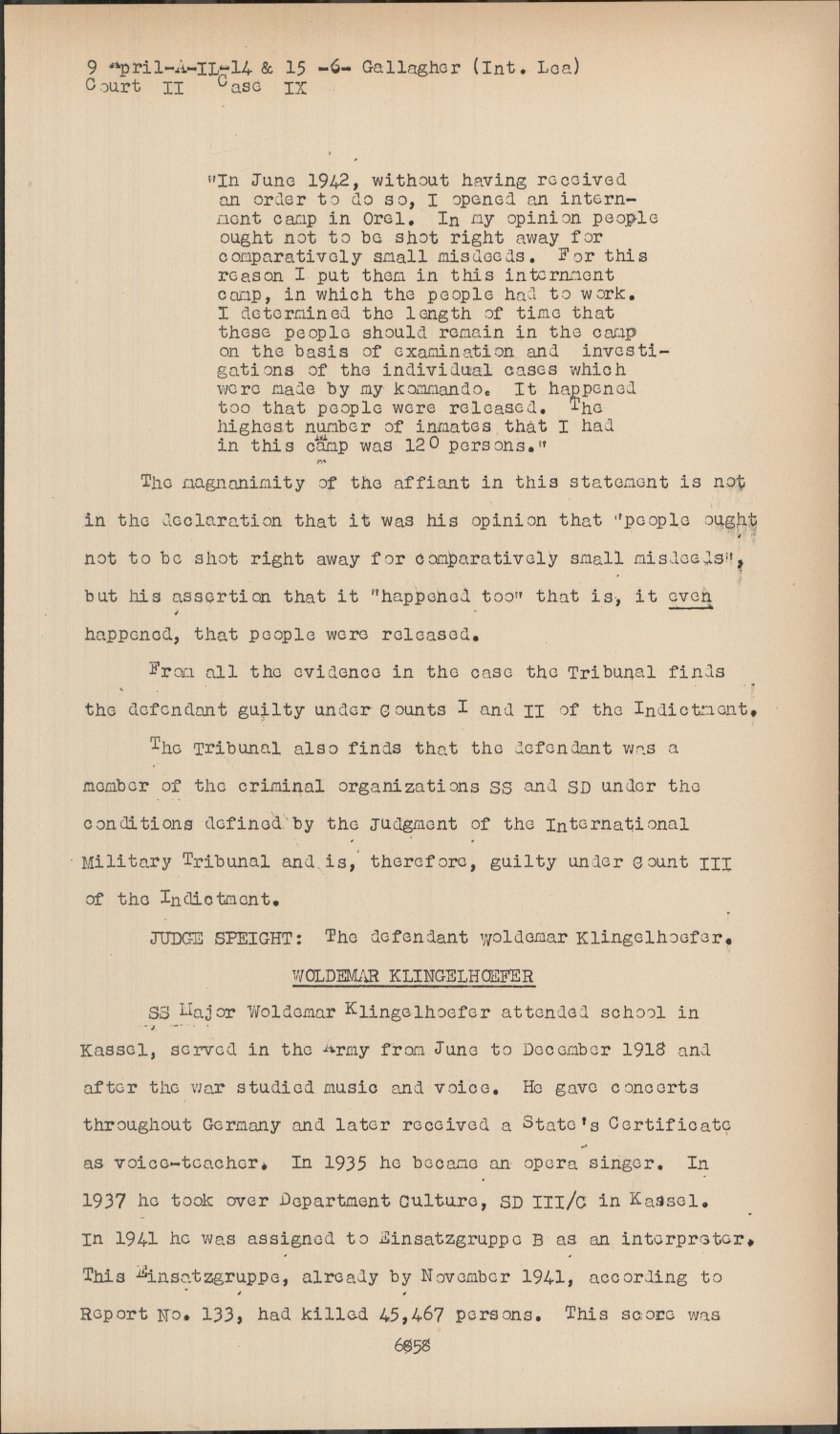
"In June 1942, without having received an order to do so, I opened an intern ment camp in Orel.
In my opinion people ought not to be shot right away for comparatively snail misdeeds.
For this reason I put them in this internment camp, in which the people had to work.
I determined the length of time that these people should remain in the camp on the basis of examination and investi gations of the individual cases which were made by my kommando.
It happened too that people were released.
The highest number of inmates that I had in this camp was 120 persons."
The magnanimity of the affiant in this statement is not in the declaration that it was his opinion that people ought not to be shot right away for comparatively small misdeeds", but his assertion that it "happened too" that is, it even happened, that people were released.
From all the evidence in the case the Tribunal finds the defendant guilty under counts I and II of the Indictment.
The Tribunal also finds that the defendant was a member of the criminal organizations SS and SD under the conditions defined by the Judgment of the International Military Tribunal and is, therefore, guilty under count III of the Indictment.
JUDGE SPEIGHT:The defendant Woldemar Klingelhoefer.
WOLDEMAR KLINGSLHOEFER
SSMajor Woldemar Klingelhoefer attended school in Kassel, served in the Army from June to December 1918 and after the war studied music and voice. He gave concerts throughout Germany and later received a State's Certificate as voice-teacher. In 1935 he became an opera singer. In 1937 he took over Department culture, SD III/c in Kassel. In 1941 he was assigned to Einsatzgruppe B as an interpreter, This Einsatzgruppe, already by November 1941, according to Report No. 133, had killed 45,467 persons. This score was considerably increased later.
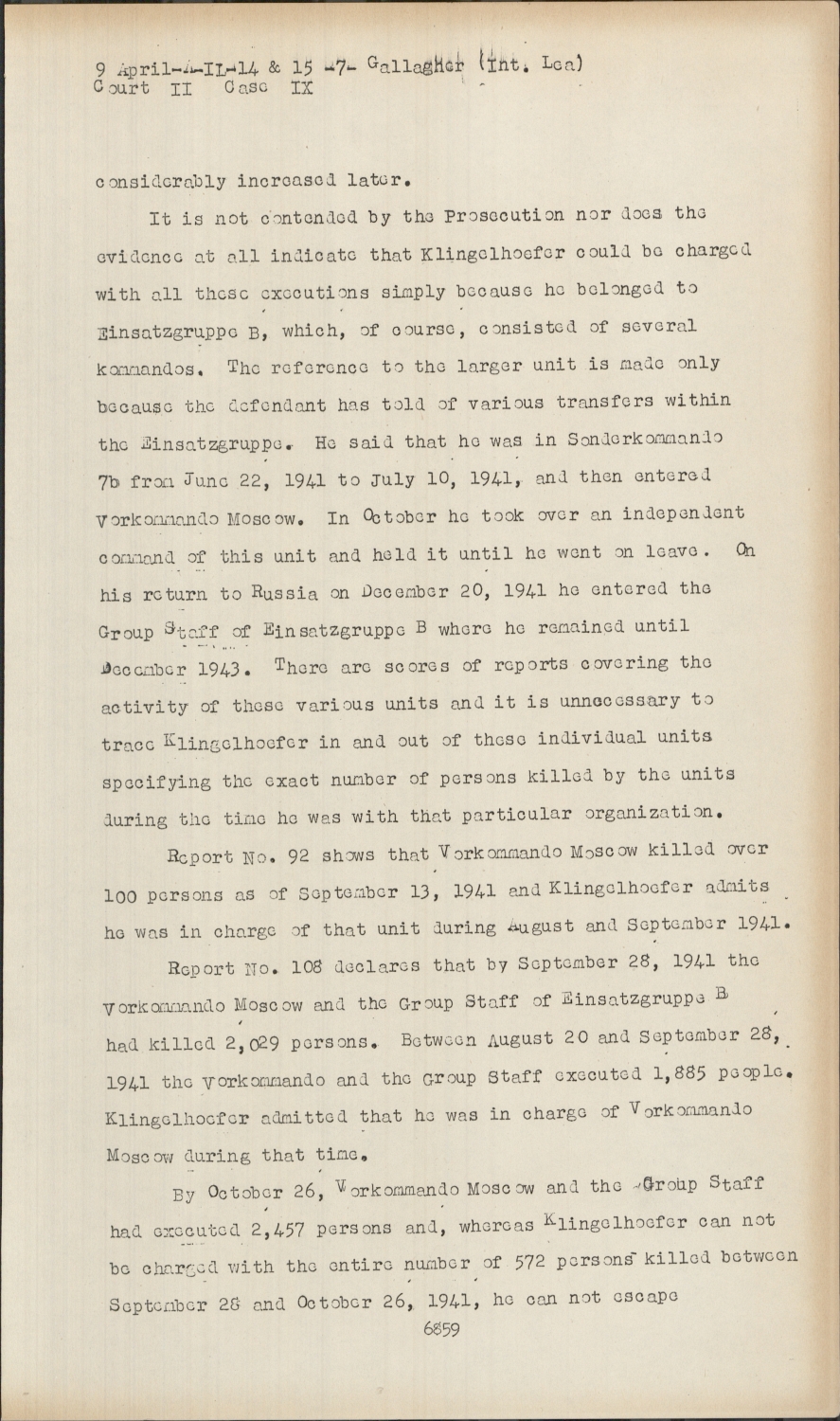
It is not contended by the Prosecution nor does the evidence at all indicate that Klingelhoefer could be charged with all these executions simply because he belonged to Einsatzgruppe B, which, of course, consisted of several kommandos. The reference to the larger unit is made only because the defendant has told of various transfers within the Einsatzgruppe. He said that he was in Sonderkommando 7b from June 22, 1941 to July 10, 1941, and then entered Vorkommando Moscow. In October he took over an independent command of this unit and held it until he went on leave. On his return to Russia on December 20, 1941 he entered the Group Staff of Einsatzgruppe B where he remained until December 1943. There are scores of reports covering the activity of these various units and it is unnecessary to trace Klingelhoefer in and out of these individual units specifying the exact number of persons killed by the units during the time he was with that particular organization.
Report No. 92 shows that Vorkommando Moscow killed over 100 persons as of September 13, 1941 and Klingelhoefer admits he was in charge of that unit during August and September 1941.
Report No. 108 declares that by September 28, 1941 the Vorkommando Moscow and the Group Staff of Einsatzgruppe B had killed 2,029 persons. Between August 20 and September 28, 1941 the Vorkommando and the Group Staff executed 1,885 people. Klingelhoefer admitted that he was in charge of Vorkommando Moscow during that time.
By October 26, Vorkommando Moscow and the Group Staff had executed 2,457 persons and, whereas Klingelhoefer can not be charged with the entire number of 572 persons killed between September 28 and October 26, 1941, he can not escape responsibility for some of these killings since in this period he commanded part of Vorkommando Moscow.
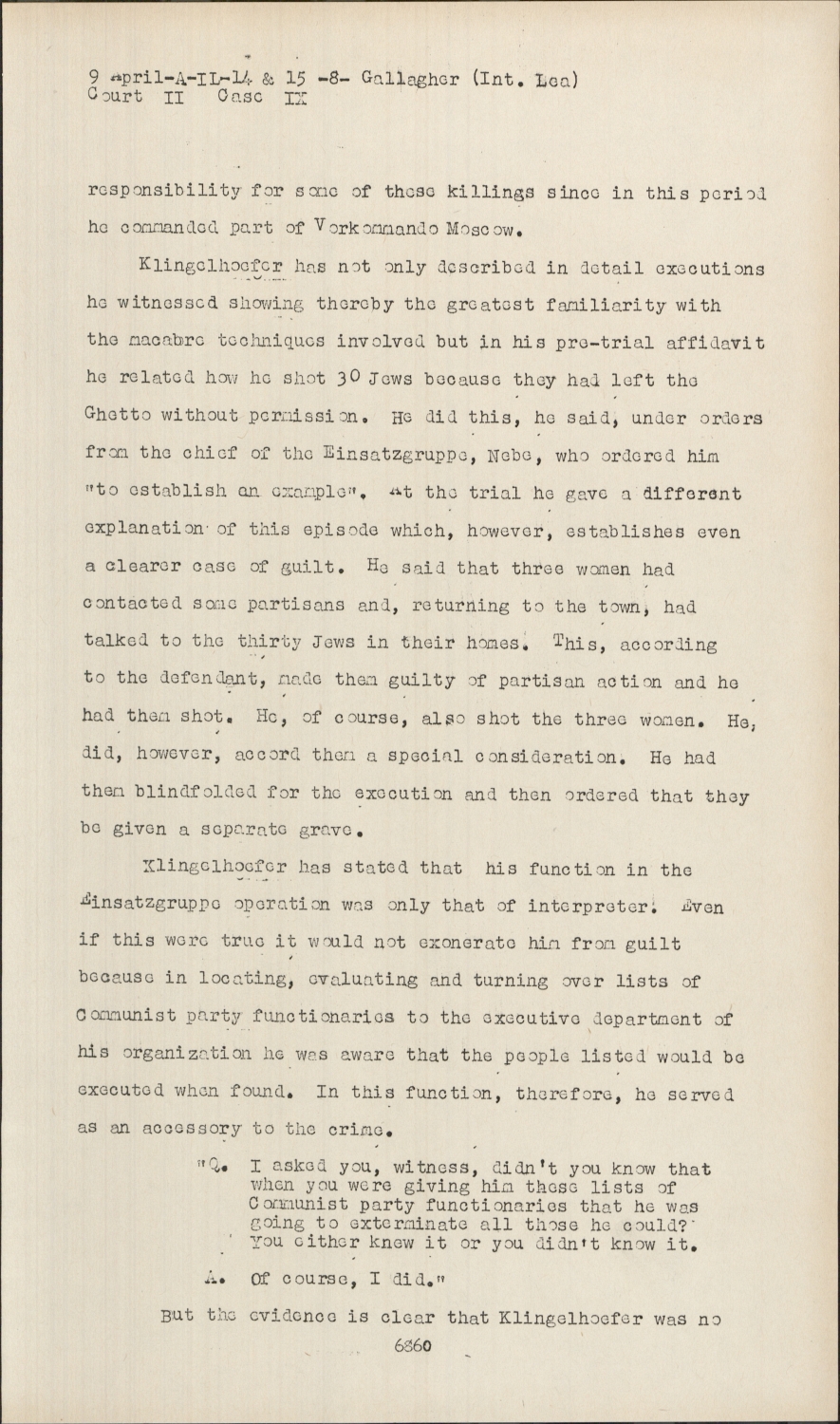
Klingelhoefer has not only described in detail executions he witnessed showing thereby the greatest familiarity with the macabre techniques involved but in his pre-trial affidavit he related how he shot 30 Jews because they had left the Ghetto without permission. He did this, he said, under orders from the chief of the Einsatzgruppe, Nebe, who ordered him "to establish on example". At the trial he gave a different explanation of this episode which, however, establishes even a clearer case of guilt. He said that three women had contacted some partisans and, returning to the town, had talked to the thirty Jews in their homes. This, according to the defendant, made them guilty of partisan action and he had then shot. He, of course, also shot the three women. He, did, however, accord them a special consideration. He had them blindfolded for the execution and then ordered that they be given a separate grave.
Klingelhoefer has stated that his function in the Einsatzgruppe operation was only that of interpreter. Even if this were true it would not exonerate him from guilt because in locating, evaluating and turning over lists of Communist party functionaries to the executive department of his organization he was aware that the people listed would be executed when found. In this function, therefore, he served as an accessory to the crime.
"Q. I asked you, witness, didn't you know that when you were giving him these lists of Communist party functionaries that he was going to exterminate all these he could?
You either knew it or you didn't know it.
A. Of course, I did."
But the evidence is clear that Klingelhoefer was no mere interpreter in the grim business of the Einsatzgruppe.
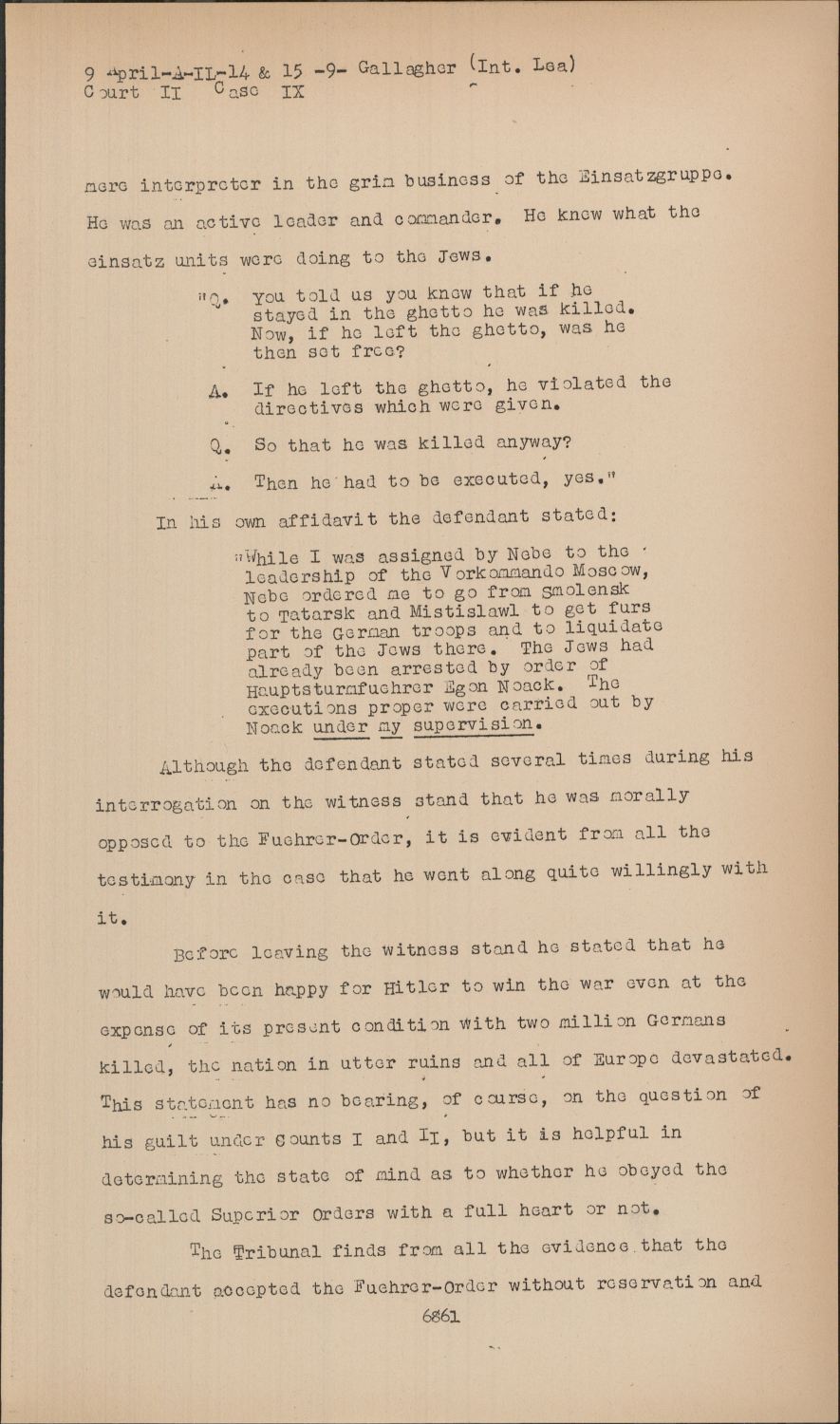
He was an active leader and commander. He knew what the einsatz units were doing to the Jews, "Q. You told us you knew that if he stayed in the ghetto he was killed.
Now, if he left the ghetto, was he then set free?
A. If he left the ghetto, he violated the directives which were given.
Q. So that he was killed anyway?
A. Then he had to be executed, yes."
In his own affidavit the defendant stated:
"While I was assigned by Nebe to the leadership of the Vorkommando Moscow, Nebe ordered me to go from Smolensk to Tatarsk and Mistislawl to get furs for the German troops and to liquidate part of the Jews there.
The Jews had already been arrested by order of Hauptsturnfuehrer Egon Noack.
The executions proper were carried out by Noack under my supervision.
Although the defendant stated several times during his interrogation on the witness stand that he was morally opposed to the Fuehrer-Order, it is evident from all the testimony in the case that he went along quite willingly with it.
Before leaving the witness stand he stated that he would have been happy for Hitler to win the war even at the expense of its present condition with two million Germans killed, the nation in utter ruins and all of Europe devastated This statement has no bearing, of course, on the question of his guilt under counts I and II, but it is helpful in determining the state of mind as to whether he obeyed the so-called Superior Orders with a full heart or not.
The Tribunal finds from all the evidence that the defendant accepted the Fuehrer-Order without reservation and that he executed it without truce.