This is also not contradicted by Heydrich's express letter of 21 September 1939, presented by the prosecution:
"to the Chiefs of all Einsatzgruppen of the Security police." According to the opening statement of the prosecution concerning the organization of the Einsatzgruppen it is a fact that the "Einsatzgruppen" in the Polish are in no way identical with the Einsatzgruppen of this trial, which at that time did not even exist, but which were not organized until Hay and June of 1941. The defendant never saw or heard of that express letter of Heydrich of 21 September 1939. Besides, this order does not provide in any lace for extermination or annihilation, but only mentions the concentration of Jews in Ghettos, which were to be set up in the cities. If, during the course of the trial various interpretations of the Fuehrer order by other persons involved are mentioned, this does not prove anything against the defendant, who was not present when this order was published in Dueben and Pretsch through the office Chiefs Streckenbach and Mueller and never heard of any other interpretation of the order, than the one given him by his superior Ohlendorf. During the rebuttal the prosecution presented document NOKW 1573, and stated that, contrary to the statements of Ohlendorf, Seibert, Schubert and Braune the document shows that alreadyduring the period or 5 to 15 November there were, constantly, executions in Simferopol although at that time the civilian population was allegedly friendly. Here too, the prosecution has left out the second half of the sentence-I assume it was through an oversight -- which says: "that there seem to be many Communists left in the city". My client has nothing to do with this document. He did not state that there were no shootings in Simferopol between 5 and 15 November. He could not state this, since during that time the defendant was still in Odessa with Kommando 11 b. He did not take over this Kommando until the 10th of November and did not arrive in Simferopol until the 28th of November.
The result of the evidence as stated by me in my trial brief, has thus not been affected by the only document presented in the rebuttal against my client.
What are the legal consequences to be drawn from the facts explained in my trial brief in all their details?
The defendant acted upon order of his Supreme War Lord and Legislator. Adolf Hitler was for him the Head of State, elected by the German people, recognized by the whole world, and with whom all nations maintained diplomatic relations until the outbreak of the war, with whom America kept up diplomatic relations until the and of 1941, and to whom the neutral states sent their diplomatic representatives until the end of the war. The Fuehrer had been given legisl tive powers by constitutional procedures -- indeed, under full observance of the Weimar constitution, a model piece of democratic ideals which is often quoted. His power was unlimited and thus Reich Defense Law issued in 1930, e.g. defines the Fuehrer and Reich Chancellor as "holder of the supreme state authority". The holder of the supreme state authority and supreme war lord and legislator gave the order for the shooting of the Jews, gypsies and Communist functionaries.
I am aware that the Control Council Law No. 10 of 20 December 1945 in article II, figure 4b, does not free a person from responsibility for action pursuant to the order of his government or of a superior, but may be considered in mitigation. Nevertheless I must raise the problem of the ideas and convictions caused by Hitler's order, in the mind of my client with regard to their legal aspect, because I believe that in the very last analysis this problem contains the inherent problems of this trial which a court, independent of all propaganda, of public opinion and of all attempts aimed at falsifications endeavors to pass just judgment on those men in the dock, cannot overlook.
I am not trying to work any extenuating circumstances out of this question and -- I want to make this quite clear -- but I want more. I want to explain why my client, at the beginning of the trial could answer the question about "guilty" or "not guilty" only with a clear "not guilty". Is the defendant Dr. Braune guilty? This is the question, to the solution of which I want to contribute. I am going to start but from the following deliberations: Though Control Council Law No. 10 may exclude any reference of a person to the order of the government or a superior with retroactive effect there is one thing which it could not have intended and did not intend: To punish men, who took up service because they believed that the order upon which they acted was legal; who, without any fault of their own, had no feeling that they did wrong and could not have had such feelings. The retroactive force of the Control Council Law may be enforced objectively; it will, however, find its limitations in the subjective part of the events, in that part which took place in the mind of the defendant. Even retro-actively effective laws cannot change anything in the fact that those persons had the right to believe their actions legal and therefore had no feeling of doing anything wrong, and this alone counts. Could the defendant, at that time, have this feeling of legality, or rather, did he have to have it?
In order to answer this question, it is necessary to briefly outline the legal position at the time:
If the defendant believed himself to be acting lawfully on the basis of the order that had been issued, he must not be punished, even if the Control Council Law does not purport to bring about convictions without guilt.
According to generally recognized legal principles, however, the awareness of having acted unlawfully is an integral part of guilt, which according to criminal law is always a personal guilt.
Also Article II, paragraph 4 b, of the Control Council Law can only be understood to mean that the recipient of an order must have been conscious of the fact that his conduct was contrary to the law and wrong. There is no guilt without the awareness of having acted unlawfully.
Also the IMT clearly acknowledged this principle. Which conceptions, then, were decisive for the defendant's awareness of acting lawfully?
I have already shown that Adolf Hitler issued the order to kill on the basis of his constitutional powers as well as on the basis of his military authority in his capacity as supreme commander of the armed forces.
"The Fuehrer's orders were law already a considerable time before this second World War.
"His orders were something quite different from the orders of any official of the hierarchy under him."
It cut short any discussion. It was legally binding for the persons concerned, even when the directives went counter to international law or to other recognized obligations."
This stated Prof. Jahrreis as expert before the IMT.
The Fuehrer Order partook of the character of a law. A law, however, was binding for a judge as well as for every official and every subject of the state, not only in the authoritarian Fuehrer state after 1933, but already under the auspices of the democratic republic based on the Weimar constitution.
The co-author and renowned commentator of the Weimar constitution, Gerhard Anschuetz, says in his commentary about this:
"If it cannot even be conceded that the judge is entitled to examine the law as for its being constitutional or not, so it can be conceded even less that he may refuse obedience to a law which was passed constitutionally because, according to his opinion concerning certain standards which, again according to his opinion, are above the legislator, that is to say, morality, ethics, natural law, they contradict these points or because they cannot stand up to certain evaluations," The person who says that is not a jurist of the authoritarian German Fuehrer state but the spiritual father of the Weimar democracy.
Already during the Weimar period, during which the defendant received legal training at German universities, it was beyond the reach of not only an official but also a judge and even beyond the Reich Supreme Court to re-examine any law for its moral basis or its background of international law.
"The background of international law could not even be examined by the Staatsgerichtshof, the State Court. The State Court was only allowed to examine whether it was constitutional, but it was not allowed to examine it from the point of view of international law."
According to Prof. Jahrreis and his opinion in the Justices' Trial.
Also the well known authority on international law, Triepel, says the following on page 153 of his book:
"Judges and subjects are under the obligation to apply the law of the state, even if contrary to international law, and to follow it. It is not up to them but up to the government to take into consideration the differences with international law which may arise out of this."
Also the well-knwon German jurist, Prof. Jahrreis, only repeats the general concept and legal opinion, when he gives the following expert opinion of the Justices' Trial:
"Every state must demand as a matter of principle, that its laws be followed, even if the individual concerned holds a different opinion owing to moral, or religious, or other grounds."
At another occasion he says:
"Already before 1933, and even more after 1933, it has always been undisputed that the judges were obligated to obey the law of the German state, even if by doing so they were violating the principles of international law."
What held good for the judge, applied of course even more for the officials and subjects, whose position did not nearly afford them the same measure of independence as that enjoyed by a judge.
But even if no legally binding force is granted to Hitler's Order, but it is evaluated as what it undeniably was, namely an order of the head of the state and supreme commander of the armed forces during war time and under military law, the result remains. If already in peace time officials and judges are bound by constitutionally enacted laws and are not even permitted, leave alone abliged, to examine their admissibility or their basis in international law, it is obvious how much more the soldier during a war and who is subject to military law is bound by the orders of his highest authority in the state. They too did not permit any re-examination.
"Should or can the state authority grant the members of its hierarchy its officials and officers, the right or even Impose on them the duty, to examine at any time any order which demands obedience from them, to determine whether it is lawful and to decide accordingly whether to obey or refuse? No domination which has appeared in history to date has given an affirmative answer to this question...... in as far as such a right of examination is not granted to members of the hierarchy, the order has legal force for them."
Every state has had the experience of its ultimate orders, its highest orders which must be binding on the hierarchy, if the authority of the State is to exist at all, being on occasion in conflict with rules not imposed by the state - to divine law, to natural law and to the laws of reason...."
"If Hitler issued an order which was faulty from a legal point of view, that did not give the German official agencies any reason to refuse obedience, for in every state there has to be an authority beyond which there is no appeal."
Thus did Prof. Jahrreis outline the problem in his expert opinion before the IMT and also during the Justices' Trial.
The legal question arises now, whether the subject of the state could, during the war, refuse to comply with orders, contradicting international law.
Let us leave aside the question in how far Germany did commit any violations of international law at all in regard to Russia, who had placed herself outside all international law from the first day of its existence. But also the farmer question has to be answered in the negative, as it had always been beyond a question for any official in Germany that, in case of a contradiction between the Reich law and international law, he had to apply Reich law.
What, however, was true for an official in peace time, was true in a far higher degree in war time for the soldier at the front:
A contrary concept would have to result in consequences, which no sovereign state is able to face as yet. The question remains inasfar as Article 47 of the German Military Penal Code made it incumbent upon the defendant to refuse compliance with Hitler's Order.
On this point I am able to keep my remarks brief and to refer to the argumentsof my colleagues, Dr. Gawlik and Dr. Aschenauer. The provisions of Article 47 (MSTGBI) can only mean that a soldier is permitted to refuse compliance with an order if there exists a higher authority able to decide if his refusal to comply with the order was justified.
Hitler's orders, however, were no ordinary military orders, but were suprema lex, beyond which one could not go any further. There was no possibility of an appeal against them. Article 47 could not be applied at all to orders emanating from Hitler, the Supreme Commander of the Armed Forces. Also in the question of the possibility of resisting to a military order, it is a prerequisite that the person to whom the order applies, should have the possibility to appeal against it. The long tradition of that Article 47 in the jurisdiction of the German Armed Forces is witness to this. In this justified conviction, however, there could not arise in the defendant an awareness of the action being unlawful, especially as he was neither permitted nor obligated to re-examine the order from the point of view of its lawfulness or its contradiction with international law. Neither did he have the scope for an examination.
Was, then, at the time of the defendants appointment in the East, i.e. 1941, this legal position of the German Reich and its subjects in conflict with the legal concept and legal position of other civilized nations in a matter at all discernible to the defendant? Also to this point I am able to refer to the remarks of my colleague Dr. Gawlik, who was shown that up to 1945, almost all the other nations of Western outlook too subscribed to these principles. Thus, during the discussions on the Briand-Kellog Pact repeatedly quoted by the Prosecution, to which Russia, however, was not signatory power, the American representative Kellogg said in 1927:
"Every state is the only judge of its conduct in the question of its existence."
The well-known authority on international law, Oppenheimer, states in his "International Law" that the law could not demand that an individual be punished for an act which he had been forced to commit by law.
Article 347 of the American Rules of Land Warfare, published in 1940 by the United States War Department, after enumerating possible war crimes, contains the following statement:
"Individual members of the armed forces are not liable to punishment for these crimes, if the latter were committed under orders or with the approval of their governments or commandants."
The same attitude was taken up until 1944 by the competent British agencies in the British "Manual of Military Law" which after listing the possible war crimes states the following in Article 443:
"It is, however, important to note that members of the armed forces, ccommitting such violations of the recognized rules of warfare, which had been ordered by their governments or their commandants, are no war criminals and can therefore not be punished by the enemy".
Thus it can also be understood that the American expert on international law, George Manner, too, writes the following in an article headed "The legal nature and punishment of criminal acts of violence contrary to the laws of war":
"The principle that the members of the armed forces of a country are not personally responsible and can therefore not be punished for acts violating the rules of warfare committed under orders or with the approval of their governmental or military superiors, does not form part of the military law. Nevertheless it appears to be a recognized principle of that law. At least since 1914 this principle has been embodied in the war manuals of the powers as a rule of the common military law."
That these were legal concepts of long standing particularly in America is shown by the fact that in 1840, the American Secretary of State, Webster, in a controversy with the British Government concerning the punishment of a British subject stated the following:
"That an individual member of an official armed force acting on the authority of its government cannot be held responsible for the tres passing of laws, is a principle of public law which has been sanctioned by the usage of all civilized nations and which the government of the United States is not inclined to contest."
Neither can Article 228 of the Peace Treaty of Versailles be drawn upon to prove the contrary, for that provision, which was never carried out, was not a law agreed upon, but the result of a onesided dictate. It is of interest to note that it was the American expert on international law, Professor Fenwick who stated in his book "International Law" that one of the reasons why this provision was not carried out, was "the difficulties arising in public law from the fact that many of the accused individuals had acted on superior orders."
That in England the order retains its old positions in the soldiers life up to this day is shown by the well-known speech held by Marshal Montgomery on 26 July 1946 at Portsmouth.
I shall omit to read the next excerpt since my colleague Dr. Aschenauer has already quoted it.
In the face of these legal principles which were generally valid even during the Second World War, the Control Council Law now sets up the statute for members of the German people, that the acting on superior orders does not do away with responsibility. The Control council certainly possesses the legislative powers to issue such rules. But it does not alter the subjective aspect of the defendant's conduct during the Russian campaign. Owing to the legal position in Germany - as shown above - but also outside the borders of the Reich, he could not even have had an awareness of guilt, it was neither his right nor his duty to examine whether the orders he received were unlawful or violated international law.
The following page I shall omit except for the last paragraph:
Apart from this question of the lawfulness of the defendant's actions performed on the order of the head of his state and his supreme commander of the armed forces, and the question of his lack of awareness of doing wrong, which is closely linked to the former, in my opinion the court must not overlook the problem inasfar as the conduct of the German Reich in the war against Russia, especially the Fuehrer Order violate the obligations of Germany towards the USSR according to international law.
I do not hesitate to state that the Fuehrer Order did not comply precisely with Germany's obligations toward the Western Powers according to international law, treaties or customary procedures in the sense of the obligations which were binding at the commencement of World War II.
But that is in my opinion not the decisive factor.
The decisive factor seems to me to be whether and to what extent Germany violated by the Fuehrer Order her obligations towards Russia which were imposed by international law, since the Fuehrer Order referred to Russian nationals in Russian territory. My client's acts were carried out exclusively against Russian nationals in Russian territory.
In my Trial Brief I explained in detail how international relations between Germany and Russia developed after 1917, and how Russia behaved since 1917 towards other countries. I have furthermore explained in how far Russia ignored existing international law true to her ideology and aims. I refer now to these explanations and restrict myself to drawing the legal conclusions from this situation.
No international treaties regarding the conduct of war existed between Germany and Russia. Nor did any international common law or custom develop between 1917 and 1941 between Germany and Russia.
Nor would the development of such procedure have been possible in view of the attitude of the USSR to international law.
Owing to her knowledge of this behavior and of Russia's fundamental attitude to modern war - I remind you, for example, of the guerilla warfare - Germany had reason to be convinced that this war would be conducted from the very first day without the slightest respect for international law on the part of the enemy. I am convinced that in these circumstances Germany was not bound by the principles of international law which applied to her relations to the Western Powers. The Tribunal must consider the question to what extent HITLER's order and its execution constitutes a violation of international obligations towards Russia - and that is all that interests us here.
The defendant could not have recognized the war against Russia as being a criminal war of aggression.
I now refer to the note from the foreign Office to the Soviet government which was published in the entire German press and broadcast throughout the world (document Book II pp. 17 ff.)
Is the defendant to be reproached for having regarded this war as a justified preventive war? Looking back on events, can one today bring such a reproach, in view of the statements made by the leading American diplomats BYRNES and BULLET and quoted in my Trial Brief?
In my Trial Brief 1 have already brought up the further question and dealt with the matter to what extent, in the light of recent knowledge and developments in the sphere of world politics, the affirmation of the IMT can be maintained that the war against Russia was "a criminal war of aggression", "an obvious attack", without a shadow of justification!I believe that after the IMT verdict in September 1946 facts became known which necessitate the re-examination of that decision by this Tribunal.
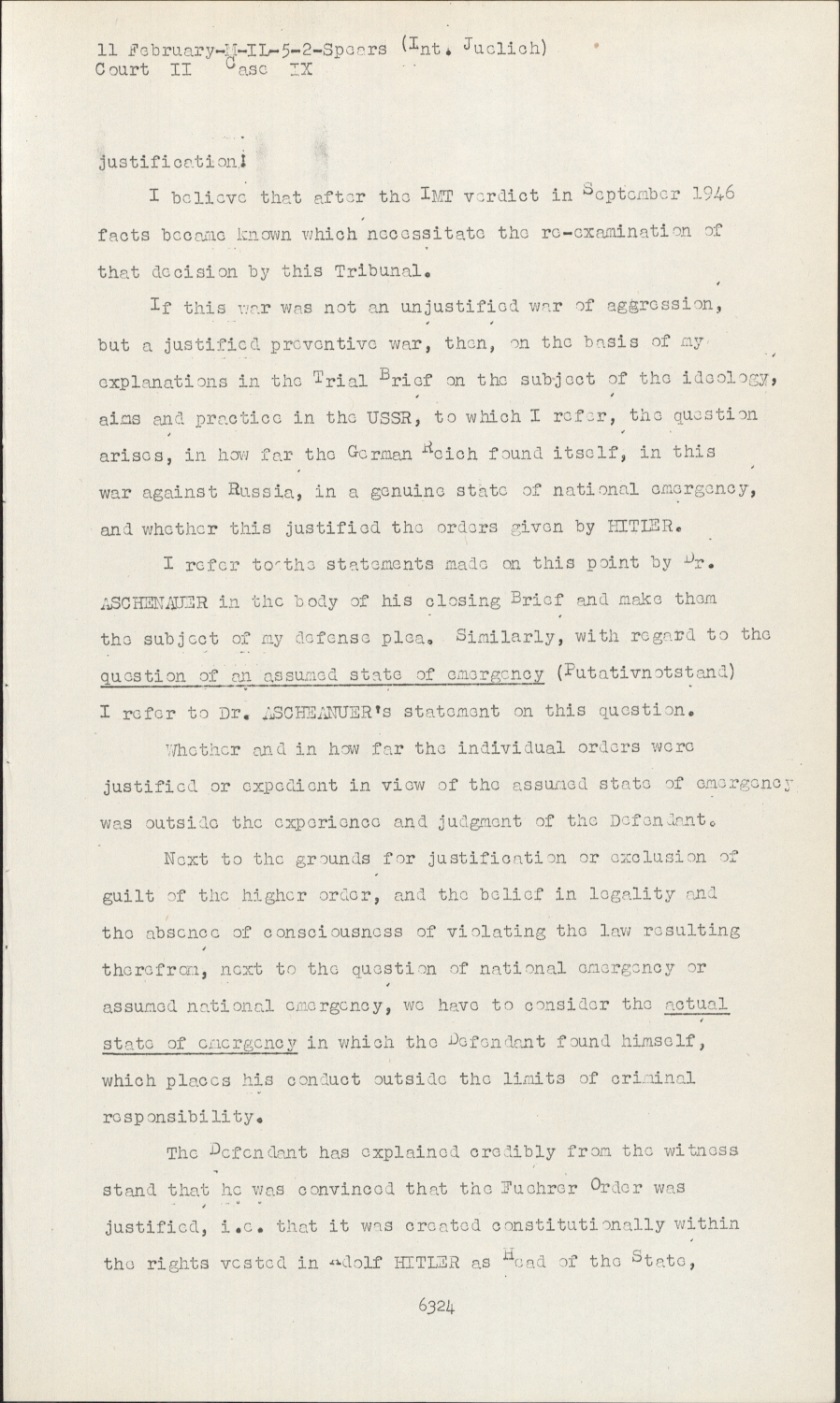
If this war was not an unjustified war of aggression, but a justified preventive war, then, on the basis of my explanations in the Trial Brief on the subject of the ideology, aims and practice in the USSR, to which I refer, the question arises, in how far the German Reich found itself, in this war against Russia, in a genuine state of national emergency, and whether this justified the orders given by HITLER.
I refer to the statements made on this point by Dr. ASCHENAUER in the body of his closing Brief and make them the subject of my defense plea. Similarly, with regard to the question of an assumed state of emergency (Putativnotstand) I refer to Dr. ASCHENAUER's statement on this question.
Whether and in how far the individual orders were justified or expedient in view of the assumed state of emergency was outside the experience and judgment of the Defendant.
Next to the grounds for justification or exclusion of guilt of the higher order, and the belief in legality and the absence of consciousness of violating the law resulting therefrom, next to the question of national emergency or assumed national emergency, we have to consider the actual state of emergency in which the defendant found himself, which places his conduct outside the limits of criminal responsibility.
The Defendant has explained credibly from the witness stand that he was convinced that the Fuehrer Order was justified, i.e. that it was created constitutionally within the rights vested in Adolf HITLER as Head of the State, supreme lawmaker and warlord (Transcript p.3094) and was therefore binding also for the recipient of the order.
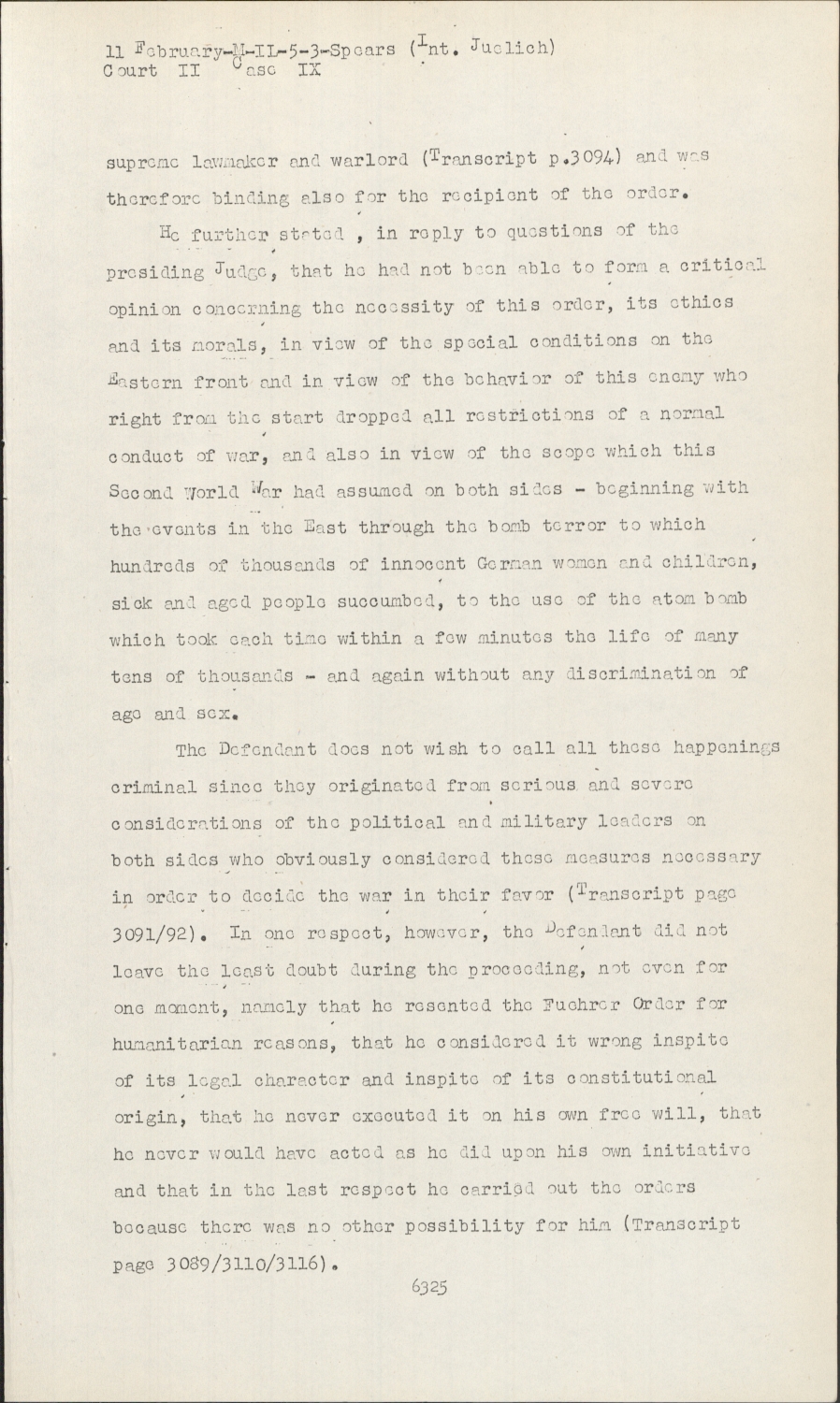
He further stated, in reply to questions of the presiding Judge, that he had not been able to form a critical opinion concerning the necessity of this order, its ethics and its morals, in view of the special conditions on the Eastern front and in view of the behavior of this enemy who right from the start dropped all restrictions of a normal conduct of war, and also in view of the scope which this Second World War had assumed on both sides - beginning with the events in the East through the bomb terror to which hundreds of thousands of innocent German women and children, sick end aged people succumbed, to the use of the atom bomb which took each time within a few minutes the life of many tens of thousands - and again without any discrimination of ago and sex.
The Defendant does not wish to call all these happenings criminal since they originated from serious and severe considerations of the political end military leaders on both sides who obviously considered these measures necessary in order to decide the war in their favor transcript page 3091/92). In one respect, however, the Defendant did not leave the least doubt during the proceeding, not even for one moment, namely that he resented the Fuehrer Order for humanitarian reasons, that he considered it wrong inspite of its legal character and inspite of its constitutional origin, that he never executed it on his own free will, that he never would have acted as he did upon his own initiative and that in the last respect he carried out the orders because there was no other possibility for him (Transcript page 3039/3110/3116).
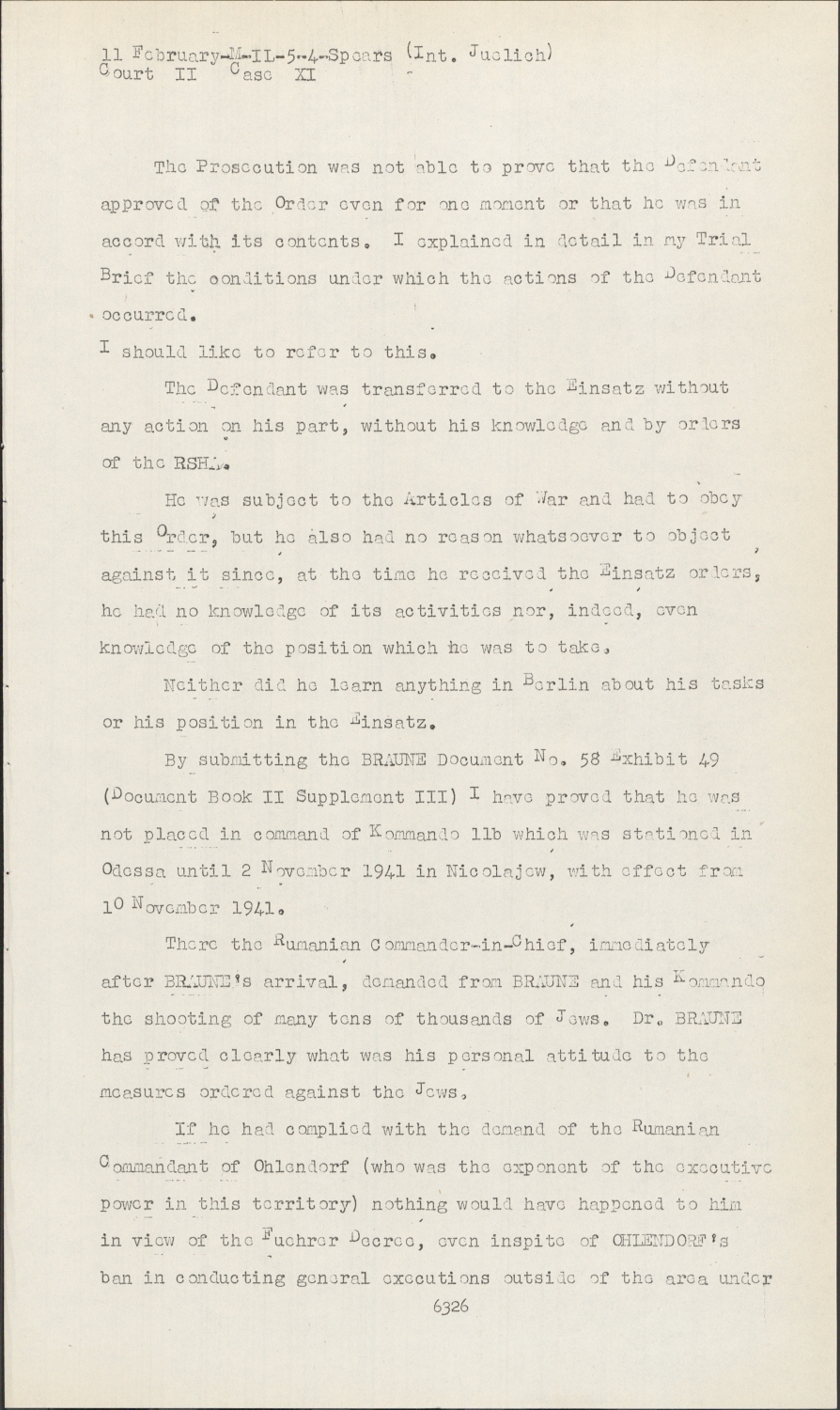
The Prosecution was not able to prove that the Defendant approved of the Order even for one moment or that he was in accord with its contents, I explained in detail in my Trial Brief the conditions under which the actions of the Defendant occurred. I should like to refer to this.
The Defendant was transferred to the Einsatz without any action on his part, without his knowledge and by orders of the RSHA.
He was subject to the Articles of War and had to obey this Order, but he also had no reason whatsoever to object against it since, at the time he received the Einsatz orders, he had no knowledge of its activities nor, indeed, even knowledge of the position which he was to take.
Neither did he learn anything in Berlin about his tasks or his position in the Einsatz.
By submitting the BRAUNE Document No. 58 Exhibit 49 (document Book II Supplement III) 1 have proved that he was not placed in command of Kommando 11b which was stationed in Odessa until 2 November 1941 in Nicolajew, with effect from 10 November 1941.
There the Rumanian Commander-in-Chief, immediately after BRAUNE's arrival, demanded from BRAUNE and his Kommando the shooting of many tens of thousands of Jews. Dr. BRAUNE has proved clearly what was his personal attitude to the measures ordered against the Jews.
If he had complied with the demand of the Rumanian Commandant of Ohlendorf (who was the exponent of the executive power in this territory) nothing would have happened to him in view of the Fuehrer Decree, even inspite of OHLENDORF's ban in conducting general executions outside of the area under German Army jurisdiction.
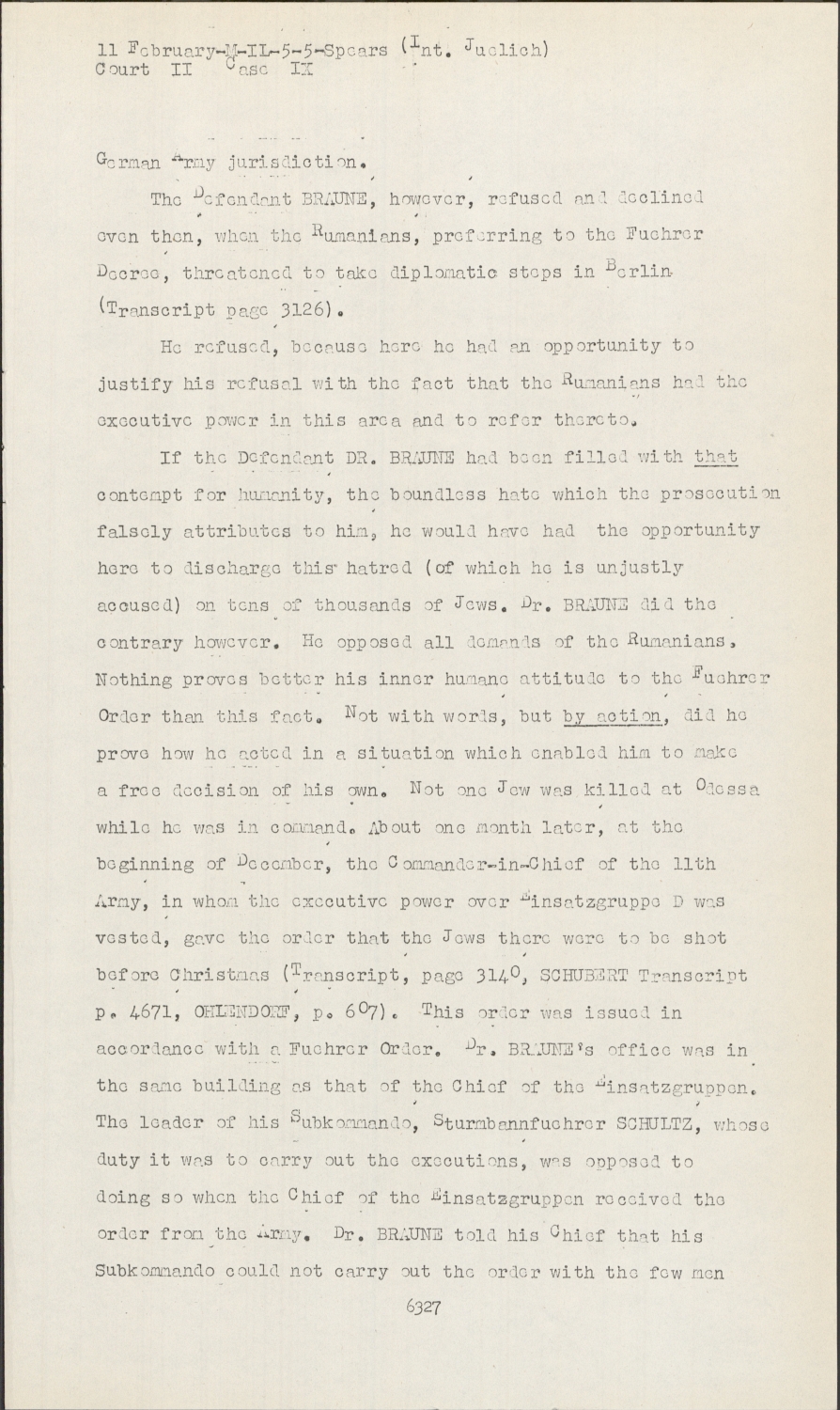
The Defendant BRAUNE, however, refused and declined even then, when the Rumanians, preferring to the Fuehrer Decree, threatened to take diplomatic steps in Berlin (Transcript page 3126).
He refused, because here he had an opportunity to justify his refusal with the fact that the Rumanians had the executive power in this area and to refer thereto.
If the Defendant DR. BRAUNE had been filled with that contempt for humanity, the boundless hate which the prosecution falsely attributes to him, he would have had the opportunity here to discharge this hatred (of which he is unjustly accused) on tens of thousands of Jews. Dr. BRAUNE did the contrary however. He opposed all demands of the Rumanians. Nothing proves better his inner humane attitude to the Fuehrer Order than this fact. Not with words, but by action, did he prove how he acted in a situation which enabled him to make a free decision of his own. Not one Jew was killed at Odessa while he was in command. About one month later, at the beginning of December, the Commander-in-Chief of the 11th Army, in whom the executive power over Einsatzgruppe D was vested, gave the order that the Jews there were to be shot before Christmas (Transcript, page 3140, SCHUBERT Transcript p. 4671, OHLENDORF, p. 607). This order was issued in accordance with a Fuehrer Order. Dr. BRAUNE's office was in the same building as that of the Chief of the Einsatzgruppen. The leader of his Subkommando, Sturmbannfuehrer SCHULTZ, whose duty it was to carry out the executions, was opposed to doing so when the Chief of the Einsatzgruppen received the order from the Army. Dr. BRAUNE told his Chief that his Subkommando could not carry out the order with the few men and vehicles at his disposal.
The army provided vehicles and personnel, the Einsatzgruppe assigned members of Kommandos 10b and 11a as reinforcements and the newly arrived police detachments as support. Now what could the defendant do in such a situation?
The Prosecution has stated that it was the duty of the Defendant to prevent these murders.
It has never once tried to answer the question what the Defendant should have or could have done. It has not given an answer to this question because it cannot find an answer to it.
What possibilities were there for the Defendant to prevent the execution to the order? Or to wash his hands of the affair or even to limit its execution an any way? Should he have refused be accept the order?
OHLENDORF, his superior, whose negative attitude towards the Fuehrer Order is quite well known, declared as follows under oath:
"The men of my groups who are under indictment here were under my military command.
if they had not executed the order which they were given they would have been called to account for it by me.
If they had refused to execute the orders they would have had to be called to account for it by me.
There could be no doubt about it.
Whoever refused anything in the front lines would have met immediate death.
If the refusal would have come about in any other way a court martial would have brought about the same consequences.
The jurisdiction of courts-martial was great, but the sentences of the SS were gruesome."
Under such circumstances, the Defendant could not quietly refrain from carrying out the order, nor could he openly refuse to do so.
Either would have been a wasted self-sacrifice which would not have changed the course of events at all. In this entire matter, one must not forget that in November 1941, when the defendant assumed command, the Fuehrer Order had been carried out by the Kommando for months, and that the commanders and subordinate commanders were acquainted with the order.
Thus, my client would not even have been able to prevent the execution of the order by refraining from issuing any directives to that effect to his subordinates. For he no longer needed to issue such directives, nor did he do so.
The Fuehrer Order had been in effect since the beginning of the mission and was being carried out, and therefore did not require any directives from Dr. BRAUNE. Apart from the executions in Simferopol, which Dr. BRAUNE, in view of the circumstances, was completely unable to prevent, the latter, therefore, would have been unable to prevent the activity of his sub-commandos only by issuing an express order not to carry out the Fuehrer Order.
This, just as much as an open refusal, would have meant a wasted self-sacrifice, for a trial before SS and Police Courts for disobedience and refusal to comply with a Fuehrer Order on the front, could only have resulted in a death sentence. Thus the Defendant could not avoid or prevent the carrying out of the Fuehrer Order, by open refusal, tacit non-Compliance, or opposing orders, apart from the fact that every one of those measures would have meant his death. Thus, they did not present the defendant with a choice in keeping with ethical law. Merely in order to give a complete picture, 1 must mention the fact that he was not able to join the advancing troops with his Kommando, and thus evade the order.
This possibility was eliminated by the military situation in this sector of the Eastern Front and the geographical position of the Crimea as a peninsula.
During the course of the trial, both the Honorable tribunal, and the Prosecution have expressed doubt that such a punishment would have been the invitable result. In defense of my client, therefore, 1 should like to add the following statements: The Defense counsel has proved that under German laws of war, disobedience, refusal to obey an order, undermining the armed forces etc. called for the death penalty."
11 Feb 1948_M_MSD_6_1_Spears (Juelich) Oberfuehrer Ohlendorf, as the Defendant's superior, stated under oath that certain death would have been the result of refusal to obey an order. In his Posen speech, Himmler the highest SS-Fuehrer and supreme judicial authority in the entire field of SS jurisprudence, expressed clearly what he thought of disloyalty, even if it were only thoughts of disloyalty. And as far as a man like Himmler was concerned, there was no difference between disloyalty and disobedience.
Even if one wishes to assume that an SS Court Would have waived the death sentence: Himmler would have seen to it that an end was put to the man, either in a concentration camp or in "a compulsory suicide squad" of a disciplinary unit of the Waffen-SS.
There should however, be no doubt as to Hitler's ideas about disobedience of his orders in war-time. Those are the facts which confronted the Defendant. In view of all this, what is proved by the four cases listed by Herr Diels, in which "refusal to obey an order" did not result in death? (Prosecution Document Volume 5-D, Pages 40/41) In none of these cases had the order been given by Hitler.
Two cases occurred in 1933/34, and in the third case, concerning Herr Diels, a Gauleiter was allegedly the person who had issued the order. Even the example of Rittmeister (Captain, Cavalry) FaberCastell is not really a convincing argument for the application of Article 47 of the Military Penal Code (MSTGB) to the Fuehrer Order. He opposed an illegal "direct" order, that is an order of a direct superior. This is, however, exactly the sort of case covered by Article 47 of the German Military Penal Code (MSTGB). It says nothing about the impossibility of applying Article 47 to the Military Penal Code (MSTGB) to an order by the Supreme Commander-inChief.
I also refer to the additional affidavit given by Herr Diels in the meantime, and submitted by Dr. Aschenauer in behalf of Herr Ohlendorf.