28) In accordance with this, all character testimonials offered on behalf of the defendant Blume give the picture of a splendid and good character (Blume documents nos.
15-29 and 31-34, also 11 and 12).29) I need not go into details. If I may summarize the most important facts in these affidavits, I may say that all these affiants always emphasized the following characteristics as the salient characteristics of the defendant Blume, namely, his open and sincere manner, his honesty and love of truth, his pleasant and kind manner which made him popular wherever he went, and his fairness in sports and his tolerance of other people's opinions.
As far as the affidavits refer to the professional activity of the defendant Blume, they confirm his absolutely correct and decent attitude and - briefly put - the fact that in his whole professional career he only served law and justice.
In conclusion I ask the Tribunal to acquit the defendant Blume on Count I and II of the Indictment.
Under Count III the defendant Blume has been charged with membership after 1 September 1939, in various organizations which have been declared criminal by the International Military Tribunal. I can be brief in discussing this Count.
a.) Count III, B of the Indictment charges the defendant Blume with having been a "member of Offices III, VI and VII of the Reich Security Main Office which constituted part of the SD. This, however, is a mistake. The defendant Blume was never a member of these offices of the RSHA.30) - - - - - - - - - - - - - - - - - - - - 27) Transcript pp. 1786-1787 and 1820. 28) Transcript pp. 1884 - 1888 29) Cf. transcript pp. 5234-5237 and transcript of 2 February, 1948, afternoon session, and transcript pp.
5232-5233 30) Cf. transcript pp. 1851 and 1877 - 1879.
b.) Count III, C of the Indictment charges the defendant Blume with having been a "member of Office IV of the Reich Security Main Office", which constituted part of the so-called Gestapo. This again is a mistake. The defendant Blume was never a member of Office OV of the RSHA.31)
c.) Count III, A of the Indictment charges the defendant Blume with membership in the Schutzstaffeln of the NSDAP, i.e. the so-called SS. In the final analysis this is not correct either; the defendant Blume can not be punished for this, either.
The International Military Tribunal in its judgment declared criminal only a certain group composed of those persons who officially became members of the SS, etc.32) The essence of this offense according to the clear wording of the IMT judgment is cooperation for criminal purposes in the above mentioned group of the organization.33) Before the IMT Justice Jackson spoke accordingly:34) "The purpose of declaring criminality of organizations.
... is punishment for aiding crimes...."
The defendant Blume was only a police official. He never did any service in the SS and therefore never rendered any "cooperation for criminal purposes" within the SS.35) He never held any position in the SS, but only a so-called assimilated rank. In this connection I refer to the official decree concerning this assimilation of ranks dated 23 June, 1938 (Blume document No. 10) and to Blume's testimony concerning this question.36) On the basis of this assimilated rank the defendant Blume was only a formal member, but no "real" or "active" member of the SS.
- - - - - - - - - - - - - - - - - - - - - 31) Cf. transcript pp. 1852 - 1853, and 1879 - 1881 32) Cf. Offocial Edition, vol. I, p. 273. 33) Cf. Offocial Edition, vol. I, p. 256 34) Cf. Official Edition, vol. VIII, p. 369 35) Cf. transcript p. 1848 36) Cf. transcript pp. 1848 - 1850.
Likewise irrelevant is the fact that the defendant Blume, 8 or 10 days before the German capitulation, received a military draft call for the Waffen-SS with the military rank of a private first class. like any other soldier, the defendant Blume had no possibility but to obey this draft order.37) The defendant Blume, therefore, must also be acquitted on Count III.
In conclusion I am going to deal with the question which could be called the "great problem" of the Nurenberg Trials. These are the questions concerning jurisdiction and justification of these tribunals and the doubts arising from Control Council Law No. 10.
Logically these statements should have been made at the beginning of this plea. However, I intentionally mention them at the end. For I believe that the statements made in the previous paragraphs I - III in themselves are sufficient a foundation for my request to acquit the defendant Blume. Moreover, in this case No. 9, we are faced with the fact that many thousand innocently exterminated human beings demand that justice be done. Therefore it might be said that it is of no relevancy whether e.g. this tribunal must be considered an American or an International one and whether Control Council Law No. 10 contains international law, be it as codification or innovation, or whether the four occupying powers in the Control Council Laws are competent merely to pass occupation laws (under Article 43 of the Hague Convention on Land Warfare), or whether they executedGerman legislative power since according to the Berlin Declaration of 5 June 1945, they assumed sovereign legislative power over the former German territory and its population, the very legislative power which Hitler held as dictator during the preceding years.
As a lawyer, however, I am familiar with the fact that in the realm of the l aw the formal aspect is very essential; and sometimes the ultimate problems of justice are hidden behind these formal questions. Therefore I should like to say a few words concerning the "great _ _ _ _ _ _ _ _ _ _ _ _ _ _ _ _ _ _ _ _ _ 37) Cf. transcript p. 1850.
problem" of the Nurenberg Trials.
THE PRESIDENT:Just a moment, please.
DR. LUMMERT:It is in the middle of page 30.
THE INTERPRETER:I am sorry, Your Honor, there is one page missing in the translation. Possibly it could be read slowly for translation.
DR. LUMMERT:You have read this already?
THE PRESIDENT :You have it now?
DR. LUMMERT:I thought the interpreter could read the missing paragraphs. At first I can read it to you.
THE INTERPRETER:Yes, that is possible.
DR. LUMMERT:The Prosecution in its Opening Statement called the Indictment a "plea of Humanity to Law."
What does Humanity means? Nobody has found more striking words for the explanation of this term than the German philosopher Johann Gottfried Herder. He was born in East Prussia and lived in Weimar after 1776 and during the years from 1793-1797 he published several collections of "Letters to promote Humanity" in connection with his "Ideas on the philosophy of the history of mankind." In the 27th letter he wrote the classic words:
"The divine in us therefore is education for humanity; all great and good people helped in it, legislators, inventors, philosophers, poets, artists, every noble man in his position, in the education of his children, in observing his duties, by example, work, institution, and philosophy. Humanity is the treasure and the result of all human strivings, it is the art of mankind. The education for it is a work which has to be continued ceaselessly; or also we, higher and lower classes, shall lapse back into crude animality, into brutality."
Whoever would not who leheartedly agree if this Humanity appeals to Law? But which is this Law? Under section I, 2a of this plea we saw that thus far the sovereignty and egoism of the individual States are the highest law on earth and that the alleged international law of Control Council Law No. 10 has thus far actually not been recognized by the individual sovereign States as supernational law nor has it been embodied in the Charter of the United Nations.
For the time being then, only the sovereign power of the victor States is using those new principles of law against citizens of defeated Germany unilaterally. From this one-sidedness results the doubt in the "justice", and also the "great problem" of the Nurenberg Trials. This problem will remain unsolved as long as the "reign of Law" in an "organized mankind" in the sense of the great ideas of President Wilson has not actually been established. This problem, on the contrary, would be decided in the negative if the organization of mankind does not take place. For in this case "les lois de l'humanite etdles exigences de la conscience publique" (the Laws of humanity and dictates of the public conscience) which have already been mentioned in the introduction to the Hague Convention on Land Warfare as the basis for this Convention, could not be realized. Present world developments, just as in the years after 1918, are obviously getting away from this goal.
Whoever, like myself, believes that it is the meaning of History, gradually to overcome force among men in favor of a general peace and a supernational law of mankind, can only fear that the work done in the Nurenberg "Palace of Justice" during the past 2 1/2 years might have been one-sided and therefore in the final analysis vain and unjust.
May the judgment of the Tribunal in this great trial bring us closer to the solution of the legal problems of mankind.
THE PRESIDENT:Dr. Lummert, I wish to congratulate you on the excellent manner in which you have presented your plea in English, although that is not your native language.
DR. LUMMART:Thank you so much, Your Honors.
THE PRESIDENT:Who is ready now? Do we have the final summation of Dr. von Stein's? I don't have it.
You may proceed.
Your Honor, Members of the Court:
May I at the start of my final plea refer to the trial-brief which I have submitted. Where I have summarized the essential results of the evidence. Principally I wish to repeat here once more what I have particularly emphasized at the close of this trial-brief: That it is necessary to oppose in the strongest possible way the contention expressed by the Prosecution that they need carry only a minor part of the burden of proof in regard to the culpable participation of the defendants in the criminal acts alleged in large outline by the Prosecution. The more grievous the misdeeds are with which a defendant is charged the more conscientiously and indubitably must it be proven that he really committed these acts. May I refer here to the statements of the Military Tribunal No. IV in the judgment of Case V. (Quoted in the JOST-Doc. Book IV, Page 7, JOST Doc. No. 36). At the close of the trial-brief it is explained what remains of proven criminal acts on the part of the defendant Dr. SANDBERGER after the results of the evidence have been appraised. Therefrom it follows that essentially 2 questions are relevant for the decision of this Case:
1.) How are SANDBERGER's measures against Communist activists and
2.) how are SANDBERGER's measures against the Esthonia Jews to be judged?
SANDBERGER's measures against Communist activists.
1.) The reasons for the Fuehrer - Order.
The measures which SANDBERGER took against Communist activists were based on the Fuehrer-order. Inasfar as the order deals with Communist activists it is essentially based on the following considerations.
For HITLER the close connection between the Russian Bolshevist System of Government and the political movement of Communism was a fact. For him the Bolshevic State apparatus was the most important representative of the Communist movement and carrier of an active Imperialism, which was a mixture of Panslavism and the aim of Communistic world revolution.
Wherever Communism has come to power, the existing political and social leadership was rooted out. All experiences since 1917 showed this clearly, at least in the Baltic countries, which in 1940 were incorporated into the Bolshevist Federation of States. The witness MAE has also confirmed this specifically for Estonia. A clear example, true for all Baltic States, is given in the liquidation-list of the NKWD, published by the Canadian University Professor MIRCHCONELL and which I inserted in the Doc. Book SANDBERGER II.
Bolshevism also developed new types of warfare, the partisan war, the nature of which is depicted by the Bolshevists themselves in the brochure of the Press-Dep. of the Soviet Embassy in London "We are Guerillas" contained in OHLENDORF Document Book II, from this very description the illegality and criminality of this form of struggle in view of international law becomes evident. (Comp, also the opinion of University professor MAURACH submitted for OHLENDORF). This form of struggle consisted in preparation and execution of an illegal levee en masse on territory effectively occupied by enemy troops.
THE PRESIDENT:Dr. von Stein, you don't contend that partisan warfare was originated by the Bolshevists do you? You know that in the Napoleonic invasion of Russia partisan warfare was quite common. You know that historically, don't you?
DR. VON STEIN:Yes, Your Honor, I only want to contend that this partisan war developed in a particularly cress manned in the Eastern campaign.
THE PRESIDENT:But you say here, "Bolshevism also developed new types of warfare, the partisan war." Well, it certainly was not new,
DR. VON STEIN:No, Your Honor, I am not trying to spy it was new. I am merely trying to spy that the manner of fighting which had been developed by the Bolschevists was new, that is to say, fighting became more cruel all the time. It cannot be compared with the beginnings of the partisan war which you have just described.
THE PRESIDENT:Very well. Proceed.
DR. VON STEIN:It was a war to the knife; which was conducted by the partisans in the bitterest and cruelest manner. It threatened the reinforcements, replacements-and supply-communications in the rear of the troops. Particularly dangerous was this warfare in such vest en ere? as Russia. In regard to the Estonian area there was a very special danger in the fact that most important communication lines of the German Army Group North ran through Estonia, namely from the navel port of Reval over Narve and Pleskau to the front end from the Reichs-border over Dorpat in direction Leningrad. To nip such movements in the bud, or to keep them to as small a size as possible, severe measures were necessary for the sake of preservation of the whole fighting front. To this came the particular type of enemy. The Eastern man is capable of a fanatical toughness, almost unlimited endurance and simply limitless faith. For him the fight against the "fascist German troops" was a crusade. The idea of the Bolshevist State of the future was an idol for him, which he worshipped as he did the Icons in former times.
HITLER as Supreme War Lord had to decide what measures necessitated by the war he regarded as essential.
HITLER expected a total war in the East, as did indeed develop. That such a war would to a greater part unset the existing principles of international law was clear to him, freed with an enemy like Bolshevism.
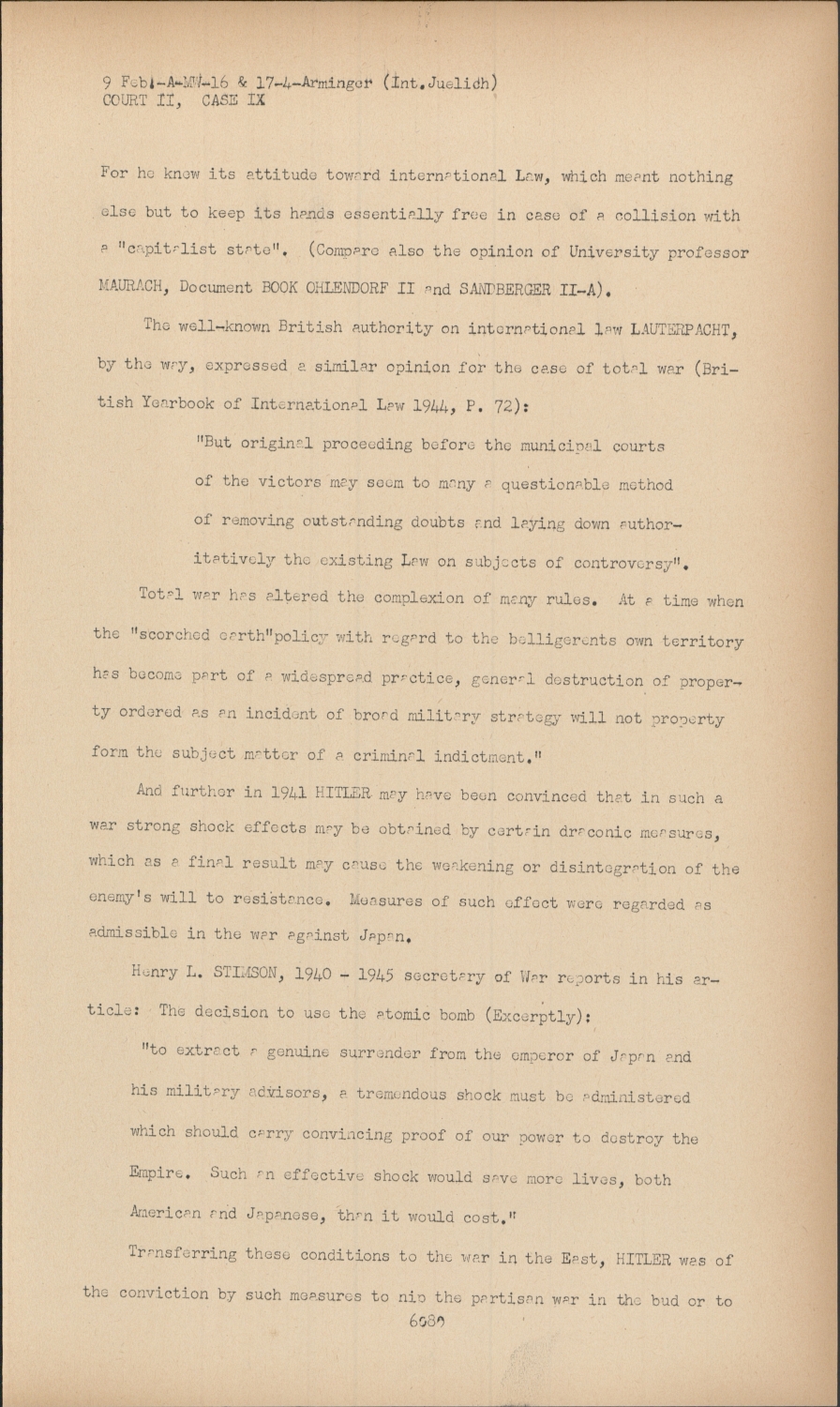
For he know its attitude toward international Law, which meant nothing else but to keep its hands essentially free in case of a collision with a "capitalist state". (Compare also the opinion of University professor MAURACH, Document BOOK OHLENDORF II and SANDBERGER II-A).
The well-known British authority on international law LAUTERPACHT, by the wry, expressed a similar opinion for the case of total war (British Yearbook of International Law 1944, P. 72):
"But original proceeding before the municipal courts of the victors may seem to many a questionable method of removing outstanding doubts and laying down author itatively the existing Law on subjects of controversy".Total war has altered the complexion of many rules.
At a time when the "scorched earth" policy with regard to the belligerents own territory has become part of a widespread practice, general destruction of property ordered as an incident of broad military strategy will not property form the subject matter of a criminal indictment."
And further in 1941 HITLER may have been convinced that in such a war strong shock effects may be obtained by certain draconic measures, which as a final result may cause the weakening or disintegration of the enemy's will to resistance. Measures of such effect were regarded as admissible in the war against Japan.
Henry L. STIMSON, 1940 - 1945 secretary of War reports in his article: The decision to use the atomic bomb (Excerptly):
"to extract a genuine surrender from the emperor of Japan and his military advisors, a tremendous shock must be administered which should carry convincing proof of our power to destroy the Empire.
Such an effective shock would save more lives, both American and Japanese, than it would cost."
Transferring these conditions to the war in the East, HITLER Was of the conviction by such measures to nip the partisan war in the bud or to suppress it effectively.
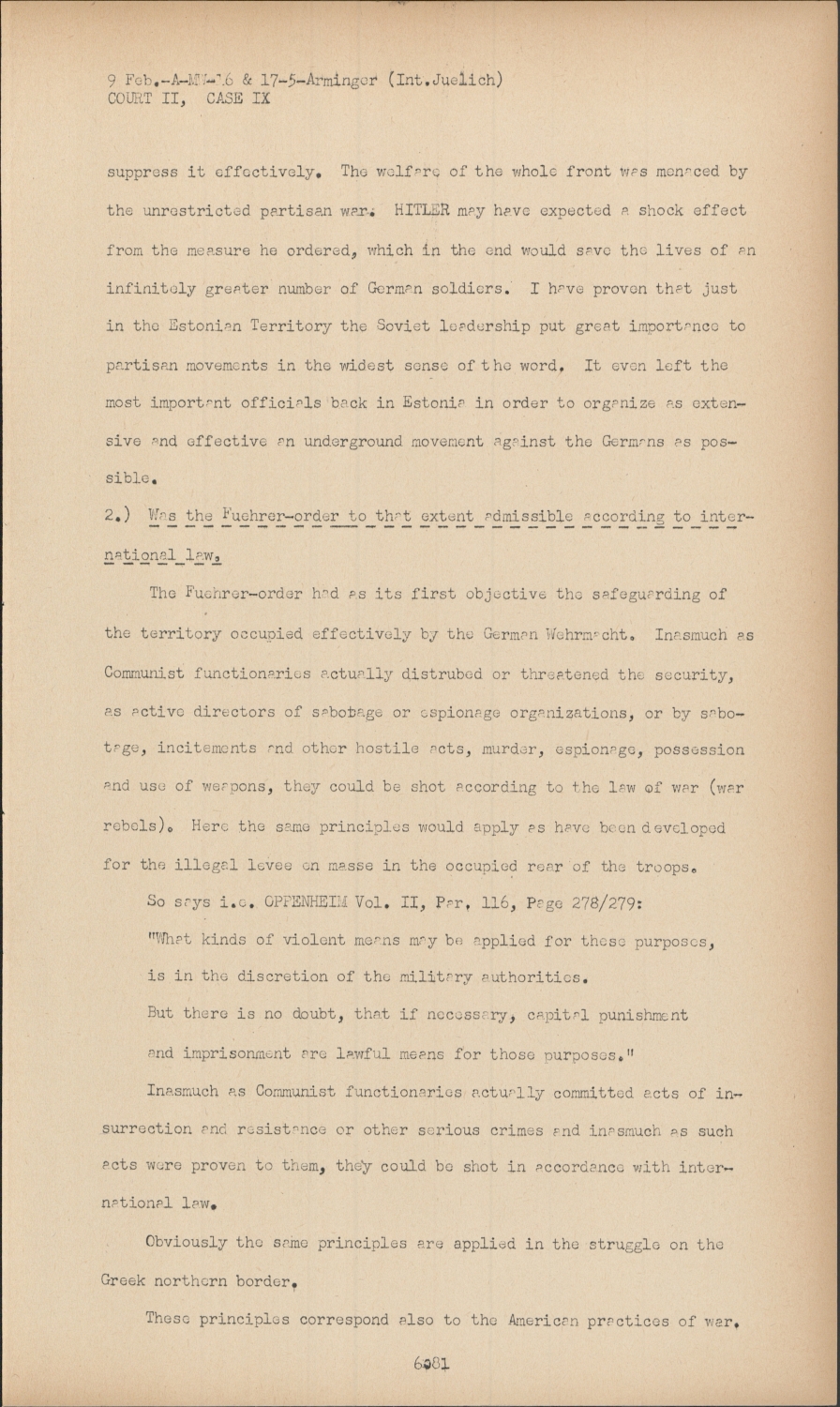
The welfare of the whole front was menaced by the unrestricted partisan war. HITLER may have expected a shock effect from the measure he ordered, which in the end would save the lives of an infinitely greater number of German soldiers. I have proven that just in the Estonian Territory the Soviet leadership put great importance to partisan movements in the widest sense of the word. It even left the most important officials back in Estonia in order to organize as extensive and effective an underground movement against the Germans as possible. 2.) Was the Fuehrer-order to that extent admissible according to international law.
The Fuehrer-order had as its first objective the safeguarding of the territory occupied effectively by the German Wehrmacht. Inasmuch as Communist functionaries actually distrubed or threatened the security, as active directors of sabotage or espionage organizations, or by sabotage, incitements and other hostile acts, murder, espionage, possession and use of weapons, they could be shot according to the law of war (war rebels). Here the same principles would apply as have been developed for the illegal levee on masse in the occupied rear of the troops.
So says i.e. OPPENHEIM Vol. II, Par, 116, Page 278/279:
"What kinds of violent means may be applied for these purposes, is in the discretion of the military authorities.
But there is no doubt, that if necessary, capital punishment and imprisonment are lawful means for those purposes."
Inasmuch as Communist functionaries actually committed acts of insurrection and resistance or other serious crimes and inasmuch as such acts were proven to them, they could be shot in accordance with international law.
Obviously the same principles are applied in the struggle on the Greek northern border.
These principles correspond also to the American practices of war.
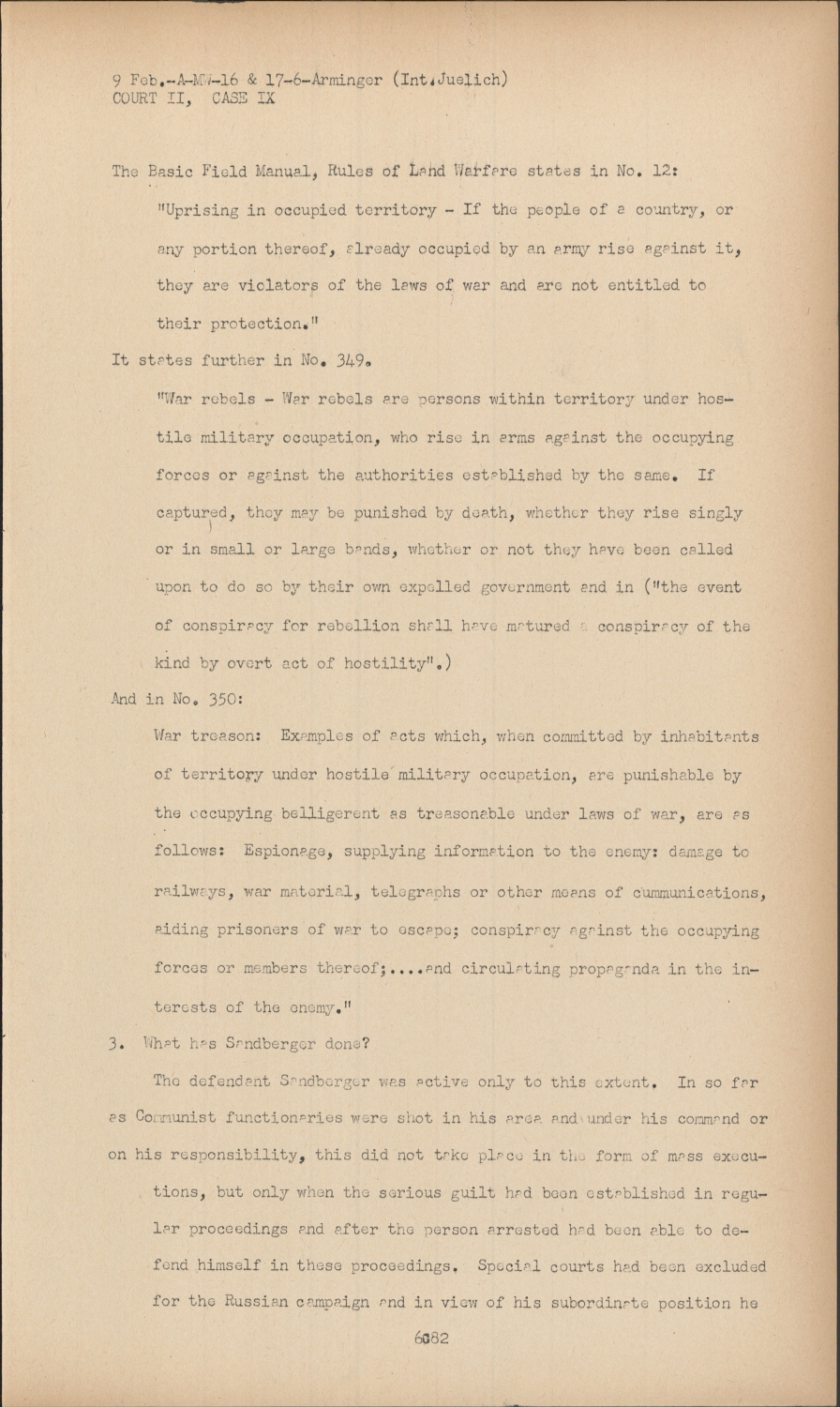
The Basic Field Manual, Rules of Land Warfare states in No. 12:
"Uprising in occupied territory - If the people of a country, or any portion thereof, already occupied by an army rise against it, they are violators of the laws of war and are not entitled to their protection."
It states further in No. 349.
"War rebels - War rebels are persons within territory under hos tile military occupation, who rise in arras against the occupying forces or against the authorities established by the sane.
If captured, they may be punished by death, whether they rise singly or in small or large bands, whether or not they have been called upon to do so by their own expelled government and in ("the event of conspiracy for rebellion shall have matured conspiracy of the kind by overt act of hostility".) And in No. 350:
War treason: Examples of acts which, when committed by inhabitants of territory under hostile military occupation, are punishable by the occupying belligerent as treasonable under laws of war, are as follows:
Espionage, supplying information to the enemy: damage to railways, war material, telegraphs or other means of communications, aiding prisoners of war to escape; conspiracy against the occupying forces or members thereof;.... and circulating propaganda in the in terests of the enemy."
3. What has Sandberger done?
The defendant Sandberger was active only to this extent. In so far as Communist functionaries were shot in his area and under his command or on his responsibility, this did not take place in the form of mass execu tions, but only when the serious guilt had been established in regu lar proceedings and after the person arrested had been able to de fend himself in these proceedings, Special courts had been excluded for the Russian campaign and in view of his subordinate position he he was not able to establish such.
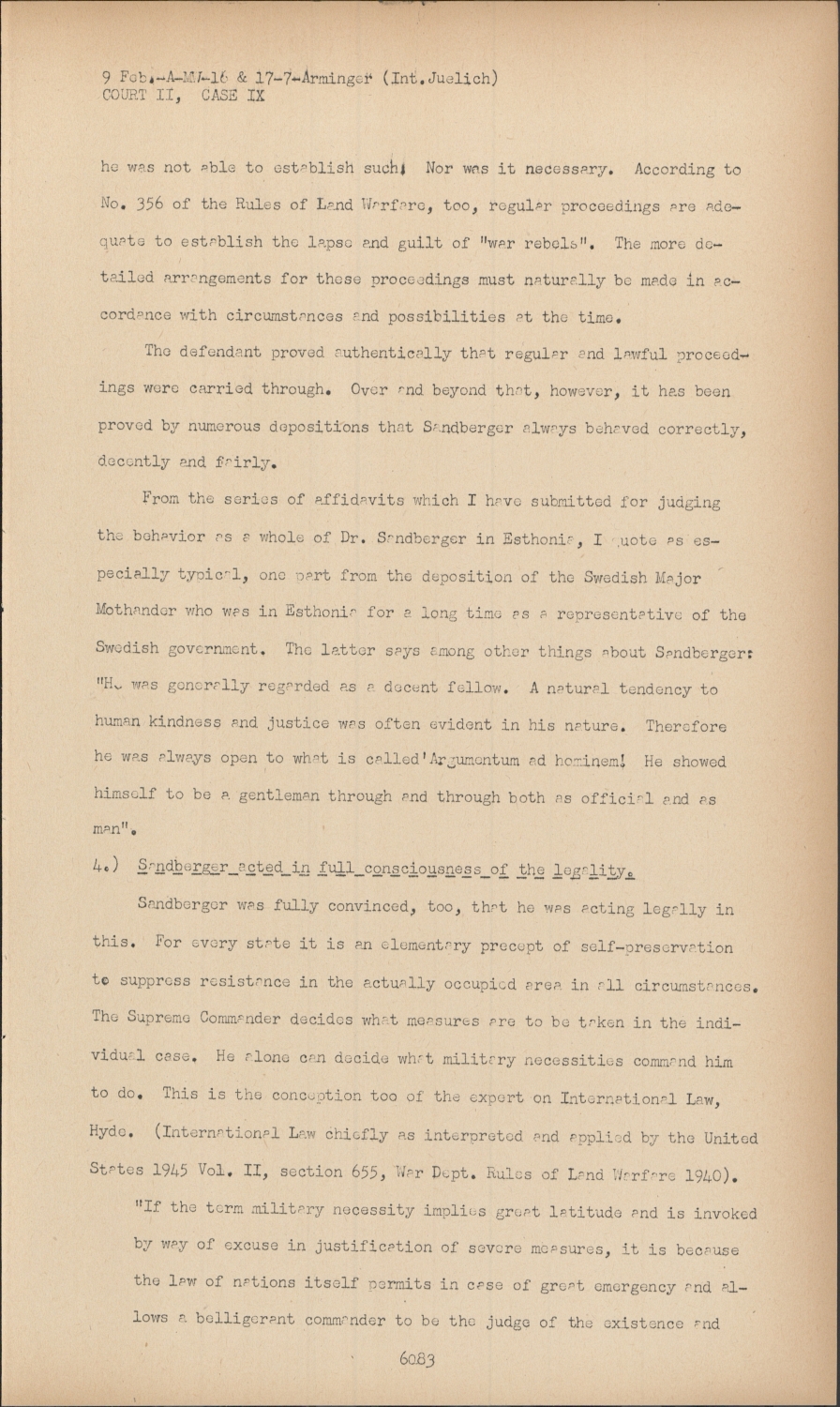
Nor was it necessary. According to No. 356 of the Rules of Land Warfare, too, regular proceedings are adequate to establish the lapse and guilt of "war rebels. The more detailed arrangements for these proceedings must naturally be made in accordance with circumstances and possibilities Pt the time.
The defendant proved authentically that regular and lawful proceedings were carried through. Over and beyond that, however, it has been proved by numerous depositions that Sandberger always behaved correctly, decently and fairly.
From the series of affidavits which I have submitted for judging the behavior as a whole of Dr. Sandberger in Esthonia, I quote as especially typical, one part from the deposition of the Swedish Major Mothander who was in Esthonia for 2 long time as? representative of the Swedish government. The latter says among other things about Sandberger: "He was generally regarded as a decent fellow. A natural tendency to human kindness and justice was often evident in his nature. Therefore he was always open to what is called Argumentum ad hominem! He showed himself to be a gentleman through and through both as official and as man". 4.) Sandberger acted in full consciousness of the legality.
Sandberger was fully convinced, too, that he was acting legally in this. For every state it is an elementary precept of self-preservation to suppress resistance in the actually occupied area in all circumstances. The Supreme Commander decides what measures are to be taken in the individual case. He alone can decide what military necessities command him to do. This is the conception too of the expert on International Law, Hyde, (international Law chiefly as interpreted and applied by the United States 1945 Vol. II, section 655, War Dept. Rules of Land Warfare 1940).
"If the term military necessity implies great latitude and is invoked by way of excuse in justification of severe measures, it is because the law of options itself permits in case of great emergency and allows a belligerant commander to be the judge of the existence and sufficiency of the need".The measures against Communist activists were severe.
But in view of the general war situation and the special position in Esthonia, they were, the defendant was convinced, justified. The resistance which naturally became manifest on receiving the Hitler Order as connected in the first place with the extensive measures timed simply at the Jews, that is, regardless of whether they had become active as partisans, war rebels, or war traitors or belonged merely to the civilian population, it was connected also however with all collective measures against other people who had no individual guilt as far as acts endangering security were concerned. Now when he came to Esthonia and had convinced himself on the spot of the horrows which the Communist activists had perpetrated there, he was also convinced that such measures were in the end unavoidable against war rebels and war traitors of the kind. This was an elementary precept of self-preservation, the self-preservation, which in particular is fully recognized in Anglo-Saxon international law. For the conviction of having acted in defense against a state of emergency which actually existed - a conviction to be claimed for Dr. Sandberger as for all defendants - reference is made to the detailed statements of Prof. Dr. Maurach in his Counsel's Opinion in the Ohlendorf Document Book II and in the Sandberger Document Book IIA. The Prosecution has not proved that Sandberger, in the measures against Communist activists, behaved contrary to the principles of International Law. Instead, it has the onus probandi the more so because I have proved that Sandberger was judged to be correct, fair and upright in general and even in Esthonia.
II Measures against the Esthonian Jews.
Sandberger moreover gave the order to intern the Esthonian Jews. 1.) Was the Internment an international offence?
The general Fuehrer Order and the orders of his superior Stahlecker issued on the basis of this order, to proceed against the Jews in the occupied territory, were the basis of his order.
The inner opposition which had arisen naturally in the defendant Sandberger when the Fuehrer Order was made known was connected above all with this part of the order. Sandberger was, as I have proved by countless affidavits, a morally pure personality who, from the beginning, had adopted a humane attitude in the Jewish question, which deviated from the official Nazi doctrine. He condemned, too, the measures hostile to the Church and protected a number of prohibited student institutions in the religious sphere. In view of these facts, what Sandberger stated about his inner attitude to the Fuehrer Order is credible without more ado. He said: The contents of this Order were so completely foreign to anything I could previously have imagined that I simply could not conceive its realisation. In particular I could not imagine that I myself could be capable of doing it and, on the other hand, I did not believe that I could demand something of my man that I could not do myself.......I considered the Order inhuman .....I resolved to evade this Order as far my Kommando and myself were concerned, in so far as ever was possible without however offering open resistance which would certainly have been senseless.
This also explains all the subsequent action of Sandberger's. He disapproved, too, the collective internment of the Jews and did not order the internment as a preliminary measure either for the killing measure which he disapproved of all the more but as a substitute measure enforced by his order in place of the far worse measure. He ordered the less farreaching even if equally disapproving of measure of deprivation of freedom which was nevertheless bearable rather than the destruction of human life. This internment cannot be disapproved of from the point of view of international law as the result of the enforced weighing up and down. When, for example, in the Boer War, a general laying waste of the country was started, innumerable women and children of the Boers were brought into the concentration camps which were newly created at that time, to avoid something worse.
I quote from Oppenheim, Page 324' "It is also lawful when, after the defeat of his main forces and occupation of this territory an enemy disperses his remaining forces into small bands, which carry on guerilla tactics and re ceive food and information, so that there is no hope of ending the war except by a general devastation which cuts off supplies of every kind from the guerilla bands.
....
It would be more human to aken them away into captivity rather than let them perish on the spot. The practice resorted to during the South African War of housing the victims of devastation in concentration camps must be approved."
Thus, a measure in itself inadmissible and in violation of the International law, was sanctioned here because it was not to prevent worse things, or because worse things were to be prevented.
The very same applies also to the case of Sandberger. The measure of internment was to prevent worse things, namely death. Therefore, no objection against this measure can be raised from the point of international law. Besides that, it represented an emergency measure to prevent the Jews from being killed and, Sandberger, in order to ward off the violation of the right to live, was compelled to violate the right to liberty even if this was done only under compulsion. 2). Why has Sandberger confined his measures to the internment?
When Sandberger issued the order for internment he was hoping that he could prevent the execution of the Jews. He was convinced of the fact that the lawless order for execution of the Jews would lead to enormous difficulties or even complications in the occupied territory. At a time when the United States of Worth America had not yet entered the war, he was right in assuming that the lawless execution of the Fuehrer order would lead to an aggravation of the international situation and that HITLER, in spite of all, might yet decide to mitigate or limit the order.
This hope was by no means unjustified. For in the following period it also occurred repeatedly that Fuehrer orders were limited. In the course of 1942, for example, the treatment of the Soviet prisoners of war was considerably cased. Moreover, inmates of concentration camps were, contrary to the original tendency, assigned to an increasing extent to economically essential work. The prisoners taken in the fights against partisans were used later on predominantly as workers.
The fact that attempts were made again and again by the highest executive authorities to achieve a change or cancellation of the execution order, is also shown in the statement by Erwin LAHOUSEN which the Prosecution itself presented in the rebuttal document-book 5 D under Doc. No, 2894, Exhibit 228. SANDBERGER's intention to intern the Jews is also substantiated in the situation report No. 111 submitted by SANDBERGER's deputy in the latter's absence. According to that report all Estonian Jews were to be housed in camps. At the same time arrangements were made for the permanent financing and feeding of the camp inmates. If Sandberger, however, intended to arrange for a long term financing and supply with food, he certainly did not order the internment as a preparatory measure for an execution following shortly thereafter. If an early execution would have been contemplated it would have been quite unnecessary for him to make any efforts for furnishing and enlargement of an internment camp.......when in San forger's absence, without his knowledge and consent, Stahlecker ordered the execution of a part of the Esthonian Jews, the former, after his return, had the rest of the Jews transferred to the Pleskau camp. If he had approved in his innermost of Stahlecker's aim to make Esthonia free of Jews, he then would have carried out the execution immediately and would not have arranged for the transfer of the Jews to the Pleskau camp which was located beyond the borders of Esthonia.
This in addition to the fact that, according to human foresight, the life for the interned Jews in Pleskau was by far safer than in Reval. The Headquarters of the Army Group North was in Pleskau. No reasonable person could expect that such an execution would be ordered in the immediate neighborhood of the headquarters as this was then ordered by JECKELIN, again without SANDBERGER's knowledge and consent, for the Jews interned in Pleskau. 3. In carrying out the executions SANBERGER's subordinates acted under irresistable compulsion.
In both cases the execution was ordered by SANDBERGER's superiors and carried out by subordinates of SANDBERGER. In one case the chain of command led from Stahlecker to Carstens, in the other case from Jeckeln to Bleymehl. This order was absolutely binding for both. Active or passive resistance, or any kind of disobedience would have entailed capital punishment for desertion, insubordination or underlining the permit of the armed forces. The sane principles were enforced in the SS. In consequence of a special decree, issued on 9 April 1940, the entire security police including the SD were alerted for special operations. If the penalties, pronounced by the Wehrmacht court martials, were harsh, those of the SS-courts were draconic. The simple death penalty was comparatively mild. Intensified kinds of death led certain death by way of the concentration camp or special probationary units. Compare Doc. Book I for the defendant Blume.
Thus, they were under compulsion which once before the Military Tribunal II had to deal with in the case of Milch. There the Tribunal stated:
"It has never been our intention nor did we ever suggest that he ought to have chosen any way which could have resulted in the loss of his life."
No person can be punished for a crime which be was forced to commit. But then, is a punishment admissible for acts which were ordered or committed under the compulsion of a dictated order?
Is a punishment admissible if a violation of such an order was threatened by such draconic penalties that "no other choice was left"?
The Military Tribunal No. IV has stated in Case No. V that the Reich was "ubiquitous", "ready for action and in a position to inflict cruel punishment immediately on everyone who did something which could have been interpreted as sabotage or opposition against the execution of decrees or regulations issued by the government." (German record, page 10736) In such cases the Military Tribunal has admitted the plea of acting under compulsion.
This state of emergency exculpates Carstens and Bleymehl to a large extent. How should Sandberger then be hold responsible for ations in which he did not participate, of which he was not informed, which he did not want, and the perpetrators of which are besides exculpated to a large extent by the state of emergency in which they were?
4) Sandberger had no criminal intent either.
The witness Strauch confirmed that objections had been raised for the reason that the Fuehrer Order was not yet carried through within Sandberger's sphere of command, although the number of Jews was only small. This is explicable. For it was declared to the defendant Sandberger, especially by his superior Stahlecker, that he was not severe enough for the things in the East and that he showed no understanding for the requirements of the time and space (Transcript of the sessions, page 2223 of the German text). Sandberger did not order the internment as a preparatory measure for the killing of the Jews, but, on the contrary, in order not or not yet to have to order their being killed.
It cannot be said: Jews were killed within Sandberger's sphere of command, therefore he is responsible. This more responsibility for the result of a crime is not recognized in criminal law, it is on the contrary rejected. A crime exists only whore a serious guilt exists. If the mere responsibility for the result of a crime is not even recognized in criminal law the less so in International Law. The International Law hitherto existing declined the criminal liability of individual persons. It was introduced on this scale and to this extent by the Nuernberg Verdicts only. It will also in future remain an exception and will, probably be applied partially only, that means not against members of the victorious powers. Thus it is an exception. Now, according to an old legal principle, valid for millenniums, exceptions are to be interpreted restrictively. If thus the responsibility for the result of a crime is not recognized by criminal law, the less so by International Law, if it is indeed intended to punish individual persons for delicts within the meaning of International Law. Also for that reason a liability of Sandberger within the meaning of criminal law must be declined.
5) Sandberger was not connected either with the killing.
It could be said that the killing of the Jews was facilitated by the internment. Thus, Sandberger had "been connected" with their being killed. If this tern of the Control Council Law-claims to have a reasonable meaning, a merely external connection with a committed crime is not sufficient, Whoever supplies the weapons with which prisoners are shot, contrary to International Law, is not connected with the crime of killing. He knows indeed that the weapons are suitable and destined for the killing of men. He creates a not at all unessential prerequisite to the killing. This condition is, however, not taken into consideration in connection with the crime, since the supplier could not prevent the misuse and, considering it reasonably, the person alone is responsible who commits the criminal action.
Whoever is connected with a crime knows of the crime, wishes the crime, and co-operates in connection with the crime by any legally essential actions or omissions, His responsibility is either constituted by the fact that he
a) actively participates in the crime
b) or inactively tolerates the crime, although it would be within his power to prevent it.
Joint commission and rendering assistance as an accomplice within the meaning of the Control Council Law refer to active actions. The "being connected" with a crime refers, however, to those forms of co-operation in which an active participation does not exist, but still an objectionable passive participation, Such a participation is to be presumed, in those cases in which a commander does not supervise his subordinates sufficiently or does not prevent excesses, although ho can foresee them. This is probably also meant by the Prosecution in stating (German Transcript of the sessions, page 64):
"The rank and the position held by these defendant comprises the authority to supervise their subordinates.
This authority together with the knowledge of the intended crime and of the subsequent commitment of the crime during the time of their command renders them unequivocally penally responsible."
In criminal law a distinction is made between preparatory activity and acts pertaining to the execution. Penally relevant are all acts pertaining to the execution, and that from the first commencement until the completion of the crime. Preparatory activity is, however, not punishable, unless it constitutes a punishable act in 9 Feb 1948_A_MSD_19_1_Hoxsie (Juelich) itself.