QWitness, can you remember that it is correct that at the beginning of the interrogation the defendant Braune refused to give his testimony Under oath?
AThat is correct.
QIs it also correct that he also refused to give en affidavit, because he thought that this was equivalent to giving an oath? I repeat the question. Is it correct that after having refused to give an oath the defendant also refused to give an affidavit, because he was of the opinion at least according to his German legal conception, that such an affidavit was equivalent in form to the oath?
AThat is correct.
QHow then do you explain the contradiction that the statement by Braune expressly contains the formulation that he did not make this statement under oath, while in your note under page 97, it says that the statement was made under oath?
AIf I may ask the question, are you referring now to the paragraph which is signed by me, which appears after the signature of Braune?
QAfter the signature of Braune.
AI should like to state that on my copy the word "Eidesstattliche Erklaerung" at the end, the word, "Eidesstattliche" has been crossed out by me at that time. It is just a typographical error and if you will read the last paragraph before the signature of Dr. Braune, it states that he made the declaration in the German language and it does not say that it is a sworn statement. It further states there that this declaration is not made under oath, but under his word of honor which Braune gave me at the interrogation.
DR. MAYER:This explanation is sufficient. I have no further questions to put to the witness.
THE PRESIDENT:Very well. Any other questions to be put to Mr. Wartenberg by defense counsel?
Apparently not. If you have anything further, Mr. Walton, in connection with this witness -
REDICRECT EXAMINATION BY MR. WALTON:
QMr. Wartenberg, a great deal has been said about your methods of interrogation. I should like to go a little further into your qualifications, Did you have prior to the time you became a member of the Office of the Chief of Counsel any experience in interrogations?
AYes, sir.
QWill you tell the Tribunal the nature of your experience before you became a member of the interrogation staff in the Office Of Chief of Counsel?
AIn 1943 I was assigned to a Military Intelligence Training Center and I observed there the School for interrogation in the German language. I had, later on, additional training with the British and American forces in England. I was assigned later on to Seventh Army Interrogation Center and the Theatre Interrogation Center at Oberursel and during all my army career, the basic element of my work was interrogations, with the exception of some short periods when I was used for other work.
THE PRESIDENT:What rank did you hold in the Army?
THE WITNESS:My last rank was Captain,
QHow long have you been on the staff here?
AExactly one year and a couple of days.
QDO you conduct interrogations alone, or is someone else present?
ADuring the interrogations conducted over here in this building I have always a German stenographer present and in addition to that there is a guard.
QNow, if you had threatened or used duress or mistreatment of an interrogates, there would be witnesses to such action on your part, would there not?
ADefinitely, yes.
I Did you ever, during your service as an interrogator in the Office of Chief of Counsel promise anybody, either a defendant or a witness, a reward for his testimony or for the execution of an affidavit?
AI never did.
QDid you ever use duress or force or threat in order to obtain an affidavit or a statement from anyone?
AI never did.
QDid you ever try to compel anyone to swear to an affidavit?
AI never did.
Q was anyone, either a witness or a defendant, compelled by anyone, else in your presence to sign an affidavit or a statement?
ANo, sir.
QWould you explain in short detail as possible how an affidavit is prepared by you?
AAll right, sir, When an interrogatee comes to the interrogation room, if he is an inmate of the Nuernberg prison, he is under guard. He identifies himself by name. He is either taken under oath or reminded that he is still under oath. Then the interrogation is taken and, after I have the records from my secretary, I am going through those facts which I consider important. I write those facts out and then I recall the interrogatee. I remind him of his oeath, if he had sworn an oath before, and I present him with the affidavit. I ask him then to read it, to make all corrections he wants to, but to let me know beforehand So that we can do it together on all the necessary copies. After that, when the interrogatee has made all his corrections, he initials the corrections, and signs the affidavit in my presence.
QDid it ever happen that drafts of affidavits prepared by you were changed radically by the interrogates so that the whole affidavit had to be rewritten in order to comply with the wishes of this affiant?
AThat happened several times.
QThen were they allowed to make changes, if necessary, on the new draft?
ACertainly, they can make their changes. There is one case where an affidavit was written four or five times -- I am not sure about the number, but it was definitely more than three times, because the defendant was not satisfied with the draft and he has all chances to make all necessary corrections.
QDo you remember the name of this then interrogatee?
AYes, that was the Defendant Ohlendorf.
QDid it also happen that prospective affiants found your draft of the affidavit unsatisfactory and drew up their own statements?
AYes, that happened in the case of Haensch. After two interrogations, I had prepared an affidavit and he told me that I mixed up things; that I distorted facts in a way that he was not able to sign it. He insulted me also in the manner he talked to me and I told him, "Draw up your own affidavits." He did so and after I had it, I read the affidavit. I called him back. I had him initial each single page and sign this affidavit without any additions.
QDid it also happen that affiants sometimes informed you that the affidavit already signed by them was not complete and they therefore wanted to make a new statement or additional statements?
AThat is correct.
DR.GAWLIK (ATTORNEY FOR DEFENDANT NAUMANN): I object to this question, Your Honors, for the following reason. This is redirect. The redirect can only refer to the preceding cross-examination and, secondly, this question is completely irrelevant in this general form. The prosecutor would have to ask whether this refers to a defendant in the dock here, but I don't know what relevancy it has - what has happened in other cases, which do not have anything to do with this trial.
THE PRESIDENT:Well, Dr. Gawlik, you and your brother counselors here have levelled a pretty steady attack on this witness' procedure so that now prosecution counsel is merely endeavoring to explain what is the procedure. Of course, if the witness is now speaking of interrogations of witnesses or defendants not connected with this case, that would be irrelevant.
DR. GAWLIK:Yes.
THE PRESIDENT:It is not apparent whether he is including in his answer generally the whole orbit of his manner of questioning or whether he is restricting it to the defendants in this case, and I would suggest in that respect, Mr. Walton, that he confine it to only those directly connected with the present case which we are trying.
MR. WALTON:I think we can clear that up in one moment, Your Honor.
THE PRESIDENT:Yes.
QMr. Wartenberg, during your contract with Office Chief of Counsel what other case or cases, if any, have you worked on, except this one?
AI have only worked for this single case.
QI believe you stated that you allowed -- I am sorry -- Will you please restate your answer to the question that when affiants informed you that the affidavits signed by them were not complete and that they wanted to make a new statement, what was your procedure?
AWith the case of the defendant Klingelhoefer, while after some time after the affidavit had been taken, I discovered a typographical error in the date. I recalled the defendant Klingelhoefer, together with his defense counsel, because by that time the indictment had been served on him. It was stated to me at that time that certain points were not clear in the previous affidavit and I wanted to have it corrected and that Klingelhoefer will present me with a new affidavit. Some days later, he came up to the office. He handed me his affidavit. His defense counsel was present. We discussed certain points and at the end the affidavit was signed and handed over to the prosecution staff.
QOne further question. Let me direct your attention to the time when you interrogated the then witness, now the defendant Blobel. Do you recall whether or not that Blobel, at the time when he was represented by Deputy Reich or von Radetzky, or someone, do you remember whether or not he stated he knew executions were carried out in his absence?
AYes, he stated that fact.
MR. WALTON:No further questions.
THE PRESIDENT:Very well, Mr. Wartenberg, you will be excused and we will take up the reading of the opening statements. I do not recall who is next in order. Who is ready to proceed?
You are ready, Dr. Gawlik?
(The witness was excused.)
DR.GAWLIK (for the defendant Seibert): My evidence--(interruption)
THE:PRESIDENT: Just a moment, please.
Dr. Gawlik, we are sorry that you may have to miss your turn. It appears that we don' have the translation of your Opening Statement. Would it be inconvenient, too troublesome, for you to allow the next attorney to read his Opening Statement, and then you can be called as soon as the translation appears.
DR. GAWLIK:Yes, certainly.
THE PRESIDENT:Is Steimle's attorney here? Are you ready? Oh, yes; very well. Who is ready?
DR.MAYER(for the defendant Braune):
THE PRESIDENT:Very well, you may proceed, Dr. Meyer.
DR. MAYER:Your Honors, the defendant Braune, like all other defendants, is charged under three counts: first, Crimes against Humanity, Countl; second, commission of war Crimes, that is Count 2; and third, Membership in a Criminal Organization - Count 3. The Prosecution in a nine document books has submitted material and has emphasized in its Opening Speech in which manner the defendants including the defendant Braune, incriminated themselves. They have-
THE PRESIDENT:Oh - just a moment-- I am sorry. I thought that you had this translation. I am very sorry, Dr. Mayer, to interrupt. But you know it is quite a task to interpret extemporaneously. So we would like to proceed with those Opening Statements whose translations We actually have here. I will indicate the ones which are ready: Defendants Walter Haensch, Heinz Schubert, von Radetzky, Ott, Biberstein, and Grad.
Now, Dr. Bergold has asked me to allow him to read his statement this afternoon. So, who is ready, of the ones I have named?
DR.RIEDIGER (for the defendant Haensch):
THE PRESIDENT:Very well, you may proceed, please, Dr. Riediger.
DR. RIEDIGER:Your Honors, the defendant Walter Haensch was taken over by the SD with the rank of Unterscharfuhrer in May 1936, after he had been working as a civilian legal consultant with the SD since 1 August 1935.
In 1942 he was temporarily detailed for service in Russia as Chief of Sonderkommando IV b for a short time.
After the completion of his mission, he first returned to his former duties in the which main Security Office and from September 1943 till the end of the war he was attached to the Office of the Reich Plenipotentiary in Denmark as administrative official in the Main Department "Administration and Law".
The Prosecution charges my client with having committed crimes against humanity and war crimes, and calls him to account for membership in the SS, the latter being an organization declared criminal by the IMT.
In evidence the Prosecution has submitted documents from which it concludes that Haensch as Chief of the Kommando is responsible
1) for the shooting of 861 persons, including 139 Jews and 649 Commissars in the neighborhood of Kiew during the the from 14 January 1942 to 12 February 1942,
2) for the shooting of 1, 317 persons, including 1,224 and 63 Commissars in the neighborhood of Artemowsk during the time from February to March 1942.
The Defendant has not contested his membership in the SS and the Service grade attained by him.
To disprove the allegations of the Prosecution I shall produce evidence for the following facts:
1) It is untrue that Haensch in the period mentioned by the Prosecution was already responsible Chief of Sonderkommando IV b. The defendant did not assume his duties in Russia until about the middle of March 1942. In evidence I shall present documents, witnesses and the defendant himself, whom I shall call to the witness stand.
2) The entire work of the Defendant in the Russian Theatre of Operations, as far as it must be taken into consideration for purposes of criminal investigation, lasted only a few weeks, due to interruptions caused by temporary duty elsewhere and ended in June 1942.
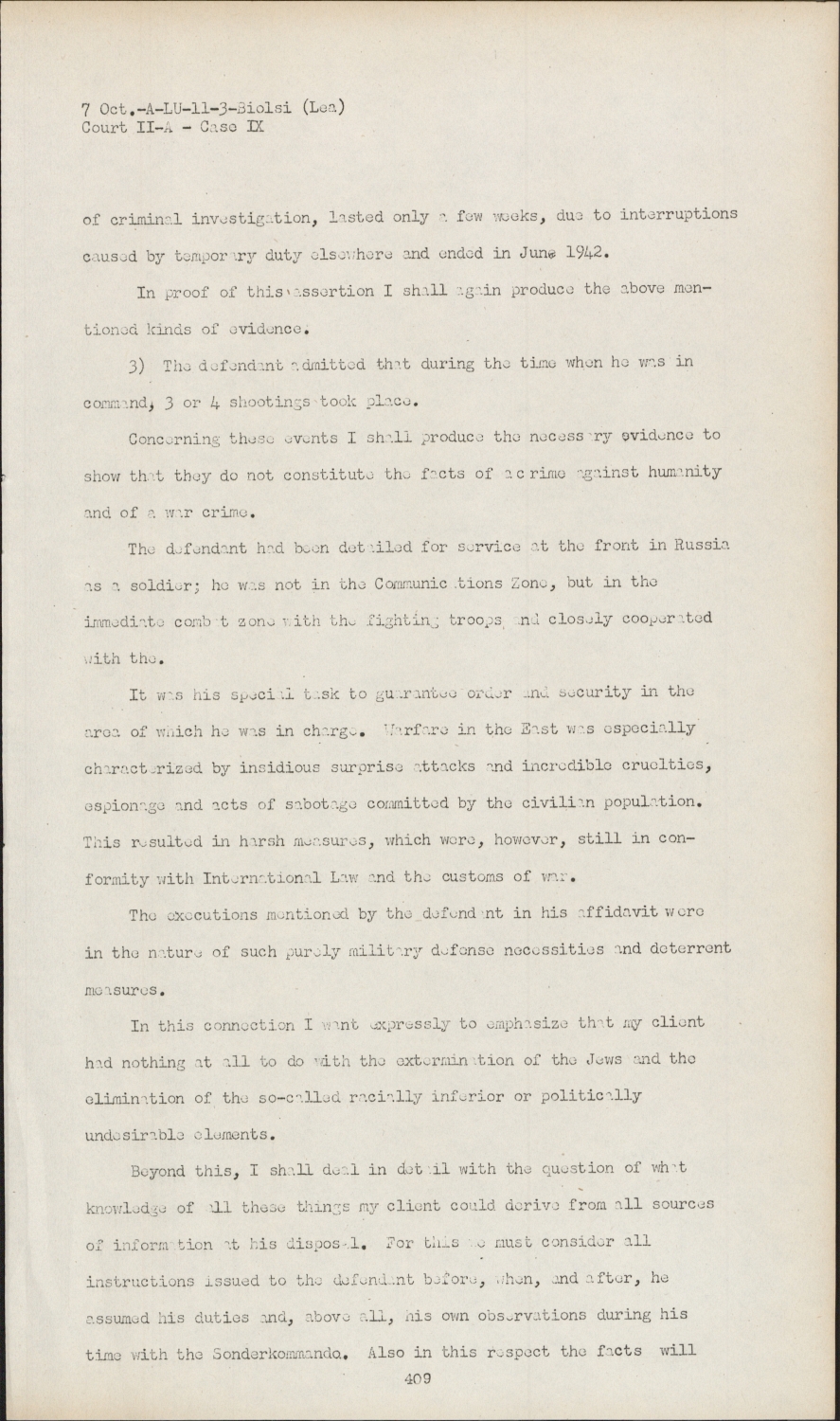
In proof of this assertion I shall again produce the above mentioned kinds of evidence.
3) The defendant admitted that during the time when he was in command, 3 or 4 shootings took place.
Concerning these events I shall produce the necessary evidence to show that they do not constitute the facts of a crime against humanity and of a war crime.
The defendant had been detailed for service at the front in Russia as a soldier; he was not in the Communications Zone, but in the immediate combat zone with the fighting troops and closely cooperated with the.
It was his special task to guarantee order and Security in the area of which he was in charge. Warfare in the East was especially characterized by insidious surprise attacks and incredible cruelties, espionage and acts of sabotage committed by the civilian population. This resulted in harsh measures, which were, however, still in conformity with International Law and the customs of war.
The executions mentioned by the defendant in his affidavit were in the nature of such purely military defense necessities and deterrent measures.
In this connection I want expressly to emphasize that my client had nothing at all to do with the extermination of the Jews and the elimination of the so-called racially inferior or politically undesirable elements.
Beyond this, I shall deal in detail with the question of what knowledge of all these things my client could derive from all sources of information at his disposal. for these must consider all instructions issued to the defendant before, when, and after, he assumed his duties and, above all, his own observations during his time with the Sonderkommando. Also in this respect the facts will demonstrate that in view of the strict observance of the Fuehrer's Order Number I concerning "secrecy", the large distances between the individual Kommandos, between which there was no connection at all moreover in view of the fact that the purposes originally assigned were in the course of time radically changed, the defendant Haensch could obtain any knowledge only from his own activity.

It will, therefore, be my task to describe this activity in detail to the Tribunal and to prove that in it Haensch neither committed any of the crimes mentioned in the indictment, nor became an accessory to it.
As regards legal questions I shall deal with the problems raised by the application of Control Council Law No. 10 concerning a soldier under the military obligation of obedience and the limits of what may be demanded of a person in the event of conflict of duties.
The question of punishment for membership in a criminal organization according to the basic directives laid down in the IMT judgement prompts me to examine once more whether the legal principle nullum crimon sine lege (no crime without a law), which is firmly established in all civilized nations, has been sufficiently considered.
Moreover, I shall investigate whether the objective and also the subjective prerequisites fur a Verdict of guilty exist, especially if all reasons precluding guilt are taken into consideration; and, above all, whether my client was conscious of acting illegally.
DR.KOESSL (for the defendant Ott): Your Honors, the Prosecution's charge of systematic murder of nations comprises a complexity of guilt which can hardly be realized in its full scope, let alone can it be defended.
This fact lies Like an oppressive nightmare on the defense counsel of this trial if one considers it as detached from the individual personalities which fate has brought into the dock here. The trial here concerns humanity without God.
Considering this, I feel that the request of the Prosecution to the Tribunal, to proclaim the right of humanity to be allowed to live in peace and dignity without any consideration of creed or race, represents a redeeming aspect.
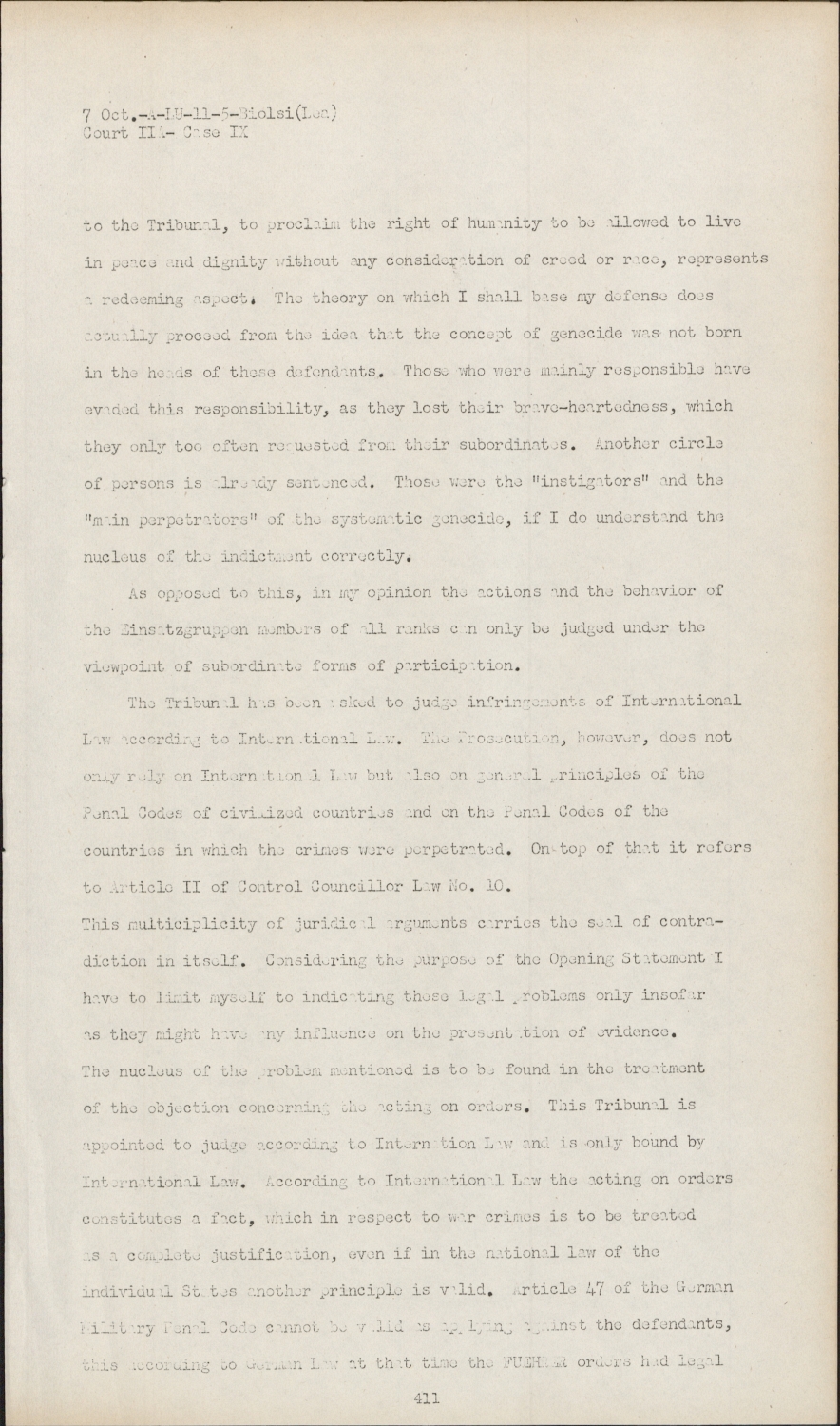
The theory on which I shall base my defense does actually proceed from the idea that the concept of genecide was not born in the head of those defendants. Those who were mainly responsible have evaded this responsibility, as they lost their brave-heartedness, which they only too often requested from, their subordinates. Another circle of persons is already sentenced. Those were the "instigators" and the "main perpetrators" of the systematic genecide, if I do understand the nucleus of the indictment correctly.
As opposed to this, in my opinion the actions and the behavior of the Einsatzgruppen members of all ranks can only be judged under the viewpoint of subordinate forms of participation.
The Tribunal has been asked to judge infringements of International Law according to International Law. The Prosecution, however, does not only rely on International Law but also on general principles of the Penal Codes of civilized countries and on the Penal Codes of the countries in which the crimes were perpetrated. On top of that it refers to Article II of Control Councillor Law No. 10. This multiciplicity of juridical arguments carries the seal of contradiction in itself. Considering the purpose of the Opening Statement I have to limit myself to indicating those legal problems only insofar as they might have any influence on the presentation of evidence. The nucleus of the, problem mentioned is to be found in the treatment of the objection concerning the acting on orders. This Tribunal is appointed to judge according to Internation Law and is only bound by International Law. According to International Law the acting on orders constitutes a fact, which in respect to war crimes is to be treated as a complete justification, even if in the national law of the individual States another principle is valid. Article 47 of the German Military Penal Code cannot be valid as applying against the defendants, this recording to German Law at that time the FUEHRER orders had legal powers and no authority was existing with which to lodge an objection against these orders.
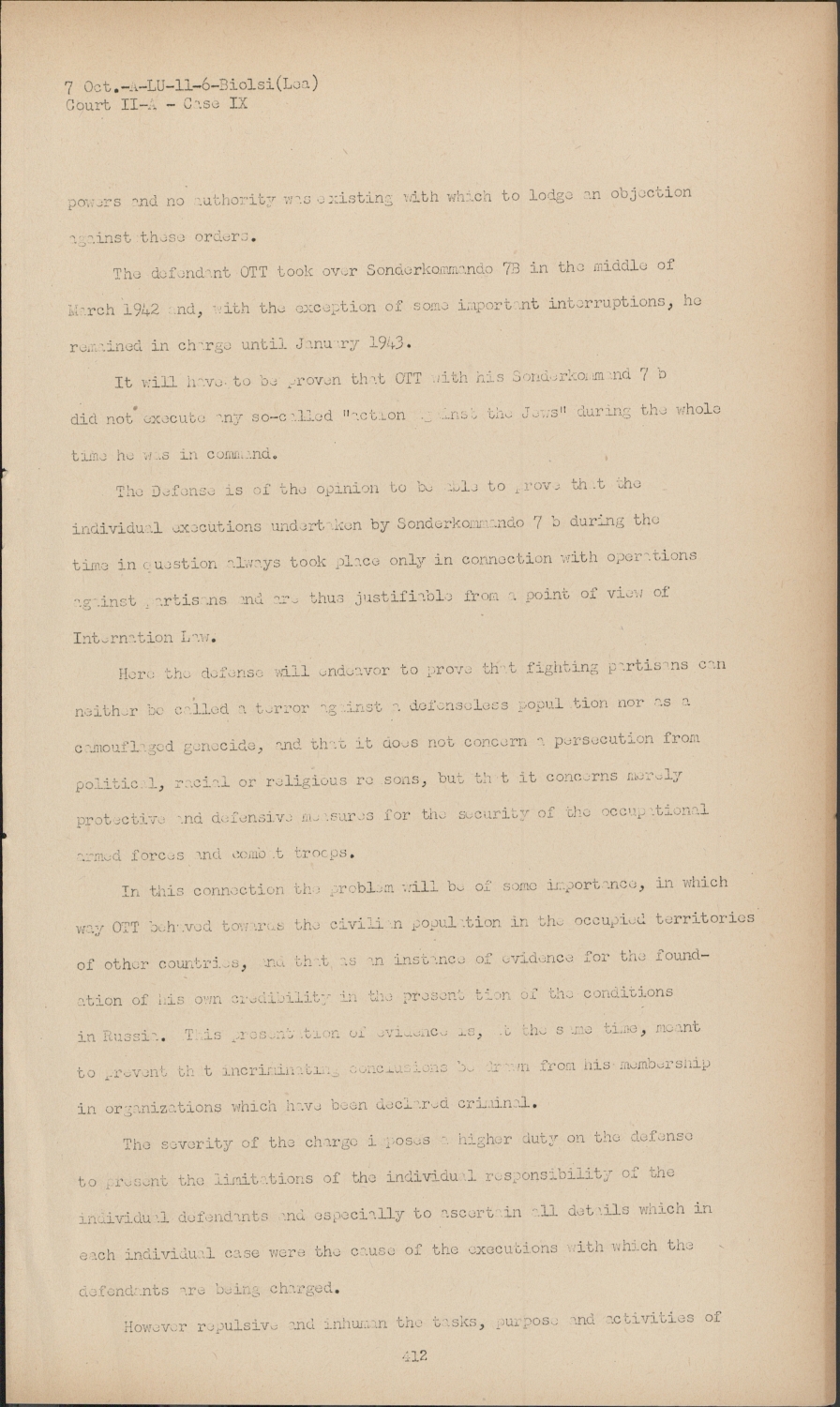
The defendant OTT took over Sonderkommando 7B in the middle of March 1942 and, with the exception of some important interruptions, he remained in charge until January 1943.
It will have to be proven that OTT with his Sonderkommand 7 b did not execute any so-called "action against the Jews" during the whole time he was in command.
The Defense is of the opinion to be able to prove that the individual executions undertaken by Sonderkommando 7 b during the time in question always took place only in connection with operations against artisans and are thus justifiable from a point of view of Internation Law.
Here the defense will endeavor to prove that fighting partisans can neither be called a terror against a defenseless population nor as a camouflaged genocide, and that it does not concern a persecution from political, racial or religious re sons, but that it concerns merely protective and defensive measures for the security of the occupational armed forces and combat troops.
In this connection the problem will be of some importance, in which way OTT behaved towards the civilian population in the occupied territories of other countries, and that as an instance of evidence for the foundation of his own credibility in the presentation of the conditions in Russia. This presentation of evidence as, at the same time, meant to prevent that incriminating conclusions be drawn from his membership in organizations which have been declared criminal.
The severity of the charge imposes a higher duty on the defense to present the limitations of the individual responsibility of the individual defendants and especially to ascertain all details which in each individual case were the cause of the executions with which the defendants are being charged.
However repulsive and inhuman the tasks, purpose and activities of the Einsatzgruppe seen as a whole, the more so the principle has to be applied that the penal guilt is a personal one, a principle which according to the statements of the International Military Tribunal, belongs to the most important legal principles.

"Guilt", however, cannot only be applied to the criminal intent of the action of the person acting. Thus all those reasons for the evidence become essential which have a bearing on the complex of perceptions of the defendant concerning his position in the dictatorial Fuehrer State.
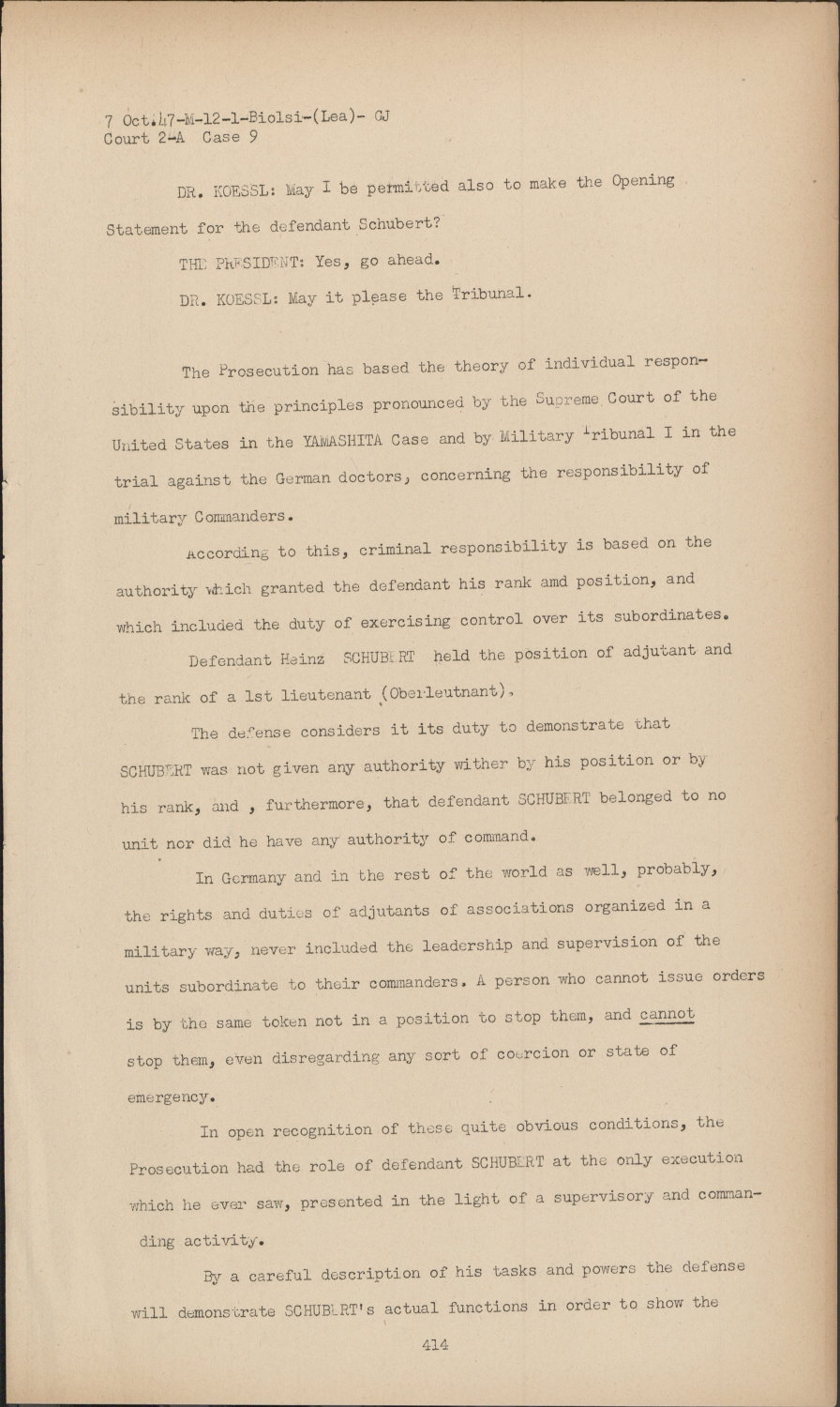
DR. KOESSL:May I be permitted also to make the Opening Statement for the defendant Schubert?
THE PRESIDENT:Yes, go ahead.
DR. KOESSL:May it please the Tribunal.
The Prosecution has based the theory of individual responsibility upon the principles pronounced by the Supreme Court of the United States in the YAMASHITA Case and by Military Tribunal I in the trial against the German doctors, concerning the responsibility of military Commanders.
According, to this, criminal responsibility is based on the authority which granted the defendant his rank amd position, and which included the duty of exercising control over its subordinates.
Defendant Heinz SCHUBERT held the position of adjutant and the rank of a 1st lieutenant (Oberleutnant).
The defense considers it its duty to demonstrate that SCHUBERT was not given any authority wither by his position or by his rank, and, furthermore, that defendant SCHUBERT belonged to no unit nor did he have any authority of command.
In Germany and in the rest of the world as well, probably, the rights and duties of adjutants of associations organized in a military way, never included the leadership and supervision of the units subordinate to their commanders. A person who cannot issue orders is by the same token not in a position to stop them, and cannot stop them, even disregarding any sort of coercion or state of emergency.
In open recognition of these quite obvious conditions, the Prosecution had the role of defendant SCHUBERT at the only execution which he ever saw, presented in the light of a supervisory and commanding activity.
By a careful description of his tasks and powers the defense will demonstrate SCHUBERT's actual functions in order to show the Tribunal the scope and the content of his work.
In this connection, the former activity and the career of the defendant will assume more significance than in the case of any other defendant. I shall, therefore, take advantage of the opportunity to show that SCHUBERT was assigned to the functions of an adjutant because of the very nature of his career, and that this function actually correspond to the career of an administrative official.
I believe that the legal basis for my argumentation was shown sufficiently during the opening speech for defendant OTT. The theory of defense presented there also provides the method for my argument in the SCHUBERT case, in order to create the conditions for examining individual responsiblity by a just standard.
THE PRESIDENT:Any one else ready?
DR.LEID: (For the defendant Klingelhoefer): I don't know whether the Tribunal has the translation of my opening speech.
THE PRESIDENT:We do not have it. I am sorry, Dr. Leid. We have the Opening Statement for the defendant Mathias Graf. Is his attorney here? No?
Radetzky, Graf, Blume, Blobel, Nosske, Rasch, Steimle, Six, Jost, Ruehl. Those are the ones we have ready. Well, of course, most of those have been delivered, but -
DR. HELMS:I am in a position to give the Opening Statement for the defendant Ruehl.
THE PRESIDENT:Very well, proceed.
DR. HELMS:May it please the Tribunal:
The defendant Felix Ruehl immediately after the collapse of Germany volunteered to serve the American authorities. This happened in the consciousness that he would have to account for his political past. But this also happened in the firm conviction that the investigations which he had would be held, could not connect him with any kind of dishonorable or punishable acts. Therefore, he did not hide in the internment camps.
When the defense of the organizations before the IMT called him to be a witness against the Prosecution this was done by him without hesitation. After the collapse he thus got into a circle to which he had never belonged, and he heard of things which he had just heard from rumors, and thus he heard about happenings which he had never known before.
Today Ruehl is sitting among those defendants who are charged with deliberate slaughter of more than one million defenseless men, women and children. What is it that brings this man, who has been brought up in simple surroundings, who has been a conscientious student soldier and official but not a fanatical National Socialist--what is it that charges him with murder? Where is the proof of his guilt?
The Prosecution has not answered this question. It wants to bring men into court, men who have committed murders, crimes and other inhuman acts. Everyone of the defendants held a leading position or a command post in an extermination unit. Each had the power to order executions by virtue of his position. See page 35 of the Opening Statement.) All had ranks and positions which included the power and the duty to control their subordinates. (Page 36 of the Opening Statement.) Not one of these criteria applies to the defendant Felix Ruehl.
To show this, there need not to be any special presentation of evidence. A glance at the Indictment and at the Prosecution's documents will be sufficient. The only documents in which the Tribunal will find the name of Felix Ruehl are his own personal papers and his own affidavit. He is not mentioned in any report, neither as a superior nor as a subordinate, and no where is any reference made to him. Many of my colleagues had to present arguments of a legal and political nature which shall serve to solve the problems which cannot be ignored in these proceedings. I will be able to second them without having to lay claim to them. Many of my colleagues, if not all of them, will have to show factual proof refutes the contrary statements of the Prosecution and which reduces them to a sound basis on which alone a just verdict will be possible.
I will be in a position in the first instance to refer to the Prosecution's own documents and will only have to contribute to a very limited extent to their explanation and their correction, finally, many of the defendants may have to state personal reasons as extenuating circumstances which make their actions and their responsibilities appear in a different light.
The defendant Felix Ruehl has nothing to conceal and has nothing to tone down or to extenuate. He has nothing more, and nothing less, to contribute to the material for the proceedings than the decent attitude of a mar who served where he was asked to servea service which was neither dishonorable nor criminal.
From June until September 1941 the defendant Felix Ruehl belonged to Sonderkommando 10b within Einsatzgruppe D. This unti is mentioned once under Figure 9 C of the Indictment, where he is charged with having murdered Communists and Jews near Czernewitz. The defendant Ruehl did not at any time lead this Sonderkommando or any of its Teilkommandos. Even the Indictment does not contain such an assertion. It merely mentions the accused as one of the officers of this Sonderkommando. Evidently even the Prosecution takes it for granted that every officer and soldier does not automatically become a criminal if punishable offenses are committed in his unit. Therefore, it endeavors to establish as close connection as possible between the defendant and the command of this unit. This is the only explanation for the Prosecution's reference, in its opening speech, to my client as deputy of the late Kommandofuehrer Persterer (page 24), whereas on its map and charts it shows him correctly as an ordinary member of this unit.
Court2-A Case 9 I shall support the resulting deduction by proving that Ruehl was neither Persterer's deputy, nor his next in seniority.
In particular, it will be shown that in the Kommando, Ruehl did not even work as an export who had the opportunity to come in touch with executive measures; that he was, however, an expert for matters of personnel and economy, that is, a so-called administrative officer a position which could not concern itself with matters which constiute the object of the indictment.
After all this, it is no coincidence that Ruehl is mentioned among the last of the defendants. There are one or two other ordinary members of a Kommando sitting together with him in the prisoner's dock. With regard to his position as administrative officer, and in view of the period for which he had been assigned to that post, he is actually the last.
That Ruehl not only lays claim to the paragraph prognosis of the Prosecution (page 25 of the Opening Speech), whereby it may be impossible to prove that some of the defendants ordered crimes or directly participated in them, beyond that, he is convinced that his activities do not connect him with any other form of participation in war crimes and crimes against humanity, within the scope of Control Council Law No. 10.
Count III of the Indictment charges of the Schuttstaffeln of the NSDAP, which is the SS; and 2) a member of Amt IV of the Reich Security Main Office, the Gestapo. This does not provide conclusive reason for requesting punishment for membership in organizations which have been declared criminal by the IMT.
One is included to overlook the fact that membership in the SS and Gestapo is not a punishable offense in itself, - that this applies to groups within these organizations, and that the IMT precluded the punishment of individually innocent members by further reservations.
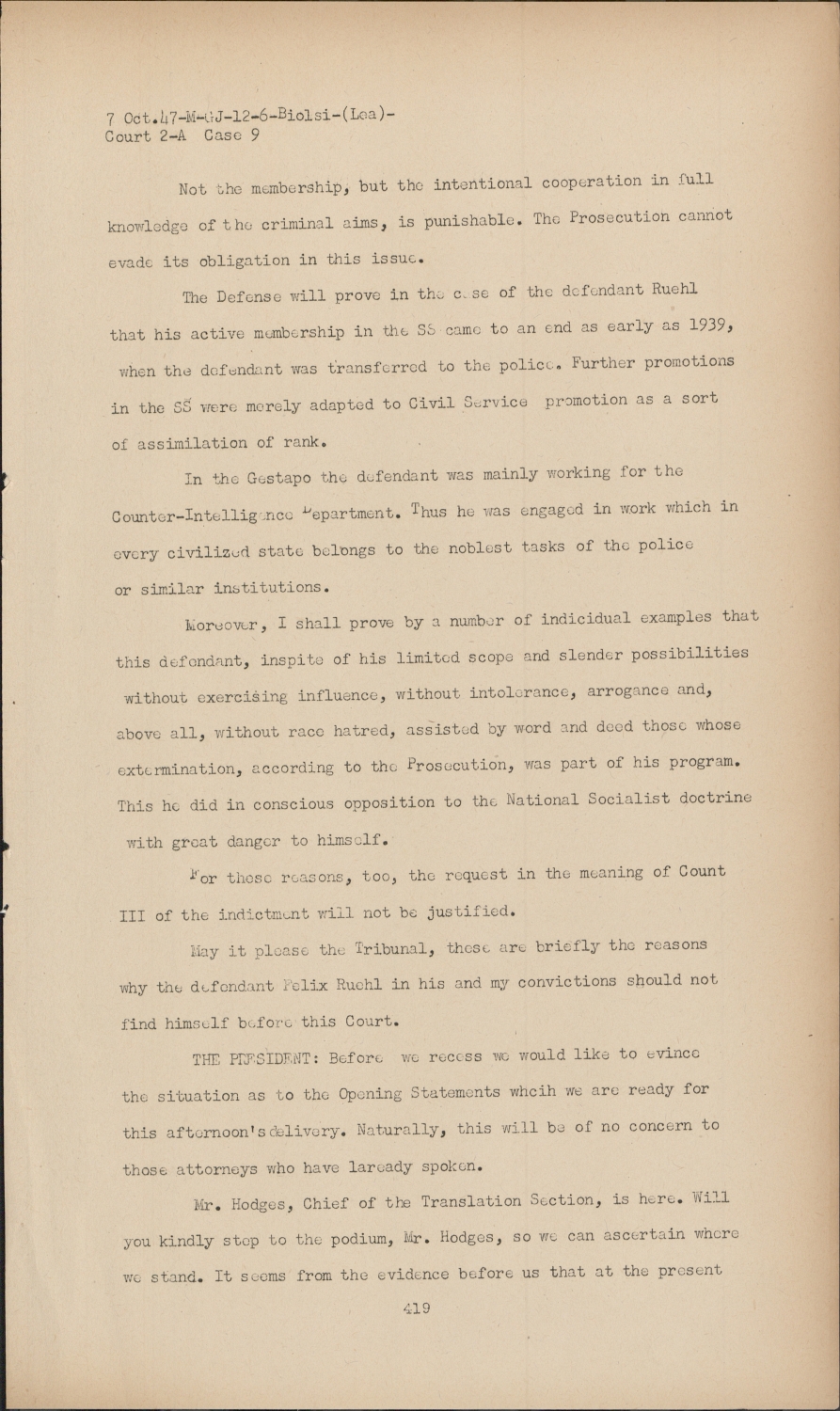
Not the membership, but the intentional cooperation in full knowledge of the criminal aims, is punishable. The Prosecution cannot evade its obligation in this issue.
The Defense will prove in the case of the defendant Ruehl that his active membership in the SS came to an end as early as 1939, when the defendant was transferred to the police. Further promotions in the SS were merely adapted to Civil Service promotion as a sort of assimilation of rank.
In the Gestapo the defendant was mainly working for the Counter-Intelligence department. Thus he was engaged in work which in every civilized state belongs to the noblest tasks of the police or similar institutions.
Moreover, I shall prove by a number of individual examples that this defendant, inspite of his limited scope and slender possibilities without exercising influence, without intolerance, arrogance and, above all, without race hatred, assisted by word and deed those whose extermination, according to the Prosecution, was part of his program. This he did in conscious opposition to the National Socialist doctrine with great danger to himself.
For these reasons, too, the request in the meaning of Count III of the indictment will not be justified.
May it please the Tribunal, these are briefly the reasons why the defendant Felix Ruehl in his and my convictions should not find himself before this Court.
THE PRESIDENT:Before we recess we would like to evince the situation as to the Opening Statements which we are ready for this afternoon's delivery. Naturally, this will be of no concern to those attorneys who have already spoken.
Mr. Hodges, Chief of the Translation Section, is here. Will you kindly stop to the podium, Mr. Hodges, so we can ascertain where we stand. It seems from the evidence before us that at the present time we do not have the Opening Statements in the English translated form, of the defendants Sandberger, Seiberg, Steimle, Nosske, Strauch Klingelhoefer and Fendler.
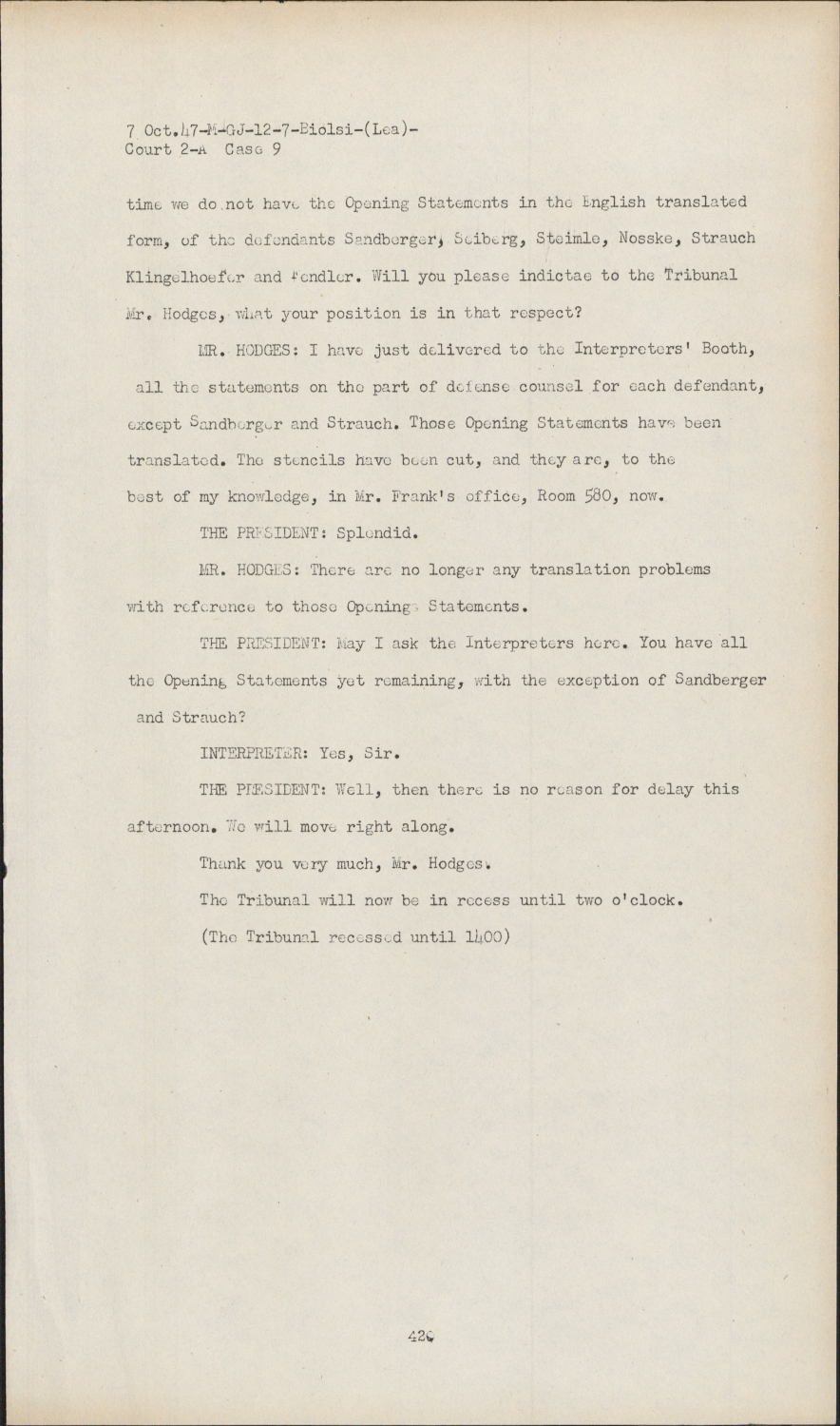
Will you please indictae to the Tribunal Mr. Hodges, what your position is in that respect?
MR. HODGES:I have just delivered to the Interpreters' Booth, all the statements on the part of defense counsel for each defendant, except Sandberger and Strauch. Those Opening Statements have been translated. The stencils have been cut, and they are, to the best of my knowledge, in Mr. Frank's office, Room 580, now.
THE PRESIDENT:Splendid.
MR. HODGES:There are no longer any translation problems with reference to those Opening Statements.
THE PRESIDENT:May I ask the Interpreters here. You have all the Opening Statements yet remaining, with the exception of Sandberger and Strauch?
INTERPRETER:Yes, Sir.
THE PRESIDENT:Well, then there is no reason for delay this afternoon. We will move right along.
Thank you very much, Mr. Hodges.
The Tribunal will now be in recess until two o'clock.
(The Tribunal recessed until 1400)