I definitely have given every single man who wanted to make additions or corrections to the affidavits the chance to do so.
QWitness, do you have the affidavit in front of you?
AYes, counsel.
QI would like to ask you to look up figure 6 of the affidaviton page 161, Document Book 1 in the German text. It there reads, I quote:
I witnessed several mass executions, and in two cases I was ordered to direct the executions.
In August or September 1941 an execution took place near Korosten, where 700 to 1,000 men were shot, and there Dr. Rasch was present."
Witness, I would like to ask you, after making out the affida vit yourself, in the second sentence concerning the execution in Korosten, did you wish to explain that these executions were conducted by defendant Blobel - because, according to the previous statement one could assume that.
ACounsel, I never tried to express my own opinion in these affidavits. I just repeated the statements the defendant had made during an interrogation. If he told me exactly as it is stated here, that there was an execution, and Dr. Rasch was also present - then these are the facts he told me. That is what I put down. I do express my own opinion ... if Dr. Rasch was present, or if Dr. Rasch was in charge, or if Blobel was in charge.
QWitness, I believe you misunderstood me. If one look at the so twosentences which I just read out, one can see quite clearly that these two sentences somehow are taken out of the contest and put together.
I would like to ask you - did you, when making out this affidavit, take individual sentences within the long interrogation of Blobel and put them together?
AI am trying right now to find that out of my record, what the defendant said.
If it please the Tribunal, I would like to read some excerpts of that interrogation, in Germna, to bring out the points:
Question 73: "Were you also present during an execution?
"A Yes, by Korosten."
"Question 86 of the same interrogation, on the same subject.
"Who gave the command for shooting?
AThe Commander at the time.
QAnd you supervised?
AYes, I watched it, and avoided excesses."
DR. HEIM:Your Honor, I believe if the witness gives us sentences from the interrogation of Blobel taken out of the contest, picture in my opinion the same/is given as is given in the affidavit.
I would like co ask the Tribunal, and make a special request, that the interrogation of defendant Blobel, on which the affidavit of 6 June is based, be made available to me because, in my opinion, a great number of questions arise out of that to be put to the witness.
MR. WALTON:I would like to be heard here before the Tribunal makes its decision on that request, your Honor.
THE PRESIDENT:You may proceed.
MR. WALTON:At this time another request is entered with the Tribunal to have the stenographic transcription of an actual interrogation. To grant this request, your Honors, would be in effect throwing open the files of the Prosecution to the entire defense counsel. We believe, first of all, that such applications for the prosecution's records of pre-trial investigations should be denied on principle, because these investigations concern others, besides defendants in the dock, and these others may be those against whom indictments are contemplated, Also, it will prejudice the Prosecution's case against the present defendants unduly, and it goes far beyond the statutory time of notice.
THE PRESIDENT:Mr. Walton, let me interrupt. I would like to suggest to defense counsel the following: He has before him the interrogator, and he has at his disposal the interrogatee. He can question his client at length whenever he desires, and he has the witness here who conducted the interrogation, and defense counsel may put to him any questions which he desires. Defense counsel has, in addition, the document, which is the only piece of evidence before the Court, namely, the statement, so we see no reason why it is necessary to go into collateral matters when the whole field of inquiry is open before you. We have no desire, and will not permit, that the defense counsel not be given every opportunity in the world to present their defense, but at the same time we don't want the proceedings to be unnecessarily protracted with questioning and investigations which will, in the end, produce no more than what is before us.
Wow, you have Mr. Wartenberg here before you. You can put any questions before him which is relevant, which you desire.
DR. HEIM:Thank you.
BY DR. HEIM:
QWitness, having the interrogation of Blobel in front of you, I would like to ask you that while looking at the interrogation to answer me the following questions: In Figure 6 of the affidavit there are contained two sentences which I have read. You have read the sentences; you have these sentences in front of you. Can you tell me whether these two sentences are excerpts from an interrogation of Blobel which occured in immediate succession, or, whether Blobel made these two statements concerning the executions at different stages of your interrogation.
AAs far as I recall it happened that the defendant Blobel only at a later time wanted certain names added to the interrogation. I do not recall exactly how it was at this point, but I recall that in the first affidavit which was presented to him in the morning of the 6th of June that we made changes by adding several names on which the defendant Blobel insisted. I cannot definitely tell you if it was also at this point, but as far as I can see right now on my interrogation report he did not mention at that time the presence of Dr. Rasch.
QWitness, may I interrupt you. Not being able to look into the interrogation of the defendant Blobel, and since the Tribunal permitted me to address questions in that respect. I would like to ask you to answer my previous question, It is based on the interrogation of Blobel. Can you determine whether Blob el concerning the two first sentences under Figure 6, said these two sentences in his affidavit in immediate succession or whether the two sentences are taken out of two different stages of the affidavit.
AThey are taken out of two different stages. As I said before, when he spoke during the interrogation of that execution) I have not the name of Dr. Rasch mentioned, and as far as I recall it, Blobel insisted later on after he was presented with the first affidavit to add a number of names.
QWitness, the examination can be shortened very much if you will answer the following question: Are these individual sentences taken out of different parts of the interrogation and did you then put them together?
ACounsel, I just stated that I have the name of Dr. Rasch not mentioned at this place of the interrogation.
QWitness, you did not answer my questions. I asked you in general concerning this affidavit of 6th June, did you state the individual sentences of the defendant Blobel and join them in this statement?
AIn general, yes.
QThen, I only have a few more questions to you. Did Defendant Blobel tell you that the figures concerning the executions in Kiev were not correct as seem from the operation report?
AThat is correct, and in paragraph 8, the last sentence expresses that fact.
QWitness, did the defendant Blobel tell you that the figure maintained by the Prosecution of 60,000 executions as stated in the operation report SKVA, was not correct?
AThe defendant Blobel stated that the figures are too high. In the last paragraph, the last sentence of paragraph 5 of his affidavit he states that the figure is between 10,000 and 15,000 persons which were executed by Sonderkommando IV-A, and in the last sentence of paragraph 8 in regard to the figure of Kiev he states that according to his opinion only half of the figure would be correct.
QIn this connection, witness, did Blobel say that the figures given by him of ten to fifteen thousand was the figure which SK IVA was at all connected with?
AI would like to read that sentence in German. "According to a superficial estimation, the correctness of which I cannot guarantee, I think that the number of people executed in participation of Commando IV-A was somewhere between 10,000 and 15,000.
QFurther oral explanations which might not have been taken down in writing which Blobel made, you don't remember?
AThe defendant Blobel told me that sometimes he was sick in the hospital.
QWitness, under Figure 7 of the affidavit of 5th June, the first sentence reads; I quote: "Sonderkommando IV-A also shot women and children." can you still remember whether Blobel gave this explanation concerning the entire activity for all the time of Kommando IV-A; or, whether he told you during the interrogation that this statement merely concerned Kiev.
AI will try to find that paragraph, but basically, when I took the affidavit, I did not consider it important if that happened only once or if it happened more often. I was concerned with the fact that the Kommando had killed women and children. As to the defendant Blobel's statement how often, I will try to find out right now. I asked him the question: "were women and children also shot?" his answer was: "on one occasion women and children were also shot."
QWitness, may I ask you to what time does this statement of Blobel's refer -- which occurrence?
AThat statement was made in general; not on a specific incident, because just before we were talking about they way of preparing reports.
QWitness, now one more point. The figure 9 of the affidavit of the 6th June; was the defendant Blobel asked by you who during his absence was Blobel's deputy?
AYes, he was asked that question.
QCan you still remember the reply Blobel gave you?
AI think that became evident pretty clearly out of the second part of paragraph 9, because on this point I definitely recall it that the defendant Blobel insisted on adding certain names to the affidavit. As far as I recall right now, offhand, the names mentioned here, namely, Dr. Rasch, Radetzky and Dr. Bayer. Either all three of them or part of them had been added by Blobel when the affidavit was presented to him in its original form in the morning of the 6th of June, I recall this incident definitely that he stated he wants to have these names in.
QWas not Blobel asked by you at the time who was the senior leader in the Sonderkommando IV-A after Blobel?
AThat is quite possible.
QDo you still remember the reply?
AI don't recall it, but may be you can help me with the facts and may be I can confirm it.
QDid Blobel reply that the senior leader might have been Radetzky?
AThat is quite possible.
QDid Blobel during an interrogation tell you that Radetzky was his deputy during his absence; did he say that expressly?
AIt is possible, but I cannot tell it offhand. I cannot find this passage right now in the interrogation, but I think that he mentioned the name of Radetzky; he definitely asked me to put the name of Radetzky into the affidavit.
QOne more question, please, witness. Did Blobel express to you during the interrogation the possibility that Radetzky was Blobel's deputy during Blobel's absence?
AYes, he did,
QNow, my last question. Under Figure 9 of the affidavit of the 6th June, at the very end, during Blobel's absence three different persons were his deputies. I quote: "Under their command a number of mass-executions were carried out." Witness, do you know for sure that Blobel explained this to you, at the time, because in my opinion he could not have learned who was his deputy at Sonderkommando IV-A during his absence?
AI do not recall this fact that he stated he did not know who was there during his absence, but I would like to point out that I did not believe that Dr. Rasch, the commanding officer of an Einsatzgruppe would be the deputy of a Kommando-leader; but anyhow, as the defendant Blobel wanted to have that point in his affidavit, it was put in, although I figured it improbable; but anything whatever a defendant or at that time an interrogates wanted to have in his affidavit was put in.
DR. HEIM:Thank you; I have no further questions.
MR. WALTON:I have one or two questions to ask on the Blobel interrogation.
THE PRESIDENT:Certainly.
REDIRECT EXAMINATION BY MR. WALTON:
QMr. Wartenberg, when you took certain facts which the Defense Counsel for Blobel has spoken of as sentences from the interrogation of the interrogates Blobel, did you do anything at that time any different than you did from other interrogations?
ANo, not at all.
QDid you after you had excerpted these sentences or facts, did you submit these sentences or facts in the form of an affidavit to the now defendant Blobel?
AYes, I did.
QWas he allowed to make corrections and changes as he so desired?
AYes, he did.
QAfter he had made the changes and corrections did he signify his willingness to sign the changed or corrected, affidavit?
AYes, he did.
QDid he sign it?
AHe signed it in my presence.
QDid he demur or object to signing it after he had corrected it?
ANo, he did not.
RE-CROSS EXAMINATION BY DR. HEIM:
QWitness, I have one more question. Did you let defendant Blobel make any corrections he wished to make?
ACertainly, yes.
QDid you not explain to him that the text had to remain essentially as it stood?
ANo. As I have explained before, because he had a number of objections, we re-wrote the whole affidavit; and I am not quite sure, it is very possible, that I dictated the new affidavit even in his presence, but I am not sure on that point, But anyhow, as he did not accept the first draft of the affidavit, a new affidavit was prepared in the afternoon and that was just done to the effect that the defendant Blobel could make all corrections he wanted to.
QDid the defendant Blobel make some more alterations in this second draft of the affidavit?
ANo, he did not.
DR. HEIM:Thank you. I have no further questions.
CROSS EXAMINATION BY DR. KOESSL (Attorney for the Defendants Ott and Schubert):

QI would like to ask a few questions concerning the affidavit Ott, which is the last document, in Document Book II-B, as Exhibit 67, MO-2993. Witness, was this affidavit Ott of the 24th July, 1947, formulated by you?
AI have the affidavit in front of me of the 24th of April, 1947.
QWas it formulated by you?
AYes. it was.
QDid you make this affidavit based on the statements by Ott at previous interrogations?
AThat is correct.
QWhen did this interrogation take place?
AOn the 21st of February, 1947, between 1000 and 1110 hours.
QDo you have on exact record of the interrogation of the 21st of February 1947?
AYes, I do.
QMay I presume that all points of the affidavit are contained in the records of the interrogation?
AYes, I think so.
QAre there some more detailed statements in the record of the interrogation than in the affidavit?
AYes. Usually the interrogation is much more detailed end after certain points which were not quite clear had been always cleared, basically, they were put into the affidavit in a clear and precise form.
QWhat statements does the record of the interrogation contain about his start of the work and the time when the Kommando was actually taken over by Ott? I ask this in connection with Figure 3 of the affidavit.
AI have there the statement where he says that he was also in Russia from the 15th of February, 1942 until January, 1943, mainly with headquarters in Orel.
QAre there any statements in the record of the interrogation about a line of training when he was not yet in charge of the Kommando?
AI do not understand that question. Could you express it a little bit clearer?
QDid Ott state during the interrogation that on 15th February, 1942 he was not immediately put in charge of the Kommando, but only after a period of training lasting about four weeks?
AI am sorry, Counsel, I cannot find any point of that. If you want to, I will read to you this paragraph where he says word by word what he did. "I was also in Russia, from the 15th February 1942 until January 1943, mainly in Orel." "With which unit there?" "Einstazgruppe B, Soncerkommando VII-B." "Thank you." I cannot find in addition any paragraph where he refers to any training.
QBut it is not entered in the record that on 15th February he was put in charge of the Kommando.
AI would like to refer to another question which I gave the interrogatee at that time. I asked him in the same connection: "Who at your time was in charge of Einsatzkommando VII-B?" "I commanded it myself; my predecessor was Obersturmbannfuehrer Rasch."
QThank you. What statements did Ott make on the operation Eisbaer?
AHe stated that this operation was under Colonel Ruebsam; that it was in different locations; that it lasted from the middle of February to May; and that at this tine he went on leave; and then he continues to talk about executions.
QMay I ask what is your opinion about executions; is that in connection with the operation Eisbaer?
AI don't think so, but I cannot say because I have just here in the record that he states that before he went on leave, it might have been twenty to twenty-five persons.
THE PRESIDENT:Yes, Mr. Walton.
MR. WALTON:Your Honors, this type of examination is going far beyond the affidavit which is now in evidence before the Tribunal.

It is used as a device to bring out information Contained in interrogations which the Court felt should not be turned over to the Defense Counsel. The Defense Counsel has a perfect right to ask what the interrogation said concerning the statements said in the indictment, and the Prosecution believes that it has a, right to ask about any of the facts concerning the signing of the affidavit or the holding of interrogations; but we wish to object to going beyond such facts in order to bring out everything that was said at this interrogation, We don't see that it is material or relevant at this time.
THE PRESIDENT:I might suggest to Defense Counsel that the only thing before us, the only thing that the Defense Counsel need to worry about, is what is contained in the affidavit, Even if the defendant should have in his conversation with the interrogator admitted many other things which are not in the affidavit and not before the Court, he does not have to answer to that. So, therefore, it seems to me entirely unnecessary to go into things which are not before the Tribunal.
DR. KOESSL:The purpose of my question will be shown clearly by my next question. BY DR. KOESSL:
QWitness, you just confirmed to me that in the record of interrogation there are not statements contained as to executions in connection with the "Operation Eisbaer." I, therefore, would like to ask you how does the sentence: "Within the Operation Eisbaer I also carried out executions of band leaders and partisans or persons suspected of being partisans", got into the affidavit draft. That is the sentence which the defendant Ott has crossed out after signing it.
AWell, he had a chance, if - by preparing an affidavit I have made a mistkae by putting down: "Within the Operation Eisbaer" a number of executions carried out, and he said it was not so, he had a perfect right to cross it out and initial it.
QDid he not say that during the interrogation?
AI stated before, that this point in the interrogation is not very clear, because after talking of the "Operation Eisbaer", he mentioned executions and therefore when I took the affidavit out of the material Ott had given me during interrogations, I was at that time under the impression that executions were carried out during that "Operation Eisbaer", but when he lateron stated it was not so, he crossed it out and initialed it.
QThank you. Now I have a few more questions from Document Book No. 1, the affidavit of Schubert, the German page 151, Exhibit No. 28, NO-3055, the affidavit of Schubert of 24 February 1947. Witness, when did the interrogation take place on which the affidavit of Schubert of 24 February 1947 is based?
ASchubert was interrogated on 18th of February, on 4th of February, and on 23rd of January, and, I myself have interrogated Schubert still during my Army career sometime in December 1945, and out of all information I personally had obtained the affidavit was made.
QThat interrogation on which the affidavit of 24 February 1947 is based was on the 18th of February, is that correct?
AOnly in part, because his personal history was in the interrogation of 23 January, so I will not say that it was done only on one particular interrogation, but on a number of them.
QDo you know that Schubert immediately after this interrogation of 18 February, was put into an unheated single cell in the defendant is wing of the prison?
ANo, that is not known to me.
QDo you know that immediately after that interrogation there, he was not allowed to go for walking any more?
AThat is not known to me, but that there is a possibility which I do not recall definitely, but I am quite sure that I am informed the prison authorities after that confession he made that there is a possibility of suicide, and I have no knowledge which or what kind of precautions the prison authorities are taking in such a case.
QIs it correct --
THE PRESIDENT:I assume, you mean "were taking"?
THE WITNESS:Yes, Your Honor. BY DR. KOESSL:
Is it correct that the Defendant Schubert on 21 February was handed the affidavit to sign in which Schubert made at least one dozen corrections?
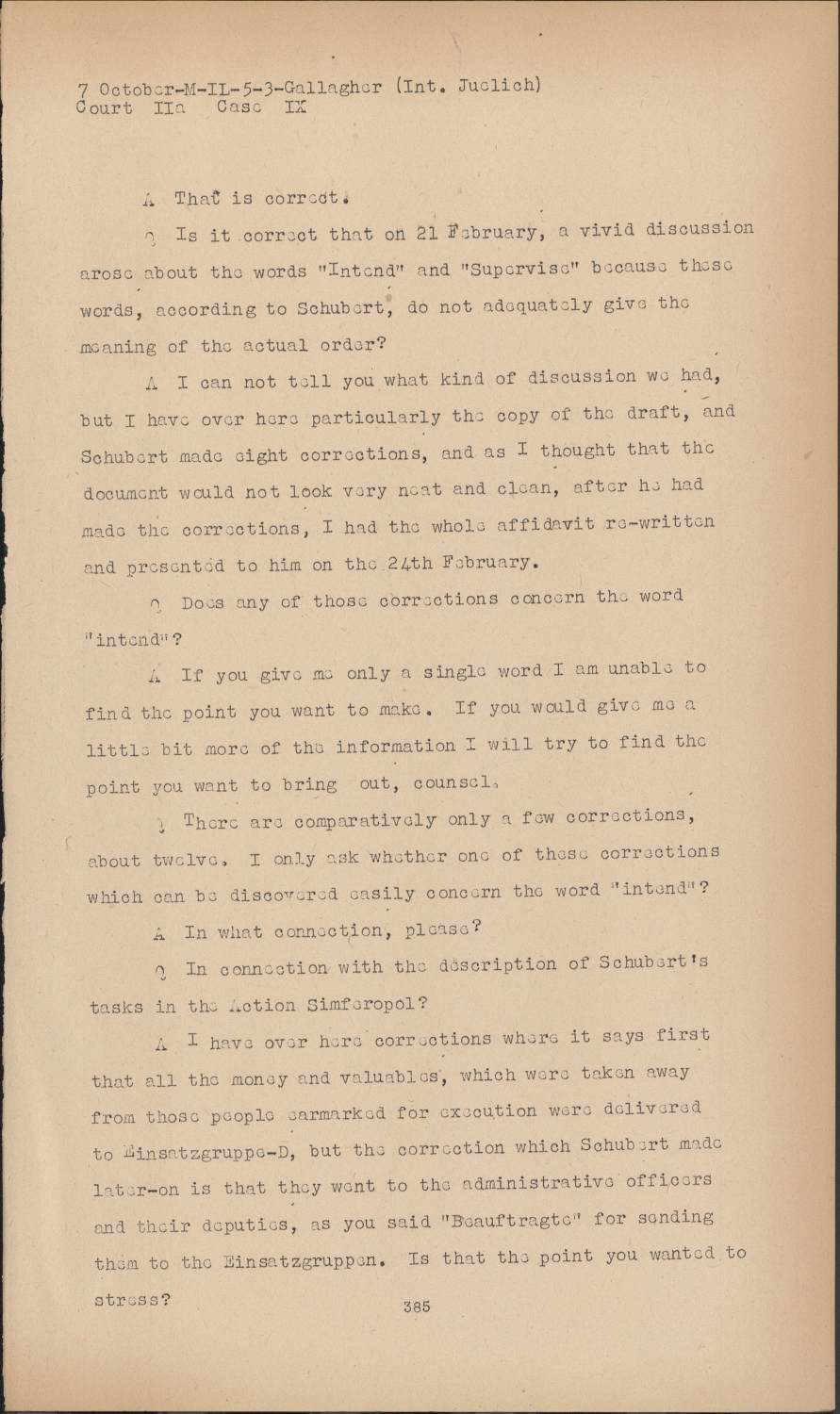
AThat is correct.
QIs it correct that on 21 February, a vivid discussion arose about the words "Intend" and "Supervise" because these words, according to Schubert, do not adequately give the meaning of the actual order?
AI can not tell you what kind of discussion we had, but I have over here particularly the copy of the draft, and Schubert made eight corrections, and as I thought that the document would not look very neat and clean, after he had made the corrections, I had the whole affidavit re-written and presented to him on the 24th February.
QDoes any of those corrections concern the word "intend" ?
AIf you give me only a single word I am unable to find the point you want to make. If you would give me a little bit more of the information I will try to find the point you want to bring out, counsel.
QThere are comparatively only a few corrections, about twelve, I only ask whether one of these corrections which can be discovered easily concern the word "intend"?
AIn what connection, please?
QIn connection with the description of Schubert's tasks in the Action Simferopol?
AI have over here corrections where it says first that all the money and valuables, which were taken away from those people earmarked for execution were delivered to Einsatzgruppe-D, but the correction which Schubert made later-on is that they went to the administrative officers and their deputies, as you said "Beauftragte" for sending them to the Einsatzgruppen. Is that the point you wanted to stress?
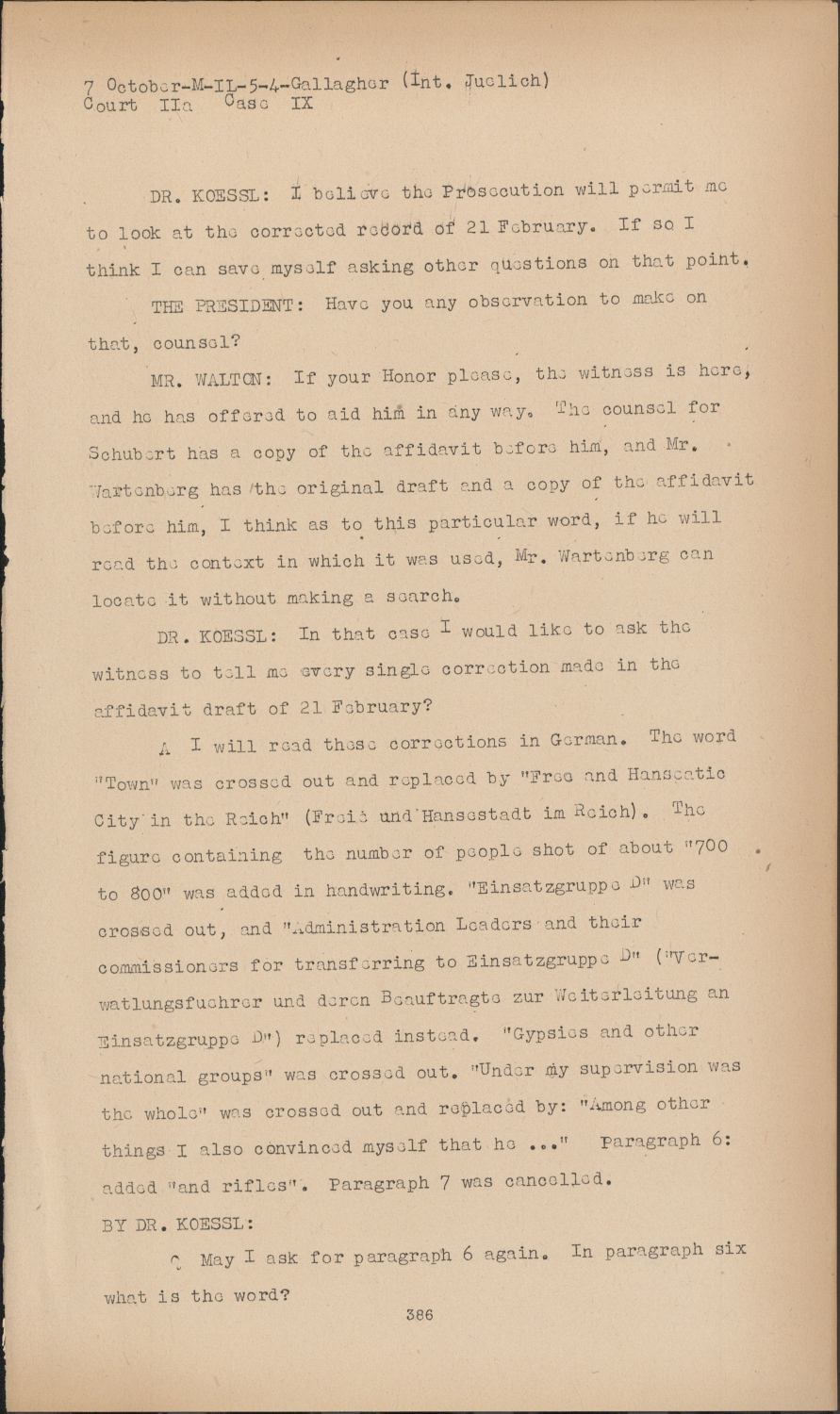
DR. KOESSL:I believe the Prosecution will permit me to look at the corrected record of 21 February. If so I think I can save myself asking other questions on that point.
THE PRESIDENT:Have you any observation to make on that, counsel?
MR. WALTON:If your Honor please, the witness is here, and he has offered to aid him in any way, The counsel for Schubert has a copy of the affidavit before him, and Mr. Wartenberg has the original draft and a copy of the affidavit before him, I think as to this particular word, if he will read the context in which it was used, Mr. Wartenberg can locate it without making a search.
DR. KOESSL:In that case I would like to ask the witness to tell me every single correction made in the affidavit draft of 21 February?
AI will read these corrections in German. The word "Town" was crossed out and replaced by "Free and Hanseatic City in the Reich" (Freie und Hansestadt im Reich). The figure containing the number of people shot of about "700 to 800" was added in handwriting. "Einsatzgruppe D" was crossed out, and "Administration Leaders and their commissioners for transferring to Einsatzgruppe D" ("Verwatlungsfuehrer und deren Beauftragte zur Weiterleitung an Einsatzgruppe D") replaced instead, "Gypsies and other national groups" was crossed out. "Under my supervision was the whole" was crossed out and replaced by: "Among other things I also convinced myself that he ..." paragraph 6: added "and rifles". Paragraph 7 was cancelled. BY DR. KOESSL:
QMay I ask for paragraph 6 again. In paragraph six what is the word?
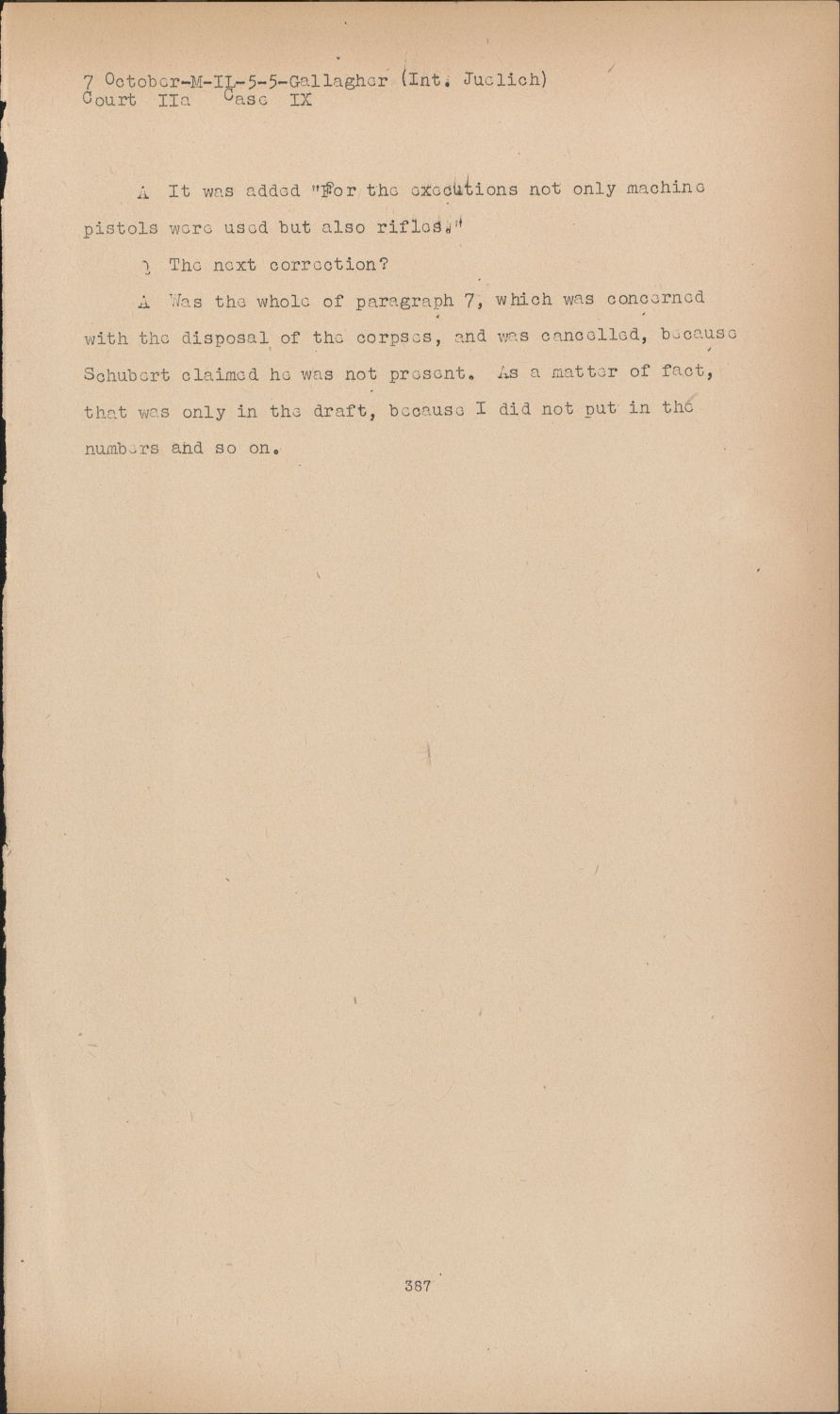
AIt was added "For the executions not only machine pistols were used but also rifles."
QThe next correction?
AWas the whole of paragraph 7, which was concerned with the disposal of the corpses, and was cancelled, because Schubert claimed he was not present. As a matter of fact, that was only in the draft, because I did not put in the numbers and so on.

QWhy was this paragraph entered in the affidavit?
ABecause I had probably during the numerous interrogations of Schubert the idea that he knew something about the disposal of the corpses, but he stated when he was present with the affidavit that he did not have any knowledge to that effect, so I cancelled the whole paragraph.
QThe next corrections?
AThese were all the corrections. Only in the affidavit itself in paragraph 3 it reads: "In January or February 1942" and he changed the date there to "December 1941".
QIn your record of the interrogations, is there any remark to the effect that a discussion about the contents of the order and Schubert's being authorized to carry out inspections is contained therein?
ANo. I have started over here a record of 21 February, but I think as we were busy in correcting the copies that my secretary did not take everything down during that interrogation because at the time we were only concerned with the different corrections which we made in handwriting, as a matter of fact, in Schubert's own handwriting.
MR. WALTON:The Prosecution fails to see the materiality of this line of questioning. The Defendant Schubert can relate any detail everything that took place at this interrogation. Mr. Wartenberg has testified to the essential facts which took place. He has delineated a number of corrections, and I see no reason in pursuing this line of questioning, Your Honors, unless it is for your own information.
THE PRESIDENT:It has only incidentally brought out a very important item, and, that is, the care with which the affidavit was made out, and the entire opportunity and extreme latitude allowing the interrogatee to make changes, so to that extent it has shed a great deal of light on the entire procedure, so we would say this has been very illuminating to the Tribunal.
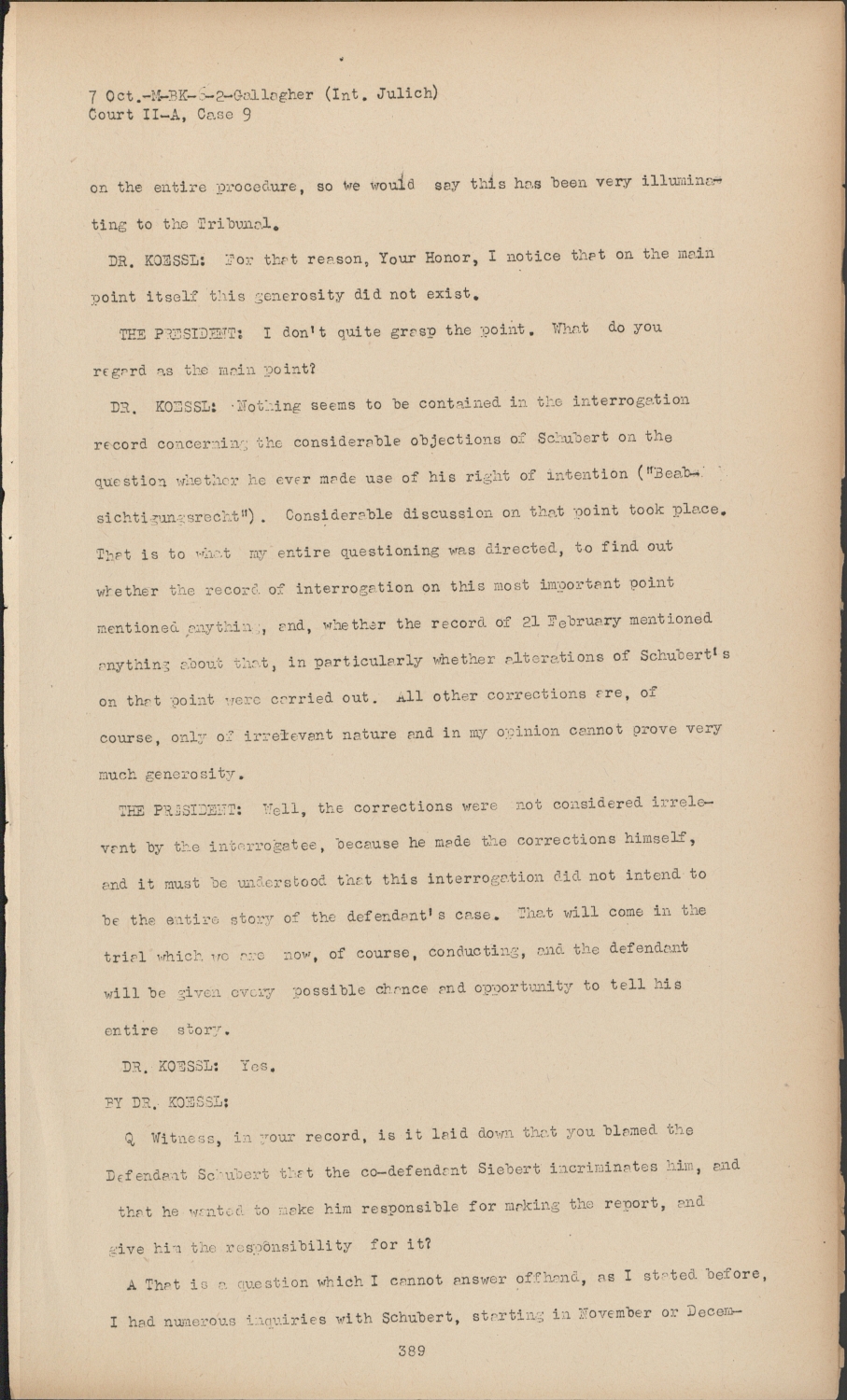
DR. KOESSL:For that reason, Your Honor, I notice that on the main point itself this generosity did not exist.
THE PRESIDENT:I don't quite grasp the point. What do you regard as the main point?
DR. KOESSL:Nothing seems to be contained in the interrogation record concerning the considerable objections of Schubert on the question whether he ever made use of his right of intention ("Beabsichtigungsrecht"). Considerable discussion on that point took place. That is to What my entire questioning was directed, to find out whether the record of interrogation on this most important point mentioned anything, and, whether the record of 21 February mentioned anything about that, in particularly whether alterations of Schubert's on that point were carried out. All other corrections are, of course, only of irrelevant nature and in my opinion cannot prove very much generosity.
THE PRESIDENT:Well, the corrections were not considered irrelevant by the interrogatee, because he made the corrections himself, and it must be understood that this interrogation did not intend to be the entire story of the defendant's case. That will come in the trial which we are now, of course, conducting, and the defendant will be given every possible chance and opportunity to tell his entire story.
DR. KOESSL:Yes. BY DR. KOESSL:
QWitness, in your record, is it laid down that you blamed the Defendant Schubert that the co-defendant Siebert incriminates him, and that he wanted to make him responsible for making the report, and give him the responsibility for it?
AThat is a question which I cannot answer offhand, as I stated before, I had numerous inquiries with Schubert, starting in November or Decem ber 1945, and of these interrogations I have no record because they were conducted in the vicinity of Frankfurt, and not by this office for which I am working right now.
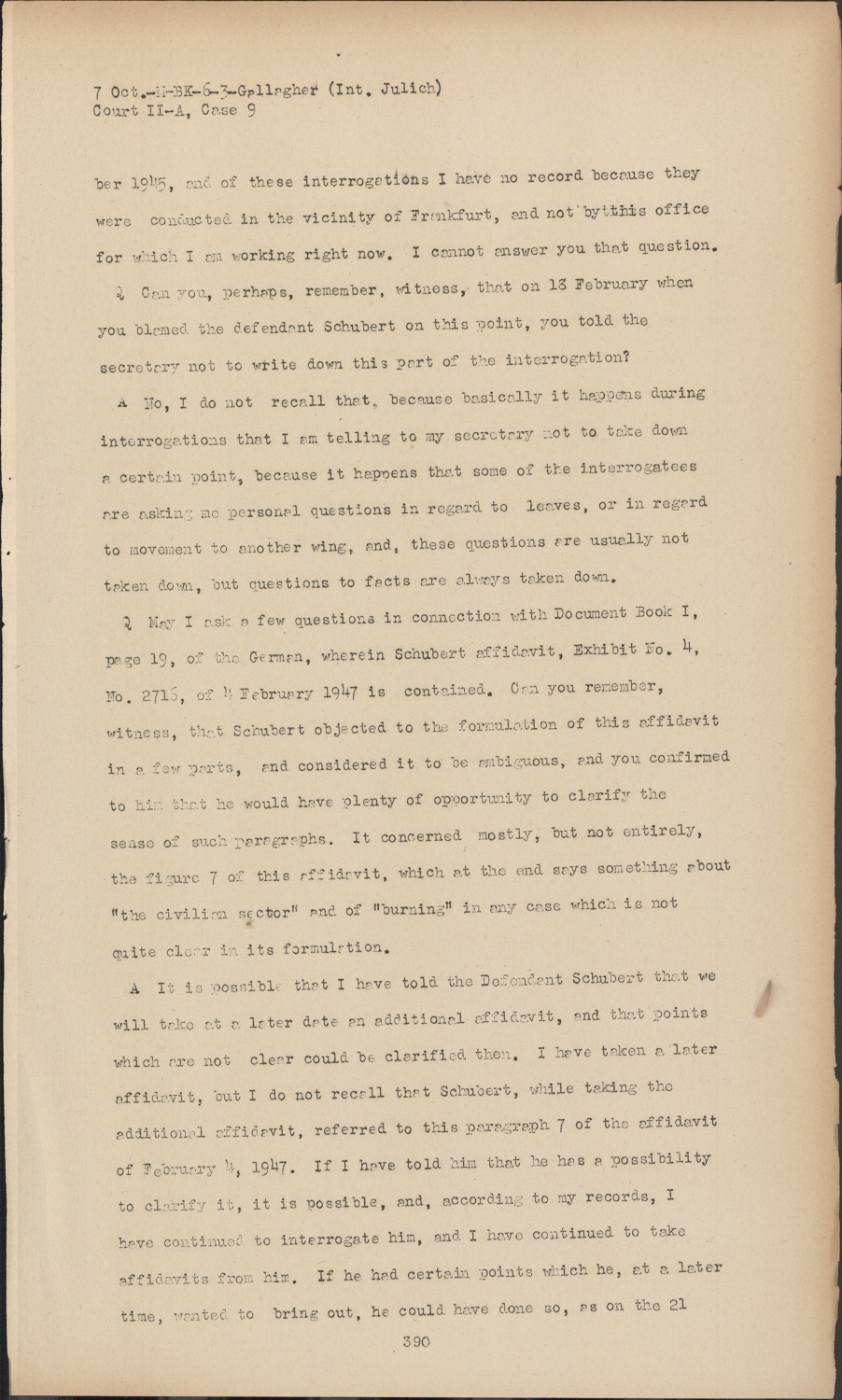
I cannot answer you that question.
QCan you, perhaps, remember, witness, that on 18 February when you blamed the defendant Schubert on this point, you told the secretary not to write down this part of the interrogation?
ANo, I do not recall that, because basically it happens during interrogations that I am telling to my secretary not to take down a certain point, because it happens that some of the interrogatees are asking me personal questions in regard to leaves, or in regard to movement to another wing, and, these questions are usually not taken down, but questions to facts are always taken down.
QMay I ask a few questions in connection with Document Book I, page 19, of the German, wherein Schubert affidavit, Exhibit No. 4, No. 2716, of 4 February 1947 is contained. Can you remember, witness, that Schubert objected to the formulation of this affidavit in a few parts, and considered it to be ambiguous, and you confirmed to him that he would have plenty of opportunity to clarify the sense of such paragraphs. It concerned mostly, but not entirely, the figure 7 of this affidavit, which at the end says something about "the civilian sector" and of "burning" in any case which is not quite clear in its formulation.
AIt is possible that I have told the Defendant Schubert that we will take at a later date an additional affidavit, and that points which are not clear could be clarified then. I have taken a later affidavit, but I do not recall that Schubert, while taking the additional affidavit, referred to this paragraph 7 of the affidavit of February 1947. If I have told him that he has a possibility to clarify it, it is possible, and, according to my records, I have continued to interrogate him, and I have continued to take affidavits from him. If he had certain points which he, at a later time, wanted to bring out, he could have done so, as on the 21 of February he was given the draft of an additional affidavit which was completely changed, and re-written, so even if he had the intention to add anything he had the chance there.