
I believe that every Army and every occupation troop under such critical circumstances as we had then at the time in the Crimea must be allowed to take such precautions for their own security. I think that such actions and similar once are being carried out in Germany as well after the capitulation repeatedly.
DR. MAYER:Your Honor, in view of the advanced time I would only like to tell the Tribunal that I have just finished a section here. I will now start on a new complex of questions, so that if the Tribunal wishes to close down here, this seems to be a good point.
THE PRESIDENT:There is merit to your suggestion, not only for what 3 you have said but also the fact that there will be quite an interval before we reconvene, an interval of time, and therefore we would have to sort of refresh our memories anyway. The Tribunal will be in recess now until Monday morning at nine-thirty o'clock.
(The Tribunal adjourned until l December 1947, at 0930 hours.)

Official Transcript of the American Military Tribunal in the matter of the United States of America, against Otto Ohlendorf, et al.
, defendants, sitting at Nurngerg, Germany, on l December 1947, 0930-1630.
Justice Musmanno, presiding.
THE MARSHAL:The Honorable, the Judges of Military Tribunal II.
Military Tribunal II is now in session.
God save the United States of America and this Honorable Tribunal.
There will be order in the Court.
DR. MAYER:Dr. Eric M. Mayer for the defendant Werner Braune. Your Honor, as to the witness Braune we concluded on Wednesday of last week with questioning, and I would like to continue now.
THE PRESIDENT:Continue Dr. Mayer.
DR. MAYER:On Wednesday we were discussing the charge of the Prosecution in the document which the Prosecution had submitted against my client. I shall now come to a different section.
WERNER BRAUNE - Continued.
DIRECT EXAMINATION - Resumed. BY DR. MAYER:
Q.- Dr. Braune, during your assignment in the East, did you go on a leave?
A.- Yes, after having taken part in the anti-Partisan action, which lasted for three days, in the first half of March 1942, together with Herr Ohlendorf, I went on leave, and, exactly on 26 April 1942, I travelled by plane together with him back to Simferopol.
Q.- When did the gas-vans arrive in Simferopol?
A.- Sofar as I remember that must have been at the end of February 1942.
Q.- How many vans were there when you arrived in Simferopol?
A.- There were two vans.
Q.- Do you remember how they were distributed?

A.- Sofar as I remember one of these two vans was given to Commando X-B, or XI-A. The other van was in Simferopol, but I am not quite certain of this. I know that Herr Ohlendorf testified that two vans were standing in Simferopol, and were always requested by the other commandos, but that is quite possible too, I think.
Q.- Were they used immediately after they arrived?
A.- Immediately after their arrival they certainly were not used, because after the long journey from Berlin to the Crimea, which is more than two-thousand kilometers, their condition on account of the weather was such that they had to be repaired.
Q.- The van which was moved to Simferopol, was it used by you?
A.- I already testified to the Prosecution that I didn't use the van but the van must have been used by my commando in Simferopol once, because I remember exactly that Sturmbannfuehrer Schulz came to me and told me he didn't want to use the van again, because he considered the unloading and the burying of the bodies to great a strain for his men. The men objected to the use of the van as well. But at what time exactly Sturmbannfuehrer Schulz said this to me, I do not remember any more. It is possible that it happened on the day when I returned from the antiPartisan operation, but it is also possible that he only said this to me after I returned from my leave.
Q.- During your leave was the van still used?
A.- I am not quite certain of this, but I don't think so. According to what Sturmbannfuehrer Schulz said to me.
Q.- The Prosecution said in the opening speech that defenseless civilians were often shot as Partisans. Did this occur in your Commando?
A.- In my commando it didn't occur. I can only assure you that these Partisans with whom we dealt were anything but defenseless civilians.
Q.- Can you tell us anything about theanti-partisan fighting, and the Partisan situation in the Crimea in general?
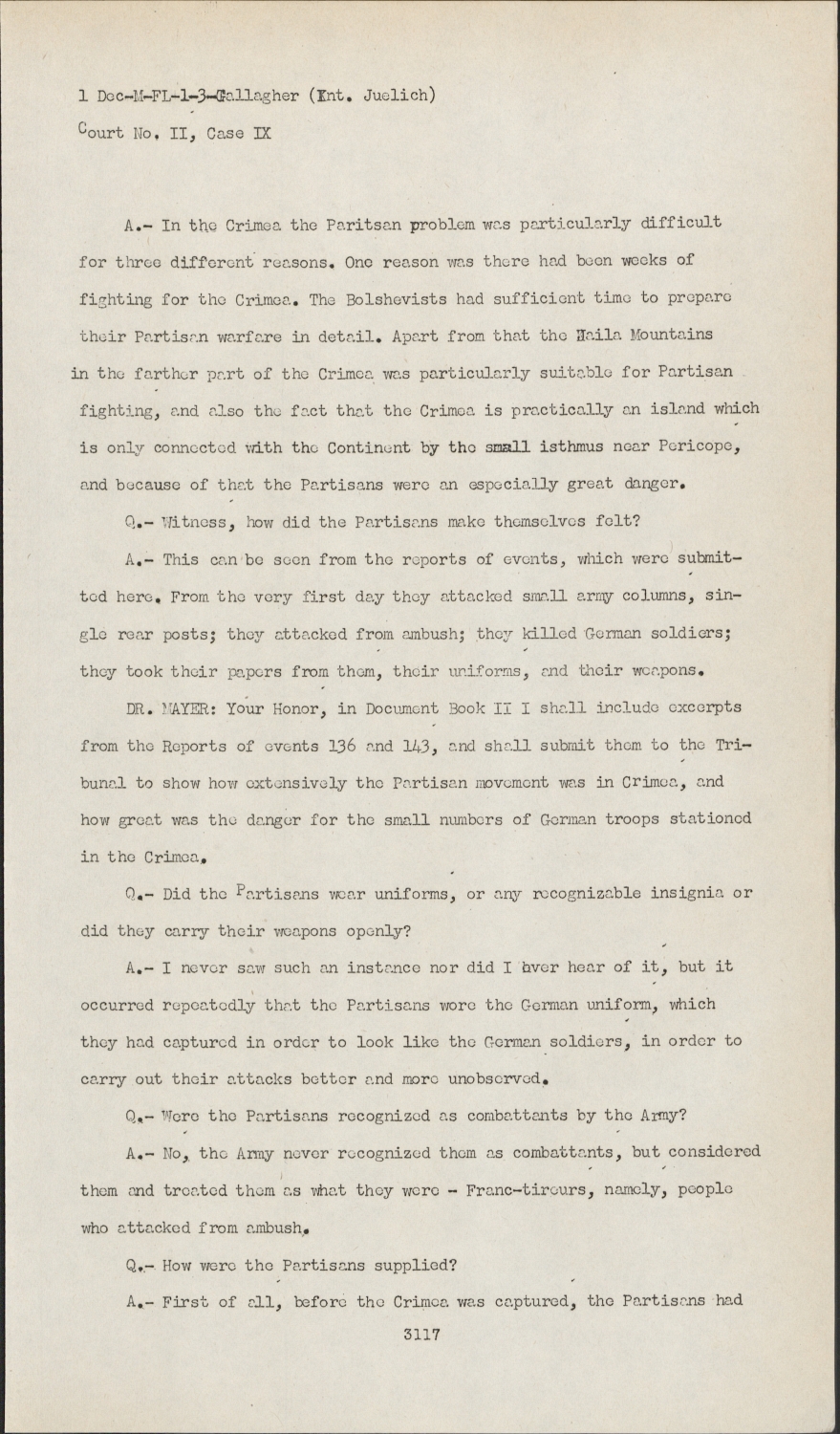
A.- In the Crimea the Paritsan problem was particularly difficult for three different reasons. One reason was there had been weeks of fighting for the Crimea. The Bolshevists had sufficient time to prepare their Partisan warfare in detail. Apart from that the Haila Mountains in the farther part of the Crimea was particularly suitable for Partisan fighting, and also the fact that the Crimea is practically an island which is only connected with the Continent by the small isthmus near Pericope, and because of that the Partisans were an especially great danger.
Q.- Witness, how did the Partisans make themselves felt?
A.- This can be seen from the reports of events, which were submitted here. From the very first day they attacked small army columns, single rear posts; they attacked from ambush; they killed German soldiers; they took their papers from them, their uniforms, and their weapons.
DR. MAYER:Your Honor, in Document Book II I shall include excerpts from the Reports of events 136 and 143, and shall submit them to the Tribunal to show how extensively the Partisan movement was in Crimea, and how great was the danger for the small numbers of German troops stationed in the Crimea.
Q.- Did the Partisans wear uniforms, or any recognizable insignia or did they carry their weapons openly?
A.- I never saw such an instance nor did I over hear of it, but it occurred repeatedly that the Partisans wore the German uniform, which they had captured in order to look like the German soldiers, in order to carry out their attacks better and more unobserved.
Q.- Were the Partisans recognized as combattants by the Army?
A.- No, the Army never recognized them as combattants, but considered them and treated them as what they were - Franc-tireurs, namely, people who attacked from ambush.
Q.- How were the Partisans supplied?
A.- First of all, before the Crimea was captured, the Partisans had a great amount of food, cattle, weapons and so forth, which they kept in the mountains.
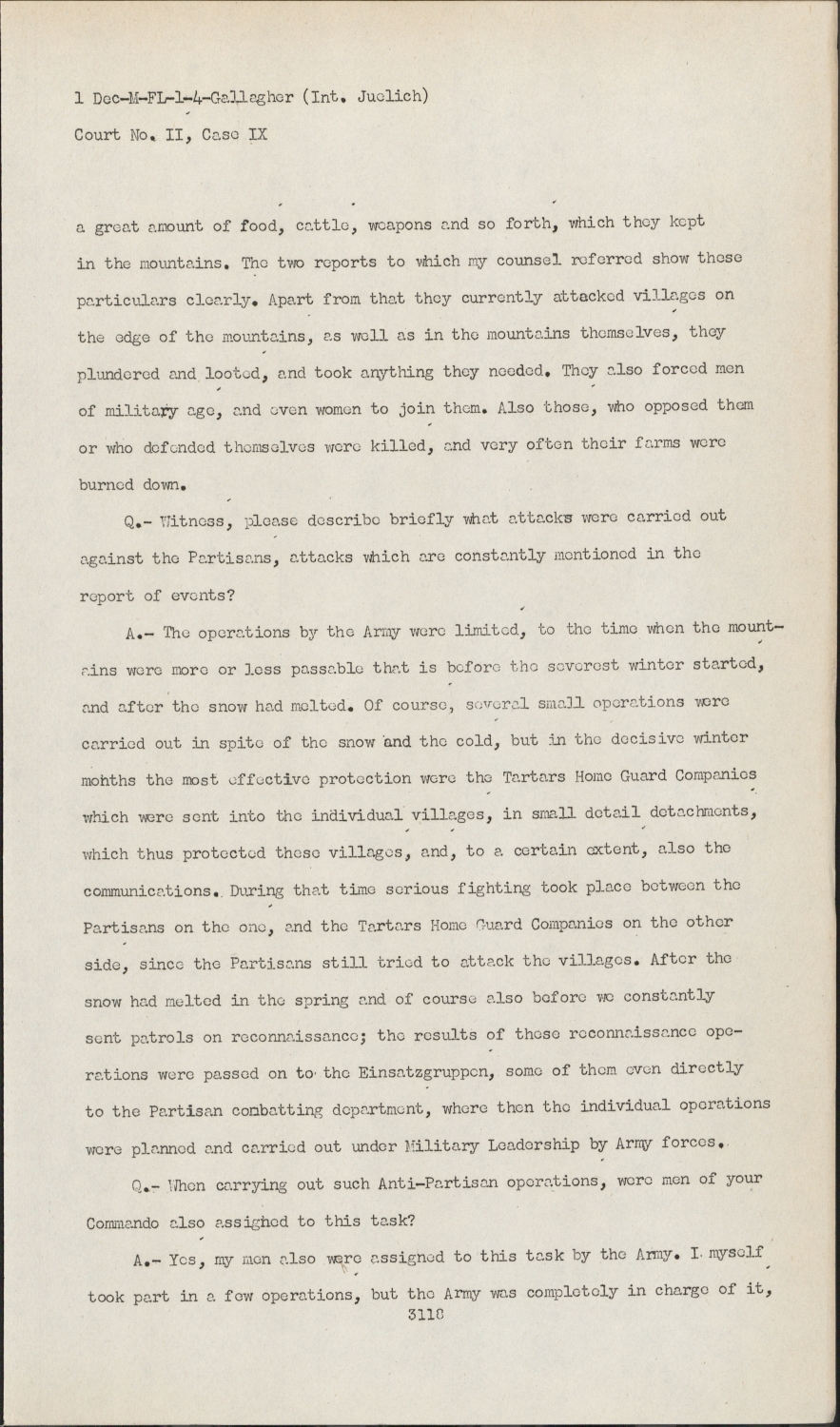
The two reports to which my counsel referred show these particulars clearly. Apart from that they currently attacked villages on the edge of the mountains, as well as in the mountains themselves, they plundered and looted, and took anything they needed. They also forced men of military age, and even women to join them. Also those, who opposed them or who defended themselves were killed, and very often their farms were burned down.
Q.- Witness, please describe briefly what attacks were carried out against the Partisans, attacks which are constantly mentioned in the report of events?
A.- The operations by the Army were limited, to the time when the mountains were more or less passable that is before the severest winter started, and after the snow had melted. Of course, several small operations were carried out in spite of the snow and the cold, but in the decisive winter months the most effective protection were the Tartars Home Guard Companies which were sent into the individual villages, in small detail detachments, which thus protected these villages, and, to a certain extent, also the communications. During that time serious fighting took place between the Partisans on the one, and the Tartars Home Guard Companies on the other side, since the Partisans still tried to attack the villages. After the snow had melted in the spring and of course also before we constantly sent patrols on reconnaissance; the results of these reconnaissance operations were passed on to the Einsatzgruppen, some of them even directly to the Partisan combatting department, where then the individual operations were planned and carried out under Military Leadership by Army forces.
Q.- When carrying out such Anti-Partisan operations, were men of your Commando also assigned to this task?
A.- Yes, my men also were assigned to this task by the Army. I myself took part in a few operations, but the Army was completely in charge of it, except in case of small reconnaissance enterprises, which in some instances might have been carried out by our men.

Q.- How strong were the detachments which were assigned to fight the Partisans?
A.- That depended on the individual case. We had operations with but one company, or one of several battalions, and we had operations where two divisions took part.
Accordingly, the operation took sometimes one day, and sometimes four to five days.
Q.- What experiences did you have in the Crimea concerning sabotage and terror group of Bolshevists?
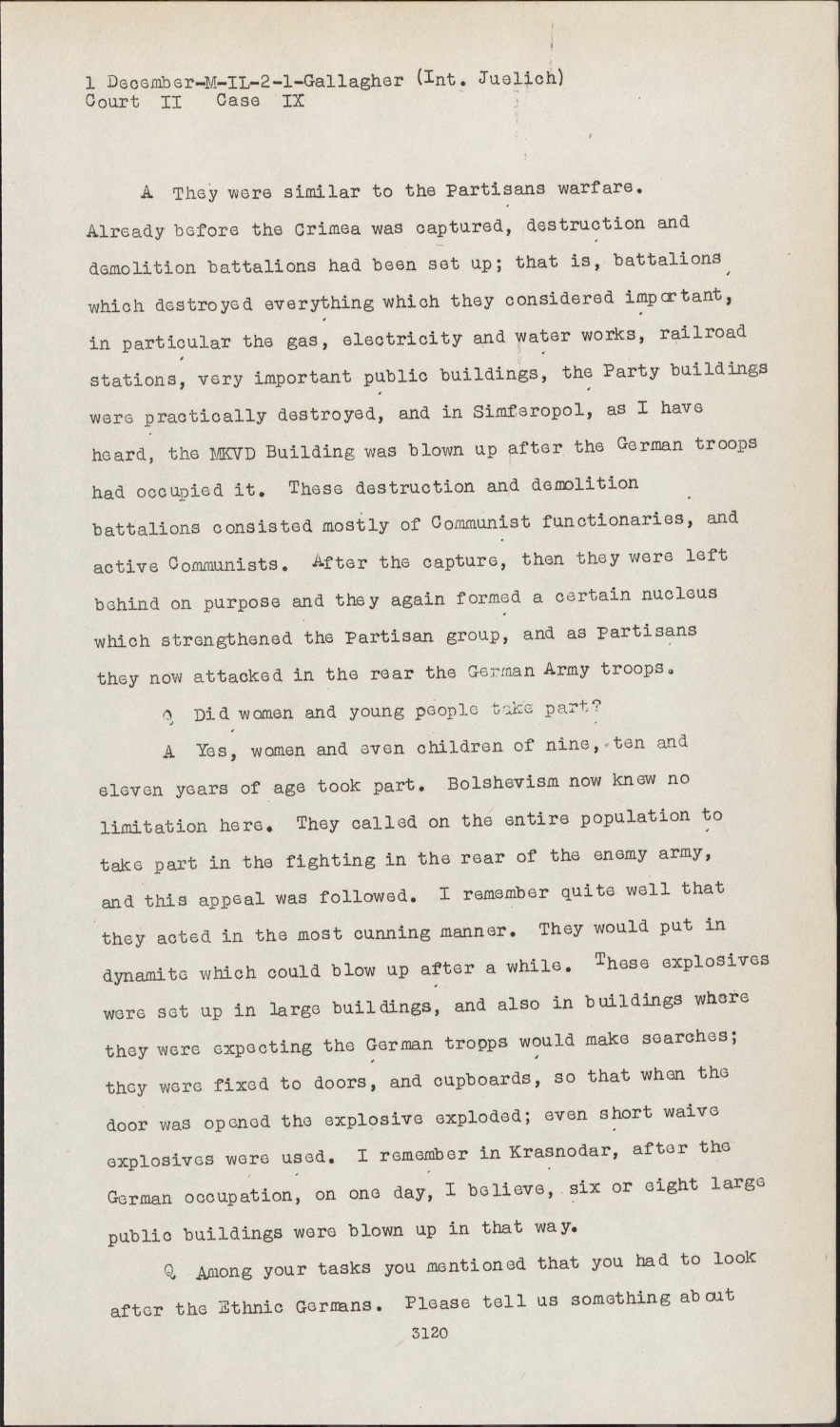
AThey were similar to the Partisans warfare. Already before the Crimea was captured, destruction and demolition battalions had been set up; that is, battalions which destroyed everything which they considered important, in particular the gas, electricity and water works, railroad stations, very important public buildings, the Party buildings were practically destroyed, and in Simferopol, as I have heard, the MKVD Building was blown up after the German troops had occupied it. These destruction and demolition battalions consisted mostly of Communist functionaries, and active Communists. After the capture, then they were left behind on purpose and they again formed a certain nucleus which strengthened the Partisan group, and as Partisans they now attacked in the rear the German Army troops.
QDid women and young people take part?
AYes, women and even children of nine, ten and eleven years of age took part. Bolshevism now knew no limitation here. They called on the entire population to take part in the fighting in the rear of the enemy army, and this appeal was followed. I remember quite well that they acted in the most cunning manner. They would put in dynamite which could blow up after a while. These explosives were set up in large buildings, and also in buildings where they were expecting the German troops would make searches; they were fixed to doors, and cupboards, so that when the door was opened the explosive exploded; even short waive explosives were used. I remember in Krasnodar, after the German occupation, on one day, I believe, six or eight large public buildings were blown up in that way.
QAmong your tasks you mentioned that you had to look after the Ethnic Germans. Please tell us something about the situation and the fate of the Ethnic Germans?

AI only experienced the problem of the Ethnic Germans in the Crimea. Before the war there lived about 50,000 German people in the Crimea. For generations they had retained their language, their culture, and their customs. Under Bolshevism they had suffered greatly. When we occupied the Crimca, Of these 50,000 Germans who used to live there only six to seven hundred remained. All the rest had been deported or Killed. According to detailed information, we obtained at first, the mass of Ethnic Germans were taken, if I may point out on the map (Witness stands in front of map on wall) via this point here, Kerch, to the Kaukasus Mountains, over this channel, this narrow channel here (indicating on the map). They then had been deported to the Siberia, or were supposed to have been sent there, (Returns to the witness stand). Those who were not fit to work or to be moved by train, so far as we heard at the time, were shot according to our information. I received confirmation of the fate of the Ethnic Germans when at the end of July, or the beginning of August, I moved with the First German. Armored Army from Rostock into the Kaukasus Mountain area. We entered Armaria with the first Army unit. We had moved in with the First German troops which invaded that country, and late one evening three Ethnic German women reported to me. They were in a terrible condition, beyond description. Their report showed us that they had been in a train which was to go farther East, but during a German airplane attack the railroad track had been destroyed, and the whole train load of Ethnic Germans, about 2,000, was left burning alive in locked ears by the Russians. One car had been damaged, and thus these three women had managed to escape at the last minute. We also heard there that these approximately 50,000 German people, that is those who had as yet not been killed were sent to Siberia from the Kuban area.
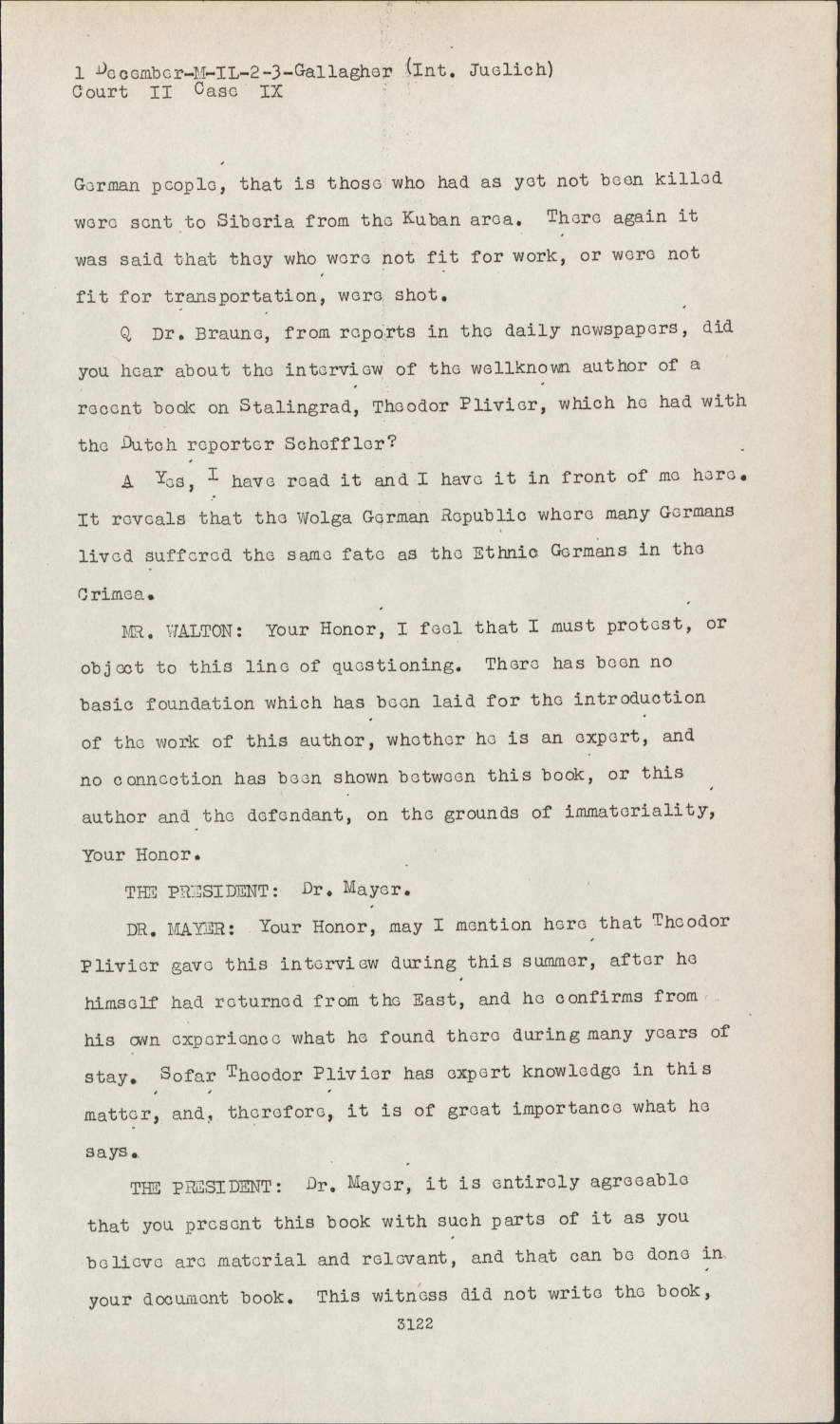
There again it was said that they who were not fit for work, or were not fit for transportation, were shot.
QDr. Braune, from reports in the daily newspapers, did you hear about the interview of the wellknown author of a recent book on Stalingrad, Theodor Plivier, which he had with the Dutch reporter Scheffler?
AYes, I have read it and I have it in front of me here. It reveals that the Wolga German Republic where many Germans lived suffered the same fate as the Ethnic Germans in the Crimea.
MR. WALTON:Your Honor, I feel that I must protest, or object to this line of questioning. There has been no basic foundation which has been laid for the introduction of the work of this author, whether he is an expert, and no connection has been shown between this book, or this author and the defendant, on the grounds of immateriality, Your Honor.
THE PRESIDENT:Dr. Mayer.
DR. MAYER:Your Honor, may I mention here that Theodor Plivier gave this interview during this summer, after he himself had returned from the East, and he confirms from his own experience what he found there during many years of stay. So far Theodor Plivier has expert knowledge in this matter, and, therefore, it is of great importance what he says.
THE PRESIDENT:Dr. Mayer, it is entirely agreeable that you present this book with such parts of it as you believe are material and relevant, and that can be done in your document book. This witness did not write the book, so, therefore, he can not tell us about the book.
If we permit witness to tell us about books, then they can just start in the libraries of the world. I had assumed that you had intended that he only refer to the book, and with a sentence or two indicate the nature of its contents, which he has now already done, and, I would think that would be sufficient. You can supplement that in your document book, of course.
DR. MAYER:Your Honor, I have finished with this question anyhow, and I shall give a small excerpt in the document book.
DR. MAYER:Your Honor, I have finished with this question now.
THE PRESIDENT:Very well.
DR. MAYER:And I shall give a small excerpt in the document book.
THE WITNESS:May I explain something further on this? I do have the newspaper cutting in front of me, but I may assure you that what I said was from my memory after I read this newspaper cutting a few days ago.
THE PRESIDENT:Very well.
Q (By Dr. Mayer) To conclude this complex of questions connections with your assignment in the East, I would like to ask you, Witness, how long you worked in the Crimea?
AUntil the end of July, 1942, I was in the Crimea. I was then attached to the First Armored Army. I joined it in the area of Rostov. From there I advanced, together with my commando, and in the second half of August I reached Maikop in the northern part of the Caucasus, but already after a few days I was recalled from there. This recall had already been issued in July, but owing to this advance it only reached me at this time.
QWhen did you return to the Reich?
AMy subkommando leader, Sturmbannfuehrer Schulz, was made my successor. At the end of August I handed the commando over to him, and in the last days of August, as far as I remember, I travelled to Vorosilov. I informed Einsatzgruppen Chief Vierkamp that I was going to the Reich. I had to wait for the plane for a few days and then traveled by plane via Nikolaev, Bucharest, Belgrade, Vienna, Berlin back to the Reich.
QWhat did you do after you returned to Germany?

AAfter my return I first took the leave to which I was entitled, which amounted to four to five weeks. Then in the second half of October I took over the State Police Office at Halle again for a short period.
QWhen were you appointed into the Reich Leader Corps of students, and how did this come about?
AAt the end of November or in the first days of January, 1942, the Reich student leader, Dr. Scheele, at the time called me to see him in Salzburg and informed me that I had leave to join his office. I was to be put in charge of the German Academic Exchange Service, and also was to become honorary chief of the Foreign office of the Reich Students Association.
QYou were also prepared to take up this appointment?
AYes, I was very pleased to take this appointment, because they were matters which had always interested me very much.
QHow did it come about that you were given this new task?
ASoon afterwards I heard that Herr Ohlendorf had suggested me for this position, just because he knew that I was interested in students and high school problems in particular in other words, that he recommended me.
QWhat tasks did you have in the German Academic Exchange Service?
AThe German Academic Exchange Service was a registered association and had the task to take care of an exchange of students, teachers and professors with other people abroad.
QWhat were your tasks in the Reich Student Association?
AMy office had several departments. First of all it was my task to look after the relations between the student association in other countries and the cooperation with them, the cultural political cooperation, the care of the foreign students studying in Germany.

Even in 1943 and 1944 we had about eight thousand foreign students in the Reich. This was my main task during those two years, the cooperation and the care for these foreign students. Beyond that, we looked after German students who had been injured during the war so that they could study abroad, in as far as this was possible, in spite of the war. Apart from that, in the German Academic Exchange Service it was my task to administer all the means and the financial department of the Studienwerk fuer Auslaender, a student association for students abroad. It gave scholarships to about 2000 foreign students per year. This amounted to about two to three millions. The Exchange Service also gave such exchange scholarships for German students who wanted to go abroad and study there.
QWere lecture evenings also arranged?
AAs part of the care of the foreign students in the Reich, everything was done that was possible to be done during the war. The cooperation was very close in spite of the war. In most German high schools I still started German Foreign Student Associations. They were particularly keen on cooperation, and part of this work was cultural evenings, lecture evenings, musical evenings. Inspection trips, etc., were carried out by them, and sightseeing trips. One of the nicest tasks I remember was looking after about two or three thousand French students. These French students, through a law by their Government, had to do labor service and had been sent to Germany for that purpose. Of course, they were very bitter about being called up to do this. Many of them had been sent to locations where they had to do work which was not in line with their training and their interest.

Here, for once, I saw an opportunity to bring the academic youth of Germany and France closer together in spite of the war. Everywhere I appointed or had suitable German students appointed to visit these French students wherever they worked, and after getting over their first distress they really were in very close and friendly contact. I saw to it that these students were given positions which suited their ability and their interests. As far as possible we got literature for them, newspapers and periodicals. We invited them to our entertainments. We tried to get leave for them to attend and in 1944 I finally even succeeded to get a number of the students to study in German universities and to be released for this purpose.
QWhy did this work finish in the winter of 1944?
AThe events of the war brought about conditions which made this work senseless. The enemy was on the borders of the Reich. The communications with other countries had been cut off, and in the Reich there was no room for such activity.
QWhen did Kaltenbrunner send you to Norway?
AIn December 1944, Kaltenbrunner sent me to Norway as commander of the Security Police and the SD in Oslo, and Kaltenbrunner ordered me to go there. In the middle of January, 1945, I left for Oslo.
QThere you were commander of the Security Police and the SD?
AYes, I said so.
QHow long were you in Norway then?
AI remained in Norway as commander until the capitulation, and then as a prisoner until 1 July 1947.
QIn Norway did they start proceedings against you?
AYes, for two years they conducted proceedings against me. For about fifteen months I was in a single cell. At the end of March, 1947, after twenty-one months, for the first time the Norwegian police interrogated me. Shortly afterwards the interrogation officer told me, it was suggested to the prosecution that they should stop proceedings against me. The proceedings were discontinued, and in the middle of June '47, after two years of imprisonment, I was transferred to an internment camp.
QThey kept you in prison for about two years in order to find out that there was nothing against you?
AYes, that is how it is.
DR. MAYER:Your Honor, this concludes my direct examination with this witness. I have no further questions to address to him. On this occasion I would like to thank the Tribunal very sincerely for giving me opportunity to carry out the questioning of the witness to such an extent.
THE PRESIDENT:And I want too to congratulate you on the very systematic manner in which you disposed of the direct examination. Do any defense counsel desire to crossexamine the witness?
DR. GAWLIK:Dr. Gawlik for Seibert.
EXAMINATION BY DR. GAWLIK:
QWitness, do you know the co-defendant Seibert?
AYes, I know him since he joined the SD in Berlin.
QWhen did this happen?
AThat must have been in 1935, but it might have been in 1936. After all these years I am not quite sure of it any more.

QWhat do you know about the activity of Herr Seibert in Russia?
AI saw him there again when I came to Einsatzgruppe D. At the time Seibert was in charge of Department III in the reporting section, and already at that time had close contact with the Army.
QDid Herr Seibert ever give any orders for executive tasks?
AAs far as I remember Herr Seibert never gave any orders for executive tasks. Seibert had nothing to do with executive tasks.
QThe question was, did Seibert ever give such orders to you. Next question, during your work as commando leader, did Herr Seibert ever inspect an execution by your commando?
ANo, I did not personally observe that. During the executions in Simferopol in December, 1941, Herr Seibert was on leave. Apart from that I never heard anything of the kind, that he ever inspected executions.
QYou just talked about Herr Seibert's leave in December '41. Do you know how long Herr Seibert was on leave at the time?
AWhen he left I do not know. I only remember that he had already gone when I arrived in the Crimea at the end of November. His return however I remember very well.
QWhen was this?
AThat was on Christmas Eve 1941. Seibert was Father Christmas to us at the time. He brought us parcels and letters from home. He came right into our Christmas celebrations.
DR. GAWLIK:Thank you. I have no further questions.
DR. KOESSL:Dr. Koessl for Schubert.
EXAMINATION BY DR. KOESSL:
QIn Document Book I, English Page 108, German, Page 141, there is a document, NO_3055, Prosecution's Exhibit No. 28. It is the affidavit by Schubert of 24 February 1947. Witness, do you know this affidavit?
AYes, I have read this affidavit in the document books and I now have it in front of me.
QThe execution in Simferopol is not the same as the one mentioned by you in the direct examination?
AYes, it is the same one.
QThe statements by Schubert in this affidavit about his order and his activity during the execution, do they conform with the facts as far as you know?
AI did not meet Schubert himself on the spot there, but to be quite honest, I was surprised when I read this affidavit. At the moment I cannot find the place, but I think at one place Schubert even says that the execution, the place of execution was a bit remote, and could not be seen from outside.
QIt is Page 2 of the original.
AOh, yes, I have found it now. It says here, I quote: "to see that the location of the shooting be remote enough." I don't understand this because when Schubert went out there the place Of execution was fixed already and the execution was carried out. There was nothing to be inspected or arrange that this place be remote because this place was already fixed and determined, and Herr Schubert could not change this. But also the rest of the contents.... I already said I did not meet Schubert on the place there. Only when I went out there with Herr Ohlendorf, or late in the afternoon or evening I heard from Herr Ohlendorf that he had sent Schubert out as well in order to see whether everything had been carried out according to the directives given by him.

On the place out there, I saw this myself, was a subkommando leader, a Sturmbannfuehrer, there was the Chief of Police, another captain, and then, I still remember, another Hauptsturmfuehrer who was out there. All these were people who had higher positions and higher ranks than Schubert. I do not understand, therefore, why he should say here and explain it in a way as if he was the head of everything, as if he was in charge of everything.
QCould Schubert give instructions to the leaders mentioned?
AAccording to his position and his rank, I consider this quite impossible. I am convinced that if Herr Schubert had tried to give orders to the Sturmbannfuehrer or the two captains, that it would have been pointed out that he was of lower rank.
QWhat tasks did Schubert have on that day as far as you know?
AAccording to how I understood Herr Ohlendorf at the time, he had no other tasks except to see to it on the place that the directives given by Herr Ohlendorf were complied with. I did not understand it to mean at the time that Schubert had been given special instructions to interfere with the actual event.
QAs far as you know, would your subleaders have agreed if Schubert had taken a hand?
AAs I said already, the leaders certainly would not, but, of course, if he made some arrangements for the guarding and some guard would not do his duty, he could have said, "You must do your duty here." In that way he could do it, yes, but on the actual place several leaders who had superior ranks to Schubert were present and they were in charge there.
QDid Schubert in any way, take part in the preparation and the carrying out of the executions?
ANoo Schubert had nothing to do with this. He was adjutant and pay master of the corps and had nothing to do with the actual tasks of a subkommando.
DR. KOESSL:Thank you, I have no further questions.
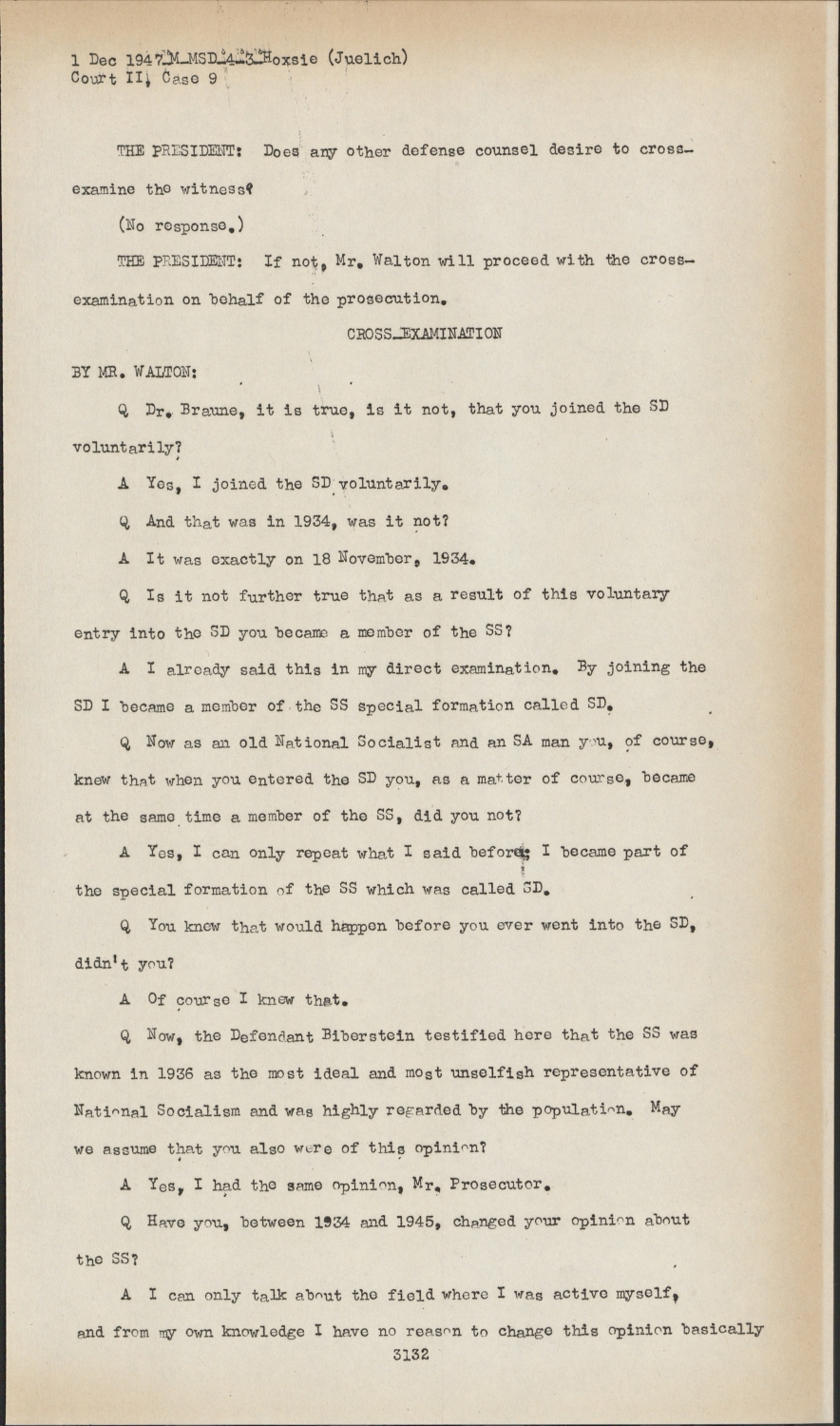
THE PRESIDENT:Does any other defense counsel desire to crossexamine the witness?
(No response.)
THE PRESIDENT:If not, Mr. Walton will proceed with the crossexamination on behalf of the prosecution.
CROSS_EXAMINATION BY MR. WALTON:
QDr. Braune, it is true, is it not, that you joined the SD voluntarily?
AYes, I joined the SD voluntarily.
QAnd that was in 1934, was it not?
AIt was exactly on 18 November, 1934.
QIs it not further true that as a result of this voluntary entry into the SD you became a member of the SS?
AI already said this in my direct examination. By joining the SD I became a member of the SS special formation called SD.
QNow as an old National Socialist and an SA man you, of course, knew that when you entered the SD you, as a matter of course, became at the same time a member of the SS, did you not?
AYes, I can only repeat what I said before; I became part of the special formation of the SS which was called SD.
QYou knew that would happen before you ever went into the SD, didn't you?
AOf course I knew that.
QNow, the Defendant Biberstein testified here that the SS was known in 1936 as the most ideal and most unselfish representative of National Socialism and was highly regarded by the population. May we assume that you also were of this opinion?
AYes, I had the same opinion, Mr. Prosecutor.
QHave you, between 1934 and 1945, changed your opinion about the SS?
AI can only talk about the field where I was active myself, and from my own knowledge I have no reason to change this opinion basically at all.

I believe that in the last years before the end of the war many people would have liked to join the SS and become SS leaders who don't want to have anything to do with it now.
QIt is further true, is it not, that when the suggestion was made to you that you should have yourself appointed to a position in the Gestapo in order that your salary might be paid by the Gestapo, you agreed to this suggestion, did you not?
AI believe, Mr. Prosecutor, I have explained this in my direct examination in all detail and cannot add anything further to this.
QWell, you can at least answer this question. If it is true you can say it is true. If it is not you can deny it. You agreed to the suggestion, didn't you?
AI explained under what certain promises and assurances I agreed to this purely formal solution.