DR. GAWLICK:Your Honor, I object to this question. First of all the question is so long I must say I didn't even understand it myself and there is great danger the witness may give an answer that may be wrongly understood because of the translation. First of all, I ask about a definite rule about hypothetical questions. According to German procedure hypothetical questions are inadmissable and I would like to refer myself here to rulings in criminal procedure - even in American criminal procedure hypothetical questions are inadmissable. What the witness should testify is what he did, what he said, what he saw, and only facts but he cannot imagine himself what he would have done if a, b, c, d, e, or f had happened. This is impossiple for one to demand of the witness and, therefore, I ask of the Tribunal that the Tribunal make a basic ruling about hypothetical questions.
THE PRESIDENT:Gawlik, have you ever read any standard work on evidence as presented in Anglo-American Criminal procedure?
DR. GAWLIK:Yes, "Wharton's Evidence in Criminal Cases".
THE PRESIDENT:Now, can you point out to the Tribunal any section in "Warton's Criminal Evidence" which states that hypothetical questions are not permitted?
DR. GAWLIK:Yes, I could do this if the book is put at my disposal.
THE PRESIDENT:All right, where did you see this book?
DR. GAWLIK:The book is here in the library but it is difficult for me to get hold of it, when I go to the library on Saturday and Sunday maybe.
THE PRESIDENT:All right, Mr. Walton will have that book available for you to persue during the recess, and when we reconvene I want you to read to the Tribunal the section you refer to where it says that hypothetical questions are not permitted.
The Tribunal will be in recess for 15 minutes.
( A recess was taken.)
THE MARSHAL:The Tribunal is again in session.
THE PRESIDENT:Professor Gawlik, are you ready now to give us the law?
DR. GAWLIK:I am sorry, Your Honor, there are three fat volumes, and I shall have to look at these fat volumes first. At the moment I have no objection to the actual questions until I find it. I only would like the last question to be put so that it is understandable to me; otherwise, I don't want to hold up proceedings for the time being.
THE PRESIDENT:Rephrase the question, Mr. Walton, and put it very briefly.
CROSS EXAMINATION (Continued) BY MR. WALTON:
Q.Colonel, if a commando leader felt that his members of an execution squad were no longer of any furhter use to him and he wished to have them replaced, would he informally discuss his replacements with you on one of your inspection trips?
A.That is quite possible, Mr. Prosecutor, that the commando leader would have informed me about it and would have talked to me about it. Yes, that is possible.
Q.And you would have discussed the matter with him, is that correct?
A.I certainly would have talked to him.
Q.And you would have given him that advice as to how to proceed?
A.If personally I had been in the position to do so and to give him some comradely advice I would have done so.
Q.Would you have also discussed the tactical situation, confronting the commando leader with him while you made a visit to his commando headquarters?
A.You mean the tactical situation, the military tactical situation, is that what you mean --Yes, we talked about it.
Q.Well, would the security tactical situation also be discussed?
A.It obviously happened when I talked to commando leaders that, of course, they informed me about the situation.
Q.Did you give them advice and counsel toward the solution of their immediate problems?
A.He did not expect me to do so because he was certain that such advice concerning security I could not tell him more than he knew himself because I wasn't an expert as far as that goes.
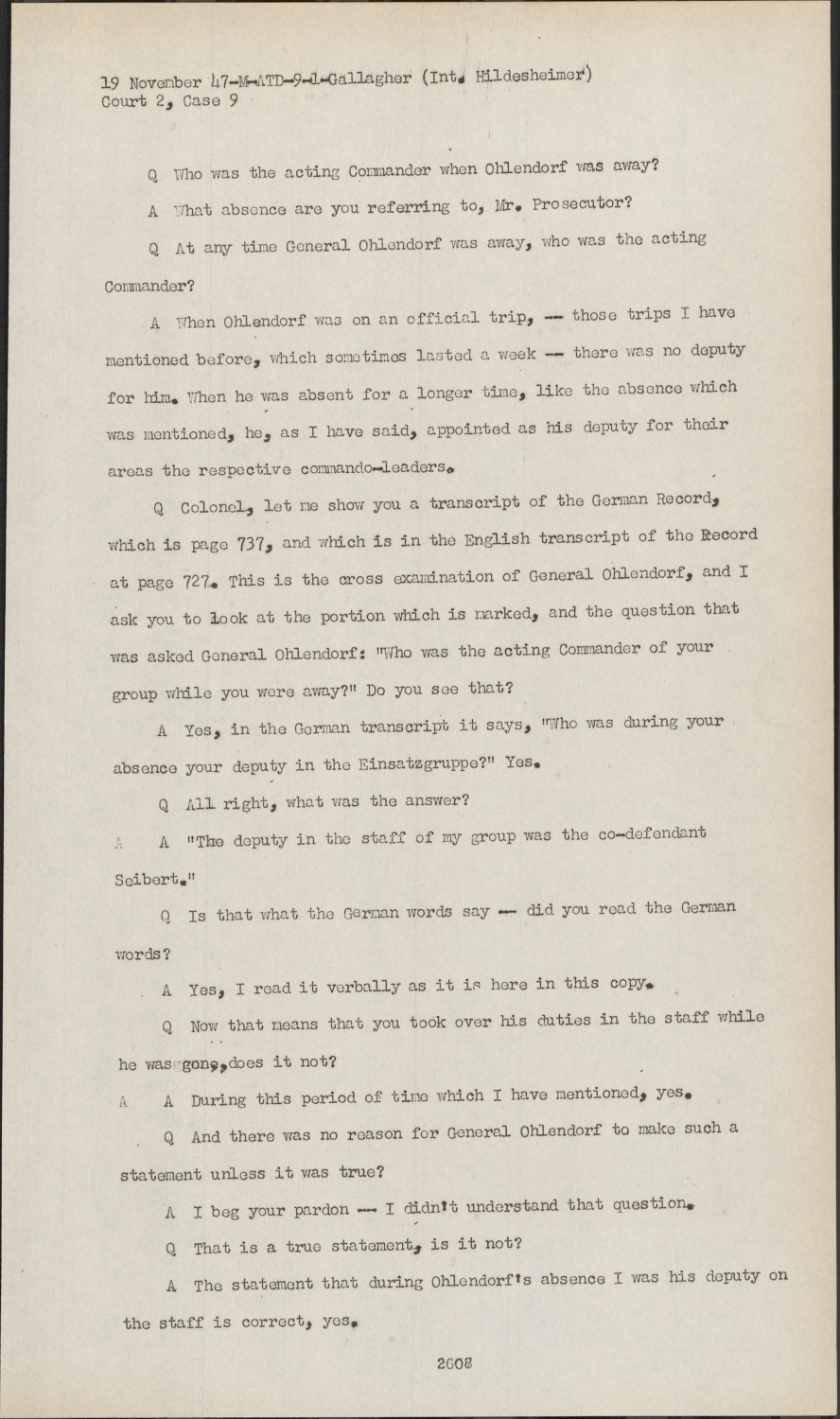
QWho was the acting Commander when Ohlendorf was away?
AWhat absence are you referring to, Mr. Prosecutor?
QAt any time General Ohlendorf was away, who was the acting Commander?
AWhen Ohlendorf was on an official trip, -- those trips I have mentioned before, which sometimes lasted a week -- there was no deputy for him. When he was absent for a longer time, like the absence which was mentioned, he, as I have said, appointed as his deputy for their areas the respective commando-leaders.
QColonel, let me show you a transcript of the German Record, which is page 737, and which is in the English transcript of the Record at page 727. This is the cross examination of General Ohlendorf, and I ask you to look at the portion which is marked, and the question that was asked General Ohlendorf: "Who was the acting Commander of your group while you were away?" Do you see that?
AYes, in the German transcript it says, "Who was during your absence your deputy in the Einsatzgruppe?" Yes,
QAll right, what was the answer?
A "The deputy in the staff of my group was the co-defendant Seibert."
QIs that what the German words say -- did you read the German words?
AYes, I read it verbally as it is here in this copy.
QNow that means that you took over his duties in the staff while he was gone,does it not?
ADuring this period of time which I have mentioned, yes.
QAnd there was no reason for General Ohlendorf to make such a statement unless it was true?
AI beg your pardon -- I didn't understand that question.
QThat is a true statement, is it not?
AThe statement that during Ohlendorf's absence I was his deputy on the staff is correct, yes.
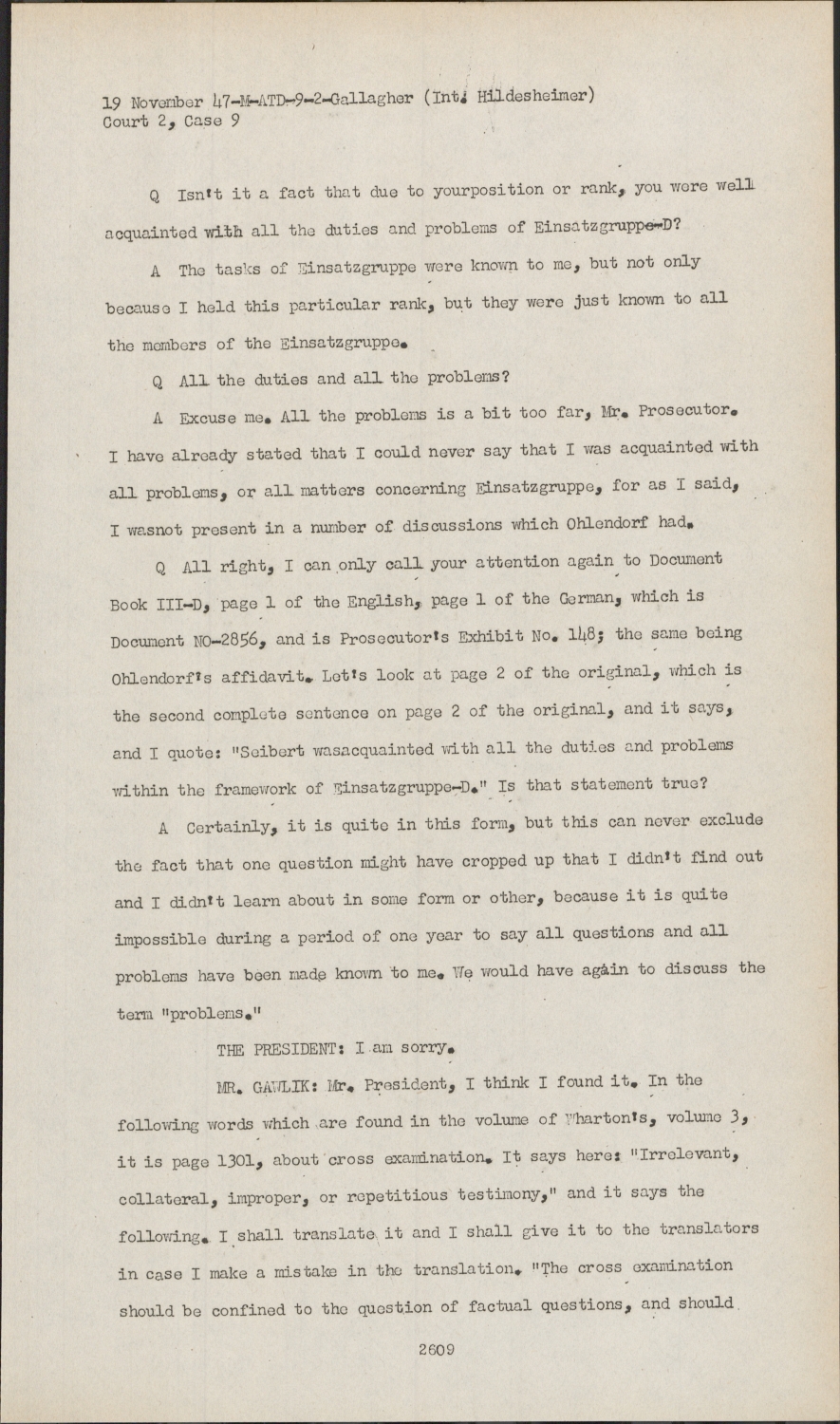
QIsn't it a fact that due to yourposition or rank, you were well acquainted with all the duties and problems of Einsatzgruppe-D?
AThe tasks of Einsatzgruppe were known to me, but not only because I held this particular rank, but they were just know to all the members of the Einsatzgruppe.
QAll the duties and all the problems?
AExcuse me. All the problems is a bit too far, Mr. Prosecutor. I have already stated that I could never say that I was acquainted with all problems, or all matters concerning Einsatzgruppe, for as I said, I wasnot present in a number of discussions which Ohlendorf had.
QAll right, I can only call your attention again to Document Book III-D, page 1 of the English, page 1 of the German, which is Document NO-2856, and is Prosecutor's Exhibit No, 148; the same being Ohlendorf's affidavit. Let's look at page 2 of the original, which is the second complete sentence on page 2 of the original, and it says, and I quote: "Seibert wasacquainted with all the duties and problems within the framework of Einsatzgruppe-D." Is that statement true?
ACertainly, it is quite in this form, but this can never exclude the fact that one question might have cropped up that I didn't find out and I didn't learn about in some form or other, because it is quite impossible during a period of one year to say all questions and all problems have been made know to me. We would have again to discuss the term "problems."
THE PRESIDENT: I am sorry.
MR. GAWLIK: Mr. President, I think I found it. In the following words which are found in the volume of Wharton's, volume 3, it is page 1301, about cross examination. It says here: "Irrelevant, collateral, improper, or repetitious testimony," and it says the following, I shall translate it and I shall give it to the translators in case I make a mistake in the translation. "The cross examination should be confined to the question of factual questions, and should exclude questions concerning expressions of opinion, or speculative questions, or all argumentative questions, especially questions of an argumentative nature which call for an opinion or conclusions, or of some assumed knowledge of facts improper.
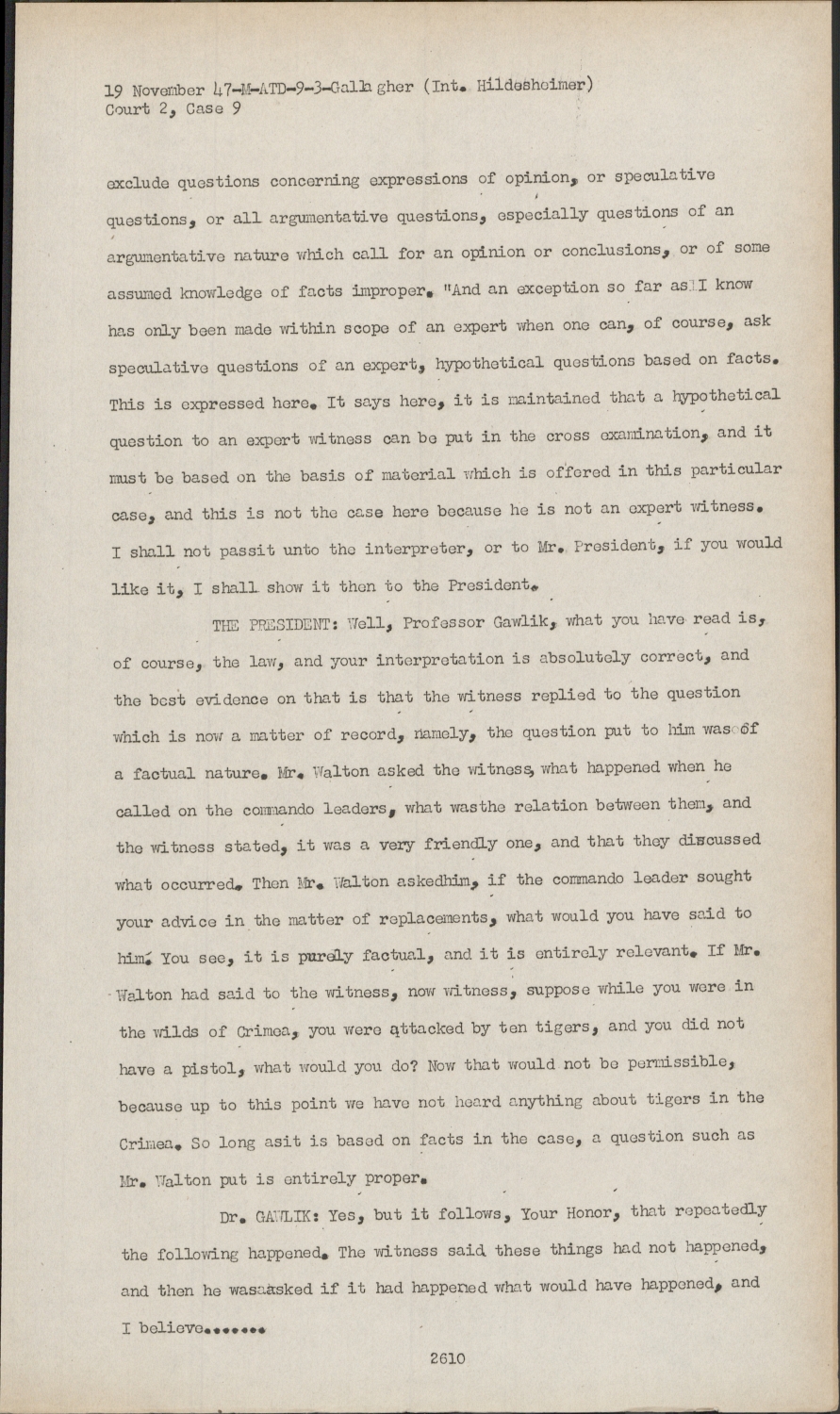
"And an exception so far as I know has only been made within scope of an expert when one can, of course, ask speculative questions of an expert, hypothetical questions based on facts. This is expressed here. It says here, it is maintained that a hypothetical question to an expert witness can be put in the cross examination, and it must be based on the basis of material which is offered in this particular case, and this is not the case here because he is not an expert witness. I shall not passit unto the interpreter, or to Mr. President, if you would like it, I shall show it then to the President.
THE PRESIDENT: Well, Professor Gawlik, what you have read is, of course, the law, and your interpretation is absolutely correct, and the best evidence on that is that the witness replied to the question which is now a matter of record, namely, the question put to him was of a factual nature. Mr. Walton asked the witness, what happened when he called on the commando leaders, what wasthe relation between then, and the witness stated, it was a very friendly one, and that they discussed what occurred. Then Mr. Walton askedhim, if the commando leader sought your advice in the matter of replacements, what would you have said to him. You see, it is purely factual, and it is entirely relevant. If Mr. Walton had said to the witness, now witness, suppose while you were in the wilds of Crimea, you were attacked by ten tigers, and you did not have a pistol, what would you do? Now that would not be permissible, because up to this point we have not heard anything about tigers in the Crimea. So long asit is based on facts in the case, a question such as Mr. Walton put is entirely proper.
Dr. GAWLIK: Yes, but it follows, Your Honor, that repeatedly the following happened. The witness said these things had not happened, and then he was asked if it had happened what would have happened, and I believe.......
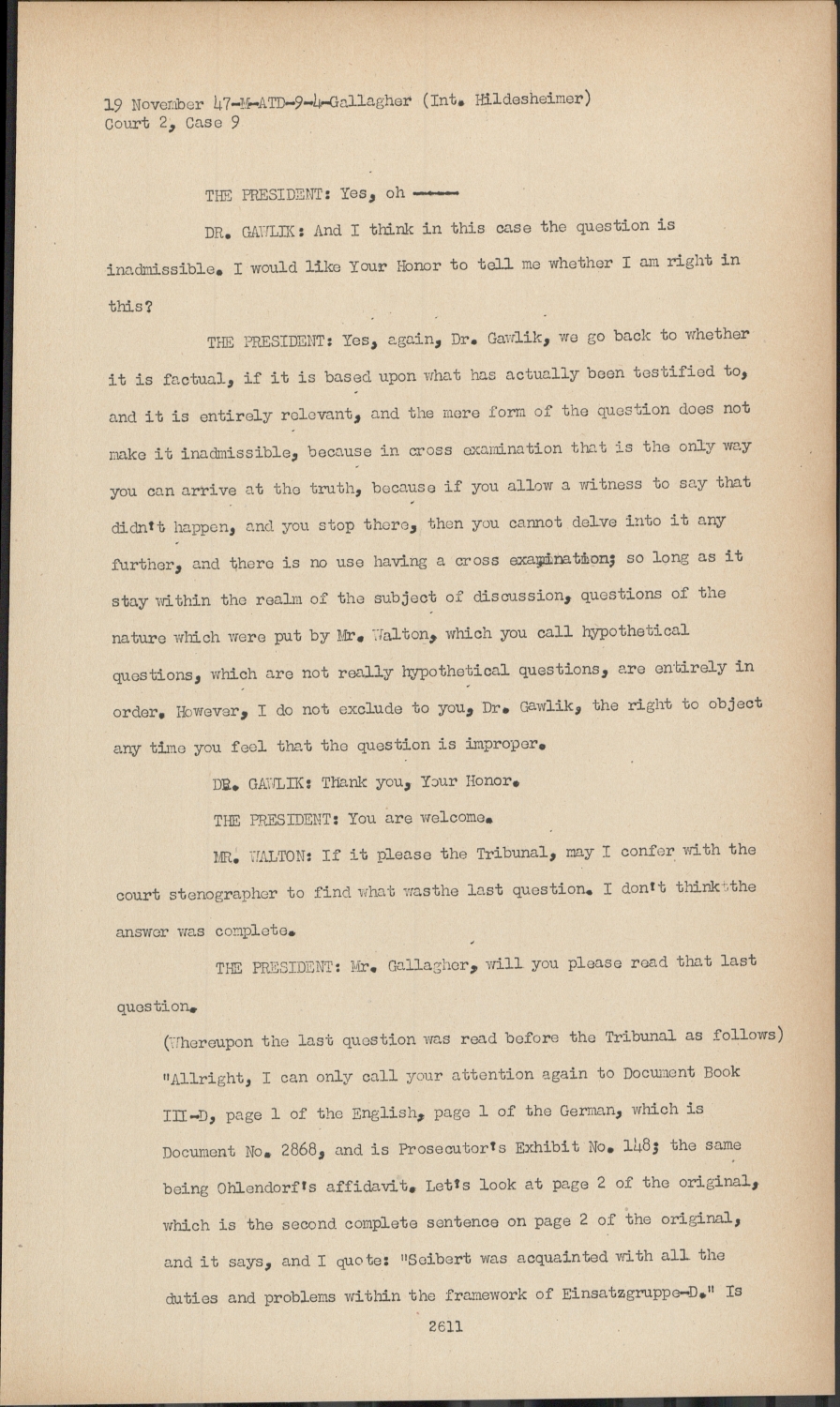
THE PRESIDENT: Yes, oh ---
DR. GAWLIK: And I think in this case the question is inadmissible. I would like Your Honor to tell me whether I am right in this?
THE PRESIDENTS Yes, again, Dr. Gawlik, we go back to whether it is factual, if it is based upon what has actually been testified to, and it is entirely relevant, and the mere form of the question does not make it inadmissible, because in cross examination that is the only way you can arrive at the truth, because if you allow a witness to say that didn't happen, and you stop there, then you cannot delve into it any further, and there is no use having a cross examination; so long as it stay within the realm of the subject of discussion, questions of the nature which were put by Mr. Walton, which you call hypothetical questions, which are not really hypothetical questions, are entirely in order. However, I do not exclude to you, Dr. Gawlik, the right to object any time you feel that the question is improper.
DR. GAWLIK: Thank you, Your Honor.
THE PRESIDENT: You are welcome.
MR. WALTON: If it please the Tribunal, may I confer with the court stenographer to find what was the last question. I don't think the answer was complete.
THE PRESIDENT: Mr. Gallagher, will you please read that last question.
(Whereupon the last question was read before the Tribunal as follows)
"Allright, I can only call your attention again to Document Book III-D, page 1 of the English, page 1 of the German, which is Document No. 2868, and is Prosecutor's Exhibit No. 148; the same being Ohlendorf's affidavit.
Let's look at page 2 of the original, which is the second complete sentence on page 2 of the original, and it says, and I quote:
"Seibert was acquainted with all the duties and problems within the framework of Einsatzgruppe-D." Is that statement true?"
) BY MR. WALTON:
QWitness, have you the sentence referred to in that document before you?
AYes, I have the sentence before me.
QIs that sentence quoted true?
AThe sentence as quoted here is correct. I have already added to it that it did not exclude -- that it never could exclude that discussions took place, the contents of which I was not informed about, and, secondly, I do not know how far the concept a "problem" can be defined.
QDid you ever receive orders from the 11th Army while General Ohlendorf was away?
AI cannot answer this. It is quite possible that orders came, but I don't know.
QWhat would you do with these orders if they primarily affected a commando?
AIn that case I would like to say that I would not have received the order, that order would be given to the Commando itself. If, however, I had received it, I would, have passedit on to the authorities of the Commando.
QIs it true that in Nikolaev and in Simferopol, where your headquarters were located, there was one or more commandos nearby?
AYes, that is correct.
QWhich commando was located in the vicinity of Simferopol while your headquarters was there?
AIn Simferopol itself there was Kommando-XI-B. The other units were according to my present estimate, the nearest commandos were at a distance of about eighty to one-hundred kilometers to the south, and to the east and to the west.
QI am only interested in the one, that was in Simferopol, the one near your headquarters. There was just one commando, was there not?
AThere was only one commando, yes.
QAnd you answered, this was XI-B?
AYes, that was XI-B, yes.
QNow, when the headquarters were at Nikolaev, what commando was in the town?
AIn the town of Nilolaev there was the Kommando-XI-A.
QNow, as a matter of fact, did these commandos perform executions while they were in Simferopol, and while they were in Nikolaev?
AI found out about this from the reports, yes.
QNow, did you ever pass an order concerning executions to either one of these commandos while General Ohlendorf was away from his headquarters?
ANo.
QYou have seen from these reports that the clothing of people who were summoned to the executions were collected, have you not?
AWhat order are you referring to? To what order may I ask?
QYou have seen from these reports that clothing of people who were summoned to execution was collected before the execution, have you not?
AI can no longer say whether this became evident from the report, but generally I think I did know about it.
QWas any of this personal property in the way of clothing, or money, or valuables turned over to Einsatzgruppe-D by the commando performing the execution?
ASo far as I know, valuables and money were turned over to the administrative leader.
QWas then an administrative leader at all times in EinsatzgruppeD Headquarters?
AI would assume so. He might have been absent sometimes, but so far as I remember he was always there.
QWell, now, isn't this clothing collected for a specific purpose?
AI do not know the purposes, but I think it was certainly made use of.
QDon't you know as a matter of fact, this clothing was turned over to the National Socialist Welfare Organization for redistribution?
AI don't know that this did happen in all cases, but I remember now that it did happen.
QNow, this was an domestic or an economic question, was it not, to clothe Ethnic Germans?
ANo, in this case we misunderstand each other. My economic question I dealt with as an intelligence officer, I had to deal with the problems in occupied territories of that nature, but not the economic questions of supply. All those questions an administrative officer or economic officer had to deal with, and that is something entirely different.
QWell, now, Colonel, if these men didn't have enough food in the occupied territories, or these people didn't have enough food in the occupied territories, you would report such fact to Berlin, would you not?
ACertainly.
QAnd if they didn't have enough clothes for the winter, would you report that?
AYes, I would have reported that, too. Excuse me, not men of Einsatzgruppe, but the population. We must understand each other here. It is the population.
QYes, all right, we are agreed on that, and this population included the ethnic Germans who were being settled in this occupied territory, didn't it?
AYes.
QNow if these people didn't have enough clothing, enough coal, or enough furnishings, that would be a question which you would deal in with as Chief of Leiter III.
AYes, that would have been mentioned in the report for the ethnic Germans.
QThen you would have been interested in a matter which concerned your office as to the distribution of these clothes collected from people who were shot, wouldn't you?

ANo, in this case I reported about the position or situation of ethnic Germans, and, if I now assume, that they had not enough clothes, as to how this situation was being dealt with, that was not for me to decide, it was never a matter for the SD official. I only had to report about it.
QI am agreed with you that you had to report about it, but the point I am making is, that you have reported to Berlin that the Ethnic German Settlers who were part of the population didn't have enough clothing; later, did you ever make an inspection to see if this lack of clothing situation was relieved?
AI cannot remember that. Obviously I visited the ethnic Germans' territory, but not to inspect them concerning these questions, but in order to inform myself generally about the position.
QAll right. Now the information that if you had made a report to Berlin that they lacked essential clothing, would you not consider it a matter of information to later on see if your report about this lack of clothing had been acted upon?
ANo - -yes, it could have been the case, but it was not necessary after each report. But many of these reports were only meant for information, and whether these matters were being dealt with was something for the SD, the competent authority to deal with which received these reports.
QWell, if you reported the lack, would you not also report on the fact that the matter was attended to later on?
AIf within a few weeks I had received a report that the population had sufficient clothing, now in that case, yes, of course, I would have reported about it.
QSo that remotely at least you were interested in the collection of clothing from all sources whatsoever, weren't you?
AWhat do you mean by interested, Mr. Prosecutor? I reported about these matters, and if they changed I reported again.
QAll right, you had enough interest that they didn't have clothing, and to report that fact. Now didn't you have enough interest to report possible sources of clothing for these people who lacked it?
You had enough interest to report the fact that they lacked clothing. Didn't you have enough interest to go one step farther in your report, and report to the proper authorities the sources of the clothing so these people could have their needs relieved?
ASo far as such sources were reported to me, they were, of course, included in the reports.
QThen you had some interest in the supply of clothing, even though it was remote?
AThat is not of remote interest. I did this according to the reports, and if I found out the source I just reported about the source, and if the fact that the shortage was over, then, of course, I reported about that fact.
QLet's go back to these people who were executed. Was that clothing kept for any length of time in Einsatzgruppe-D Headquarters?
AI saw no camp in Einsatzgruppe-D.
QI didn't ask you about a camp.
AI never saw a collection of clothes.
QWell, why is it in your interrogation of the 13th of March which was read to you, in which you stated the valuables and clothing were collected by an inspector from AMT-I. They were registered, and sent to Germany, and the money and valuables were either deposited in a local bank or sent to Germany, and that this inspector was responsible to Ohlendorf?
AThat is correct, Mr. Prosecutor, this administrative officer had to deal with such tasks; the money and valuables, as I said, were sent to the group, but no clothing was taken to the group, but this administrative officer just took care of it. In the Commando he was the competent authority. That was within his competence.
QTook care of what?
ATo make use of the clothing and valuables which were received.
QIn the headquarters of Einsatzgruppe D?
AYes. It did not mean, however, that a transport of all these things to the Einsatzgruppe took place.
QWell, you stated a few minutes ago that you never saw any clothing or valuables in Einsatzgruppe D... there was no store for these items.
AI don't know whether that was translated differently. I said the same just now. I said, Mr. Prosecutor, that that does not mean a transport of clothing from the kommandos to the Einsatzgruppe.
QWell, was there ever any clothing of people who were executed stored in Einzatzgruppe D for a day, or a week, or a month?
AI never saw a store.
QI didn't ask you whether you ever saw it; I asked you whether it was there.
AI do not know, Mr. Prosecutor.
QIt could have been there, then?
AA large store would have struck me... I would have seen it.
QAll right. What was the name of this inspector or administrative officer to whom these items were entrusted for transmission to Berlin?
AIt was Hauptsturmfuehrer Ulrich.
QWas he on the staff of Einsatzgruppe D?
AYes. He was a member of the staff.
QDid you see him every day that you reported for duty in the headquarters of Einsatzgruppe D?
AI saw him currently.
QDid you know what his duties were?
ANot his individual tasks - but as it is, with every staff there were eight different sections which were under a staff officer who dealt with the section pertaining to his work. Of course, what became generally known, became also known to me.
QYes. And he reported his disposition of these items, did he not?

AHe must have done so, yes.
QWell wasn't that a matter to be included in the reports to Berlin?
AI don't remember any report in which there was anything to this effect. There could have been individual memoranda or letters from this administrative officer.
QYou mean he reported from his own office to Berlin, and it did not go through the general report which you made out?
ANo, it was never contained in my own report because it was an entirely different department.
QI am not speaking of your reports as Chief of Office III; I am speaking of the general reports which you drew up for the whole Gruppe. Were his activities ever included in those reports?
AHe made out his own reports. And a listing of these reports within the general situation reports, I cannot remember.
QDid each one of those eight departments make separate reports to Berlin besides the general situation reports?
AMany of the departments, yes. For instance, the motor pool expert reported about the Office II, about conditions in the field of transport; the medical officer had to report continually to the medical office in the RSHA. The interpreter, of course, did not make any reports. The departments had been given deadlines from the offices in Berlin.
QColonel, these items of clothing and valuables that had been collected by the kommandos, had been sent in to Einsatzgruppe D headquarters, were they not?
ANo, I have already said they were not sent there. If they had, I would have seen larger stores.
QAre you familiar with the reports which General Ohlendorf made concerning watches and rubels - which is contained in Document Book III-D?
AYes, I know it.
QNow, where did these watches come from...and these rubels?
AI have already said that valuables and money had to be passed on to the administrative officer of the Einsatzgruppe. The administrative officer knew about this.
QFrom where did they come - from the kommandos?
AYes, they came from the kommandos.
QNow, the Einsatzgruppe did not keep these items, did they...of money and watches?
ANo.
QBut they transmitted them either to Berlin or, or as the report says, to the Wehrmacht - didn't they?
AYes.
QDid they take receipts for deliveries to other authorities?
ANot personally. I personally didn't get a receipt. But I am sure that the administrative officer had these receipts. He had to have them.
QHow many times do you estimate that your headquarters sent off shipments of clothing and watches and valuables from Einsatzgruppe D?
AI beg your pardon, I never say any shipments of clothing in the Einsatzgruppe.
QAll right. Valuables, watches, fountain pens, eye-glass frames, jewels, rubels... how many times do you estimate that shipments were made to higher authority from Einsatzgruppe D?
AI guess that perhaps this happened twice during the time that I was there. It is possible that this happened in the army a third time.
QThen of all the executions performed by Einsatzgruppe D... only twice or three times valuables were sent in to the headquarters?
AThey were not sent to headquarters. That was so in this one case... that is mentioned in this letter.
QWell, you knew that these things were being taken from people who were selected for executions, didn't you?
AYes, I learned about that... but whether they were items which were generally confiscated I could see that, of course - I did not know any details. They may have been of other people who had to give up their valuables for other reasons. That I don't know.
QAll right. Wasn't it the responsibility of every man in that headquarter to see that no Einsatzgruppe personnel enriched himself by keeping such items for his own use?
ASuch order was issued by the Chief of the Einsatzgruppe generally once, and of course I also was informed about it.
QWell, isn't it a fact that these shipments were made regularly, from time to time, out of Einsatzgruppe D headquarters?
AI really can't say that. It is quite possible that I made a mistake when I said twice, and that it might have happened more often, but that there could have been a shipment weekly or fortnightly, I don't know. I think it quite impossible.
QYou have testified that your co-defendant Heinz Schubert was General Ohlendorf's adjutant, have you not?
AYes.
QHow well did you and Schubert know each other?
AI had known Schubert by sight, and I knew that he was working in Office I of the RSHA. Before the assignment I must have talked with him on one or two occasions in Berlin, but I did not know him better than that. I only met him again in the assignment.
QNow, your day-to-day relations with Schubert were friendly, were they not?
AYes.
QWhen you were present for duty at Einsatzgruppe D you came into contact with Lt. Schubert, didn't you?
AWhen both of us were present in the garrison - yes, we saw each other daily; but I have already said that I was often away with Ohlendorf, or by myself; but otherwise, of course, I saw him daily when he was there and I was there.
QDid Schubert take orders from you when General Ohlendorf was absent from his headquarters?
AI cannot remember any general orders, but it must have happened that I did not order Schubert because he was a personnel acquaintance of mine, but I just told him to do something.
QYes. Did Schubert know your functions and duties in the Gruppe?
AYes, he was aware of them.
QNow, if Schubert made the statement that, and I quote: "In matters where one did not want to bother the chief, one turned to Seibert" - would that be a true statement?
AWhen somebody came to the garrison and Ohlendorf was not present, or for some reason or other was away, he came to see me because I held the highest rank... that is quite correct in that form.
QNow, would you take care of these matters in the specific instances which you have stated? Would you render a decision in these matters?
AThat depended what sphere this matter was pertaining to which was called to my attention. If it was pertaining to my own sphere, certainly would have been able to make a decision. Otherwise, I could only have given advice, and I could have said who the expert was for this particular shpere.
QAnd unless it concerned your field you are positive that you never gave any directives or orders?
AIn the combat territory, and during the assignment, considering the special situation in the Crimea, I can never say generally that this was absolutely excluded as a possibility; but I do not remember any directives which have anything to do with spheres that I have mentioned.
QBut it could have happened, even though you don't remember?
AI don't know.
QIt is possible, isn't it?
AI can hardly say whether it is possible.
QNow, from his knowledge about the headquarters and the personnel in there, and their duties - if Schubert considered you the full deputy of Ohlendorf he had a basis for this assumption didn't he?
AHour he had it personally, I do not know. I can only imagine, as I already said, that he was aware of my position within the staff, yes.
QAll right. Let me call your attention to his affidavit of 24 February 1947, which is contained in Document Book I, page 108 of the English, 141 of the German, and which is his affidavit 3055, Prosecution Exhibit 28. Let me call your particular attention to paragraph 2, the second sentence thereof, which reads, and I quote: "In October 1941 I was assigned to Einsatzgruppe D. Otto Ohlendorf was the Chief of the Einsatzgruppe, and Willy Seibert was his deputy." Do you find that sentence?
AYes, I've got it, Mr. Prosecutor.
QThat is a true statement, isn't it?
AI have already given my opinion on that. Schubert was detailed to the staff and he found me there -- as the highest ranking officer and as the deputy for the Staff, and this is the only way I can regard this statement.
QDo you know Karl Jonas, J-o-n-a-s?
AJonas? I seem to remember the name, surely.
QWell, I'll tell you. He was second in command to Hans Gabel, the chief of the order police company attached to Einsatzgruppe D.
AYes.
QDo you remember the name now?
AYes, I remember.
QHow often did you see him while you were on duty with Einsatzgruppe D?
AWhile Gabel was currently employed in the staff of the Einsatzgruppe I saw Jonas very rarely - that means not very often; I am just thinking over to what kommando he was assigned. I cannot remember exactly.
QHe was assigned to the police company.
AYes. Yes. That is correct. I don't know at the moment in what kommando he served.