The result of the Fritsch trial which undoubtedly represents a victory of justice over political expediencies was that Hitler realized that justice could be a stronger opponent than he had thought originally and that, in case of real danger, he would have to adopt more drastic methods if he whished to realize his political aims either in a specific case or in their overall aspect. Since the judgment in the Fritisch trial, Hitler's suspicions with regard to judicial authorities, especial y those in the Wehrmacht, had become firmly established.
I, as Defense Counsel for Lehmann have now the task to illustrate the results of these suspicions and to describe Hitler's efforts to deprive the judicial authorities in the Wehrmacht of one province after another.
Hitler's struggle against the judicial authorities in the Wehrmacht had other reasons apart from the defeat in the Fritsch trial. At least equally decisive for him was the fact that the Wehrmacht was the government organ which had preserved a relatively pronounced independence from the party and which adhered to traditional methods. The very fact that the Wehrmacht had a tradition which the Party lacked, constituted a barrier. But an even more important moment was the fact that the special knowledge and experience of a soldier cannot be replaced by political convictions and a ready tongue thus saving the Wehrmacht from a personnel policy governed by party politics. Thus the Wehrmacht comprised strong forces which, it is true, advocated a strong and self-reliant state but which declined or even opposed political games of hazard and the ideological extravaganzas of the Party. This attitude was particularly prevalent among judicial officers of the Wehrmacht. The Wehrmacht Legal Corps mainly comprised jurists who had come into conflict with the Party in the prosecution of their profession in civilian life and who had joined the Wehrmacht in the hope of carrying out their professional duties free from Party influence, since the Party had hitherto respected that organization.
In the course of the hearing of witnesses, I shall show that the proper task of the legal machinery of the Wehrmacht was jurisdiction as applied to the troops. During the war, this task came to include jurisdiction over the inhabitants of occupied territories whenever this function was not carried out by indigenous courts or other organs according to government orders. These were the tasks which Hitler tried, in an ever increasing measure, to take out of the hands of the judges in order to subordinate them to political expediencies. In the course of my argumentation, I must deal with Hitler's struggle against judicial authorities in relation to Wehrmacht troops as well as in relation to the inhabitants of occupied territories. For both express the same suspicions, one and the same basic attitude towards the potential opponent of the dictator, i.e. towards the judicial authorities. In order to show to Your Honors the degree to which Hitler's suspicions of the judicial authorities of the Wehrmacht increased, I shall, in examining the defendant, not only deal with the documents and orders with which he has been charged, but I shall mention, in chronological order, the many and varied methods, with with Hitler tried to undermine Wehrmacht jurisdiction. In this connection, I shall show that these attacks did not only emanate from Hitler but in the same measure from party offices and the police which all tried to gain more influence.
Concerning jurisdiction over Wehrmacht troops, we must mention, to begin with, that, since the outbreak of war, Hitler in his capacity of supreme judicial authority of the Wehrmacht and as the military superior of all other judicial authorities, had the possibility of making his direct influence felt in some of the criminal proceedings.
He had reserved for himself the right to confirm or reject judgments against generals and all death sentences against all officers pronounced by Wehrmacht courts. But this measure of influence upon the activity of Wehrmacht Courts by no means satisfied the aspirations of the regime. A decisive step in the desired direction was taken by the p rty when it demanded to be informed of all verdicts of Wehrmacht Courts against members of the Party. The Party feared that its members could possibly be treated unfavorably as compared to non-Party members. Furthermore, it expected that judgments should be influenced by political considerations; it hoped to procure a weapon against the judicial authorities in the Wehrmacht by knowledge of the judgments, and to be able, at least in specific cases, to intervene with Hitler, Bormann or Himmler. Upon Hitler's orders, the demands of the Party had to be complied with.
A decisive attempt to undermine and discredit the judicial authorities of the Wehrmacht in the eyes of the Wehrmacht troops was made when Hitler issued the order to remove from the jurisdiction of the Wehrmacht all criminal cases of a political character which were directed against the Third Reich itself, and to transfer them to ordinary courts. No. experienced soldier of a foreign army will be able to comprehend how the Commander in Chief of the Armed Forces of new country could allow such a problem to arise during war-time. And yet after long and tenacious opposition, it came to pass that Hitler ordered all political cases to be handed over to civil jurisdiction. He even went as far as to contemplate the complete abolition of judicial authorities of the Wehrmacht. In the course of this trial, I shall have to deal on various occasions, with the background of these incidents and their actual course, on the basis of the above mentioned and other examples.
The part which was played by Lehmann in these conflicts is of decisive importance for the evaluation of his character and of his basic attitude to his duties and to justice in general and of his sympathetic approach in the incidents which have become the object of the charge against him.
A few weeks after the outbreak of war the Wehrmacht judicial authorities were not only put more and more on the defensive, but they were also exposed to the most severe attacks with regard to their competency for the inhabitants of the occupied territories. Whereas the attacks concerning jurisdiction over Wehrmacht troops emanated from Hitler and the Party, the latter incidents originated from Himmler and the police. Soon after the campaign in Poland, these quarters raised the charge that the military courts had failed in their task, that they had allowed partisans to escape and that they had failed to appreciate the actual requirements of warfare. These accusations were refuted. Nevertheless, they showed that serious forces were at work against the continued existence of Wehrmacht jurisdiction. After conclusion of the fighting in the netherlands, Goering, on his own initiative and without consideration for the existing judicial Wehrmacht authorities, ordered that, in proceedings against Dutchmen accused of illtreatment of German parachutists, Luftwaffe Courts should be composed of officers and not judges. The decisive phase in the elimination of Wehrmacht Courts with regard to the civilian population in occupied countries commenced, however with Hitler's order to leave the Wehrmacht Courts behind in the campaign against Soviet Russia and to place punitive power into the hands of the troops. Hitler finally went as far, as to order that procedure which was originally only applicable to the Russian theatre of war, to be extended also to the other theatres of war and occupied areas, with the provision that the accused were not to be sentenced by the Army but to be handed over to the SD.
His aim was therefore, to completely remove the civilian population from the jurisdiction of the Wehrmacht, because he considered the proceedings before the Wehrmacht courts as clumsy and from his point of view, politically unreliable.
It will be my task to demonstrate what superior powers Hitler had at his disposal in this struggle and how the defendant Lehmann, in spite of that superiority, did everything at all humanly possible, in order to maintain the Wehrmacht jurisdiction.
II.
Within this historical framework just outlined, the sphere of duty of the Chief of the Wehrmacht Legal Branch in general as well as Lehmann's activities in particular have to be examined. As concerns the position of the defendant, the Prosecution avoided to define it in detail, be it only with one word. The only thing they said up to the present in this connection was that Lehmann's position corresponded to that of a "Judge Advocate General", without, however, substantiating that comparison in any way. They are obviously hoping by means of the haziness concerning the defendant's competency, to establish responsibilities that never existed.
Already at this juncture, the Derense wishes to draw attention to the remarkable fact that the Prosecution does not charge my defendant with an offenees which took place within the sphere of the Wehrmacht judiciary. On the contrary, all the charges against the defendant Lehmann are concerning cases in which the competency of the Wehrmacht juris diction had been infringed upon through Hitler's personal interference, i.e. cases which had been taken out of the hands of the Wehrmacht judiciary.
Does the Prosecution think, perhaps, that a convinced jurist, a man who sees his life's task in the maintenance of a free jurisdiction, only subject to the law, can find satisfication in handing over his tasks to the police? Has it ever been heard that a man voluntarily acted as the pall bearer of the vocation of his life? In this respect the Prosecution did not only become the victim of a factual error; their theory also contradicts every reasonable experience of life.
May I in this connection draw the attention of the Honorable Tribunal to a sentence in the opinion of Tribunal II in case IV "The United States of America against POHL et al." which contains the following interesting remarks concerning the actual position of a defendant within an organization (English transcript page 8079) I quote as follows:
"At the outset of the testimony, the Tribunal realized the necessity of guarding against assuming criminality or even culpable responsibility, solely from the official titles which the several defendants held. The Tribunal has been especially careful to discover and analyze the actual power and authority of the several defendants, and the manner and extent to which they were exercized, without permitting itself to be unduly impressed by the official designations on letterheads or office doors." End of quotation.
In order to afford the Tribunal a concrete idea of the sphere of tasks of Dr. Lehmann and his department, I shall start out with a definition of the position and tasks of a judge in the Wehrmacht in general and shall have to draw in rough outlines a survey over the organization of the Wehrmacht judiciary system as a whole.
Special consideration will have to be devoted to the problem of who had the highest responsibility for the correct application of justice within the Wehrmacht.
I shall then turn my attention to the particular field of activities of the defendant Lehmann. Already the official designation of "Chief of the Wehrmacht Legal Branch" Chef des Wehrmachts Rechts which was given to his office during the war, is liable to create erroneous impressions. In the first place it must be taken into consideration that the Chiefs of the Legal Branches of the OKW as well as of the individual branches of the Wehrmacht were doing nothing more than to act as the special advisors and experts to their commanding officers and that only the commanding officers had the authority to issue orders. As far as the relations of the OKW to the branches of the Werhmacht in respect to legal matters were concerned, it was of course correspondingly affected by the fact that the OKW was not a Supreme Command of the German Wehrmacht in the technical sense, but only a staff under Hitler's command, for the purpose of coordinating the three branches of the Wehrmacht, as was already sufficiently elucidated in the course of the hearing of evidence. Just as the OKW did not have the authority to issue orders to the individual branches of the Wehrmacht, neither did the Legal Branch of the Wehrmacht have the authority to issue orders to the Legal Branches of the branches of the Wehrmacht. Within the OKW, however, the Wehrmacht Legal Branch was by no means to only agency handling legal questions. This applied also to the sphere of International Law which is of particular interest here.
It will furthermore have to be defined, which tasks in particular were the individual duties of the department headed by Lehmann, and where their center of gravity lies.
The Defense will have to examine, how far Lehmann was able to or forced to develop his own initiative, and in particular what were the limitations imposed on his powers of exerting influence.
III.
I shall then turn to the specific acts with which the defendants are charged.
With respect to the asserted planning and waging of wars of aggression and to the alleged conspiracy, I shall be albe to present my evidence very concisely. The documents introduced by the prosecution do not justify the slightest shadow of suspicion of participation by Dr. Lehmann in the alleged crimes. In this connection the IMT established principles which do not admit unlimited generalizations but which make participation in these crimes dependent upon the existence of certain specific requirements. Without wishing to critize the prosecution, I feel it my duty to state that it could have dropped these counts had it taken the reasons for the IMT judgment into consideration.
The principal subject of my argumentation will be Hitler's four orders, in connection with which my client is accused of criminal complicity. They are the following, in order of date:
a. the decree concerning the exercise of jurisdiction in the Barbarossa territory, b. the Commissar order, c. the Nacht und Nebel decree with the subsequent so called "Terrorist Order" superseding it, and d. the "Kommando" order.
With regard to the Kommissar and Kommando orders, I shall attempt to prove that Lehmann had no part in them. The Kommissar order contains even in its original version a regulation according to which the measures ordered in it fall outside the competency of the Wehrmacht judicial authorities, that is to say, beyond any influence Lehmann might have been able to exert.
The only way in which my client had anything to do with the matter was that he suggested a clearer, more precise wording for the above-mentioned regulation to which Keitel had referred specifically, stating that the order had nothing to do with the Legal Division.
THE PRESIDENT:At this time we will take our recess.
(recess)
THE MARSHAL:The Tribunal is again in session.
DR. KELLER:I just mentioned the specific facts which the Defendant Lehmann is being charged with.
The same is true of the Kommando order, which was neither issued nor formulated by the Wehrmacht Legal Division. The final version emanated from Hitler himself, as did the previous announcement in the Wehrmacht report of the 7 October 1942. The activity of the Wehrmacht Legal Division in connection with this matter ended with Lehmann's repeated and pressing demands for a conference to clarify certain preliminary questions. Such a conference never took place.
With regard to the decree concerning the exercise of jurisdiction in the Barbarossa area it appears imperative to oppose the prosecution's insulting insinuation in its Opening Statement (page 55), that the Barbarossa jurisdiction order, and I quote:
"permitted German soldiers to engage in wanton slaughter at the whim of any officer and without fear of any punishment". End of quotation.
The picture drawn by the prosecution could give the impression that the course of the war on the Eastern front would have been entirely different had there been no Ministerialdirektor Lehmann. I think I shall be able to prove the falsity of such an idea from the prosecution documents themselves. The evidence already presented by my colleagues has given a clear picture of the actual conditions under which the battles in the East were fought. The general defense will offer the High Tribunal further material in this connection.
In presenting my evidence I shall first deal with the events leading up to that order. With regard to those events, there is a particularly striking case which shows the difficulties which arise for the defense when it has access only to certain sets of documents which appear to be complete. Even if I am not able to submit the notes and drafts made at the time, I shall be able to fill the regrettable gaps by means of verbal statements and affidavits.
The hearing of witnesses will show how Lehmann opposed Hitler's original order excluding the Wehrmacht courts from any activity in connection with a campaign against the Soviet Union, and what he achieved thereby. In discussing that order I shall first deal with that part which concerns jurisdiction over the indigenous population. I shall have to correct various errors both of a factual and of a legal nature, to which the prosecution appears to have succumbed. The same applies also to the second part of the order, which concerns the prosecution of criminal acts on the part of our own troops against the indigenous population. It will have to be proved that in fact this part of the decree did nothing to alter the previously existing conditions and that Lehmann himself saw to it that the Wehrmacht courts continued to handle criminal acts by the troops in the same way as they had done previously.
The Nurnberg Tribunals have already occupied themselves extensively with the complex of the so-called Nacht und Nebel decree, and one judgment has been passed in connection with it which is inexplicable as far as those people are concerned who were involved in its issuance and practical application. The defense now believes it can throw fresh light on the matter, both from documents which the prosecution has first submitted in these proceedings and from material procured elsewhere. It will be proved that the greater part of that which was previously ascribed to the decree had nothing whatever to do with the order as it was issued to and executed by the Wehrmacht, but that it emanated from agencies which acted on their own authority and without the knowledge of the Wehrmacht. Only after eliminating everything which is thus irrelevant to these proceedings will it be possible to examine the measures with which Dr. Lehmann is connected.
In presenting my evidence I shall first refer to the reasons which led to the decree in question. I shell have to go into the question of the French resistance movement, of its legality and of the degree of danger which it constituted for the occupation troops.
In this connection I should like to refer here to an ordinance of General de Gaulle's government in exile dated 6 July 1943, Article 1 of which localized all acts contributing to the liberation of France, including such as were punishable according to existing law.
I quote that Article 1:
"All acts committed after 10 June 1940 and having as their aim the liberation of France are declared legal, even if they constitute infractions of the law in force at the time."
End of quotation.
I take the liberty of pointing out to the High Tribunal that that regulation goes further than the law by Hitler legalizing the measures of 30 June 1934 mentioned at the beginning of my statement. I shall submit further evidence concerning the resistance movement in the form of documents and affidavits.
As far as facts are concerned, I shall produce evidence that the aim of Hitler's order was to deny every form of justice to the population of the occupied territories and that my client was successful in his efforts to direct the order out of the purely police sphere and into legal channels. Finally I shall deal with the functioning of the decree in the occupied territories as well as in Germany.
As far as the legal aspect is concerned, the Nacht und Nebel decree opened up the large field of problems connected with international law. Many disputed and for the most part unsolved questions arise here, to which international treaties or agreements give no definite answer. Therefore, in order to clarify the legal conditions existing at the time, I must use the second source of international law, namely the practice of governments. It will be necessary to include that in my presentation of evidence.
I am not now in a position to give a separate opinion on all legal questions. Nor do I wish to make any sort of qualification such as that made by the Prosecution in its Opening Statement with reference to the Nacht und Nebel decree, when it states, for example, and I quote (page 65):"that in the end stupid violence is a weapon which recoils upon its user."
End of quotation.
I should like to suggest to the prosecution, however, that in dealing with the question of the Nacht und Nebel decree they would have done better to take into consideration the second source of international law, namely the practice of governments.
There is nobody who will not regret, for humanitarial reasons, measures such as the isolation of internees from the outside world as ordered by the Nacht und Nebel decree. However, I must draw the attention of the prosecution to the fact that in this connection no uniform practice of governments has yet resulted therefrom. This may be assumed from the fact that similar measures were employed by the Allies after the capitulation of Germany, when all persons interned according to the regulations of automatic arrest were denied all contact with the outside world for months on end. I should also like to draw the attention of the prosecution to the fact that the regulations of automatic arrest - which, according to the Arrest Categories Handbook for Germany, were applied to 300,000 persons - are also of importance in connection with the question what measures an occupying power may employ for the maintenance of peace, order and security in an occupied country. Further expressions of the practice of governments will supplement the judgment of the Nacht und Nebel decree according to international law. I shall be very careful to submit only such material as is important from the point of view of international law. Emotional aspects and political generalizations are thus excluded from the outset.
May it please the Tribunal I am convinced that, according to the personal impression which you will have had an opportunity to obtain of my client on the witness stand, it would be unnecessary for me to present evidence as to the character of Dr. Lehmann, if it were only a matter of proving that before you is a man whose high principles are above all doubt.
When I mention this point, I do not do so because of a remark in the Opening Statement of the prosecution, the assessment of which remark I can confidently leave to the High Tribunal. The necessity to present evidence concerning the character of Dr. Lehmann arises, on the contrary, from the fact that in the complicated mechanism of a dictatorship many statements do not correspond to the original intention of their author. Their outward expression often had to be adapted to the requirements of the moment, in order to achieve perhaps an aim which could only become evident by reading between the lines. One can only tell, however, what was really intended by a given statement if one is familiar with the entire character of the person who made the statement, and on the basis of the principles which he adopted in the opinion of those people who were able to observe him in the most varied situations during the course of years. I hope to treat this also with the discretion due to this High Tribunal.
I shall attempt to conduct the defense of my client in an unbiased manner, in order to help as far as possible to arrive at the truth objectively. The better I succeed, the more certainly will it be in his favor.
DR. KELLER:May I ask the Tribunal to call the Defendant Lehmann to the stand now.
THE PRESIDENT:Very well. The defendant may take the stand.
RUDOLFLEHMANN, a witness took the stand and testified as follows:
THE PRESIDENT:Hold up your right hand:
I swear by God, the Almighty and Omniscient, that I will speak the pure truth and that I will withhold and add nothing.
(The witness repeated the oath.)
THE PRESIDENT:You may he seated.
DIRECT EXAMINATION BY DR. KELLER (Attorney for the Defendant Lehmann):
Q.Witness, may I ask you to state your full name for the record?
A.My name is Rudolf Lehmann.
Q.When and where were you born?
A.I was born on the 11th of December, 1890, in Posen.
Q.Will you please briefly state your family history?
A.My father was senior public prosecutor. My grandfather was the President of a district court, Oberlandesgericht. Other than that, there were in the family parsons, teachers, artisans, and farmers.
Q.Are you married?
A.Yes.
Q.May I ask you briefly to state your wife's family history?
A.My father in law was a professor of law at the Berlin University.
Q.Do you have any children?
A.Yes, I have two children.
Q.Will you very briefly describe your own professional career for us?
A.In 1912 I passed my first legal examination. I participated in the First World War as an officer of the reserves. I passed my second legal examination after the First World War. Thereafter, as a young official, I worked in the offices of public prosecutors and in courts, In 1925 I became an assistant in the Reich Ministry of Justice in the Department which dealt with the reform of penal law and trial procedure.
Q.When did you b come a ministerial counselor?
A.I became a ministerial counselor in 1932 at the age of 42 years.
Q.Under how many ministers did you work?
A.I worked under ten different ministers in the Ministry of Justice.
Q.What was your main sphere of tasks, apart from the one to which you just had reference now?
A.My main sphere of tasks, as I just stated, was to help in the drafting of reform suggestions for penal law and for trial procedure. Until the year of 1932, I worked on penal law. From 1932 onwards, I worked on trial procedure and trial rules. Next to this activity I carried out other activities which occupied much of my time in Germany.
In 1925 Germany had joined the International Penal Law and Prison Commission. This was a commission which had its permanent seat in Berne, Switzerland. From 1925 until 1937, I was junior German delegate attached to this commission. The commission held regulat meetings in Berne and a large scale meeting which took place every five years, a legal convention. I helped to organize the convention which took place in Berlin in 1935.
Q.How many countries were represented in this convention?
A.Approximately fifty countries.
Q.What were your relations to members of this international commission?
A.I believe they were good.
DR. KELLER:If the Court please, concerning this subject matter, I should like to submit in my Document Book VIII certain statements at the appropriate time. Q. (By Dr. Keller) Were these relations still regarded as good after 1933, after the seizure of power by National Socialism?
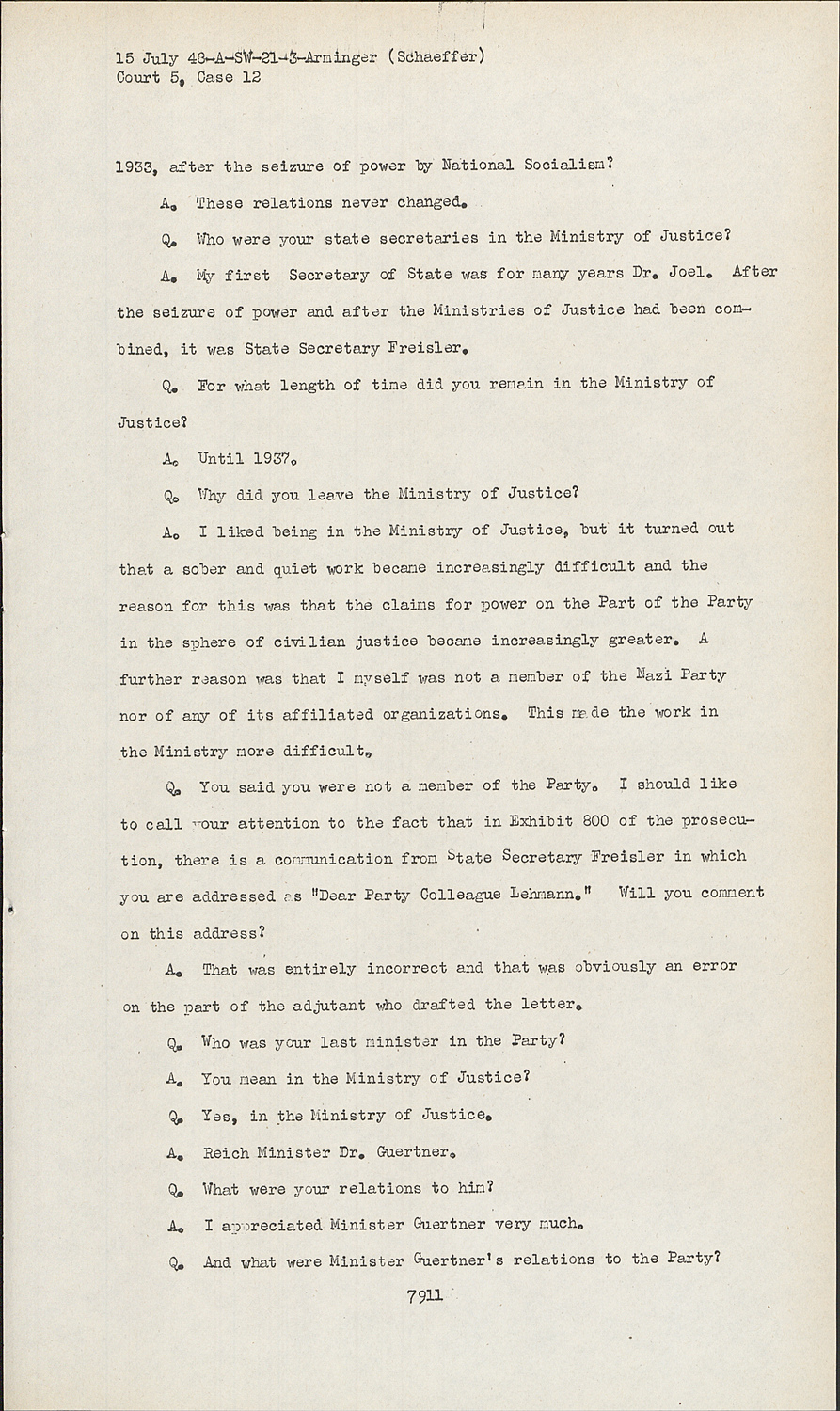
A.These relations never changed.
Q.Who were your state secretaries in the Ministry of Justice?
A.My first Secretary of State was for many years Dr. Joel. After the seizure of power and after the Ministries of Justice had been combined, it was State Secretary Freisler.
Q.For what length of time did you remain in the Ministry of Justice?
A.Until 1937.
Q.Why did you leave the Ministry of Justice?
A.I liked being in the Ministry of Justice, but it turned out that a sober and quiet work became increasingly difficult and the reason for this was that the claims for power on the Part of the Party in the sphere of civilian justice became increasingly greater. A further reason was that I myself was not a member of the Nazi Party nor of any of its affiliated organizations. This made the work in the Ministry more difficult.
Q.You said you were not a member of the Party. I should like to call your attention to the fact that in Exhibit 800 of the prosecution, there is a communication from State Secretary Freisler in which you are addressed as "Dear Party Colleague Lehmann." Will you comment on this address?
A.That was entirely incorrect and that was obviously an error on the part of the adjutant who drafted the letter.
Q.Who was your last minister in the Party?
A.You mean in the Ministry of Justice?
Q.Yes, in the Ministry of Justice.
A.Reich Minister Dr. Guertner.
Q.What were your relations to him?
A.I appreciated Minister Guertner very much.
Q.And what were Minister Guertner's relations to the Party?
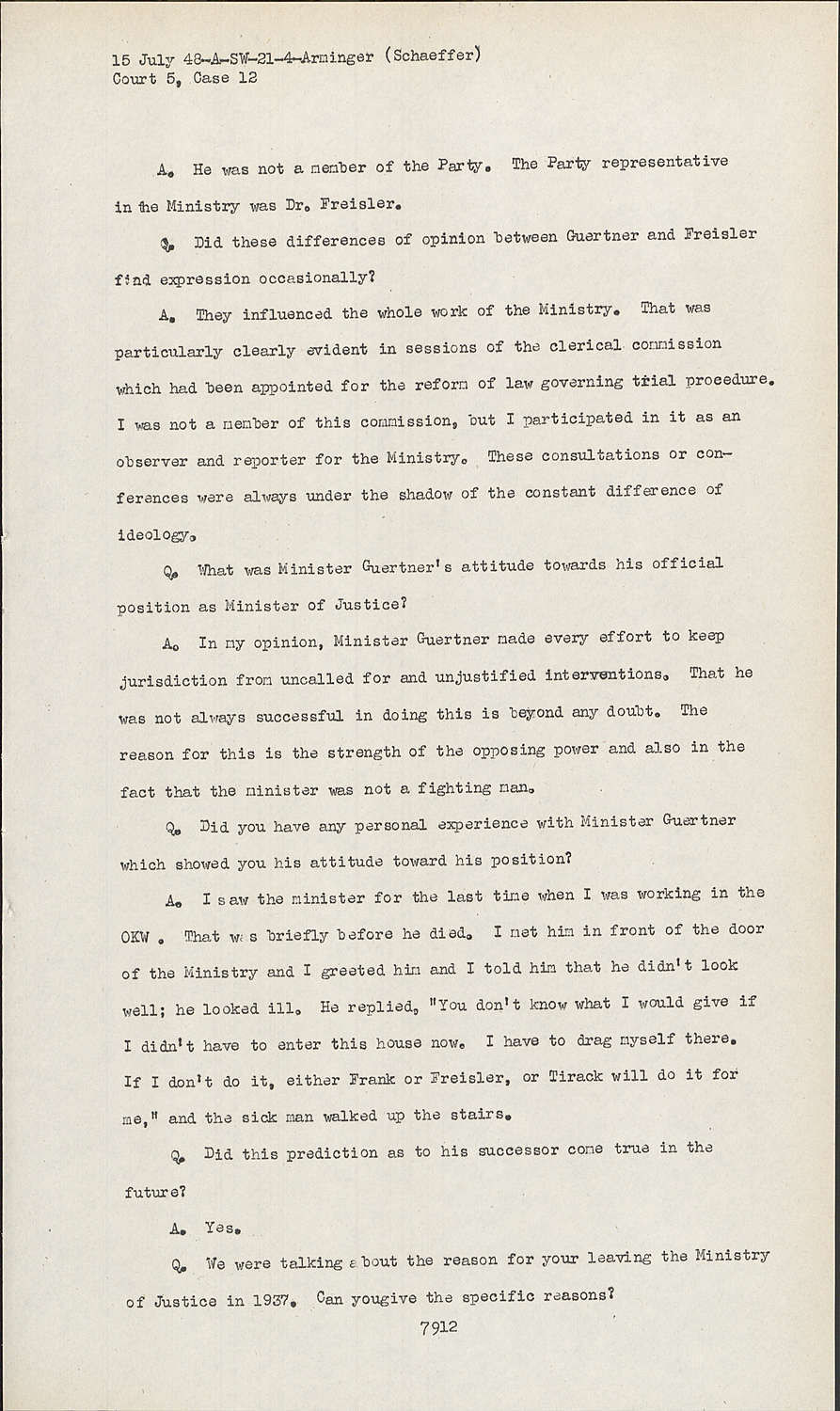
A.He was not a member of the Party. The Party representative in the Ministry was Dr. Freisler.
Q.Did these differences of opinion between Guertner and Freisler find expression occasionally?
A.They influenced the whole work of the Ministry. That was particularly clearly evident in sessions of the clerical commission which had been appointed for the reform of law governing trial procedure. I was not a member of this commission, but I participated in it as an observer and reporter for the Ministry. These consultations or conferences were always under the shadow of the constant difference of ideology.
Q.What was Minister Guertner's attitude towards his official position as Minister of Justice?
A.In my opinion, Minister Guertner made every effort to keep jurisdiction from uncalled for and unjustified interventions. That he was not always successful in doing this is beyond any doubt. The reason for this is the strength of the opposing power and also in the fact that the minister was not a fighting man.
Q.Did you have any personal experience with Minister Guertner which showed you his attitude toward his position?
A.I saw the minister for the last time when I was working in the OKW . That was briefly before he died. I met him in front of the door of the Ministry and I greeted him and I told him that he didn't look well; he looked ill. He replied, "You don't know what I would give if I didn't have to enter this house now. I have to drag myself there. If I don't do it, either Frank or Freisler, or Tirack will do it for me," and the sick man walked up the stairs.
Q.Did this prediction as to his successor come true in the future?
A.Yes.
Q.We were talking about the reason for your leaving the Ministry of Justice in 1937. Can yougive the specific reasons?
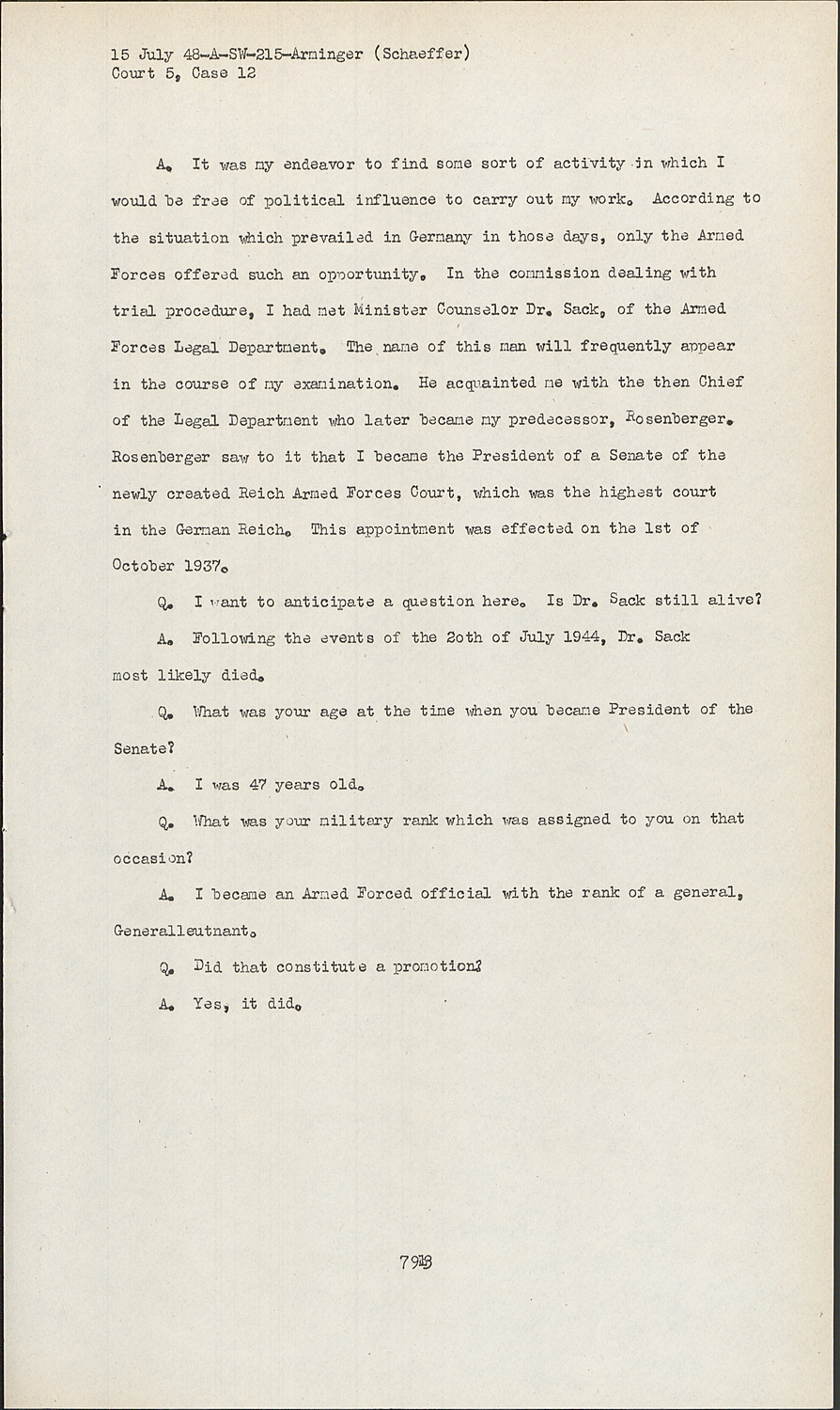
A.It was my endeavor to find some sort of activity in which I would be free of political influence to carry out my work. According to the situation which prevailed in Germany in those days, only the Armed Forces offered such an opportunity. In the commission dealing with trial procedure, I had met Minister Counselor Dr. Sack, of the Armed Forces Legal Department. The name of this man will frequently appear in the course of my examination. He acquainted me with the then Chief of the Legal Department who later became my predecessor, Rosenberger. Rosenberger saw to it that I became the President of a Senate of the newly created Reich Armed Forces Court, which was the highest court in the German Reich. This appointment was effected on the 1st of October 1937.
Q.I want to anticipate a question here. Is Dr. Sack still alive?
A.Following the events of the 20th of July 1944, Dr. Sack most likely died.
Q.What was your age at the time when you became President of the Senate?
A.I was 47 years old.
Q.What was your military rank which was assigned to you on that occasion?
A.I became an Armed Forced official with the rank of a general, Generalleutnant.
Q.Did that constitute a promotion?
A.Yes, it did.
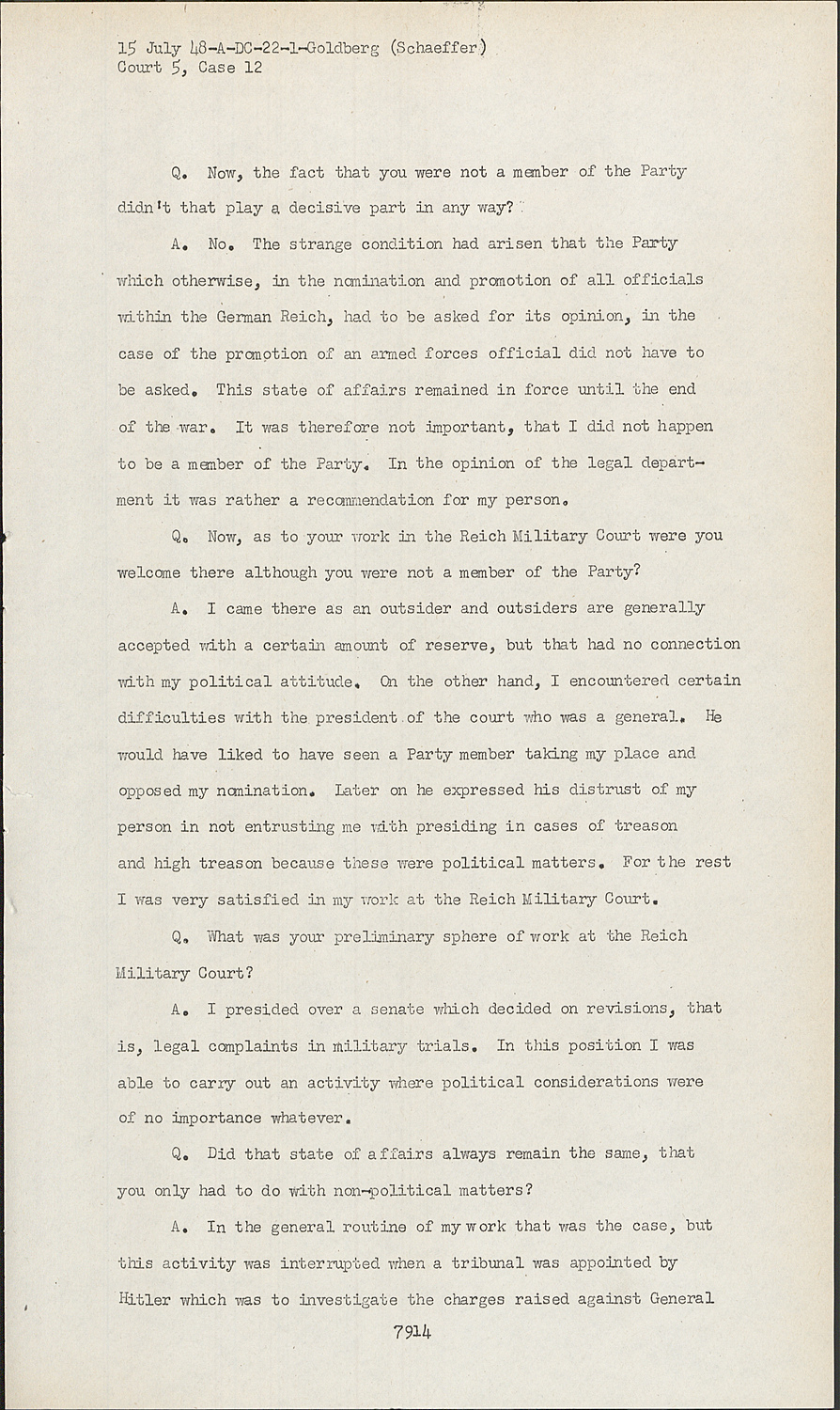
Q.Now, the fact that you were not a member of the Party didn't that play a decisive part in any way?
A.No. The strange condition had arisen that the Party which otherwise, in the nomination and promotion of all officials within the German Reich, had to be asked for its opinion, in the case of the promotion of an armed forces official did not have to be asked. This state of affairs remained in force until the end of the war. It was therefore not important, that I did not happen to be a member of the Party. In the opinion of the legal department it was rather a recommendation for my person.
Q.Now, as to your work in the Reich Military Court were you welcome there although you were not a member of the Party?
A.I came there as an outsider and outsiders are generally accepted with a certain amount of reserve, but that had no connection with my political attitude. On the other hand, I encountered certain difficulties with the president of the court who was a general. He would have liked to have seen a Party member taking my place and opposed my nomination. Later on he expressed his distrust of my person in not entrusting me with presiding in cases of treason and high treason because these were political matters. For the rest I was very satisfied in my work at the Reich Military Court.
Q.What was your preliminary sphere of work at the Reich Military Court?
A.I presided over a senate which decided on revisions, that is, legal complaints in military trials. In this position I was able to carry out an activity where political considerations were of no importance whatever.
Q.Did that state of affairs always remain the same, that you only had to do with non-political matters?
A.In the general routine of my work that was the case, but this activity was interrupted when a tribunal was appointed by Hitler which was to investigate the charges raised against General Freiherr von Fritsch.