"Can we, in consideration of the present political situation, at all afford to advocate a ruthless use of force? Is this not likely to result in another hate-campaign against Germany, in new and more intensive measures of control and a closer coordination of our enemy nations? The ex-enemy powers, quite aware of their present military superiority, will undoubtedly advocate a strictly regulated conduct of war and lay the greatest stress upon observance of all laws of humanity."
The evidence under Counts Two and Three will abundantly demonstrate the poisonous effect of these views on German methods of warfare during the Second World War, and especially their shocking and disastrous impact upon the civilian populations of countries occupied by Germany. For the most part, those cirminal policies were embodied in orders and directives framedat the very top level of the Wehrmacht, usually with direct participation by Warlimont and Lehmann, and, within his fields of work, of Reinecke also. These orders were distributed through regular military channels to the highest field commanders, including all of the other defendants in this case, and were by them passed down to the lower formations, where the orders were actually carried out.
In outlining the charges under Counts Two and Three, it will be most convenient to deal first with the criminal orders and directives which were chiefly intended for the conduct of the war and the German military occupation in Western and Southern Europe, and secondly with those which were especially connected with the war against the Soviet Union. In all theatres of war, of course, these criminal orders and the crimes which resulted therefrom sprang from the same disregard for the laws of war and the dictates of humanity. Likewise, numerous types of war crimes and crimes against humanity were common to all theatres. Nevertheless, there were certain significant distinctions, arising chiefly out of differences in the technique of warfare in the west as compared to the east, andout of the different occupational tactics which the Germansshose to apply as among the various occupied countires.
Finally, after sketching the chief categories of crimes in the west and in the cast, we will outline the Wehrmacht's participation in the German slave labor program, which was a malignant common denominator of German occupation policy in all countries.
Under Count Two of the indictment, the principal charge of war crimes committed in Western and Southern Europe relates to the socalled "Commando" and "Terror Flier" orders. Under Count Three of the Indictment, we will no chiefly concerned with criminal measures taken by the German Army in the occupied countries, involving the execution of hundreds of thousands of hostages, and the secret deportation and execution of many others under the notorious "Night and Fog Decree" (Nacht und Nebel Erlass).
In the autumn of 1942, the Nazis were still at the climax of their power and the Allies in the initial stage of their preparations for the invasion which was to follow two years later. In August of that year, British and Canadian commandos raided Dieppe. It was the first time since Dunkirk that Allied Forces had crossed the channel in strength to probe the German fortifications in the west, as a first rehearsal for the still distant invasion of "Fortress Europe".
In the following months, small groups of Allied soldiers dressed in uniform and carrying weapons openly -- so-called "commando" units -were landed on the continent, mainly in France and Norway, to accomplish special combat missions which consisted predominantly inthe destruction of highly important military installations. The Wehrmacht's answer to these legitimate acts of warfare was the notorious "Commando Order", which directed the summary execution of captured commando troops, even if fully uniformed. When tha defendant Warlimont came to his office at the OKW on 8 October 1942, he found on his desk Hitler's directive for the drafting of the "Commando Order" together with the text of the official German radio announcement of 7 October 1942 which read as follows:
All terror and sabotage troops of the British and their accomplices who do not act like soldiers but like bandits have in future to be treated as such by the Ger man troops, and they must be slaughtered ruthlessly in combat wherever they turn up.
Immediately after receipt of the text of the radio announcement, Warlimont gave the following instructions with respect to its enforcement :
1) Transportation into order-form.
2) ....this order too, must - in accordance with the Legal Department and counter-intelligence - be very carefully considered and correctly worded.
Distribu tion only as far as the Armies, from there only orally.
To be destroyed after reading.....
Court No. V-A, Case No. XII.
By 9 October, the defendant Lehmann had completed a draft of the order, which was transmitted by Warlimont to the OKW Intelligence Department under Admiral Canaris for his comments. Canaris voiced strong objection; his words deserve to be quoted because they show not only that the utter illegality of the Commando Order was well known to those who prepared and executed it, but also that some of Hitler's military leaders dared to voice their opposition when they were so minded. In a memorandum received by Warlimont, Lehmann and Reinecke, Canaris stated:
....Sabotage units in uniform are soldiers and have the right to be treated as PWs.... Reprisals on PWs, according to the agreement ratified in 1934 are absolutely not permitted.
This respect for international law was not unique to Canaris in the days when the Germans were themselves making widespread use of paratroops for sabotage purposes. As early as June 1938, the defendand Sperrle had stated in a plan for the employment of his Air Fleet 3 against France in case of her intervention against the seizure of Czechoslovakia that:
It is intended to use parachute sabotage troops....
for the purpose of destroying suitable targets, against which bombing raids cannot guarantee decisive success.
And in June 1940, the OKH advised all Army Groups and Armies that:
"German parachutists are elements of the German Wehr macht ("Regular Troops"). They are legal combattants and they carry out justified acts of warfare.
Where they are committed (whether at the front or behind the enemy lines or way in the rear) does not affect their quality as com battants.
Their position as justified by martial law re mains unchanged."
But the accepted German view underwent a marked reversal when the shoe was on the other foot. Lehmann put forward the following Court No. V-A, Case No. XII.
pseudo-legal justification as an excuse for murdering commandos:
"Whoever performs acts of sabotage as a soldier with the idaa in mind to surrender without a fight after the act is successfully completed does not conduct himself as an honorable warrior.
He misusas the rights of article 23c, Hague Convention since such methods of warfare had not been thought of at the time this article was formulated."
On 17 October 1942, Jodi submitted the final draft of the "Commando Order", prepared by Warlimont and Lehmann, to Hitler and on the following day it was issued, stating in part:
....From now on all enemies on so-called commando missions in Europe or Africa challenged by German troops, even if they are to all appearance soldiers in uniform or demolition troops, whether armed, in battle, or in flight, are to be slaughtered to the last man.
It does not make any difference whether they are landed from ships and airplanes for the actions or whether they are dropped by parachute.
Even if these individuals, when found, should apparently be prepared to give themselves up, no pardon is to be granted them on principle.
...
If individual members of such commandos, such as agents, saboteurs, etc.
, fall into the hands of the Armed Forces by some other means, through the police in occupied territories, for instance, they are to be handed over immediately to the SD.
...
Because commando operations were most prevalent in the western and southern theatres of war, it was in these theatres that the order was of most importance. It was, however, distributed by the OKW to all three branches of the service -- Army, Navy and Air Court No. V-A, Case No. XII.
Fores -- and to all theatres under the OKW, including Norway, Africa, the Balkans, the Mediterranean, and France and the Low Countries. It was passed to Himmler's SS and Police Force, and the OKH sent the order down to all army groups and armies in the east. From them it went down to the divisions and lower units. Each and every defendant in the dock -- except Leeb, who had retired some months earlier -- was familiar with the Commando Order, and each of them, like every other German officer, knew perfectly well that it required the commission of murder. Pursuant to this order, British and Norwegian commandos were executed in Norway in 1942 and 1943, American commandos were shot in Italy in 1944, and other Allied soldiers were murdered in these countries and elsewhere.
The first executions of captured commandos occurred not more than a fortnight after the order was issued. On 21 November 1942, Warlimont received the following report from Air Fleet 5 in Norway:
Following supplementary report is made about landing of a British freight glider at Hegers in the night of November 11:
a) No firing on the part of German defense.
b) The towing plane (Wellington) has crashed after touching the ground, 7-man crew dead.
The attached freight glider also crashed, of the 17-man crew, 14 alive.
Indisputably a sabotage force.
Fuehrer order has been carried out.
And so the reports came in -- British, American, French, Norwegian, Greek commandos slaughtered in battle, slaughtered in captivity; the laconic reports tell a story of foul murder. A teletype signed by Warlimont to the Commander in Chief Southeast directed:
....The English radio operator Carpenter and the Greek sailor Lisgaris captured at Alimnia are no longer needed and are released for special treat ment according to Fuehrer Order.
Court No. V-A, Case No. XII.
"Special treatment" is a German euphemism for murder; another is "dealt with". On 15 December 1942, the following was circulated in 320 copies over the signature of Fieldmarshal von Rundstedt?
We must count to an increased extent on various attempts by the enemy to damage our shipping lanes and other important military objects.
Proof of that is the landing of English saboteurs from an English submarine at the mouth of the Gironde River on 8 December 1942.
Even though one gang was caught and dealt with, further sabotage troops, nevertheless have reached Bordeaux and succeeded in damaging valuable freighters by explosives with attached magnets, on 12 December 1942.
Yes, those British commandos were "dealt with"; they were shot down in cold blood after capture and interrogation. Their relatives did not even have their anxiety ended by a death report. In an interpretation of the Commando Order given to the OKW Department for Prisoner of War Affairs under Reinacke, Warlimont said:
The WFST /Jodl's and Warlimont's section of OKW/
considers it to be out of the question hereafter, that saboteurs should be treated as soldiers, in accordance with the Fuehrer's orders, which would be the case if their death should be reported to the enemy-nation in accordance with the regulations valid for fallen enemy soldiers.
Thus the WFST is of the opinion that no reports of deaths should be made.
Reinecke's Prisoner of War Department received reports on the execution of commandos and on occasion, when a commando was committed to a prisoner of war camp by mistake, he was later turned over to the SD for execution. For example, Stalag 7a, under the jurisdiction of Reinecke, was directed to surrender a British commando to the SD on Court No. V-A, Case No. XII.
16 April 1944.
On 22June 1944, Warlimont gave an enlightening explanation of the "German concept of usage and customs of warfare" in a memorandum to the Legal Department under Lehmann:
The Fuehrer order is to be applied even if the enemy employs only one person for a task.
Therefore, it does not make any difference if several persons or a single person take part in a commando operation.
The reasons for the special treatment of participants in a commando operation is that such operations do not correspond to the German concept of usage and customs of warfare.
Nor did the murder of Allied commandos cease with the invasion of France by Anglo-American forces on 22 June 1944. On 23 June, Rundstedt requested OKW to clarify the applicability of the order in view of the large-scale landing. In a reply the following day, Warlimont directed that the Commando Order should be enforced against all paratroopers found outside of the immediate combat zone. Daily reports on the number "liquidated" were also required. This order was sent through military channels on 29 June to the defendant Blaskowitz, then Commander-inChief of Army Group G in Southern France. He in turn passed the order down to units subordinated to him, including the First Army, whence it reached the LXXX Corps under the First Army. The order passed down by Blaskowitz explicitly required all executions of commandos to be reported through Army channels. A few days later, on 3 July 1944, thirty odd British and American commandos were captured by troops of the LXXX Corps and summarily executed.
When any Allied method of warfare started to prove effective against the Wehrmacht, the usual first reaction of its leaders was to declare such methods of warfare criminal and threaten with death the enemy troops engaged therein. A year after the successful commando raids aroused the German wrath, the growing strength of the Allied Air Forces began to be acutely felt. In view of the wondrous shortness of Court No. V-A, Case No. XII.
the German memory, we will do well to remind ourselves that in the field of aerial attacks against enemy cities, the Allies were imitators, not originators; Warsaw, Rotterdam, London and other cities were flattened or badly scarred long before any German city suffered severely. Nonetheless, by the fall of 1943 Allied attacks in Germany aroused indignant screeches from Goebbels and Himmler. The former used the press and other means to incite the German civilian population to lynch American and British fliers who had been forced to parachute from disabled plants over Germany, and Himmler directed the German police not to protect Allied fliers from these lynching-bees.
As was often the case, the German soldier was more chivalrous when acting on his own initiative than when following the orders of his highest superiors. On several occasions Wehrmacht troops protected Allied fliers from civilian attacks, as indeed the laws of war required, for the airmen were unarmed, endeavored to surrender, and were entitled to the status of prisoners of war.
in connection with this decree, that the evidence is quite overwhelming of a systematic rule of violence, brutality and terror." The circumstances surrounding the issuance and enforcement of the Night and Fog decree were the subject of extensive testimony before Military Tribunal No. III in Case No. 3 (United States vs. Alstoetter, et al). That Tribunal stated, in its Judgment:
"The Night and Fog Decree (Nacht und Nebel Erlass) arose as the plan or scheme of Hitler to combat so-called resistance movements in occupied territories.
Its enforcement brought about a systematic rule of violence, brutality, outrage, and terror against the civilian populations of territories overrun and occupied by the Nazi armed forces.
2 . . . . . .".... civilians of occupied territories accused of alleged crimes in resistance activities against German occupying forces were spirited away for secret trial by special courts of the Ministry of Justice within the Reich; .... the victim's whereabouts, trial, and subsequent disposition were Kept completely secret, thus serving the dual purpose of terrorizing the victim's relatives and associates and barring recourse to evidence, witnesses, or counsel for defense.
If the accused were acquitted, or if convicted, after serving his sentence, he was handed over to the Gestapo for "protective custody" for the duration of the war.
These proceedings resulted in the torture, ill treatment, and murder of thousands of persons.
3 On 12 December 1941 the OKW, through Keitel, issued the Night and Fog Decree, which had been prepared by the defendant Lehmann in the OKW Legal Department. It provided in part as follows.
"I. In case of criminal acts committed by non German civilians and which are directed against the Reich or the occupation power endangering their safety or striking power, the death penalty is applicable in principle.
"II. Criminal acts described in paragraph I will, in principle, be tried in the occupied territories only when it appears probable that death sentences 1. Vol.
1, Trial of the Major War Criminals, p.232 2. U.S. vs. Alstoetter, et al, mimeographed transcript,p.10715 3. U.S. vs. Alstoetter, et al, mimeographed transcript,p.10714 are going to be passed against the offenders, or at least the main offenders, and if the trial and the execution of the death sentence can be carried out without delay.
In other cases the offenders, or at least the main offenders, are to be taken to Germany."
In a covering letter, also written by the OKW Legal Department, the purpose of the decree was given:
Efficient and enduring intimidation can only be achieved, either by capital punishment or by measures by which the relatives of the criminal and the population do not know the fate of the criminal.
This aim is achieved when the criminal is transferred to Germany.
A copy of this order, which was made effective in France, Holland, Norway, Bohemia and Moravia, and the Ukraine, was received by the defendants Warlimont and Reinecke.
About two months prior to the issuance of this decree, the defendant Lehmann had been informed by Keitel, that Hitler desired new means to be found for combatting the growing resistance movement in France. Lehmann was a guiding spirit in the formulation, issuance, and execution of the Night and Fog decree. Some of its unfortunate victims were tried in secret court sessions, and in many instances no indictment was served. But many victims were not afforded even this miserable semblance of a trial; they were simply shipped directly to a concentration camp. "NN" prisoners, as they were called, were held in Mauthausen, Auschwitz, Flossenburg, Dachau, Ravensbrueck, Buchenwald and numerous other concentration camps. There they were starved, tortured and killed. Those in charge of the camps were instructed that absolute secrecy of detention was to be observed and the prisoners were denied all means of communication with the outer world.
Nor was there any deliverance for the wretched victims after trial and acquittal or after conviction and completion Such soldierly conduct could not be tolerated by OKW; on 9 July 1944 an order prepared by Warlimont's section was issued by OKW which directed that Wehrmacht troops should not protect so-called Ango-American "terror-fliers" against action by the civilian population.
This order stated in part:
"It has happened recently that soldiers have turned against the population to protect Anglo-American terror flyers and have thereby aroused their justified indignation.
I request to make sure speedily that this will be prevented ...."No German fellow country-man can be capable of understanding such conduct of our armed forces.
Also, the population of the occupied territories is not to be prevented from resorting to self-help in justified indignation at Ango-erican terror flyers.
..." This order, together with a similar order by Hitler and murderous incitement by Goebbels through the press, led to the slaughter of numerous Allied airmen in flagrant violation of the rules of war.
Mr. Barbour will continue with the reading.
3. Count Three: Civilians -- "Night and Fog" Decree
MR. BARBOUR:May it please the Tribunal:
The Wehrmacht's policies and practices in governing the occupied countries were characterized by a blind and unimaginative faith in the use of ruthless force ana methods of intimidation and terrorism. This policy was not only brutal and criminal; it was senseless and bound to end in failure. Catastrophe was the price that the leaders of the Third Reich had to pay for their arrogant disregard of law and for their failure to realize that in the end stupid violence is a eapon which recoils upon its user. The socalled "Night and Fog" ("Nacht und Nebel") decree was the foundation of a system which embodied these principles to perfection. It was the means through which the Wehrmacht sought to "pacify" the countries of Western Europe. The IMT found, of their sentence.
Thus, on 6 November 1943, Lehmann's Legal department issued the following directive over Keitel's signature:
"Perpetrators who have been acquitted in the course of judicial proceedings by the army or against whom proceedings have been suspended or who have fully served a term of imprisonment during the war imposed by an army court, are to be handed over to the Secret State Police for detention for the duration of the war."
As the war continued, the "Night and Fog" decree was supplemented by the so-called "Terror and Sabotage" decrees. On 1 July 1944, the defendant Warlimont informed Lehmann that "because of incidents that have occured at Copenhagen, the Fuehrer has ordered an immediate cessation of court martial proceedings against members of the civilian population in the occupied territories." Thereafter, by decrees in the formulation of which both Lehmann and Warlimont participated, civilians charged with acts of violence were to be summarily shot without trial if apprehended "in the act", and, if arrested later, were to be turned over to the Security Police, a delivery tantamount to execution.
The defendant Lehmann can hardly tell us that he was unaware of the most goulish aspects of this murderous business. On 26 April 1944, his department received the following communication:
"The Prosecutor-General in Cattowice has drawn attention to the fact that the corpses of NN Prisoners (Night and Fog prisoners) who were sentenced to death by the Special Court in Oppeln and who were executed, are turned by the Gestapo.
He expresses his doubts whether, because of the large number, of cremations performed in the district of Cattowice on account of the numerous deaths occurring in Concentration Camp Auschwitz and on account of the numerous executions of Polish members of bands, the separation of the ashes of the individual dead is guaranteed."
4. Count Three: Civilians -- Hostages and Reprisals.
We have seen in the previous section the criminal measures devised by the Wehrmacht for the imprisonment, deportation or execution, without trial or with only the form of a trial, of persons suspected of hostile action against the German authorities. The other principal method adopted by the German occupational authorities was equally savage and senseless; it consisted in the indiscriminate murder of many thousands of innocent civilians -- murder committed under the pretext of calling such persons "hostages" -- in the absurd belief that the civilian population would be "pacified" by such measures. In fact, as could have been foreseen, such wholesale executions served rather to arouse and enrage the inhabitants, who thus saw thousands of their friends and relatives executed, even though they had not lifted a finger against the occupying authorities.
While terroristic measures of this kind were not confined to any particular occupied country, they were applied with particular severity in Western Europe and in the Balkans. Particularly in Greece and Yugoslavia, fantastically high execution ratios -- ranging up to the execution of one hundred hostages for the killing of one German -- were applied. During the fall of 1941, such ratios were adopted as standard German Army policy. On 16 September 1941, an OKW order, prepared in Warlimont's department and initialed by him, called attention to disturbances which had occurred in the occupied countries and stated:
"a. It should be inferred in every case of resistance to the German occupying forces, no matter what the individual circumstances, that it is of Communist origin.
"b. In order to nip those machinations in the bud the most drastic measures should be taken immediately and on the first indication, so that the authority of the occupying forces may be maintained and further spreading prevented.
In this connection it should be remembered that a human life in the countries concerned frequently counts for nothing, and a deterrent effect can be attained only by unusual severity.
The death penalty for 50-100 Communists should generally be regarded in these cases as suitable atonement for one German soldier s death.
The way in which sentence is carried out should still further increase the deterrent effect."
While this order laid great stress on Communist responsibility for these uprisings, it was by no means intended that the hostages executed should in all cases be Communists. Quite the contrary. On 28 September 1941, another OKW order -again emanating from Warlimont's department -- laid down the following:
"Because of attacks on members of the Wehrmacht which have taken place lately in the occupied territories, it is pointed out that it is opportune for the Military Commanders to have always at their disposal a number of hostages of different political persuasions, i.e.,
l) Nationalists,
2) Democratic Middle Class,
3) Communists "It is of importance that among these are leading personalities or members of their families.
Their names are to be published.
In case of an attack, hostages of the group corresponding to that to which the culprit belongs are to be shot."
The execution of hostages in Greece and Yugoslavia is one of the major charges against the defendants in Case No. 7, now pending before Military Tribunal No. 5. In the present case, we will present evidence of similar crimes in other occupied countries, including France. For example, during July and August 1944, numerous hostages were executed in the area of Army Group G, commanded by the defendant Blaskowitz. A month earlier, despite the fact that units of the French resistance forces fulfilled all the conditions for recognition as properly constituted armed forces, and had been proclaimed part of the Allied Forces, Blaskowitz issued to his subordinate units an order that "members of the French resistance movement are to be treated as guerillas."
That, of course, meant immediate execution upon capture.
COURT NO. V-A, CASE NO. XII.
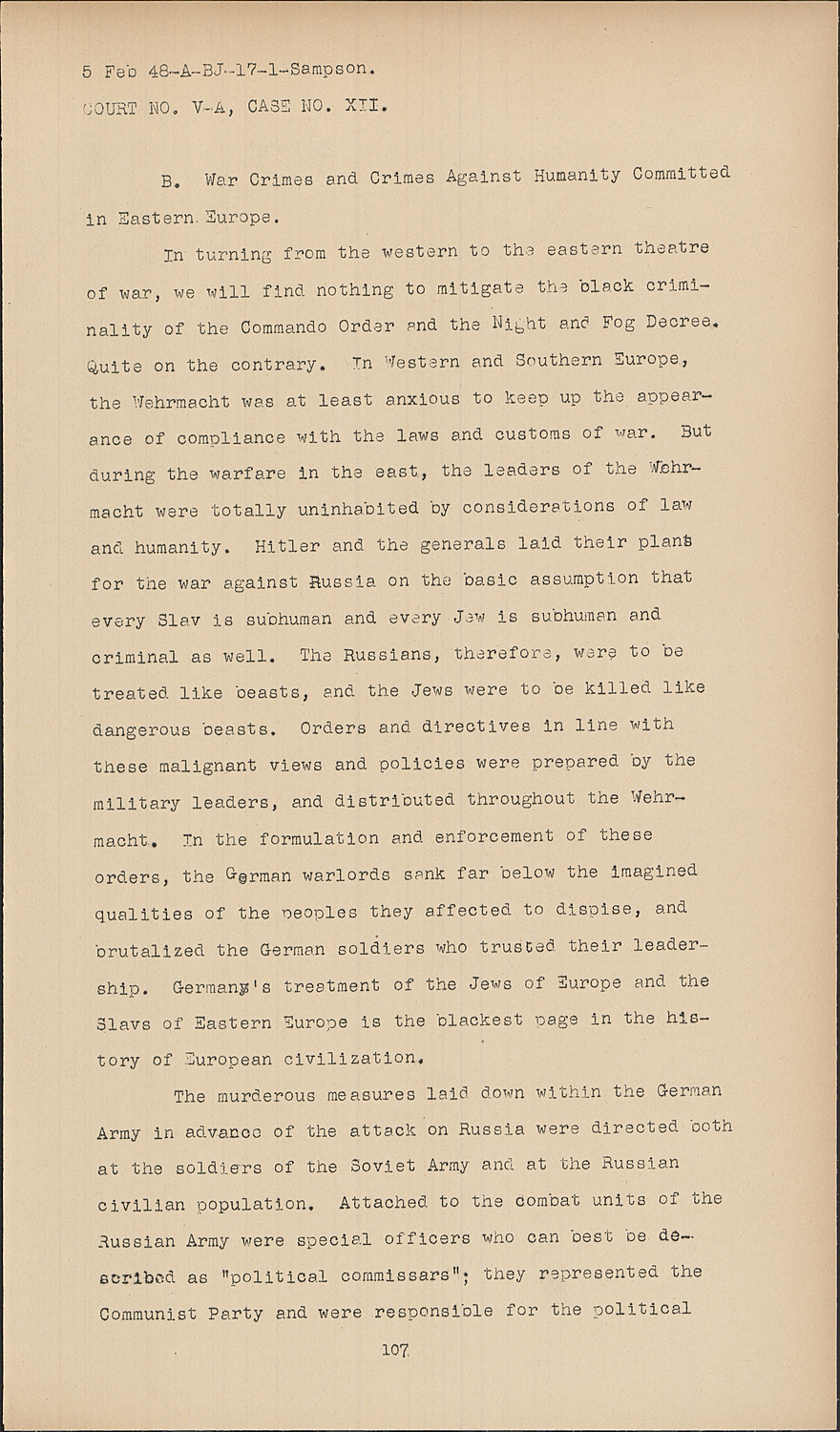
B.War Crimes and Crimes Against Humanity Committed in Eastern Europe.
In turning from the western to the eastern theatre of war, we will find nothing to mitigate the black criminality of the Commando Order and the Night anc Fog Decree. Quite on the contrary. In Western and Southern Europe, the Wehrmacht was at least anxious to keep up the appearance of compliance with the laws and customs of war. But during the warfare in the east, the leaders of the Wehrmacht were totally uninhabited by considerations of law and humanity. Hitler and the generals laid their plans for the war against Russia on the basic assumption that every Slav is subhuman and every Jaw is subhuman and criminal as well. The Russians, therefore, were to be treated like beasts, and the Jews were to be killed like dangerous beasts. Orders and directives in line with these malignant views and policies were prepared by the military leaders, and distributed throughout the Wehrmacht. In the formulation and enforcement of these orders, the German warlords sank far below the imagined qualities of the peoples they affected to dispise, and brutalized the German soldiers who trusted their leadership. Germany's treatment of the Jews of Europe and the Slavs of Eastern Europe is the blackest page in the history of European civilization.
The murderous measures laid down within the German Army in advance of the attack on Russia were directed both at the soldiers of the Soviet Army and at the Russian civilian population. Attached to the combat units of the Russian Army were special officers who can best be described as "political commissars"; they represented the Communist Party and were responsible for the political indoctrination and morale of the Russian troops.
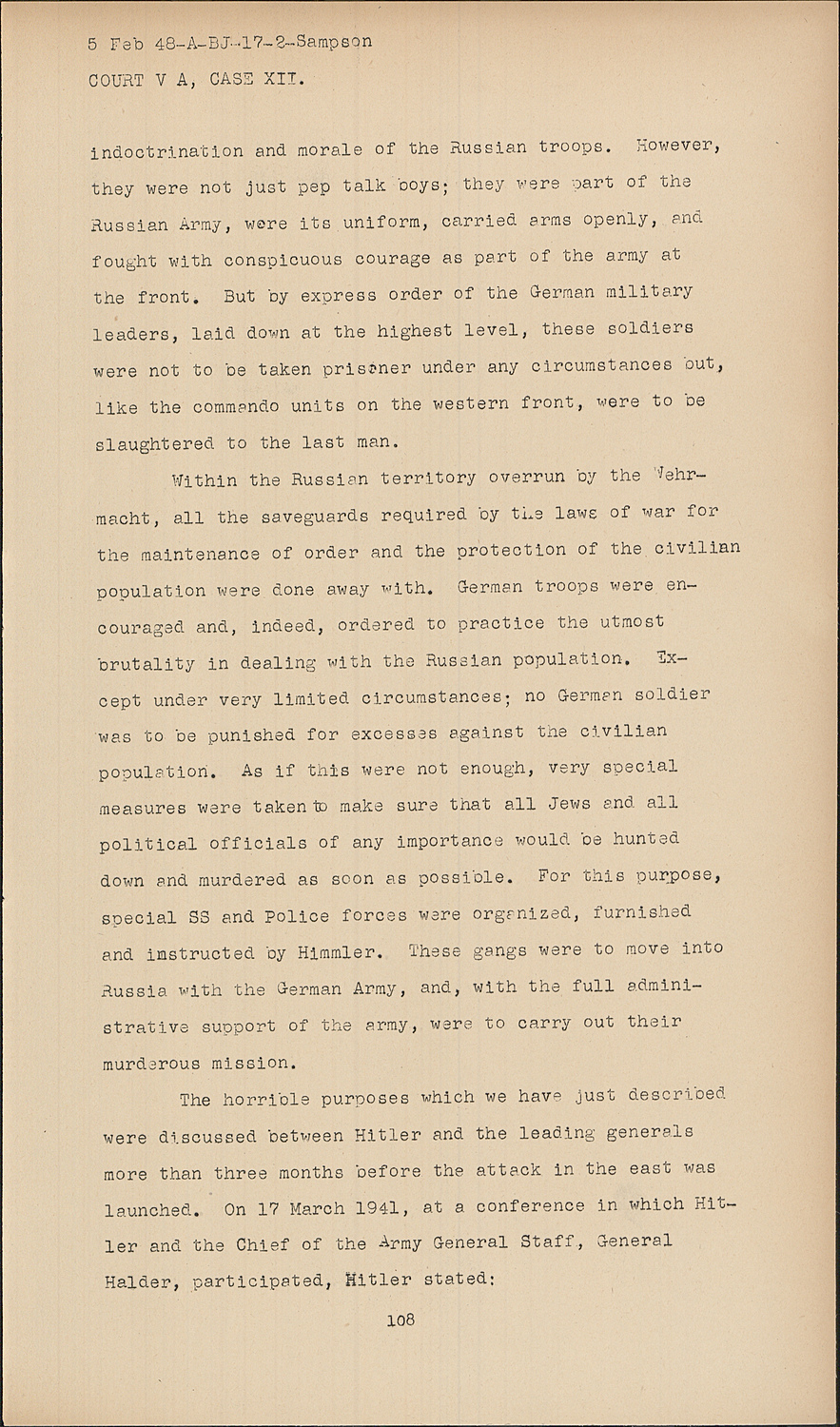
However, they were not just pep talk boys; they were part of the Russian Army, were its uniform, carried arms openly, and fought with conspicuous courage as part of the army at the front. But by express order of the German military leaders, laid down at the highest level, these soldiers were not to be taken prisoner under any circumstances out, like the commando units on the western front, were to be slaughtered to the last man.
Within the Russian territory overrun by the Wehrmacht, all the saveguards required by the laws of war for the maintenance of order and the protection of the civilian population were done away with. German troops were encouraged and, indeed, ordered to practice the utmost brutality in dealing with the Russian population. Except under very limited circumstances; no German soldier was to be punished for excesses against the civilian population. As if this were not enough, very special measures were taken to make sure that all Jews and all political officials of any importance would be hunted down and murdered as soon as possible. For this purpose, special SS and Police forces were organized, furnished and instructed by Himmler. These gangs were to move into Russia with the German Army, and, with the full administrative support of the army, were to carry out their murderous mission.
The horrible purposes which we have just described were discussed between Hitler and the leading generals more than three months before the attack in the east was launched. On 17 March 1941, at a conference in which Hitler and the Chief of the Army General Staff, General Halder, participated, Hitler stated:
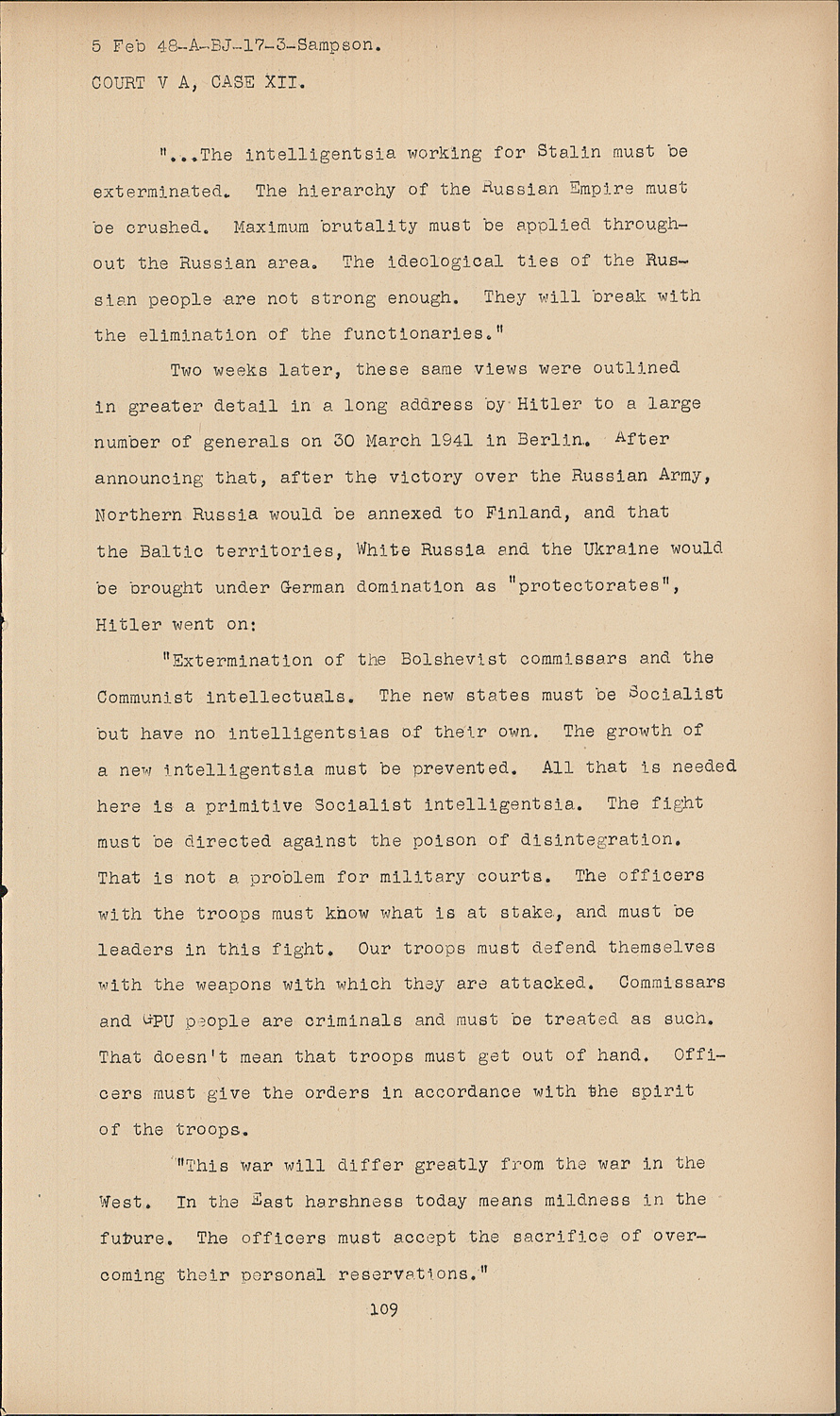
"...The intelligentsia working for Stalin must be exterminated. The hierarchy of the Russian Empire must be crushed. Maximum brutality must be applied throughout the Russian area. The ideological ties of the Russian people are not strong enough. They will break with the elimination of the functionaries."
Two weeks later, these same views were outlined in greater detail in a long address by Hitler to a large number of generals on 30 March 1941 in Berlin. After announcing that, after the victory over the Russian Army, Northern Russia would be annexed to Finland, and that the Baltic territories, White Russia and the Ukraine would be brought under German domination as "protectorates", Hitler went on;
"Extermination of the Bolshevist commissars and the Communist intellectuals. The new states must be Socialist but have no intelligentsias of their own. The growth of a new intelligentsia must be prevented. All that is needed here is a primitive Socialist intelligentsia. The fight must be directed against the poison of disintegration. That is not a problem for military courts. The officers with the troops must know what is at stake, and must be leaders in this fight. Our troops must defend themselves with the weapons with which they are attacked. Commissars and GPU people are criminals and must be treated as such. That doesn't mean that troops must get out of hand. Officers must give the orders in accordance with the spirit of the troops.
"This war will differ greatly from the war in the West. In the East harshness today means mildness in the future. The officers must accept the sacrifice of overcoming their personal reservations."
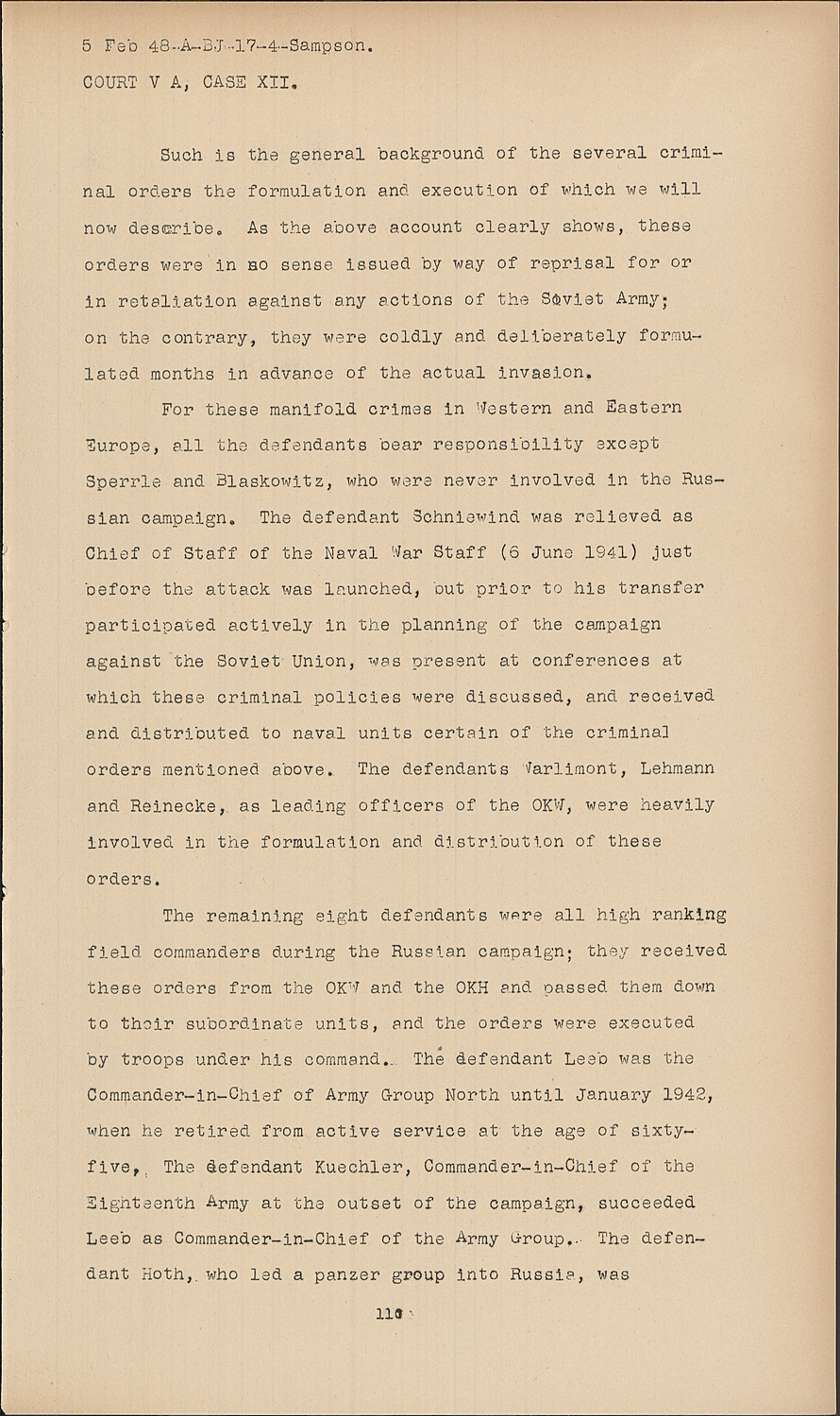
Such is the general background of the several criminal orders the formulation and execution of which we will now describe. As the above account clearly shows, these orders were in no sense issued by way of reprisal for or in retaliation against any actions of the Soviet Army; on the contrary, they were coldly and deliberately formulated months in advance of the actual invasion.
For these manifold crimes in Western and Eastern Europe, all the defendants bear responsibility except Sperrle and Blaskowitz, who were never involved in the Russian campaign. The defendant Schniewind was relieved as Chief of Staff of the Naval War Staff (6 June 1941) just before the attack was launched, but prior to his transfer participated actively in the planning of the campaign against the Soviet Union, was present at conferences at which these criminal policies were discussed, and received and distributed to naval units certain of the criminal orders mentioned above. The defendants Warlimont, Lehmann and Reinecke, as leading officers of the OKW, were heavily involved in the formulation and distribution of these orders.
The remaining eight defendants were all high ranking field commanders during the Russian campaign; they received these orders from the OKW and the OKH and passed them down to their subordinate units, and the orders were executed by troops under his command. The defendant Leeb was the Commander-in-Chief of Army Group North until January 1942, when he retired from active service at the age of sixtyfive, The defendant Kuechler, Commander-in-Chief of the Eighteenth Army at the outset of the campaign, succeeded Leeb as Commander-in-Chief of the Army Group. The defendant Hoth, who led a panzer group into Russia, was promoted to the command of the Seventeenth Army in Rundstedt's Army Group South in October, 1941 and in May 1942 was transferred to the command of the Fourth Panzer Army.