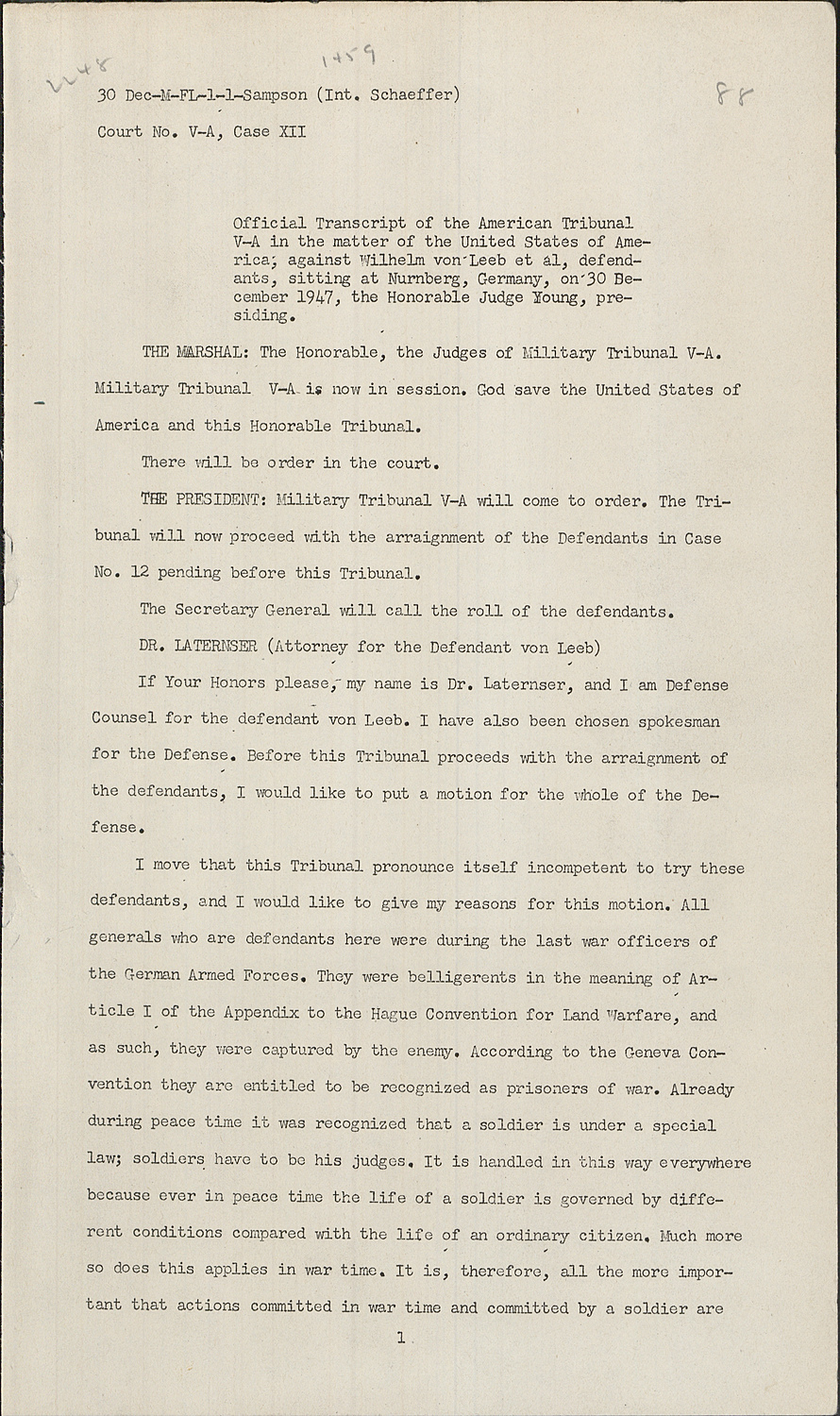
Official Transcript of the American Tribunal V-A in the matter of the United States of Ame rica; against Wilhelm von Leeb et al, defend ants, sitting at Nurnberg, Germany, on 30 De cember 1947, the Honorable Judge Young, pre siding.
THE MARSHAL:The Honorable, the Judges of Military Tribunal V-A. Military Tribunal V-A is now in session. God save the United States of America and this Honorable Tribunal.
There will be order in the court.
THE PRESIDENT:Military Tribunal V-A will come to order. The Tribunal will now proceed with the arraignment of the Defendants in Case No. 12 pending before this Tribunal.
The Secretary General will call the roll of the defendants.
DR.LATERMSER (Attorney for the Defendant von Leeb) If Your Honors please, my name is Dr. Laternser, and I am Defense Counsel for the defendant von Leeb.
I have also been chosen spokesman for the Defense. Before this Tribunal proceeds with the arraignment of the defendants, I would like to put a motion for the whole of the Defense.
I move that this Tribunal pronounce itself incompetent to try these defendants, and I would like to give my reasons for this motion. All generals who are defendants here were during the last war officers of the German Armed Forces. They were belligerents in the meaning of Article I of the Appendix to the Hague Convention for Land Warfare, and as such, they were captured by the enemy. According to the Geneva Convention they are entitled to be recognized as prisoners of war. Already during peace time it was recognized that a soldier is under a special law; soldiers have to be his judges. It is handled in this way everywhere because ever in peace time the life of a soldier is governed by different conditions compared with the life of an ordinary citizen. Much more so does this applies in war time. It is, therefore, all the more important that actions committed in war time and committed by a soldier are judged by a court consisting of soldiers.
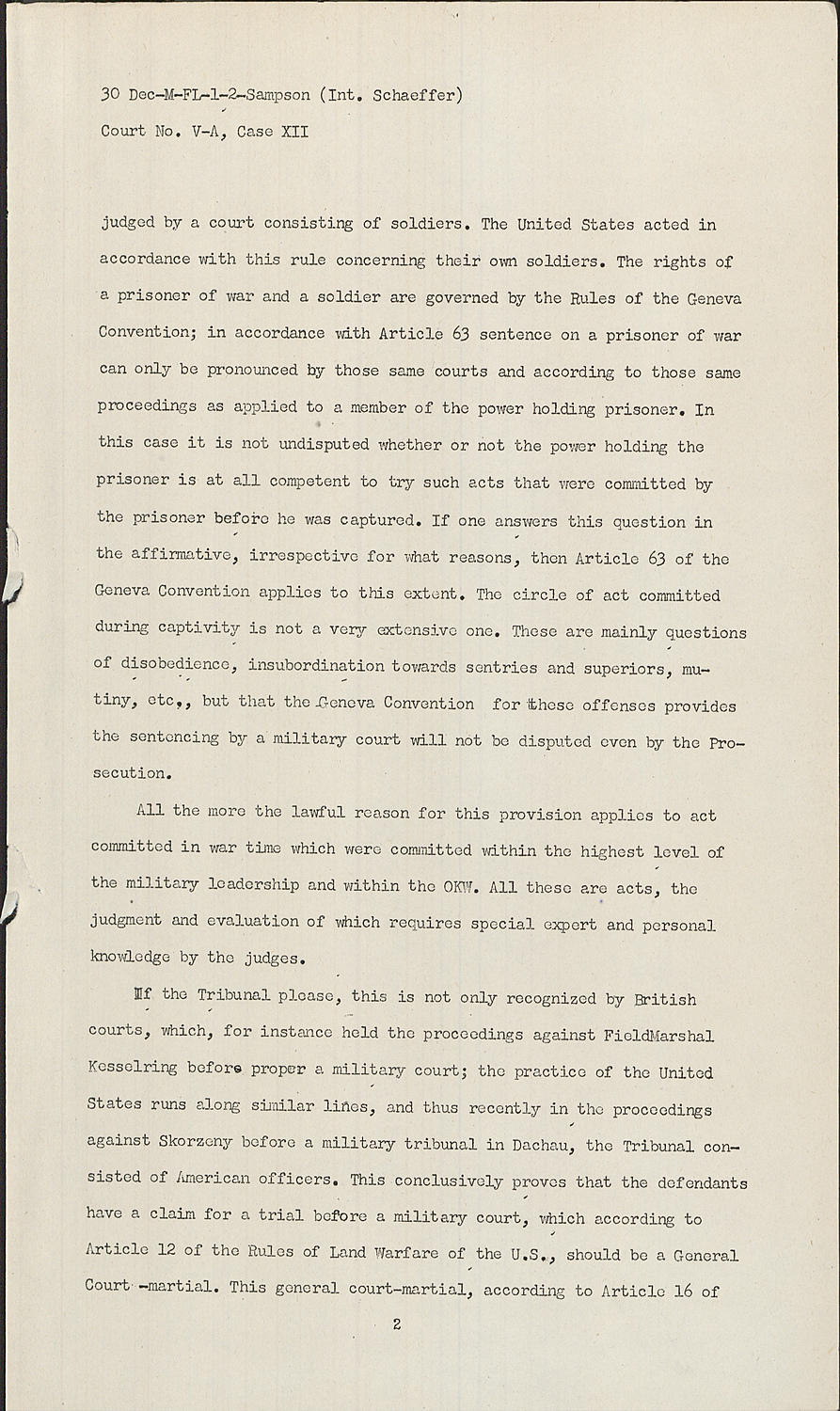
The United States acted in accordance with this rule concerning their own soldiers. The rights of a prisoner of war and a soldier are governed by the Rules of the Geneva Convention; in accordance with Article 63 sentence on a prisoner of war can only be pronounced by those same courts and according to those same proceedings as applied to a member of the power holding prisoner. In this case it is not undisputed whether or not the power holding the prisoner is at all competent to try such acts that were committed by the prisoner before he was captured. If one answers this question in the affirmative, irrespective for what reasons, then Article 63 of the Geneva Convention applies to this extent. The circle of act committed during captivity is not a very extensive one. These are mainly questions of disobedience, insubordination towards sentries and superiors, mutiny, etc., but that the Geneva Convention for these offenses provides the sentencing by a military court will not be disputed even by the Prosecution.
All the more the lawful reason for this provision applies to act committed in war time which were committed within the highest level of the military leadership and within the OKW. All these are acts, the judgment and evaluation of which requires special expert and personal knowledge by the judges.
If the Tribunal please, this is not only recognized by British courts, which, for instance held the proceedings against Field Marshal Kesselring before proper a military court; the practice of the United States runs along similar lines, and thus recently in the proceedings against Skorzeny before a military tribunal in Dachau, the Tribunal consisted of American officers. This conclusively proves that the defendants have a claim for a trial before a military court, which according to Article 12 of the Rules of Land Warfare of the U.S., should be a General Court -martial. This general court-martial, according to Article 16 of the same Rules, has to consist of officers of at least the same rank.
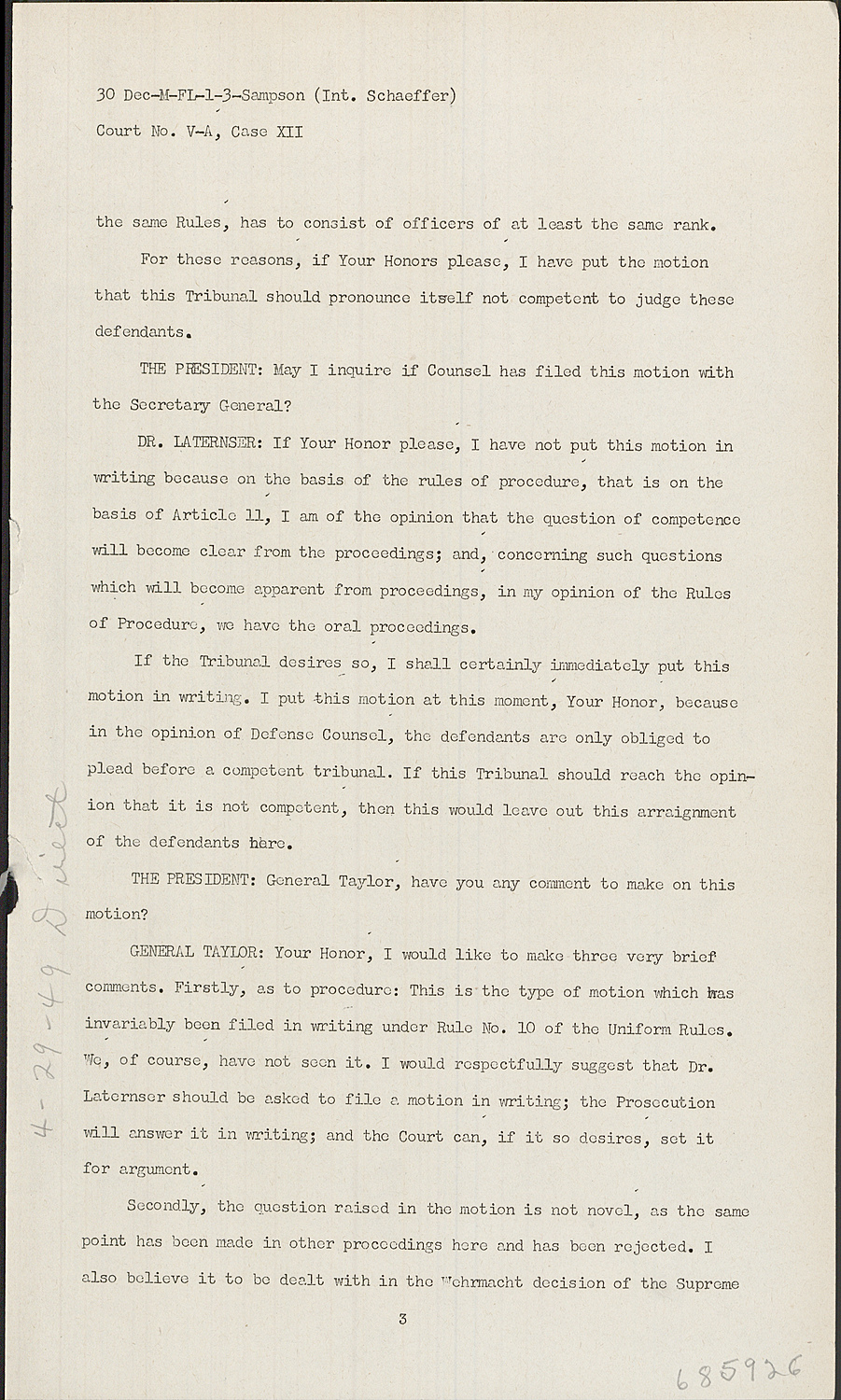
For these reasons, if Your Honors please, I have put the motion that this Tribunal should pronounce itself not competent to judge these defendants.
THE PRESIDENT:May I inquire if Counsel has filed this motion with the Secretary General?
DR. LATERNSER:If Your Honor please, I have not put this motion in writing because on the basis of the rules of procedure, that is on the basis of Article 11, I am of the opinion that the question of competence will become clear from the proceedings; and, concerning such questions which will become apparent from proceedings, in my opinion of the Rules of Procedure, we have the oral proceedings.
If the Tribunal desires so, I shall certainly immediately put this motion in writing. I put this motion at this moment, Your Honor, because in the opinion of Defense Counsel, the defendants are only obliged to plead before a competent tribunal. If this Tribunal should reach the opinion that it is not competent, then this would leave out this arraignment of the defendants here.
THE PRESIDENT:General Taylor, have you any comment to make on this motion?
GENERAL TAYLOR:Your Honor, I would like to make three very brief comments. Firstly, as to procedure: This is the type of motion which has invariably been filed in writing under Rule No. 10 of the Uniform Rules. We, of course, have not seen it. I would respectfully suggest that Dr. Laternser should be asked to file a motion in writing; the Prosecution will answer it in writing; and the Court can, if it so desires, set it for argument.
Secondly, the question raised in the motion is not novel, as the same point has been made in other proceedings here and has been rejected. I also believe it to be dealt with in the Wehrmacht decision of the Supreme Court, all of which matters we can cover in our answer to the motion.
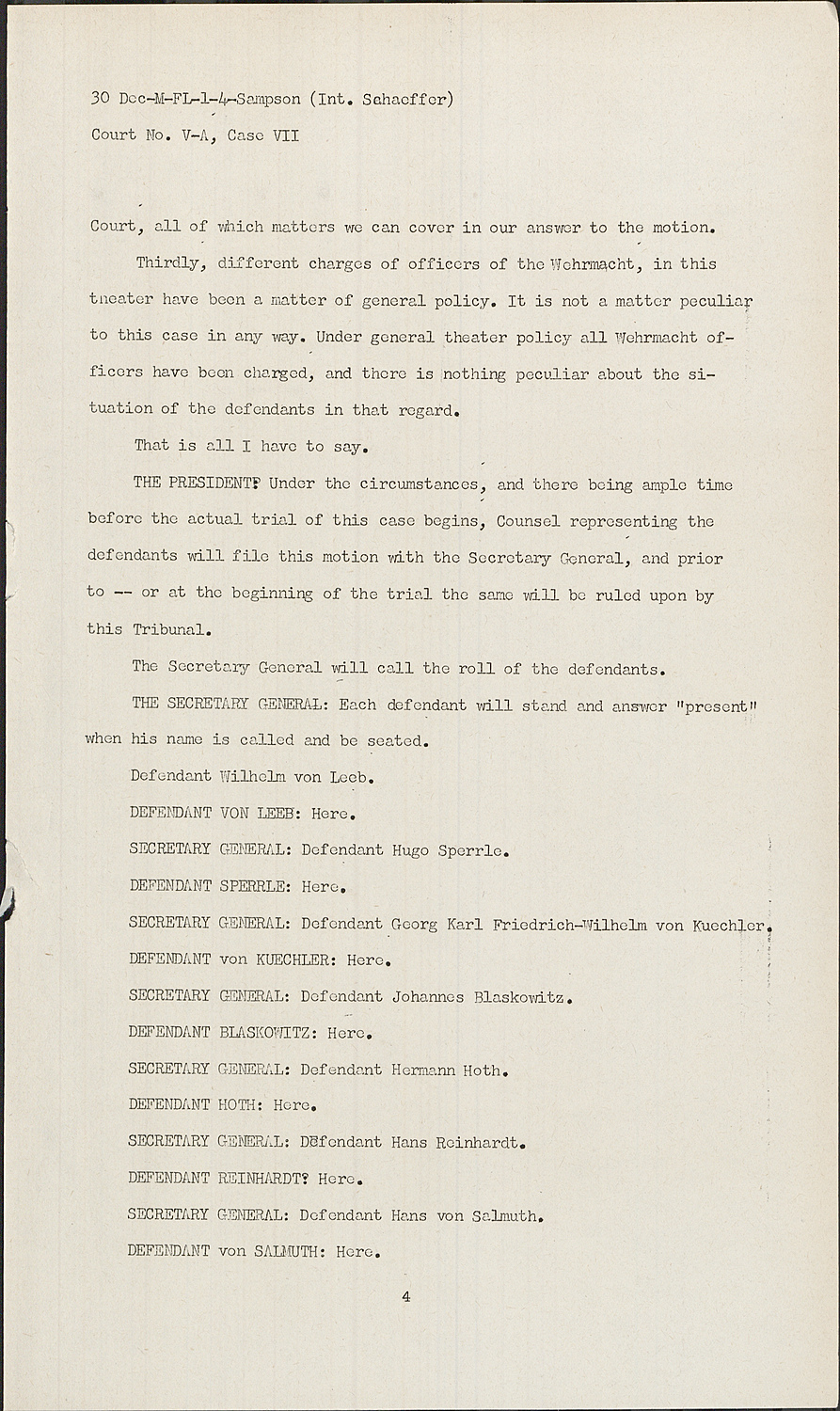
Thirdly, different charges of officers of the Wehrmacht, in this theater have been a matter of general policy. It is not a matter peculiar to this case in any way. Under general theater policy all Wehrmacht officers have been charged, and there is nothing peculiar about the situation of the defendants in that regard.
That is all I have to say.
THE PRESIDENT:Under the circumstances, and there being ample time before the actual trial of this case begins, Counsel representing the defendants will file this motion with the Secretary General, and prior to -- or at the beginning of the trial the same will be ruled upon by this Tribunal.
The Secretary General will call the roll of the defendants.
THE SECRETARY GENERAL:Each defendant will stand and answer "present" when his name is called and be seated.
Defendant Wilhelm von Leeb.
DEFENDANT VON LEEB:Here.
SECRETARY GENERAL:Defendant Hugo Sperrle.
DEFENDANT SPERRLE:Here.
SECRETARY GENERAL:Defendant Georg Karl Friedrich-Wilhelm von Kuechler DEFENDANT von KUECHLER:
Here.
SECRETARY GENERAL:Defendant Johannes Blaskowitz.
DEFENDANT BLASKOWITZ:Here.
SECRETARY GENERAL:Defendant Hermann Hoth.
DEFENDANT HOTH:Here.
SECRETARY GENERAL:Defendant Hans Reinhardt.
DEFENDANT REINHARDT:Here.
SECRETARY GENERAL:Defendant Hans von Salmuth.
DEFENDANT von SALMUTH: Here.
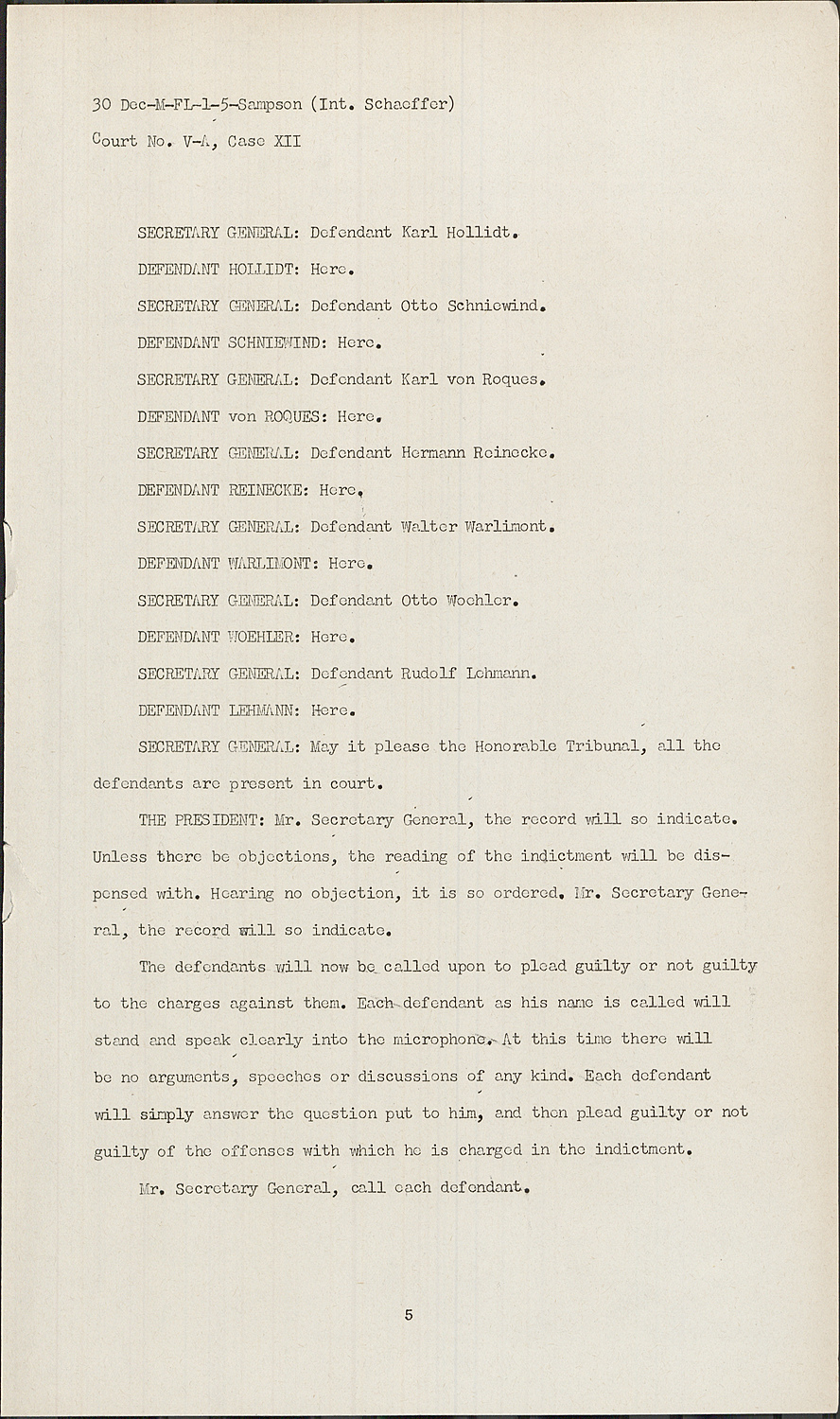
SECRETARY GENERAL:Defendant Karl Hollidt.
DEFENDANT HOLLIDT:Here.
SECRETARY GENERAL:Defendant Otto Schniewind.
DEFENDANT SCHNIEWIND:Here.
SECRETARY GENERAL:Defendant Karl von Roques.
DEFENDANT von ROQUES: Here.
SECRETARY GENERAL:Defendant Hermann Reinecke.
DEFENDANT REINECKE:Here.
SECRETARY GENERAL:Defendant Walter Warlimont.
DEFENDANT WARLIMONT:Here.
SECRETARY GENERAL:Defendant Otto Woehler.
DEFENDANT WOEHLER:Here.
SECRETARY GENERAL:Defendant Rudolf Lehmann.
DEFENDANT LEHMANN:Here.
SECRETARY GENERAL:May it please the Honorable Tribunal, all the defendants are present in court.
THE PRESIDENT:Mr. Secretary General, the record will so indicate. Unless there be objections, the reading of the indictment will be dispensed with. Hearing no objection, it is so ordered, Mr. Secretary General, the record will so indicate.
The defendants will now be called upon to plead guilty or not guilty to the charges against them. Each defendant as his name is called will stand and speak clearly into the microphone. At this time there will be no arguments, speeches or discussions of any kind. Each defendant will simply answer the question put to him, and then plead guilty or not guilty of the offenses with which he is charged in the indictment.
Mr. Secretary General, call each defendant.
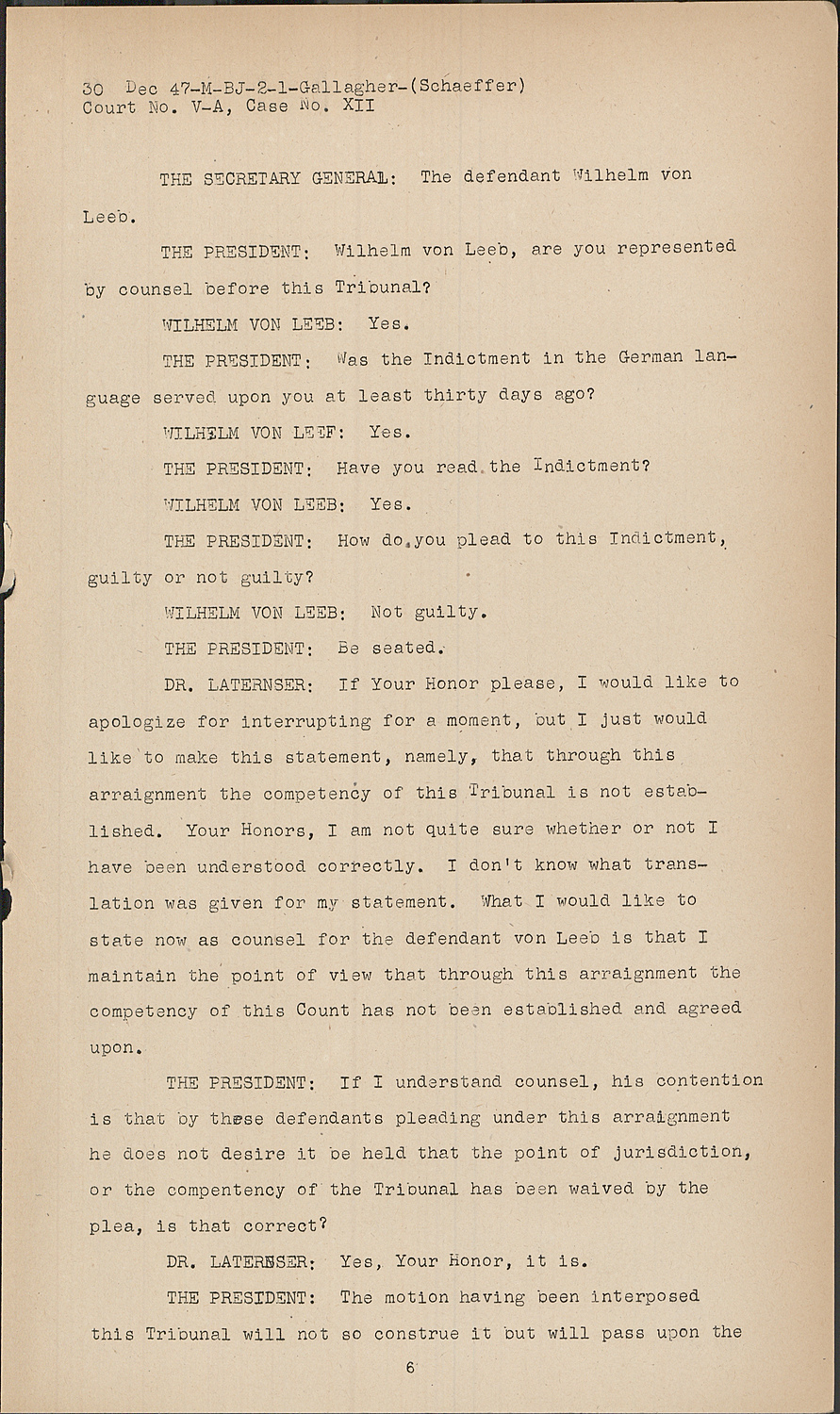
Court No. V-A, Case No. XII
THE SECRETARY GENERAL:The defendant Wilhelm von Leeb.
THEPRESIDENT; Wilhelm von Leeb, are you represented by counsel before this Tribunal?
WILHELM VON LEEB:Yes.
THEPRESIDENT; Was the Indictment in the German language served upon you at least thirty days ago?
WILHELM VON LEEF:Yes.
THE PRESIDENT:Have you read the Indictment?
WILHELM VON LEEB:Yes.
THE PRESIDENT:How do you plead to this Indictment, guilty or not guilty?
WILHELM VON LEEB:Not guilty.
THE PRESIDENT:Be seated.
DR. LATERNSER:If Your Honor please, I would like to apologize for interrupting for a moment, but I just would like to make this statement, namely, that through this arraignment the competency of this Tribunal is not established. Your Honors, I am not quite sure whether or not I have been understood correctly. I don't know what translation was given for my statement. What I would like to state now as counsel for the defendant von Leeb is that I maintain the point of view that through this arraignment the competency of this Count has not been established and agreed upon.
THE PRESIDENT:If I understand counsel, his contention is that by these defendants pleading under this arraignment he does not desire it be held that the point of jurisdiction, or the compentency of the Tribunal has been waived by the plea, is that correct?
DR. LATERNSER:Yes, Your Honor, it is.
THE PRESIDENT:The motion having been interposed this Tribunal will not so construe it but will pass upon the motion as though no plea had been entered, or as though the motion had been ruled upon before the arraignment was had.
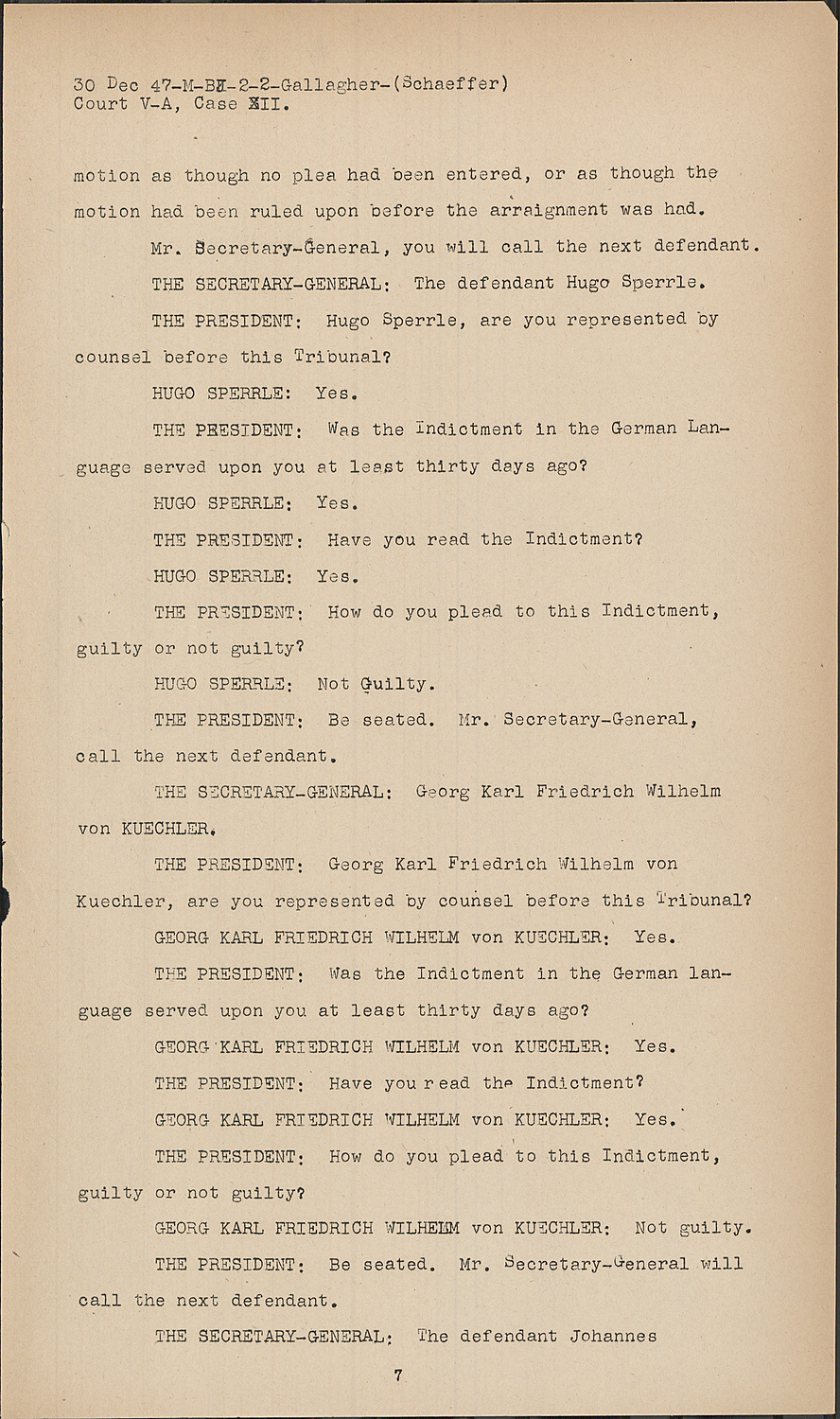
Mr. Secretary-General, you will call the next defendant.
THESECRETARY-GENERAL: The defendant Hugo Sperrle.
THE PRESIDENT:Hugo Sperrle, are you represented by counsel before this Tribunal?
HUGO SPERRLE:Yes.
THE PRESIDENT:Was the Indictment in the German Language served upon you at least thirty days ago?
HUGO SPERRLE:Yes.
THE PRESIDENT:Have you read the Indictment?
HUGO SPERRLE:Yes.
THE PRESIDENT:How do you plead to this Indictment, guilty or not guilty?
HUGO SPERRLE:Not Guilty.
THE PRESIDENT:Be seated. Mr. Secretary-General, call the next defendant.
THESECRETARY-GENERAL: Georg Karl Friedrich Wilhelm von KUECHLER.
THE PRESIDENT:Georg Karl Friedrich Wilhelm von Kuechler, are you represented by counsel before this Tribunal?
GEORG KARL FRIEDRICHWILHELM von KUECHLER: Yes.
THE PRESIDENT:Was the Indictment in the German language served upon you at least thirty days ago?
GEORG KARL FRIEDRICHWILHELM von KUECHLER: Yes.
THE PRESIDENT:Have you read the Indictment?
GEORG KARL FRIEDRICHWILHELM von KUECHLER: Yes.
THE PRESIDENT:How do you plead to this Indictment, guilty or not guilty?
GEORG KARL FRIEDRICHWILHELM von KUECHLER: Not guilty.
THE PRESIDENT:Be seated. Mr. Secretary-General will call the next defendant.
THESECRETARY-GENERAL: The defendant Johannes Blaskowitz?
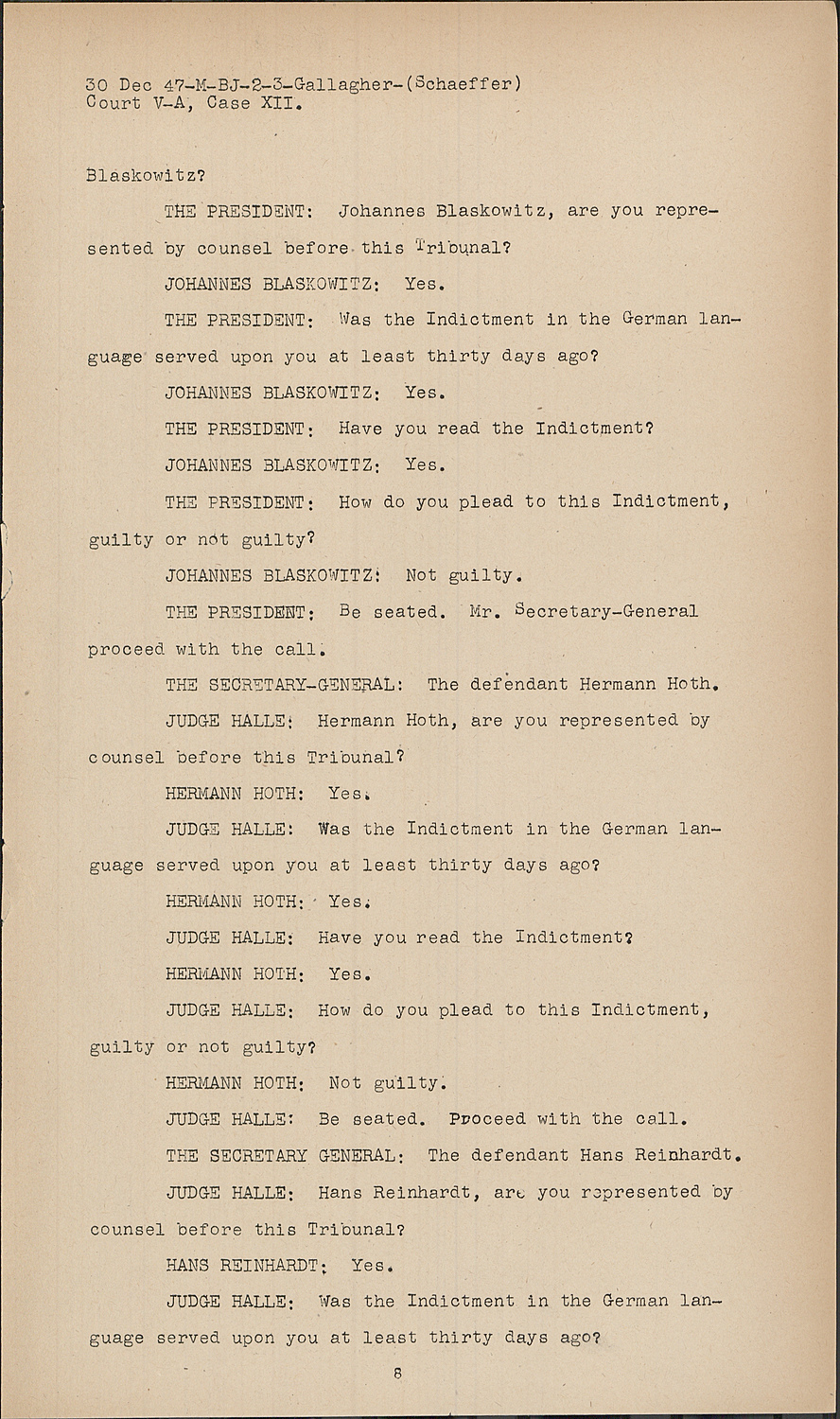
THE PRESIDENT:Johannes Blaskowitz, are you represented by counsel before this Tribunal?
JOHANNES BLASKOWITZ:Yes.
THE PRESIDENT:Was the Indictment in the German language served upon you at least thirty days ago?
JOHANNES BLASKOWITZ:Yes.
THE PRESIDENT:Have you read the Indictment?
JOHANNES BLASKOWITZ:Yes.
THE PRESIDENT:How do you plead to this Indictment, guilty or not guilty?
JOHANNES BLASKOWITZ:Not guilty.
THE PRESIDENT:Be seated. Mr. Secretary-General proceed with the call.
THESECRETARY-GENERAL: The defendant Hermann Hoth.
JUDGE HALLE:Hermann Hoth, are you represented by counsel before this Tribunal?
HERMANN HOTH:Yes.
JUDGE HALLE:Was the Indictment in the German language served upon you at least thirty days ago?
HERMANN HOTH:Yes.
JUDGE HALLE:Have you read the Indictment?
HERMANN HOTH:Yes.
JUDGE HALLE:How do you plead to this Indictment, guilty or not guilty?
HERMANN HOTH:Not guilty.
JUDGE HALLE:Be seated. Proceed with the call.
THE SECRETARY GENERAL:The defendant Hans Reinhardt.
JUDGE HALLE:Hans Reinhardt, are you represented by counsel before this Tribunal?
HANS REINHARDT:Yes.
JUDGE HALLE:Was the Indictment in the German language served upon you at least thirty days ago?
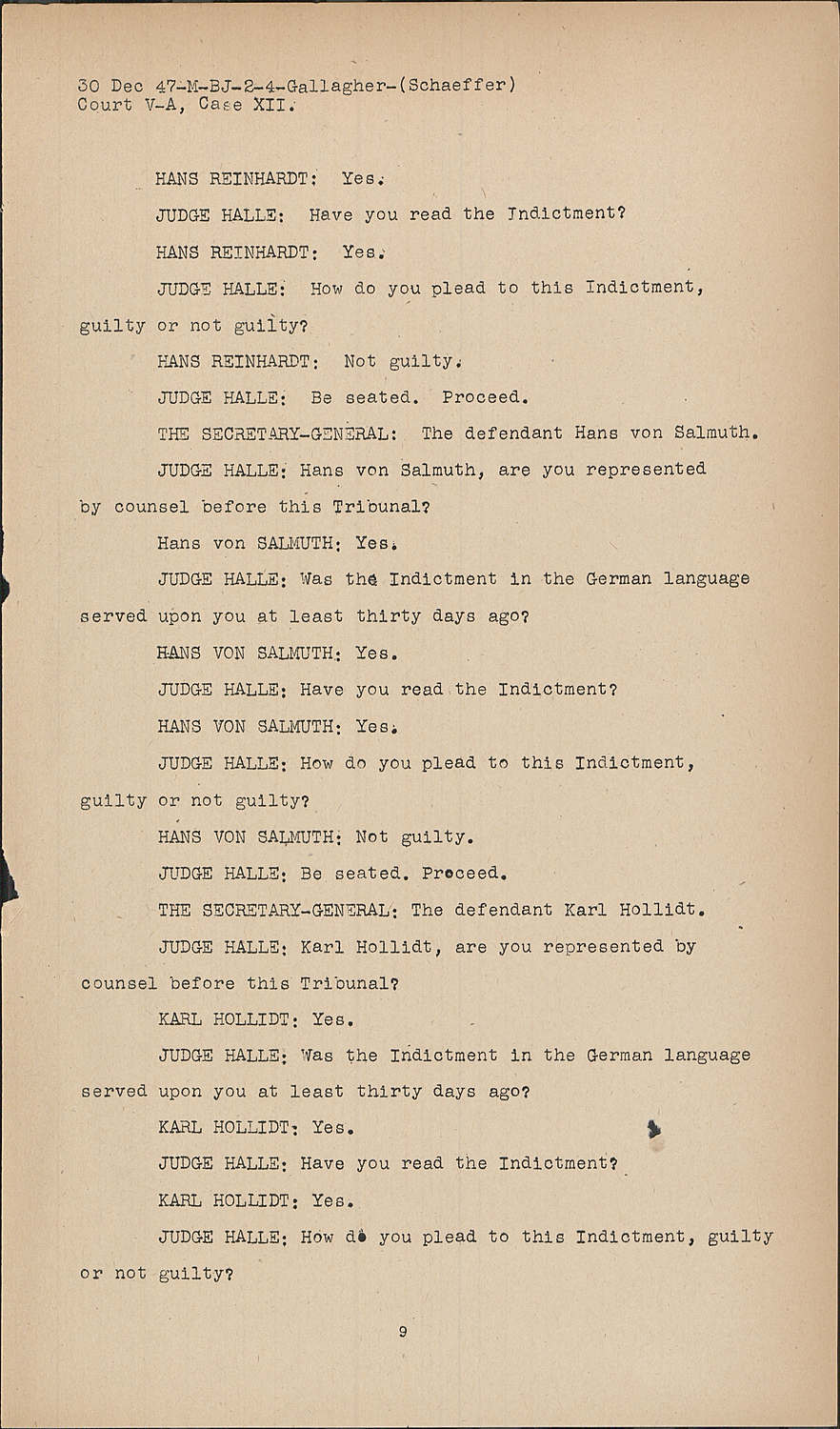
HANS REINHARDT:Yes.
JUDGE HALLS:Have you read the Indictment?
HANS REINHARDT:Yes.
JUDGE HALLE:How do you plead to this Indictment, guilty or not guilty?
HANS REINHARDT:Not guilty:
JUDGE HALLE:Be seated. Proceed.
THESECRETARY-GENERAL: The defendant Hans von Salmuth.
JUDGE HALLE:Hans von Salmuth, are you represented by counsel before this Tribunal?
Hans von SALMUTH: Yes.
JUDGEHALLE; Was the Indictment in the German language served upon you at least thirty days ago?
HANS VON SALMUTH:Yes.
JUDGE HALLE:Have you read the Indictment?
HANS VON SALMUTH:Yes.
JUDGE HALLE:How do you plead to this Indictment, guilty or not guilty?
HANS VON SALMUTH:Not guilty.
JUDGE HALLE:Be seated. Proceed.
THESECRETARY-GENERAL: The defendant Karl Hollidt.
JUDGE HALLE:Karl Hollidt, are you represented by counsel before this Tribunal?
KARL HOLLIDT:Yes.
JUDGE HALLE:Was the Indictment in the German language served upon you at least thirty days ago?
KARL HOLLIDT:Yes.
JUDGE HALLE:Have you read the Indictment?
KARL HOLLIDT:Yes.
JUDGE HALLE:How do you plead to this Indictment, guilty or not guilty?
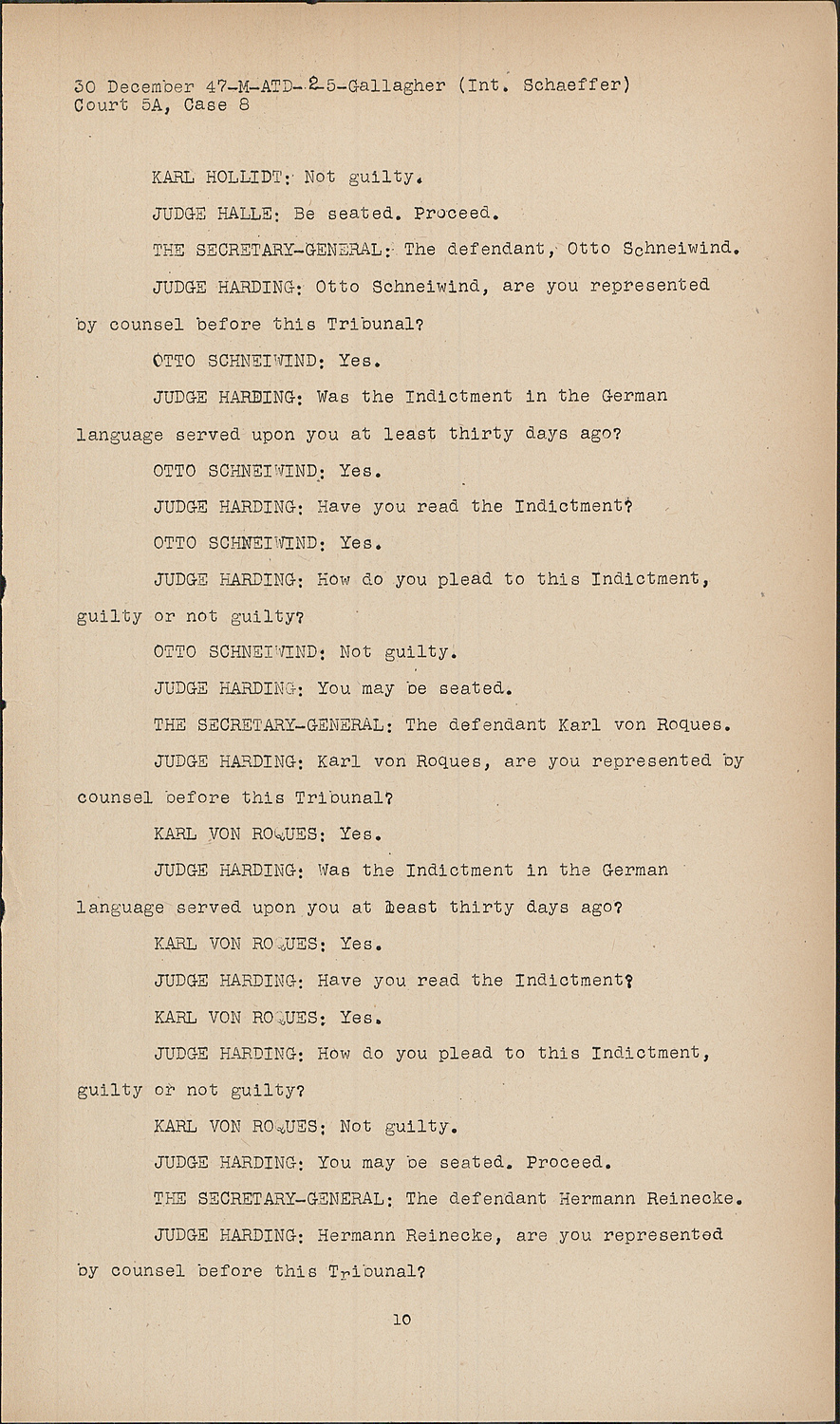
KARL HOLLIDT:Not guilty.
JUDGE HALLE:Be seated. Proceed.
THESECRETARY-GENERAL: The defendant, Otto Schneiwind.
JUDGE HARDING:Otto Schneiwind, are you represented by counsel before this Tribunal?
OTTO SCHNEIWIND:Yes.
JUDGE HARBING:Was the Indictment in the German language served upon you at least thirty days ago?
OTTO SCHNEIWIND:Yes.
JUDGE HARDING:Have you read the Indictment?
OTTO SCHNEIWIND:Yes.
JUDGE HARDING:How do you plead to this Indictment, guilty or not guilty?
OTTO SCHNEIWIND:Not guilty.
JUDGE HARDING:You may be seated.
THESECRETARY-GENERAL: The defendant Karl von Roques.
JUDGE HARDING:Karl von Roques, are you represented by counsel before this Tribunal?
KARL VON ROQUES:Yes.
JUDGE HARDING:Was the Indictment in the German language served upon you at least thirty days ago?
KARL VON ROQUES:Yes.
JUDGE HARDING:Have you read the Indictment?
KARL VON ROGUES:Yes.
JUDGE HARDING:How do you plead to this Indictment, guilty or not guilty?
KARL VON ROQUES:Not guilty.
JUDGE HARDING:You may be seated. Proceed.
THESECRETARY-GENERAL: The defendant Hermann Reinecke.
JUDGE HARDING:Hermann Reinecke, are you represented by counsel before this Tribunal?