Much is frequently made of the fact that in the early period of Hitler's regime two things should have put non on the alert: the squashing of the Roehm revolt in a way which did not correspond to German law, and the anti-semitism. The army know, as General Halder has explained in his testimony, that the Roehm revolt was a very real menace to the stability of the state and to the existence of the army; and as far as antisemitism was concerned, the first measures purported to eliminate certain influences from the professions and from the economic life with which the officers had, as a general proposition, no connection and, therefore, could not gauge their significance. There was no question that Hitler's party was in certain respects revolutionary in character. It seemed, however, to be less so than the other party which grow up on the left: the Communists. The choice lay between two revolutions, and certain revolutionary features had to be taken for granted. As Hitler followed in outward appearance a perfectly legal procedure there seemed to be no reason for violent opposition.
It is a counterfeit logic - to use a Lincolnian expression - to say that one or two points of a program, or certain acts in executing it that are reprehensible, must necessarily lead to considering the whole program and all other acts reprehensible. The some argument applies the other way round; one might quite as well say that if certain parts of the program and certain actions recommend a man or a party, one might feel justified in overlooking, the bad results and acts. Neither political programs nor political activities are over a hundred per cent to the liking of all people.
What the army saw was that the jobless were taken off the streets and that the foreign powers were willing to grant to Hitler's government a all those concessions which they had declined to his predecessors. The naval agreement with England seemed to eliminate the one great danger which every German felt to be existing until that time: the unnecessary rivalry between Germany and Great Britain. And when the Munich agreement had been concluded, Hitler's prestige as a national leader was at its pinnacle.
His party had scored more votes before 1933 than any other party. He had therefore under a parliamentary system unquestionably had the right to be invited to form a government, and the Reichstag had given him exceptional powers by the so-called Enabling Law in 1933 with a vote of 441 to 94. Why should an army officer doubt that he was the chosen leader of the nation and hesitate to recognize him as his commander-in-chief? Why should he suspect that the power laid into his hands by the nation would be misused and involve the nation and all other nations in a most terrible war?
The army was a part of the German nation which has always displayed great respect for constituted authority, and coupled therewith, had implicit confidence in the purity of intention and the righteousness of the authorities.
It was not that the army mixed in politics and built up the Nazi system. Quite to the contrary, the judgment of history will in all probability be that one of the principle sources of the tragedy of the last decades was that so large a part of the educated minds and characters of the German nation had been withdrawn from politics by too great an isolation in their professional sphere.
II.
I felt it to be appropriate to devote some words to giving the Tribunal the historical perspective as seen from the German point of view at the time. History moves so fast in this age that it is very necessary to stop from time to time, and to reconstruct what has gone by and what occupied the thoughts and motivated the actions of men at a given period of the past.
We have grown up with the idea that, the march of time does not, or only very slightly, affect the laws once they are laid down, nor the courts that are set up to administer them. Even this idea seems to have become obsolete, and that is, in a particular way, true of the law under which this Tribunal is sitting, and the Court from which it derives its precedents and to which it is tied by certain provisions of its statute: the International Military Tribunal.
The Government of the United States, under whose flag this Tribunal is sitting has recently issued a publication "Nazi-Soviet Relations 1939 - 1941" which purports to show that the Soviet Union instigated, and was a party to, an aggressive war. I understand it to be one of the fundamental rules of law, and of Anglo-American law in particular, that a party must come into court Tilth clean hands. It is the contention of the Government of the United States, implied in the recent publication, that this rule was violated in the IMT proceedings. If that is true, it must also be true that the laws which were issued under the same circumstances were faulty in their inception. If a court in the United States or in any other state would find that a law, either State or Federal, was passed by a body not properly constituted, this state of affairs would have to be taken into account, and the constitutionality would have to be tested. Why should this fundamental rule not apply to this Tribunal? Because it is an International Court? International Law is not different in this respect. The rule is in fact particularly applicable here. For all International Courts are based on the principles common to all national systems of law.
There is another point which is of the utmost importance for the international character of this Tribunal. International courts are based on the cooperation of the participating powers in creating them, and on their continued cooperation while they are functioning. This is not a theoretical point. It is very practical. The defense needs testimony from persons interned in camps in the British Zone of Occupation and in the Soviet Union. From the one, the prisoner was not made available as witness before this Tribunal; from the other, no testimony in writing could be had. And even from the archives of the United States, the documents, as far as they are in the hands of the prosecution, are not freely laid before the Tribunal nor accessible to the defense. This is contrary to the rules of evidence and procedure developed in International Law which provide that all parties to international proceedings are bound fully to disclose pertinent facts and documents to the Court.
The presentation of the case of the defendant whom I represent will demonstrate with great clearness what an injustice is done to the defense by disregarding those fundamental rules of International Law and I earnestly pray that the Tribunal keep this point before it.
III. Sources of law and precedents applicable in this case being as scant and as questionable as I have just tried to outline - what does remain as a measuring rod? The simple rules of human behavior as developed in Western civilization and simple, broad common sense. That means in this particular instance the conduct that would be expected of an officer in any army anywhere. Looking for some short phrasing of such standards I came across a few sentences contained in a letter addressed by a Commander-in-Chief to a general whom he had appointed to an important command - of Abraham Lincoln to General Hooker, taking over the Army of the Potomac: "... I believe you to be a brave and skilful soldier, which of course I like. I also believe that you do not mix politics with your profession, in which you are right. You have confidence in yourself, which is a valuable, if not an indispensable quality. You are ambitious which, within reasonable bounds, does good rather than harm; but I think that during General Burnside's command of the army you have taken counsel of your ambition and thwarted him as much as you could, in which you did a great wrong to the country, and to a most meritorious and honorable brother officer. I have heard, in such a way as to believe it, of your recently saying that both the Army and the Government needed a dictator. Of course it was not for this, but in spite of it, that I gave you the command. Only those generals who gain successes can set up dictators. What I now ask of you is military success, and I will risk the dictatorship. The Government will support you to the utmost of its ability, which is neither more nor less than it has done and will do for all commanders. I much fear that the spirit which you have aided to infuse into the army, of criticising their commander and withholding confidence from him, will now turn upon you.
Neither you nor Napoleon, if he were alive again, could get any good out of an army while such a spirit prevails in it." Here are, I think, most of the vital elements of what an officer is to be and what he should avoid being or doing. Besides that, it is a help in gaining the right perspective, if, by juxtaposition, one observes the superb gesture with which a President in a true democracy can waive aside the idea of dictatorship and then considers the life under a dictator which these defendants lived and which they could not alter without falling into the danger of becoming traitors to their country and violating their oath of allegiance. It is easy enough to say today: you should have resigned your commission. I doubt whether it is for a Military Tribunal to endorse such a principle, I doubt also whether it is historically or morally justified to adopt such principle. To give up a position in the Third Reich meant to leave it to the SS or other Party organization. The administration of occupied territory was in Poland a party affair and it is there that the worst crimes were perpetrated; it was in Belgium chiefly in the hands of the army and it was there that the best order was maintained. And taking an even broader view: if the leading class emigrates in large groups, the rest is easily liquidated until tabula rasa is established. That is what happened, in successive stages, in the Soviet Union. With all the respect due to the devotion and sacrifice of the men who participated in the events of the 20th of July 1944 -- it cannot be laid down as a general rule that an officer should kill his commander-in-chief. What then is the rule? That an officer should do his duty as a soldier, that he should obey his orders, but that he should remain conscious of the fundamental rules of law and humanity and oppose and resist to the best of his ability such orders as are contrary to such rules.
Conflicts will necessarily arise in a dictatorship. Each case will have to be judged on its own merits, on the degree of pressure, the goal to be attained, the means at the disposal of the individual. What was the position of the defendant Warlimont under the dictatorship of Hitler? The Prosecution maintains that he was one of the highest military leaders. That is far from the truth. He was a General Staff Officer, without command power, head of a division with coordinating functions, of the central bureaucratic office of the High Command which had to draft and distribute orders which originated from superior officers. His position was inferior in responsibility and initiative even to that of a Chief of Staff of an important command which has been closely scrutinized by Military Tribunal No. V in case No. 7: von List et al. with the result that the Chiefs of Staff were acquitted. The influence which Warlimont was able to exert was small. He did not use it to emphasize or strengthen the orders which are reprehensible like the Commandoand Commissar orders. On the contrary he tried his utmost - and in some instances successfully - to keep Hitler's intentions within the bounds of International Law, and when orders had been issued over his head that were reprehensible, he tried - and in many instances successfully - to prevent or mitigate their execution. The case against him is chiefly built up from documents. His defense will have to rely primarily on the interpretation, on the correct reading of these documents. His efforts were by their very nature discreet and clandestine. Otherwise they would have been destined to fail from the outset. What was secret and discreet at that time is hard to lay open and prove now. This I beg the Tribunal to keep in mind when the defendant is presenting his case.
The Tribunal has frequently expressed the opinion that documents speak for themselves, that they need no explanation. That is true for a democracy. It should be true wherever ordinary common sense prevails. It is not true for a dictatorship. It is, I think, Talleyrand, a dictator's foreign minister, who is credited with saying that the language is to be used, not to disclose, but to conceal the writer's intentions. What might seem understandable in diplomacy at that time, had, in the age of Hitler, spread into all other fields of activity of the state. The phrasing of laws in the Third Reich provides ample opportunities for studying this development. Military orders were not free from it. It was an absolute necessity from the top down to adapt Hitler's exaggerations to the realm of reality. Keitel in one of the rare moments of frank discussion observed to his A.D.C. that he could not grant Warlimont's request to be relieved because he was the only officer on his staff who could draft an order in such a way that Hitler would accept and sign it and that it would nevertheless give the troop-commander enough lee-way to act as he thought necessary. It will be a strange picture of wrangling over words and phrases which we will have to develop before the Tribunal, of orders already issued in their substance, then couched in terms which would defeat their aims or mitigate them or allow them to be restricted to a small group of persons so that they might soon fall into oblivion. And in the cases where Hitler had issued orders which were incompatible with the moral concepts of an honorable officer, we will show how the defendant Warlimont cooperated with men who were of the same mind with him to prevent or circumvent the execution of such orders. It is one of the unfortunate handicaps of the defense, which I am certain the Tribunal will fully appreciate, that many of the men with whom he so cooperated like Admiral Canaris and General Wagner cannot give testimony as they were killed by Hitler as his avowed opponents.
Warlimont is accused of having participated in starting aggressive wars, It is obvious that wars can be conducted offensively or defensively. The prosecution takes great pains to blur over the distinction between offensive warfare and aggressive warfare. It is the task of all General Staff Officers of all armies to make - each in his place - their contributions to plans which are laid down in preparation for wars in which their countries night be involved. That is their professional duty. It lies beyond their duty to make decisions, as the whether an aggressive war will be waged. It would set a dangerous precedent to say that they have to examine the question of whether offensive plans might be used for an aggressive war. The IMT has been very careful to limit the scope of responsibility for aggressive wars. It has nowhere taken exception to the participation of a man in the war efforts of his country, not even of Speer who was responsible for the whole field of the German armament production. Warlimont participated in the war effort as a General Staff Officer, not in initiating aggressive wars. While this Tribunal has been in session, the world has witnessed the beginning of a new war. The world has been staring at the point on the map where it was to start on a given date. Is it an aggressive war? Who is the aggressor? Nothing could illustrate the terrible responsibility of deciding such a question more clearly than what we are witnessing in these days. The reaction of the world does not seem to be that anybody expects of the soldier in the rank and file or of the officer on the staff that they give much thought to the distinction between offensive and aggressive action while they are doing their duty, which is to fight. The responsibility for that distinction lies elsewhere.
THE PRESIDENT:There will not be time for any further proceedings today and the Tribunal will be in recess until Monday morning at ninethirty.
(The Tribunal adjourned until 0930 hours, 21 June 1948)
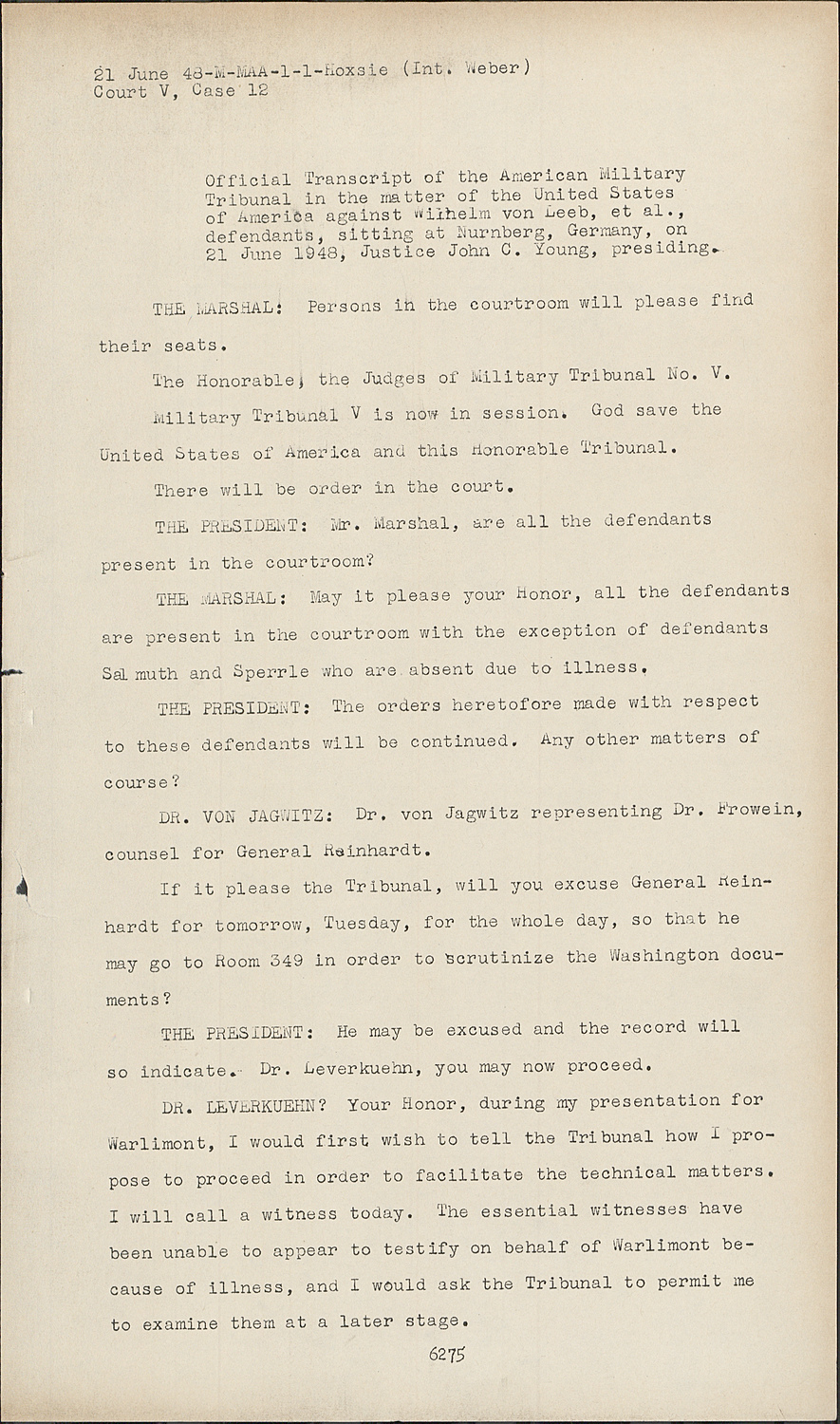
Official Transcript of the American Military Tribunal in the matter of the United States of America against Wilhelm von Leeb, et al.
, defendants, sitting at Nurnberg, Germany, on 21 June 1948, Justice John C. Young, presiding.
THE MARSHAL:Persons in the courtroom will please find their seats.
The Honorable, the Judges of Military Tribunal No. V.
Military Tribunal V is now in session. God save the United States of America and this Honorable Tribunal.
There will be order in the court.
THE PRESIDENT:Mr. Marshal, are all the defendants present in the courtroom?
THE MARSHAL:May it please your Honor, all the defendants are present in the courtroom with the exception of defendants Sal muth and Sperrle who are absent due to illness.
THE PRESIDENT:The orders heretofore made with respect to these defendants will be continued. Any other matters of course ?
DR. VON JAGWITZ:Dr. von Jagwitz representing Dr. Frowein, counsel for General Reinhardt.
If it please the Tribunal, will you excuse General Reinhardt for tomorrow, Tuesday, for the whole day, so that he may go to Room 349 in order to Scrutinize the Washington documents?
THE PRESIDENT:He may be excused and the record will so indicate. Dr. Leverkuehn, you may now proceed.
DR.LEVERKUEHN? Your Honor, during my presentation for Warlimont, I would first wish to tell the Tribunal how I propose to proceed in order to facilitate the technical matters. I will call a witness today. The essential witnesses have been unable to appear to testify on behalf of Warlimont because of illness, and I would ask the Tribunal to permit me to examine them at a later stage.
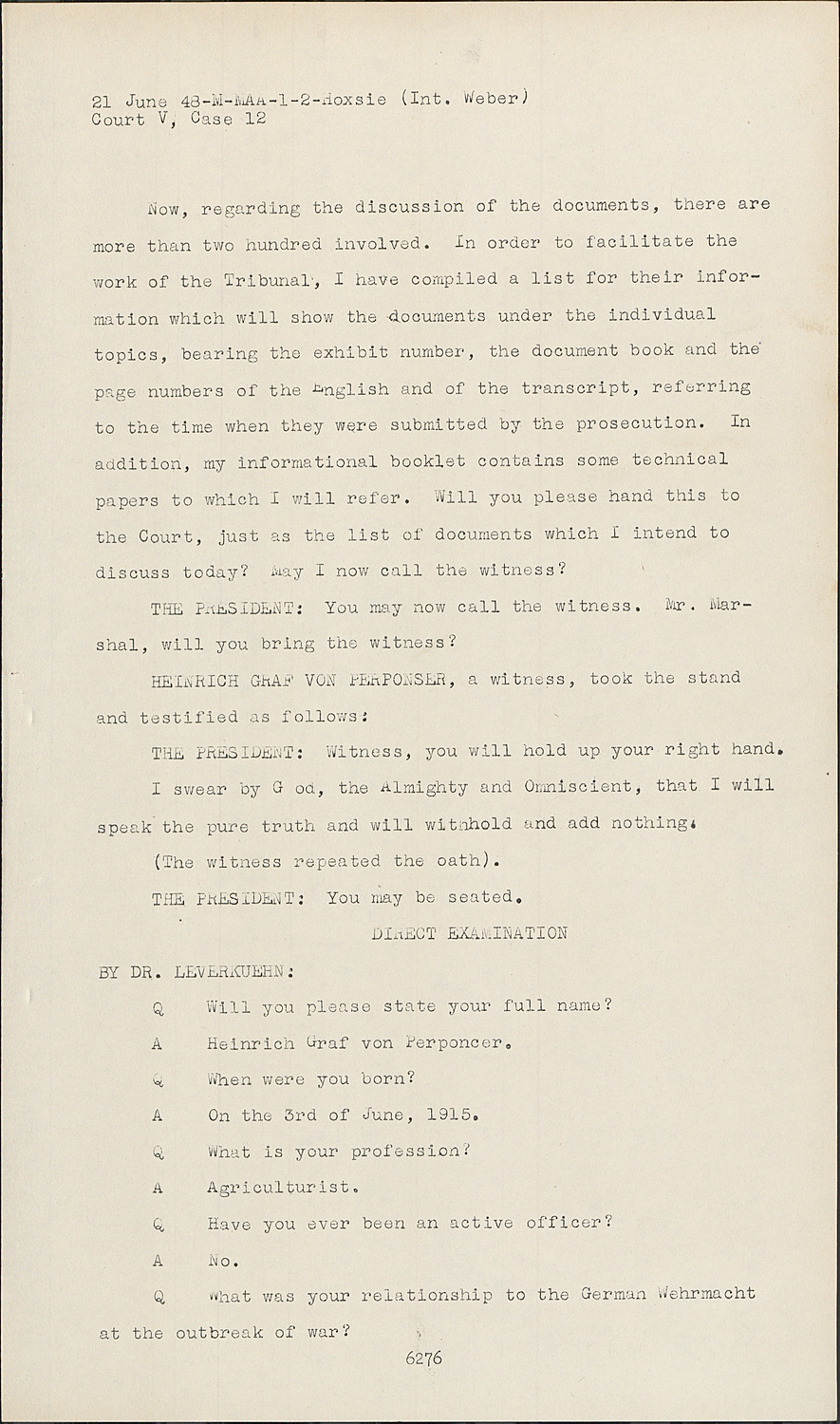
Now, regarding the discussion of the documents, there are more than two hundred involved. In order to facilitate the work of the Tribunal, I have compiled a list for their information which will show the documents under the individual topics, bearing the exhibit number, the document book and the page numbers of the English and of the transcript, referring to the time when they were submitted by the prosecution. In addition, my informational booklet contains some technical papers to which I will refer. Will you please hand this to the Court, just as the list of documents which I intend to discuss today? May I now call the witness?
THE PRESIDENT:You may now call the witness. Mr. Marshal, will you bring the witness?
HEINRICH GRAF VONPERPONSER, a witness, took the stand and testified as follows:
THE PRESIDENT:Witness, you will hold up your right hand.
I swear by God, the Almighty and Omniscient, that I will speak the pure truth and will withhold and add nothing.
(The witness repeated the oath).
THE PRESIDENT:You may be seated.
DIRECT EXAMINATION BY DR. LEVERKUEHN:
QWill you please state your full name?
AHeinrich Graf von Perponcer.
Q when were you born?
AOn the 3rd of June, 1915.
QWhat is your profession?
AAgriculturist.
QHave you ever been an active officer?
ANo.
QWhat was your relationship to the German Wehrmacht at the outbreak of war?
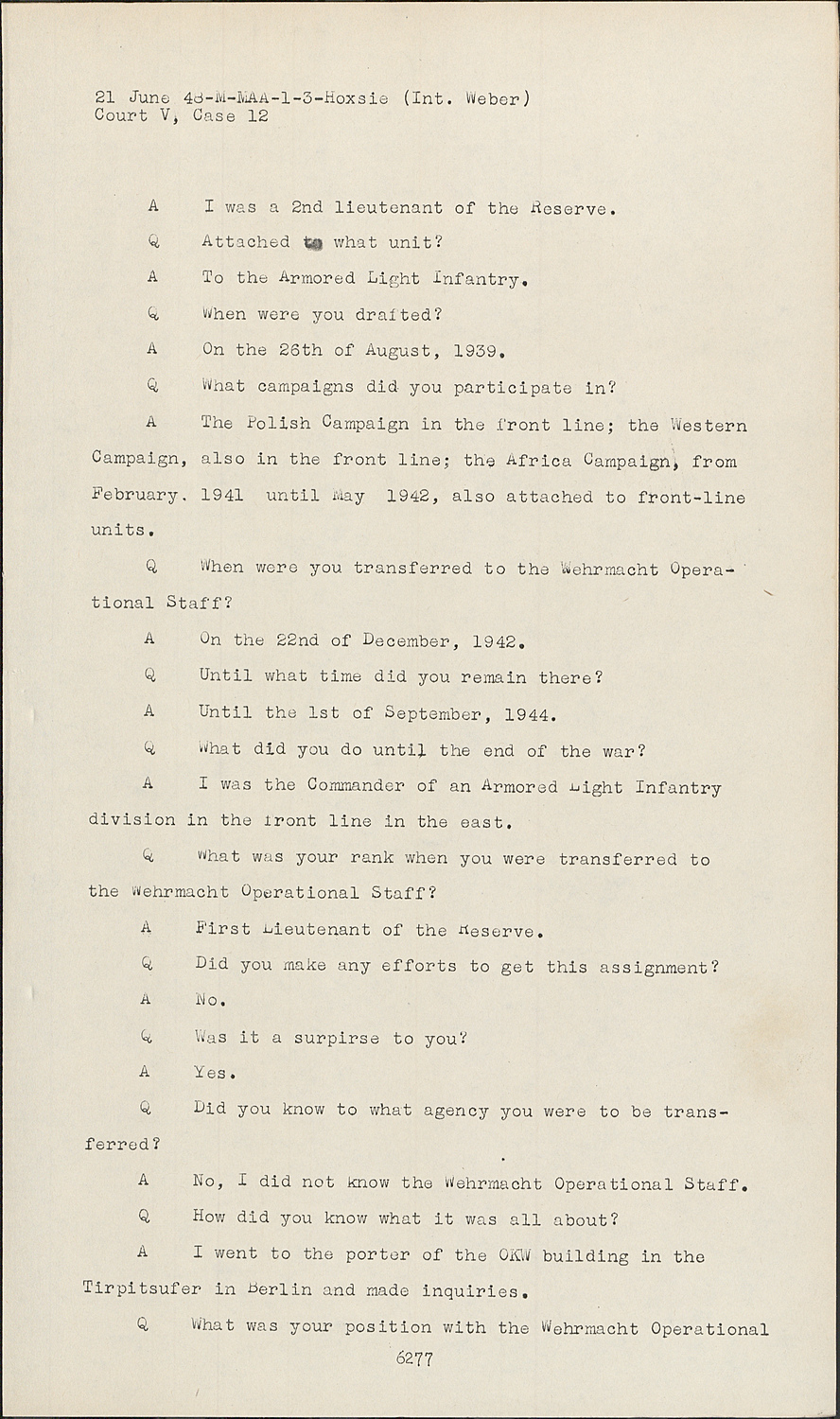
AI was a 2nd lieutenant of the Reserve.
QAttached to what unit?
ATo the Armored Light Infantry.
Q when were you drafted?
AOn the 26th of August, 1939.
QWhat campaigns did you participate in?
AThe Polish Campaign in the front line; the Western Campaign, also in the front line; the Africa Campaign, from February. 1941 until May 1942, also attached to front-line units.
QWhen were you transferred to the Wehrmacht Operational Staff?
AOn the 22nd of December, 1942.
QUntil what time did you remain there?
AUntil the 1st of September, 1944.
QWhat did you do until the end of the war?
AI was the Commander of an Armored Light Infantry division in the front line in the east.
QWhat was your rank when you were transferred to the Wehrmacht Operational Staff?
AFirst Lieutenant of the Reserve.
QDid you make any efforts to get this assignment?
ANo.
QWas it a surpirse to you?
AYes.
QDid you know to what agency you were to be transferred ?
ANo, I did not know the Wehrmacht Operational Staff.
QHow did you know what it was all about?
AI went to the porter of the OKW building in the Tirpitsufer in Berlin and made inquiries.
QWhat was your position with the Wehrmacht Operational Staff?
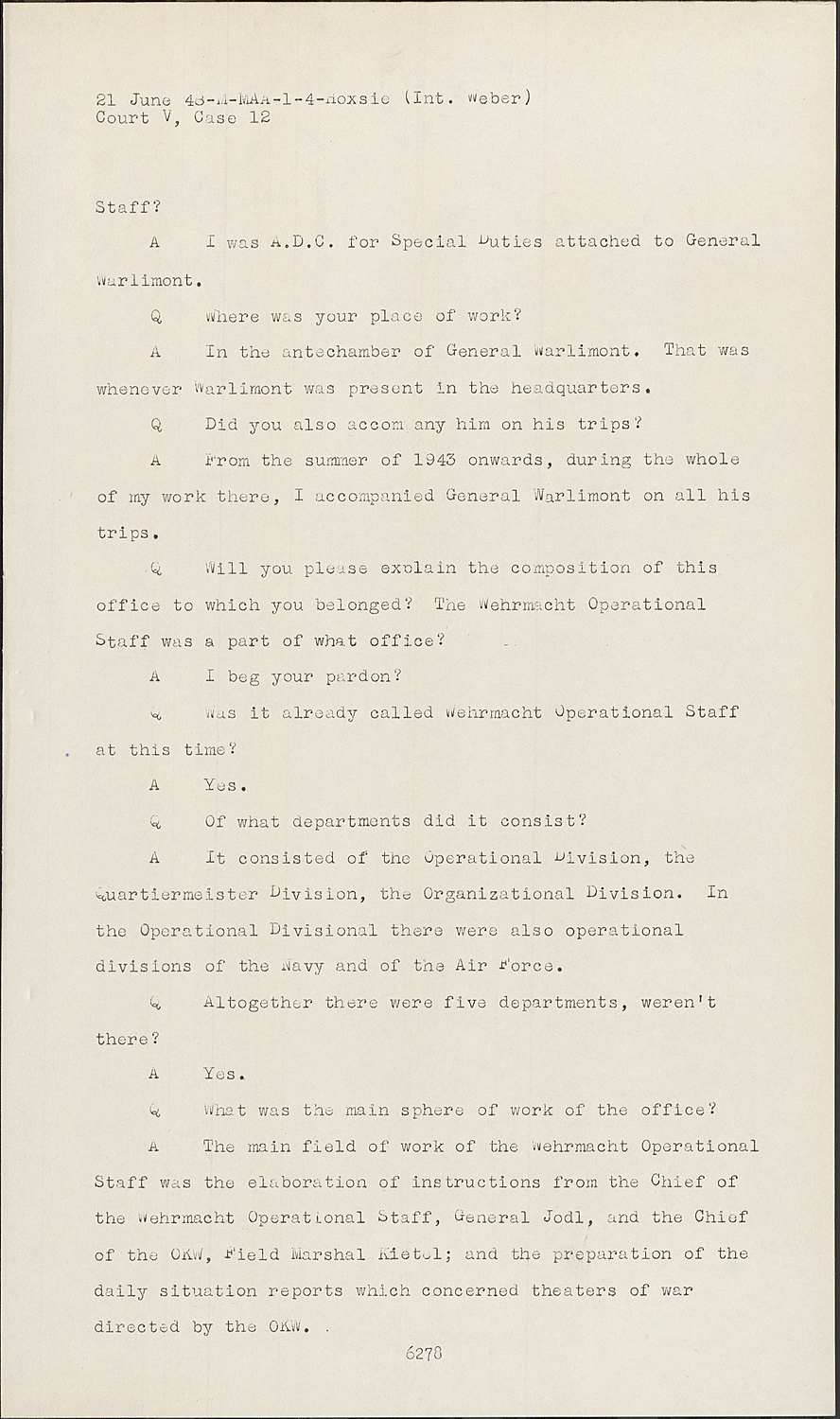
AI was A.D.C. for Special Duties attached to General Warlimont.
QWhere was your place of work?
AIn the antechamber of General Warlimont. That was whenever Warlimont was present in the headquarters.
QDid you also accom any him on his trips?
AFrom the summer of 1943 onwards, during the whole of my work there, I accompanied General Warlimont on all his trips.
QWill you please explain the composition of this office to which you belonged? The Wehrmacht Operational Staff was a part of what office?
AI beg your pardon?
QWas it already called Wehrmacht Operational Staff at this time?
AYes.
QOf what departments did it consist?
AIt consisted of the Operational Division, the Quartiermeister Division, the Organizational Division. In the Operational Divisional there were also operational divisions of the Navy and of the Air Force.
QAltogether there were five departments, weren't there ?
AYes.
QWhat was the main sphere of work of the office?
AThe main field of work of the Wehrmacht Operational Staff was the elaboration of instructions from the Chief of the Wehrmacht Operational Staff, General Jodl, and the Chief of the OKW, Field Marshal Kietel; and the preparation of the daily situation reports which concerned theaters of war directed by the OKW.
QThat is, the main tasks were in the operational field, weren't they?
AYes.
QAnd will you describe the other tasks? How would you describe them?
AThey had to be dealt with in conjunction with operational missions.
QWhat subject matters would pertain to the tasks of the Organizational Division, for instance?
AThe Organizational Division dealt with the distribution of the replacement of enlisted men, allotting them to the branches of the Wehrmacht and the SS, the registration and distribution of munitions to the services.
QWhat was the task of the Quartiermeister Division?
AQuartiermeister tasks consisted mainly in dealing with supplies for the theaters of war directed by the OKW in conjunction with the Quartiermeister Division of the General Staff of the German Army; then the distribution of the various motor fuels; and the administration of the occupied territories which were subordinate to military commanders.
QDid you, in this department, also have to deal with Germany's allies?
AThe distribution of military equipment or the supply of military equipment to Germany's allies was dealt with by the Organizational Department.
QDuring those trips on which you accompanied General Warlimont, did you also travel to occupied territories and to Germany's allies?
AYes.
QWhat was the task of General Warlimont during those trips?
AGeneral Warlimont was charged with voicing the wishes of the OKW to the allies and also of receiving requests from Germany's allies. He had no power of decision or of command during these missions.
QWhat was the personnel approximately of the Wehrmacht Operational Staff at your time?
AWhen I was assigned, to the Wehrmacht Operational Staff it consisted of about thirty officers and a few civil servants. At the conclusion of my career there, there were some more.
QWere they all at Hitler's Headquarters, or was there another place where they worked?
AThe Organizational Department was constantly in Berlin.
QHow would you describe the position of General Warlimont?
AThe position of General Warlimont was that of a departmental chief, and there were several of them in the OKW.
QWas there another such organization below General Jodl?
AYes, there was the Wehrmacht Intelligence Division, and the Wehrmacht Propaganda Division.
QAnd General Warlimont, was he the superior or coequal of the Chiefs of those two divisions?
AHe was their co-equal, not their superior.
QHow did General Warlimont receive his instructions?
AWarlimont generally received his instructions from General Jodl or Field Marshal Keitel at noon during the Situation Conference with Hitler, or by telephone during the morning, or in the afternoon.
QDid he also receive numerous written directives from Jodl or would it merely be orally?
AThere were frequent written directives from Jodl.
QHow were Hitler's wishes or orders put to him?
AHitler's wishes and orders were constantly conveyed to him by Field Marshal Keitel or General Jodl.
QIf an instruction or an order of Hitler's had been issued, could General Warlimont lodge a protest and make remonstrations with Hitler or somebody else?
ANo, General Warlimont did not have the right to make oral reports to Hitler.
QDescribe briefly the course of events of a day such as you witnessed it in Hitler's headquarters when you were serving under General Warlimont.
AIn the morning the teletypes received during the night or matters received and prepared either early in the morning or late at night were submitted to General Warlimont. He returned them to the department with the necessary instructions, or after having checked the matters which were ready he passed them on for submission to General Jodl. At about half past eleven the Situation Conference took place within the closest circle of the Wehrmacht Operational Staff.
QWho attended?
AThat was attended by the Chiefs of the Divisions (Abteilungen) and their experts. Subsequently, General Warlimont attended the Situation Conference with Hitler in order to furnish replies to inquiries of Field Marshal Keitel or General Jodl. In the afternoon there was again the scrutinizing and preparation of teletypes and instructions. It was also filled by oral reports of the divisional chiefs, particularly of the Chief of the Operational Division. The working time lasted until about nine or ten o'clock at night.
QDid you yourself attend Situation Conferences?
AI always attended the Situation Conferences within the Wehrmacht Operational Staff.
QWhat about the Situation Conferences held at Hitler's office?
QIt was only rarely that I attended Situation Con -ferences held at Hitler's office.
QDo you know the name Schram?
AMajor Schram was in charge of the war diary in the Wehrmcht Operational Staff, and if I recall correctly, that was effective from summer, 1943.
QSchram computed that 60,000 incoming teletypes a year were received at the Wehrmacht Operational Staff. Do you think that estimate is correct?
AI think his figure is quite feasible.
QThat is approximately 160 incoming teletypes a day?
AYes, it fluctuated according to the positions at the fronts. It is quite possible that this number of teletypes was received.
QHow many written communications were dealt with in a day's work in addition to the teletypes by the Wehrmacht Operational Staff?
AI would assume approximately the same number.
QWhat percentage of these incoming communications received were not of a purely operational nature but pertained to the office of the Quartiermeister or Organizational Departments?
AI would say approximately 25 to 30 per cent did not concern operational matters.
QWho at the time was in charge of the Quartiermeister Department?
AThe Quartiermeister Division was headed first by Colonel von Tippelskirch, afterwards by Colonel Poleck.
QApproximately at what time of the day did these gentlemen make oral reports to General Warlimont?
AUsually at night, approximately at eight o'clock.
QHow long did the report last?
AOne hour, or more than one hour.
QHow was this bulk of communications received, how was it dealt with clerically? Was it all routed via one clerical office?
AYes, there was one registry for the Operational Staff or the Wehrmacht, and this registry also dealt with incoming and outgoing matters for the Chief of the Wehrmacht Operational Staff and the Chief of the OKW.
QIn other words, neither Keitel nor Jodl had a registry of their own?
ANo, they hadn't.
QNow, if you dealt with a matter yourself or if it was dealt with by your closest staff, how was this handled by the registry?
AThe department dealing with it obtained by telephone from the registry a secret number for all top secret matters, or matters for chiefs only.
QTherefore, if on a communication which bears the heading "OKW/Wehrmacht Operational Staff," the letter "Q" or "V" follows, then this may be a number which Keitel or Jodl called for directly?
AYes.
QIt doesn't necessarily mean that it was dealt with by General Warlimont?
ANo, both of them could get such numbers directly from the registry.
QDid General Jodl and Field Marshal Keitel also deal with matters by directly consulting the experts in the department?
AIt occurred that both gentlemen talked over matters directly with the experts in a department. Therefore, it was ordered in general that such personal consultations had to be reported to General Warlimont as he was the Chief of the Operational Staff.
QWhat about the geographical accommodation of Hitler and his closer entourage?
AIn the headquarters in East Prussia, there were two districts which were fenced in and which were a short distance from each other. One of them housed Hitler and some important members of the Nazi Party, from the Wehrmacht, the adjutants' office of Hitler, Field Marshal Keitel and his adjutants, General Jodl and his adjutants, General Scharf, General Bohle, the Chief of the Army Staff, and the Generals of the Navy and Air Force delegated to Hitler's headquarters.
QAnd what about the second fenced-off section?
AThis housed solely the closer working staff of General Jodl directed by General Warlimont, and the Organizational Department.
QHow far were they, distant from each other?
AIn East Prussia about seven to ten minutes.
QAnd what about Berchtesgaden?
AAbout half an hour.
QCould you enter this Compound 1 without any difficulties?
AYou could only enter it with a special pass.
QAnd who of the persons residing in the second compound had such a pass?
AGeneral Warlimont and two couriers who took the daily mail over, and the Liaison Officer of the Organizational Department.
QDid you yourself have such a pass?
ANo, I myself did not have such a pass.
QNow, if you wanted to enter Compound 1 how did you do it?
AAs I was known there, all I needed to do was to phone the guards and then I could pass without any difficulty.
QNow, apart from official contacts, was there a personal contact on the part of General Warlimont and the members of the Compound 1?
ANo.
QWhat was his relationship to the leading members of the Nazi Party, for instance Goering?
ABetween Goering and General Warlimont there was a mutual antipathy.
QDid Goering make derogatory comments about him, did any such comments come to your attention?