AFTERNOON SESSION (The Tribunal reconvened at 1330 hours, 4 June 1948).
THE MARSHAL:The Tribunal is again in session.
KARL von ROQUES - Resumed
DIRECTEXAMINATION ( continued) BY DR. TIPP:
QGeneral, before the luncheon recess we had discussed Exhibit 986, contained in Document Book IX-Q, on Page 65 of the English and 168 of the German text. You had testified that in this Einsatzgruppen report the Einsatzkommando Plath... is mentioned in two different sections and we had stopped when we described the incident near Rowni where the Rear Army Group is mentioned. Could you please continue with your comments?
ANear Powni, as I said towards the end, a sabotage troop of 20 persons was arrested. These people had been dropped by parachute and were intended to explode the railway line Krementschug-Poltava and there are no shootings mentioned in this report.
QGeneral, you described the task of the commandos as being of a security police nature and also the screening of the civilian population. On the other hand, you also said that in your area no Einsatzkommandos operated, at least not to the best of your knowledge. Who in your area was it who actually carried out this counter-intelligence type of screening of the population?
AThe Secret Field Police in my area, which is apparent from the already discussed monthly reports of the Secret Field Police which frequently mention the counter-intelligence screening of the civilian population; particularly this is mentioned in the monthly report of the Secret Field Police of the months of January and February 1942 which were discussed this morning.
QFrom reports of subordinate units which are available here were you able to determine whether cooperation actually existed between the units subordinate to you and the Einsatzkommandos?
AI didn't find very much in the documents but it is significant that for the first time after the arrival of the Sonderkommando Plath, which was discussed this morning, the SD was mentioned in the reports of my troops altogether.
QI give to you now Document Book of the Prosecution 9 Supplement Part I. The exhibit is 1322, on Page 86 of the English text and Page 205 of the German text, NOWK-2803. The document contains reports of the Feldkommandantur 194 to your agency. The SD is mentioned in a daily report dated 8 April 1942. What can you tell us about this report, General?
AIt seems here that there was cooperation between the Feldkommandantur and an SD Kommando. This was on the occasion of an assault on two German officers. Why the SD and not the Secret Field Police took action here I cannot tell you. At any rate, the SD acted in this event for reasons of a police security nature. The SD ascertained the perpetrators and, in accordance with the SD's own authority, executed them. In addition, investigations were made of further persons involved. We have here proof, therefore, for the already discussed possible cooperation with the SD with respect to fighting the bandits and saboteurs.
QGeneral, this morning we discussed the tasks of the SD as they appeared to you. We also discussed the activity of the Higher SS and Police Leader as you observed it. That the Einsatzgruppen reports have shown a completely different picture for both types of agencies you, yourself, have stated. I want to ask you once again expressly about this latter part of their activity.
Did you ever learn anything?
ANo. I never heard anything about this part of the activity.
QIn a different context you have mentioned once that in the Ukraine there were persecutions of Jews which came from the population itself. However, from the Einsatzgruppen reports it is revealed that the SD was the instigator and agitator for these persecution, at least to a certain extent. Didn't you learn anything about this at all, General?
ANo, I didn't; the very opposite.
QWill you please comment?
AOn 10 July 1941, as Commander of the Rear Area of Army Group South, I took ever my new office. The headquarters was located in Lemberg. I received, during the last days of July 1941, a report that on the previous evening in a prison in Lemberg a larger number of Jews had been driven together by members of the Ukrainian militia. They were maltreated in the prison and some of them were killed. According to the report which I had received German soldiers were also to have participated in this action. I was highly indignant about this report and I gave instructions to make every effort to make the perpetrators account for their actions, particularly where German soldiers were concerned in these excesses. The SD leader who was responsible for the Lemberg area I called to see me. I asked him to enlighten me on these incidents. The Higher SS and Police Leader was at that time no longer present in Lemberg. Otherwise I would, of course, have addressed myself to him. The SD leader told me that he, himself, had not yet received any information about the incident. Apparently this concerned excesses which involved the Ukrainian militia which was subordinate to him. These people had done that, misusing the insignia and armlets which they were allowed to wear.
He promised me to punish the guilty ones and for the future to make all efforts to prevent the recurrence of such excesses. It seemed to me important, above all, to ascertain whether in actual fact German soldiers had participated in this incident. Therefore, I had my judge advocate make a detailed investigation about this incident which had the result that individual German members of the armed forces were discovered to have participated in the excess. It was just as clearly revealed, however, that these were not members of any troops subordinate to me but members of units who were just passing through the area.
At that time, I might add, Lemberg was a junction which was passed by many supply columns of the fighting troops. In spite of all efforts made it was not possible to actually ascertain what unit these soldiers were members of. On the same day I contacted all troop commanders located in Lemberg, called them to my office and announced my opinion to them in no uncertain words. I told them that they were responsible for the conduct of the troops under their command and that they ought to be ashamed of themselves to have such hangmen in soldiers' uniform under their command. I never learned of a similar incident in the future.
QGeneral, let us now discuss the various operational situation reports which, as you know, the prosecution has submitted against you in large numbers. To what extent there is any connection between these events and your person, and to what extent such a connection has been established by the prosecution we do not have to discuss here because that will fall to the decision of the Tribunal. I would like to state, however, that for technical reasons and for reasons of time it isn't possible to talk about all events with you, but I would like as an introduction to ask you what comments of your own you would like to make about the whole of the material submitted against you by the prosecution? where you able to ascertain anything about whether and how many incidents took place and could have taken place within your area? The prosecution seems to contend, as we said at the beginning, that all of Einsatzgruppe C almost exclusively operated in your area.
AIrrespective of where these incidents reported in the Einsatzkommando reports took place, I would once again like to stress here with all determination that I did not at any time during my service in Russia hear of any such incidents. What the police forces did in my area was removed from the sphere of my responsibility by virtue of an order of the OKH which has been adequately discussed by me and my co-defendants.
QI believe, General, that has been made quite clear in the meantime, in order to be somewhat briefer, perhaps you can tell us some facts which you actually ascertained?
AIn the operational situation reports which the prosecution has submitted against me -
QPerhaps you ought to be a little slower.
AAbout 100 incidents of shootings have been mentioned. Mostly these shootings concerned Jewish indigenous population, and the shootings were carried out by police units. In stating this, I disregard incidents of minor importance. Of these 100 cases, 69 did not take place in my area which is clearly established. In 9 cases the locality where the events took place could not be ascertained on the maps. In 13 cases no certain date has been mentioned, and in view of the operational situation reports, it cannot be shown whether these events took place at a date when the area where they took place was under my command and jurisdiction. Only 9 of these 100 incidents which are contained in the documents offered can have taken place in my area at all.
QNow, General, let us discuss the individual operational situation reports. In order to be clearer in this discussion, I should like to stick to the chronological sequence of these events, which is shown in the dates. Occasional deviations, of course, it might not be possible to avoid. The first document in this series is Exhibit 934 of the prosecution contained in Document Book IX 0 of the prosecution, on page 43 of the English and page 101 of the German text, Document NO-2847, that is operational situation report Number 59 dated the 21st of August 1941. Einsatzgruppe C, which is the only one that we are interested in here, is entered as having been located in Nowo Ukrainska. Was that place at that time located within your area, General?
ANo. Nowo Ukrainska came into my area as late as the 8th of September.
QIn this Einsatzgruppen report in Section 4 under "Measures of Execution" it is mentioned that the first SS brigade in Stara-Konstantinov carried out a reprisal measure.
In addition, it is mentioned that in Korosten it had carried out a large scale action immediately after that city had been conquered. And similarly an action is mentioned in Radomischl. What can you tell us about these events as far as time and locality involved are concerned?
AThe report of events from Berlin is dated the 21st of August. When the events discussed herein actually took place, it is not possible to ascertain because no individual dates are given. I am not informed either as to how long it took until such a report of the SD from the area of commitment would get to Berlin and would be recomposed there into this report of events. On the basis of some individual reports of events, however, it is possible to determine that the events can be dated back more than 4 weeks behind the date of the report of events. As to the localities mentioned by you, Korosten came as late as the 8th of September and Radomischl as late as the 23rd of September into my area. These two events therefore did not take place in my area, which is clearly established. As to Stara Konstaninov the date is also lacking. Stara-Konstantinov, according to the dates mentioned by the prosecution, was added to my area on the 5th of August. I can, therefore, not state whether the actions reported took place at a time when the area was already part of my territory or not.
QThis event in Stara-Konstantinov seems to me worth special discussion, General, because in this report of the 21st of August it is mentioned that Stara-Konstantinov that it was the residence of the Higher SS and Police Leader and the Commander of the Rear Area Army Group. Can you tell me whether the First SS Brigade and the Higher SS and Police Leader were already stationed in this city when the area was not yet in your area of command?
AYes, the Higher SS and Police Leader had his official residence already in Stara-Konstantinov when I got there. In the same way the brigade staff of the First SS Brigade was already located there.
QThe First SS Brigade, General, has already been discussed on the occasion of the report of the Higher SS and Police Leader of the 8th of August 1941 in connection with the operation which took place in that very area. Therefore, I believe I can ask you very briefly to what extent was the First SS Brigade subordinate to you?
AIt was only subordinate to me when I needed it for tactical commitment in anti-partisan fighting and there only with the consent of the Higher SS and police Leader.
QDid you get any information about that action, General?
ANo, even in the documents nothing is shown which reveals that any agency of the armed forces was interpolated in the process of that action, any agency which might have informed me.
QI should like to ask you then, General, to turn up in the same Document Book IX 0, Exhibit 935, the next exhibit. It is on page 45 in the English Document Book and on page 126 of the German Document Book. It is Document NO-2842. That document is an operational situation report Number 60 dated the 22nd of August 1941. As the residence of the Einsatzgruppen now, Nowo Ukrainka is mentioned, which, as you say, fell to your area as late as September 1941. In this operational situation report a certain locality Chmielnik is mentioned, Tschernjachow, then a few villages northwest of Beredichew and Triakel. Were these located in your area, General?
AThe date when these events took place is not stated. For the reasons which I mentioned before, it cannot be determined when these events actually took place. I can, according to the maps, exclude the places, Berdichew and Tschernjachow, both of which were added to my area on the 8th of September, but even about these events I did not hear anything because near Chmielnik, which I want to point out particularly, there is only an intention recorded, not an action which was carried out.
QLet us now turn, General, to Prosecution Exhibit 940, which is in the same document book on page 52 of the English text and page 170 of the German text, Document NO3154. It is an operational situation report of 11 September 1941. In this report a number of places are mentioned, among them Kirowo, Korosten, Fastov, and Kamenensk Podolsk. What can you tell us about the date and location of these places?
AAll these places were not located within my area on the 11th of September. Kirowo, Korosten, and Fastov were included in my area as late as the 23rd of September. Kamenensk Podolsk was turned over to Reich Commissariat Ukraine on the 1st of September.
QThis event in Kamenensk Podolsk has already been discussd previously with the witness Schall, General. I would just like to ask you about your personal knowledge about this incident. In this connection, I would like to put to you Exhibit 938 of the prosecution contained in the same document book on page 50 of the English text and page 137 of the German text, Document NOKW-1544. These are notes for a conference with Army Group South on the second of September 1941. According to the contents of the document and according to the testimony given by the witness Schall this conference took place between this witness and your chief of staff Colonel v. Krosigk.
In Section 3g figures are given concerning the settlement of the Jewish question in Kamenensk Podolsk. Do these figures refer to the mass execution mentioned in the last document -- mass execution of Jews in Kamenensk Podolsk?
ANo. I am certain it does not refer to that. Of course, I was not present during the conference, but I can well imagine to what this entry refers. Colonel Schall, when he was on the witness stand, also dealt with these incidents. Near Kamenensk Podolsk there is the only crossing of the Dnjostr River for a vast stretch of land. The Dnjestr formed the borderline to the Rumanian area and the Rumanians had formed the habit from their Rumanian area to send an enormous number of Jews over this crossing of the Dnjestr near kamenensk Podolsk. Of course, these were all people unfit for work, women, children and old people. I remember one report which was submitted to me about these occurrences, and which stated how unhappy the Feldkommandant was because he did not know what to do with these large numbers of Rumanian Jews, especially as regarded food supplies and accommodations. These occurrences were immediately reported to the Army Group with the request to make representations to the Rumanians and to ask for these unhappy people who had been sent across the Dnjestr to be transported back to Rumania; and the figures mentioned here, figures given by the chief of staff refer to these Jews.
QHad this retransportation already been carried out, General, when that area was made part of the General Government? I believe you said that was on the 1st of September 1941.
ANo. That matter was still fluctuating, when on the first of September 1941 that area was turned over to the Reich Commissariat Ukraine, I heard no more about it.
QNow, I would like you to turn up, General, in Document Book IX 0, Exhibit 942 of the prosecution, on page 178 of the German and page 57 of the English text. It is Document NO-3151. This document is the operational situation report 86 of the 17th of September 1941. In this operational situation report, nine large-scale executions are mentioned. I don't want to read all these difficult Russian names out, but I would like to ask you what you were able to determine on the basis of the maps about this document?
AI can state about this document that of the 9 incidents reported therein, five could not have taken place in my area at all. One place could not be discovered on the map and concerning the remaining three incidents, the date isn't mentioned. So that there again I cannot state when these incidents took place, and whether they took place in my area. For the rest, that I didn't hear anything of all these incidents, I don't want to repeat again because all these occurrences took place under cover of complete secrecy.
QTo follow up the sequence -- the chronological sequence of the events, I would now like to have passed to you Document Book IX L of the prosecution which contains Exhibit 864 on page 54 in the English document book and 108 in the German document book, Document NO-3149. This is an operational situation report 88, dated the 19th of December 1941. It is mentioned herein an execution in Radomischle to have taken place on the 8th of September 1941 and to have been carried out by Sonderkommando 4A. A further action is mentioned without date to have taken place in Berdichew. What can you tell us about this report?
ARadomischel was at that time not yet located in my area. Only on the 23rd of September, as I have already stated, this place was made part of my area. When the action was carried out in Berdichew is not stated here.
I did not hear anything about that action either.
QThe next report which we have available or rather the next reports which we have available deal with events which took place in Kiev. This brings me to a further point enumerated in the indictment. In Section 82b you are charged with the following, "Briefly before the first of October 1941 units within the Rear Area of Army Group South under the jurisdiction and command of General von Roques executed 34,000 Jews in the city of Kiev." Before I discuss with you the individual documents, I should like to ask you to tell the court whether at that time Kiev was part of your area, that is, before the first of October 1941?
ANo.
QGeneral, now I should like to ask you to tell the Tribunal what you know about the conquest of Kiev and the events in Kiev from your own knowledge?
AFrom my own knowledge concerning the preparations of an attack against Kiev and the capitulation of Kiev I know nothing. As I have already stated, from the 10th of September 1941 onwards I was in charge of units at the front. I was in charge of the Group "Von Roques" and my command post at that time was Kriwojrog, approximately 400 kilometers distant from Kiev. The conquest of Kiev was carried out by the 6th Army. I had nothing to do with the preparation of the attack of Kiev either.
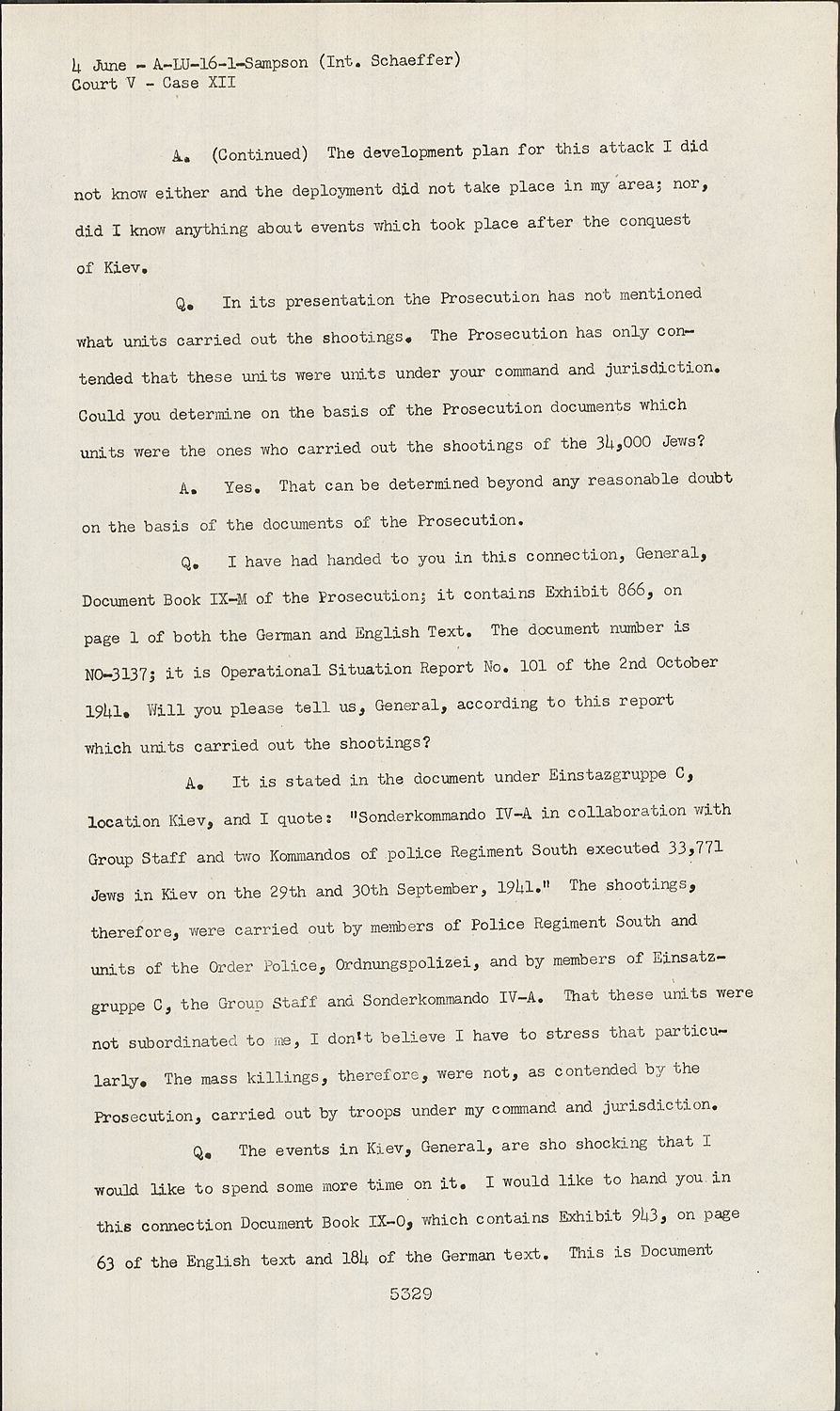
A. (Continued) The development plan for this attack I did not know either and the deployment did not take place in my area; nor, did I know anything about events which took place after the conquest of Kiev.
Q. In its presentation the Prosecution has not mentioned what units carried out the shootings. The Prosecution has only contended that these units were units under your command and jurisdiction. Could you determine on the basis of the Prosecution documents which units were the ones who carried out the shootings of the 34,000 Jews?
A. Yes. That can be determined beyond any reasonable doubt on the basis of the documents of the Prosecution.
Q. I have had handed to you in this connection, General, Document Book IX-M of the Prosecution; it contains Exhibit 866, on page 1 of both the German and English Text. The document number is NO-3137; it is Operational Situation Report No. 101 of the 2nd October 1941. Will you please tell us, General, according to this report which units carried out the shootings?
A. It is stated in the document under Einstazgruppe C, location Kiev, and I quote: "Sonderkommando IV-A in collaboration with Group Staff and two Kommandos of police Regiment South executed 33,771 Jews in Kiev on the 29th and 30th September, 1941." The shootings, therefore, were carried out by members of Police Regiment South and units of the Order Police, Ordnungspolizei, and by members of Einsatzgruppe C, the Group Staff and Sonderkommando IV-A. That these units were not subordinated to me, I don't believe I have to stress that particularly. The mass killings, therefore, were not, as contended by the Prosecution, carried out by troops under my command and jurisdiction.
Q. The events in Kiev, General, are she shocking that I would like to spend some more time on it. I would like to hand you in this connection Document Book IX-O, which contains Exhibit 943, on page 63 of the English text and 184 of the German text. This is Document NO-3146; Operational Situation Report No. 94; dated 25th September 1941.
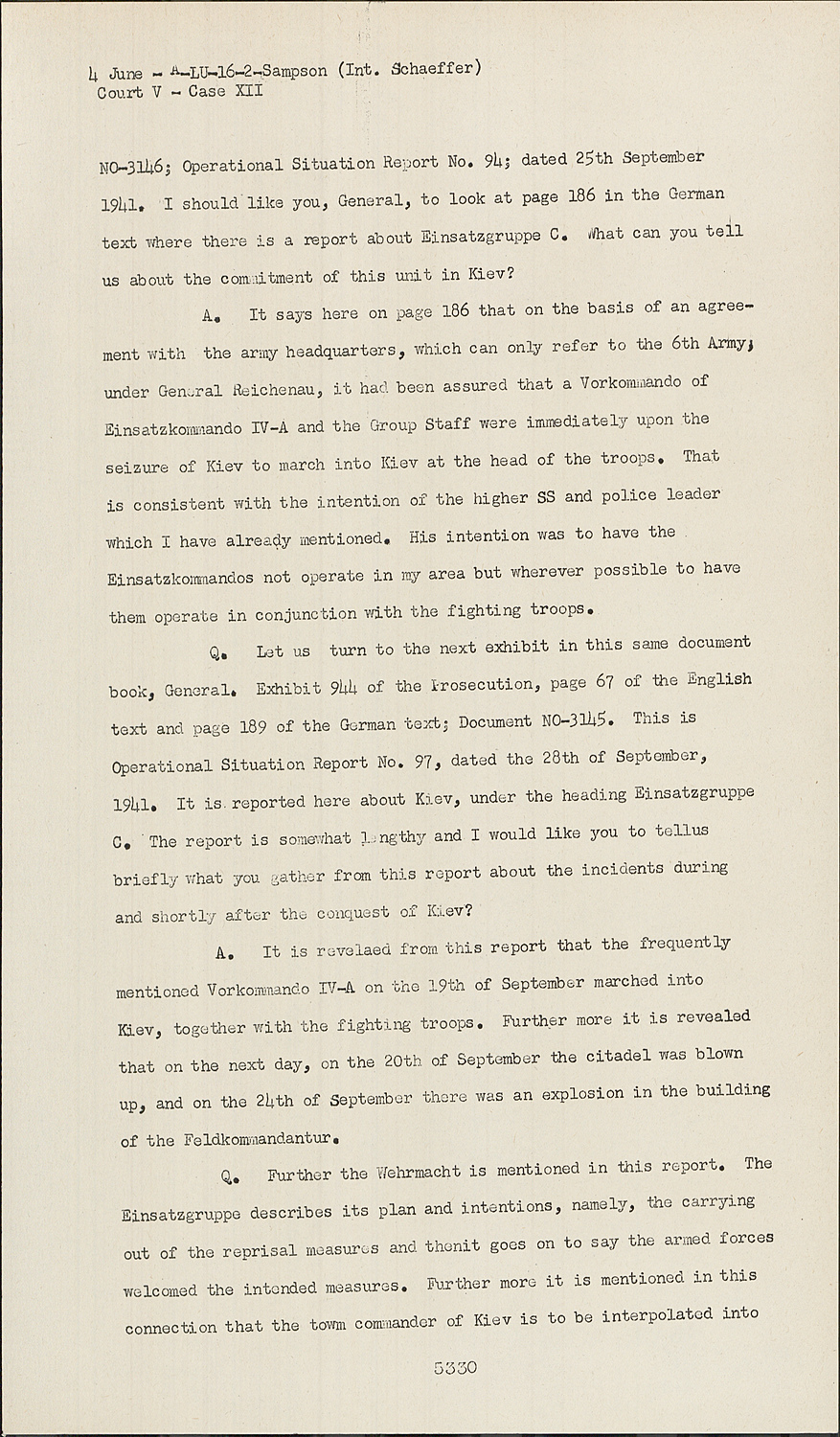
I should like you, General, to look at page 186 in the German text where there is a report about Einsatzgruppe C. What can you tell us about the commitment of this unit in Kiev?
A. It says here on page 186 that on the basis of an agreement with the army headquarters, which can only refer to the 6th Army; under Genaral Reichenau, it had been assured that a Vorkommando of Einsatzkommando IV-A and the Group Staff were immediately upon the seizure of Kiev to march into Kiev at the head of the troops. That is consistent with the intention of the higher SS and police leader which I have already mentioned. His intention was to have the Einsatzkommandos not operate in my area but wherever possible to have them operate in conjunction with the fighting troops.
Q. Let us turn to the next exhibit in this same document book, General. Exhibit 944 of the Prosecution, page 67 of the English text and page 189 of the German text; Document NO-3145. This is Operational Situation Report No. 97, dated the 28th of September, 1941. It is reported here about Kiev, under the heading Einsatzgruppe C. The report is somewhat Lengthy and I would like you to tellus briefly what you gather from this report about the incidents during and shortly after the conquest of Kiev?
A. It is revelaed from this report that the frequently mentioned Vorkommando IV-A on the 19th of September marched into Kiev, together with the fighting troops. Further more it is revealed that on the next day, on the 20th of September the citadel was blown up, and on the 2hth of September there was an explosion in the building of the Feldkommandantur.
Q. Further the Wehrmacht is mentioned in this report. The Einsatzgruppe describes its plan and intentions, namely, the carrying out of the reprisal measures and thenit goes on to say the armed forces welcomed the intended measures. Further more it is mentioned in this connection that the towm commander of Kiev is to be interpolated into this process.
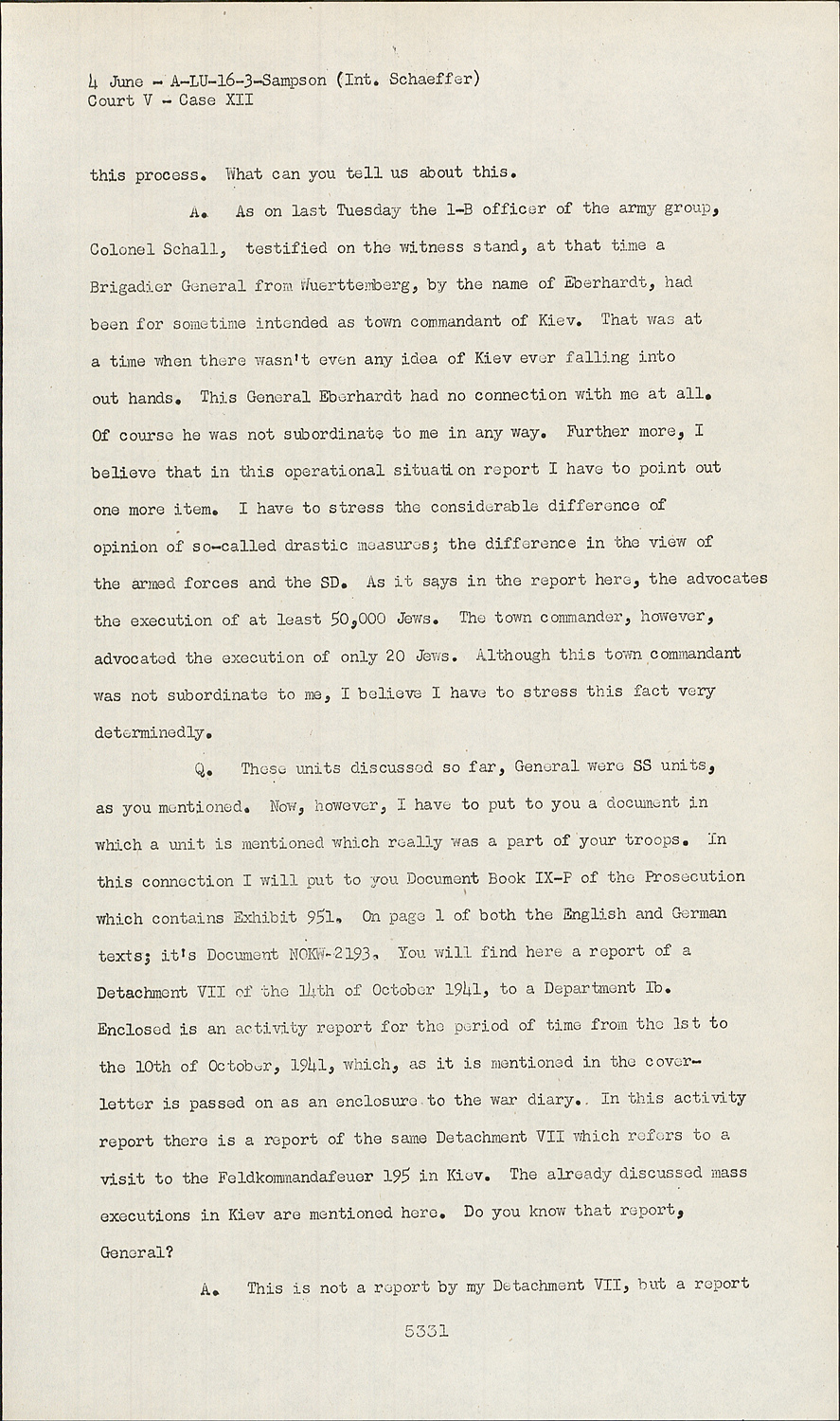
What can you tell us about this.
A. As on last Tuesday the 1-B officer of the army group, Colonel Schall, testified on the witness stand, at that time a Brigadier General from Wuerttemberg, by the name of Eberhardt, had been for sometime intended as town commandant of Kiev. That was at a time when there wasn't even any idea of Kiev ever falling into out hands. This General Eberhardt had no connection with me at all. Of course he was not subordinate to me in any way. Further more, I believe that in this operational situation report I have to point out one more item. I have to stress the considerable difference of opinion of so-called drastic measures; the difference in the view of the armed forces and the SD. As it says in the report here, the advocates the execution of at least 50,000 Jews. The town commander, however, advocated the execution of only 20 Jews. Although this town commandant was not subordinate to me, I believe I have to stress this fact very determinedly.
Q. These units discussed so far, General were SS units, as you mentioned. Now, however, I have to put to you a document in which a unit is mentioned which really was a part of your troops. In this connection I will put to you Document Book IX-P of the Prosecution which contains Exhibit 951. On page 1 of both the English and German texts; it's Document NOKW-2193. You will find here a report of a Detachment VII of the 14th of October 1941, to a Department Ib. Enclosed is an activity report for the period of time from the 1st to the 10th of October, 1941, which, as it is mentioned in the coverletter is passed on as an enclosure to the war diary. In this activity report there is a report of the same Detachment VII which refers to a visit to the Feldkommandafeuer 195 in Kiev. The already discussed mass executions in Kiev are mentioned here. Do you know that report, General?
A. This is not a report by my Detachment VII, but a report of the Detachment VII of the 454th Security Division.
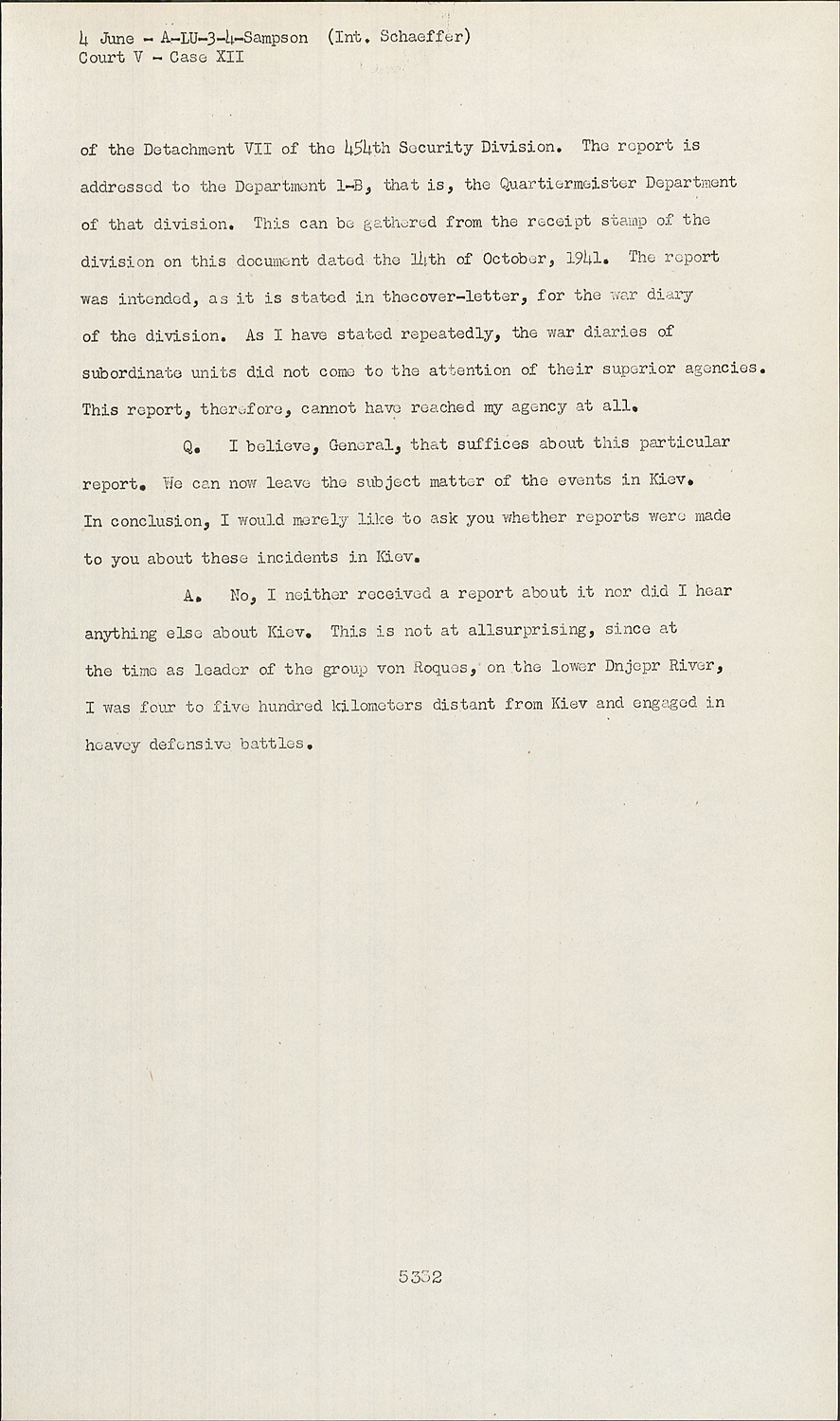
The report is addressed to the Department 1-B, that is, the Quartiermeister Department of that division. This can be gathered from the receipt stamp of the division on this document dated the 14th of October, 1941. The report was intended, as it is stated in thecover-letter, for the war diary of the division. As I have stated repeatedly, the war diaries of subordinate units did not come to the attention of their superior agencies. This report, therefore, cannot have reached my agency at all.
Q. I believe, General, that suffices about this particular report. We can now leave the subject matter of the events in Kiev. In conclusion, I would merely like to ask you whether reports were made to you about these incidents in Kiev.
A. No, I neither received a report about it nor did I hear anything else about Kiev. This is not at allsurprising, since at the time as leader of the group von Roques, on the lower Dnjepr River, I was four to five hundred kilometers distant from Kiev and engaged in heavey defensive battles.
Q. When, as far as you remember, did Kiev become part of your area, General?
A. The first German troops entered Kiev on the 19th of September. During the subsequent period heavy street fighting was going on in Kiev. It is quite obvious that such an area cannot be included into a rear area army group; and Colonel Schall has stated in great detail that Kiev was not in a position yet to be added to the rear area of the army group. The 454th Division, at least large elements of this division, were subordinated to the 6th Army at the time. As far as I remember, Kiev did not even fall into my area when on the 10th of October the area east of the Dnjepr was made part of the area under my jurisdiction. In my opinion, the town area of Kiev remained under the command of the Town Commandant. It was expressly excepted when on the 25th of October the whole area west of the Dnjepr was handed over to the Reichkommissariat, Ukraine, the town area of Kiev was then directly turned over to the Reichkommissariat. I remember this particularly well, i.e. the fact that Kiev did not at that time belong to my area, because I was of course interested in having a book at this most beautiful and largest city of the Ukraine, the capital of this country, before my leave. Therefore, I made a trip to Kiev during the second half of the month of October. On the 16th of October we came to Kremenischy, and on the 27th of October I went on leave; however, to my regret I had to give up this plant because even I myself was not permitted to enter the area of Kiev. This was forbidden by the army group, which would never have been the case if Kiev had been part of my area. I remember it so well because I was very annoyed about it that the Higher SS and Police Loader who was attached to me could undisturbedly stay in Kiev for several days whereas I wasn't even allowed to enter the town.
Q. Let us now leave the subject matter of the events in Kiev and let us discuss a number of other events which took place later on. First of all would you please look at Document Book IX-0 which contains Exhibit 945; on page 69 of the English text and page 191 of the German text; it is Document NO-3140; it's Operational Situation Report 106; dated the 7th of October 1941.
I would like you to comment upon Section III of that report, General. It is mentioned therein that an execution took place on the 19th of September, 1941 in Shitomir. In the operational situation report it is stated that already on the 10th of September a conference took place with the Feldkommandant of Kiev on the basis of which it was determined to carry out this execution. It is also mentioned that for transportation to the execution some of the vehicles were made available by the Feldkommandantur. Do you know that incident, General?
A. No.
Q. Did not the Feldkommandant report about this incident?
A. No. At any rate, I never received such a report. Shitomir had only been made part of my area on the 8th of September. On the 10th, when this conference took place, allegedly, which you just mentioned, the headquarters of the 6th Army was still located in Shitomir. The Feldkommandant of Shitomir had not at all been appointed by me; he had been there for some time prior to that date, and, of course, he had been appointed by the 6th Army; or rather by the commandant of the Roar Area of the 6th Army, whose headquarters was also located in Shitomir. The headquarters of the 6th Army remained in Shitomir and was transferred only after the conquest of Kiev; that is, after the 19th of September. Then, the headquarters of the 6th Army was transferred to quarters on the other bank of the Dnjepr River. If, therefore, the Feldkommandant had discussed these measures with anybody at all, and, if he reported these measures to anybody at all, such a report according to the whole situation could have only been made to the 454th Security Division or directly to the headquarters of the 6th Army and, the Commander of the Rear Area of the 6th Army. Certainly not to me, I was not at all concerned in this. For the rest, I was at that time in Kriwojrog, several hundred kilometers distant from Shitomir, so that I could not have heard anything about this incident through any other channel.
Q. I may point out that the events in Shitomir just now mentioned are discussed in two further documents of the Prosecution, in Document Book IX-M of the Prosecution; in Exhibit 868, on page 7 of the English text and page 69 of the German text; NO-2655. This is situation and activity report No. 6 of the Einsatzgruppen of Security Police and the SD in the Soviet Union, for the period from the 1st to the 31st of October, 1941. On page 24 of the original it is mentioned that in Shitomir 3,145 Jews were shot; the same number which can be found in the last exhibit discussed, 945. The Prosecution has also introduced this same Einsatzgruppen report No. 6 for a second time in Document Book IX-P, Exhibit 952, Document R-102, on page 4 of the English and 35 of the German texts. Perhaps I might add that this concerns a report for the period from the 1st to the 31st of October, 1941, whereas the shootings in Kiev as well as in Shitomir took place in September beyond any reasonable doubt. Despite this, those events are described as having taken place October without any special mention of the date. Could you now please turn to Document Book IX-0, General, to Exhibit 950, on page 105 of the English text and page 125 of the German text; Document No. 2832. That is Operational Situation Report No. 135 of the 19th of December 1941. Here again a number of events are mentioned, but, can you tell us about them?
A. Under no circumstances can I have gained knowledge of these incidents, because on the 27th of October I already started on my sick leave.
Q. We will now pass to Document Book IX-P of the Prosecution, Exhibit 953, page 11 of the English text and page 57 of the German text. It is Document NO-2857; I correct that, NO-2827. The document contains Operational Situation Report No. 143 of the 8th December 1941.
These events are determined, as to their date; they took place during the period of time from the 31st of October until the 7th of November. A shooting of hostages in Kiev is mentioned. 414 persons were executed according to this report. Further, it is mentioned that the town commandant intervened and actions in Rowno are mentioned which took place between the 6th and 10th of November, 1941.
A. I can only give the same answer as before. I could not have gained any knowledge of these events because at that time I was on sick leave. In addition, I have to stress again that from the 25th of October onwards, and already since the 1st of September Rowno had been part of the Reichkommissariat Ukraine.