A program for the construction of battle cruisers and capital ships was also formulated and set under way. In 1937, the same year that the defendant Schniewind become Chief of Naval Armament, Germany entered into the Anglo-German Naval Treaty, under which both powers bound themselves to interchange full details of their building programs. But this was only a feint to gain time; as the IMT found, Germany had no intention of abiding by the naval agreements, and promptly and deliberately violated them.
The German Air Force - newly born in 1935 - occupied a special position among the three services. The top staff of the Air Force (Oberkommando der Luftwaffe, or OKL) was part of Goering's own Air Ministry, not part of the War Ministry. Goering recruited his staff from civilian aviation administrators such as Erhard Milch, famous pilots such as Udet, and by transfer to the Air Force of regular army officers such as Kesselring, Wever, and the defendant Sperrle.
The infant Luftwaffe soon found opportunity to try its wings in actual combat. The Spanish Civil War broke out in July, 1936, and in September, the defendant Warlimont arrived in Spain as Plenipotentiary Delegate of the Wehrmacht. Although diplomatic reasons underlay German aid to Franco, the Wehrmacht was especially interested in the opportunity it afforded to test German equipment and German battle tactics with new weapons. The Army sent only a few troops, but substantial quantities of guns and ammunition. The Navy played a relatively minor part, though the pocket battlecruiser "Deutschlahd" and two light cruisers patrolled the Spanish Goast. But the Luftwaffe played a major role.
In November, 1936, the defendant Spernle arrived in Franco Spain at the head of the so-called "Condor Legion", which included a large number of bomber, fighter, and reconnaissance squadrons and several anti-aircraft batteries. An article by the defendant Sperrle reveals the great value of the Spanish experience to the Luftwaffe in its subsequent aggressive campaigns, especially in Poland and France. In October, 1937, Sperrle was relieved in Spain and given command of one of the three "air groups' into which the Luftwaffe was divided.
Spectacular as were the achievements of the Navy and the Luftwaffe, the Army's expansion wasof greater importance. As in the case of the Navy, the top staff was renamed the "Oberkommando des Heeres" (OKH). With the need for camouflage removed, the Troops Department now emerged as the General Staff of the Army.
The subdividing of Germany into seven Wehrkreise was abolished in 1935, and the three obsolete cavalry divisions dissolved. Germany was newly divided into thirteen Wehrkreise, each with a corps headquarters. Nurnberg was the center of the Wehrkreis XIII, and the building directly across the street from the Palace of Justice is the former headquarters of the XIIIth Army Corps. Subordinate to each corps were three (occasionally two) infantry divisions. In addition, there were three more corps headquarters, without territorial jurisdiction, controlling the motorized, light, and armoured (panzer) divisions respectively. Above the corps headquarters, the two old "gruppenkommandos" were replaced by three territorial "army group" (heeresgruppe) headquarters, commanded by the three most senior generals - von Rundstedt, von Book, and there defendant von Leeb. A fourth non-territorial army group under von Brauchitsch controlled the motorized, light, and armoured divisons.
In March 1936, the last safeguard of the Versailles Treaty was swept away. A year earlier, a plan for the military reoccupation of the Rhineland had been prepared by the Ministry of War. On 7 March 1936, in open defiance of the Treaty, the demilitarized zone of the Rhineland was entered by German troops.
Once again, the secret rearmament activities of earlier years gave the German military leaders courage; the German Navy's secret history states On 7 March 1936, during the critical moment of the occupation of the demilitarized zone on the Western border, eighteen submarines in service were available, seventeen of which had already passed the test period and in case of emergency, they could have been employed without difficulties on the French coast up to the Gironde.
In announcing this action to the Reichstag, Hitler endeavored to assuage the hostile reaction which he no doubt expected to follow from this violation of the Treaty by saying: "We have no territorial claims to make in Europe". But events which were to give the lie to this assurance were not far in the future. Between May 1935 and the end of 1937, the German Army more than quadrupled; by the time of the annexation of Austria, it comprised 32 infantry, 4 motorizod, 4 armoured, 3 light, and 1 mountain division, or 44 in all.
The impressive revival of the Wehrmacht's strength was achieved by Germany's military leaders with the full support of German industry and, after January 1933, under the political leadership of Adolf Hitler and the Nazi Party. And before we describe the conquest of Poland and the other countries overrun by the Wehrmacht, we may well pause to examine briefly the development of relations between the Wehrmacht and the Nazis, for it was the alliance between Hitler and the Wehrmacht -an alliance which was established and preserved despite some points of difference and much ill will between the Nazi Party and the German officers' corps -- that wasthe key stone of the arch of the Third Reich. As the defendant Reinecke put it in the notes for one of his lectures "The two pillars of the Third Reich are the Party and the Armed Forces and each is thrown back on the success or downfall of the other.
The basis for this alliance between Hitler and the Wehrmacht was not openly acknowledged during the early months of the Hitler regime. Indeed, when Blomberg took office in the Hitler-Papen cabient, he attributed his selection to Hindenburg, not to Hitler, and, with a bow to von Seeckt, promised to preserve the Reichswehr as "an instrument of the state above all parties." But this promise rapidly became meaningless as German party politics succumbed to the rigor mortis of dictatorship. After the election of 5 March 1933 Hitler had numerous opposition members in the Reichstag the Enabling Act of 24 March 1933, which gave his cabinet full legislative power, even above the Constitution. A month later Goering established the Gestapo, and in July all parties other than the NSDAP were declared criminal. During the remainder of 1933, the vise of tyranny was tightened by the prostitution of the judiciary, strangling of the trade unions, and the subjection of the press to Goebbels and Dietrich. It had been all very well for von Seeckt to maintain a haughty superiority to "party politics" under the Weimar Republic, but by the latter part of 1933 there was no such thing left in Germany, and there was only one overriding and all-important political issues whether to fight against the militaristic tyranny that was settling over Germany, or to join with Hitler and the Nazis in establishing the dictatorship of the Third Reich. The leaders of the Wehrmacht gave their answer cautiously but, in the end, decisively.
Indeed, in some circles of the Wehrmacht, there was rather more enthusiasm than caution. In February 1933, Hitler's very first month as Chancellor, both Blomberg and Reichenau made public statements favorable to the Nazi cause, and on 31 March 1933, Blomberg, speaking for the Wehrmacht, saluted Hitler as "the leader of the German destiny". Later the same year Hitler reciprocated these manifestations of good will. On 1 September 1933, the day of the annual Nazi Party rally at Nurnberg, Blomberg waspromoted to the rank of a full general (Generaloberst) and the defendant Leeb was appointed Commander-inChief of Gruppenkommando 2.But Blomberg and Reichenau had been specially favored by Hitler, and the latter was a well known Nazi sympathizer.
As yet, the old line conservative generals -- such as the Commander-in-Chief, von Fritsch and the Chief of the General Staff, Lieutenant-General Beck -had not taken a position. Hitler's support of rearmament was favorably received throughout the Wehrmacht, but there was trouble with some of Hitler's followers, notably the Storm Troops (Sturmabteilung, or "SA") under the leadership of the notorious Roehm. This, the so-called "radical wing" of the Nazi Party' wanted to break the grip of the officers' corps by incorporating the SA into the Reichswahr. But this threat to the privileged status of the officers' corps was eliminated during the so-called "Roehm purge" in June 1934, when Roehm and his followers were murdered in an orgy of political assassinations This put the quietus on the military hopes of the SA, and was so welcome an event to the Wehrmacht that they were prepared to overlook the brutal murder during the "purge" of two of their own colleagues -- Generals von Schleicher and von Bredew.
And so when Hindenburg died on 2 August 1934, and Hitler proclaimed himself Chief of State and Supreme Commander of the Armed Forces, Hitler had already won powerful support among the leading generals, and the remainder were by no means prepared to take a stand against him. That some day, on the ordersof Blomberg, all members of the Wehrmacht took the following oath to Hitler:
I take this holy oath before God, that I will render unconditional obedience to the Fuehrer of the German Reich and of the German people, Adolf Hitler, and as a brave soldier Will be prepared at any time to sacrifice my life for this oath.
But it was the repudiation of the arms limitations of the Versailles Treaty in May 1935 which finally sealed the bargain between Hitler and the military leaders.
We have already traced their clandestine rearmament activities during the fifteen years which preceded this event, and have seen with what unalloyed enthusiasm they welcomed open rearmament in the spring of 1935. And it was in the fall of 1935 that the old line generals threw off their previous reserve and spoke out enthusiastically and devotedly for the Fuehrer. The occasion was the 125th anniversary of the German War Academy, which had been founded by Scharnhorst in 1810, and which had closed in 1920 as required by the Versailles Treaty. On 15 October 1935; great ceremony attended the reopening of the academy. The Fuehrer himself was in attendance with Goebbels and Dietrich at his heels; the aged Fieldmarshal von Mackensen and General von Seeckt emerged from retirement; among the active military leaders in attendance were Blomberg, Fritsch, the Chief of the General Staff Beck, Goering and Milch from the Luftwaffe, Rundstedt, Witzleben, and the Commander of the War Academy, Lieutenant-General Liebmann.
The occasion was graced by speeches, not only by Blomberg, but also by Beck and Liebmann, both of whom were foremost and highly respected examples of the so-called "old school" among the German military leaders. Addressing the students of the Academy. Beck reminded then "of the duty which they owe to the man who recreated the Wehrmacht and made it strong again and who finally struck off the fetters of Versailles, and to the new State which assured us a foundation stronger than ever in a united nation". Addressing the Fuehrer on "behalf of the officers' corps, General Liebmann declared:
We knew and we are convinced in our deepest being that we have solely your determined will and your infallible leadership to thank for our freedom and - like the German people - we and the entire German Armed Forces will show our thanks to you, our Fuehrer, through unflinching faith fulness and devotion.
There ensued a period which might be described as honeymoon between Hitler and the Wehrmacht. The military leaders were thoroughly occupied with the recreation of Germany's military might and Hitler, for the most part, did not interfere with their activities. Hitler took the occasion of his own birthday (20 April) in 1936 to promote Blomberg to the highest military rank of fieldmarshal -the first German fieldmarshal appointed since the first World War; simultaneously. Fritsch and Goering were made full generals and Raeder a Generaladmiral. The attitude of the German officers' corps towards Hitler during these years has been well summarized by the defendant Blaskowitz;
The rearmament of Germany, at first (1933-35) secret and later unconcealed, was welcomed by me.
All officers of the Army shared this attitude and therefore had no reason to oppose Hitler.
Hitler produced the results which all of us warmly desired.
In such happy collaboration with Hitler, the officers' corps proceeded to make the Wehrmacht once again mighty for war. Shortly before their creation was put to use, however, a serious crisis occurred. Most of us are too much inclined to think of Hitler's dictatorship as untroubled; in point of fact, Hitler was constantly encountering crises, some of which seriously threatened his political mastery.
Early in 1938, the relations between Hitler and the Army were gravely affected by what has become known as the "Blomherg-Fritsch affair". This episode resulted in important changes in the top organization of the Wehrmacht, and had other far-reaching consequences.
The principal actors in this drama were Hitler, Himmler, Goering and, within the Army, Blomberg, Fritsch, Beck, Lieutenant-General Wilhelm Keitel, who had succeeded Reichenau as Chief of the Armed Forces Department of the War Ministry, and several of the senior generals of the Army, including Rundstedt, Reichenau, Brauchitsch, and the defendant Leeb.
The immediate cause of the crisis was that on 12 January 1938, having previously obtained Hitler's blessing, Fieldmarshal Blomberg, a widower, married a young lady whose lineage was not sufficiently aristocratic to meet with the approval of the German officers' corps. Hitler and Goering witnessed the ceremong, and all seemed serene, but very shortly thereafter rumors were circulated in high places attacking the lady's reputation. Criticism of the marriage within the officers' corps grew louder and louder. On the basis of these rumors, Hitler and Goering forced Blomherg to resign on 25 January 1938, and two days later the Blombergs left Germany for Italy on what was at the same time honeymoon and exile.
It is not altogether clear whether or not Hitler himself was anxious to get rid of Blomberg, who was primarily the victim of German military class-consciousness. But there is little doubt that Hitler, as well as Goering and Himmler, wanted to be rid of the Commander-inChief of the Army, General von Fritsch, whose arrogant behavior had rubbed Hitler the wrong way, and who made no secret of his lack of respect for the military abilities of Goering and Himnler. Two days after Blomberg's dismissal, Hitler, in Goering's presence, summarily relieved Fritsch as Commander-in-Chief of the Army, using as a pretext an absolutely false and unspeakably malicious accusation that Fritsch had been guilty of unnatural sez offenses. Fritsch was held in house arrest pending investigation, and a few weeks later was completely exonerated by a military court martial, but in the meantime he had been replaced as Commander-in-Chief of the Army by von Brauchitsch, and Fritsch remained in retirement until the attack against Poland a year and a half later.
This preposterous and contemptible affair threw the Army into an uproar, and had fantastic overtones. A fiery young naval lieutenant named von Wangenheim flew to Rome, sought out Blomberg, and offered him a pistol in order that his suicide might vindicate the honor of the Wehrmacht. The wordly fieldmarshal handed back the pistol with the observation that Wangenheim "apparently had entirely different opinions and a different standard of life than he himself". But the effect of Fritsch's dismissal was fundamentally much more important, inasmuch as a large part part of the officers' corps thoroughly approved Blomberg's dismissal, whereas everyone knew that Fritsch -- the very model of a very German general and the idol of the Wehrmacht -- had been most shamefully treated.
Furthermore, important issues underlay Fritsch's dismissal. The officers' corps had not forgotten Roehm and the SA, and now Himmler and the SS loomed as a menace to the Army's military monopoly. Some of the leading generals, such as Leeb and von Kressenstein, were strong advocates of religious training for the troops, which did not fit the neo-paganism of the SS. Furthermore, Goering, capitalizing on the exploits of his Luftwaffe in Spain, was demanding a larger voice in military affairs than von Fritsch was disposed to accord him. It was plain that the whole Fritsch-Blomberg affair was a frame-up, and that Goering and Himmler were back of it. This was a direct and sinister attack against the Army leadership, for the purpose of subjecting it to domination by Hitler, Goering, Himmler, and other party bigwigs. The Army's efforts to meet this challenge failed miserably; in this failure personal ambition, lack of solidarity, and moral instability all played a part.
Having dismissed Blomberg and Fritsch, Hitler was faced with the question of their replacement, and in solving this problem appears to have relied chiefly on Goering and a newcomer to the top level, LieutenantGeneral Wilhelm Keitel, who, as Chief of the Armed Forces Department, had been Blomberg's chief assistant in the War Ministry since 1935, and whose son had married Blomberg's daughter.
On 27 January, Hitler informed Keitel that he himself would take over personal command of the Wehrmacht, with Keitel as his chief assistant. The War Ministry and the title "Minister of War" were abolished. All this was accomplished by a Hitler decree on 4 February 1938. The Armed Forces Department of the War Ministry was taken over by Hitler as his personal military staff and designated "Supreme Command of the Armed Forces (Oberkommando der Wohrmacht or "OKW"); the rest of the Ministry passed out of existence. Keitel was given the title "Chief of the Supreme Command of the Armed Forces", and thereafter functioned more or less as Hitler's executive officer for armed forces matters.
Hitler did not immediately select a successor to Fritsch as Commander-in-Chief of the Army. The defendant Leeb and Rundstedt were the most senior generals, but Hitler at first leaned rather toward his old time favorite, Reichenau. Rundstedt or Leeb would have been acceptable to the officers'corps, but there was strong opposition to Reichenau. On 3 February 1938, Hitler finally decided to appoint Lieutenant-General von Brauchitsch, at that time Commander-in-Chief of the army group for motorized and armoured troops. Brauchitsch was held in high esteem among the leaders of the officers' corps, but several circumstances connected with his selection boded ill for the unit- and independence of the Army. Firstly, Brauchitsch allowed himself to be chosen as successor to a man who had been most shamefully and wrongfully dismissed. Secondly, Brauchitsch himself was suffering domestic complications, and permitted himself to undergo the indignity of having these carefully reviewed by Hermann Goering. Worse still, this very private problem was solved only with the assistance of Keitel and Goering, who were instrumental in persuading his wife to consent to a divorce, so that Brauchitsch could remarry. Thirdly, while Bruachitsch was given the rank of full general which Fritsch had held, Goering was to receive the rank of fieldmarshal which Blomberg had held, and would thereby outrank the Commander-in-Chief of the Army.
Finally, as a condition of his appointment, Brauchitsch was required to agree to a large number of important changes in the top leadership of the Army. At first, Brauchitsch balked at this last condition, but on the afternoon of 2 February, in conference with Goering and Keitel, Brauchitsch gave way.
The result of all this was that the German newspapers for 6 February 1938 did not carry only the news of the creation of OKW , and of Goering's and Brauchitsch's promotions; they also carried the news that the defendant Leeb had been relieved as Commander-in-Chief of Army Group 2 and retired, along with six other high ranking generals, including such respected figures as von Kressenstein and von Kleist, and six Air Ferce generals. This third humiliation of the old line Army leadership was part of the price which Bruachitsch paid for his persoral advancement.
Indeed, the Army's failure to cope more successfully with this crisis showed up its weaknesses all too clearly. Von Fritsch himself, able soldier that he was, seems to have been preoccupied with the attack on his personal character, and to have taken no effective action against the more fundamental challenge to the army leadership. He realized well enough that Himmler was back of it, but his unimaginative reaction was to send Himmler a written challenge to a pistol duel, and it is even doubtful that the challenge ever reached Himmler.
It is difficult to see how Hitler could have withstood a unanimous stand by the military leaders, but there was no unanimity. Many of them, such as Brauchitsch, Reichenau, Keitel, List, von Schobert. Guderian, von Manstein and others, were too ambitious to reject the promotions and new appointments which came to them in the course of the affair. A few weeks later, on 1 March 1938, the two most senior officers - Von Rundstedt and Von Bock - accepted promotion to the rank of full general. Even such men as Beck and Adam, who later resigned, seem to have been content for the moment to block Reichenau's candidacy as Commander-inChief and secure the promise of a court martial to clear von Fritsch's name. 51 In summary, the most significant lesson of the Blomberg-Fritsch affair is that the alliance between the Wehrmacht and Hitler was so strong that even this rude blow failed to shatter it.
The Wehrmacht had seen the Nazis overthrow the Weimar Republic, establish a ruthless dictatorship, and throw their political opponents into concentration camps. They had seen their colleagues Schleicher and Bredow murdered, and now they saw Fritsch fall victim to a foul attack, and seven of their most respected leaders rudely pensioned off. But they also saw in Hitler the leader of a party which had established a strong and seemingly permanent government, and which gladly furnished the funds for rearmament without the necessity of explaining and justifying everything to the Reichstag. They saw the factories of Germany humming and pouring out the armaments which they needed to reconstitute the Wehrmacht. They saw the man and the party who had created political conditions favorable to the flowering of enormous military might. They had learned that Hitler, like themselves, had scant respect for the sanctity of treaties, and could be counted on to pursue a "realistic" foreign policy. They knew that, in Hitler's mind, all this rearmament was not aimless; they knew of and shared Hitler's ultimate intention to put the Wehrmacht to use. All these things were more important to the Wehrmacht than the future career of Fritsch or the unpleasant habits of Himmler. Basically, the reason that the Army did not take a firm stand behind Fritsch was that they did not want to take a decisive stand in opposition to Hitler. Whatever differences they had with Hitler were largely on questions of method and timing; there were no fundamental differences of purpose.
In the eyes of the German people and among the troops, the Army's prestige was saved by Hitler's announcement that Blomberg and Fritsch had retired voluntarily for reasons of health, and by highly complimentary letters from the Fuehrer to each of them. Bitter feelings caused by the affair lingered on in some circles of the officers' corps, but the fundamental basis for the Wehrmacht's participation in and support of the Third Reich was not seriously shaken. And the alliance between the Wehrmacht and Hitler was to survive other serious tests in the fateful years 1938 and 1939.
THE PRESIDENT:At this time the Tribunal will take its customary fifteen minute forenoon recess.
THE MARSHAL:The Tribunal will be in recess until 1115 hours.
(A recess wastaken)
THE MARSHAL:The Tribunal is again in session.
DR.GOLLNICK? (Attorney for the Defendant Sperrle) If the Tribunal please, I should ask to have permission to make a very short and urgent motion which I have to put in behalf of my client.
He feels at the moment unable to fellow the proceedings and to attend them. May I state in this connection all I know about his state of health. For years he has been suffering from weakness of the heart muscle and circulation trouble. His state of health has deteriorated considerably in the last few years. He has frequently suffered from fainting fits, and since October, 1947, he has been in the police prison hospital; he is suffering from dizziness; there are disturbances in connection with his equilibrium; there is constant humming in his ears and his ability to concentrate is gravely impaired by these symptoms. According to the Doctor's statement, he is suffering also from arteriosclerosis and from Stomach ulcer trouble. At the time he is suffering from a severe headache and also heart trouble; he is unable to attend the proceedings. He wishes to undergo medical treatment immediately so as to get some relief for his troubles.
I, therefore, ask the Tribunal to see to it that he be excused from attending the proceedings and that he may be allowed to return to the hospital, and that the physician may examine him immediately to determine as to how far he is able to follow the proceedings.
THE PRESIDENT:For how long does Counsel desire that he be excused?
DR. GOLLNICK:For the time being, for today. It will depend, of course, upon the Doctor's opinion.
May I also say that he wishes to be excused from attending the trial as frequently as possible because he feels unfit. Of course, this will depend upon the expert opinion of the examining physicians as to whether his state of health warrants amerely temporary suspension or whether it will necessitate his complete absence from the trial. He wishes, of course, to stand trial, but, of course his wish is limited by his present state of health.
THE PRESIDENT:Inasmuch as your application is only that he be excused for today, the application that he may be excused for today will be granted; and, any future excuses will depend, of course, upon the reports that we may have from time to time from the medical authorities, and, you, as his counsel, can keep us advised, and we will try to work it out the best way we can and in accordance with your wishes.
The record will then show that on application of counsel for Hugo Sperrle, defendant, that he is excused from further attendance today at the request of his counsel.
DR. GOLLNICK:Thank you, Your Honor.
THE PRESIDENT:The Prosecution may proceed with the reading of the opening statement.
MR. McHANEY:If Your Honors please, Mr. Niederman will continue with the statement for the Prosecution.
BY MR. NIEDEPMAN:
COUNTS ONE AND FOUR: FLOWER WARS (BLUMENKRIEGE) -AUSTRIA AND
CZECHOSLOVAKIA (1938 - 1939) One reason that the unpleasant memory of the fate of Blomberg and Fritsch faded so rapidly was that the Army immediately became preoccupied with far weightier matters.
At least as early as 5 November 1937, at a meeting with Blomberg, Fritsch, Goering, Raeder, and Foreign Minister von Neurath, Hitler had announced his intention to conquor Austria and Czechoslovakia at the first suitable opportunity. At this secret meeting, Hitler stated:
"It is not a case of conquering people, but of conquering agriculturally useful space.
It would also be more to the purpose to seek raw material producing territory in Europe directly adjoining the Reich and not overseas, and this solution would have to be brought into effect for one or two generationsn.
..The history of all times -
Roman Empire, British Empire -- has proved that every space expansion can only be effected by breaking re sistance and taking risks.
Even setbacks are unavoidable;
neither formerly nor today has space been found without an owner; the attacker always comes up against the propri eter.
...The question for Germany is where the greatest possible conquest could be made at the lowest cost.
...
The German question can be solved only by way of force, and this is never without risk.
....
The intention to seize Austria and Czechoslovakia was made clear in the following words:
"For the improvement of our military-political position, it must be our first aim in every case of entanglement by war to conquor Czechoslovakia and Austria simultan eously, in order to remove any threat from the flanks in case of a possible advance westwards.
...The annexa tion of the two states to Germany militarily and pol itically would constitute a considerable relief, owing to shorter and better frontiers, the freeing of fight ing personnel for other purposes, and the possibility of reconstituting new armies up to a strength of about twelve divisions."
These intentions were, of course, in flagrant violation of Hitler's announcements in 1935 and 1936 that he had no intention of attacking Austria or Czechoslovakia, and of the agreement of July 1936 between Germany and Austria under which Hitler recognized "the full sovereignty of the federal state of Austria". Nonetheless, on 13 December 1937, Hitler approved a report concerning the military execution of the intentions outlined by him at the conference in November.
Throughout 1937, agents of the German Foreign Office had been undermining the Austrian government and directing the activities of the outlawed Austrian Nazi Party. On 12 February 1933, Schuschnigg, the Chancellor of Austria, was peremptorily summoned to meet with Hitler at the Obersalzberg. When Schuschnigg arrived at the Berghof, he found Hitler flanked by the military, including the defendant Sperrle, and Keitel and Reichenau. In a diary kept by General Alfred Jodl, one of the defendants convicted by the IMT, who throughout much of this period was Chief of Operations under Keitel, the entry for 11 February states:
"In the evening and on 12 February General Keitel, with General von Reichenau and Sperrle at Obersalzberg.
Schuschnigg with G. Schmidt are being put under heaviest political and military pressure.
At 23 hours Schuschnigg signs minutes."
A speech delivered in March 1942 by a high ranking Austrian Nazi, Gauleiter Dr. Rainer, gives a fuller account of the nature of this meeting:
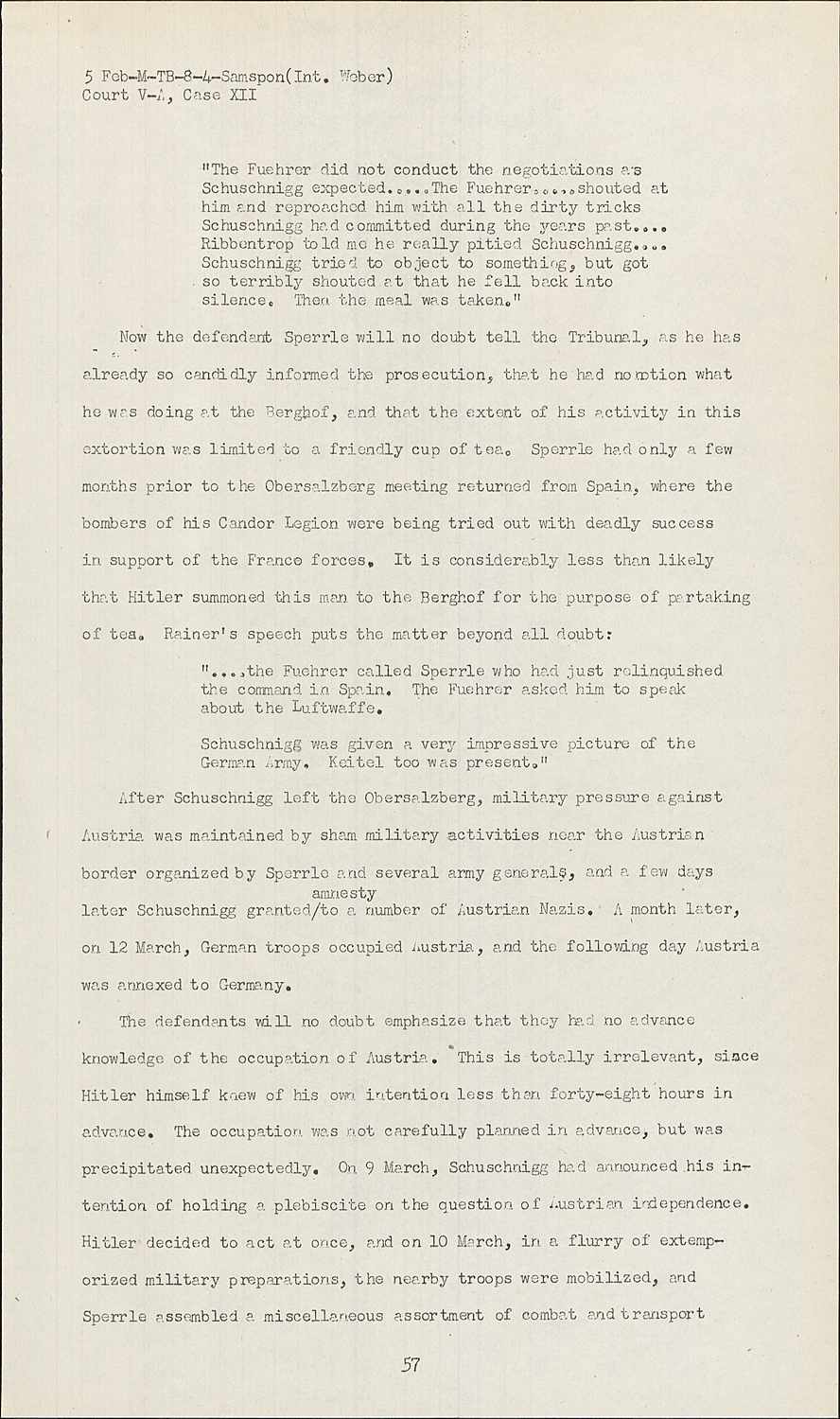
"The Fuehrer did not conduct the negotiations as Schuschnigg expected.
....The Fuehrer.....shouted at him and reproached him with all the dirty tricks Schuschnigg had committed during the years past.
...
Ribbentrop told me he really pitied Schuschnigg....
Schuschnigg tried to object to something, but got so terribly shouted at that he fell back into silence.
Then the meal was taken."
Now the defendant Sperrle will no doubt tell the Tribunal, as he has already so candidly informed the prosecution, that he had notation what he was doing at the Berghof, and that the extent of his activity in this extortion was limited to a friendly cup of tea. Sperrle had only a few months prior to the Obersalzberg meeting returned from Spain, where the bombers of his Candor Legion were being tried out with deadly success in support of the Franco forces. It is considerably less than likely that Hitler summoned this man to the Berghof for the purpose of partaking of tea. Rainer's speech puts the matter beyond all doubt:
"....the Fuehrer called Sperrle who had just relinquished the command in Spain.
The Fuehrer asked him to speak about the Luftwaffe.
Schuschnigg was given a very impressive picture of the German Army.
Keitel too was present."
After Schuschnigg left the Obersalzberg, military pressure against Austria was maintained by sham military activities near the Austrian border organized by Sperrle and several army generals, and a few days amnesty later Schuschnigg granted/to a number of Austrian Nazis.
A month later, on 12 March, German troops occupied Austria, and the following day Austria was annexed to Germany.
The defendants will no doubt emphasize that they had no advance knowledge of the occupation of Austria. This is totally irrelevant, since Hitler himself knew of his own intention less than forty-eight hours in advance. The occupation was not carefully planned in advance, but was precipitated unexpectedly. On 9 March, Schuschnigg had announced his intention of holding a plebiscite on the question of Austrian independence. Hitler decided to act at once, and on 10 March, in a flurry of extemporized military preparations, the nearby troops were mobilized, and Sperrle assembled a miscellaneous assortment of combat and transport planes at airports in Bavaria.
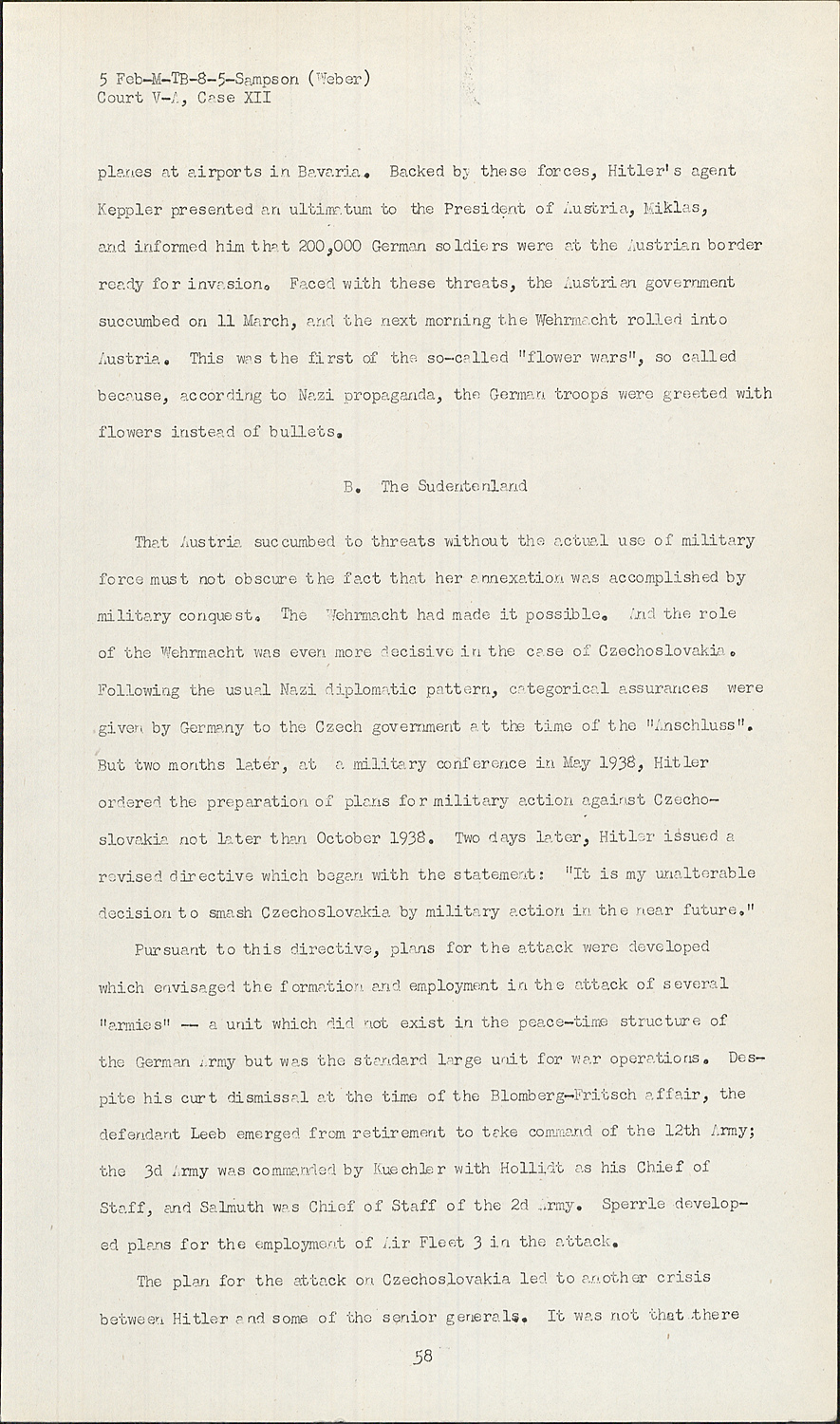
Backed by these forces, Hitler's agent Keppler presented an ultimatum to the President of Austria, Miklas, and informed him that 200,000 German soldiers were at the Austrian border ready for invasion. Faced with these threats, the Austrian government succumbed on 11 March, and the next morning the Wehrmacht rolled into Austria. This was the first of the so-celled "flower wars", so called because, according to Nazi propaganda, the German troops were greeted with flowers instead of bullets.
B. The Sudentenland That Austria, succumbed to threats without the actual use of military force must not obscure the fact that her annexation was accomplished by military conquest.
The Wehrmacht had made it possible. And the role of the Wehrmacht was even more decisive in the case of Czechoslovakia. Following the usual Nazi diplomatic pattern, categorical assurances were given by Germany to the Czech government at the time of the "Anschluss". But two months later, at a military conference in May 1938, Hitler ordered the preparation of plans for military action against Czechoslovakia not later than October 1938. Two days later, Hitler issued a revised directive which began with the statement: "It is my unalterable decision to smash Czechoslovakia by military action in the near future."
Pursuant to this directive, plans for the attack were developed which envisaged the formation and employment in the attack of several "armies" -- a unit which did not exist in the peace-time structure of the German Army but was the standard large unit for war operations. Despite his curt dismissal at the time of the Blomberg-Fritsch affair, the defendant Leeb emerged from retirement to take command of the 12th Army; the 3d Army was commanded by Kuechler with Hollidt as his Chief of Staff, and Salmuth was Chief of Staff of the 2d Army. Sperrle developed plans for the employment of Air Fleet 3 in the attack.
The plan for the attack on Czechoslovakia led to another crisis between Hitler and some of the senior generals. It was not that there was any disagreement with the objective of conquest of Czechoslovakia or any doubt about theability of the German Army to do this; once again, it was entirely a question of timing.
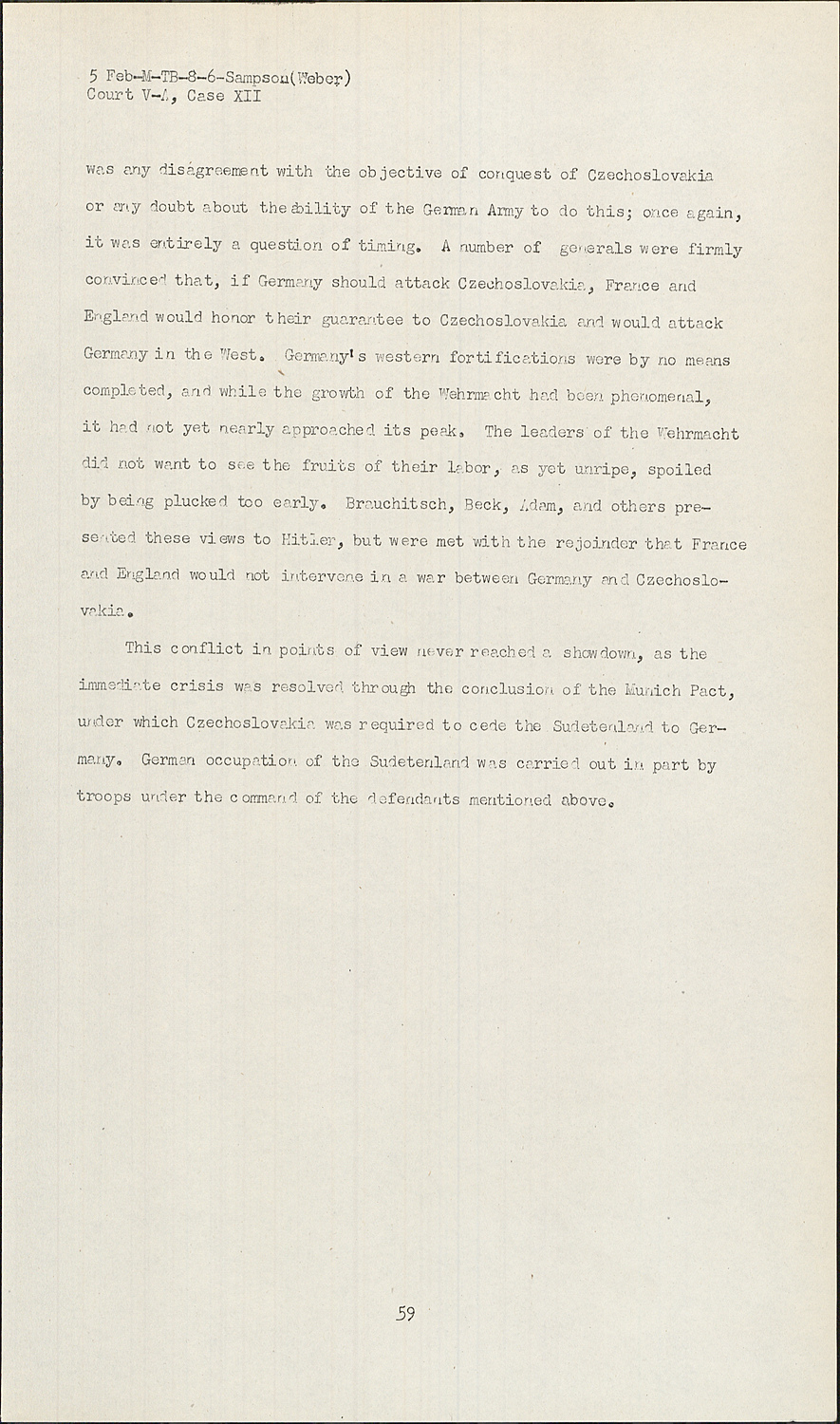
A number of generals were firmly convinced that, if Germany should attack Czechoslovakia, France and England would honor their guarantee to Czechoslovakia and would attack Germany in the West. Germany's western fortifications were by no means completed, and while the growth of the Wehrmacht had been phenomenal, it had not yet nearly approached its peak. The leaders of the Wehrmacht did not want to see the fruits of their labor, as yet unripe, spoiled by being plucked too early. Brauchitsch, Beck, Adam, and others preseated these views to Hitler, but were met with the rejoinder that France and England would not intervene in a war between Germany and Czechoslovakia.
This conflict in points of view never reached a showdown, as the immediate crisis was resolved through the conclusion of the Munich Pact, under which Czechoslovakia was required to cede the Sudetenland to Germany. German occupation of the Sudetenland was carried out in part by troops under the command of the defendants mentioned above.
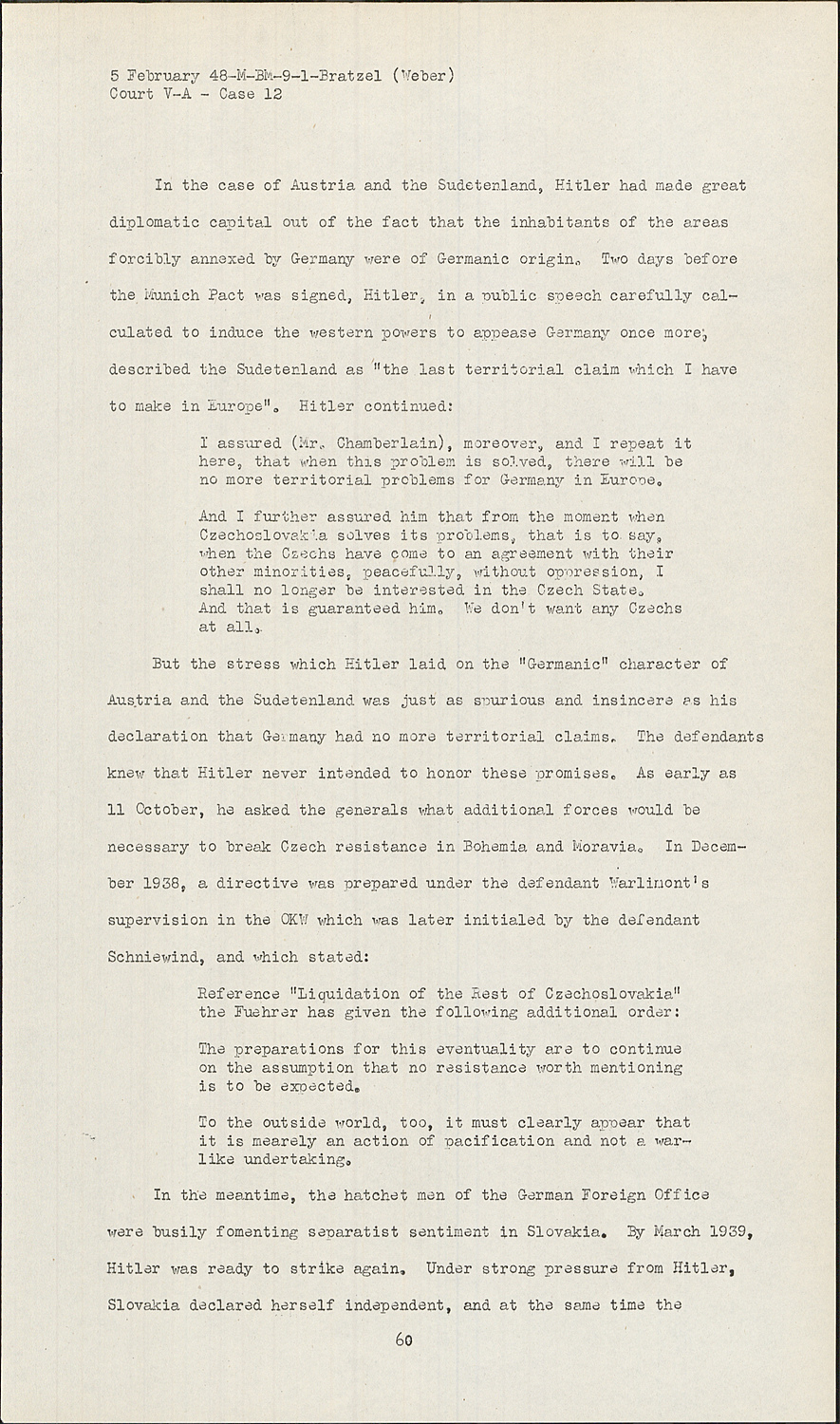
In the case of Austria and the Sudetenland, Hitler had made great diplomatic capital out of the fact that the inhabitants of the areas forcibly annexed by Germany were of Germanic origin. Two days before the Munich Pact was signed, Hitler, in a public speech carefully calculated to induce the western powers to appease Germany once more; described the Sudetenland as "the last territorial claim which I have to make in Europe". Hitler continued:
I assured (Mr. Chamberlain), moreover, and I repeat it here, that when this problem is solved, there will be no more territorial problems for Germany in Europe.
And I further assured him that from the moment when Czechoslovakia solves its problems, that is to say, when the Czechs have come to an agreement with their other minorities, peacefully, without oppression, I shall no longer be interested in the Czech State.
And that is guaranteed him. We don't want any Czechs at all.
But the stress which Hitler laid on the "Germanic" character of Austria and the Sudetenland was just as spurious and insincere as his declaration that Germany had no more territorial claims. The defendants knew that Hitler never intended to honor these promises. As early as 11 October, he asked the generals what additional forces would be necessary to break Czech resistance in Bohemia and Moravia. In December 1938, a directive was prepared under the defendant Warlimont's supervision in the OKW which was later initialed by the defendant Schniewind, and which stated:
Reference "Liquidation of the Rest of Czechoslovakia" the Fuehrer has given the following additional order:
The preparations for this eventuality are to continue on the assumption that no resistance worth mentioning is to be expected.
To the outside world, too, it must clearly apoear that it is mearely an action of pacification and not a war like undertaking.
In the meantime, the hatchet men of the German Foreign Office were busily fomenting separatist sentiment in Slovakia. By March 1939, Hitler was ready to strike again. Under strong pressure from Hitler, Slovakia declared herself independent, and at the same time the President of Czechoslovakia, Hacha, was summoned to Berlin and, in the presence of Goering and Keitel, was threatened with immediate invasion and the destruction of Prague from the air by the planes of Sperrle's Luftflotte.