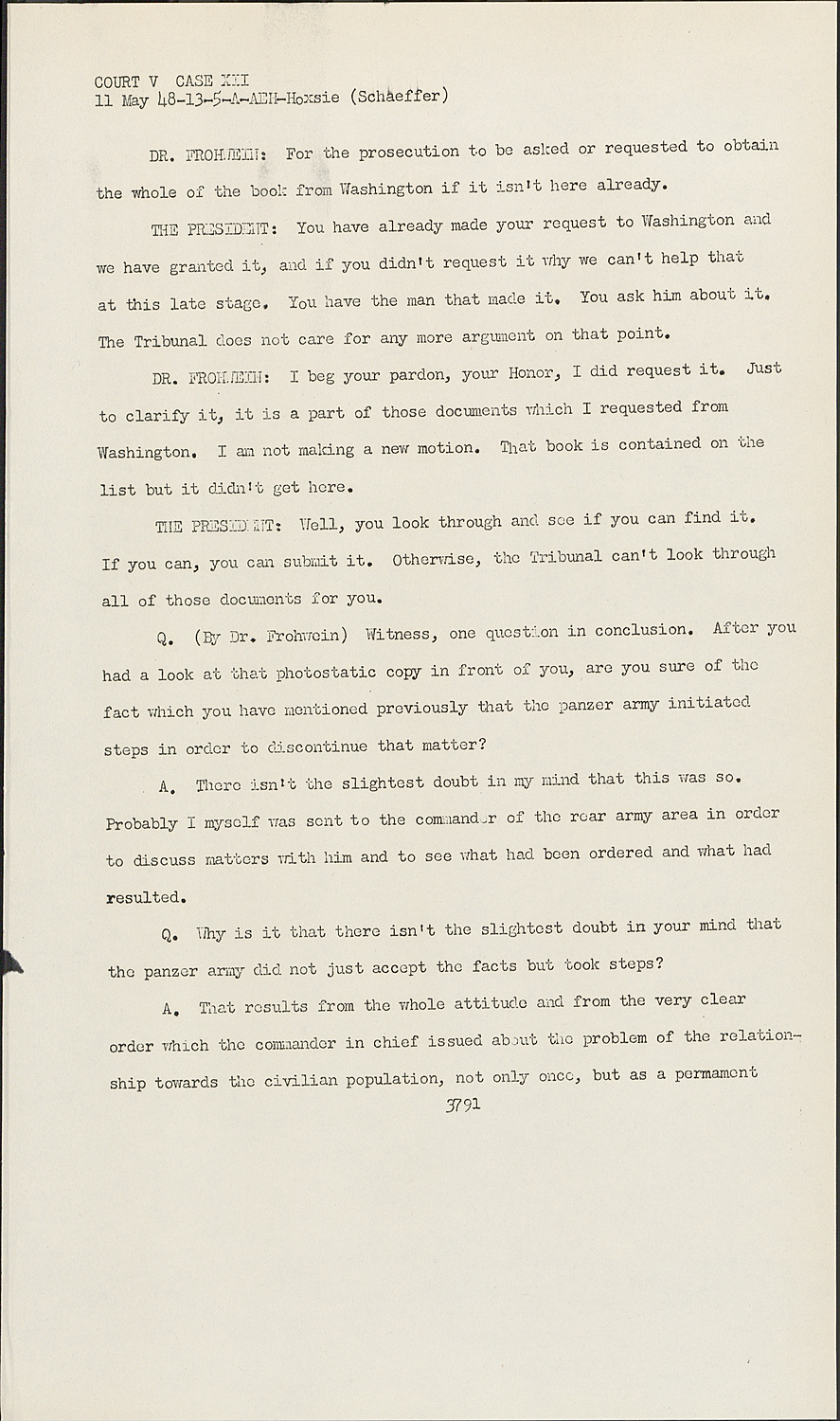
DR. FROHWEIN:For the prosecution to be asked or requested to obtain the whole of the book from Washington if it isn't here already.
THE PRESIDENT:You have already made your request to Washington and we have granted it, and if you didn't request it why we can't help that at this late stage. You have the man that made it. You ask him about it. The Tribunal does not care for any more argument on that point.
DR. FROHWEIN:I beg your pardon, your Honor, I did request it. Just to clarify it, it is a part of those documents which I requested from Washington. I am not making a new motion. That book is contained on the list but it didn't get here.
THE PRESIDENT:Well, you look through and see if you can find it. If you can, you can submit it. Otherwise, the Tribunal can't look through all of those documents for you.
Q. (By Dr. Frohwein) Witness, one question in conclusion. After you had a look at that photostatic copy in front of you, are you sure of the fact which you have mentioned previously that the panzer army initiated steps in order to discontinue that matter?
A.There isn't the slightest doubt in my mind that this was so. Probably I myself was sent to the commander of the rear army area in order to discuss matters with him and to see what had been ordered and what had resulted.
Q.Why is it that there isn't the slightest doubt in your mind that the panzer army did not just accept the facts but took steps?
A.That results from the whole attitude and from the very clear order which the commander in chief issued about the problem of the relationship towards the civilian population, not only once, but as a permament COURT V CASE XII directive.

It was the simple result that such measures in the final analysis will cost German soldiers' blood. We did not want to continue to send the civilian population into the bandits' arms.
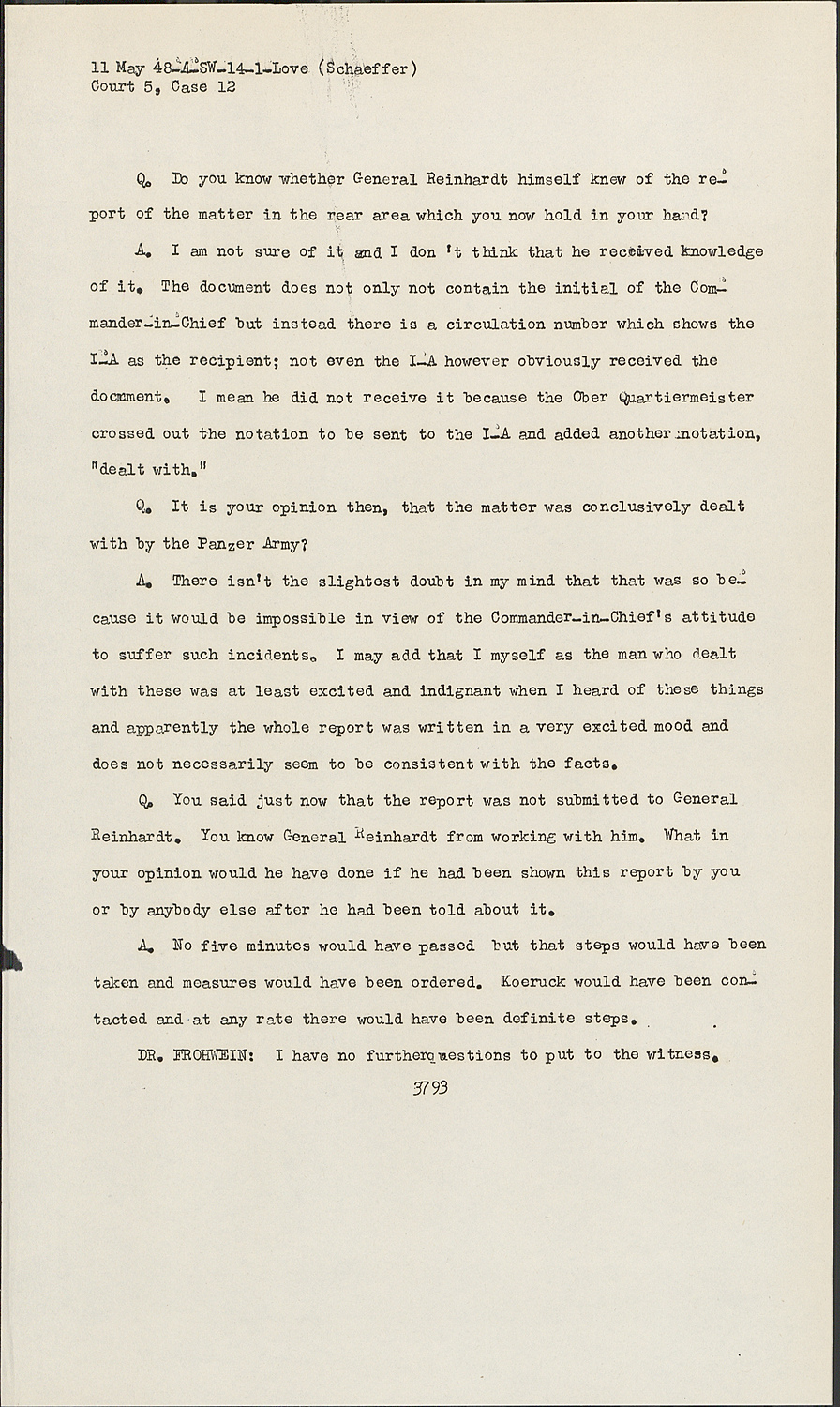
Q.Do you know whether General Reinhardt himself knew of the report of the matter in the rear area which you now hold in your hand?
A.I am not sure of it and I don 't think that he received knowledge of it. The document does not only not contain the initial of the Commander-in-Chief but instead there is a circulation number which shows the I-A as the recipient; not even the I-A however obviously received the document. I mean he did not receive it because the Ober Quartiermeister crossed out the notation to be sent to the I-A and added another notation, "dealt with."
Q.It is your opinion then, that the matter was conclusively dealt with by the Panzer Army?
A.There isn't the slightest doubt in my mind that that was so because it would be impossible in view of the Commander-in-Chief's attitude to suffer such incidents. I may add that I myself as the man who dealt with these was at least excited and indignant when I heard of these things and apparently the whole report was written in a very excited mood and does not necessarily seem to be consistent with the facts.
Q.You said just now that the report was not submitted to General Reinhardt. You know General Reinhardt from working with him. What in your opinion would he have done if he had been shown this report by you or by anybody else after he had been told about it.
A.No five minutes would have passed but that steps would have been taken and measures would have been ordered. Koeruck would have been contacted and at any rate there would have been definite steps.
DR. FROHWEIN:I have no furtherquestions to put to the witness.
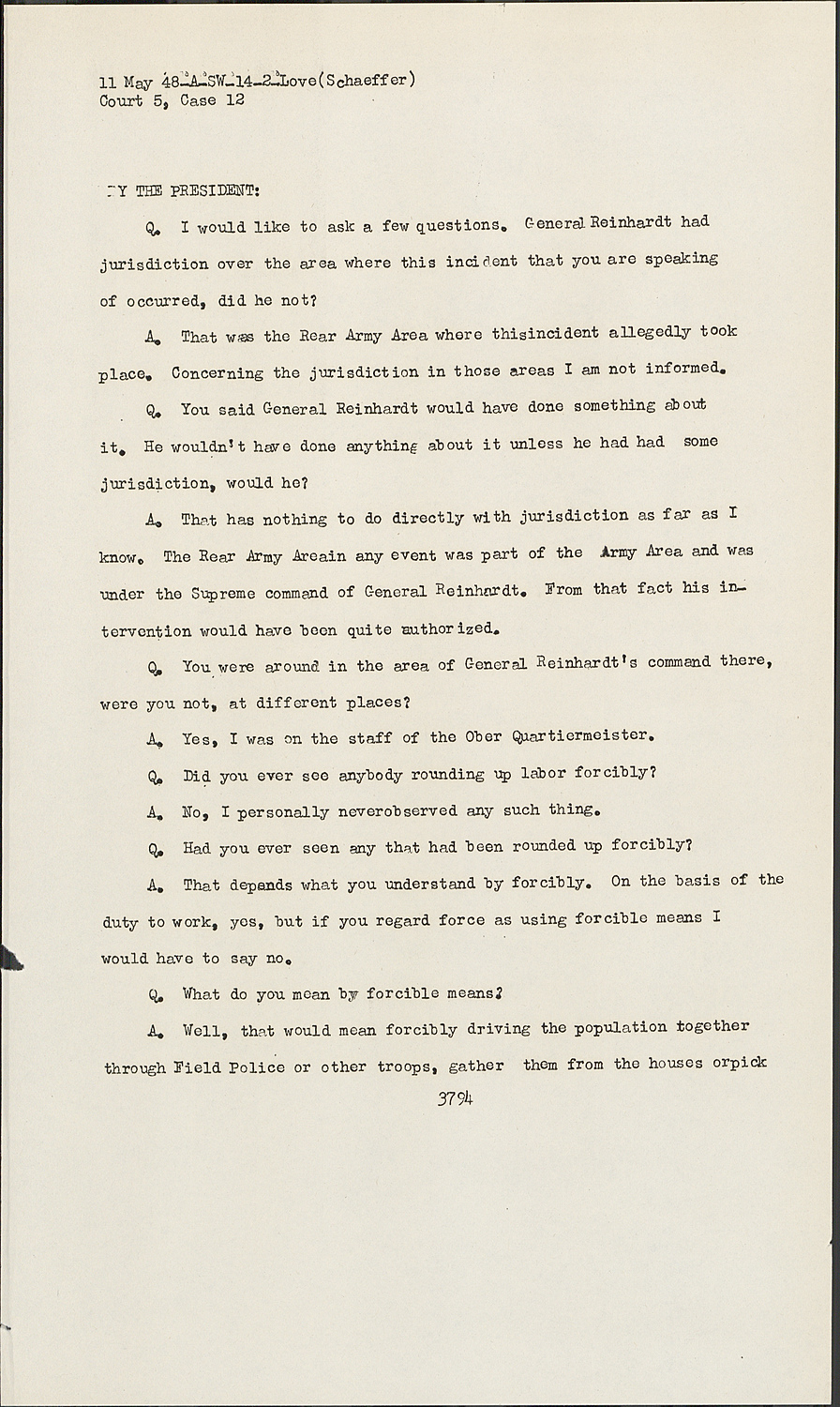
BY THE PRESIDENT:
Q.I would like to ask a few questions. General Reinhardt had jurisdiction over the area where this incident that you are speaking of occurred, did he not?
A.That was the Rear Army Area where thisincident allegedly took place. Concerning the jurisdiction in those areas I am not informed.
Q.You said General Reinhardt would have done something about it. He wouldn't have done anything about it unless he had had some jurisdiction, would he?
A.That has nothing to do directly with jurisdiction as far as I know. The Rear Army Areain any event was part of the Army Area and was under the Supreme command of General Reinhardt. From that fact his intervention would have been quite authorized.
Q.You were around in the area of General Reinhardt's command there, were you not, at different places?
A.Yes, I was on the staff of the Ober Quartiermeister.
Q.Did you ever see anybody rounding up labor forcibly?
A.No, I personally neverobserved any such thing.
Q.Had you ever seen any that had been rounded up forcibly?
A.That depends what you understand by forcibly. On the basis of the duty to work, yes, but if you regard force as using forcible means I would have to say no.
Q.What do you mean by forcible means?
A.Well, that would mean forcibly driving the population together through Field Police or other troops, gather them from the houses orpick them up in the streets and commit them for labor.
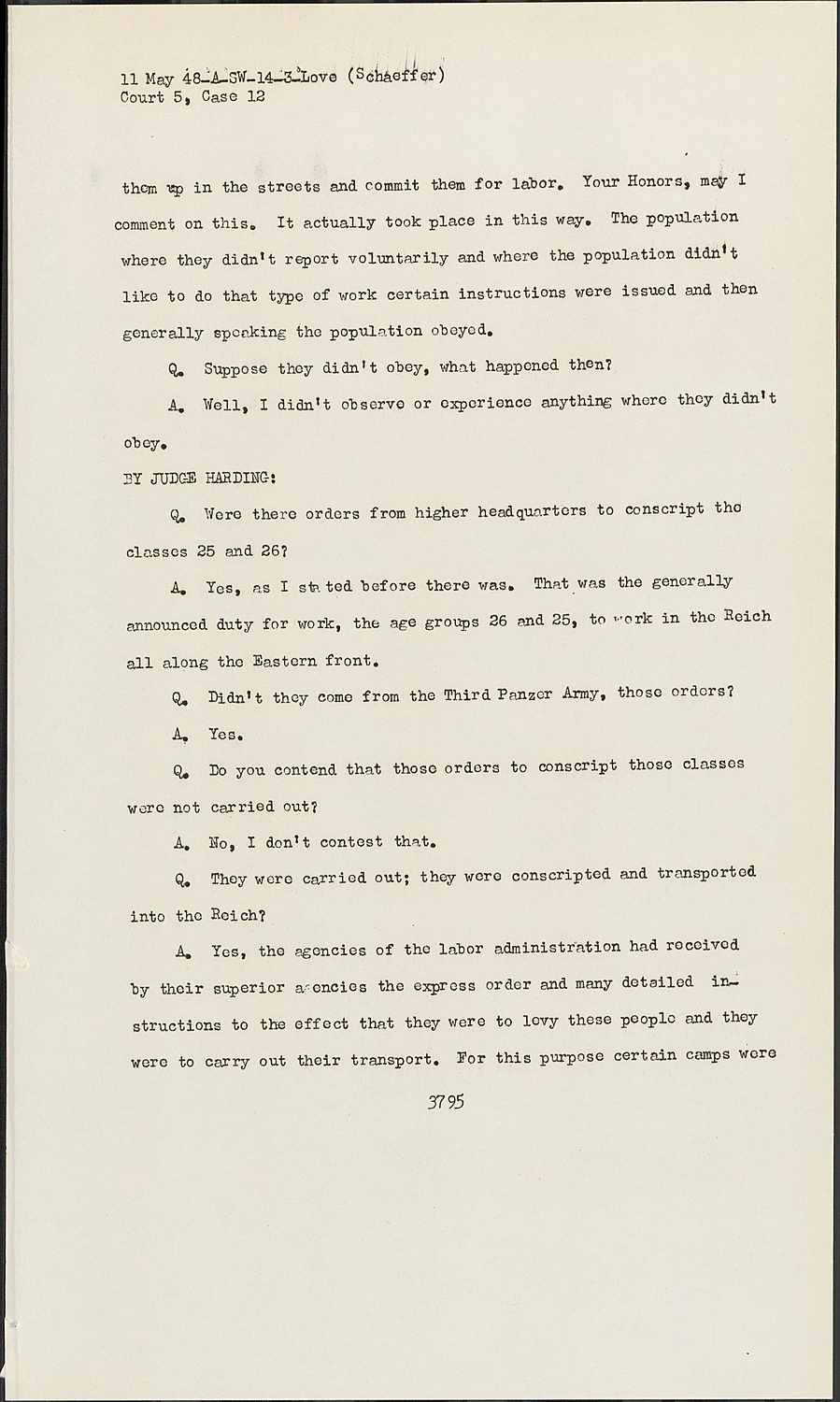
Your Honors, may I comment on this. It actually took place in this way. The population where they didn't report voluntarily and where the population didn't like to do that type of work certain instructions were issued and then generally speaking the population obeyed.
Q.Suppose they didn't obey, what happened then?
A.Well, I didn't observe or experience anything where they didn't obey. BY JUDGE HARDING:
Q.Were there orders from higher headquarters to conscript the classes 25 and 26?
A.Yes, as I stated before there was. That was the generally announced duty for work, the age groups 26 and 25, to work in the Reich all along the Eastern front.
Q.Didn't they come from the Third Panzer Army, those orders?
A.Yes.
Q.Do you contend that those orders to conscript those classes were not carried out?
A.No, I don't contest that.
Q.They were carried out; they were conscripted and transported into the Reich?
A.Yes, the agencies of the labor administration to had recived by their superior agencies the express order and many detailed instruction to the effect that they were to levy these people and they were to carry out their transport. For this purpose certain camps were installed, labor exchanges, etc.
That took place before my eyes I would say.
Q.And that was done regardless of whether these people wanted to go to the Reich or not?
A.I beg your pardon.
Q.They were taken to the Reich regardless of whether or not they wanted to go.
A.It was their duty and this duty had been announced for these age groups and it was not dependent upon their own free will whether they went.
JUDGE HARDING:That's all.
THE PRESIDENT:Any other direct? You may cross examine.
CROSS EXAMINATION BY MR. NIEDERMAN:
Q.Witness, I show you a duty roster of the 3rd Panzer Army, your Army and show you the column with your name on it. This has not been offered in evidence as yet. It is identified as NOKW 3342. That is on page 18 of the English, 17 of the original. Under QU 2 you see the first entry on that page that I have just given to you; you needn't bother to turn the pages; it has just been given to you at that page.
DR. FROHWEIN:I beg your pardon, couldn't the defense also get a copy. The witness has a photostat; the Tribunal has a copy in English, but the defense has neither the German nor the English.
MR. NIEDERMAN:I was just going to ask him about the first item.
If you will look at it it has four words in it and that is the entire question.
THE PRESIDENT:You can read the photostat. Do you have a German translation.
MR. NIEDERMAN:I don't have a mimeograph copy of this photostat.
THE PRESIDENT:You look at the photostat, Dr. Frohwein. BY MR. NIEDERMAN:
Q.Is not the first item there under your name supervisor of the Army Rear Area?
A.It means the sub division of the Rear Army Area.
Q.I hog your pardon, sub division of the Rear Army Area. And, what does that mean?
A.May I ask you under what date that entry is entered. I couldn't recognize it here because I wouldn't really know what I had to do with a sub division of the Rear Army Area in actual fact. Was it in an administrative sub division? I don't quite know what it means. Such a duty roster is usually just put down on paper but if I could find the date it would make it easier for me to comment.
Q.The date I might point out to you on the front of the document is 12 October 1943. However, your answer is you don't know and so we will pass to the next question. Did you not yourself sign a report stating that 50 per cent of the population were escaping conscription by way of joining the partisans?
A.May I see that document. It is quite thinkable I did sign it.
Q.You recall signing such a report?
A.No, I don't happen to remember it but it is quite possible I did.
Q.I will show it to you. Document NOKW 2336, Exhibit 491, Book 7-?A, page 233, the German 7-C at page 20.
A.I see it is 4 August 1941.
Q. 1943, I believe.
A. 1943, yes.
Q.You notice in the middle of the page in some areas about -
A.I beg your pardon I have quite followed.
Q.Let me direct yourattention to the middle of the page, "in some areas about 50 percent of the persons -
A.I beg your pardon I have to read the whole thing in its context.
Q.It is a long document, witness; perhaps we can save you time.
A.Yes, it id long but it is most important that I read it because immediately before the sentence which you marked it says, "The first Eastern workers for the Reich have been Conducted to the camps which take care of them without any coercive measures having to be used. In some districts," - and now comes a sentence which you underlined -
Q.Will you read it.
A.Yes, I am about to read it. "In some districts the conscripts are about 50 per cent of he persons who have escaped possibly by way of joining the bands. The atmosphere amongst the remaining in the camps is not bad."
Q.Witness, I don't want you to read the whole document. You will agree with me after reading that over your own signature you have admitted that at least 50 per cent of the population tried to evade this conscription, did they not?
A.In some communities that happened. They tried to evade and I assumed fromthe reports that they joined the bands but there is nothing further. On the contrary, here again the tendence of the Army before and after this sentence shows very clearly that the men were well taken care of and that such good care could turn the mood of the population and that the first Eastern workers went to the Reich without any undesirable measures having had to be applied. The document, I believe is quite consistent with what I said.
Q.I agree too. Now I am going to show you another document which is not yet in evidence, NOKW 2347. Now you will recall how disturbed you were for the month of November 1943. The Rear Area had attempted to press some people into work. Now here is a report from the 3rd Panzer Army QU 26 which is your section, reporting for the month of Novemher. I would like to direct your attention to under I, the Political Situation.
A.I am just about to read it.
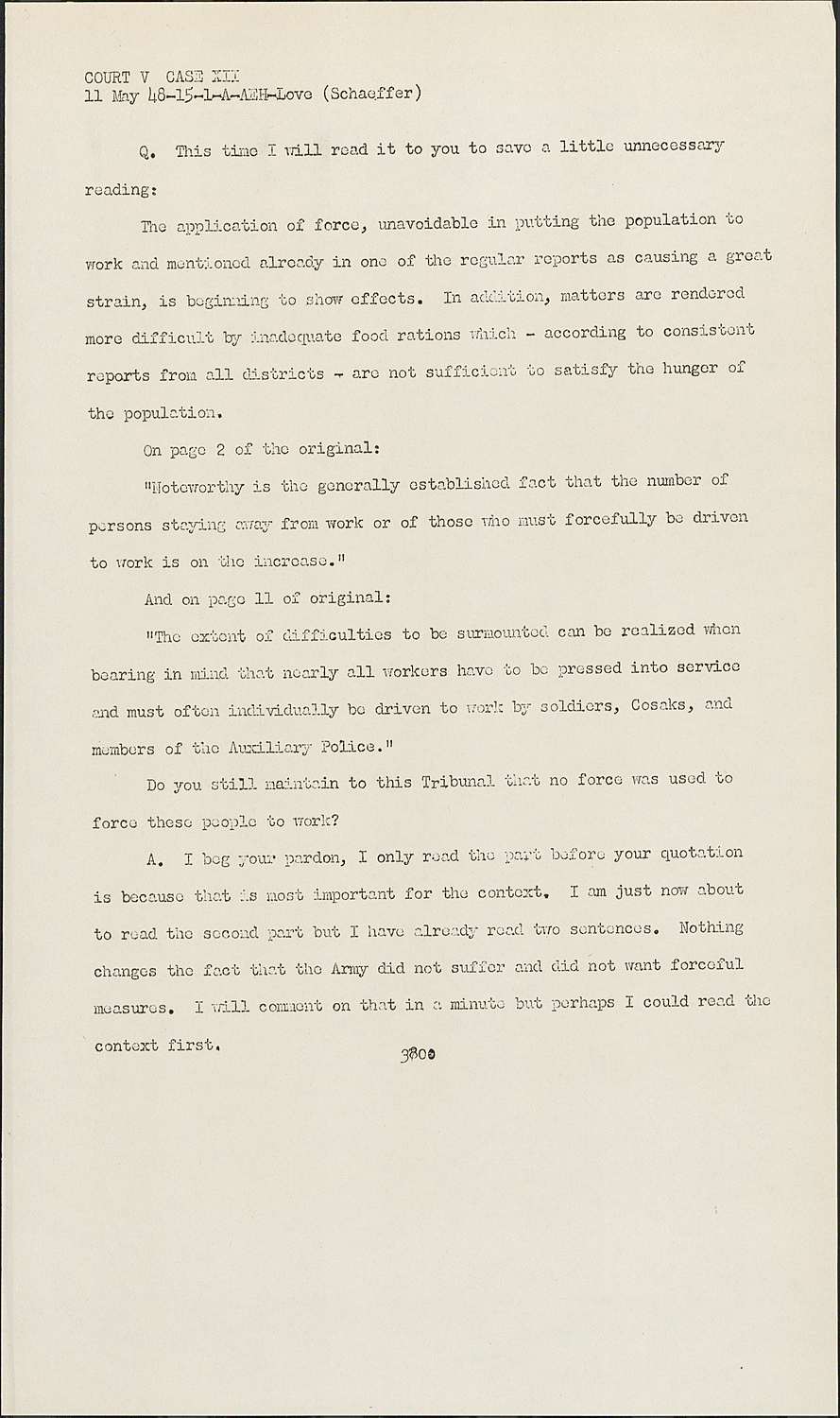
Q.This time I will read it to you to save a little unnecessary reading:
The application of force, unavoidable in putting the population to work and mentioned already in one of the regular reports as causing a great strain, is beginning to show effects. In addition, matters are rendered more difficult by inadequate food rations which - according to consistent reports from all districts - are not sufficient to satisfy the hunger of the population.
On page 2 of the original:
"Noteworthy is the generally established fact that the number of persons staying away from work or of those who must forcefully be driven to work is on the increase."
And on page 11 of original:
"The extent of difficulties to be surmounted can be realized when bearing in mind that nearly all workers have to be pressed into service and must often individually be driven to work by soldiers, Cosaks, and members of the Auxiliary Police."
Do you still maintain to this Tribunal that no force was used to force these people to work?
A.I beg your pardon, I only read the part before your quotation is because that is most important for the context. I am just now about to read the second part but I have already read two sentences. Nothing changes the fact that the Army did not suffer and did not want forceful measures. I will comment on that in a minute but perhaps I could read the context first.
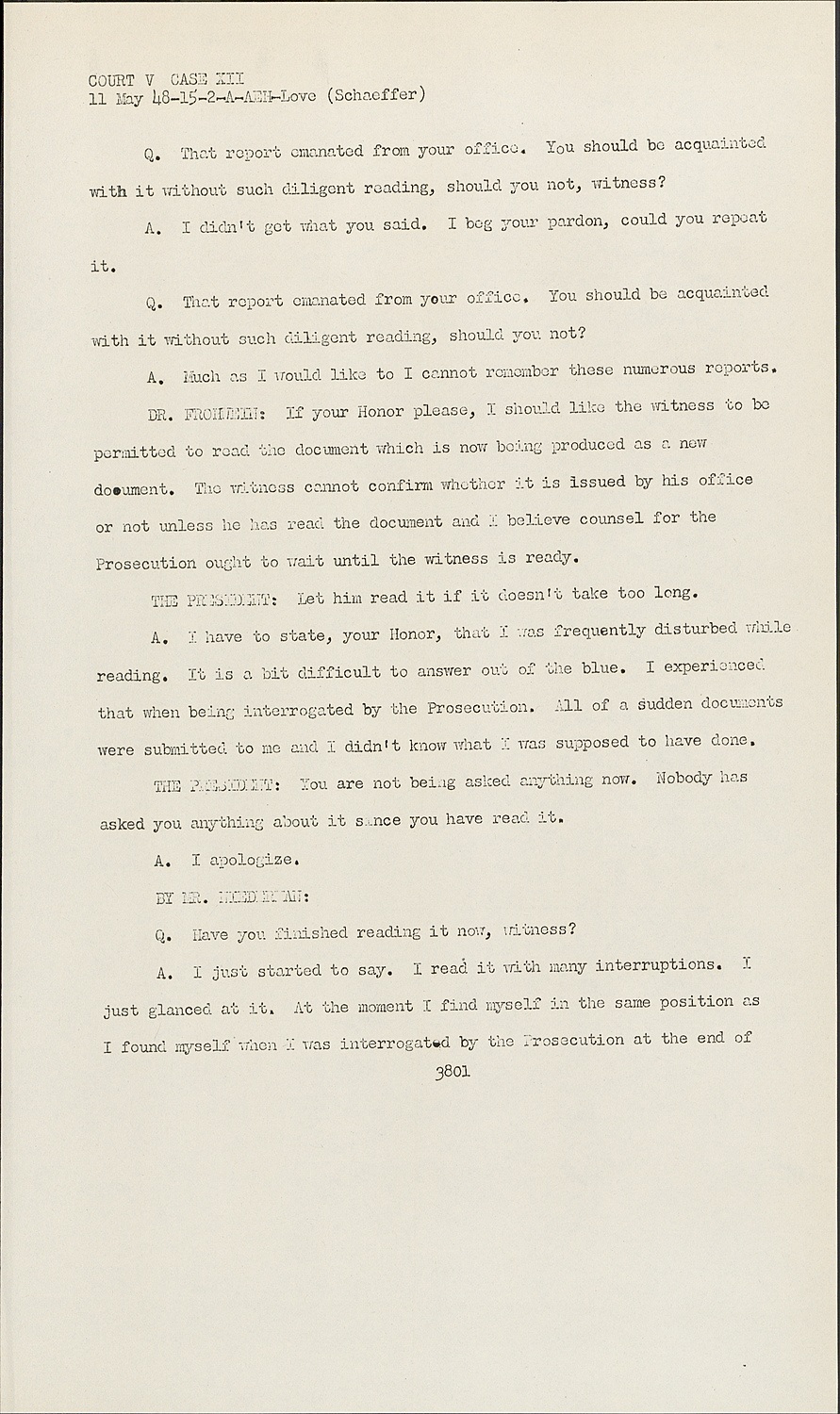
Q.That report emanated from your office. You should be acquainted with it without such diligent reading, should you not, witness?
A.I didn't get what you said. I beg your pardon, could you repeat it.
Q.That report emanated from your office. You should be acquainted with it without such diligent reading, should you not?
A.Much as I would like to I cannot remember these numerous reports.
DR. FROHWEIN:If your Honor please, I should like the witness to be permitted to read the document which is now being produced as a new document. The witness cannot confirm whether it is issued by his office or not unless he has read the document and I believe counsel for the Prosecution ought to wait until the witness is ready.
THE PRESIDENT:Let him read it if it doesn't take too long.
A.I have to state, your Honor, that I was frequently disturbed while reading. It is a bit difficult to answer out of the blue. I experienced that when being interrogated by the Prosecution. All of a sudden documents were submitted to me and I didn't know what I was supposed to have done.
THE PRESIDENT:You are not being asked anything now. Nobody has asked you anything about it since you have read it.
A.I apologize.
By MR. NIEDNRMAN:
Q.Have you finished reading it now, witness?
A.I just started to say. I read it with many interruptions. I just glanced at it. At the moment I find myself in the same position as I found myself when I was interrogated by the Prosecution at the end of COURT V CASE XII January.
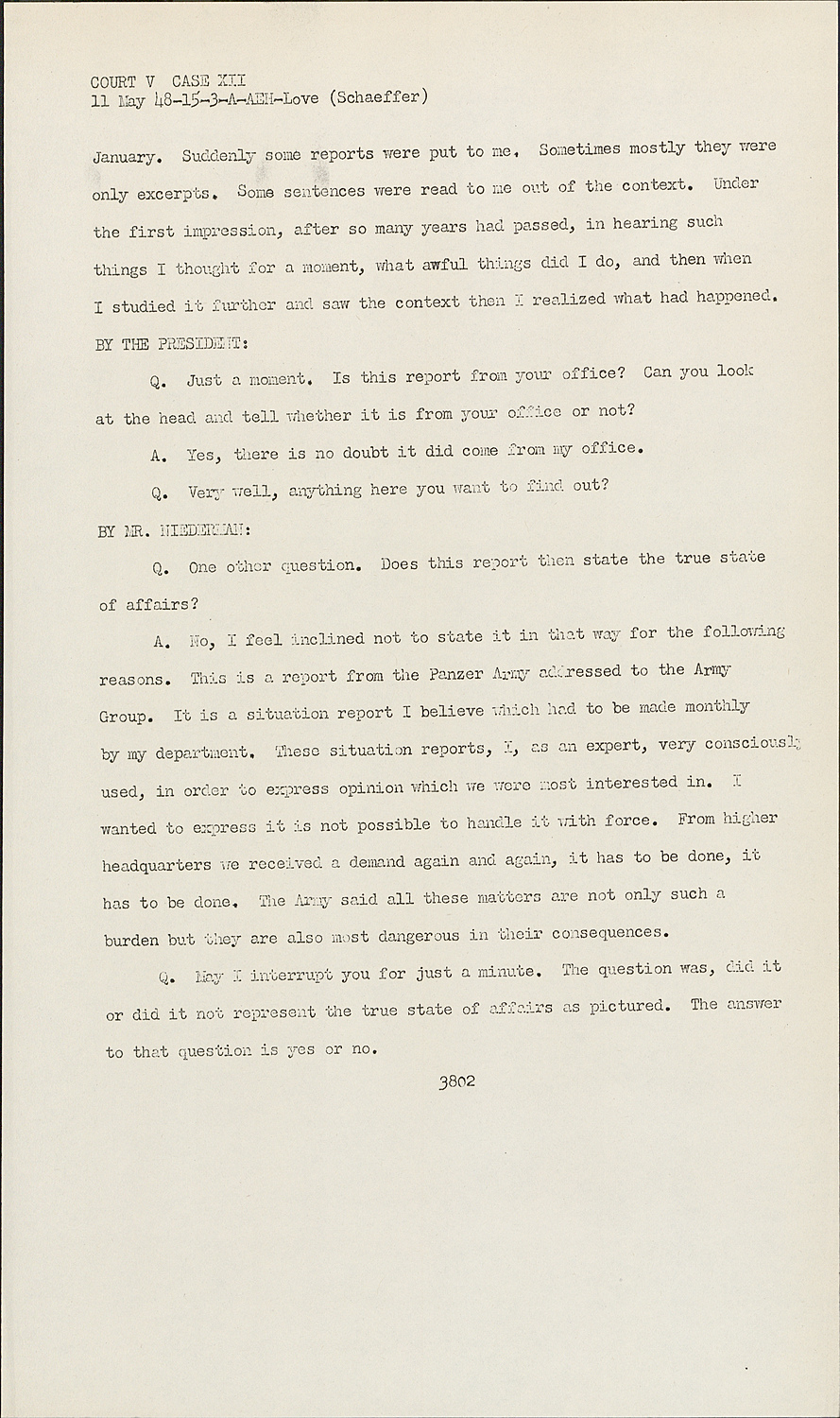
Suddenly some reports were put to me. Sometimes mostly they were only excerpts. Some sentences were read to me out of the context. Under the first impression, after so many years had passed, in hearing such things I thought for a moment, what awful things did I do, and then when I studied it further and saw the context then I realized what had happened. BY THE PRESIDENT:
Q.Just a moment. Is this report from your office? Can you look at the head and tell whether it is from your office or not?
A.Yes, there is no doubt it did come from my office.
Q.Very well, anything here you want to find out? BY MR. NIEDERMAN:
Q.One other question. Does this report then state the true state of affairs?
A.No, I feel inclined not to state it in that way for the following reasons. This is a report from the Panzer Army addressed to the Army Group. It is a situation report I believe which had to be made monthly by my department. These situation reports, I, as an expert, very consciously used, in order to express opinion which we were most interested in. I wanted to express it is not possible to handle it with force. From higher headquarters we received a demand again and again, it has to be done, it has to be done. The Army said all these matters are not only such a burden but they are also most dangerous in their consequences.
Q.May I interrupt you for just a minute. The question was, did it or did it not represent the true state of affairs as pictured. The answer to that question is yes or no.
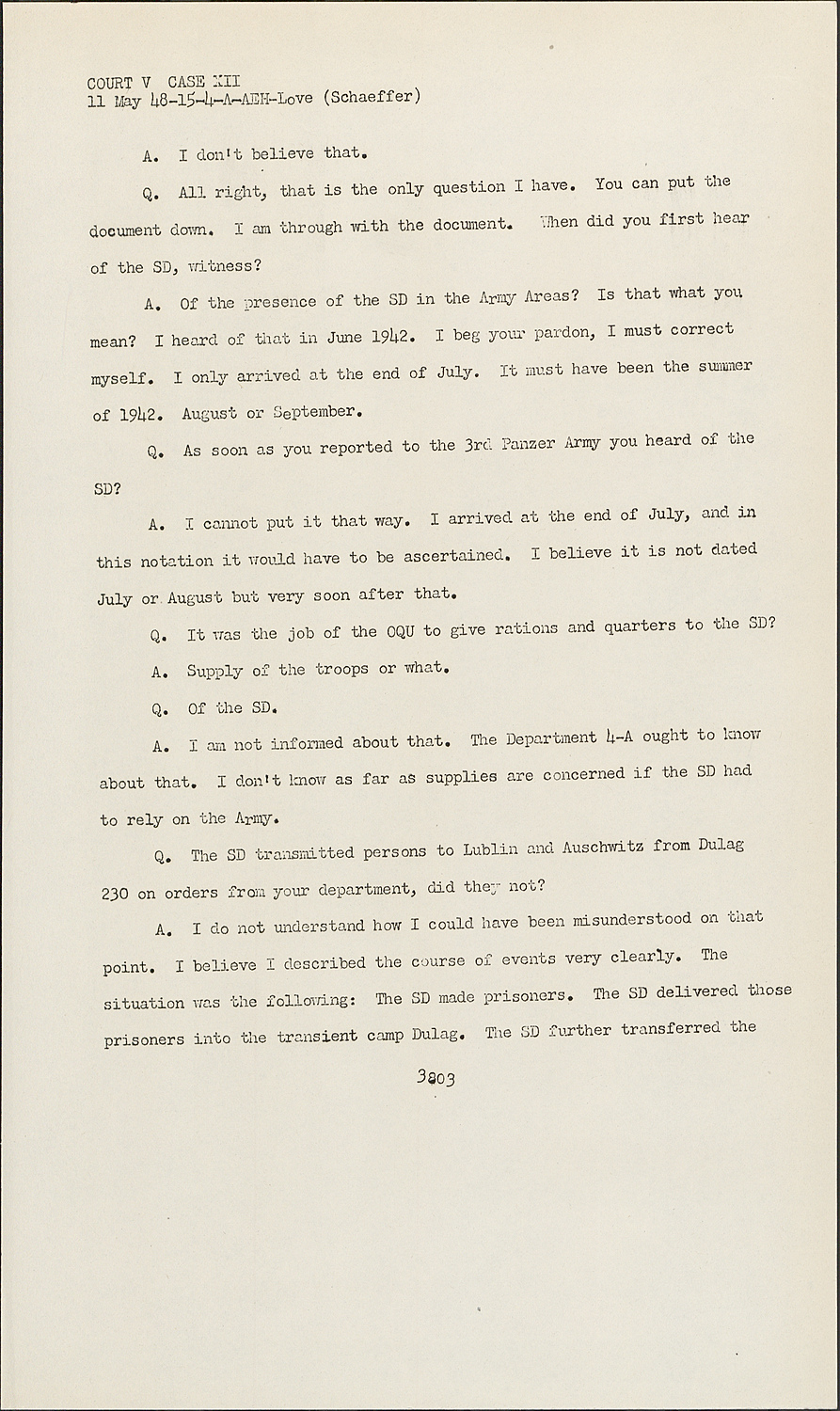
A.I don't believe that.
Q.All rights that is the only question I have. You can put the document down. I am through with the document. When did you first hear of the SD, witness?
A.Of the presence of the SD in the Army Areas? Is that what you mean? I heard of that in June 1942. I beg your pardon, I must correct myself. I only arrived at the end of July. It must have been the summer of 1942. August or September.
Q.As soon as you reported to the 3rd Panzer Army you heard of the SD?
A.I cannot put it that way. I arrived at the end of July, and in this notation it would have to be ascertained. I believe it is not dated July or August but very soon after that.
Q.It was the job of the OQU to give rations and quarters to the SD?
A.Supply of the troops or what.
Q.Of the SD.
A.I am not informed about that. The Department 4-A ought to know about that. I don't know as far as supplies are concerned if the SD had to rely on the Army.
Q.The SD transmitted persons to Lublin and Auschwitz from Dulag 230 on orders from your department, did they not?
A.I do not understand how I could have been misunderstood on that point. I believe I described the course of events very clearly. The situation was the following: The SD made prisoners. The SD delivered those prisoners into the transient camp Dulag. The SD further transferred the COURT V CASE XII prisoners from the transient camp to Lublin and Auschwitz.
We were called on the telephone by the SD in order to mediate a transportation matter, and passed on this request and of the SD to the agency which was dealing with transportation.
Q.Witness, can you confine yourself, please, to answering my question. The question is, did the SD on your order transmit to Lublin and Auschwitz persons from Dulag 230?
A.No.
Q.I show you document NOKW 2332 which is Exhibit 657, Book 9-C, page 276, the German page 533. Witness, you will notice that is an order from your department ordering the transfer of band persons and persons suspected of band activity to concentration camps. That order emanated from your department, did it not?
A.Is that a question? I answered the question in the negative as well as the previous one. The document does not show that the Army ordered band suspects to be sent to Lublin or Auschwitz.
Q.Did this order before you emanate from your department?
A.I don't even know whether it is in order or what it is since the distribution is unfortunately not on the document. It seems to me that it is a survey about the technical causes of the transportation.
Q.Witness, did this document before you emanate from your department
A.OQU 2. There can be no doubt that it did.
QDid you not in an affidavit state it was necessary for the SD to procure through you a priority before they could ship any prisoners any where?
AI do not know whether the translation is correct. It says here something about priority. If I recollect the interrogation by the Prosecution correctly, you mean the priority lists which were later on installed.
QThat is correct.
AShould I answer that?
QYes, that is correct.
AThe SD, and I said that earlier, had in order to get transportation space to have a transportation number assigned to it by the VBTO. Later on when the front started moving -
THE PRESIDENT:You told us about that twice, witness.
AYes. I am talking now about the priority in this connection; I will come to deal with these movements. When the front started moving and objects and human beings had to be transported to and from the rear area, not everything could be coped with by the VBTO; the QQ started the method of the priority list; and there in a certain sequence was kept from case to case for those goods or human beings who had a transportation number assigned to come through because the VBTO could not judge that.
QAnd then after the fall of 1943, approximately, it was necessary to get a priority from your department before there could be any shipments by the SD of prisoners; is that right?
ANo. No priority list was made out; the QQ-II or the man who worked for him, the Q-II, had a piece of paper and that stated one, two or three certain items, and he told the VBTO in that sequence when things will have to be arranged; certain things are to be later and certain things transported first.
QThat is what I want to know. Now, one more question. Do you recall when Sturmbannfuehrer Feibeck requested from you a flame thrower?
ANo. I don't remember that case; as, I told the Prosecution at the time.
QYou have no recollection even though it's in this QQ-II diary of yours.
AYes. There are many number of things which are contained in that and which I do not remember. When the Prosecution in January read this note to me, and submitted it to me, I said: well, certainly, if it says so in the document, then it must be correct.
QWell, I have just finished reading an affidavit by Fischer who was propaganda company commander of the 3d Panzer Army, and states that Feibeck asked the army for a flame thrower to destroy corpses of Jews buried at Witebsk. You have no knowledge of that incident?
AAs I said earlier on, I cannot remember the details of that case, or rather, I can remember nothing but the note, the notation about the incident. I told the Prosecution at the time because at that time also the Prosecution put to me Fischer's statement. That this idea was not discussed with me is certain because if it had been the case, I don't think I would have forgotten about it.
MR. NIEDERMAN:There are no further questions.
THE PRESIDENT:Any redirect?
REDIRECT EXAMINATION BY DR. FROHWEIN:
QWitness, Judge Hale asked you about forcible coercive measures which were applied in conscripting the two age groups 25 and 26. I gained the impression that this subject matter is not completely clear yet. I should, therefore, like to ask you to once again clarify the difference for us which exists between the word which you used, force, on the one hand and the other term, legal duty, or legal force on the other hand. If you could perhaps make it once more quite clear to us what is meant by one measure and what is meant by the other.
AYes, certainly. When I talk about conscripting this manpower for labor, by way of duty, that a decree of legal validity was issued; and, this decree had to be obeyed, and, which, generally speaking was obeyed because the people in question were used to obeying. I remember very clearly, however, also for a large part, we adopted the method of: let's choose the smaller of the two evils. If we remained in the bandit area and in the operational area we will be in more danger than if we got shipped away. That a certain portion of the population did not obey the decree and would not obey the decree was accepted as a fact; it couldn't be prevented. Those who wanted to evade could do so just by hiding in the woods. That is one aspect. By force and coercive measures I meant during my examination here measures which resulted in delivering these people together and which took that as intention and meaning of the army order; if I may put it that way, brute force.
JUDGE HARDING:A question, if I may interrupt. How old were these age groups at that time; what was the age at that period of time of these age groups 25 and 26.
AEighteen years old; I believe it was in 1943, and, since it is 1925 they must have been eighteen years old.
JUDGE HARDING:That is, everybody that was born in the year 1925 and 1926 was included in these age groups.
AYes; however, according to labor commitment aspects that was a method of the labor administration which had to carry out the whole thing.
JUDGE HARDING:And this was the year 1943?
AI believe so. I haven't got a very good memory for dates, but I believe that is the right date; I believe it was 1943. BY DR. FROHWEIN:
QWitness, now let's supplement that factor. What German agencies were responsible for the labor commitment of the age groups born in 1925 and 1926, that is those who were conscripted by the legal decrees.
MR. NIEDERMAN:The Prosecution objects to this question. I believe that this is outside the scope of the cross examination.
THE PRESIDENT:Oh, let him answer it if he can. Tell him to answer if he can -- without making a speech.
QPlease answer the question briefly. What German agencies were responsible for the conscription of those two age groups, 1925 and 1926?
AThe labor commitment agencies which were under the jurisdiction of the army economic inspectorates.
QWere those agencies subordinate to the Panzer Army?
ANo.
QI now would like to discuss with you the two documents which the Prosecution put to you, Document NOKW-2336, Exhibit 491; German Document Book VII-C, page 21. I am afraid I couldn't follow when the English version was mentioned. Witness, your own QQ-II report was shown to you with the deduction that it revealed the application of force by the Panzer Army. I should like you to read a very few sentences now from the report itself which might throw a light on this question.
AThe first eastern workers for the Reich have been conducted to the camps which take care of them without any undesirable methods having to be applied. In some districts the conscripts, or 50 per cent of the conscripts have escaped, possibly by way of joining the bands. The atmosphere and morale amongst the remaining conscripts in the camps which take care of them is not bad. The good care and organization promises, as far as the army is concerned, advantageous results for propaganda, etc.
QThat is enough, thank you. In your opinion does that report reveal anything about coercive measures, the apllication of force, or doesn't it?
AYes, It reveals that no force was used.
QNow, I put to you the document newly submitted by the Prosecution, NOKW-2347; that has no exhibit number yet. It has been submitted for the same reason, namely, to prove that force was used by the panzer army. I should like to ask you to have a look at page 5 of that report; that is the German text, and, to announce to the Tribunal the most important sentences of that portion.
AThe recruiting of the quota of one thousand labor forces demanded from the army to be sent to the Reich has been carried out on a voluntary basis. However, only a certain percentage has been possible to conscript. Then, it goes on, but that is probably of no interest. It shows how many people have been conscripted so far. A forcible recruitment for the Reich, how that can be carried out in actual practice is incomprehensib to the army as well as to the economic staff.
QWhat does that last sentence say about coercive measures in the conscription of these people?
AWell, it says that it was incomprehensible to use force; at least it would have no success. If force had been applied they would always have been able to evade labor. It could only be done by treating these people well and by showing them goodwill.
QThe last document to discuss with you is one which the Counsel for the Prosecution has put to you, Document NOKW-2332, contained in German Document Book IX-C, on page 533. Counsel for the Prosecution put to you that the order for the carrying out of transport of band suspects to concentration camps was issued by this order. I would like you to read through the last paragraph of this order and thereafter tell me to what "carrying out" refers.