AYes, I have just read that. That, in itself, is a natural military necessity in operational areas. One can't let people just run around loose who cannot be identified. The fact that the Wehrmacht had an interest in arresting these people is, of course, natural.
QDo you know, as a matter of fact, Herr Lammers, that the OKW, shortly after this meeting, issued an order which contained precisely this proposal, and I have particular reference to France. Do you know that?
ANo, I don't know anything about that. This question was not dealt with by me a tall after the meeting. I can't remember having learnt that any order in this direction was issued. I don't know what agreements Sauckel made with the OKW later on at all.
Q.Now Herr Lammers, your recollection about this is not very sharp at this date, which we can understand, but perhaps you can remember whether you could describe the proposals made by Warlimont as compulsory -that is, compulsory methods or voluntary methods?
A.It is impossible for me to state today what took piece in a meeting in June, 1944. I can't possibly give details. I must state that I had no expert interest in these matters at all. I just happened to be chairman of the meeting and the subject matter being unfamiliar, I did hot retain details about these things.
Q.I am just asking you if you remember whether Werlimont's proposals were suggesting compulsory methods or voluntary methods. That is all I am asking you. If you don't remember, you can say so.
A.Compulsory methods insofar as you yourself mentioned regarding the arrest of certain people who could not identify themselves. This, without doubt, is a compulsory method, but in my opinion, an absolutely legal compulsory method. I would like to state I cannot remember that General Warlimont advocated illegal compulsory methods.
Q.Now, how long had you known General Warlimont, Dr. Lammers, before this meeting?
A.Well, I met him a few years before, when he was still a colonel or a lieutenant colonel. I can't remember exactly any more. I only saw him a relatively few times and didn't speak with him very often. When we did meet, we only just shook hands and talked about trivial matters, but I never carried on any professional negotiations with him.
Q.You had a limited contact with him, then, professionally speaking?
A.Yes, to a very small extent, and then only perhaps I saw a signature of his somewhere, or something like that.
Q.Did you have any social contact with him?
A.Socially I probably saw him at some ceremony or other, and our contacts were no different from the ones I already described.
Q.You probably don't describe yourself as a close friend of the defendant, Warlimont, then?
A.No, I cannot, under any circumstances.
Q.When you testified as to what was in his heart, when he was at this meeting in July, 1944, you were really using some sort of ability you have to read the character of this men that you knew so little about?
A.Well, occasionally I talked with the Chief of the OKW about Warlimont, and other people, now and again, and the fact that he was under the Chief of the OKW and was with General Jodl, and was very highly esteemed by these people, that he was a very honorable man, and in his whole character, whenever I observed him, he was very reserved and reticent, and I would never have credited him with recommending any kind of illegal methods.
Q.Now, Herr Doctor, in your affidavit you identified document 3787-PS as probably having come from Warlimont. I will land this document to you now in the German. This is in Book X, which I think the Tribunal does not have before it, and has heretofore been introduced as Prosecution Exhibit 1028. Now, Herr Lammers, the first page of this is a cover letter to a report of a meeting of the Reichs Defense Counsel, is it not?
A.Yes.
Q.What is the office from which this cover letter originates?
A.It comes from the OKW with a file reference here which I cannot explain because I don't know the business department at all.
Q.The file designation is WFA/L, is that right?
A.Well, L, I think, is the Department of National Defense, but I don't know what the other, WFA, is. It could be Wehrmachtfuehrungsamt, Landes-Verteidigungs, or something like that. I don't know what it is.
Q.Wehrmachtfuehrungsamt Landes Verteidigungs, I think that is very accurate.
A.It is very unclear.
Q.I think your description is probably quite accurate. Witness, did you know that Warlimont was chief of the department wehrmacht Fuehrungsstab?
A.No, I don't know. I only know that he worked with General Jodl in the Wehrmacht Fuehrungsstab. I didn't know about the individual organization.
Q.Well, now will you turn to the report of the second meeting of the Reichs DefenseCouncil, which is attached to this letter, and will you direct your attention to the list of persons present? Did you find that?
A.Yes, I have the list.
Q.Now, will you find the notation of the presence of the Supreme Commander of the Armed Forces, Generaloberst Keitel?
A.No, I can't see him on the list. I can only see that the Chair man was Goering, and then -- yes, yes, there its -- Supreme Command of the Wehrmacht, General Keitel.
Q.The next person present, listed under Keitel, is Oberst Warlimont, is it not?
A.Then there is something I can't read. It locks like WFA, Colonel of the General Staff, Warlimont.
Q.After WFA, opposite Warlimont's name, don't you find in parenthesis "Secretariat Reichs Defense Council"?
A.Yes, RVR, Secretariat Reichs Defense Council, yes that's right.
Q.In other words, is it not true that Warlimont is office, the WFA, was the Secretariat of the Reichs Defense Council?
A.If that is set down in the record, then it is, but I don't know it from my own knowledge, because I can't remember, but if it is set down here in the record by the OKW, then probably the designation is correct.
Q.I was going to suggest to you, Dr. Lammers, that might be one of the reasons that you stated in your affidavit that you presumed this document originated from Warlimont, is that right?
A.The reason I said at the time that I assumed that was quite different, but I must add something. The question of the Reich Defense Council played a certain part in the IMT trial and also now plays a cer tain part.
The Deputy President of the Reichs Defense Council, Goering, testified that the Reichs Defense Council held no meeting whatsoever. Originally I made a similar testimony. It was supported by what I have since learned, what Goering testified, because these sessions were mass meetings -- about fifty to eighty persons -- and Goering stated that himself, saying that he didn't call these meetings as meetings of the Reichs Defense Council, but he just called the people together. These events are known to me from the IMT trial. I then heard that records were in existence which concerned meetings of the Reichs Defense Council, and then in the Spring of 1946, I was able to talk to General Warlimont, when I was here in the so-called witness wing, and I talked to him and said to him: "Look, did any meetings of the Reich Defense Council ever take place?" and he said yes, they had. If you ask me, I don't think any meetings did take place, but since I saw this record, then I remembered this information given me by Warlimont. This caused me to say that there was a possibility this record was issued by Warlimont, but whether he actually wrote it, I can't even say today. Perhaps I could give some information about it if I could see the original of this record. Perhaps from some handwritten notation on it I could see whether it originated from Warlimont.
Q.You said in your affidavit you presumed it came from Warlimont. Is that right?
A.Well, I assume that the document was written by Warlimont, but I can't give a definite statement about it.
Q.One last question. Do you know whether the OKH had a liaison officer to Rosenberg's Ministry?
A.I can't say anything definite about that either. I only know that somebody was attached to Rosenberg who were a Wehrmacht uniform and I remember that he didn't come from the OKH, but that he was Consul General and that the Foreign Office had to put him in Wehrmacht uniform, but I think that he came from the Foreign Office, but I can't say anything definite about it.
Q.You do know that the OKW had a liaison officer?
A.Yes, the OKW in itself certainly had a liaison with Rosenberg through Jodl, represented by Warlimont initiated by a communication from the OKW in 1941, Spring, this first of all, concerned Rosenberg's mission in the East, regarding conditions of the liaison between the OKW and Rosenberg who was later to become Reich Minister of the occupied Eastern territories I really don't know about the development of this. Presumably there must have been quite a lot of liaison people as experts in a given sphere had to carry on negotiations with their counterparts from the other agency.
MR. MC HANEY:No further questions.
EXAMINATION BY THE COURT QUESTIOHS BY JUDGE HALE:
Q.Dr. Lammers, I would like to ask if you were in confinement at the time you executed this affidavit on November 16, 1946?
A.Yes; for over two and a half years I have been in confinement.
Q.Were you under indictment in the Ministries Case at that time?
A.No.
Q.Did you know or have reason to believe that you were to be indicted?
A.At that time I didn't assume that because I was originallybrought here to Nurnberg with the apparent object of being indicted in the main trial and since I was not indicted and I complained all the time about being under arrest and since I was continually told that I was under arrest as a witness which in reality was very harsh arrest I had to assume that I would not be indicted.
Q.In July 1944 you spoke of an evacutation taking place. About where was the German line in the East at that time?
A.I really can't tell you without a map or without some file material.
Q.I thought perhaps you could tell us generally, of course, with out being specific.
A.No, I only know that there were a lot of retreats in 1941 and '42 but in '44 the German Front had retreated, had gone back very much, but I can't say anymore about it as far as I can remember.
Q.I was still in Russia and had not reached the borders of old Poland?
A.I think it was still in Russia because at the end of '45 (Sic) it might have been in Poland but as far as I remember the break-through of the Russians at Balawa took place on the 12th of January 1944. Therefore, at this time the front must have been in Poland from which I assume that Balawa is in Poland -- I really can't tell without a map.
Q.You spoke of young people who did not want to fall into the hands of the Russians. Of what nationalities were these young people?
A.Well, they were in the majority people from the Baltic States Lithuanians, Finns, etc., but there were also Ukrainians among them. The whole line was like that. All these people who were capable of bearing arms didn't want to go back to the Russians, firstly, because they were afraid they would be called up at once and put into action in the Army and secondly, because they were afraid of being shot because Stalin had stated that he had he interest at all in his own Russian prisoners of war and in his eyes they were all traitors and then they were young people who under no circumstances wanted to fall into the hands of the Russians and they wanted to go back with the Germans.
I know that there were a large number of people like that.
Q.And what were these specific measures advocated by Sauckel that were discussed in this meeting of July '44 and which apparently met with considerable opposition?
A.Well, with regard to this, I would like to state, Your Honor, that in this meeting the majority of questions did not concern the East but concerned Italy, France and Belgium and that there individual harsh statements were made by Sauckel who by putting pressure on the buigomasters and the Chairman of the village Communities wished to intensify the labor recruitment and there strong coersive methods of recruiting labor were suggested and opposed by the German Reich Plenipotentiary in Italy, the chief of the civilian Administration in Belgium and in Paris among others. Eastern matters were also mantioned but they were rather more on the fringe of the discussion and the main question was the combating of the partisans which, as Sauckel stated, made any kind of recruiting absolutely impossible and, therefore, he asked that stricter measures be taken here.
Q.What were the strong measures advocated by Sauckel?
A.Well, Sauckel wanted - he didn't do, but he wanted the Buergermeisters and the Chiefs of the Communities to be arrested if they didn't deliver up the necessary quota of workers. The main participants in the meeting were entirely of the opinion that the procurement of the workers should only take place as recruitment and I remember definitely from a meeting which took place at the beginning of January 1944 that a long list which Sauckel had appended listing the numbers of people who could presumably be procured, he submitted to me and I have it in one of my files.
In this list Sauckel gave long lists of people from various countries and he described these dates as "recruitment" of so and so many people. There were territories in which the word " "recruitment" was not specifically set down, for instance, in France where a French compulsory conscription of labor was in existence, imposing compulsory labor for the German occupation authorities to be performed in Germany, There was a lot of talk about the fact that the French executive power was not sufficient for this work, and, therefore, German executive power had to intervene here if the French could not provide these labor conscripts.
I remember a typical case with regard to this. The French police had a large number of workers and took them to the train provided for them and their wives and children came with them and then the farewell scene took place and as the train was supposed to start, the doors were already closed, women and children threw themselves on the rails and stopped the starting. There-upon the German train commander who had only a few escort men with him from the French police told them to stop it. Thereupon the French police said, "Oh, Commissioner, our task only goes as far as bringing the workers to the train. We haven't anything to do at all with the departure of the train," and that, of course, was a case in which one said German executive power must intervene here if they want the whole tiling to be carried out and they must intervene with legal methods, with the assignment of German police and if necessary with the assignment of the German Wehrmacht.
Q.Just one other question, Doctor. I understand you that by recruitment you mean voluntary as distinguished from involuntary labor. Am I correct?
A.Yes, I only know that there was voluntary recruitment but there were complaints made about the fact that this voluntary recruitment and the procurement of the signatures on the recruitment cortifi cate was misused by the General Plenipotentiary for Labor and that it really wasn't quite so voluntary.
I, myself, objected to such methods and other people objected to such methods.
THE PRESIDENT:The witness may be excused and the Tribunal will be in recess until one-thirty.
( The Tribunal recessed until 1330 hours.)
AFTERNOON SESSION (The Tribunal reconvened at 1330 hours.)
THE MARSHAL:All the persons in the courtroom will be seated, please.
The Tribunal is again in session.
THE PRESIDENT:Mr. Secretary, this statement of Counsel for the defendants as to those they desire to cross examine on the affidavits should be in the records.
Is Counsel for von Salmuth present? There is an application made very early in the trial by Counsel for von Salmuth for certain documents relating particularly to his defense. I understand that since that time the application has been made on behalf of all of the defendants and these, no doubt, are included in the list for which application has been made and I will, therefore, return this to the secretary with, that understanding. Will one of you Counsel who are present please advise Dr. Dollnick when he returns so if I am wrong that it can be corrected.
You may proceed now with the cross examination.
MR. DOBBS:The Prosecution has available at the moment the affiant Patutschnik. I ask that the Marshal be directed to have this witness brought to the courtroom so that he may be cross examined by defense counsel.
THE PRESIDENT:The Marshal will produce the witness.
DR. SURHOLT:Could I have two minutes please. I have just received some important information concerning this cross examination.
THE PRESIDENT:Very well.
MR. DOBBS:May I bring to the attention of the Court the witness Patutschnik furnished an affidavit which is document No. 5239. This appeared in Prosecution book 6J at page 208. The document was received in evidence as Prosecution No. 383.
THE PRESIDENT:The witness will hold up his right hand.
"I swear by God, the Almighty and Omniscient, that I will speak the pure truth and will with hold and add nothing."
(The witness repeated the oath.)
You may be seated.
CROSS EXAMINATION BY DR. SURHOLT (for Reinecke):
QWitness, you may take off your earphones while we are talking. I believe that will be more comfortable.
AYes.
QYou executed an affidavit?
AYes.
QIt is dated 19 September 1947?
AI cannot recall the date at the moment, but I refer to the affidavit itself.
QHow did it happen that you made this statement?
AI was requested as a witness and I was interrogated and made this affidavit.
QDo you know how your name happened to be given?
AI cannot tell you that positively, but I would assume that one of my former comrades of Stalag Pomgaws, during an interrogation concerning himself referred to my name and mentioned me.
QI am interested mainly in your connections with the Wehrmacht. When were you drafted?
AFor the first time, briefly, before the outbreak of the war during the last days of August 1939. Then I was with the Wehrmacht until 16 or 17 November 1939. Then I discharged again.
QJust a moment. Why were you discharged?
AAt that time I was with a technical unit. I, myself, am not a technician. At the outbreak of the war I was as common solider as an infantryman drafted and I served as a truck driver. Since I happened not to be a qualified mechanic I could not carry out any repairs on my vehicle and as I wasn't very suitable as a driver, I found no difficulties in being discharged because I was not suited for the unit in which I happened to be.
The second time I was drafted on the 14th or 18th of October 1941.
QWere you promoted?
AYes.
QWhen?
AI was made Corporal, I believe, that was at the beginning of 1942 and I was promoted non-commissioned officer. I believe that was on the 1st of May 1942.
QWhat was your degree of suitability?
AIt was KV. That was "fit for service." I believe that changed during the war.
QWhy did you stay at home then?
AI don't understand the question.
QYou just said that you were fit for service and why then didn't you come to the front?
AI don't know that exactly. I was drafted. That I told you. First of all at the beginning of the war as a member of a technical unit, I can tell you exactly, it was Technical War Economy Unit 13 and with that unit I participated in the Polish Campaign.
QI beg your pardon, witness, will you try and answer my questions directly? Otherwise you will be making statements which are of no interest to the defense and will be taking up too much time.
AYour previous question contained a preposition which did not apply necessarily in actual fact. If I wasn't at the front, I was still in the operational area in Poland first of all.
QI talked about 1941, when you were drafted for the second time. How long did you remain asoldier?
AFrom the 14th or 18th of October, 1941, until the end of the war until the end of hostilities.
QAnd what was your highest rank?
ANon-commissioned officer.
QAnd why weren't you promoted any further?
AWell -
QDo you know reasons for that, yes or no?
AOf course, I could give you reasons, but I think that would be taking us too far afield.
QI beg your pardon. Are those problems connected with your own person?
APartially, certainly. Perhaps I wasn't a very exemplary soldier, and my military ambition was restricted during the time of my service.
QAnd those were the reasons, were they?
AThere might have been other reasons which played a part.
QDo you know of these other reasons?
ASome of them.
QWhat reasons?
AI told you I don't have an exact knowledge about these problems, Perhaps here or there I was reported as not being utterly politically reliable, but as I said, I have no exact knowledge. I can only suppose I have some indications.
QWere you a member of the Party?
AYes.
QAnd yet you were politically unreliable?
AYes, at the same time I was. I may state in this connection ---
QThank you, witness. The question is answered.
AI can say that I was in protective custody before I was drafted and that there were certain situations concerning my personal position rather exceptional.
QWe might deal with that factor a little later, perhaps. At the moment, I would like to know what experiences you made in the prisoner of war camps Pomgau and Hammelburg. When did you get to the prisoner of war camp in Pomgau?
AAt the beginning of May, 1942.
QWhat was your position there?
AAccording to my rank, I was non-commissioned officer and my function was that of an auxiliary worker with the judicial officer of the camp. I helped him and at the same time I was an interpreter.
Q ISee. Were you also deputy judiciary?
AYes.
QHow did it happen that you got this position?
AI was a jurist and my superiors appointed me deputy judiciary.
QYou have a legal state examination?
AYes.
QAnd what is your profession today?
ALawyer.
QWho was the actual judiciary in that camp, if you were his deputy?
AThe judiciary was a captain. First of all, it was Captain Dr. Josef Masser from Gratz. In his civilian profession, he was a colleague of mine, a lawyer. He lives in Gratz, Wielandstrasse, I believe the number is 56. He was my immediate superior until I believe it was the first of December 1933. I cannot give you the date with any certainty at the moment -- I beg your pardon, first of December, 1943. He was then replaced by another captain, Dr. Radauer. His civilian profession was judge in Salzburg, and Captain Radauer was my immediate superior until I believe the end of 1944, approximately for one year. My last superior was Captain Dr. Polster. To the best of my knowledge, he was administrative jurist and he also came from Gratz.
QWitness, you then were and are a jurist?
AYes.
QFrom your affidavit, I would like to read to you Paragraph 6. It says there, "The Russian prisoners of war were not under the protection of the Geneva Convention and were not treated according to martial law." How am I supposed to understand these premises and conclusions that you draw from the statements? Can you give me an explanation?
AYes, the Russian prisoners of war were subject, according to certain secret orders, not to the same treatment that was afforded to the so-called western prisoners of war in accordance with the Geneva Convention and The Hague Rules for Land warfare. My statement in the affidavit, which I maintain today, is based on my immediate knowledge of several secret orders of the OKW, or more exactly, the top level of the prisoner of war administration in the OKW.
QI have those orders here. We will refer to it later. Now, I would like to discuss with you a second sentence. It says there -- you are dealing with the interrogations of Russian prisoners of war by the Gestapo and by the counter-intelligence officer. "If, on the basis of interrogations --" it is paragraph 9 of the affidavit. I shall repeat. "If, on the basis of interrogations and other evidence, in the opinion or attitude of the court officer, it was established that the Russian prisoner of war concerned was not to be subject to any disciplinary action, Captain Radauer, the court officer, wrote a letter of transfer to the Gestapo." You are a jurist, witness, and what do you understand here by the word arbitrary, or what difference do you make between the word according to the conviction or arbitrary opinion of the court officer?
AThe word arbitrary decision or arbitrary opinion I want to have interpreted in the way as it is commonly understood. I mean it as a contrast to considerations which are based only on legal and factual considerations and facts.
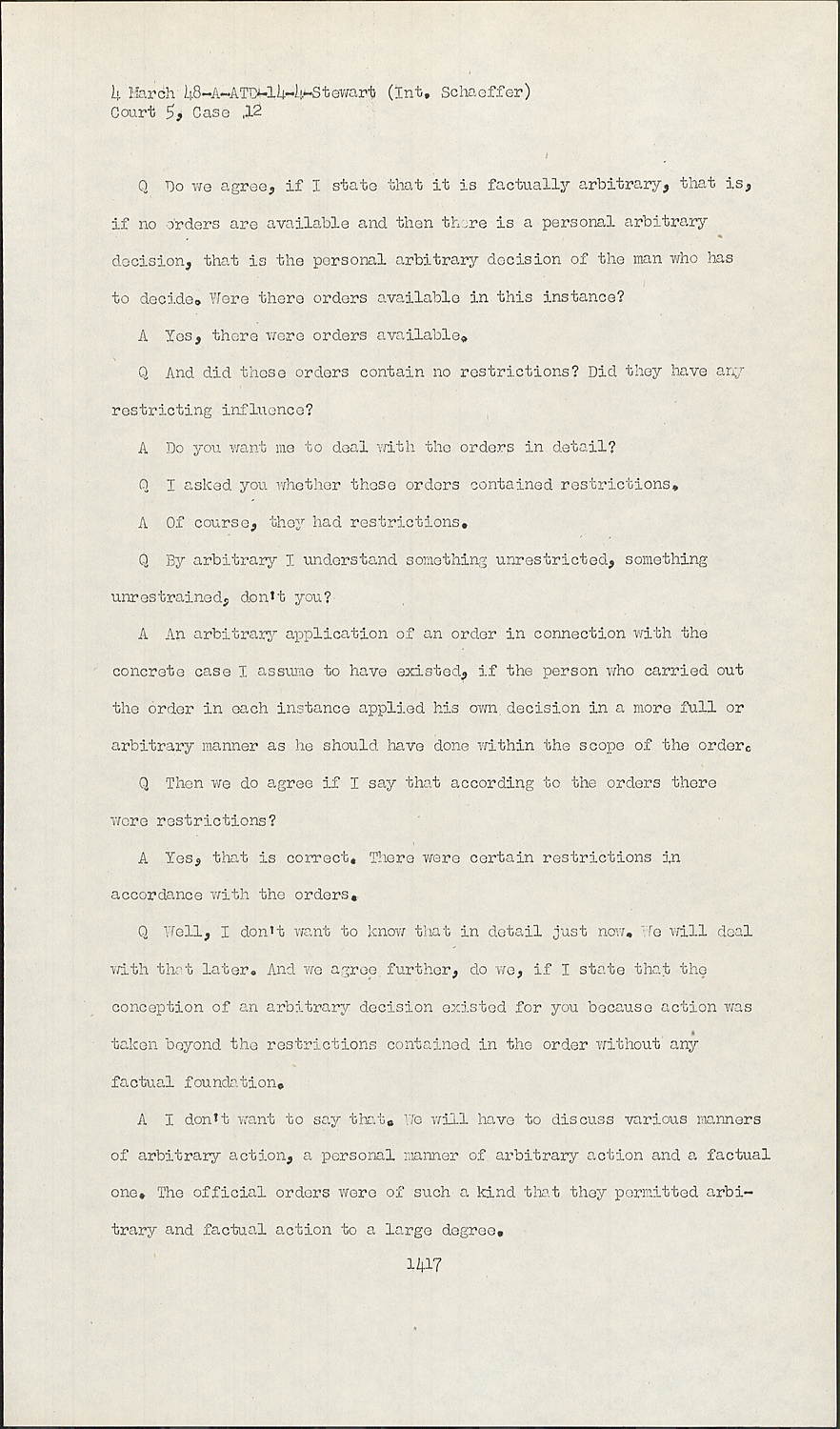
QDo We agree, if I state that it is factually arbitrary, that is, if no orders are available and then there is a personal arbitrary decision, that is the personal arbitrary decision of the man who has to decide. Were there orders available in this instance?
AYes, there were orders available.
QAnd did these orders contain no restrictions? Did they have any restricting influence?
ADo yon want me to deal with the orders in detail?
QI asked you whether these orders contained restrictions.
AOf course, they had restrictions.
QBy arbitrary I understand something unrestricted, something unrestrained, don't you?
AAn arbitrary application of an order in connection with the concrete case I assume to have existed, if the person who carried out the order in each instance applied his own decision in a more full or arbitrary manner as he should have done within the scope of the order.
QThen we do agree if I say that according to the orders there were restrictions?
AYes, that is correct. There were certain restrictions in accordance with the orders.
QWell, I don't want to know that in detail just now. We will deal with that later. And we agree further, do we, if I state that the conception of an arbitrary decision existed for you because action was taken beyond the restrictions contained in the order without any factual foundation.
AI don't want to say that, we will have to discuss various manners of arbitrary action, a personal manner of arbitrary action and a factual one. The official orders were of such a kind that they permitted arbitrary and factual action to a large degree.
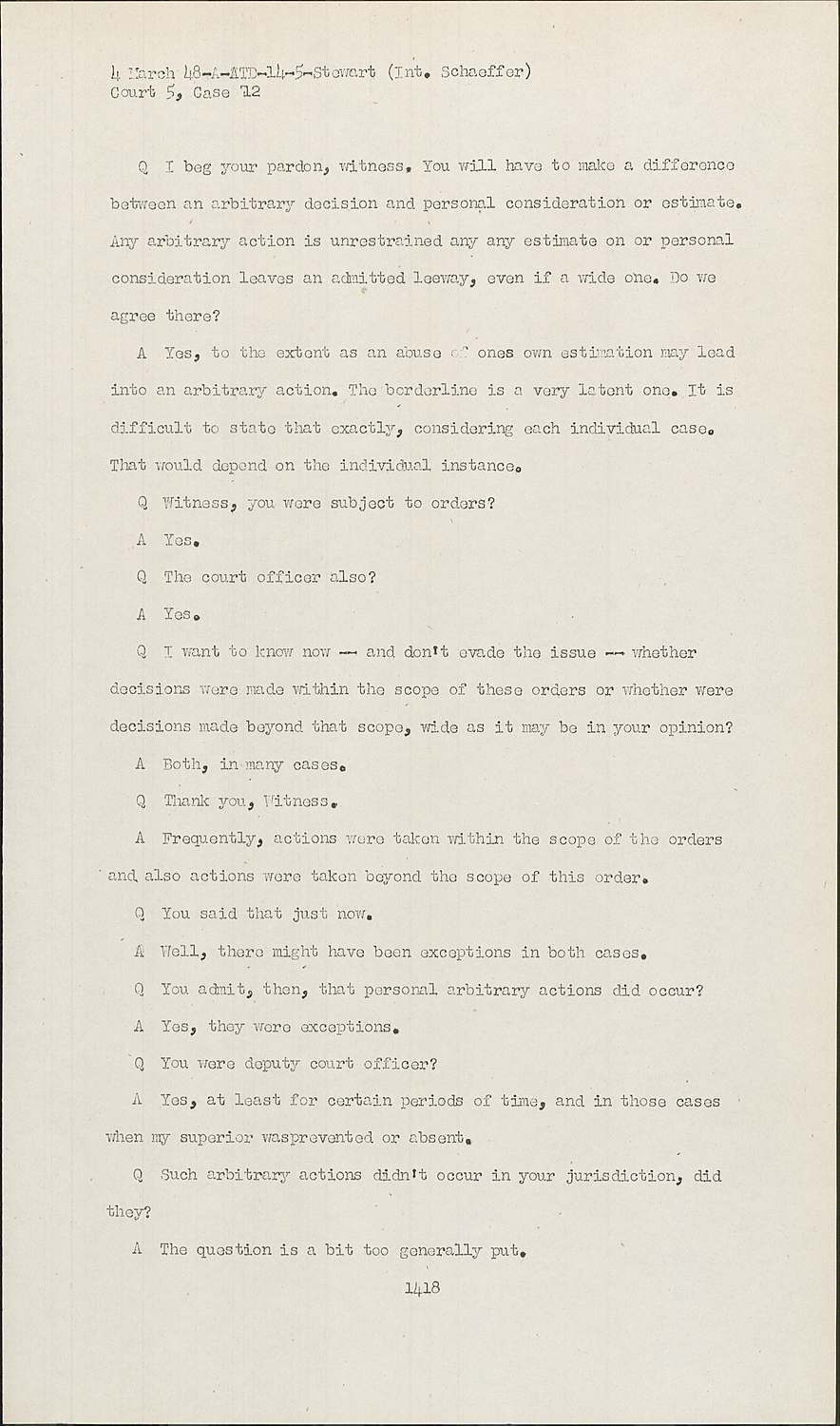
QI beg your pardon, witness. You will have to make a difference between an arbitrary decision and personal consideration or estimate. Any arbitrary action is unrestrained any any estimate on or personal consideration leaves an admitted leeway, even if a wide one. Do we agree there?
AYes, to the extent as an abuse of ones own estimation may lead into an arbitrary action. The borderline is a very latent one. It is difficult to state that exactly, considering each individual case. That would depend on the individual instance.
QWitness, you were subject to orders?
AYes.
QThe court officer also?
AYes.
QI want to know now -- and don't evade the issue -- whether decisions were made within the scope of these orders or whether were decisions made beyond that scope, wide as it may be in your opinion?
ABoth, in many cases.
QThank you, witness.
AFrequently, actions were taken within the scope of the orders and also actions were taken beyond the scope of this order.
QYou said that just now.
AWell, there might have been exceptions in both cases.
QYou admit, then, that personal arbitrary actions did occur?
AYes, they were exceptions.
QYou were deputy court officer?
AYes, at least for certain periods of time, and in those cases when my superior was prevented or absent.
QSuch arbitrary actions didn't occur in your jurisdiction, did they?
AThe question is a bit too generally put.
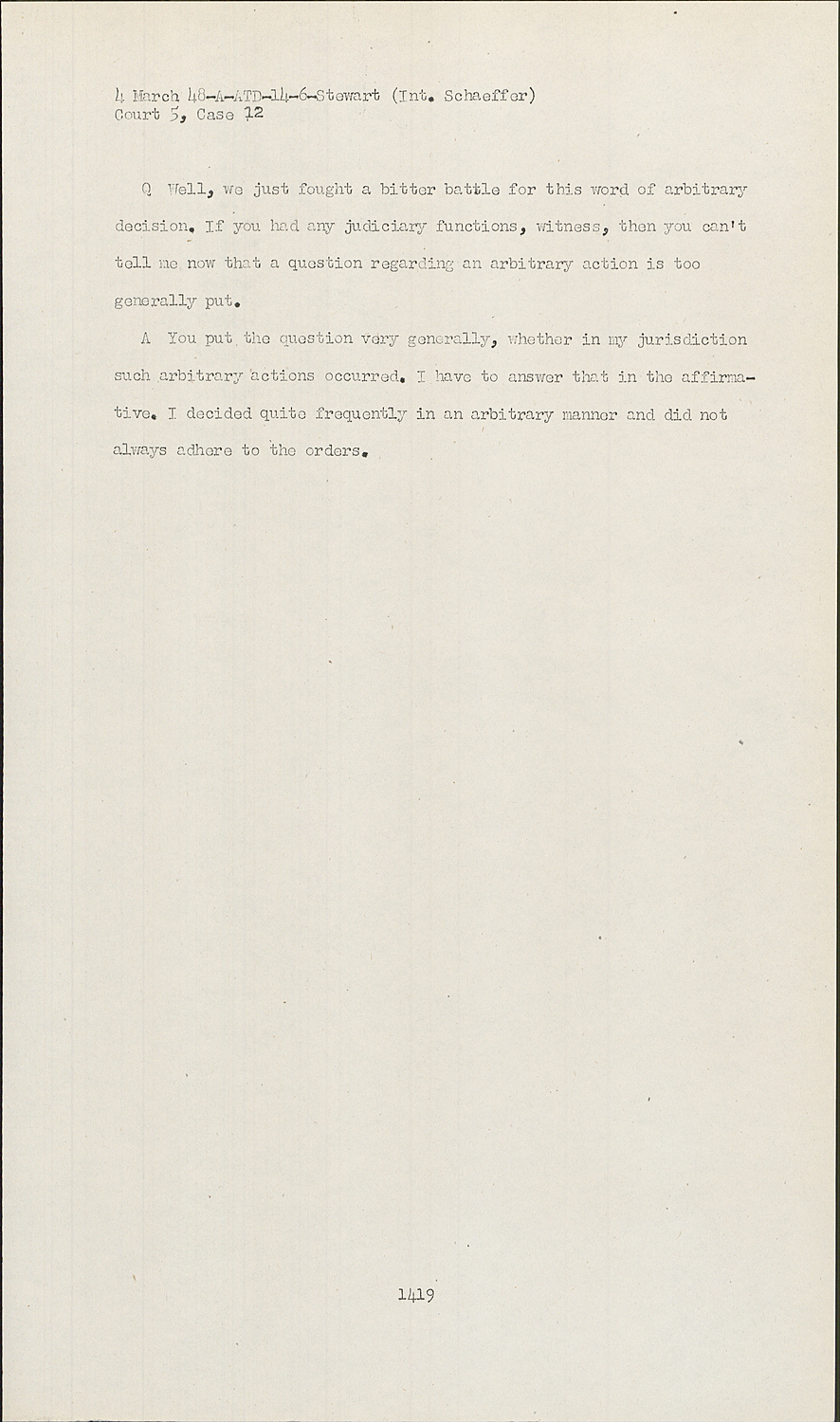
QWell, we just fought a bitter battle for this word of arbitrary decision. If you had any judiciary functions, witness, then you can't tell me now that a question regarding an arbitrary action is too generally put.
AYou put the question very generally, whether in my jurisdiction such arbitrary actions occurred. I have to answer that in the affirmative. I decided quite frequently in an arbitrary manner and did not always adhere to the orders.
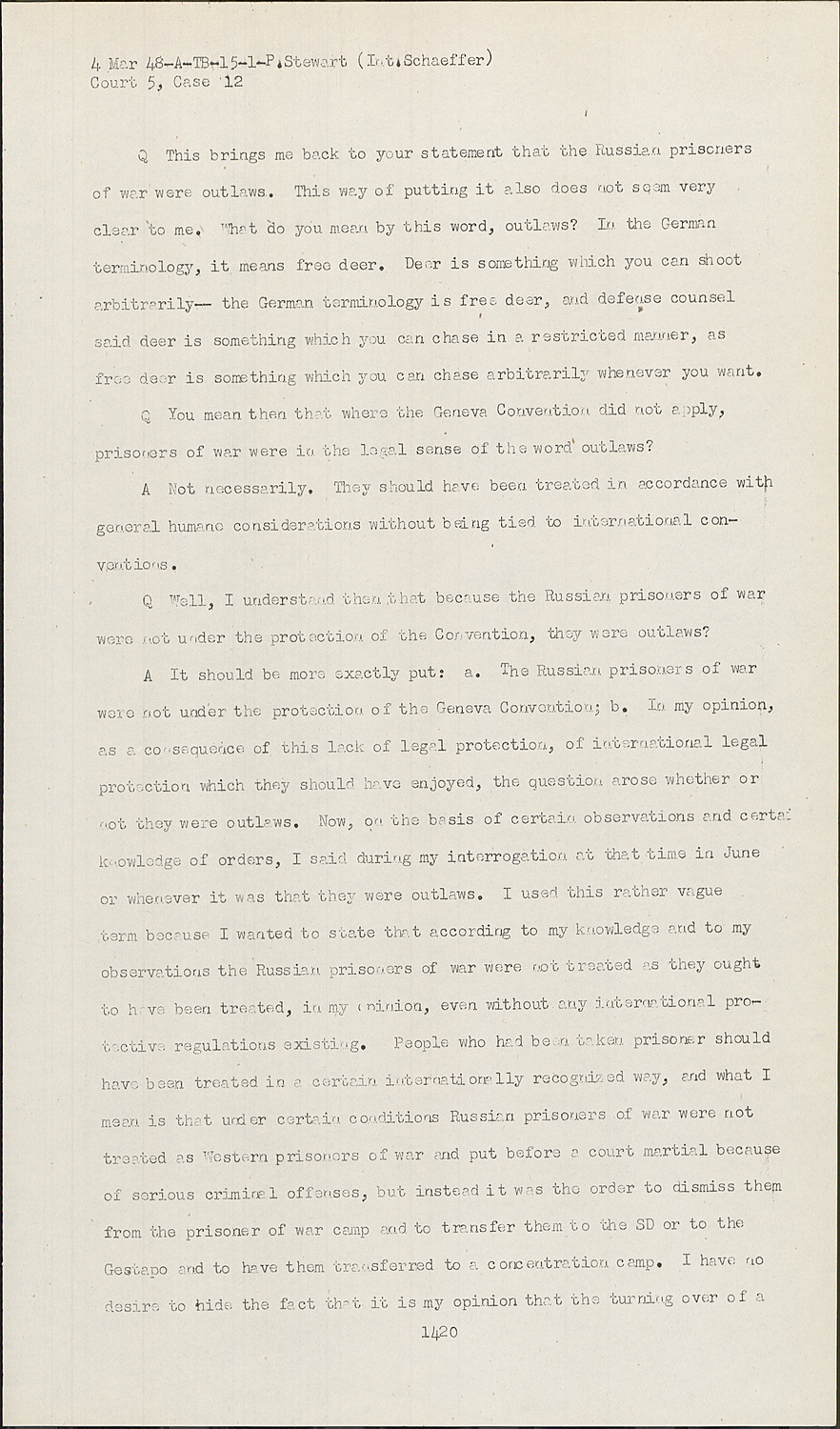
QThis brings me back to your statement that the Russian prisoners of war were outlaws. This way of putting it also does not seem very clear to me. What do you mean by this word, outlaws? In the German terminology, it means free deer. Dear is something which you can shoot arbitrarily-- the German terminology is free deer, and defense counsel said deer is something which you can chase in a restricted manner, as free deer is something which you can chase arbitrarily whenever you want.
QYou mean then that where the Geneva Convention did not apply, prisoners of war were in the legal sense of the word outlaws?
ANot necessarily. They should have been treated in accordance with general humane considerations without being tied to international Conventions.
QWell, I understand then that because the Russian prisoners of war were not under the protection of the Convention, they were outlaws?
AIt should be more exactly put: a. The Russian prisoners of war were not under the protection of the Geneva Convention; b. In my opinion, as a consequence of this lack of legal protection, of international legal protection which they should have enjoyed, the question arose whether or not they were outlaws. Now, on the basis of certain observations and certain knowledge of orders, I said during my interrogation at that time in June or whenever it was that they were outlaws. I used this rather vague term because I wanted to state that according to my knowledge and to my observations the Russian prisoners of war were not treated as they ought to have been treated, in my opinion, even without any international protective regulations existing. People who had been taken prisoner should have been treated in a certain internationally recognized way, and what I mean, is that under certain, conditions Russian prisoners of war were not treated as Western prisoners of war and put before a court martial because of serious criminal offenses, but instead it was the order to dismiss them from the prisoner of war camp and to transfer them to the SD or to the Gestapo and to have them transferred to a concentration camp. I have no desire to hide the fact that it is my opinion that the turning over of a person to a concentration camp without a legal procedure or without the minimum legal protection for the defense of the subject in question is, in my opinion, a method which should not be applied in the Twentieth Century.