Twenty odd members of these gangs are now on trial before Military Tribunal II.
Encouraged by the success of the Einsatzgruppen in Russia, the leaders of the Third Reich proceeded to evolve a systematic program for the extermination of all European Jews, the basic plans for which were laid at a series of interdepartmental conferences on the "final solution of the Jewish Question" which took place during 1942. The defendant Stuckart and representatives of the defendants Lammers and Weizsaecker took part in those conferences, which led to a program fro the evacuation of eleven million European Jews to camps in eastern Europe, where they were to be worked to death or slaughtered by methods of mass execution. The extermination of European Jewry was perhaps the most monstrous and certainly the most successful of all the crimes of the Third Reich, and most of the defendants in this case are directly involved in its execution. All of the Foreign Office defendants participated in the deportation of Jews from the puppet and satellite countries dominated by Germany. Within Germany itself, the program was symbolized and consummated by the decree of 1 July, 1943, drafted by the defendant Stuckart and others and signed by the defendant Schwerin-Krosigk, which deprived all Jews in Germany of judicial process and authorized the police to punish "all criminal acts committed by Jews", and provided for the ultimate confiscation of all Jewish property/
The "final solution of the Jewish Question" had gruesome and grotesque byproducts; the assortment of watches, spectacles and jewelry seized from murdered Jews, and the rings and gold teeth pulled from the fingers and dug out of the skulls of Jewish corpses. The defendant Puhl supervised the classification and deposit of these valuables in the Reichsbank, and the proceeds from their disposal were credited to the Reich Treasury under the defendant Schwerin-Krosigk.
A fourth general category of activities of the defendants to which we have referred are: Support of the Membership in Criminal Organizations: charged in Counts Four, Five, Seven and Eight.
Under this heading we are, of course speaking of a form of participation in crime rather than of a distinct type of crime. The organizations with which various of the defendants were connected include, preeminently, the SS, and the so-called "Leadership Corps" of the Nazi Party, both of which were declared criminal organizations by the judgment of the IMT.
Fourteen of the defendants are charged with membership in criminal organizations; all fourteen were high-ranking officers in the SS, one of the fourteen was also member of the "Sicherheistdients", and four were members of the Leadership Corps in the Nazi Party. As to all fourteen the proof will abundantly show that they both knew of and participated in the crimes on the basis of which these organizations were declared to be criminal.
As to several of the defendants, however, the charge of participation in the criminal activities of the SS is not limited to membership therein. We will hear frequent mention in this proceeding of a group called the "Circle of Friends" of Himmler, of which the defendant Keppler was a founder and in which the defendants Rasche and Kehrl were active. The so-called "Himmler Circle" was composed of about thirty of the foremost German business and financial leaders, among whom the defendant Rasche was numbered, several high-ranking government officials, including the defendants Keppler and Kehrl, and a number of the most notorious leaders of the SS, including Himmler himself, his adjutant Karl Wolff, Oswald Pohl, Otto Ohlendorf, and Wolfram Sievers. The business and financial leaders who belonged to the Himmler Circle made large regular annual contributions to Himmler to aid in financing the activities of the SS; the defendant Rasche, for example, procured contributions by the Dresdner Bank of some 50,000 marks per year, and the Dresdner Bank itself served as the depository for these funds. The prominent German industrialist Friedrich Flick, and his associate Otto Steinbrinck, were recently convicted of criminal responsibility for SS activities by virtue of their membership in the Himmler Circle.
The SS, of course, was not solely dependent for its funds upon the voluntary contributions of the Himmler Circle. The defendant Schwerin-Krosigk, as Reich Minister for Finance, furnished fiscal support for the SS.
The Dresdner Bank, by the procurement of the defendant Rasche, furnished credit to the SS for its general activities in Germany and in the occupied territories. The defendant Puhl and Rasche procured credit from the Reichbank and the Dresdner Bank respectively, to finance the SS industries which were operated with concentration-camp labor. And the Reichsbank, as we have seen, acted as the depository for valuables confiscated from Jews murdered by the SS.
We have now completed this statement of the crimes charged by the indictment, and will turn to a summary of the evidence concerning the responsibility of each defendant or group of defendants for the crimes so charged.
THE PRESIDENT:I believe, Mr. Lyon, this would be a suitable time for our noon recess.
MR. LYON:Very well, your Honor.
THE PRESIDENT:The Tribunal will recess to 1:30.
(A recess was taken until 1330 hours, 6 January 1943.)
( AFTERNOON SESSION (The hearing reconvened at 1330 hours, 6 January 1948)
THE MARSHAL:The Tribunal is again in session.
THE PRESIDENT:Mr. Marshal, are all the defendants present in the courtroom?
THE MARSHAL:With the exception of defendant Meissner, sir.
THE PRESIDENT:Mr. Lyon, you may proceed.
MR. LYON:The Prosecution will summarize the evidence against the defendants, individually or in homegeneous groups, according to the five principal categories which we noted at the outset -- foreign affairs, government administration, banking, war economy, and the SS. It will be convenient to begin with the defendants who played important parts in the German war economy, and who, except Kehrl, are charged with responsibility under Counts One and Two for planning and preparing for aggressive warfare.
Following the outline of evidence in the war economy field, which will particularly involve the defendants Koerner, Pleiger, Keppler, and Kehrl, we will, in order, take up the two defendants (Rasche and Puhl) from the banking field, then the Reich Ministers and other high officials in the field of government administration, then the two SS Generals. Finally, we will return to the Foreign Office defendants, whose criminal participation in the commission of crimes against peace has already been described, and outline their comparable responsibility for war crimes and crimes against humanity.
Now, if the Tribunal please, Mr. Gantt will continue with the reading of the statement.
MR. GANTT:The joint appearance in this dock of Koerner, Keppler, Kehrl, and Pleiger is a natural development growing COURT IV CASE II out of their close collaboration throughout the Third Reich in every important phase of the crimes which may be termed economic or industrial in character -- in economic preparation for aggression, in economic ruination of occupied countries, and in enslavement of their citizens in German industry.
In virtually every important government agency playing a major part in these crimes, we will find one or more, and frequently all four, of these men in leading positions. In the Four Year Plan, the top agency for economic preparation for war, Koerner was second only, to Goering and the other three also had important positions. In fact, they had a good deal to do with the very creation of the Four Year Plan in 1936 and had already worked together for several years under Keppler's leadership in the so-called Buro Keppler, which had laid the groundwork for the Four Year Plan. They were also instrumental in the creation and management of the hoge government corporate colussus, the Hermann Goering Works, which was organized in 1937 as a major project of the Four Year Plan and grew in a few short years to become the largest mining and smelting combine, the largest steel and armament producer, the largest inland shipping company and in general by far the largest industrial combination in Europe. In the Central Planning Board, from 1942 the top war-time agency under the Four Year Plan for economic affairs including slave labor, Koerner was a member of the four man board, along with Milch, Speer, and Funk, who have already been convicted for their roles therein; and the record of the Board's meetings also reveals the prominent parts played by Pleiger and Kehrl.
In the numerous agencies active in plundering and ruthlessly exploiting occupied countries we will find the same story: these four defendants, like the Wehrmacht, COURT IV CASE II fanned out in all directions.
In the western occupied territories the basic plan for spoliation of the textile industry was the so-called "Kehrl Plan". In Czechoslovakia Kehrl and the defendant Rasche of the Dresdner Bank were Special agents of the German government appointed to supervise German absorption of Czech heavy industry, much of it by the Hermann Goering Works. In the eastern territories, the supreme agency for directing the program of plunder was the Economic Executive Staff East, under the direction of Koerner as Goering's representative. Under the general program for spoliation in these eastern territories, numerous specialized organizations were established. Those included: BHO, headed by Koerner and Pleiger, for the mining and smelting industries; the Ost Faser Company, headed by Kehrl for the textile industry and its raw materials; the Kontinentale Oel Company, of which Keppler was a leading official, for oil exploitation; and the DUT, in form a company of which Keppler and Kehrl were corporate officials, but actually an arm of the SS for handling property seized from hapless citizens of eastern countries who were supposed, under the Nazi plans, to give up their land and possessions to German settlers. Finally the Hermann Goering Works, of which Koerner and Pleiger were particularly important officials, reached its enormous size in large part by absorbing industries in occupied countries on a wholesale basis.
The prominence of these four defendants in all these criminal activities properly reflects their position in the regime of the Third Reich and in the part thereof which was Nazi in the strictest sense. All four were highly influential figures in the Party. Three of them were SS officers, Keppler and Koerner holding the rank of Lieutenant General and Kehrl that of Brigadier General.
COURT IV CASE II Their relations to Hitler, Goering and Himmler were very close both before and after 1933. We have already seen that Keppler in 1932 formed a group of industrialists and financiers to advise Hitler, a group which came to be known as the Keppler Circle and later as the Circle of Friends of Himmler, and of which Kehrl and Rasche were members. Keppler's activity in 1932 in promoting Hitler's rise to power was as useful and ubiquitous as it was later to become in the field of both foreign affairs and economics. In November 1932 Keppler was instrumental along with Kurt von Schroeder, the Cologne banker, and the defendant Meissner, in securing signatures of numerous leading industrialists to a petition to Hindenburg to appoint Hitler chancellor. It was Keppler and von Schroeder again who, with Himmler and Hess, arranged the historic meeting of 4 January 1933 between von Papen and Hitler, which led directly to the alliance between Hitler and von Papen that was the necessary foundation for the appointment of Hitler as Chancellor shortly thereafter.
Keppler deserves to be better known to the world than he is for his part in laying the basic economic foundation for Hitler's invasions and wars of aggression. Keppler learned from World War I that Germany needed to be selfsufficient in certain critical materials if she was to have any hope of success in another major conflict. He succeeded in 1934 in having Hitler create and place him in charge of a Special Agency for the Development of German Natural and Synthetic Raw Materials. Here the basis was laid for the successful development of programs for greatly expanding the production of synthetic textiles, synthetic rubber, diesel oil, gasoline lubricants and fats.
Keppler's agency was generally known as Buro Keppler, COURT IV CASE II and in the work of this office, Keppler's closest collaborators included the defendants Kehrl, Koerner, and Pleiger.
In early 1936, the activity of the Buro Keppler was extended, and Keppler and his staff were included in an Advisory Committee on Questions of Raw Material, a group which was presided over by Goering and Schacht, and which included the defendants Koerner, Keppler, Pleiger, Kehrl and von Krosigk, General Keitel and other representatives of the Army and a number of industrialists, including representatives of Krupp and Farben. The general tone of the meetings of this committee is aptly summarized in a statement made by Goering at a meeting of the Ministerial Council on 27 May 1936, attended by the defendant Krosigk, that "All measures are to be considered from the standpoint of an assured waging of war."
In August 1936, Hitler founded the Four Year Plan under Goering as Plenipotentiary, to achieve, as he said, the following tasks:
1. The German Army must be ready for combat within 4 years, 2. The German economy must be mobilized for war within 4 years.
The IMT in its judgment noted that Minister of Economics Funk:1 On October 14, 1939, after the war had begun, made a speech in which he stated that the economic and financial departments of Germany working under the Four Year plan had been engaged in the secret economic preparation for war for over a year.
Numerous other descriptions of the nature of the Four Year Plan, as well as a mass of proof of its actual activities, confirm the accuracy of Funk's statements. Thus, in November 1936, General Thomas, Head of the Military Economic ----------------
1. Vol. I, Trial of the Major War Criminals, p. 132.
COURT IV CASE II Staff of the Wehrmacht, stated that:
...the Four Year Plan is military economy at its purest. A month later, Goering stated to a group of industrialists:
We are already on the threshold of mobilization and we are at war, only the guns are not yet being fired.
One of the major projects of the Four Year Plan in the field of heavy industry was the establishment of the Hermann Goering Works in 1937. The initial purpose of the Hermann Goering Works was the exploitation of deposits of German iron ore which were of such low grade that private industry had not found it profitable to develop them, but had relied upon the importation of iron ore from foreign countries. It is quite obvious that iron was, as Goering stated before the IMT, "a basic prerequisite for the re-establishment of the armament industry".1 These defendants could not fall to know the purpose of the iron ore program, as well as of the Four Year Plan of which it was a part, as one of preparation for aggression.
On the 17th of March 1937 Koerner, Pleiger and Keppler attended a meeting of the Working Committee of the Four Year Plan at which Goering stated:
In the name of the Fuehrer who has specially charged me to declare that he will not deviate from this course, I declare as my standpoint, that it must be possible to mine as much ores from the German soil as are necessary for the actual needs of war.
...
.... the shortage of ores must not endanger the program of munition production or armaments in case of war.
A short time later on 23 July 1937 Goering, in pursuance of the Four Year Plan and on the instigation of Pleiger, announced the establishment of the Hermann Goering Works with the words "Iron is the decisive raw material to win freedom and space for the people". Koerner became chairman of the Supervisory Board and Pleiger technical manager and chairman of the ------------------1. Transcript of IMT Proceedings, p. 6083-6086 COURT IV CASE II Managing Board.
Keppler and Kehrl also were members of the Aufsichtsrat of the Goering Works and of its numerous affiliated companies.
It is impossible to describe here more than the broad outlines of the pervasive authority and activities of the Four Year Plan and of its important offshoot, the Hermann Goering Works. It will appear from the proof that both these organizations, like the Foreign Office, kept pace with each anticipated aggression. Thus for example on 14 October 1938, just two weeks after the Munich Pact, a speech by Goering reveals clearly that in the calculations of officials of the Four Year Plan, not merely the Sudetenland but all of Czechoslovakia was already counted on as belonging to Germany.
In a contemporary report of this meeting some of Goering's remarks were summarized as follows:
"The Sudetenland has to be exploited with all means.
General Field Marshal Goering counts upon a complete industrial assimilation of Slovakia.
Bohemia and Slovakia would become German dominions.
Everything possible must be taken out.
The Oder Danube Canal has to be speeded up.
Searches for oil and ore have to be conducted in Slovakia, notably by State Sec retary Keppler."
Goering's prophecy might have continued, as the proof will disclose, that the Hermann Goering Works would greatly augment its potency as a producer of armament by absorbing the bulk of the Czech mining, smelting, and steel industry, including the Skoda Works, with the assistance of the defendants Kehrl and Rasche.
The economic policy of Germany in its territories as carried out by the Four Year Plan was both the foundation and result of its aggressions. The systematic exploitation of occupied territory was a premeditated aim of each aggression, and following each invasion the execution of this policy became a springboard for further aggressions. Thus these economic policies and the acts carried out pursuant thereto were not only criminal violations of the laws of land warfare; they were also steps in the commission of crimes against peace as an indispensable means of waging aggressive wars and as preparation for launching still further wars of aggression.
For example, less than two months after the invasion of Poland. Goering set forth the policy for exploitation of its resources by special agencies under the Four Year Plan as follows:
"..there must be removed from the territories of the Government General all raw materials, scrap materials, machines etc.
which are of use for the German war economy.
"For this purpose, I have formed a Main Trustee Of fice East (Haupttreuhandstelle Ost)...."We have already referred to the activities of Koerner, Keppler.
Pleiger and Kehrl in several of the leading, agencies established to exploit Russian resources in complete disregard of the rules of war, and the details of their success in these enterprises on a huge scale can await the proof.
We may pause only to note that here, even more clearly perhaps than elsewhere, the plans for spoliation were an integral part of the planning of the illegal invasion itself. Months before the invasion of Russia, plans for its economic exploitation were laid out. In March 1941, Koerner joined the operation staff for Case Barbarossa, the code term for the attack upon Russia, which in fact took place three months later. On the 2nd of May 1941, in a conference of State Secretaries on Case Barbarossa, it was stated:
"1. The war can only be continued if all armed forces are fed by Russia in the third year of war.
"2. There is no doubt that as a result many millions of people will starve to death if we take out of the country the things necessary for us."
The Decree of April 1942 established the Central Planning Board, and its overall authority in the economic field necessarily involved the Board in continuous activity with respect to the general direction of the slave labor program. In the decisions and deliberations of the Board, important figures included not only the defendant Koerner, who was a member of the Board, but also the defendants Kehrl and Pleiger. Kehrl was in practice virtually a member of the Board. He was chief of the Planning Office, which prepared the material for the conferences of the Board and saw to the execution of its decisions and usually he participated in the deliberations of the Board. Pleiger also took part in many of the Central Planning Board meetings, at which he forcefully urged the labor demands of the German coal industry, which was always considered a most vital sector of the industrial war machine and was one of the largest users of foreign slave labor.
A few of the many statements made by these defendants at meetings of the Board amply illustrate their responsibility for decisions affecting literally millions of foreign workers under conditions which they knew meant slavery on a vast scale and which they also knew would inevitably exact a heavy toll of sickness, semi-starvation and death. At a meeting in the spring of 1943, in which both Kehrl and Koerner took part, Kehrl referred to Pleiger's need for labor in the coal industry as follows:
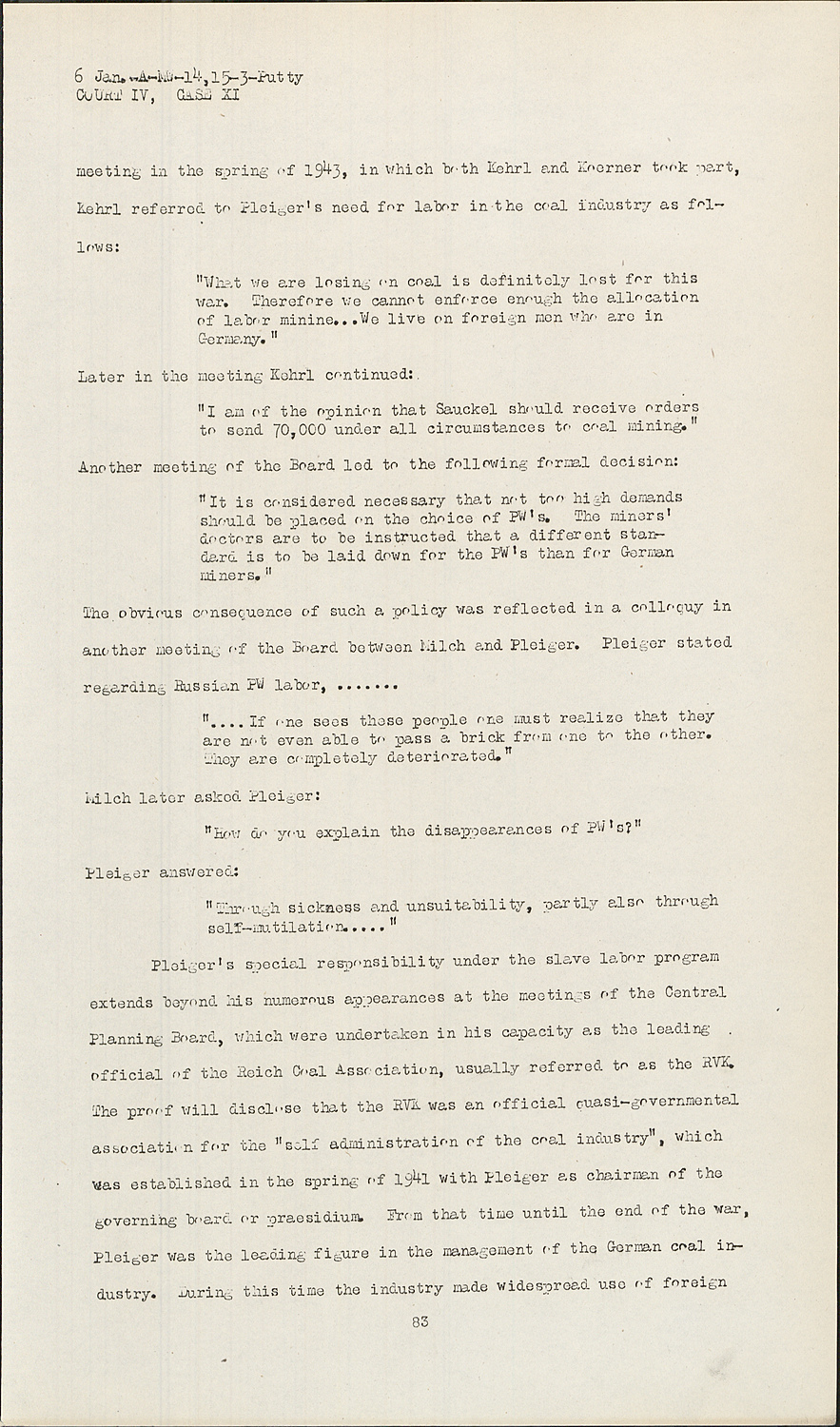
"What we are losing on coal is definitely lost for this war.
Therefore we cannot enforce enough the allocation of labor minine.
..We live on foreign men who are in Germany."
Later in the meeting Kehrl continued:
"I am of the opinion that Sauckel should receive orders to send 70,000 under all circumstances to coal mining."
Another meeting of the Board led to the following formal decision:
"It is considered necessary that not too high demands should be placed on the choice of PW's. The miners' doctors are to be instructed that a different stan dard is to be laid down for the PW's than for German miners."
The obvious consequence of such a policy was reflected in a colloquy in another meeting of the Board between Milch and Pleiger. Pleiger stated regarding Russian PW labor,.......
"....If one sees those people one must realize that they are not even able to pass a brick from one to the other.
They are completely deteriorated." Milch later asked Pleiger:
"How do you explain the disappearances of PW's?" Pleiger answered:
"Through sickness and unsuitability, partly also through self-mutilation.
... " Pleiger's special responsibility under the slave labor program extends beyond his numerous appearances at the meetings of the Central Planning Board, which were undertaken in his capacity as the leading official of the Reich Coal Association, usually referred to as the RVK.
The proof will disclose that the RVK was an official quasi-governmental association for the "self administration of the coal industry", which was established in the spring of 1941 with Pleiger as chairman of the governing board or praesidium. From that time until the end of the war, Pleiger was the leading figure in the management of the German coal industry. During this time the industry made widespread use of foreign slave laborers and prisoners of war in the course of which this human raw material was not only enslaved but also mistreated and in many cases worked to death, with the result that on several occasions even agencies of the Nazi Government raised their voices in protest.
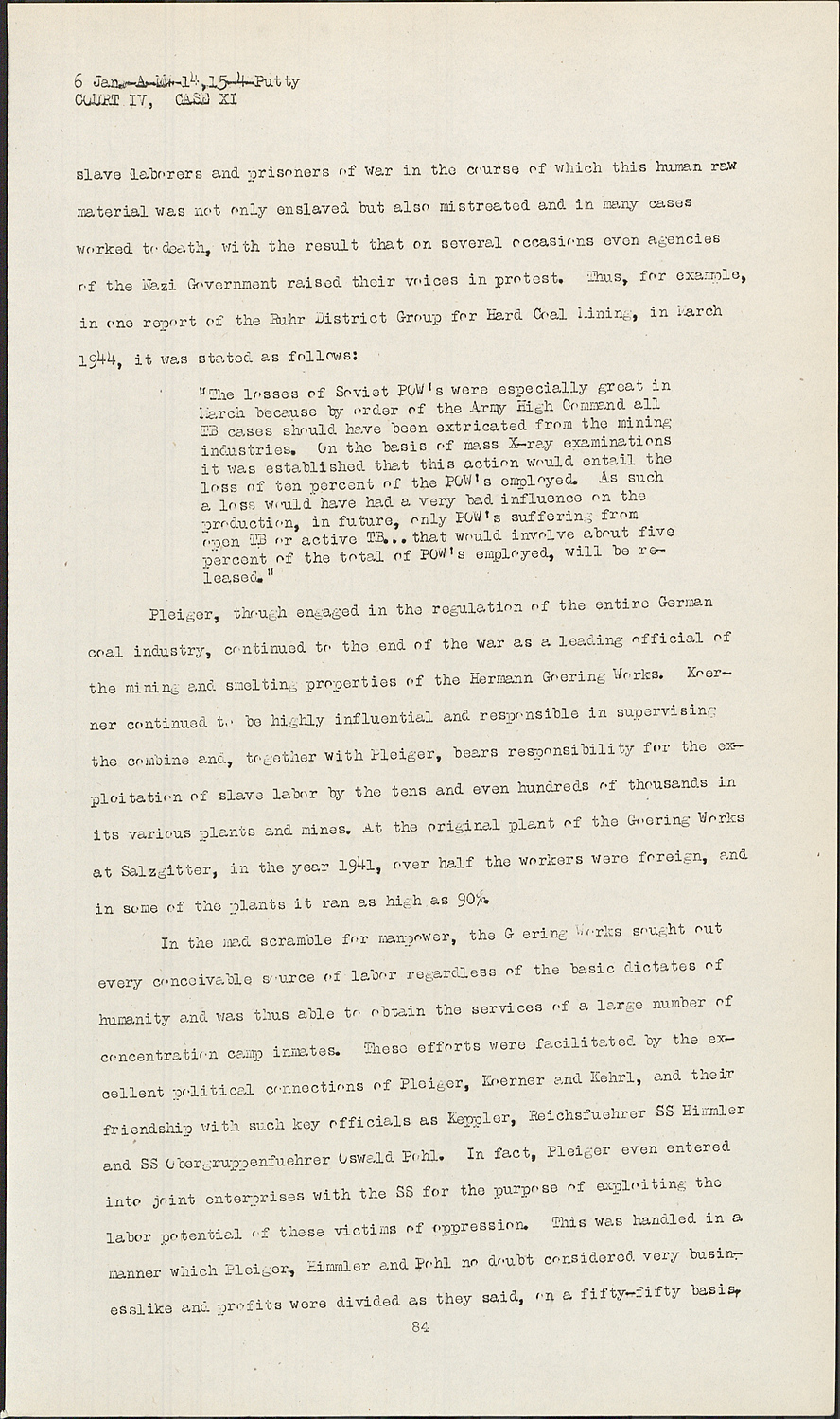
Thus, for example, in one report of the Ruhr district Group for Hard Coal Mining, in March 1944, it was stated as follows:
"The losses of Soviet POW's were especially great in March because by order of the Army High Command all TB cases should have been extricated from the mining industries.
On the basis of mass X-ray examinations it was established that this action would entail the loss of ten percent of the POW's employed.
As such a loss would have had a very bad influence on the production, in future, only POW's suffering from open TB or active TB.
..that would involve about five percent of the total of POW's employed, will be re leased."
Pleiger, though engaged in the regulation of the entire German coal industry, continued to the end of the war as a leading official of the mining and smelting properties of the Hermann Goering Works. Koerner continued to be highly influential and responsible in supervising the combine and, together with Pleiger, bears responsibility for the exploitation of slave labor by the tens and even hundreds of thousands in its various plants and mines. At the original plant of the Goering Works at Salzgitter, in the year 1941, over half the workers were foreign, and in some of the plants it ran as high as 90%.
In the mad scramble for manpower, the Goering Works sought out every conceivable source of labor regardless of the basic dictates of humanity and was thus able to obtain the services of a large number of concentration camp inmates. These efforts were facilitated by the excellent political connections of Pleiger, Koerner and Kehrl, and their friendship with such key officials as Keppler, Reichsfuehrer SS Himmler and SS Obergruppenfuehrer Oswald Pohl. In fact, Pleiger even entered into joint enterprises with the SS for the purpose of exploiting the labor potential of these victims of oppression. This was handled in a manner which Pleiger, Himmler and Pohl no doubt considered very businesslike and profits were divided as they said, on a fifty-fifty basis, With your permission Mr. Fitzpatrick will continue.
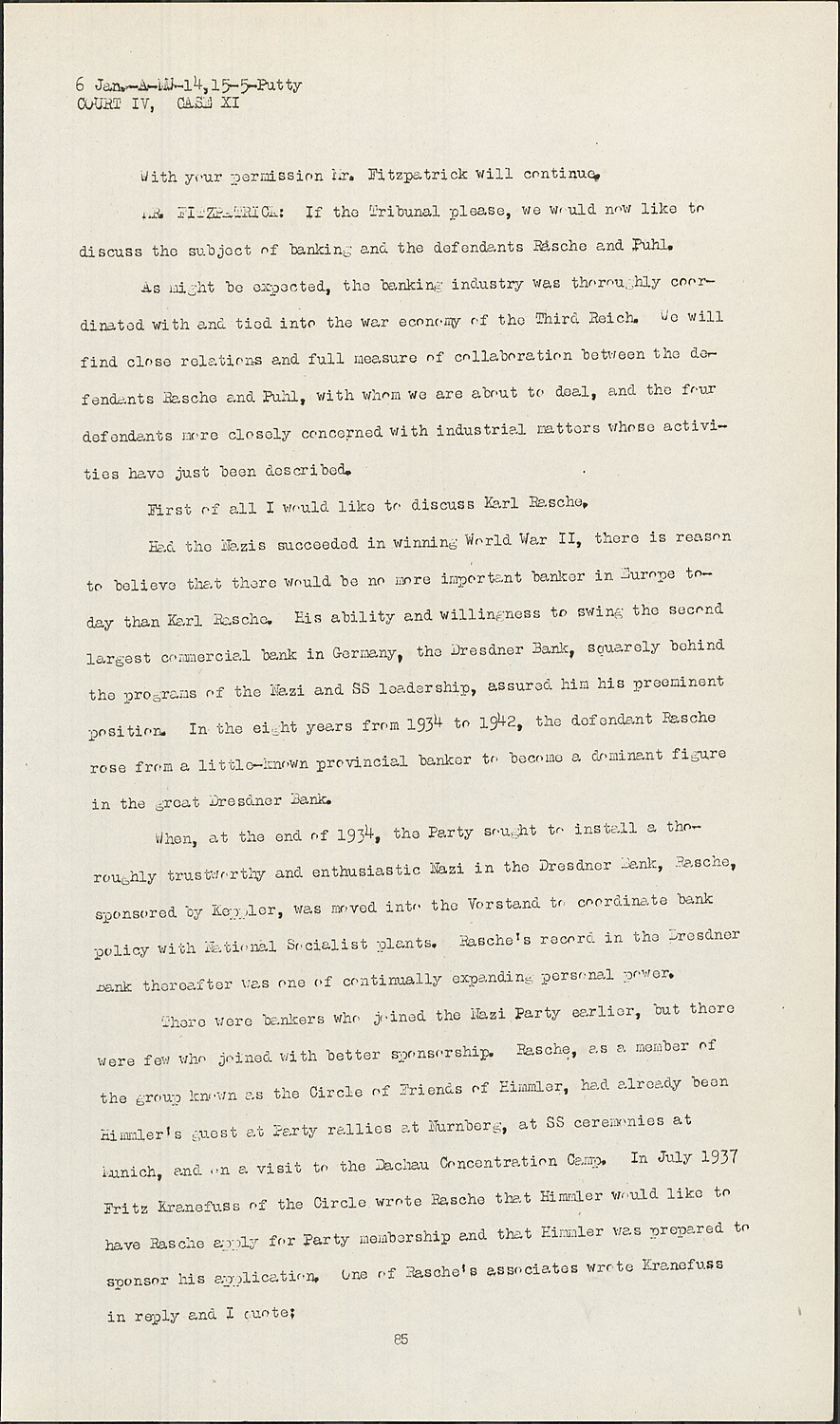
Mr. FITZPATRICK: If the Tribunal please, we would now like to discuss the subject of banking and the defendants Rasche and Puhl.
As might be expected, the banking industry was thoroughly coordinated with and tied into the war economy of the Third Reich. We will find close relations and full measure of collaboration between the defendants Rasche and Puhl, with whom we are about to deal, and the four defendants more closely concerned with industrial matters whose activities have just been described.
First of all I would like to discuss Karl Rasche.
Had the Nazis succeeded in winning World War II, there is reason to believe that there would be no more important banker in Europe today than Karl Rasche. His ability and willingness to swing the second largest commercial bank in Germany, the Dresdner Bank, squarely behind the programs of the Nazi and SS leadership, assured him his preeminent position. In the eight years from 1934 to 1942, the defendant Rasche rose from a little-known provincial banker to become a dominant figure in the great Dresdner Bank.
When, at the end of 1934, the Party sought to install a theroughly trustworthy and enthusiastic Nazi in the Dresdner Bank, Rasche, sponsored by Keppler, was moved into the Vorstand to coordinate bank policy with National Socialist plants. Rasche's record in the Dresdner Bank thereafter was one of continually expanding personal power.
There were bankers who joined the Nazi Party earlier, but there were few who joined with better sponsorship. Rasche, as a member of the group known as the Circle of Friends of Himmler, had already been Himmler's guest at Party rallies at Nurnberg, at SS ceremonies at Munich, and on a visit to the Dachau Concentration Camp. In July 1937 Fritz Kranefuss of the Circle wrote Rasche that Himmler would like to have Rasche apply for party membership and that Himmler was prepared to sponsor his application. One of Rasche's associates wrote Kranefuss in reply and I quote:
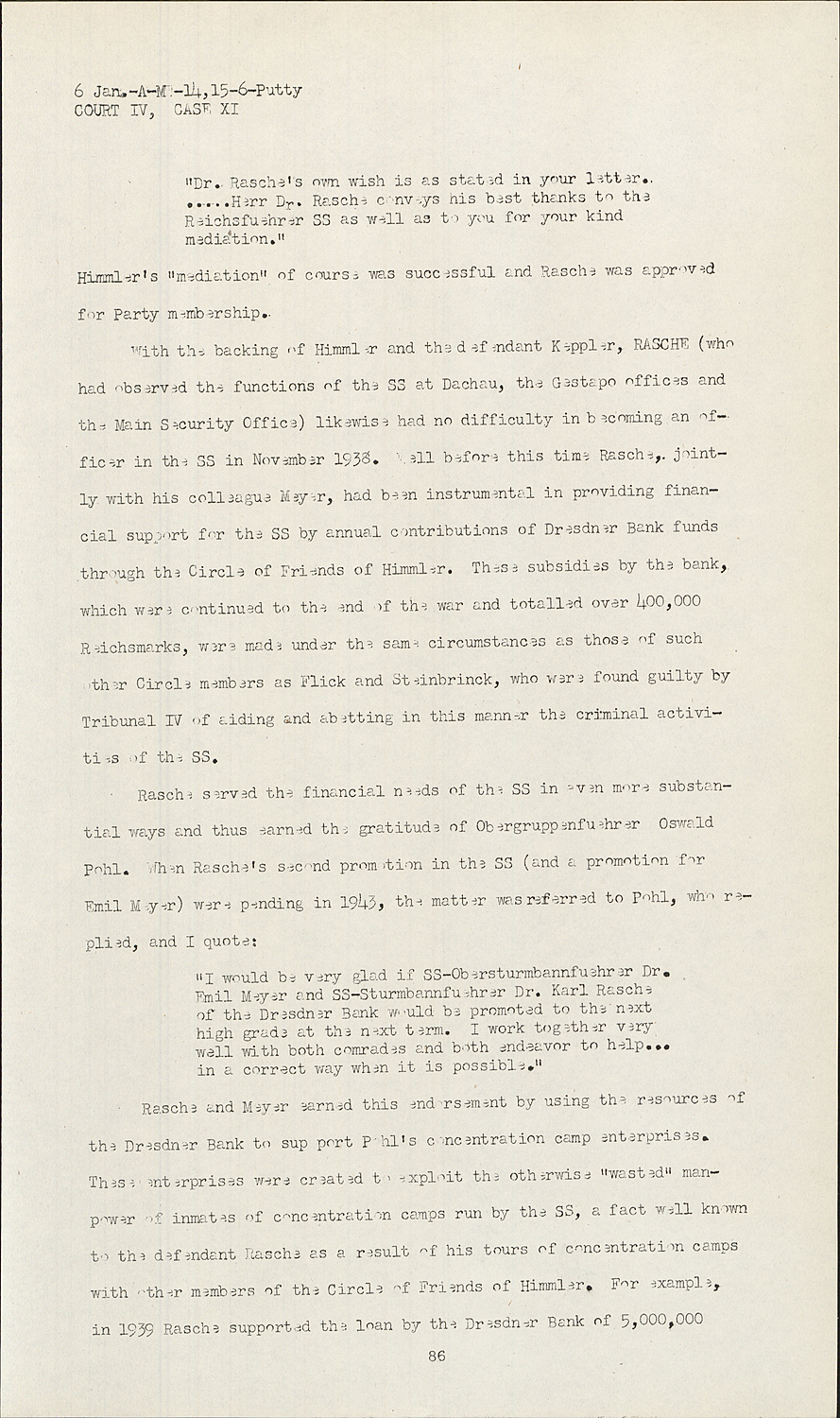
"Dr. Rasche's own wish is as stated in your letter.
.....Herr Dr. Rasche conveys his best thanks to the Reichsfuehrer SS as well as to you for your kind mediation."
Himmler's "mediation" of course was successful and Rasche was approved for Party membership.
With the backing of Himmler and the defendant Keppler, RASCHE (who had observed the functions of the SS at Dachau, the Gestapo offices and the Main Security Office) likewise had no difficulty in becoming an officer in the SS in November 1938. Well before this time Rasche, jointly with his colleague Meyer, had been instrumental in providing financial support for the SS by annual contributions of Dresdner Bank funds through the Circle of Friends of Himmler. These subsidies by the bank, which were continued to the end of the war and totalled over 400,000 Reichsmarks, were made under the same circumstances as those of such other Circle members as Flick and Steinbrinck, who were found guilty by Tribunal IV of aiding and abetting in this manner the criminal activities of the SS.
Rasche served the financial needs of the SS in even more substantial ways and thus earned the gratitude of Obergruppenfuehrer Oswald Pohl. When Rasche's second promotion in the SS (and a promotion for Emil Meyer) were pending in 1943, the matter was referred to Pohl, who replied, and I quote:
"I would be very glad if SS-Obersturmbannfuehrer Dr. Emil Meyer and SS-Sturmbannfuehrer Dr. Karl Rasche of the Dresdner Bank would be promoted to the next high grade at the next term.
I work together very well with both comrades and both endeavor to help.
..
in a correct way when it is possible."
Rasche and Meyer earned this endorsement by using the resources of the Dresdner Bank to support Pohl's concentration camp enterprises. These enterprises ware created to exploit the otherwise "wasted" manpower of inmates of concentration camps run by the SS, a fact well known to the defendant Rasche as a result of his tours of concentration camps with other members of the Circle of Friends of Himmler. For example, in 1939 Rasche supported the loan by the Dresdner Bank of 5,000,000 Reichsmarks to Oswald Pohl's Deutsche Erd-und Steinwerka, usually referred to as DEST and during later years Rasche supported a number of other loans by the Dresdner Bank to this and other such SS enterprises.
In its judgment, Military Tribunal II found that, and I quote: "The DEST enterprises were strictly concentration camp enterprises" and that "The evidence in this case reveals that there was perhaps no industry which permitted such constant mal-treatment of prisoners as the DEST enterprises".
We find support by Rasche and his Dresdner Bank for still another program carried to ruthless extremes by the SS, the program commonly known as aryanization, which called for dismissal of Jews from employment and coercive transfer of their property to others. When the defendant Keppler in July 1937 wrote Carl Goetz that it was "imperative to aryanize" the Merkurbank in Austria and asked that he -- and I quote: "designate a gentleman from your institution" -- that is the Dresdner Bank -- "to cooperate with my office in the above matter", Goetz obligingly replied to Keppler as follows, and I quote:
"After the decision of the Fuehrer as a result of your report to aryanize the Merkurbank in order to expand it as a German stronghold in Austria we must find new ways to attain this goal.
I have assigned Dr. Meyer and Dr. Rasche from our Vorstand to get in touch with your office immediately."
In the aryanization of Jewish-owned property, under the general pressure against Jews and frequently also in connection with special additional coercive measures, Rasche and his subordinates achieved striking success. For example, in Czechoslovakia, the Boehmische Escomptebank (usually referred to as BEB) guided and supervised by Rasche, operated a model and successful aryanization department. The defendants interest and role in the program is indicated in a letter which he received from an assistant in March 1939, promptly after the German occupation of Bohemia-Moravia:
"Enclosed I am sending you a memorandum concerning various conferences and affairs which will interest you.
Tonight a mating of the German banks takes place at President Kehrl's office,"--that is the defendant Kehrl--"where directives will be given regarding Aryanization in this territory."
A report of the BEB for the period from March 1939 to April 1941 observed:
"When on the 15th of March 1939 the Protectorate, Bohemia and Moravia, was established and, at this time, the Aryanization of the economy of Bohemia and Moravia began, our institution was governed by two considerations:
First, we were concerned to transfer our own Jew ish business connections into non-Jewish hands and not to allow them to be 'aryanized away' through our competitors;Second, we were concerned to make use of this unique opportunity of promoting our business in a grand style and to gain as many new clients as possible through aryanizations."
.....Today we can say that we have in general at tained the goal set forth."
The proof will disclose that the aryanizations accomplished by the Dresdner Bank were not isolated and ordinary business transactions, but, instead, were an integral part of a governmental program which was calculated to employ the services of Rasche and his agencies to make racial persecution effective. In addition, in territory outside the pre-1938 corders of Germany, they frequently involved violations of rights protected by the rules of land warfare.
Spoliation and plunder on an even more extensive and general scale prompted the director of a Dresdner Bank branch to write to Rasche in 1943: "We have just heard this jocular verse, Very flatterint to you, from one of our clients:
Who marches behind the leading tank?
It is Dr. Rasche of the Dresdner Bank." This light jingle accurately describes Rasche's zeal in dispossessing the citizens of countries occupied by German armies. Before the invasion of the Sudetan region of Czechoslovakia and during the "war of nerves" of the summer of 1938, subordinates of Rasche were already preparing for the acquisition of Czech bank branches in the Sudetan region. The defendant reviewed and approved these plans. When Kehrl was appointed governmental supervisor for German acquisitions in the Sudetenland, the close association between Rasche and Kehrl, acquaintances through Keppler since 1935, began. Rasche had no difficulty in securing Kehrl's approval to the taking over of twenty-six branches of the BEB and four branches of the Zivnostenska Bank, under circumstances involving coercion upon the former proprietors.
Thereafter Rasche directed the planning for the acquisition of the BEB itself. Rasche's project was approved at a conference for the division of Czech banking institutions among the German "Great Banks", at which Kehrl presided. When German forces invaded Prague in March 1939, representatives of the Dresdner Bank marched at their heals and took over the BEB in an informal but effective manner, and transfer was afterwards formalized. With the BEB established as an affiliate of the Dresdner Bank, Rasche became Chairman of the Verwaltungsrat.
Next Kehrl and Rasche received a much broader assignment from Goering. It was no less than bringing about the transfer of the most important heavy industries of Czechoslovakia into German central and ownership. This task was part of the program for Czechoslovakia which, in the short term, sought to utilize Czech industry for waging war and, in the long run, intended to Germanize both the population and economy. As Rasche himself described the mission in a letter toGritzbach, Goering's adjutant, in 1943:
"Already at the time when the Sudentenland re turned home to the Reich in 1938 and when the BEB transferred its Sudeten branches to the Dresdner Bank, and future developments could not be foreseen, we tried at the request of German governmental authorities to establish German influence over the industries of the Protectorate.
In this we were successful...
In the further course of events a more com prehensive and special authority was given to Kehrl and myself by the Reichsmarshall in order to acquire and reorganize such industrial concerns, and I believe that we have gotten good results in discharging this task."
Through a variety of techniques, which included "purchases" by artificially-valued Reichsmark under German-made economic conditions, aryanization, registration, sequestration, and confiscation, outright or through "trusteeships", and the use of threats, open or veiled, these "good results" were indeed achieved. Steel works, rolling mills, coal and iron ore mines, and machine tool and armament factories passed into the trusteeship of Kehrl and Rasche, the shares being paid for in part by by credits from the Dresdner Bank and the BEB.
Rasche handled most of the direct negotiations, and Kehrl also took a forceful hand, using the services of the Gestapo where advisable. In August 1959, Rasche wrote the following note to Himmler's adjutant, Karl Wolff:
"You will remember that I pointed out how valuable the support **red by the SD Special Departments Prague and Bruenn was to me and my staff from the very beginning of the negotia tions.
Thatnot only helped me considerably in attacking the many problems we had to face, but also led to the reduction of the basis of the purchase price by a substantial amount of for eign exchange on the ground of arguments which even the opposite side recognized.
...."
The activities of Rasche and his agents were by no means confined to Czech Slovakia, but covered the whole of Europe, as the proof will abundantly show. In themselves and taken singly, often these activities consisted of seemingly ordinary banking transactions -- advancing credits and purchasing securities. But in their context, purpose, and design, these "innocuous" acts emerge as part of a long range course of conduct which was carefully and fully integrated into schemes of enormous criminality. Loans per se may not be criminal, but loans to the DEST purposely to enable the enslavement, torture, and murder of thousands of persons, with full knowledge that the loans had such a result, do constitute a serious crime.