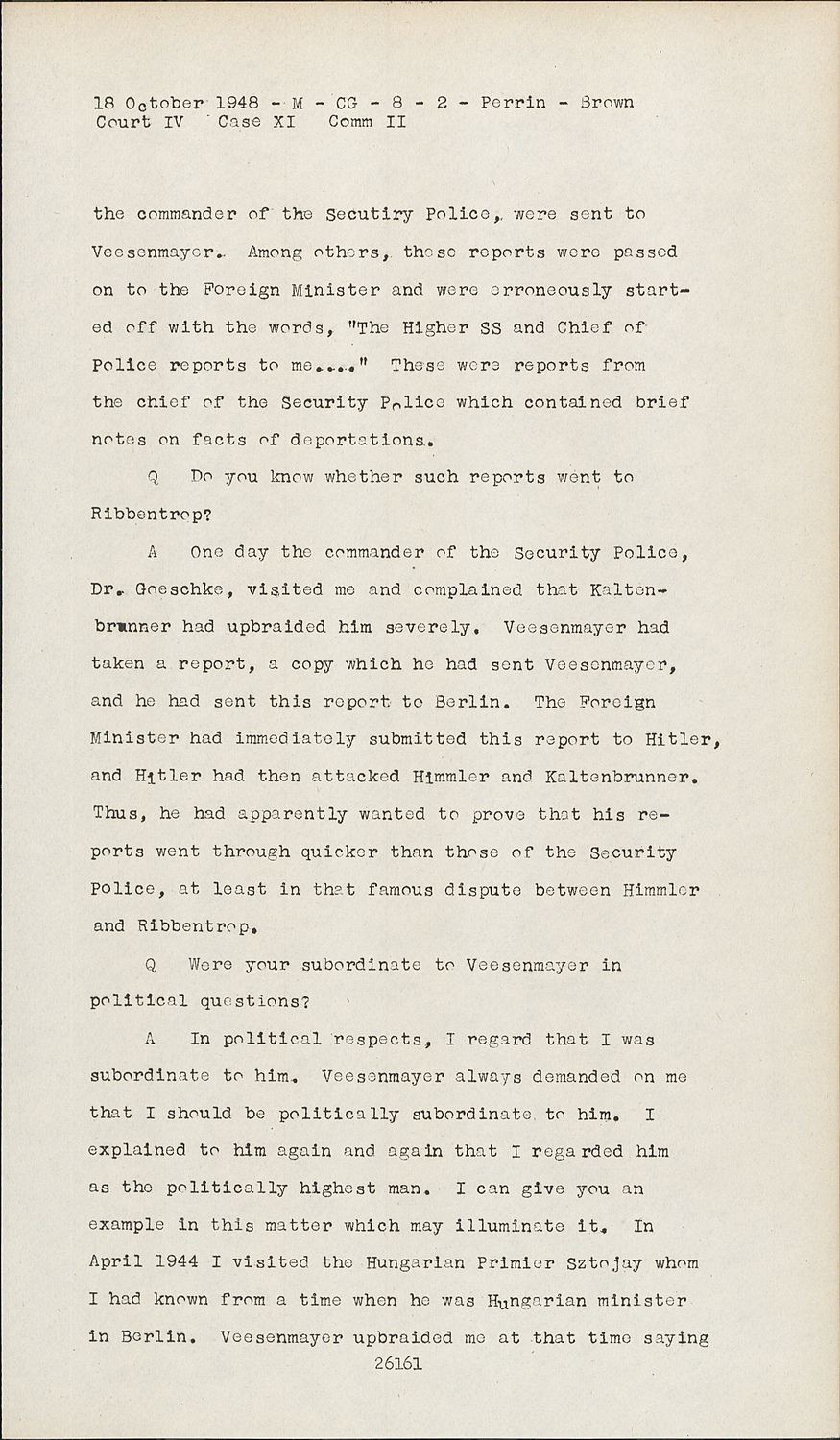
Among others, these reports were passed on to the Foreign Minister and were erroneously started off with the words, "The Higher SS and Chief of Police reports to me...." These were reports from the chief of the Security Police which contained brief notes on facts of deportations.
QDo you know whether such reports went to Ribbentrop?
AOne day the commander of the Security Police, Dr. Goeschke, visited me and complained that Kaltenbrunner had upbraided him severely. Veesenmayer had taken a report, a copy which he had sent Veesenmayer, and he had sent this report to Berlin. The Foreign Minister had immediately submitted this report to Hitler, and Hitler had then attacked Himmler and Kaltenbrunner. Thus, he had apparently wanted to prove that his reports went through quicker than those of the Security Police, at least in that famous dispute between Himmler and Ribbentrop.
QWere your subordinate to Veesenmayer in political questions?
AIn political respects, I regard that I was subordinate to him. Veesenmayer always demanded on me that I should be politically subordinate to him. I explained to him again and again that I regarded him as the politically highest man. I can give you an example in this matter which may illuminate it. In April 1944 I visited the Hungarian Primier Sztojay whom I had known from a time when he was Hungarian minister in Berlin. Veesenmayer upbraided me at that time saying Court IV Case XI Comm II that this man was unreliable and that should have been done through him.
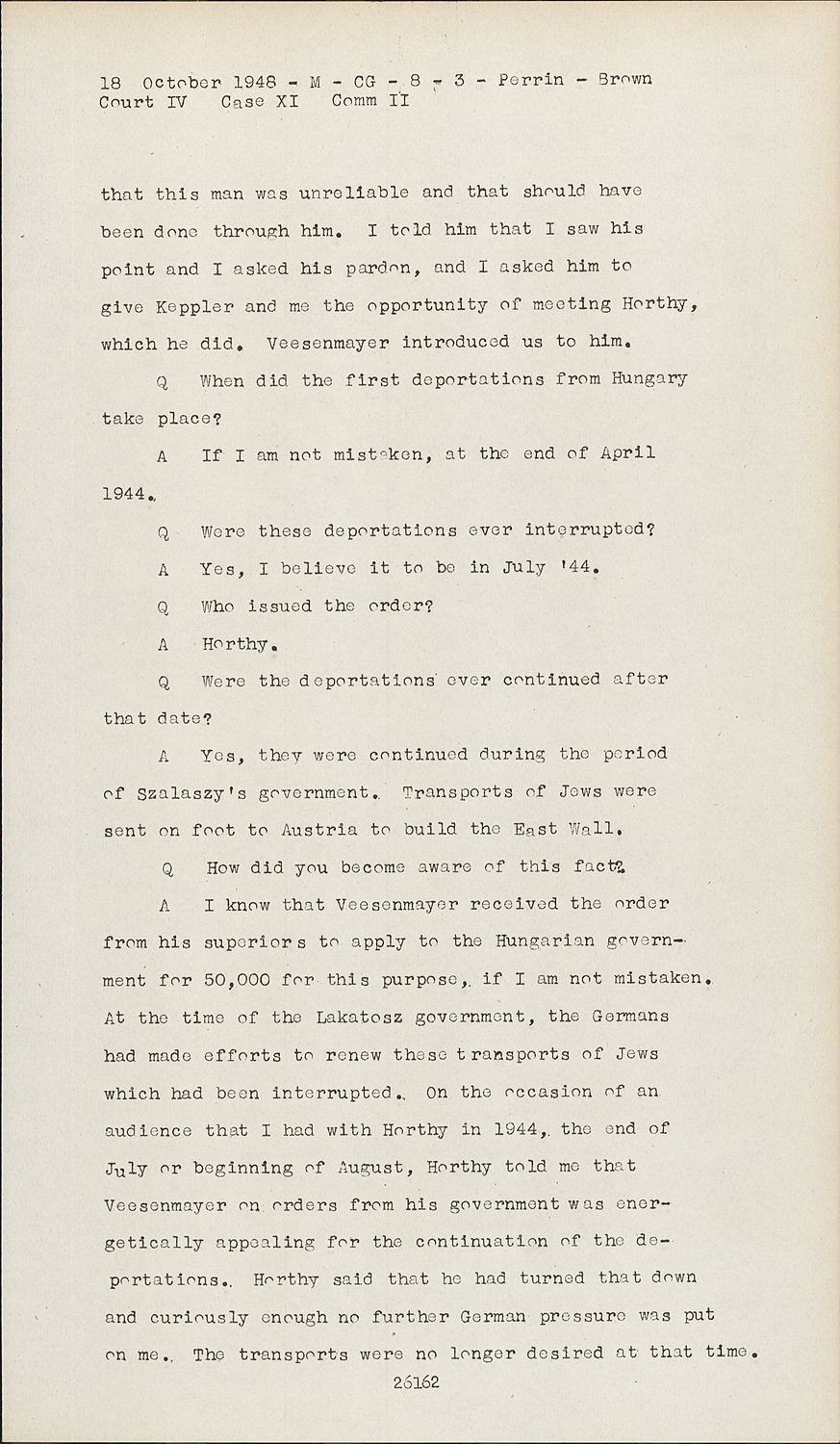
I told him that I saw his point and I asked his pardon, and I asked him to give Keppler and me the opportunity of meeting Horthy, which he did. Veesenmayer introduced us to him.
QWhen did the first deportations from Hungary take place?
AIf I am not mistaken, at the end of April 1944.
QWere these deportations ever interrupted?
AYes, I believe it to be in July '44.
QWho issued the order?
AHorthy.
QWere the deportations ever continued after that date?
AYes, they were continued during the period of Szalaszy's government. Transports of Jews were sent on foot to Austria to build the East Wall.
QHow did you become aware of this fact?
AI know that Veesenmayer received the order from his superiors to apply to the Hungarian government for 50,000 for this purpose, if I am not mistaken. At the time of the Lakatosz government, the Germans had made efforts to renew these transports of Jews which had been interrupted. On the occasion of an audience that I had with Horthy in 1944, the end of July or beginning of August, Horthy told me that Veesenmayer on orders from his government was energetically appealing for the continuation of the deportations. Horthy said that he had turned that down and curiously enough no further German pressure was put on me. The transports were no longer desired at that time.
Court IV Case XI Comm II
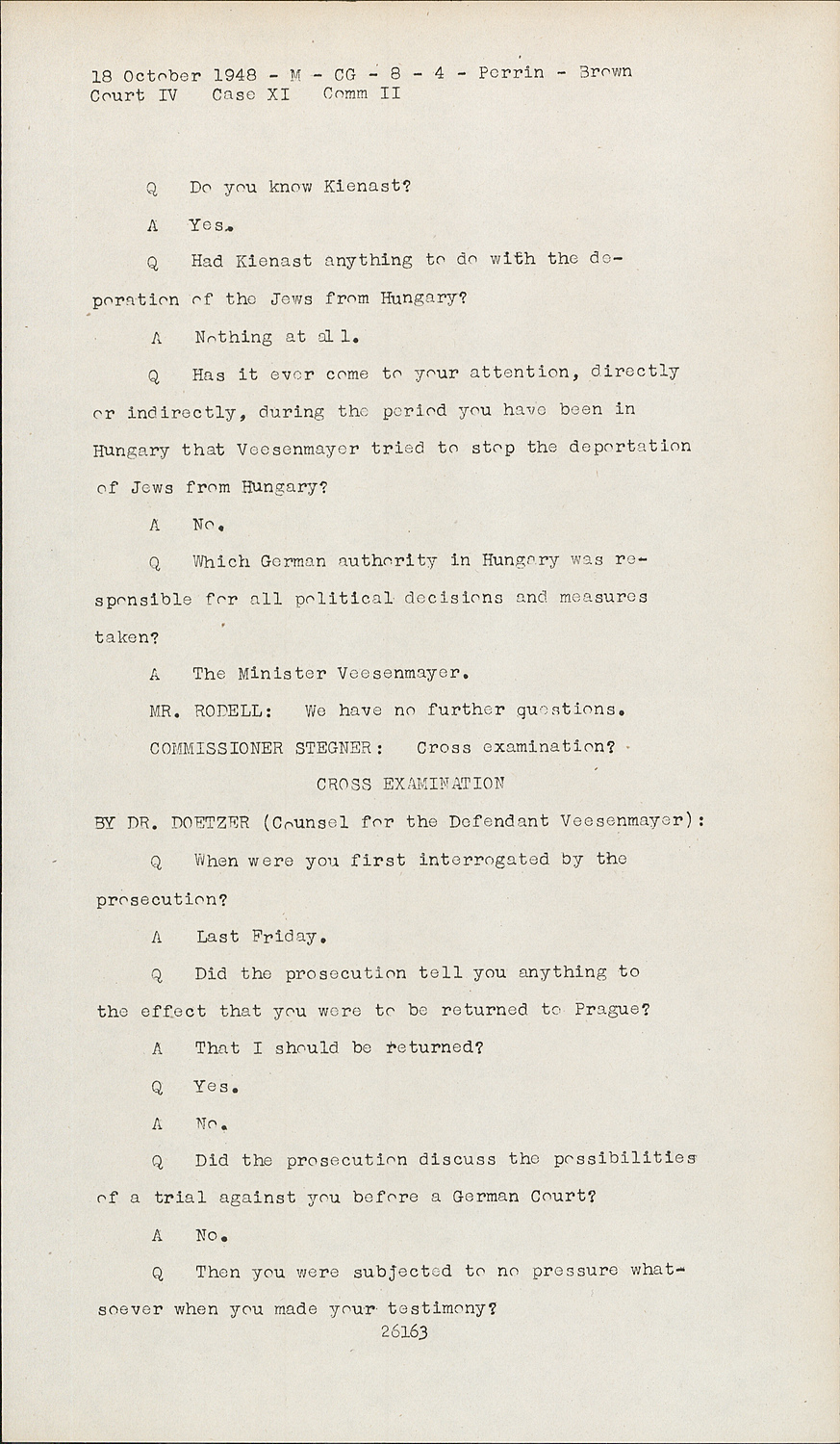
QDo you know Kienast?
AYes.
QHad Kienast anything to do with the deporation of the Jews from Hungary?
ANothing at al 1.
QHas it ever come to your attention, directly or indirectly, during the period you have been in Hungary that Veesenmayer tried to stop the deportation of Jews from Hungary?
ANo.
QWhich German authority in Hungary was responsible for all political decisions and measures taken?
AThe Minister Veesenmayer.
MR. RODELL:We have no further questions.
COMMISSIONER STEGNER:Cross examination?
CROSS EXAMINATION BY DR. DOETZER (Counsel for the Defendant Veesenmayer):
QWhen were you first interrogated by the prosecution?
ALast Friday.
QDid the prosecution tell you anything to the effect that you were to be returned to Prague?
AThat I should be Returned?
QYes.
ANo.
QDid the prosecution discuss the possibilities of a trial against you before a German Court?
ANo.
QThen you were subjected to no pressure whatsoever when you made your testimony?
Court IV Case XI Comm II
ANo, indeed.
QYou know that you are under oath?
AI believe that question is superfluous.
QAnd you wish to continue assorting that the question was never brought up whether you were to be charged before German courts, that question was not discussed on Friday?
ANo, never.
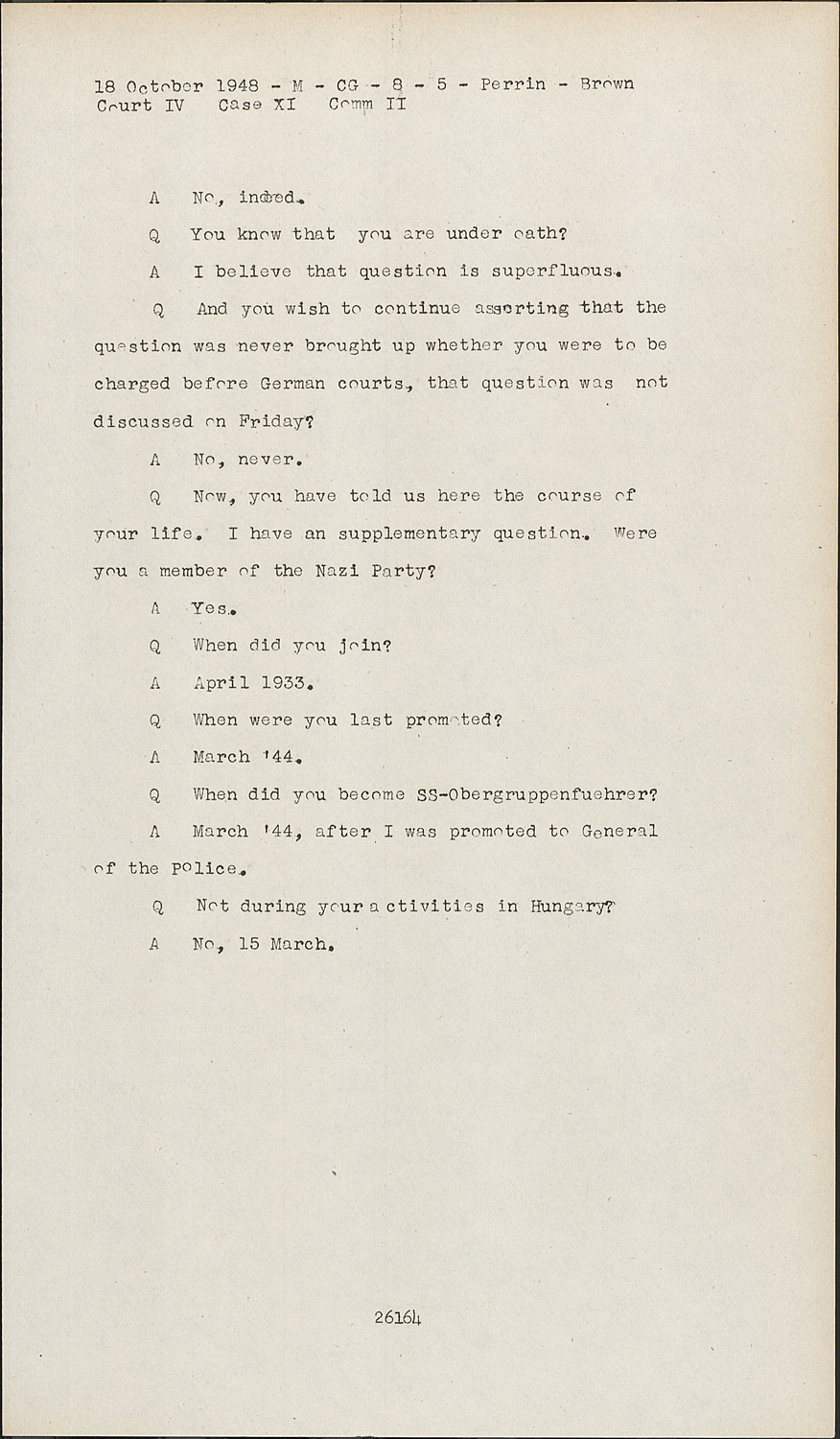
QNow, you have told us here the course of your life. I have an supplementary question. Were you a member of the Nazi Party?
AYes.
QWhen did you join?
AApril 1933.
QWhen were you last promoted?
AMarch '44.
QWhen did you become SS-Obergruppenfuehrer?
AMarch '44, after I was promoted to General of the police.
QNot during your activities in Hungary?
ANo, 15 March.
Court IV - Case XI Comm II
QAnd after you ended your activities in Hungary you received a particularly large task -namely. Chief of the Ordnungspolizei in Southern Germany and Austria?
AYes.
QYou described the task that Himmler gave you as Higher SS and Police Chief in Hungary. Do you have any written document on the subject?
ANo.
QDid you communicate the fact of your occupying it to any other German authorities in Hungary?
AYes.
QTo whom?
AAnyone who asked me or anyone with whom I had official dealings.
QDo you know Berger, the SS general, who is a defendant here?
AYes.
QWas he the man informed about the position of the Higher SS and Police Chief?
ACertainly.
DR. DOETZER:Mr. Commissioner, I shall have Berger inform the Tribunal on occasion on what a Higher SS and Police Chief was in the Third Reich.
AMay I say something on this subject?
QNo, I have no further questions on that subject. Maybe the prosecution has.
AYes.
QNow, when you were in Hungary -
MR. CAMING:I would like to caution defense counsel that he is going so fast that the prosecution cannot get the answer from the interpreter due to the Court IV Case XI Comm II fact this interposing is going back and forth.
THE COMMISSIONER:All right; let's go a little slower.
Q (By Dr. Doetzer): Mr. Winkelmann, did you negotiate with the prime minister Sztojay on any other occasion but the case you mentioned in which Veesenmayer reproached you? Did you negotiate with him with him on any other occasion?
AI spoke with him; I was frequently with him for lunch.
QAt the beginning of your activities in Hungary did you not, together with Kaltenbrunner and Sztojay. conduct the introductory negotiations regarding the deportation of Jews?
ANo, I didn't: I never did it.
THE COMMISSIONER:You are going too fast.
QThen Sztojay told an untruth when he stated that?
AYes, he did.
MR. CAMING:I have to caution defense counsel again. The prosecution cannot get the answers of the witness and his following questions. They are going too fast, Your Honor, and I shall have to caution defense counsel again to pause between the questions and the answer.
THE COMMISSIONER:All right, gentlemen; let's try to get along and go a little slower.
Q (By Dr. Doetzer): Then did you not, in conjunction with Kaltenbrunner, visit Sztojay and discuss the deportation of Jews from Hungary?
ANo.
QDid Kaltenbrunner tell you that he alone had Court IV Case XI Comm II conducted negotiations with Sztojay regarding the deportation of Jews?
ANo.
QDo you know from your period of confinement in Hungary and from legal proceedings that Kaltenbrunner did conduct those negotiations with Sztojay?
AYes.
QWitness, during the first Sztojay government were you in constant touch with the Hungarian Minister of the Interior - whose name I can spell J a r o s s.
AYes. On what subject?
QI will ask you that later. Did you conduct current continuous negotiations with him?
ANo.
QDid you with Jaross and Eichmann conduct negotiations regarding the deportation of Jews?
ANo, never.
QDid you visit Jaross together with Eichmann?
ANo, never.
QDid you visit state secretary Backe in Eichmann's company?
ANo, never.
QTogether with Eichmann did you visit state secretary Endre?
ANo, I didn't visit him either.
QWho was Kienast?
AKienast was a member of my staff.
QHow large was your staff?
AIt consisted of myself, my adjutant, Captain Maler, Kienast and Captain Schmidt, two typists, a chauffeur, and a telephone operator.
Court IV Case XI Comm II
QDo you know that Kienast has deposed affidavits against my client?
ANo, I didn't know that.
QDid you read it? Did counsel for the defense, Dr. Gawlik give it to you?
AYes, he did.
QThen you certainly do know that Kienast asserts that you conducted negotiations with Eichmann.
AIf that is in there it is wrong.
QWitness, do you know Vojnar, the Minister of Szalaszy government?
AYes.
QDid you visit him frequently?
ANo; three or four times.
QDo you know that Vojnar has deposed an affidavit?
AYes.
Q in which he says that you were the German representative in Hungary and that you and Eichmann were Himmler's deputies in Hungary?
AYou have to read that context.
QI am asking you whether you read that.
A what you read isn't in there; consequently, I could not have read it.
QThen you are familiar with this affidavit, too?
AYes.
DR. DOETZER:For the record, this is an affidavit against the defendant Berger, Volume 66-b, Ex hibit No. 2384, NO-1874. Herein Vojnar says that Hitler stated -- and I quote -
MR. CAMING:If defense counsel wishes to refer to an outside exhibit for the attention of the Tribunal, Court IV Case XI Comm II that is quite an order.
Any other reference to it, unless it is directed to the examination of this witness, is mere argumentation and should be withheld until defense counsel files his brief. He shouldn't read the document. Let him cross examine the witness on his document if it is in German here.
MR. DOETZER:Mr. Commissioner, I believe I have to read this to him because he says I read something incorrectly.
THE COMMISSIONER:Very well.
Q (By Dr. Doetzer): I shall now read this to you and ask you to refresh your memory.
AAnd please read the previous sentence too.
Q "Himmler stated the Jews were well treated in Germany because they were working and since the Jews had been cinluded in the Jaeger Program -- that is, the Higher Plane Program -- the capacity had risen by 40%. Himmler stated that Obergruppenfuehrer Winckelmann and, particularly, Eichmann were under his orders in Hungary."
ALet me emphasize again -
QI haven't asked a question at all yet. I want to ask you merely: do you now believe that I correctly quoted that document for the basis of my previous statement or should I do it again?
AIt still isn't correct. Please read that document. It says there that Vojnar had discussed all possible questions with Himmler, the preparation of the accommodations setting up a Hungarian gendarmerie and police department in Germany and so forth and so on. One of these questions was the Jewish question. It was Court IV Case XI Comm II defined in my tasks to hear Vonhar's wishes with regard to his accommodation in Germany.
That is the only thing I negotiated with Vojnar on, the preparations for his ministry. He wanted to accommodate 5,000 men. He wanted two police schools.
QThank you; I am not interested in all that. The document speaks for itself. I just want to ask one question for the sake of fairness because he disputes that he visited Vijnar with Eichmann.
AI do not dispute that. I merely dispute ... May I answer t hequestion? In my interrogation in Hungary it says verbatim that once by accident together with Eichmann I was with Vojnar. That is corroborated by Ferency, the Hungarian who played a great role in that business. I met Eichmann in Vojnar's anteroon and Vojnar called us in together. Vojnar wrote "several times", but I am sure it wasn't several times.
DR. DOETZER:Let me remark for the record that in this prosecution exhibit, which the prosecution put in evidence at that time the sentence is to be found: "Eichmann came in Winckelmann's company several times to me in the Ministry of the Interior."
AIt isn't true.
QYou discussed youractivity in Hungary and your curious position as Higher SS and Police Chief. Let me ask you briefly: to whom was Eichmann disciplinarily subordinate?
AHis superior in the RSHA was Gruppenfuehrer Mueller and then Kaltenbrunner.
DR. DOETZER:For the record let me point out that this witness's closet collaborator, Kienast.
Court IV Case XI Comm II testified on this matter, page 7137 of the German transcript.
He says that Eichmann was disciplinary subordinate to the Chief of the Security Police and that he, in turn, was subordinate to the Higher SS and Police Fuehrer in Hungar.
QWitness, you testified in connection with your relations with the defendant Veesenmayer that in political questions you recognized him as your superior; is that so?
AYes.
DR. DOETZER:I again refer to the witness Kienast who on page 7138 of the German transcript testified explicitly before the Commission that Winckelmann never recognized Veesenmayer's authority to give him directives.
Court 4, Case 11 - Commission II
Q.Now, so far as I understood you correctly, witness, you testified that legally Veesenmayer, was responsible for the deportations as German Minister; is that so?
A.Yes.
Q.Has that always been your opinion or is it just your opinion since the interrogation by the prosecution?
A.It always has been.
Q.It always has been?
A.Yes.
Q.When the deportations were stopped to whom did the legal order for that go -- to you or to Veesenmayer?
A.Neither one.
Q.Did you report to defendant Veesennayer on receiving this order from Himmler?
A.Yes, although I didn't get the order.
Q.But you did report on it?
A.Yes.
Q.Did you know of Eichmann's and Kaltenbrunner's plenipotentiary powers regarding Jews in Hungary?
A.No.
Q.Then how can you say the minister was legally responsible for the deportation of Jews?
A.Because the minister on orders from his superiors approached the Hungarian government to get their approval for the deportation of what was initially 100,000 Jews. That was the legal basis.
Q.Don't you know that in this plenipotentiary authorization which Dr. Gawlik showed to you you were made competent for dealing with the Jewish problem in Hungary?
A.Yes, but I never had the plenipotentiary powers.
Q.Don't you know from your own knowledge as Higher SS and Police Fuehrer that this higher plenipotentiary power was given to Kaltenbrunner and Eichmann?
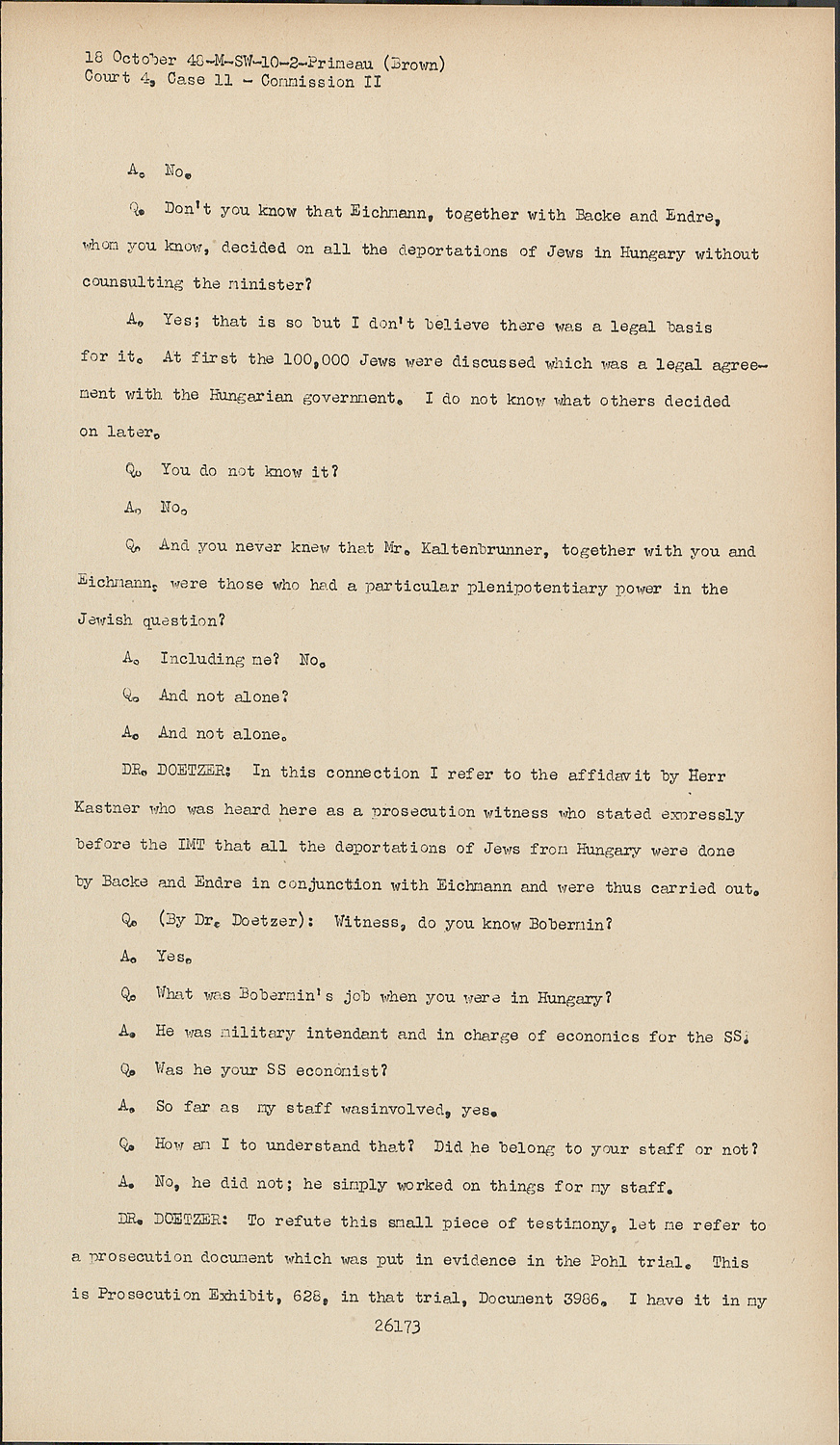
Court 4, Case 11 - Commission II
A.No.
Q.Don't you know that Eichmann, together with Backe and Endre, whom you know, decided on all the deportations of Jews in Hungary without counsulting the minister?
A.Yes; that is so but I don't believe there was a legal basis for it. At first the 100,000 Jews were discussed which was a legal agreement with the Hungarian government. I do not know what others decided on later.
Q.You do not know it?
A.No.
Q.And you never knew that Mr. Kaltenbrunner, together with you and Eichmann, were those who had a particular plenipotentiary power in the Jewish question?
A.Including me? No.
Q.And not alone?
A.And not alone.
DR. DOETZER:In this connection I refer to the affidavit by Herr Kastner who was heard here as a prosecution witness who stated expressly before the IMT that all the deportations of Jews from Hungary were done by Backe and Endre in conjunction with Eichmann and were thus carried out.
Q. (By Dr. Doetzer): Witness, do you know Bobermin?
A.Yes.
Q.What was Bobermin's job when you were in Hungary?
A.He was military intendant and in charge of economics for the SS?
Q.Was he your SS economist?
A.So far as my staff wasinvolved, yes.
Q.How an I to understand that? Did he belong to your staff or not?
A.No, he did not; he simply worked on things for my staff.
DR. DOETZER:To refute this small piece of testimony, let me refer to a prosecution document which was put in evidence in the Pohl trial. This is prosecution Exhibit, 626, in that trial, Document 3906. I have it in my Court 4, Case 11 - Commission II Volume V-a for Veesenmayer as Defense Exhibit 120.
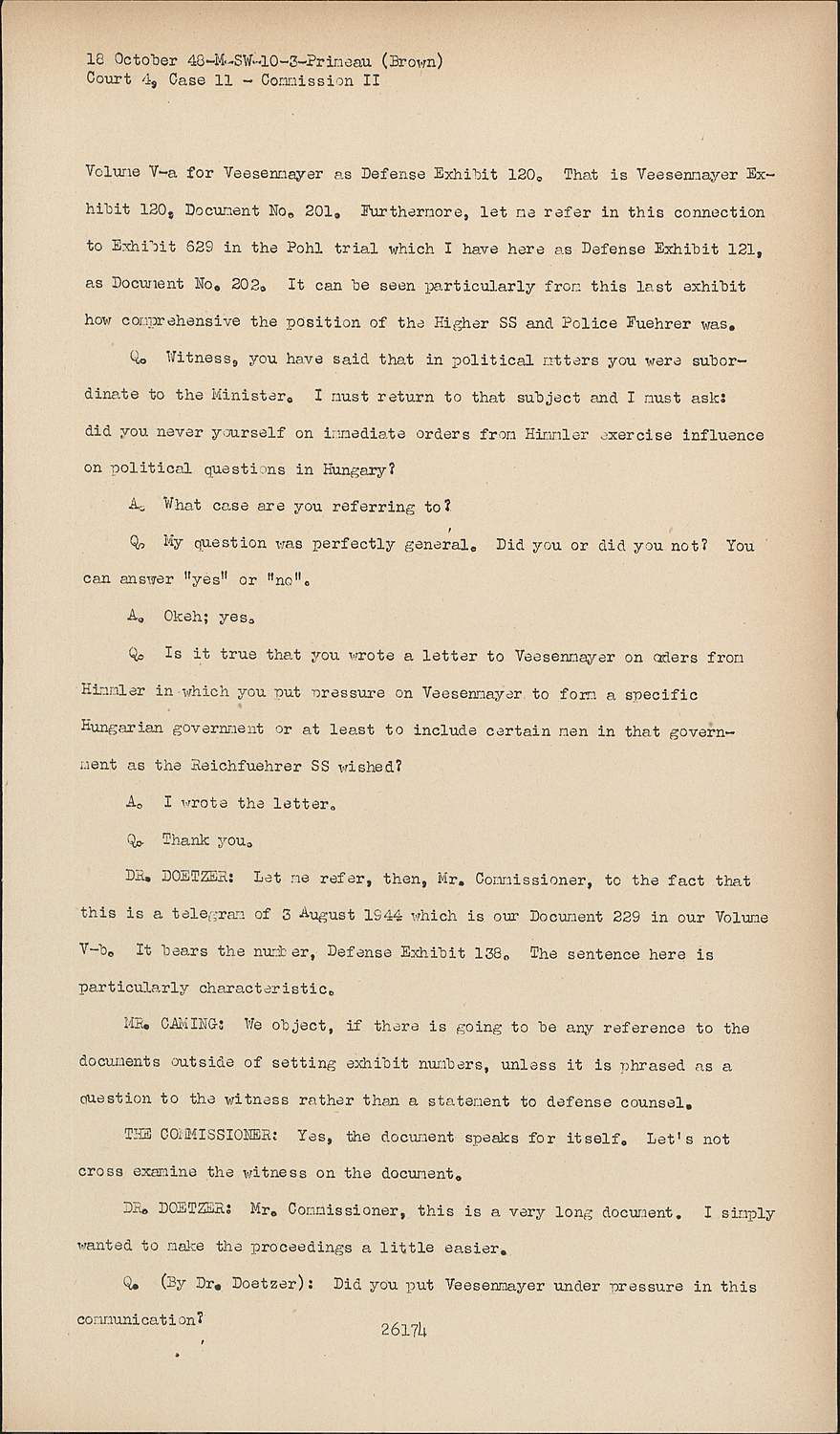
That is Veesenmayer Exhibit 120. Document No. 201. Furthermore, let me refer in this connection to Exhibit 529 in the Pohl trial which I have here as Defense Exhibit 121, as Document No. 202. It can be seen particularly from this last exhibit how comprehensive the position of the Higher SS and Police Fuehrer was.
Q.Witness, you have said that in political matters you were subordinate to the Minister. I must return to that subject and I must ask: did you never yourself on immediate orders from Himmler exercise influence on political questions in Hungary?
A.What case are you referring to?
Q.My question was perfectly general. Did you or did you not? You can answer "yes" or "no".
A.Okeh; yes.
Q.Is it true that you wrote a letter to Veesenmayer on Orders from Himmler in which you out pressure on Veesenmayer to form a specific Hungarian government or at least to include certain men in that government as the Reichfuehrer SS wished?
A.I wrote the letter.
Q.Thank you.
DR. DOETZER:Let me refer, then, Mr. Commissioner, to the fact that this is a telegram of 3 August 1944 which is our Document 229 in our Volume V-b. It bears the number, Defense Exhibit 138. The sentence here is particularly characteristic.
MR. CAMING:We object, if there is going to be any reference to the documents outside of setting exhibit numbers, unless it is phrased as a question to the witness rather than a statement to defense counsel.
THE COMMISSIONER:Yes, the document speaks for itself. Let's not cross examine the witness on the document.
DR. DOETZER:Mr. Commissioner, this is a very long document. I simply wanted to make the proceedings a little easier.
Q. (By Dr. Doetzer): Did you put Veesenmayer under pressure in this communication?
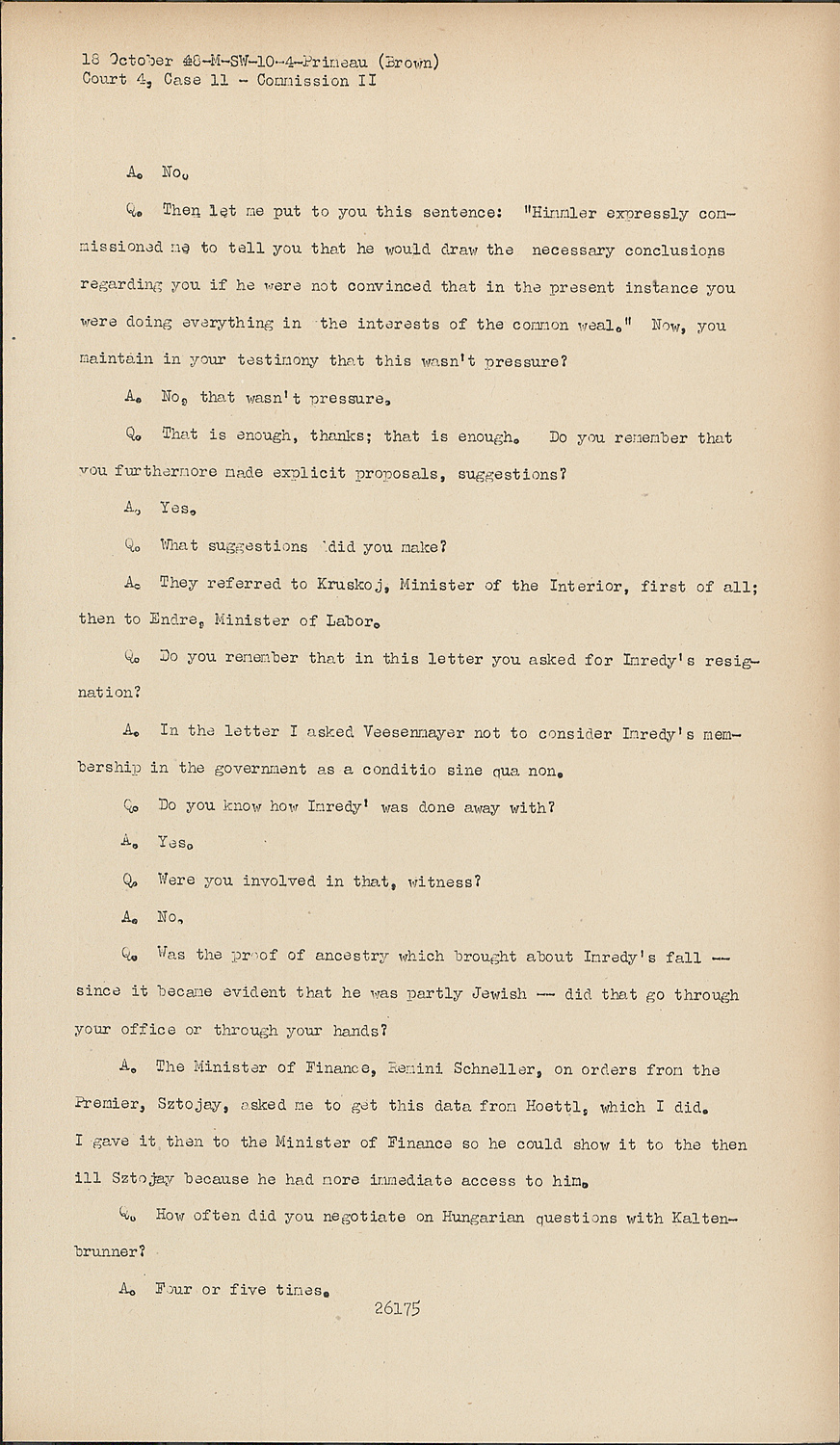
Court 4, Case 11 - Commission II
A.No.
Q.Then let me put to you this sentence: "Himmler expressly commissioned me to tell you that he would draw the necessary conclusions regarding you if he were not convinced that in the present instance you were doing everything in the interests of the common weal." Now, you maintain in your testimony that this wasn't pressure?
A.No, that wasn't pressure.
Q.That is enough, thanks; that is enough. Do you remember that you furthermore made explicit proposals, suggestions?
A.Yes.
Q.What suggestions did you make?
A.They referred to Kruskoj, Minister of the Interior, first of all; then to Endre, Minister of Labor.
Q.Do you remember that in this letter you asked for Imredy's resignation?
A.In the letter I asked Veesenmayer not to consider Imredy's membership in the government as a conditio sine qua non.
Q.Do you know how Imredy' was done away with?
A.Yes.
Q.Were you involved in that, witness?
A.No.
Q.Was the proof of ancestry which brought about Imredy's fall-since it became evident that he was partly Jewish -- did that go through your office or through your hands?
A.The Minister of Finance, Remini Schneller, on orders from the Premier, Sztojay, asked me to get this data from Hoettl, which I did. I gave it then to the Minister of Finance so he could show it to the then ill Sztojay because he had more immediate access to him.
Q.How often did you negotiate on Hungarian questions with Kaltenbrunner?
A.Four or five times.
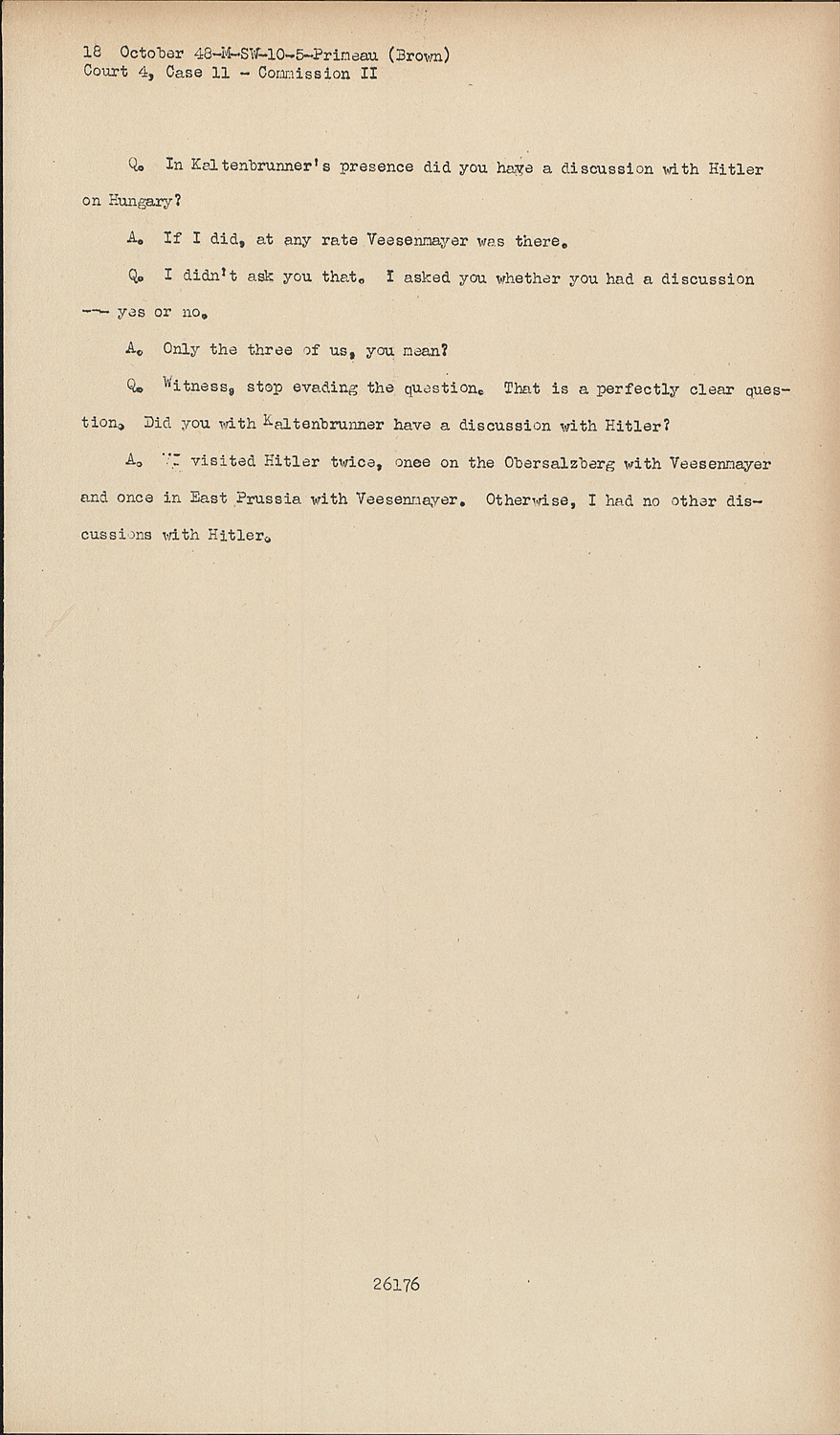
Court 4, Case 11 - Commission II
Q.In Keltenbrunner's presence did you have a discussion with Hitler on Hungary?
A.If I did, at any rate Veesenmayer was there.
Q.I didn't ask you that. I asked you whether you had a discussion --- yes or no.
A.Only the three of us, you mean?
Q.Witness, stop evading the question. That is a perfectly clear question. Did you with Kaltenbrunner have a discussion with Hitler?
A. ** visited Hitler twice, once on the Obersalzberg with Veesenmayer and once in East Prussia with Veesenmayer. Otherwise, I had no other discussions with Hitler.
Court IV Case XI Comm II
DR. DOETZER:To clarify this testimony by the witness, I refer to a document put in evidence by me which the witness, of course, is familiar, since he just reffered to it. This is the affidavit by the Minister Alexander Freiherr von Doernberg, which bears No. 141, and is Defense Exhibit No. 163, in my volume 5-C. Paragraph 1 of the affidavit is the one that is relevant here, in which Doernberg describes how the witness carried on politics behind Vessenmayer's nack, with Kaltenbrunner.
QWitness, you said that the police reports that the Prosecution has put in evidence in great numbers here, did not originate with you but with the BDS?
AThat is right.
QIs it to be seen from these original copies that they did not originate from you?
AYes, they bear the letterhead, Chief of the Security Police, and were signed by Dr. Goeschke.
QWitness, do you remember that there were difficulties with the distribution list because other German agencies also wanted to be on it?
ANo, I don't remember that.
QThen let me refresh your memory by telling you that there were exhaustive negotiations with you on the subject of including other German agencies on this distribution list.
AI don't remember that.
QOh, you don't remember. Then let me remind you that it was General Reifenberg, the German general with plenipotentiary powers. Doesn't that recall anything to mind?
Court IV Case XI Comm II
AHe was on the list already.
QWas he always on it?
AI cannot tell you that.
QAnd there were no negotiations with you?
ANo.
QDo you remember, witness, that in all questions involving the German questions in Hungary, you negotiated directly with Hungarian agencies?
AI did not negotiate with any Hungarian agencies.
QDo you remember that all SS Offices in Hungary, and Police Offices too, if you want to draw a distinction, were forbidden by you to have any immediate dealings with the German Embassy and to conduct all negotiations through you?
ANo, I don't.
QYou don't remember that?
ANo, I don't.
QFrom whom did you receive your orders, eitness?
AFrom Himmler.
QYou never received any from the Ordnungspolizei?
ANo.
Q.And none from the security Police?
ANo.
DR. DOETZER:In this connection, too, I refer to Kienast's repeatedly mentioned affidavit and what is to be found in it, which proves something different from the witness' testimony.
QWhen you reported to Himmler did you go via the Embassy, or did you go through channels of your own?
AMy own.
QThen externally and technically you were entirely independent from the German Embassy?
Court IV Case XI Comm II
ACompletely.
QWitness, do you remember that you were in favor of the confiscation or the requisitioning of the largest Hungarian publishing house, "Globus?"
AYes, I do remember that.
QYou had powers to do that?
AYes.
QDo you know that the Embassy recinded that requisitioning later?
AIt was not only the Embassy that did that. That was on the basis of a discussion that I had with Sztojay, in which I asked his pardon.
QAside from Jaross, Sztojay, Backe and Endre, whom we have already mentioned, with what other Hungarians did you have personal contact, or conduct negotiations?
ABardossy, Palfi, Jurczek, State secretary Moczary.
QThat you, that is enough. Did you try to set up a government agreeable to the SS with Bardossy at the head?
ANo.
DR. DOETZER:I refer in this connection to my Document 207, Exhibit 132, in Veesenmayer Document Book 5-B, which document proves the contrary of the witness' testimony.
QDo you know the Ujassi-Kadar-Kern affair?
AYes, I do.
QWhat role did you play in it?
A.When I heard that the arrest was to take place I asked the Security Police Offices that this should be done only with the agreement of the Hungarian police.
Court IV Case XI Comm II My further activity law in my making several efforts with Kaltenbrunner and Himmler to see to it that these three officers should be turned over to the Hungarian government.
In the discussion following the meeting with Ribbentrop, when Sztojay was there, at the beginning of June 1944, I again asked Himmler in Stojay's presence, to give the officers back to the Hungarian government. That was what my activity was.
Q.Did you not frequently demand, on orders from Himmler, that the Hungarian State Secretaries Backe and Endre should remain in office?
AAsk when?
QI just want to know whether you asked at all.
AThat is possible.
QDid you work with the Hungarian General Ruskaj?.
AHe visited me several times but there was no question of our working together.
QDid you know that Ruskaj opposed the Embassy's policy in his policies?
AYes, I knew that. Ruskaj was against everything.
QDid you know of the abduction of General Bakay.
AYes.
QWhen did you tell Veesenmayer about it, before or after?
AAs far as I know, afterwards.
QThank you. Witness, were you never told in Hungary, either by Hungarians or Germans, that there were two representative agencies of the Reich there?
ANo.
QOn the one hand the Embassy, and on the other Court IV Case XI Comm II hand the Higher-SS and Police Fuehrer.