Schlegelberger deemed in his duty, apparently to notify me of what hid taken place, because originally it was I who had transmitted the matter to him.
QThat suffices to clarify the facts of the case inasmuch as they affect your own case. I now pass over to Document NG-128, introduced as Prosecution Exhibit 1581, in book 77 of the Prosecution, page 92 of the English and 110 of the German. The provincial president of Upper Silesia also, according to this document, addressed a letter to you of 26 January, 1942, in which he requests that the respective of clemency and pardon be relegated to him. What did you do pursuant to that?
AI didn't order this transfer of authority as requested. I didn't have authority to do it, anyway. I only saw from the document and from other documents that in actual fact the matter was only settled as late as 28 May, 1942, by means of a decree enacted by the Reich Minister of Justice in conjunction with State Minister in Chief of the Presidial Chancellery.
PRESIDING JUDGE MAGUIRE:We have now reached the time for recess, Doctor. The Tribunal will be in recess until 1:30.
(The Tribunal recessed until 1330 hours.)
AFTERNOON SESSION (The Tribunal reconvened at 1330 Hours.)
THE, MARSHALL: The Tribunal Is now in session.
PRESIDING JUDGE MAGUIRE:Mr. Marshal, are all the defendants in Court?
THE MARSHAL:May it please Your Honor, all the defendants are In the courtroom except Keppler, Rasche, Stuckart, Schellenberg, and Erdmannsdorff, who are ill in the hospital. Ritter, Kohrl, Pleiger, Steengracht, Woermann, and Krosigk are absent excused.
PRESIDING JUDGE MAGUIRE:Very well, Dr. Soidl, are you ready to resume? You may go ahead.
HANS HEINRACH LAMMERS - Resumed DIRECT EXAMINATION (Continued) BY DR. SEIDL;
QI come now to Document NG-1512, Exhibit 1582, on page 94 of Volume 77. Another document is associated with this document put in by the Prosecution, with the NG, 3502, Exhibit 1583, on page 99. Both of these documents deal with legislative matters, that is, the Fuehrer decree of 21 March, 1942, and I ask you, witness, what was the reason for this simplification measure?
AThese measures were based on urgent war necessities to make manpower available, and secondly for Wehrmacht purposes and for purposes of labor allocation.
QDo these simplification measures affect only the field of juridical administration, or also the field of legislation?
AIn the main this was a simplification of the rules for procedure in civil law suits, in penal law suits, and in the so-called voluntary jurisdiction. They did not affect juridical administration.
QTo what extent did your participation extend in the bringing about of this decree?
ASince this was a Fuehrer decree, it fell under my tasks to participate in this juridical formulation. I don't wish to dispute at all that I made several suggestions hare, although today I am not solo to state them in detail, nor can I state to what extent those suggestions were incorporated in the decree. One was incorporated.
QSome of your own suggestions, according to this document, affected the regulation that the laws promulgated to implement this decree by the Minister of Justice were not only oound to the okay of the chief of the party chancellory, but were also dependent upon your own agreement. I now want to ask why you made that suggestion?
A.This regulation was important to me because I believed that I should assume for myself the responsibility of having my intervention in the matter constitute a counter-balance against any misuse of this legis lation.
Probably it would have been a matter of indifference to the Fue hrer whether or not I intervened,Perhaps the Fuehrer would have given the Minister of Justice the implementing right along, or only on agreement with the Chief of the Party Chancellery, without insinuating me.
Q.What was the practical effect of your insinuation in this mat ter?
A.Certainly it was only favourable. Dr. Ficker, the specialist here will be able to corroborate that because now the Minister of Justice could not operate as he wished alone or only on agreement with Bormann.
Q.In this exceptional case the Fuehrer signed this decree on your suggestion.
Now, why did you give your approval to the signing although usually you did not do so?
A.In my file note it says that the Fuehrer signed this decree after I had reported it to him. It does hot say it was on my suggestion, but whether it was the one or the other is a matter of indifference, be cause in the last analysis the Fuehrer signed all such documents upon reporting them to him -- or, if you wish, on my suggestion -- even in those cases where I merely reported that the matter was proceeding in an orderly fashion.
If in this present case, as you can see from the docu ment, and which I assume to be so, I give my approval for this decree, I was able to do that with all the less misgivings in that the decree, not only in formal respects, but also in accordance with its entire contents, was reasonable and correct, when you take into consideration the fact that it was promulgated for the sake of simplification during the war.
Q.The documents reveal that the decree had previously been agreed upon by Reichsleiter Bormann.
Why was that done?
A.That was necessary,of course, in view of the right the Party always had to intervene in regulations of this sort; and I should like to take credit for the fact that we were able to get his approval in this decree.
The great need for this decree can be seen from my file note of 6 March 1942, according to which he attributed a profound political significance to this decree, a significance which the decree does not have, but unfortunately this document does not contain Bormann's letter to me from which that can be seen.
Q.We shall now turn to the implementing directives. Why did you approve them?
A.Because after my examination which I conducted as a matter of course, they seemed to me unexceptional. I had to undertake this examination because t is was one of the few cases in which my approval had been provided for and for which I had to get the Fuehrer's approval.
Q.Did you discuss these Implementing directives with Reichsleiter Bormann too?
A.Yes, and that, too was a matter of course and necessary, because if the promulgation of the implementing directives was to be based on his and my approval, then these two approvals had to be in conformity with each other, and that could best be done by oral discussion.
Q.Bid you approve these implementing directives in place of the Fuehrer?
A.There can be no question of my acting under my own cower as a representative of the Fuehrer. The declaration that I approved had to be based on.the previous agreement of the Fuehrer, and I have already explained the general significance of this approval of mine.
Q.Why did you neglect to get a general approval of the Fuehrer on these implementing directives?
A.As I have already said, because that approval had already been given. When I presented the decree itself, which decree is a general decree and thepurpose of which is not immediately obvious from it, I had, at that time, already had the implementing directives before me in this final form, and had presented them to the Fuehrer. On the basis of certain details here I can remember very precisely that the Fuehrer approved them.
indeed , and that he himself made suggestions which I incorporated into these implementing directives. To this extent the Implementing directives were already in such a state that the Fuehrer had approved then and I could declare jiy approval of them. Now, in this note of 6 May 1942 states that presentation et cetera to the Fuehrer can be dispensed with; and that refers to the fact that another report to the Fuehrer was not necessary because the Fuehrer had already approved it and because at that moment he was inacessible. Otherwise, perhaps, I might have inquired a second tine, particularly since this was a very important matter and the suggestion which the Fuehrer had given was important to him.
Q.That answer suffices to clarify this document so far as it is necessary for this trial. I turn now to Document NG-102, Exhibit No. 1584, on Page 103 of the English Document Book. This document contains a suggestion by the Reich Minister of Justice for a confirmation of penal verdicts.
What was the purpose of this suggestion?
A.It was to prevent a disorderly intervention into penal justice from higher authorities. For that reason State Secretary Schlegelberger proposed that a confirmation be introduced for penal verdicts of the same sort as the confirmation that was customary in courts martial.
Q.As can be seen from the document you basically approved, such a right of confirmation. What moved you to take this particular attitude?
A.That wascorrect, and what moved me to it was the consideration that this confirmation could serve to bring about a uniform response in the passing of verdicts, because the Reich Minister of Justice had presented the lists, to be found in this document; and these lists show a number of practical examples which manifest a great lack of uniformityin the sentences passed.
Q.In your approval did you refer to experiences you had had resulting from the Fuehere's intervention in juridical matters?
A.That's what I was referring to when I said before that the Schlegelberger suggestion was to serve to prevent disorderly intervention in justice, because I knew that such intervention had taken place.
Q.What decision did the Fuehrer reach when you made this suggestion of State Secretary Schlegelberger to him?
A.The Fuehrer basically approved the decree but he could not decide to sign it. Apparently it was important to him to treat the matter dilatorily for the reason that he told me that he intended to appoint someone to the open post of Minister of Justice, and in view of those facts it seemed entirely understandable that the decree should be postponed, because if it was intended to appoint a new Minister of Justice it was not expedient, of course, to promulgate a decree of some significance immediately before that and thus anticipate the decisions which the new Minister of Justice night reach.
Q.Why did you work on the matter further, then?
A.Because the appointment of a new Minister of Justice was not yet a sure thing, and for that reason the matter was looked into and worked on further for the time being; and, in particular, I wrote once more to Bormann, as can be seen from the document. However, my letter to him is missing; only his answer is in evidence here, in which he informs me of us disapproving attitude.
QYou just mentioned that on 28 July 1942 you had spoken with Bormann in this matter. Why did you do so, and what was the result of this discussion with Bormann?
AI first wrote him and then, as you correctly state, I spoke with him on 28th July because, despite his disapproving attitude, I wished to present the note once again to the Fuehrer; and, on this occasion, Bormann told me that the Fuehrer would hardly accept my suggestion because the appointment of a new Minister of Justice was certainly to be expected shortly. In view of this information I refrained from reporting to the Fuehrer since it would have been unsuccessful; and I could agree with Bormann only to the extent that such a reform in the field of justice, if it took place, of course, would have to be reserved for the new Minister of Justice.
QOn 20 August 1942 Thierack was appointed the new Minister of Justice. After his appointment did Thierack return to this matter?
AI lid not take up the suggestion anew.
QAnd what efforts did you make in working on this matter further, if you did so at all?
AI endeavored to exhaust all the possibilities to keep justice in an orderly condition and to find means to prevent disorderly intervention altogether in the field of justice.
QThat suffices for this document. I turn now to Document NG-174, Exhibit No. 1585, on page 119 of the English Document Book. This document contains a draft of a law to supplement the laws against high treason. This document, again, seems to be typical for the normal functioning of the ministeries of the Reich Chancellery in matters of justice. In a letter of 27 May 1942 the Reich Minister of Justice sent a letter to various addressees, one of which is you, with the preliminary draft for the law he intended, with the request that you approve it.
Did you approve this preliminary draft?
AAs always, in such cases, I refrained from approving it.
QIn a letter of 5 September 1942 to you the Minister of Justice brings this draft with forty-five copies to you in the Reich Chancellery. He asks for a decision on the part of the Government, and he asks which ministries involved had already approved. You aren't listed there.
ANo, he couldn't list me there because, first of all, I had no ministry under me, and, secondly, I hadn't expressed myself at all. That's what can be seen from this letter of 5 September. He mentioned that certain ministries had approved, but he doesn't mention that I had approved nor did he do so subsequently, because he couldn't.
QAnd them what did the Reich Chancellery do?
AThe draft went through the usual channels for such matters of legislation until it was finally published in the Reich Legal Gazette, but I need not repeat all that again.
QYou have stated that in a factual matter you are not involved in this affair at all; and I turn now to the letter of 22 July 1944, in which the Reich Minister of Justice again brings in a draft of a law with fifty-five copies, to be approved by the Government. This letter is addressed to you, and I ask you whether you approved this draft of the law.
AHere, too, in the case of this draft of the law, which is taking place two years later, I refrained from approving it because that was not within my competency, and the Minister of Justice remarks explicitly here that the Chief of the Party Chancellery and the ministries involved had approved; I am not among them.
QWhat did the Reich Chancellery do thereupon?
AThe matter went through the usual channels for such legislation with a few file notes by the men working on it until finally it came to the Fuehrer for signature.
QDid you have anything else to say about this law?
AYes. Let me emphasize that in the letter of the Minister of Justice, of 22 July 1944, it is said that "the draft of this law has been drawn up on the basis of my suggestion and has received the form of a law instead of a decree," and there is a more profound reason for that. Dr. Thierack, the Minister of Justice, really did not want a law, but, on the basis of the special powers he had been given as of 20 August 1942, he wished to promulgate a decree under his own authority. To this I refused my approval because I was of the view that that was no matter which should be settled in that fashion. He didn't like that very much.
QThat suffices for this document. I turn now to Document 2927, Exhibit No. 1586, on page 137 of the English Document Book. This document contains two complete documents that have nothing to do with each other but which are here associated in the document book. The first document is a memorandum of the Reich Chancellery of the 18th of August 1942, with the heading, "Participation of Poles and Jews in Criminal Acts." It is here reported in this memorandum that the Reich Minister of Justice has sent a draft of a decree to the ministries principally involved regarding the punishability of criminal acts committed by Jews and Poles, and he requests that you adopt an opinion on this matter.
I ask you whether this draft of the decree ever reached the Reich Chancellery.
AI do not know; I cannot assume that it did, as it cannot be seen from the document. Perhaps it was in the files because the memorandum here in the document contains the remark at the top, "To RK, No. etc. etc.," - "RK" standing for "Reich Chancellery". So it must have arrived somewhere within the Chancellery, although it is not indicated just where in the document.
QWas the Reich Chancellery a ministry involved at all in this matter?
ANo, it wasn't a ministry involved, because it wasn't even a ministry.
QAccording to the draft of this law what people were to be included?
AThe document shows perfectly clearly that in the draft proposed it was a question of assuring the fact that German nationals could be punished if they were accomplices in criminal acts committed by Poles or Jews. Previously they could not have been punished if they so participated, and, consequently, it was felt to be necessary to provide for punishment of German accomplices in this regard. It was entirely fitting that such a decree should be promulgated; and, consequently, ray man in charge, Gritzinger, who remarks quite justifiably that there can be no misgivings against this draft of a decree, submits this draft to me for my information. I initialed it, as giving my approval, and then the matter was submitted several times and looked into further and kept in mind, but apparently no further decision was made in the Reich Chancellery concerning the matter. Perhaps the decree was promulgated; perhaps it was not; I do not know.
THE PRESIDENT:Counsel, please don't indulge in the practice you did just now, asking him what this law stood for and then he reads practically the recital of the law to us.
We can read it just as well ourselves. He didn't add a thing in his last answer; it was all right before us. Yet you asked him to tell us what it was; you didn't have to do that. We don't like that. That's exactly what he did. I followed him almost all the way through an almost exact word recital of the law there what was right there to be read by us. You're just consuming our patience and our time.
Go ahead. BY DR. SEIDL:
QI now turn to the second document, contained in this Prosecution Exhibit No. 1586, which is dated three months later than the one we just discussed. This is a copy of a letter from the Reich Minister of Justice to Reichsleiter Bormann, of 16 November 1942, sent to you for your information.
Does this document deal with the same matter?
A.It deals with something absolutely and utterly different, namely the turning over of criminal prosecution of Poles, Russians, Jews and gypsies to the police. This is an entirely different matter from that in the first document.
Q.The matter contained in this second half of this prosecution's exhibit, we shall enter upon it later. First of all we simply want to refute the intention implicit here that possible inferences can be drawn from the association of these two documents, the one with the other, at least so far as the Reich Chancellery is concerned. Now, let me ask you, is the first half of this document a proposal, is there any discussion in that first half of the criminal prosecution of Poles, Russians, Jews and gypsies as suggested by Thierack, is that what is happening?
A.Not in the slightest. There is no word about that in the first part of the document.
Q.Now as to the second half, there is no mention of a decree for the criminal prosecution of Poles, Jews, etc. Let me ask you now whether the note of your representation of 18 August, 1942, deals with the criminal prosecution of Poles, Russians, Jews, etc?
A.This note refers only to the creation of a decree that will make it possible to punish German citizens who are accomplices in criminal acts committed by Poles and Jews. That is with reference to the first document. Now with reference to the second document -
THE PRESIDENT:Now, don't go into that first document. Why do you read that all over again I want to know.
DR. SEIDL:We have to discuss this matter some way or other.
THE PRESIDENT:You don't have to discuss it in that manner, and furthermore these documents speak for themselves. If you want to argue these documents later on you can do so, but we resent having you argue then over and over again and spending time on them when we spent some little time discussing this before, and we can read it. The documents are before us and we can read them. Now, there is no sense to a procedure like that.
You are presuming that we can't read or can't understand the document.
DR. SEIDL:In our view the prosecution is drawing absolutely wrong inferences from these two documents and consequently, since two documents are included together here which have nothing to do with each other I regard it as my duty as defense counsel to clarify this matter, and I see no other way to do so than by asking the questions of the witness. I don't know how else I am going to do this.
THE PRESIDENT:Do you mean asking them and reasking them over and over again as you have been doing here in effect?
DR. SEIDL:So far I have not asked this question of this witness.
THE PRESIDENT:Well, you have gone back to this first document, counsel , now a second time. Now the first part of this document which we spent a lot of time on you have unnecessarily rehashed it over a while ago. Now you cone back to it and say, "What does this document contain, and what does this other document contain"? We have spent a lot of time here this afternoon. We are going to have to ask you for more discretion or we are going to have to ask you to limit your time in cutting in your defense of your case. It is going beyond all reason.
Q. (By Dr. Seidl): Witness, in that case we will break off discussing these matters, and I shall turn to something different. I shall turn to NG-151, Prosecution's Exhibit 1551. This is in Volume 76-B, Page 303. This document belong with those concerning the limitation of the legal rights of Jews, and when we were dealing with Volume 76 we did not enter upon this question because it belonged in the subject matter which we are now discussing. Exhibit 1551 contains directives of 1 July, 1943, in the matter of civil law. Please describe the origins of this decree so far as you as Chief of the Reich Chancellery had anything to do with it, .
A.On 3 August 1942, the Reich Minister of Justice addressed a letter to a number of agencies, which you can see here, sending a draft of a ministerial council directive to them in which the question of the limitation of the legal remedies , appeal etc.
of Jewsis discussed. He asks the addreseces to express their opinions. He does not ask me to. He included me merely because that was the question of an intended ministerial council decree with which I had to concern myself.
Q.Were statements made by other ministries to be found in this matter also?
A.There was exhaustive correspondence in the matter, which I need not delineate, in which various wishes were expressed by the ministries involved. I merely had knowledge of these matters and filed them. At this stage of theprocedure I had no more to do with it than that.
Q.Then at what time did you have something done in the matter?
A.On 21st August I submitted this whole matter to the Plenipotentiary General for the Reich Administration and asked him to see the matter through, and then when he thought it was fitting to bring a decree to the Ministerial Council. That would have been his job and not mine.
Q.Did you adopt any point of view of your own at that time?
A.As in all such cases I deliberately refrained from that, and in a number of other letters, which I needn't list here. I was asked to adopt an opinion which, however, was not my task, and which I did not do.
Q.The appointment of Thierack as Minister of Justice, which had taken place in the meantime, did that have any effect on the course of events in this affair?
A.Toward theend of August, 1942, the matter was defensively referred to by the newly appointed Minister of Justice because immediately after taking office new plans made their appearance before this already discussed Ministerial Council decree. Whereas there had previously been a discussion of the fact that Jews should not be permitted to take oath, but now new questixns were expressed, that the Jews should not be permitted to refuse to be tried by German courts, that their should be regulations of the estates of deceased Jews, and then, and this is the crucial matter, the punishment of criminal acts should be left in the hands of the police. That was the influence that Thierack made felt after his appointment as Minister of Justice.
Q.It seems to me that the last point you mentioned needs further explanation. What do you know aboutThierack's wishes regarding transferring to the police the punishment of criminal acts of Jews?
A.As I know now only after the serving of the indictment and having seen in the documents, the new Minister of Justice, shortly after his taking office, reached a definite agreement with Himmler according to which criminal procedure against Poles and Jews was to be removed from regular juridical procedure and was to be taken care of by thepolice,but the documents here show with respect to me that apparently quite deliberately I was not allowed to participate in this, but that it had been secret from me.
THE PRESIDENT:You let your counsel argue what the documents show. They ere in evidence, and you don't have to argue the matter if he is going to argue it later on. Go ahead, counsel, with you next question. We can draw our own conclusions, and it becomes our duty to draw conclusions about what these documents eventually show.
BY DR. SEIDL:
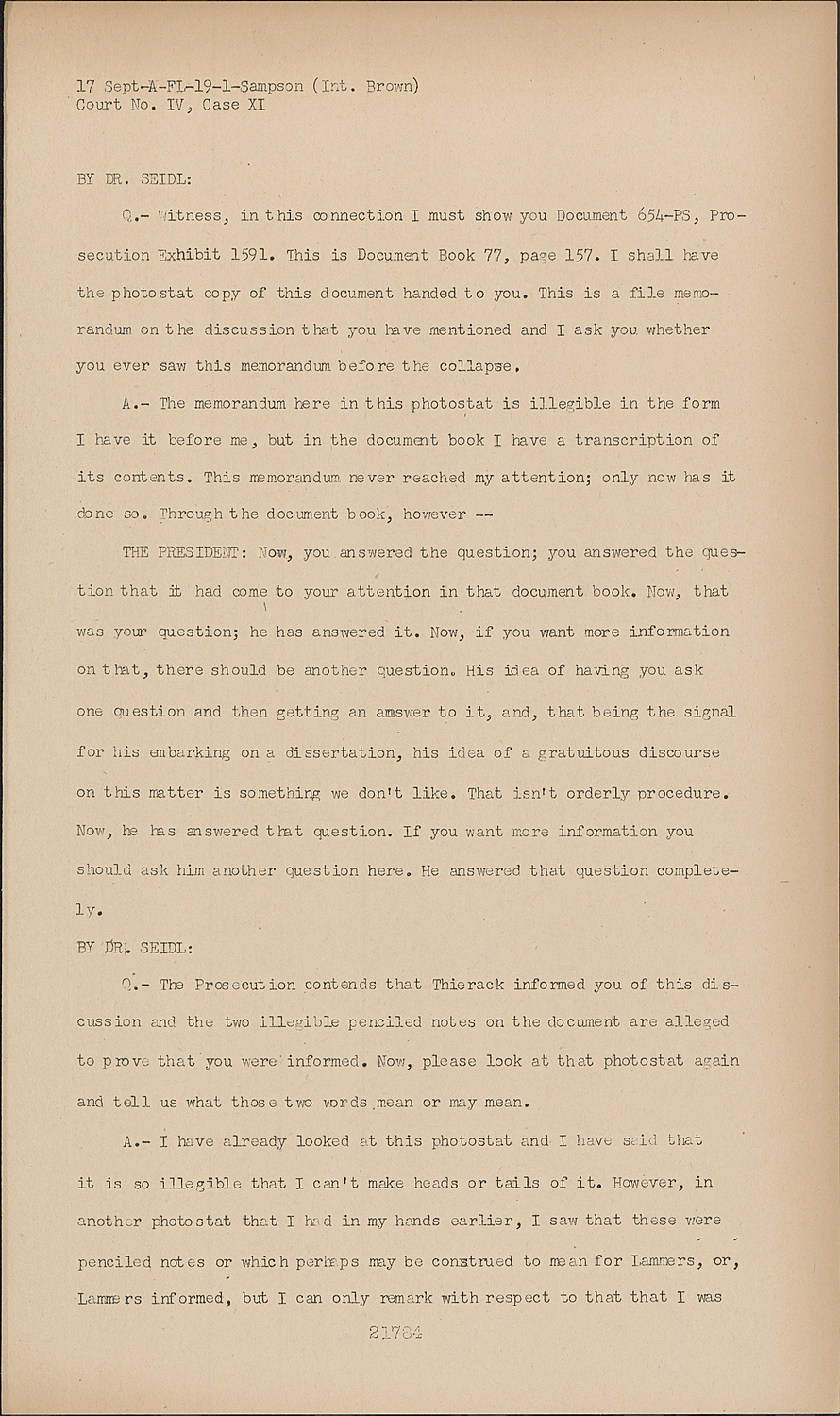
Q.- Witness, in this connection I must show you Document 654-PS, Prosecution Exhibit 1591. This is Document Book 77, page 157. I shall have the photostat copy of this document handed to you. This is a file memorandum on the discussion that you have mentioned and I ask you whether you ever saw this memorandum before the collapse.
A.- The memorandum here in this photostat is illegible in the form I have it before me, but in the document book I have a transcription of its contents. This memorandum never reached my attention; only now has it done so. Through the document book, however -
THE PRESIDENT:Now, you answered the question; you answered the question that it had come to your attention in that document book. Now, that was your question; he has answered it. Now, if you want more information on that, there should be another question. His idea of having you ask one question and then getting an answer to it, and, that being the signal for his embarking on a dissertation, his idea of a gratuitous discourse on this matter is something we don't like. That isn't orderly procedure. Now, he has answered that question. If you want more information you should ask him another question here. He answered that question completely. BY dR. SEIDL:
Q.- The Prosecution contends that Thierack informed you of this discussion and the two illegible penciled notes on the document are alleged to prove that you were informed. Now, please look at that photostat again and tell us what those two words mean or may mean.
A.- I have already looked at this photostat and I have said that it is so illegible that I can't make heads or tails of it. However, in another photostat that I fed in my hands earlier, I saw that these were penciled notes or which perhaps may be construed to mean for Lammers, or, Lammsrs informed, but I can only remark with respect to that that I was not informed that this discussion had taken place by the Reich Minister of Justice nor by any ministries involved, but only by my specialist Reichskabinettsrat Dr. Ficker who reported to me on the fact that the discussion took place, without entering into the contents of that discussion in any way; and, this document is in my document book as NG-059, with Lammers' Exhibit No. 24; Book III, page 6. That is the sole information that I received on this ostensible set of minutes, which, by the way, are not minutes at all because it is said that there was a five and a half hour discussion and a set of minutes of three pages cannot cover such a long discussion obviously.
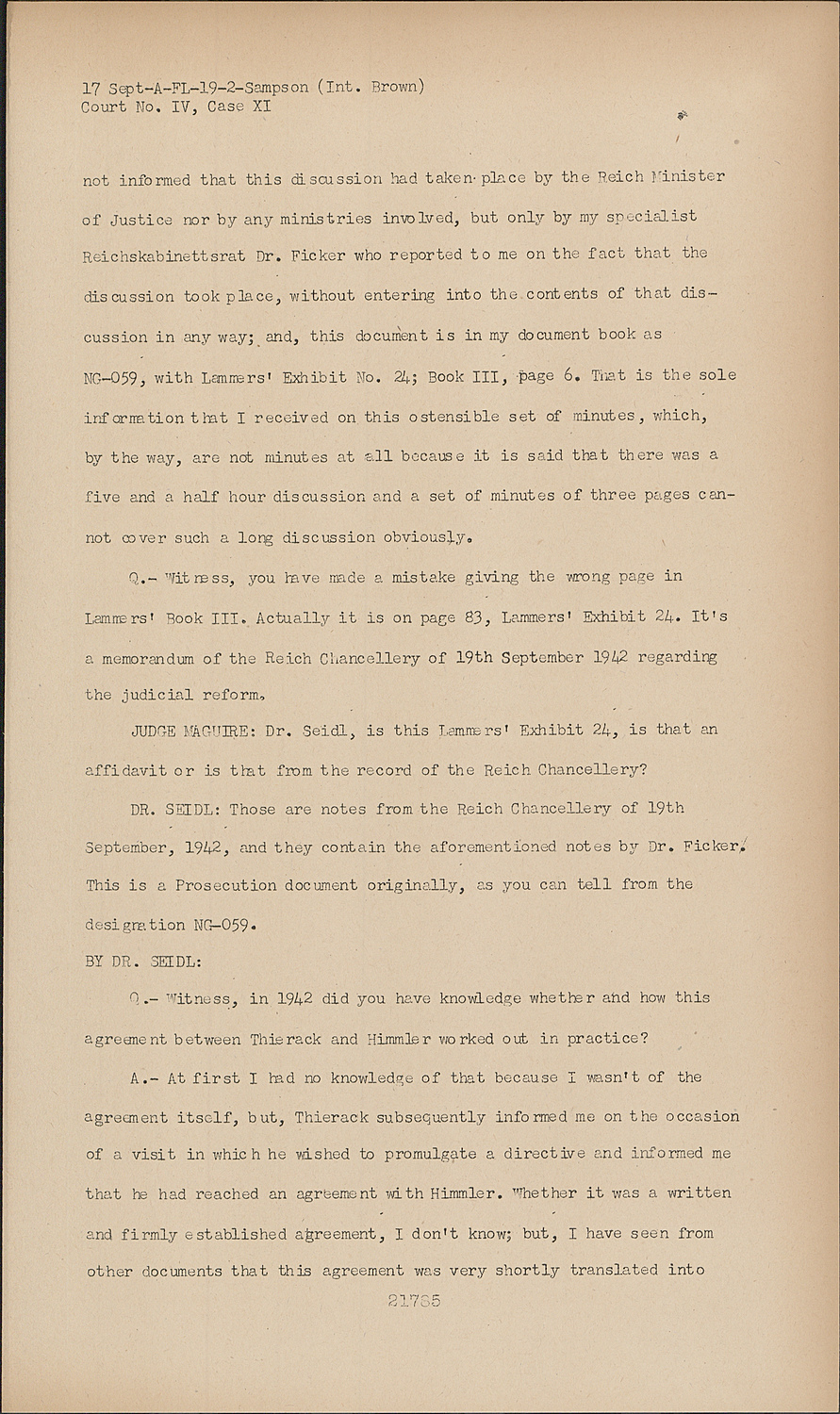
Q.- Witness, you have made a mistake giving the wrong page in Lammers' Book III. Actually it is on page 83, Lammers' Exhibit 24. It's a memorandum of the Reich Chancellery of 19th September 1942 regarding the judicial reform.
JUDGE MAGUIRE:Dr. Seidl, is this Lammers' Exhibit 24, is that an affidavit or is that from the record of the Reich Chancellery?
DR. SEIDL:Those are notes from the Reich Chancellery of 19th September, 1942, and they contain the aforementioned notes by Dr. Ficker. This is a Prosecution document originally, as you can tell from the designation NG-059. BY DR. SEIDL:
Q.- witness, in 1942 did you have knowledge whether and how this agreament between Thierack and Himmler worked out in practice?
A.- At first I had no knowledge of that because I wasn't of the agreement itself, but, Thierack subsequently informed me on the occasion of a visit in which he wished to promulgate a directive and informed me that he had reached an agreement with Himmler. Whether it was a written and firmly established agreement, I don't know; but, I have seen from other documents that this agreement was very shortly translated into practice long before the promulgation of the thirteen implementing decrees for the Reich Civil law of 1 July 1943.
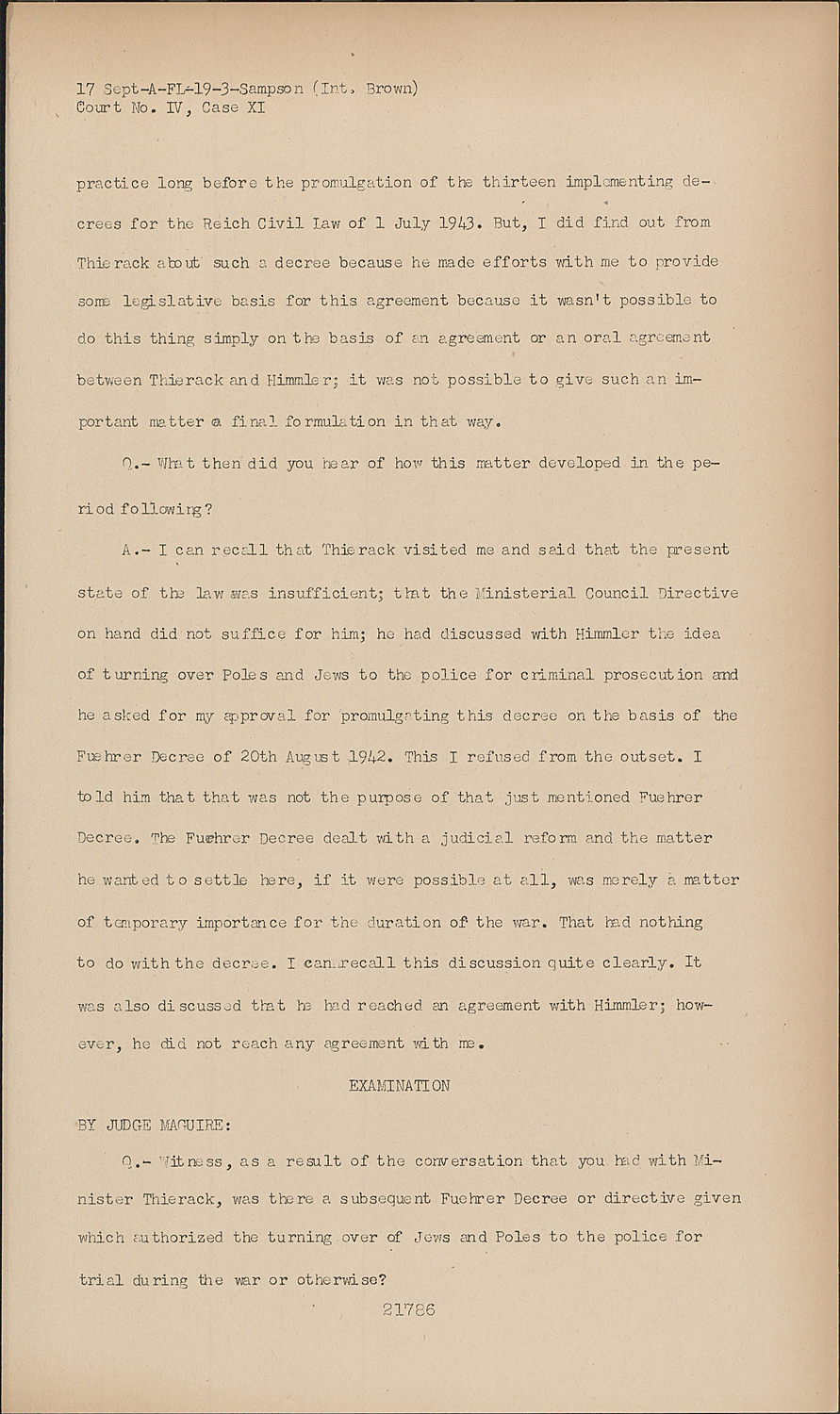
But, I did find out from Thierack about such a decree because he made efforts with me to provide some legislative basis for this agreement because it wasn't possible to do this thing simply on the basis of an agreement or an oral agreement between Thierack and Himmler; it was not possible to give such an important matter a final formulation in that way.
Q.- Whit then did you hear of how this matter developed in the period following?
A.- I can recall that Thierack visited me and said that the present state of the law was insufficient; that the Ministerial Council Directive on hand did not suffice for him; he had discussed with Himmler the idea of turning over Poles and Jews to the police for criminal prosecution and he asked for my approval for promulgating this decree on the basis of the Fuehrer Decree of 20th August 1942. This I refused from the outset. I told him that that was not the purpose of that just mentioned Fuehrer Decree. The Fuehrer Decree dealt with a judicial reform and the matter he wanted to settle here, if it were possible at all, was merely a matter of temporary importance for the duration of the war. That had nothing to do with the decree. I can.recall this discussion quite clearly. It was also discussed that he had reached an agreement with Himmler; however, he did not reach any agreement with me.
EXAMINATION BY JUDGE MAGUIRE:
Q.- Witness, as a result of the conversation that you had with Minister Thierack, was there a subsequent Fuehrer Decree or directive given which authorized the turning over of Jews and Poles to the police for trial during the war or otherwise?
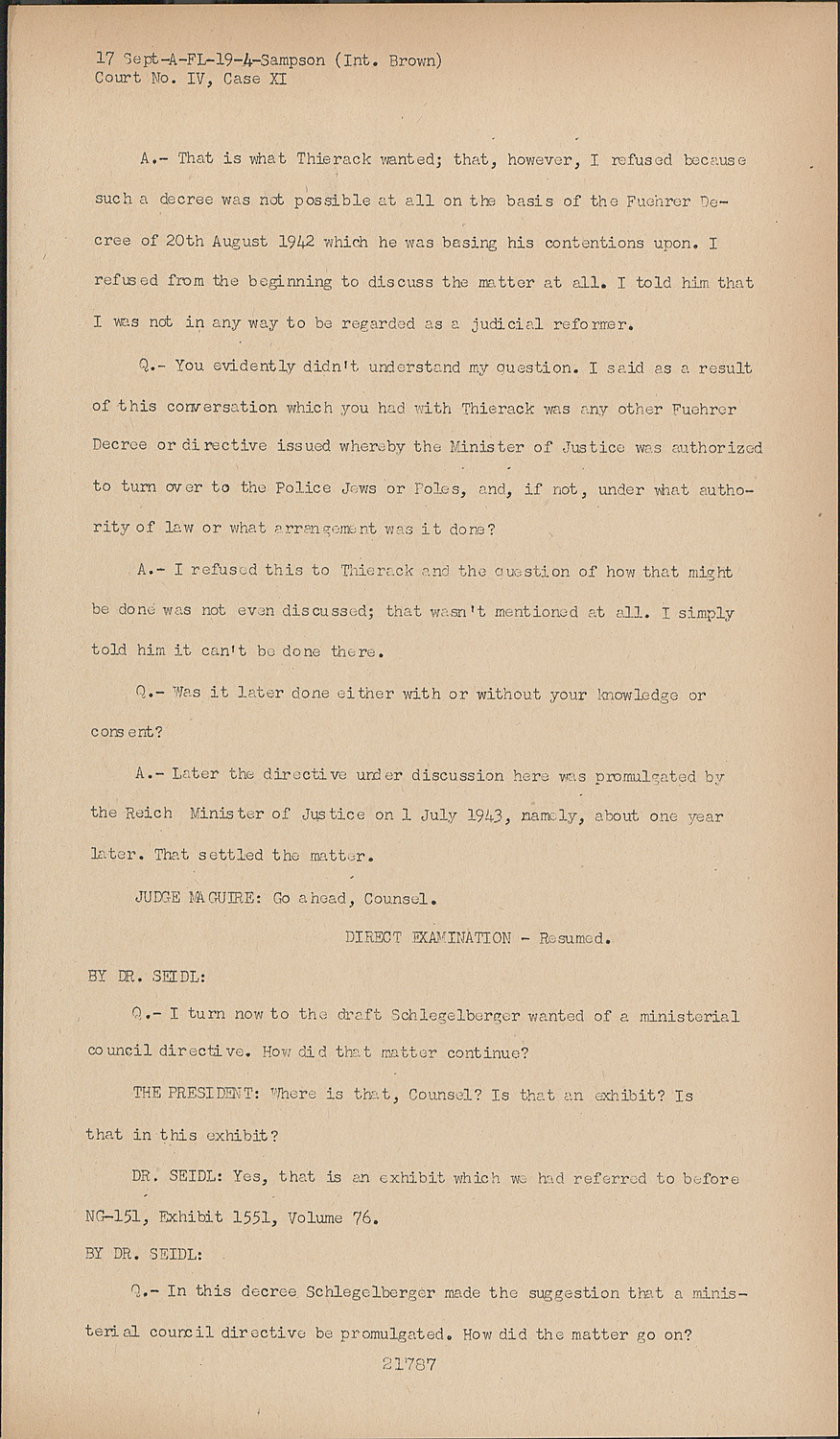
A.- That is what Thierack wanted; that, however, I refused because such a decree was not possible at all on tbs basis of the Fuehrer Decree of 20th August 1942 which he was basing his contentions upon. I refused from the beginning to discuss the matter at all. I told him that I was not in any way to be regarded as a judicial reformer.
Q.- You evidently didn't understand my Question. I said as a result of this conversation which you had with Thierack was any other Fuehrer Decree or directive issued whereby the Minister of Justice was authorized to turn over to the Police Jews or Poles, and, if not, under what authority of law or what arrangement was it done?
A.- I refused this to Thierack and the question of how that might be done was not even discussed; that wasn't mentioned at all. I simply told him it can't be done there.
Q.- Was it later done either with or without your knowledge or consent?
A.- Later the directive under discussion here was promulgated by the Reich Minister of Justice on 1 July 1943, namely, about one year Inter. That settled the matter.
JUDGE MAGUIRE:Go ahead, Counsel.
DIRECT EXAMINATION - Resumed. BY DR. SEIDL:
Q.- I turn now to the draft Schlegelberger wanted of a ministerial council directive. How did that matter continue?
THE PRESIDENT:Where is that, Counsel? Is that an exhibit? Is that in this exhibit?
DR. SEIDL:Yes, that is an exhibit which we had referred to before NO-151, Exhibit 1551, Volume 76. BY DR. SEIDL:
Q.- In this decree Schlegelberger made the suggestion that a ministerial council directive be promulgated. How did the matter go on?