The isolated acquisition of a single piece of Jewish property in Germany or the occupied territories might appear insignificant, but the German program of racial and religious persecution rested upon the eagerly offered services of wholesale "aryanizers" like Rasche in the Dresdner Bank. Rasche deliberately supported and participated in these criminal plans, using the resources of the Dresdner Bank as necessary, and his criminal responsibility is clear.
With the court's permission, I will now discuss the defendant, Emil Puhl.
The defendant Emil Puhl was the servant of the German Reichsbank, of the SS upon several important occasions, and of the National Socialist Party. Almost his entire working life was spent in the Reichsbank, Germany's central bank and a public institution. He began in 1913 as a clerk and advanced steadily to "Director" in 1933, to the Reichsbank President's Acting Deputy in 1939, and to Vice-President in 1940.
Reichsbank President Schacht on 7 January 1939 submitted to Hitler a report signed by the Directors of the Reichsbank which urged a curtailment of armament expenditures and a balanced budget to prevent inflation. On 19 January Hitler dismissed Schacht as President and most of his Directors left and were replaced by men more acceptable to the Nazi Party leaders. Puhl however remained. Walter Funk was appointed President to replace Schacht, and on 11 February 1939 Puhl became his Acting Deputy, presided over the meetings of the Reichsbank Directorium and dominated the affairs of both the Reichsbank and its subsidiary, the Golddiskontbank. Funk, lacking banking experience, seldom interfered in the management of either institution.
In the early fall of 1939, Oswald Pohl's industry, the DEST, which has already been described, was pressed for funds. The 5,000,000 Reichsmark loan granted by the Dresdner Bank was insufficient for the full expansion of "economic activities" as planned by the SS. Oswald Pohl, whom Military Tribunal II found was "an admitted slave driver on a scale never before known", approached the defendant Puhl and asked for financial support from the Reichs Bank.
A subordinate of Puhl wrote to him in August 1939 describing the request and I quote:
The SS has established various economic enter prises in order to use prisoners of concentra tion camps (mainly persons held in protective custody) as labor for tasks of the Four Year Plan.
.....The most important enterprise, for which credit is sought, is the Deutsche Erd und Steinwerke GmbH, Berlin.
...The expense for labor.
...is slight, because the labor force consists in the main of prisoners, most of them people who are being held in protective custody (at present approximately 4,000). Puhl made an exhaustive personal investigation of the SS project, ineluding a tour of such concentration camps as Oranienburg, and careful inspection of the DEST books and records.
Because both the Reichsbank and the Golddiskontbank were legally barred from advancing funds in such a case the defendant Puhl urged and approved the device of ostensibly utilizing funds of the Reich Economic Ministry which were on deposit at the Golddiskontbank, and secured the approval of the Golddiskontbank and Reichsbank to this plan. As Puhl described the transaction, in a letter to Lange and the Vorstand of the Golddiskontbank in September, 1939 and I quote:
In the course of the conversation with the Reich Economic Minister and President of the Deutsche Reichsbank, we agreed that from our side financial assistance will be given according to the wishes of the Reichsfuehrer SS.
I have reported to the Minister about the set up of the Deutsche Erdund Steinwerke GmbH as per enclosed statement and .... told him about my personal impression.
....
We agree that the credit in question cannot be considered from the viewpoint of ordinary business.
........ As a result, the Golddiskontbank advanced RM 8,000, 000, an amount 400 times the base capital of the DEST, at an extremely low rate of interest. Thereafter the defendant Puhl aided the DEST to secure reductions in the rate of interest and deferred the time of repayment.
In May 1941, the DEST, its labor force swollen by the addition of slave workers from the occupied territories, found itself in need of additional funds, and remembering past pleasant relations with Puhl, wrote again to the Golddiskontbank and I quote:
In our brief report to Reichbank Director Dr. Dauer on the progress made in our plants it was also mentioned that the Reichsfuehrer SS had ordered (us) to expand our enterprises, in which prisoners of concentration camps are used for work, considerably beyond their original size.
...and we apply now to you....
to kindly examine the possibility of granting an additional RM 8,000,000.
Again, the defendant Puhl provided support to the request, so that within a week's time the new loan was granted.
But Puhl was to make himself even more useful to Heinrich Himmler and to Oswald Pohl. The extermination and deportation of the Jews in the East produced a vast amount of valuable property which the SS seized. To marshal these resources, the so-called "Action Reinhardt" was instituted. Military Tribunal II, in its judgment in the Pohl case, found, and I quote:
The fact that Pohl himself did not actually transport the stolen goods to the Reich or did not himself remove the gold from the teeth of dead inmates does not exculpate him.
This was a broad criminal program re quiring the cooperation of many persons and Pohl's part was to conserve and account for the loot."
Emil Puhl's part was to receive this loot, including the gold teeth from Oswald Pohl, to safeguard and conserve it, and to dispose of part of it and account for the proceeds.
Himmler had contacted Funk and had reached an agreement with him whereby the Reichsbank would handle this loot which would be transported to the Reichsbank by the SS. The defendant Emil Puhl was entrusted with the execution of the agreement and he worked out the details in his own office in the Reichsbank with Oswald Pohl. Pohl entrusted the deliveries of the gold teeth and other loot to an SS man named Melmar. Subsequently, the delivery of these valuables to the Reichsbank was discussed on the telephone between Pohl and Puhl's assistant at the Reichsbank, a man named Thoms. The fact that these valuables had been taken from the bodies of concentration camp inmates was quite plain from the fact that many of the items were stamped "Lublin" or Auschwitz", which were well-known to be the sites of concentration camps, and from the very unusual amount of dental gold.
By the end of the war, the Reichsbank had accepted 76 shipments of this bloodstained SS loot, and the total value of these shipments exceeded 60,000,000 Reichsmarks.
With Your Honor's permission, I would now like he move to the subject of the Government Ministries.
Between the economic ministers and bankers, on the one hand, and the government ministers on the other, there is of course no sharp line of division. The activities of several of the Reich Ministries lay partly in the economic field, and this is particularly true of the Ministry of Food and Agriculture, with which we will begin.
And with that, I would like to discuss the defendant, Walter Darre.
Like Hitler and Hess, Richard Walther Darre was born outside of Germany. Born in Argentina of German parentage, he went in his early youth to Germany where he received most of his education. Like Rosenberg, he was one of the mystic pseudo-intellectuals who furnished a large part of Hitler's program and the ideology underlying it. His book entitled, "Peasantry As The Life Spring of the Nordic Race," attracted Hitler's attention in 1930, and led to their close acquaintance. Shortly afterwards, Darre was commissioned as one of the original seventeen Reichsleiters of the Nazi Party to organize the office of Agrarian policy within the Party. He became one of the small circle at the very top of the Nazi Party and, as the senior Lieutenant-General, Darre ranked sixth in the entire SS.
Darre's mystic preachings stated that the bases of the State were "blood and soil, that is blood," the human beings who give it life and character, and the "soil,"the space available for its existence. Germans, he said, were "people without space." To solve the problem, Germany must obtain space in the East.
But Darre was no mere theorist. As Reich Minister of Food and Agriculture from 1933 onward, he early recognized that the expansion of Germany by aggressive means could be only achieved by providing the nutritional basis for the marching armies.
As early as the summer of 1934, he proclaimed the so-called "Battle of Production" which was the first of many steps taken by Darre to make every possible preparation for war within his jurisdiction. A huge program for stockpiling of grain was developed. In a secret report of 31 December 1937, and I quote: "The Preparation of the Economic Mobilization by the Plenipotentiary General for the War Economy", we find reference to drafts by Darre of an overall organization for the war food economy. In a circular prepared jointly by Darre and Frick on 8 September 1938 for the eventuality that Czechoslovakia would have to be taken by force, it was said, and I quote:
The Reich Ministry of Food and Agriculture has now finished a draft of a series of decrees which contain the necessary provi sions for the introduction of a war food economy in the case of war and are to be put in force with the order of mobilization.
The organizational basis was ready for the expected attack upon Czechoslovakia and only the Munich agreement temporarily postponed war. However, just prior to the invasion of Poland, on 31 august 1939, the war food economy program was introduced by decrees which had already been drafted by Darre's Ministry in 1938.
The importance of Darre's contributions to the preparation for aggressive war is aptly summarized in his own words. In November 1939, Darre, with great pride, submitted to Goering a report on his achievements, which stated, and I quote: "The whole work of agrarian policy since the seizure of power was already dominated by the preparation for a possible war," and 1942 Darre wrote that, and I quote:
In a gigantic struggle before 1939 I created the prerequisites which made it possible for the Fuehrer to wage this war as far as food is concerned.
When Darre wrote and made speeches about "Soil", he meant not only the mobilization of German soil for war; he also meant that Germany had the right to seize the soil and its products of other countries. This precept too he put into practice. As country after country was over-run by Germany, their agricultural resources were in turn ruthlessly exploited for the benefit of Germany, with Darre and officials under his direction playing a large part.
Why did Darre make himself an important and enthusiastic participant in wars of aggression and schemes for the economic ruination of other countries? The answer is found in the first half of the phrase "Blood and Soil." Darre vigorously preached the doctrine of German racial superiority. He vied with Streicher, Dietrich, and Goebbels in inciting and leading Germans to persecution of Jews inside Germany and later of other unfortunate peoples in occupied countries who were deemed racially inferior under Nazi ideology, which Darre himself had helped to foster.
In books and speeches Darre repeatedly urged, as he put it, that "Germany should he freed from each and every Jew". His incitement to persecution of Jews took such forms, for example, as these few of his many statements, and I quote:
The difference between Fascism and National Socialism was that the Fascist dies, not realize enough the importance of race, of blood and soil and that though the Fascists knew of the "Jewish Danger", they did not take the necessary steps.
Jewish democracy is the consequence of Liberalism - the peasantry will be ruined by democracy, since democracy is Jewish.
The peasantry has only two possibilities, either the elimination of Jewry, or complete ruin brought about by the Jews.
Darre again demonstrated by his actions that he meant what he said. He carried the campaign be the Reich Ministry of Food and Agriculture and to the Reich Food Estate where, through the medium of laws and decrees, he expelled all Jews from every phase of German agriculture and discriminated, against Jews in the distribution of food. The Reich Food Estate was given the task of "combatting the Foes of the Peasantry: the Jew, the Jesuit, the Free Mason". All such anti-Semitic measures were extended to the occupied territories and particularly they affected the Polish Jews.
But Darre's active promotion of racial persecution went still further. From 1931 to 1938 he served as the first head of the notorious SS Race and Settlement Office, and again he was able to put his program into practice. Resettling of German farmers in Polish territory was advocated by Darre as early as 1930. Final execution of the program was assigned to Himmler as the Reich Commissar for the Strengthening of Germanism, supported by Darre as the Reich Minister of Food and Agriculture. After the conquest of Poland, under the guise of creating a New Peasantry, Germans of acceptable racial and political background were early settled in the east where they were assigned, the property of Polish nationals, most of whom had been shipped to Germany and elsewhere for slave labor.
Special sections were set up by Darre in the Reich. Ministry of Food and Agriculture to facilitate its active participation in the resettlement program.
To complete his work in effectuating his own aid Hitler's doctrines, he played his part in the German slave labor program. In fact, it was in Darre's Ministry that the first large impetus for enslavement of conquered peoples took form. As early as 19 December 1939, Darre's demands for 1,500,000 Polish farm laborers for German agriculture were presented to the General Council of the Four Year Plan. Not satisfied with the results of this request, Darre arranged a conference in Berlin with Hans Frank, the Governor General of Poland, at which Darre's urgent demand for 1,000,000 Poles from the Governor General was communicated to Frank. At a later date, a representative of Darre was present at a conference held by Frank in Poland during which Darre's demands were again presented, whereupon Frank reviewed the attempts to enlist voluntary workers for assignment in the Reich and inquired whether "Polish workers could be recruited by coercive measures." The reply being in the affirmative, Frank further stated, "that the path had now been indicated. Where the labor department could not achieve results, the police must step in."
Although, during the course of the war Darre retired from active leadership of the Reich's agricultural agencies during the war he was a major pillar of the Third Reich and a major criminal against humanity and civilization. Darre, like Dietrich, Rosenberg, Goebbels, and Streicher, was one of the master builders of the ideology from which followed quite logically all the major crimes of the Third Reich. These crimes fulfilled the hopes and the plans of Darre himself; and he played a leading role in their execution.
If it please the Tribunal Mr. Hardy will now continue the reading.
MR. HARDY:May it please the Tribunal.
THE PRESIDENT:Mr. Hardy.
MR. HARDY:I will now proceed to the individual responsibility of the defendant Otto Dietrich.
Press and Propaganda, as an indispensable instrumentality of the totalitarian state, experienced an extraordinary measure of exploitation at the hands of Hitler, Goebbels and the defendant Otto Dietrich. This was accomplished to a degree never before dreamed of, in terms of technical efficiency, range, depth and intensity, nuance of expression, and timing. Hitler said in "Mein Kampf":
With the help of a clever persistent propaganda, even heaven can be represented to the people as hell, and the most wretched life as paradise.
....
This "clever persistent propaganda" consisted largely of generous doses of poison which flowed night and day from presses throughout the Third Reich into the veins of German and world, thought.
This venom was prepared and distilled by the defendant Otto Dietrich from the time of his appointment by Hitler as Reich Press Chief of the NSDAP in August 1931 until shortly before the end of the war. His power and responsibility over the party press in the Third Reich were defined in February 1934 when Hitler decreed:
He (Dietrich) directs in my name the guiding principles for the entire editorial work of the party press.
In addition, as my press chief, he is the highest authority for all press publica tions of the party and all its agencies.
....
All the press divisions, press offices, etc., within the party or its affiliated and subsidiary organizations (political organiza tions, SD and SS, Hitler Youth, German Labor Front) are, irrespective of their particular administrative affiliation, sub ordinate and responsible in their publicity work to the Reich Press Chief of the NSDAP.
This supreme authority over the party press was further extended to include all the newspapers and periodicals within Germany, in November 1937, when Dietrich was appointed by the Fuehrer to the position of Reich Press Chief of the government and State Secretary in the Propaganda Ministry. -----------------------------------------
1. "Mein Kampf", German Edition - 1941, p. 302 With the advent of the Nazis, a complete remodelling of press and propaganda apparatus of government took place.
By a Hitler decree of 13 March 1933, a Ministry of Public Enlightenment raid Propaganda was created. In October 1933, an Editorial Control Law, formulated by the defendant Dietrich, was enacted which placed all editors under the yoke. An organization euphemistically entitled the Reich Chamber of Culture was established in September 1933 which insured complete control over every cultural worker in Germany. Thus, as the IMT concluded, "independent judgment, based on freedom of thought, was rendered quite impossible."
As the government Press Chief, Dietrich directed and controlled the press division of the Reich government in the Propaganda Ministry. This division was composed of three sections; the German press, the foreign press, and the periodical press. The German press section directed all press and journalistic activities of the Third Reich, thereby bringing the independent German newspapers "into line" with the party press machine. This was ingeniously accomplished by setting up a technique of political control through day-by-day directives, binding upon all editors. This control of the German or home press section was carried out through compulsory press conferences wherein these confidential and secret directives were given to the newspapermen. The subsequent destruction of these directives was mandatory. Failure to comply with them meant severe punishment. The murky twilight which had settled over the German press with the advent of Hitler had now deepened into night. The blackout of freedom of the press was complete.
In charging the defendant Dietrich under this Indictment, we do not cast any aspersions upon the concepts of press and propaganda as living forces for national health and well-being. The tools used by the defendant Dietrich boast a noble origin and history. It is to their prostitution and subversion that the world solemnly objects. It is to ---------------------------------------1. Vol. I, Trial of the Major War Criminals, p. 182 their demoniac perversion of tie possibilities and potentialities of these instruments for good - to the hysterical fomenting of public sentiment for aggression, to the agitation for widespread anti-Semitism, and pseudo-scientific support of racist philosophiesthat the Prosecution points an accusing finder.
Were any government to install a loudspeaker in every public square, urging and inciting riots against minority elements, or were it to issue, as did the defendant, daily instructions to editors particularly describing the type and set-up of inflammatory material desired, such abuse of power should be condemned with equal vigor.
As one of the rulers of the State, and in the absence of a domestic opposition press which he and his colleagues had carefully abolished, the defendant ordered, and refined these abuses. The audiences addressed by the defendant were not casual groups incited to passion by an occasional eloquent spellbinder. The potential mob here was composed of the entire German people, and the spellbinders - the 3,097 newspapers in the Reich - all were briefed daily by the defendant. When we recall that the newspapers of Germany represented the highest newspaper coverage in the world, exceeding by far the 1,911 journals of the United States, and the approximately 1,500 of France, the power exerted by the defendant becomes apparent.
Dietrich began his intimate association with Hitler in 1929, when, as a young newspaper editor from the Rhineland, he had thrown in his lot with the rising demagogue, He had acted as press manager for the Fuehrer in his early struggle for power; he had introduced him to the steel magnates to whom Hitler had turned for support at the famous Duesseldorf meeting; and he had handled for Hitler all press matters incident to the latter's sensational 30,000 mile aerial election campaign of 1931, during the course of which Hitler spoke to 14,000,000 Germans.
He was essentially "Hitler's man". However, the defendant was no faceless automaton who acted as a mechanical conduit for the wishes of the Fuehrer. Nor, as the evidence will show, did he sit supinely by, as he may ask us to believe, dutifully nodding his approval to Hitler's suggestions. Hitler relied on his Press Chief for information concerning the home and foreign press. It was Dietrich who selected the news items for Hitler's attention. This choice by the defendant was decisive!
The Prosecution has charged that the defendant Dietrich initiated and formulated press campaigns before each aggressive act to weaken the prospective victims, provide spurious justification for aggression, and prepare the German people psychologically for war.
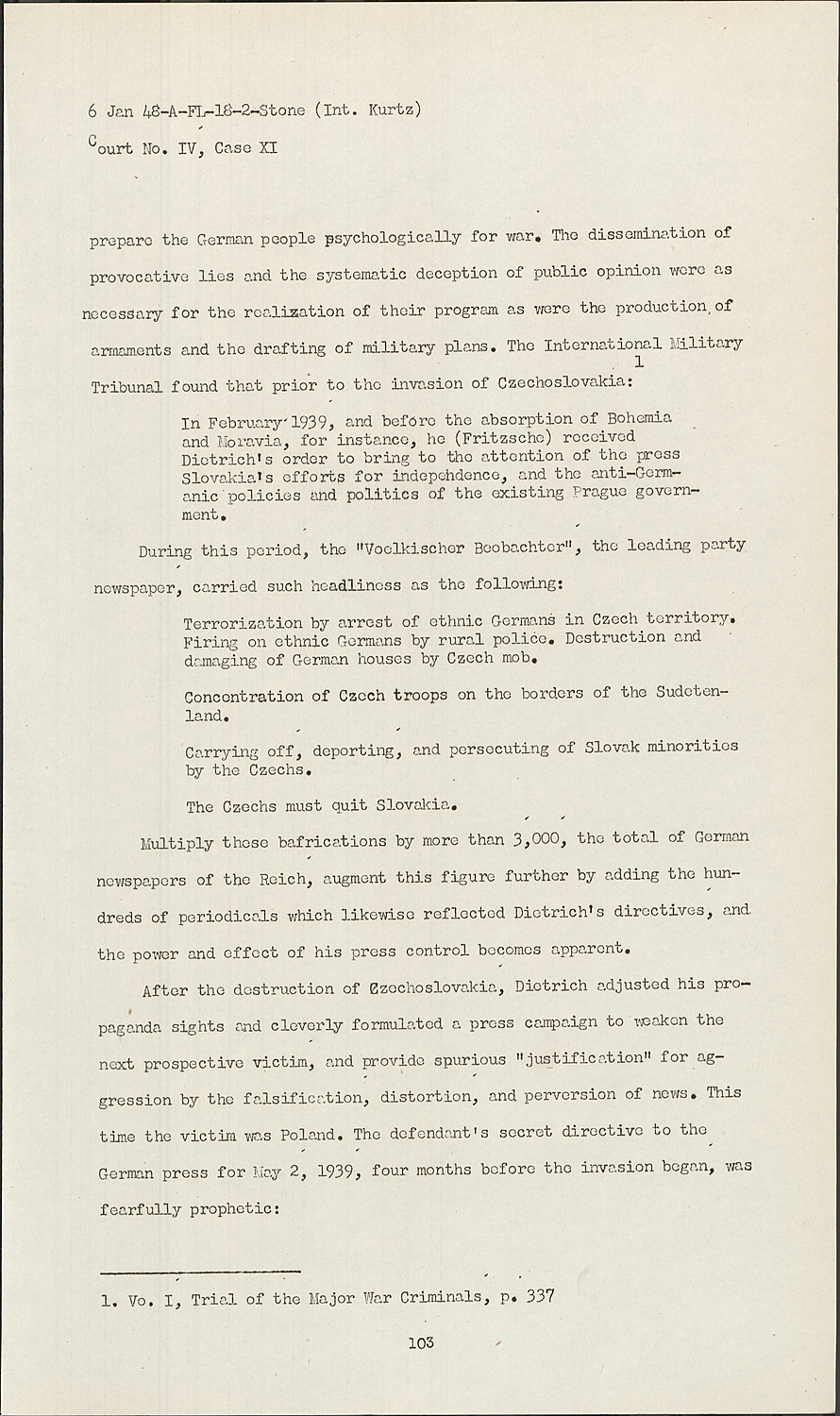
The dissemination of provocative lies and the systematic deception of public opinion were as necessary for the realization of their program as were the production of armaments and the drafting of military plans. The International Military Tribunal found that prior to the invasion of Czechoslovakia:
In February 1939, and before the absorption of Bohemia and Moravia, for instance, he (Fritzsche) received Dietrich's order to bring to the attention of the press Slovakia's efforts for independence, and the anti-Germ anic policies and politics of the existing Prague govern ment.
During this period, the "Voelkischer Beobachter", the leading party newspaper, carried such headliness as the following:
Terrorization by arrest of ethnic Germans in Czech territory.
Firing on ethnic Germans by rural police. Destruction and damaging of German houses by Czech mob.
Concentration of Czech troops on the borders of the Sudeten land.
Carrying off, deporting, and persecuting of Slovak minorities by the Czechs.
The Czechs must quit Slovakia. Multiply these bafrications by more than 3,000, the total of German newspapers of the Reich, augment this figure further by adding the hundreds of periodicals which likewise reflected Dietrich's directives, and the power and effect of his press control becomes apparent.
After the destruction of Czechoslovakia, Dietrich adjusted his propaganda sights and cleverly formulated a press campaign to waken the next prospective victim, and provide spurious "justification" for aggression by the falsification, distortion, and perversion of news. This time the victim was Poland. The defendant's secret directive to the German press for May 2, 1939, four months before the invasion began, was fearfully prophetic: ----------------------1. Vo. I, Trial of the Major War Criminals, p. 337 The individual statements of the Polish press can be further sharply denied by the German press.
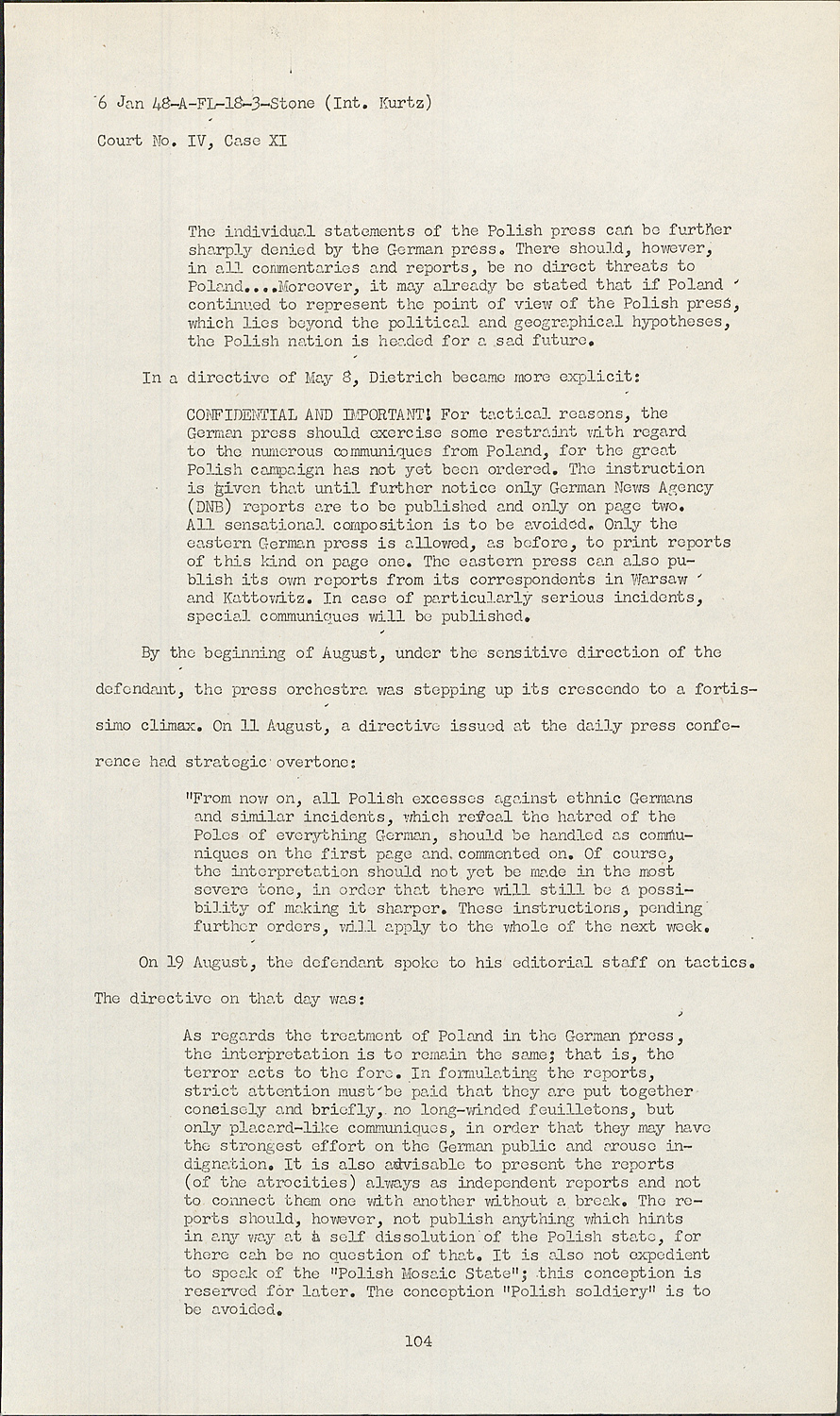
There should, however, in all commentaries and reports, be no direct threats to Poland.
...Moreover, it may already be stated that if Poland continued to represent the point of view of the Polish press, which lies beyond the political and geographical hypotheses, the Polish nation is headed for a sad future.
In a directive of May 8, Dietrich became more explicit:
CONFIDENTIAL AND IMPORTANT:For tactical reasons, the German press should exercise some restraint with regard to the numerous communiques from Poland, for the great Polish campaign has not yet been ordered.
The instruction is given that until further notice only German News Agency (DNB) reports are to be published and only on page two.
All sensational composition is to be avoided. Only the eastern German press is allowed, as before, to print reports of this kind on page one.
The eastern press can also pu blish its own reports from its correspondents in Warsaw and Kattowitz.
In case of particularly serious incidents, special communiques will be published.
By the beginning of August, under the sensitive direction of the defendant, the press orchestra was stepping up its crescendo to a fortissimo climax. On 11 August, a directive issued at the daily press conference had strategic overtone:
"From now on, all Polish excesses against ethnic Germans and similar incidents, which reveal the hatred of the Poles of everything German, should be handled as commu niques on the first page and commented on.
Of course, the interpretation should not yet be made in the most severe tone, in order that there will still be a possi bility of making it sharper.
These instructions, pending further orders, will apply to the whole of the next week.
On 19 August, the defendant spoke to his editorial staff on tactics. The directive on that day was:
As regards the treatment of Poland in the German press, the interpretation is to remain the same; that is, the terror acts to the fore.
In formulating the reports, strict attention must be paid that they are put together concisely and briefly, no long-winded feuilletons, but only placard-like communiques, in order that they may have the strongest effort on the German public and arouse in dignation.
It is also advisable to present the reports (of the atrocities) always as independent reports and not to connect them one with another without a break.
The re ports should, however, not publish anything which hints in any way at a self dissolution of the Polish state, for there can be no question of that.
It is also not expedient to speak of the "Polish Mosaic State"; this conception is reserved for later.
The conception "Polish soldiery" is to be avoided.
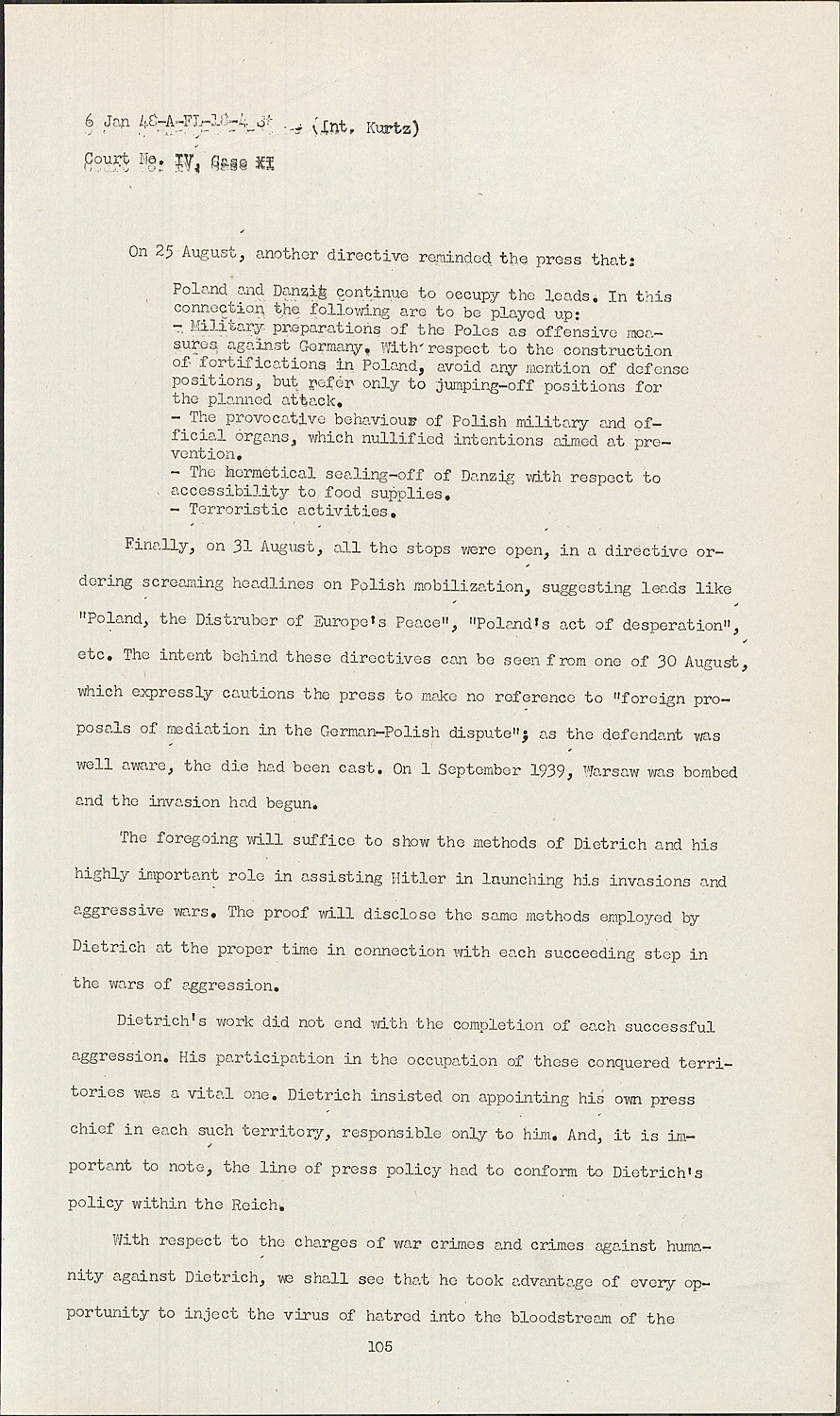
On 25 August, another directive reminded the press that:
Poland and Danzig continue to occupy the leads. In this connection, the following are to be played up:
- Military preparations of the Poles as offensive mea sures against Germany.
With respect to the construction of fortifications in Poland, avoid any mention of defense positions, but refer only to jumping-off positions for the planned attack.
- The provocative behaviour of Polish military and of ficial organs, which nullified intentions aimed at pre vention.
- The hermetical sealing-off of Danzig with respect to accessibility to food supplies.
- Terroristic activities.
Finally, on 31 August, all the stops were open, in a directive ordering screaming headlines on Polish mobilization, suggesting leads like "Poland, the Distruber of Europe's Peace", "Poland's act of desperation", etc. The intent behind these directives can be seen from one of 30 August, which expressly cautions the press to make no reference to "foreign proposals of mediation in the German-Polish dispute"; as the defendant was well aware, the die had been cast. On 1 September 1939, Warsaw was bombed and the invasion had begun.
The foregoing will suffice to show the methods of Dietrich and his highly important role in assisting Hitler in launching his invasions and aggressive wars. The proof will disclose the same methods employed by Dietrich at the proper time in connection with each succeeding step in the wars of aggression.
Dietrich's work did not end with the completion of each successful aggression. His participation in the occupation of these conquered territories was a vital one. Dietrich insisted on appointing his own press chief in each such territory, responsible only to him. And, it is important to note, the line of press policy had to conform to Dietrich's policy within the Reich.
With respect to the charges of war crimes and crimes against humanity against Dietrich, we shall see that he took advantage of every opportunity to inject the virus of hatred into the bloodstream of the German people.
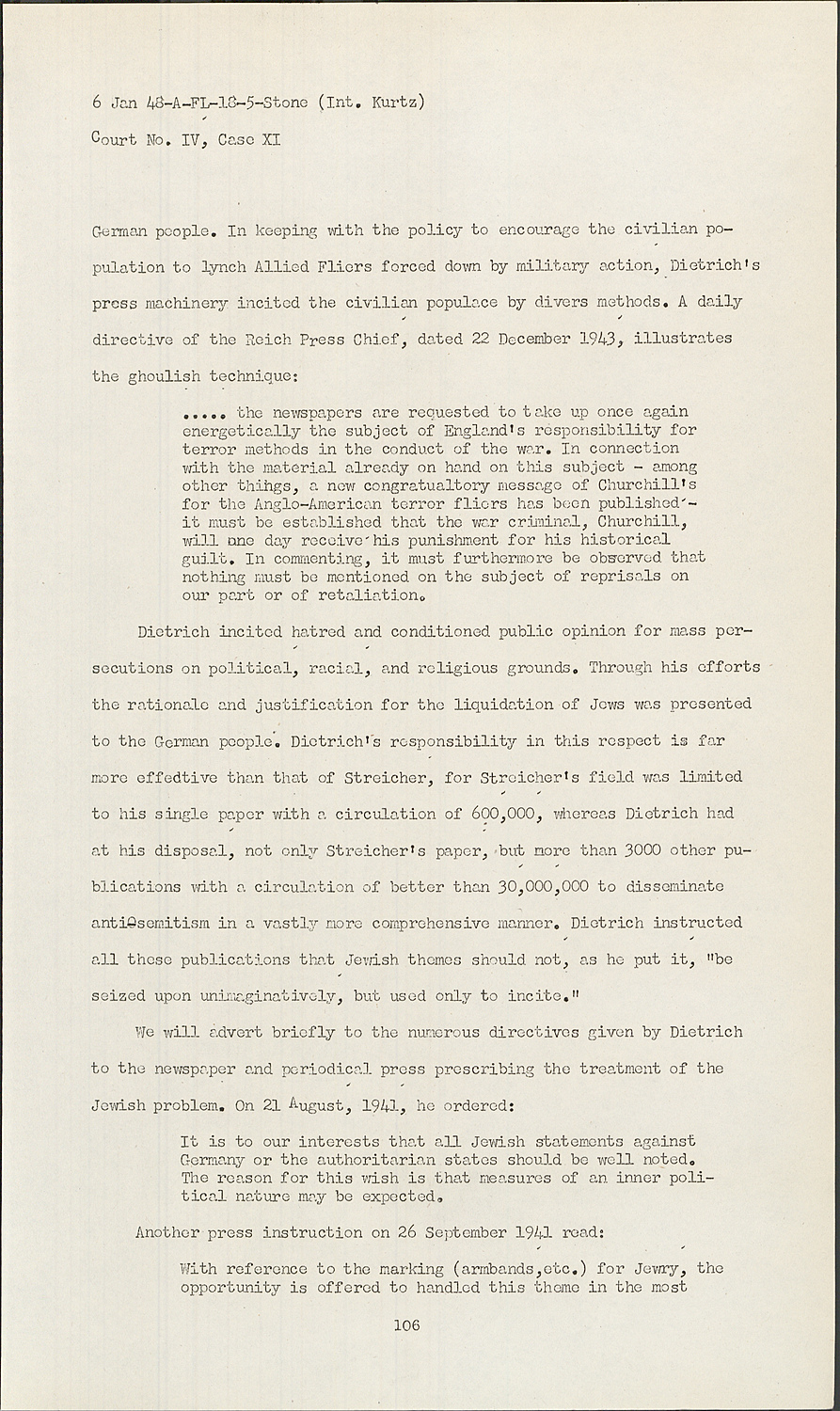
In keeping with the policy to encourage the civilian population to lynch Allied Fliers forced down by military action, Dietrich's press machinery incited the civilian populace by divers methods. A daily directive of the Reich Press Chief, dated 22 December 1943, illustrates the ghoulish technique:
.....the newspapers are requested to take up once again energetically the subject of England's responsibility for terror methods in the conduct of the war.
In connection with the material already on hand on this subject - among other things, a new congratualtory message of Churchill's for the Anglo-American terror fliers has been published it must be established that the war criminal, Churchill, will one day receive his punishment for his historical guilt.
In commenting, it must furthermore be observed that nothing must be mentioned on the subject of reprisals on our part or of retaliation.
Dietrich incited hatred and conditioned public opinion for mass persecutions on political, racial, and religious grounds. Through his efforts the rationale and justification for the liquidation of Jews was presented to the German people. Dietrich's responsibility in this respect is far more effective than that of Streicher, for Streicher's field was limited to his single paper with a circulation of 600,000, whereas Dietrich had at his disposal, not only Streicher's paper, but more than 3000 other publications with a circulation of better than 30,000,000 to disseminate anti-semitism in a vastly more comprehensive manner. Dietrich instructed all these publications that Jewish themes should not, as he put it, "be seized upon unimaginatively, but used only to incite."
We will advert briefly to the numerous directives given by Dietrich to the newspaper and periodical press prescribing the treatment of the Jewish problem. On 21 August, 1941, he ordered:
It is to our interests that all Jewish statements against Germany or the authoritarian states should be well noted.
The reason for this wish is that measures of an inner poli tical nature may be expected.
Another press instruction on 26 September 1941 read:
With reference to the marking (armbands, etc.) for Jewry, the opportunity is offered to handled this theme in the most varied ways, in order to make clear to the German people the necessity for these measures, and especially to in dicate the obnexiousness of the Jews.
From tomorrow on, the special delivery service will provide material to be used as proof of the injuries which Jewry has inflicted upon Germany, and the destiny it has envisaged for her, past and present.
This material must be utilized with caution.
The German Weekly Service, controlled by Dietrich, in a "Special Anti-Jewish Issue" to periodicals of 23 May 1943, issued the following directives:
The duty of all periodicals is to work up attacks on the destructive influence of the Jews with respect to the cultures of peoples.
The effect desired is the elimination of any vestige of popular sentimentality for the "poor Jews."
Every individual Jew, wherever he is and whatever he does, is to blame.
There are no "decent Jews", but rather only these with greater or lesser camouflage.
The Jew is a no torious criminal.
The defendant's directives to the newspapers often contained rebukes for previous moderation and explicit instructions for the use and techniques calculated to incite their readers to applaud the outrages then under way; the directive of 29 April 1943 was a manual of the technique of anti-Semitism in practice:
In Yesterday's and today's Tagesparole we have addressed ourselves to the subject of Jewry frequently.
... In head lines and text material, the Jewish Bolshevist murder and arson ring must always be referred to, not only today or tomorrow, but continuously must the world's mortal enemy be unmasked and grappled with.
The press is receiv ing the appropriate DNB yellow Jewish material which must be worked up accordingly.
In this connection, from now on it is the future duty of the press to apply itself with greater intensity to the Jewish question as its permanent duty.
... From now on the main question is the building up of anti-Semitism.
It is clear that one cannot pull anti Semitism out of a vacuum, but that one must have a certain basis for it, any kind of theme to which everything else can be adapted.
With this in mind, the newspapers will re ceive a Jewish theme daily, one that should not be seized upon unimaginatively, but used only to incite.
The news papers here have a wide field and there are countless sen sational stories wherein the Jew is depioted as the author of crime, which can be used.
First of all, American internal politics offers an inexhaustible reservoir.
If the news papers put their assistants to work here, we will have the opportunity to see the true face, true behaviour, and true desires of the Jew depicted daily in ever new and varied forms.
For the rest, the Jew must naturally be brought into the Ger man press politically as well.
In everything it must be esta blished that the Jews are to blame! The Jews wanted the war!Everywhere throughout the world, the Jews prepared the war against Germany! The Jew intensifies the war! The Jew profits by the War! Always and everywhere the Jew is to blame! Na turally, those reports which do not lend themselves to anti semitic treatment must be adapted for use as anti-Semitic propaganda.
...The possibility of playing up the true charac ter of the Jew is infinite.
...It is the duty of the entire German press to join in the above depicted anti-Semitic ope ration.
It was stated in part in an explanation of the defendant's Tagesparole of 15 February 1944 that:
The instigator, supportor, and leader of this war is, and will remain, the international Jew - that criminal race which now, as in the centuries past, is to blame for the fact that the nations of the earth are arrayed against one another in war.
An understanding among the peoples of the earth can be hoped for only when this worldpest once and for all is stamped out.
Let us face the issue squarely. The defendant Dietrich is charged with an attack on the human mind and spirit.
THE PRESIDENT:Just a moment, Mr. Hardy. I understand that a new film has to be inserted; so we'll have to take our recess here.
The Tribunal will take a fifteen-minute recess.
(A recess was taken.)
Court No. IV, Case No. XI.
THE MARSHAL:The Tribunal is again in session.
THEPRESIDENT; Mr. Hardy, you may continue where you left off.
MR. HARDY:In summation let us face the issue squarely The defendant Dietrich is charged with an attack on the human mind and spirit. He is charged with the responsibility for warping the collective mind and spirit of millions of people, not in the pursuit of a civilizing mission, but for the uses of war and annihilation. He was a Frankenstein who produced a monstrous mass hypnosis, and who, as much as any man alive or dead, bears guilt for the cataclysm of war and the extermination of millions.
Then I will proceed to the defendant, Wilhelm Stuckart.
The defendant Stuckart, State Secretay in the Ministry of the Interior from 1935 to 1945, was the administrative and legislative specialist serving successively under Minister Frick and then Himmler, who succeeded Frick in 1943. Stuckart's Department I in the Interior Ministry was the central agency which had final authority on constitutional questions; jurisdiction over government administration and civil defense; authority over the civil service, responsibility for drafting pertinent legislation, and was the final arbiter of questions concerning citizenship and race. The Nazi method of passing laws through personal decrees and edicts required a central organization to maintain consistency and uniformity in the legislative and administrative practices of the Government, otherwise the Third Reich would have disintegrated by virtue of its own incoherency.
Stuckart looms into prominence in the incorporation of the conquered territories into the Third Reich. He headed the central offices for the civil administration of Austria, Sudetenland, Bohemia and Moravia, Alsace-Lorraine and Luxembourg, Norway, and the occupied southeastern territories.
As Frick's deputy, he shares in the guilt, summarized in the judgment of the IMT as follows:1 "Frick signed the law of March 13, 1938, which united Austria with the Reich, and he was made responsible for its accomplishment.
In setting up German administration in Austria, he issued decrees which introduced German law, the Nurnberg decrees, the military service law, and he provided for police security by Himmler....
"He also signed the laws incorporating into the Reich the Sudetenland, Memel, Danzig, the eastern territories, (West Prussia and Posen), and Eupen, Malmedy, and Moresnet. He was placed in charge of the actual incorporation, and of the establishment of German administration over these territories. He signed the law establishing the protectorate of Bohemia and Moravia.
"As the head of the central offices for Bohemia and Moravia, the government General, and Norway, he was charged with obtaining close cooperation between the German officials in these occupied countries and the supreme authorities of the Reich. He supplied German civil servants for the administration in all occupied territories, advising Rosenberg as to their assignment in the occupied eastern territories....."
Stuckart participated in drafting the secret Reich Defense law of 4 September 1938. In a conference in which he presided as Chief of Staff of the Plenipotentiary General for administration (GBV), Frick, he explained the purposes of the law as follows:
"In case of war, it will be the task of the GBV to issue legal decrees, within the jurisdiction of these above named ministries (Reich Ministries of Justice, of Education, and of Ecclesiastical Affairs) which continue to conduct ---------------1. Vol. I, Trial of the Major War Criminals, pp. 299-300.