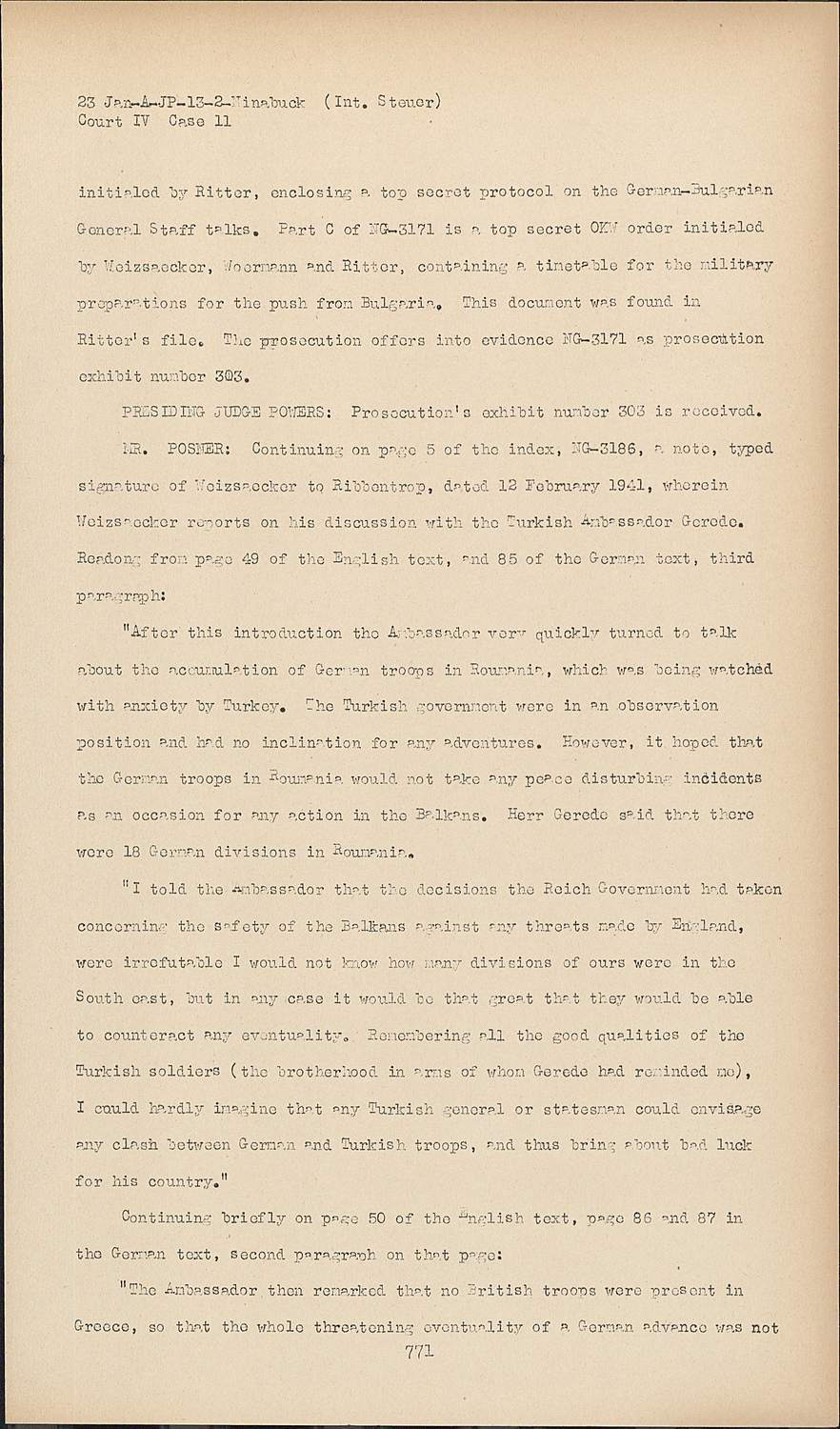
Part C of NG-3171 is a top secret OKW order initialed by Weizsaecker, Woermann and Ritter, containing a timetable for the military preparations for the push from Bulgaria. This document was found in Ritter's file. The prosecution offers into evidence NG-3171 as prosecution exhibit number 303.
PRESIDING JUDGE POWERS:Prosecution's exhibit number 303 is received.
MR. POSNER:Continuing on page 5 of the index, NG-3186, a note, typed signature of Weizsaecker to Ribbentrop, dated 12 February 1941, wherein Weizsaecker reports on his discussion with the Turkish Ambassador Gerede. Readong from page 49 of the English text, and 8-5 of the German text, third paragraph:
"After this introduction the Ambassador very quickly turned to talk about the accumulation of German troops in Roumania, which was being watched with anxiety by Turkey. The Turkish government were in an observation position and had no inclination for any adventures. However, it hoped that the German troops in Roumania would not take any peace disturbing incidents as an occasion for any action in the Balkans. Herr Gerede said that there were 18 German divisions in Roumania.
"I told the Ambassador that the decisions the Reich Government had taken concerning the safety of the Balkans against any throats made by England, were irrefutable I would not know how many divisions of ours were in the South east, but in any case it would be that great that they would be able to counteract any eventuality. Remembering all the good qualities of the Turkish soldiers (the brotherhood in arms of whom Gerede had reminded me), I could hardly imagine that any Turkish general or statesman could envisage any clash between German and Turkish troops, and thus bring about bad luck for his country."
Continuing briefly on page 50 of the English text, page 86 and 87 in the German text, Second paragraph on that page:
"The Ambassador then remarked that no British troops were present in Greece, so that the whole threatening eventuality of a German advance was not given at the moment.
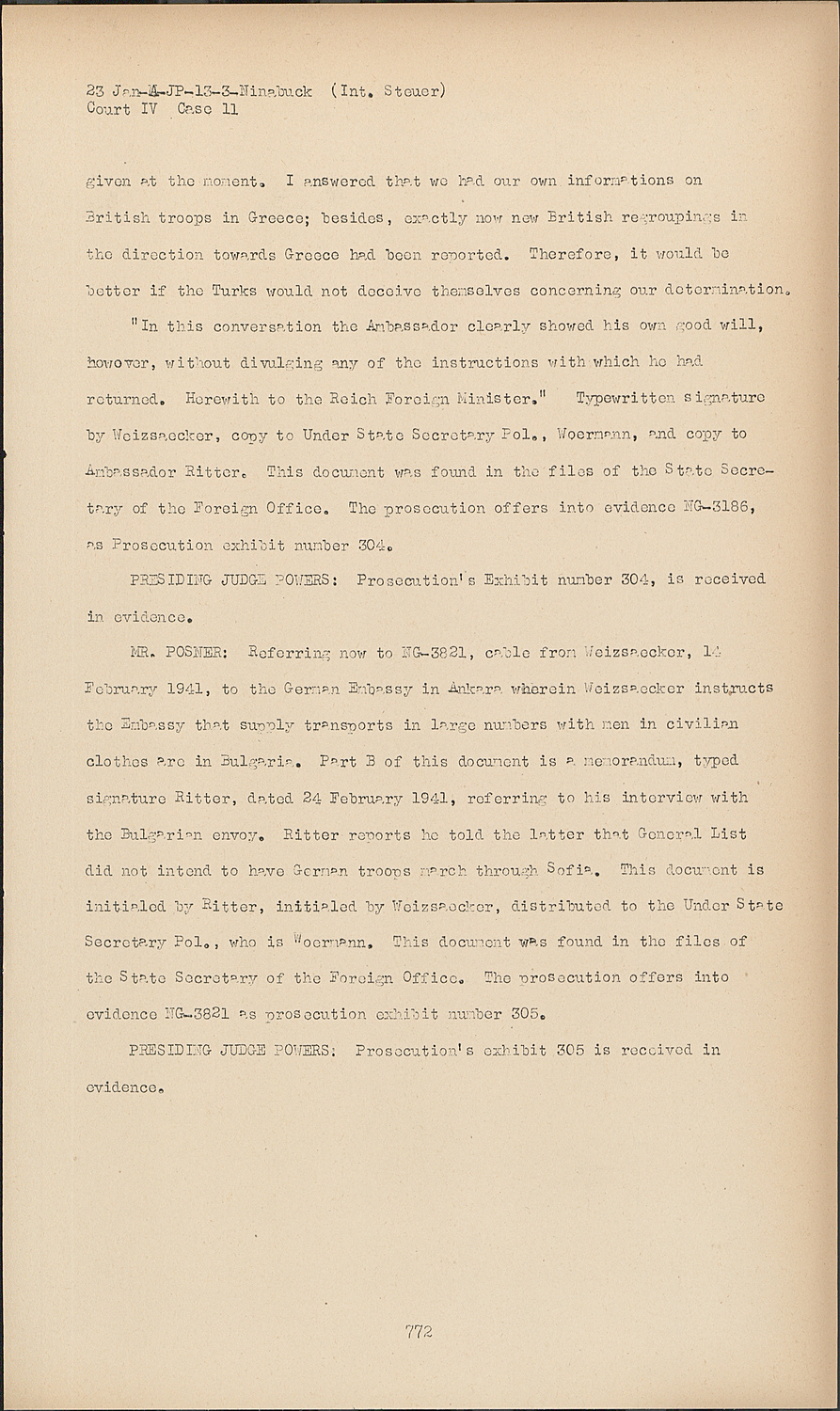
I answered that we had our own informations on British troops in Greece; besides, exactly now new British regroupings in the direction towards Greece had been reported. Therefore, it would be better if the Turks would not deceive themselves concerning our determination.
"In this conversation the Ambassador clearly showed his own good will, however, without divulging any of the instructions with which he had returned. Herewith to the Reich Foreign Minister." Typewritten signature by Weizsaecker, copy to Under State Secretary Pol., Woermann, and copy to Ambassador Ritter. This document was found in the files of the State Secretary of the Foreign Office. The prosecution offers into evidence NG-3186, as Prosecution exhibit number 304.
PRESIDING JUDGE POWERS:Prosecution's Exhibit number 304, is received in evidence.
MR. POSNER:Referring now to NG-3821, cable from Weizsaecker, 14 February 1941, to the German Embassy in -Ankara wherein Weizsaecker instructs the Embassy that supply transports in large numbers with men in civilian clothes are in Bulgaria. Part B of this document is a memorandum, typed signature Ritter, dated 24 February 1941, referring to his interview with the Bulgarian envoy. Ritter reports he told the latter that General List did not intend to have German troops march through Sofia, This document is initialed by Ritter, initialed by Weizsaecker, distributed to the Under State Secretary Pol., who is Woermann. This document was found in the files of the State Secretary of the Foreign Office. The prosecution offers into evidence 110-3821 as prosecution exhibit number 305.
PRESIDING JUDGE POWERS:Prosecution's exhibit 305 is received in evidence.
AFTERNOON SESSION
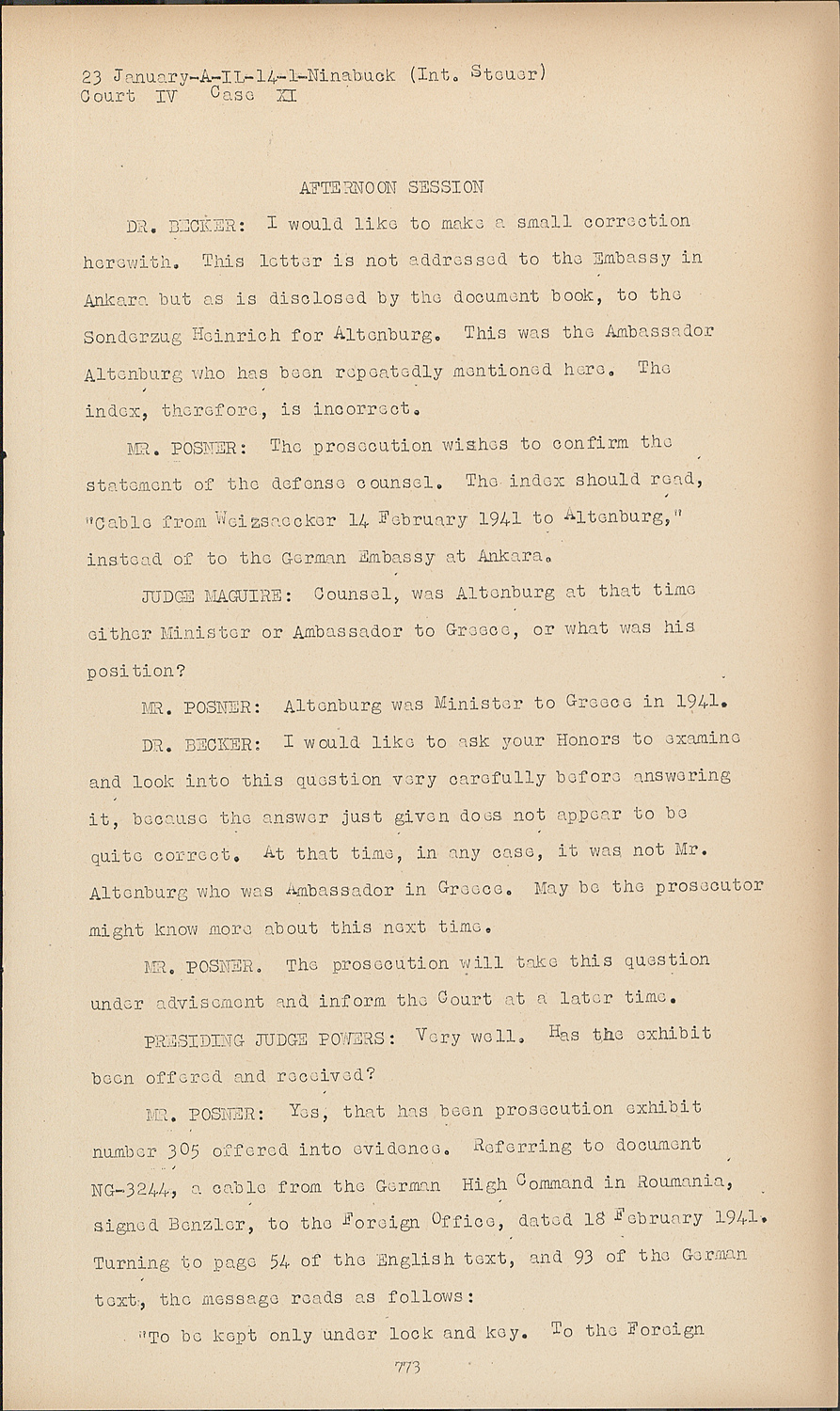
DR. BECKER:I would like to make a small correction herewith. This letter is not addressed to the Embassy in Ankara but as is disclosed by the document book, to the Sonderzug Heinrich for Altenburg. This was the Ambassador Altenburg who has been repeatedly mentioned here. The index, therefore, is incorrect.
MR. POSNER:The prosecution wishes to confirm the statement of the defense counsel, The index should read, "Cable from weizsaecker 14 February 1941 to Altenburg," instead of to the German Embassy at Ankara.
JUDGE MAGUIRE:Counsel, was Altenburg at that time either Minister or Ambassador to Greece, or what was his position?
MR. POSNER:Altenburg was Minister to Greece in 1941.
DR. BECKER:I would like to ask your Honors to examine and look into this question very carefully before answering it, because the answer just given does not appear to be quite correct. At that time, in any case, it was not Mr. Altenburg who was Ambassador in Greece. May be the prosecutor might know more about this next time.
MR. POSNER.The prosecution will take this question under advisement and inform the Court at a later time.
PRESIDING JUDGE POWERS:Very well. Has the exhibit been offered and received?
MR. POSNER:Yes, that has been prosecution exhibit number 305 offered into evidence. Referring to document NG-3244, a cable from the German High command in Roumania, signed Benzler, to the Foreign Office, dated 18 February 1941. Turning to page 54 of the English text, and 93 of the German text, the message reads as follows:
"To be kept only under lock and key. To the Foreign Office, Berlin, Wireless message from the High Command of the German Army in Roumania.
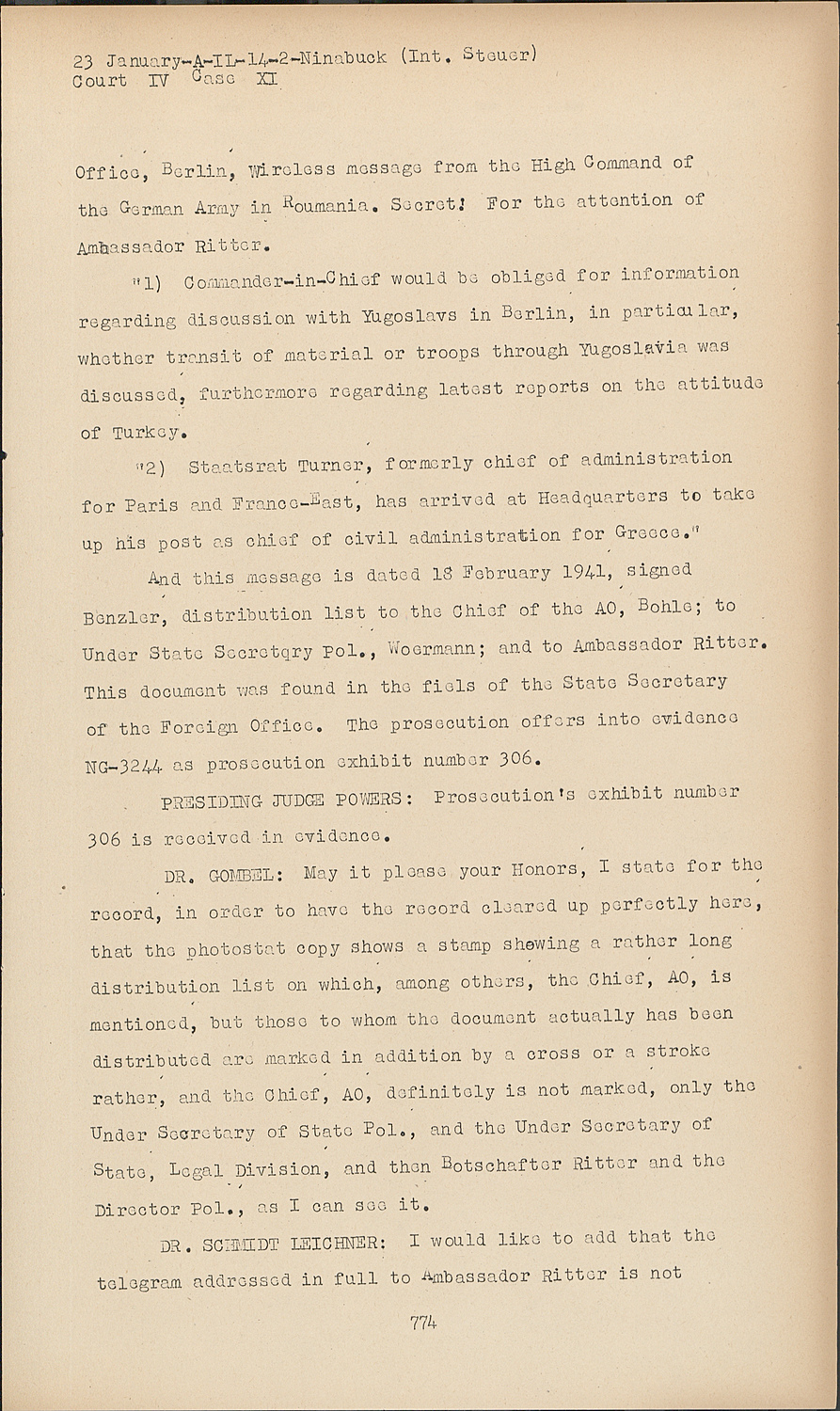
Secret; For the attention of Ambassador Ritter.
"1) Coramander-in-Chief would be obliged for information regarding discussion with Yugoslavs in Barlin, in particular, whether transit of material or troops through Yugoslavia was discussed, furthermore regarding latest reports on the attitude of Turkey.
"2) Staatsrat Turner, formerly chief of administration for Paris and France-East, has arrived at Headquarters to take up his post as chief of civil administration for Greece."
And this message is dated 13 February 1941, signed Benzler, distribution list to the Chief of the AO, Bohle; to Under State Secretqry Pol., Woermann; and to Ambassador Ritter. This document was found in the fiels of the State Secretary of the Foreign Office. The prosecution offers into evidence NG-3244 as prosecution exhibit number 306.
PRESIDING JUDGE POWERS:Prosecution's exhibit number 306 is received in evidence.
DR. GOMBEL:May it please your Honors, I state for the record, in order to have the record cleared up perfectly here, that the photostat copy shows a stamp shewing a rather long distribution list on which, among others, the Chief, AO, is mentioned, but those to whom the document actually has been distributed are marked in addition by a cross or a stroke rather, and the Chief, AO, definitely is not marked, only the Under Secretary of State Pol., and the Under Secretary of State, Legal Division, and then Botschafter Ritter and the Director Pol., as I can see it.
DR. SCHMIDT LEICHNER:I would like to add that the telegram addressed in full to Ambassador Ritter is not initialled by Herr Ritter, nor do I know whether my lady colleague is right in stating that these dashes which are shown at the bottom next to the names on the distribution list signify that they were made by the respective gentlemen shown in the distribution list.
It is possible that they were made by some other person. This obviously only means that the communication is supposed to have been forwarded to the gentlemen whose names are shown.
PRESIDING JUDGE POWERS:The comments of defense counsel with reference to the instrument will be noted. The order admitting it to evidence will be adhered to.
MR. POSNER:Referring at this point to document NG-3820, cable from Richthofen to the Foreign Office, dated 9 March, 1941. Richthofen reports that Draganov, Bulgarian envoy to Berlin, will be recalled because of his too far-reaching territorial demands which include Salonika and Thrace (Greek areas). This note was distributed to Under State Secretary Pol., Woermann, and Ritter. Part B is a note by Weizsaecker dated 10 March 1941 which states that Draganov never mentioned goals of which Germany is not now in approval, initialed by Weizsaecker, initialed by Woermann. This document was found in the files of the State Secretary of the Foreign Office. The prosecution offers into evidence NG-3820 as prosecution exhibit number 307.
PRESIDING JUDGE POWERS:Prosecution's exhibit 307 is received in evidence.
MR. POSNER:Proceeding with document NG-3094, memorandum by Woermann, dated 12 March 1941, initialed by Weizseaecker and distributed to Erdmannsdorf, Woermann reports on his conversation with Cosmelli, the Italian Charge d'Affaires. He reassured Cosmelli in spite of the latter's doubts, that ho know of no existing German plans to force Greece to capitulation.
This bears the typed signature of Woermann. This document was found in the files of the State Secretary of the Foreign Office. The prosecution offers into evidence NG-3094 as prosecution exhibit number 308.
PRESIDING JUDGE POWERS:Prosecution's exhibit 308 is received.
MR. POSNER:The prosecution calls the Court's attention to the fact that document NG-3094 was not distributed to Erdmannsdorff and asks that part to be stricken from the record.
PRESIDING JUDGE POWERS:You may proceed, Mr. Posner.
MR. POSNER:Referring to document NG-3232, secret telegram from Erbach, German Minister to Greece, to the German Foreign Office, dated 14 March 1941. Referring to page 61 of the English text, page 100 in the German text; "Preparations for continued cryptographic activity have been made for the case of war. The official radio equipment can be moved to my private apartment only at the last moment, since the radio equipment of the Military Attache, as pointed out in telegram no. 270 is workable to a limited extent only, and thus all the coding would have to take place already now in my apartment, located 8 kilometers from the offices. Such a move could not be concealed from the Greeks and British who are now closely watching all members of the Legation, thus doubtlessly provoking corresponding measures preventing radio contact.
"In order to be prepared for all possible contingencies, may I ask to be alerted to increased readiness for radio operations prior to a contemplated German action against Greece. In that case, I would have the official radio equipment moved to my apartment at once." Signed Erbach.
One copy each of this document was distributed to the Reich Foreign Minister, to Ritter, to Under State Secretary Pol., Woermann, initialed by Weizsaecker. The prosecution offers into evidence NG-3232, as prosecution exhibit number 309.
PRESIDING JUDGE POWERS:Prosecution's exhibit 309 is received in evidence.
MR. POSNER:Proceeding with document NG-3519, page 7 of the index, telegram from Erbach, German Minister to Greece, dated 11 March 1941, to the Foreign Office, initialed by Weizsaecker, wherein Erbach informs the Foreign Office as to the steps taken for the case of war. This document was found in the files of the State Secretary of the Foreign Office. The prosecution offers into evidence document NO-3519 as prosecution's exhibit 310.
PRESIDING JUDGE POWERS:Prosecution's exhibit 310 is received in evidence.
MR. POSNER:Continuing with document NG-3134, top secret memorandum, typed signature Ritter, dated 18 March 1941, initialed by Weizsaecker and initialed by Ritter. During discussion between Ritter and General Jodl it was decided that in the process of the invasion of Greece, one German division would have to march along the southern half of the Greek Turkish border. General Jodl wondered whether it would be necessary to inform the Turkish Government. Ritter replied that the legal aspects of this issue were being examined at the present time. This document was submitted to State Secretary Weizsaecker, Under State Secretary Pol., Woermann, found in the files of the State Secretary of the Foreign Office. The prosecution offers into evidence NG-3134 as prosecution exhibit number 311.
PRESIDING JUDGE POWERS:The Prosecution's Exhibit No. 311 is received in evidence.
MR. POSNER:Referring to Document NG-3542, the telegram of Ribbentrop should be dated here, 7 March 1941, instead of, 14 March 1941, signed by Heeren, the German Minister to Yougoslavia.
DR.SCHMIDT-LEIDINER: May it please the Tribunal, I wish to apologize by referring back to the previous document, NG-3134, but I would like to ask that the index be corrected as to the declaration "It was decided" does not appear adequate to me.
MR. POSNER:May it please the Court, the Prosecution didn't receive the implication of defense objection at this point.
PRESIDING JUDGE POWERS:Why was it stated?
MR. POSNER:The defense counsel suggested it was necessary for the Prosecution to correct it to re d as suggested, and it was necessary.
THE PRESIDING JUDGE POWERS:The correction will be made in the index.
MR. POSNER:The Prosecution refers at this point to Document NG3821, Prosecution's Exhibit No. 305, wherein a discussion concerning Altenburg's position was mentioned. The information received is that Altenburg was in the Political Department of the Foreign Office in February 1941, and served as Ribbentrop's adviser on Balkan matters.
PRESIDING JUDGE POWERS:You may proceed.
MR. POSNER:The Prosecution now proceeds with NG-3542, page 7A of the index. A telegram by Ribbentrop's dated 7 March 1941, to Heeren, German Minister to Yougoslavia. Part A of this document is a telegram by Ribbentrop to the German Embassy at Belgrade, wherein Ribbentrop request the German's Ambassador's opinion as to whether he shall arrange for another meeting with Prince-Regent Paul in Yougoslavia and persuade him that Yugoslavia should join in the Tripartite Pact. Part A is marked "State Secretary." Part B is Document NG 3452, the telegram is in secret code by Heeren to Ribbentrop, dated 7 March 1941, wherein Heeren reports on the royal conference between Prince-Regent Paul and high Yougoslavian ministers.
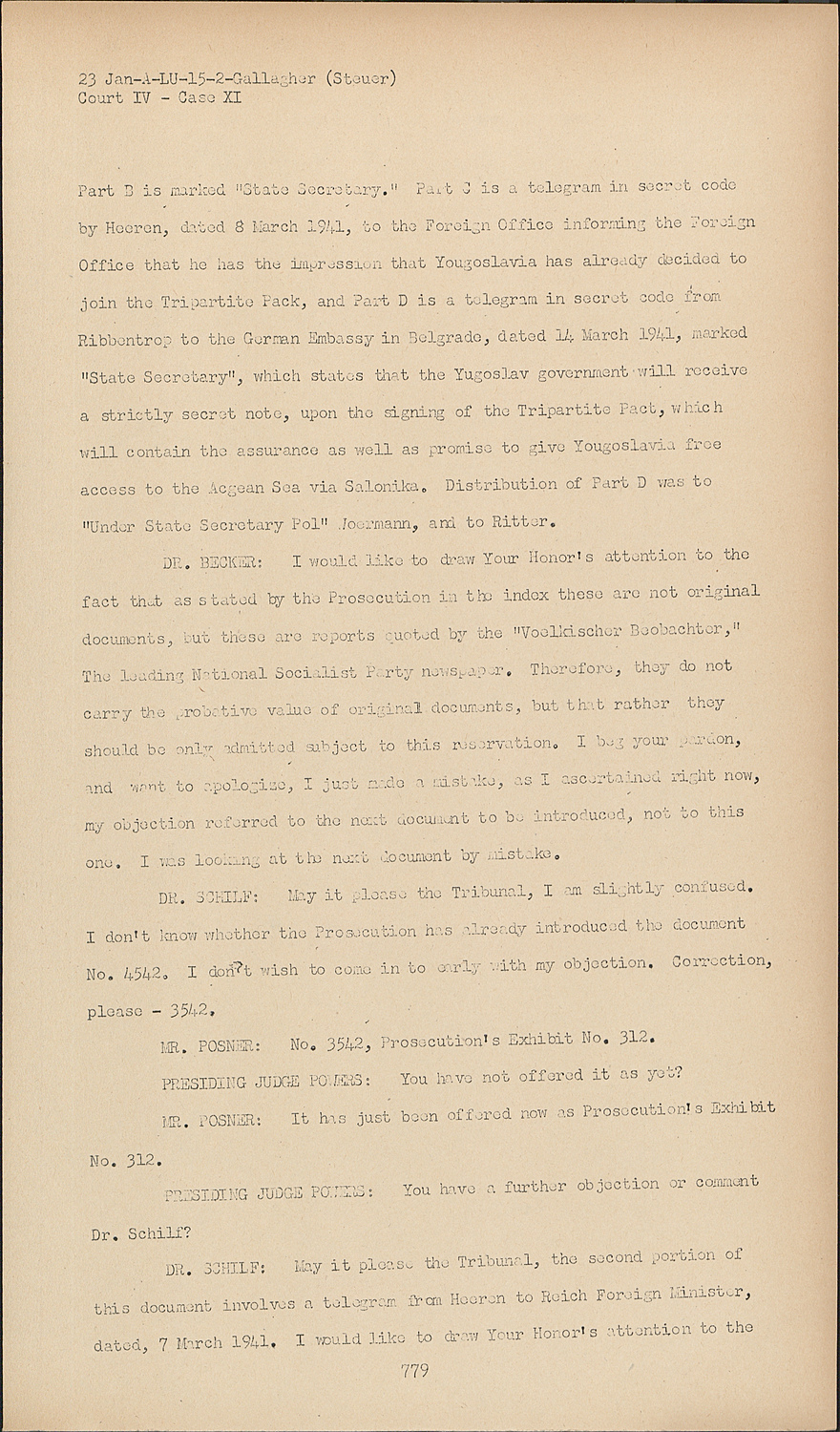
Part B is marked "State Secretary." Part G is a telegram in secret code by Heeren, dated 8 March 1941, to the Foreign Office informing the Foreign Office that he has the impression that Yougoslavia has already decided to join the Tripartite Pack, and Part D is a telegram in secret code from Ribbentrop to the German Embassy in Belgrade, dated 14 March 1941, marked "State Secretary", which states that the Yugoslav government will receive a strictly secret note, upon the signing of the Tripartite Pact, which will contain the assurance as well as promise to give Yougoslavia free access to the Aegean Sea via Salonika. Distribution of Part D was to "Under State Secretary Pol" Woermann, and to Ritter.
DR. BECKER:I would-like to draw Your Honor's attention to the fact that as stated by the Prosecution in the index these are not original documents, but these are reports noted by the "Voelkicischer Beobachter," The leading National Socialist Party newspaper. Therefore, they do not carry the probative value of original documents, but that rather they should be only admitted subject to this reservation. I beg your pardon, and want to apologize, I just made a mistake, as I ascertained right now, my objection referred to the next document to be introduced, not to this one. I was looking at the next document by mistake.
DR. SCHILF:May it please the Tribunal, I am slightly confused. I don't know whether the Prosecution has already introduced the document No. 4542. I don't wish to come in to early with my objection. Correction, please - 3542.
MR. POSNER:No. 3542, Prosecution's Exhibit No. 312.
PRESIDING JUDGE POWERS:You have not offered it as yet?
MR. POSNER:It has just been offered now as Prosecution's Exhibit No. 312.
PRESIDING JUDGE POWERS:You have a further objection or comment Dr. Schilf?
DR. SCHILF:May it please the Tribunal, the second portion of this document involves a telegram from Heeren to Reich Foreign Minister, dated, 7 March 1941. I would like to draw Your Honor's attention to the following which will effect the significant value of this portion of the document.
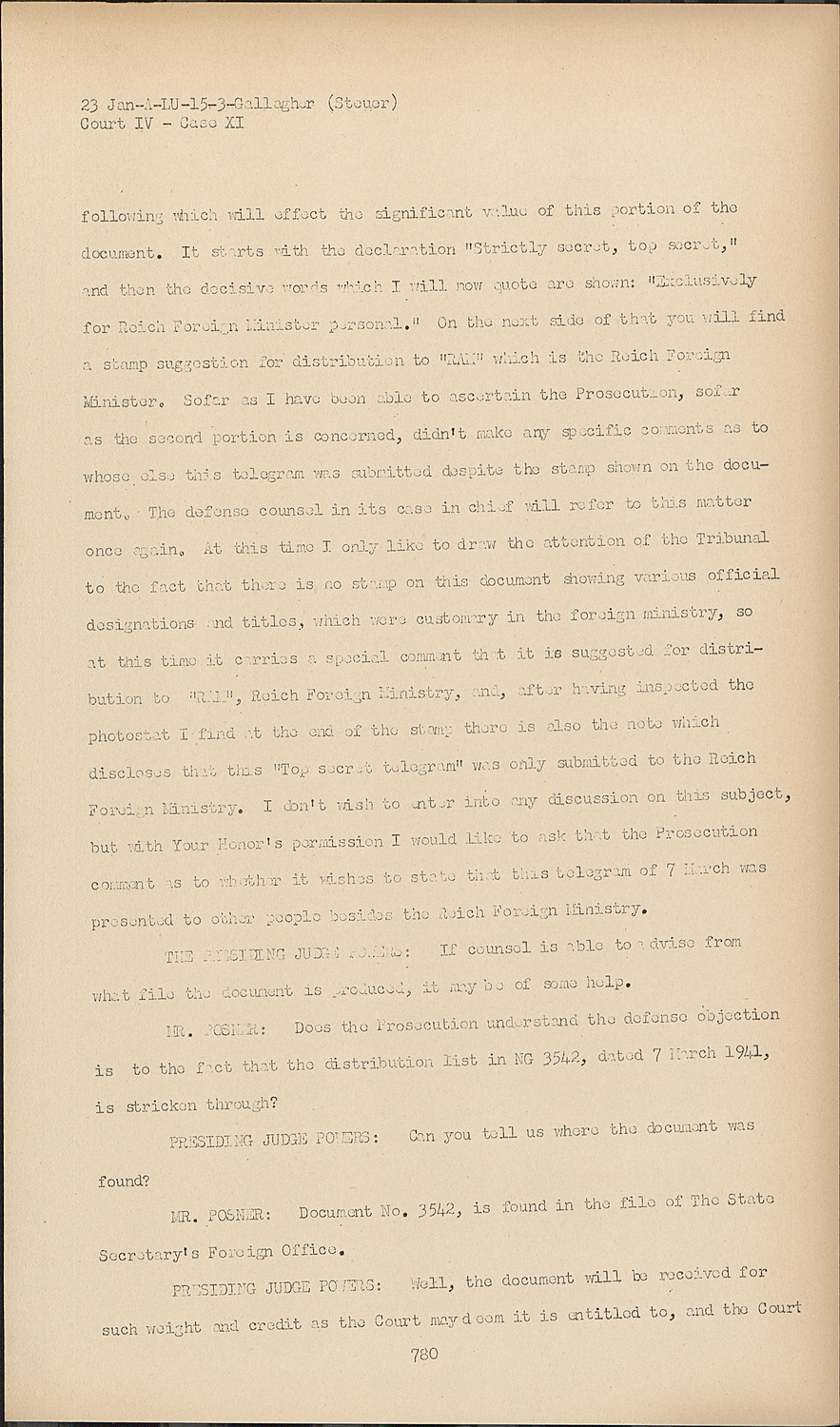
It starts with the declaration "Strictly secret, top secret," and then the decisive words which I will now quote are shown: "Exclusively for Reich Foreign Minister personal." On the next side of that you will find a stamp suggestion for distribution to "RAM" which is the Reich Foreign Minister. Sofar as I have been able to ascertain the Prosecution, sofar as the second portion is concerned, didn't make any specific comments as to whose else this telegram was submitted despite the stamp shown on the document. The defense counsel in its case in chief will refer to this matter once again. At this time I only like to draw the attention of the Tribunal to the fact that there is no stamp on this document showing various official designations and titles, which were customary in the foreign ministry, so at this time it carries a special comment that it is suggested for distribution to "RAM", Reich Foreign Ministry, and, after having inspected the photostat I find at the end of the stamp there is also the note which discloses that this "Top secret telegram" was only submitted to the Reich Foreign Ministry. I don't wish to enter into any discussion on this subject, but with Your Honor's permission I would like to ask that the Prosecution comment as to whether it wishes to state that this telegram of 7 March was presented to other people besides the Reich Foreign Ministry.
THE PRESIDING JUDGE POWERS:If counsel is able to advise from what file the document is produced, it maybe of some help.
MR. POSNER:Does the Prosecution understand the defense objection is to the fact that the distribution list in NG 3542, dated 7 March 1941, is stricken through?
PRESIDING JUDGE POWERS:Can you tell us where the document was found?
MR. POSNER:Document No. 3542, is found in the file of The State Secretary's Foreign Office.
PRESIDING JUDGE POWERS:Well, the document will be received for such weight and credit as the Court may deem it is untitled to, and the Court takes note of the fact that the distribution list as to the stamp on the document has been scratched out.
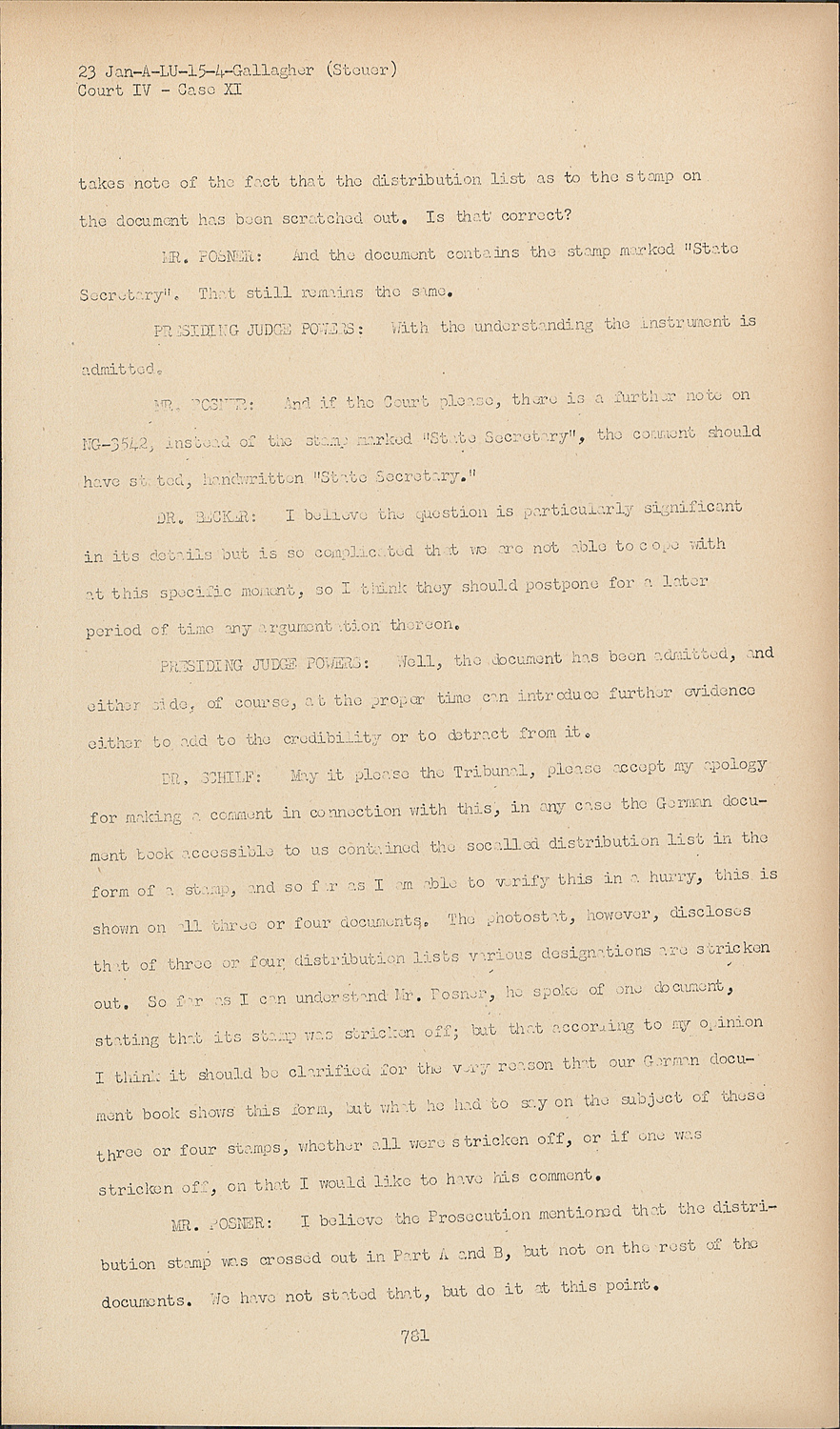
Is that correct?
MR. POSNER:And the document contains the stamp marked "State Secretary". That still remains the same.
PRESIDING JUDGE POWERS:With the understanding the instrument is admitted.
MR. POSNER:And if the Court please, there is a further note on NG-3542, instead of too stamp marked "State Secretary", the comment should have sated, handwritten "State Secretary."
DR. BECKER:I believe the question is particularly significant in its details but is so complicated that we are not able to c ope with at this specific moment, so I think they should postpone for a later period of time any argument ation thereon.
PRESIDING JUDGE POWERS:Well, the document has been admitted, and either side, of course, at the proper time can introduce further evidence either to add to the credibility or to detract from it.
MR. SCHILF:May it please the Tribunal, please accept my apology for making a comment in connection with this, in any case the German document Look accessible to us contained the socalled distribution list in the form of a stamp, and so far as I am able to verify this in a hurry, this is shown on all three or four documents. The photostat, however, discloses that of three or four distribution lists various designations are stricken out. So far as I can understand Mr. Posner, he spoke of one document, stating that its stamp was stricken off; but that according to my opinion I think it should be clarified for the very reason that our German document book shows this form, but what he had to say on the subject of these three or four stamps, whether all were stricken off, or it one was stricken off, on that I would like to have his comment.
MR. POSNER:I believe the Prosecution mentioned that the distribution stamp was crossed out in Part A and B, but not on the rest of the documents. We have not stated that, but do it at this point.
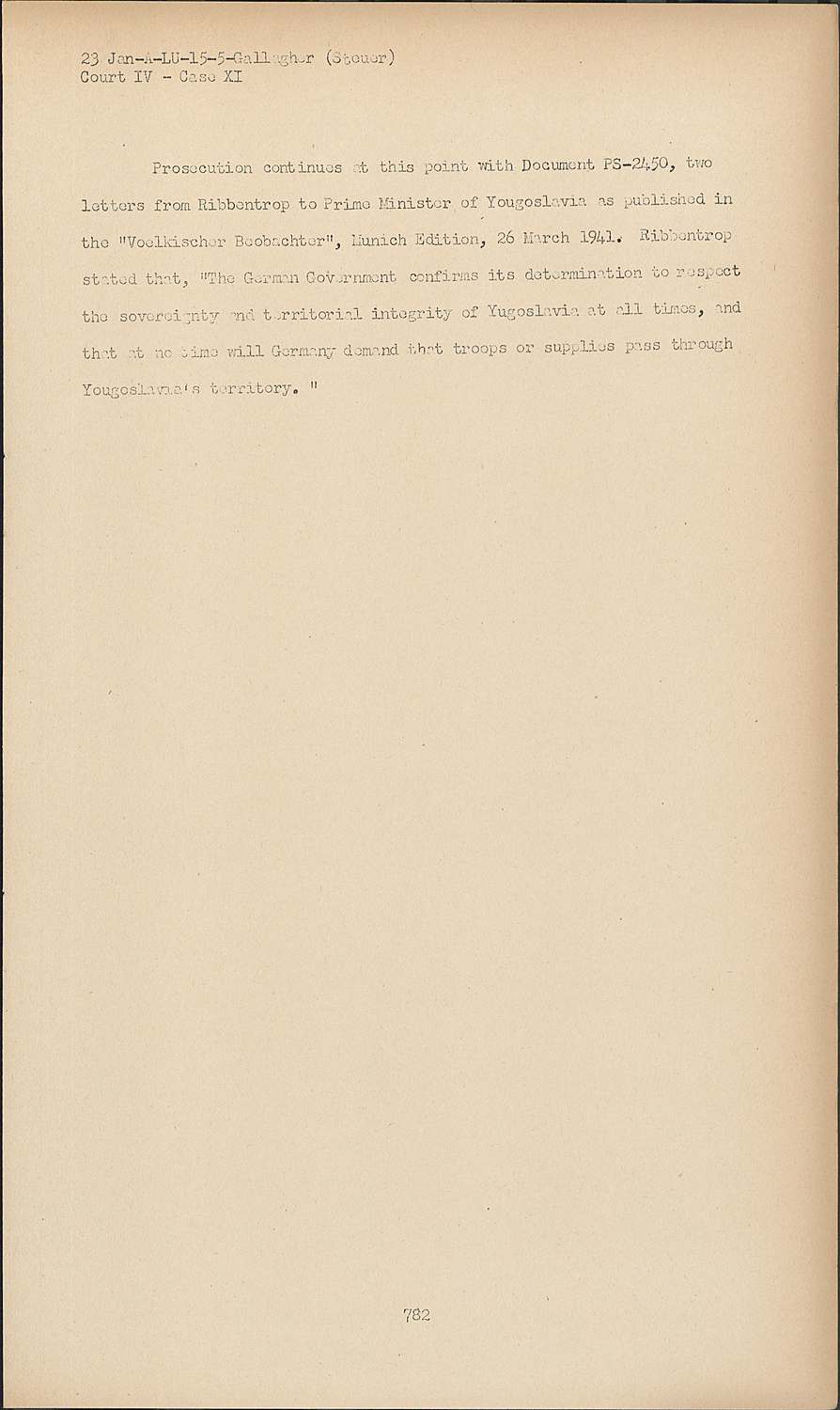
Prosecution continues at this point with Document PS-2450, two letters from Ribbentrop to Prime Minister of Yougoslavia as published in the "Voelkischer Beobachter", Munich Edition, 26 March 1941. Ribbentrop stated, that, "The German Government confirms its determination to respect the sovereignty and territorial integrity of Yugoslavia at all times, and that at no time will Germany demand that troops or supplies pass through Yougoslavia's territory. "
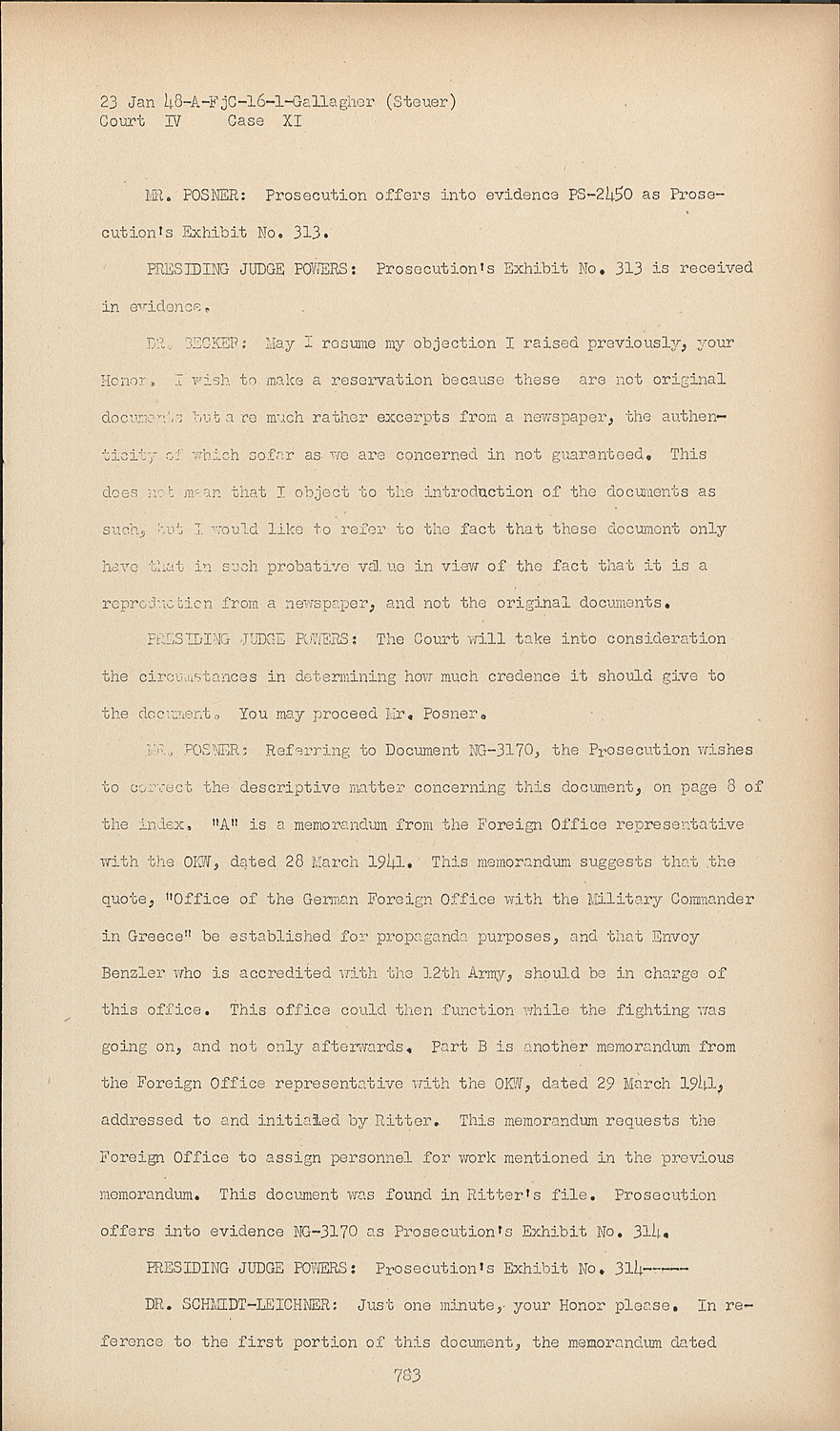
MR. POSNER:Prosecution offers into evidence PS-2450 as Prosecution's Exhibit No. 313.
PRESIDING JUDGE POWERS:Prosecution's Exhibit No. 313 is received in evidence.
DR. BECKER:May I resume my objection I raised previously, your Honor. I wish to make a reservation because these are not original documents but a re much rather excerpts from a newspaper, the authenticity of which sofar as we are concerned in not guaranteed. This does not mean that I object to the introduction of the documents as such, but I would like to refer to the fact that these document only have that in such probative value in view of the fact that it is a reproduction from a newspaper, and not the original documents.
PRESIDING JUDGE POWERS:The Court will take into consideration the circumstances in determining how much credence it should give to the document. You may proceed Mr. Posner.
MR. POSNER:Referring to Document NG-3170, the Prosecution wishes to correct the descriptive matter concerning this document, on page 8 of the index. "A" is a memorandum from the Foreign Office representative with the OKW, dated 28 March 1941. This memorandum suggests that the quote, "Office of the German Foreign Office with the Military Commander in Greece" be established for propaganda purposes, and that Envoy Benzler who is accredited with the 12th Army, should be in charge of this office. This office could then function while the fighting was going on, and not only afterwards. Part B is another memorandum from the Foreign Office representative with the OKW, dated 29 March 1941, addressed to and initialed by Ritter. This memorandum requests the Foreign Office to assign personnel for work mentioned in the previous memorandum. This document was found in Ritter's file. Prosecution offers into evidence NG-3170 as Prosecution's Exhibit No. 314.
PRESIDING JUDGE POWERS:Prosecution's Exhibit No. 314----
DR.SCHMIDT-LEICHNER: Just one minute, your Honor please. In reference to the first portion of this document, the memorandum dated 28 March 1941, this does not disclose the person who is meant, because the document starts and I quote, "I had occasion today," I cannot see it from the original photostat and I am unable to verify it.
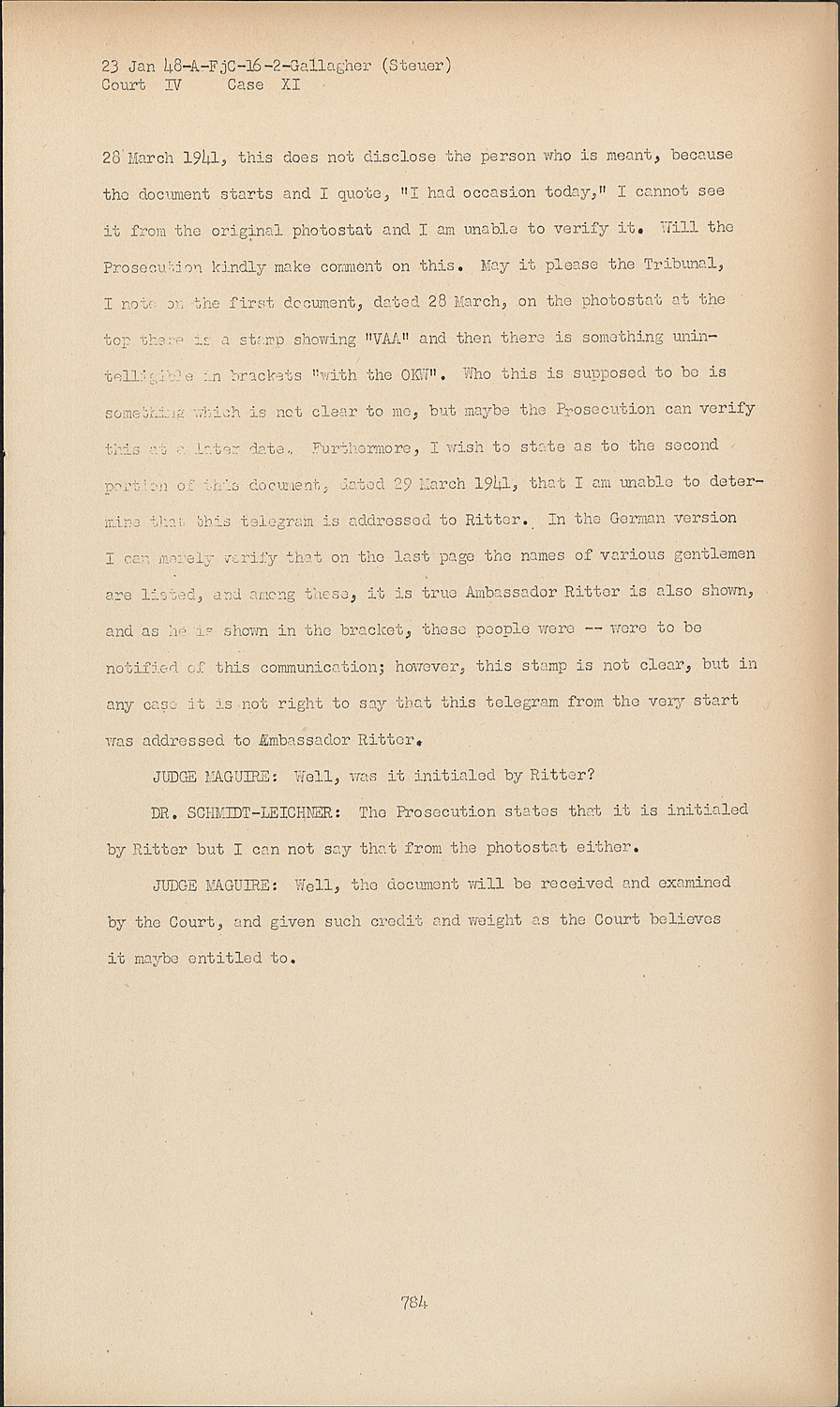
Will the Prosecution kindly make comment on this. May it please the Tribunal, I note on the first document, dated 28 March, on the photostat at the top there is a stamp showing "VAA" and then there is something unintelligble in brackets "with the OKW". Who this is supposed to be is something which is not clear to me, but maybe the Prosecution can verify this at a later: date. Furthermore, I wish to state as to the second portion of this document, dated 29 March 1941, that I am unable to determine that this telegram is addressed to Ritter. In the German version I can merely verify that on the last page the names of various gentlemen are listed, and among these, it is true Ambassador Ritter is also shown, and as he is shown in the bracket, these people were -- were to be notified of this communication; however, this stamp is not clear, but in any case it is not right to say that this telegram from the very start was addressed to Ambassador Ritter.
JUDGE MAGUIRE:Well, was it initialed by Ritter?
DR.SCHMIDT-LEICHNER: The Prosecution states that it is initialed by Ritter but I can not say that from the photostat either.
JUDGE MAGUIRE:Well, the document will be received and examined by the Court, and given such credit and weight as the Court believes it maybe entitled to.
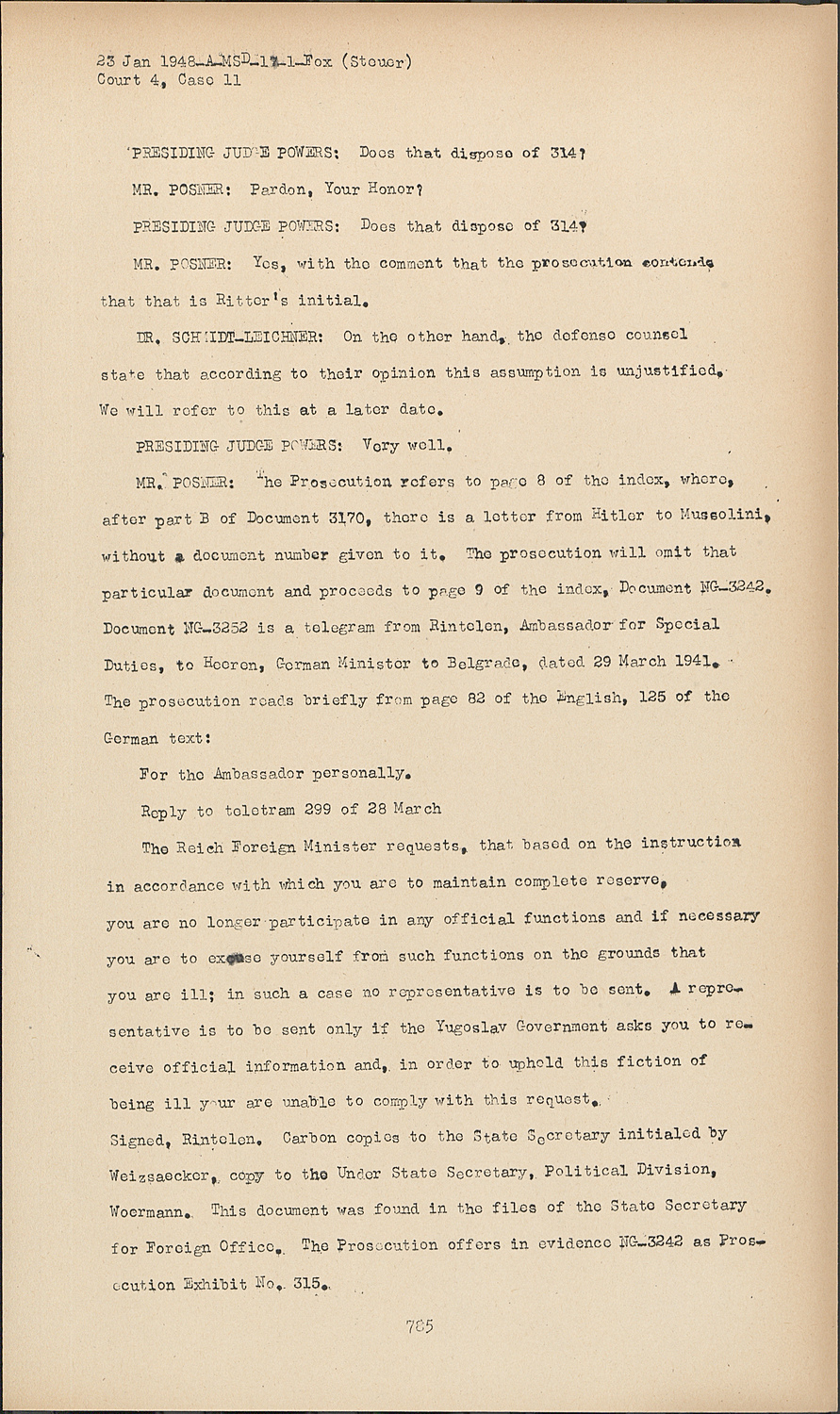
PRESIDING JUDGE POWERS:Does that dispose of 314?
MR. POSNER:Pardon, Your Honor?
PRESIDING JUDGE POWERS:Does that dispose of 314?
MR. POSNER:Yes, with the comment that the prosecution contend that that, is Ritter's initial.
DR.SCHMIDT-LEICHNER: On the other hand the defense counsel state that according to their opinion this assumption is unjustified. We will refer to this at a later date.
PRESIDING JUDGE POWERS:Very well.
MR. POSNER:The Prosecution refers to page 8 of the index, where, after part B of Document 3170, there is a letter from Hitler to Mussolini, without a document number given to it. The prosecution will omit that particular document and proceeds to page 9 of the index. Document NG-3242. Document NG-3252 is a telegram from Rintelen, Ambassador for Special Duties, to Heeren, German Minister to Belgrade, dated 29 March 1941. The prosecution reads briefly from page 82 of the English, 125 of the German text:
For the Ambassador personally.
Reply to teletram 299 of 28 March The Reich Foreign Minister requests, that based on the instruction in accordance with which you are to maintain complete reserve.
you are no longer participate in any official functions and if necessary you are to excuse yourself from such functions on the grounds that you are ill; in such a case no representative is to be sent. A representative is to be sent only if the Yugoslav Government asks you to receive official information and, in order to uphold this fiction of being ill your are unable to comply with this request. Signed, Rintelen. Carbon copies to the State Secretary initialed by Weizsaecker, copy to the Under State Secretary, Political Division, Woermann. This document was found in the files of the State Secretary for Foreign Office. The Prosecution offers in evidence NG-3242 as Prosecution Exhibit No. 315.
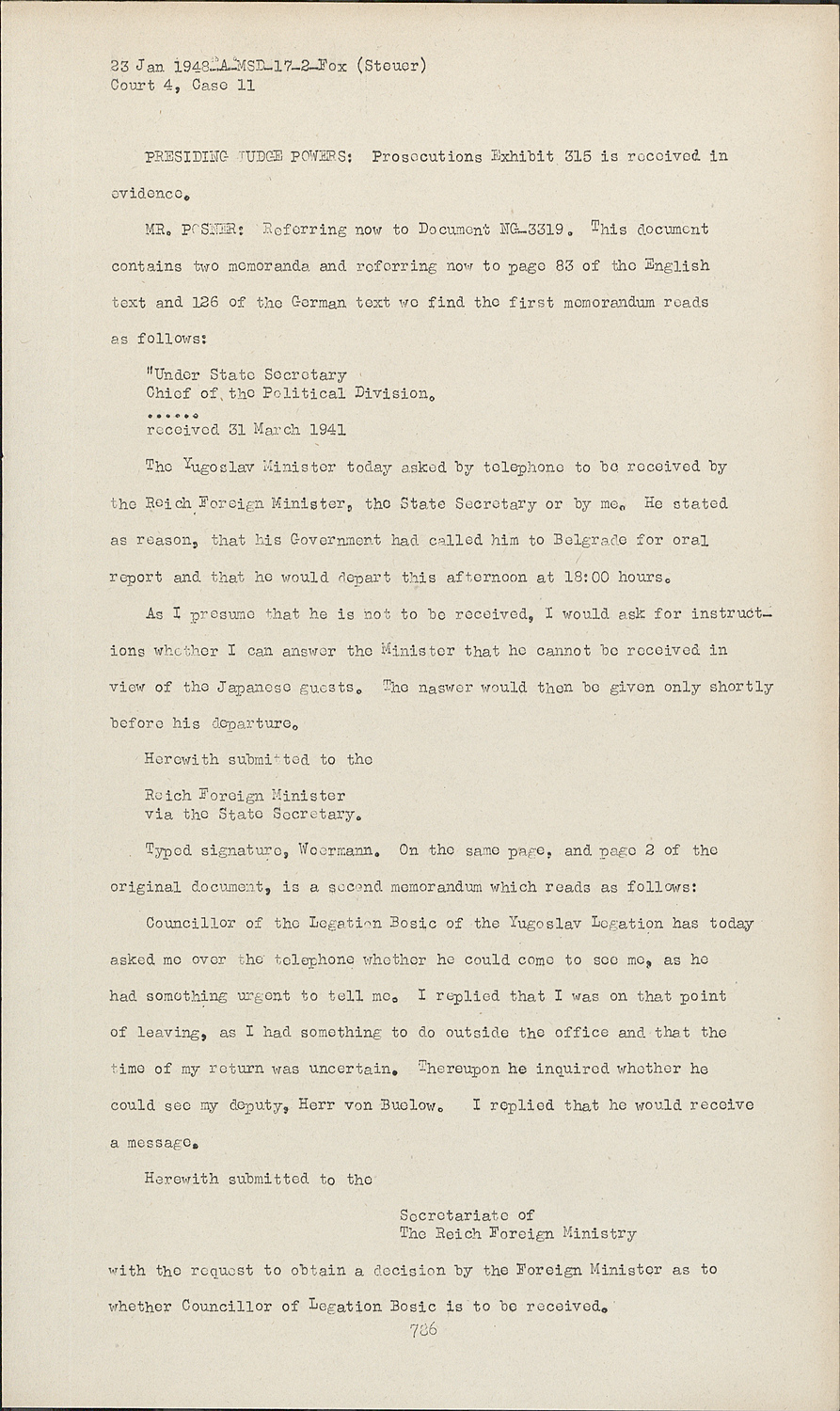
PRESIDING JUDGE POWERS:Prosecutions Exhibit 315 is received in evidence.
MR. POSNER:Referring now to Document NG-3319. This document contains two memoranda and referring now to page 83 of the English text and 126 of the German text we find the first memorandum reads as follows:
"Under State Secretary Chief of, the Political Division.
received 31 March 1941 The Yugoslav Minister today asked by telephone to be received by the Reich Foreign Minister, the State Secretary or by me.
He stated as reason, that his Government had called him to Belgrade for oral report and that he would depart this afternoon at 18:00 hours.
As I presume that he is not to be received, I would ask for instructions whether I can answer the Minister that he cannot be received in view of the Japanese guests. The naswer would then be given only shortly before his departure.
Herewith submitted to the Reich Foreign Minister via the State Secretary.
Typed signature, Woermann. On the same page, and page 2 of the original document, is a second memorandum which reads as follows:
Councillor of the Legation Bosic of the Yugoslav Legation has today asked me over the telephone whether he could come to see me, as he had something urgent to tell me. I replied that I was on that point of leaving, as I had something to do outside the office and that the time of my return was uncertain. Thereupon he inquired whether he could see my deputy, Herr von Buelow. I replied that he would receive a message.
Herewith submitted to the Secretariate of The Reich Foreign Ministry with the request to obtain a decision by the Foreign Minister as to whether Councillor of Legation Bosic is to be received.
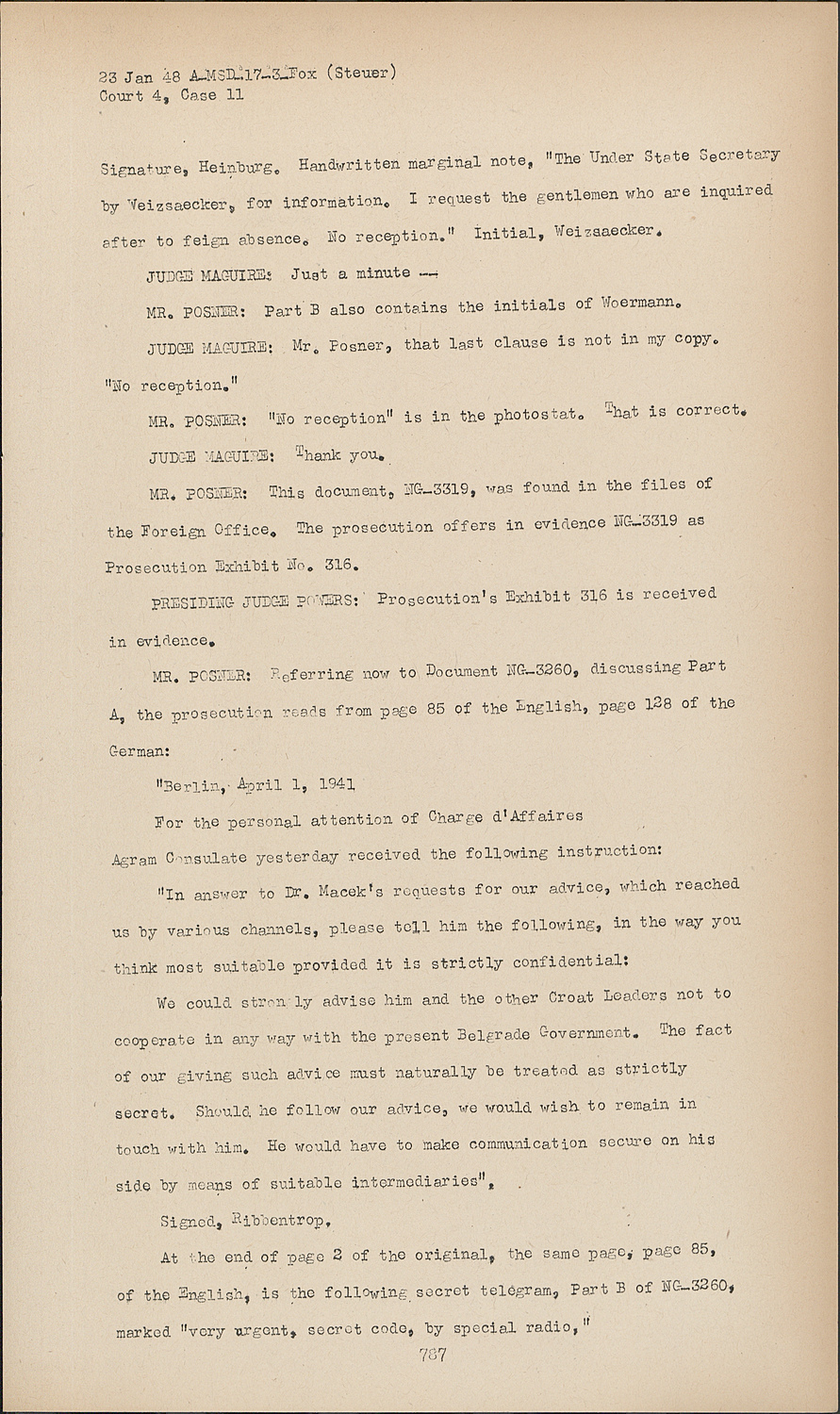
Signature, Heinburg. Handwritten marginal note, "The Under State Secretary by Weizsaecker, for information. I request the gentlemen who are inquired after to feign absence. No reception." Initial, Weizsaecker.
JUDGE MAGUIRE.Just a minute -
MR. POSNER:Part B also contains the initials of Woermann.
JUDGE MAGUIRE:Mr. Posner, that last clause is not in my copy. "No reception."
MR.POSNER: "No reception" is in the photostat. That is correct.
JUDGE MAGUIRE:Thank you.
MR. POSNER:This document, NG-3319, was found in the files of the Foreign Office. The prosecution offers in evidence NG-3319 as Prosecution Exhibit No. 316.
PRESIDING JUDGE POWERS:Prosecution's Exhibit 316 is received in evidence.
MR. POSNER:Referring now to Document NG-3260, discussing Part A, the prosecution reads from page 85 of the English, page 128 of the German:
"Berlin, April 1, 1941 For the personal attention of Charge d'Affaires Agram Consulate yesterday received the following instruction:
"In answer to Dr. Macek's requests for our advice, which reached us by various channels, please tell him the following, in the way you think most suitable provided it is strictly confidential:
We could strongly advise him and the other Croat Leaders not to cooperate in any way with the present Belgrade Government. The fact of our giving such advice must naturally be treated as strictly secret. Should he follow our advice, we would wish to remain in touch with him. He would have to make communication secure on his side by means of suitable intermediaries".
Signed, Ribbentrop.
At the end of page 2 of the original, the same page, page 85, of the English, is the following secret telegram, Part B of NG-3260, marked "very urgent, secret code, by special radio," "The Reich Minister for Foreign Affairs requests up-to-date telegraphic report on further development of the situation.
Anything now of importance is to be reported here by return.
It is particularly important for us to be informed as quickly as possible on any decisions by Croat Leaders, and to know where they are at any given time (Journeys to Belgrade for example). Wherever you have reliable informats available for the collection of such news, you must keep in constant touch with them.
Herr Malletke from Reichsleiter Rosenberg's office, and SS Standartenfuehrer Voesenmeyer are leaving here today with the object of sounding authoritative Croat personalities and will call on you. Both have instructions to exert their influence on the lines of the telegrams dispatched to you yesterday.
The Reich Minister for Foreign affairs requests you to inform the Croat personalities in question in a suitable fashion, that Herr Veesenmeyer can be considered as the confidential agent of the Reich Minister for Foreign Affairs. Typewritten signature, Rintelen.
The prosecution offers in evidence NG-3260, Prosecution Exhibit NG3260, Prosecution Exhibit No. 317.
DR.DOETZER (for Veesenmayer): May it please the Tribunal -
THE PRESIDENT:Just a moment. The channel seems to be dead.
INTERPRETER STEUER:I beg your pardon, Your Honor. It is our channel.
THE PRESIDENT:Start over again.
DR. DOETZER:From the reading of the last document on the part of the prosecutor, there is disclosed -- at least according to my opinion -- that the index in this case does not exactly coincide with the contents of the document. In the index it says, and I refer to the last sentence, for Exhibit 317, that Veesenmayer enjoys his -- I read it again -- that Veesenmayer enjoys the full confidence of the Reich Foreign Minister, and that according to my opinion is not disclosed by the document.
MR. POSNER:The prosecution contends that that meaning is in the document itself.
PRESIDING JUDGE POWERS:The Court observes that the language is somewhat different from that in the document. As to whether or not they mean the same thing is a matter of argument and the Court will take into consideration that there is a dispute about it and will admit the Exhibit 317 into evidence for such weight and credit as the Court feels it is entitled to.
MR. POSNER:Referring at this point to Document NG-3247, in this secret telegram from Freund, dated 3 April 1941, the Foreign Office is informed, that Veesenmayer arrived at Zagreb. The second half of this document reads as follows, on page 87 of the English text, pages 132 and 133 of the German text, reading the thrid paragraph on page 87?
"Reich Danube and Alpine transmission for Croatia particularly important. Too much emphasis on the announcement of the persecution of Ethnic Germans harmful because of slight examination of contrary facts. On the other hand, continually increased allusion to the contrasts between Croats and Serbs, stressing German sympathy and increasing understanding of Croat interests. At the right moment, special prominence to brothership in arms in the World War."
Marked for the State Secretary. Suggested distribution to Chief of the AO Bohle. Under State Secretary Pol. Woermann, and Ritter has received a copy of this document. The prosecution offers into evidence NG-3247 as Prosecution Exhibit No. 318.
PRESIDING JUDGE POWERS:Prosecution Exhibit No. 318 is received in evidence.
MR. POSNER:Proceeding to Document NG-3248, secret telegram from Ribbentrop. There is a correction in this index at this point. Instead of "secret telegram from Ritter," it should be "secret telegram from Ribbentrop to the German Legation in Belgrade, dated 2 April 1941, and a reply from Belgrade, died 3 April 1941." Ribbentrop instructs the Embassy to reduce its personal to a skeleton staff of four to five men on the third of April. The air attache and his staff, as well as all dispensable personnel, are to leave Yugoslavia. Colonel Toussaint and his indispensable staff are to remain. All others are to head immediately for German or neutral territory. The German Consulates in Yugoslavia, except for Agram, are to be closed on the third of April." In Part B, the reply from Belgrade, signed Feine, states that all the consulates have been informed. This copy is marked, "State Secretary"; other copies sent to Under State Secretary Pol. Woermann, and Ambassador Ritter.
JUDGE MAGUIRE:The index indicates that Bohle was on this list. Are we to strike that off? Mr. Posner?
MR. POSNER:I heard the suggestion by the Court. I am waiting for the exhibit to come back, sir. We will answer the Court directly. The prosecution stated that it was marked for the State Secretary and that a copy was sent to the Under State Secretary Pol., which is Woermann, and Ambassador Ritter. It did not mention that the Chief of the A.O., Bohle, also received a copy; but he is on the distribution list.
JUDGE MAGUIRE:So, his name should -
MR. POSNER:He remains on the distribution list. That is correct.
DR. GOMBEL:I understand the prosecution correctly, that the prosecution does not contend that Herr Bohle received a copy?
DR. BECKER:I would like to draw Your Honors attention to the distribution list. There is explained, Under State Secretary Pol, under State Secretary Legal Division, and then at the left side of that there is a handwritten note which is indicated to be State Secretary by the prosecution.