JUDGE MAGUIRE:Mr. Posner.
MR. POSNER:Yes sir.
JUDGE MAGUIRE:It would aid me in keeping my record of these exhibits and to whom they refer if, where you have chief of AO and chief political division, you would identify the defendant, if it does refer to any of the defendants. It makes my work a good deal longer if I have to get cut the chart and check it up each time than if I could have it as we go along.
MR. POSNER:The prosecution can comply with that wish and from here on will proceed to put in the names of the proper defendants.
JUDGE MAGUIRE:Yes.
THE PRESIDENT:Well, I don't think you should put it in the document, but you should indicate that that is your understanding of who it was so that that would be cleared up. Let's not confuse it with the document. Let's have the document the way it is.
MR. POSNER:Yes sir. Part B of the document NG-2670 is Weizsaecker's reply to the telegram just referred to. Page 11 of the English text reads as follows, page 31 in the German text:
"State Secretariat, Belgrade, Coded telegram, Secret code. Fuehrer speech subsequent to dispatch of your telegram probably allayed new wave of alarm, since Fuehrer laid particular stress on limitation of our interests and absence of war aims even with regard to England and France, and restated that Germany had accepted definite frontiers in the south and west of the Reich. Further action as per your suggestion, therefore, does not appear to be necessary any longer, unless even now after the Fuehrer speech there should arise some new occasion for issuing reassuring communiques to Yugoslavia, in which case I ask for telegraphic report."
Initialed Weizsaecker, initialed Woermann. At the bottom of this document is a notation, "Departed 22/9 at 1800 hours." Document NG-2670was found in the Foreign Office file and is introduced into evidence as prosecution's exhibit number 261.
THE PRESIDENT:It is so received.
MR. POSNER:Referring to document TC-43, German assurance to Yugoslavia dated 6 October 1939, Hitler states: "Immediately after the completion of the Anschluss I informed Yugoslavia that, from now on, the frontier with this country would also be an unalterable one and that we only desire to live in peace and friendship with her." The prosecution offers into evidence TC-43 as prosecution exhibit number 262.
THE PRESIDENT:Prosecution exhibit 262 is received.
MR. POSNER:Referring at this point to document NG-3086, the prosecution wishes to make a correction in the index replacing the word "Hitler", where it says, "Hitler states", it should read "Heeren states" (spelling) H-e-e-r-e-n.
THE PRESIDENT:Very well.
MR. POSNER:This document is a top secret telegram by Minister Heeren, Belgrade, dated 8 February 1940 to the Foreign Office, marked State Secretary, distributed to the Under Secretary, Political Division. Heeren inquires whether the financial aid to the Nazi influenced paper "Telegramm" has been definitely approved. The prosecution offers into evidence NG-3086 as prosecution's exhibit number 263.
THE PRESIDENT:It is so received.
MR. POSNER:The prosecution at this point refers to document NG3237 which has been distributed to the Court and served upon the defense counsel, complying with the 24-hour regulation.
DR. SCHILF:May it please the Tribunal, I refer to NG-3086 and I understood the prosecutor to say that the telegram was addressed to the Under State Secretary, therefore, to the defendant Woermann. I now have the photostat before me, and I cannot verify the statement.
I would be grateful to the prosecutor for indicating to me on what basis they draw such a conclusion.
MR. POSNER:The prosecution mentioned that this was a top secret telegram by Minister Heeren, Belgrade, to the Foreign Office, marked State Sceretary, distributed to the Under State Secretary, Pol.
THE PRESIDENT:I think that is reflected in the document. Very well. You may proceed, Mr. Posner.
MR. POSNER:Yes sir.
THE PRESIDENT:What was the identification number of the document you started to refer to?
MR. POSNER: NG-3237.
THE PRESIDENT:What paging do you intend to give to this document that has now been distributed?
MR. POSNER:This will follow document NG-3086 and will be page 14-a in the English book.
THE PRESIDENT:There are two pages, 14-a and 14-b then, I assume?
MR. POSNER:That is correct, 14-a and 14-b.
THE PRESIDENT:Very well. You may go ahead.
MR. POSNER:Reading the first paragraph of document NG-3237; "The Greek envoy came to see me today in a rather nervous frame of mind. He took the news of the Western Powers' intention to extend the theatre of war less seriously than a possible repetition of the Scandinavian events. It was his belief that Germany, possibly in conjunction with Italy, might forestall the supposed intentions of the Western Powers and on her side draw the Balkans, in particular Greece, into the war theatre, I did not remove the anxieties of the envoy. However, I put the blame entirely on England and France."
Proceeding to the third sentence from the bottom of the page, page 1 of the original document: "Nothing was more understandable to me than the Greek desire to remain untouched by the turmoil of armed conflict. This wish would also be fulfilled if the Western powers refrained from their plans to extend the war."
On page 2 of the English document, and 2 of the original, the last sentence: "In conclusion I brought the conversation around to the internal situation in Greece, to utterances by Herr Politis of a pro-western power nature, and similar matters." Typewritten signature, Weizsaecker. This document was found in the files of the State Secretary of the Foreign Office. The prosecution offers into- evidence prosecution exhibit number NG-3237 as prosecution exhibit number 264.
THE PRESIDENT:Prosecution exhibit number 264 is received. We have now reached that point where we must take our recess, the usual recess, until tomorrow morning at 9:30.
(The Tribunal adjourned to 23 January 1943 at 0930 hours.)
Court No. IV, Case No. 11.
Official Transcript of the American Military Tribunal in the matter of the United States of America against Ernst von Weizsaecker, et al, defendants, sitting at Nurnberg, Germany, on 24 January 1948, 0930-1630, the Honorable Leon W. Powers, presiding.
THE MARSHAL:The Honorable, the Judges of Military Tribunal IV. Military Tribunal IV is now in session. God save the United States of America and this honorable Tribunal. There will be order in the court.
THE PRESIDENT:Mr. Marshal, are all the defendants in court?
THE MARSHAL:May it please your Honors, all the defendants are present in the courtroom with the exception of defendants Meissner, Pleiger and Keppler who are absent due to illness.
THE PRESIDENT:Today's sessions of the Tribunal will be presided over by Judge Powers.
PRESIDING JUDGE POWERS:Are you ready to proceed, Mr. Posner?
MR. POSNER:Yes, your Honor. The prosecution continues in document book 7-A, page 3 of the index, referring to document NG-2978. This is a draft of a note dated 29 May 1940, to the German Minister Heeren in Belgrade from Weizsaecker, containing the typed signature of Weizsaecker. This document was found in the files of the State Secretary of the Foreign Office. In this note Weizsaecker instructs Heeren not to discuss the question of an eventual German march through Yugoslavia in case of enemy action in the Balkans. Weizsaecker had originally stated that it was still too soon to discuss this matter with the Yugoslavs, especially as there was no guarantee that Yugoslavia would maintain secrecy towards the other powers. This latter version of the draft had been revised. The prosecution offers into evidence NG-2978 as Prosecution's Exhibit Number 265.
PRESIDING JUDGE POWERS:Exhibit 265 will be received.
MR. MAGEE:May it please the Court, may the record in this case show that the signatures here are typed and that there are no initials on the telegram.
Court No. IV, Case No. 11.
MR. POSNER:The prosecution just mentioned it was the typed signature of Weizsaecker and did not mention any initials on the document.
PRESIDINT JUDGE POWERS:The Court observes the fact. You may proceed.
MR. POSNER:Referring at this point to NG-3239, copy of a secret telegram by Woermann dated 15 August 1940, to the German Embassies in Rome and Athens wherein Woermann explains the conversation between Weizsaecker and the Greek envoy. Turning briefly to page 16 of the English text, page 35 in the German text:
"Director, Political Division, Under State Secretary, Political Division, Personal and strictly confidential. Referring to 'Agence d'Athenes' representation of case, dated 12 August, German News Service, Greek ambassador yesterday denied to State Secretary murder of Albanian patriots, and objected to Stefani's representation of the matter. Ambassador wished semi-official Greek representation of affair to be taken into account in German Press. Expressed theory that Italy desired war with Greece."
Referring to the middle of this page, right above page 2 of the original:
"Reply given to Ambassador, as far as events in Mediterranean are concerned, we rely upon reports coming from our Italian allies. He was therefore to entertain no hope that we would publish in our press the Greek version of events which had tekan place. We did not believe that Italy sought to quarrel with Greece. It would be more prudent of the Ambassador to avoid rash use of the word 'WAR'. If he spoke of a conflagration following in the wake of a Greek-Italian conflict in the Balkans, the only such event which we could possibly imagine was one which would be to the disadvantage of Greece."
Referring to page 17 of the English text, page 37 in the German text, is the second note by Woermann concerning his talk with the Greek envoy, the second paragraph:
Court No. IV, Case No. 11.
"The Greek Government was very greatly disturbed by the fact that strong Italian forces and particularly motorized troops and tanks had recently been coming to Albania and were being drawn up on the Greek frontier. The Minister President considered the situation to be very grave and expected an invasion by Italian troops, perhaps even the following day."
Referring now to the last paragraph briefly:
"In this difficult situation, the Greek Government requested the advice of the German Government. I told the ambassador that I did not understand precisely what kind of advice was expected of us. The ambassador then couched his request in more precise terms, stating that it was perhaps not a matter of advice but rather of information as to Italy's plans as far as Greece was concerned. I told the ambassador that I personally did not believe Italy's intentions towards Greece at the time to be aggressive. The ambassador then asked whether it would not be possible for him to speak to the Reich Minister for Foreign Affairs in person, as his Government expected a telegraphic report from him that day. I replied that the Reich Minister for Foreign Affairs was out of Berlin at the time. We herewith submit the above report to the Reich Minister for Foreign Affairs, with the request for instructions." Typed signature, Woermann.
The third note by Woermann further explains the situation on page 18 of the English text, page 33 in the German:
"During the early hours of this morning, the Greek ambassador made desperate efforts to reach the Reich Minister for Foreign Affairs through the Office of the Minister. On being informed that the Reich Minister for Foreign Affairs was attpresent on a journey to Southern Germany, but that it might be possible to reach him by telephone in the train at 0208 hours, he visited me at 0145 hours. He asked me to put the call through from my flat, a request which I refused."
And turing briefly to the final paragraph, page 19 of the English text, page 40 in the German text:
Court No. IV, Case No. 11.
"I held out no hope that I should be successful, at that time of the night, in putting through a call to the Reich Minister for Foreign Affairs and in getting him to express an opinion. At 0208 hours, during a halt at Hof, I informed Herr Gottfriedsen of the facts by telephone, adding that there was no necessity to waken the Reich Minister for Foreign Affairs, but that he was to be informed early in the morning. The Greek Ambassador was then informed, on my instructions, that I had not succeeded in contacting the Reich Minister for Foreign Affairs en route, but had sent the report of our conversation to him." Typed signature, Woermann. Distribution, State Secretary, Weizsaecker; Under State Secretary, Woermann.
The second note in document NG-3239 is initialed by Weizsaecker. The prosecution offers into evidence NG-3239 as Prosecution's Exhibit Number 266.
PRESIDING JUDGE POWERS:Prosecution's Exhibit 266 is received.
MR. POSNER:Referring to document NG-3092, page 4 of the index, a note typewritten signature of Woermann, dated 25 September 1940, initialled by Weizsaecker which reveals that Woermann repeated Germany's allegations that Greece was aiding England to offset Greek assurances of its neutrality towards Germany. NG-3092 is the handwritten signature of Woermann instead of the typed signature. The prosecution offers into evidence NG-3092 as Prosecution's Exhibit Number 267.
PRESIDING JUDGE POWERS:Prosecution's Exhibit Number 267 is received in evidence.
MR. POSNER:Proceeding to document NG-3084, a telegram signed Mackensen, dated 25 October 1940, to Ribbentrop. Mackensen reports from Rome that he has reliable information as to the imminence of the Italian Invasion of Greece. This telegram is initialed by Weizsaecker, copy to the Under State Secretary Pol., which is Woermann, and this document was found in the files of the State Secretary of the Foreign Office.
The second part of this document is a telegram by Weizsaecker dated 26 October 1940 wherein Weizsaecker instructs the German Ambassador in Greece to use the greatest restraint in conversations, particularly in Greek-Italian matters. This telegram contains the typed signature of Weizsaecker. The prosecution offers into evidence WG-3084, as prosecution exhibit number 268.
PRESIDING JUDGE POWERS:Prosecution's exhibit number 268 is received in evidence.
MR. POSNER:Referring to document NG- 3085, page 5 of the index, two telegrams from Bismarck, the German Counselor of the Embassy in Italy, to the German Foreign Office, initialed by Weizsaecker and distributed to the Under State Secretary Pol., Woermann.
Part A, Bismarck telegram, dated 27 October 1940, advises the Foreign Office that Ciano, the Italian Foreign Minister, informed him of the dispatch of an ultimatum to Greece which is planned for the following day. Part B is a Bismarck telegram dated 27 October 1940 and forwards the complete text of the Italian ultimatum which, among other points, contains the Italian demand to occupy strategic points in Greece and to counteract the so-called Greek Government's friendly and favorable attitude toward Great Britain. This document was found in the files of the State Secretary of the Foreign Office. Telegram A was initialed by Weizsaecker. The prosecution offers into evidence NG-3085as prosecution exhibit number 269.
PRESIDING JUDGE POWERS:Prosecution's exhibit number 269 is received into evidence.
MR.POSNER; Proceeding to document NG-3356, a memoradum by Ritter for Foreign Office officials, dated 29 October 1940. Reading briefly on page 29 of the English text, the memorandum is as follows, on page 52 of the German text, third paragraph, page 29:
"There are not yet any reports concerning activities of the British on the continent or the Greek islands. The British war ships have so far not left Alexandria. England ordered the Greek merchant ships to enter British ports immediately and has forbidden them to enter foreign, including French ports." Typewritten signature, Ritter, initialed Weizsaecker, initialed by Ritter, distribution to the Foreign Minister, to the Under State Secretary, Political Division Woermann. The prosecution offers into evidence NG-3356 as prosecution exhibit number 270.
PRESIDING JUDGE POWERS:Prosecution's exhibit number 270 is received in evidence.
MR. POSNER:Referring to document NG-3332, a memorandum from the Reich Main Security Office to the Foreign Office, distrubted to Weizsaecker and Woermann, dated 30 October 1940, informing the Foreign Office that although Greek diplomats and couriers may leave the Reich, the Foreign Office will be informed immediately by telephone when they cross the borders. This document was found in the files of the State Secretary of the Foreign Office. The prosecution offers into evidence NG3332 as prosecution exhibit number 271.
PRESIDING JUDGE POWERS:Do you have an objection, sir? Do you desire to be heard, Dr. Schilf?
DR. SCHILF:Yes, your Honor, if you please. I wish to refer to exhibit 3356. As far as I understood the prosecutor alleged that this memorandum was signed by Woermann and that is exactly what the index states, but it is possible that this is a misunderstanding of mine and in that case, the index would have to be corrected. There is no initial of Woermann on this document.
MR. POSNER:If the Prosecution recalls correctly, there is no mention of this document being signed by Woermann. It was initialed by Ritter and Weizsaecker and Woermann as Under State Secretary Pol. was on the distribution list.
PRESIDING JUDGE POWERS:Prosecution's exhibit 271 is received in evidence.
MR. MAGEE:Your Honors, may I say a word with respect to the Government's exhibit 270 and refer you to the index on page 5 of the English version? The index states and underscores, "There are no reports of British forces in Greece." There is no such statement in the telegram and I move that be stricken.
MR. POSNER:May the prosecution have exhibit 270?
PRESIDING JUDGE POWERS:I assume that that statement in the index is a conclusion which you drew from the telegram.
MR. POSNER:I believe the prosecution can clear this matter up in just one minute, please. If it please the Court, the reference in the index is the summary of the document itself. If the Court wishes, we can read directly from the exhibit.
PRESIDING JUDGE POWERS:Well, that exact statement doesn't occur in the telegram.
MR. POSNER:Not in those words, but the meaning is the same, your Honor.
PRESIDING JUDGE POWERS:Well, the Court will note the suggestion made about the exhibit. The order admitting it stands.
MR. POSNER:May the prosecution just add the point that there are no quotes in this particular index at this point? The prosecution is ready to proceed with document NG-3404, page 6 of the index. Part A, telegram from Minister Heeren in Belgrade dated 24 November 1940, to the German Foreign Office wherein Herren expresses the fear that the Yugoslav Government may not permit German trucks to pass through their country. Part A is initialed by Weizsaecker. The prosecution wishes to correct in the index, part B of document NG-3404 which should read as follows; "Draft of a note, typed signature of Wiehl, addressed to the Reich Foreign Minister via the State Secretary."
In this note Wiehl urges that no more deliveries of material for aircraft be made to Yugoslavia in view of their refusal to allow the German trucks to pass through their country. Ritter and Woermann on the distribution list. Woermann is listed as Under State Secretary Pol.
Part C is a telegram by Herran dated 7 December 1940, initialed by Weizsaecker Herren reports that the German request for permission by the Yugoslav Government for the transit of one thousand German trucks has been definitely denied, since the trucks obviously were serving military purposes. This document was found in the files of the State Secretary of the Foreign Office. The prosecution offers into evidence NG-3404as prosecution's exhibit number 272.
PRESIDING JUDGE POWERS:Prosecution's exhibit number 272 is received in evidence.
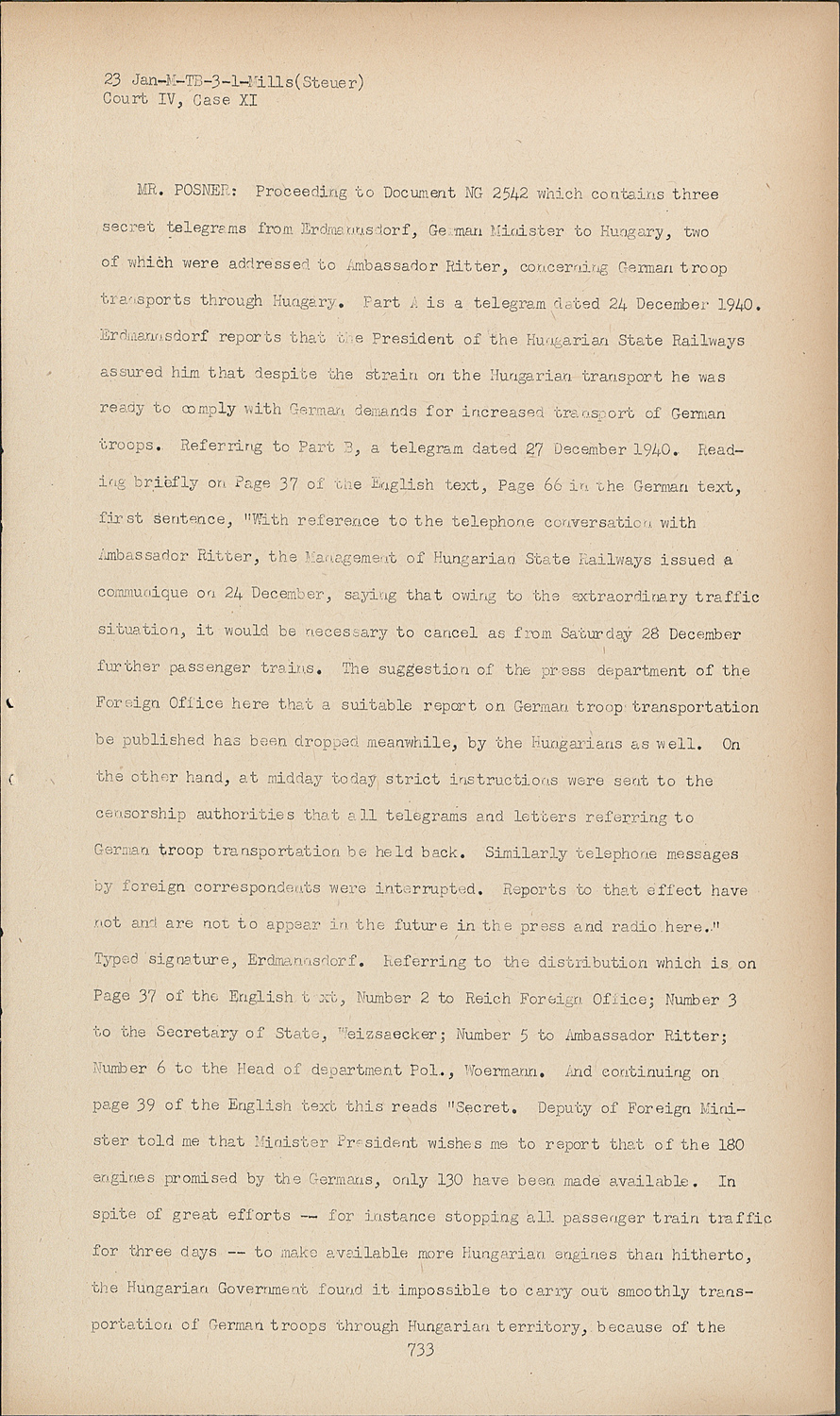
MR. POSNER:Proceeding to Document NG 2542 which contains three secret telegrams from Erdmannsdorf, German Minister to Hungary, two of which were addressed to Ambassador Ritter, concerning German troop transports through Hungary. Fart A is a telegram dated 24 December 1940. Erdmannsdorf reports that the President of the Hungarian State Railways assured him that despite the strain on the Hungarian transport he was ready to comply with German demands for increased transport of German troops. Referring to Part 3, a telegram dated 27 December 1940. Reading briefly on Page 37 of the English text, Page 66 in the German text, first sentence, "With reference to the telephone conversation with Ambassador Ritter, the Management of Hungarian State Railways issued a communique on 24 December, saying that owing to the extraordinary traffic situation, it would be necessary to cancel as from Saturday 28 December further passenger trains. The suggestion of the press department of the Foreign Office here that a suitable report on German troop transportation be published has been dropped meanwhile, by the Hungarians as well. On the other hand, at midday today strict instructions were sent to the censorship authorities that all telegrams and letters referring to German troop transportation be held back. Similarly telephone messages by foreign correspondents were interrupted. Reports to that effect have not and are not to appear in the future in the press and radio here." Typed signature, Erdmannsdorf. Referring to the distribution which is on Page 37 of the English text, Number 2 to Reich Foreign Office; Number 3 to the Secretary of State, Weizsaecker; Number 5 to Ambassador Ritter; Number 6 to the Head of department Pol., Woermann. And continuing on page 39 of the English text this reads "Secret. Deputy of Foreign Minister told me that Minister President wishes me to report that of the 180 engines promised by the Germans, only 130 have been made available. In spite of great efforts -- for instance stopping all passenger train traffic for three days -- to make available more Hungarian engines than hitherto, the Hungarian Government found it impossible to carry out smoothly transportation of German troops through Hungarian territory, because of the great shortage of engines, particularly as the weather conditions are so unfavorable and because Rumania has not yet returned the mountain engines built by Hungary."
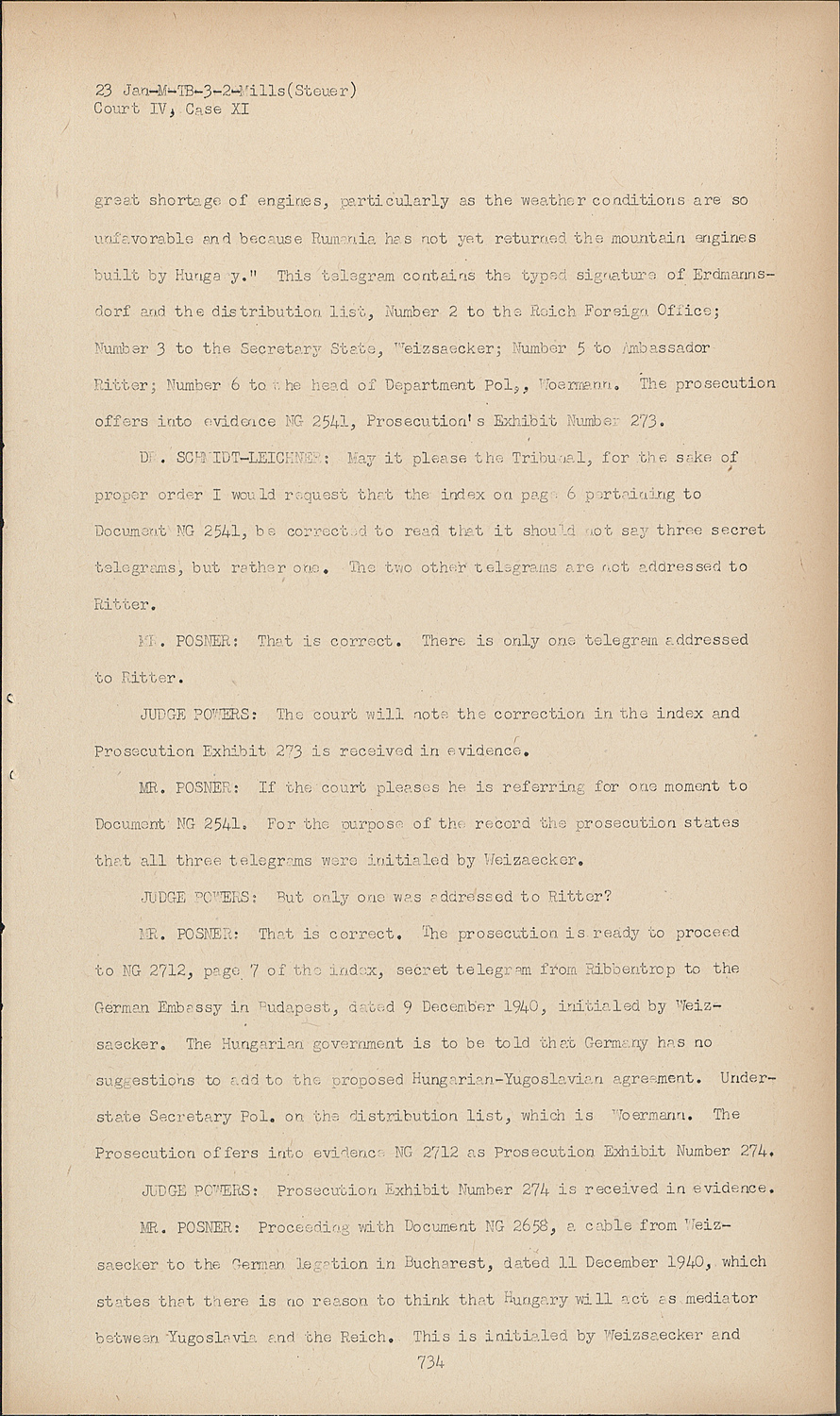
This telegram contains the typed signature of Erdmannsdorf and the distribution list, Number 2 to the Reich Foreign Office; Number 3 to the Secretary State, Weizsaecker; Number 5 to Ambassador Ritter; Number 6 to the head of Department Pol,, Woermaan. The prosecution offers into evidence NG 2541, Prosecution's Exhibit Number 273.
DR.SCHMIDT-LEICHNER: May it please the Tribunal, for the sake of proper order I would request that the index on page 6 pertaining to Document NG 2541, be corrected to read that it should not say three secret telegrams, but rather one. The two other telegrams are not addressed to Ritter.
MR. POSNER:That is correct. There is only one telegram addressed to Ritter.
JUDGE POWERS:The court will note the correction in the index and Prosecution Exhibit 273 is received in evidence.
MR. POSNER:If the court pleases he is referring for one moment to Document NG 2541. For the purpose of the record the prosecution states that all three telegrams were initialed by Weizaecker.
JUDGE POWERS:But only one was addressed to Ritter?
MR. POSNER:That is correct. The prosecution is ready to proceed to NG 2712, page 7 of the index, secret telegram from Ribbentrop to the German Embassy in Budapest, dated 9 December 1940, initialed by Weizsaecker. The Hungarian government is to be told that Germany has no suggestions to add to the proposed Hungarian-Yugoslavian agreement. Understate Secretary Pol. on the distribution list, which is Woermann. The Prosecution offers into evidence NG 2712 as Prosecution Exhibit Number 274.
JUDGE POWERS:Prosecution Exhibit Number 274 is received in evidence.
MR. POSNER:Proceeding with Document NG 2658, a cable from Weizsaecker to the German legation in Bucharest, dated 11 December 1940, which states that there is no reason to think that Hungary will act as mediator between Yugoslavia and the Reich. This is initialed by Weizsaecker and Woermann and was found in the files of the Foreign Office.
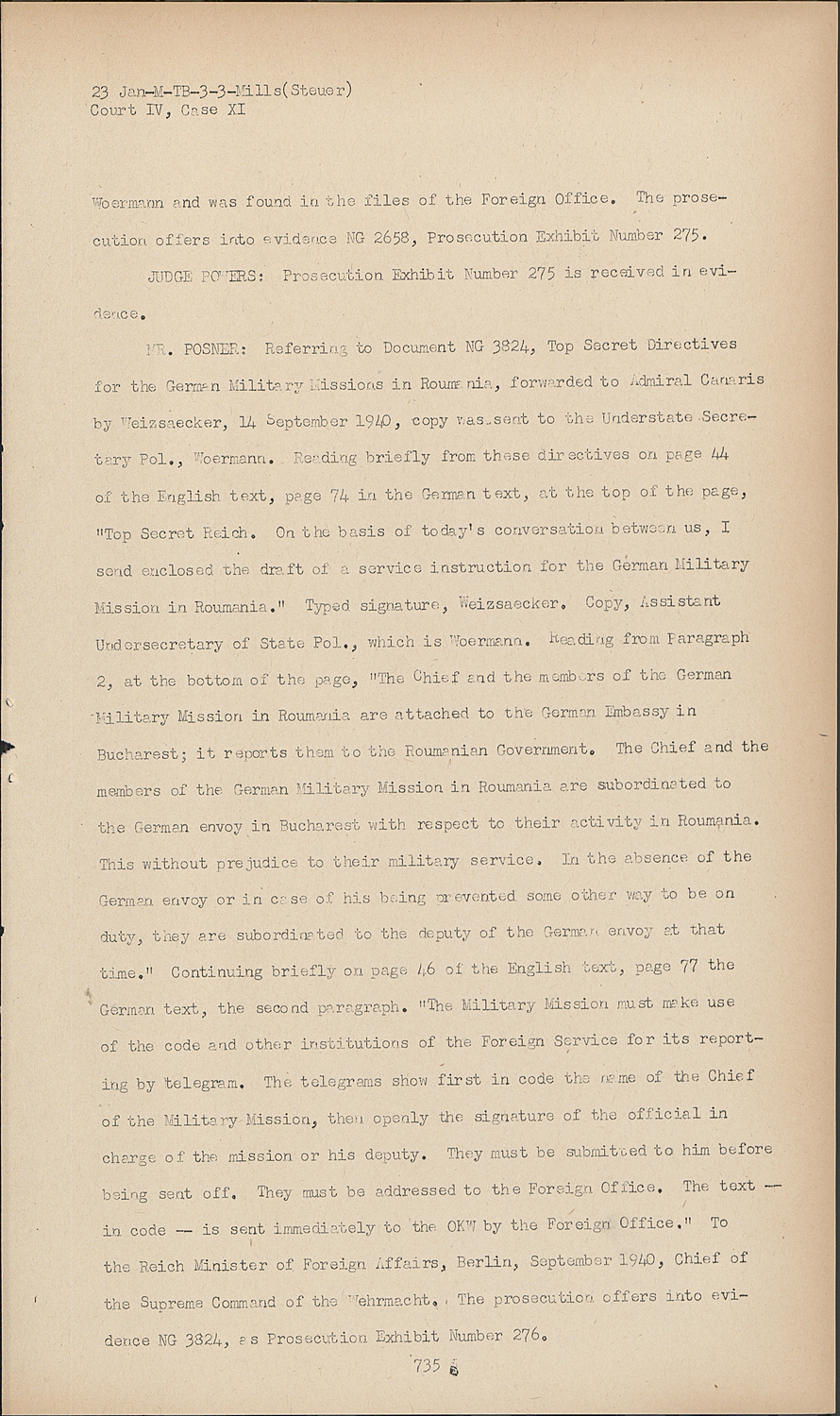
The prosecution offers into evidence NG 2658, Prosecution Exhibit Number 275.
JUDGE POWERS:Prosecution Exhibit Number 275 is received in evidence.
MR. POSNER:Referring to Document NG 3824, Top Secret Directives for the German Military Missions in Roumania, forwarded to Admiral Canaris by Weizsaecker, 14 September 1940, copy was sent to the Understate Secretary Pol., Woermann. Reading briefly from these directives on page 44 of the English text, page 74 in the German text, at the top of the page, "Top Secret Reich. On the basis of today's conversation between us, I send enclosed the draft of a service instruction for the German Military Mission in Roumania." Typed signature, Weizsaecker. Copy, Assistant Undersecretary of State Pol., which is Woermann. Reading from Paragraph 2, at the bottom of the page, "The Chief and the members of the German Military Mission in Roumania are attached to the German Embassy in Bucharest; it reports them to the Roumanian Government. The Chief and the members of the German Military Mission in Roumania are subordinated to the German envoy in Bucharest with respect to their activity in Roumania. This without prejudice to their military service. In the absence of the German envoy or in case of his being prevented some other way to be on duty, they are subordinated to the deputy of the German envoy at that time." Continuing briefly on page 46 of the English text, page 77 the German text, the second paragraph. "The Military Mission must make use of the code and other institutions of the Foreign Service for its reporting by telegram. The telegrams show first in code the name of the Chief of the Military Mission, then openly the signature of the official in charge of the mission or his deputy. They must be submitted to him before being sent off. They must be addressed to the Foreign Office. The text -in code -- is sent immediately to the OKW by the Foreign Office." To the Reich Minister of Foreign Affairs, Berlin, September 1940, Chief of the Supreme Command of the Wehrmacht. The prosecution offers into evidence NG 3824, as Prosecution Exhibit Number 276.
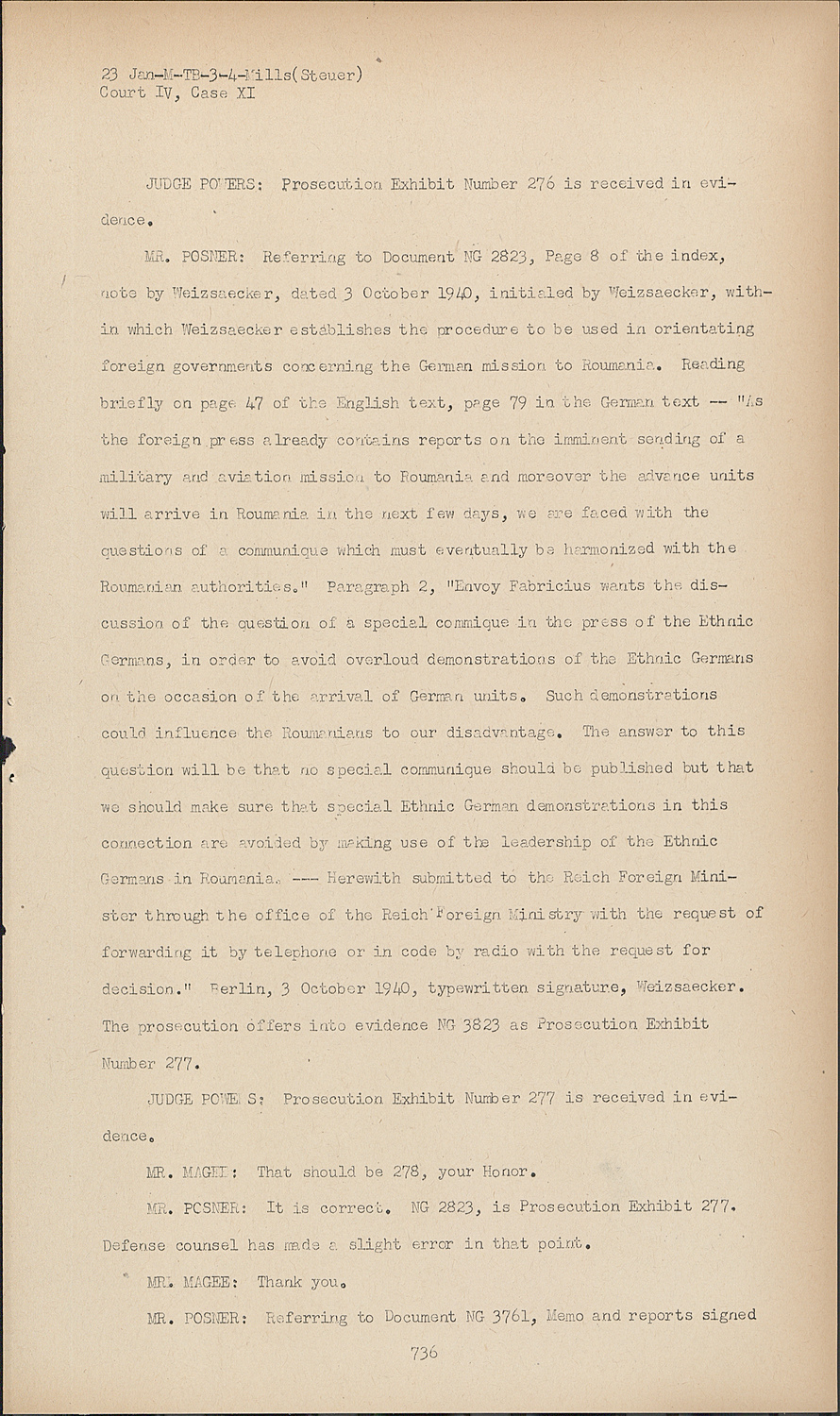
JUDGE POWERS:Prosecution Exhibit Number 276 is received in evidence.
MR. POSNER:Referring to Document NG 2823, Page 8 of the index, note by Weizsaecker, dated 3 October 1940, initialed by Weizsaecker, within which Weizsaecker establishes the procedure to be used in orientating foreign governments concerning the German mission to Roumania. Reading briefly on page 47 of the English text, page 79 in the German text -- "As the foreign press already contains reports on the imminent sending of a military and aviation mission to Roumania and moreover the advance units will arrive in Roumania in the next few days, we are faced with the questions of a communique which must eventually be harmonized with the Roumanian authorities." Paragraph 2, "Envoy Fabricius wants the discussion of the question of a special commique in the press of the Ethnic Germans, in order to avoid overloud demonstrations of the Ethnic Germans on the occasion of the arrival of German units. Such demonstrations could influence the Roumanians to our disadvantage. The answer to this question will be that no special communique should be published but that we should make sure that special Ethnic German demonstrations in this connection are avoided by making use of the leadership of the Ethnic Germans in Roumania. --- Herewith submitted to the Reich Foreign Minister through the office of the Reich Foreign Ministry with the request of forwarding it by telephone or in code by ratio with the request for decision." Berlin, 3 October 1940, typewritten signature, Weizsaecker. The prosecution offers into evidence NG 3823 as Prosecution Exhibit Number 277.
JUDGE POWERS:Prosecution Exhibit Number 277 is received in evidence.
MR. MAGEE:That should be 278, your Honor.
MR. POSNER:It is correct. NG 2823, is Prosecution Exhibit 277. Defense counsel has made a slight error in that point.
MR. MAGEE:Thank you.
MR. POSNER:Referring to Document NG 3761, Memo and reports signed Fabricius, dated 7-8 October 1940, minimizing the importance of German troop movements in Roumania.
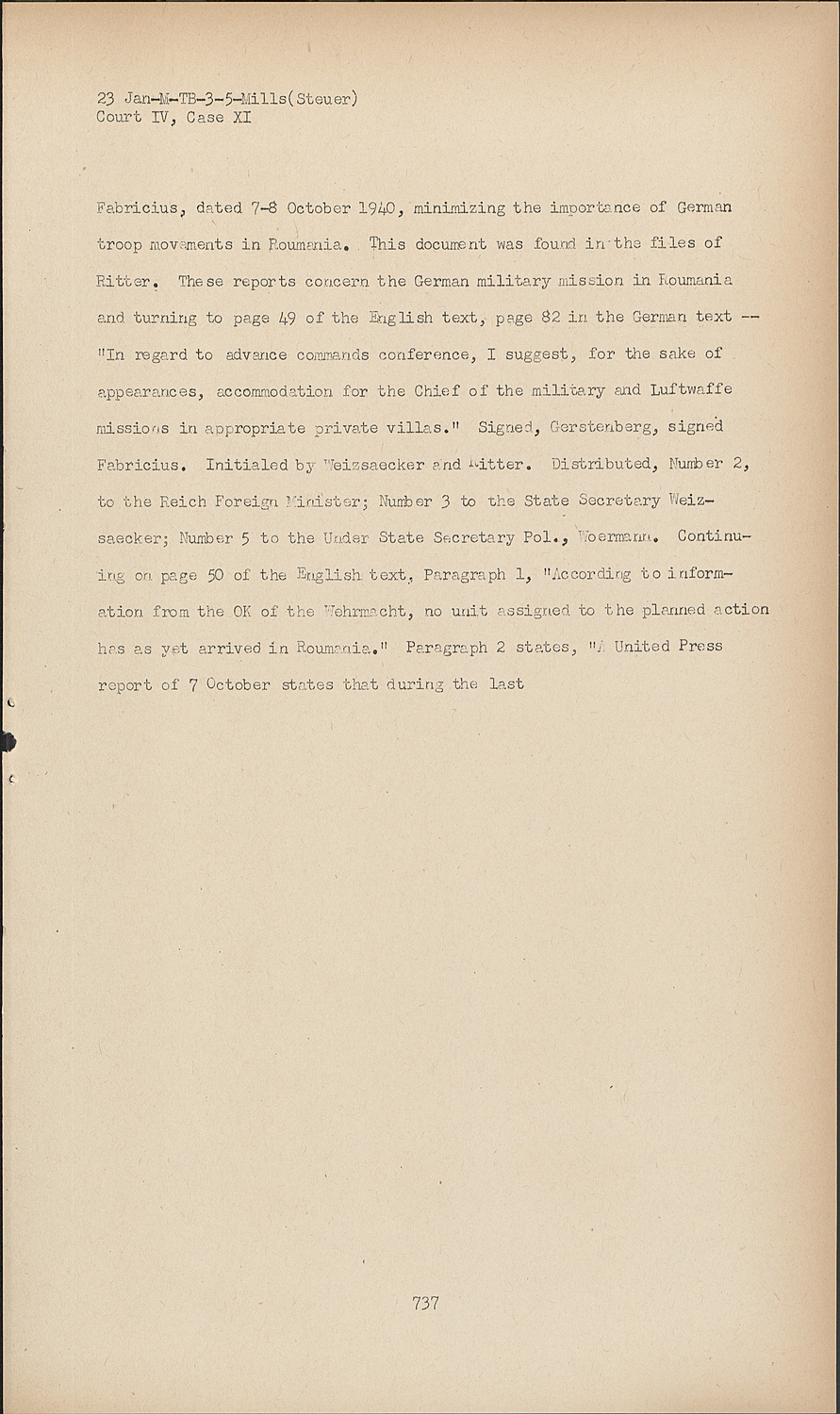
This document was found in the files of Ritter. These reports concern the German military mission in Roumania and turning to page 49 of the English text, page 82 in the German text -"In regard to advance commands conference, I suggest, for the sake of appearances, accommodation for the Chief of the military and Luftwaffe missions in appropriate private villas." Signed, Gerstenberg, signed Fabricius. Initialed by Weizsaecker and Ritter. Distributed, Number 2, to the Reich Foreign Minister; Number 3 to the State Secretary Weizsaecker; Number 5 to the Under State Secretary Pol., Woermann. Continuing on page 50 of the English, text, Paragraph 1, "According to information from the OK of the Wehrmacht, no unit assigned to the planned action has as yet arrived in Roumania." Paragraph 2 states, "A United Press report of 7 October states that during the last 24 hours, three to four transports consisting of a partly motorized division, 15,000 men strong, have already arrived in Roumania in the region between Ploesti and the mouth of the Danube.
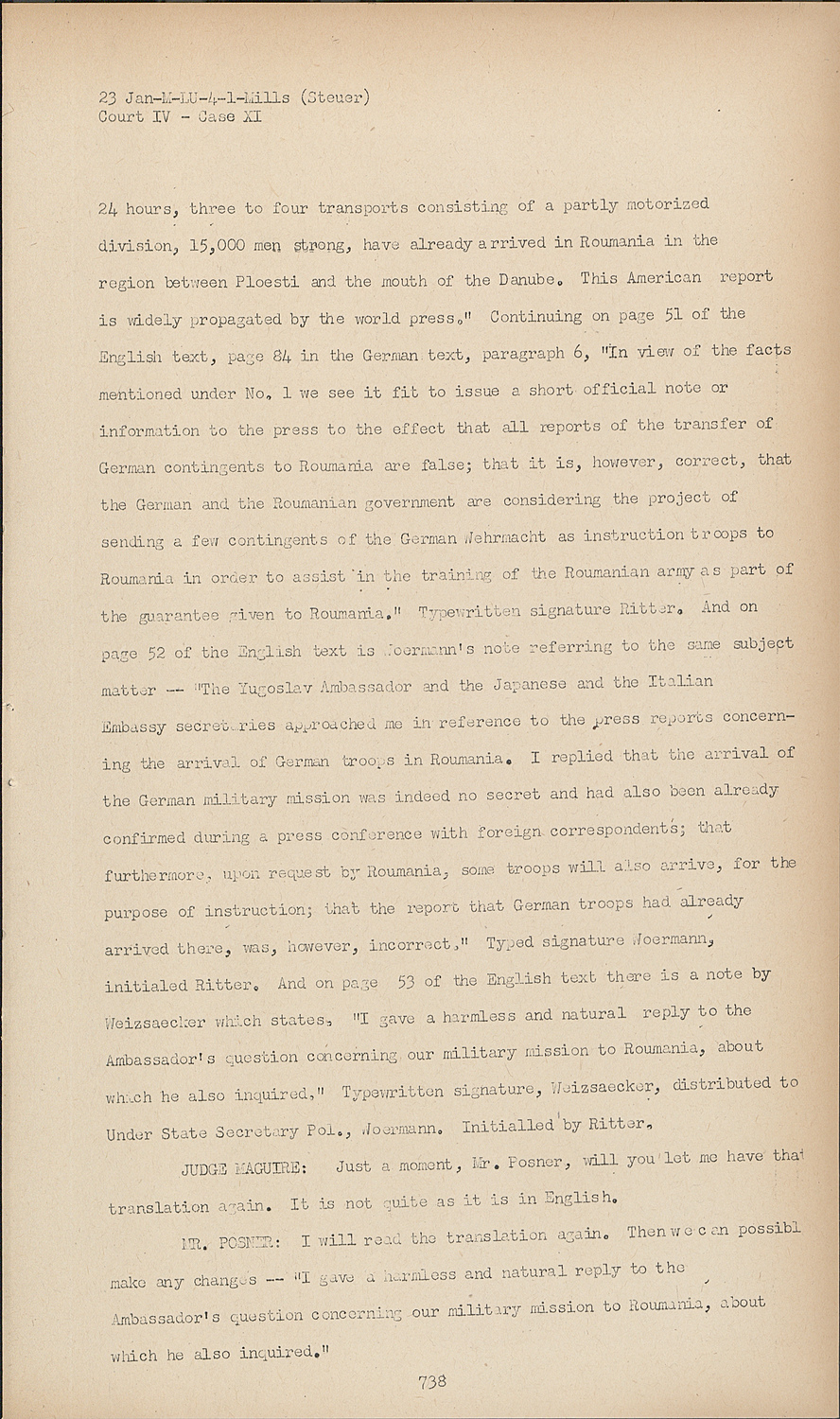
This American report is widely propagated by the world press." Continuing on page 51 of the English text, page 84 in the German text, paragraph 6, "In view of the facts mentioned under No. 1 we see it fit to issue a short official note or information to the press to the effect that all reports of the transfer of German contingents to Roumania are false; that it is, however, correct, that the German and the Roumanian government are considering the project of sending a few contingents of the German Wehrmacht as instruction troops to Roumania in order to assist in the training of the Roumanian army as part of the guarantee given to Roumania." Typewritten signature Ritter. And on page 52 of the English text is Woermann's note referring to the same subject matter -- "The Yugoslav Ambassador and the Japanese and the Italian Embassy secretaries approached me in reference to the press reports concerning the arrival of German troops in Roumania. I replied that the arrival of the German military mission was indeed no secret and had also been already confirmed during a press conference with foreign correspondents; that furthermore, upon request by Roumania, some troops will also arrive, for the purpose of instruction; that the report that German troops had already arrived there, was, however, incorrect," Typed signature Woermann, initialed Ritter. And on page 53 of the English text there is a note by Weizsaecker which states, "I gave a harmless and natural reply to the Ambassador's question concerning our military mission to Roumania, about which he also inquired," Typewritten signature, Weizsaecker, distributed to Under State Secretary Pol., Woermann. Initialled by Ritter.
JUDGE MAGUIRE:Just a moment, Mr. Posner, will you let me have that translation again. It is not quite as it is in English.
MR. POSNER:I will read the translation again. Then we can possibl make any changes -- "I gave a harmless and natural reply to the Ambassador's question concerning our military mission to Roumania, about which he also inquired."
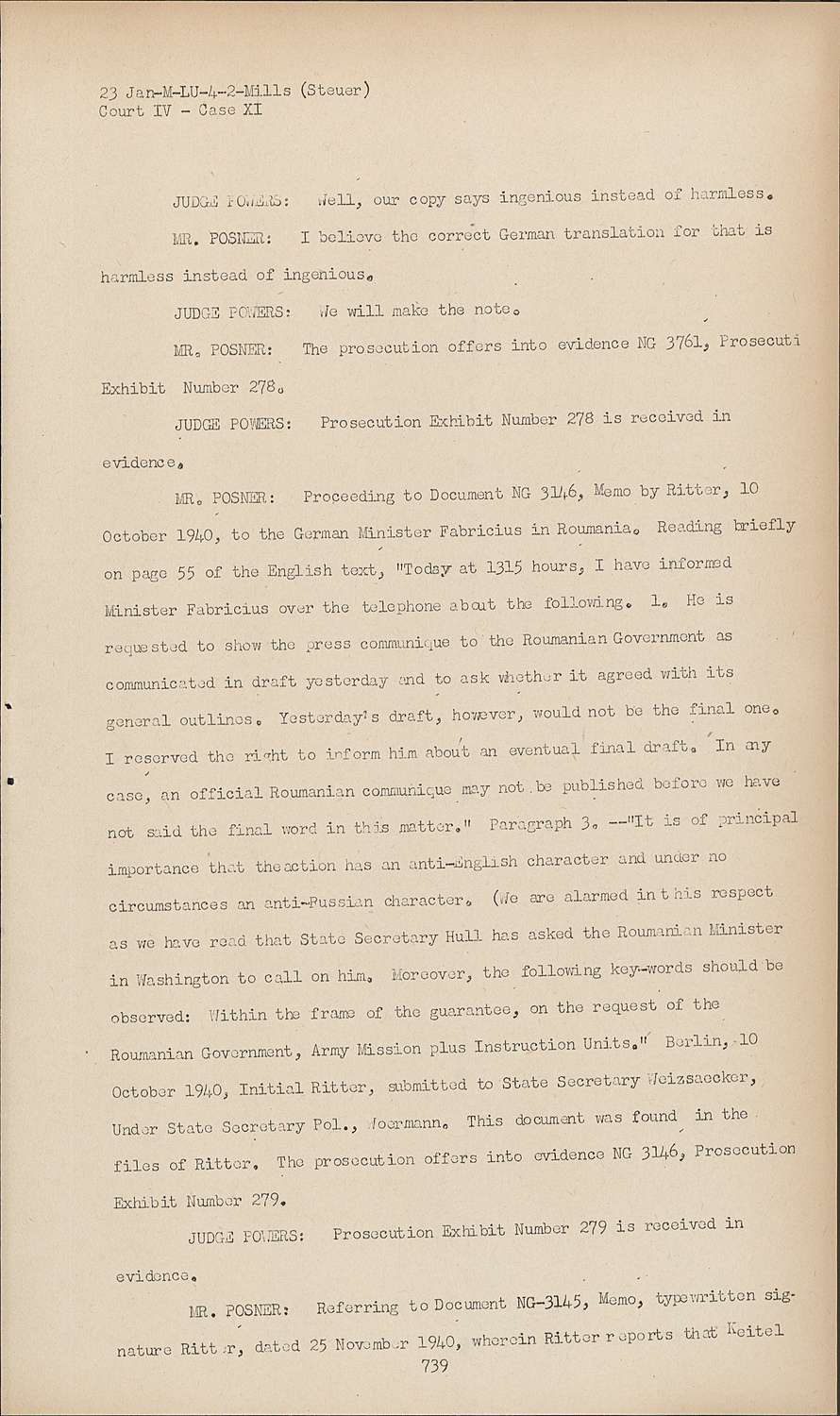
JUDGE POWERS:Well, our copy says ingenious instead of harmless.
MR. POSNER:I believe the correct German translation for that is harmless instead of ingenious.
JUDGE POWERS:We will make the note.
MR. POSNER:The prosecution offers into evidence NG 3761, Prosecuti Exhibit Number 278.
JUDGE POWERS:Prosecution Exhibit Number 278 is received in evidence.
MR. POSNER:Proceeding to Document NG 3146, Memo by Ritter, 10 October 1940, to the German Minister Fabricius in Roumania. Reading briefly on page 55 of the English text, "Today at 1315 hours, I have informed Minister Fabricius over the telephone about the following. 1. He is requested to show the press communique to the Roumanian Government as communicated in draft yesterday and to ask whether it agreed with its general outlines. Yesterday's draft, however, would not be the final one. I reserved the right to inform him about an eventual final draft. In any case, an official Roumanian communique may not be published before we have not said the final word in this matter." Paragraph 3. --"It is of principal importance that the action has an anti-English character and under no circumstances an anti-Russian character. (We are alarmed in this respect as we have read that State Secretary Hull has asked the Roumanian Minister in Washington to call on him. Moreover, the following key-words should be observed: Within the frame of the guarantee, on the request of the Roumanian Government, Army Mission plus Instruction Units." Berlin, 10 October 1940, Initial Ritter, submitted to State Secretary Weizsaecker, Under State Secretary Pol., Woermann. This document was found in the files of Ritter. The prosecution offers into evidence NG 3146, Prosecution Exhibit Number 279.
JUDGE POWERS:Prosecution Exhibit Number 279 is received in evidence.
MR. POSNER:Referring to Document NG-3145, Memo, typewritten signature Ritter, dated 25 November 1940, wherein Ritter reports that Keitel persuaded Antonescu to accept another division of German troops.
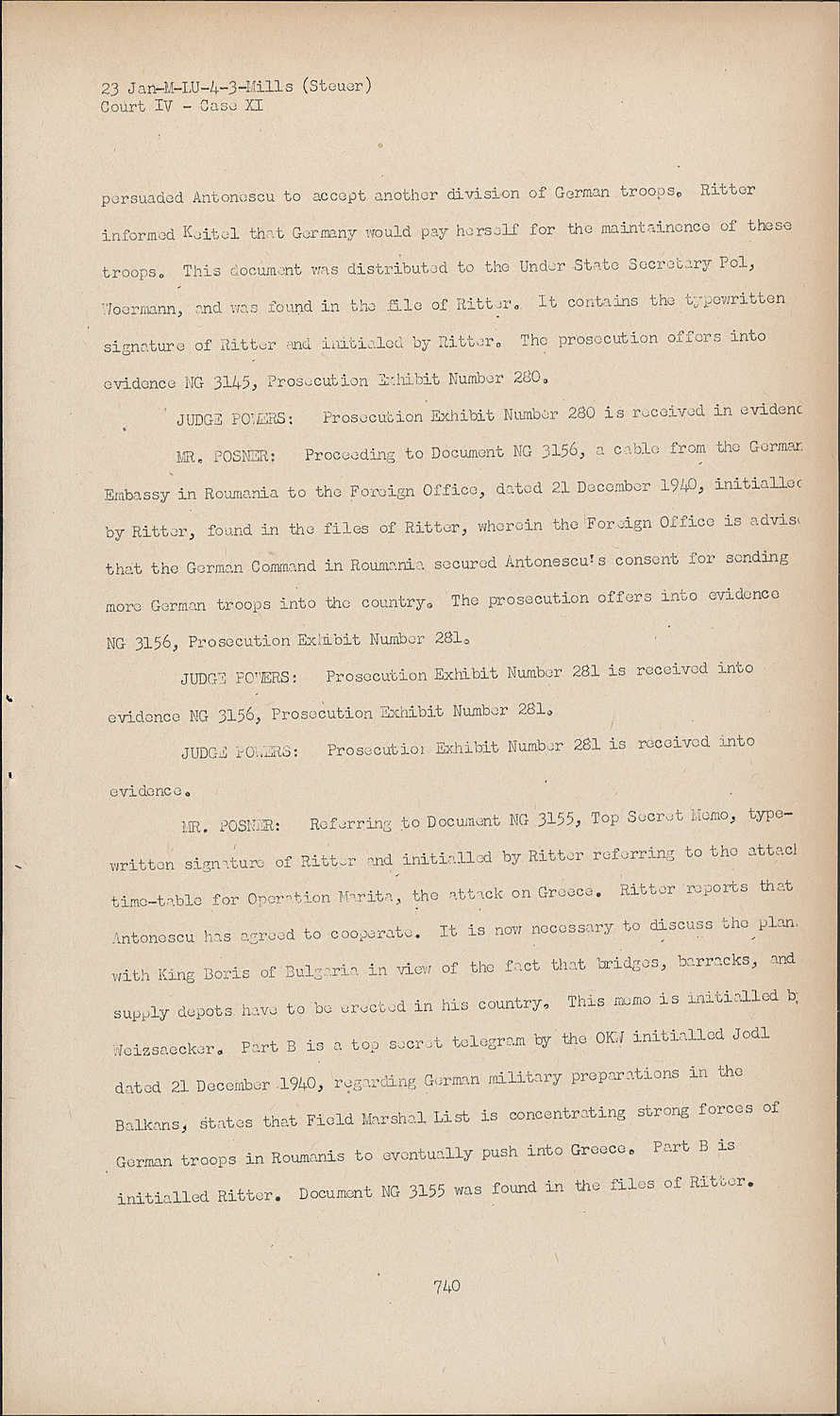
Ritter informed Keitel that Germany would pay herself for the maintainence of these troops. This document was distributed to the Under State Secretary Pol, Woermann, and was found in the file of Ritter. It contains the typewritten signature of Ritter and initialed by Ritter. The prosecution offers into evidence NG 3145, Prosecution Exhibit Number 280.
JUDGE POWERS:Prosecution Exhibit Number 280 is received in evidenc
MR. POSNER:Proceeding to Document NG 3156, a cable from the German Embassy in Roumania to the Foreign Office, dated 21 December 1940, initialled by Ritter, found in the files of Ritter, wherein the Foreign Office is advise that the German Command in Roumania secured Antonescu's consent for sending more German troops into the country. The prosecution offers into evidence NG 3156, Prosecution Exhibit Number 281.
JUDGE POWERS:Prosecution Exhibit Number 281 is received into evidence NG 3156, Prosecution Exhibit Number 281.
JUDGE POWERS:Prosecution Exhibit Number 281 is received into evidence.
MR. POSNER:Referring to Document NG 3155, Top Secret Memo, typewritten signature of Ritter and initialled by Ritter referring to the attach time-table for Operation Marita, the attack on Greece. Ritter reports that Antonescu has agreed to cooperate. It is now necessary to discuss the plan. with King Boris of Bulgaria in view of the fact that bridges, barracks, and supply depots have to be erected in his country, This memo is initialled by Weizsaecker. Part B is a top secret telegram by the OKW initialled Jodl dated 21 December 1940, regarding German military preparations in the Balkans, states that Field Marshal List is concentrating strong forces of German troops in Roumanis to eventually push into Greece. Part B is initialled Ritter. Document NG 3155 was found in the files of Ritter.