Court No. IV, Case No. II.
THE PRESIDENT:Prosecution Exhibit 238 is received.
MR. POSNER:Proceeding to TC-40, Declaration of the German Minister to the Netherlands, dated 26 August, 1939, wherein the integrity and the violability of the Netherlands would be respected by the Third Reich. Prosecution offers into evidence TC-40, Prosecution Exhibit No. 239.
THE PRESIDENT:Prosecution Exhibit 239 is received.
MR. POSNER:Referring to TC-42 "German Assurance to Luxembourg", dated 26 August, 1939, wherein Germany further guaranteed the inviolability of Luxembourg even in case of a conflict. Prosecution offers into evidence TC-42 as Prosecution Exhibit No. 240.
THE PRESIDENT:Prosecution Exhibit 240 is received.
MR. POSNER:With reference to Document NG-2407, Prosecution brings the Court's attention to the first paragraph in the index striking the words "rejected without qualification" therefrom; inserting the words "could not make use of..." in their place.
THE PRESIDENT:Just a moment, I didn't get that. The first paragraph, you say?
MR. POSNER:It is the first paragraph, page 2 of the index of Document NG-2407. The words "rejected without qualification" should be stricken and the words "could not make use of" inserted in their place.
THE PRESIDENT:Very well.
MR. POSNER:Document NG-2407 is a letter by Weizsaecker dated 29 August, 1939, found in the files of the Foreign Office, Weizsaecker instructs the German embassies in Brussels and the Hague that the German Government cannot use the mediation offers of the King of Belgium and the Queen of the Netherlands. On this document Woermann's typed signature is crossed out, replaced by Weizsaecker's signature in longhand.
Prosecution offers into evidence NG-2407 as Prosecution Exhibit No. 241.
Court No. IV, Case No. II.
THE PRESIDENT:Does the Defense counsel wish to be heard?
DR. VONBRAUN (Counsel for defendant Weizsaecker): I only wanted to draw the Court's attention to the fact that there are no initials and that the signature is not in Herr von Weizsaecker's handwriting.
THE PRESIDENT:That point will be noted. The document is received as document-
MR. POSNER:I don't believe the Prosecution mentioned there were initials on that document.
THE PRESIDENT:I don't recall... They said something about Weermann's signature being crossed out and then Weizsaecker's in longhand. That statement was made.
MR. POSNER:That is correct; and the Prosecution contends that that is Weizsaecker's handwritten signature.
THE PRESIDENT:Well, that is a matter of dispute and subject to argument when the Defense puts in its case-in-chief.
MR. POSNER:Prosecution refers now to Document NG-2393, referring merely to it as a top-secret cable by Weizsaecker, dated 29 August, 1939. NG-2393 has been introduced as Prosecution Exhibit No. 194 of Document Book 4-B. Referring briefly to page 13 of the English text and page 13 of the German text: Para. 2: "Should any conflict break out we have the intention of sanding Ambassador Ritter on a special mission to Brussels and subsequently Luxembourg as authorized representative of the Reich Government to clarify the German views concerning the continuation of trade relations. Ambassador Ritter has been ordered to inform the Belgian government now already of this mission, intended in the event of a conflict, without mentioning the name Ritter."
"Please inform Luxembourg government accordingly."
Typed signature "Weizsaecker."
THE PRESIDENT:Is that offered as 242?
MR. POSNER:No, sir. That has been offered into evidence Court No. IV, Case No. II.
as Prosecution Exhibit No. 194, merely referred to at this point.
THE PRESIDENT:Excuse me.
MR. POSNER:Prosecution refers now to Document NG-2229, introduced as Prosecution Exhibit 205, of Document Book 5, a note by Sonnleithner of the Foreign Office and initialed by Weizsaecker, dated 14 September, 1939, wherein Ribbentrop asks that the Foreign Office be given prior information on all OKW reports of a political nature.
THE PRESIDENT:That is already in evidence?
MR. POSNER:Yes, sir; that is Prosecution Exhibit No. 205.
THE PRESIDENT:You may proceed.
MR. POSNER:Proceeding to TC-41, Prosecution wishes to correct the record by striking through TC-32; in other words, this next document will be referred to as TC-41. TC-41 is a German assurance to the Netherlands dated 6 October, 1939, from documents of German Politics, Volume 7, page 351, wherein Hitler assures the Netherlands of traditional friendship. Prosecution offers into evidence Document TC-41 as Prosecution No. 242.
MR.MAGEE (Counsel for defendant Weizsaecker): Your Honor, with respect to these documents, we again call the Court's attention to the fact that these appear to be written in the first person, and we would like to know against what individual they are stated.
MR. POSNER:If the Prosecution remembers correctly, and as the Prosecution has just recently stated, the same documents have been introduced during the I.M.T. and no question had been raised as to who had spoken. They had gone in as authentic documents and did not go to the weight of the evidence or as relevancy at that particular point. There were no comments by the Defense, and the Prosecution here presents these same documents in the same manner.
MR. MAGEE:May I be heard on that, your Honor?
JUDGE MAQUIRE:What exhibit are you talking about?
MR. MAGEE:It appears on page 16 of the English text, a Court No. IV, Case No. 11 series of quotes, your Honors, starting with TC-32.
THE PRESIDENT:Vary wall, Mr. Magee.
MR. MAGEE:I am not familiar with what objections were made by counsel at the trial of the I.M.T. case. It is my position that we are not bound by any actions that were taken by counsel for the Defense there. We object to these documents on the ground that there is no showing of an authentic source, and we say that they are not admissible until the government establishes who made these so-called statements and by what authority.
I therefore object to them as incompetent, irrelevant and immaterial, and not properly proven and not connected up with Mr. Weizsaecker.
MR. POSNER:I don't believe the Prosecution at this point mentioned that this particular document was connected with defendant Weizsaecker. We won't commit ourselves any further on that point; but as Hitler was a spokesman for the German people, a speech made by him is considered relevant to the Prosecution and, therefore, admissible into evidence.
THE PRESIDENT:Dr. Schilf.
DR. SCHILF:I must apologize. I should like to mention one point, your Honors. I would like to draw the Court's attention to a specific fact. The declarations to which we have objected are all headed by the same heading. I am now referring to Document TC-37, 41, 43. They were compiled into one document, and the heading always says, and I quote: "German assurances..." (plural) and than to Norway, Belgium, and so forth. The heading, in other words, does not indicate who it is that gives these statements or assurances. My colleague, Mr. Magee, has already pointed out that the justification of such German assurances are merely asserted by the Prosecution.
THE PRESIDENT:Could you enlighten the Court a little bit as to the source? This is from these captured documents--or are they Court No. IV, Case No. 11.
all from this Politik Volume VII, I?
MR. POSNER:If it please the Court, we would just like to discuss this for one moment.
THE PRESIDENT:Very well.
JUDGE MAQUIRE:May I propound a question of counsel? It would appear -- at least on the face of things -- that this is not an isolated volume published in a particular year but this is one of a series of volumes. How such volumes were gotten together periodically, from what general sources they ware drawn, whether they are in the nature of a running history of German politics might be enlightening. I think any court in any land has the right to consult and to give weight to historical histories and historical documents. Now, I don't know what the fact is about this, but if we could have that matter cleared up we might be able to dispose of this thing.
THE PRESIDENT:Dr. Kempner...
DR. KEMPNER:I am sorry that I was not here five minutes ago. The statement we have to make is just this: The documents of German policy are an official collection of German historical data edited under the licenseship of the German government--in particular of the German Ministry of Public Enlightenment and Propaganda, after consultation with the German Foreign Office.
MR. MAGEE:Your Honor, this still misses the point. As I see it, we are trying to ascertain who issued these statements on behalf of the German government and from what source they come. They sound very much like the words of Adolf Hitler, and I would like the Prosecution to state if they do contend that these statements were issued by anybody other than Hitler. If so, I would like to know it.
THE PRESIDENT:Well, now, it seems to me we are spending considerable time on this. I am not so sure it is going to be of such tremendous importance. But I should also like to know if the Prosecution Court No. IV, Case No. 11.
can so advise us -- and they doubtless can -- by going to their source and from it ascertaining just whose utterances these are.
The exhibit will be received with the request that counsel advise the Court and the Defense if they have the source of this, where it came from, to whom these statements are really attributed. We are also interested in being enlightened on that subject.
I don't think it is necessary to spend any more time on it at this time, and the Court will now recess for fifteen minutes.
(A recess was taken.)
THE MARSHAL:Persons in the Courtroom will please find their seats.
The Tribunal is again in session.
THE PRESIDENT:Dr. Kempner.
DR. KEMPNER:I just want to say one sentence about these utterances from documents of German policy. These are statements, these utterances, these assurances given us refer to and are assurances of the former leader of the German Reich, Adolf Hitler.
THE PRESIDENT:That's what defense counsel a ssumed
DR. KEMPNER:And I agree with him on this point.
THE PRESIDENT:Very well.
The Prosecution may proceed. You may proceed.
MR. POSNER:Think you, your Honor.
Proceeding with Document NG-1726, a top-secret telegram from the German ambassador in Belgium to the German Foreign Office, dated 8 November 1939, found in the files of the State Secretary of the Foreign Office. Reading briefly from Page 17 of the English text, Page 18 of the German text:
"I have just heard from a reliable Dutch source that a journey to the Hague has been undertaken by the King of the Belgians owing to threatening news received concerning the German preparations for attack near the Belgian and Dutch border. King is said to have stated in The Hague that he is in possession of exact information concerning the formation of German units, which from the military point of view show every intention of attacking. Hitherto it only concerned billeting of large troop formations which had been released in the East. In the last few days however, regrouping is said to have taken place which represented a strategic concentration for attack. According to the King's information this concentration had been completed in about two to three days so that from then onwards the attack could ensue at any moment. From the foregoing description of the Dutch confidential agent it is seen that it concerns a Belgian-Dutch offer of negotiation for action, which originated from the initiative of the Belgian king and the anxiety of being precipitated into a war."
Typed signature "Buelow."
The prosecution offers into evidence MG-1726 as Prosecution Exhibit No. 243.
THE PRESIDENT:Prosecution Exhibit 243 is received.
MR. POSNER:Omitting Document PS-1811, the Prosecution proceeds to Document NG-1727 Page 4 of the Index. Document NG-1727 was found in the files of the State Secretary of the Foreign Office and consists of the following parts;
The draft of a negative reply to the telgram from King Leopold and Queen Wilhelmina, written in very insolent language in the name of Hitler.
The second part is a telegram from King Leopold and Quean Wilhelmina to Hitler, offering the services to mediate in the present conflict; the telegram is dated 7 November 1939.
The third is a draft of the telegram from the Reich Foreign Minister to German Embassies in the Hague and Brussels, instructing there to inform these governments that Hitler has received the telegram of Kin Leopold and queen Wilhelmina, which will receive careful examination.
Part IV is a note, typewritten signature "Weizsaecker," wherein Weizsaecker states that he told the Italian ambassador Attolico that Hitler was not in Berlin at that time.
The Prosecution offers into evidence NG-1727 as Prosecution Exhibit No. 244.
DR. von BRAUN: (Dr. von Braun for the Defendant Weizsaecker) I wish to draw Your Honors' attention to the fact that the Index gives the impression as though the answered telegram had been initialled by Herr von Weizsaecker. This is not in conformity with the actual facts. May I ask that the Index be corrected and amended accordingly?
MR. POSNER:As the Prosecution has previously stated, the Index does not go into evidence, and no mention of this last objection by the Defense has been made by the Prosecution concerning this document.
THE PRESIDENT:No, but if there is a mistake in the Index let's correct it if we can, as it's a matter of convenience to have the Index corrected.
MR. POSNER:The prosecution will have to look at the exhibit for just one second, if the Court please.
The prosecution sees that on this photostat we have here the initial is not evident, but the Prosecution reserves the right to examine a better photostat, and, at that time, advise the Court as to whether the initial does appear or doesn't.
THE PRESIDENT:Well, we will strike it as long as it doesn't appear. We'll strike it anyhow -- I mean the Index. We'll strike it from the Index as long as it isn't clear. I'm sure it isn't in the evidence -- but as a matter of convenience.
Has that been offered?
MR. POSNER:Yes.
THE PRESIDENT:It is received as Prosecution Exhibit 244.
MR. POSNER:As 244. The Prosecution proceeds to Document NG-1724, and wishes to correct the record at this point. The description should read: "A copy of a telegram by Weizsaecker was not sent German Embassies in Brussels and The Hague, dated 15 November 1939." This document comes from the files of the State Secretary of the Foreign Office. NG1724 states that the embassies in Brussels and The Hague are notified that Germany rejected the mediation offer because, as Ribbentrop had originally stated, of the attitude of France and England, and that now Germany was resolved to continue the war until England was Annihilated.
The Prosecution offers into evidence NG-1724 as Prosecution Exhibit No. 245.
THE PRESIDENT:Prosecution Exhibit 245 is received.
MR. POSNER:Proceeding to Document NG-2790, a memorandu, handwritten signature "Woermann," initialled by Weizsaecker, dated 13 January 1940, found in the files of the State Secretary of the Foreign Office.
Reading from Page 25 of the English text, Page 32 in the German text:
"The Belgian Ambassador told me today that he wants to call on the State Secretary in the question of the continued instances of flights of German aircraft over Belgian territory. In particular he criticizes that we had left former complaints unanswered, which places him in a difficult position towards his Government.
"Also Councillor of Embassy Count Berryer spoke to me repeatedly about these flights over Belgian territory, which, he says, continued up to the last days.
"The Luftwaffe operational staff has been requested to give us a plausible explanation for Belgian consumption. Herewith submitted to the State Secretary (signature) Woermann," initialled Weizsaecker.
The Prosecution offers into evidence NG-2790 as Prosecution Exhibit No. 246.
THE PRESIDENT:Dr. Schilf?
DR. SCHILF:May it please the Tribunal, it is not too pleasant for me to once more have to r efer to the Index, but it is possible that this may only be an error translation. However, this error is of such substantial relevance that it requires correction. On Page 6 of the Index, at the top, the statement is reproduced that was just given us by Mr. Posner, but it is misleading in the English translation. The word "excuse" is mentioned there for "Entschuldigung," and they speak of a "plausible excuse" which was to be given. However, in the document itself the translation reads, "To give us a plausible explanation," -- This is on Page 25, Your Honors -- which is somewhat different from the statement shown in the index. May I ask that the Prosecution make a statement as to whether it wishes to correct this rather misleading error of translation?
THE PRESIDENT:Why I assume we can make that "plausible explanation," instead of "plausible excuse." I don't think there will be any argument about that -- if that is, of course, and exact reproduction. We'll put in here "plausible explanation."
Is that a satisfactory translation?
MR. POSNER:That is satisfactory.
THE PRESIDENT:Very well. Has that been offered?
MR. POSNER:NG-2790 has been offered as Prosecution Exhibit 246 .
THE PRESIDENT:It is received as Prosecution Exhibit 246.
MR. PSONER:Proceeding to Document NG-2893, a memorandum, typed signature "Weizsaecker," dated 15 January 1940, wherein Weizsaecker is told by Davignon, Belgian Minister to Germany, that conversation in Berlin is that the invasion of Holland and the Netherlands is imminent, that a German plane with a load of documents is forced down in Belgium, to which Weizsaecker casually replied he had read about that in the press.
Part B: In a secret telegram from Ambassador in Brussels, Buelow, to the Foreign Office, the Foreign Office is informed that the Belgians know that German troops have taken up positions along the border and that the documents from the German plane showed Germany's aggressive intentions and complete plans for the attacks.
Part C: In a secret note, typed signature "Weizsaecker," concerning his second talk with Davignon. Weizsaecker states, on Page 32 of the English text. Page 43 in the German text, approximately twelve sentences down from the top of the page:
"The day before yesterday already the ambassador had talked of certain documents which had appeared from a German plane which had landed near Mecheln. From these documents would result the definite impression of Germany's offensive intentions against Belgium.
"I looked surprised and repeated my remark of the day before yesterday that I knew of this story only through the press, but Davignon himself obviously had no proof either. The ambassador said now it went without saying that he did not have these documents with him. But he repeated that the documents, which had come into his government's possession in such a strange way had given the impression of offensive intentions to his government and to the king who after all are serious persons and would certainly not exaggerate anything."
Continuing on Page 33 of the text, and Page 45 in the German text, the second paragraph reads:
"I told Davignon once and for all it appeared to me that he was informed on these documents from the air-plane by a short telegram only, while I myself would not know anything of them at all. Both of us would lack, therefore, the sufficient foundation for a discussion of the case.
But I would consider Belgium's suspicious one-sided measures confirmed in a way which I could not acknowledge."
Part D of this document is a secret note, typewritten signature, "Weizsaecker," dated 22 June 1940, wherein Weizsaecker, speaking to the Italian Ambassador Attolico, says, on Page 35 of the English text. Page 47 in the German text, the second paragraph:
"As I did not want to enter into the subject, I told Attolico, that this story was making the round through the foreign press for quite a while already. However, I would like to ask him whether he could not tell me on his part why it was that the Belgians were so alarmed a week ago.
"The subject of our conversation changed afterwards, and I could therefore not recognize whether and how far Attolico is informed on the Italian part in his whole question. Herewith submitted to the Reich Foreign Minister."
Typewritten signature, "Weizsaecker." This document was found in the files of the State Secretary of the German Foreign Office.
Proceeding to Page 7 of the Index-
THE PRESIDENT:Well, is that offered?
MR. POSNER:Oh, pardon me. Prosecution offers into evidence Document NG-2893 as Prosecution Exhibit No. 247.
THE PRESIDENT:It is so received.
MR. POSNER:Proceeding, at this point, to Document NG-2615, the Prosecution wishes to correct the identification of the document in the Index to read "A memorandum signed by Auer and initialled by Weizsaecker." NG-2615 is a memorandum of 15 March 1940 whereby Weizsaecker is informed concerning the Venlo incident, which involved the arrest of two British subjects on neutral Belgian territory. In a note, containing the typewritten signature of Weizsaecker, concerning his talk with the American Charge d'affaires, Weizsaecker says, on Page 37 of the English text. Page 49 in the German text, second paragraph, second sentence:
"I replied to Mr. Kirk, without having read the memorandum in his presence, that I found it slightly naive of the British Government, that it is altogether doing anything in favor of the two British subjects in this unsavory affair. Herewith, through Under State Secretary Pol." Typewritten signature, "Weizsaecker."
And turning now to Page 38 of the English text-
THE PRESIDENT:Is that offered, or are you still on the same document? Pardon me; I thought that was all.
MR. POSNER:Your Honor, this is the same document.
THEPRESIDENT: vary well.
MR. POSNER:The Prosecution refers to Page 38 of the English text, and we find a note, typewritten signature "Weizsaecker," dated 18 March 1940, which briefly reads as follows:
"The Netherlands Minister today once more saw me about the Venlo affair. He inquired whether I could give him any new information.
"I gave him the stereotyped negative reply." Distributed to the Under State Secretary Pol. Woermann.
The Prosecution offers into evidence NG-2615, as Prosecution Exhibit No. 248.
THE PRESIDENT:Prosecution Exhibit 248 is received.
MR. POSNER:Referring, at this point, to TC-57, "The German Ultimatum to Belgium and the Netherlands," dated 9 May 1940, from the "Document of German Politics," Part VIII, pp. 142-150. Germany based her ultimatum on relations of neutrality in the Netherlands, one of then being on Page 43 of the English text. Paragraph 4, Page 57 of the German text:
"Thus, for example, Belgium has fortified exclusively her eastern frontier against Germany, whilst on her frontier facing France no fortifications have been constructed. Repeated urgent representations made by the German Government were indeed on each occasion replied to by the Royal Belgian Government with a promise that this state of affairs directed only against Germany would be remedied, but in practice nothing happened and all promises in this direction remained unfulfilled."
The Prosecution offers into evidence Document TC-57, as Prosecution Exhibit No. 249.
MR. MAGEE:Your Honors, with respect to this document, may 1 renew the objections we made to the former documents and state that the Prosecution has not yet shown who issued this particular document? They just say it is a writing to the German Government, taken from the following volume, which, I understand, is not an official German source; and so I would like to have a statement from the Prosecution as to who signed this letter. Otherwise, we object to it until it's properly connected up.
THE PRESIDENT:Mr. Posner?
MR. POSNER:If it please the Court, I believe the Prosecution can state the source of these documents. The Prosecution contends, at this point, that the source is from the Institute for Foreign Political Science, under the auspices of the Foreign Office, and we submit that as the official source of these particular documents.
MR. MAGEE:Your Honors, the counsel seems to miss the point. He just says it's taken from an official source, but I think, in view of the charges here, we should knew who signed these documents on behalf of the German Government and who had knowledge of then.
THE PRESIDENT:Are you in a position to say now who signed them, or are you submitting this as a document from the records without ascribing then to, for instance, Mr. Weizsaecker or any individual in particular?
MR. POSNER:If the Prosecution may see this exhibit for one instance now, we might examine it and probably come to some conclusion.
JUDGE MAGUIRE:While they're making that examination--as I read this document, this appears to be the ultimatum by the Government itself; and I can see if this is to be questioned that this is the ultimatum and a correct copy of it, it seems to me it is rather unimportant who prepared it. It's the historical development of the invasions, or alleged invasions, of Belgium and Holland.
Is there any question that this is a correct copy of the ultimatum delivered to these two governments?
I am asking counsel for the Defense.
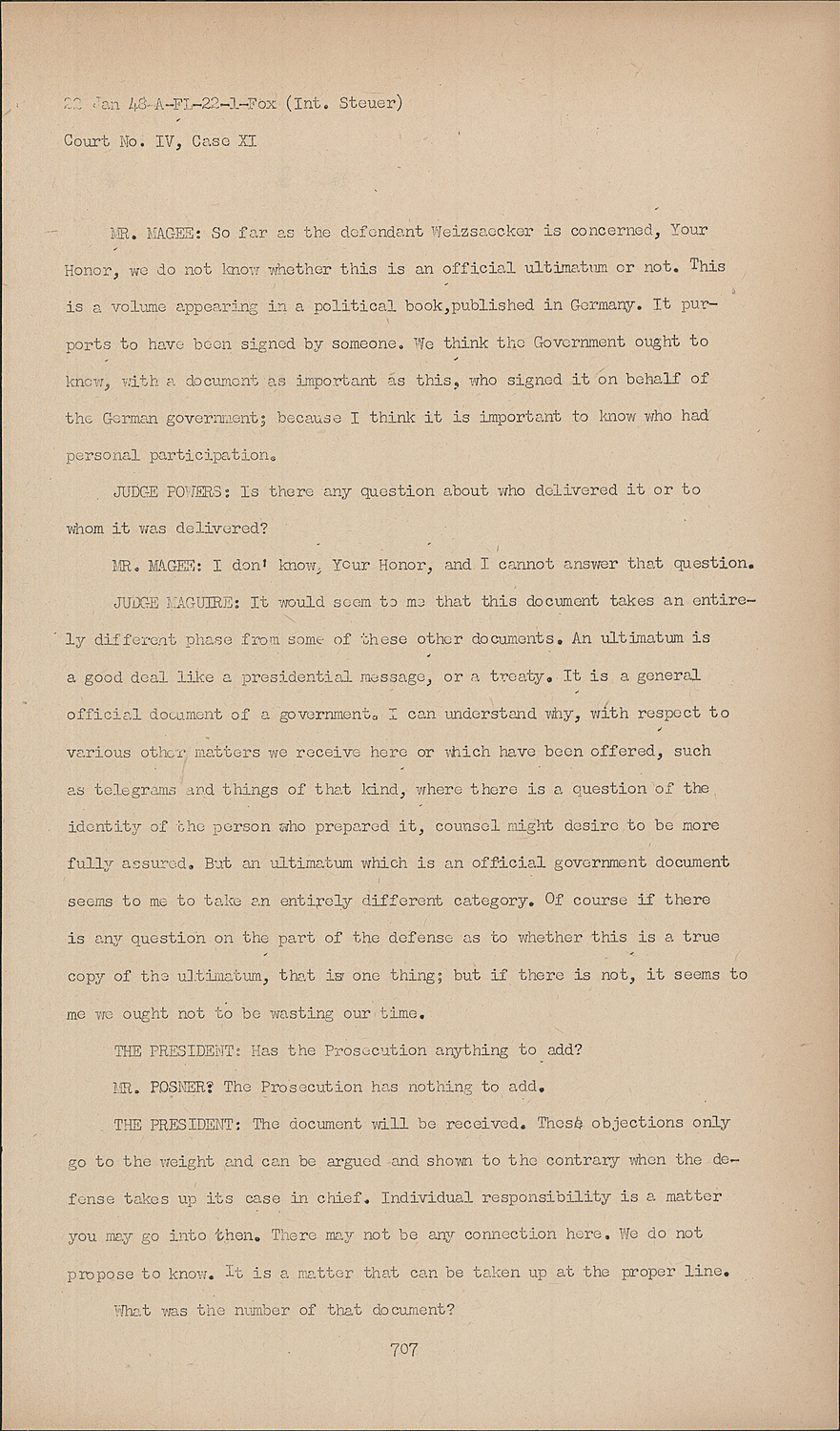
MR. MAGEE:So far as the defendant Weizsaecker is concerned, Your Honor, we do not know whether this is an official ultimatum or not. This is a volume appearing in a political book,published in Germany. It purports to have been signed by someone. We think the Government ought to knew, with a document as important as this, who signed it on behalf of the German government; because I think it is important to know who had personal participation.
JUDGE POWERS:Is there any question about who delivered it or to whom it was delivered?
MR. MAGEE:I don' know, Your Honor, and I cannot answer that question.
JUDGE MAGUIRE:It would seem to me that this document takes an entirely different phase from some of these other documents. An ultimatum is a good deal like a presidential message, or a treaty. It is a general official document of a government. I can understand why, with respect to various other matters we receive here or which have been offered, such as telegrams and things of that kind, where there is a question of the identity of the person who prepared it, counsel might desire to be more fully assured. But an ultimatum which is an official government document seems to me to take an entirely different category. Of course if there is any question on the part of the defense as to whether this is a true copy of the ultimatum, that is one thing; but if there is not, it seems to me we ought not to be wasting our time.
THE PRESIDENT:Has the Prosecution anything to add?
MR. POSNER:The Prosecution has nothing to add.
THE PRESIDENT:The document will be received. These objections only go to the weight and can be argued and shown to the contrary when the dofense takes up its case in chief. Individual responsibility is a matter you may go into then. There may not be any connection here. We do not propose to know. It is a matter that can be taken up at the proper line.
What was the number of that document?
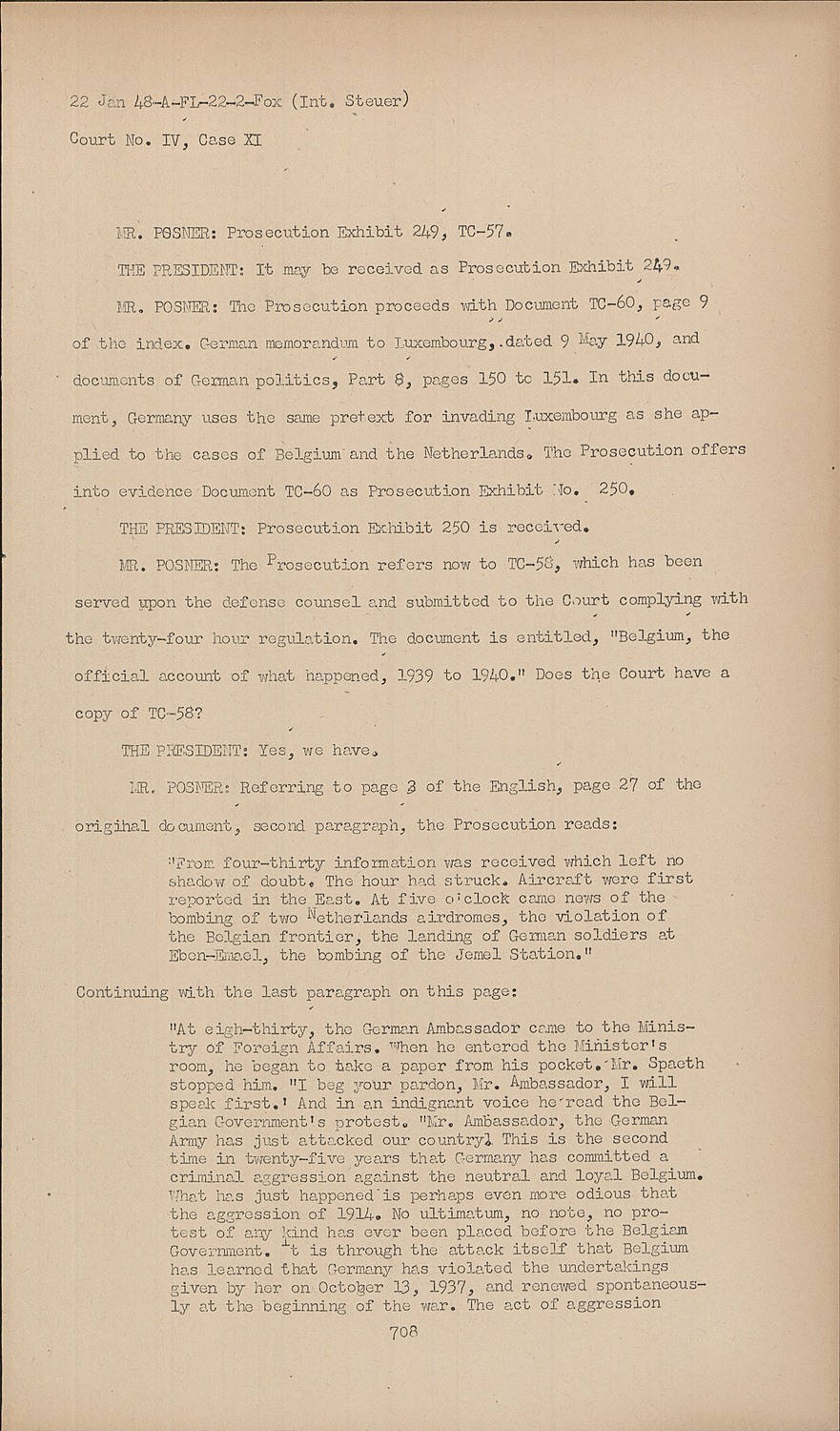
MR. POSNER:Prosecution Exhibit 249, TC-57.
THE PRESIDENT:It may be received as Prosecution Exhibit 249.
MR. POSNER:The Prosecution proceeds with Document TC-60, page 9 of the index. German memorandum to Luxembourg, dated 9 May 1940, and documents of German politics, Part 8, pages 150 to 151. In this document, Germany uses the same pretext for invading Luxembourg as she applied to the cases of Belgium and the Netherlands. The Prosecution offers into evidence Document TC-60 as Prosecution Exhibit No. 250.
THE PRESIDENT:Prosecution Exhibit 250 is received.
MR. POSNER:The Prosecution refers now to TC-50, which has been served upon the defense counsel and submitted to the Court complying with the twenty--four hour regulation. The document is entitled, "Belgium, the official account of what happened, 1939 to 1940." Does the Court have a copy of TC-58?
THE PRESIDENT:Yes, we have.
MR.POSNER; Referring to page 3 of the English, page 27 of the original document, second paragraph, the Prosecution reads:
"From four-thirty information was received which left no shadow of doubt.
The hour had struck. Aircraft were first reported in the East.
At five o'clock came news of the bombing of two Netherlands airdromes, the violation of the Belgian frontier, the landing of German soldiers at Eben-Emael, the bombing of the Jemel Station."
Continuing with the last paragraph on this page:
"At eigh-thirty, the German Ambassador came to the Minis try of Foreign Affairs.
When he entered the Minister's room, he began to take a paper from his pocket.
Mr. Spaeth stopped him.
"I beg your pardon, Mr. Ambassador, I will speak first.
' And in an indignant voice he read the Bel gian Government's protest.
"Mr. Ambassador, the German Army has just attacked our country.
This is the second time in twenty-five years that Germany has committed a criminal aggression against the neutral and loyal Belgium.
What has just happened is perhaps even more odious that the aggression of 1914.
No ultimatum, no note, no pro test of any kind has ever been placed before the Belgian Government.
It is through the attack itself that Belgium has learned that Germany has violated the undertakings given by her on October 13, 1937, and renewed spontaneous ly at the beginning of the war.
The act of aggression committed by Germany, for which there is no justification whatever, will deeply shock the conscience of the world.
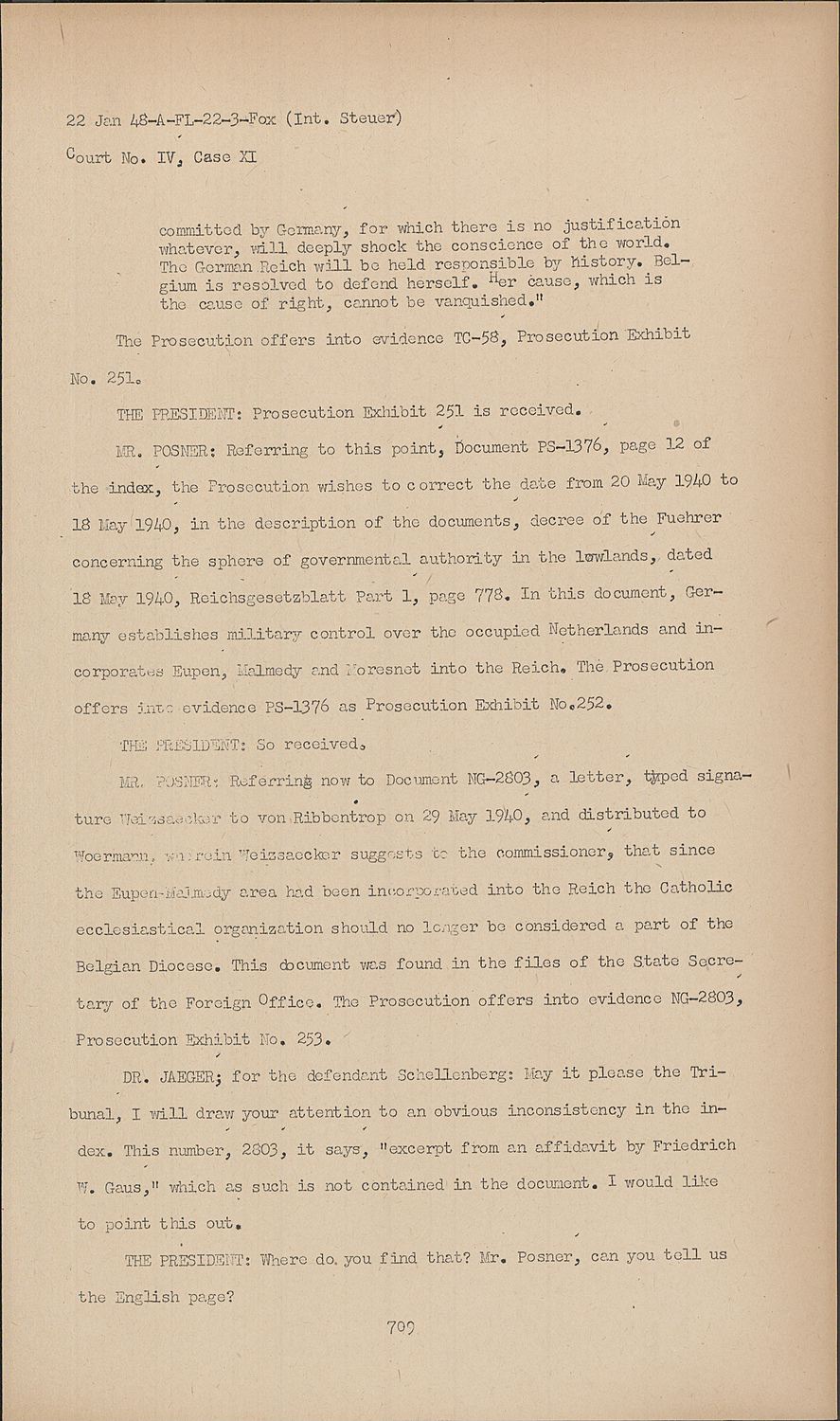
The German Reich will be held responsible by history. Bel gium is resolved to defend herself.
Her cause, which is the cause of right, cannot be vanquished."
The Prosecution offers into evidence TC-58, Prosecution Exhibit No. 251.
THE PRESIDENT:Prosecution Exhibit 251 is received.
MR. POSNER:Referring to this point, Document PS-1376, page 12 of the index, the Prosecution wishes to correct the date from 20 May 1940 to 18 May 1940, in the description of the documents, decree of the Fuehrer concerning the sphere of governmental authority in the lowlands, dated 18 May 1940, Reichsgesetzblatt Part 1, page 778. In this document, Germany establishes military control over the occupied Netherlands and incorporates Eupen, Malmedy and Moresnet into the Reich. The Prosecution offers into evidence PS-1376 as Prosecution Exhibit No. 252.
THE PRESIDENT:So received.
MR. POSNER:Referring now to Document NG-2803, a letter, typed signature Weizsaecker to von Ribbentrop on 29 May 1940, and distributed to Woermann, wherein Weizsaecker suggests to the commissioner, that since the Eupen-Malmady area had been incorporated into the Reich the Catholic ecclesiastical organization should no longer be considered a part of the Belgian Diocese. This document was found in the files of the State Scoretary of the Foreign Office. The Prosecution offers into evidence NG-2803, Prosecution Exhibit No. 253.
DR.JAEGER; for the defendant Schellenberg: May it please the Tribunal, I will draw your attention to an obvious inconsistency in the index. This number, 2803, it says, "excerpt from an affidavit by Friedrich W. Gaus," which as such is not contained in the document. I would like to point this out.
THE PRESIDENT:Where do you find that? Mr. Posner, can you tell us the English page?
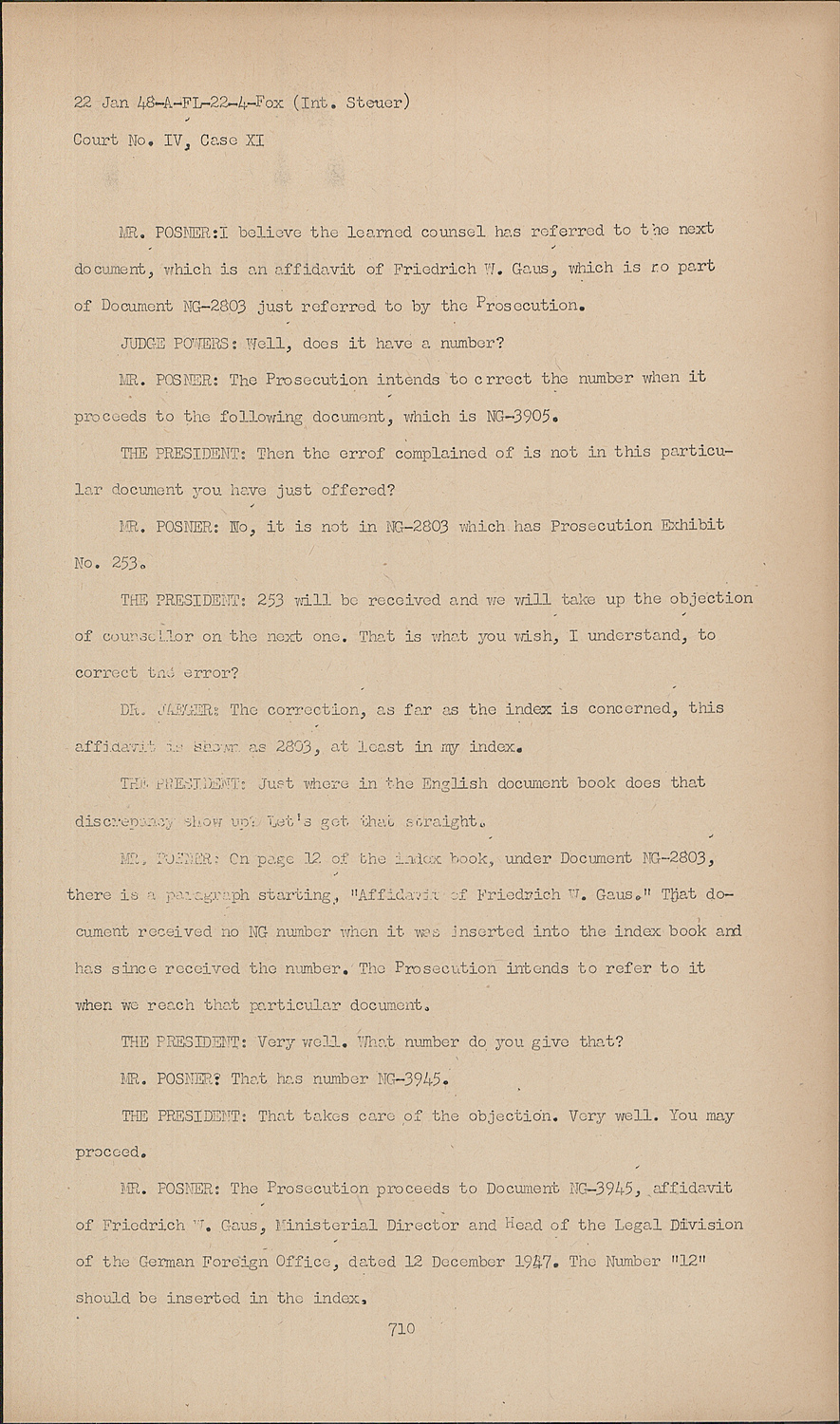
MR. POSNER:I believe the learned counsel has referred to the next document, which is an affidavit of Friedrich W. Gaus, which is no part of Document NG-2803 just referred to by the Prosecution.
JUDGE POWERS:Well, does it have a number?
MR. POSNER:The Prosecution intends to crrect the number when it proceeds to the following document, which is NG-3905.
THE PRESIDENT:Then the errof complained of is not in this particular document you have just offered?
MR. POSNER:No, it is not in NG-2803 which has Prosecution Exhibit No. 253.
THEPRESIDENT: 253 will be received and we will take up the objection of counsellor on the next one. That is what you wish, I understand, to correct the error?
DR. JAEGER:The correction, as far as the index is concerned, this affidavit is shown as 2803, at least in my index.
THE PRESIDENT:Just where in the English document book does that discrepancy show up let's get that straight.
MR. POSNER:On page 12 of the index book, under Document NG-2803, there is a paragraph starting, "Affidavit of Friedrich W. Gaus." That document received no NG number when it was inserted into the index book and has since received the number. The Prosecution intends to refer to it when we reach that particular document.
THE PRESIDENT:Very well. What number do you give that?
MR. POSNER:That has number NG-3945.
THE PRESIDENT:That takes care of the objection. Very well. You may proceed.
MR. POSNER:The Prosecution proceeds to Document NG-3945, affidavit of Friedrich W. Gaus, Ministerial Director and Head of the Legal Division of the German Foreign Office, dated 12 December 1947. The Number "12" should be inserted in the index.