Q.Herr Berger, excuse me if I interrupt. We don't need so many details. It seems more important to me that you should refer to the map I gave you for your information and that you should identify it in such a way that the Tribunal can get some picture of the town and areas concerned. This map has been placed at my disposal by the Secretary General's office.
(Document handed to the Tribunal.)
A.In he bottom left hand corner of the map, Number 1, Bratislava; Number 2, Nuetra, or in Czech, Nitra, Nitra is the seat of the Slovak Archbishop. Then about eighteen kilometers to the north, Number 3, Silein. I held that on 1 September 1939.
Q. 1944.
A.Yes, 1944. Then comes Number 4, Turk St. Martin, not very far from Silein. Then due south, Banska-Bistrica, Number 5. Zvolen, Number 6. These were the main centres of the insurgent movement. In Zvolen sat the Communist general and leader of the insurgents who had been sent from Russia. In Banska-Bistrica the Czech insurgent leaders were drooped from British planes. Then Number 7, Rosenberg, Number 8, the famous Dukla Pass, further East and further up. And Number 9, still further east, Kosti That was the center of the insurgents array group.
Q.Please continue.
A.The situation for me was desparate in every way. Rosenberg was so important because the entire production of German gun carriages had been evacuated to Rosenberg. There were 982 finished gun carriages waiting in Rosenberg which had fallen into the hands of the insurgents. The situation would not have been so bad if I had not found orders which were absolutely insane. The immediate disarmament of the Slovak Wehrmacht was demanded of me; setting up of labor battalions; the arrest of general Gael the safeguarding of President Tiso. Well that is enough. The situation in Bratislava itself was quite extraordinary. When we drove over the bridge, the Slovak bridge guards shot at us with teo centimeter machine guns. It's not a very pleasant feeling. I just mentioned this in order to make it clear from the beginning, Your Honors, that for me as a soldier and as a general it was absolutely impossible -- it would have been absolutely insane if, in such desparate military situations I had tried to interfere in matters of internal politics and tried to take up, for instance, the Jewish question.
First of all I had to keep Bratislava quiet. Bratislava with one million inhabitants is one third of the entire population or Slovakia. The next day I had the wages raised everywhere. The German manufacturers who had evacuated themselves there had to pay this. In fact they had to do quite a lot in one way and another. Then I gave immediate orders for the disarming of the Slovak Army. Those who were loyal to their oath, who reaffirmed their oath, remained soldiers. Pay and food was given according to the German pattern. Hitler ordered summary courts-martial to be set up. I immediately dissolved the courtmartial which was in existence. In Slovakia lots of shirkers had collected from Germany, including three generals and eighty-two staff officers. They had to leave Slovakia within forty-eight hours. They did that with bleeding hearts and got a correspondingly friendly letter from Herr Keitel. The most important thing for me was that the population with right tendencies, that is the anti-communists, should come over to my side. On 2 September at 11 o'clock I reported to President Tiso with my orders and in the presence of the German minister. I didn't try to conceal the gravity of the situation. Incidentally, he was absolutely aware of it himself. I wanted to gain his support for my social measures. I succeeded in doing this. Then through -- well I can't mention any names - but through him I made contact with highly placed Slovaks who were highly respected. I am expressing myself so carefully because I don't know what goes out of this courtroom and I don't want to be the cause of a new persecution in Slovakia. But for the Tribunal itself I will describe this incident in writing. These agencies carried out my propaganda for me among the enemy. On every piece of paper it said "These who desert will not be treated as prisoners of war, but will immediately be discharged to their homes." I had one safeguard -- that is the priest in the place concerned.
If a priest in any place took over the guarantee for a new man, to say that he would not join the partisans or do anything else silly, then he was discharged immediately, or if he wanted to remain a soldier he could join the newly formed Wehrmacht. The insurgents tried to bring the Archbishop of Neutra to Zvolen and from there to Russia. But we prevented this by coming exactly four hours earlier. I then formed a battle force near Neutra. That is Number 2 on the map. During the next few days, days and nights were filled with tension - whether or not we would succeed in penetrating this mountain fortress, in particular Turk St. Martin, Number 4 on the map, and capturing this town. At the same time when the revolt got properly under way, four Russian divisions attacked the Ducla Pass, in order to open a way for the Russian armies from the northeast into Slovakia. The Ducla Pass itself was held by an armored division with unique courage. Then there was the Schaefer combat group. This marched from the Henrici army group from East to West in the direction of Rosenberg. I must mention these combat groups separately because I have been charged, or rather a witness has testified here that that the Dirlewanger Brigade -
Q.Witness, could you talk a little more softly please?
A.Yes, I beg your pardon. A witness testified that the Dirlewanger Brigade had been fighting under my command here. During my time, Dirlewanger was not fighting in Slovakia. The combat group and division Schill, after detailed preparation under my personal leadership, on 14 September, took Kostelliani. That is near Turk St. Martin. During the night they advanced through Turk St. Martin and captured it. That cleared the railroad track, Rosenberg was captured, and on the 18th I was ordered to the Fuehrer's headquarters. There was very great tension there because I had not fulfilled a single one of the orders given by Adolf Hitler. I could not fulfill them because otherwise everything would have collapsed. Then there was a second battle. In the Zvolen area about three hundred fifty -- I can't remember the exact figure -- but about three hundred fifty Ethnic Germans were murdered. Something of this came to Hitler's ears and reprisals were ordered. This was exactly what I had no use for. This order, too, I failed to execute. The reason which I also heard, and which was given to my men, that I had been relieved from my post in Slovakia because I had once got very drunk and behaved disrespectfully and inndecently, are not true. In the whole time that I was in Slovakia I didn't have any time to visit a single saloon. During the whole of this time complaints about Jews or expulsions of Jews or sending to concentration camps was not discussed at all, for the reason that these topics were not acute. The Slovak rising was not a Jewish rising but a military rising. From 1 to 19 September I was everywhere, where fighting was going on. I saw the Germans and I saw the Slovak dead. The witness Becher said in an affidavit which I think was not submitted in the end, that he had been to see Himmler and that Himmler had told him, Becher, that I had told him about the insurgent Jews in Slovakia and that the Jewish matter in Slovakia was to be settled by military measures.
PRESIDING JUDGE MAGUIRE:Just a moment, witness. Do I understand, Dr. Freeschmann, that this affidavit was not received in evidence -- the Becher affidavit?
DR. FROESCHMANN:Well, the witness Berger just said so, but I don't know at the moment.
Just a moment, please.
PRESIDING JUDGE MAGUIRE:Let's find out.
MR. PETERSEN:If the Court please, the Becher affidavit was not submitted. "In view of the testimony of the witness Kastner we deemed it unnecessary.
PRESIDING JUDGE MAGUIRE:Well, let's not discuss then matters which are not in evidence. No use answering that affidavit because it's not before the Court. BY DR. FROESCHMANN:
Q.Witness, I will ask you, how do you explain to yourself after this description that you have given us, Himmler's remark that the rising in Slovakia or the clearing up of the Jewish question had been carried out by you?
A.If Himmler said this he must have used it as a lie to get out of a tight corner, which of course does not mean to say that he did actually say this.
Q.Witness, at that time did you receive from anyone an official report that Jews had participated in the rising, been taken prisoner, or had been found among those killed?
A.No, as I have said once before, I saw the killed on both sides myself, but they were Slovak soldiers.
Q.Is it then also untrue that you had ordered Jews to be deported to Auschwitz as the witness Kastner said?
A.First of all I had no reason for this because I didn't hear anything about any insurgent Jews in the Slovak area. In the second place, I had excellent relationship with the Catholic clergy, and I would immediately have spoiled my relationship with them if I carried out any anti-Jewish schemes.
If I may say so, though it really doesn't belong here, I told the other story in detail just now in order to explain the unusual situation in which I, as a soldier, was. Ordinary normal common sense would have prevented me, even if I were as bloodthirsty as I am accused of being, from doing any such thing.
Q.Witness, do you mean to say that if really anywhere, anyhow, Jews had taken part as soldiers in this rising as a consequence they must have been sent to a concentration camp?
A.Yes, but in any ease this is a purely theoretical question.
Q.One final question on this point. Has any commissioner interrogated you on this matter?
A.Yes.
Q.A commission which was to investigate war crimes in Slovakia? When was that and were any submissions made to you on that point?
A.If I am not mistaken it was in February 1947, here in Nuremberg. The record of it must be available.
Q.Were any charges raised against you?
A.No, Oh yes, one charge was made. But nothing was said about Jewish questions. It wasn't even mentioned. I was charged that the Kostelliani camp that had been stormed, that there I had found an underground armament plant with huge quantities of ammunition and gasoline and that I had immediately seized and taken away all this material.
Q.Witness, did you give any orders which could only be executed after you had left?
A.My successor was General Hoefle. I didn't give him any orders that he had to carry out. For the rest, he was very self confident and very much taken with himself and his capacibilities, and he was an ardent National Socialist and would not have taken any orders from me.
Q.I attach importance in the date on which you handed over to General Hoefle. When was it?
A.It's in one of the document books here. It's a letter from Himmler's adjutant to Grothmann -- Grothmann to the Chief of Personnel Office, and it is dated September.
Q.Is that document NO 2282, Exhibit 1107, in Book 44 page 6?
A.Yes.
Q.Witness, is there anything else you want to say on this subject?
A.Only one sentence. The Dirlewanger brigade cannot have come to Slovakia at the earliest before the and of the military rising in Warsaw. As far as I know that was 4 October 1944. That is the earliest date on which it can have reached Slovakia.
Q.Then I would ask you to look at document book 60-B, page 14. There you will find document NOKW-356, exhibit 1670. The last of the documents grouped under this number is a teletype from Keitel to the Commander of the Gorman troops in Denmark dated 23 September 1943. Under figure 4, Keitel says, with reference to the deportation of the Jews, that is, the Danish Jews of course, "SS-Obergruppenfuehrer Berger is authorized to carry this out."
A.This document book contains a number of documents concerning deportation of Danish Jews. All these documents show that the Commanderin-Chief of the security police there, Dr. Mildner, received all the orders about this Jewish evacuation and that he was responsible for carrying them out. In particular, on page 28, NG-3920, exhibit 1674, it expressly says that the management of the anti-Jewish scheme in Denmark is to lie only in the hands of the commander of the security police, Dr. Mildner. And four pages earlier, in document NG-3907, exhibit 1673, you have the names of those members of the Gestapo who were responsible for carrying out the transport. I myself was not concerned with any antiJewish measures in Denmark. Rather, it was a mistake of Keitel. He mixed up a few things.
Under figure 3 of this lengthy document NOKW-356, exhibit 1670, on the last page under figure 3, it mentions the transfer of recruits. This measure, the transfer of recruits was to be carried out by myself. I was to be in charge of it.
DR. FROESCHMANN:Your Honor, in this connection I have some documents in my books 3 and 4, two affidavits, made by the commander, Best, and they confirm the witness's testimony, but these two document books have not yet been submitted to the prosecution and so I cannot offer these documents at the moment. I reserve the right to offer them in the next few days.
MR. PETERSEN:Your Honor, the prosecution will waive the 24 hour notice on those documents subject to our right to object later on to them after we have seen what they are. Defense counsel can examine on that subject if he wants to.
DR. FROESCHMANN:Since the prosecution waives its rights I now offer as Berger exhibit 17, document number 21 in book 4, I beg your pardon, document book 3, affidavit of Dr. Werner Best, dated 24 April, 1948, and document number 30 in book 4 on page 3.
PRESIDING JUDGE MAGUIRE:Dr. Froeschmann, we have book 3 but we do not have book 4 as yet. I wonder if that -
DR. FROESCHMANN:Then I won't offer document 30 now.
PRESIDING JUDGE MAGUIRE:Well, you may offer that other document as soon as the book is available to the Tribunal.
DR. FROESCHMANN:Yes, your Honor, I am having the document handed to the Secretary General.
Q. (By Dr. Froeschmann) Witness, in book 66-B we only have two more documents that we have to discuss. These are two documents which have been described as anti-partisan reports. The prosecution claims that the extermination of the Jews played a special part in this. One of these documents, NO-511, exhibit 2369, has been withdrawn by the prosecution in agreement with the defense and so it drops out.
MR. PETERSEN:That's right, your Honor.
Q. (Cont'd) The other document is the document on page 26, NO-1128, exhibit 2370. This concerns a report of the higher SS and police leader in Russia South, Ukraine and Northeast, to which a report on partisan fighting is attached. Did you know this report?
A.No.
Q.Did you otherwise regularly receive regular reports about partisan fighting?
A.No.
Q.Now, we have an affidavit by Grothmann on page 35, NO-1473, exhibit 2571. Grothmann maintains that as far as he remembers for at least six months you had received reports about partisan fighting. Now, what is all this about?
A.I think that Grothmann is mixing up two things. I made considerable efforts in the case of all partisan actions to obtain copies of the orders given, the training regulations, all documents concerning the composition of the partisan bands in any way, about their training, their feeding, their sick rate, in order to obtain at least some kind of survey on some sort of basis for my claim that Russia through the partisan war was trying to establish a new kind of warfare against which until now we had no effective means of defense. I asked Himmler to let me have documents of this kind. I got very little actual material from him, though. I did get some from the OKW. I was neither officially nor unofficially interested in any way in these reports. I was not concerned with the matter.
DR. FROESCHMANN:Your Honor, I have asked to have the witness Grothmann produced for cross examination and the prosecution agreed. We will then see whether Berger's statement is correct or not. That closes the second section of the second chapter and now I turn to the third section, the Dirlewanger special brigade and the Kaminsky brigade.
Q. (By Dr. Froeschmann) Witness, the prosecution charges you with being connected with the recruiting campaigns in the satellite states and that you then had these people attached to SS and police formations. You are further charged that these formations committed atrocities against the civilian population and that the Dirlewanger brigade was one of these formations and that the Kaminsky brigade was also one of them. Would you now briefly tell us what you know about the activation of the Dirlewanger special formation?
A.The special Dirlewanger brigade owes its existence to an order of Adolf Hitler, an order given in 1940 while the campaign in the West was still going on. One day Himmler called me up and told me that Hitler had ordered all men convicted of poaching with arms who were at present in prison were to be collected and formed into a special detachment. That Hitler should have such a somewhat unusual and far-fetched idea at all is due to the following reason.
First of all, he himself didn't like hunting and had nothing but scorn for all hunters. Wherever he could ridicule them he did. In the second place, at this time he received a letter from a woman whose husband was a so-called Old Party Member. He shot his stags in the National Forests. He was caught in the act and that's how he landed in prison for a couple of years. The woman complained that her husband was in jail and asked that he be permitted to prove himself at the front. That was the basis. I didn't enjoy this order one little bit for the simple reason that I had considerable difficulties with the Reichsmarshal and the Reich Master of the Hunt, Hermann Goering, and especially with the Gauleiters, who quite suddenly all turned out to be wild huntsmen and I saw all this trouble coming in advance so I told Himmler to give this order to the Reich Main Security Office and without a clearcut order I couldn't do anything, but I got the order and here again I refer to the complete files of Himmler which the prosecution has, where an order to this effect and information to myself, also to this effect, must be contained.
Thereupon, in accordance with my orders I got in touch with the head of the Reich Office for Criminals, Nebo. We agreed that at the beginning of the late summer all suitable men should be sent to the barracks at Oranienburg. That was done. I myself went to see the men. There were about two hundred eighty or three hundred of them at the time. I read them Hitler's order and all the regulations concerning rehabilitation and asked them whether they were prepared to join in such a scheme or whether they would prefer to go back to jail.
Q.Witness, did these regulations, among other things, provide that these men had a chance after proving themselves to have their status and the right to bear arms restored to them? Please answer yes or no.
A.Yes.
Q.And is it further true that from the day that they went into action these men were regarded as being drafted by the so-called emergency service law?
A.Yes.
Q.Finally, is it true that the dependents of these men as a result received family allotments?
A.Yes.
Q.Is it further true that according to the implementation regulations, according to suitable service, the sentence was then quashed through the channels of the Reich Ministry of Justice?
A.Yes, that was the essential point.
Q.And which was the agency responsible for the quashing of such sentences?
A.That was my legal officer.
Q.How far did your activity go and how far did your competencies go with regard to the Dirlewanger brigade?
A.Since personal connections and official connections are being mixed up at random here, I would like to explain this clearly. My competency with the exception of the question of rehabilitation, the quashing of the sentences, the allotments for families, stopped at the moment that the people entered the barracks and were enrolled and considered as having been called up in the normal manner as a result of the emergency service law.
Q.Were the later recruits to this brigade also your affair?
A.After this affair I didn't need to bother about recruits. That was a matter that ran all by itself as long as poachers existed. Naturally everybody heard of this business right away and many people applied to all agencies to be taken into this brigade so as to be able to get out into freedom and the green forests instead of sitting behind bars.
Q.Witness, I don't know at the moment but have you already told us about the tasks of the Dirlewanger brigade? I don't think you did.
A.No, I didn't. The brigade was to have a task within the area of the Government General, in particular in the very thickly wooded strip along the frontier of the German-Russian sphere of interest from Lwow to the San, that is a forested area covering about 180 kilometers long and 50 to 60 kilometers wide. In this area these men were to reinforce the German and Polish forestry personnel. There was a special reason for this. In 1939 before the Germans marched in, all prisons in Warsaw were opened. All professional criminals, many serving life sentences for robbery with murder, withdrew into this forested area. Every day we suffered losses there through snipers who picked off German and Polish forestry officials and German and Polish police officials. Far more Poles than Germans were killed. The police which, according to the old system, was combing out, as it was called, the area and so trying to catch these men suffered losses but never captured a single one, and I think we can say that quite openly, they laid down their arms.
Q.Witness, the witness Morgen talked here of a visit you paid to this Dirlewanger brigade, so it is alleged. He said that you too had gone poaching and that you had been reported for this. What about this statement of Morgen's?
A.The visit is true, in fact, Hitler had ordered it. It is moreover correct that with the brigade I visited at the time, which was the one that was most advanced, that together with them I went hunting. It is also true that the German master of forestry made a punitive report. The whole Government General laughed at it; in the first place I was invited to this hunting party by the Governor of Lublin. Secondly, it was in a forested area where individuals could only move at all if they could to a very large extent safeguard themselves, that is, we hunted in the middle of the partisan area and were not safe for a single moment and didn't know whether any moment we might not ourselves become the hunted. The master of forestry was never in this area.
Q.When did this visit take place?
A.Between Christmas, 1940 and New Year, 1941.
Q.Now, the witness Morgan touched upon a somewhat unattractive subject, that you are supposed to have got so drunk that you drove a car into a tree; is that true?
A.No. The accident, the motor accident, is correct but in the first place I was not driving. I was sitting beside the driver. Secondly, we did not hit a tree but a fully laden ammunition truck which was standing in the middle of the road because we had to drive without lights in this area, because the streets were blocked. It was the road from Lublin to Lwow.
Q.We may come back to this accident in quite a different context, witness.
A.I myself was fairly seriously injured. I went through the windshield with my head which wasn't particularly good either for my hear or the windshield. If I had been at the wheel I could have protected myself to a certain extent because the driver can hold onto the wheel. All that's happened before.
Q.Now, witness, the witnesses Morgen, Vogel and Barcelewski have testified that you had been a close personal friend of Dirlewanger and the prosecution goes one step further and says that you more or less elevated Dirlewanger and made him leader of the special brigade. Would you take document book 66-C, page 1, NO-2920, exhibit 2386? Who was Dirlewanger?
A.Dirlewanger was an officer of the reserve in the same regiment to which I belonged, the Grenadier regiment Koenig Karl, number 123.
Q.In the first World War?
A.Yes, in the first World War. Dirlewanger later became known in Germany for two major actions against the Communists, one action was that of his armored unit in the liberation of the town of Sangerhausen in Thuringia from the hands of Hoelz. As a result he received the freedom of Sangerhausen. Then I didn't see him again for years except perhaps once a year at the regimental dinner. In 1933 he became director of the labor office in Heilbronn.
He was a doctor of economics. For one or two years everything went very nicely. Then he got into a quarrel with his Kreisleiter. This Kreisleiter was hanged in Landsberg for murdering American airmen who had been shot down. These quarrels arose because this Kreisleiter directed money from the Winter Aid Scheme for his own purposes. I will mention the details afterwards.
Now, Dr. Dirlewanger was hardly a good boy, you can't say that, but he was a good soldier and he had one big mistake that he didn't know when to stop drinking. On such an occasion in 1935 the Kreisleiter brought him into a very unpleasant situation and he was convicted for indecent assault upon a minor for two or two and a half years imprisonment.
Q.Penitentiary, wasn't it?
A.Yes, penitentiary. At that time the law had come out that members of the Nazi Pary in the case of such crimes were to be punished with particularly heavy sentences. Dirlewanger served this sentence. The testimony of the witness Morgen according to which this sentence is supposed to have been earlier, is wrong. The proof of this will be given.
Q.Witness, I didn't quite understand your last remark.
A.The proof -
Q.No, I don't want to know that. What I want to know is this business that Morgen is supposed to have claimed that this sentence was imposed previously.
A.Well, I remember his saying that it had been earlier on, that the sentence had been longer than two and a half years, but I think I remember correctly.
Q.Exceptionally so, in that case.
A.The condemnation was absolutely unjust. Scarcely was he out of jail when he reported to me in the Ministry of Education. He blew his stack. It was in 1937. I explained to him quite clearly, "This is the last time. All this comes from your drunkenness." He had not left me very long when I heard from someone else that he had been arrested again and jailed.
He had applied for the reopening of the proceedings and Gauleiter Murr, the brother-in-law of this Kreisleiter, was not at all interested in reopening the proceedings and so they were kind enough to simplify the affair, to take him to the private concentration camp of the Gauleiter in Wuerttemberg, Welsheim. Thereupon I turned to Himmler in a teletype, to the higher SS and police leader, and they had enough sense of justice to intervene and fetch him out again the next day. Then I sent him to Spain, that's correct.
After he had come back with the Condor Legion he again tried to get his case reopened. I helped him. We had to mobilize all agencies including the Ministry of Justice and the Party Chancellery, the Fuehrer's Chancellery, Himmler, in order to get nothing more than the permission to get the case reopened. This was done in Stuttgart. In March or April 1940, it must have been at this time, because I am told that a number of the witnesses came from the front or from the assembly area in the Rhineland and Dirlewanger was cleared and the Treasury was to bear the costs. Neither I nor the SS nor any other agency exerted anything in the nature of pressure upon the court. I was far too unknown to be able to do such a thing at that time anyway and there wasn't anybody else who could have done it. Dirlewanger now tried to work his reentry into the Wehrmacht. Permission for this was granted, and in the middle of August I received this order to set up the brigade and I had the somewhat foolish idea for me of suggesting Oskar Dirlewanger as leader but I told myself, "He himself is a courageous soldier. In the first World War he led his company in an outstanding manner with much personal understanding." At that time he was over 40, so one could assume that gradually he would become a little more sensible and so to the best of my knowledge and conscience I proposed him.
Q.Witness, the professional witness Morgen in this connection said that Dirlewanger had made you a present of a very large and very valuable carpet, the only disadvantage being that it had been stolen in the East and by that the prosecution wanted to state that the connection between you was not so purely objective but that it was a somewhat closer contact.
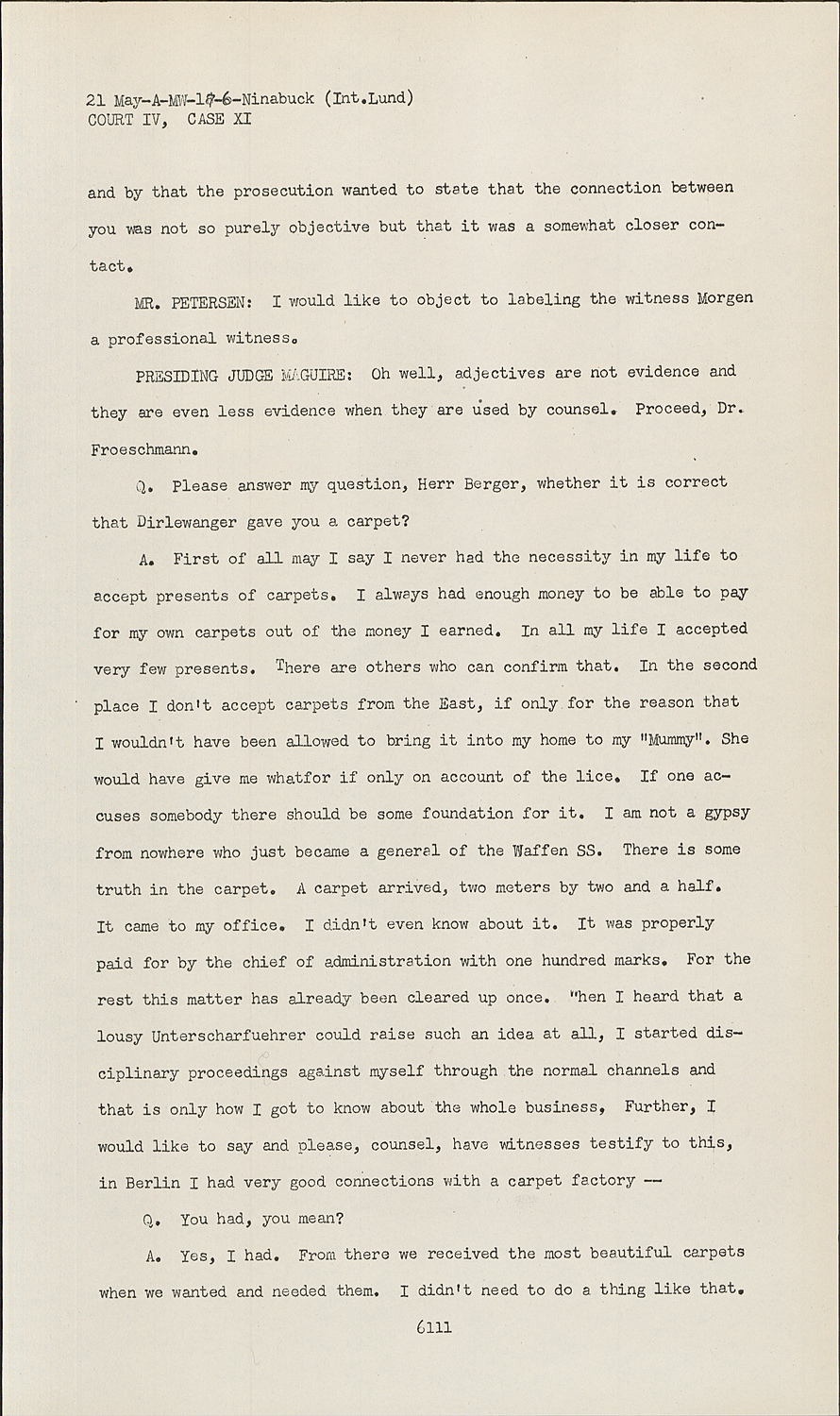
MR. PETERSEN:I would like to object to labeling the witness Morgen a professional witness.
PRESIDING JUDGE MAGUIRE:Oh well, adjectives are not evidence and they are even less evidence when they are used by counsel. Proceed, Dr. Froeschmann.
Q.Please answer my question, Herr Berger, whether it is correct that Dirlewanger gave you a carpet?
A.First of all may I say I never had the necessity in my life to accept presents of carpets. I always had enough money to be able to pay for my own carpets out of the money I earned. In all my life I accepted very few presents. There are others who can confirm that. In the second place I don't accept carpets from the East, if only for the reason that I wouldn't have been allowed to bring it into my home to my "Mummy". She would have give me whatfor if only on account of the lice. If one accuses somebody there should be some foundation for it. I am not a gypsy from nowhere who just became a general of the Waffen SS. There is some truth in the carpet. A carpet arrived, two meters by two and a half. It came to my office. I didn't even know about it. It was properly paid for by the chief of administration with one hundred marks. For the rest this matter has already been cleared up once, when I heard that a lousy Unterscharfuehrer could raise such an idea at all, I started disciplinary proceedings against myself through the normal channels and that is only how I got to know about the whole business, Further, I would like to say and please, counsel, have witnesses testify to this, in Berlin I had very good connections with a carpet factory -
Q.You had, you mean?
A.Yes, I had. From there we received the most beautiful carpets when we wanted and needed them. I didn't need to do a thing like that.
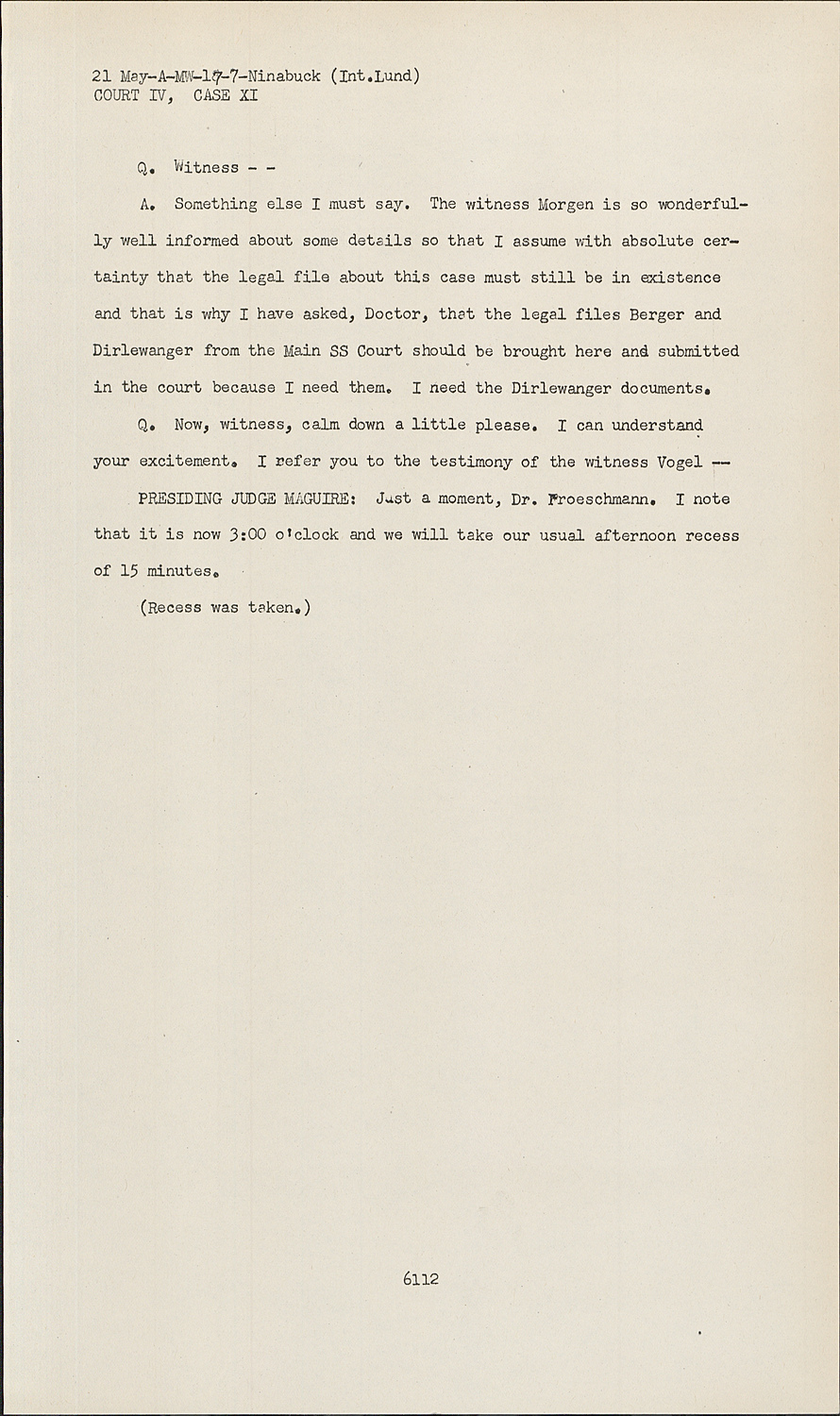
Q.Witness -
A.Something else I must say. The witness Morgen is so wonderfully well informed about some details so that I assume with absolute certainty that the legal file about this case must still be in existence and that is why I have asked, Doctor, that the legal files Berger and Dirlewanger from the Main SS Court should be brought here and submitted in the court because I need them. I need the Dirlewanger documents.
Q.Now, witness, calm down a little please. I can understand your excitement. I refer you to the testimony of the witness Vogel -
PRESIDING JUDGE MAGUIRE:Just a moment, Dr. Froeschmann. I note that it is now 3:00 o'clock and we will take our usual afternoon recess of 15 minutes.
(Recess was taken.)
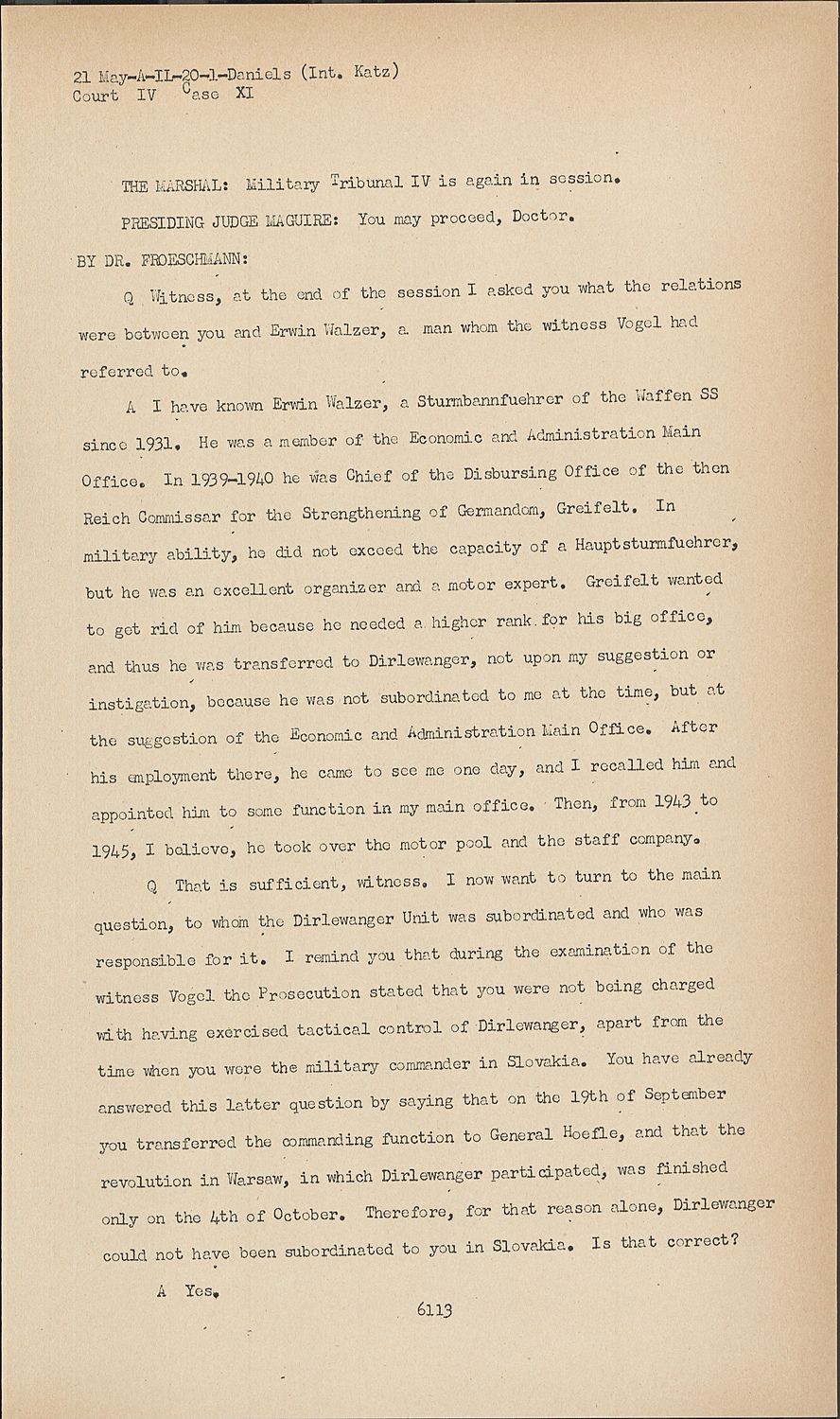
THE MARSHAL:Military Tribunal IV is again in session.
PRESIDING JUDGE MAGUIRE:You may proceed, Doctor. BY DR. FROESCHMANN:
QWitness, at the end of the session I asked you what the relations were between you and Erwin Walzer, a man whom the witness Vogel had referred to.
AI have known Erwin Walzer, a Sturmbannfuehrer of the Waffen SS since 1931. He was a member of the Economic and Administration Main Office. In 1939-1940 he was Chief of the Disbursing Office of the then Reich Commissar for the Strengthening of Germandom, Greifelt. In military ability, he did not exceed the capacity of a Hauptsturmfuehrer, but he was an excellent organizer and a motor expert. Greifelt wanted to get rid of him because he needed a higher rank for his big office, and thus he was transferred to Dirlewanger, not upon my suggestion or instigation, because he was not subordinated to me at the time, but at the suggestion of the Economic and Administration Main Office. After his employment there, he came to see me one day, and I recalled him and appointed him to some function in my main office. Then, from 1943 to 1945, I believe, he took over the motor pool and the staff company.
QThat is sufficient, witness. I now want to turn to the main question, to whom the Dirlewanger Unit was subordinated and who was responsible for it. I remind you that during the examination of the witness Vogel the Prosecution stated that you were not being charged with having exercised tactical control of Dirlewanger, apart from the time when you were the military commander in Slovakia. You have already answered this latter question by saying that on the 19th of September you transferred the commanding function to General Hoefle, and that the revolution in Warsaw, in which Dirlewanger participated, was finished only on the 4th of October. Therefore, for that reason alone, Dirlewanger could not have been subordinated to you in Slovakia. Is that correct?
AYes.
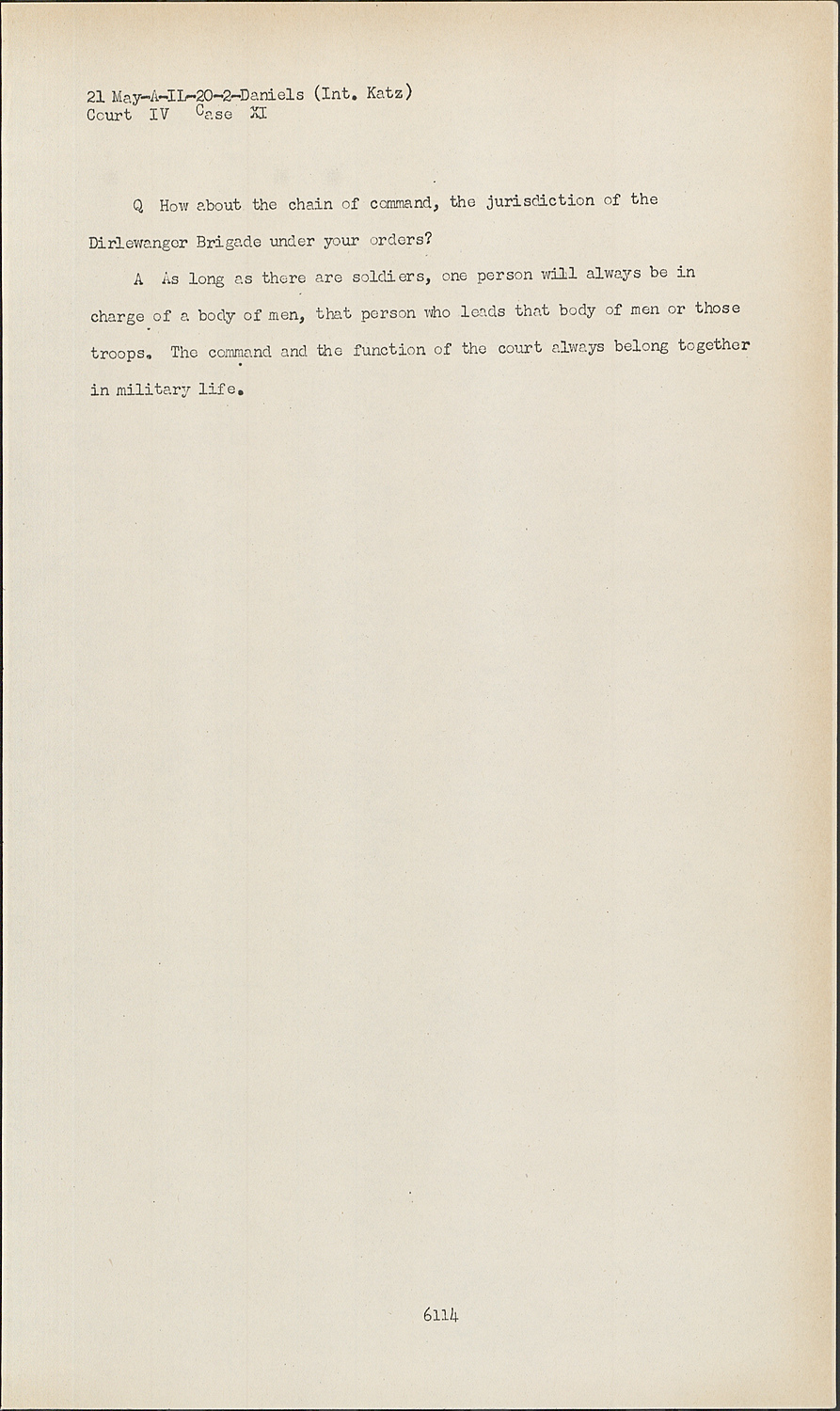
QHow about the chain of command, the jurisdiction of the Dirlewanger Brigade under your orders?
AAs long as there are soldiers, one person will always be in charge of a body of men, that person who leads that body of men or those troops. The command and the function of the court always belong together in military life.