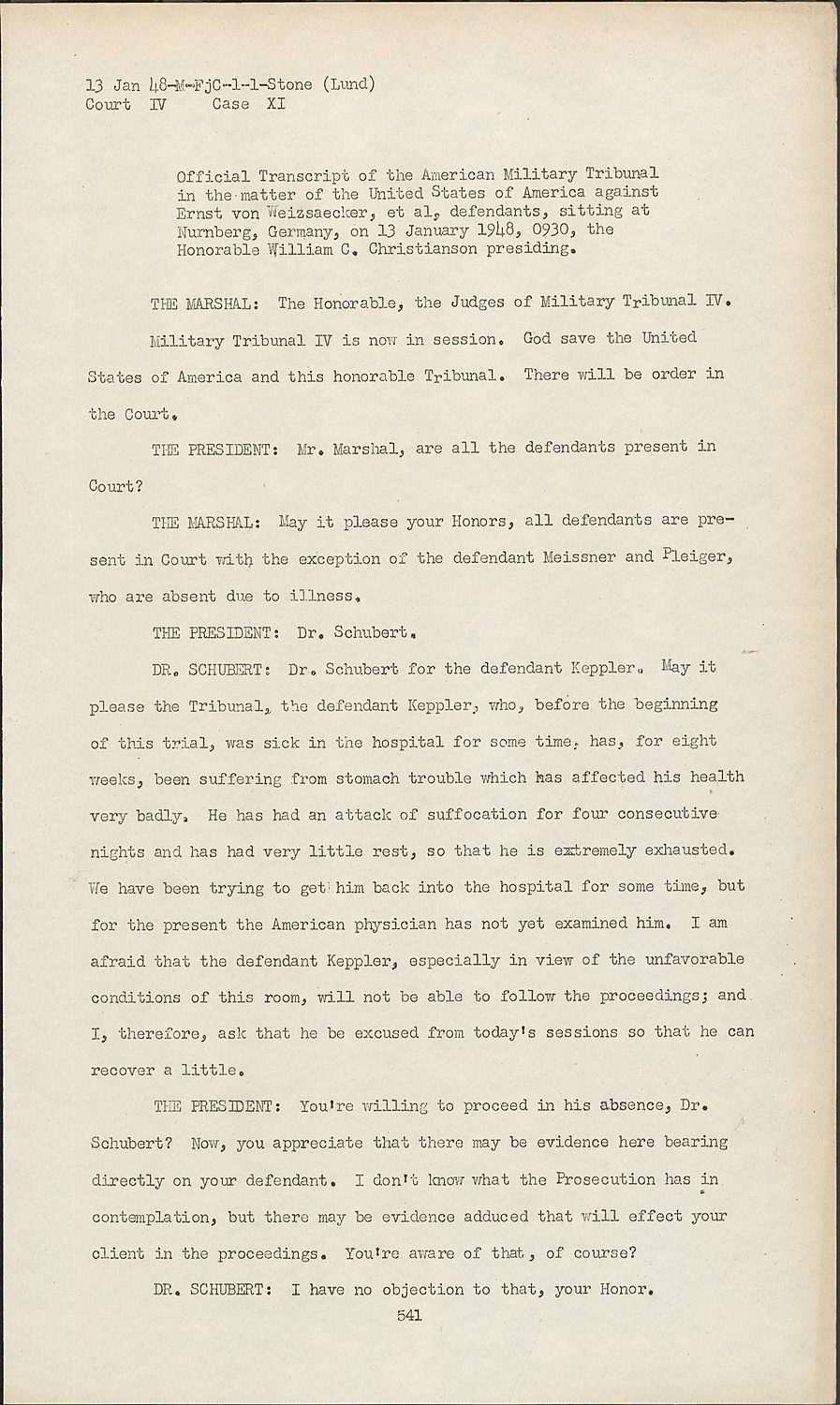
Official Transcript of the American Military Tribunal in the matter of the United States of America against Ernst von Weizsaecker, et al, defendants, sitting at Nurnberg, Germany, on 13 January 1948, 0930, the Honorable William C. Christianson presiding.
THE MARSHAL:The Honorable, the Judges of Military Tribunal IV.
Military Tribunal IV is now in session. God save the United States of America and this honorable Tribunal. There will be order in the Court.
THE PRESIDENT:Mr. Marshal, are all the defendants present in Court?
THE MARSHAL:May it please your Honors, all defendants are present in Court with the exception of the defendant Meissner and Pleiger, who are absent due to illness.
THE PRESIDENT:Dr. Schubert.
DR.SCHUBERT; Dr. Schubert for the defendant Keppler. May it please the Tribunal, the defendant Keppler, who, before the beginning of this trial, was sick in the hospital for some time, has, for eight weeks, been suffering from stomach trouble which has affected his health very badly. He has had an attack of suffocation for four consecutive nights and has had very little rest, so that he is extremely exhausted. We have been trying to get him back into the hospital for some time, but for the present the American physician has not yet examined him. I am afraid that the defendant Keppler, especially in view of the unfavorable conditions of this room, will not be able to follow the proceedings; and I, therefore, ask that he be excused from today's sessions so that he can recover a little.
THE PRESIDENT:You're willing to proceed in his absence, Dr. Schubert? Now, you appreciate that there may be evidence here bearing directly on your defendant. I don't know what the Prosecution has in. contemplation, but there may be evidence adduced that will effect your client in the proceedings. You're aware of that, of course?
DR. SCHUBERT:I have no objection to that, your Honor.
THE PRESIDENT:You have not? He may be excused from today's sessions.
DR. SCHUBERT:Thank you, your Honor.
THE PRESIDENTSIs the Prosecution ready to proceed.
MR. POSNER:Yes, your Honor.
THE PRESIDENT:Will you give your name for the record?
MR. POSNER:Mr. Posner of the Prosecution.
Before proceeding to introduce the evidence concerning the aggression against Poland the Prosecution would like to distribute Informational Chart, NG-3123. This chart lists the names, positions, and the dates thereof of the members of the Foreign Office, and it is submitted for informational purposes only, so that for any of the names thereon appearing, when information is introduced into evidence the Court will be apprised thereof.
THE PRESIDENT:In other words, this chart is not binding upon any one. It's purely for information.
MR. POSNER:Purely for information purposes -- yes, your Honor.
THE PRESIDENT:This has also been furnished the defense counsel, I presume, so that they'll know what it is about.
MR. POSNER:Yes, sir, it has.
If the Tribunal is ready, at this point the Prosecution will proceed with its direct case against the defendants involving the aggression against Poland.
THE PRESIDENT:You may proceed.
MR. POSNER:The Prosecution asks the Court to take judicial note, at this point, of an extract in the transcript of the Trial of the Major War Criminals, page 39, paragraph 1, containing the official judgment of the International Military Tribunal,
THE PRESIDENT:What page is that?
MR. POSNER:Page 39, paragraph 1 of the Official Transcript.
THE PRESIDENT:That's of the Judgment?
MR. POSNER:Yes, the Transcript of the Judgment, yes sir.
JUDGE MAGUIRE:That is as printed?
MR. POSNER:As printed.
THE PRESIDENT:Very well; we'll take judicial notice of that.
MR. POSNER:The Prosecution would, at this point, briefly like to read just one paragraph of that excerpt to the Court.
"In the opinion of the Tribunal the events of the days immediately preceding the 1st of September 1939 demonstrated the determination of Hitler and his associates to carry out the declared intention of invading Poland at all costs, despite appeal from every quarter. With ever-increasing evidence before it that intention would lead to war with Great Britian and France as well, Hitler was resolved not to depart from the course he had set for himself. The Tribunal is fully satisfied by the evidence that the war initiated by Germany against Poland on 1 September 1939 is most plainly an aggressive war which was to develop, in due couse into a war which embraced almost the whole world and resulted in the commission of countless crimes, both against the laws and customs of war and against humanity."
Proceeding to the first document in Document Book IVA, the Prosecution refers to TC-15, "Arbitration Treaty between Germany and Poland, done at Locarno, dated October 16, 1925," which states briefly, on page 2 of the English, page 1 of the German, Article I:
"All disputes of every kind between Germany and Poland with regard to which the Parties are in conflict as to their respective rights, and which it may not be possible to settle amicably by the normal methods of diplomacy, shall be submitted for decision either to an arbitral tribunal or to the Permanent Court of International Justice, as laid down hereafter."
The Prosecution offers into evidence Document TC-15 as Prosecution Exhibit No. 130.
THE PRESIDENT:Is that correct, Mr. Secretary General?
THE SECRETARY GENERAL:Yes, that's correct.
THE PRESIDENT:Prosecution Exhibit 130 is received.
MR. POSNER:Discussing Document TC-21, a declaration of nonaggression between Germany and Poland, dated the 26th of January 1934, which provided that Germany and Poland will seek settlement by peaceful means should disputes arise between them, and that under no circumstances will they proceed to use force for the purpose of a settling such disputes. The declaration states that this agreement shall remain in effect for a period of ten years.
The Prosecution offers into evidence Prosecution Exhibit No. 131.
THE PRESIDENT:Prosecution Exhibit 131 is received.
MR. POSNER:Referring now to Document NG-1998, a memorandum signed "Weizsaecker," concerning German policy with regard to Danzig, dated the 13th of October 1936. In this memorandum Weizsaecker prepares the following points which should be discussed by Hitler and Gauleiter Forster. Reading on page 17 of the English, and page 16 of the German, Paragraph 2:
"The Danzig Senate must cooperate closely with the Foreign Office, "It must be the goal of the Danzig policy to liberate Danzig and to see that it becomes a part of Germany again.
At present, this would not be possible, save for a coup d'etat. Such a coup d'etat is not being considered for the present, since it would involve the still unsolved Corridor problem.
As long as Danzig is still governed by the League of Nations through International law this situation remains a regretable fact." Continuing to paragraph 5 below, English page 17, and German page 18:
"The High Commissioner's right to interfere in the political affairs of Danzig constitutes an evil enroachment on the Free City."
And the last sentence on the page reads: "Therefore, all that is possible now is to strive for an actual relief, rather than one that is legal."
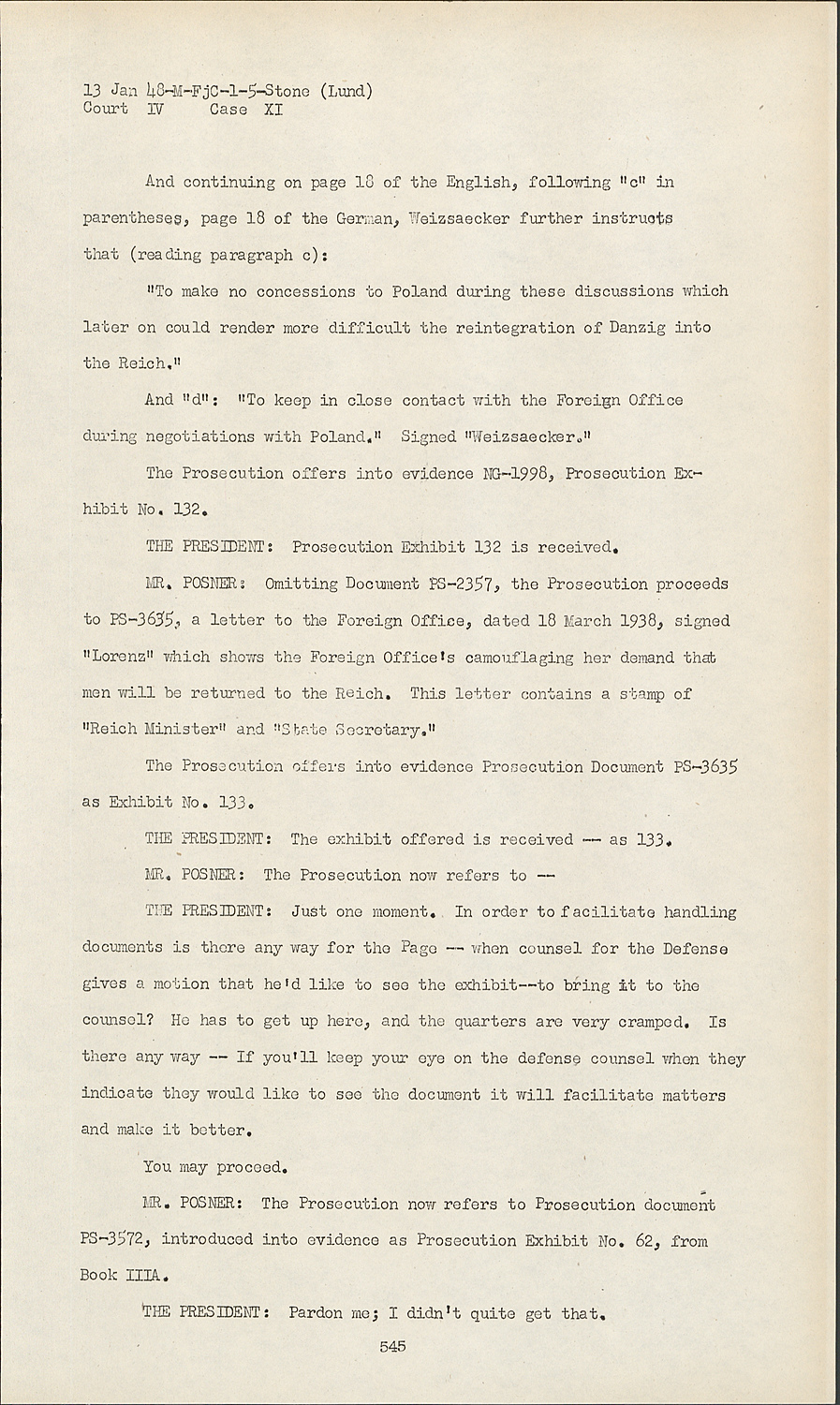
And continuing on page 18 of the English, following "c" in parentheses, page 18 of the German, Weizsaecker further instructs that (reading paragraph c):
"To make no concessions to Poland during these discussions which later on could render more difficult the reintegration of Danzig into the Reich."
And "d": "To keep in close contact with the Foreign Office during negotiations with Poland." Signed "Weizsaecker."
The Prosecution offers into evidence NG-1998, Prosecution Exhibit No. 132.
THE PRESIDENT:Prosecution Exhibit 132 is received.
MR. POSNER:Omitting Document PS-2337, the Prosecution proceeds to PS-3635, a letter to the Foreign Office, dated 18 March 1938, signed "Lorenz" which shows the Foreign Office's camouflaging her demand that men will be returned to the Reich. This letter contains a stamp of "Reich Minister" and "State Secretary."
The Prosecution offers into evidence Prosecution Document PS-3635as Exhibit No. 133.
THE PRESIDENT:The exhibit offered is received -- as 133.
MR. POSNER:The Prosecution now refers to
THE PRESIDENT:Just one moment. In order to facilitate handling documents is there any way for the Page -- when counsel for the Defense gives a motion that he'd like to see the exhibit--to bring it to the counsel? He has to get up here, and the quarters are very cramped. Is there any way -- If you'll keep your eye on the defense counsel when they indicate they would like to see the document it will facilitate matters and make it better.
You may proceed.
Mr. POSNER: The Prosecution now refers to Prosecution document PS-3572, introduced into evidence as Prosecution Exhibit No. 62, from Book IIIA.
THE PRESIDENT:Pardon me; I didn't quite get that.
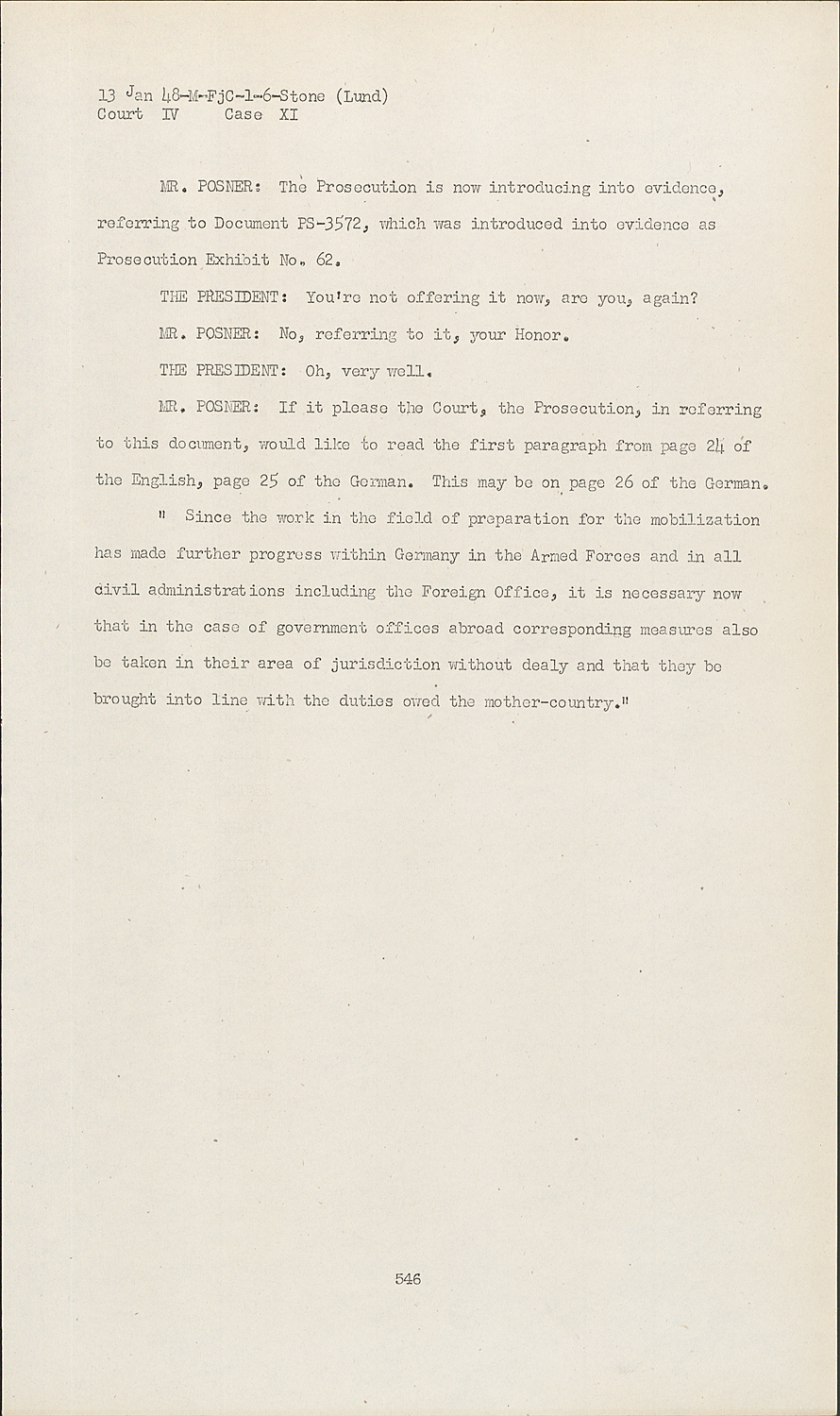
MR. POSNER:The Prosecution is now introducing into evidence, referring to Document PS-3572, which was introduced into evidence as Prosecution Exhibit No. 62.
THE PRESIDENT:You're not offering it now, are you, again?
MR. POSNER:No, referring to it, your Honor.
THE PRESIDENT:Oh, very well.
MR. POSNER:If it please the Court, the Prosecution, in referring to this document, would like to read the first paragraph from page 24 of the English, page 25 of the German. This may be on page 26 of the German.
" Since the work in the field of preparation for the mobilization has made further progress within Germany in the Armed Forces and in all civil administrations including the Foreign Office, it is necessary now that in the case of government offices abroad corresponding measures also be taken in their area of jurisdiction without dealy and that they be brought into line with the duties owed the mother-country."
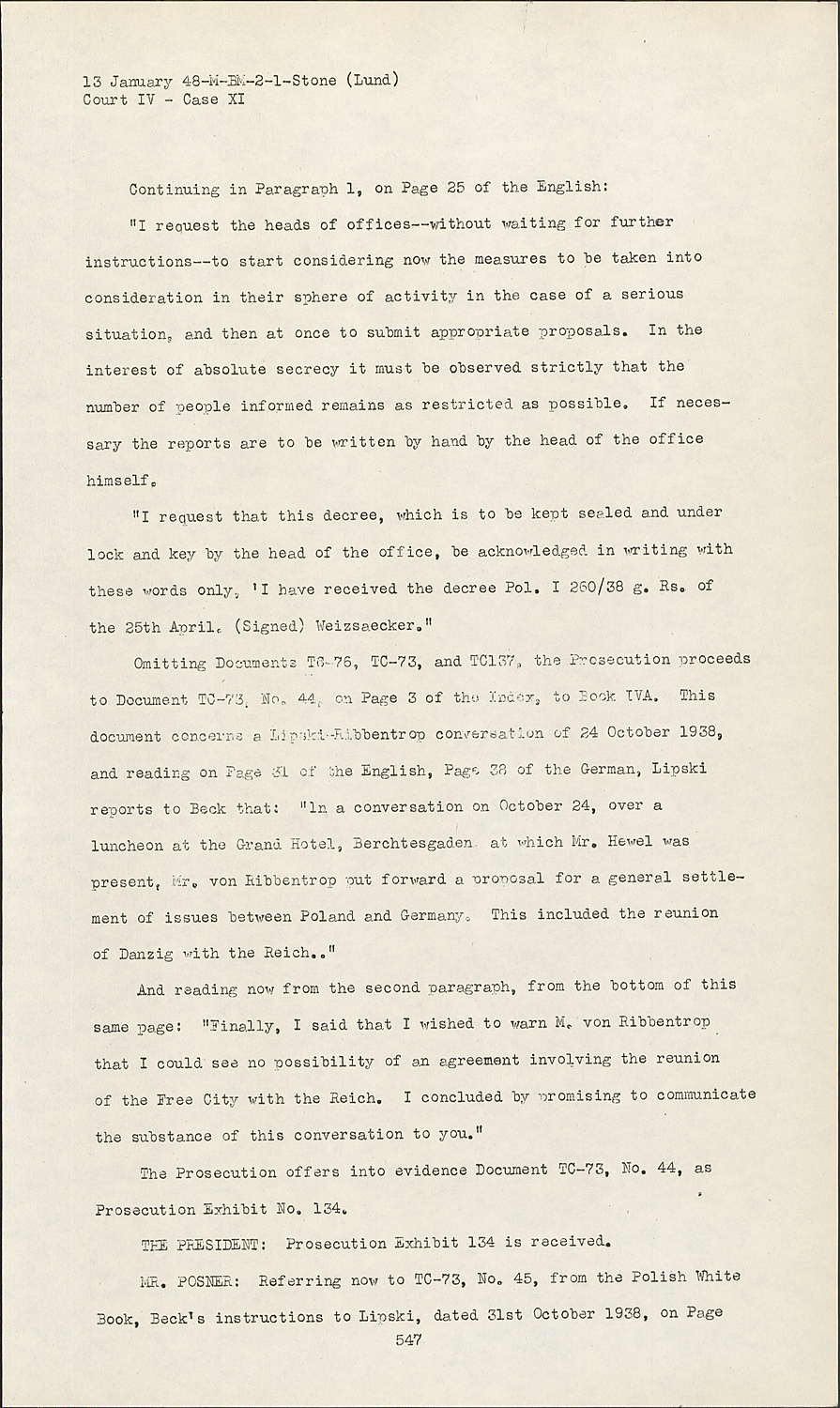
Continuing in Paragraph 1, on Page 25 of the English:
"I request the heads of offices--without waiting for further instructions--to start considering now the measures to be taken into consideration in their sphere of activity in the case of a serious situation, and then at once to submit appropriate proposals. In the interest of absolute secrecy it must be observed strictly that the number of people informed remains as restricted as possible. If necessary the reports are to be written by hand by the head of the office himself.
"I request that this decree, which is to be kept sealed and under lock and key by the head of the office, be acknowledged in writing with these words only, 'I have received the decree Pol. I 260/38 g. Rs. of the 25th April. (Signed) Weizsaecker."
Omitting Documents TC-76, TC-73, and TC137, the Prosecution proceeds to Document TC-73, No. 44, on Page 3 of the Index, to Book IVA. This document concerns a Lipski-Ribbentrop conversation of 24 October 1938, and reading on Page 31 of the English, Page 38 of the German, Lipski reports to Beck that: "In a conversation on October 24, over a luncheon at the Grand Hotel, Berchtesgaden at which Mr. Hewel was present, Mr. von Ribbentrop put forward a proposal for a general settlement of issues between Poland and Germany. This included the reunion of Danzig with the Reich.."
And reading now from the second paragraph, from the bottom of this same page: "Finally, I said that I wished to warn M. von Ribbentrop that I could see no possibility of an agreement involving the reunion of the Free City with the Reich. I concluded by promising to communicate the substance of this conversation to you."
The Prosecution offers into evidence Document TC-73, No. 44, as Prosecution Exhibit No. 134.
THE PRESIDENT:Prosecution Exhibit 134 is received.
MR. POSNER:Referring now to TC-73, No. 45, from the Polish White Book, Beck's instructions to Lipski, dated 31st October 1938, on Page 34 of the English, Page 40 of the German, Beck instructs Lipski as follows:
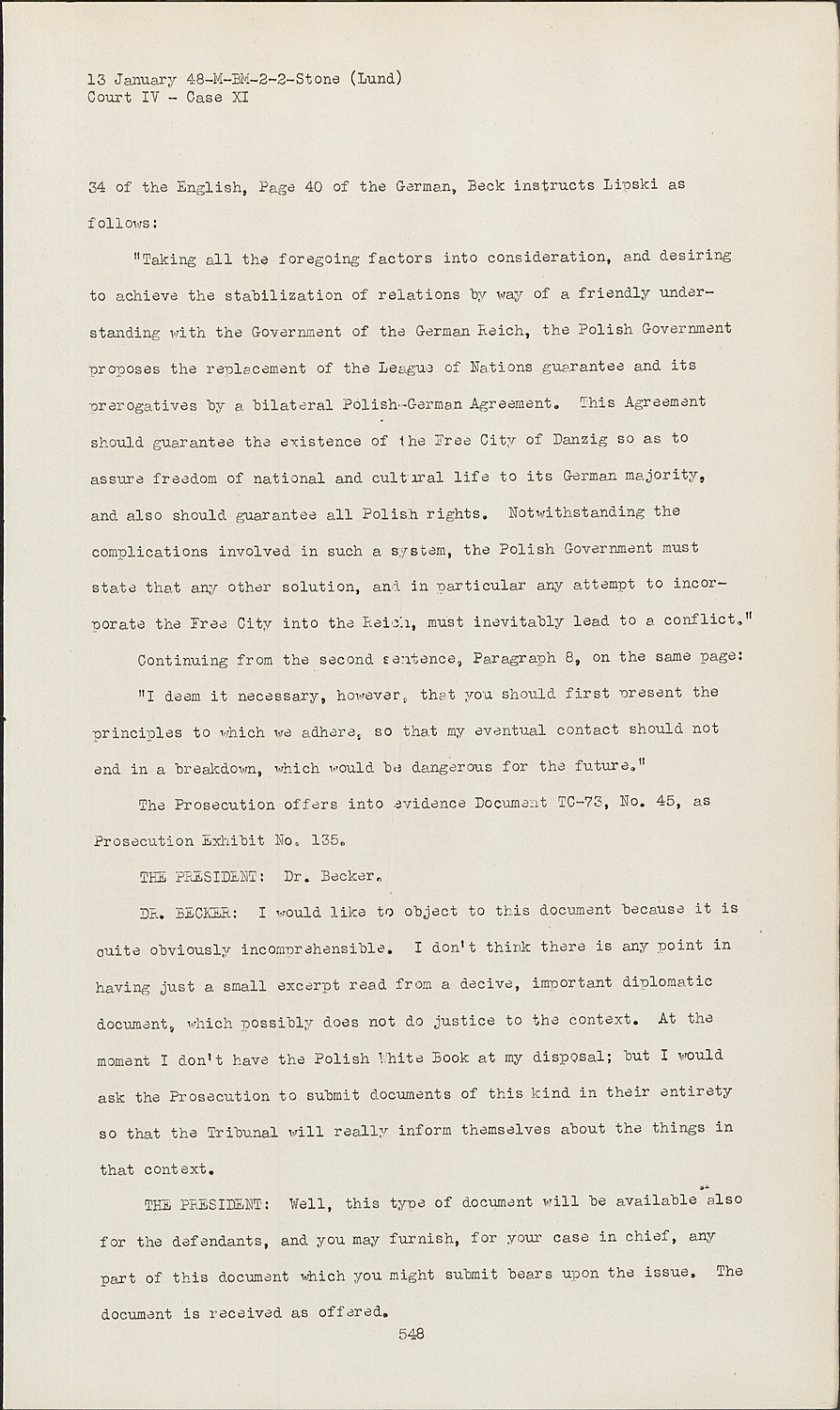
"Taking all the foregoing factors into consideration, and desiring to achieve the stabilization of relations by way of a friendly understanding with the Government of the German Reich, the Polish Government proposes the replacement of the League of Nations guarantee and its prerogatives by a bilateral Polish-German Agreement. This Agreement should guarantee the existence of 1 he Free City of Danzig so as to assure freedom of national and cultural life to its German majority, and also should guarantee all Polish rights. Notwithstanding the complications involved in such a system, the Polish Government must state that any other solution, and in particular any attempt to incorporate the Free City into the Reich, must inevitably lead to a conflict."
Continuing from the second sentence, Paragraph 8, on the same page:
"I deem it necessary, however, that you should first present the principles to which we adhere, so that my eventual contact should not end in a breakdown, which would be dangerous for the future."
The Prosecution offers into evidence Document TC-73, No. 45, as Prosecution Exhibit No. 135.
THE PRESIDENT:Dr. Becker.
DR. BECKER:I would like to object to this document because it is quite obviously incomprehensible. I don't think there is any point in having just a small excerpt read from a decive, important diplomatic document, which possibly does not do justice to the context. At the moment I don't have the Polish White Book at my disposal; but I would ask the Prosecution to submit documents of this kind in their entirety so that the Tribunal will really inform themselves about the things in that context.
THE PRESIDENT:Well, this type of document will be available also for the defendants, and you may furnish, for your case in chief, any part of this document which you might submit bears upon the issue. The document is received as offered.
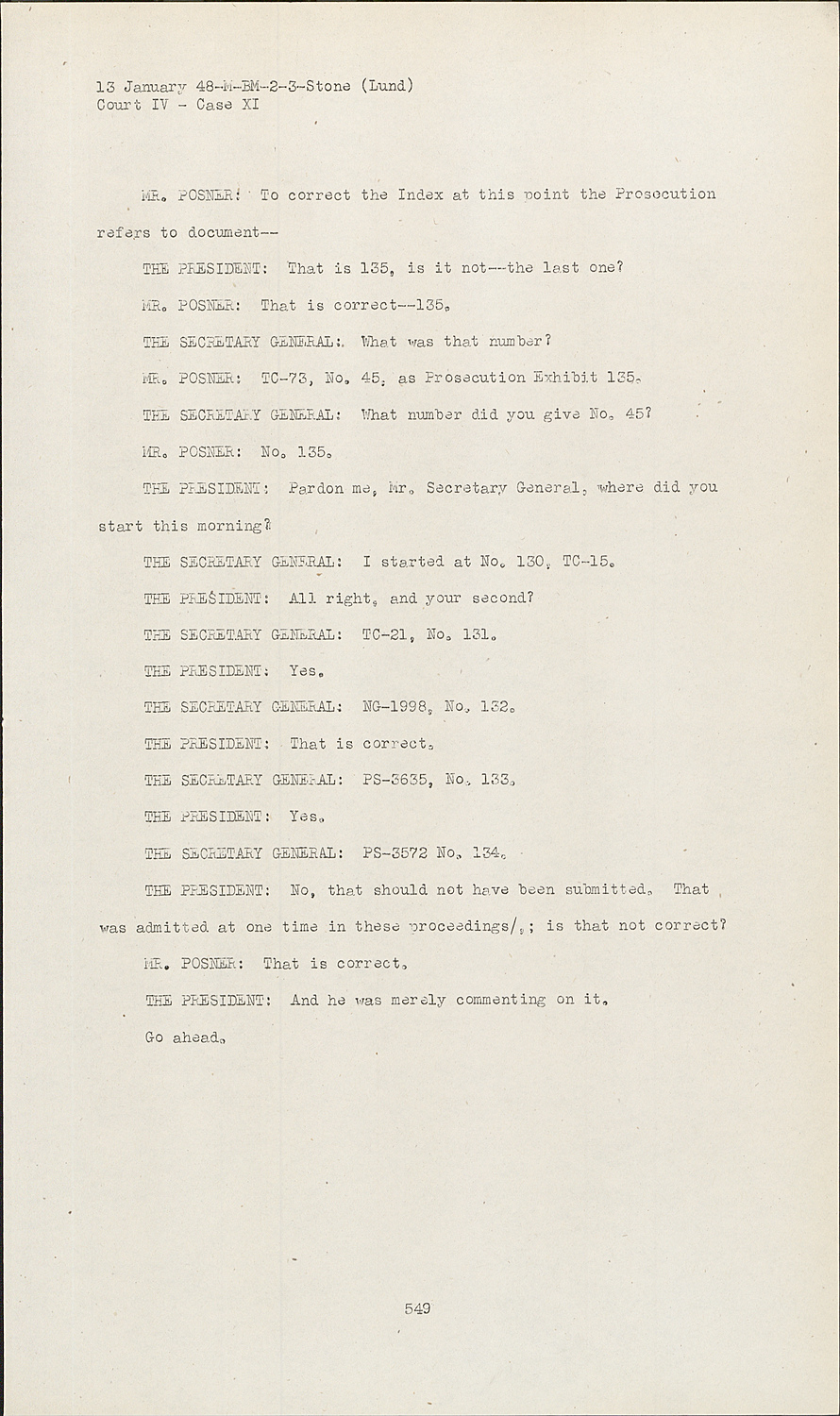
MR. POSNER:To correct the Index at this point the Prosecution refers to document-
THE PRESIDENT:That is 135, is it not--the last one?
MR. POSNER:That is correct--135.
THE SECRETARY GENERAL:What was that number?
MR. POSNER:TC-73, No. 45, as Prosecution Exhibit 135.
THE SECRETARY GENERAL:What number did you give No. 45?
MR. POSNER:No. 135.
THE PRESIDENT:Pardon me, Mr. Secretary General, where did you start this morning?:
THE SECRETARY GENERAL:I started at No. 130, TC-15.
THE PRESIDENT:All right, and your second?
THE SECRETARY GENERAL:TC-21, No. 131.
THE PRESIDENT:Yes.
THE SECRETARY GENERAL:NG-1998, No. 132.
THE PRESIDENT:That is correct.
THE SECRETARY GENERAL:PS-3635, No. 133.
THE PRESIDENT:Yes.
THE SECRETARY GENERAL:PS-3572 No. 134.
THE PRESIDENT:No, that should not have been submitted. That was admitted at one time in these proceedings/,; is that not correct?
MR. POSNER:That is correct.
THE PRESIDENT:And he was merely commenting on it.
Go ahead.
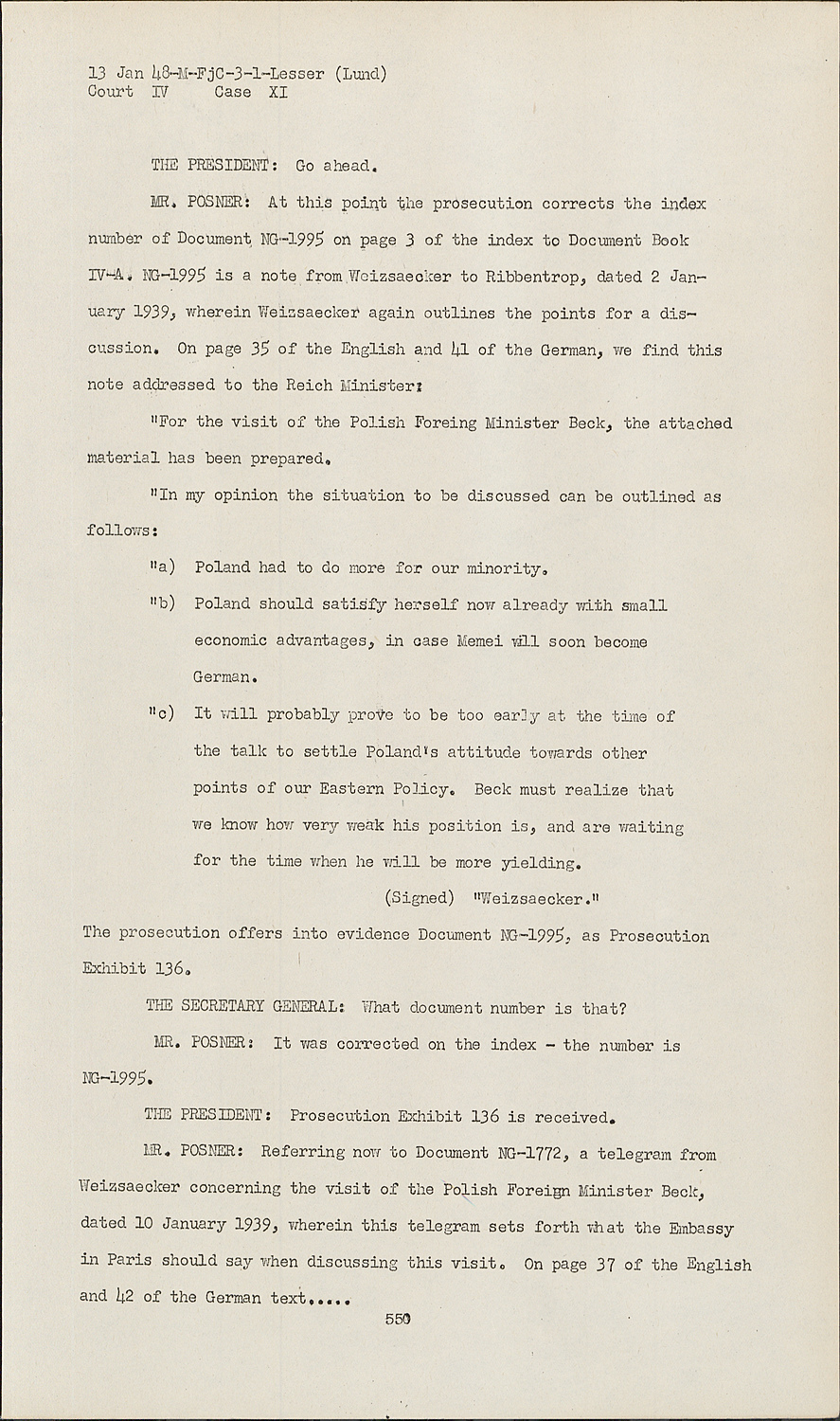
THE PRESIDENT:Go ahead.
MR. POSNER:At this point the prosecution corrects the index number of Document NG-1993 on page 3 of the index to Document Book IV-A. NG-1995 is a note from Weizsaecker to Ribbentrop, dated 2 January 1939, wherein Weizsaecker again outlines the points for a discussion. On page 35 of the English and 41 of the German, we find this note addressed to the Reich Minister:
"For the visit of the Polish Foreing Minister Beck, the attached material has been prepared.
"In my opinion the situation to be discussed can be outlined as follows:
"a) Poland had to do more for our minority.
"b) Poland should satisfy herself now already with small economic advantages, in case Memei will soon become German.
"c) It will probably prove to be too early at the time of the talk to settle Poland's attitude towards other points of our Eastern Policy.
Beck must realize that we know how very weak his position is, and are waiting for the time when he will be more yielding.
(Signed) "Weizsaecker." The prosecution offers into evidence Document NG-1995, as Prosecution Exhibit 136.
THE SECRETARY GENERAL:What document number is that?
MR. POSNER:It was corrected on the index - the number is NG-1995.
THE PRESIDENT:Prosecution Exhibit 136 is received.
MR. POSNER:Referring now to Document NG-1772, a telegram from Weizsaecker concerning the visit of the Polish Foreign Minister Beck, dated 10 January 1939, wherein this telegram sets forth what the Embassy in Paris should say when discussing this visit. On page 37 of the English and 42 of the German text.....
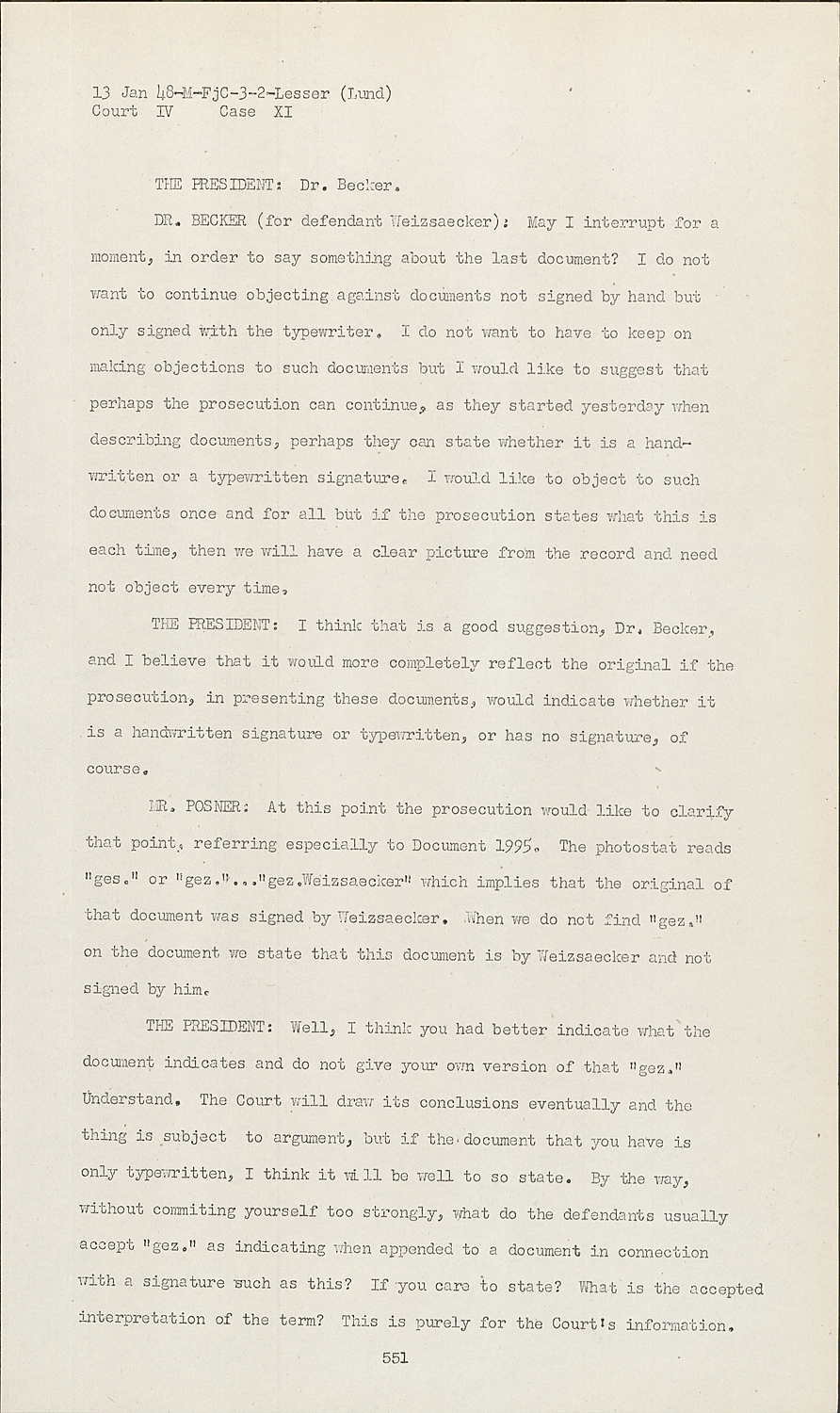
THE PRESIDENT:Dr. Becker.
DR.BECKER (for defendant Weizsaecker): May I interrupt for a moment, in order to say something about the last document? I do not want to continue objecting against documents not signed by hand but only signed with the typewriter. I do not want to have to keep on making objections to such documents but I would like to suggest that perhaps the prosecution can continue, as they started yesterday when describing documents, perhaps they can state whether it is a handwritten or a typewritten signature. I would like to object to such documents once and for all but if the prosecution states what this is each time, then we will have a clear picture from the record and need not object every time.
THE PRESIDENT:I think that is a good suggestion, Dr. Becker, and I believe that it would more completely reflect the original if the prosecution, in presenting these documents, would indicate whether it is a handwritten signature or typewritten, or has no signature, of course.
MR. POSNER:At this point the prosecution would like to clarify that point, referring especially to Document 1995. The photostat reads "ges." or "gez."..."gez.Weizsaecker" which implies that the original of that document was signed by Weizsaecker. When we do not find "gez." on the document we state that this document is by Weizsaecker and not signed by him.
THE PRESIDENT:Well, I think you had better indicate That the document indicates and do not give your own version of that "gez." Understand. The Court will draw its conclusions eventually and the thing is subject to argument, but if the document that you have is only typewritten, I think it will be well to so state. By the way, without commiting yourself too strongly, what do the defendants usually accept "gez." as indicating when appended to a document in connection with a signature such as this? If you care to state? What is the accepted interpretation of the term? This is purely for the Court's information.
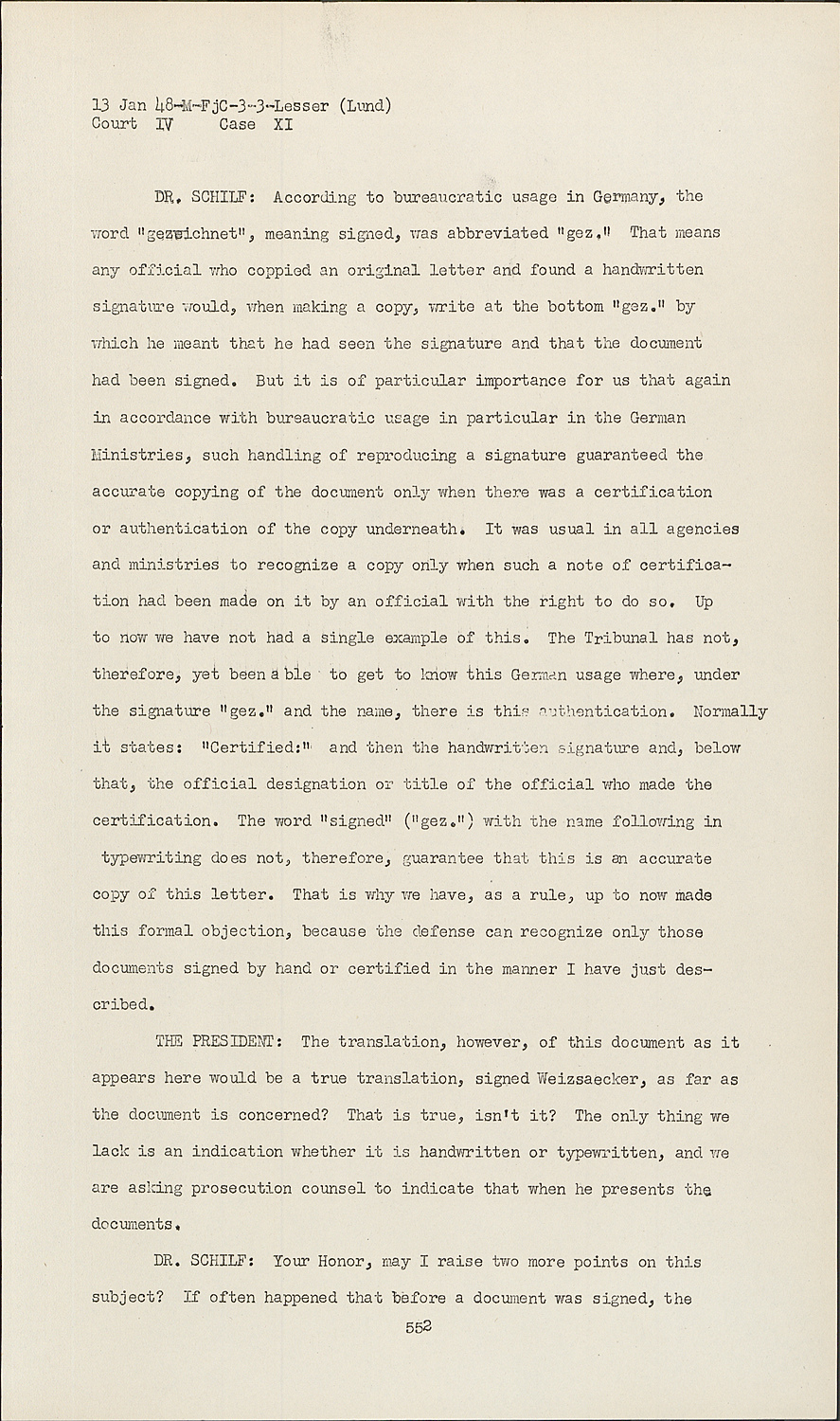
DR. SCHILF:According to bureaucratic usage in Germany, the word "gezeichnet", meaning signed, was abbreviated "gez." That means any official who coppied an original letter and found a handwritten signature would, when making a copy, write at the bottom "gez." by which he meant that he had seen the signature and that the document had been signed. But it is of particular importance for us that again in accordance with bureaucratic usage in particular in the German Ministries, such handling of reproducing a signature guaranteed the accurate copying of the document only when there was a certification or authentication of the copy underneath. It was usual in all agencies and ministries to recognize a copy only when such a note of certification had been made on it by an official with the right to do so. Up to now we have not had a single example of this. The Tribunal has not, therefore, yet been able to get to know this German usage where, under the signature "gez." and the name, there is this authentication. Normally it states: "Certified:" and then the handwritten signature and, below that, the official designation or title of the official who made the certification. The word "signed" ("gez.") with the name following in typewriting does not, therefore, guarantee that this is an accurate copy of this letter. That is why we have, as a rule, up to now made this formal objection, because the defense can recognize only those documents signed by hand or certified in the manner I have just described.
THE PRESIDENT:The translation, however, of this document as it appears here would be a true translation, signed Weizsaecker, as far as the document is concerned? That is true, isn't it? The only thing we lack is an indication whether it is handwritten or typewritten, and we are asking prosecution counsel to indicate that when he presents the documents.
DR. SCHILF:Your Honor, may I raise two more points on this subject? If often happened that before a document was signed, the name had already been inserted by typewriter, so that you cannot tell whether a document now submitted, where it says "Signed - so and so" was, in actual fact, sent out from the office or whether it may not perhaps have been a draft which never reached the addressee.
That is why it would be a good thing if the prosecution could, every time, make some claim whether this document, which is not signed by hand and not certified, whether, according to the prosecution's claims, the letter actually reached the addressee. That is just a suggestion but otherwise, in our defense case, we will have to make a tremendous amount of objections of a purely formal nature which possibly could already be cleared up during the prosecution's case-in-chief.
JUDGE MAGUIRE:Just one moment, before Dr. Schilf leaves the podium, A subordinate in the Foreign Office would not place the letters gez. on a document unless he had seen the original and that it bore the signature, is that a fact?
DR. SCHILF:No, your Honor, you cannot say that. It is only certain that an official of the Foreign Office made the copy if this certification would be on the document. If it has been certified, then the Foreign Office official, (these were usually the so-called middle officials,) states thereby that this document is an accurate copy of the document he had before him. In the case of the documents submitted here, as a rule it cannot be seen whether this copy was made in the Foreign Office at all. On the contrary, as far as I have been able to see, these have obviously been mainly copies from other files than those of the Foreign Office. For instance, I can remember having seen documents of a customs authority where allegedly a copy of a document from the Foreign Office was included. So one really cannot be certain whether it was an accurate copy of a document from the Foreing Office unless there is an original signature or this famous certification.
JUDGE MAGUIRE:I did not make myself quite clear, evidently. The thing I desired to know was, whether or not, when the letters "gez."
appear on a copy of a document, it is an indication, that he who put those letters on the document had seen an original document bearing the signature of the person purporting to sign it. If not, what was the purpose and object of putting the letters "gez." on the documents.
DR. SCHILF:No. We have no means of establishing that those letters "gez." in any way represent an official certification of the signature. We cannot establish whether this copy was made by an official of the Foreign Office. It could have been made by anybody. The copy could have been made by somebody quite outside the Foreign Office who had seen the document in some other files and then taken a copy for his own files. It is not necessarily positive proof that it was an official of the Foreign Office.
JUDGE MAGUIRE:Just one question: But, in the ordinary course of keeping departmental records, or making departmental records, did not the letters "gex." (or "gezed.") indicate that the original had been signed and that this was a copy of a signed original - in ordinary course?
DR. SCHILF:In the normal course of business one might perhaps start from the premise that a signature did exist; but as we do not know who put this "gez." and name on the copy we can never say whether the signature really did exist on the original document.
DR. BECKER:May it please the Tribunal. I think I can clear up this discussion. What usually happened was this. As we have already seen in the case of a number'of documents, a big distribution list was on these documents. That is, from the very beginning the official writing the document knew that he would neese so and so many copies. So, from the very beginning, he prepared a large number of copies on which, in accordance with the signature to be expected later, he would type: "Signed so and so." This causes the fact of uncertainty in this whole question, because, in practical usage, too many copies would be prepared in advance in view of the official's very natural desire not to cause himself extra work and make more copies afterwards; and in such cases he would prepare a fairly large number of copies in advance, stating "Signed - so and so" before the signature had actually been placed on the document.
To be absolutely correct, the signature should afterwards have been certified, when it had been affixed to the document, but of course this was not done later on because the agencies were so overworked - at least it didn't always happen. At any rate, in order to answer His Honor's question clearly, we cannot say that an official would say "Signed - so and so" on a document only after the document had been signed. In actual fact, in the majority of cases, this would be written in advance, so that from the typewritten note "Signed - so and so" we cannot tell whether the signature was actually affixed or not.
JUDGE MAGUIRE:One other question, if I may be permitted. Let us assume that there was a document which was to be distributed...Let us assume that there was a document which, when executed, was to be distributed to four or five different officials in the Foreign Office or outside of it, - that kind of a document - and it was, in fact, signed by the official for whose signature it was prepared. Would each one of those copies that were thereafter distributed, contain a certification in the ordinary course of handling it, or would merely the carbon copy be set up to bear this "gez." designation?
DR. SCHILF:In the normal course of business these signatures would have been certified.
JUDGE MAGUIRE:For each copy?
DR. SCHILF:I could not say whether each separata copy would be certified because it depends on the office itself. But, as I just learn from the defendants, as a rule, a certification would be necessary on each copy. Now, just one more thing. In Germany we make a difference between copies and carbon copies. Carbon copies we call the copies made on a typewriter by means of carbon paper. What Herr Becker said just now, as a rule applies to carbon copies made by the typist; so if a letter is dictated, the typist, writes the document with one original and, shall we say, five carbon copies; on these carbon copies she then writes : "Signed" ("Gozeichnet)", and that before the original has been signed. These carbon copues are then usually sent out to other agencies and other departments without the original actually having been signed.
THE PRESIDENT:We started out by asking what "Gez." meant and have received all this. Now we are glad to be enlightened and it was interesting. But the ruling is, of course, the same. These arguments may perhaps be more appropriate, and they have been arguments, when you come to final submission of the case and the arguments as to the weight of these documents which are unsigned. You may proceed.
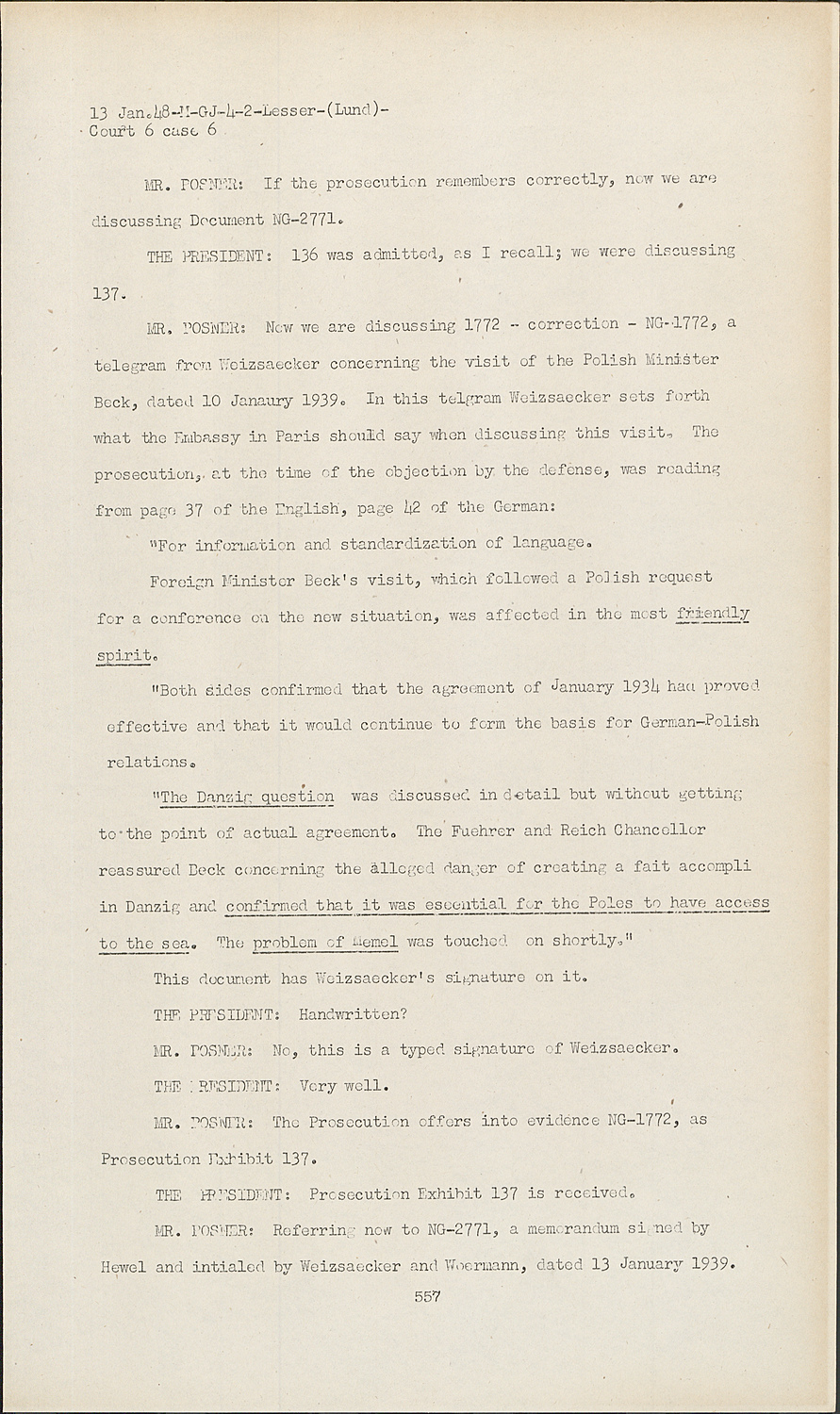
MR. POSNER:If the prosecution remembers correctly, new we are discussing Document NG-2771.
THEPRESIDENT: 136 was admitted, as I recall; we were discussing 137.
MR. POSNER:Now we are discussing 1772 - correction - NG-1772, a telegram from Weizsaecker concerning the visit of the Polish Minister Beck, dated 10 Janaury 1939. In this telgram Weizsaecker sets forth what the Embassy in Paris should say when discussing this visit. The prosecution, at the time of the objection by the defense, was reading from page 37 of the English, page 42 of the German:
"For information and standardization of language.
Foreign Minister Beck's visit, which followed a Polish request for a conference on the new situation, was affected in the most friendly spirit.
"Both sides confirmed that the agreement of January 1934 had proved effective and that it would continue to form the basis for German-Polish relations.
"The Danzig question was discussed in detail but without getting to the point of actual agreement. The Fuehrer and Reich Chancellor reassured Beck concerning the alleged danger of creating a fait accompli in Danzig and confirmed that it was eseential for the Poles to have access to the sea. The problem of Memel was touched on shortly."
This document has Weizsaecker's signature on it.
THE PRESIDENT:Handwritten?
MR. POSNER:No, this is a typed signature of Weizsaecker.
THE PRESIDENT:Very well.
MR. POSNER:The Prosecution offers into evidence NG-1772, as Prosecution Exhibit 137.
THE PRESIDENT:Prosecution Exhibit 137 is received.
MR. POSNER:Referring now to NG-2771, a memorandum signed by Hewel and intialed by Weizsaecker and Woermann, dated 13 January 1939.
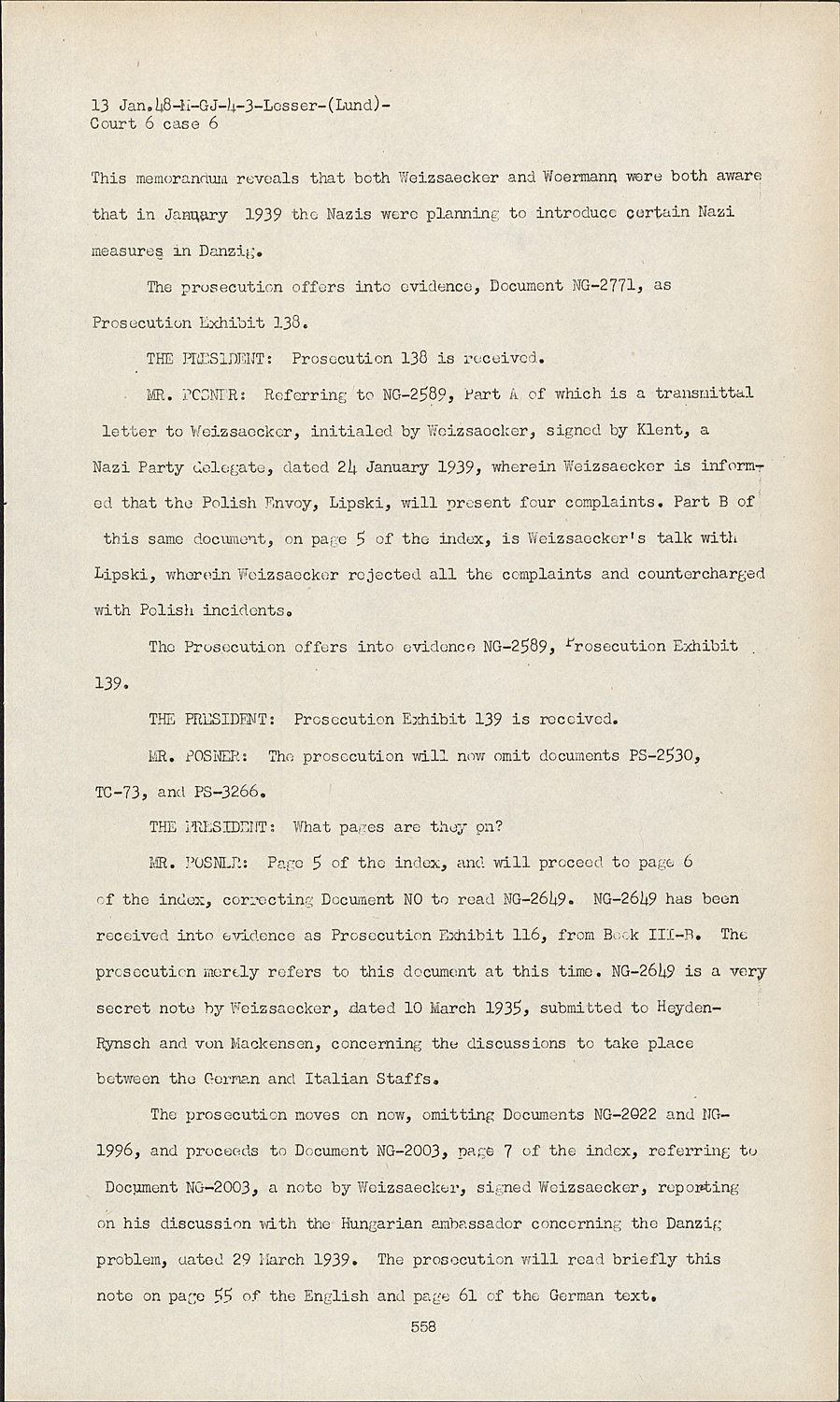
This memorandum reveals that both Weizsaecker and Woermann were both aware that in January 1939 the Nazis were planning to introduce certain Nazi measures in Danzig.
The prosecution offers into evidence, Document NG-2771, as Prosecution Exhibit 138.
THE PRESIDENT:Prosecution 138 is received.
MR. POSNER:Referring to NG-2589, Part A of which is a transmittal letter to Weizsaecker, initialed by Weizsaecker, signed by Klent, a Nazi Party delegate, dated 24 January 1939, wherein Weizsaecker is informed that the Polish Envoy, Lipski, will present four complaints. Part B of this same document, on page 5 of the index, is Weizsaecker's talk with Lipski, wherein Weizsaecker rejected all the complaints and countercharged with Polish incidents.
The Prosecution offers into evidence NG-2589, Prosecution Exhibit 139.
THE PRESIDENT:Prosecution Exhibit 139 is received.
MR. POSNER:The prosecution will now omit documents PS-2530, TC-73, and PS-3266.
THE PRESIDENT:What pages are they on?
MR. POSNER:Page 5 of the index, and will proceed to page 6 of the index, correcting Document NO to read NG-2649. NG-2649 has been received into evidence as Prosecution Exhibit 116, from Book III-B. The prosecution merely refers to this document at this time. NG-2649 is a very secret note by Weizsaecker, dated 10 March 1934, submitted to HeydenRynsch and von Mackensen, concerning the discussions to take place between the German and Italian Staffs.
The prosecution moves on now, omitting Documents NG-2022 and NG1996, and proceeds to Document NG-2003, page 7 of the index, referring to Document NG-2003, a note by Weizsaecker, signed Weizsaecker, reporting on his discussion with the Hungarian ambassador concerning the Danzig problem, dated 29 March 1939. The prosecution will read briefly this note on page 55 of the English and page 61 of the German text.
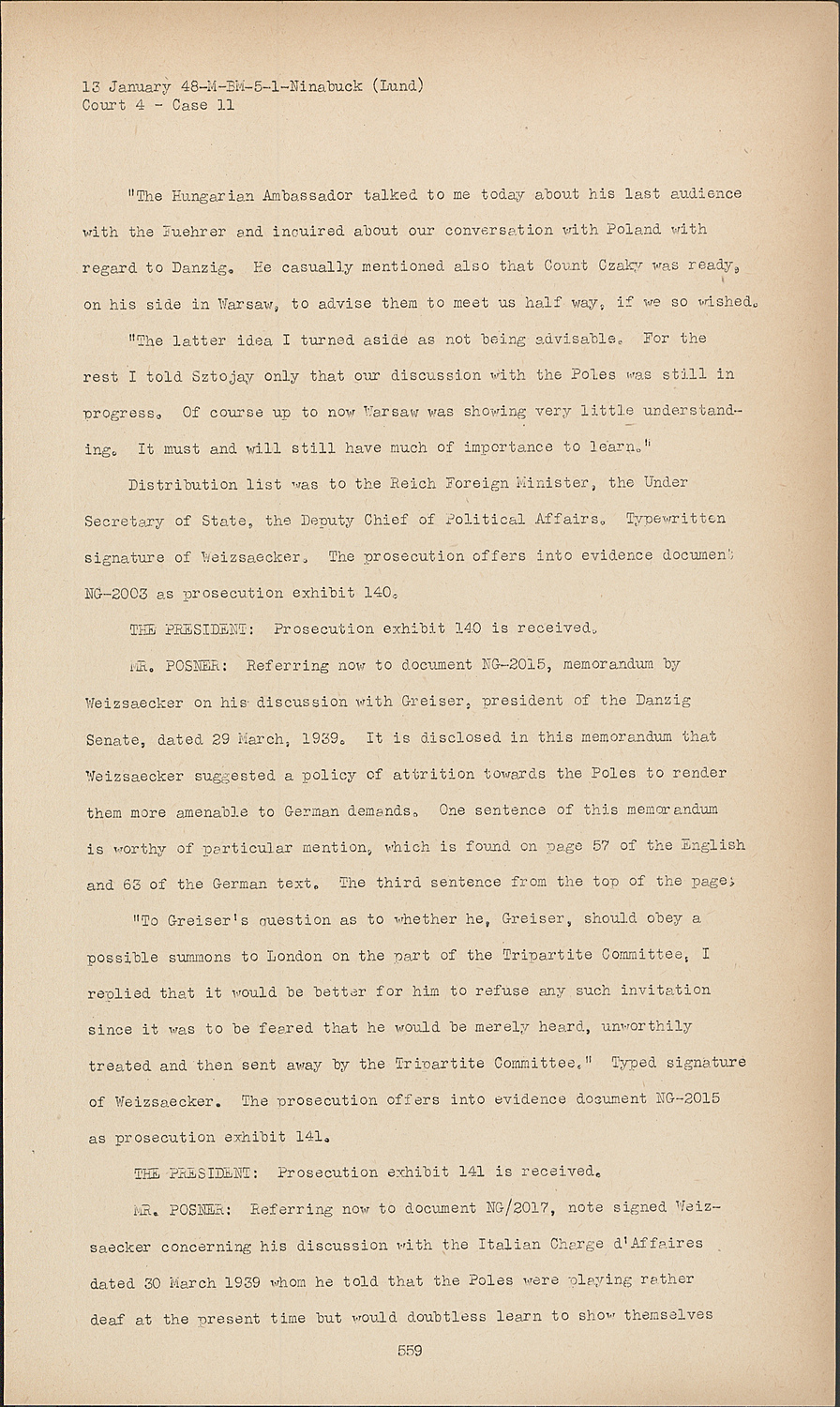
"The Hungarian Ambassador talked to me today about his last audience with the Fuehrer and inquired about our conversation with Poland with regard to Danzig. He casually mentioned also that Count Czaky was ready, on his side in Warsaw, to advise them to meet us half way, if we so wished.
"The latter idea I turned aside as not being advisable. For the rest I told Sztojay only that our discussion with the Poles was still in progress. Of course up to now Warsaw was showing very little understanding. It must and will still have much of importance to learn."
Distribution list was to the Reich Foreign Minister, the Under Secretary of State, the Deputy Chief of Political Affairs. Typewritten signature of Weizsaecker. The prosecution offers into evidence document NG-2003 as prosecution exhibit 140.
THE PRESIDENT:Prosecution exhibit 140 is received.
MR. POSNER:Referring now to document NG-2015, memorandum by Weizsaecker on his discussion with Greiser, president of the Danzig Senate, dated 29 March, 1939. It is disclosed in this memorandum that Weizsaecker suggested a policy of attrition towards the Poles to render them more amenable to German demands. One sentence of this memorandum is worthy of particular mention, which is found on page 57 of the English and 63 of the German text. The third sentence from the top of the page;
"To Greiser's question as to whether he, Greiser, should obey a possible summons to London on the part of the Tripartite Committee, I replied that it would be better for him to refuse any such invitation since it was to be feared that he would be merely heard, unworthily treated and then sent away by the Tripartite Committee." Typed signature of Weizsaecker. The prosecution offers into evidence document NG-2015as prosecution exhibit 141.
THE PRESIDENT:Prosecution exhibit 141 is received.
MR. POSNER:Preferring now to document NG/2017, note signed Weizsaecker concerning his discussion with the Italian Charge d'Affaires dated 30 March 1939 whom he told that the Poles were playing rather deaf at the present time but would doubtless learn to show themselves more amenable.
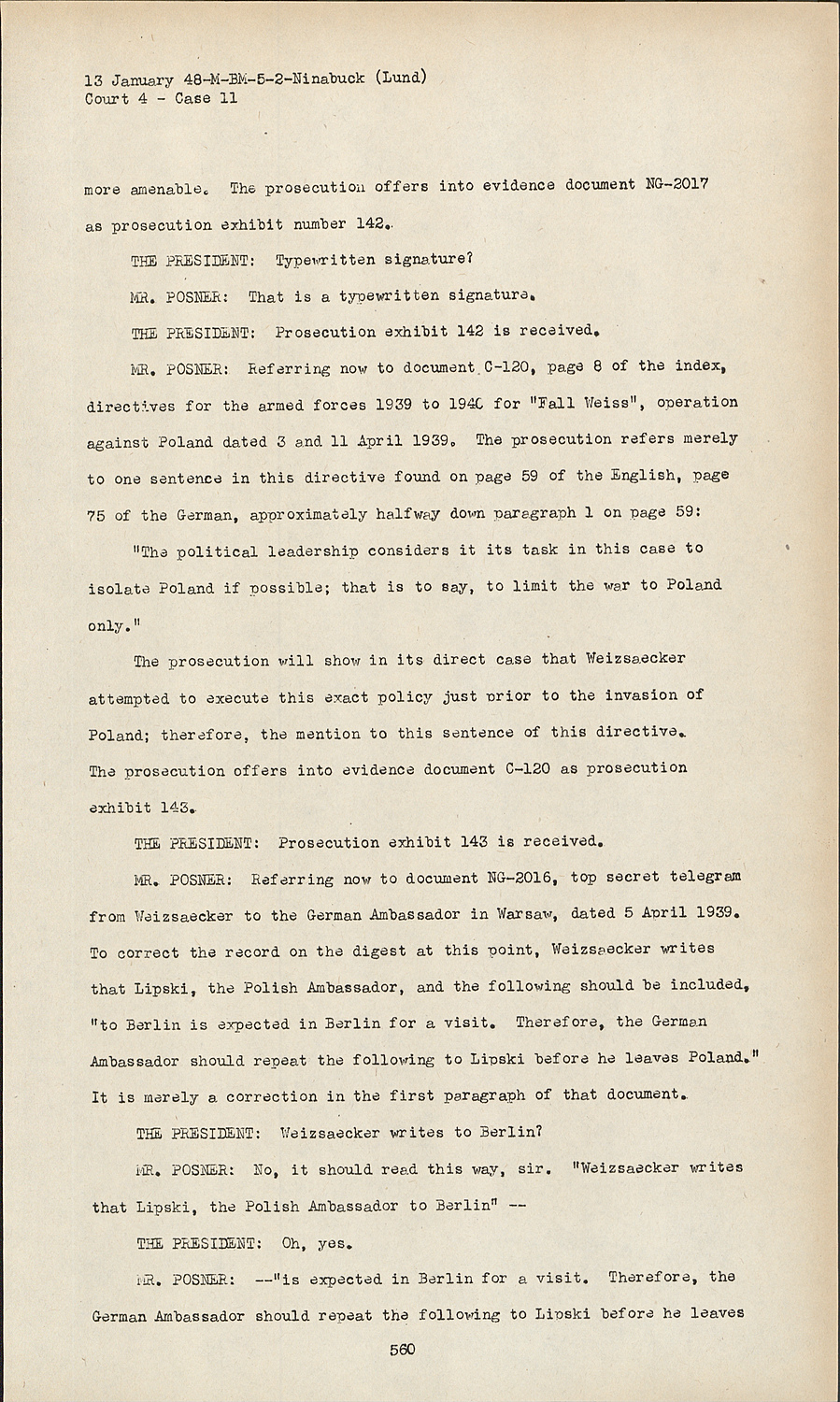
The prosecution offers into evidence document NG-2017as prosecution exhibit number 142.
THE PRESIDENT:Typewritten signature?
MR. POSNER:That is a typewritten signature,
THE PRESIDENT:Prosecution exhibit 142 is received.
MR. POSNER:Referring now to document C-120, page 8 of the index, directives for the armed forces 1939 to 1940 for "Fall Weiss", operation against Poland dated 3 and 11 April 1939. The prosecution refers merely to one sentence in this directive found on page 59 of the English, page 75 of the German, approximately halfway down paragraph 1 on page 59:
"The political leadership considers it its task in this case to isolate Poland if possible; that is to say, to limit the war to Poland only."
The prosecution will show in its direct case that Weizsaecker attempted to execute this exact policy just prior to the invasion of Poland; therefore, the mention to this sentence of this directive. The prosecution offers into evidence document C-120 as prosecution exhibit 143.
THE PRESIDENT:Prosecution exhibit 143 is received.
MR. POSNER:Referring now to document NG-2016, top secret telegram from Weizsaecker to the German Ambassador in Warsaw, dated 5 April 1939. To correct the record on the digest at this point, Weizsaecker writes that Lipski, the Polish Ambassador, and the following should be included, "to Berlin is expected in Berlin for a visit. Therefore, the German Ambassador should repeat the following to Lipski before he leaves Poland." It is merely a correction in the first paragraph of that document.
THE PRESIDENT:Weizsaecker writes to Berlin?
MR. POSNER:No, it should read this way, sir. "Weizsaecker writes that Lipski, the Polish Ambassador to Berlin"
THE PRESIDENT:Oh, yes.
MR.POSNER: --"is expected in Berlin for a visit. Therefore, the German Ambassador should repeat the following to Lipski before he leaves Poland."