A.Yes, that is correct.
Q.Referring to the direct examination, I would like to ask you once more: Now, in recruiting these agricultural workers, the Reich Food Ministry and the Reich Food Estate had nothing to do with that? In other words, no emissaries or representatives of these two agencies took part in the registration and recruitment of these agricultural workers if, in a special case, it was necessary to bring them to Germany by force?
A.The registration and recruitment of agricultural workers was exclusively under the competency of the Reich Labor Ministry.
Q.Now, I have finished my cross examination in connection with these points, but beyond that you have given an affidavit which is contained in Volume 104. This concerns the decree of 7 October 1939 with reference to the Reich Commissar for the strengthening of Germanism. Since the Tribunal has permitted me to put questions to you about this affidavit to cross examination also, I would like to ask you just a few questions about this particular subject. Witness, do you still remember the circumstances which led to the fact that Himmler was appointed to that position by order of Hitler?
A.I remember that at the beginning of October, 1939, there was first a rumor current in the Ministry to the effect that Himmler would like to become head of the Resettlement in the Eastern Territories.
Q.Do you know that upon that a memorandum was worked out in the Reich Food Ministry?
A.Well, I don't remember quite exactly, but I think that is correct.
Q.Did my clients have any interest in the fact that the settlement would be safeguarded by real experts in this field?
A.The agricultural resettlement was under the competency of the Reich Food Ministry and was handled by Department VIII of this Ministry. After the Eastern territories had been incorporated into the Reich, I mean by that Danzig, West Prussia, and the Warthegau, it would have been COURT IV CASE XI a matter of course for the Reich Food Ministry to take over also in these territories the agricultural resettlement.
Q.Witness, then it is correct that by this decree the actual competent ministry was "booted" out bo this competency?
A.Yes.
Q.What was the position of the Reich Food Minister on the basis of this decree?
A.The duties that the Reich Food Minister still called his own after the enactment of this decree were practically nil.
Q.Witness, do you know that at that time Darre' went to Hitler and put all his offices at Hitler's disposition? However, that the division of labor that he asked for was not granted?
A.I believe he told me that at that time.
Q.Thank you, I have no further questions.
JUDGE POWERS:Any further cross examination? Any direct? Redirect?
REDIRECT EXAMINATION BY MR. O'HAIRE:
A.Witness, if we may return to the question of working conditions, and the reference that the defense ade to the working and living conditions in Poland, am I correct insaying that part off the methods referred to in the Berlin conference with Frank was the withholding of certain benefits in Poland, and having working conditions in Poland such that the Poles would be happy to take positions or volunteers for work in the Reich?
AWell, it was a fact that the wage and food conditions of the Poles in the Reich we re regulated in a different manner than those of the German workers. They had lower salaries, lower wages, and I believe at times they did not nave the same nations. Whether this meeting with Frank touched upon these points, I do not know exactly. However, it was mentioned, as far as I remember, that if the Poles did not come voluntarily to Germany they certainly would receive certain disadvantages in their onw country.
QYou mean with reference to the recruiting of Poles and the fact that this was within the jurisdiction of the Ministry of Labor, and not within the jurisdiction of the Reich Ministry of Food and Agriculture or the Reich Food Estate, am I correct in saying that requests were made as we said before? Requests ware actually made by the Ministry for workers? Now, in making the request, am I correct in saying that the attitude of the Ministry and the Food Estate was as follows:
"We are in need of workers; we must have them for the German agriculture You must get them for us. How you get them is not our concern, but we insist that you produce workers for German agriculture?"
AYes, that is correct.
QIs it correct that the Reich Ministry of Food and Agriculture and the Reich Food Estate personnel made this independent attempt to procure or obtain Polish workers without going through the recognized channels which were referred to as the Labor Ministry channels.
AThe only attempt in this direction that I rem ember was this meeting and conference with Governor-General Frank. There we negotiated directly with Frank. But Frank, if he recruited these workers, would certainly have activated his offices and labor offices or whatever he had there in Poland for this work.
DR. STEIN:I would like to object to this sort of redirect. This is only a redirect examination and the questions that are being put now have not the least connection with the cross examination.
JUDGE POWERS:Oh, I think they have. The question was a little leading in form, but I think in substabce it covered the cross. The objection is ove ruled.
QNow we refer to the position of Backe, and the defense brought out that he had the dual capacity in which he might function. I would like to know whether or not Backe had the approval and permission of the Reich Minister to carry on his work in an unfettered manner, freely. Whether he was working in his capacity as the Secretary of the Reich Ministry, or in the Four Year Plan. Now, let me rephrase my question: what was Darre's attitude towards Brake's taking over these questions of procuring workers?
AThe question of workers, of course, fell within the competency of State Secretary, Backe.
After all, he was the head of Department IV. I also remember that, of course, he had considerable freedom of action. For instance, I know that Minister Darre's himself once told me that in connection with all these economic matters Backe should be competent, whereas, he himself wanted to limit to other matters.
QNow one question on the decree of 7 October 1939. Did Darre's force his way into the Germanization program as set up by this decree?
AWell, he believed -- he thought that resettlement in the newly acquired Eastern territory was actually a matter for the Reich Food Ministry, which should not have been removed from his competency.
QWas Himmler anxious that Darre's assume a portion of the work under the strenthening of Germanism?
ANo, he certainly didn't want that. He just wanted to take it away from him.
QIn other words. Himmler did not want Darre in any respect to have part of the Germanization program?
AThat was certainly his purpose.
QAny participation that Darre's had under the program was as a result of his insistence upon becoming affiliated with the Germanization program?
JUDEPOWERS:Aren't you getting a little outside the pasture now?
MR.O'HAIRE: Now, Your Henor, I am trying to clarify the decree and the position of Darre's under the strengthening of Germanism program.
JUDGE POWERS:Well, you asked all about that on direct examination. Go ahead, though, but make it snappy. This matter of any controversy between Himmler and Darre's is not within the subject of anybody's inquiry, as I recall it.
MR.O'HAIRE: Well, Your Honor, I was trying to clear up the -
JUDGE POWERS:Well, go ahead. Go ahead.
QWitness, has the ordinary proposed strengthening program been decreed as of October, 1939, Darre' or his organizations would never have been affiliated with the program?
ANo.
JUDGE MAGUIRE:Do you understand that question, witness? I don't.
AI understand the question to the effect that if this decree had not been issued up to whom -- I mean who would have had to do that work. Well,Q Well, let me put my question this way, witness. Did Darre' have to insist upon some participation in this program?
AYes, that was his duty as Minister of Food and Agriculture.
QIf the Court please, at this time I would like to make some reference to a newspaper known as the Land Post and "Oder", and it is something I would like to clarify.
JUDGE POWERS:Has there been anything in the case so far?
QYes, there has, Your Honor, and I said one of the witnesses
JUDGE POWERS:But you have't asked the witness anything about it?
MR.O'HAIRE: Not as yet sir.
JUDGE POWERS:Well, this is supposed to be redirect and you are not supposed to inquire about anything exempt matters that were developed in cross examination. Now we have got some kind of rules here, or this thing will run wild.
MR.O'HAIRE: I beg your pardon, Your Honor, I have concluded my corss-examination. I was going to have him testify later about the newspapers.
JUDGE POWERS:Well, go ahead, but don't let it happen again. Any direct examination should be completed. If you bring this in, it permits further cross examination. We must have some rules. Go ahead.
QYou spoke about the NS-Land Post. Is that a familiar term?
AYes, it is.
QWhat organization published the newspaper?
AThe NS-Land Post was a weekly newspaper which dealt mainly with technical articles for the farmers. The newspaper was published in the publicity department of the Reich Food Estate, and the Editor-in-Chief, as far as I know, was a Roland Schultze.
QI would like now to mention the; publication Oder, Can you explain the publishers of that newspaper?
AYes, I believe the Editor-in-Chief was a certain Mr. Reichle.
A yes, that was published on order of Minister Darre as far as I know.
MR.O'HAIRE: Thank you.
PRESIDING JUDGE POWERS:The defense may cross-examine on the question of these publications of they want to.
DR. STEIN:These, of course, are entirely new questions that have just appeared.
PRESIDING JUDGE POWERS:We know that.
RECROSS EXAMINATION BY DR. STEIN:
QWitness, only very briefly I want to put a few questions to you on the subject of the "N.S. Landpost". Was the "N.S. Landpost" a newspaper which anybody could read, or was it exclusively obtainable for circles of agricultural work?
AYes, it was designed for agricultural circles, but everybody could buy it.
QAnd "Oder" was a monthly journal, wasn't it, and was available on all bookstands and had a circulation which went beyond the farming circles?
AYes, I believe that the readers went beyond the agricultural circles.
QIn redirect examination you were asked concerning the food, the feeding of these polish workers. You said then that the poles would got lower rations than the general workers?
AYes, I said -- I beg your pardon.
QWitness, is it correct that the Poles received more bread and more potatoes because they were especially used to these particular foods?
AYes, as far as I know -- Of course directly I had nothing to do with these things -- they received more potatoes and bread and less of fats and meat.
QDo you know about conditions, or about rural conditions, conditions in the country?
AYes.
QIs it customary that a peasant woman would cook jointly for herself and all the help and that all people on this farm would eat exactly the same food, and there was not a special mess for the help and a special cooking done for the farm owners. You know that, don't you?
AYes, that is quite customary at farms.
QNow, the prosecutor asked you in the course of the conference that you yourself were present with Minister Frank -
PRESIDING JUDGE POWERS:I thought, Doctor, you were going to limit yourself to these publications.
DR. STEIN:I am sorry. I see myself forced also to put some questions in recross examination.
PRESIDING JUDGE POWERS:Well, put them as promptly as possible, please. Q (By Dr. Stein) Then you are said to have stated that in any case you would need workers no matter in which way they were recruited, but on the other hand, you said during my cross-examination that the Reich Ministry of Food and Agriculture and the Reich Food Estate had nothing to do with this recruiting of workers. Will you please explain this obvious misconception?
AWell, I don't believe that is a misconception. We wanted to have the workers, and said, of course, we would like to get them on a voluntary basis and have them come voluntarily but if that can't be done, then, of course, the Governor General would have to use the powers that were in his competency.
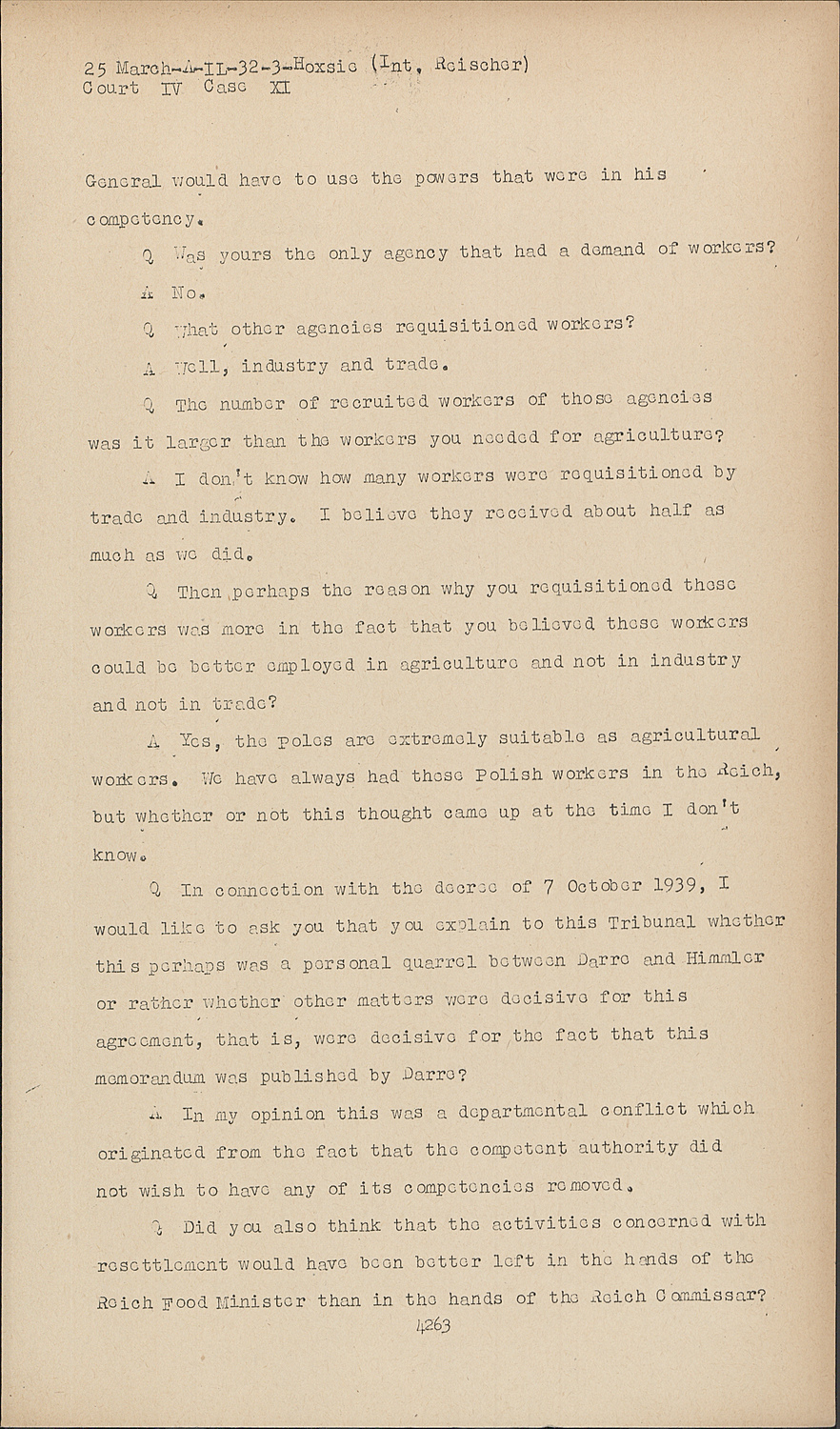
QWas yours the only agency that had a demand of workers?
ANo.
QWhat other agencies requisitioned workers?
AWell, industry and trade.
QThe number of recruited workers of those agencies was it larger than the workers you needed for agriculture?
AI don't know how many workers were requisitioned by trade and industry. I believe they received about half as much as we did.
QThen perhaps the reason why you requisitioned these workers was more in the fact that you believed these workers could be better employed in agriculture and not in industry and not in trade?
AYes, the Poles are extremely suitable as agricultural workers. We have always had these Polish workers in the Reich, but whether or not this thought came up at the time I don't know.
QIn connection with the decree of 7 October 1939, I would like to ask you that you explain to this Tribunal whether this perhaps was a personal quarrel between Darre and Himmler or rather whether other matters were decisive for this agreement, that is, were decisive for the fact that this memorandum was published by Darre?
AIn my opinion this was a departmental conflict which originated from the fact that the competent authority did not wish to have any of its competencies removed.
QDid you also think that the activities concerned with resettlement would have been better left in the hands of the Reich Food Minister than in the hands of the Reich Commissar?
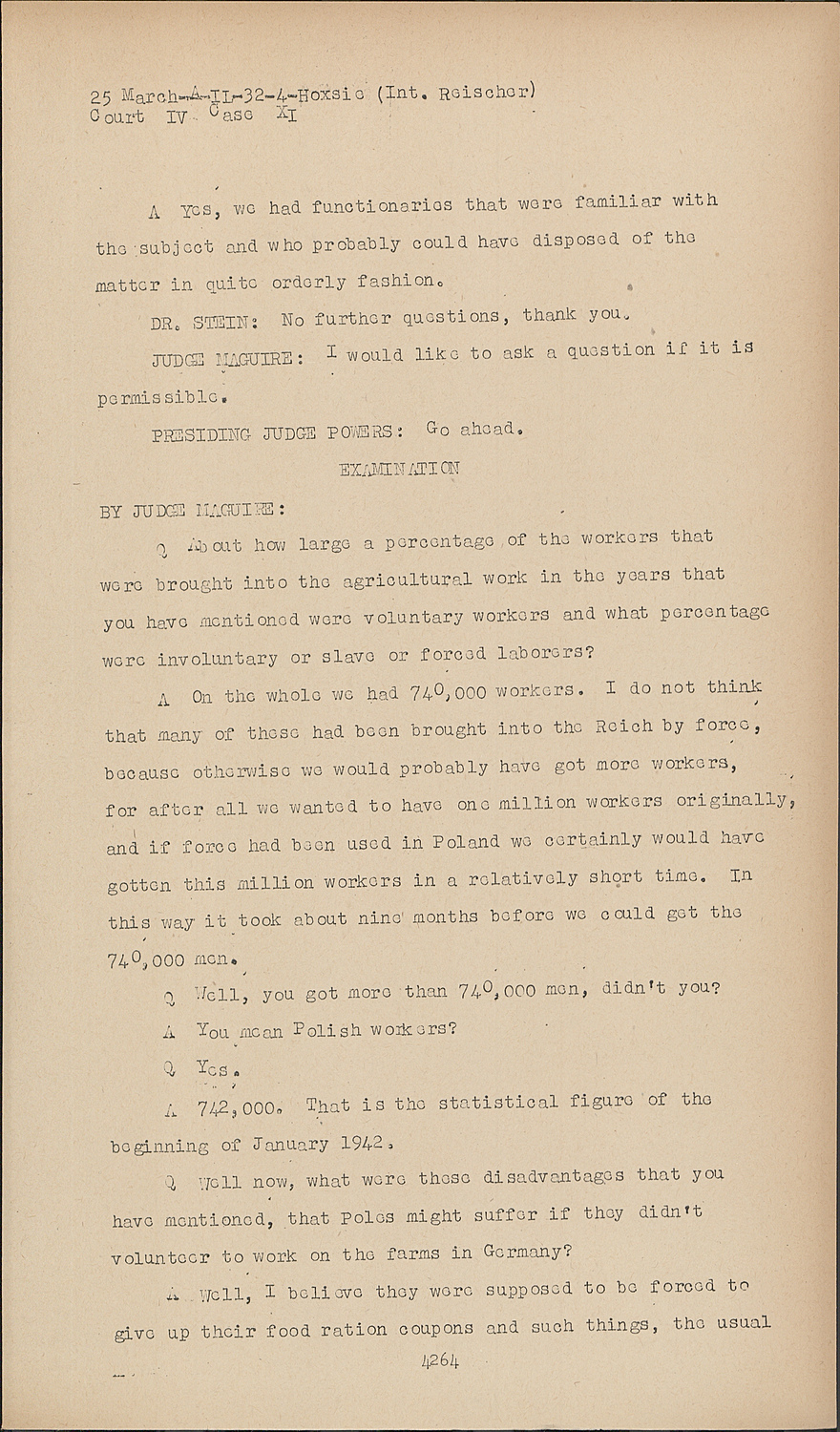
AYes, We had functionaries that were familiar with the subject and who probably could have disposed of the matter in quite orderly fashion.
DR. STEIN:No further questions, thank you.
JUDGE MAGUIRE:I would like to ask a question if it is permissible.
PRESIDING JUDGE POWERS:Go ahead.
EXAMINATION BY JUDGE MAGUIRE:
QAbout how large a percentage of the workers that were brought into the agricultural work in the years that you have mentioned were voluntary workers and what percentage were involuntary or slave or forced laborers?
AOn the whole we had 740,000 workers. I do not think that many of these had been brought into the Reich by force, because otherwise we would probably have got more workers, for after all we wanted to have one million workers originally and if force had been used in Poland we certainly would have gotten this million workers in a relatively short time. In this way it took about nine months before we could get the 740,000 men.
QWell, you got more than 740,000 men, didn't you?
AYou mean Polish workers?
QYes.
A 742,000. That is the statistical figure of the beginning of January 1942.
QWell now, what were these disadvantages that you have mentioned, that Poles might suffer if they didn't volunteer to work on the farms in Germany?
AWell, I believe they were supposed to be forced to give up their food ration coupons and such things, the usual measures that one would take if somebody would not report to the labor office, and that is the same way today.
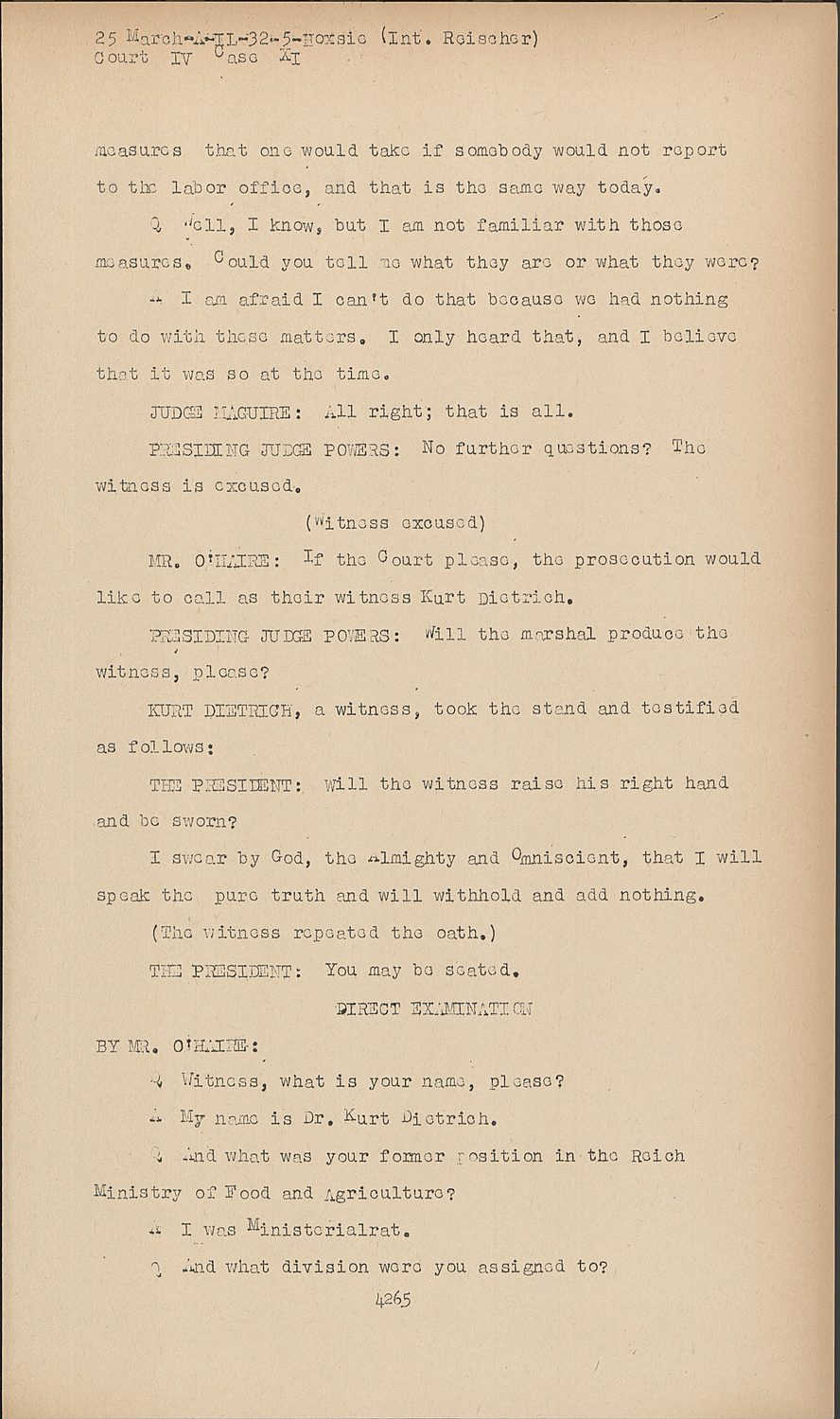
QWell, I know, but I am not familiar with those measures. Could you tell me what they are or what they were?
AI am afraid I can't do that because we had nothing to do with these matters. I only heard that, and I believe that it was so at the time.
JUDGE MAGUIRE:All right; that is all.
PRESIDING JUDGE POWERS:No further questions? The witness is excused.
(Witness excused)
MR.O'HAIRE: If the Court please, the prosecution would like to call as their witness Kurt Dietrich.
PRESIDING JUDGE POWERS:Will the marshal produce the witness, plecase?
KURTDIETRICH, a witness, took the stand and testified as follows:
THE PRESIDENT:Will the witness raise his right hand and be sworn?
I swear by God, the Almighty and Omniscient, that I will speak the pure truth and will withhold and add nothing.
(The witness repeated the oath.)
THE PRESIDENT:You may be seated.
DIRECT EXAMINATION BY MR. O'HAIRE:
QWitness, what is your name, please?
AMy name is Dr. Kurt Dietrich.
QAnd what was your former position in the Reich Ministry of Food and Agriculture?
AI was Ministerialrat.
QAnd what division were you assigned to?
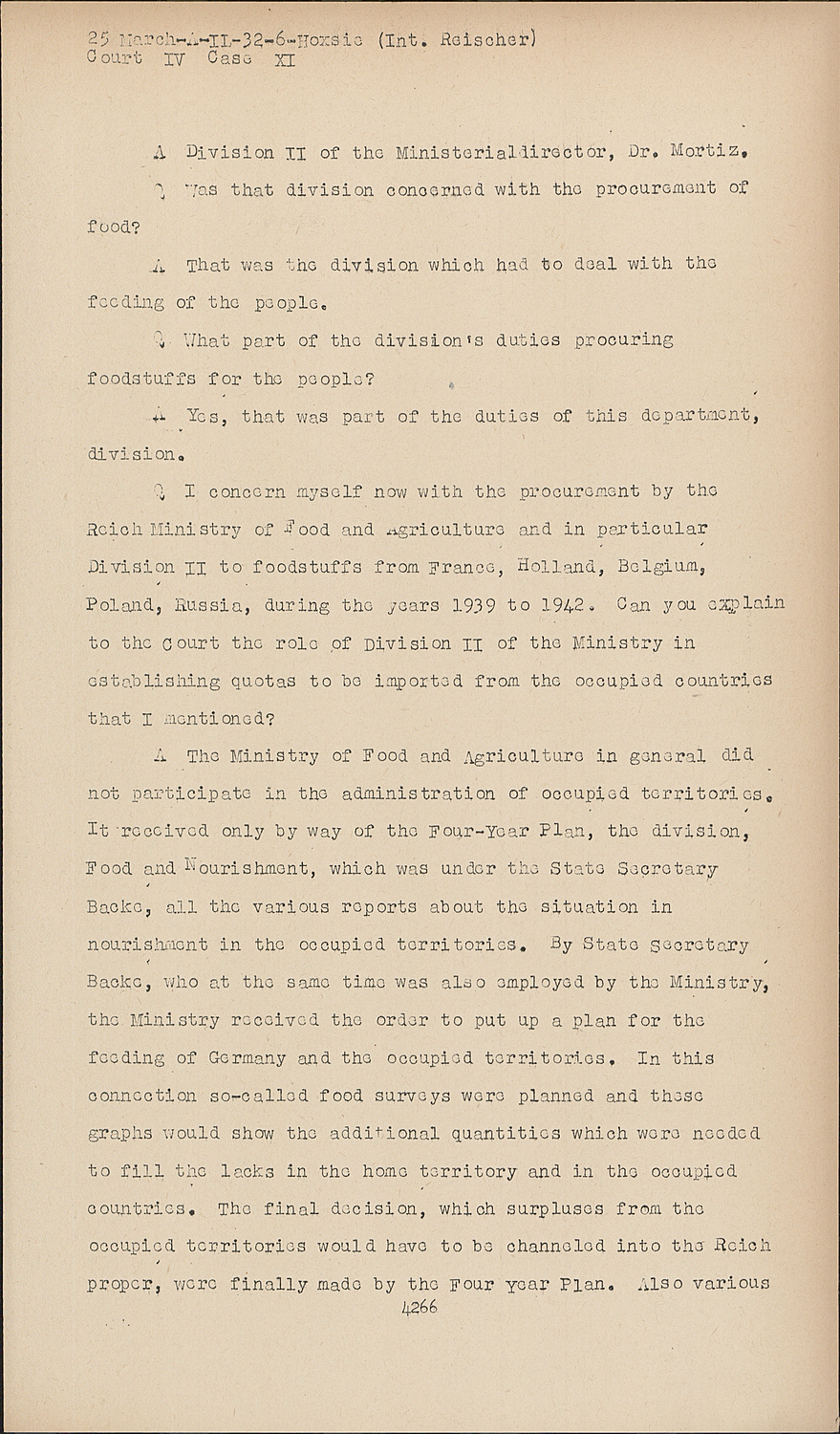
ADivision II of the Ministerial director, Dr. Mortiz.
QWas that division concerned with the procurement of food?
AThat was the division which had to deal with the feeding of the people.
QWhat part of the division's duties procuring foodstuffs for the people?
AYes, that was part of the duties of this department, division.
QI concern myself now with the procurement by the Reich Ministry of Food and agriculture and in particular Division II to foodstuffs from France, Holland, Belgium, Poland, Russia, during the years 1939 to 1942. Can you explain to the court the role of Division n of the Ministry in establishing quotas to be imported from the occupied countries that I mentioned?
AThe Ministry of Food and Agriculture in general did not participate in the administration of occupied territories. It received only by way of the Four-Year Plan, the division, Food and Nourishment, which was under the State Secretary Backe, all the various reports about the situation in nourishment in the occupied territories. By State secretary Backe, who at the same time was also employed by the Ministry, the Ministry received the order to put up a plan for the feeding of Germany and the occupied territories. In this connection so-called food surveys were planned and these graphs would show the additional quantities which were needed to fill the lacks in the home territory and in the occupied countries. The final decision, which surpluses from the occupied territories would have to be channeled into the Reich proper, were finally made by the Four year Plan. Also various negotiations had taken place with the various military commanders or the Reich Commissars.
QDid the Division II determine the surplus foodstuffs in the occupied countries?
ADivision II did not decide what those surpluses had to be put it only channeled the surpluses that were allocated to this division to their final destination.
QDid the Division II, after a study of the food available in the occupied countries and after consideration of the need for foodstuffs within the Reich, determine upon the amount of foodstuffs that they would import or that they recommended to be imported to the Reich?
ADivision II only made the corresponding recommendations as to which the foodstuffs were to be imported so that the German people could be fed.
QNow, once the food being imported into the Reich reached the borders of the Reuch, would it go to the agencies of the Reich Ministry?
AThe Ministry disposed of these foodstuffs with the help of the various Reich agency offices.
QNow as to the contact between the Ministry and in particular Division II and the personnel in charge of the agricultural departments in the occupied areas, were the people in the occupied areas concerned with food and agriculture former employees of the Reich Food Estate or the Reich Ministry?
AThese in general were members of the Reich Food Estate.
QWere those former members in a position to determine the amount of foodstuffs actually within the area in the occupied countries?
AI really cannot testify to this point because I was not able close contact with this whole field. I should assume though that the gentlemen from the agencies of the Reich Food Estate who were sent into the occupied territeries could got an overall view of the situation in foodstuffs and nourishment in the occupied territories from their own personal experiences
QIn the event that there was some opposition by the former members of the Reich Food Estate or Reich Ministry to the amount of foodstuffs requested for the Reich, was it possible for the Ministry to recall the same personnel to Germany?
AThe Reich Ministry had no influence upon that. But State Secretary Backe who was head of the Group Food in the Four Year Plan, would request that s suitable replacement be sent.
QWas it possible in the event that Division II thought they were receiving same opposition from these former employees anddecided that they should be recalled, was it possible for them to ask State Secretary Backe to request their recall by means of Goering and the Four Year Plan?
ADivision II probably had no influence upon this fact, but only the State Secretary Backe in his capacity as head of the Business Group Food in the Four Year Plan.
QIn the event it was decided to recall an individual, that we referred to, a former employee of the Reich Food Estate, was it possible to recall him directly?
ADirectly? No. He could not be recalled directly because this man, the member of the Reich Food Estate, was subordinated either to a commander or a Reich Commissar and was a member of their staff. That could only go though the OKW or through the Four Year Plan.
QI have in mind two former members of the Food Estate recalled from Poland. While the recall is not direct, I would like to know whether or not it was not it was not possible that the Ministry, in particular Division II, through State Secretary Backe, could have these men recalled?
AConcerning these conditions in Poland I cannot testify according to my own knowledge since I did not work with these matters, but here too I would assume that that too was possible only via the Four Year Plan.
QNow during the years 1939 to 1945 in all matters pertaining to the Reich Ministry of Food and Agriculture and the Reich Food Estate who was the responsible person?
AIn the first place it was the minister who was the responsible man.
MR.O'HAIRE: Thank you, that is enough. Your witness.
CROSS EXAMINATION BY DR. STEIN: (For the defendant Darre):
QWitness, you have just mentioned that the surpluses from the occupied territories were channeled into the Reich proper and you have just been speaking of the western countries. Do you know that the countries, Denmark, and the Netherlands, exported their agricultural products in normal times?
A.Yes, I knew. I also did not speak about Denmark in this connection because after all we had trade treaties with Denmark even during the war. Denmark, I believe, was not within the circle of these occupied western territories.
Q.Do you know that these territories, and especially Denmark, before the war exported to England their agricultural products, and especially their pork?
A.Yes, I know.
Q.During the war this international market was, of course, disrupted Now all these countries had only one way during the war and that was to import into Germany or into all the occupied territories. You have just said in this connection that trade agreements were negotiated with these countries, is that correct?
A.With Denmark?
Q.Yes, with Denmark.
A.Yes. Well, Denmark was not an occupied territory.
Q.Do you know what the situation was with the Netherlands?
A.With the Netherlands, of course, the Reich Commissar for the occupied Netherlands territories was the negotiator tut no treaties were concluded.
Q.In this examination you have mentioned that people of the Reich Food Estate, that is in their capacity as experts, were sent into these territories. Now I should like to ask you whether these members of the Reich Food Estate, were drafted by the armed forces as all the other people, and as such were subordinated to their - that is were exclusively subordinated to their Army superior.
A.Well, I really can't say who drafted then, whether it was the OKW or whether it was the Four-Year Plan, but I should assume that they were drafted by the OKW and were sent into the occupied territories that had a military commander. In the other territories, for instance, Holland which had a Reich Commissar they were drafted in the usual way via the Four-Year Plan and were sent to Holland to their various positions.
Q.At the moment when these people in question were either drafted into the Army or as in the Netherlands were subordinated to the Reich Commissar, now were they then completely - had they completely severed their relations with the Reich Food Ministry I wish to say?
A.They had been excluded from membership in the Food Ministry and the Food Estate and either belonged as military personnel to the OKW or as military personnel to the Reich Commissar.
Q.That is to say that they got their directives exclusively from other agencies?
A.Yes, they got their directives then either through the OKW, through the military commander, or the Reich Commissar to whom they were subordinated then.
Q.You mentioned the person of Banks. You also pointed out that Backs was a member of the Four-Year Plan personnel. Is it correct that that capacity received his directives exclusively from Goering?
AWell, Backe was, of course, the head of the Business Group Food within the framework of the Four Year Plan, and in his capacity as such received directives from Goering.
DR. STEIN:No further questions, thank you.
PRESIDING JUDGE POWERS:There being no further questions the witness is excused.
(The witness was excused)
PRESIDING JUDGE POWERS:Do you have any other witness?
MR.O'HAIRE: One more witness, Your Honor, Pflaumbaum.
PRESIDING JUDGE POWERS:The Marshal will produce the witness.
WALTERPFLAUMBAUM, a witness, took the stand and testified as follows:
THE PRESIDENT:Will the witness raise his right hand and be sworn. I swear by God, the Almighty and Omniscient, that I will speak the pure truth and will withhold and add nothing.
(The witness repeated the oath.)
THE PRESIDENT:You may be seated.
DIRECT EXAMINATION BY MR. O'HAIRE:
QWitness, what is your name?
AMy name is Walter Pflaumbaum.
QAnd what was your former position within the Reich Ministry of Food and Agriculture?
AI was formerly an official for stockbreeding in the Rheinland, and later on the head of the division for live stock raising and animalproducts.
QWill you explain the position you last described?
AThe Reichstelle for animal products had the duty to take over surplus animal products in the Reich, to stock them up, and also to see to it that the imports of meat and animal products from abroad to the Reich were carried out.
QNow, were there other similar rank offices?
AYes, for the various food stuffs, there were, of course, the most divergent Reich offices as for meats, vegetables, fat and so forth.
QSo that we can say that the operation of the other Reich offices was similar to yours?
AYes, as far as my memory serves, the other Reich offices conducted their business in the same away as the agency at whose head I was.
QFine. We will now concern ourselves with the request for food products and food products imported into the Reich. How were you notified as to the importation of a shipment of cattle?
AThe amounts of live stock and meat that were to be imported were told us by the Reich Ministry for Food and Agriculture. The technical carrying out of the taking over of these products formed the competency of the Reich offices.
QNow, as to the receipt of food stuffs from the occupied territories, was It possible that the food stuffs could be received by any other organizations in addition to the Reich offices?
AThe amounts of live stock and meat that came in from the occupied territories were taken over by the military administration of the occupied territories and were sold to us or given to us, or by the organization that was designated to do just this job by the military administration.
QOnce you received the food stuffs, what was your procedure?
AThe live stock and the meat was given over to us from so-called frontier slaughter houses which had already been established before 1933 or slaughter houses close to frontiers.
These animals were taxed and classified. In as far as special agreements with the countries existed, these agreements were acted upon accordingly and were carried out by mixed committees and commissions. In so far as there were no such agreements, these animals were classified according to German tables and were paid for accordingly.
QNow, in the Reich office, you were directly subordinate to the Reich Minister?
AThe Reichstelle was subordinate to the Ministry for Food and Agriculture and received its directives from there.
QYou had direct contact with Division II of the Reich Ministry of Food and Agriculture?
AYes, the directives in general came from the referents who were competent for live stock and meat economy in the Ministry.
QAs to the distribution of the food stuffs within the Reich, you followed the orders of the Reich Ministry?
AThe directives came from the Reich Food Estate which since the beginning of the war was subordinate to the Reich Ministry.
QNow, as to the office and its profits. After you had reached a ceiling of approximately 60 million, the balance was paid, or the excess was paid into the Reich treasury?
AThe Reichstelle had surplus only in peacetime, but in wartime, of course, there was no surplus, imports went up in price and with that we had losses, of course.
QNow, just repeating this, all food stuffs coming into the Reich came in through the Reich offices?
AYes, in the field of live stock and cattle and meat, all the animal products came through the Reich office for animals, and it was probably the same way with the other Reich offices.