QIs it correct to say that the Dierlewanger Brigade was fighting at a particularly dangerous point of the Eastern Front.
AThe area between Mogilar and Minsk was, I should say, a highly dangerous partisan area; Smolensk was also, the whole center was.
QI'm not interested in dealing with the activity of the Dierlewanger Brigade which becomes clear from the following. I'd like to put to you: To whom was the Dierlewanger Brigade sub ordinate?
AAll I know, Counsel, is that this brigade was sub ordinate to the Chief of the SS Main Office, and I know that from what Gruppenfuehrer Juers told me. I know it from my comrades and all other people in the office. We knew that it was subordinated to the Chief of the Main Office. To offer prove therefor I am unable to do. All I can say is that I know what I was told and what we all knew.
QIs it true to say that the Dierlewanger Brigade consisted of people with previous criminal convictions, to whom an opportunity was to be offered to prove their worth in this brigade and thus rehabilitate their civilian and military honor?
AYes. For instance, what pilferers and people were present, and those whom I met myself, had more or less previously been convicted by the SS in military matters, not in criminal matters; they were not private people. They were simply SS members, some of whom came from Danzig-Matskau; and some of them had been in the Dachau Concentration Camp.
QAnd you yourself were sent there because you were charged with various actions an SS man was not supposed to undertake?
ATo answer that question from my own conscience I am unable to do. If I want to give an answer to myself I am bound to say that on the whole I feel not guilty, and the punishment was extremely harsh to be sent to the Dierlewanger Brigade. I would have equally liked to have gone out as a simple soldier.
QWere you and Juers friends?
AYes, we established contact with each other because I got him a room with Herr Etschner.
QWell, we need not go into those details.
ANo.
QDid you ever complain to Juers that it was unjust for you to be sent to the Dierlewanger Brigade?
AI did not do that at all because Kuefner and Juers had done that themselves. I did not do it at all.
QWhy not?
AI once spoke to him about it, and he said, "Vogel, there's nothing else we can do. You must rehabilitate yourself." It is very difficult for me to answer your question.
QYou see -- now you speak about rehabilitation again but surely that pre-supposes that you had once been punished from a disciplinary or a judicial point of view; therefore, I would like to ask you, were you, on several occasions, punished as an SS man.
AAs a decent German, and with all the honor I have at my disposal here, I was never punished for disciplinary matters at an ordinary police or SS court; apart from Vienna, I was never punished. For weeks and months I was in protective custody in Grunewaldstrasse, and I was released therefrom.
QWere you ever present when ethnic Germans were recruited?
ANo.
QTherefore, you don't know how the recruiting went on?
AAll I know about that is that, for instance, in the SS Recruitment Office, particularly in Vienna, under Sturmbannfuehrer Ietsch I saw a certain amount of this. I saw the daily correspondence concerning the orders, etc.
QWhat were the tasks of the SS Main Office?
AThe SS Main Office? Of course I know only the various tasks of the SS Recruitment Office.
QPlease excuse me if I interrupt you, Witness. Let us not waste the time of the Court. Please tell me, very briefly, what the tasks of the SS Main Office were.
AThe SS Main Office, as for its task, was controlling the whole of the Allgemeine SS and as such the various offices assigned to it. It is very difficult to give you all the details.
QDid you, at any time during your activity, find out through personal experience that to the SS Main Office the Dierlewanger Brigade was subordina ted?
AI did not find that out for certain, but I heard -
QI don't want to know what you heard. I want to know what you experienced yourself.
AI once had an order in the Adjutant's Office of Gruppenfuehrer Juers, according to which the Dierlewanger Brigade, between December 1943 and 1944, was to be recruited from the Danzig-Matskau Camp etc.; but I no longer know from whom this came.
QWould it be correct to say that the SS Main Office had to see to it that the troops at the front were supplied with suitable men and equipment?
AThis was the SS Recruitment Office, with the SS Main Operational Office's being called in.
QWas the Recruitment Office not under the SS Main Office?
AYes.
QTherefore, it would be possible to say that the SS Main Office was responsible for the replacement and supplying of the troops at the front?
AYes, certainly.
QAccording to your personal knowledge did this entail an authority to issue orders on the part of the Main Office to the troops at the Eastern Front.
AI cannot answer that question. It's beyond my ability.
QTherefore, from your own observations you could not testify here that the Dierlewanger Brigade was under the SS Main Office from the point of view of issuing orders? I mean from your own observations.
AIt's an assumption, as I say; it's purely hearsay as I said before. I could not offer you any proof. All I know is that Obergruppenfuehrer Berger and Dierlewanger were great friends.
QNow, I have a few questions left. I asked you once before whether you now own any property. Didn't you say this morning, at the beginning of your direct examination, that you lend somebody 120,000 Marks?
AI always earned good money. I was the general representative of the Lingel Shoe Factory in Erfurt, and I was in charge of two enterprises. In 1939 until 1941, I released that money. I salvaged some money. Then, I had to start from scratch again.
That's the fate of the nation.
QIn conclusion I would like to ask you: You were never punished for disciplinary reasons nor were you punished judicially, apart from the Vienna conviction?
ALet me emphasize before this Tribunal once again, my honor as a private German Was never reflected upon, except for political reasons.
QIf the Tribunal please, the testimony of this witness has been so confused in parts that I will have to make the motion of supplying a list of previous punishments inflicted on this witness. From that list it will become clear whether and in how far the testimony of this witness concerning his convictions was correct or was not correct.
Now, I have a final question: Did you ever see a chart concerning the organization of the Main Office? Did you collaborate in working up such a chart?
ANo.
QPlease look at this chart here on the wall (POINTED TO THE PROSECUTION PREPARED CHART ON THE LEFT WALL OF THE COURTROOM) There in the bottom row you will find a square where it says Dierlewanger Brigade, and that square is linked by red lines with the SS Main Office. Were you ever shown a chart or a draft which showed a similar picture as the chart does?
ANo, counsel, I have not collaborated in drawing up any such chart. I know our charts, of course. That chart in the Main Office did not show this link to the Dierlewanger Brigade.
QI have no further questions.
PRESIDING JUDGE POWERS:Is there any further cross examination?
Any direct?
MR. PETERSEN:No, Your Honor, no further questions.
PRESIDING JUDGE POWERS:If there are no further questions for this witness, the witness will be excused.
You are excused, Mr. Witness.
(THE WITNESS LEAVES THE STAND)
PRESIDING JUDGE POWERS:Did you have another witness?
MR. PETERSEN:Yes, I should like to call the witness Konrad Morgan to the stand.
PRESIDING JUDGE POWERS:Will the Marshal produce the witness, please?
MR. PETERSEN:In connection with the Dierlewanger charge against the Defendant Berger I should like to make this statement -- that we do not charge that the Defendant Berger had tactical control over the Dierlewanger unit at any time, except during the time that he was Military Commander in Slovakia in 1944. We do charge that he had administrative control over the unit and that he recruited members of the unit with the knowledge of the atrocities commited by the unit, and that he had the power of appointment and removal of Dierlewanger and of Dierlewanger's subordinates and that he had every power over Dierlewanger except that tactical control in the field.
PRESIDING JUDGEPOWERS: (To the Court Marshal) I think you have the wrong witness.
(To the Prosecutor): I may have misunderstood you, but who did you say you charge?
MR. PETERSEN:Konrad Morgan. Of what, Sir? I'm sorry.
I said we charged Berger with recruitment for the Dierlewanger unit, with every power over the Dierlewanger unit except that of tactical control in the field and military operations. We do not charge that except insofar as Berger was Military commander in Slovakia.
PRESIDING JUDGE POWERS:Well, we'll note the claim.
KONRADMORGAN, a witness, took the stand and testified as follows:
THE PRESIDENT:Will the witness raise his right hand and be sworn?
"I swear by God, the Almighty and omniscient, that I will speak the pure truth and that I will withhold and add nothing." (THE WITNESS REPEATED THE OATH) You may be seated.
DIRECT EXAMINATION BY MR. PETERSEN:
QWitness, what is your full name?
AKonrad Morgan.
QWhen and where were you born?
AOn the 8th of June 1909, Frankfurt am Main.
QWhat was the last rank that you held in the SS?
ASS-Sturmbannfuehrer.
QWill you please indicate to the Tribunal -- give the Tribunal a summary of your career and your activity in the SS?
AAt the beginning of the war I was conscripted into the Waffen SS. I remained with the troops for one year. In October 1940 I was sent to the SS Main Court as a judge. I was with the SS and Police Court VI at Cracow. In May 1942 I was relieved of my office; I was demoted because of an acquittal and was sent to the front as an ordinary soldier. In June 1943 I was called back to the Reich criminal police Office by order, and in that position I was in charge of investigations in concentration camp. I remained in that position for one year, and by the end of 1944 I was sent to the SS and Police Court, Breslau, where I was stationed when Germany collapsed.
QNow, if I understood you correctly, you said that you were an SS judge. Will you please tell us of your activity with the SS and Police Court VI, in Cracow?
AAn SS judge was a judge of courts martial with the Waffen SS, and his tasks and functions correspond to the Wehrmacht courts martial regulations. My task consisted of investigating and preparing criminal cases and the indictment. And in cases where I was not in charge of investigations I was the presiding judge in the actual proceedings. Our competency reached all members of the Waffen SS and those of the police troops who were on active duty, irrespective of their membership in the SS. But we were not concerned with members of the Wehrmacht, civilians, foreigners or other persons.
QNow, Witness, when did you first hear of the Dierlewanger unit?
AI think this must have been at the beginning of 1942 when the many convictions of a certain troop unit came to my notice. And this caused me to pay particular attention to this unit. That unit was only known to me under their APO number as it were. This concerned pilfering and mistreatment of the civilian population, and the sentences reached against members of that unit. I made the surprising discovery that all of them had previous convictions, I also found out that that unit was commanded by a Sturmbannfuehrer Dierlewanger. As for this Sturmbannfuehrer Dierlewanger, a number of complaints were in circulation, as well as criminal applications When I investigated his record I found out that he had been sentenced for immorality to four years' hard labor and that he had served that sentence. I saw his criminal record myself.
QWhat kind of a charge had been levied against him? What was the offense?
AHe had committed a grave offense of immorality in office.
I found that out with such surprise that I availed myself of the next opportunity of going to Lublin, the garrison, and checking up on the man's activity more closely.
QNow, will you tell the Court what you found out further in the course of your investigations? What did you find out about this unit and about Dierlewanger?
ALet me correct something here, At that time we were not concerned with the brigade. It was a much smaller unit; it was a unit which was not part of the Waffen SS. It amounted to a police supplementary unit, used for the protection of road work in the Government General. The members, at that time, consisted purely of poachers with previous convictions. Later on inmates of concentration camps and other criminals were transferred to the unit. The unit grew and grew until it finally reached the strength of a division. But when I investigated at that time the unit was no longer larger than about one battalion. The previous convictions which I found out about were, as I said before, for pilfering and mistreatment of the civilian population. When I contacted the agencies in Lublin to make inquiries I heard everywhere the dramatic complaints, and particularly the security police described to me this unit as a post and a terror of population, as well as of the German agencies. It was a completely illegal bunch of people, and the man in charge, Dierlewanger, did not observe the law or moral obligation of man. For instance, on repeated occasions he had pilfered the ghetto in Lublin. He went on plundering and embezzling the money made therefrom. He arrested the people, and particularly he would arrest the Jews and accuse them of ritual slaughter, which was illegal at the time; but this was only done in order to blackmail them, in order to have them pay money up to the amount of 15,000 Zloty.
With that sum this so-called sentence could be paid for, and the Jew concerned was released. If the money did not appear the man would be shot. But the most frightful incident which was told me was this: As I said before, Dierlewanger had arrested people illegally and arbitrarily, and as for his female prisoners -- joung Jewesses -- he did the following against them: He called together a small circle of friends consisting of member of a Wehrmacht supply unit. Then he made so-called scientific experiments, which involved stripping the victims of their clothes. Then they (the victims) were given an injection with strychnin. Dierlewanger looked on smoking a cigarette, as did his friends, and they saw how these girls were dying. Immediately after that the corpses were cut into small pieces, mixed with horse meat, and boiled into soap.
I would like to state here, emphatically, that here we were only concerned with the suspicion, although a very urgent one. We had witness's testimony concerning these incidents, and the security police Lublin had made certain investigations. As there were so many criminal cases on my hands, I investigated only very sporadically and broke this off because it seemed to me to be the most urgent thing to arrest Dirlewanger at once and investigate all these frightful crimes later on in very detailed proceedings. For that reason after two days' investigations I left Lublin immediately and returned to Cracow in order to tell SS Obergruppenfuehrer Krueger, the Supreme Judicial authority, in detail about these things. I asked him for an order for arrest of Dirlewanger and the members of his brigade staff.
QWhat happened when you reported this matter to your judicial officer?
AObergruppenfuehrer Krueger showed indignation and had a fit of rage; however, he told me, "There is nothing I can do here. Unfortunately I am not competent because this detachment is subordinate exclusively to the orders of SS Obergruppenfuehrer Berger." He thereupon, in my presence, rang up SS Obergruppenfuehrer Berger at the head office in Berlin. The telephone call came through in a very few minutes. Obergruppenfuehrer Berger himself was on the line. Krueger screamed at Berger in no mean manner and told him all these atrocities committed by Dirlewanger and his units, and in conclusion he told him, "You see to it that this bunch of criminals will disappear from the Government General within a week or I will act myself and lock them all up." Berger was somewhat "small-mouthed" on the occasion and promised to do everything he could and that was the end of the conversation. In actual fact, within ten days or a fortnight, it took a little longer than the time limit set originally, the unit was transferred. It was my assumption that the unit would be sent to a training center in the Reich area in order to be dissolved there; that Dirlewanger would be punished, but to my surprise I learned that the unit had been sent to Southern or Central Russia to Mogilev.
I thereupon sent the files with a report to the commander of the unit, and the Supreme Judicial authority concerned, but it would appear that nothing was done against Dirlewanger, because he was promoted to a General and his unit in the end was as strong as a division.
QNow, if it should be true that Dirlewanger were not subordinate to Berger would this necessarily mean that Berger was not responsible for Dirlewanger's actions? In combat I mean?
JUDGE MAGUIRE:I think you had better ask that question over again because I don't understand what you mean.
QIf it should be true that Dirlewanger were not subordinate to Berger during combat, would this necessarily mean that Berger was not responsible for Dirlewanger's actions?
DR. FROESCHMANN:Dr. Froeschmann for Berger. If the Tribunal please, I object to this question. It is a question of a purely legal nature. This witness should only report his facts.
JUDGE POWERS:Well, it does seem to the Tribunal that the question invades somewhat the province of the Tribunal and calls for an incompetent conclusion. The objection is therefore sustained.
QWitness, during the course of your investigations as an SS Judge did you determine that there were personal connections between Berger and Dirlewanger?
AYes, there were very close relations between them, Berger visited Dirlewanger in Lublin and there was a denunciation made about that also, because Berger and Dirlewanger went hunting there which was illegal. In other words, they became poachers themselves and Berger when he returned became so drunk that he wrapped his car around a tree, which ruined the car completely. There was also the customs people complained that a whole truck load of geese was sent from Lublin to Berger's main office in Berlin. It was found out at the time that in violation of the many strict regulations concerning fuel for "official trips" and all that, that the truck had been sent by Berger from Berlin to Lublin in order to pick up these geese illegally.
I also found out that Dirlewanger made a present to Obergruppenfuehrer Berger in the shape of a very big and valuable Persian carpet which, of course, he had stolen.
QWere there also shipments of liquor and other food that were made by Dirlewanger in the East to Berger?
AThere is nothing I can say about that. I was more interested in the bigger issues.
QWhat did you do with the files of your case against Dirlewanger?
AAs I said before, I sent them to my Supreme Judicial authority, Obergruppenfuehrer Krueger. After it was found that Berger was competent as the Judicial authority the files were sent on to him, together with a report to Reichsfuerher SS Himmler.
QWitness, is it true that shortly after your investigations of Dirlewanger you were demoted and sent to the front lines?
AYes, I said this before.
QDid you hear anything further about Dirlewanger after you came to the criminal police office? The German - in 1943? Reichs Kriminal Polizei.
AWhen I investigated matters connected with concentration camps, I found out that the Dirlewanger unit had to a very large extent carried out a recruiting campaign in concentration camps, asking for volunteers from among the inmates who could join their ranks.
QWhat kind of persons were selected from concentration camps?
AThose who volunteered and those who were medically suitable. No distinction was made between political or criminal inmates.
QWhat were your duties in the Reichskriminalpolizei Amt? The Reich Criminal Police Office?
AI was expected to investigate important criminal issues.
QDid you during the course of those investigations investigate the Commander of Buchenwald Concentration Camp?
AYes, for instance, I investigated the case of Standartenfuehrer Koch, the Commandant of Buchenwald camp, and his wife, whom I arrested.
I investigated about five commandants of concentration camps, and started 700 proceedings against concentration camp guards and members of the commandant's staff.
QWhat were the results of your investigations of Koch and what happened to Koch?
AKoch was sentenced to death and shot.
QWasn't Koch with the Post Schutz Einheit? The Postal guards?
AWhen I went to Buchenwald concentration camp, Koch had been relieved from his post as Commandant just before and was in charge of a Postschutz regiment at Saatz, and in that capacity he was subordinate to Obergruppenfuehrer Berger direct.
QDid you work on any further cases in the Reich Kriminal Polizei Amt? The Reich Criminal Police Office? Did you work on any other further cases which involved the defendant Berger?
AYes, in 1944 I came across him in an important case. That case concerned investigations directly against the Germanic Main Office, Brussels.
QExcuse me, the translation is "The Germanic Directorate".
A (Interpreter) The Germanic Directorate in Brussels.
QWill you go into detail about that investigation?
AI found out in these investigations that Obergruppenfuehrer Berger used this Germanic Directorate to carry out the following transactions: there were several millions of Belgian francs which he had smuggled into Brussels, which was of course in complete violation of all foreign currency regulations, including also the Wehrmacht regulations concerning exchange; and with those Belgian francs he bought illegally from a Belgian banker English gold sovereigns. These gold sovereigns were smuggled into Paris and exchanged into diamonds, and he smuggled the diamonds to Spain, and for those diamonds he wanted to buy Tungsten which is important for armament production. The man who carried out these transactions on behalf of Berger, particularly the buying in Spain, was a Belgian Unter- or Obersturmfuehrer, who was a member of Berger's SS Main Office, and this is how he got his job, as I found out later:
On one day he had shot at political opponents in a cafe and killed two Belgian policemen. The Belgian police and the German agencies were looking for him, but at the Instigation of Berger he was disguised and smuggled across the frontier to Spain where he was used for these smuggling transactions.
JUDGE POWERS:It is time for our regular adjournment. Are you about through?
QI have about two or three questions yet. I don't believe they will be very long.
JUDGE POWERS:Well, if they are snort.
QWell, should this SS man have been tried by a Belgian court?
AYes, I said he was a member of the Waffen SS and belonged to Berger's Main Office. We should have sentenced him. When I heard of this case I actually had him arrested. I sent him a fake telegram to Spain and I arrested him at the frontier station in order to have him sentenced, but the prisoner transport got mixed up with the invasion and the prisoners used this opportunity to escape and probably got back to Spain.
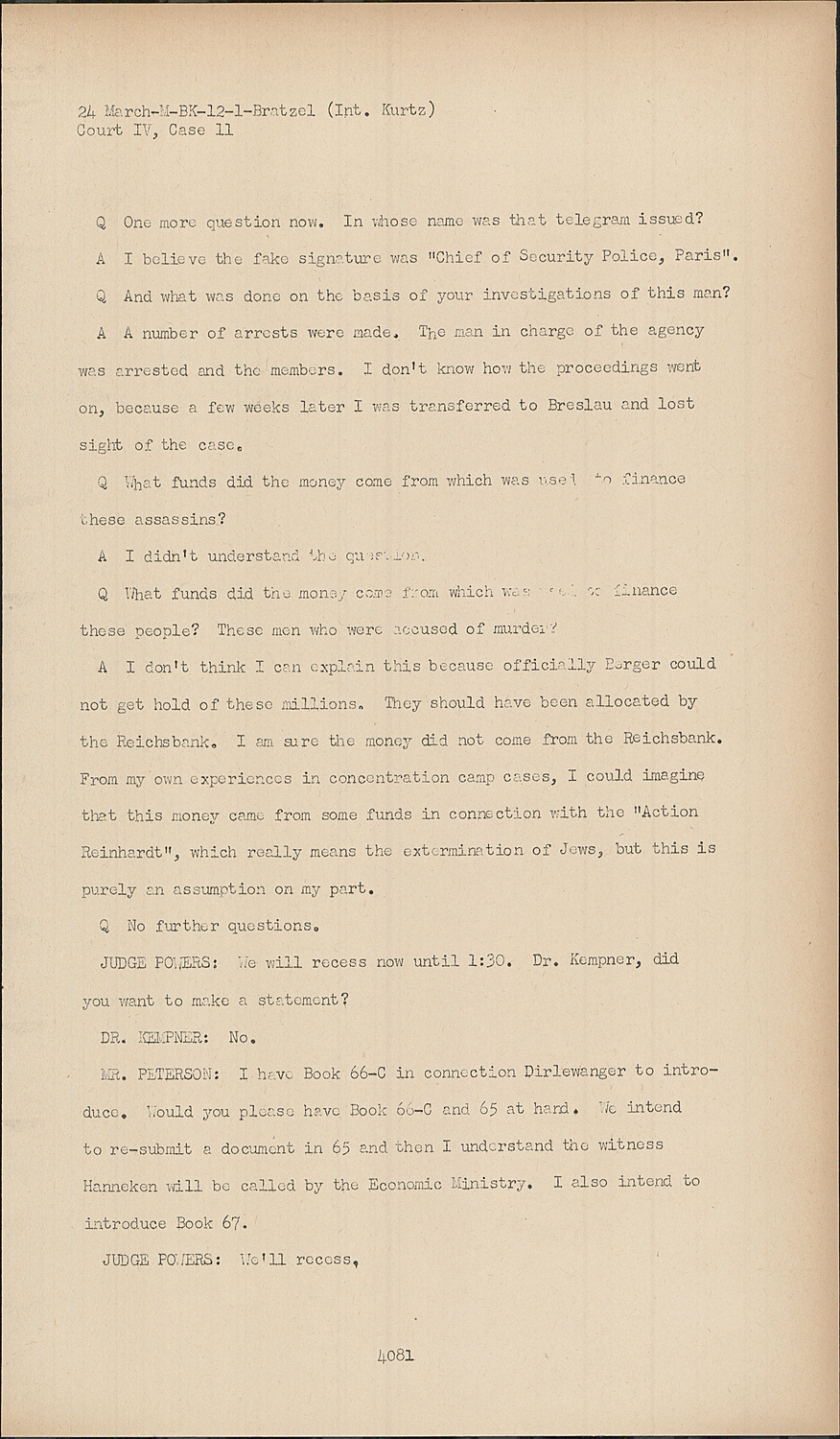
QOne more question now. In whose name was that telegram issued?
AI believe the fake signature was "Chief of Security Police, Paris".
QAnd what was done on the basis of your investigations of this man?
AA number of arrests were made. The man in charge of the agency was arrested and the members. I don't know how the proceedings went on, because a few weeks later I was transferred to Breslau and lost sight of the case.
QWhat funds did the money come from which was used to finance these assassins?
AI didn't understand the question.
QWhat funds did the money come from which was used to finance these people? These men who were accused of murder?
AI don't think I can explain this because officially Berger could not get hold of these millions. They should have been allocated by the Reichsbank. I am sure the money did not come from the Reichsbank. From my own experiences in concentration camp cases, I could imagine that this money came from some funds in connection with the "Action Reinhardt", which really means the extermination of Jews, but this is purely an assumption on my part.
QNo further questions.
JUDGE POWERS:We will recess now until 1:30. Dr. Kempner, did you want to make a statement?
DR. KEMPNER:No.
MR. PETERSON:I have Book 66-C in connection Dirlewanger to introduce. Would you please have Book 66-C and 65 at hand. We intend to re-submit a document in 65 and then I understand the witness Hanneken will be called by the Economic Ministry. I also intend to introduce Book 67.
JUDGE POWERS:We'll recess.
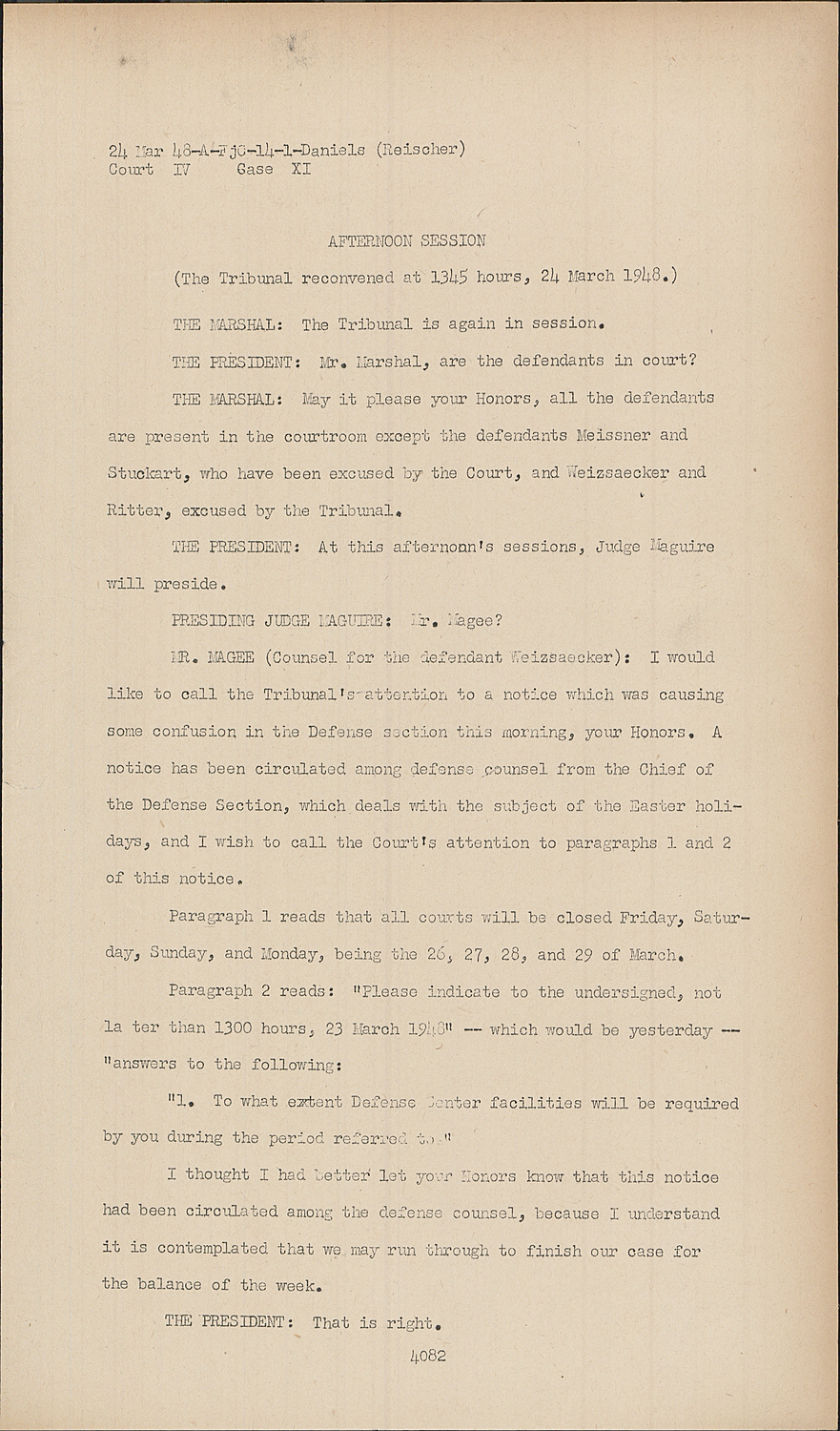
AFTERNOON SESSION (The Tribunal reconvened at 1345 hours, 24 March 1948.)
THE MARSHAL:The Tribunal is again in session.
THE PRESIDENT:Mr. Marshal, are the defendants in court?
THE MARSHAL:May it please your Honors, all the defendants are present in the courtroom except the defendants Meissner and Stuckart, who have been excused by the Court, and Weizsaecker and Ritter, excused by the Tribunal.
THE PRESIDENT:At this afternoon's sessions, Judge Maguire will preside.
PRESIDING JUDGE MAGUIRE:Mr. Magee?
MR.MAGEE (Counsel for the defendant Weizsaecker): I would like to call the Tribunal's attention to a notice which was causing some confusion in the Defense section this morning, your Honors, A notice has been circulated among defense counsel from the Chief of the Defense Section, which deals with the subject of the Easter holidays, and I wish to call the Court's attention to paragraphs 1 and 2 of this notice.
Paragraph 1 reads that all courts will be closed Friday, Saturday, Sunday, and Monday, being the 26, 27, 28, and 29 of March.
Paragraph 2 reads: "Please indicate to the undersigned, not la ter than 1300 hours, 23 March 1948" -- which would be yesterday -"answers to the following:
"1. To what extent Defense Center facilities will be required by you during the period referred to."
I thought I had better let your Honors know that this notice had been circulated among the defense counsel, because I understand it is contemplated that we may run through to finish our case for the balance of the week.
THE PRESIDENT:That is right.
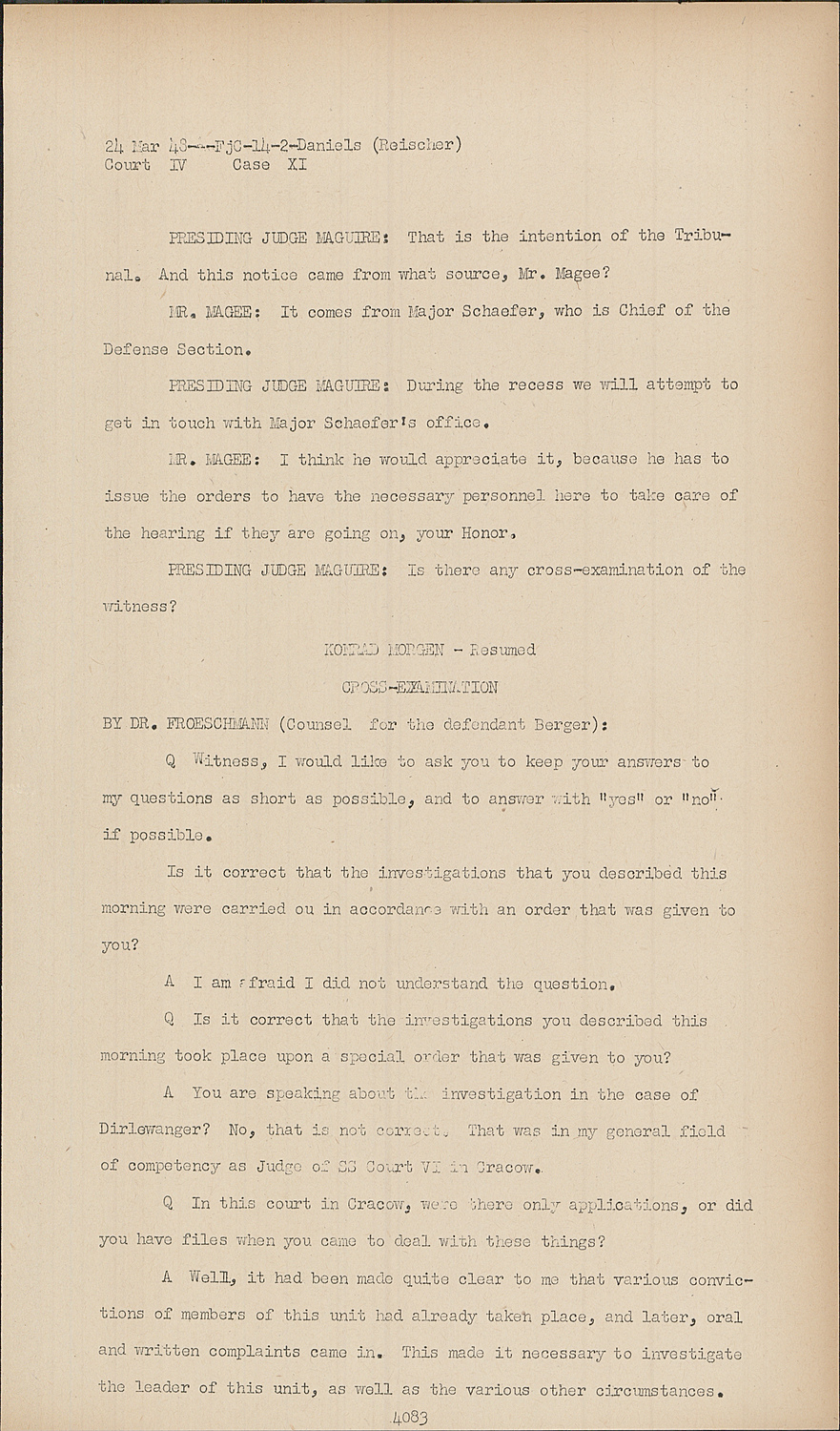
PRESIDING JUDGE MAGUIRE:That is the intention of the Tribunal. And this notice came from what source, Mr. Magee?
MR. MAGEE:It comes from Major Schaefer, who is Chief of the Defense Section.
PRESIDING JUDGE MAGUIRE:During the recess we will attempt to get in touch with Major Schaefer's office.
MR. MAGEE:I think he would appreciate it, because he has to issue the orders to have the necessary personnel here to take care of the hearing if they are going on, your Honor.
PRESIDING JUDGE MAGUIRE:Is there any cross-examination of the witness?
KONRAD MORGEN - Resumed CROSS EXAMINATION BY DR. FROESCHMANN (Counsel for the defendant Berger):
QWitness, I would like to ask you to keep your answers to my questions as short as possible, and to answer with "yes" or "no" if possible.
Is it correct that the investigations that you described this morning were carried ou in accordance with an order that was given to you?
AI am afraid I did not understand the question.
QIs it correct that the investigations you described this morning took place upon a special order that was given to you?
AYou are speaking about the investigation in the case of Dirlewanger? No, that is not correct. That was in my general field of competency as Judge of SS Court VI in Cracow.
QIn this court in Cracow, were there only applications, or did you have files when you came to deal with these things?
AWell, it had been made quite clear to me that various convictions of members of this unit had already taken place, and later, oral and written complaints came in. This made it necessary to investigate the leader of this unit, as well as the various other circumstances.
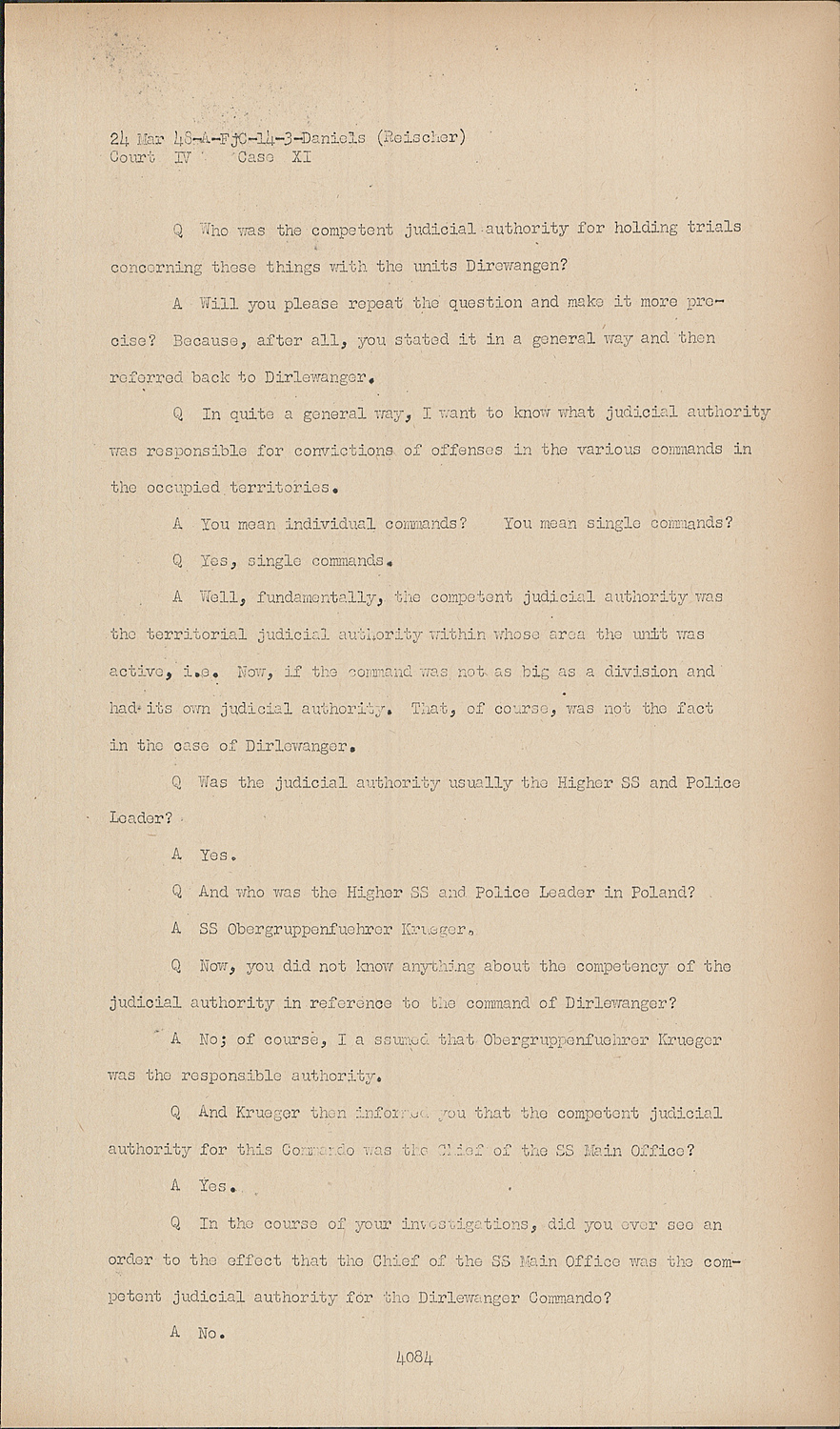
QWho was the competent judicial authority for holding trials concerning those things with the units Direwangen?
AWill you please repeat the question and make it more precise? Because, after all, you stated it in a general way and then referred back to Dirlewanger.
QIn quite a general way, I want to know what judicial authority was responsible for convictions of offenses in the various commands in the occupied territories.
AYou mean individual commands? You mean single commands?
QYes, single commands.
AWell, fundamentally, the competent judicial authority was the territorial judicial authority within whose area the unit was active, i.e. Now, if the command was not as big as a division and had its own judicial authority. That, of course, was not the fact in the case of Dirlewanger.
QWas the judicial authority usually the Higher SS and Police Leader?
AYes.
QAnd who was the Higher SS and Police Leader in Poland?
A SSObergruppenfuehrer Krueger.
QNow, you did not know anything about the competency of the judicial authority in reference to the command of Dirlewanger?
ANo; of course, I a ssumed that Obergruppenfuehrer Krueger was the responsible authority.
QAnd Krueger then informed you that the competent judicial authority for this Commando was the chief of the SS Main Office?
AYes.
QIn the course of your investigations, did you ever see an order to the effect that the Chief of the SS Main Office was the competent judicial authority for the Dirlewanger Commando?
ANo.