AYes, and it so stated on the chart, that Westhoff had prepared the chart for signature.
QOn that chart, which was shown to you in January or February of this year, were corrections made and changes compared with your earlier sketch?
AYes.
QIn what respect?
AWhat I explained before, namely, we always used the term "Hitler-Keitel" as one collective term on our charts, because to our minds Hitler and Keitel represented the Supreme Command agencies of the Wohrmacht and the OKW and belonged together in that respect.
Q witness, I only wish to speak about this chart. On your sketch which you gave to the Prosecution, was there a square up on top which said "Hitler-OKW", and what followed immediately below that square? Will you please tell us that?
AAfter the square "Hitler-OKW-Keitel", the next square was commander in Chief of the Replacement Army, Himmler.
QAnd what did it say under the square "Himmler"?
AThen came the Chief of Prisoner of War Affairs, Berger.
QVery well. At last I can state, now, that you made a chart on which, at the top, Hitler and Keitel-OKW appeared in the same square.
AYes.
QBelow the Hitler-OKW square, there appeared the Commander in Chief of the Replacement Army, and under that the Chief of Prisoner of War Affairs.
AYes.
QNow, let me ask you this. Was there on your chart which you gave to the prosecution the Keitel square put on one side somehow?
ANo. No, it waspart of the Hitler square.
QQuite. Did you, on your chart, draw the square Berger in a similar size, as the sort of center of the whole chart?
ANo.
QIs it thereforecorrect that merely through the genius of the prosecution in drawing pictures it appears that Berger is the center of this chart, whereas Keitel and OKW are put on one side as a negligible quantity in order to demonstrate that Berger was the center of PW affairs?
AWell, to the layman this may well be the case.
QThank you very much. Now another set of problems, also concerned with that chart. You see colored squares, don't you, green, orange, and then you see red and black lines, is that correct?
AYes, I can see them.
QDid you have those lines in your own chart?
AIn my chart they were somewhat differently drawn, both as for the coloring and the conducting of the lines.
QIs it therefore again correct to say that arbitrary changes were made in your chart?
AWell, yes.
QMy final question. Witness, would you please tell me how it was that you had drawn so many agencies on your chart which were not connected organically with PW Affairs at all -- such as the Kreisleiters at the bottom, or the Labor Exchange. How did it occur to you to have these agencies drawn on your chart?
AWell, I was asked with what agencies we had direct relations and with which we had a liaison officer.
QNow just a moment, one thing after another. You were asked with what agencies you had liaison?
AYes.
Q why did you not put another few hundred agencies on the chart, with which you were also connected?
ABecause I only drew those with which we had a liaison officer or direct collaboration.
QBut you were not really organically connected with these agencies, were you?
AWell, I do not know what you mean by "organically connected."
QI mean, by "organically connected," a firmly established, permanent, and interconnected collaboration, so that one organization becomes part of the other organization as it were. One cannot exist without the other. Couth GBA exist without you?
AIt could not make its decisions without us.
QI beg your pardon? You mean without the working population he could not make any plans?
AWe had nothing to do with the working population.
QI am talking about the GBA.
AGBA was connected with us in order to regulate the committing of prisoners of war for work.
QWhat do you mean, it wasconnected with you?
AWe allocated figures to their requirement in workers from prisoners of war.
QYou want to say collaborated with you permanently?
AYes.
QBut I do not call that a connection.
AWell, then, we simply differ. I do not know how else I could put it.
QAre you agreed with me, witness, that this chart as it is drawn here does not correspond to you work as Chief of Staff of PW Affairs, in fact it is almost wholly impossible?
AI beg your pardon?
QDo you agree with me that the chart as it is drawn here, from the poitn of view of draftsmanship, is almost impossible if you think of the activity you had as a Chief of Staff of PW Affairs? Don't you understand me?
AI don't really understand you. I think I know what you are getting at. Of course as Chief of Staff of PW Affairs I must be in a position to draw a chart. I really don't know what you are driving at.
QYou were subordinate to Hitler or Himmler. You can take two squares and connect those two with a line, is that correct? And you can do that because you were subordinate to the Hitler organization, were you not?
AYes.
QNow, if you take Labor Exchange, for instance, or the GBA, or the Foreign Office, then these organizations do not belong in that channel of command to which I have had reference just now. They were merely agencies with which you discussed pending problems. They therefore are not an immediate part of your organizational complex, is that correct?
AYes, that is right. We made dotted lines, not completely solid lines.
QBut now on the chart these lines are partly solid.
AYes, but with different coloring.
QI can therefore state that this chart is a product of the imagination of the prosecution, on the basis of yours and Westhoff's submissions, is that correct?
AI think the difficulty was that two different people worked on the same thing, because my first, original charts were much more simple, clear, and easy to understand. Only by using Westhoff's statement as well, the whole thing was somewhat changed. But that, I think, does not make any considerable difference to the actual connections. After all, the lines are there where they should be.
DR. FROESCHMANN : I have no further questions, THE PRESIDENT:
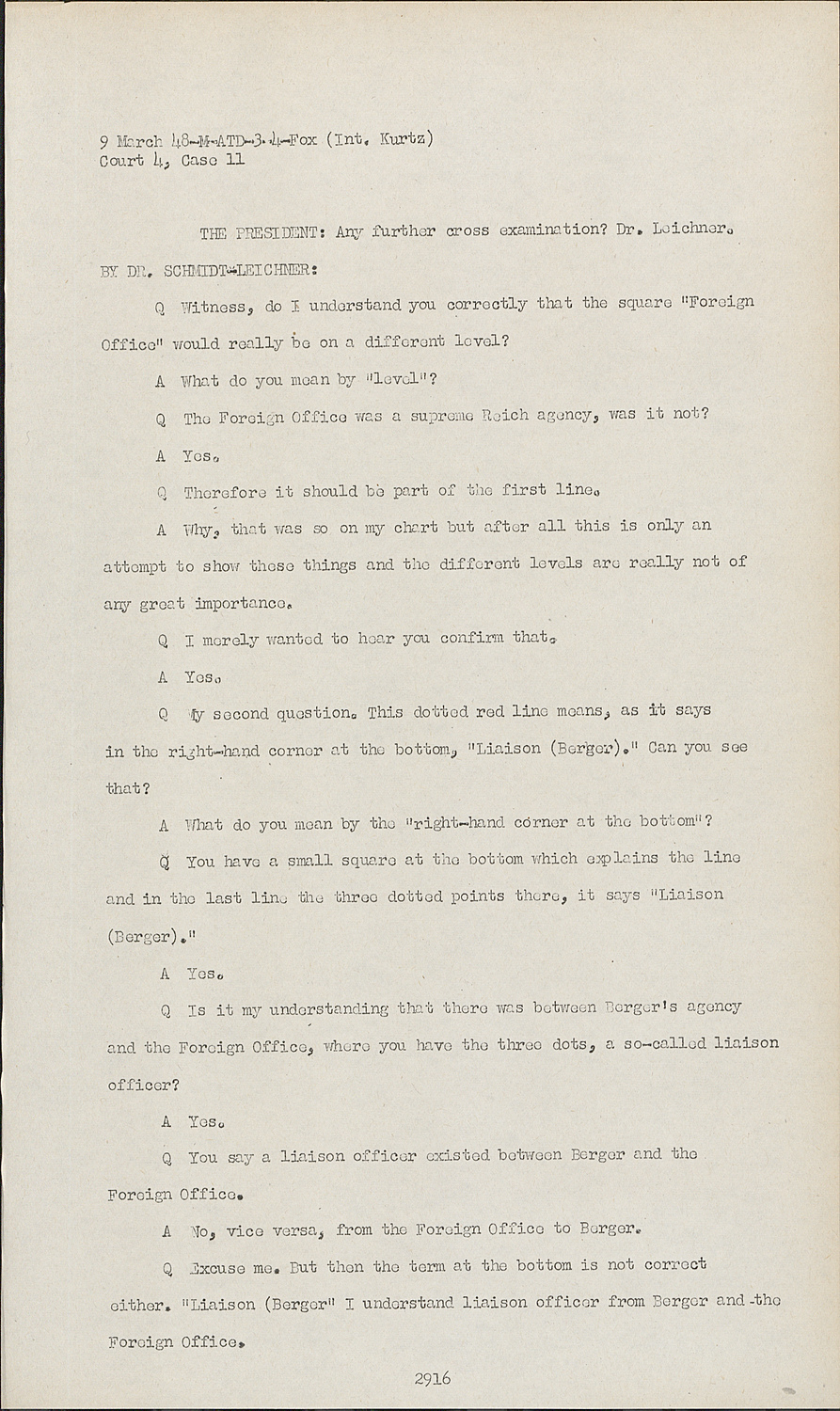
Any further cross examination? Dr. Leichner. By DR. SCHMIDT-LEICHNER:
QWitness, do I understand you correctly that the square "Foreign Office" would really be on a different level?
AWhat do you mean by "level"?
QThe Foreign Office was a supreme Reich agency, was it not?
AYes.
QTherefore it should be part of the first line.
AWhy, that was so on my chart but after all this is only an attempt to show these things and the different levels are really not of any great importance.
QI merely wanted to hear you confirm that.
AYes.
QMy second question. This dotted red line means, as it says in the right-hand corner at the bottom, "Liaison (Berger)." Can you see that?
AWhat do you mean by the "right-hand corner at the bottom"?
QYou have a small square at the bottom which explains the line and in the last line the three dotted points there, it says "Liaison (Berger)."
AYes.
QIs it my understanding that there was between Berger's agency and the Foreign Office, where you have the three dots, a so-called liaison officer?
AYes.
QYou say a liaison officer existed between Berger and the Foreign Office.
ANo, vice versa, from the Foreign Office to Berger.
QExcuse me. But then the term at the bottom is not correct either. "Liaison (Berger" I understand liaison officer from Berger and-the Foreign Office.
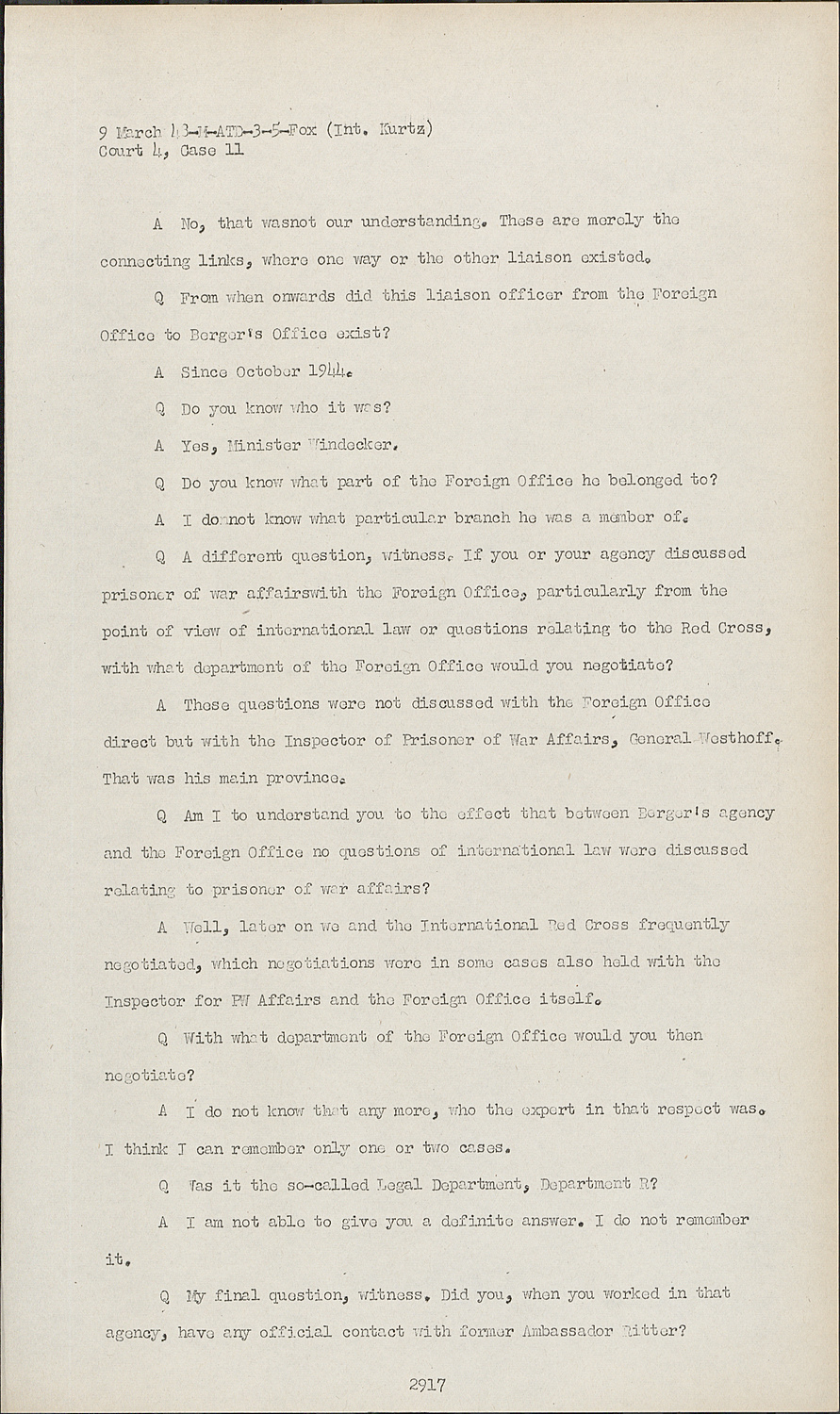
ANo, that wasnot our understanding. These are merely the connecting links, where one way or the other liaison existed.
QFrom when onwards did this liaison officer from the Foreign Office to Berger's Office exist?
ASince October 1944.
QDo you know who it was?
A yes, Minister Windecker.
QDo you know what part of the Foreign Office he belonged to?
AI do not know what particular branch he was a member of.
QA different question, witness. If you or your agency discussed prisoner of war affairswith the Foreign Office, particularly from the point of view of international law or questions relating to the Red Cross, with what department of the Foreign Office would you negotiate?
AThese questions were not discussed with the Foreign Office direct but with the Inspector of Prisoner of War Affairs, General Westhoff. That was his main province.
QAm I to understand you to the effect that between Berger's agency and the Foreign Office no questions of international law were discussed relating to prisoner of war affairs?
AWell, later on we and the International Red Cross frequently negotiated, which negotiations were in some cases also held with the Inspector for PW Affairs and the Foreign Office itself.
QWith what department of the Foreign Office would you then negotiate?
AI do not know that any more, who the expert in that respect was. I think I can remember only one or two cases.
QWas it the so-called Legal Department, Department R?
AI am not able to give you a definite answer. I do not remember it.
QMy final question, witness. Did you, When you worked in that agency, have any official contact with former Ambassador Ritter?
ANever.
DR. SCHMIDT-LEICHNER:Thank you very much.
DR. HAENSEL: Karl Haensel for Steengracht. BY DR. DR. HAENSEL:
QWitness, I do not wish to put the Foreign Office on a yet higher level. I merely want to deepen our conversation a little. You put Windecker into the square "Foreign Office" -- at least, there he is now, with your consent.
AYes.
QAnd you briefly touched on the problem of what Windecker had to do with it. Can you tell us, in one sentence, what Windecker's duties were concerning the treatment of prisoners of war? Did he have to deal exclusively with issues for the alleviation of the lot of prisoners of war?
ANo, that really was not his work in that respect. He was dealing with different special cases which we hadto discuss with Windeckor. They were mainly the affairs of the holiday camp for British and American officers, the management of which was newly formed and taken over by us. It was formerly in the hands of the Foreign Office.
QWas that an alleviation for the officers?
AYes, certainly.
DR. HAENSEL: Thank you very much.
THE PRESIDENT: Any further cross examination? Any redirect?
MR. PETERSEN: No, Your Honor. I request that the witness be excused.
THE PRESIDENT: The witness may -
DR. KEMPNER: May I ask one question in connection with the Foreign Office?
THE PRESIDENT: Very well.
REDIRECT EXAMINATION BY DR. KEMPNER?
QYou talked about holiday camps.
AYes.
QWere these propaganda camps or camps for special treatment or otherwise?
ANo, they were purely recuperation camps.
QThere was nothing political behind them?
ANo.
THE PRESIDENT: The witness may be excused.
THE WITNESS:May I make a statement?
MR. PETERSEN:I believe the witness wishes to correct his testimony of the last time he took the stand.
THE PRESIDENT:Is it a correction you wish to make, in your testimony?
THE WITNESS :Yes, please.
THE PRESIDENT:Very well, you may make your statement.
THE WITNESS:Yesterday, when I was interrogated by Mr. Singer, I found out that in the session of 25 February, when we dealt with the question of channels of command, in matters of Gift parcels, there was a misunderstanding on my part.
The first of these questions of this probelm originated with Russian prisoners of war, the problem being whether those Russiand had ever received gift packages and so on. The following questions I equally connected with Russian prisoners of war and in that connection nothing was known to me about an order concerning the confiscation of these gift packages and a counter-order. I never understood that these questions aimed at Himmler's or Berger's orders, that is, at orders which were at that time dealing with the immediate release or quick consumption of the large stocks of the International Red Cross parcels.
Concerning that above mentioned order, I repeatedly made statements under oath, in my interrogation in 1947 and 1948, in great detail, without any reservations. I described all details which were relevant, including how these orders came to be issued, and why they were rescinded. The latter should show clearly that in the session mentioned I misundersto the questions put to me, because otherwise I would not have stated the contrary of what I said in the interrogations so clearly, under oath.
In fact it was only yesterday that I heard of these facts, when I talked to Mr. Singer.
I should like to point out on this occasion that the misunderstanding may partly be due to the fact that as my hearing is extremely bad and these earphones impede me - my car has got a shot - I have great difficulty understanding and hearing. Moreover, I had a bad cold in those days, which always has an influence on my damaged sense of hearing. Today, on the other hand, I have been able to follow much more closely than I did the other day.
THEPRESIDENT: very well.
MR. PETERSEN:May the witness be excused?
THE PRESIDENT:Just a moment. Judge Maguire has a question to ask him.
JUDGE MAGUIRE:I must confess that I do not know now what part of his testimony he is correcting, and what the facts were with respect to these matters. I wish you would clear that up.
MR. PETERSEN:I shall supply the Court with the pages of the transcript at which this interrogation appears, if that is convenient to the Court. Or, would the Court prefer that I explain? I asked at that time whether the defendant Berger issued an order for the immediate consumption of all stocks of Red cross parcels which were on hand and at that time the witness stated that no such order had been issued and that he did not know of its ever being rescinded because no such order had ever been issued. This is the point of testimony which the witness is now correcting -- to the effect that such an order was issued and that it was subsequently rescinded.
JUDGE MAGUIRE:Did that order relate to all prisoners or to prisoners of certain nations?
MR. PETERSEN:I believe that affected all prisoners.
JUDGE MAGUIRE:Well, let us find out, ask him that question directly.
REDIRECT EXAMINATION * Continued BY MR. PETERSEN:
QDid this order with respect to International Red Cross parcels affect all prisoners of war?
AAll those prisoners of war who received Red Cross parcels and that meant all except the Russians.
QIt did not affect the Russians because they did not receive any Red Cross parcels?
AYes, quite.
JUDGE MAGUIRE:That clears it up.
THE PRESIDENT:Dr. Froeschmann, I take it you have some questions relative to the last statement. You will confine your questions to the last statement.
DR. FROESCHMANN:If the Tribunal please, of course I haven't got the transcript of that day's session with me now -- I mean his testimony of 25 February. Therefore I cannot ascertain what the witness said at that time; but I am interested in one thing.
RECROSS EXAMINATION BY DR. FROESCHMANN:
QDid the interrogator yesterday put to you that on 25 February you gave wrong testimony?
ANo.
QHow did your statement of today come to be made?
AIn my discussion with Mr. Singer yesterday I had a conversation with General Westhoff and he mentioned this business and it was then that it occurred to me what we were concerned with in this matter.
I did not see a copy of my testimony. I was completely ignorant of this misunderstanding until yesterday.
QMay I ask you also, did Hitler quite generally forbid the issue of Red Cross parcels to prisoners of war?
AAt a later period of time, in 1945, an order to that effect came down.
QDid Berger oppose that order?
AHe did, from the word "go", and very strongly.
QDid Berger, concerning the issue of Red Cross parcels, since he took over, take any strong measures?
ANo, on the contrary he tried to improve matters.
DR. FROESCHMANN:Thank you very much. No further questions.
THE PRESIDENT:If there are no further questions, the witness will be excused.
MR. PETERSEN:With the Court's permission, I should now like to call the witness General Westhoff to the stand.
THE PRESIDENT:The Marshal will produce the witness. He has not testified heretofore, has he?
MR PETERSEN:He has not.
ADOLFWESTHOFF, a witness, took the stand and testified as follows:
THE PRESIDENT:Will the witness raise his right hand and be sworn? "I swear, by God, the Almighty and Omniscient, that I will speak the pure truth and will withhold and add nothing."
(The witness repeated the oath.)
You may be seated.
DIRECT EXAMINATION BY MR. PETERSEN:
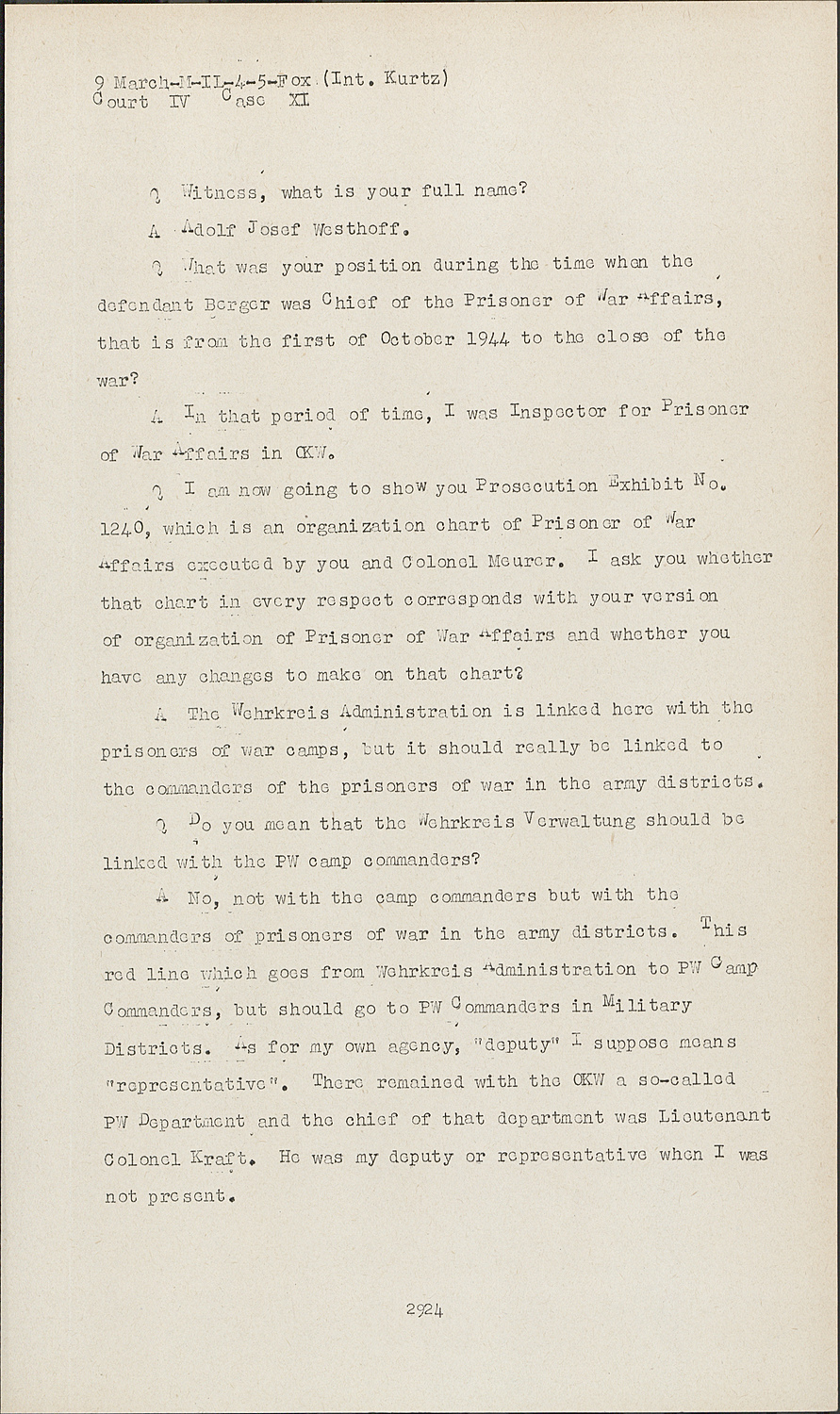
QWitness, what is your full name?
AAdolf Josef Westhoff.
QWhat was your position during the time when the defendant Berger was chief of the Prisoner of War Affairs, that is from the first of October 1944 to the close of the war?
AIn that period of time, I was Inspector for Prisoner of War Affairs in OKW.
QI am now going to show you Prosecution Exhibit No. 1240, which is an organization chart of Prisoner of War affairs executed by you and Colonel Meurer. I ask you whether that chart in every respect corresponds with your version of organization of Prisoner of War Affairs and whether you have any changes to make on that chart?
AThe Wehrkreis Administration is linked here with the prisoners of war camps, but it should really be linked to the commanders of the prisoners of war in the army districts.
QDo you mean that the Wehrkreis Verwaltung should be linked with the PW camp commanders?
ANo, not with the camp commanders but with the commanders of prisoners of war in the army districts. This red line which goes from Wohrkreis Administration to PW Camp Commanders, but should go to PW Commanders in Military Districts, As for my own agency, "deputy" I suppose means "representative". There remained with the OKW a so-called PW Department and the chief of that department was Lieutenant Colonel Kraft. He was my deputy or representative when I was not present.
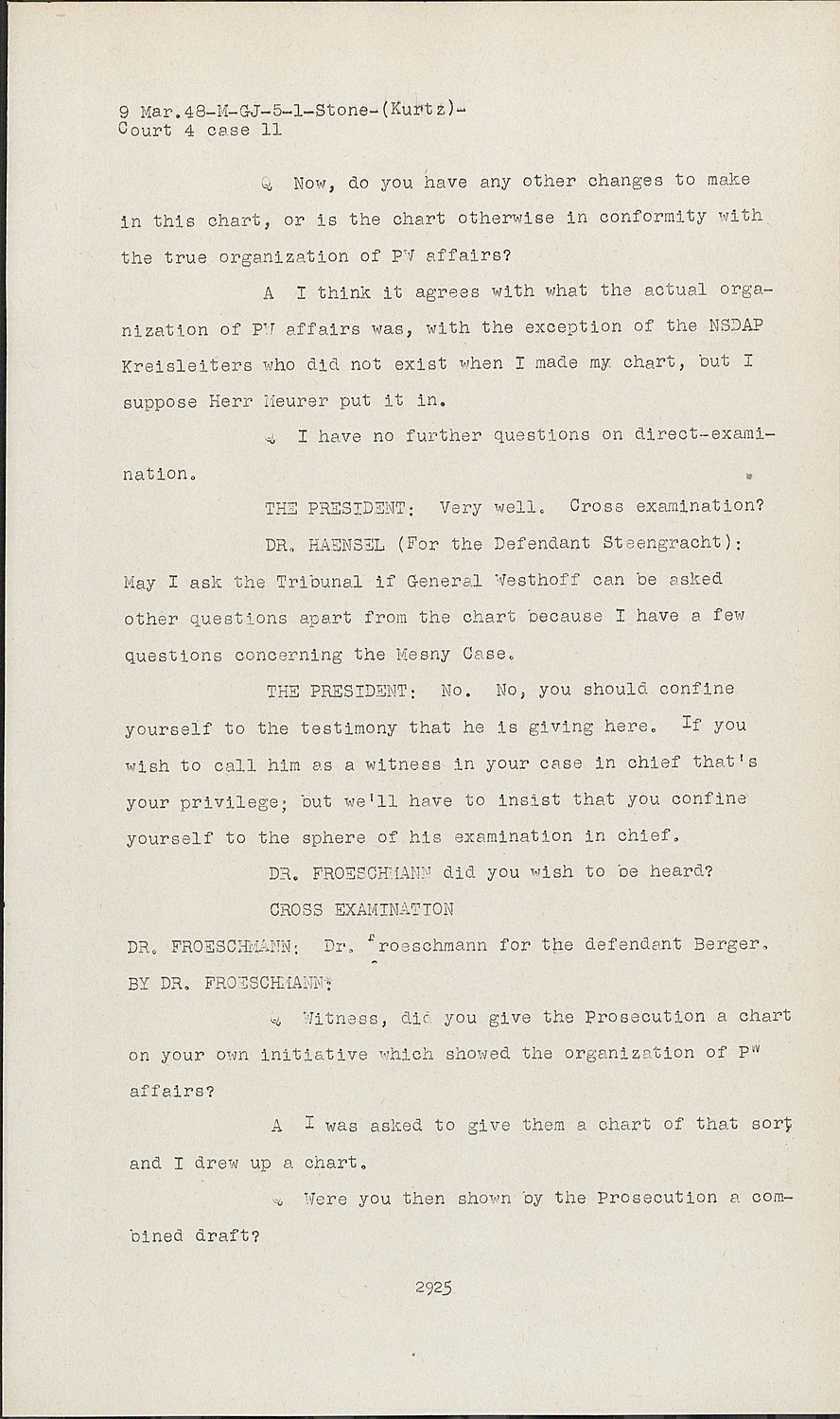
Q Now, do you have any other changes to make in this chart, or is the chart otherwise in conformity with the true organization of PW affairs?
A I think it agrees with what the actual organization of PW affairs was, with the exception of the NSDAP Kreisleiters who did not exist when I made my chart, but I suppose Herr Meurer put it in.
Q I have no further questions on direct-examination.
THE PRESIDENT: Very well. Cross examination?
DR. HAENSEL (For the Defendant Steengracht): May I ask the Tribunal if General Westhoff can be asked other questions apart from the chart because I have a few questions concerning the Mesny Case.
THE PRESIDENT: No. No, you should confine yourself to the testimony that he is giving here. If you wish to call him as a witness in your case in chief that's your privilege; but we'll have to insist that you confine yourself to the sphere of his examination in chief.
DR. FROESCHMANN did you wish to be heard?
CROSS EXAMINATION DR. FROESCHMANN: Dr. Froeschmann for the defendant Berger. BY DR. FROESCHMANN:
Q Witness, did you give the Prosecution a chart on your own initiative which showed the organization of PW affairs?
A I was asked to give them a chart of that sort and I drew up a chart.
Q Were you then shown by the Prosecution a combined draft?
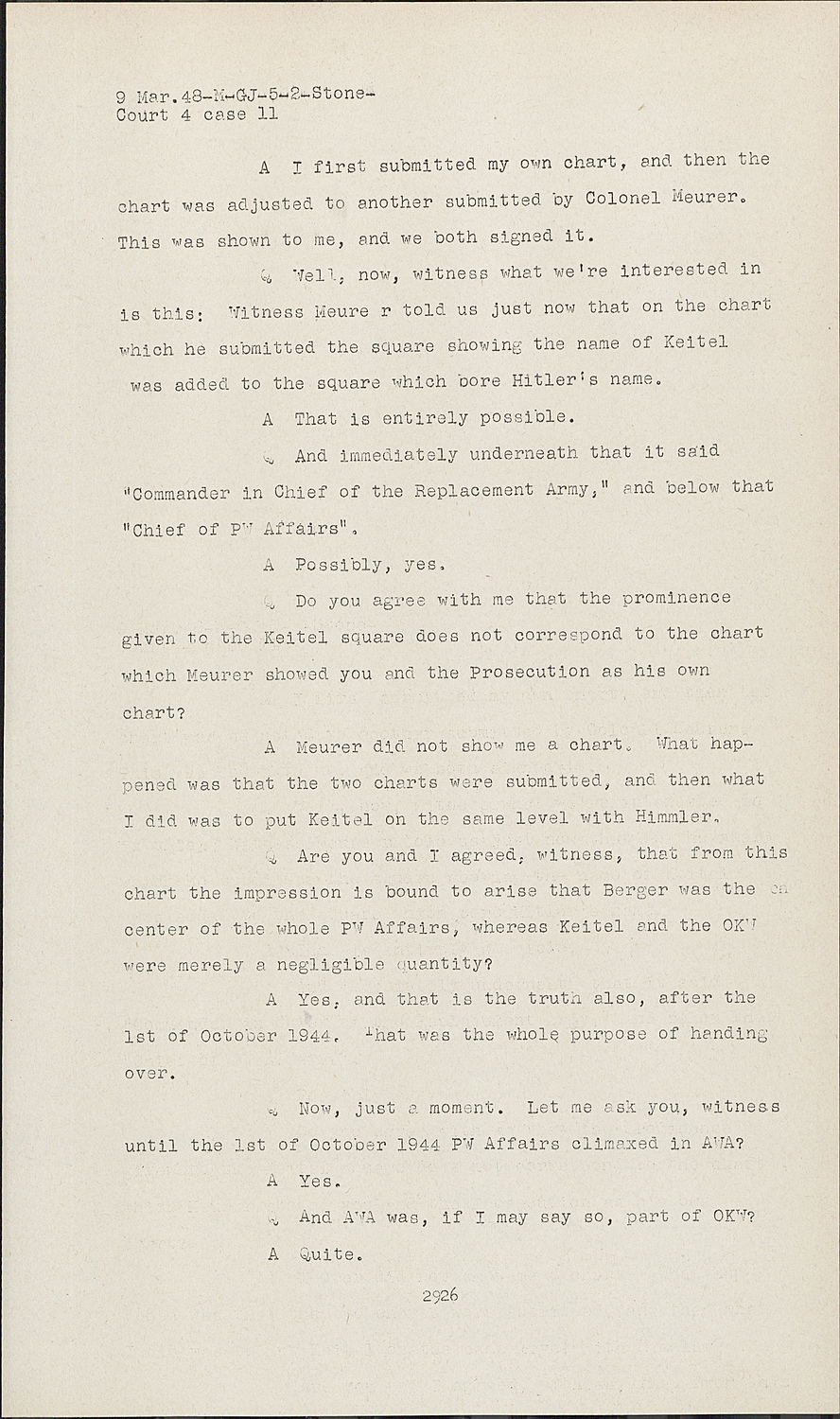
A I first submitted my own chart, and then the chart was adjusted to another submitted by Colonel Meurer. This was shown to me, and we both signed it.
Q Well, now, witness what we're interested in is this: Witness Meure r told us just now that on the chart which he submitted the square showing the name of Keitel was added to the square which bore Hitler's name.
A That is entirely possible.
Q And immediately underneath that it said "Commander in Chief of the Replacement Army," and below that "Chief of PW Affairs".
A Possibly, yes.
Q Do you agree with me that the prominence given to the Keitel square does not correspond to the chart which Meurer showed you and the Prosecution as his own chart?
A Meurer did not show me a chart. What happened was that the two charts were submitted, and then what I did was to put Keitel on the same level with Himmler.
Q Are you and I agreed, witness, that from this chart the impression is bound to arise that Berger was the center of the whole PW Affairs, whereas Keitel and the OKW were merely a negligible quantity?
A Yes, and that is the truth also, after the 1st of October 1944. That was the whole purpose of handing over.
Q Now, just a moment. Let me ask you, witness until the 1st of October 1944 PW Affairs climaxed in AWA?
A Yes.
Q And AWA was, if I may say so, part of OKW?
A Quite.
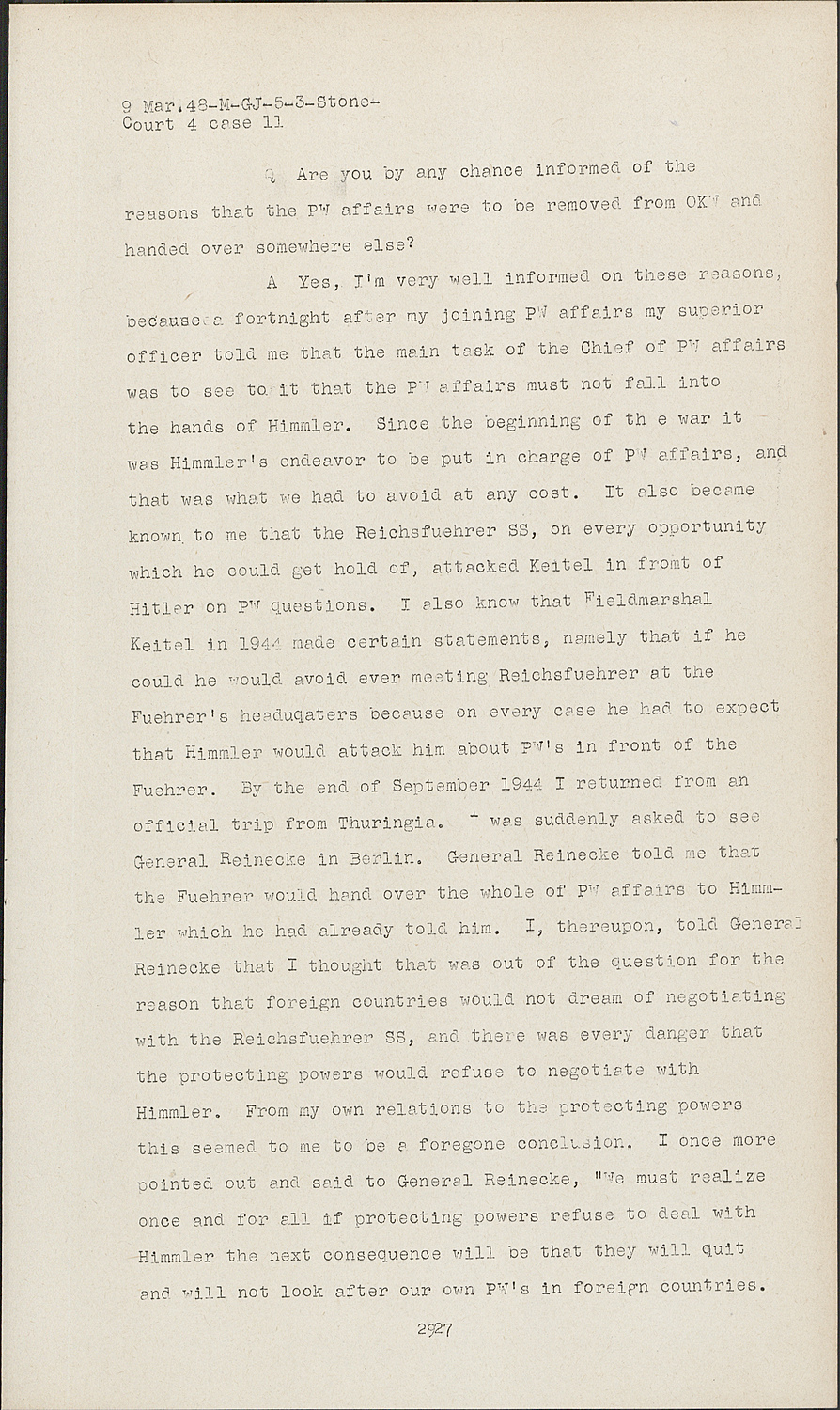
Q Are you by any chance informed of the reasons that the PW affairs were to be removed from OKW and handed over somewhere else?
A Yes, I'm very well informed on these reasons, because a fortnight after my joining PW affairs my superior officer told me that the main task of the Chief of PW affairs was to see to it that the PW affairs must not fall into the hands of Himmler. Since the beginning of th e war it was Himmler's endeavor to be put in charge of PW affairs, and that was what we had to avoid at any cost. It also became known, to me that the Reichsfuehrer SS, on every opportunity which he could get hold of, attacked Keitel in fromt of Hitler on PW questions. I also know that Fieldmarshal Keitel in 1944 made certain statements, namely that if he could he would avoid ever meeting Reichsfuehrer at the Fuehrer's headuqaters because on every case he had to expect that Himmler would attack him about PW's in front of the Fuehrer. By the end of September 1944 I returned from an official trip from Thuringia. I was suddenly asked to see General Reinecke in Berlin. General Reinecke told me that the Fuehrer would hand over the whole of PW affairs to Himmler which he had already told him. I, thereupon, told General Reinecke that I thought that was out of the question for the reason that foreign countries would not dream of negotiating with the Reichsfuehrer SS, and there was every danger that the protecting powers would refuse to negotiate with Himmler. From my own relations to the protecting powers this seemed to me to be a foregone conclusion. I once more pointed out and said to General Reinecke, "We must realize once and for all if protecting powers refuse to deal with Himmler the next consequence will be that they will quit and win not look after our own PW's in foreign countries.
For those reasons it seems to me to be necessary that Fieldmarshal Keitel is told that at least the protecting powers matters must be dealt with by the OKW". General Reinecke rang up Fieldmarshal Keitel who happened to be in Berlin and asked him whether we could come and see him. We did go and see him, and General Reinecke told Fieldmarshal Keitel what I had tol d him concerning my misgivings. I was present at the time. Fieldmarshal Keitel got very excited. At first he took negative attitude, and it was on that occasion that he emphasized that now that the Fuehrer wants to give this to Himmler he was only too glad to be rid of the whole business because he was fed up with having to deal with Himmler all the time. I once again pointed out the danger that protecting powers might quit. Thereupon Fieldmarshal Keitel conceded that he would try to go and see Himmler again and would attempt to have all protecting powers affairs remain with us. But it was his wish to establish a very small department which should confine itself to the affairs of the protecting powers. Anything else he would refuse to have anything to do with, and that was what actually happened in the end, namely, that the whole of PW affairs was handed over to Himmler, with the exception of protecting powers affairs, and those who worked on German PW's abroad. That remained with OKW. Everything else was handed over to Himmler. After that questions sometimes turned up in my official spher where I regarded it necessary to refer to Fieldmarshal Keitel, and in a case like that I submitted a note through AWA pointing out that this or that should be changed or was inadmissible. In all cases of that sort Fieldmarshal Keitel, as a matter of principle, always put on the margin "I'm no longer concerned with this; I will not be worried with this; Himmler wanted to be put in charge of the PW affairs;
so, let him get on as best he can." He refused to do anything about PW affairs, apart from the matters which concerned protecting powers alone.
Q General, would it be true to say that a small set of problems was still left to OKW, namely, certain PW camps which were located in operational areas, particularly in Norway?
A PW camps in operational areas were never subordinated to OKW. OKW was never in charge of a PW camp or any PW establishment. You must make a distinction between PW affairs before 1st October 1944 and after 1st October 1944. Before 1st October 1944 PW affairs were organized as follows: There was under Hitler in the OKW responsible for PW affairs Fieldmarshal Keitel; and under him there was General Reinecke; as the expert working on this probelm there was in AWA the agency "Chief of PW Affairs". They were purely experts and never could reach any decisions. This was purely a governement department which issued ministerial decrees and directives. OKW would have not had at any time any power to issue orders to or punish PW camps or establishments. All PW's in operational areas were subordinated to OKH, the Quartermaster General. All PW establishments in the Reich were subordinated to the Replacement Army with the organizational details. PW camps were part of the Army District Commands. The Army District Commands had commanders of PW's in The Army Districts. They were the experts of the deputy commanding generals in all matters appertaining to PW's. The Army District Commanders were subordinated to the Commander in Chief of the Replacement Army. What the case actually was was that the OKW could issue ministerial directives and that any authority to issue orders or inflict punishment was with the Replacement Army.
In addition to this there was the Luftwaffe. They had an inspector of PW affairs of their own, and at the special request and demand of the then Reichmarshal the PW's of the Luftwaffe were subordinated to the Luftwaffe itself. On 1st October 1944 this organization was radically changed in the following manner: The Reichsfuehrer SS took over PW's and appointed SS Obergruppenfuehrer Berger as Chief of PW affairs, and he was not chief of PW affairs with OKW and OKH. He was Chief of PW Affairs, and as such was in charge of all PW's and all PW establishments. He had the authority to issue orders. He had the power to inflict punishment. Then there were subordinate to him the PW's of the Luftwaffe as well. The department remained with OKW was again a purely ministerial one. It merely negotiated with the protecting powers, with the International Red Cross, with the YMCA, and other charitable organizations. They also had the right to visit camps and find out in the camps whether the regulations of the Geneva Conventions, insisted on by the protecting powers, were carried out in the camps?
Q General, is it correct that on 23 October 1944 there was reached between you and Colonel Maurer, whom we mentioned so often before, an agreement, according to which the competencies mentioned by you were delimited?
A No, you're making a slight mistake there. That was not on the 23rd of October, nor was it made between Maurer and me. The OKW having ordered that PW affairs were to be handed over to SS Obergruppenfuehrer Berger, preliminary negotiations were held, and these negotiations might have taken place -- let's say on the 8th or 10th of October. These preliminary negotiations ware held by me at the order of General Reinecke, in order to establish, approximately at first in the outline, how delimitations were to be effecte This having been done there was a conference on 23rd October between Herr Berger and General Reinecke.
At that conference took part General Linde, on behalf of the OKW, as Deputy Chief of the AWA, my immediate superior officer, and I as the expert for PW affairs. Berger was accompanied by Meurer, but the conference was not presided over by Meurer or myself. The negotiations were held exclusively between Berger and General Reinecke. As far as I remember I did not even open my mouth once.
Q I beg your pardon?
A I don't think I said one single word in that whole conference. The negotiations were held purely between Obergruppenfuehrer Berger and General Reinecke. I was present merely as an expert in case any questions should arise.
Q Can you still remember, witness, the agreements which were written down after the conference?
A I don't think the agreements were written down. A regulation was issued at the time, signed by the Fuehrer, which dealt with the breaking down of the organization of PW affairs. As far as I can remember this read as follows: That PW affairs were to be handed over to Himmler with the exception of those affairs which touched upon the Geneva Conventions and, therefore, dealt with the protecting powers. This was the basic order signed by Hitler himself. This basic order was worked on later on by myself. I laid down the various spheres, which were known to be processed by Himmler's agency and those which remained with us. That was necessary for the following reason: Himmler did not have any expert personnel under him who knew their job, nor did he have any experience in the administration of PW affairs.