"I urgently request that no ordinance regarding the definition of the word 'Jew' be issued.
We are only tying our hands by estab lishing these foolish definitions.
The occupied territories will be purged of Jews.
The Fuehrer has charged me with the execution of this very hard order.
No one can release me from this respon sibility in any case, and I strongly resent all interference.
You will receive memorandum from LAMMERS in a short time."
The Jews of Germany were being deported to the East and now the East was to be "purged" of Jews. When Himmler speaks of the Fuehrer Order as being a very hard one, it takes no imagination to know what was intended -they were to be done away with. The world knows, to its horror, that the program was carried out and helpless men, women and children by the millions were slaughtered in cold blood. While BERGER was not in one of the extermination camps, he played an important part in crushing the complaints of even highly placed officials like Kube and Rosenberg so that the ghastly scheme should proceed according to plan. He was present when Himmler delivered his Posen speech on 4 October 1943 at a meeting of the SS Gruppenfuehrers. He there spoke of the Russian Prisoners of War:
"At that time we did not value the mass of humanity as we value it today, as raw material, as labor.
What, after all, thinking in terms of generations, is not be regretted, but is now deplorable by reason of the loss of labor, is that the prisoners died in tens and hundreds of thousands of exhaustion and hunger.
..
"One basic principle must be the absolute rule for the SS men:
We must be honest, decent, loyal, and comradely to members of our own blood and to nobody else.
What happens to a Russian, to a Czech, does not interest me in the slightest.
What the nations can offer in the way of good blood of our type we will take, if necessary by kidnapping their children and raising them here with us.
Whether nations live in prosperity or starve to death interests me only insofar as we need them as slaves for our Kultur; otherwise, it is of no interest to me.
Whether 10,000 Russian females fall down from exhaustion while digging an anti tank ditch interests me only insofar as the anti-tank ditch for Germany is finished.
..
"The other side doesn't make life easy for us. And you must not forget that the fortunate position in which we are placed by occupying large parts of Europe carries with it also the disadvantage that in this way we have among ourselves, and thus against us, millions of people and dozens of foreign nat ionalities.
Automatically we have against us all those who are convinced communists; we have against us every Free-Mason, every democrat, every convinced Christian.
These are the ideological enemies whom we have against us all over Europe and whom the enemy has totally for himself.
..
"I also want to talk to you, quite frankly, on a very grave matter.
Among ourselves it should be mentioned quite frankly, and yet we will never speak of it publicly.
Just as we did not hesitate on June 30th, 1934, to do the duty we were bidden, and stand comrades who had lapsed, up against the wall, and shoot them, so we have never spoken about it and will never speak of it.
It was that tact which is a matter of course, and which, I am glad to say, is inherent in us, that made us never discuss it among ourselves, never speak of it.
It appalled everyone, and yet everyone was certain that he would do it the next time if such orders are issued and if it is necessary.
"I mean the evacuation of the Jews, the extermination of the Jewish race.
It's one of these things which is easy to talk about -- 'The Jewish race is being exterminated', says one party member.
'That's quite clear, it's in our program -- elimination of the Jews, and we're doing it, exterminating them.
' And then they come, 80,000,000 worthy Germans, and each one has his decent Jew.
Of course the others are vermin, but this one is an A-1 Jew.
Not one of all those who talk this way has witnessed it; not one of them has been through it.
Most of you must know what it means when 100 corpses are lying side by side, or 500 or 1000.
To have stuck it out and at the same time -- apart from exception caused by human weakness -- to have remained decent fellows, that is what has made us hard.
This is the page of glory in our history which has never been written and is never to be written.
.."
BERGER was present at this meeting, he heard this speech but he denies that anything was said about the extermination of the Jews, and in this he is corroborated by von Woyrsch. The captured phonographic text of the speech was played to BERGER and somewhat grudgingly he admitted that it sounded like Himmler's voice.
Von Woyrsch joined the SS in 1930. He states that after 1933 it was considered a combat unit against Bolshevists and Communists. He was in command of the Motorized Police in the Polish Campaign, but he denies that he was involved in cleaning out any Poles; denies that he encountered any opposition from the Polish insurgents and from the Polish Army, and that everywhere the public turned to him for help. He also denies that Himmler said anything about extermination of Jews in his Posen speech. But if his recollection of what Himmler said in this speech is as faulty as his recollection of his own actions and those of his command in the Polish campaign, little credence can be given to his testimony.
In September 1939 Lt. Col. Lauhousen rendered a report of an inspection trip on 20 September 1939 to Poland. Regarding von Woyrsch he stated:
"1215-1400, Conference at Rzeszow with G-2 (IC-Maj. Dehmel);
G-2 (Maj. Schmidt-Richtberg.)
"Explain situation as well as military action.
"Hand LWOW for G-2 further reports about unrests in that Army area arising from partly illegal measures taken by Special Purpose Group (Einsatzgruppen) of Brigadier General (Oberfuehrer) Woyrsch (mass shootings - especially of Jews). It was annoying to the troops that young men, instead of fighting at the front, were testing their courage on defenseless people."
This was an official report made contemporaneously with the affairs which it described. There is no reason to doubt its accuracy, and shortly after it was written von Woyrsch ceased to function in command of this unit. In view of this report we are unable to give any weight to his assertion that he and the other Gruppenfuehrers would have objected if Himmler had mentioned the extermination of the Jews.
The transcript itself, which is a captured document, and the phonograph records made of the speech leave little or no doubt that it was rendered substantially in the form claimed by the Prosecution.
The spontaneous corroboration of the contents of the Posen speech was given by the witness Hildebrandt, who was himself convicted before one of these Tribunals and who received a 25-year sentence. On cross-examination he was asked about a letter written by Himmler in August, 1944, in which it was proposed to make him the Higher SS and Police Leader for Transylvania, and which concluded with the comment:
"In case Hildebrandt is not there, send the most brual man available to that region."
He admitted receiving the letter, but said:
"The letter is quite beside the point. It has no practical background and it never had any practical results.
Himmler's phraseology is nothing new.
I didn't got excited about it and I didn't take it seriously.
After this Posen speech nothing could surprise me any more."
The weight to be given the defendant BERGER'S assertion that the persecution of Jews was abhorrent to him can be gained from the following exhibits: 2381 and 2382.
On 23 July 1942 BERGER wrote Gruppenfuehrer Mueller of the RSHA, an organization and person for whom he now expresses great contempt, that recruiting in Hungary was purely a question of producing family allowances; that negotiations with the Hungarian Economic Office led to nothing for the time being; that the Hungarians said that if Hitler wanted anything more he must occupy the country; that a certain Baron Collas proposed to get hold somehow of the property situated in Hungary belonging to the German Jews which he estimated to be worth many million pengos.
BERGER asked to be informed as soon as possible if this means was practicable.
On 19 August an order was issued based on a report of 13 August, but these documents were not among the captured documents.
On 24 November 1942, the Office of the Chief of Security Police and SD reported to Himmler that due to certain circumstances it was not possible, at least in the near future, to realize pengos for BERGER'S purposes from this property, but that permits to emigrate could be sold to Slovakian Jews, as had been done in the case of Dutch Jews, for approximately 100,000 Swiss francs per head, and thus BERGER could realize the required 30,000,000 pengos for the recruitment of volunteers for the Waffen SS in Hungary.
BERGER insists that this came too late and he obtained the necessary funds in another manner, Unfortunately, there are apparently no other records available to disclose the final history of this happy plan. But even if the suggestion came too late, the correspondence clearly discloses BERGER'S thoughts, and intentions, and dissipates his present claim that he was not imbued with any spirit of persecution.
Gabor Vanja, a former Hungarian Minister of the Interior under the Szalasi government (since executed for his own part in these matters) gave an affidavit on 28 August, 1945. He deposes that on order of Szalasi he visited Himmler at his Headquarters and discussed with him and BERGER, whom he assumed was to be Himmler's deputy, the deportation to Germany of the remaining Hungarian Jews.
We have discussed the sad history of these Jews in our considerations in the case of VEESENMAZER.
He further deposes that Himmler ordered that the details of the evacuation be discussed the following day with BERGER and Kaltenbrunner in Berlin; that this conference took place in Berlin on 16 December 1944, and BERGER confirmed Himmler's request and ordered Kaltenbrunner to negotiate the details and they were agreed upon; that Kaltenbrunner forced the immediate and energetic delivery and said that Winkelmann and Eichmann, especially the latter, would supervise the action; that Eichmann wanted to deport even the women, children and old men from Budapest and when Vanjz protested, stated that Germany would deport the Jews herself.
There is no question but that the deportations were carried out and that the majority of these unfortunate people met their deaths in German extermination camps or in the slave labor enterprises conducted by the SS.
Although the defendant, by reason of Vanja's execution, could not cross-examine this affiant, there is no reason to believe that his affidavit is not substantially correct. If the case against BERGER rested upon the affidavit alone we would not feel justified in finding him guilty, but it is corroborated by evidence given by BERGER himself, and which already establishes that he was an active party in the program of the persecution, enslavement and murder of the Jews. Slovakian Jews. While the witness Kastner testified that it was on BERGER'S recommendation to Himmler that the remaining Jews in Slovakia were deported to extermination camps, Kastner's testimony rests solely upon hearsay. The source of this hearsay, Becher, was not produced as a witness, nor any reason given for the failure to do so.
We therefore hold that this charge has not been proven beyond a reasonable doubt, and with regard to Slovakian Jews BERGER must be and is exonerated. Danish Jews: The Prosecution relies upon a letter from Keitel to the German Army Commander in Denmark, stating, among other things, that SS Obergruppenfuehrer BERGER, would be in charge of the deportation of the Danish Jews. This, however, is the only evidence on this phase of the matter. BERGER insists that Keitel was in error and the operation was in charge of someone else. There is no evidence other than Keitel's.
We hold that proof of guilt beyond a reasonable doubt has not been established and we exonerate BERGER of guilt as to this particular charge.
Special Commando - Dirlewanger. Direwangerwas an old comrade of BERGER'S from the first World War, and while a savage and skillful fighter, was a man of unsavory character in many respects, which BERGER himself admits. Dirlewanger had been convicted of sexual crimes against a minor, but BERGER asserts that he was of the opinion that the conviction was the result of a personal quarrel which Dirlewanger had with one of the Nazi officials; that he obtained Dirlewanger's release and had him sent to Spain as a member of the German Condor Legion where he fought on behalf of Franco; that on his return he succeeded in having Dirlewanger reinstated in the SS as Obersturmbannfuehrer.
It was BERGER'S idea that for partisan fight, in the East, a battalion of poachers be organized. Himmler approved this suggestion and BERGER'S recommendation that Dirlewanger train and command this battalion.
It was assigned to the East and immediately started on a career of savagery, plunder and corruption, which brought it to the unfavorable attention of German officials who had an opportunity to learn of its conduct.
The prosecution called Konrad Morgen, who had been conscripted into the SS, and in October 1940 sent to the SS Main Court as a Judge. He was with the SS Police Court VI at Cracow; in May 1942 was relieved of his duties and demoted because of an acquittal he had granted and sent to the front as an ordinary soldier; he was recalled to the police courts in June 1942 and was in charge of investigations at concentration camps. In passing, it may be stated that it was he who was originally responsible for the investigation, trial, and subsequent execution of the notorious Koch who was Commandant of the Buchenwald concentration camp.
As Judge, his task was to investigate and prepare criminal cases and, when not in charge of investigations, he acted as Presiding Judge. His jurisdiction covered all members of the Waffen SS and Police Troops on active duty, but not members of the Wehrmacht.
In the beginning of 1942 he noticed that there had been many convictions of the members of the Dirlewanger unit for plundering and mistreatment of the civilian population. He discovered that all the members of this battalion has been previously convicted of offenses.
There were also complaints against Dirlewanger. This unit was not a part of the Waffen SS but was a supplementary police unit. At that time it consisted purely of poachers with previous convictions, but later on inmates of concentration camps and other criminals were transferred to the unit. It finally reached the strength of a division.
His investigation at Lublin among German agencies and the Security Police revealed that this unit was a pest and a terror to the population; that Dirlewanger on repeated occasions plundered the ghettos in Lublin, would arrest Jews on the charge of ritual murder, exact blackmail up to 15,000 zloty, and if the money was not forthcoming have the victim shot. It was charged that he arrested young Jewesses, called in a small circle of friends, stripped the women of their clothes, beat them, and finally gave them an injection of strychnine and watched them die; that the testimony concerning these incidents was obtained by witnesses and the criminal police.
THE PRESIDENT:Judge Maguire will continue the reading from this point.
JUDGE MAGUIRE:The witness deemed it urgent to arrest Dirlewanger and to investigate these frightful crimes. He reported to Obergruppenfuehrer Krueger at Cracow and asked for an order of arrest. Krueger reported that there was nothing he could do because he was not competent and that the detachment was subordinate exclusively to the orders of BERGER. Krueger immediately phoned BERGER at Berlin and after denouncing Dirlewanger informed BERGER that unless "this bunch of criminals disappear from the Government General within a week I will go myself and lock them up." BERGER finally promised to do everything he could and in approximately two weeks the unit was transferred, but not as the witness thought to the Reich, and Dirlewanger punished, but, to his surprise, it was sent to Central Russia, to Mogilev. However, the witness sent the files with the report to the Commander and the Supreme Judicial Authority concerned, but nothing was done and Dirlewanger was promoted.
While BERGER violently attacks the testimony and credibility of the witness, nevertheless his own report to Himmler of 22 June 1942 corroborates it in part:
"Now it is peculiar that the surprise attacks by partisans started all of a sudden when Dr. Dirlewanger's Sonderkommando was removed from the district by more or less fair means.
"Perhaps this is also now a warning that a savage country cannot be governed in a 'decent manner' and that the Sonder kommando's police 'to rather shoot two Polos too many than one too few' was right.
"Considering the weakness of this commando and referring to the following data, I request permission to again comb the penal institutions in close collaboration with SS-Gruppenfuehrer Mueller and after thoroughly examining them, to train all men sentenced for poaching and to use them for reinforcing the old Sonderkommando, and for forming a new second one."
It was the practice of the Dirlewanger Brigade to seize villages, shut the inhabitants in barns, set them afire, and shoot down the living torches when they tried to escape, and to clear roads of mines with serried ranks of peasants who would walk down the roads thus exploding the mines, with the result that thousands were thus blown to pieces.
On 23 June, 1943, Bach-Zelewski rendered an official report on Operational Cottbus, in which he stated that two to three thousand local people lost their lives in cleaning up mines, 3,709 were liquidated, and 599 wounded; 4,900 men and 600 women were assigned for labor, with German losses of only 83 killed, 473 wounded, and non-German auxiliary losses of 39 killed, 152 wounded and 14 missing.
The disproportion in losses between the partisans and the German troops indicate not warfare but massacre.
Further corroboration as to the true nature of Dirlewanger's activities can be seen from the recitation of his merits when, in August, 1943, he was awarded the German Cross of Gold, namely, that his battalion had wiped out 15,000 guerrillas at a loss to itself of 92 dead, 218 wounded and 8 missing.
In July 1943, defense witness Bramtigan submitted to BERGER a series of reports of murder and outrages committed against the helpless population of white Ruthenia which, as the Reich Commissioner for that territory stated, "Supplies the answer to the puzzle why even after large scale operations the number of partisans would not decrease but actually increase, and why food supplies for the home front and the front line from the embattled areas grew scantier instead of going up.
Furthermore, reports show that any propaganda moves after such operations have ended, operations which are terminated by mass shootings of the entire population, are completely useless," and. "if the treatment of the indigenous population in the Occupied Eastern Territories, is continued in the same manner which has been used up to now, not only by the police but also by the O. T. (Organization Todt,) then in the coming winter we may expect now partisans but the revolt of the whole country.......The Regiment Dirlewanger is particularly prominent in that type of operation. It is composed almost exclusively of previously convicted criminals of Germany."
BERGER'S reaction is shown by his letter of 13 July 1943, where he says:
"I deeply regret that reports of this sort are being relayed unchecked, that much confusion is being stirred up and above all things that the confidence in close cooperation is being destroyed.
In the case at hand it is my opinion that it would have been the duty of Commissar General Kube to ascertain the accuracy of the reports to his satisfaction on the spot and then to get in touch with the competent SS and Police Leader, SS-Brigadefuehrer von Gottberg, or with the chief in charge of the fighting partisans,
SSObergruppenfuehrer von dem Bach. We can alter nothing here in any case, for you cannot give orders to a troop without per sonally having exact insight into the situation.
Moreover, per haps Herr Kube's attention can still be called to the fact that for the most part these 'criminals' are former Party members who were formerly punished for poaching or for some stupid action, are now taken out and allowed to prove themselves, and this they do with an incredible percentage of bloody losses."
On 16 July 1943 BERGER received an order from Himmler to inform the Reich Minister for the East that the campaign against the partisans was going quite according to schedule and Wolhynia and Podolien would be the next on the list.
On 4 May 1944 BERGER wrote Brandt, head of Himmler's Personal Staff:
"In the case of the Dirlewanger regiment and the whipping scene at Minsk, a letter from Reichsleiter Rosenberg was sent to the Reichsfuehrer SS.
Since the Reichsfuehrer has not yet approached me on this subject I assume that you have kept this letter back for the time being.
Like other letters it did not go through my hands, or I would have changed it."
"As is well known, there are a number of people in the East Ministry who do not want to act as I do and are pleased when con flicts arise.
Kindly suggest to the Reichsfuehrer SS to address the following or a similar letter to Reichsleiter Rosenberg.
"'Dear Party Member Rosenberg:
"'On principle I share your view, and I am not at all pleased when an incident such as one in Minsk occurs.
However, I am con vinced that you can fully understand it if I cannot at present in volve SS-Standartenfuehrer Dr. Dirlewanger in an investigation as I need him most badly for the safeguarding of that area.
'" The manner in which these operations against partisans were conducted is clearly disclosed by Exhibit 2370, in which it appears that in the four months' period of August, September, October and November, 1942, 1,337 bandits were counted dead after engagements, 737 prisoners immediately executed, 7,828 executed after questioning, and that of accomplices and guerrilla suspects, 14,257 were executed, and 363,211 Jews were executed.
BERGER'S personal interest and sense of propietorship in Dirlewanger and his Brigade is shown by his communication of 19 October 1943, wherein he stated:
"This change of opinion is probably due to the unqualified conduct of my special unit Dr. Dirlewangerwho, so far as I can ascertain, has behaved in a most unsatisfactory manner in every respect."
While in the field the unit was not under his tactical direction, it was organized by him, trained by the man whom he selected, the idea was his, he kept it and its commander under his protection, he was repeatedly informed of its savage and uncivilized behavior, which he not only permitted to continue, but attempted to justify; he fought every effort to have it transferred or dispersed, recommended its commander for promotion and covered him with the mantle of his protection. That one of the purposes for which the Brigade was organized was to commit crimes against humanity and that it did so to an extent which horrified and shocked even Nazi Commissars, and Rosenberg's Ministry for the Eastern Territories, who can hardly be justly accused of leniency towards the Jews and people of the Eastern territories, is shown beyond a doubt. BERGER'S responsibility is quite as clear.
He is GUILTY with respect to the matters charged against him regarding the actions of the Dirlewanger Unit and we so find.
Special Treatment of Foreign Nationals. The term "special treatment" had a well-recognized meaning in Nazi Germany. It meant execution or at best confinement in a concentration camp, the latter being, in most instances, the substitution of a lingering death for a quick one. We will consider what, if any, part BERGER and the SSHA played in the treatment of foreign nationals.
Himmler was infected with the idea that German blood must not be contaminated by being mingled with that of what he termed to be inferior peoples, and that those who violated his decree on this subject should and would be subject to "special treatment" unless it was shown that they were of suitable Aryan groups or outstanding individuals whose blood might be valuable to Germany.
Hildebrandt, one of BERGER'S witnesses and head of the SS Main Office Race and Settlement, having engaged in one of the usual jurisdictional disputes with the head of the Security and Police Office, reached an agreement, under the date of 20 August, 1943 that the task of negatively eliminating the undesirables was that of the Security Police and that of selecting those racially qualified belonged to the Office Race and Settlement (RUSHA).
The prosecution alleges that examiners of BERGER'S SS Main Office undertook to make racial examinations in cases of this kind and that he bears criminal responsibility therefor. That these examiners made such examinations is established by the evidence, but there is serious doubt whether BERGER or his Main Office are responsible for their actions. The examiners were detailed to BERGER by the RUSHA to conduct physical examinations of recruits for the Waffen SS. The weight of the evidence is, however, that in making the so-called racial examinations, these men were not subject to BERGER'S control, but to that of the bureau from which they were detailed. We have no doubt that BERGER'S office knew of the latter activity, but there is a reasonable doubt that, when acting in that capacity, he had jurisdiction over them. Therefore, we find him NOT GUILTY with respect thereto.
Recruiting of Concentration Camp Guards. It is unnecessary for us to elaborate what has long since been established regarding German concentration camps. They were conceived in sin and born in iniquity, and the subsequent consequences were the natural result of both their parentage and environment.
Although it is claimed they were first used for the imprisonment of communists and convicted criminals, it is clear beyond question that from the very beginning they were utilized for the imprisonment of those who disagreed with Nazi policy or became the objects of Nazi persecution. In time their inmates included these persecuted for religious beliefs, such as Catholic Priests, Portestant pastors, as well as political opponents, Jews and foreigners who rebelled against their lot or who transgressed against the cruel conditions under which they were compelled to work. Peoples of every country who fell under German domination and control were numbered among the victims of this system. It is one of the main insignia of German terrorism. Although in this case every defendant disclaims knowledge of what actually went on in them, each looked upon them as places of horror from which he sought to protect these in whom he had an interest.
After the outbreak of the war and during its progress they were the means of terror used to keep both German and other populations under control.
BERGER does not deny that he and his agency recruited the guards of these camps at least until 1942. Many of these guards were recruited from the SS. There are strong indications that this was likewise true as late as 1944, but it is immaterial whether his activities ended in 1942 or continued thereafter. His defense is that his recruits were only used as exterior guards and had nothing to do with what went on in the interior of the camps.
The evidence shows that among the records in this case there are exhibits showing he furnished guards for Buchenwald, Auschwitz and Oranienburg, and for camps holding Jews working as slave laborers for the Organization Todt.
BERGER claims that it seems incredible that a man holding the high rank in the SS, that he did not know of the atrocities committed in these camps, but that nevertheless he did not know.
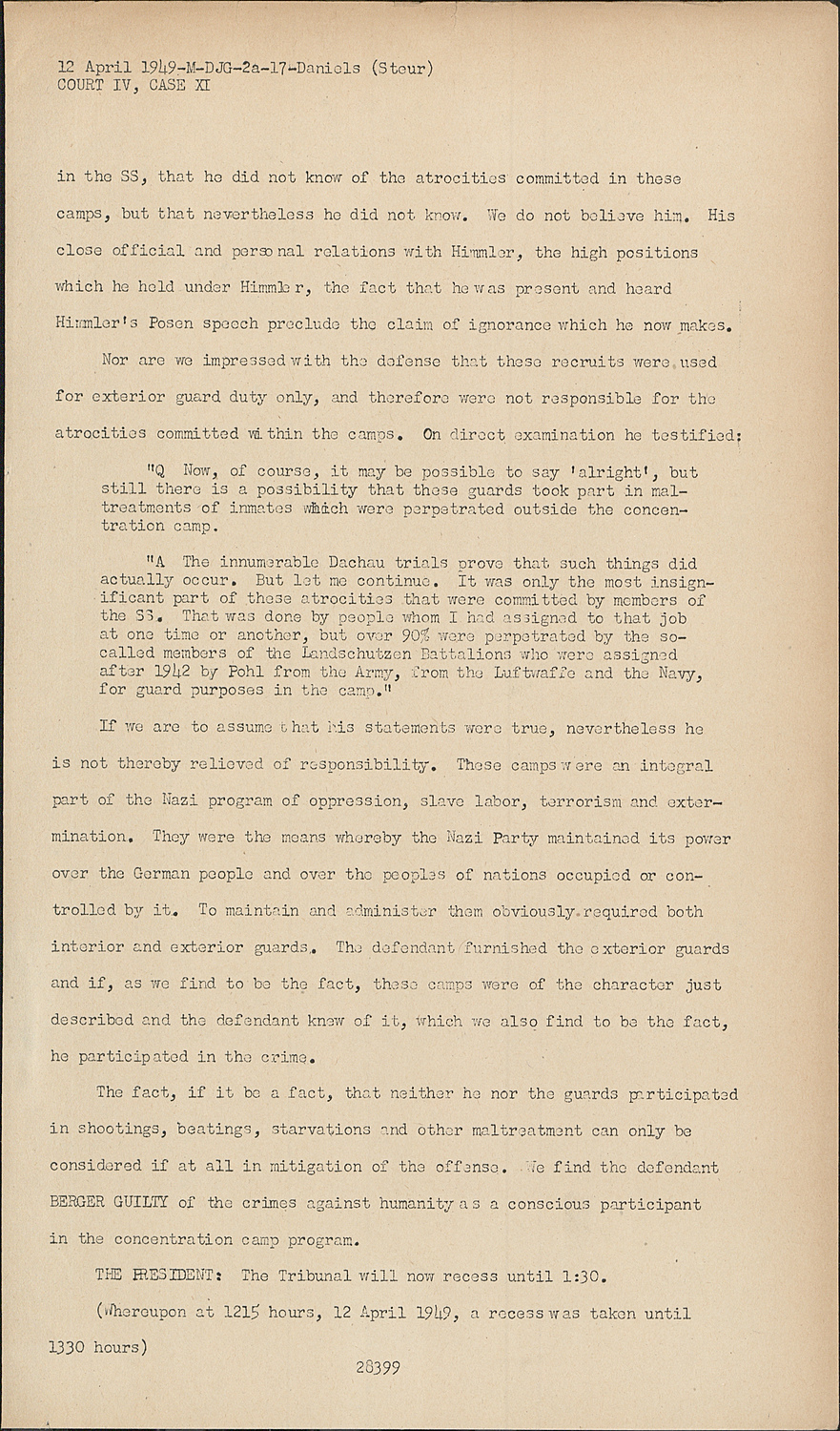
We do not believe him. His close official and personal relations with Himmler, the high positions which he held under Himmler, the fact that he was present and heard Himmler's Posen speech preclude the claim of ignorance which he now makes.
Nor are we impressed with the defense that these recruits were used for exterior guard duty only, and therefore were not responsible for the atrocities committed within the camps. On direct examination he testified:
"Q Now, of course, it may be possible to say 'alright', but still there is a possibility that these guards took part in mal treatments of inmates which were perpetrated outside the concen tration camp.
"A The innumerable Dachau trials prove that such things did actually occur.
But let me continue. It was only the most insign ificant part of these atrocities that were committed by members of the SS.
That was done by people whom I had assigned to that job at one time or another, but over 90% were perpetrated by the so called members of the Landschutzen Battalions who were assigned after 1942 by Pohl from the Army, from the Luftwaffe and the Navy, for guard purposes in the camp."
If we are to assume that his statements were true, nevertheless he is not thereby relieved of responsibility. Those camps were an integral part of the Nazi program of oppression, slave labor, terrorism and extermination. They were the means whereby the Nazi Party maintained its power over the German people and over the peoples of nations occupied or controlled by it. To maintain and administer them obviously required both interior and exterior guards. The defendant furnished the exterior guards and if, as we find to be the fact, these camps were of the character just described and the defendant knew of it, which we also find to be the fact, he participated in the crime.
The fact, if it be a fact, that neither he nor the guards participated in shootings, beatings, starvations and other maltreatment can only be considered if at all in mitigation of the offense. We find the defendant BERGER GUILTY of the crimes against humanity as a conscious participant in the concentration camp program.
THE PRESIDENT:The Tribunal will now recess until 1:30.
(Whereupon at 1215 hours, 12 April 1949, a recess was taken until 1330 hours)
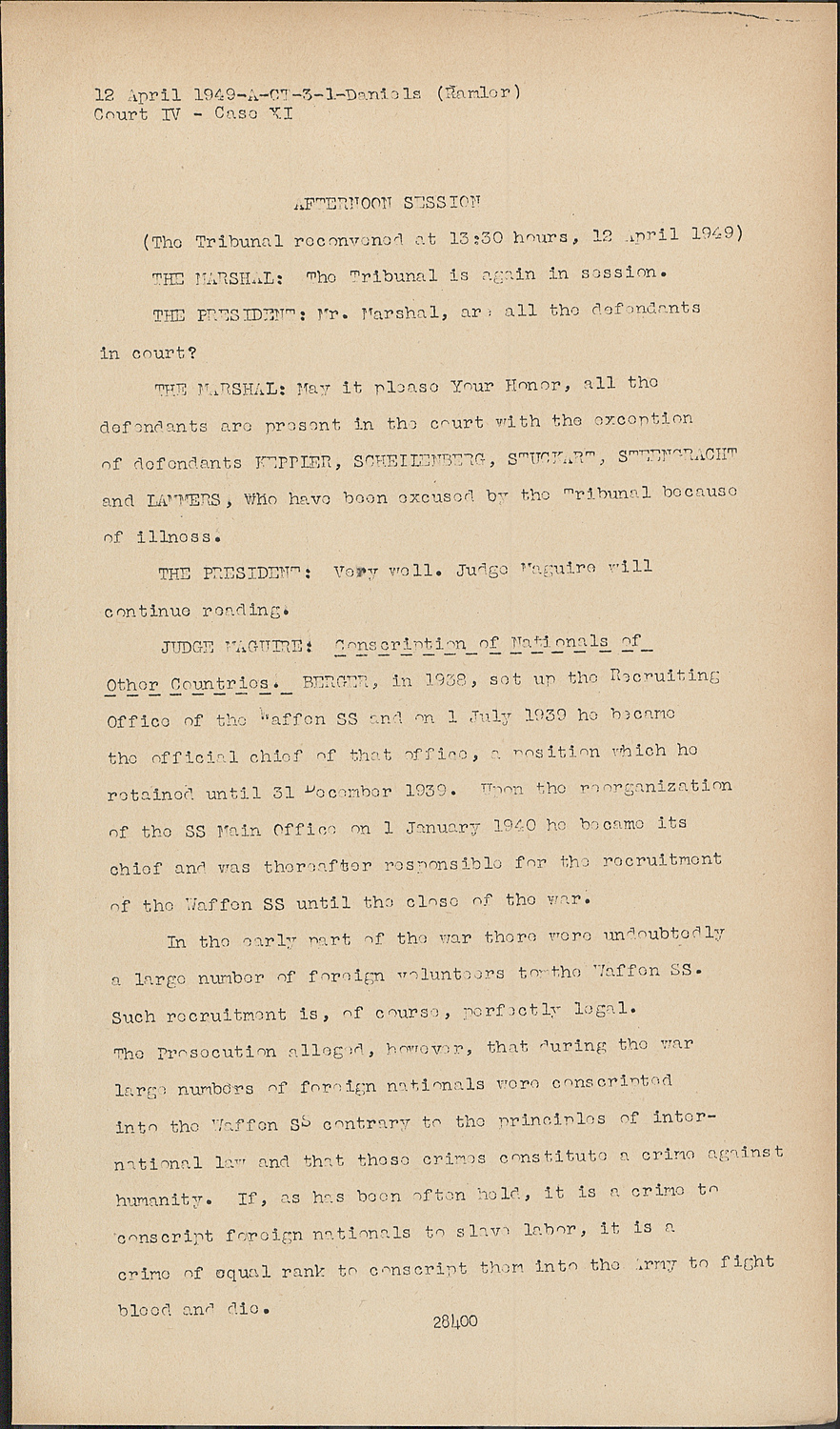
AFTERNOON SESSION (The Tribunal reconvened at 13:
30 hours, 12 April 1949)
THE MARSHAL:The Tribunal is again in session.
THE PRESIDENT:Mr. Marshal, are all the defendants in court?
THE MARSHAL:May it please Your Honor, all the defendants are present in the court with the exception of defendants KEPPLER, SCHEILENBERG, STUGKART STEENGRACHT and LAMMERS, who have been excused by the Tribunal because of illness.
THE PRESIDENT:Very well. Judge Maguire will continue reading.
JUDGE MAGUIRE:Conseription of Nationals of Other Countries. BERGER, in 1938, set up the Recruiting Office of the Waffen SS and on 1 July 1939 he became the official chief of that office, a position which he retained until 31 December 1939. Upon the reorganization of the SS Main Office on 1 January 1940 he became its chief and was thereafter responsible for the recruitment of the Waffen SS until the close of the war.
In the early part of the war there were undoubtedly a large number of foreign volunteers to the Waffen SS. Such recruitment is, of course, perfectly legal. The Prosecution alleged, however, that during the war large numbers of foreign nationals were conscripted into the Waffen SS contrary to the principles of international law and that these crimes constitute a crime against humanity. If, as has been often hold, it is a crime to conscript foreign nationals to slave labor, it is a crime of equal rank to conscript them into the army to fight blood and die.
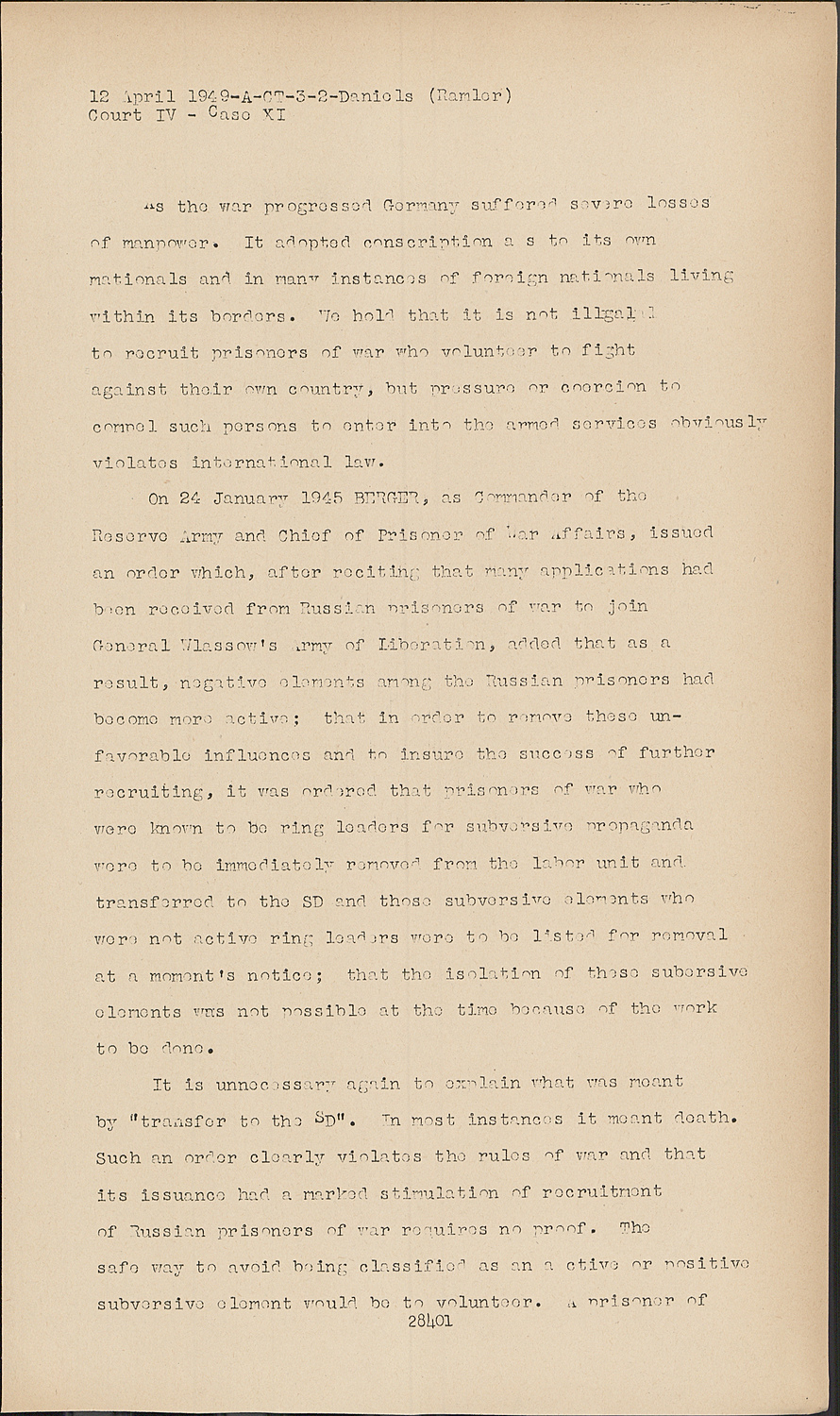
As the war progressed Germany suffered severe losses of manpower. It adopted conscription a s to its own mationals and in Many instances of foreign nationals living within its borders. We hold that it is not illgal to recruit prisoners of war who volunteer to fight against their own country, tint pressure or coercion to compel such persons to enter into the armed services obviously violates international law.
On 24 January 1945 BERGER, as Commander of the Reserve Army and Chief of Prisoner of War Affairs, issued an order which, after reciting that many applications had been received from Russian prisoners of war to join General Wlassow's Army of Liberation, added that as a result, negative elements among the Russian prisoners had become more active; that in order to remove these unfavorable influences and to insure the success of further recruiting, it was ordered that prisoners of war who were known to be ring leaders for subversive propaganda were to be immediately removed from the labor unit and transferred to the SD and these subversive elements who were not active ring leaders were to be listed for removal at a moment's notice; that the isolation of these subersive elements was not possible at the time because of the work to be done.
It is unnecessary again to explain what was meant by "transfer the SD". In most instances it meant death. Such an order clearly violates the rules of war and that its issuance had a marked stimulation of recruitment of Russian prisoners of war requires no proof. The safe way to avoid being classified as an a ctive of positive subversive element would be to volunteer. A prisoner of war who endeavored to persuade his comrades not to fight against his brother there by violated no rule of war and such conduct would, under no possibility, subject him to legal punishment, or would justify his being turned over to the SD.
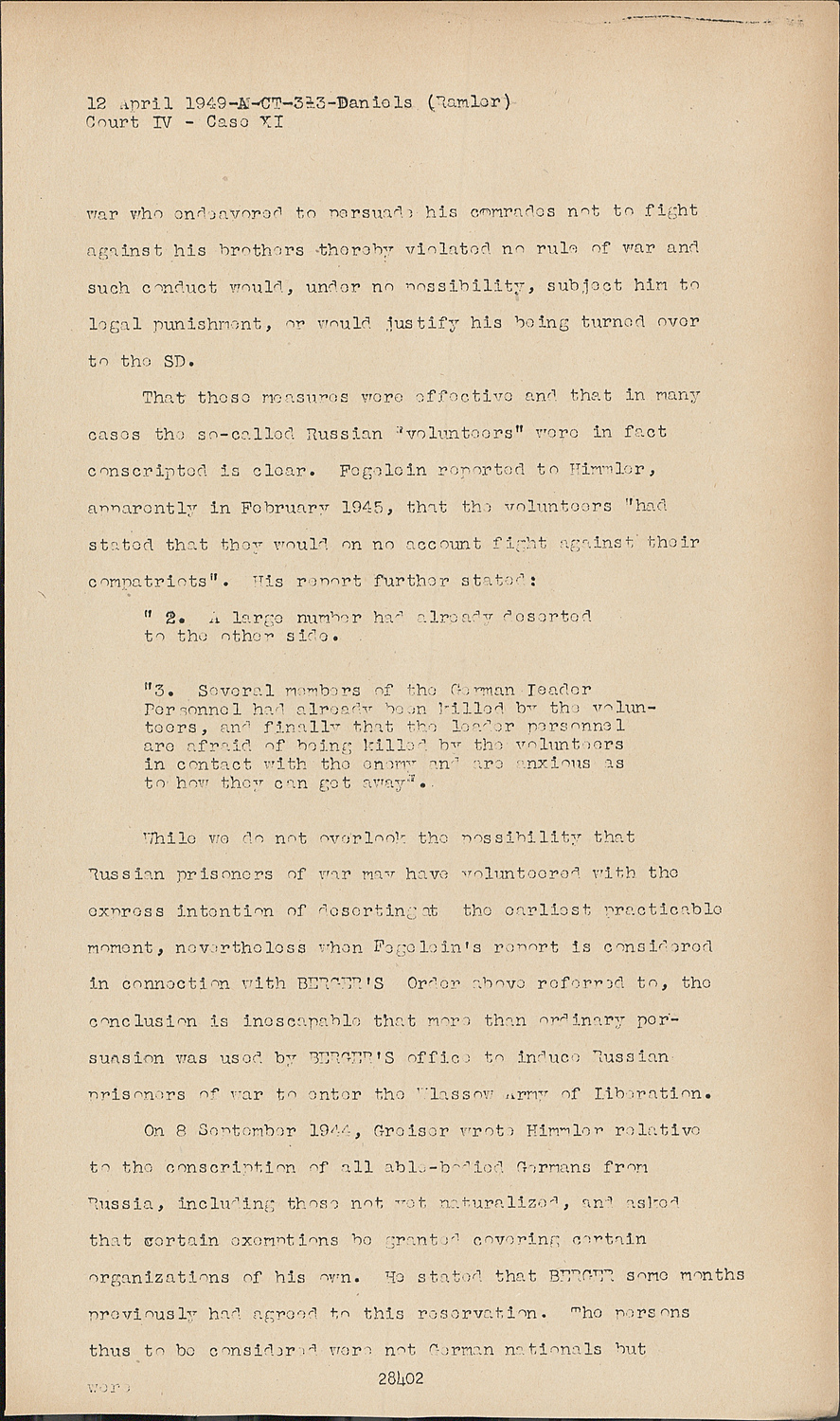
That these measures were effective and that in many cases the so-called Russian "volunteers" were in fact conscripted is clear. Fegelein reported to Himmler, apparently in February 1945, that the volunteers "had stated that they would on no account fight against their compatriots". His report further stated:
" 2. A large number had already deserted to the other side.
" 3. Several members of the German leader Personnel had already been killed by the volun teers, and finally that the leader personnel are afraid of being killed by the volunteers in contact with the enemy and are anxious as to how they can get away".While we do not overlook the possibility that Russian prisoners of war may have volunteered with the express intention of deserting at the earliest practicable moment, nevertheless when Fegelein's report is considered in connection with BERGER'S Order above referred to, the conclusion is inescapable that than ordinary persuasion was used by BERGER'S office to induce Russian prisoners of war to enter the Wlassow Army of Liberation.
On 8 September 1944, Greiser wrote Himmler relative to the conscription of all able bedied Germans from Russia, including these not naturalized, and asked that certain exemptions be granted covering certain organizations of his own. He stated that BERGER some months previously had agreed to this reservation. The persons thus to be considered were not German nationals but were Were people of German blood who were citizens of Russia.
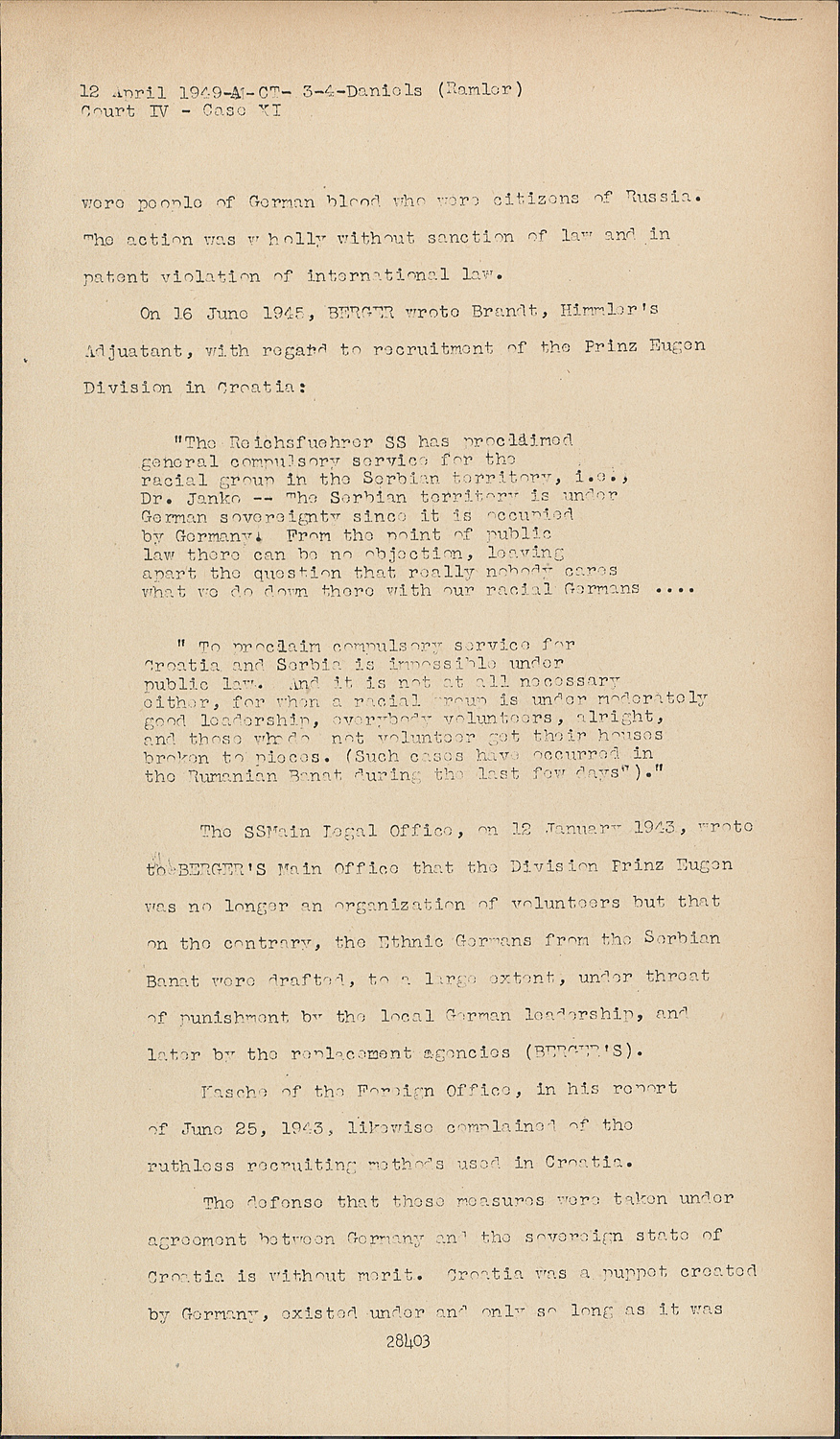
The action was Wholly without sanction of law and in patent violation of international law.
On 16 June 1945, BERGER wrote Brandt, Himmler's Adjuatant, with regain to recruitment of the Prinz Eugen Division in Croatia:
"The Reichsfuehrer SS has proclaimed general compulsory service for the racial group in the Serbian territory, i.e., Dr. Janko -- The Serbian territery is under German sovereignty since it is occupied by Germany.
From the point of public law there can be no objection, leaving apart the question that really nobody cares what we do down there with our racial Germans ...." To proclaim compulsery service for Croatia and Serbia is impossible under public law.
And it is not at all necessary either, for when a racial group is under moderately good leadership, everybody volunteers, alright, and these whodo not volunteer get their houses broken to pieces.
(Such cases have occurred in the Rumanian Banat during the last few days")."The SSMain Legal Office, on 12 January 1943, wrote to BERGER'S Main Office that the Division Prinz Eugen was no longer an organization of volunteers but that on the contrary, the Ethnic Germans from the Serbian Banat were drafted, to a large extent, under threat of punishment by the local German leadership, and later by the replacement agencies (BERGER'S).Kasehe of the Foreign Office, in his report of June 25, 1943, likewise complained of the ruthless recruiting methods used in Croatia.
The defense that these measures were taken under agreement between Germany and the severeign state of Croatia is without merit.
Croatia was a puppet created by Germany, existed under and only so long as it was backed up by German arms.
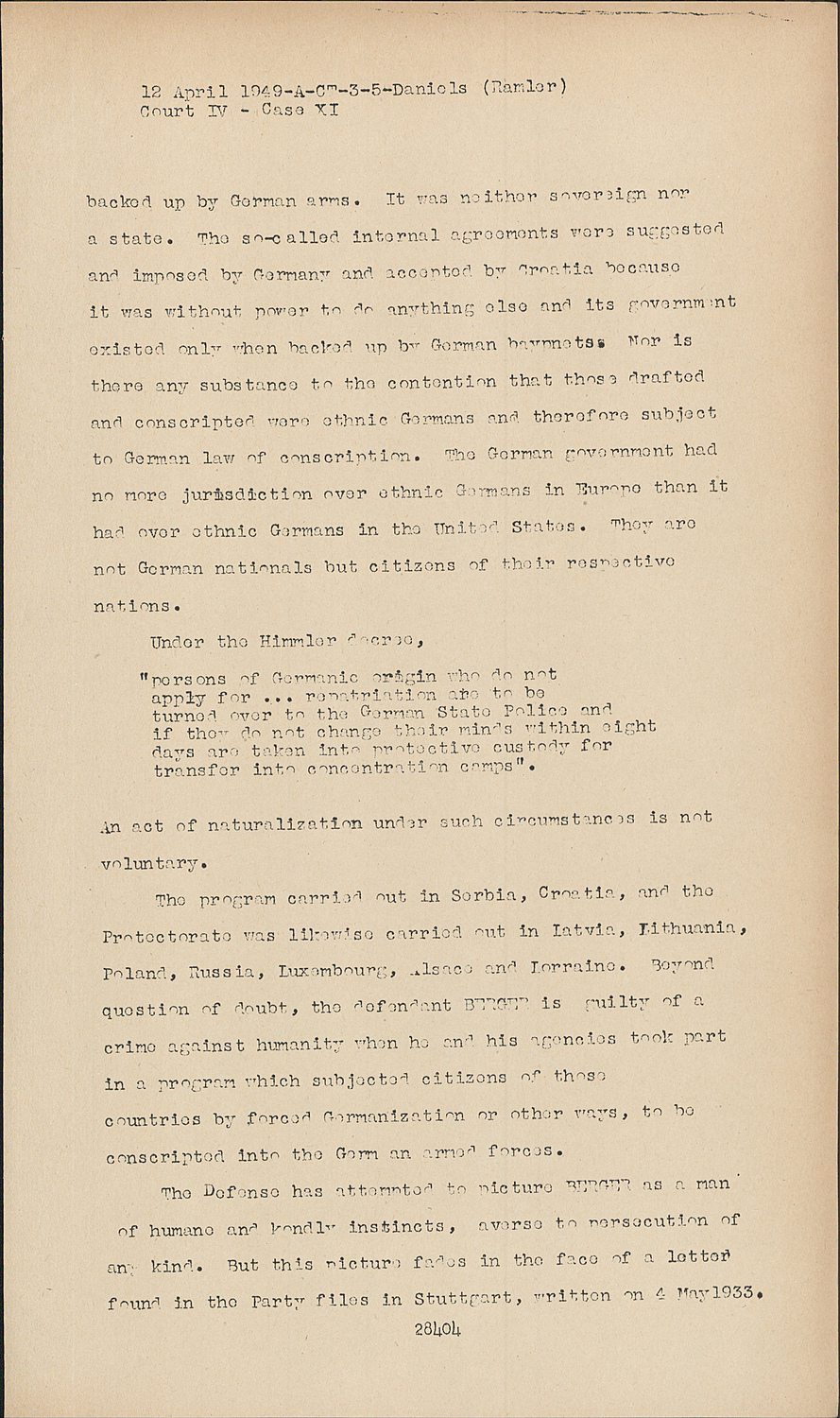
It was neither severeign nor a state. The so-called internal agreements were suggested and imposed by Germany and accepted by Croatia because it was without power to do anything else and its government existed only when backed up by German baypnets. Nor is there any substance to the contention that these drafted and conscripted were ethnic Germans and therefore subject to German law of conscription. The German government had no more jurisdiction over ethnic Germans in Europe than it had over ethnic Germans in the United States. They are not German nationals but citizens of their respective nations.
Under the Himmler decree, "persons of Germanic origin who do not apply for ... repatriation are to be turned over to the German State Police and if they do not change their minds within eight days are taken into protective custody for transfer into concentration camps". An act of naturalization under such circumstances is not voluntary.
The program carried out in Serbia, Croatia, and the Protectorate was likewise carried out in Latvia, Lithuania, Poland, Russia, Luxembourg, Alsace and Lorraine. Beyond question of doubt, the defendant BERGER is guilty of a crime against humanity when he and his agencies took part in a program which subjected citizens of these countries by forced Germanization or other ways, to be conscripted into the Germ an armed forces.
The Defense has attempted to picture BERGER as n man of humane and kendly instincts averse to persecution of an kind.
But this picture fades in the face of a letter found in the Party files in Stuttgart, written on 4 May 1933.
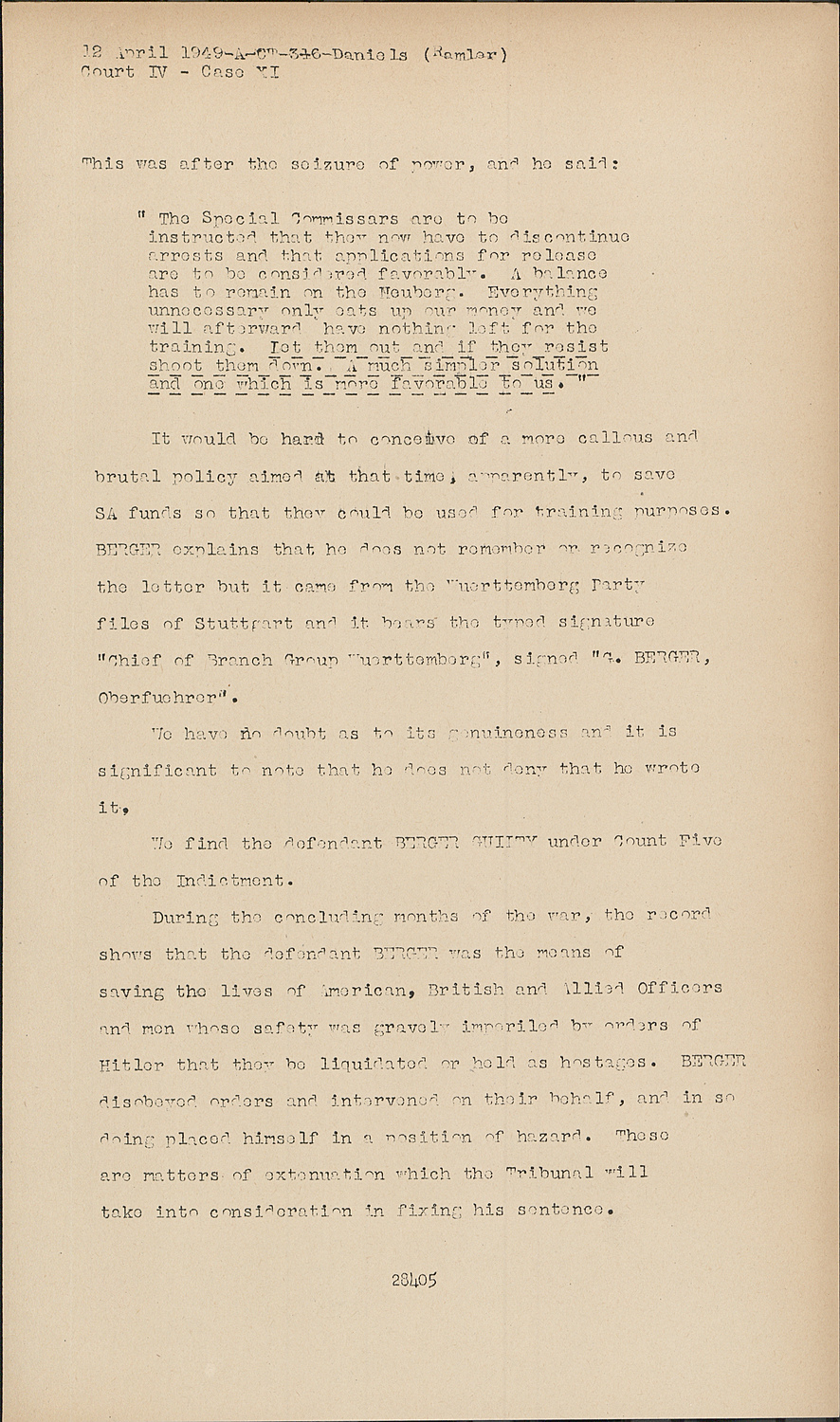
This was after the seizure of power, and he said:
" The Special Commissars are to be instructed that they new have to discentinue arrests and that applications for release are to be censidered favorably.
A balance has to remain on the Neuberg.
Everything unnecessary only eats up our money and we will afterward have nothing loft for the training.
Let them out and if they resist shoot them down.
A much simpler solution and one which is more favorable to us.
It would be hard to conceive of a more callous and brutal policy aimed at that time apparently, to save SA funds so that they could be used for training purposes. BERGER explains that he does not remember or recognize the letter but it came from the wuerttemberg party files of Stuttgart and it bears the typed signature "Chief of Branch Group wuerttemberg", signed "G. BERGER, Oberfuehrer".
We have no doubt as to its genuineness and it is significant to note that he does not deny that he wrote it.
We find the defendant BERGER GUILTY under Count Five of the Indictment.
During the concluding months of the war, the record shows that the defendant BERGER was the means of saving the lives of American, British and Allied Officers and men whose safety was gravely imperiled by orders of Hitler that they be liquidated or hold as hostages. BERGER disobeyed orders and intervened on their behalf and in so doing placed himself in a position of hazard. These are matters of extenuation which the tribunal will take into consideration in fixing his sentence.
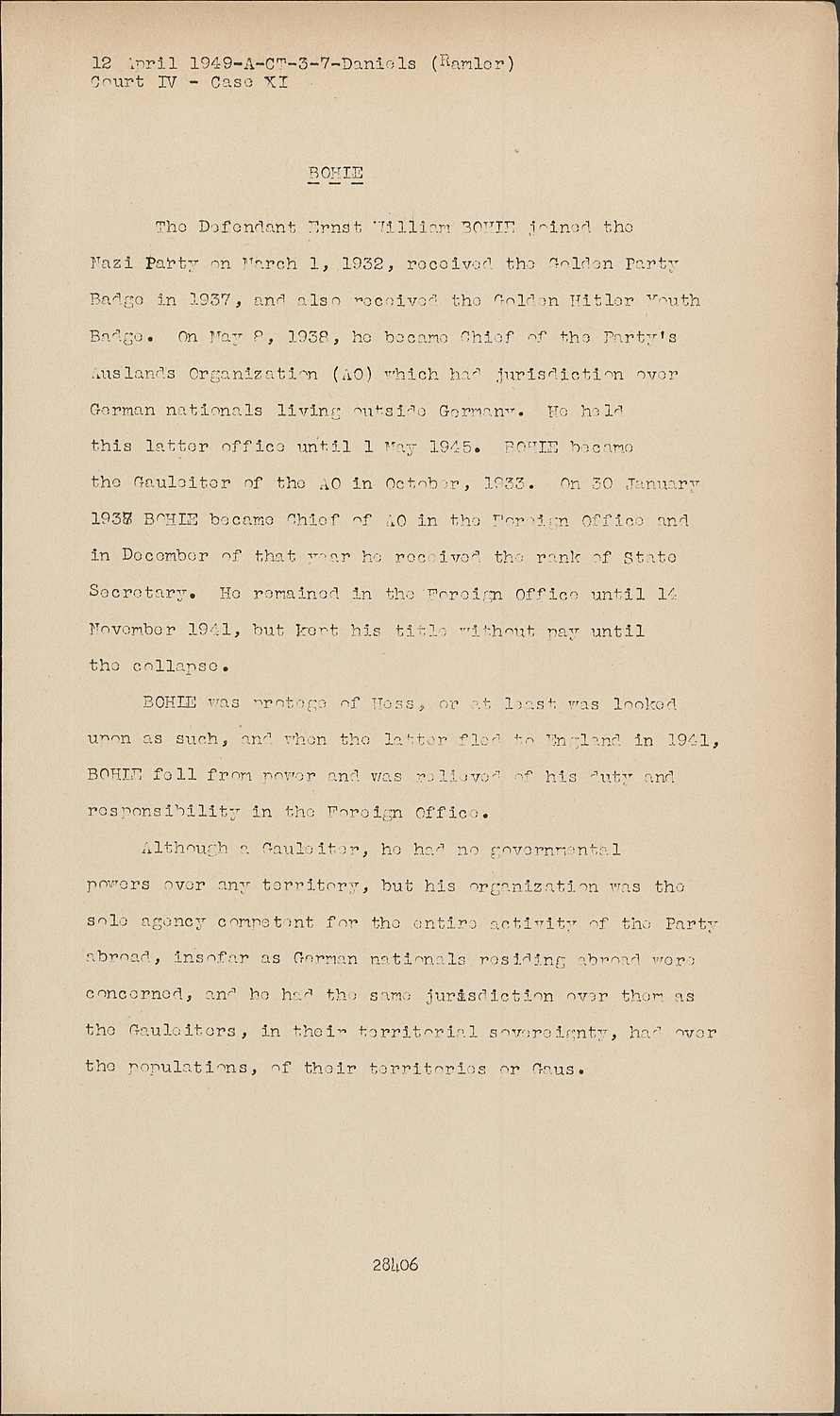
BOHLE The Defendant Ernst William BOHLE joined the Nazi Party on March 1, 1932, received the Golden Party Badge in 1937, and also received the Golden Hitler Youth Badge.
On May 8, 1938, he became Chief of the Party's Auslands Organization (AO) which had jurisdiction over German nationals living outside Germany. He held this latter office until 1 May 1945. BOHLE became the Gauleiter of the AO in October, 1933. On 30 January 1937 BOHLE became Chief of AO in the Foreign Office and in December of that year he received the rank of State Secretary. He remained in the Foreign Office until 14 November 1941, but kept his title without pay until the collapse.
BOHLE was protege of Hess, or at least was looked upon as such, and when the latter fled to England in 1941, BOHLE fell from power and was relieved of his duty and responsibility in the Foreign Office.
Although a Gauleiter, he had no governmental powers over any territory, but his organization was the sole agency competent for the entire activity of the Party abroad, insofar as German nationals residing abroad were concerned, and he had the same jurisdiction over them as the Gauleiters, in their territorial sovereignty, had over the populations, of their territories or Gaus.