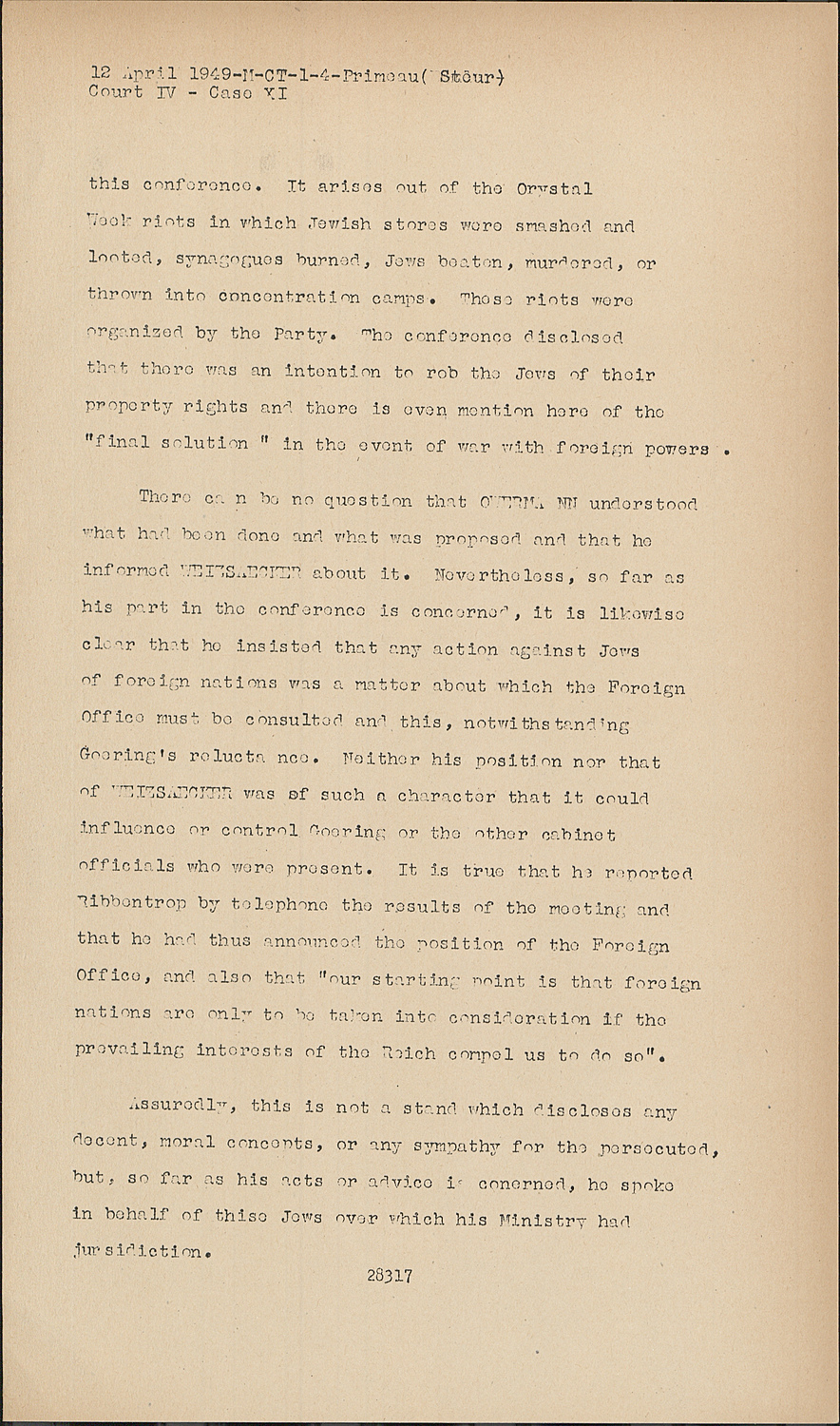
It arises out of the Orystal Week riots in which Jewish stores were smashed and looted, synagogues burned, Jews beaten, murdered, or thrown into concentration camps. These riots were organized by the party. The conference disclosed that there was an intention to rob the Jews of their property rights and there is even mention here of the "final solution " in the event of war with foreign powers .
There ca n be no question that OWERMANN understood what had been done and what was proposed and that he informed WEIZSAECKER about it. Nevertheless , so far as his part in the conference is concerned, it is likewise clear that he insisted that any action against Jews of foreign nations was a matter about which the Foreign Office must be consulted and this, notwithstanding Goering's relucta nce. Neither his position nor that of WEIZSAECKER was of such a character that it could influence or control Goering or the other cabinet officials who were present. It is true that he reported Ribbentrop by telephone the results of the meeting and that he had thus announced the position of the Foreign Office, and also that "our starting point is that foreign nations are only to be taken into consideration if the prevailing interests of the Reich compel us to do so".
Assuredly, this is not a stand which discloses any decent, moral concepts, or any sympathy for the persecuted but, so far as his acts or advice is conerned, he spoke in behalf of thise Jews over which his Ministry had jursidiction.
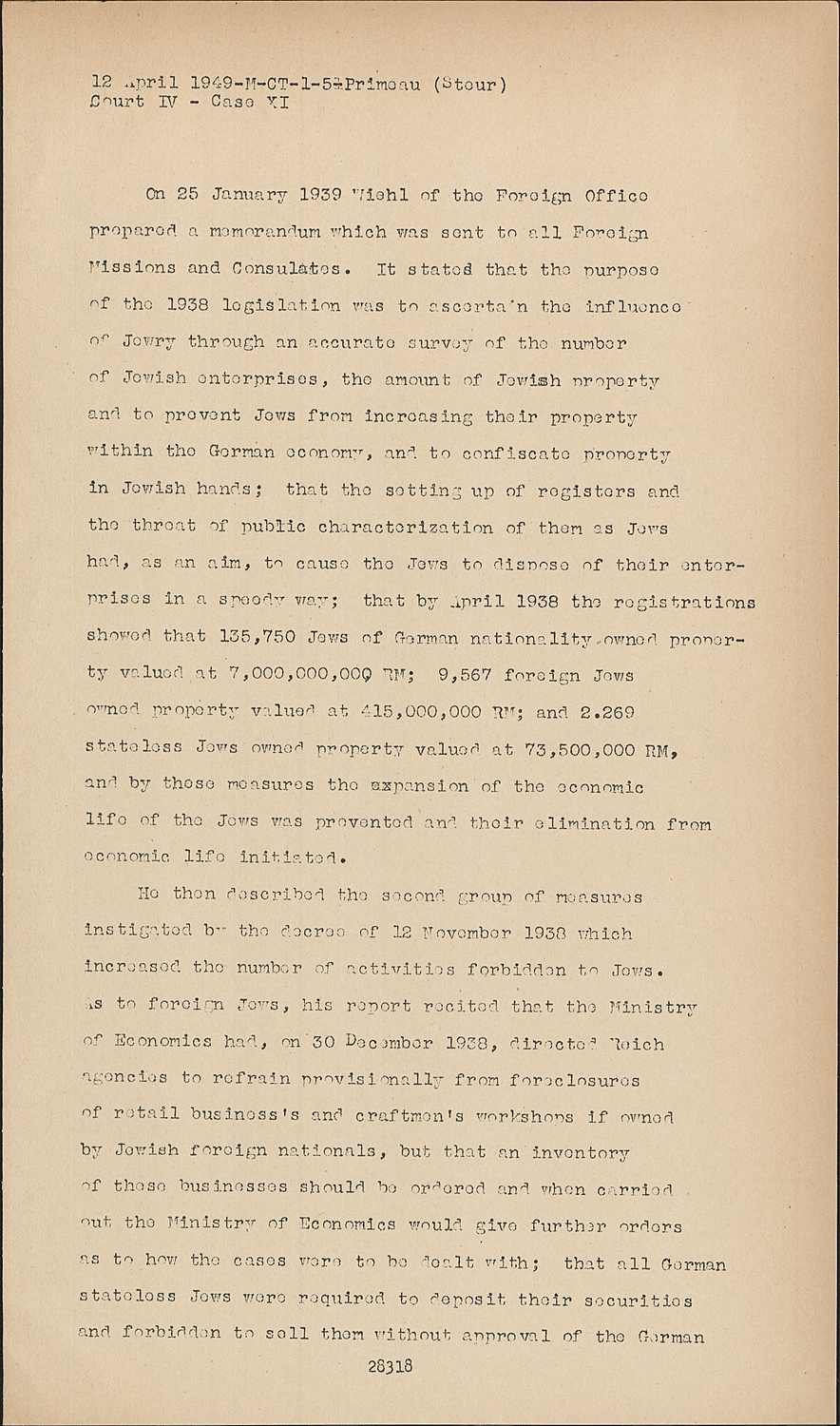
On 25 January 1939 Wiehl of the Foreign Office prepared a memorandum which was sent to all Foreign Missions and Consulates. It stated that the purpose of the 1938 legislation was to ascertain the influence of Jewry through an accurate survey of the number of Jewish enterprises, the amount of Jewish property and to prevent Jews from increasing their property within the German economy and to confiscate property in Jewish hands; that the setting up of registers and the threat of public characterization of them as Jews had, as an aim, to cause the Jews to dispose of their enterprises in a speedy way; that by April 1938 the registrations showed that 135,750 Jews of German nationality owned property valued at 7,000,000,000 RM; 9,567 foreign Jews owned property valued at 415,000,000 RM; and 2.269 stateless Jews owned property valued at 73,500,000 RM, and by these measures the expansion of the economic life of the Jews was prevented and their elimination from economic life initiated.
He then described the second group of measures instigated by the decree of 12 November 1938 which increased the number of activities forbidden to Jews. As to foreign Jews, his report recited that the Ministry of Economics had, on 30 December 1938, directed Reich agencies to refrain provisionally from foreclosures of retail business's and craftmen's workshops if owned by Jewish foreign nationals, but that an inventory of these businesses should be ordered and when carried out the Ministry of Economics would give further orders as to how the cases were to be dealt with; that all German stateless Jews were required to deposit their securities and forbidden to sell them without approval of the German Ministry of Economics; that Jewish sellers, instead of receiving the payment fixed in the selling agreement, would be ordered to receive Reich debentures, and that German economic life wo uld be completely de justafied in the year 1939.
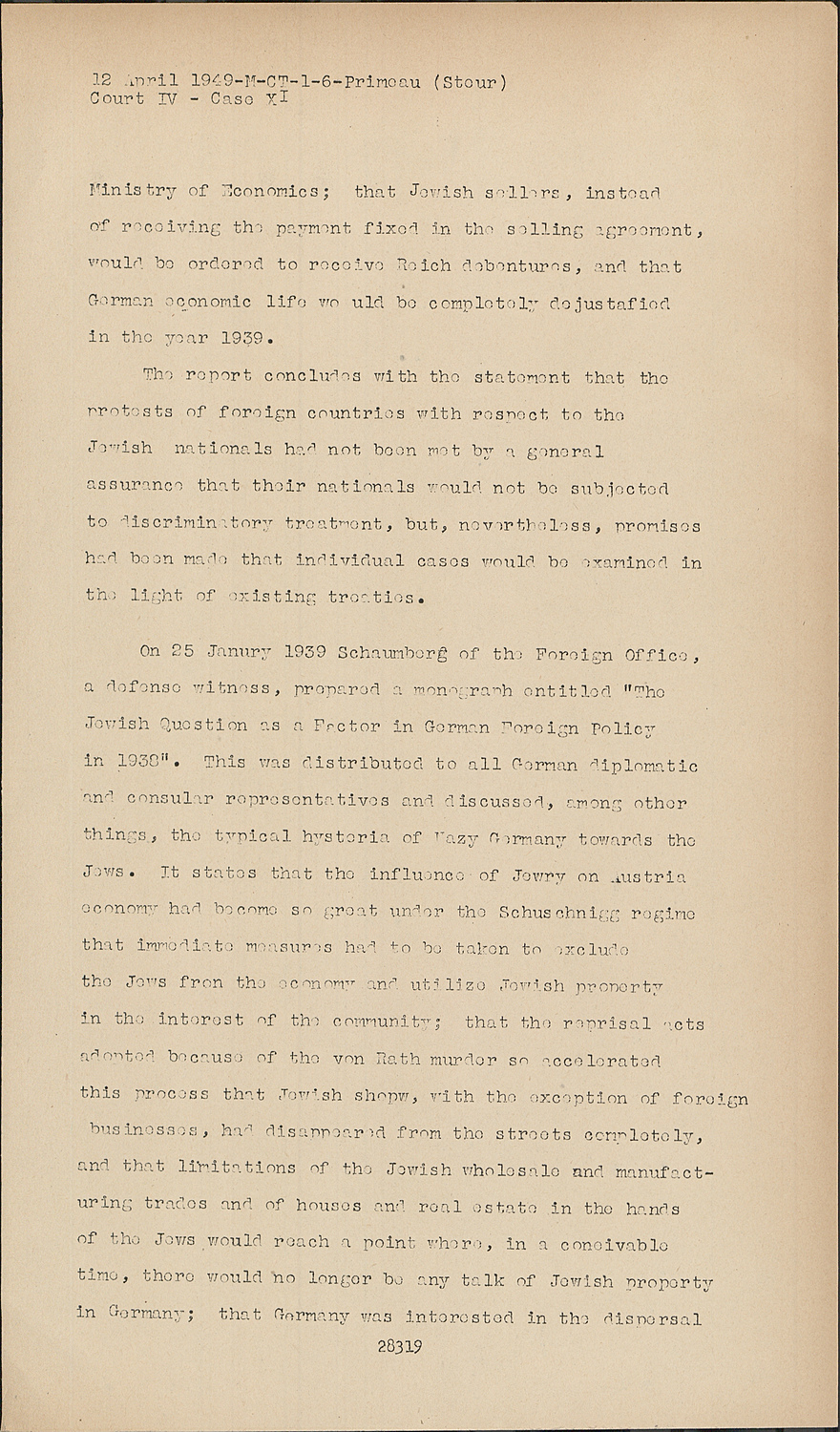
The report concludes with the statement that the protests of foreign countries with respect to the Jewish nationals had not been met by a general assurance that their nationals would not be subjected to discriminatory treatment, but, nevertheless, promises had been made that individual cases would be examined in the light of existing treaties.
On 25 January 1939 Schaumberg of the Foreign Office, a defense witness, prepared a monograph entitled "The Jewish Question as a Factor in German Foreign Policy in 1938". This was distributed to all German diplomatic and consular representatives and discussed, among other things, the typical hysteria of Nazy Germany towards the Jews. It states that the influence of Jewry on Austria economy had become so great under the Schuschnigg regime that immediate measures had to be taken to exclude the Jews from the economy and utilize Jewish property in the interest of the community; that the reprisal acts adopted because of the von Rath murder so accelerated this process that Jewish shepw, with the exception of foreign businesses, had disappeared from the streets completely, and that limitations of the Jewish wholesale and manufacturing trades and of houses and real estate in the hands of the Jews would reach a point where, in a coneivable time, there would no longer be any talk of Jewish Property in Germany; that Germany was interested in the dispersal Of Jewry; the calculation that as a consequence boycott groups and anti-German centers would be formed all over the world disregards the fact , already apparent, that the influx of Jews in all parts of the world invokes the opposition of the native population and thereby forms the best propaganda for the German Jewish policy:
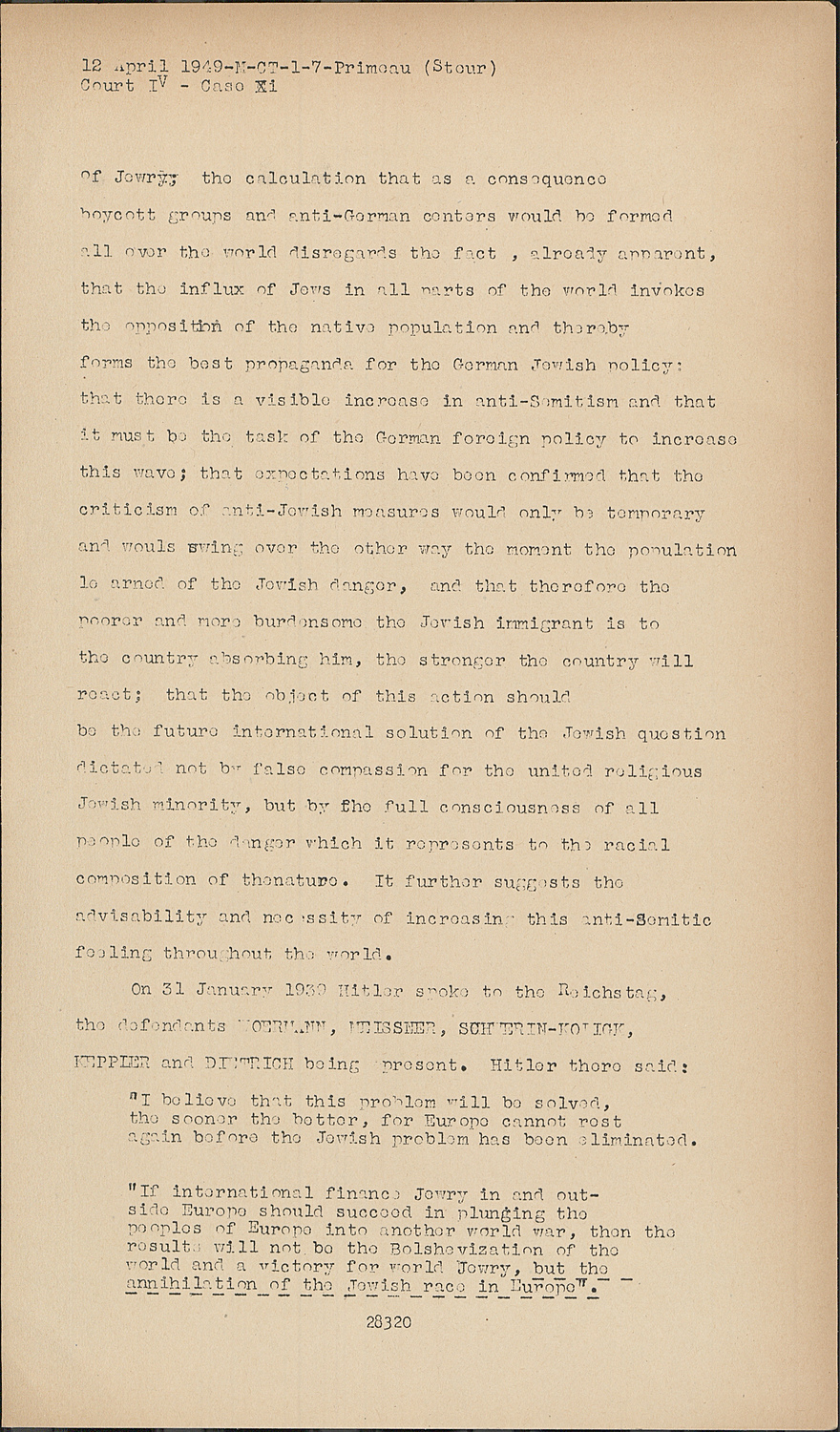
that there is a visible increase in anti-Semitism and that it must be the task of the German foreign policy to increase this wave; that expectations have been confirmed that the criticism of anti-Jewish measures would only be temporary and wouls swing over the other way the moment the population le arned of the Jewish danger, and that therefore the poorer and more burdensome the Jewish immigrant is to the country absorbing him, the stronger the country will react; that the object of this action should be the future international solution of the Jewish question dictated not by false compassion for the united religious Jewish minority, but by the full consciousness of all people of the danger which it represents to the racial composition of thenature. It further suggests the advisability and necessity of increasing this anti-Semitic feeling throughout the world.
On 31 January 1939 Hitler spoke to the Reichstag, the defendants WOERMANN, MEISSNER, SCHWERIN-KOLIGK, KEPPLER and DIETRICH being present. Hitler there said:
"I believe that this problem will be solved, the sooner the better, for Europe cannot rest again before the Jewish problem has been eliminated.
"If international finance Jewry in and out side Europe should succeed in plunging the peoples of Europe into another world war, then the results will not be the Bolshevization of the world and a victory for world Jewry, but the annihilation of the Jewish race in Europe". Those are not idle words, nor, in view of the brutal tactics which he had already adopted against opponents, both real and fancied, could any of his listeners or readers have any reason to deem them to be more rhetorical froth.
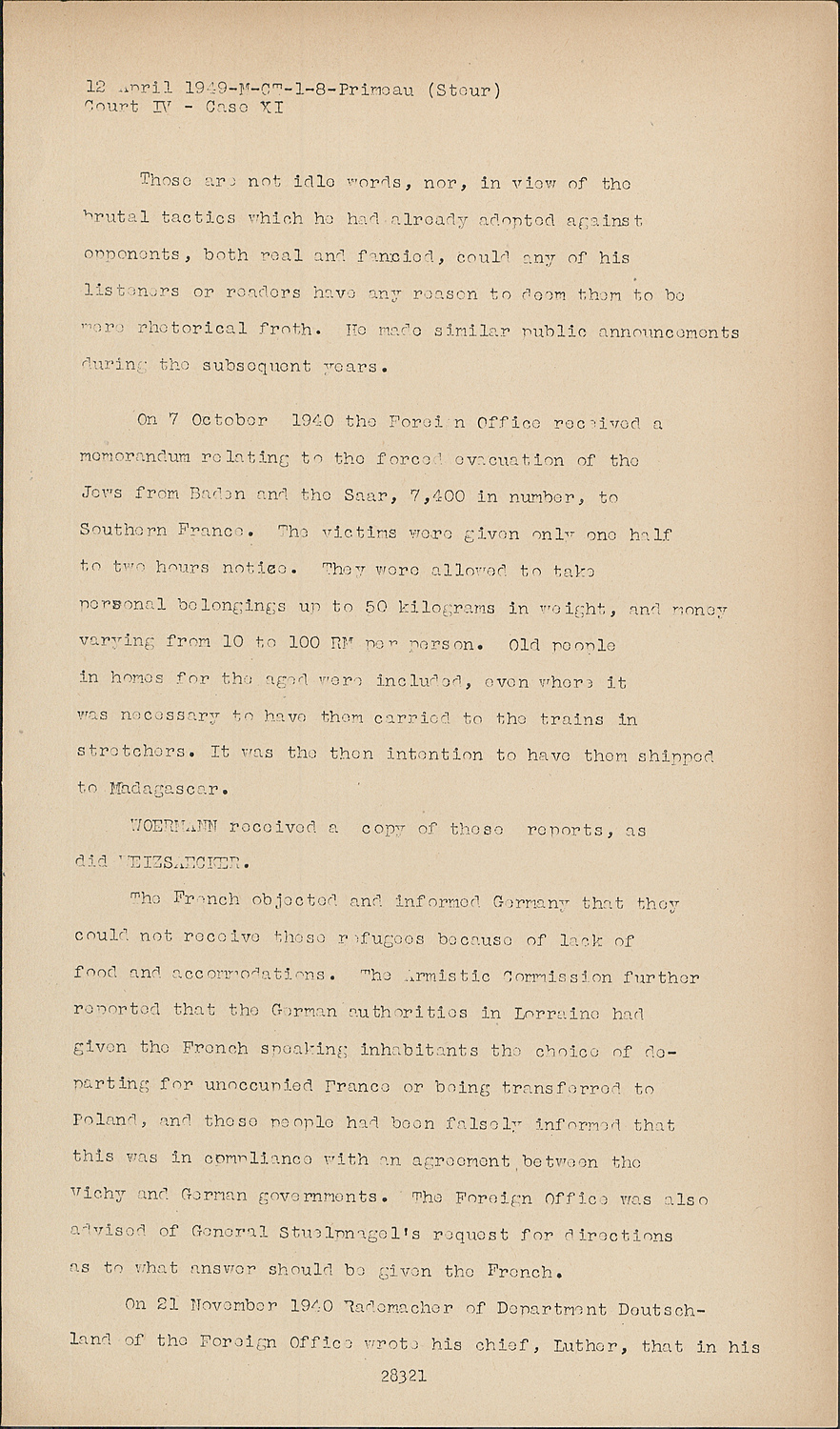
He made similar public announcements during the subsequent years.
On 7 October 1940 the Foreign Office received a memorandum relating to the forced evacuation of the Jews from Baden and the Saar, 7,400 in number, to Southern France. The victims were given only one half to two hours notice. They were allowed to take personal belongings up to 50 kilograms in weight, and money varying from 10 to 100 RM per person. Old people in hemes for the aged were included, even where it was necessary to have them carried to the trains in stretchers. It was the then intention to have them shipped to Madagascar.
WOERMANN received a copy of these reports, as did WEIZSAECKER.
The French objected and informed Germany that they could not receive these refugees because of lack of food and accommodations. The Armistic Commission further reported that the German authorities in Lorraine had given the French speaking inhabitants the choice of departing for unoccupied France being transferred to Poland, and these people had been falsely informed that this was in compliance with an agreement between the vichy and German governments. The Foreign Office was also advised of General Stuelpnagel's request for directions as to what answer should be given the French.
On 21 November 1940 Rademacher of Department Deutschland of the Foreign Office wrote his chief, Luther, that in his opinion Abetz, the German Ambassador to the Vichy Government, should be instructed to tell the French to settle the matter quietly and not mention it again in Wiesbaden (site of the Armistice Commission), and that the German Commission should tell the French that the matter would be settled in Paris.
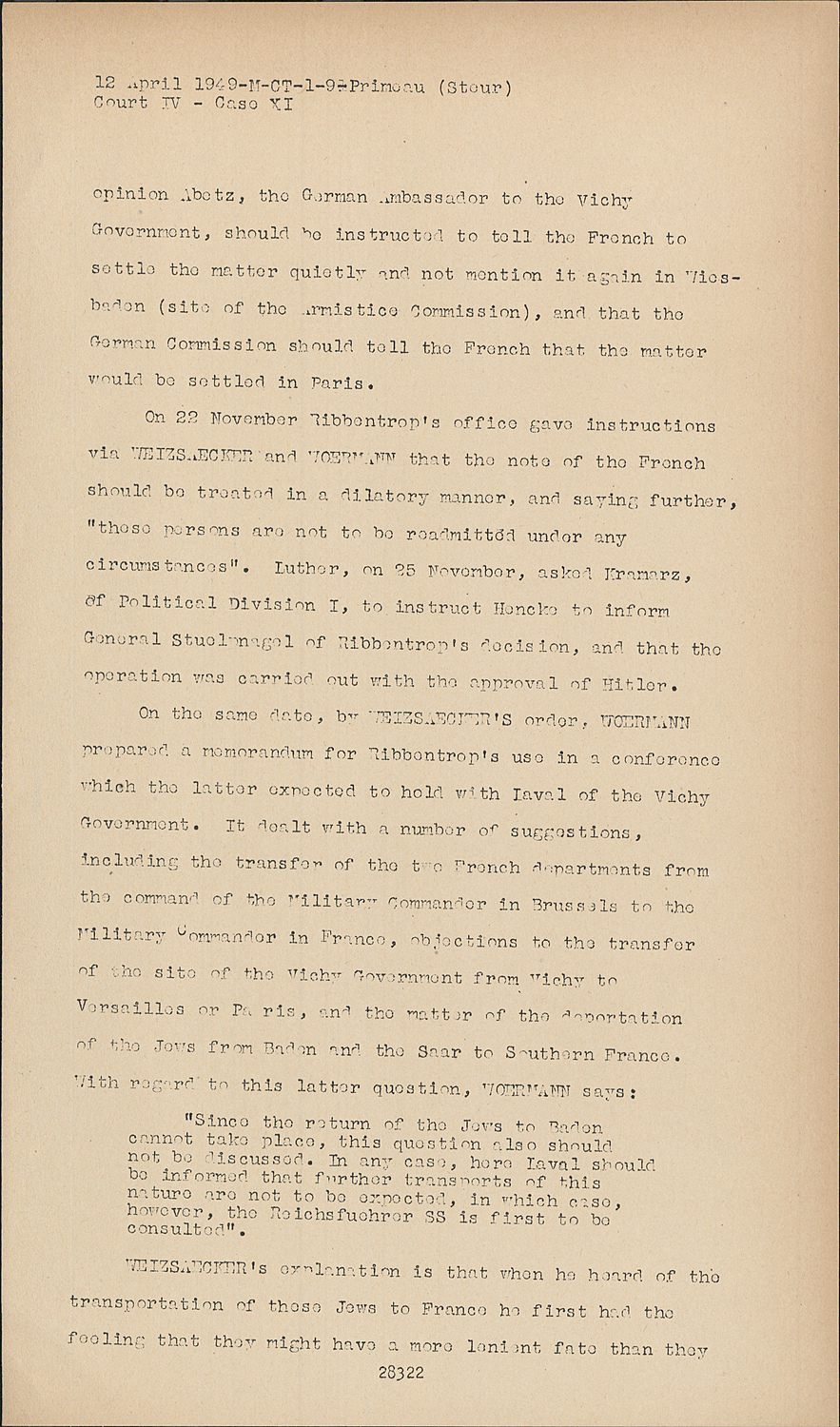
On 22 November Ribbentrop's office gave instructions via WEIZSAECKER and WOERMANN that the note of the French should be treated in a dilatory manner, and saying further, "these persons are not to be readmitted under any circumstances". Luther, on 25 November, asked Kramarz, of Political Division I, to instruct Hencke to inform General Stuelpnagel of Ribbentrop's decision, and that the operation was carried out with the approval of Hitler.
On the same date, by WEIZSAECKER'S order, WOERMANN prepared a memorandum for Ribbentrop's use in a conference which the latter expected to hold with Laval of the Vichy Government. It dealt with a number of suggestions, including the transfer of the two French departments from the command of the Military Commander in Brussels to the Military Commander in France,objections to the transfer of the site of the Vichy Government from Vichy to Versailles or Pa ris and the matter of the deportation of the Jews from Baden and the Saar to Southern France. With regard to this latter question, WOERMANN says:
"Since the return of the Jews to Baden cannot take place, this question also should not be discussed.
In any case, here Iaval should be informed that further transports of this nature are not to be expected, in which case, however, the Reichsfuehrer SS is first to be consulted".WEIZSAECKER's Explanation is that when he heard of the transportation of these Jews to France he first had the feeling that they might have a more lenient fate than they would have received in Germany and then the reports came in about abuses they suffered in camps in the Pyrenees; that when he first heard about the transport to the East he thought they would be better off there than in then Pyrenees because if they were used for labor they would be treated decently, but it finally burned out that the Jews would have been better off in France anyhow and that with the modest means of Foreign Office influence within the scope of diplomatic possibilities, he, was not absolutely able to determine where the lesser evil and where he could best intervene.
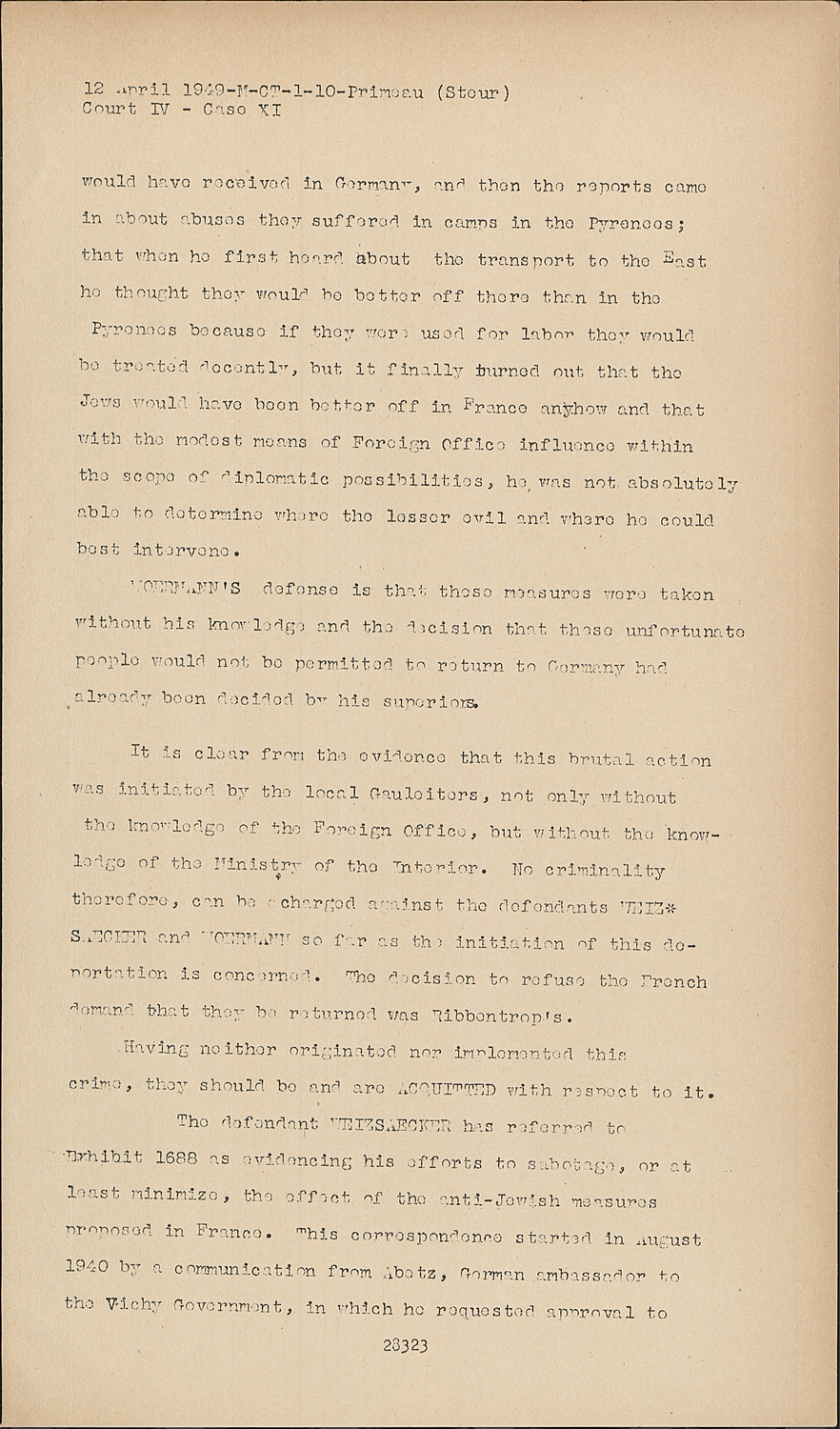
WOERMANN'S defense is that these measures were taken without his knowledge and the decision that these unfortunate people would not be permitted to return to Germany had already been decided by his superiors.
It is clear from the evidence that this brutal action was initiated by the local Gauleiters, not only without the knowledge of the Foreign Office, but without the knowledge of the Ministry of the Interior.
No criminality therefore, can be charged against the defendants WEIZ* SAECKER and WOERMANN so far as the initiation of this deportation is concerned, The decision to refuse the French demand that they be returned was Ribbentrop's.
Having neither originated nor implemented this crime, they should be and are ACQUITTED with respect to it.
The defendant WEIZSAECKR has referred to Exhibit 1688 as evidencing his efforts to sabotage, or at least minimize, the effect of the anti-Jewish measures proposed in France. This correspondence started in August 1940 by a communication from Abetz, German ambassador to the Vichy Government, in which he requester approval to certain proposed anti-Jewish measures which were:
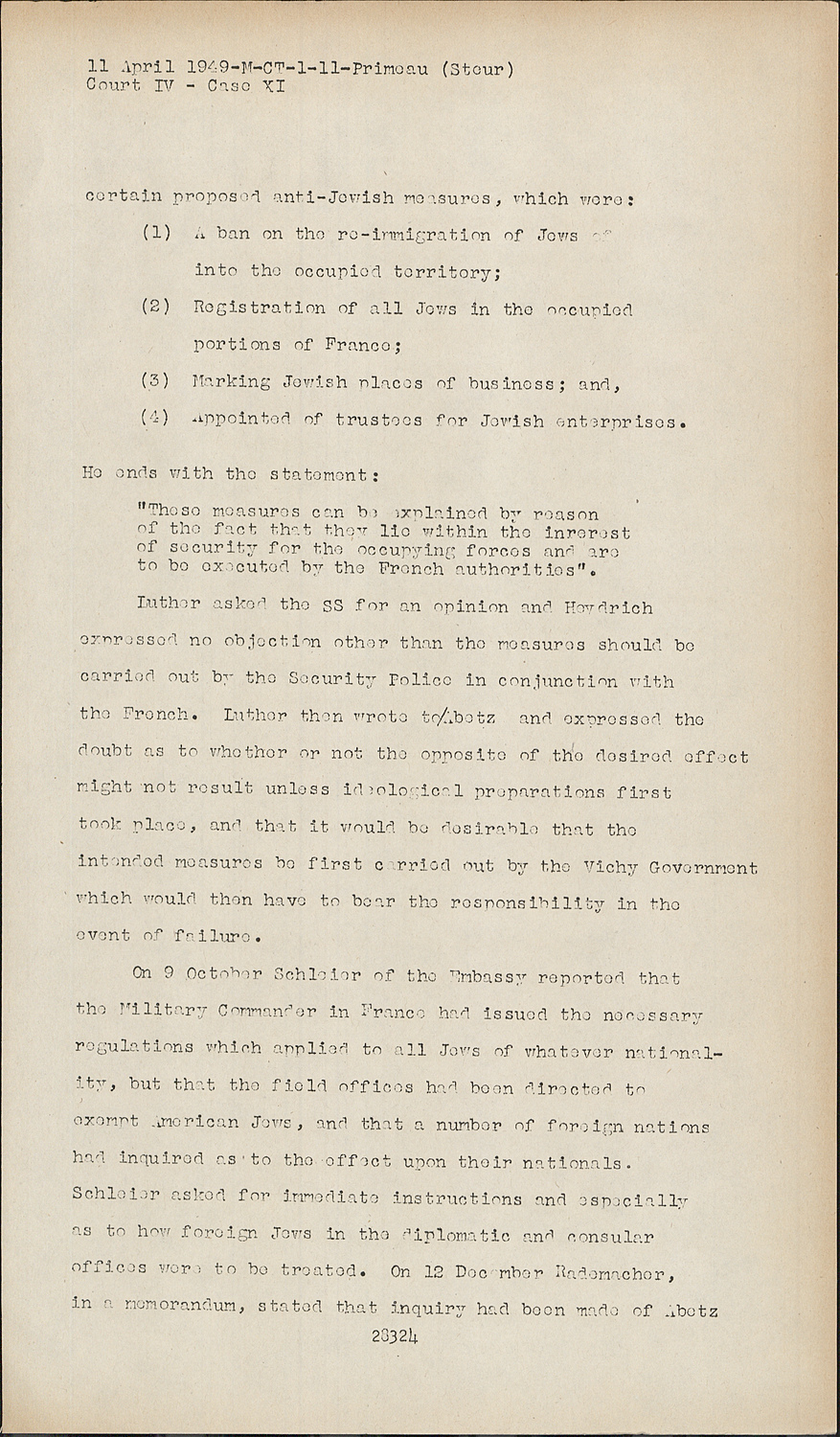
(1) A ban on the re-immigration of Jews into the occupied territory;(2) Registration of all Jews in the occupied portions of France;(3) Marking Jewish places of business; and, (4) Appointed of trustees for Jewish enterprises.
He ends With the statement:
"These measures can be explained by reason of the fact that they lie within the inrerest of security for the occupying forces and are to be executed by the French authorities".Luther asked the SS for an opinion and Hevdrich expressed no objection other than the measures should be carried out by the Security police in conjunction with the French.
Luther then wrote to/Abetz and expressed the doubt as to whether or not the opposite of the desired effect might not result unless ideological preparations first took place, and that it would be desirable that the intended measures be first carried out by the Vichy Government which would then have to bear the responsibility in the event of failure.
On 9 October Schleier of the Embassy reported that the Military Commander in France had issued the necessary regulations which applied to all Jews of whatever nationality, but that the field offices had been directed to exempt American Jews, and that a number of foreign nations had inquired as to the effect upon their nationals. Schleier asked for immediate instructions and especially as to how foreign Jews in the diplomatic and consular offices were to be treated. On 12 December Rademacher, in a memorandum, stated that inquiry had been made of .Abetz as to whether all these measures would affect foreign Jewish diplomatic representatives and that the latter had replied that if Jews belong to the diplomatic corps they were exempt, but if they were employees of diplomatic representatives the contrary was true and that the State Secretary WEIZAECKER, at a conference in the Foreign Office Directors' Office, was in agreement with this ruling, particularly since the diplomatic representatives concerned were accredited to France and not to the German Reich.
Almost immediately thereafter (19 December 1940) Ribbentrop made a decision that the American notes of protest against measures affecting Jews of American nationality, if again submitted, should be answered by stating that the measures were adopted for reasons of security, and disapprove the German Field Commander's instructions to exempt American Jews from the application of ordinances, and stated:
"It Would be a mistake to reject the protests of friendlt nations, such as Spain and Hungary, and to show weakness, on the other hand, towards America".It is somewhat difficult to understand WEIZSAECKER'S claim that in this instance he had adopted an attitude favoring the Jews.
What then did WEIZSAECKER' concurrence in Abetz's suggestion actually amount to? Without question, unless Germany in 1940 desired or intended to run the risk of a final break of relations with the United States, it was bound to accord to American diplomatic representatives the immunity to which, under international law, they were entitled. At that time, at least, this would have been catastrophic from the German political standpoint.
WEIZSAECKER's position is merely a concurrence in the obvious.
But it is to be noted that he did not either recognize or recommend that it should be extended to Jewish employees of American diplomatic representatives.
It is a decision which was, at best, exceedingly doubtful.
He concurred in limiting diplomatic immunity to Jewish members of the diplomatic corps.
In addition, he offered as justification a pure sophistry, namely, that these diplomats were accredited to France and not to Germany It has never been claimed by the defense that Germany had annexed France or any part of it, other than Alsace-Lorraine.
It merely had military possession of part of the country; the Reich had never suggested that the presence of foreign diplomats in occupied France was improper, nor ha d it asked for their recall.
The German Embassy received and answered in qyiries made by these diplomats with respect to the treatment of their Jewish nationals.
If these documents prove anything, then it is the fact that at the time the defendant WEIZSAECKER was not attempting to help or mitigate the conditions of the Jews, so far as foreign nationals were concerned, but he was engaged in aggravating their lot.
Had this then intentions been these which he now claims, and had he felt that any appeal to Ridden trop on humanitarian grounds was useless, the way was open to him to have used the very avenue of approach to which, he complains, he was so often compelled, namely, to call attention to the fact that the proposed action was contrary to the Hague Convention that it was extremely doubtful whether Germany had the right to abrogate the usual immunities to which the employees of diplomatic representatives were entitled, and also to point out the foreign political repercussions, which would arise if they were not exempted from the proposed measures.
He did nothing.
As early as 27 April 1937 the defendant VON WEIZSAECKER laid down rules for the future handling of the Palestine question:
"1. A splitting-up of world Jews is to be preferred to the establishment of a State in Palestine.
"2. If German foreign policy should become actively concerned with this question, direct pressure on the British mandatory power would, at least for the present, seem inadvisable.
"Those rules, however, did not prevent the Foreign Office from informing the domestic German agencies of its attitude, so that in measures of domestic policy for Jewish emigration, consideration should be given to the fact that Jewish emigration to Palestine should not be encouraged at all costs, but rather that their emigration to any other place in the world is to be preferred * * * " and that "* * * German authorities stationed abroad are to be given instructions concerning the attitude to be adopted by them towards the Palestine question".With respect to the Luther's alleged independence of action, the defendant WEIZSAECKER testified that at the end of August 1942 Ribbentrop ordered Luther that in the event of further steps concerning the deportation of Jews and similar matters, it should be brought to the attention of State Secretary WEIZSAECKER that up to that time the rule had not been enforced.
He further says that in this dreadful and tragic Jewish question he had to lot many things "pass through my hands upon instruction from higher agencies that were objectionable to me.
I admit that".
On 11 August 1942 Luther prepared a memorandum which was distributed to WEIZSAECKER, WORMANN and ERDMANNSDORFF relative to the discussions he had with the Hungarian Minister regarding the treatment of Hungarian Jews in France, and the Minister's pretest against this action.
On 6 October 1942 Luther again reported a conference with the Hungarian Minister about Hungarian Jews in the territories occupied by German troops, Hungarian Jews in the Reich, and the evacuation of all Jews from Hungary itself. This w as sent to Ribbentrop via WEIZSAECKER and was distributed to a nd initialled by WOERMANN.
On 14 October 1942 WEIZSAECKER himself received the Hungarian Minister and discussed the Jewish problem with him and reminded him of Ribbentrop's comment that the recent air raids on Budapest were evidence that the Jews there contributed to spreading panic and that the German Minister at Budapest would have carried out his instructions regarding the Jewish problem before the Hungarian Minister arrived there. A copy of this went to WOERMANN and at the bttom appears a note to make sure that the German Minister called on the Hungarian Foreign Minister as per his instructions prior to Sztojay's arrival.
On 9 March 1942 Eichmann of the SS wrote the Foreign Office that it was intended to deport to Auschwitz 1,000 French and s tateless Jews who had been arrested in France in 1941, asking if there was any objection.
On 11 March the SS again wrote the Foreign Office that it was desired to include 5,000 Jews more from France. On the same day Luther wired the German Embassy in Paris, forwa rding the request and asking for comment, and Paris Replied " No objection".
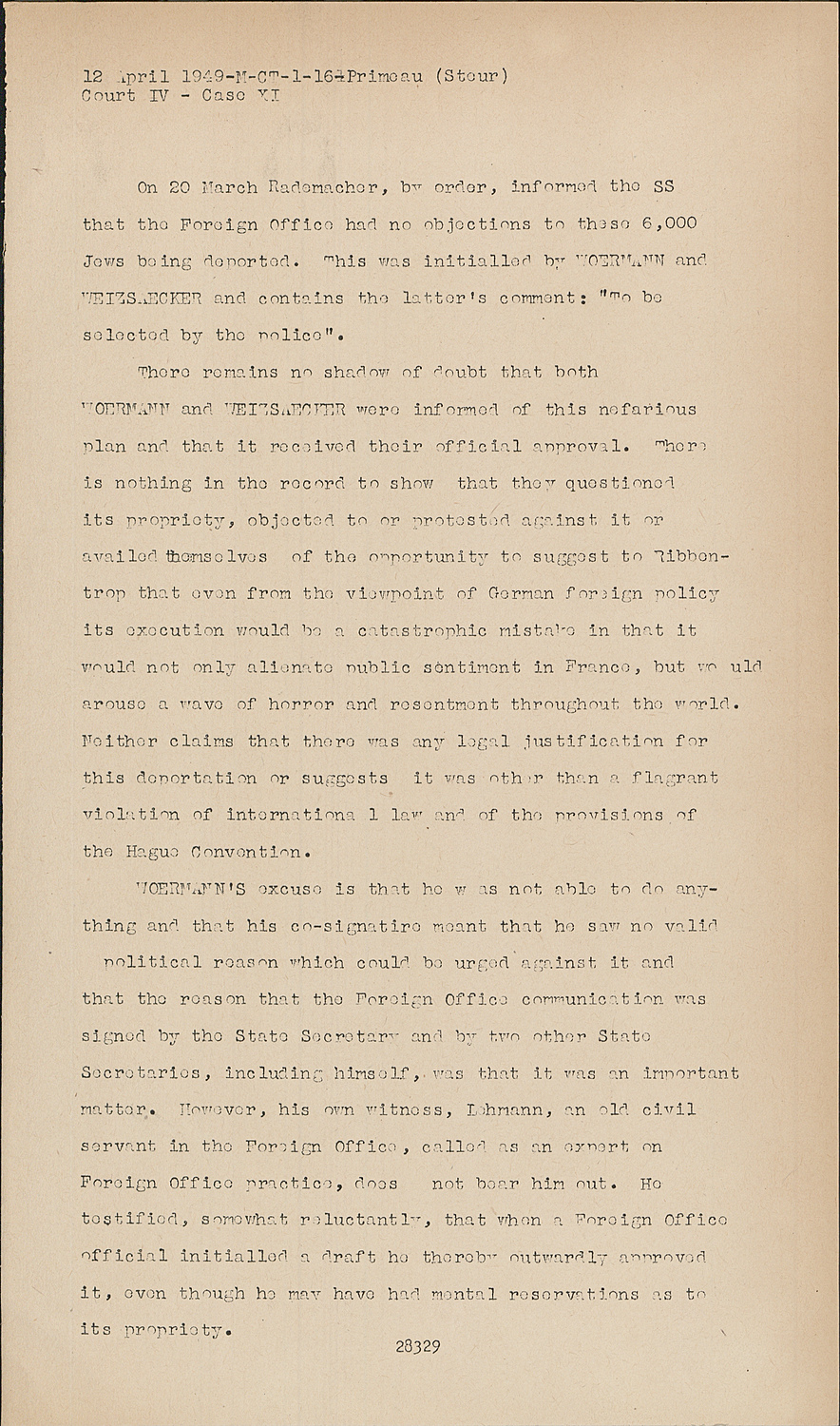
On 20 March Rademacher, by order, informed the SS that the Foreign Office had no objections to these 6,000 Jews being deported. This was initialled by WOERMANN and WEIZSAECKER and contains the latter's comment: "To be selected by the police".
There remains no shadow of doubt that both WOERMANN and WEIZSAECKER were informed of this nefarious plan and that it received their official approval. There is nothing in the record to show that they questioned its propriety, objected to or protested against it or availed themselves of the opportunity to suggest to Ribbentrop that even from the viewpoint of German foreign policy its execution would be a catastrophic mistake in that it would not only alienate public sentiment in France, but would arouse a wave of horror and resentment throughout the world. Neither claims that there was any legal justification for this deportation or suggests it was other than a flagrant violation of internationa l law and of the provisions of the Hague Convention.
WOERMANN'S excuse is that he w as not able to do anything and that his co-signatire meant that he saw no valid political reason which could be urged against it and that the reason that the Foreign Office communication was signed by the State Secretary and by two other State Secretaries, including himself, was that it was an important matter.
However, his own witness, Lehmann, an old civil servant in the Foreign Office, called as an expert on Foreign Office practice, does not bear him out. He testified, somewhat reluctantly, that when a Foreign Office official initialled a draft he thereby outwardly approved it, even though he may have had mental reservations as to its propriety.
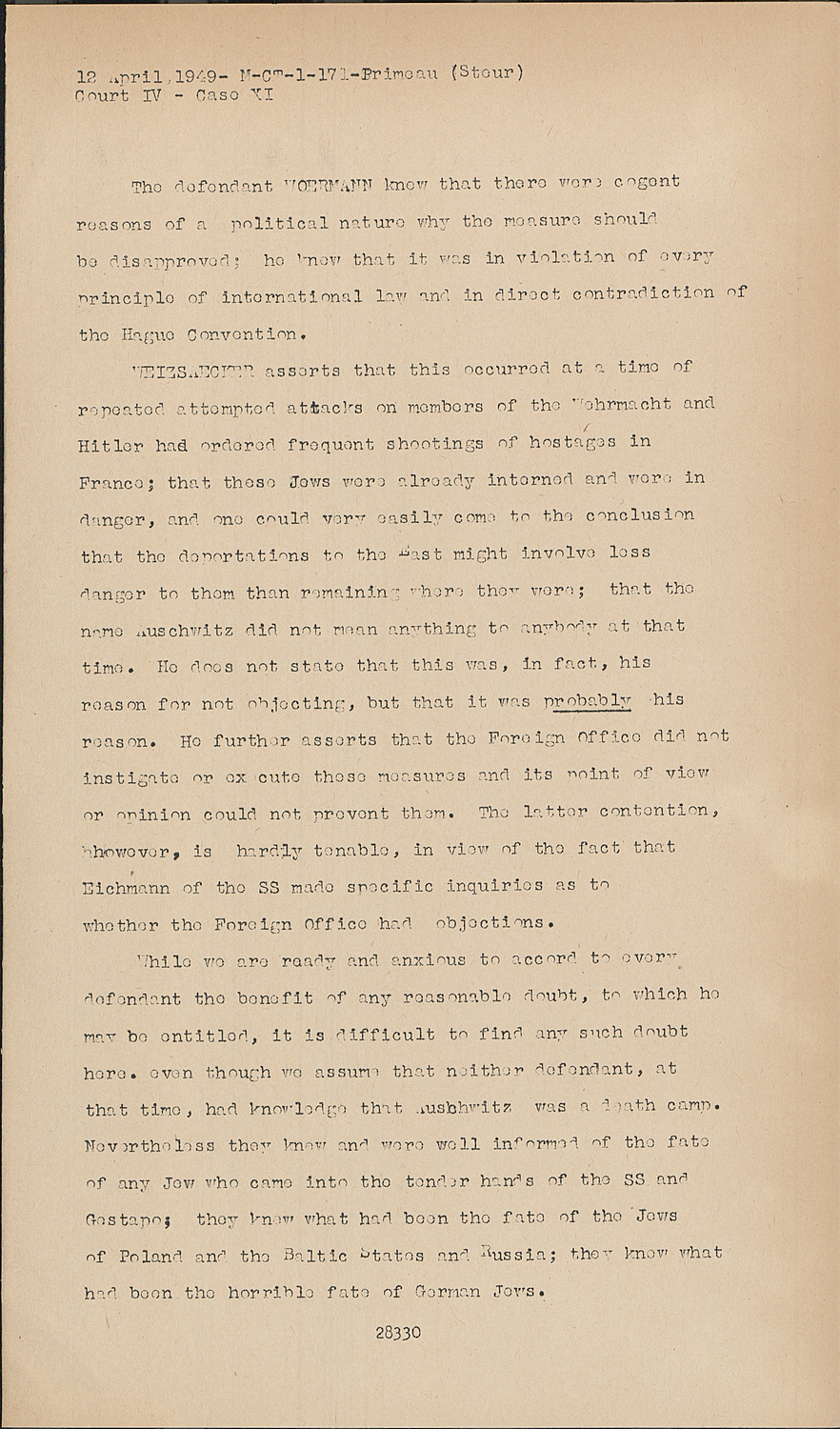
The defendant WOERMANN knew that there were cogent reasons of a political nature why the measure should be disapproved; he know that it was in violation of every principle of international lay and in direct contradiction of the Hague Convention.
WEIZSAECKER asserts that this occurred at a time of repeated attempted attacks on members of the Wehrmacht and Hitler had ordered frequent shootings of hostages in France; that these Jews were already interned and were in danger, and one could very easily come to the conclusion that the deportations to the East might involve loss danger to them than remaining where they were; that the name Auschwitz did not mean anything to anybody at that time. He does not state that this was, in fact, his reason for not objecting, but that it was probably his reason. He further asserts that the Foreign Office did not instigate or execute these measures and its point of view or opinion could not prevent then. The latter contention, however, is hardly tenable, in view of the fact that Eichmann of the SS made specific inquiries as to whether the Foreign Office had objections.
While we are ready and anxious to accord every defendant the benefit of any reasonable doubt, to which he may be entitled, it is difficult to find any such doubt here. even though we assume that neither defendant, at that time, had knowledge that Auschwitz was a death camp. Nevertheless they knew and were well informed of the fate of any Jew who came into the tender hands of the SS and Gestapo; they knew what had been the fate of the Jews of Poland and the Baltic States and Russia; they know what had been the horrible fate of German Jews.
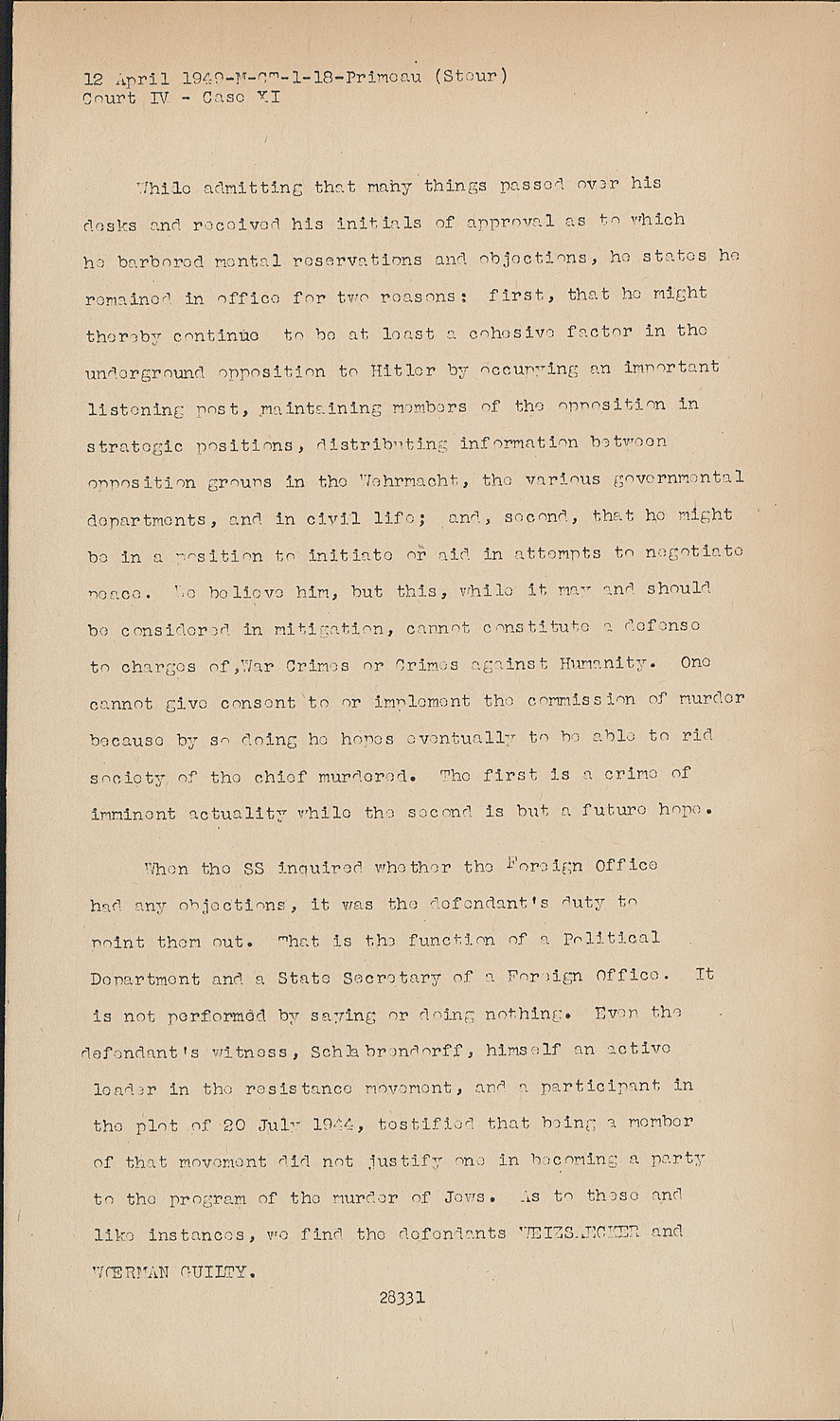
While admitting that many things passed over his desks and received his initials of approval as to which he barbered mental reservations and objections, he states he remained in office for two reasons:
first, that he might thereby continue to be at least a cohesive factor in the underground opposition to Hitler by occupying an important listening post, maintaining members of the opposition in strategic positions, distributing information between opposition groups in the Wehrmacht, the various governmental departments, and in civil life; and, second, that he might be in a position to initiate or aid in attempts to negotiate peace.
We believe him, but this, while it may and should be considered in mitigation, cannot constitute a defense to charges of,War Crimes or Crimes against Humanity.
One cannot give consent to or implement the commission of murder because by so doing he hopes eventually to be able to rid society of the chief murdered.
The first is a crime of imminent actuality while the second is but a future hope.
When the SS inquired whether the Foreign Office had any objections, it was the defendant's duty to point them out.
That is the function of a Political Department and a State Secretary of a Foreign Office.
It is not performed by saying or doing nothing.
Even the defendant's witness, Schla brendorff, himself an active leader in the resistance movement, and a participant in the plot of 20 July 1994, testified that being a member of that movement did not justify one in becoming a party to the program of the murder of Jews.
As to these and like instances, we find the defendants WEIZSAECKER and WOERMAN GUILTY.
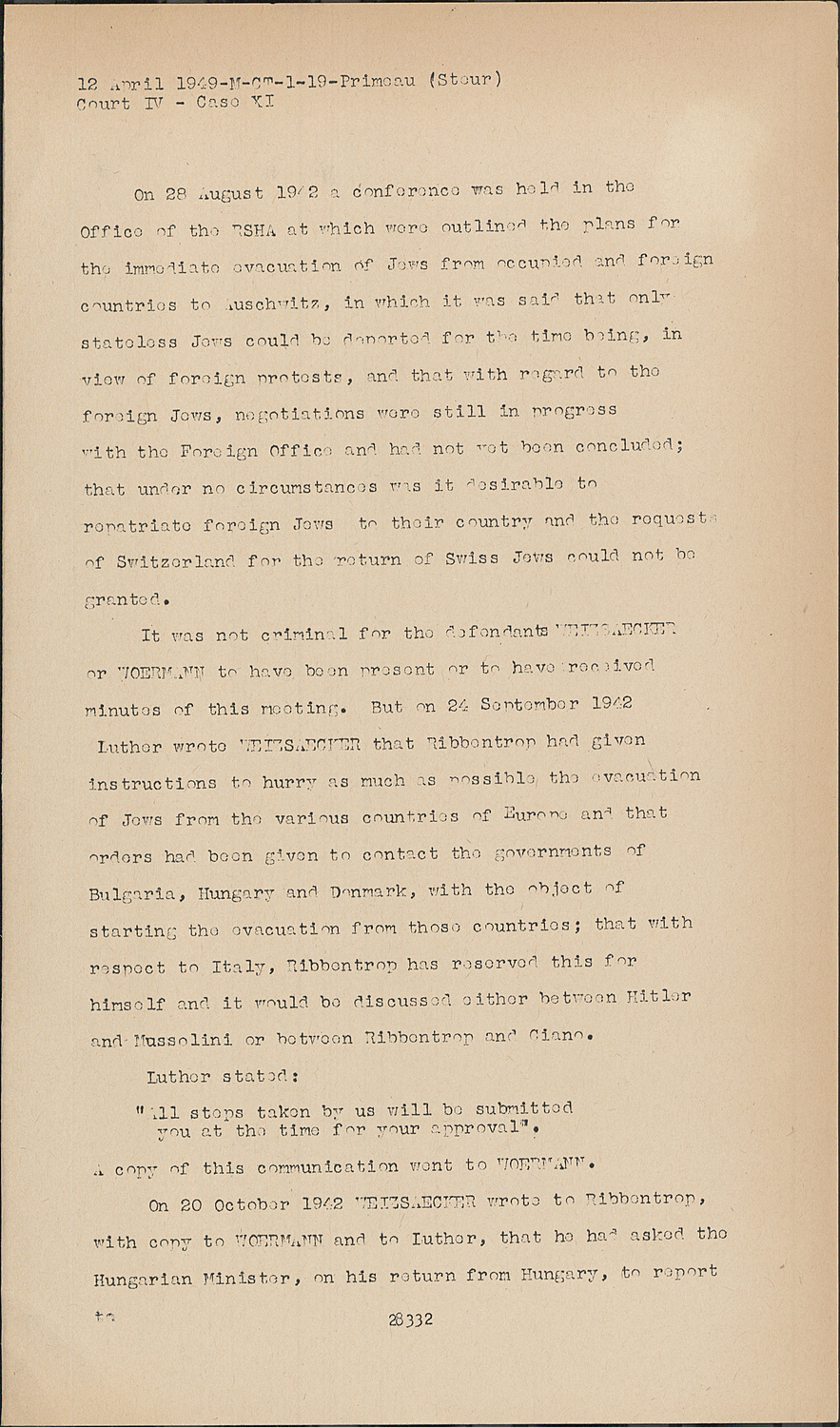
On 28 August 1942 a conference was held in the Office of the RSHA at which were outlined the plans for the immediate evacuation of Jews from occupied and foreign countries to Auschwitz, in which it was said that only stateless Jews could be deperted for the time being, in view of foreign protests, and that with regard to the foreign Jews, negotiations were still in progress with the Foreign Office and had not yet been concluded; that under no circumstances was it desirable to repatriate foreign Jews to their country and the request of Switzerland for the return of Swiss Jews could not be granted.
It was not criminal for the defendants WEIZSAECKER or WOERMANN to have been present or to have received minutes of this meeting.
But on 24 September 1942 Luther wrote WEIZSAECKER that Ribbentrop had given instructions to hurry as much as possible the evacuation of Jews from the various countries of Eurepe and that orders had been given to contact the governments of Bulgaria, Hungary and Denmark, with the object of starting the ovacuation from these countries; that with respect to Italy, Ribbentrop has reserved this for himself and it would be discussed either between Hitler and Mussolini or between Ribbentrop and Ciane.
Luther stated:
"All stops taken by us will be submitted you at the time for your approval".A copy of this communication went to WOERMANN.
On 20 October 1942 WEIZSAECKER wrote to Ribbentrop, with copy to WOERMANN and to Luther, that he had asked the Hungarian Minister, on his return from Hungary, to report to on what the people of Budapest thought of the German proposals concerning the treatment of Jews.
He also reported on the same date the result of a conversation which he had had with the Hungarian Minister in which he stated:
"The way Hungary treated the Jewish problem ha s, so far, not been in accordance with our principles".On 6 October Juther reported to Robbentrop, through WEIZSAECKER (it was initialled by him), regarding a conference which he had had with the Hungarian Minister, in which he ha d informed Sztojay that Hungary was either to take back its Jews or permit Germany to deport them to the East; that the latter had, in an attempt to avoid the matter, inquired whether Italy had agreed to like measures and was assured that it had; that Luther then brought up the matter of a settlement of the Jewish problem in Hungary which the Hunga rian Minister attempted to a void by the same technique.
It was this memorandum which led to WEIZSAECKER'S conference heretofore mentioned.
The actual deporta tion of Hungarian Jews did not commence until the late spring of 1944 and WEIZSAECKER took his post as Ambassador to the Vatican in May 1943, so he had no further connection with the Hungarian-Jewish question. While there can be no doubt that his conference with the Hungarian Minister in fall of 1942 was designed to implement Jewish persecution and deportation, it was abortive and the Hungarians could not be induced or compelled to adopt the German anti-Jewish campaign until, in 1944, the German troops marched in, VEESENMAYER took up his duties a s German Minister and Plenipotentiary, overthrew the Kallay Cabinet, put in German puppets Who cooperated in the concentration of and deportation of the Jews.
WEIZSAECKER'S connection with these deportations is so slight and insignifacnt that we AQUIT him with respect thereto. Holland and Belgium. That both WEIZSAECKER and WOERMANN had knowledge of the deportation and subsequent death of Dutch Jews deported to the Reich is beyond doubt. Nor do we find that either took any action or made any objection to the uselessly cruel procedure. Sweden, as the Protecting power for Holland, called attention to the fact that of 600 Dutch Jews deported from Amsterdam to Mauthausen, 400 had died and it appeared from the list that deaths occurred on specified days -- that the Prisoners in question were nearly all younger men; that the Swedish legation had repeatadly applied to the Foreign Office for permission to visit Dutch Jews in the camps which applications had been refused.
Luther, in writing to the RSHA, recommended that when deaths occurred it should never appear that they occurred on fixed days. It is significant that WOERMANN, in reporting to WEIZSAECKER and Ribbentron regarding the report given to him by Minister Bene at the Hague, stated:
"AS to results of the slaying of a WA man by an unidentified Jewish assassin, 400 Jews ......have been brought from the Nether lands to Germany to 'work here'". (The quotation marks are WOERMANN'S).On 22 June 1942 Eichmann of the SS wrote Rademacher of the Foreign Office that provisions had been made to run daily tra ins, with a capacity of 1,000 persons each, sta rting in the middle of July, in order to deport to Auschwitz 40,000 Jews, from occupied French territory, 400,000 from the Netherlands, and 10,000 from Belgium.
This was to include able-bodied Jews not living in mixed marriages or not citizens of the British Empire, the United States, Mexico, the enemy states of Central Sout America, or of neutral and allied states. He requested that note be made of the proposals and asking if there were any objections against the matter on the part of the Foreign Office.
On 28 June Luther wired the Embassy in Paris, the Foreign Office representative at Brussels and Bene, transmitting the Eichmann message and requesting an early reply. This was submitted to WEIZSAECKER and WOERMANN and Section POL II before dispatch.
On 2 July Abetz replied that there was no objection Providing the measure was carried out in such a manner as to add to the anti-Semitic sentiment, but that it should be first applied to foreign Jews and to French Jews only if there were no sufficient foreign Jews to fill the quota. On 10 July Luther wired Abotz it was not possible to give priority in deportation to foreign Jews; that further orders relating to expulsion of foreign Jews were pending; that the evacuation proposed was to be carried out without delay.
On or about the 13th of July, Bone, at the Hague reported that the first two trains, each containing 1,080 Jews, had left, and that the RSHA had suggested that the deported Jews should be deprived of Dutch nationality in order to avoid intervention by Sweden, the Protective power, -- that as a result of a conference held that day, the Reich Commissioner was prepared to issue a decree depriving Dutch Jews of Dutch nationality the ground that all Jews are enemies of Germany and if no objections were raised by the Foreign Office this deprivation of Dutch nationality would then apply to all Jews of Dutch na tionality and not only to these who had been deported, and asked for the Foreign Office opinion.
On 20 July Rademacher submitted a memorandum to WEIZSAECKER and WOERMANN with the request for instructions, suggesting that Bene's proposal seemed too far-reaching, but the D-III of Department Deutschland considered it desireable that Dutch legilsation concerning Jews be adjusted to that of the Reich so that immediately all Dutch resident aborad, or who ha d transferred their residence abroad, would lose their nationality as had German Jews under the same circumstances through the Citizenship Law of 25 November 1941.
On 29 July Luther submitted to WEIZSAECKER and WOERMANN a draft of a letter to Eichmann that the Foreign Office had no objection, in principle, to the deportation, but in view of the psychological effect, requested that first stateless Jews be deported, thus including a large number of foreign Jews who had emigrated to the West, of whom there were nearly 25,000 in the Netherlands, and that for the same reasons Brussels would first select only Polish, Czech, Russian and other Jews, but that Jews of Hungarian and Rumanian nationalities could be deported but their property must be secured in each case.
D-III prepared a second memorandum concerning Bene's proposal that all Dutch Jews be deprived of Dutch nationality, stating that it was irrelevant whether Jews had left the country voluntarily or by deportation, and that where Jews were deported to Eastern territories not incorporated into the Reich, the Protective Power was as little competent as/to those areas and territories as it was in the Netherlands -- that frequently it could not be determined whether residence outside the country was due to voluntary emigration or deportation and, on principles, no information whatsoever would be given to the outside world by the police regarding persons who had been deported to Eastern territories, and thus visits to the camps, etc.