Official Transcript of the American Military Tri bunal in the matter of the United States of Ameri ca, against Ernst von Weizsaecker et al, defendants sitting at Nurnberg, Germany, on 17 November 1948, 0900, Justice Christianson, presiding.
THE MARSHAL:The Honorable, the Judges of Military Tribunal IV. Military Tribunal IV is now in session. God save the United States of America and this Honorable Tribunal. There will be order in the court.
THE PRESIDENT:Mr. Marshal, are the defendants in court?
THE MASHAL:May it please your Honors, all the defendants are present in the courtroom except the defendants Keppler, Stuckardt and Schellenberg who are in the hospital.
THE PRESIDENT:Very well; Dr. Seidl, you may resume your argument.
DR. SEIDL:Dr. Seidl, speaking in behalf of the defendant Dr. Lammers;
Continuing on page 30 at the bottom:
Nor is there any convincing proof to support the assumption that even now war constitutes a crime for which the responsible statesmen and commanders maybe called to account individually and under criminal law. The Charter of the United Nations knows no legal maxim declaring aggressive war to be a crime liable to a definite punishment. Nor did the development following the proclamation of the United Nations Charter result in an amplification of the International law in this direction. On the contrary: In the light of this development the proceedings before the IMT appear, with ever increasing clarity, to be an exceptional procedure having its justification, .nor in generally recognized principles of International Law, but in the unbounded power of the conquerors created by Germany's unconditional surrender. A convincing proof of the correct ness of this argumentation is furnished by the treatment of the motion put to the United Nations by the USA which demands that the principles adopted in Nuremberg should be codified and declared to be a part of the general International Law. The United Nations assigned this task to two commissions one of which declared itself to be incompetent, while the other, up to now at any rate, has not achieved any practical result.
There is an interpolation there, Your Honors.
The lack of clarity of law on the subject of aggressive warfare as an independent crime per se in the sense of the charter of the IMT and of Control Council Law 10 has also been demonstrated in the proceedings instituted before the IMT in the Far East. That trial of Japanese statesmen and commanders in chief was concluded a few days ago and no less than four of the judges registered their individual dissenting opinions for the record. The French judge, the Dutch judge, the Phillipine judge, and the Indian judge were unanimous in their opinion that prior to the outbreak of World War II aggressive warfare was no crime under international law.
Continuing on page 31:
In this connection we have to call the attention of the Tribunal to another statement which is also contained in the above-mentioned declaration of the Defense at the beginning of the proceedings before the IMT and which reads:
"Finally the Defense consider it their duty to point out at this juncture another peculiarity of this Trial which departs from the commonly recognized principle of modern jurisprudence.
The judges have been appoint ed exclusively by states which formed the one party in this war.
This one party to the proceeding is all in one:
Creator of the statute of the Tribunal and of the rules of law, prosecutor and judge.
It used to be until now the common legal concept that this should not be so; just as the United States of America, as the champion for the institution of international ar bitration and jurisdiction always demanded that neu trals, or neutrals and representatives of all parties should be called to the Bench.
...... While the evidence was still being presented before the IMT, it appeared that the Soviet Union together with the other three signatory powers was not only creator of the statute of the Tribunal and of the rules of criminal law, prosecutor and judge, but, oreover, that it also had taken part in a common plan, which is expressed in terms of penal law in section 6 (a) of the IMT Charter, and forms the subject of the proceedings under counts I and II of the Indictment. Thereby, another prin ciple was violated which forms an integral part of any legal order, namely that no one may sit in judgment in his own case, that no one may take part in the judicial appraisal of facts to which he himself is a party and which form the subject of the judicial inquiry.
The ex-Reich Minister of Foreign Affairs, von Ribbentrop, was right, therefore, when he declared in his final plea before the IMT:
"....Before the establishment of the Charter of this Tribunal, even the signatory powers of the London Agreement must have had different views about international law and policy than they have today.
When I went to see Marshal Stalin in Mos cow in 1939, he did not discuss with me the pos sibility of a peaceful settlement of the German Polish conflict within the framework of the Briand Kellogg pact; but rather he hinted that if in ad dition to half of Poland and the Baltic Countries he did not receive Lithuania and the harbor of Libau, I might as well return home.
In 1939 the waging of war was obviously not yet re garded as an international crime against peace state;otherwise I could not explain Stalin's telegram at the conclusion of the Polish campaign, which reads:
'The friendship of Germany and the Soviet Union, cemented by the blood which they have shed together has every prospect of being a firm and lasting one'." In the proceedings before the IMT the Defense did not hesitate to draw the conclusions resultins from these facts in regard to the jurisdiction of the IMT.
The Tribunal could not fall in line with the argumentation because if it had, its self-dissolution would have been inevitable. The legal position is fittingly described in an editorial which appeared in the London "Economist" a few days after judgment had been pronounced and which after a reference to the German-Soviet-non-aggression pact, the pact dated 23 August 1939, says:
"....During the trial the defense produced wit nesses, including Baron von Weizsaecker, permanent Secretary of State in the German Foreign Office from 1938 to 1943, who testified about a secret treaty attached to the Non-Aggression Pact and providing for territorial partition of six European states bet ween Germany and the Soviet Union.
The Prosecution made no attempt to disprove this evidence; neverthe less, the judgment completely ignores it.
Such silence unfortunately shows that the Nuremberg Tribunal is on ly within certain limits an independent judiciary.
In ordinary criminal law it would certainly be a remarkable case if a judge, summing up on a charge of murder, were to avoid mentioning evidence on the part played by an accomplice in the murder because the evi dence revealed that the judge himself had been that accomplice.
That nobody thinks such reti cence extraordinary in the case of Nuremberg mere ly demonstrates how far we still really are from anything that can be called a "reign of law" in international affairs.
Both Britain and France are on record as having concurred in the expul sion of the Soviet Union from the league of Na tions for its unprovoked attack on Finland in 1939; this verdict still stands and is not modi fied by anything which has happened since.
In 1939 Moscow openly glorified in military coope ration with Germany for the destruction of Po land, "that ugly offspring of the Versailles Treaty", and Ribbentrop in his last plea quoted a cable of congratulation from Stalin as proof that the Soviet Union had not then regarded the war against Poland as an aggression.
The con trast between 1939 and 1946 is indeed fantastic, and it is too much to expect that either his torians in the future or Germans in the present will share in the current United Nations" con vention of not seeing it ......." The Defense in the present Trial introduced another 226 documents dealing with the German-Soviet relations in the period between 1939 and 1941 which are contained in the Document Books VI to XII for the defendant Lammers.
The legal questions resulting from these documents and the facts underlying them have been dealt with in a brief which I submitted to the Tribunal; in it, I arrive at the conclusion that while the conquer, by virtue of his might, may take measures against the vanquished even from such actions in which he himself took part, he may not legally set up a Tribunal as legislator nor act as judge in such Tribunal, if he himself participated in the "crime of the vanquished as an accomplice". Actions violating this principle which has its basis in the law of all civilized countries are legally nil and void. Nil and void according to this interpretation, therefore, is the London Agreement of 8 August 1945, and the IMT Charter which forms an essential part of the latter, inasmuch as, with the cooperation of the USSR, it orders, in section 6 (a) the criminal prosecution because of a crime against peace committed by the invasion of Poland in the Fall of 1939 and the aggressive war against that country. Nil and void, furthermore, is the Control Council Law No. 10 which is based on the London Agreement of 8 August 1945, inasmuch as it ordered in Section II, subsection 1a, with the cooperation of the Soviet Union, the criminal prosecution, because of a crime against the peace committed by the above-mentioned actions.
And finally the judgment of the IMT of 30 September, and 1 October 1946, is nil and void, inasmuch as this judgment entailed the conviction because of these crimes of a defendant with the cooperation of judges from the USSR.
However, the Reich Minister and Chief of the Reich Chancellery Dr. Lammers could not be convicted on Counts I and II of the Indictment even if this Tribunal should arrive at the conclusion that the IMT Charter and Control Council Law No. 10 are in agreement with the general International Law in force at the time when the acts were committed and that the objections raised by the Defense are unfounded.
Let me in this connection call the attention of the Tribunal to some statements made by the IMT in subsection 6 of its judgment. There it reads that "in the opinion of the Tribunal the conspiracy must be made distinct with regard to its criminal intentions. Between it and the decision and deed, there must not be too long an interval ... The Tribunal has to examine whether there existed a concrete plan for the waging of war and it has to determine who took part in this conrete plan . . . . " The Prosecution was unable to prove that the defendant Dr. Lammers was in any way connected with plans involving the prepapration and conduct of wars of aggression.
He did not take part, in particular in the four secret discussions held by Hitler on 5 November 1937 23 May 1939, 22 August 1939 and 23 November 1939, upon which the IMT based its judgment in counts I and II. Nor did the defendant Dr. Lammers subsequently gain knowledge of these conferences from the records The evidence has shown, on the contrary, that the defendant Dr. Lammers was present at noen of the numerous conferences which the Fuehrer and Reich Chancellor had had with nearly all of the European chiefs of government and foreign ministers and with many pleinipotentiaries of overseas countries. The evidence submitted both in the IMT-trial and in these proceedings shows clearly that the chief of the Reich chancellery was at no time concerned with questions of foreign and military matters. He did not belong to the rather small group of persons who at best could still exert a certain amount of influence on the decisions affecting foreign policy and military matters - so far as it was possible at all to exert any authoritative influence on so dynamic a person as Adolf Hitler.
The Prosecution was unable to submit one single document showing any participation of the chief of the Reich Chancellery in the preparation of the campaign against Poland.
Some few documents have been submitted to prove that the defendant Dr. Lammers took part in the preparation of the attack on Norway. But in fact these documents do not allow the conclusion to be drawn that the measures and actions of the chief of the Reich Chancellery mentioned therein are in any causal connection with the occupation of Norway effected on 9 April 1940. The Defense must deny altogether that the occupation of Norway was a war of aggression in the sense of the IMT charter and of Control Council Law No, 10 It was no less a man than the former British Prime Minister Winston Churchill who, after the conclusion of the IMT-trial, shed light upon the interrelations which then, on 9 April 1940, led to the occupation of Norway by German troops.
If there should have been left any doubts that this action was a genuine preventive measure on the part of Germany, these ought to be eliminated by the following statements of the then First Lord of the British Admiralty:
"On April 3 the British Cabinet implemented the resolve of the Supreme War Council, and the Admiralty was authorized to mine the Norwegian "Leads" on April 8. As pur mining of Norwegian waters might provoke a German retort, it was also agreed that a British brigade and a French continent should be sent to Narvik to clear the port and advance to the Swedish frontier.
Other forces should be des patsched to Stavanger, Bergen and Drontheim, and in order to I had to asked for the mining to be done on Sept, 29, 1939.
. . . . " Tgis example gives cause for some reflection. It shows that the greatest restraint should be observed in forming a judicial judgment on international relations. It may be expected that in the course of the years many documents will still be published and facts become known, which might make many a thing appear in a different light and justify an opinion deviating from the concept of the IMT or of other tribunals. It may be that this also applies to the causes which in 1941 led to the war between Germany and the Soviet Union.
The Prosecution has submitted a few documents which are to demonstrate the defendant Dr. Lammers participation in the alignment of administration in the occupied Eastern territories. These documents do not permit the conslusion to be drawn that their contents violated any penal law.
Above all, however, they fail to show that the chief of the Reich Chancellery took a hand in the planning and preparation of a war of aggression against the Soviet Union.
He did not play a decisive role - on the contrary, he had no share whateverin the negotiations conducted for two years between the Reich Government and the government of the USSR and which, on the basis of the side of the German Government, were temporarily bound to arouse serious msigivings. And doubts as to future conduct of the neighbor in the East. In particular, however, did the Reich Minister and Chief of the Reich Chancellery at no time take part in the military discussions and measures which directly proceded the invasion of Russia on 22 June 1941.
In Count III the defendant Dr, Lammers is chargedwith having committed war crimes in that he took part in measures destined to incite the civilian population to lynch enemy flyers who had bailed out over German territory. The prosecution was aunable to prove this allegation, which is contained in the indictment. The documents submitted - exhibits 1229 and 1230 do not permit the conclusion to be drawn that the conduct of the defendant Dr. Lammers became the cause of an action which involved a viola tion of the Geneva Convention of 1929 or of other provisions under international law.
The Reich Minister and Chief of the Reich Chancellery, by a letter which was marked "secret" merely forwarded a circular letter from Reichsleiter Lormann to the Reich Minister of Justice, from which he could only deduce that it concerned thequestion of quashing cases of lynching which had already occurred. But as the hearing og the evidence has shown, the circular of Bormann submitted by the Prosecution as Exhibit 1230 is not identical with the circular which in fact was added as an enclosure to the defendant Dr. Lammers's letter to the Reich Minister of Justice and which bears the date of 4 June 1944. By some chance the Defense gained possession of the circu lar which at the time was actually forwarded by the chief of the Reich Chancellery to the Reich Minister of Justice.
The contents of this circular which, to be sure, deal with the same matter, give no reason for any misgivings and no longer any cause for the assumption that the transmission of a war crime. The Defense has introduced this circular as Lammers Exhibit No. 55 (636-PS). In the rebuttal proceedings the Prosecution submitted excerpts from several judgments passed by American military tribunals against citizens who had actually lynched enemy flyers who had bailed out. These verdicts are of no value as evidence material against Dr. Lammers since the Prosecution was unable to prove that there was actually a causal connection between Dr. Lammers's attitude and these cases. Nor can the Tribunal ignore - when examining this case - the reasons which finally drove the German population to this self-protection: namely that the attacks of the allied air force against the civilian population had in the course of the war reached proportions and forms an exclude any invocation of the holy principles of humanity in this court.
If there is talk of lynch-justice, then one must forget the many hundreds of thousand of old men, women and children, who found a horrible death under the ruins of the German cities or who - appearing as burning torches - threw themselves into rivers in an attempt to save themselves from the enemy's showwer of phosphorus.
He who, is responsible for this kind of war-fare and does not even hesitate the use the a tombomb, should - this is our opinion - be careful in the interpertration of laws of war and the principles of humanity.
Under Count V of the Indictment the defendant Lammers is charged with having committed war crimes and crimes against humanity inasmuch as he participated in atrocities and other punishable actions against the civilian populations of the occupied countries.
Admittedly, it is correct that the Reich Minister and Chief of the Reich Chancellery co-signed the Fuehrer-Decree on the basis of which Reichsfuehrer-SS Himmler was appointed to Reich Commissar for the Strengthening of Germanism.
As regards the significance of the co-signature the same applies here as has already been stated in general in regard to the question of joint signature under laws and Fuehrer*Decrees by the Reichsminister and Chief of the Reich Chancellery. The Chief of the Reich Chancellery did not take over the responsibility as his own when co-signing, in this case, nor could he take it. Besides, the contents of this decree constitute neither the fact of a war crime nor that of a crime against humanity.
If the Reich Commissar for the strenghtening of Germanism exceeded the authority entrusted to him by virtue of this decree on his own accord, this happened completely outside the sphere of influence of the defendant Dr. Lammers and he could not have forseen it. Neither at the time of the issue nor at any later date dod the Reich Minister and Chief of the Reich chancellery have the Commissar or to supervise his measures. As regards the consideration of the question as to whether the resettlement of parts of the p opulation can be considered at all as a war crime or a crime against humanity, the actual praxis of the state after the second world war must not be ignored. Western Germany of today is flooded with millionsof people from the East of the Reich, who have been driven from their houses and homes by force and do not own any other property but what they actually carry on their backs. These measures were carried out in execution of the agreements of Yalta and Potsdam, that is to say, by virtue of decisions of the powers who also signed the London agreement of 8 August 1945 and Control Council Law No. 10. The misery caused through these resettlements is so terrible The misery causedthrough these resettlements is so terrible that as early as 29 March 2946 the Bishops of the Cologne and Paderborn dioceses considered it their duty to draw the attention of the world to this injusticel The Following statements appear, among others, in the Pastoral Letter:
"..... A few weeks ago we had cause to voice our opinion of the outrageious incidents taking place in the east of Germany, above all in Silesia and the Sudetenland, where more than 10 million Germans have been brutally driven out of their ancestral homes, without investigations being made as to their personal guilt.
The pen cannot describe the dreadful misery prevailing there in violation of all principles of humanity and justice.
All these people are crammed together in the rest of Germany without any possessions, without the possibility to make a living.
It cannot be imagined how these masses, driven out of their homes, can avoid becoming restless and peace-disturbing elements."
In the meantime, more millions have been driven out by the use of force and undeterminably number of refugees -- very likely more than one million had died miserably without awakening the conscience of the world.
I felt obliged as early as during the trial before the IMT to discuss the legal questions arising from this fact and made the following statement in my Closing Brief for the Defendant Frank:
"The expatriation and resttlement, carried out in persuance to the Potsdam declaration of 2 August 1945 are insofar of importance for the present trial, as the resettlements are carried out on the basis of an agreement between the very signatory powers of the London agreement of 8 August 1945, are the authors of the charter for this Tribunal which forms the essential part of that agreement.
From these facts two conclusions may be drawn:
1. The execution of resettlements is either in accordance with the acknowledged principals of the general Inter national law, in which case the resettlements cannot be considered as constituting war crimes or crimes against humanity under the Statute of this Tribunal.
The evidence material submitted by the Prosecution is re ference to resettlements must then be considered as of no importance and it is then not necessary to go into the details of the charges under this Point of the Indictment.
2. Or, the execution of resettlements is a violation of principles, derived from the law of all civilized nations, and then, constitutes a criminal offence.
In this case the same conclusions must be drawn with reference to the jurisdiction, as I had to point out already in the case of the defendant Hess with respect to another but similar statement of facts.
In this case too, the Prosecutors (accusers) would make measures the subject of a judicial trial, which they themselves have propagated in the same manner and carried out.
And the Tribunal would make those measures the subject of its verdict, which the Signatory Powers in the agreement of Potsdam of 2 August 1945 considered as necessary, only to classify them 6 days later punishable in the IMT charter, as war crimes and crimes against humanity.
The matter at hand is not a case of merely subjecting formal legal facts to examination.
Such facts, on the contrary, raise the question of the bases of law and its usage.
The law is the epi ome of standards which at one and the same time cannot have a different meaning at different places.
What one considers today to be legal cannot have been a crime yesterday.
The law can only exist as an indivisable entirety or it cannot exist at all."
These statements before the IMT are still valid today and the events which have occurred in the meantime could only confirm the truth of this thesis.
Within the scope of Count V of the Indictment, the defendant Dr. Lammers is also charged with having participated in the program to exterminate all European Jews still alive. The evidence material submitted by the rosecution does not justify this charge.
In the trial before the IMT as well as during the various subsequent trials it could be ascertained with a considerable degree of certainty who the persons and agencies were who had been responsible for the execution of these measures in connection with the so-called final solution of the Jewish question. In this respect I refer to the statements of the SS-Hauptsturmfuehrer Wisliceny and of the former commandant of the concentration camp Auschwitz, Rudolf Hoess, before the IMT.
The testimonies of these witnesses and numerous documents introduced by the Prosecution in the various trials show clearly that all of these measures were directed and carried out by Amt IV of the RSHA, and that these measures had long started when the 3 conferences in January, March and October 1942 took place, to which the Prosecution refers in order to prove the existence of a program for the extermination of European Jewry. The defendant Dr. Lammers did not take part in any of these conferences nor was a program according to the contention of the Prosecution established as is proven by the memoranda on these conferences, introduced by the Prosecution. The Prosecution even failed to prove that the Chief of the Reich Chancellery was subsequently informed about these memoranda. Moreover, the evidence has shown that not only did the Reich Minister and Chief of the Reich Chancellery not agree with the suggestions put forward in these conferences, but, on the contrary, opposed them.
In this connection I wish to refer to the testimonies of Dr. Lammers on the witness stand and to the statements of the witnesses Dr. Ficker, Dr. Boley, Dr. Leesener, Dr. Ehrensberger and Dr. Kettner. As a result of the evidence presented it can be regarded as an established fact regarding these counts that the defendant Dr. Lammers did not commit any act which might have been causal to the extermination measures carried out by the officials of the RSHA. Not only so, but the defendant Dr. Lammers on the contrary, submitted to the Fuehrer five reports on this matter and did everything which could be expected of him in consideration of the information then at his disposal.
W ithin Count V of the Indictment the defendant Dr. Lammers is also charged with having taken part in the enactment of laws providing the confinement in concentration camps of such members of the civilian population as were suspected of opposing the policy of the German occupational authorities. In support of this charge the Prosecution could furnish no moreproof then it could furnish for its other charge that the defendant Dr. Lammers, in his capacity as chief of the Reich Chancellery, had taken part in the drafting and implementing the so called "Night and Fog Decroe". As regards the latter, it has already been established before the IMT and in the course of two other trials, that this decree was issued upon a direct Hitler order, by the OKW. The Chief of the Reich Chancellery was in no way associated with its preparation and implementation. And as regards the arrest of members of the civilian population endangering the safety of the occupational authorities reference must be made to the relevant provisions of the Hague Regulations on Land Warfare of 1907 which explicitly give the occupying power the right to take all steps deemed necessary for the safety of the occup tion forces and the maintenance of public order. As a matter of fact after the unconditional surrender, the Allied occupying powers did not hesitate to intern for reasons of safety as pointed out - approximately one million German nations, who were suspect for political reasons.
In this connection we wish to call the attention of the Tribunal to Directive No. 38 of the Allied Control Council for Germany. This Directive deals with the arrest and surveillance of potentially dangerous Germans." According to chapter I, subsection Ic, the idea underlying this directive was to set up rules applicable to the whole of Germany "the internment of Germans who without being guilty of definite crimes, are to be regarded as a danger to the Allied cause, as well as regarding the control and surveillance of Germans who constitute a potential danger." That this is a political measure and that the reason for the arrest is the political conviction of the detainee is conclusively proven by Chapter 1, subsection 5 of that directive, which says literally:
"A distinction should be made between imprisonment of war criminals and similar offenders for criminal conduct and internment of po tentially dangerouspersons who may be confined because their free dom would constitute a danger to the Allied Cause.
.. " In appraising the evidential value of this directive and its suitability as a means of interpreting Control Council Law No. 10 it is essential to consider the date of its promulgation.
It was promulgated on 12 October 1946, i.e. nearly one year and a half after the cessation of hostilities.
Count VI of the Indictment charges the defendant Dr. Lammers with having committed war crimes and crimes against humanity by participating in the spoliation of public and private property and the exploitation of the territories under German occupation. The evidence introduced by the Prosecution fails to show that the ex-Reich Minister and Chief of the Reich Chancellery displayed any initiative of his own in this direction. All he did in this connection was to arrange the communication between the Fuehrer and the individual Reich ministries without possessing any jurisdiction or responsibility in the matter itself. As regards the laws, ordinances and Fuehrer decrees co signed by him too the above comments will apply. These directives do not in themselves contain anything which might constitute a war crime or a crime against humanity. For the rest, it must be pointed out in this connection as well that the act of robbery and spoliation, as a delict under International Law, is not less vague and disputed than the "exploitation of occupied territories", as put forward by the Prosecution.
A valuable contribution towards the interpretation of the relative provisions of the IMT charter and Centrol Council Law No. 10 is furbished by the dismantling policy in Germany adopted after Germany's unconditional surrender and prior to the conclusion of a peace treaty and are being carried out to this day by the occupation powers. It is no exaggeration to say that the measures taken in pursuit of this policy of dismantling , more fittingly described as policy of devastation, - dwarf everything which was don by German troops and occupation authorities in the way of confiscations in the occupied territories. In this connection it can at least be said in defense of the measures taken in the territories under German military occupation that Germany at that time was involved in a war endangering the very life of the whole nation, of which fact, at least since the Casablanca declaration of January 1943, there can be no doubt.
Count VII of the Indictment charges the ex-Reich Minister and Chief of the Reich Chancellery with having participated in a program which concerned the deportation of members of the civilian population in the occupied territories. Here, too, the Defense must deny that the evidence introduced by the Prosecution indicates an initiative in this direction on the part of the defendant Dr. Lammers himself. While it is true that the Reich Minister and Chief of the Reich Chancellery in almost all the other cases also co-signed the Fuehrer decree through which Gauleiter SAUCKEL was appointed Plenipotentiary-General for the Mobilization of Labor on 21 March 1942, the fact of his having jointly signed this decree does not establish a factual responsibility on the part of the Reich Minister and Chief of the Reich Chancellery in this case any more than it does in any other; his signature only served as certification.
For the rest, this decree, too, contains no provision constituting the fact of a war crime or a crime against humanity. The PlenipotentiaryGeneral for the Mobilization of Labor was directly responsible to the Fuehrer and the Reich Minister and Chief of the Reich Chancellery had no right, either on the strength of the above mentioned decree or of any other regulations, to issue instructions to him or exercise any official control over him.
The indictment also mentions a conference of the chiefs which took place on 11 July 1944, with the Reich Minister and Chief of the Reich Chancellery in the chair, which dealt with questions of labor allocation. The memorandum on this conference introduced by the Prosecution gives no correct account of what happened during this conference. The defense witness Dr. BOLEY who drafted this memorandum gave a detailed explanation of the reasons which actuated him in drafting this incomplete and unfinished version of the memorandum and, - like various other witnesses, - gave an account of what actually happened during that conference. The evidence showed that the conference was held for the purpose of discussing the complaint put forward by various Chiefs of the administration in the occupied territories against the agencies of the Plenipotentiary-General for the Mobilization of Labor and that the Reich Minister and Chief of the Reich Chancellery, in his capacity as a mediator between the parties involved, did not take any initiative towards an intensified mobilization of conscripted foreign manpower. No regulations were taken as a result of those discussions, and the authorities directly concerned with the matter - not including the Reich Chancellery were subsequently left to deal with the matter.
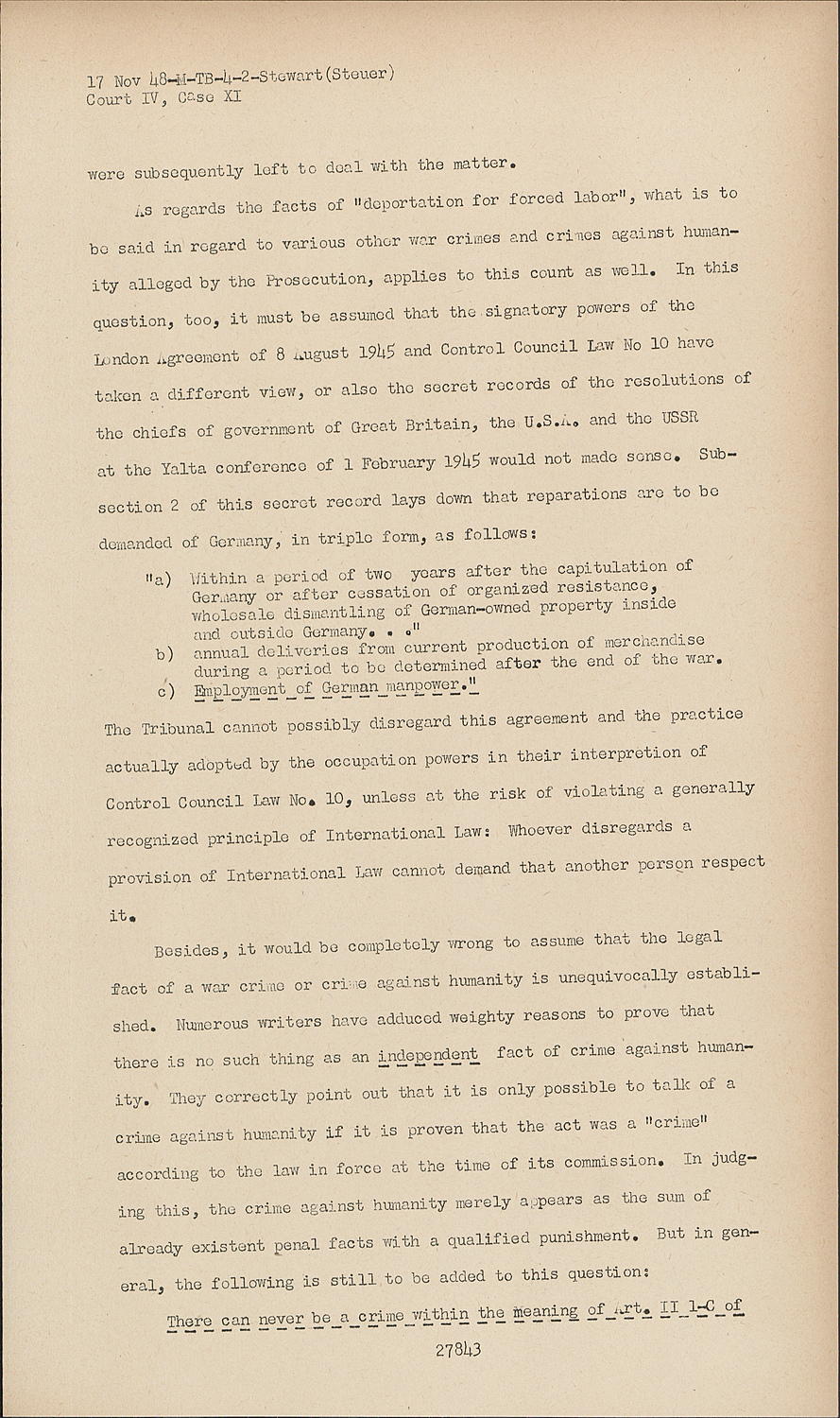
As regards the facts of "deportation for forced labor", what is to be said in regard to various other war crimes and crimes against humanity alleged by the Prosecution, applies to this count as well. In this question, too, it must be assumed that the signatory powers of the London Agreement of 8 August 1945 and Control Council Law No 10 have taken a different view, or also the secret records of the resolutions of the chiefs of government of Great Britain, the U.S.A. and the USSR at the Yalta conference of 1 February 1945 would not made sense. Subsection 2 of this secret record lays down that reparations are to be demanded of Germany, in triple form, as follows:
"a) Within a period of two years after the capitulation of Germany or after cessation of organized resistance, wholesale dismantling of German-owned property inside and outside Germany.
. ."
b) annual deliveries from current production of merchandise during a period to be determined after the end of the war.
c) Employment of German manpower." The Tribunal cannot possibly disregard this agreement and the practice actually adopted by the occupation powers in their interpretion of Control Council Law No. 10, unless at the risk of violating a generally recognized principle of International Law: Whoever disregards a provision of International Law cannot demand that another person respect it.
Besides, it would be completely wrong to assume that the legal fact of a war crime or crime against humanity is unequivocally established. Numerous writers have adduced weighty reasons to prove that there is no such thing as an independent fact of crime against humanity. They correctly point out that it is only possible to talk of a crime against humanity if it is proven that the act was a "crime" according to the law in force at the time of its commission. In judging this, the crime against humanity merely appears as the sum of already existent penal facts with a qualified punishment. But in general, the following is still to be added to this question:
There can never be a crime within the meaning of Art. II 1-C of Control Council Law No. 10 in a case where the contrary behavior would itself have been a crime.
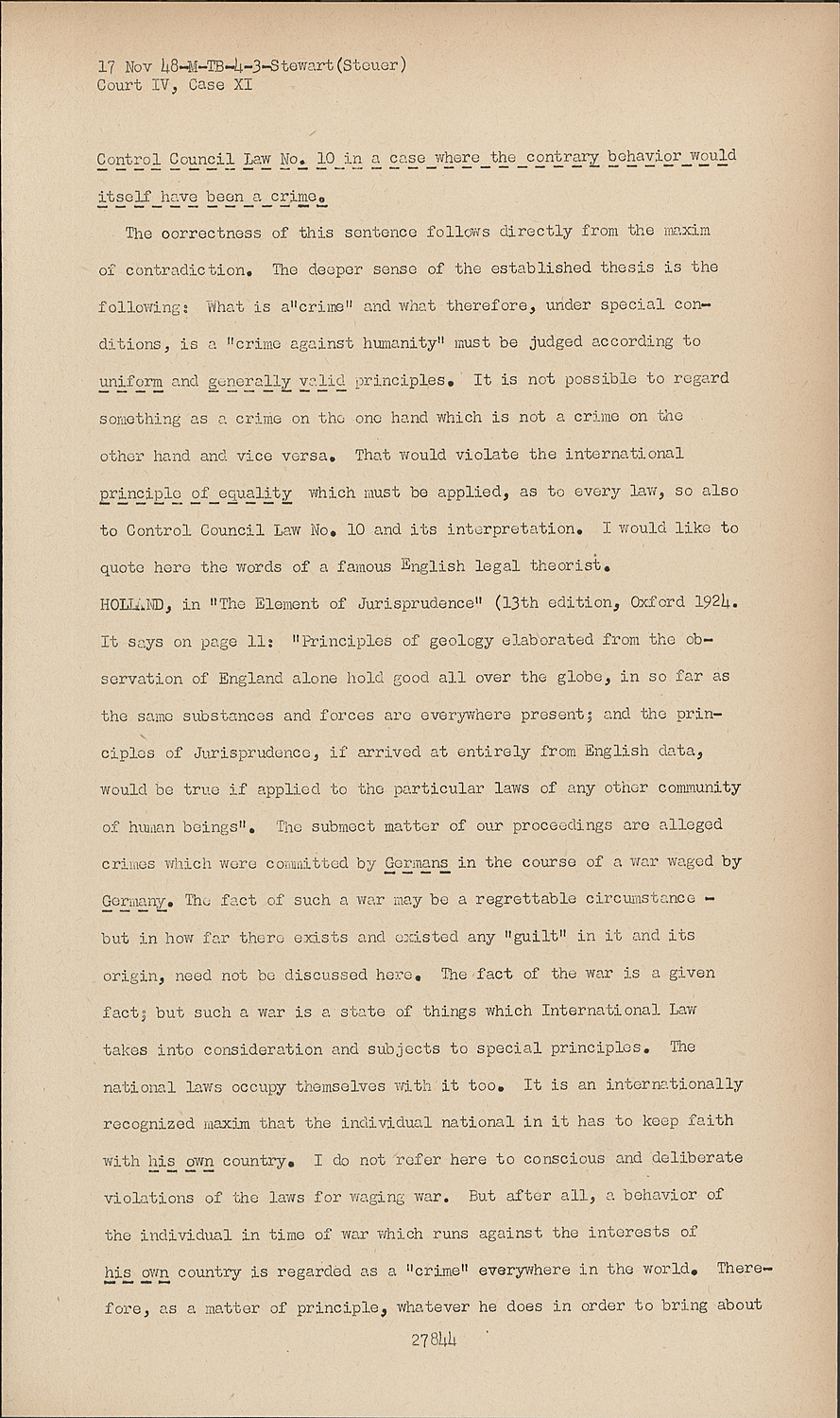
The correctness of this sentence follows directly from the maxim of contradiction. The deeper sense of the established thesis is the following: What is a"crime" and what therefore, under special conditions, is a "crime against humanity" must be judged according to uniform and generally valid principles. It is not possible to regard something as a crime on the one hand which is not a crime on the other hand and vice versa. That would violate the international principle of equality which must be applied, as to every law, so also to Control Council Law No. 10 and its interpretation. I would like to quote here the words of a famous English legal theorist. HOLLAND, in "The Element of Jurisprudence" (13th edition, Oxford 1924. It says on page 11: "Principles of geology elaborated from the observation of England alone hold good all over the globe, in so far as the same substances and forces are everywhere present; and the principles of Jurisprudence, if arrived at entirely from English data, would be true if applied to the particular laws of any other community of human beings". The submect matter of our proceedings are alleged crimes which were committed by Germans in the course of a war waged by Germany. The fact of such a war may be a regrettable circumstance but in how far there exists and existed any "guilt" in it and its origin, need not be discussed here. The fact of the war is a given fact; but such a war is a state of things which International Law takes into consideration and subjects to special principles. The national laws occupy themselves with it too. It is an internationally recognized maxim that the individual national in it has to keep faith with his own country. I do not refer here to conscious and deliberate violations of the laws for waging war. But after all, a behavior of the individual in time of war which runs against the interests of his own country is regarded as a "crime" everywhere in the world. Therefore, as a matter of principle, whatever he does in order to bring about the victory of his own country, cannot on the other hand be charged against him as a crime, even if in peacetime it would be subject to different judgment.
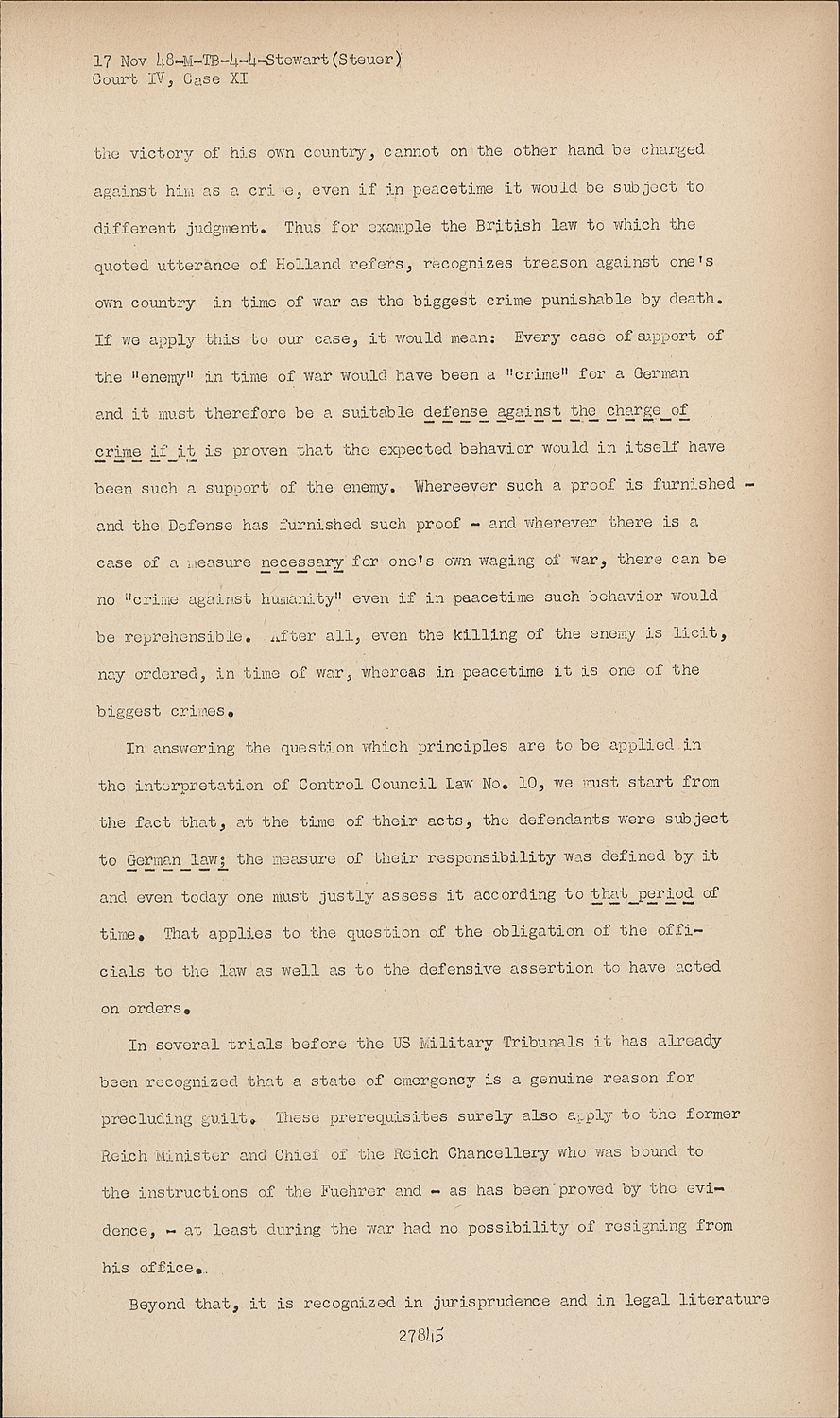
Thus for example the British law to which the quoted utterance of Holland refers, recognizes treason against one's own country in time of war as the biggest crime punishable by death. If we apply this to our case, it would mean: Every case of support of the "enemy" in time of war would have been a "crime" for a German and it must therefore be a suitable defense against the charge of crime if it is proven that the expected behavior would in itself have been such a support of the enemy. Whereever such a proof is furnished and the Defense has furnished such proof - and wherever there is a case of a measure necessary for one's own waging of war, there can be no "crime against humanity" even if in peacetime such behavior would be reprehensible. After all, even the killing of the enemy is licit, may ordered, in time of war, whereas in peacetime it is one of the biggest crimes.
In answering the question which principles are to be applied in the interpretation of Control Council Law No. 10, we must start from the fact that, at the time of their acts, the defendants were subject to German law; the measure of their responsibility was defined by it and even today one must justly assess it according to that period of time. That applies to the question of the obligation of the officials to the law as well as to the defensive assertion to have acted on orders.
In several trials before the US Military Tribunals it has already been recognized that a state of emergency is a genuine reason for precluding guilt. These prerequisites surely also apply to the former Reich Minister and Chief of the Reich Chancellery who was bound to the instructions of the Fuehrer and - as has been proved by the evidence, - at least during the war had no possibility of resigning from his office.
Beyond that, it is recognized in jurisprudence and in legal literature that the "general public", the "state" too may be in a state of emergency so that interventions which are meant to serve, and do serve, the elimination of this state of emergency may become exempt from punishment.
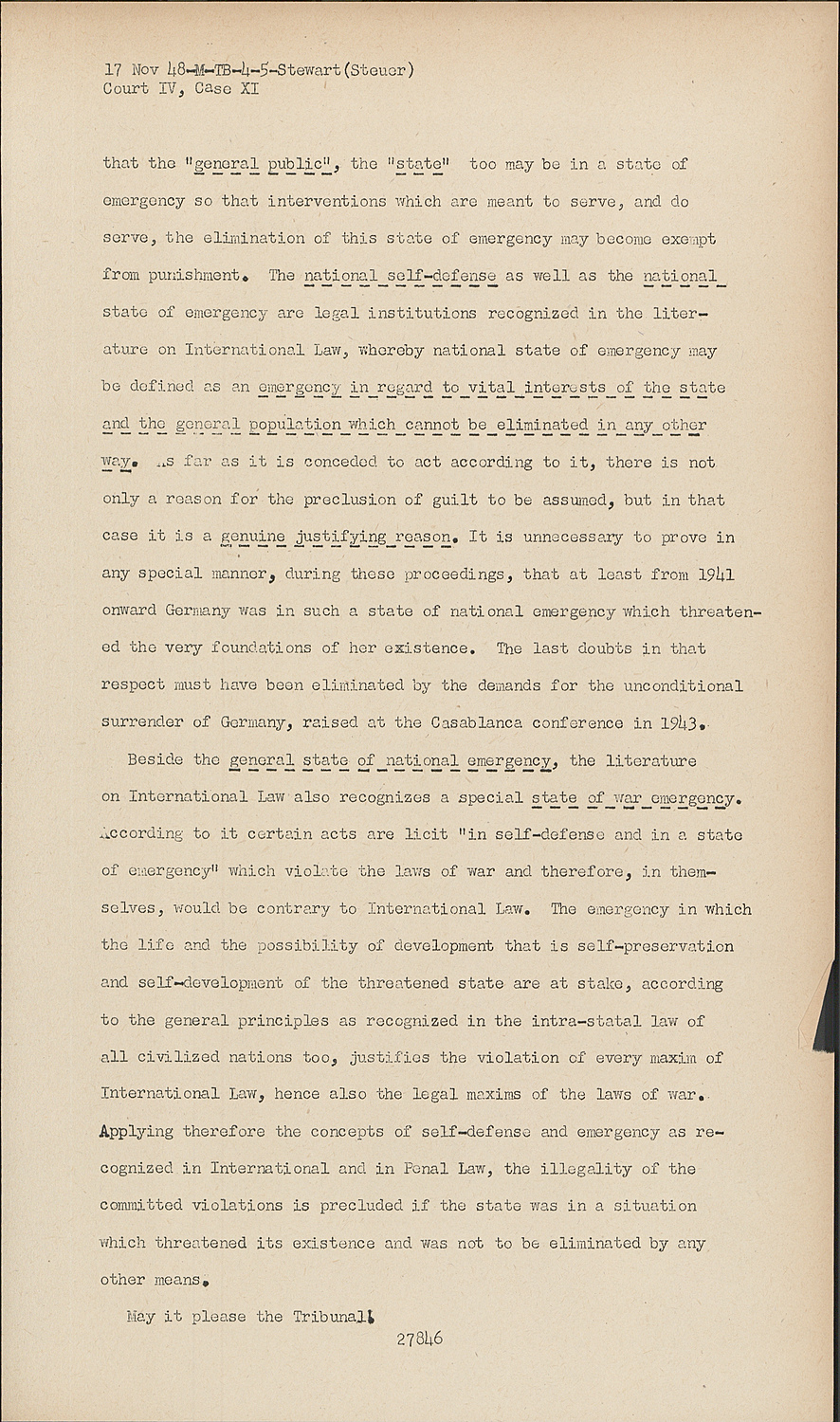
The national self-defense as well as the national state of emergency are legal institutions recognized in the literature on International Law, whereby national state of emergency may be defined as an emergency in regard to vital interests of the state and the general population which cannot be eliminated in any other way. As far as it is conceded to act according to it, there is not only a reason for the preclusion of guilt to be assumed, but in that case it is a genuine justifying reason. It is unnecessary to prove in any special manner, during these proceedings, that at least from 1941 onward Germany was in such a state of national emergency which threatened the very foundations of her existence. The last doubts in that respect must have been eliminated by the demands for the unconditional surrender of Germany, raised at the Casablanca conference in 1943.
Beside the general state of national emergency, the literature on International Law also recognizes a special state of war emergency. According to it certain acts are licit "in self-defense and in a state of emergency" which violate the laws of war and therefore, in themselves, would be contrary to International Law. The emergency in which the life and the possibility of development that is self-preservation and self-development of the threatened state are at stake, according to the general principles as recognized in the intra-statal law of all civilized nations too, justifies the violation of every maxim of International Law, hence also the legal maxims of the laws of war. Applying therefore the concepts of self-defense and emergency as recognized in International and in Penal Law, the illegality of the committed violations is precluded if the state was in a situation which threatened its existence and was not to be eliminated by any other means.
May it please the Tribunal!