It was precisely in connection with the personality of Dr. Meissner that the question was also often raised of WHY DID HITLER TAKE OVER MEISSNER, A NON-PARTY MEMBER, AS CHIEF OF THE PRESIDIAL CHANCELLERY upon succeeding Hindenburg as President of the Reich in 1934. This question is all the more pertinent since Hitler realized quite well that it was none other than Dr. Meissner who in the fall of 1932 exerted influence on Reich President von Hindenburg AGAINST having Hitler installed as chancellor. The convincing answer to this question was given by Dr. Meissner during his own interrogation: Hitler esteemed Meissner as an experienced legal expert and an eloquent civil servant, who in his 14 years activity as chief of the Same Reich office had acquired an extraordinary knowledge of the political history of the German Reich since the first world war, who was personally acquainted with an extraordinarily large number of leading men, particularly from foreign countries, and who, finally, united in his person all these qualities which constitute the basic requirements for a chief of the President chancellery. A statement to the same effect is given by dare in his affidavit and in his testimony before this Tribunal in the session of 1 September 1948.
Hitler knew that Meissner was not even a member of the Party; it is particularly characteristic that although Hitler conferred the "Golden Party Badge" on Dr. Meissner as well as on the other Ministers and state secretaries on 30 January 1937, he knowingly and intentionally refrained from receiving him at the same time as a member of the Party; the official text concerning this affair also clearly shows that this conferring of the "Golden Party Badge" was intended merely to distinguish him for his many years loyal service to the STATE, in other words, a sub stitute for a decoration, for which at the time there was still no provision in the Third Reich.
Some of the other high officials who at that time received the "Golden Party Badge" together with Meissner were at the same time given membership in the Party - which until then had been closed. - In the case of Dr. Meissner - as likewise in the case of Dr. Popitz - Hitler did NOT do this. Hence, he obviously realized that Meissner did not quite fit in with the Party.
Furthermore, Dr. Meissner was repeatedly urged to accept the rank of an honorary leader in the SS or the SD or in some other formation of the Party. In contrast to many other high officials - Dr. Meissner steadfastly refused to do so. It required courage in the Third Reich consistently to adhere to this non-conforming attitude toward the Party.
And then, when a number of decorations were instituted in the Third Reich during the war, precisely the head of the Secretariat for Decorations was one of the few office chief who received no such decoration. So little "service" had Dr. Meissner contributed, in Hitler's opinion, to the latter's Party and for the Prosecution of his war!
Here I would like to interpolate something, In consideration of the fact that the prosecution has made a new charge in its trial brief which must not be left unanswered because it seems to me of particular importance and distorts the picture of Meissner's personality. I am referring to the trial brief of the prosecution and to the part which states that Meissner participated in the execution of the Nacht and Nebel decree. That is wrong and has never been proved and there is not the slightest hit of evidence throughout the whole testimony to that effect. In speaking of the Nacht and Nebel decree, in the issue of which Meissner played no part whatsoever, the Prosecution asserts on page 38 that Meissner has submitted not one iota of evidence in proof of the fact that he took action against the execution of this ill famed decree. Your Honors, I fail to understand this position of the prosecution, for how is anyone to prove that he, as an official, acted contrary to any law and decree, and how is any official to be asked that he must do so.
This is entirely contrary to the fact proved by the statement of numerous affiants as listed. The witness Kiewitz, Buenting, Delvaux, and Thomas, Exhibit 26, 16, 6, and 28 respectively. And by Meissner's own testimony, pages 4772 to 4773 of the English transcript. The affiant Thomas, himself a known victim of fascism, states in the above-mentioned affidavit, and I quote: "In particular, he, Meissner, made efforts to insure that the Belgian population should be treated in a manner which was beyond reproach from the point of international law. In very numerous cases he succeeded in obtaining pardons for Belgians who had been sentenced to death and release for those who had been arrested. This applies also to cases falling under the so-called Nach and Nebel decree in which he, Dr. Meissner, tried to obtain confidential information which he then communicated to the German adjutant's office which passed it on to the dependents of the arrested person." According to the above the allegation of the prosecution previously cited reflects, to say the least, a flagrant disregard for a fact which has been proven beyond all reasonable doubt. The contrary of the prosecution's assertions has been proved, namely that in violation of the ruling of the Nacht and Nebel decree he constantly informed attornies and the members of the families of the persons concerned of the fate of those persons. In the trial brief various, examples are cited and a letter by the later Minister of Justice Thierack is cited. However, the prosecution overlooks that these cases cited by them are not the cases concerned with the Night and Fog decree, but clemency matters, where, it is true, Hitler did deserve the right to make a decision concerning the clemency after the end of the war; but there were cases in which he decided that the execution of the death sentences were not to be carried out during the war and that the clemency petition should be regulated after the end of the war. So much for the clarification of the obviously untrue and incorrect assertions of the prosecution with regard to this question. That brings me to the close of my argumentation of the Meissner case. On page 50 of my plea I summarize the following facts.
In summation I would like to add the following:
Dr. Meissner is the type of permanent civil servant who is free of Party Obligations who served the state for 45 years in all, the first 20 years uninterruptedly in the position of chief of the chancellery of the Reich Chief of state at the particular time. He did not "belong to the active resistance group the conspiracy of 20 July 1944; but for years by means of unflagging and courageous efforts in small ways he resisted tyranny, the rule of force and the further spread of the reign of lawlessness. Dr. Meissner's political career, which has been revealed in this trial was longer than that of any of the other defendants at Nuremberg; it "began at the end of the first world war and lasted until the collapse after the second and it went through a tragic period of German history.
BUT IT ALWAYS FOLLOWED THE PATH OP DUTY AND INTEGRITY ANDTHE STRAIGHT AND NARROW PATH OF JUSTICE AND HUMANITY, a frequently dangerous path of manly struggle against all injustice and of courageous intercession by means of untiring work in small ways on behalf of persons who were tormented and persecuted. When Dr. Meissner leaves this courtroom, he will not be accompanied by the causes of victims, but by the gratitude of many persons who have been saved, both in Germany and beyond its borders,
PRESIDING JUDGE MAGUIRE:Dr. Riediger on behalf of defendant Schellenberg? You may proceed.
DR.RIEDIGER (Counsel for the defendant Schellenberg): Your Honors:
The defense has summarized in detail in its final brief the result of the case in chief in the case against the defendant Schellenberg. In a further brief a reply was made to the allegations of the prosecution. The defense at this point emphatically again calls the attention of the Tribunal to the fact that it was unfortunately necessary to deal in these briefs also with the questionable methods employed by the prosecution ID presenting its evidence. The defense was forced to refute false quotations of documents by the prosecution and an interpretation which often was absurd.
If one can draw conclusions from the methods employed to present a case as to the strength of the case then the prosecution's case against the defendant Walter Schellenberg trust be rather weak.
And this is the case. Under Count I of the indictment Walter Schellenberg is accused of participation in the planning and waging of aggressive wars and under Count II of participation in a conspiracy to this end. The defense is in the fortunate position of being able to dispense with a discussion of the basic problems under international and criminal law on the subject of "Aggressive War." It is profiting in this respect by the statements and expert opinions submitted in Ms connection by there defense counsels. But it is decisive that even a brief glance at the stage effects of this play which has been so glaringly illuminated by the prosecution reveals that the defendant Schellenberg cannot even by found among the dramatic personnel, It has been made sufficiently clear by now in several trials before the Nuernberg Military Tribunals that the group of persons who might actually belong to the perpetrators of the planning and conspiracy crimes is very limited. It comprises exclusively the top men of the administrations, and the demarcation line between those who are responsible and those who are free of any responsibility according to the pertinent provisions of the Control Council Law separates the group of those wen whose participation was of less importance". as was held by the judgment in Case VI.
In order to ascertain whether the defendant Schellenberg was even near this demarcation line we wish to consider once more briefly the evidence introduced by the prosecution in connection with Counts I and II of the indictment. They are contained in Document Book 71. To begin with we find there:
Document L 185 and Document L 219:
Tables of Organization of the RSHA (Reich Security Main Office) of 1 January 1941 and 1 October 1943. They do not reveal anything with regard to Schellenberg's position at the time of the Venle-incident which occurred on 9 November 1939.
According to the Table of Organization L 185 Schelfuehrer and Regierungsrat and in charge of Group IV E - counter -intelligence - of the RSHA. At that time he was 31 years old, at the time of the Venle-incident 29. Since Schellehberg is neither Alexander the Great nor Napoleon to whom the prosecution in its final brief compares him, in other words since he was not guiding the ship of state, we must draw the necessary conclusion from his youth and low rank that he simply did not belong to that group in the administration which decided about war or peace. He actually was a little tool carrying out orders which he received; and by carrying out these orders he die not unleash war, nor even one phase of a war which was decided and waged at quite a different level by quite different people. The SS-Sturmbannfuhrer "holding the comparative rank of " -- I want to change "Captain" into "battalion" -- instead of "company" -- in the attack once he had received an order to that effect. Like such an army captain Schellenberg neither planned an aggressive war nor did he belong to the group of persons conspiring against peace.
Document 4510 and the cover letter Document 4692.
An official report on the Venlo incident by the Netherlands government which as evidence is without value. The report re-it*r*t*---* the position which the Netherlands government had to adopt officially concerning the Venlo-incident, there is no proof for its correctness. What is however decisive is the fact that this report does not disclose any circumstances which would classify the defendant Schellenberg as one of the "Chief perpetrators", as one of the leaders of the Reich, a position which he simply did not hold.
Document NG 4691:
Excerpts from the "Oberheitmann material". They represent press informations with which the defendant Schellenberg had no connection. Their contents in no way mentions a criminal position which the defendant Schellenberg might have held as one of the perpetrators involved in the preparation of an aggressive war and the conspiracy.
Document 789 :
A speech by Hitler of 23 November 1939 which has no value as evidence in the case against Schellenberg either. For the case against Schellenberg alleges that he was one of these who planned aggressive wars and who took such a decisive part in the planning that their's was the decision between war or peace. It is this document which shows the difference between the actual planner and the subordinate agencies who were not asked at all. Even the Commanders-in-chief of the Armed Forces to whom speech was made were only informed about Hitler's trend of thought and the decisions taken by him, and not even Field Marshals or Generals were consulted about their opinion or had influence upon these decisions; and yet this charge is made against an entirely subordinate person.
Document NG 4672 and Document TC 57.
Memorandum of the German government to the Netherlands and Belgian governments with the attached Frick/Himmler report containing the assertions about the connections between the Secret Service agents in Holland and Belgium and the official Dutch and Belgian authorities. These documents neither make Schellenberg a member of the small group of actual planners of an aggressive war since he was under orders to co-operate in obtaining the material.
Document 2316:
A memorandum by the Foreign Office concerning the cooperation with Amt VI- Foreign Intelligence Service - which is dated 9 August 1940, that is the time when the defendant Schellenberg neither was in charge nor even a member of AMt VI. Chief of Amt VI was SS-Brigadefuehrer Jost. Schellenberg at that time however was Group Leader IV-E - Counter-intelligence he had no influence upon either the trends of thought of the Foreign Office nor of these of the Chief of Office Jost. It was explained in the Final Brief of the defense (Engl.
p. 33) and it was also (affidavit Neumann, ) that the central office for intelligence work in Holland and consequently also for the intelligence operations with the intelligence officers of the Secret Service was Amt VI. Nobody heard that Chief of Office Just who was one of the defendants here in Nurnberg before a Military Tribunal ever was charged with preparation of an aggressive war. No doubt, he could not be found guilty of such a charge either. All the less it is possible to find the defendant Schellenberg guilty of such a charge since he was ordered to participate in these intelligence operations only as pert of his training to prove his worth in the counter-intelligence service.
Now a word about the witnesses mustered by the prosecution in connection with the Venlo-incident. There is first the witness Gaus to whose affidavit Document 3945, the prosecution is referring. Herr Gaus, in the Foreign Office, is shown receiving from Schellenberg personally a compilation of reports concerning the collaboration of the Service Service with the Belgian and Dutch authorities. We know that Herr Gaus as Ribbentrop's closest advisor was consulted all the time in the formulation of every statement by Ribbentrop. Here we come very much closer to the group of people who were preparing and planning since Ribbentrop was certainly one of then. But is Herr Gaus in the dock? No, he is a prosecution witness to testify about the alleged actions of others while a cloud of benevolent forget fullness descends upon his memory as far as his own activity in decisive positions is concerned. But let us ignore these facts which interest other defendants in these proceedings much more. Herr Gaus neither was able to tell anything that could brand the defendant Schellenberg as a man planning war and conspiring. The witnesses Lammers, Goetel, and *ehrends were only in a position to describe actual events of the Ven*Oincident.
We mention only casually the fact that the prosecution did not call as witnesses the chief participants Major STEVENS and Captain BEST, but Captain BEST'S chauffeur who naturally did not and could not have a true insight into the real facts of the case. It suffices to state that none of the above mentioned witnesses was able or did testify anything whatsoever with regard to the actual charge in question, i.e. that SCHELLENBERG belonged to the group of these persons who planned war and conspired to this end. Obviously the only purpose of their appearance lay in supporting the prosecution's propaganda campaign against the defendant. Thus the entirely superfluous "identification scene" LEMMENS/SCHEMMEL before the tribunal, reported in a sensational manner by the entire world press, was nothing but an act serving toward this end: it was superfluous since no one had questioned that the defendant SCHELLENBERG had participated in the negotiations with the British intelligence officers and that he took part in the Venlo-incident. The statements about the injury and subsequent death of the Dutch Lieutenant KLOP who posing as a British officer, had participated in the negotiations served the same purpose. Here the prosecution even makes the absurd allegation that in Venlo SCHELLENBERG "shot Lt. KLOP in cold blood". The prosecution does not charge him with this crime knowing that he did not commit it. Yet it is certainly a very effective ruse to imply some such action as being attributable to the defendant, and yet even defendant Lehman had to admit that German officers only shot into the air and that Klop was not wounded until he hi rise If had shot several times. Luckily, the attempt at least to cast suspicion on Schellenberg "incidentally" as a murderer, If not to indict him directly as such, could be thwarted by the testimony of the witness Waneck (Trans. page 6882), who was able to give the name of the man who in returning the shots fired by Lt. Klop unfortunately wounded the latter.
Moreover, the defense has also proved that Schellenberg's task was merely conducting the negotiations with the British intelligence officers, but that he was not in charge of the arrest detail.
Immediately after the incident, he drove back to Duesseldorf alone in his car assuming that the head of the detail and the Chief of Police, Dr. Hasselbacher, in Dusseldorf, who was responsible for all further measures with respect to those persons arrested, would also see that the wounded Lieutenant Klop would receive the necessary medical care.
Finally, the prosecution also submitted Document 3710 as evidence of Schellenberg's participation in planning an aggressive war against Soviet Russia.
This is an affidavit of the defendant himself, in which the latter states that he was included in negotiations between Heydrich and General Wagner, the Quartermaster General of the Army, for formulating an agreement. The purpose of this agreement was to draw the lines of authority between the Wehrmacht and the "Einsatzgruppen" to be assigned in the Eastern campaign. This, however, had nothing to do with the separate order secretly issued to those Einsatzgruppen to kill Jews, of which the defendant knew nothing, but referred to the task of the Einsatzgruppen to police the occupied territory. It is true that before he was included in those negotiations, the defendant was informed that war with Soviet Russia was imminent. However, in this case too, neither by this information nor by his being ordered to take part in the negotiations mentioned, did he become a member of the circle of the highest political leadership, which can be held criminally responsible for planning and conducting an aggressive war against the Soviet Union or for conspiracy to this end as defined by Control Council Law No. 11. None of the Einsatzgruppen leaders who at this time were actually busy with the organization and training, etc. of their groups, was indicted or sentenced for a crime against the peace, not even the chief defendant of the Einsatzgruppen trial, Ohlendorf. Indeed, they are not guilty of this crime. But how much loss so is Schellenberg, who never had anything to do with the activities of these Einsatzgruppen and who was only called upon to formulate an agreement with the Wehrmacht regarding their police authority.
He neither organized the Einsatzgruppen, nor did he activate them, and even Field Marshals and Generals who commanded entire armies to be deployed in the East were not punished for preparing an aggressive war against the Soviet Union, for even they did not belong to that small circle of men, of whom - if not altogether of only one man - it may be said they really responsibly planned and prepared this war.
The defense will dispense with discussing in detail the evidence which it submitted relative to counts I and II of the indictment and the results of the examinations of its witnesses pertinent to this. The entire material has been evaluated in the Trial Brief of the defense"instead of the "prosecution" and in the rebuttal to the Trial Brief of the prosecution, and it would only impose upon the court's patience to have the statements which it has road in both documents of the defense once more presented here, The legal aspects of the case, as well, are too clear to require further clarification. In section D I - page 140 153 of its Trial Brief, the defense described this legal situation in connection with the provisions of Control Council Law No. 10, which is the basis for the Nuernberg Trials, and with the findings of the Nurnberg Tribunals. This description as well as the review of the evidence must result in the following: The defendant Schellenberg was not one of the political leaders of the Reich, either before the invasion of the Netherlands, or before the war against Soviet Russia, he cannot be hold responsible for planning and waging an aggressive war and entering into a conspiracy to this end. We therefore request an acquittal on Counts I and II of the Indictment.
In count V of the indictment, Walter Schellenberg is then accused of having committed war crimes and crimes against humanity by having taken part in criminal acts against the civilian population. The indictment regards these acts as having materialized in Schellenberg's inclusion in the formulation of the Heydrich-Wagner agreement, in an alleged participation in the organization of Einsatzgruppen in Yugoslavia and in the publishing of an order prohibiting the emigration of Jews from Belgium and France.
We will again take up first of all the role of Schellenberg in the formulation of the Heydrich-Wagner agreement, and here we will again proceed by giving once more a brief survey of the prosecution evidence. The most incriminating prosecution document pertaining to the Heydrich-Wagner agreement is Document 3710 Exhibit 1148 the statement of the defendant himself, which was presented to the latter by the interrogation official for signature on 26 November 1945.
We cannot omit pointing out the fact that at that time Schellenberg was not warned that this statement was to be used against him. It was rather the basis of testimony given by Schellenberg in the IMT trail, in which he was used as witness for the prosecution. On the contrary, shortly before the opening of Case XI, Schellenberg was assured that he himself would not be placed under indictment at all, in fact the indictment first published did not even contain his share. The procedure of using an affidavit of the defendant as a major incriminating document, can, however, not result in any success for the prosecution. Being fully aware of this fact, the prosecution in its argumentation attempted to claim "the defendant himself states in his affidavit that... and then to draw conclusions which the prosecution would like to attribute to him, but which Schellenberg never said in his affidavit.
What did the defendant Schellenberg really say? That he was ordered by the Chief of the RSHA, Heydrich, to continue the negotiations already begun with the Quartermaster General of the Army, General Wagner, because of his experience in matters of protocol. This assignment was based on an order of Hitler to assign units of the Security Police and the SD, the so-called Einsatzgruppen, in the East to the frontline troops of the Army, with the duty to cover the frontline troops and if necessary to break any resistance in the conquered territories.
The agreement determined the relationship of subordination and authority between Armed Forces and Einsatzgruppen. The agreement, previously discussed and formulated by Schellenberg with General Wagner, was finally signed by Heydrich and Wagner, Schellenberg furthermore describes in detail that no mention was made in these negotiations in his presence of an order to kill Jews and that reports about activities of the Einsatzgruppen in this connection had not come to his attention until he made the affidavit in 1945. The version of the statement submitted by the defendant Schellenberg further shows that it was formulated in order to pin Schellenberg down to as positive as possible a formulation regarding an assumption which, based on the conditions, equally predicated knowledge of the Wehrmacht leadership concerning the executions carried out by the Einsatzgruppen. To testify as to the contents of this affidavit, the prosecution then brought Schellenberg to the witness stand in the IMT trial. At that time it defended his statement against the attacks of the defense in all points as absolutely credible, thus regarded as indisputable the truth of that which today it would like only to be considered true insofar as it fits its concept now. As we have seen, Schellenberg's participation in the draft of the agreement was limited to writing provisions for perfectly legitimate activities, such as must be instituted in the rear of any fighting army, and such as were completely indispensable for a campaign in Soviet Russia with the partisan warfare methods peculiarly characteristic for this country. As further evidence the Prosecution introduces Document 2890 Document 2620 affidavits of the Einsatzgruppenfuehrer Otto Ohlendorf, in which the latter makes basic comments on the preliminary history and activities of the Einsatzgruppen.
These statements have nothing to do with the defendant Schellenberg. Ohlendorf, who was informed about everything connected with the Einsatzgruppen and their activities, does not mention Schellenberg's name at all, which he certainly would not have omitted doing, if he had had any basis for including Schellenberg in the activities of the Einsatzgruppen.
The defense has called attention in its closing brief to the marked differences between Schellenberg and Ohlendorf. But this very description of Ohlendorf is proof for the truth of Schellenberg's statement that he know nothing of the special duties of the Einsatzgruppen. For Ohlendorf above all shows the clear separation of the official security assignment which was the basis of the Heydrich-Wagner agreement, and the special order of the Fuehrer, which was issued to the Einsatzgruppenfuehrers orally and in strict secrecy, before they were activated. In a petition of Ohlendorf's defense which was recently submitted to General Clay, this statement was made:
"The assigning of special units of the Security Police to the Eastern area of operations of the German Army, was based on an order of Hitler several months before the beginning of the East ern Campaign.
It was regulated in detail by an agreement between the OKH and the Chief of the Security Police and the SD."
In this decree it was provided that the armies should be assigned a liaison officer of the Security Police and the SD, to whom mobile units of the Security Police and the SD, e.g. Einsatzgruppen or Einsatzkommandos respectively, were subordinate.
PRESIDING JUDGE MAGUIRE:This is an appropriate time; we will take the morning recess. There will be a recess for fifteen minutes.
(A recess was taken.)
THE MARSHAL:Military Tribunal IV is again in session.
JUDGE MAGUIRE:Counsel's attention is drawn to the fact that he has already used twenty-three minutes of his time; so that you will govern yourself accordingly.
These formations were neither offices nor otherwise included in the TO of the RSHA; rather, they were special mobile units which had been organized for a certain specified assignment.
The members of the Einsatzgruppen and Einsatzkommandos were either taken from the ranks of the Security Police and the SD, or they were drafted, e.g., as truck drivers or interpreters, while the great majority of recruits were assigned to their tasks by order of Himmler and organized into companies of the constabulary and the Waffer-SS. The Einsatzgruppen and Einsatzkommandos, thus, were not offices, and not authorities, but military units.
It was their duty to provide political security in the occupied territories, both in the Wehrmacht sphere of operations and in the rear echelon territories which were not directly under civilian administration (cf. Opening Statement of the prosecution in Case IX of 29 Sept. 1947, German page 11). In detail, this included first and foremost: investigation of underground and partisan movements, of espionage, sabotage, etc., reporting to a very extensive degree on the political situation to the competent commanders of the army, care of ethnic groups (ethnic German Tartars, Ukrainians, etc.), special assignments of the armies, which could consist in bringing in the harvest, guarding bridges, the use of whole detail at the front, fighting partisans, etc.
Within the security duties, in a special order of Hitler which was not communicated to the leaders of the Einsatzgruppen and Einsatzkommandos until a few days before the beginning of the Eastern campaign; this order decreed that in addition to the general duties of the Security Police and the SD, the Einsatz-formations had been given the task of safeguarding and protecting the area in the rear of the front line by killing Jews, Gypsies, communist agents, active communists, and all such persons who might have endangered the security.
The Hitler order to kill was responsible for events which have been dealt with as Einsatzgruppen Trial before the American Military Tribunal No. II in Nurnberg." (United States of America versus Otto Ohlendorf et al "Comment on Facts and Legal Questions arising during the Einsatzgruppen Trial (Case 9) before the American Military Tribunal II in Nurnberg" by Rudolf Aschenauer, Defense Counsel, Pages 2 and 3). In that trial, defense counsel for the defendant Ohlendorf has enumerated two fundamental differences with utmost lucidity, namely: The difference between the general Hitler Decree ordering the formation of Einsatzgruppen and drafting the table of organization for the general tasks of the Security Police, as defined in the jurisdiction break-down of the Wehrmacht with the above organization and fixed in the Wagner-Heydrich agreement; on the other hand, there was Hitler's special decree specifying additional tasks, i.e. the killing of Jews, Gypsies, communist agents, and active Communists. If, to crown these arguments, Ohlendorf himself enunciates: "This Hitler decree to kill was responsible for the events which . . . formed the subject of the Einsatzgruppen Trial", this pronouncement establishes the fact that these events were not actually linked to the discussions concerning the limits which were fixed for the jurisdiction of the Wehrmacht and the Einsatzgruppen, respectively, as they merely covered legitimate general duties.
I will now interpolate a passage from Case 12 in connection with the activities of the Einsatzgruppen:
". . .Another factor must also be taken into consideration in connection with the activi ties of the Einsatzgruppen.
This is the dual nature of its functions.
On the criminal liquidation of certain elements; on the other hand it is exercised legitimate police ac tivities in connection with the security of the rear communications of the armies, in which capacity it operated largely against guerillas . . ."And on page 122 of the judgment it says:
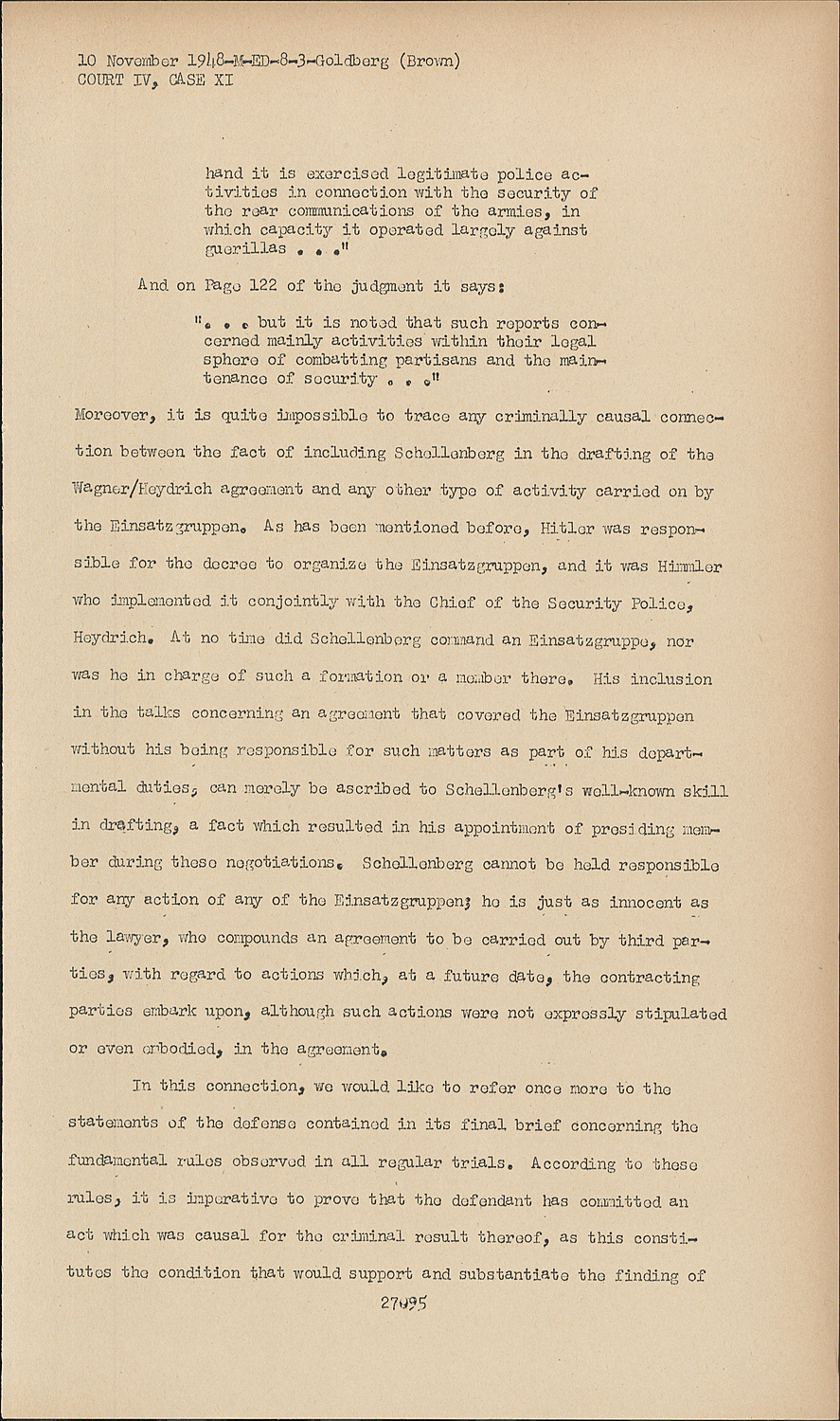
". . . but it is noted that such reports con cerned mainly activities within their legal sphere of combatting partisans and the main tenance of security . . ." Moreover, it is quite impossible to trace any criminally causal connection between the fact of including Schellenberg in the drafting of the Wagner/Heydrich agreement and any other type of activity carried on by the Einsatzgruppen.
As has been mentioned before, Hitler was responsible for the decree to organize the Einsatzgruppen, and it was Himmler who implemented it conjointly with the Chief of the Security Police, Heydrich. At no time did Schellenberg command an Einsatzgruppe, nor was he in charge of such a formation or a member there. His inclusion in the talks concerning an agreement that covered the Einsatzgruppen without his being responsible for such matters as part of his departmental duties, can merely be ascribed to Schellenberg's well-known skill in drafting, a fact which resulted in his appointment of presiding member during these negotiations. Schellenberg cannot be held responsible for any action of any of the Einsatzgruppen; he is just as innocent as the lawyer, who compounds an agreement to be carried out by third parties, with regard to actions which, at a future date, the contracting parties embark upon, although such actions were not expressly stipulated or even embodied, in the agreement.
In this connection, we would like to refer once more to the statements of the defense contained in its final brief concerning the fundamental rules observed in all regular trials. According to these rules, it is imperative to prove that the defendant has committed an act which was causal for the criminal result thereof, as this constitutes the condition that would support and substantiate the finding of the defendant's guilt criminal.
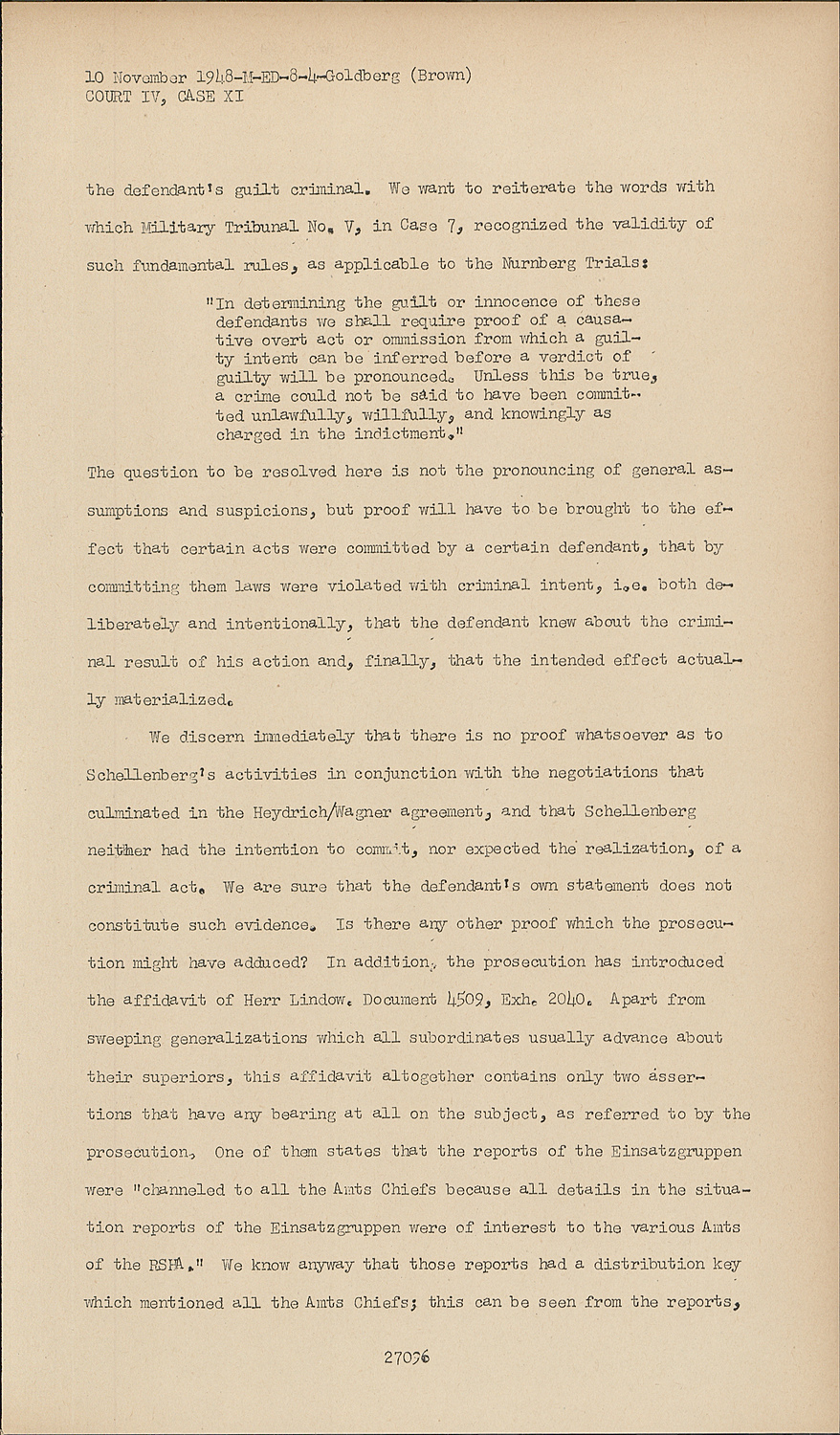
We want to reiterate the words with which Military Tribunal No, V, in Case 7, recognized the validity of such fundamental rules, as applicable to the Nurnberg Trials:
"In determining the guilt or innocence of these defendants we shall require proof of a causa tive overt act or ommission from which a guil ty intent can be inferred before a verdict of guilty will be pronounced.
Unless this be true, a crime could not be said to have been commit ted unlawfully, willfully, and knowingly as charged in the indictment."
The question to be resolved here is not the pronouncing of general assumptions and suspicions, but proof will have to be brought to the effect that certain acts were committed by a certain defendant, that by committing them laws were violated with criminal intent, i.e. both deliberately and intentionally, that the defendant knew about the criminal result of his action and, finally, that the intended effect actually materialized.
We discern immediately that there is no proof whatsoever as to Schellenberg's activities in conjunction with the negotiations that culminated in the Heydrich/Wagner agreement, and that Schellenberg neither had the intention to commit, nor expected the realization, of a criminal act. We are sure that the defendant's own statement does not constitute such evidence. Is there any other proof which the prosecution might have adduced? In addition, the prosecution has introduced the affidavit of Herr Lindow. Document 4509, Exh. 2040. Apart from sweeping generalizations which all subordinates usually advance about their superiors, this affidavit altogether contains only two assertions that have any bearing at all on the subject, as referred to by the prosecution. One of them states that the reports of the Einsatzgruppen were "channeled to all the Amts Chiefs because all details in the situation reports of the Einsatzgruppen were of interest to the various Amts of the RSHA." We know anyway that those reports had a distribution key which mentioned all the Amts Chiefs; this can be seen from the reports, submitted by the prosecution, Besides, it is quite open to conjecture whether the offices mentioned in the distribution key actually informed themselves about the reports, a fact which the prosecution has failed to prove at all.
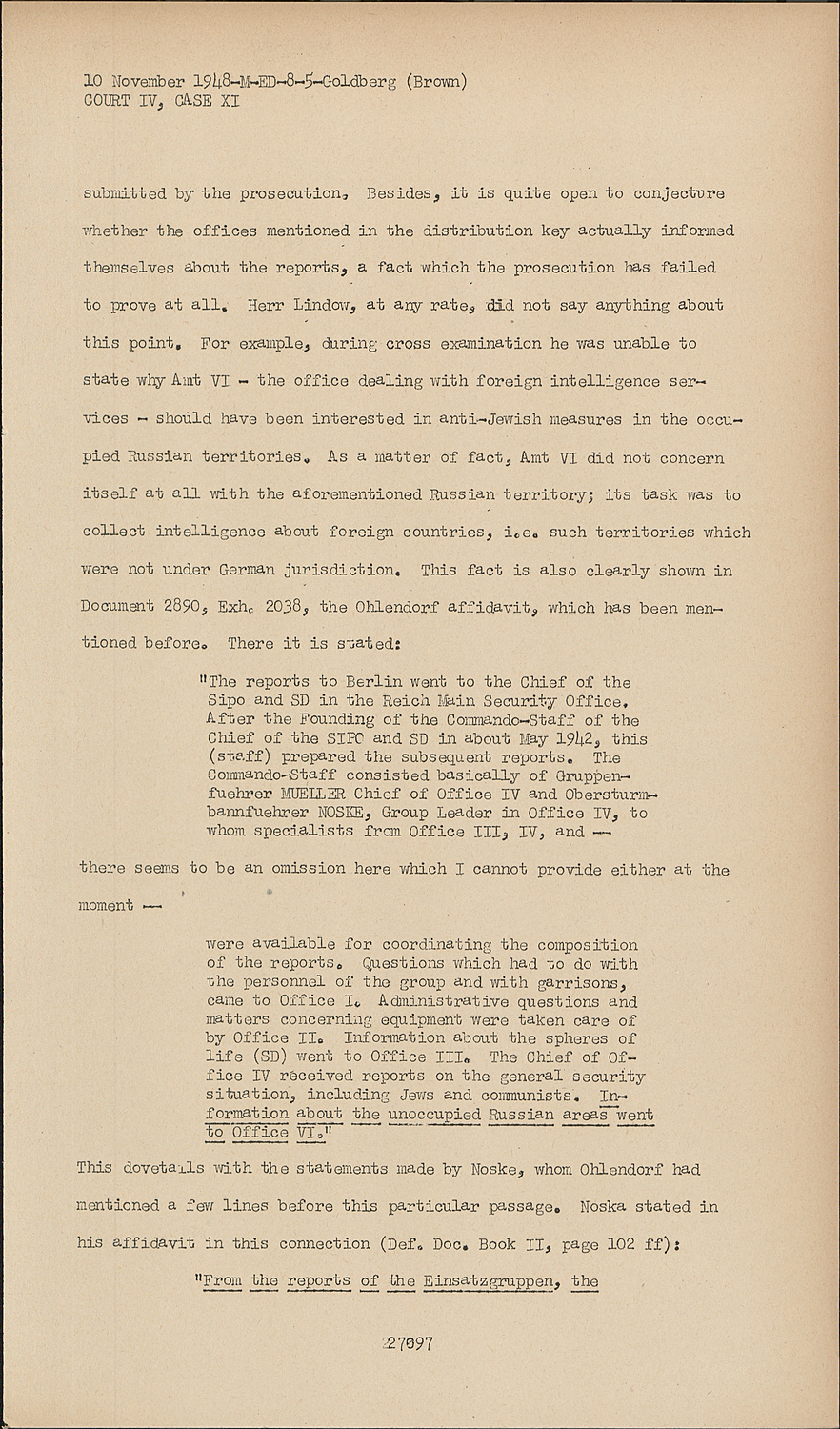
Herr Lindow, at any rate, did not say anything about this point. For example, during cross examination he was unable to state why Amt VI - the office dealing with foreign intelligence services - should have been interested in anti-Jewish measures in the occupied Russian territories. As a matter of fact, Amt VI did not concern itself at all with the aforementioned Russian territory; its task was to collect intelligence about foreign countries, i.e. such territories which were not under German jurisdiction. This fact is also clearly shown in Document 2890, Exh. 2038, the Ohlendorf affidavit, which has been mentioned before. There it is stated:
"The reports to Berlin went to the Chief of the Sipo and SD in the Reich Main Security Office, After the Founding of the Commando-Staff of the Chief of the SIPO and SD in about May 1942, this (staff) prepared the subsequent reports.
The Commando-Staff consisted basically of Gruppen fuehrer MUELLER Chief of Office IV and Obersturm bannfuehrer NOSKE, Group Leader in Office IV, to whom specialists from Office III, IV, and -there seems to be an omission here which I cannot provide either at the moment -were available for coordinating the composition of the reports.
Questions which had to do with the personnel of the group and with garrisons, came to Office I. Administrative questions and matters concerning equipment were taken care of by Office II.
Information about the spheres of life (SD) went to Office III.
The Chief of Of fice IV received reports on the general security situation, including Jews and communists.
In formation about the unoccupied Russian areas went to Office VI."
This dovetails with the statements made by Noske, whom Ohlendorf had mentioned a few lines before this particular passage. Noska stated in his affidavit in this connection (Def. Doc. Book II, page 102 ff):
"From the reports of the Einsatzgruppen, the offices received only those parts which con cerned them.
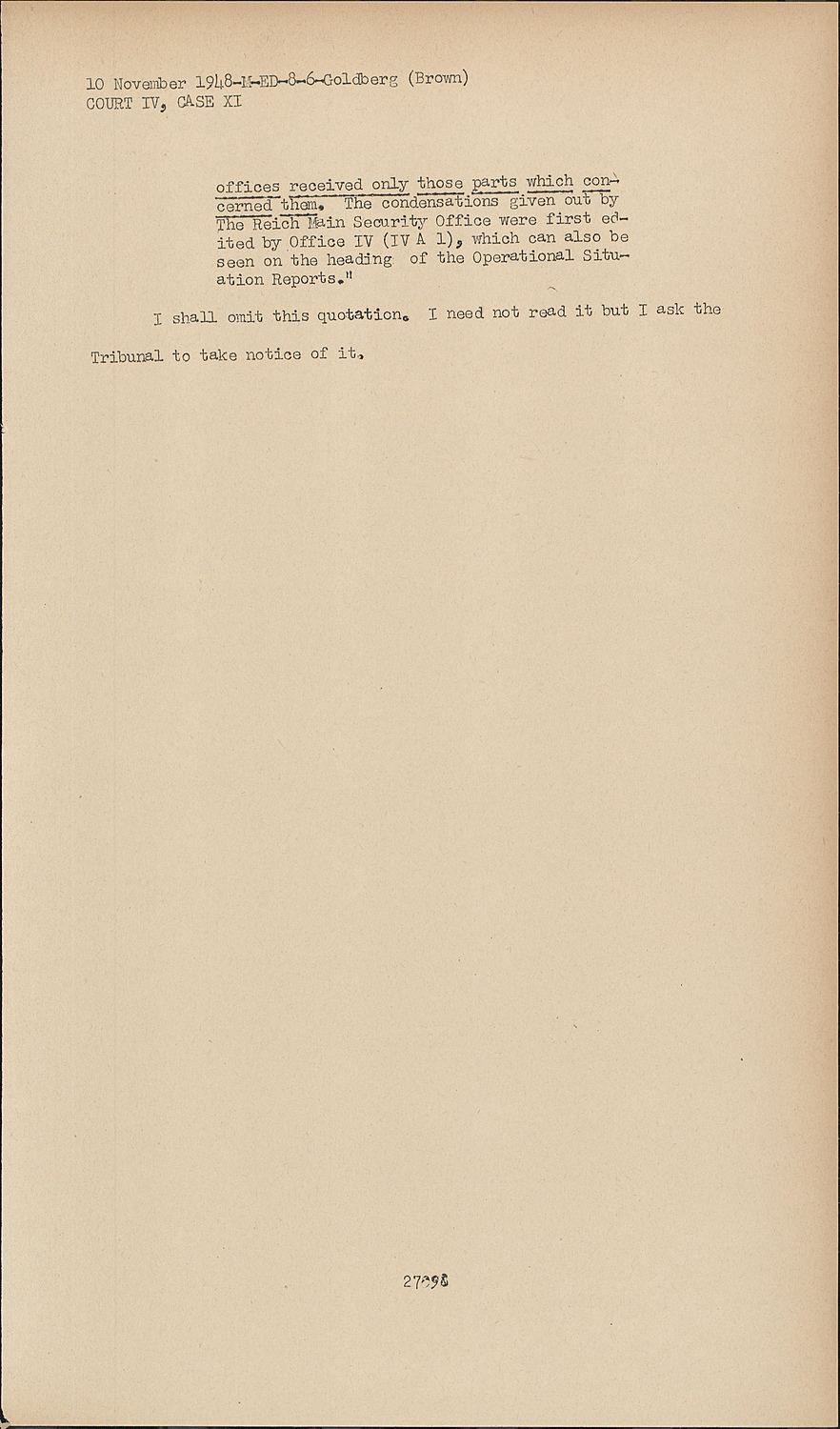
The condensations given out by The Reich Main Security Office were first ed ited by Office IV (IV A 1), which can also be seen on the heading of the Operational Situ ation Reports."
I shall omit this quotation. I need not read it but I ask the Tribunal to take notice of it.