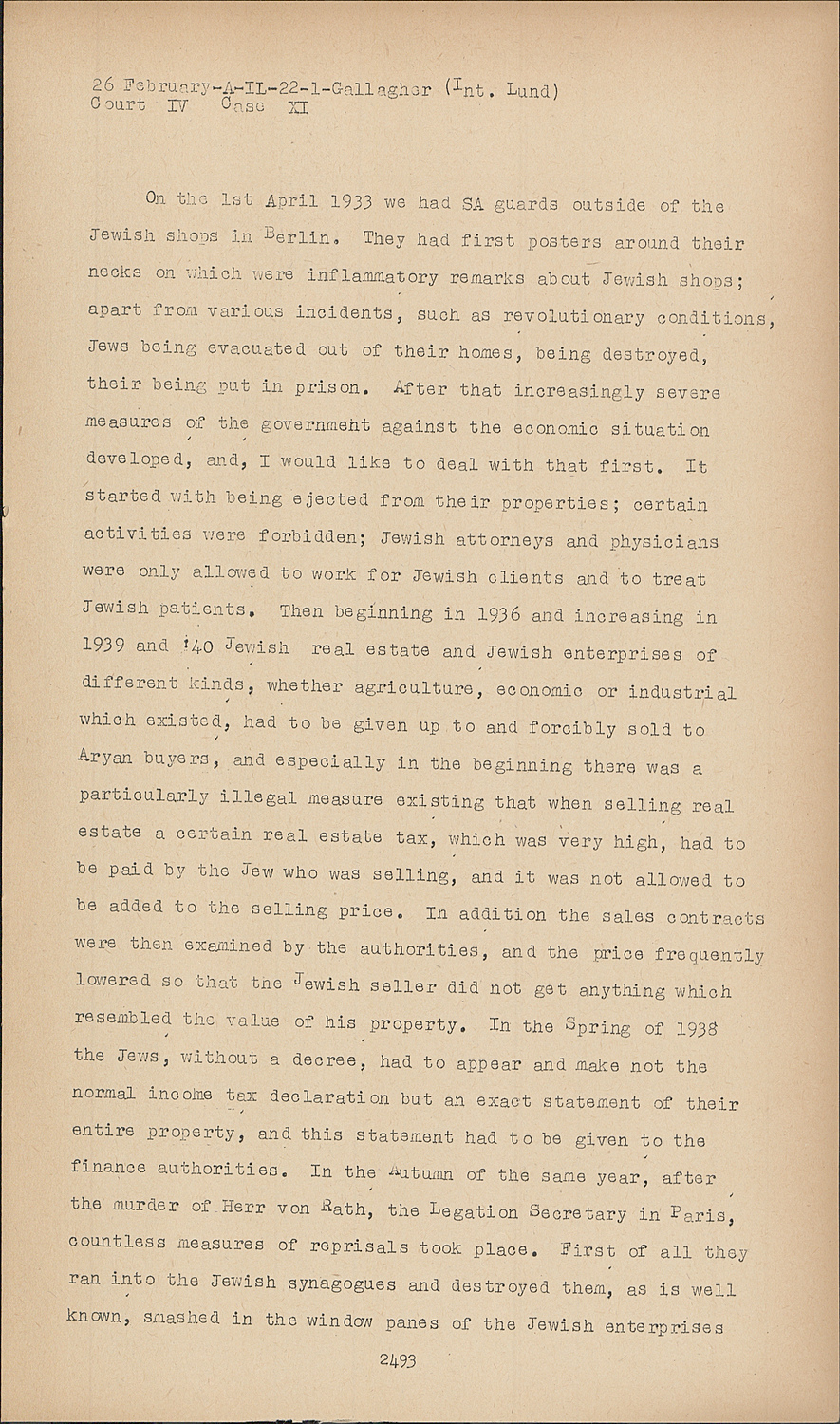
On the 1st April 1933 we had SA guards outside of the Jewish shops in Berlin. They had first posters around their necks on which were inflammatory remarks about Jewish shops; apart from various incidents, such as revolutionary conditions, Jews being evacuated out of their homes, being destroyed, their being put in prison. After that increasingly severe measures of the government against the economic situation developed, and, I would like to deal with that first. It started with being ejected from their properties; certain activities were forbidden; Jewish attorneys and physicians were only allowed to work for Jewish clients and to treat Jewish patients. Then beginning in 1936 and increasing in 1939 and 40 Jewish real estate and Jewish enterprises of different kinds, whether agriculture, economic or industrial which existed, had to be given up to and forcibly sold to Aryan buyers, and especially in the beginning there was a particularly illegal measure existing that when selling real estate a certain real estate tax, which was very high, had to be paid by the Jew who was selling, and it was not allowed to be added to the selling price. In addition the sales contracts were then examined by the authorities, and the price frequently lowered so that the Jewish seller did not get anything which resembled the value of his property. In the spring of 1938 the Jews, without a decree, had to appear and make not the normal income tax declaration but an exact statement of their entire property, and this statement had to be given to the finance authorities. In the Autumn of the same year, after the murder of Herr von Rath, the Legation Secretary in Paris, countless measures of reprisals took place. First of all they ran into the Jewish synagogues and destroyed them, as is well known, Smashed in the window panes of the Jewish enterprises which remained, and, there was looting of the enterprises too, and, in addition to that the Jews had to raise a Billion marks.
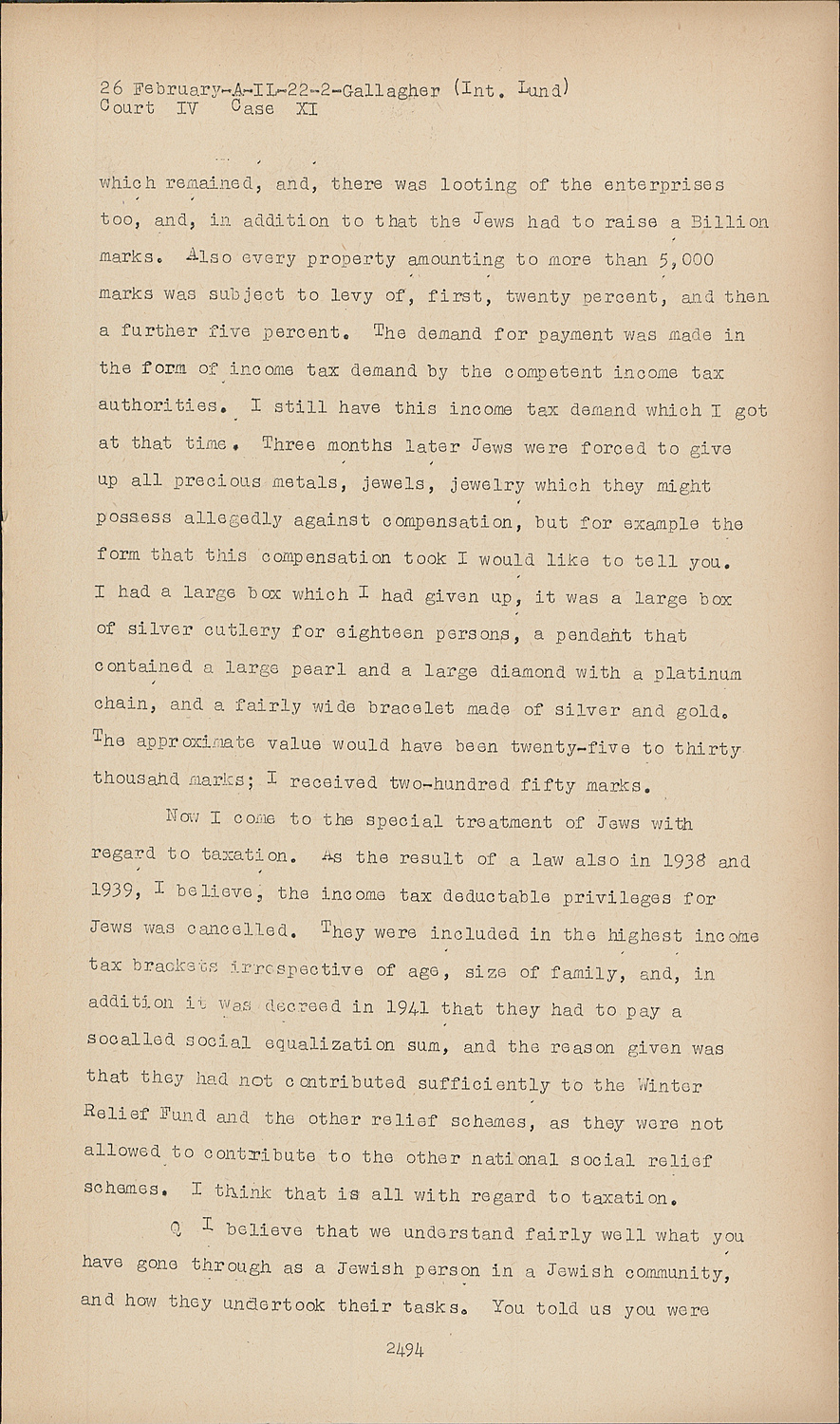
Also every property amounting to more than 5,000 marks was subject to levy of, first, twenty percent, and then a further five percent. The demand for payment was made in the form of income tax demand by the competent income tax authorities. I still have this income tax demand which I got at that time. Three months later Jews were forced to give up all precious metals, jewels, jewelry which they might possess allegedly against compensation, but for example the form that this compensation took I would like to tell you. I had a large box which I had given up, it was a large box of silver cutlery for eighteen persons, a pendant that contained a large pearl and a large diamond with a platinum chain, and a fairly wide bracelet made of silver and gold. The approximate value would have been twenty-five to thirty thousand marks; I received two-hundred fifty marks.
Now I come to the special treatment of Jews with regard to taxation. As the result of a law also in 1938 and 1939, I believe, the income tax deductable privileges for Jews was cancelled. They were included in the highest income tax bracksts irrespective of age, size of family, and, in addition it was decreed in 1941 that they had to pay a socalled social equalization sum, and the reason given was that they had not contributed sufficiently to the Winter Relief Fund and the other relief schemes, as they were not allowed to contribute to the other national social relief schemes. I think that is all with regard to taxation.
QI believe that we understand fairly well what you have gone through as a Jewish person in a Jewish community, and how they undertook their tasks. You told us you were deported to Theresienstadt.
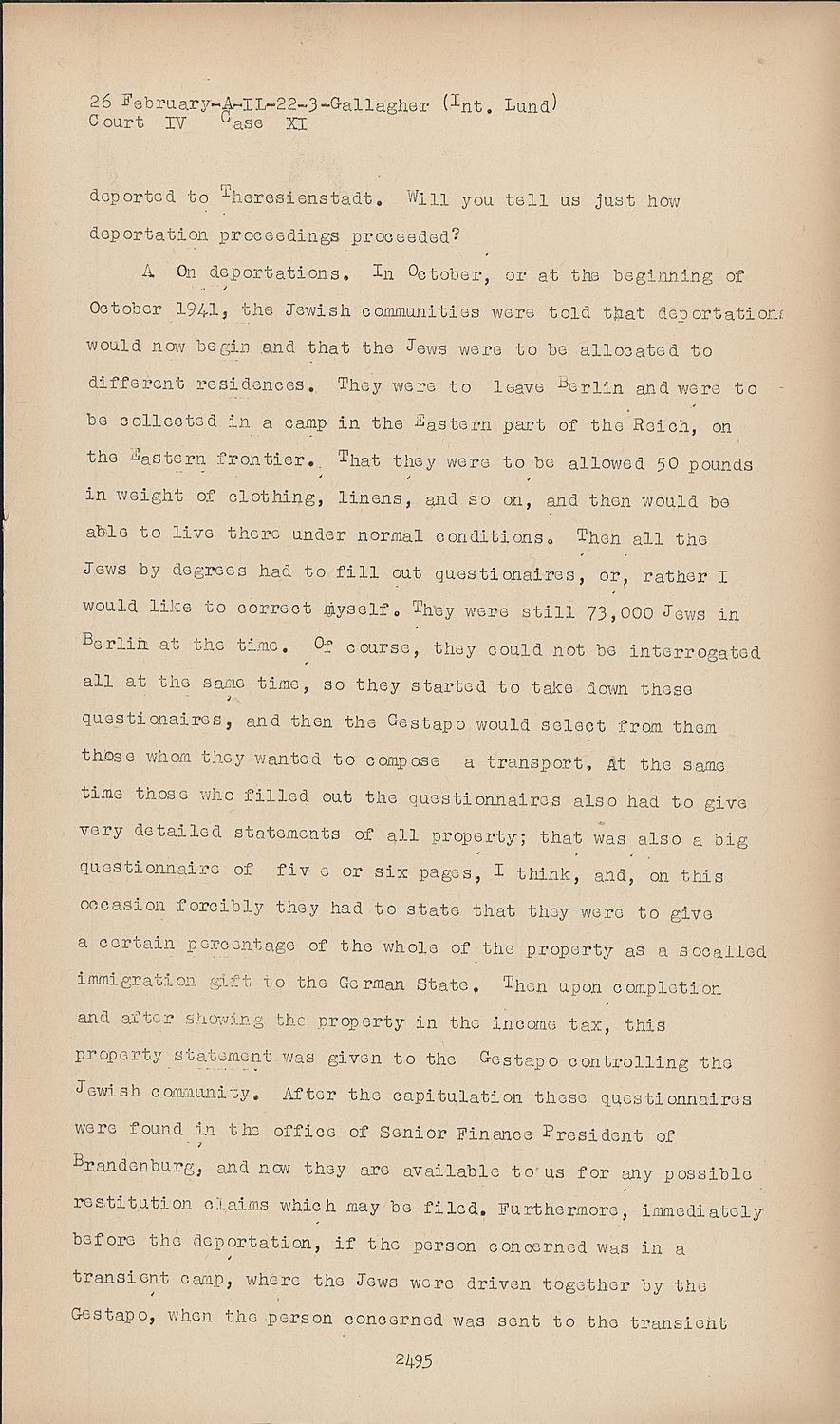
Will you tell us just how deportation proceedings proceeded?
AOn deportations. In October, or at the beginning of October 1941, the Jewish communities were told that deportations would now begin and that the Jews were to be allocated to different residences. They were to leave Berlin and were to be collected in a camp in the Eastern part of the Reich, on the Eastern frontier. That they were to be allowed 50 pounds in weight of clothing, linens, and so on, and then would be able to live there under normal conditions. Then all the Jews by degrees had to fill out questionaires, or, rather I would like to correct myself. They were still 73,000 Jews in Berlin at the time. Of course, they could not be interrogated all at the same time, so they started to take down these questionaires, and then the Gestapo would select from them those whom they wanted to compose a transport. At the same time those who filled out the questionnaires also had to give very detailed statements of all property; that was also a big questionnaire of fiv e or six pages, I think, and, on this occasion forcibly they had to state that they were to give a certain percentage of the whole of the property as a socalled immigration gift to the German State. Then upon completion and after showing the property in the income tax, this property statement was given to the Gestapo controlling the Jewish community. After the capitulation these questionnaires were found in the office of Senior Finance President of Brandenburg, and now they are available to us for any possible restitution claims which may be filed. Furthermore, immediately before the deportation, if the person concerned was in a transient camp, where the Jews were driven together by the Gestapo, when the person concerned was sent to the transient camp, he received a written notice of the confiscation of his entire property, because of purposes inimical to the State.
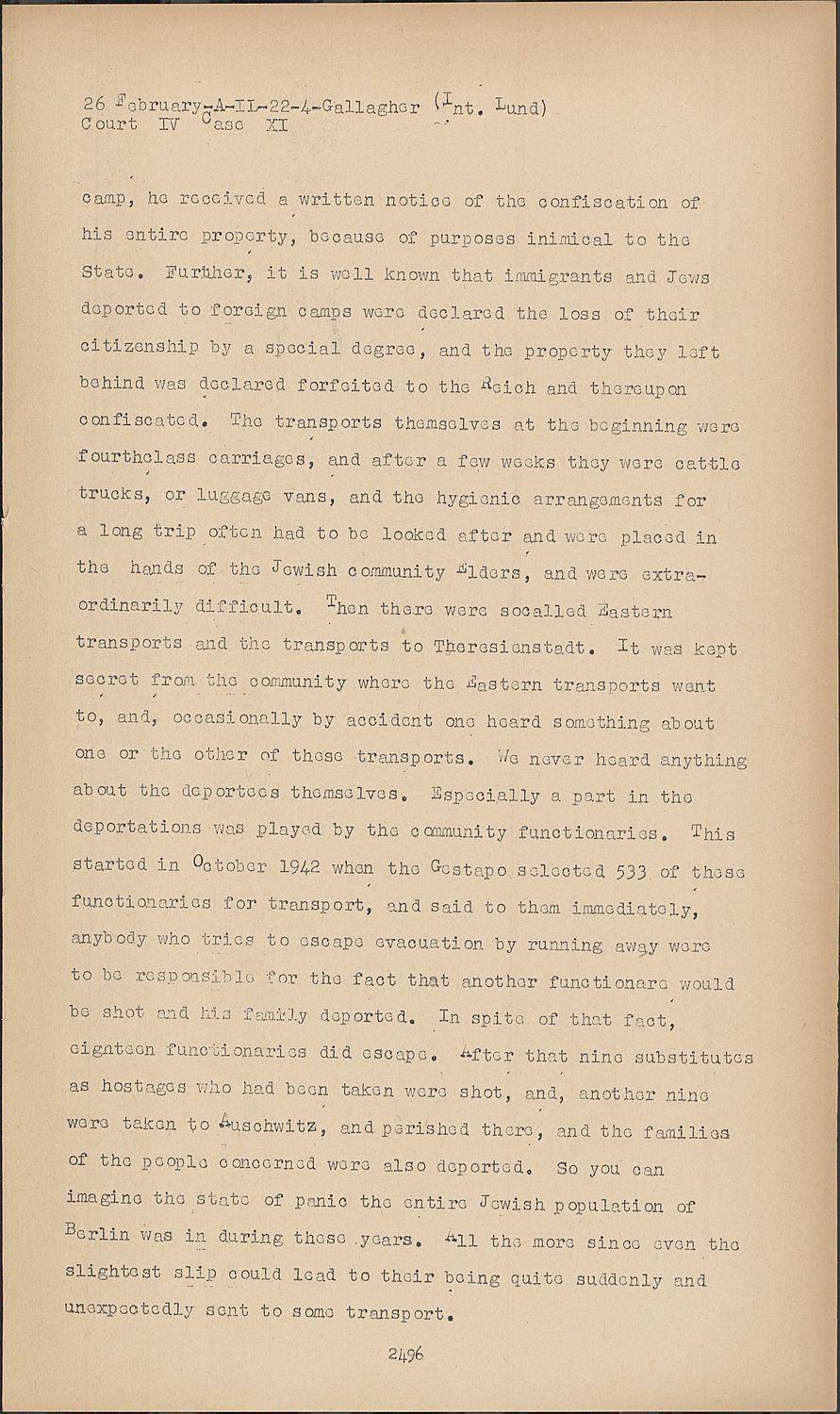
Further, it is well known that immigrants and Jews deported to foreign camps were declared the loss of their citizenship by a special degree, and the property they left behind was declared forfeited to the Rich and thereupon confiscated. The transports themselves at the beginning were fourthclass carriages, and after a few weeks they were cattle trucks, or luggage vans, and the hygienic arrangements for a long trip often had to be looked after and were placed in the hands of the Jewish community Elders, and were extraordinarily difficult. Then there were socalled Eastern transports and the transports to Theresienstadt. It was kept secret from the community where the Eastern transports went to, and, occasionally by accident ons heard something about one or the other of these transports. We never heard anything about the deportees themselves. Especially a part in the deportations was played by the community functionaries. This started in October 1942 when the Gestapo selected 533 of these functionaries for transport, and said to them immediately, anybody who tries to escape evacuation by running away were to be responsible for the fact that another functionare would be shot and his family deported. In spite of that fact, eighteen functionaries did escape. After that nine substitutes as hostages who had been taken were shot, and, another nine were taken to Auschwitz, and perished there, and the families of the people concerned were also deported. So you can imagine the state of panic the entire Jewish population of Berlin was in during these years. All the more since even the slightest slip could lead to their being quite suddenly and unexpectedly sent to some transport.
There were an immense number of finicky little regulations, some of which had not even been published in the press. The starting point, I suppose, was the affixing of the Jewish Star in Autumn 1941; immediately afterwards came the announcement that Jews were not allowed to sit in public means of transport as long as any non-Jew still had to stand - and there were no exceptions for the aged or the sick or prople suffering from war disablement. This regulation was later made even more severe and Jews were not allowed to use public means of transportation at all.
Q.Dr. Hosse, there is one question I would like to clear up at this time, on these deportations. Were persons deported did they involve nationalities other than Germans?
A.Yes.
Q.That nationalities would you say?
A.For instance, Hungarians, Poles, Russians - no, I beg your pardon, I must withdraw that - Russians not, in principle, because all Allies were excepted; that was during the war; but apart from that, no regard was taken to nationality.
Q.There is one other fact that is very interesting and I think you ought to repeat it. You say the records of property registration had been found since the war. Will you tell me again where they were found?
A.In the office of the Senior Finance President in Berlin Brandenburg, and an agency has now been set up, half under the Berlin Magistrate and hall under the Allied Commandantura, whose task it is to examine this material, to put it in order and handle it.
MR. HINSKOFF:That will be sufficient. Thank you very much, Dr. Mosse.
PRESIDING JUDGE POWERS:Any cross examination of this witness? There appears to be more Judge Maguire desires to ask a few questions.
EXAMINATION BY JUDGE MAGUIRE:
Q.Witness, you spoke of armament work carried on in the Theresionstadt camp. What kind of armament was that and who was compelled to, or did work in it?
A.In the first place we had to cut some pieces of mica into thin plates; as far as I know, they were afterwards used for aircraft. Then uniforms were repaired and, for winter fighting, some of it was sprayed white. Then, for a time, spare parts for aircraft were made - but these were things that did not have to be handled with machinery. Instructions for the work went to the SS Camp Leaders and it was compulsory to take part, that is, for as many persons as were required to do the work. According to what the women told me -- it was mostly women's work, especially this cutting of mica -- as SS man was there all the time, watching.
Q.One other question. Were those who were compelled so to work on armaments only German Jews, or were they the Jews and other inmates of the camp, from other countries?
A.Everybody was concerned, irrespective of nationality. There were Austrians, Czechs, Poles, Polish Jews --nobody asked what the nationality was.
JUDGE MAGUIRE:That is all.
PRESIDING JUDGE POWERS:There are no further questions? Do you. have any, Mrs. Minskoff?
MRS, MINSKOFF: I have no more questions.
PRESIDING JUDGE POWERS:Well, if there are no more questions, the witness will be excused. (Witness excused). Is there something else?
MRS. MINSKOFF:No, we have no more witnesses for today. We are prepared to bring on a witness tomorrow morning.
PRESIDING JUDGE POWERS:Well, I take it the Prosecution hasn't any more to present today?
DR. KEMPHER:Yes, Your Honor.
PRESIDIIG JUDGE POWERS:In that event
MRS. MINSKOFF:That is correct.
PRESIDING JUDGE POWERS:Well, since the Prosecution has no evidence to present now, the Tribunal will recess until tomorrow morning at 0930.
(Military Tribunal IV adjourned until 27 February at 0930 hours.)
Official Transcript of the American Military Tribunal in the matter of the United States of America, against Ernst von Weizsaecker, et al, defendants, sitting at Nuernberg, Ger many, on 27 February 1948, 0930-1630, the Honorable Robert F. Maguire presiding.
THE MARSHAL:The Honorable, the Judges of Military Tribunal IV. Military Tribunal IV is now in session. God save the United States of America and this Honorable Tribunal. There will be order in the Count.
THE PRESIDENT:Mr. Marshal,are the defendants in court?
THE MARSHAL:May it please your Honors, all the defendants are present in the courtroom with the exception of the defendants Meissner and Stuckart who are absent due to illness.
THE PRESIDENT:There seems to be considerable noise in the system this morning, is that true? There seems to be. I wonder if something can be done about that.
At this morning's session, Judge Maguire will preside.
PRESIDING JUDGE MAGUIRE:Dr. Kempner?
DR. KEMPNER:The Prosecution calls to the stand the witness Jeanette Wolff.
JEANETTEWOLFF, a witness, took the stand and testified as follows:
THE PRESIDENT:Will the witness raise her right hand and be sworn? "I swear by God, the Almighty and Omniscient, that I will speak the pure truth and will withhold and add nothing."
(The witness repeated the oath.)
THE PRESIDENT:You may be seated.
DIRECT EXAMINATION BY DR. KEMPNER:
Q.- What is your name, please?
A.- Jeanette Wolff.
Q.- How old are you now?
A.- I will be sixty on my next birthday.
Q.- Where were you born?
A.- In Bocholt, in Westphalia.
Q.- Where are you living now?
A.- In Berlin, Neukoelln, Jonasstrasse 50.
Q.- In what sector of Berlin is that?
A.- In the United States Sector.
Q.- At the moment you are City Councillor in Berlin, is that correct?
A.- Yes.
Q.- Are you married?
A.- My husband has not been heard of since Buchenwald.
Q.- Have you any children?
A.- I had.
Q.- How many children?
A.- Theree of my own and one adopted child.
Q.- What happened to them?
A.- My oldest child was sent to the extermination camp Stutthof, and was shot there, the beginning of 1945. My second daughter survived. I found her again, but her heart and nerves are completely done for. My third daughter, Kaethe, was arrested as early as 1939, taken into protective custody, and deported from Ravensbrueck. I never saw her again.
Q.- In what year was that?
A.- At the end of 1943 she was deported. I learned that from a survivor of Ravensbruck. My youngest child was one adopted by me.
Q.- What happened to the youngest? How old was she?
A.- Three and a quarter. She was an adopted child. The mother had become mentally sick because of the events; the father had been shot by the Nazis, in Wallerskirch. In 1943, on the second of November, the child together with about two thousand other children from all the Jewish camps of Riga -- was packed into open trucks, at a degree of cold of forty-two degrees. We never heard anything of those children again.
Q.- Did any other members of your family perish after 1939?
A.- My husband in Buchenwald; my brother and his wife, one daughter, two sons-in-law, and three grandchildren, in Auschwitz.
Q.- Were you yourself -
A.- Nine cousins, one uncle, aunts -- twenty-four altogether, apart from my own immediate family.
Q.- Were you yourself in a camp?
A.- Yes, in several camps.
Q.- Were you in camps in the occupied territories?
A.- Yes, in Latvia.
Q.- In what year was that?
A.- At the beginning of 1942, we arrived there.
Q.- Where did you arrive? In what country?
A.- Latvia.
Q.- Who occupied it at the time?
A.- The Germans.
Q.- In what other camp were you, Frau Wolff?
A.- In the subsidiary camp of Kaiserwald, near Riga, in Muehlgraben.
Q.- Will you tell us about your deportation?
A.- Yes. I think it was on the twentieth of December, 1941, that we got a letter which said, "You and your family" -- that was, it was intended to take effect the beginning of January -- "have to be at the Boersenhalle in Dortmund," I and one thousand three hundred and fifty Jews from the Dortmund area were deported.
Q.- Were you told for what purpose you were to present yourselves?
A.- Yes, for labor allocation in the east. My husband joined me, from prison. He came from Sachsenhausen. He had been sent there in 1938 after the big Jewish pogroms. He had been taken away and later on he was put in prison once again and they allowed him to be deported with me. My daughter from Ravensbrueck was not allowed to join us.
Q.- In order to clear that up, you had received orders to report to go to the cast for labor allocation?
A.- Yes.
Q.- Were there only German Jews or were there Jews who originally had come from Poland and other countries?
A.- The transport with which I want, consisted of Jews who lived in Germany but these included Poles. Later, we met Jews from Latvia, from Poland, from Hungary, from Czechoslovakia, and from Bielo-Russia, in the labor squads.
Q.- So you were sent to the occupied territory, if I understood you correctly, weren't you?
A.- Yes.
Q.I see that you are rather about these terrible events. Please answer my questions very slowly and listen very carefully, won't you? So you were sent there. Where was that?
A.To Riga.
Q.To Riga, in occupied territory, is that right?
A.Yes.
Q.Was there a camp there or what was there? Please tell us in one sentence, quite briefly.
A.There was a block of houses surrounded by a high barbedwire fence. That was the so-called Riga Jewish Ghetto.
Q.Were there prisoners of all nationalities from occupied territories there?
A.There were three ghetti which were not separated in point of space, but which were separated by barbed-wire.
Q.About how many people were there?
A.In our camp, in the beginning, about twenty thousand. In the one opposite, there were only men, Poles and Latvians whose wives had been murdered. There were perhaps five thousand. And in the third block, that was the women's camp of surviving Polish wives from Wilna and Latvia, women from Liban and Riga, there were about two hundred of them.
Q.Did people come from Hungary?
A.Later on.
Q.In what year?
A.About the middle of 1944.
Q.Did people come from Poland?
A.Yes, earlier.
Q.Earlier?
A.Yes.
Q.Jews from France?
A.I can't say because the Stutthof Camp was not our camp.
There were sixty-nine thousand inmates and as the blocks were separated by barbed-wire it was impossible to talk, to get in touch with another block without getting beaten up for it.
Q.So you know about the Poles end Hungarians and Latvians and Germans?
A.Yes.
Q.And Czechs?
A.Yes.
Q.Is that correct?
A.Yes.
Q.You yourself did notsee any Frenchmen?
A.No.
Q.All right, if you didn't see it, let's leave it.
A.Oh, yes, I saw them, behind barbed-wire, but I didn't speak to then.
Q.But then you don't know whether they were really French.
A.I was told that.
Q.Did you work there?
A.Yes, like everybody.
Q.For whom did you work?
A.From the ghetto in Riga, mainly in Wehrmacht units.
Q.What did you do for the Wehrmacht?
A.I myself was a uniform tailor.
Q.What did the others do?
A.They made uniforms, boots, fur coats, leatherware, all things for the Wehrmacht -- partly repairs and partly newly made.
Q.Did you make ammunition?
A.I was never in such a detachment, but I was told that in the troop economy camp (Truppenwirtschaftslager) things of this kind were being made. I cannot say. I did not see it myself.
Q.Were squads sent out to the airport and to the wharfs?
A.Yes, to the airport in Riga. New airfields were being built. That was the punitive camp of Spilve, where people were beaten up atrociously. In addition there was a big repair camp for motor cars, tanks, andother engines. May I think for a moment? It was called "HKP". That means Motor Pool.
Q.Army motor pool?
A.Yes, that is right.
Q.But surely that is not so bad, if you made uniforms and worked as a uniform tailor, as a woman. A lot of women work like that.
A.That would not have been so bad if the amount of work we were supposed to do had not been so impossibly high, if the conditions of life hadn't been so unbearably bad. The food was not sufficient to permit a person to remain alive even if he was not working.
Q.If you couldn't do the work you were supposed to do, what happened then?
A.Those who couldn't work were considered as being as good as liquidated, and that is why everybody tried to work until he collapsed.
Q.What do you mean by "liquidated"?
A.There were camps which can only be described as death camps, from which drives were constantly going into effect, people collected and sent on so-called "ascension" squads (Himmelfahrtskommandos).
Q.What do you mean "ascension"?
A.If the purpose of a squad was obscure and it held old and feeble people, then we knew that the people wouldn't come back.
Q.Were there so-called "children's drives" too?
A.Yes.
Q.What were they?
A.In 1943, on the second of November, in the morning, very early, we heard that all children under ten, must be sent to the Blech Platz, which was a square where the first executions and also the drives were varied on, and where roll was called.
The area is drenched only with Jewish blood, on a gigantic scale. The children had to be taken to this square. It was very cold. It was between thirty-eight and forty degrees. The children were packed into open trucks. They were given three days' food -- that is, imitation coffee and dry bread. The children -- we never saw any of them again.
There were more children drives. This was the last. We were in the Muehlgraben Camp.
We had been able to hide fourteen children in the ghetto in the course of the drive and in other camps too some children had been hidden. We were glad if the children ever laughed, because our life was so heavy. Our families torn apart. They were cruel. They deported us to the east so that we shouls work together, and took our husbands away. They sent them to the stone quarries. They sent them to their death in Salispils.
Q.Tell us, of the conditions under which you worked there, I would like to know the following: Did you have any definite kind of clothing or definite style of hairdress, or anything of the kind?
A.In the beginning, as long as we were in the Riga Ghetto, we kept and were our civilian clothing.
Q.How did you do your hair?
A.In 1943, they shaved our heads with an 0 mm machine.
Q.What happened to the hair?
A.The hair had to be collected. Nothing was to be lost. It was packed in sacks end worked into ropes allegedly for the Zeppelins.
Q.Is that all?
A.No, that is not all. The children's drives came later. Not a single child was allowed to survive. There were drives during work which were cruel.
Q.Were people beaten?
A.Yes. On Black Sunday in Muehlgraben, people were used to carry wood. All punishment was carried out by some inhumane work, if it was not shooting or hanging. In this case, two people had to carry, in the boiling sun -- I think at the end of May, it was terribly hot, -- they had to carry up to one and a half hundredweight of wood between them, on a stretcher. And the camp commandant and two Wehrmacht NCO's beat these men with lashes and drove them right across the camp courtyard until they collapsed.
Among the people there was one very beautiful young woman, Kathe Ehrlich from Vienna, a Czech national, but she had been deported to us from Vienna.
The commandant and the NCO Schwellenbach beat her so long until she lay bleeding on the ground. One of the people got a grave injury to the lung and died of it.
In this camp there were only Wehrmacht people; no SS.
DR. KEMPNER:That is all we want to hear for today. Thank you for coming.
PRESIDING JUDGE MAGUIRE:Is there any cross examination? There being no cross examination, the witness is now excused.
DR. KEMPNER:With the Court's permission, the prosecution is now calling the other witness we have this morning, Mr. Auerbach.
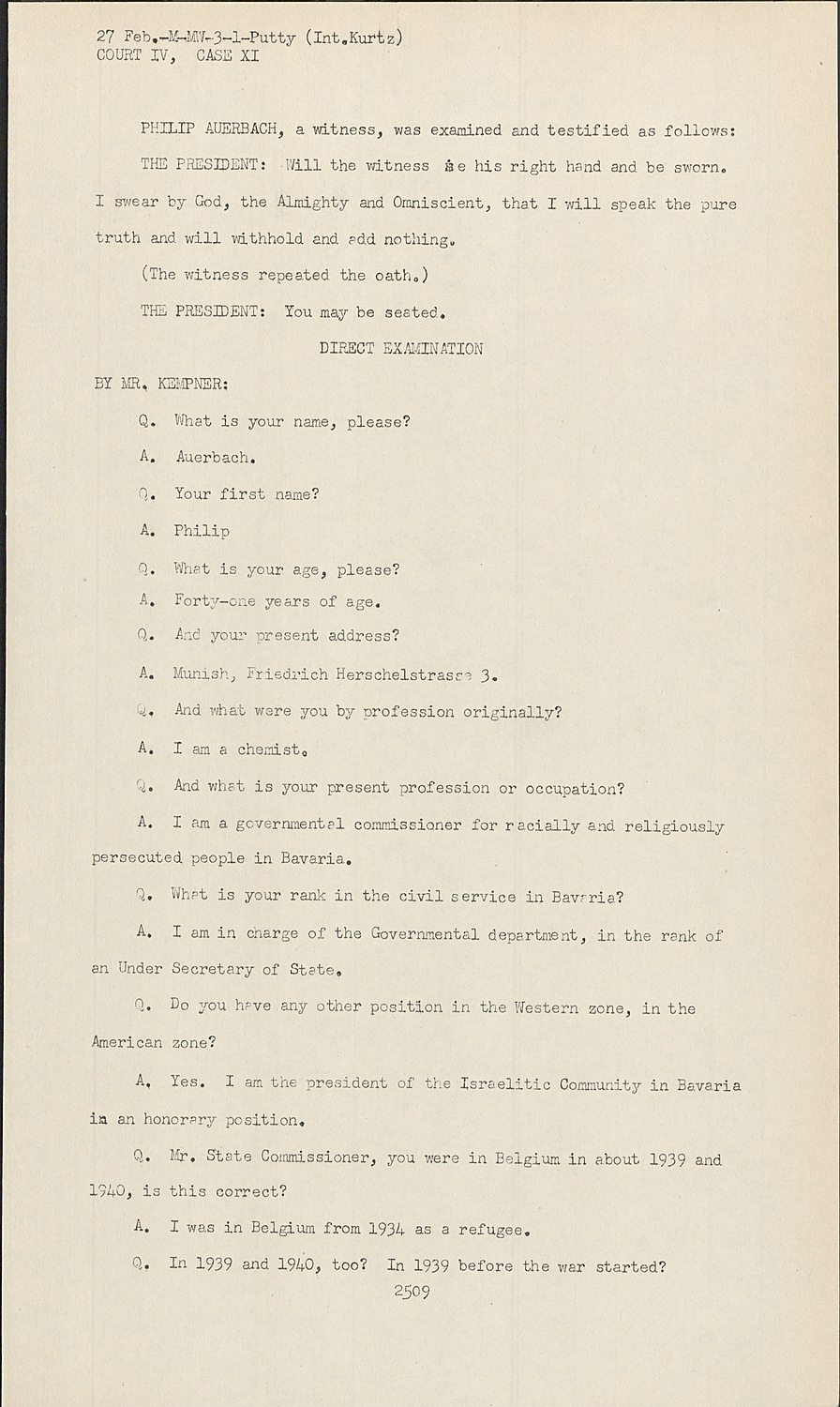
PHILIPAUERBACH, a witness, was examined and testified as follows:
THE PRESIDENT:Will the witness are his right hand and be sworn. I swear by God, the Almighty and Omniscient, that I will speak the pure truth and will withhold and add nothing.
(The witness repeated the oath.)
THE PRESIDENT:You may be seated.
DIRECT EXAMINATION BY MR. KEMPNER:
Q.What is your name, please?
A.Auerbach.
Q.Your first name?
A.Philip
Q.What is your age, please?
A.Forty-one years of age.
Q.And your present address?
A.Munish, Friedrich Herschelstrasse 3.
Q.And what were you by profession originally?
A.I am a chemist.
Q.And what is your present profession or occupation?
A.I am a governmental commissioner for racially and religiously persecuted people in Bavaria.
Q.What is your rank in the civil service in Bavaria?
A.I am in charge of the Governmental department, in the rank of an Under Secretary of State.
Q.Do you have any other position in the Western zone, in the American zone?
A.Yes. I am the president of the Israelitic Community in Bavaria in an honorary position.
Q.Mr. State Commissioner, you were in Belgium in about 1939 and 1940, is this correct?
A.I was in Belgium from 1934 as a refugee.
Q.In 1939 and 1940, too? In 1939 before the war started?
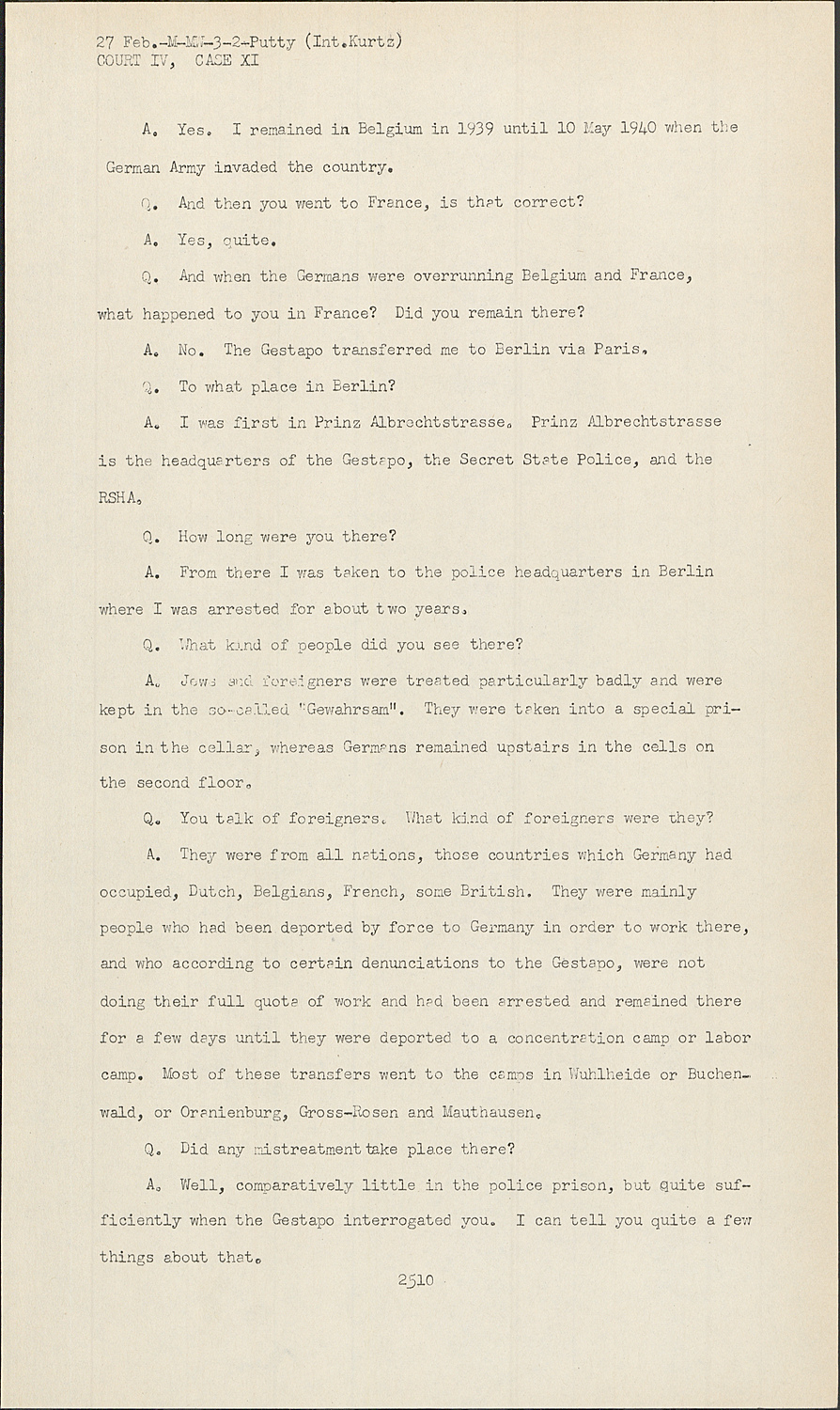
A.Yes. I remained in Belgium in 1939 until 10 May 1940 when the German Army invaded the country.
Q.And then you went to France, is that correct?
A.Yes, quit.
Q.And when the Germans were overrunning Belgium and France, what happened to you in France? Did you remain there?
A.No. The Gestapo transferred me to Berlin via Paris.
Q.To what place in Berlin?
A.I was first in Prinz Albrechtstrasse. Prinz Albrechtstrasse is the headquarters of the Gestapo, the Secret State Police, and the RSHA.
Q.How long were you there?
A.From there I was taken to the police headquarters in Berlin where I was arrested for about two years.
Q.What kind of people did you see there?
A.Jews and foreigners were treated particularly badly and were kept in the so-called "Gewahrsam". They were taken into a special prison in the cellar, whereas Germans remained upstairs in the calls on the second floor.
Q.You talk of foreigners. What kind of foreigners were they?
A.They were from all nations, those countries which Germany had occupied, Dutch, Belgians, French, some British. They were mainly people who had been deported by force to Germany in order to work there, and who according to certain denunciations to the Gestapo, were not doing their full quota of work and had been arrested and remained there for a few days until they were deported to a concentration camp or labor camp. Most of these transfers went to the camps in Wuhlheide or Buchenwald, or Oranienburg, Gross-Rosen and Mauthausen.
Q.Did any mistreatment take place there?
A.Well, comparatively little in the police prison, but quite sufficiently when the Gestapo interrogated you. I can tell you quite a few things about that.
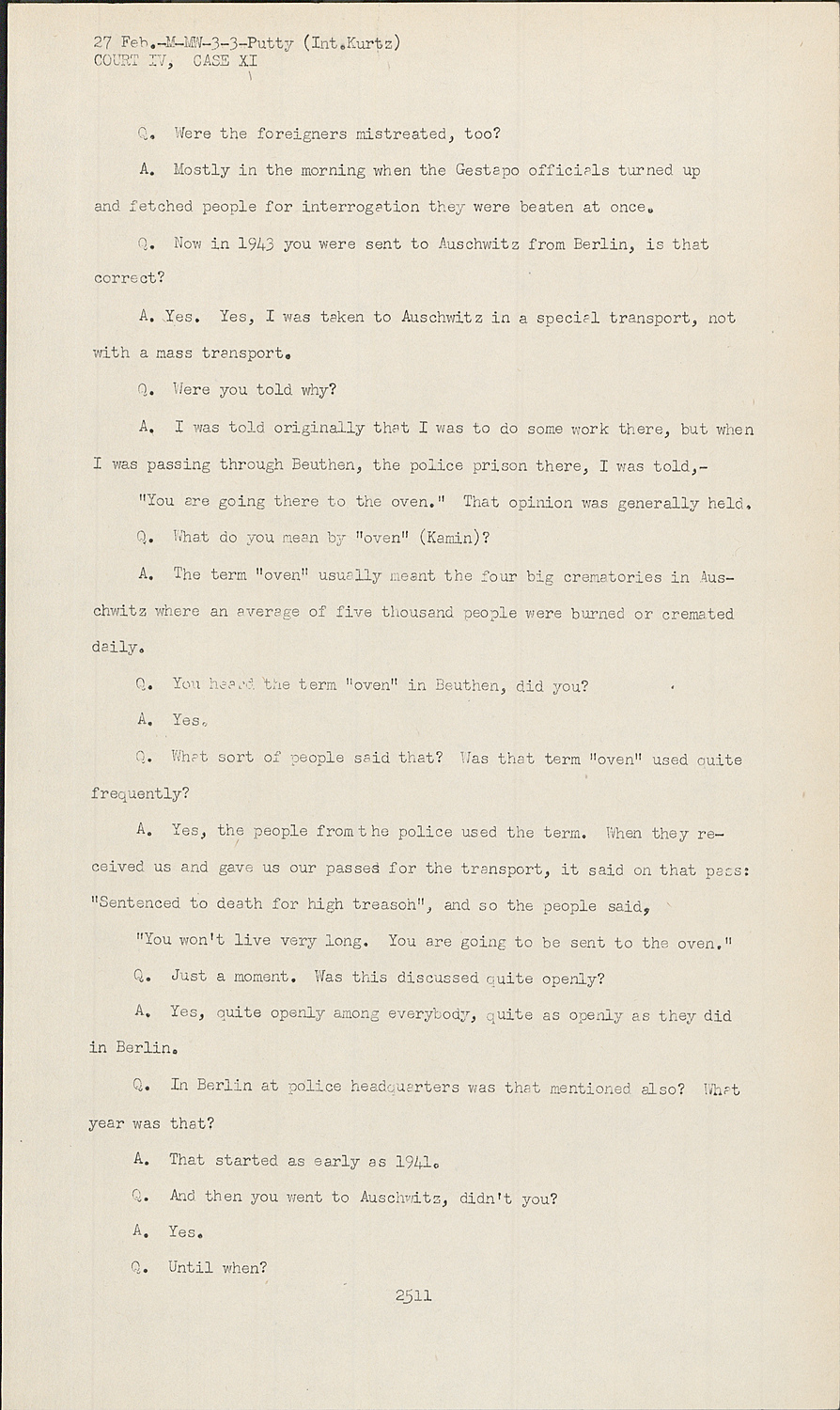
Q.Were the foreigners mistreated, too?
A.Mostly in the morning when the Gestapo officials turned up and fetched people for interrogation they were beaten at once.
Q.Now in 1943 you were sent to Auschwitz from Berlin, is that correct?
A.Yes. Yes, I was taken to Auschwitz in a special transport, not with a mass transport.
Q.Were you told why?
A.I was told originally that I was to do some work there, but when I was passing through Beuthen, the police prison there, I was told, "You are going there to the oven."
That opinion was generally held.
Q.What do you mean by "oven" (Kamin)?
A.The term "oven" usually meant the four big crematories in Auschwitz where an average of five thousand people were burned or cremated daily.
Q.You heard the term "oven" in Beuthen, did you?
A.Yes.
Q.What sort of people said that? Was that term "oven" used quite frequently?
A.Yes, the people from the police used the term. When they received us and gave us our passes for the transport, it said on that pass: "Sentenced to death for high treason", and so the people said.
"You won't live very long. You are going to be sent to the oven."
Q.Just a moment. Was this discussed quite openly?
A.Yes, quite openly among everybody, quite as openly as they did in Berlin.
Q.In Berlin at police headquarters was that mentioned also? What year was that?
A.That started as early as 1941.
Q.And then you went to Auschwitz, didn't you?
A.Yes.
Q.Until when?
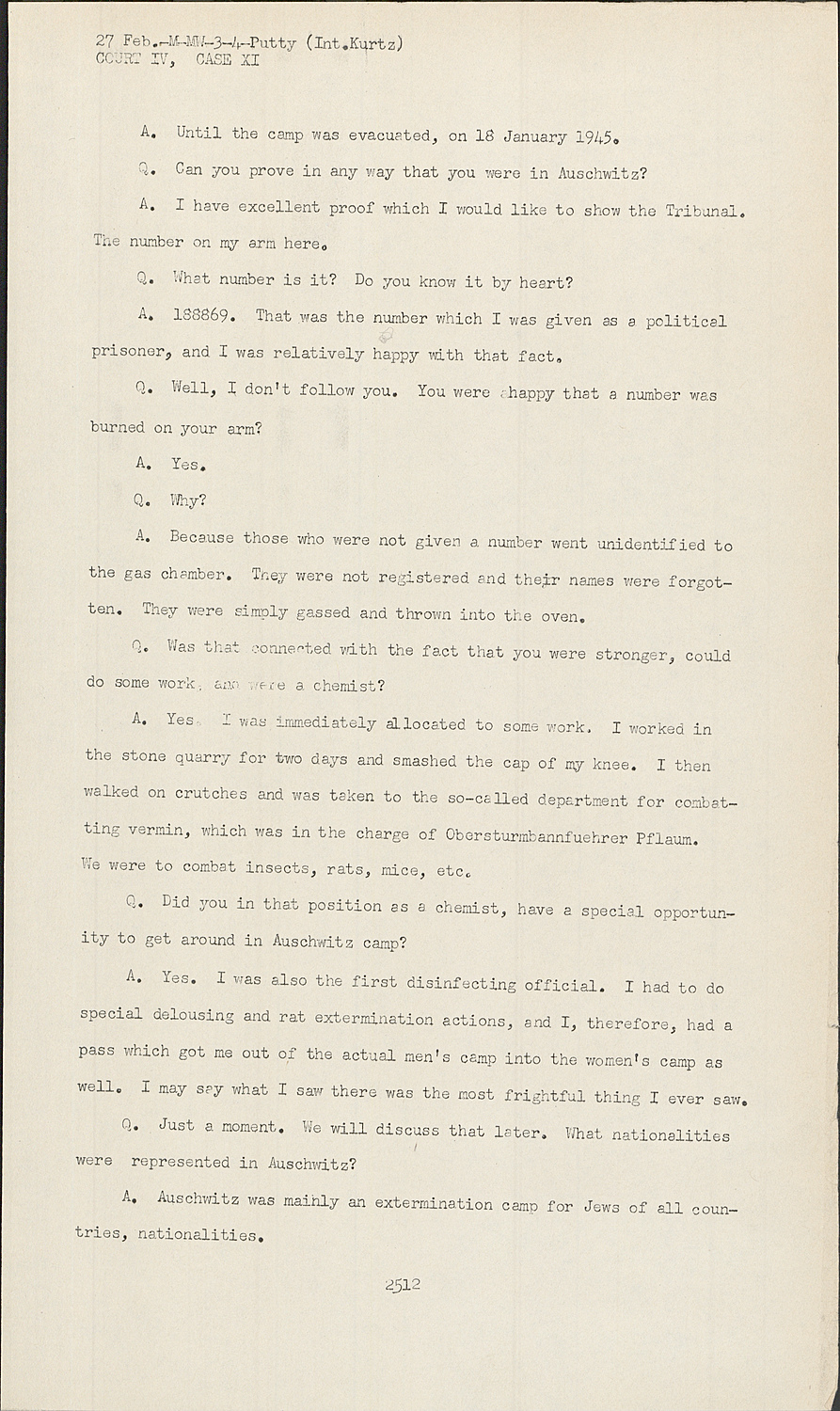
A.Until the camp was evacuated, on 18 January 1945.
Q.Can you prove in any way that you were in Auschwitz?
A.I have excellent proof which I would like to show the Tribunal. The number on my arm here.
Q.What number is it? Do you know it by heart?
A. 188869. That was the number which I was given as a political prisoner, and I was relatively happy with that fact.
Q.Well, I don't follow you. You were happy that a number was burned on your arm?
A.Yes.
Q.Why?
A.Because those who were not given a number went unidentified to the gas chamber. They were not registered and their names were forgotten. They were simply gassed and thrown into the oven.
Q.Was that connected with the fact that you were stronger, could do some work, and were a chemist?
A.Yes I was immediately allocated to some work. I worked in the stone quarry for two days and smashed the cap of my knee. I then walked on crutches and was taken to the so-called department for combatting vermin, which was in the charge of Obersturmbannfuehrer Pflaum. We were to combat insects, rats, mice, etc.
Q.Did you in that position as a chemist, have a special opportunity to get around in Auschwitz camp?
A.Yes. I was also the first disinfecting official. I had to do special delousing and rat extermination actions, and I, therefore, had a pass which got me out of the actual men's camp into the women's camp as well. I may say what I saw there was the most frightful thing I ever saw.
Q.Just a moment. We will discuss that later. What nationalities were represented in Auschwitz?
A.Auschwitz was mainly an extermination camp for Jews of all countries, nationalities.