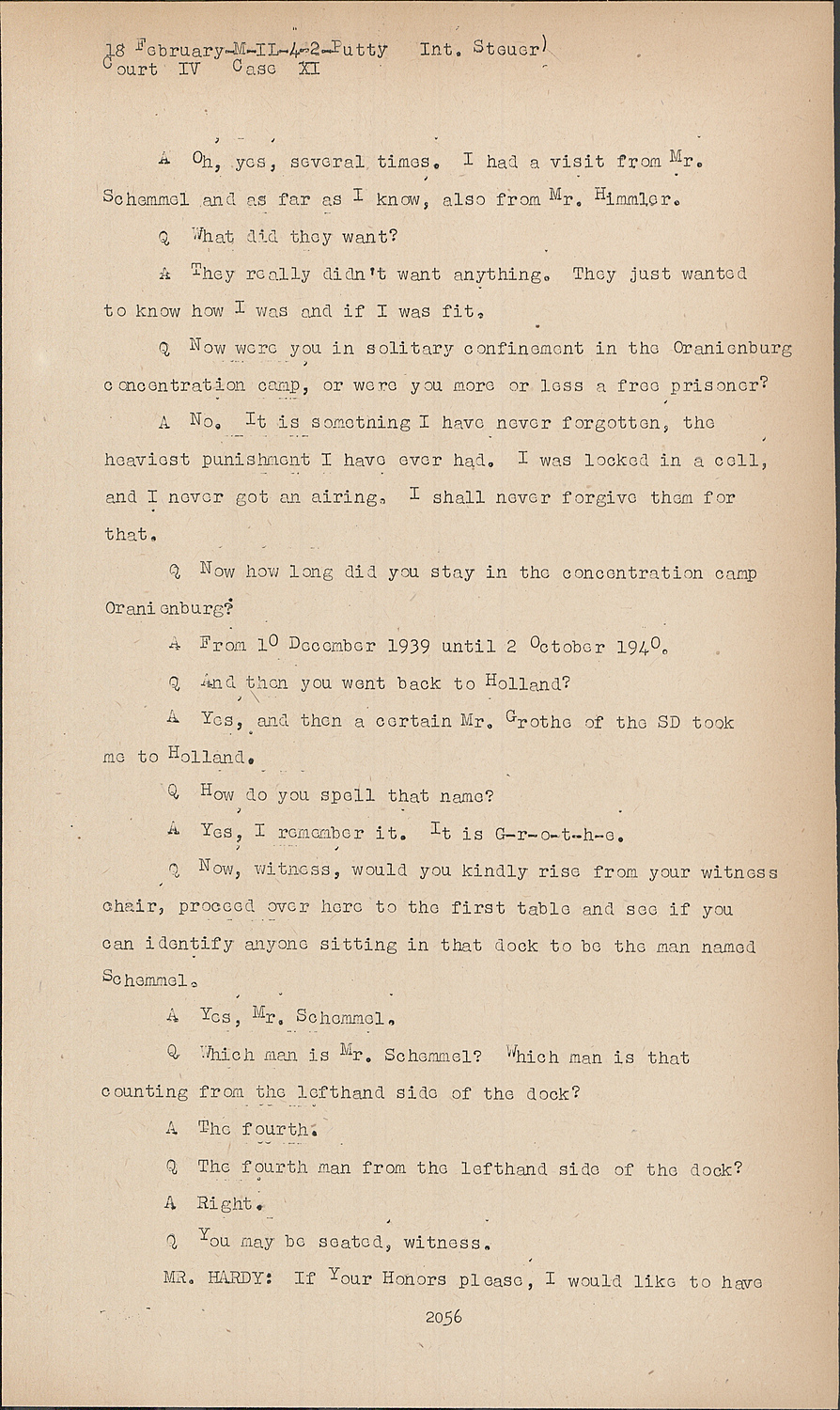
AOh, yes, several times. I had a visit from Mr. Schemmel and as far as I know, also from Mr. Himmler.
QWhat did they want?
AThey really didn't want anything. They just wanted to know how I was and if I was fit.
QNow were you in solitary confinement in the Oranienburg concentration camp, or were you more or less a free prisoner?
ANo. It is something I have never forgotten, the heaviest punishment I have ever had. I was locked in a cell, and I never got an airing. I shall never forgive them for that.
QNow how long did you stay in the concentration camp Oranienburg?
AFrom 10 December 1939 until 2 October 1940.
QAnd then you went back to Holland?
AYes, and then a certain Mr. Grothe of the SD took me to Holland.
QHow do you spell that name?
AYes, I remember it. It is G-r-o-t-h-e.
QNow, witness, would you kindly rise from your witness chair, proceed over here to the first table and see if you can identify anyone sitting in that dock to be the man named Schemmel.
AYes, Mr. Schemmel.
QWhich man is Mr. Schemmel? Which man is that counting from the lefthand side of the dock?
AThe fourth.
QThe fourth man from the lefthand side of the dock?
ARight.
QYou may be seated, witness.
MR. HARDY:If Your Honors please, I would like to have noted for the record that the witness identified the man as Schemmel to be the defendant Schellenberg.
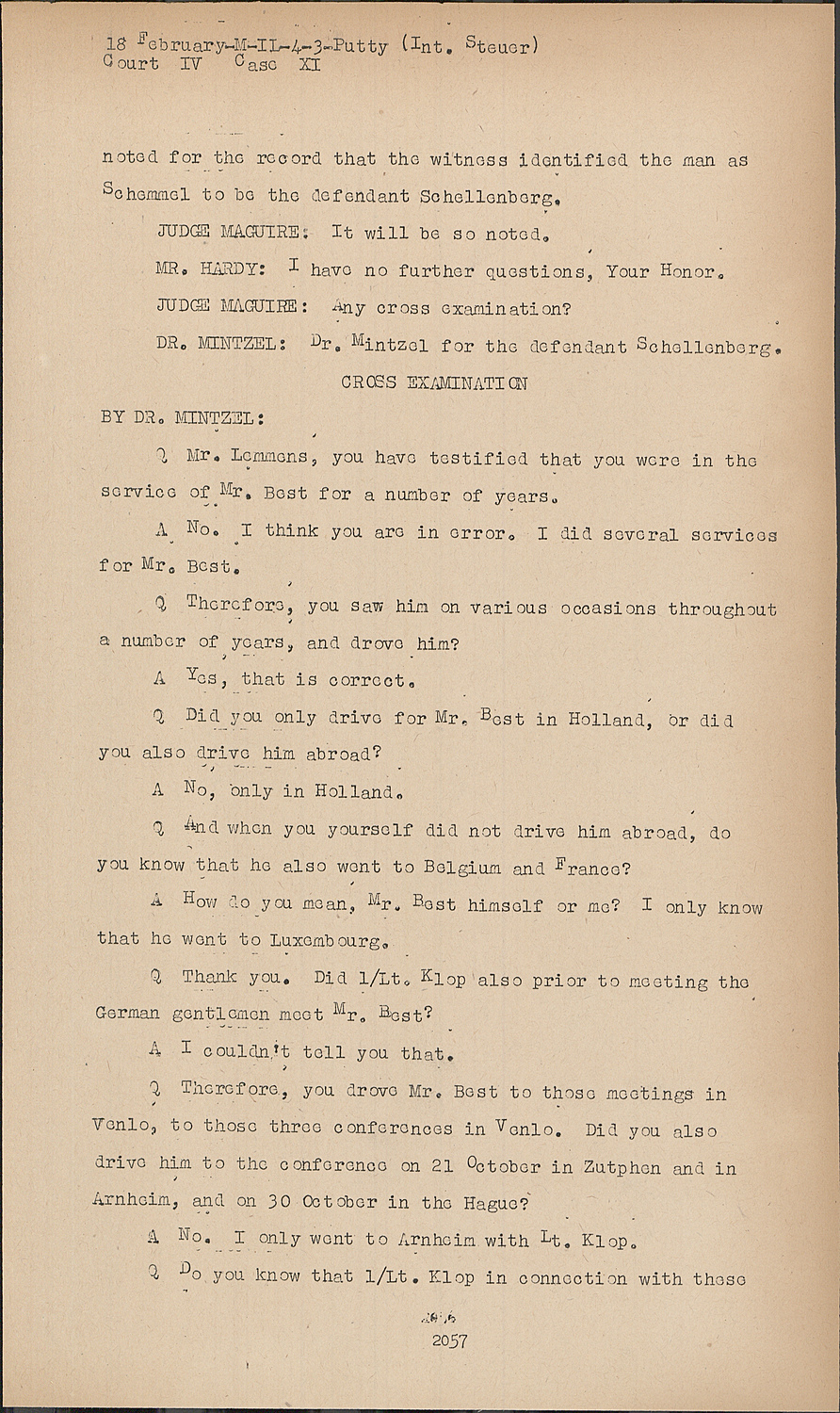
JUDGE MAGUIRE:It will be so noted.
MR. HARDY:I have no further questions, Your Honor.
JUDGE MAGUIRE:Any cross examination?
DR. MINTZEL:Dr. Mintzel for the defendant Schellenberg.
CROSS EXAMINATION BY DR. MINTZEL:
QMr. Lemmens, you have testified that you were in the service of Mr. Best for a number of years.
ANo. I think you are in error. I did several services for Mr. Best.
QTherefore, you saw him on various occasions throughout a number of years, and drove him?
AYes, that is correct.
QDid you only drive for Mr. Best in Holland, or did you also drive him abroad?
ANo, only in Holland.
QAnd when you yourself did not drive him abroad, do you know that he also went to Belgium and France?
AHow do you mean, Mr. Best himself or me? I only know that he went to Luxembourg.
QThank you. Did l/Lt. Klop also prior to meeting the German gentlemen meet Mr. Best?
AI couldn't tell you that.
QTherefore, you drove Mr. Best to those meetings in Venlo, to those three conferences in Venlo. Did you also drive him to the conference on 21 October in Zutphen and in Arnheim, and on 30 October in the Hague?
ANo. I only went to Arnheim with Lt. Klop.
QDo you know that l/Lt. Klop in connection with these conferences with the German gentlemen used the name "Kopper"?
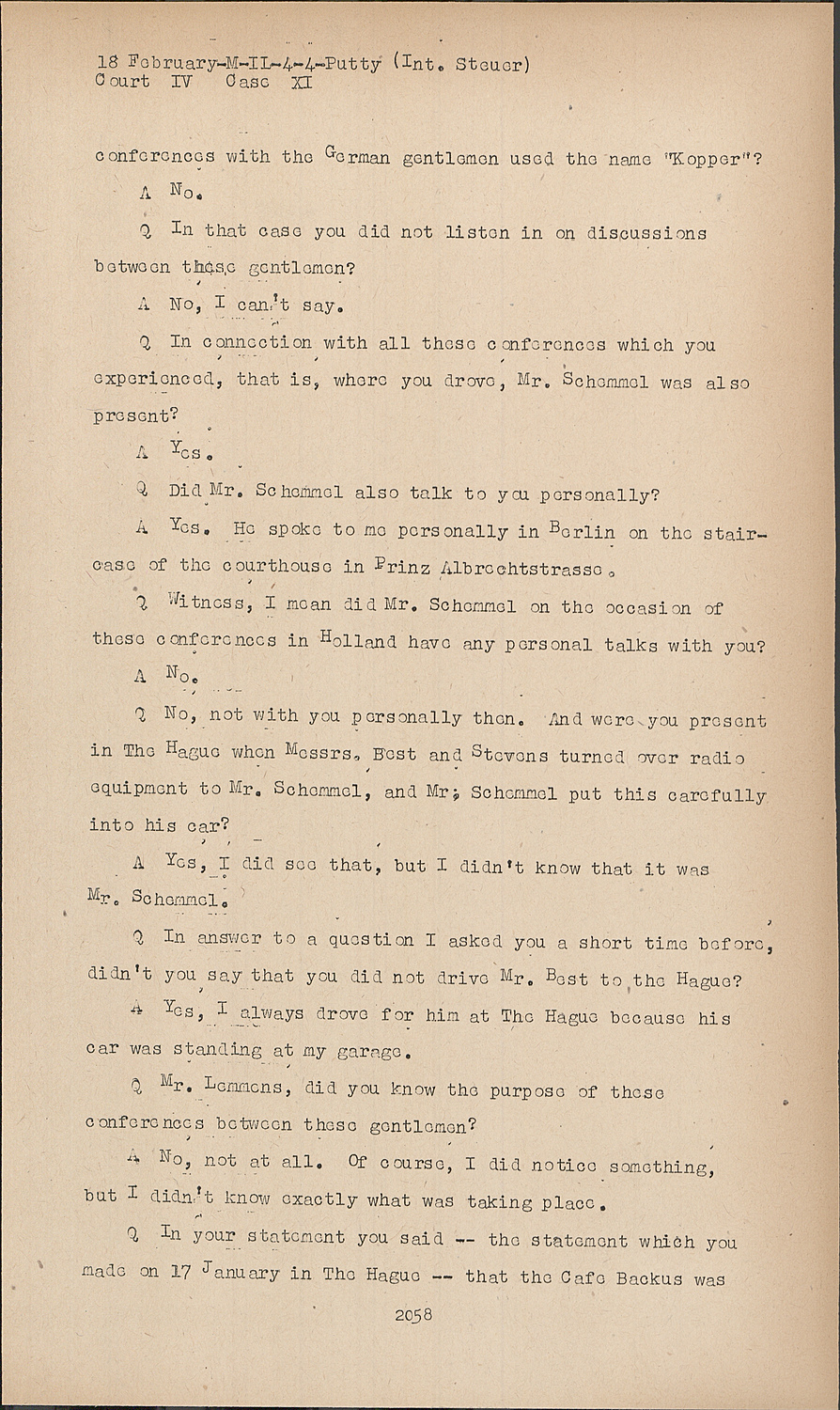
ANo.
QIn that case you did not listen in on discussions between these gentlemen?
ANo, I can't say.
QIn connection with all these conferences which you experienced, that is, where you drove, Mr. Schemmel was also present?
AYes.
QDid Mr. Schemmel also talk to you personally?
AYes. He spoke to me personally in Berlin on the staircase of the courthouse in Prinz Albrechtstrasse.
QWitness, I mean did Mr. Schemmel on the occasion of these conferences in Holland have any personal talks with you?
ANo.
QNo, not with you personally then. And were you present in The Hague when Messrs. Best and Stevens turned over radio equipment to Mr. Schemmel, and Mr. Schemmel put this carefully into his car?
AYes, I did see that, but I didn't know that it was Mr. Schemmel.
QIn answer to a question I asked you a short time before, didn't you say that you did not drive Mr. Best to the Hague?
AYes, I always drove for him at The Hague because his car was standing at my garage.
QMr. Lemmens, did you know the purpose of these conferences between these gentlemen?
ANo, not at all. Of course, I did notice something, but I didn't know exactly what was taking place.
QIn your statement you said -- the statement which you made on 17 January in The Hague -- that the Cafe Backus was a distance of five meters from the German frontier.
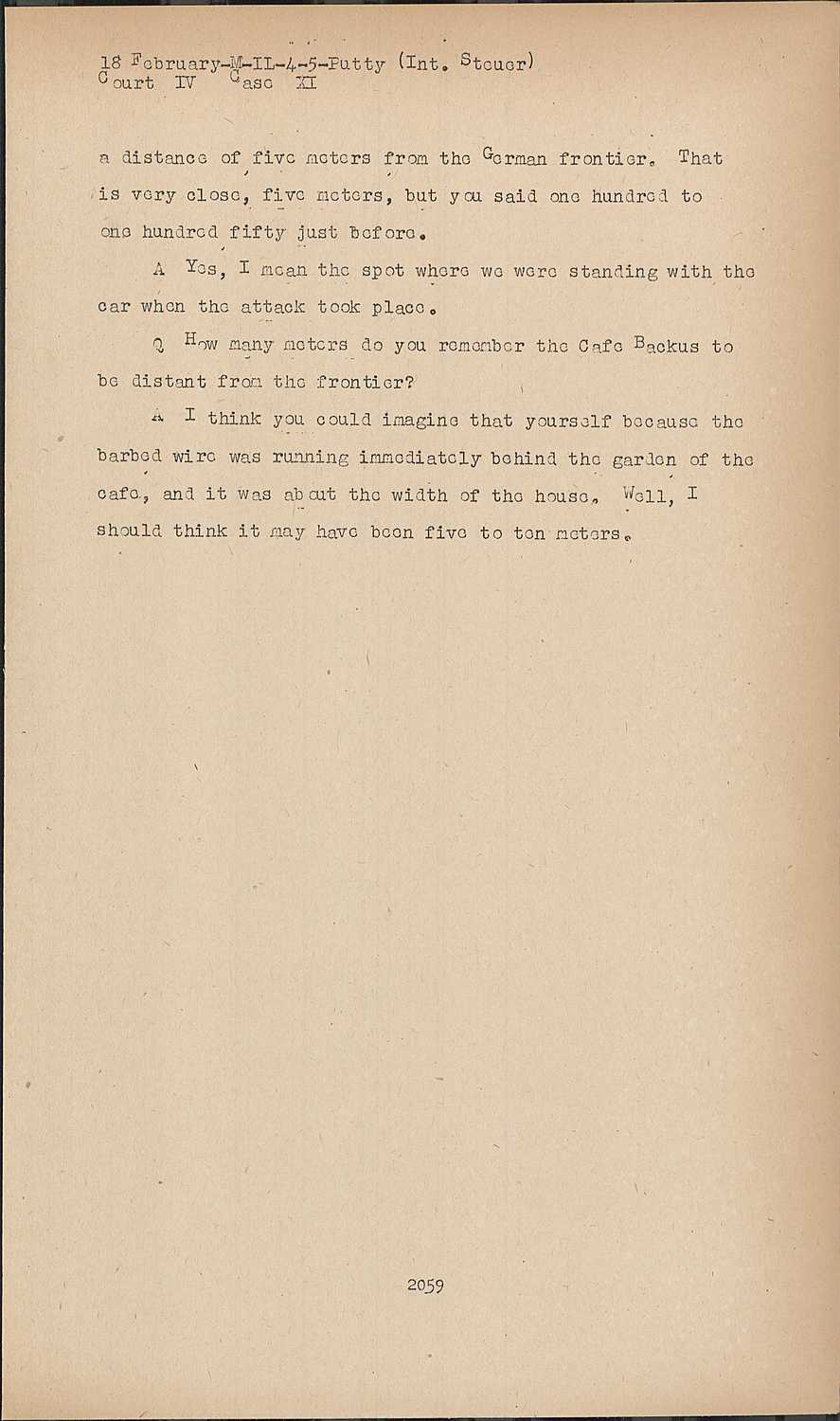
That is very close, five meters, but you said one hundred to one hundred fifty just before.
AYes, I mean the spot where we were standing with the car when the attack took place.
QHow many meters do you remember the Cafe Backus to be distant from the frontier?
AI think you could imagine that yourself because the barbed wire was running immediately behind the garden of the cafe, and it was about the width of the house. Well, I should think it may have been five to ten meters.
Q.It was approximately 3:15 when you arrived by car in Venlo and Herr Schemmel was already there. Herr Lemmens, I now submit to you the statement made by Herr Schellenberg in regard to his participation in the incident on the 9th of November 1939 in Cafe Backus. Herr Schellenberg, as on the occasion of other conferences in Holland, in view of the fact that Dutch Police might exercise control at any time, did not carry a weapon on this day either. The salute which Herr Best and Herr Stevens gave him was not yet terminated when in answer to Herr Klop fire developed, and both sides shouted "hands up," or something similar, whereupon Herr Schemmel raised his hands in order not to be shot in the confusion that ensued. When Herr Schemmel thereupon returned back to his car, wearing a minicle and a coat similar to that of Herr Best, was just missed by a hair's breadth from being shot by a German because they considered him to be one of two Englishmen and thought he was going to excape. The leader of the German Commando Naujoks was just able to *ear down the arm of the man who was proposing to fire. Herr Schemmel returned back to his car and drove right back to Duesseldorf in the company of a certain Herr Christensen.
Herr Lemmens as opposed to this statement which will be corroborated by a number of witnesses, do you propose to maintain the testimony which you gave today and which you gave in the Hague eight days after the incident happened, and do you continue to assure us that Herr Schellenberg was raising his hands above and that he was carrying a pistol?
A.Yes, I can tell you that very quickly. Mr. Schemmel and I only knew him then as Mr. Schemmel. I saw him make this signal with his hands quite distinctly, for it was in my opinion the signal for the attack. Whether he had a revolver on him or not it is possible, but he opened the door of his car and made this movement. It was the car in which I was sitting, and thus I was able to see everything quite distinctly, but everything happened at the same time. Whether he actually had the revolver in his hands, well that I couldn't say. Yes, but in my opinion it was so that he had the revolver.
Q.You are unable to state for certain that this is the case. You just believe it to be the case--the entire incident, even according to the report of the Netherlands Government, introduced in this Document Book, started at a tremendous speed at a moment's notice.
A.Yes, it certainly all happened very quickly. Yes, but because I was not sitting behind the steering wheel I had plenty of opportunity to see everything very distinctly.
Q.Herr Lemmens, do you know anything of the fact that Herr Schellenberg in the company of two people, before reaching the place arranged with Mr. Best and Mr. Stevens, was apprehended by the Netherlands Police and searched?
A.Yes, I also know that, but it was a long time previous to that. I cannot say exactly when.
Q.Certainly. I don't say that it was the same day, but it did happen on the occasion of one of these meetings.
A.But it was only Lt. Klop there.
Q.It may be. In any case even on the occasion of that meeting after being searched by the police, he did not carry a weapon because otherwise the Netherlands police would have found it. Herr Schemmel-the assault that took place was immediately in the vicinity of the Reich Frontier. Are you of the opinion that it was necessary for a car which was on the German side, right in the vicinity of the frontier, to inform that car by raising hands or isn't it clear that in view of the short distance involved the people on the other side, upon their own initiative, could see that now the time had come to start the assault?
A.Look here: I can only state the experience which I had.
Q.Herr Lemmens, after the interrogations were concluded you were returned to your native country. Do you know that it was Herr Schemmel who prevented the participants' being put in a gib show trial in Germany in order to prove that the Secret Service was responsible for assaults and attacks against the German Government, and, therefore, you owe it to Herr Schemmel that you were not involved in these matters.
A.No, I don't know that.
Q.After your return to Holland you were employed as an assembly man?
A.Yes.
Q.But after some time you gave this up?
A.Yes, I had to give it up.
Q.And after that you were able to devote yourself to the underground movement?
A.Yes, but I had to go to Yppenburg first, as they had told me in Berlin.
Q.Now, my final question: Were you yourself in the service of the Secret Service?
A.No. BY JUDGE MAGUIRE:
Q.Now, witness, were any shots fired on either side before this signal with the arms was obeyed by the Defendant Schellenberg, whom you know as Schemmel?
A.No, not before that, but when Mr. Schemmel gave the signal shooting started at the same time.
PRESIDING JUDGE MAGUIRE:Mr. Hardy?
MR. HARDY:I have one question, Your Honor.
REDIRECT-EXAMINATION BY MR. HARDY:
Q.Did Lt. Klop fire before the Germans fired?
A.No, the car came across from the direction of the German border firing and it was then that Lt. Klop fired at the car.
MR. HARDY:I have no further questions, Your Honor.
JUDGE POWERS:I have one. BY JUDGE POWERS:
Q.Were these people in uniform?
A.Yes, partly they were in uniform and partly not.
Q.Well, I have particular reference to those that were in his car-
the captain and the lieutenant.
A.No, they were in civilian clothes. BY JUDGE MAGUIRE:
Q.Was Lt. Klop in uniform?
A.No, he wasn't either.
MR. HARDY:I have no further questions, Your Honor.
PRESIDING JUDGE MAGUIRE:The witness is then excused.
MR. HARDY:If Your Honors please, I now request that the Witness Bruno Grothe be called to the witness-stand. This is a German national who will testify in the German language, Your Honor.
BRUNOGROTHE, a witness, took the stand and testified as follows:
THE PRESIDENT:The witness will raise his right hand and be sworn: "I swear by God, the Almighty and Omniscient, that I will speak the pure truth and will withhold and add nothing." (THE WITNESS REPEATED THE OATH) You may be seated.
PRESIDING JUDGE MAGUIRE:You may proceed, Mr. Hardy.
MR. HARDY:Thank you, Your Honor.
DIRECT EXAMINATION BY MR. HARDY:
Q.Witness, your name is Bruno Grothe--spelled "G-R-O-T-H-E"? Is that correct?
A.It Is.
Q.When and where were you born?
A.On the 19th of December 1898 in Hamburg.
Q.What is your present address?
A.Right now here in Nuernberg.
Q.Are you confined in the Nuernberg Prison?
A.Yes, I'm here in prison, in Nuernberg Palace of Justice.
Q.Were you a member of the NSDAP, witness?
A.Whether I was a member of the NSDAP? Yes, since 1940.
Q. 1940. Were you a member of the SS?
A.SS? No, I wasn't a member there
Q.Did you work for the Gestapo?
A.I was a police official; I was criminal official in the Gestapo Secret State Police. It's my profession to be a State policeman. I had been so for 26 years.
Q.I see.
In what department in RSHA were you engaged?
A.I was, first of all in Department III, and then the same division became *V, which was counter-intelligence.
Q.I see. Were you ever in Department IV-E?
A.Yes, Amt. IV-E, 4b, my last referat.
Q.Do you know the name Walter Schellenberg?
A.Walter Schellenberg? Yes. He was the Chief of Amt. VI.
Q.Was he ever in Amt. IV-E?
A.Yes, once he was a Gruppenleiter (group leader) of IV-E temporarily.
Q.When did you first make the acquaintance of Schellenberg?
A.That was on 10 November 1939, on the occasion of this Venlo incident. Prior to that, as far as I know, I never saw him.
Q.I see. Well, how did you happen to make his acquaintance concerning the Venlo affair on 10 November, the day after the affair?
A.On 9 November the two Englishmen, Stevens and Best, were apprehended in Venlo and were then brought to Berlin, and my chief, Dr. Schambacher, was ordered to interrogate these two offices as far as counterintelligence was concerned, and on that occasion I made Herr Schellenberg's acquaintance. At the same time I was Kriminalkommissar or Assistant Chief of the Kriminalraete. I was ordered to take care of these officers in a certain respect; that is, to see to it that they were accommodated in the building, that they were fed, furnished razor blades, cigarettes, or whatever they might need.
Q.Now, were Stevens and Best interrogated by any one in your office in Berlin?
A.Yes.
Q.Were you present?
A.Yes, at first I didn't interrogate them, and I wasn't present directly immediately at their interrogations. My order was to collect the interrogation records because excerpts were made from these records, and this was done in particularly heavy handwriting which was submitted personally to the Fuehrer. On that occasion I had to enter the rooms where the two officers were under interrogation, and then I saw, at least in part, how the interrogation proceeded. The interrogation was conducted by criminal commissars (Kriminalkommissars) and criminal counselors (Kriminalraete).
Q. witness, what happened after that to Stevens and Best, after the arrived in Berlin and were interrogated?
A.They were held separately, each one in an office rooms, and for each of them an office room was cleared, and a bed was put in, and then the necessary guards were posted -- that they were SS people -and I was ordered to see to it that the necessary furniture--tables, chairs,etc, -- was provided and also food. During the first few days they were fed from the canteen, and later on their food was provided by the prison itself.
Q.Well, where did they go after they left Berlin?
A.On 10 December 1939 both of them were brought to the Sachsenhausen Concentration Camp.
Q.Well, were they brought to the concentration camp under cover names for purposes of security?
A.Yes, both of them were given cover names. The one was called "Fuchs", and the other was called "Wolf."
Q.Now, what did Schellenberg do? Did Schellenberg make any statements relative to the Venlo incident, which you heard yourself?
A.Just a minute. I didn't quite get your question, Mr. Prosecutor.
PRESIDING JUDGE MAGUIRE:It is necessary to recess; there is trouble with the recording machine.
MR. HARDY:
Q.Did you know yourself -
PRESIDING JUDGE MAGUIRE:Just a moment. We'd like to run to 11 o'clock. We'll find out how long it will be necessary to recess. Just a moment.
Mr. HARDY: I only have about eight more questions. I think we can finish up and then recess. BY MR. HARDY:
Q.Did Schellenberg-
PRESIDING JUDGE MAGUIRE:Just a moment.
MR. HARDY:Oh, I'm sorry, Your Honor.
PRESIDING JUDGE MAGUIRE:Suspend for two minutes.
(Pause)
You may now proceed.
The courtroom will remain quiet, please. BY MR. HARDY:
Q.Now, witness, my question again: Did Schellenberg make any statements relative to the Venlo incident which you heard?
A.Schellenberg did not discuss this Venlo incident with me personally. Whatever I know concerning this Venlo incident I know from the files.
Q.Well, did Schellenberg make any statements about the success of the Venlo incident that you happened to hear?
A.Concerning the success, of course, he was very pleased over it -- that the issue was successful, but I only occasionally heard these remarks just on the very margin of things whenever he had some discussions with some criminal officials. But in my case he didn't discuss them with me personally. He didn't tell me, "Herr Grothe, this happened." So what I really heard listening in to other discussions.
Q.Did Schellenberg receive any decoration for this work con nected with the Venlo incident?
A.Schellenberg and various other gentlemen received the Iron Cross First-Class in connection with this affair-- not only Schellenberg but other gentlemen too.
Q.Was this the Iron Cross First Class that they received?
A.Yes, it was the Iron Cross First Class.
Q.Who awarded that to Schellenberg and decorated him with that Iron Cross First Class?
A.Well, in the office it was said that this had been bestowed upon him by the Fuehrer.
Q.Did you know a man named "Lemmens?"
A.Lemmens? Yes, he was a driver. I just saw him outside on the floor.
Q.Did you ever hear the name "Schenne.?"
A.Schemmel? Yes, as far as I'm informed, this was Schellenberg's cover name.
Q.I have no further questions, Your Honor.
PRESIDING JUDGE MAGUIRE:Is there any cross-examination?
PRESIDING JUDGE MAGUIRE:Is there any cross examination? You may proceed.
CROSS EXAMINATION BY DR. MINTZEL:
Q.Herr Grothe, it was your duty to see that Herr Best and Herr Stevens were taken care of for the time of their confinement?
A.Yes, it was.
Q.Do you know that the numerous trunks that these gentlemen had -- I believe there were sixteen trunks in all -- they received these trunks so that they had all their things available while they were in confinement?
A.Sixteen trunks? I know nothing about sixteen trunks.
Q.Well, I am not going to establish this as a definite figure of sixteen, but do you know that the gentlemen received their personal effects from Holland to have them available?
A.Yes, in the course of time they received their personal effects and they also received civilian clothes from England, through the intervention of the German Red Cross.
Q.Later on, you also took care of Herr Stevens in Munich?
A.Well, no, you can't say that I took care of him in Munich. I visited him two or three times in Munich. Well, "visited him" is saying too much. I visited him in an official capacity.
Q.I am asking you for the reason that you have knowledge that in Munich Stevens had opportunity to attend the theater in civilian clothes.
A.Yes, accompanied by an SS man, in civilian clothes, he had an opportunity to go to a theather performance.
Q.As far as the treatment of these two gentlemen is concerned-
that is what I wish to elucidate by these questions--the treatment that these two gentlemen received was adequate and reasonable?
A.Yes, they were decently treated, on the whole.
Q. "Decently treated"?
A.Yes.
PRESIDING JUDGE MAGUIRE:Any redirect?
MR. HARDY:I have no further questions, Your Honor.
PRESIDING JUDGE MAGUIRE:Do any of the members of the Tribunal wish to ask questions? The witness may be excused.
MR. HARDY:Your Honor, before you recess for the fifteen-minute recess, my next witness will be Walter Behrends. He can be brought in and placed on the witness stand and be ready for examination immediately after the recess.
PRESIDING JUDGE MAGUIRE:The Marshal may take care of it. The Tribunal will be in recess for fifteen minutes.
( A recess was taken.)
THE MARSHAL:The Tribunal is again in session.
MR. HARDY:If Your Honors please, this witness will be examined by Mr. Goodman of the prosecution. Before the examination starts, defense counsel for the defendant Dietrich has a request to make to the Tribunal.
DR. FIGHT:Dr. Ficht for the defendant Dietrich. May it please Your Honors, could you please excuse the defendant Dietrich from the afternoon's session so that he can prepare his defense and discuss it with his defense counsel? The prosecution has told me that he is not particularly affected by this afternoon's events.
PRESIDING JUDGE MAGUIRE:I take it that is the fact, Mr. Hardy?
MR. HARDY:I have nothing to introduce on Dietrich.
PRESIDING JUDGE MAGUIRE:Very well. The defendant Dietrich will be excused for the afternoon's session.
MR. HARDY:If Your Honors please, after the completion of the Schellenberg presentation, we have three affiants who will then be heard before the Tribunal in lieu of the document books on SchwerinKrosigk, we will call three affiants. Dr. Kempner will notify the defense counsel concerned.
PRESIDING JUDGE MAGUIRE:In the event that the defendant SchwerinKrosigk's case is not to be dealt with this afternoon -- I believe a request was made that he be excused. Am I right on that?
MR. HARDY:Schwerin-Krosigk you mean? Mr. Landis can answer that perhaps.
MR. LANDIS:I talked with Dr. Fritsch last night. The German books were served, one in the morning and two in the afternoon, and he told me that he was willing to waive the twenty-four-hour rule. The English books for the Tribunal and the other necessary English books are being prepared now and should be ready this afternoon. I have been trying to get in touch with Dr. Fritsch to find out what his schedule is. He told me he would be ready to go ahead today.
PRESIDING JUDGE MAGUIRE:Do you expect to reach his case?
MR. LANDIS:After the three affiants?
PRESIDING JUDGE MAGUIRE:Yes.
MR. LANDIS:If they don't take the rest of the day.
PRESIDING JUDGE MAGUIRE:Well, then, we'd better not excuse the defendant from the afternoon's session. Mr. Goodman?
WALTERBEHRENDS, a witness, took the stand and testified as follows:
THE PRESIDENT:Let the witness rise and he sworn. The witness will raise his right hand and be sworn. "I swear by God, the Almighty and Omniscient, that I will speak the pure truth and will withhold and add nothing."
(The witness repeated the oath.)
THE PRESIDENT:You may be seated. You may proceed.
DIRECT EXAMINATION BY MR. GOODMAN:
QMay it please the Tribunal, now, Mr. Witness, your full name is Walter Behrends?
AYes.
QYou were born on 10 December 1909 in Sandi, Germany?
AYes.
QHow long have you been practicing medicine?
ASince 1936.
QAre you a surgeon?
AYes.
QWere you engaged in your profession in the year 1939?
AYes.
QWhere?
AIn Duesseldorf, in the Evangelisches Krankenhaus.
QWere you a member of the SS?
AYes.
QThe Allgemeine SS?
AYes.
QIn what year did you become a member?
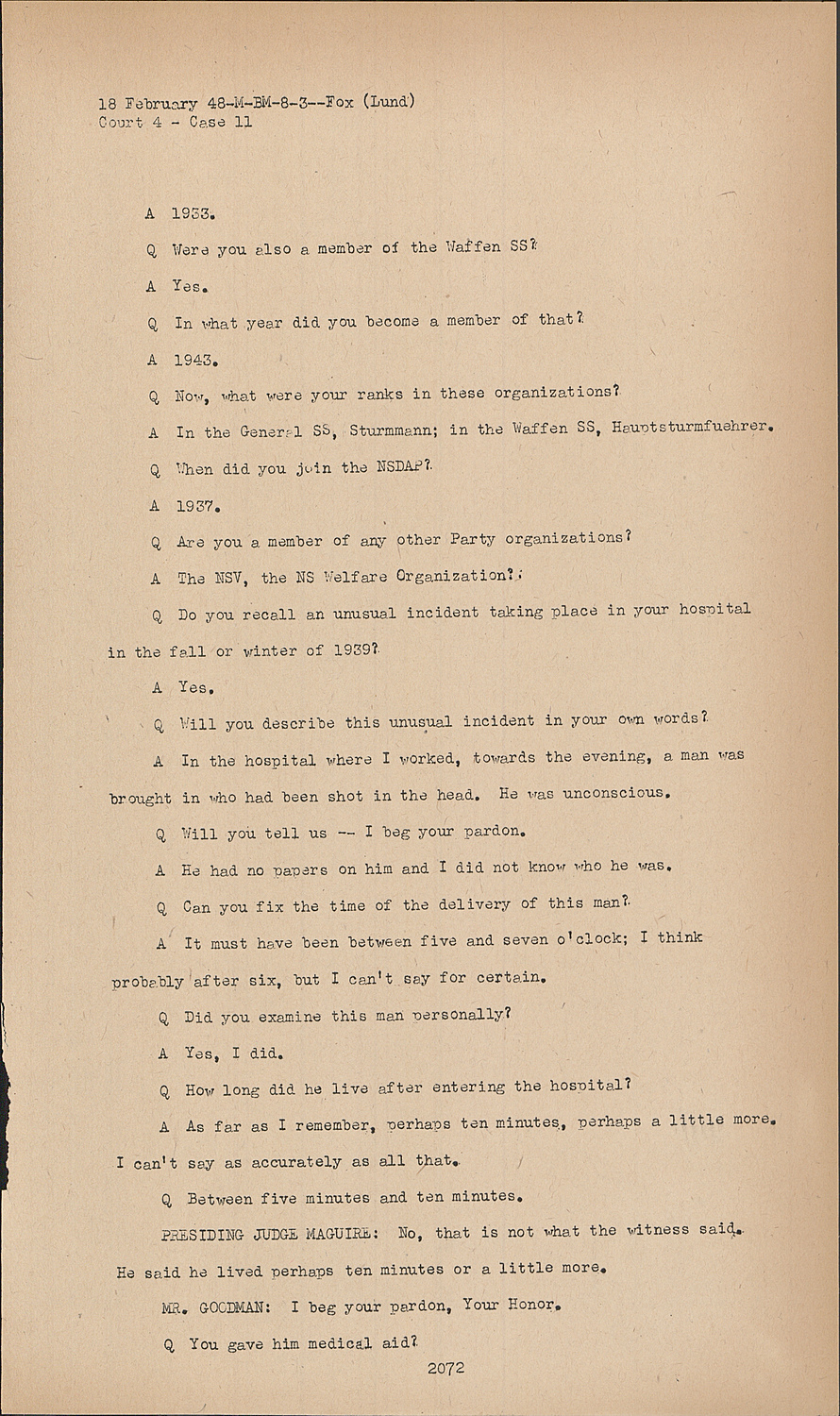
A 1933.
QWere you also a member of the Waffen SS?
AYes.
QIn what year did you become a member of that?
A 1943.
QNow, what were your ranks in these organizations?
AIn the General SS, Sturmmann; in the Waffen SS, Hauptsturmfuehrer.
QWhen did you join the NSDAP?
A 1937.
QAre you a member of any other Party organizations?
AThe NSV, the NS Welfare Organization?
QDo you recall an unusual incident taking place in your hospital in the fall or winter of 1939?
AYes.
QWill you describe this unusual incident in your own words?
AIn the hospital where I worked, towards the evening, a man was brought in who had been shot in the head. He was unconscious.
QWill you tell us -- I beg your pardon.
AHe had no papers on him and I did not know who he was.
QCan you fix the time of the delivery of this man?
AIt must have been between five and seven o'clock; I think probably after six, but I can't say for certain.
QDid you examine this man personally?
AYes, I did.
QHow long did he live after entering the hospital?
AAs far as I remember, perhaps ten minutes, perhaps a little more. I can't say as accurately as all that.
QBetween five minutes and ten minutes.
PRESIDING JUDGE MAGUIRE:No, that is not what the witness said. He said he lived perhaps ten minutes or a little more.
MR. GOODMAN:I beg your pardon, Your Honor.
QYou gave him medical aid?
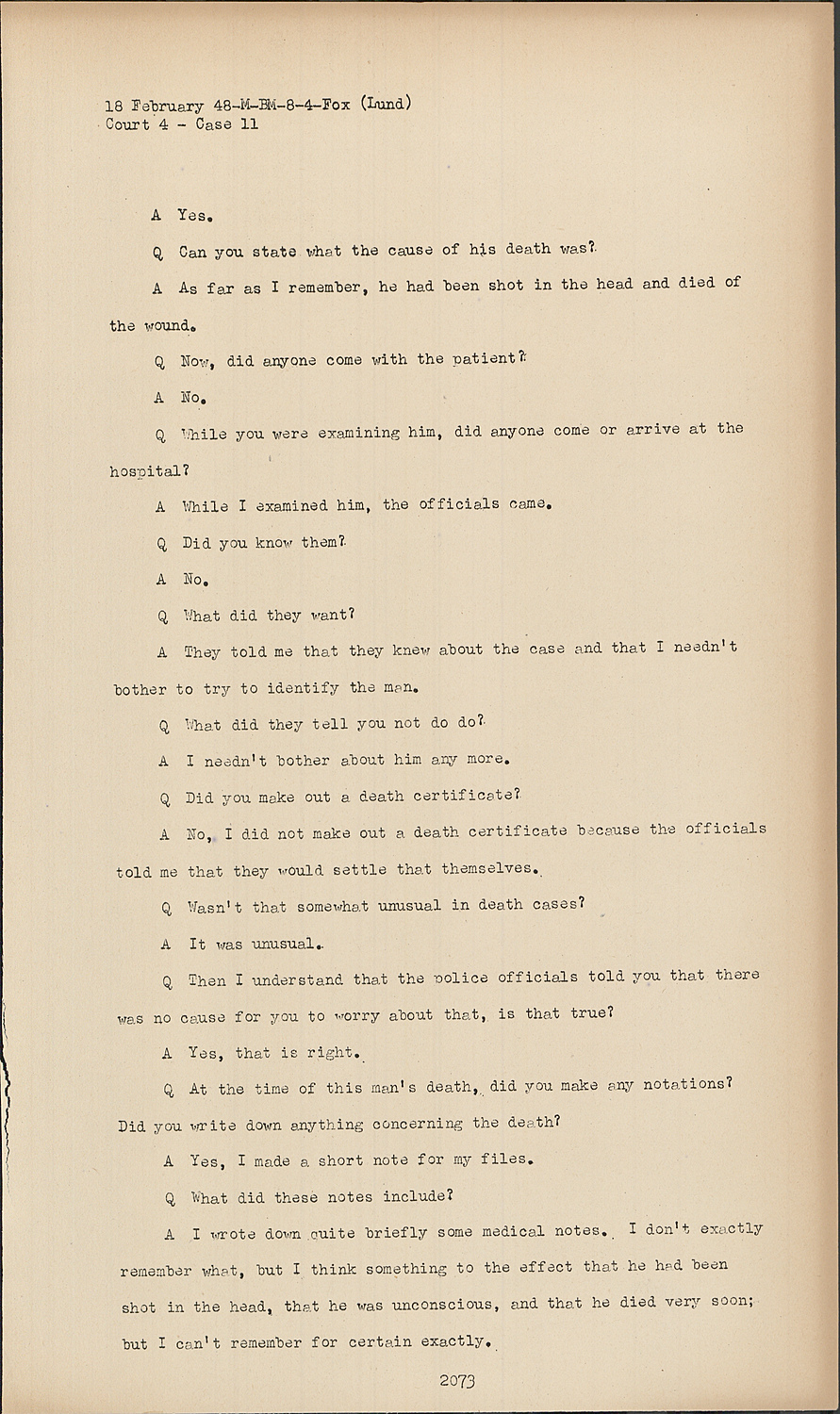
AYes.
QCan you state what the cause of his death was?
AAs far as I remember, he had been shot in the head and died of the wound.
QNow, did anyone come with the patient?
ANo.
QWhile you were examining him, did anyone come or arrive at the hospital?
AWhile I examined him, the officials came.
QDid you know them?
ANo.
QWhat did they want?
AThey told me that they knew about the case and that I needn't bother to try to identify the man.
QWhat did they tell you not do do?
AI needn't bother about him any more.
QDid you make out a death certificate?
ANo, I did not make out a death certificate because the officials told me that they would settle that themselves.
QWasn't that somewhat unusual in death cases?
AIt was unusual.
QThen I understand that the police officials told you that there was no cause for you to worry about that, is that true?
AYes, that is right.
QAt the time of this man's death, did you make any notations? Did you write down anything concerning the death?
AYes, I made a short note for my files.
QWhat did these notes include?
AI wrote down quite briefly some medical notes. I don't exactly remember what, but I think something to the effect that he had been shot in the head, that he was unconscious, and that he died very soon; but I can't remember for certain exactly.
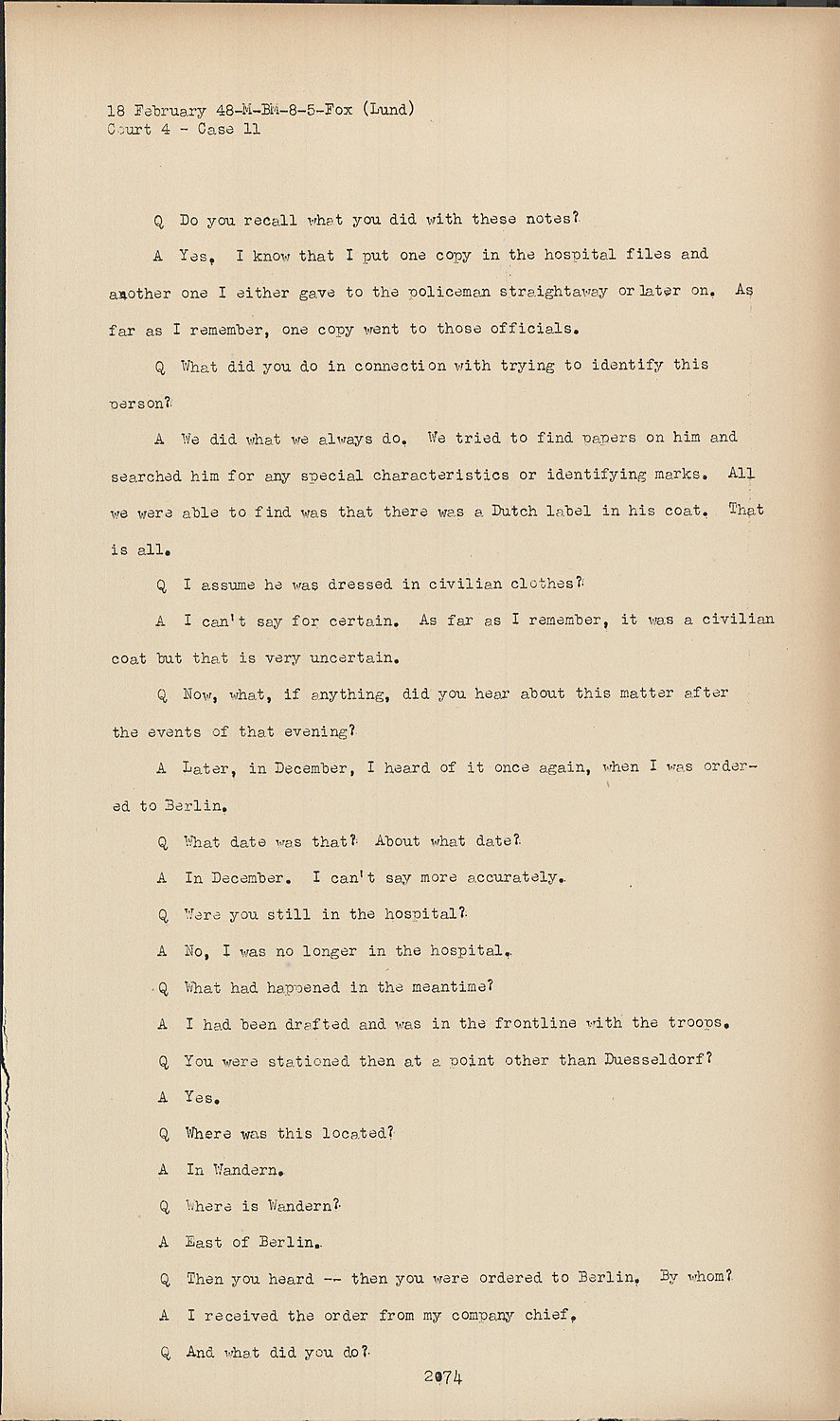
QDo you recall what you did with these notes?
AYes. I know that I put one copy in the hospital files and another one I either gave to the policeman straightaway or later on. As far as I remember, one copy went to those officials.
QWhat did you do in connection with trying to identify this person?
AWe did what we always do. We tried to find papers on him and searched him for any special characteristics or identifying marks. All we were able to find was that there was a Dutch label in his coat. That is all.
QI assume he was dressed in civilian clothes?
AI can't say for certain. As far as I remember, it was a civilian coat but that is very uncertain.
QNow, what, if anything, did you hear about this matter after the events of that evening?
ALater, in December, I heard of it once again, when I was ordered to Berlin.
QWhat date was that? About what date?
AIn December. I can't say more accurately.
QWere you still in the hospital?
ANo, I was no longer in the hospital.
QWhat had happened in the meantime?
AI had been drafted and was in the frontline with the troops.
QYou were stationed then at a point other than Duesseldorf?
AYes.
QWhere was this located?
AIn Wandern.
QWhere is Wandern?
AEast of Berlin.
QThen you heard -- then you were ordered to Berlin. By whom?
AI received the order from my company chief.
QAnd what did you do?
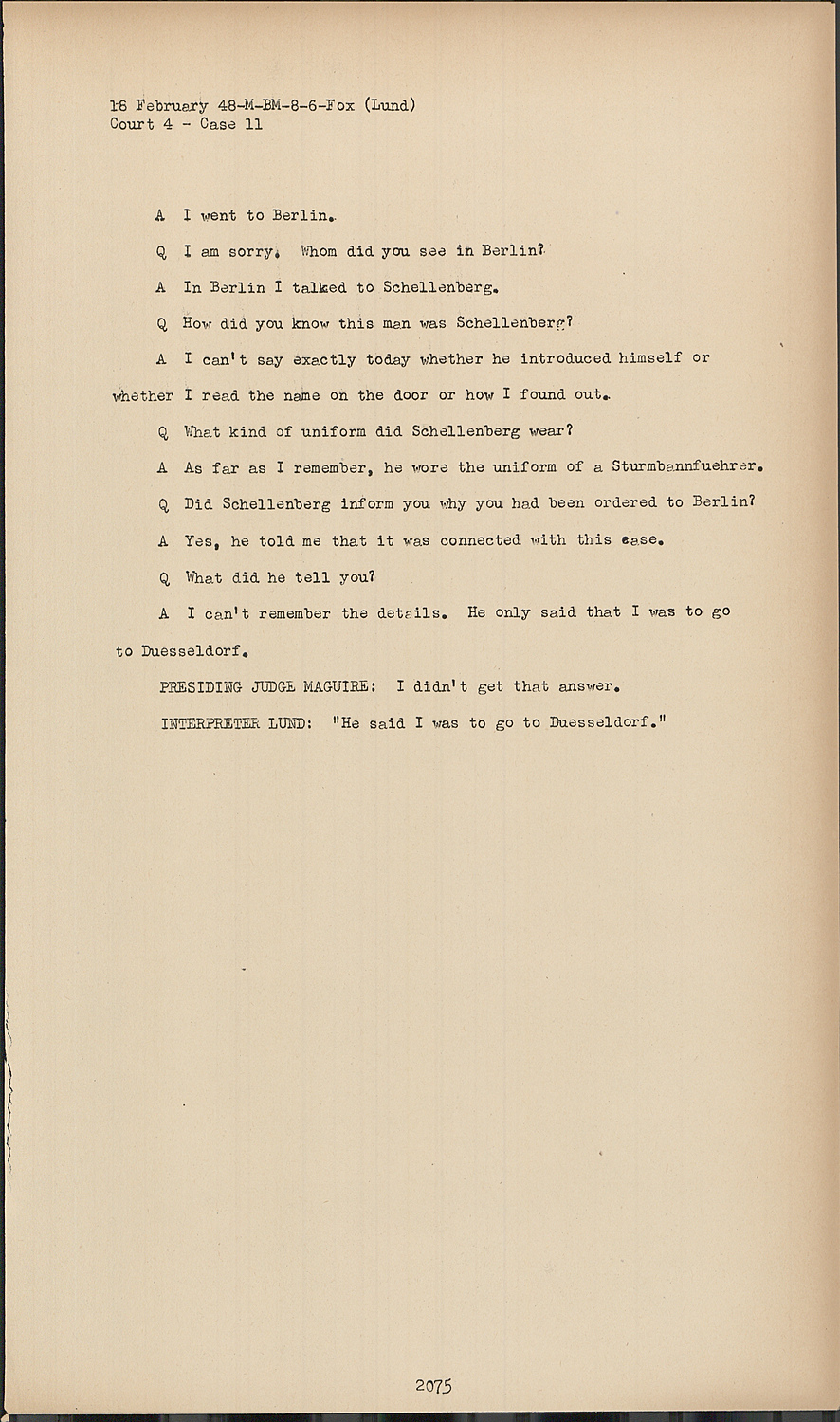
AI went to Berlin.
QI am sorry. Whom did you see in Berlin?
AIn Berlin I talked to Schellenberg.
QHow did you know this man was Schellenberg?
AI can't say exactly today whether he introduced himself or whether I read the name on the door or how I found out.
QWhat kind of uniform did Schellenberg wear?
AAs far as I remember, he wore the uniform of a Sturmbannfuehrer.
QDid Schellenberg inform you why you had been ordered to Berlin?
AYes, he told me that it was connected with this case.
QWhat did he tell you?
AI can't remember the details. He only said that I was to go to Duesseldorf.
PRESIDING JUDGE MAGUIRE:I didn't get that answer.
INTERPRETERLUND: "He said I was to go to Duesseldorf."