But, speaking very generally on this subject, I want to say that, as a matter of fact, it was impossible to have this aforementioned main duty of the Chief of the Reich Chancellery over fulfilled, because the Fuehrer obviously didn't even want this duty to be fulfilled; and there was no occasion to fulfill it either.
MR. LEWIS:May it please the Court, the Prosecution would like to have the year of publication and the publisher of the particular book from which the quotation was made.
PRESIDING JUDGE MAGUIRE:That's a reasonable request. From what is this quotation taken, and in what year was it published?
WITNESS LAMMERS:Your Honor,I will have my defense counsel give you the necessary citations. I failed to make a note of it here, but it will be supplied if Your Honors please.
DR. SEIDL:Your Honor, we will furnish the date, as well as the title of this official manual, and we will submit it for Your Honors' attention.
PRESIDING JUDGE MAGUIRE:Very well. BY DR. SEIDL:
QI would now like to ask you, Herr Dr. Lammers: How often did you actually report to the Fuehrer?
ADuring the years 1933 and 1934 approximately up to August of the latter year--that is, the death of Hindenburg-it was approximately four times a week, and sometimes it was even less than that; and sometimes there were interruptions in my reports to the Fuehrer. A half hour was usually made available; perhaps sometimes even an hour was made available; perhaps sometimes even an hour was made available for the submission of these reports; but this included the report given by the then Reich Press Chief, Funk, which took place simultaneously then. From August of 1934 onwards my regular reports gradually came to be more or less suspended to an increasing degree; and it was only subject to prior notification, rendered to the Adjutant's office or subsequently to Bormann, that I was given access to report to the Fuehrer, and finally this came to be more and more rare, with the result that approximately from 1937 onwards there were intervals amounting up to four, six, and eight weeks--and even more--between the individual reports rendered to the Fuehrer.
I very much regret that my diaries are not available to me, because in that case, if I had them available,I would be able to be very specific and indicate the dates when I actually reported to the Fuehrer, because I certainly made a note of those reports, or, as an alternative, the-Adjutant would have made an entry of the report, and I would include the listing of the individual items which comprised the subject-matter of the respective factual reports. That is, those would be indications of those matters on which I reported to the Fuehrer in each case.
QWitness, in connection with your last answer you spoke of factual reports. In order to av oid misunderstandings, from the very start I would like to ask you: What do you mean when you say "factual reports?"
AWhen I say "factual reports," I confine myself to these reports in connection with which I was permitted, upon my own initiative, to report on everything that I considered significant and which occurred in myown sphere of jurisdiction. However, in order to avoid any misunderstanding from arising, I have to emphasize at this point that in the interval be tween such factual reports, needless to say, occasionally, now and again, I was ordered to appear before the fuehrer, because he may have decided to give me some specific order, or, Perhaps, because it was necessary for me to arrange for immediate access to; the Fuehrer; and sometimes I had to enforce my requests because there may have been some rush matter, or there may have been some document which required speed and which had to be submitted to Hitler for his signature.
In such cases there were no factual reports to Hitler, and, in most cases, I was told, "You have five minutes," or, "You have ten minutes' time." In addition to that it was said that the Fuehrer did not want to be concerned with any other matters; or I was told not to take anything else along. On such occasions it was not possible for me to bring the discussion to of or subject-matter, because the Fuehrer would have been very much annoyed about that; and he would have repudiated any further discussion. Even in rush matters it happened very often that all access was turned down altogether, and the Fuehrer had me told that he didn't want to have anything to do at all with the matter under consideration. In that case all I could do was to have such matters transmitted to the departmentally responsible minister.
QHow long did your so-called "factual reports" to the Fuehrer take, as a rule?
AThey amounted to an half hour, three-quarters of an hour, or possible one hour; but it was only on very rare occasions that this one-hour limit was exceeded; and, in that case, it wasn't done for the purpose of enabling me to take care of other matters, but, much rather, it was done because the Fuehrer may have had some special assignment for me. In connection with this, I would like to be permitted to say the following: I was a stereotype tern or expression that the Fuehrer used whenever I came to report. He used to say, "How much do you have?" "How long will it take?" "Just give me the most important matters." And my stereotype answer would be, "I have only brought the most important things along; and, after all, you are the one giving the orders, so you can tell me what to bring up and what not to bring up if the time isn't sufficient."
The result was that the Fuehrer may have said, "I don't want to listen to this today; you can report on that after a few weeks in connection with another matter." Thus it happened that even those items on which I had contenplated reporting were actually not handled on those occasions.
QHerr Dr. Lammers, you mentioned just a little while ago that you kept a diary and that you regretted that this diary is no longer in your possession. Well, perhaps the Prosecution, on cross-examination, will be good enough to submit this diary to you. Therefore, in View of that, I wish to ask you the following at this stage; What does the enumeration of report items in your diary mean? Does it mean that these items were actually reported on?
ANo, it doesn't mean that by any means. As I said before, I would actually have to see the items. Some of the items I may have deleted, some may not have been deleted; and, apart from that, on these lists attached to the diary you will not find a note of the actual settlement of the respective item; but all that was jotted down were notes to help me in order to give me a survey as to when I actually rendered a report.
Q.Therefore, I want to ask you: Did you have any possibility at all to inform and advise the Fuehrer currently?
ANo, that possibility was non-existent. In view of the limited reporting activity that I exercised, you will understand that there can be no talk of any current and constant consultation and reporting to the Fuehrer. This was out of the question as far as I was concerned; and it is clear that it is not a surprising thing, therefore, that as a result, to an increasing degree, I lost interest in certain political events--foreign and domestic--and it's not surprising that I confined myself, to an ever-increasing degree, to the "formalistic administration of trash," as the Fuehrer used to designate it, and handled that.
The comparatively small points of contact that I bad in this connection when reporting to the Fuehrer actually clearly show that I wasn't able to fulfill the duties of a Chief of the Reich-Chancellery, but in no case can this be interpreted as being a factor to show that I had been a kind of chancellor or vice-chancellor.
PRESIDING JUDGE MAGUIRE:Witness, this is not the time for argument. And let's confine ourselves to the answers to the questions--the factual answers. Arguments can be made later by yourself and Counsel at the appropriate time.
Proceed, Dr. Seidl. BY DR. SEIDL:
QWhen did you make your last factual report to the Fuehrer?
ABy last factual report to the Fuehrer took place on the 24th of September 1944, and since that time, up to the time of the collapse, it is true that occasionally, now and then, I may have had access to the Fuehrer; but the period of time was always a very few minutes only, in order to submit a document for a rush signature; and if a longer Period of time was involved, then, it may have been tied up with some official reception. On that occastion I was called in in my capacity as a statistician.
QWho informed and advised the Fuehrer, in reality, under the Third Reich?
A.This is a question which is very hard to answer. To such extent as the Fuehrer permitted himself to be informed or advised at all, this could he done only on the part of very few individuals. The circle of those people who actually kept the Fuehrer informed was, needless to say, substantially larger than the circle of those people whom Hitler would permit to consult him or whom he himself would actually consult. As far as the latter circle of persons is concerned, I did not belong to that circle. With reference to the circle of those people who kept the Fuehrer informed I did belong to that circle inasmuch as I had to report to him frequently in detail on information and data received, or I had to transmit memorando to him ; this report way have been made by means of personal submission of this data, or it may have been in writing. In most instances, the latter method was used. But, as a result, this was done without the Fuehrer's showing any reaction to me, at least in answer to this information. As far as over-all political questions were concerned, I never kept him posted, and I never consulted him on these matters. Taking it all in all, the channels through which the Fuehrer would be kept posted to date andthrough which he may possibly also have been consulted ware manifold, and in each individual case they were very diverse in nature.
Q.It may be that you will be able to go into a little more detail concerning these channels leading up to the Fuehrer. And, in doing so, perhaps you tell be able to emphasize the manner in which and the extent to which the channels taken went through you, in your capacity as Chief of the Reich Chancellery, or, the extent to which they did not go through you as channel.
A.The read to the Fuehrer , in his capacity as Reich Chencellor, through me as intermediary, in my capacity as Chief of the Reichs Chandellery, would have - and I say "would have" -- had to have been the only read in all official matters. That is to say, the entire exchange of correspondence with the Reich Ministers and Reich Commissars would have had to have been mediated through my person. And, in connection with oral reports rendered to the Fuehrer by these offices.
I would have to have been called in, or at least I should have been informed concerning the result of these reports and the contents of them. In reality, this was not the case. The reads leading up to the Fuehrer went through my person only with two exceptions; but these exceptions were so tremendous in their impact that the procedure that actually should have prevailed was rescinded as a result.
Q.To what exceptions are you referring?
A.The read leading up to the Fuehrer through my person was eliminated, first of all, inasmuch as oral communications with certain executive officers and, in part, also written communications with such executives were conducted by the Fuehrer himself directly; and the second exception is the following: Inasmuch as such communication was conducted by the Fuehrer through special persons assigned by him or through special agencies assigned by him for that purpose they had to go either through the personal adjutant's office or the military adjutant's office, through the Chief of the Party Chancellery and the Secretary of the Fuehrer, Reichsleiter Bormann. Now, referring to the persons of the first category who communicated directly with the Fuehrer, they actually would submit only matters of second and third rate importance to me, matters in which they themselves were not interested. In that case they would chose the official channel through me. In speaking of Goering, Himmler, and other people, they would consider it to be below their dignity to choose the read to the Fuehrer through me as intermediary; and at least they considered this to be superfluous to choose that channel and even to give me subsequent information. Concerning particularly those matters, however, which were handled directly with the Fuehrer in the manner just described by me, those were, very frankly, the very matters which were of the greatest importance to the State. The graphic reproduction of the various channels leading us to the Fuehrer was a hard task, as can be seen on the chart hung in the courtroom here. I would like to be permitted, with Your Honors' permission to comment on that chart with a few brief words.
Q.Please permit me to interrupt you, Witness.
Mr. President, a copy of this chart, as drawn up by us, is to be found on the wall in front of this courtroom. We are not introducing this chart in evidence, but all we are doing is to identify it by a number. The document book is Lammer's Document Book VII; and we are doing to designate it as Lammer's Exhibit No. 306 for identification only.
PRESIDING JUDGE MAGUIRE:Well, do you expect to put it in the document book, or how do you expect to handle it, Doctor Seidl?
DR. SEIDL:Your Honor, we respectfully ask that you be good enough to insert this chart behind the Index to Document Book I--Banners Defense Document Book I.
PRESIDING JUDGE MAGUIRE:There is no reason why you should not offer it right now. Has the Prosecution seen it yet?
DR. SEIDL:Your Honor, the Prosecution has received a copy of this chart too.
PRESIDING JUDGE MAGUIRE:All right. Any objection to it?
MR. LEWIS:I was given that copy of the chart right before the afternoon session began, as I recollect. The only possible objection that we have is that we would like to knowwho the drafter of that chart is.
PRESIDING JUDGE MAGUIRE:Do you mean the draftsman or the man who gave information to the draftsman?
MR. LEWIS:Well, I don't want to get involved in technicalities, Sir.
PRESIDING JUDGE MAGUIRE:Well, has the Witness examined this chart, and does he state that those are the channels of persons to the Fuehrer?
DR. SEIDL:Your Honor, it was the Defendant Dr. Lammers himself who drew up this chart; and we submitted this chart to the Tribunal in order to simplify the Witness' testimony by illustrating his remarks, and, above all, to make his testimony more expeditious and speed it up.
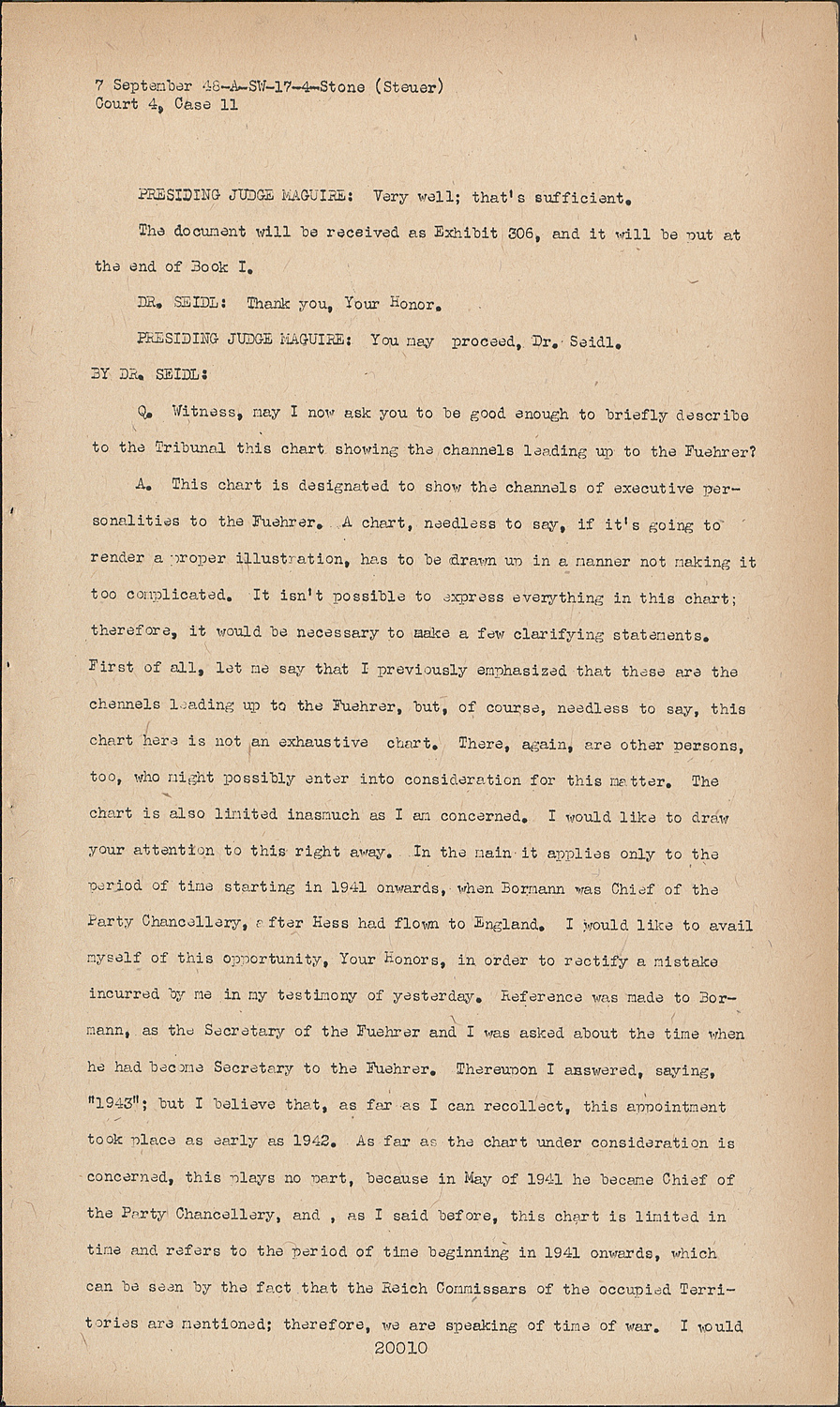
PRESIDING JUDGE MAGUIRE:Very well; that's sufficient.
The document will be received as Exhibit 306, and it tell be put at the end of Book I.
DR. SEIDL:Thank you. Your Honor.
PRESIDING JUDGE MAGUIRE:You may proceed, Dr. Seidl. BY DR. SEIDL:
Q.Witness, may I now ask you to be good enough to briefly describe to the Tribunal this chart showing the channels leading up to the Fuehrer?
A.This chart is designated to show the channels of executive personalities to the Fuehrer. A chart, needless to say, if it's going to reader a proper illustration, has to be drawn up in a manner not making it too complicated. It isn't possible to express everything in this chart; therefore, it would be necessary to sake a few clarifying statements. First of all, let me say that I previously emphasized that these are the channels leading up to the Fuehrer, but, of course, needless to say, this chart here is not an exhaustive chart. There, again, are other persons, too, who might possibly enter into consideration for this matter. The chart is also limited inasmuch as I am concerned. I would like to draw your attention to this right away. In the main it applies only to the period of time starting in 1941 onwards, when Bormann was Chief of the Party Chancellery, after Hess had flown to England. I would like to avail myself of this opportunity, Your Honors, in order to rectify a mistake incurred by me in my testimony of yesterday. Reference was made to Bormann, as the Secretary of the Fuehrer and I was asked about the time when he had become Secretary to the Fuehrer. Thereupon I answered, saying, "1943"; but I believe that, as far as I can recollect, this appointment took place as early as 1942. As far as the chart under consideration is concerned, this plays no part, because in May of 1941 he became Chief of the Party Chancellery, and , as I said before, this chart is limited in time and refers to the period of time beginning in 1941 onwards, which can be seen by the fact that the Reich Commissars of the occupied Territories are mentioned; therefore, we are speaking of time of war. I would like to say one thing, however; in the main, to a certain extent, this chart can also be adapted to circumstances prevailing prior to 1941, but in that case you cannot insert the name of Bormann; you have to put in the name of Hess, with the Fuehrer's Deputy Bormann being his Chief of Staff.
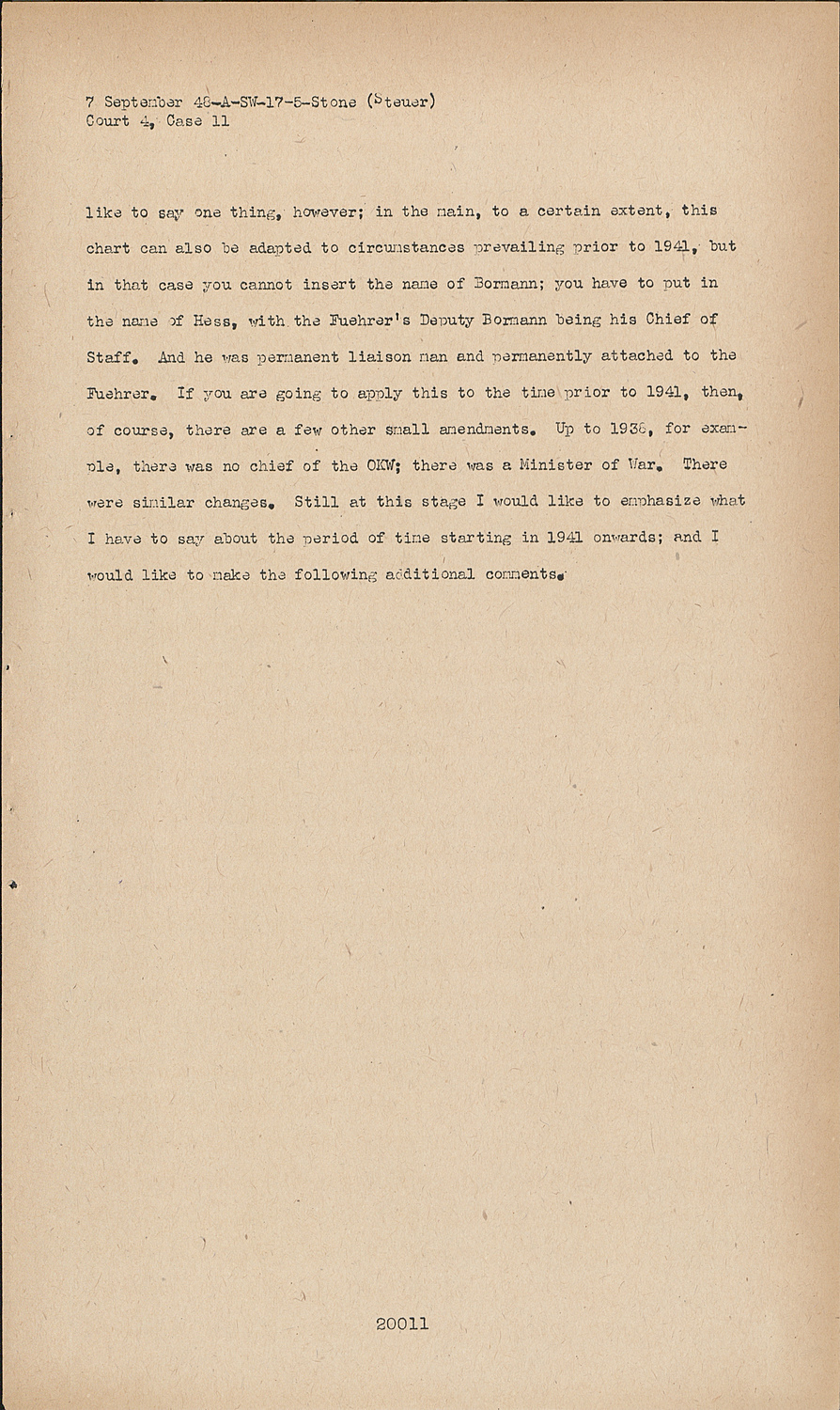
And he was permanent liaison man and permanently attached to the Fuehrer. If you are going to apply this to the time prior to 1941, then, of course, there are a few other small amendments. Up to 1936, for example, there was no chief of the OKW; there was a Minister of War. There were similar changes. Still at this stage I would like to emphasize what I have to say about the period of time starting in 1941 onwards; and I would like to make the following additional comments.
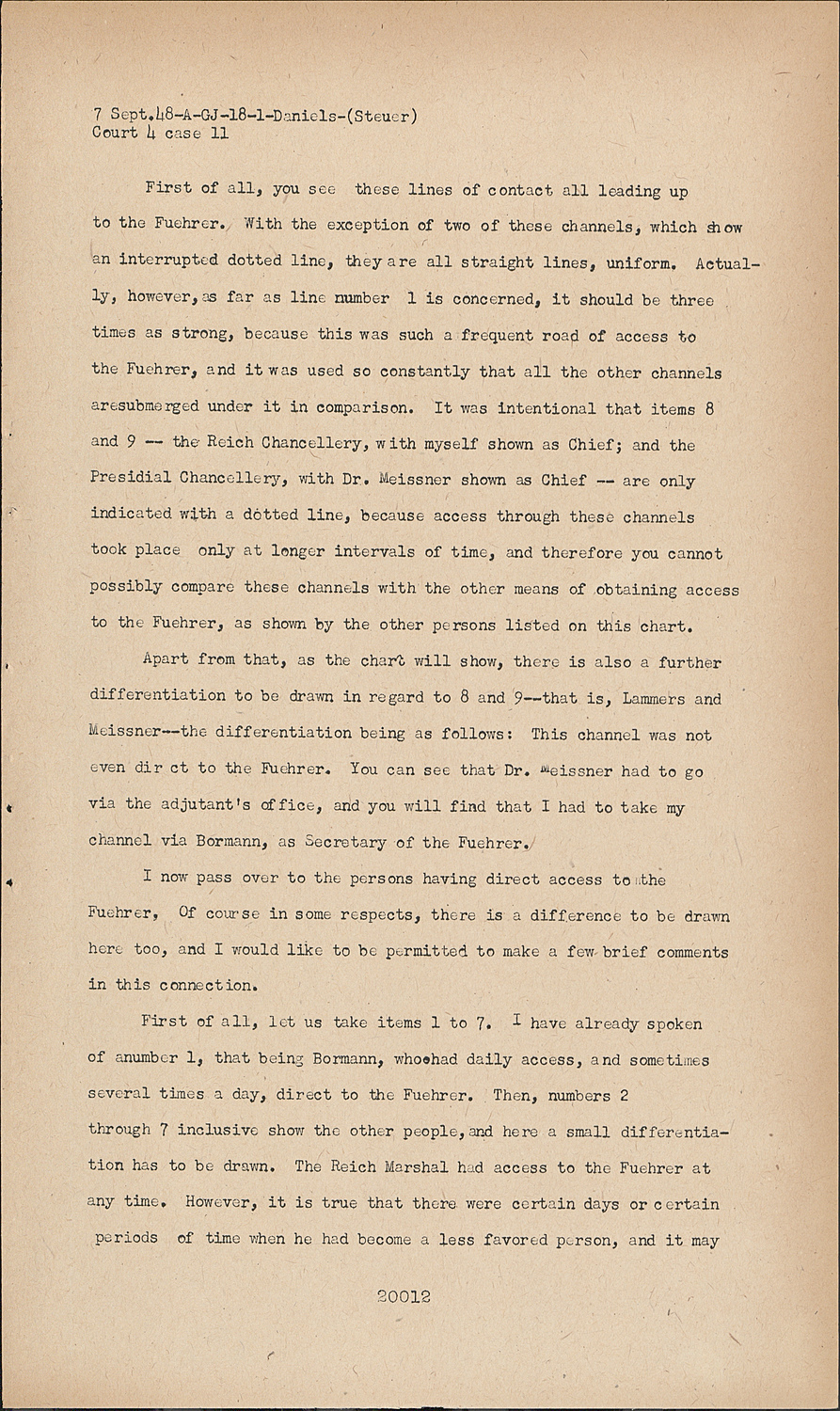
First of all, you see these lines of contact all leading up to the Fuehrer. With the exception of two of these channels, which show an interrupted dotted line, they are all straight lines, uniform. Actually, however,as far as line number 1 is concerned, it should be three times as strong, because this was such a frequent read of access to the Fuehrer, and it was used so constantly that all the other channels aresubmerged under it in comparison. It was intentional that items 8 and 9 -- the Reich Chancellery, with myself shown as Chief; and the Presidial Chancellery, with Dr. Meissner shown as Chief -- are only indicated with a dotted line, because access through these channels took place only at longer intervals of time, and therefore you cannot possibly compare these channels with the other means of obtaining access to the Fuehrer, as shown by the other persons listed on this chart.
Apart from that, as the chart will show, there is also a further differentiation to be drawn in regard to 8 and 9--that is, Lammers and Meissner--the differentiation being as follows: This channel was not even direct to the Fuehrer. You can see that Dr. Meissner had to go via the adjutant's office, and you will find that I had to take my channel via Bormann, as Secretary of the Fuehrer.
I now pass over to the persons having direct access to the Fuehrer, Of course in some respects, there is a difference to be drawn here too, and I would like to be permitted to make a few brief comments in this connection.
First of all, let us take items 1 to 7. I have already spoken of number 1, that being Bormann, who had daily access, and sometimes several times a day, direct to the Fuehrer. Then, numbers 2 through 7 inclusive show the other people,and here a small differentiation has to be drawn. The Reich Marshal had access to the Fuehrer at any time. However, it is true that there were certain days or certain periods of time when he had become a less favored person, and it may he that access was a little delayed under thos conditions, but normally he had access to the Fuehrer.
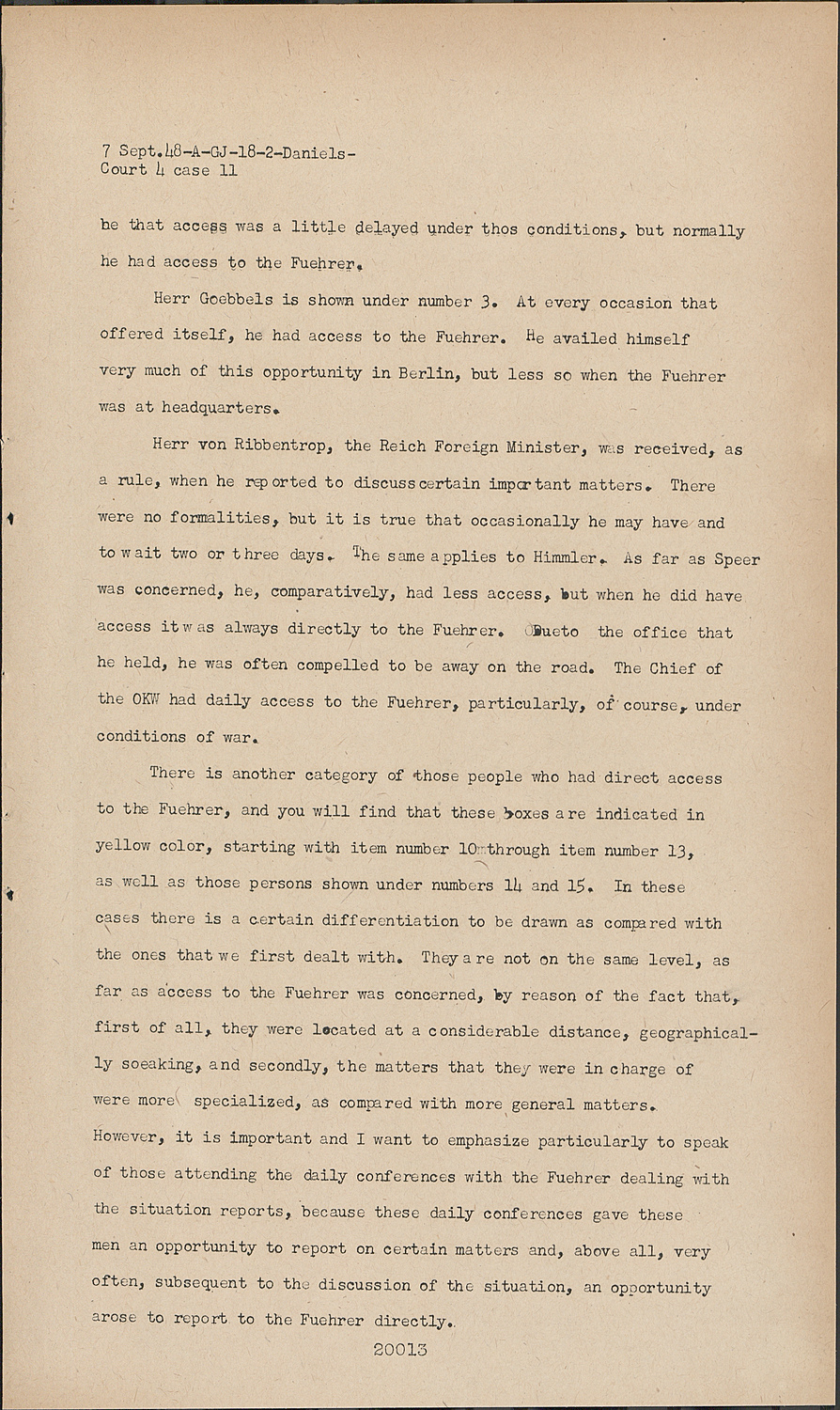
Herr Goebbels is shown under number 3. At every occasion that offered itself, he had access to the Fuehrer. He availed himself very much of this opportunity in Berlin, but less so when the Fuehrer was at headquarters.
Herr von Ribbentrop, the Reich Foreign Minister, was received, as a rule, when he reported to discusscertain important matters. There were no formalities, but it is true that occasionally he may have and to wait two or three days. The same applies to Himmler. As far as Speer was concerned, he, comparatively, had less access, but when he did have access it was always directly to the Fuehrer. Bueto the office that he held, he was often compelled to be away on the read. The Chief of the OKW had daily access to the Fuehrer, particularly, of course, under conditions of war.
There is another category of those people who had direct access to the Fuehrer, and you will find that these boxes are indicated in yellow color, starting with item number 10 through item number 13, as well as those persons shown under numbers 14 and 15. In these cases there is a certain differentiation to be drawn as compared with the ones that we first dealt with. They are not on the same level, as far as access to the Fuehrer was concerned, by reason of the fact that, first of all, they were located at a considerable distance, geographically soeaking, and secondly, the matters that they were in charge of were more specialized, as compared with more general matters. However, it is important and I want to emphasize particularly to speak of those attending the daily conferences with the Fuehrer dealing with the situation reports, because these daily conferences gave these men an opportunity to report on certain matters and, above all, very often, subsequent to the discussion of the situation, an opportunity arose to report to the Fuehrer directly.
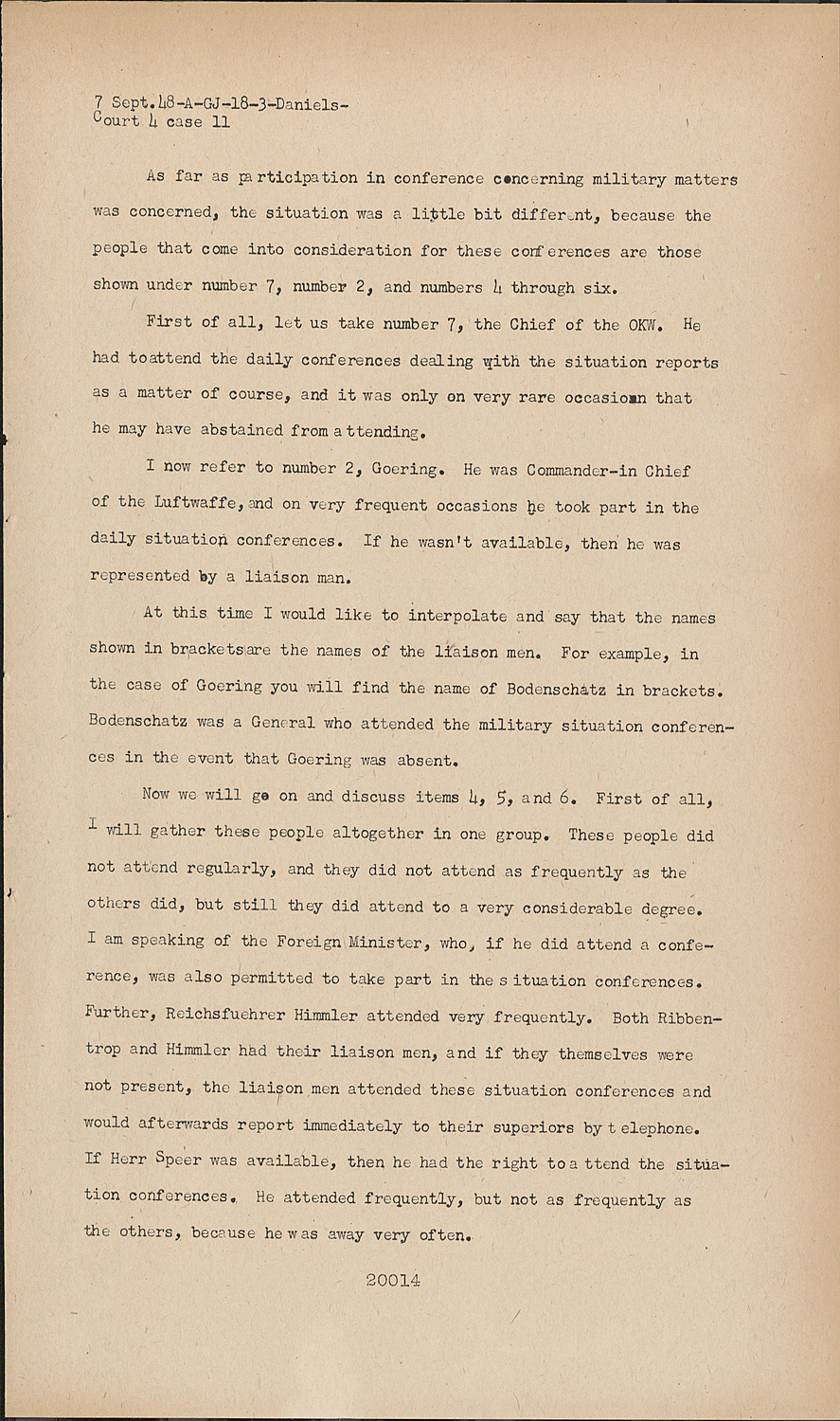
As far as participation in conference concerning military matters was concerned, the situation was a little bit different, because the people that come into consideration for these conferences are those shown under number 7, number 2, and numbers 4 through six.
First of all, let us take number 7, the Chief of the OKW. He had toattend the daily conferences dealing with the situation reports as a matter of course, and it was only on very rare occasio n that he may have abstained from attending.
I now refer to number 2, Goering. He was Commander-in Chief of the Luftwaffe,and on very frequent occasions he took part in the daily situation conferences. If he wasn't available, then he was represented by a liaison man.
At this time I would like to interpolate and say that the names shown in bracketsare the names of the liaison men. For example, in the case of Goering you will find the name of Bodenschatz in brackets. Bodenschatz was a General who attended the military situation conferences in the event that Goering was absent.
Now we will go on and discuss items 4, 5, and 6. First of all, I will gather these people altogether in one group. These people did not attend regularly, and they did not attend as frequently as the others did, but still they did attend to a very considerable degree. I am speaking of the Foreign Minister, who, if he did attend a conference, was also permitted to take part in the situation conferences. Further, Reichsfuehrer Himmler attended very frequently. Both Ribbentrop and Himmler had their liaison men, and if they themselves were not present, the liaison men attended these situation conferences and would afterwards report immediately to their superiors by telephone. If Herr Speer was available, then he had the right to attend the situation conferences. He attended frequently, but not as frequently as the others, because he was away very often.
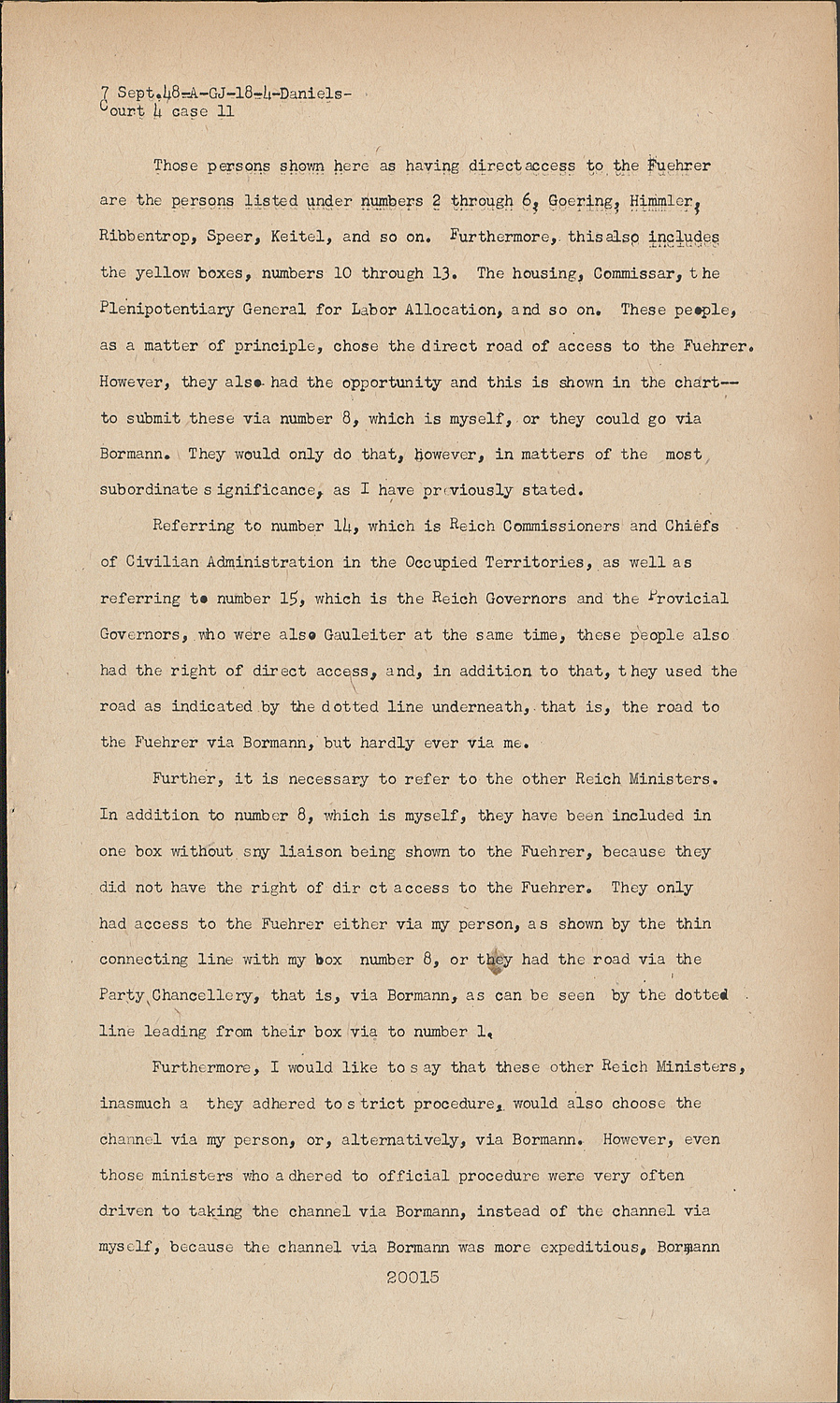
Those persons shown here as having directaccess to the Fuehrer are the persons listed under numbers 2 through 6, Goering, Himmler, Ribbentrop, Speer, Keitel, and so on. Furthermore, thisalso includes the yellow boxes, numbers 10 through 13. The housing. Commissar, the Plenipotentiary General for Labor Allocation, and so on. These people, as a matter of principle, chose the direct road of access to the Fuehrer. However, they also had the opportunity and this is shown in the chart-to submit these via number 8, which is myself, or they could go via Bormann. They would only do that, however, in matters of the most subordinate significance, as I have previously stated.
Referring to number 14, which is Reich Commissioners and Chiefs of Civilian Administration in the Occupied Territories, as well as referring to number 15, which is the Reich Governors and the Provicial Governors, who were also Gauleiter at the same time, these people also had the right of direct access, and, in addition to that, they used the read as indicated by the dotted line underneath, that is, the read to the Fuehrer via Bormann, but hardly ever via me.
Further, it is necessary to refer to the other Reich Ministers. In addition to number 8, which is myself, they have been included in one box without any liaison being shown to the Fuehrer, because they did not have the right of direct access to the Fuehrer. They only had access to the Fuehrer either via my person, as shown by the thin connecting line with my box number 8, or they had the road via the Party Chancellery, that is, via Bormann, as can be seen by the dotted line leading from their box via to number 1.
Furthermore, I would like to say that these other Reich Ministers, inasmuch a they adhered to strict procedure, would also choose the channel via my person, or, alternatively, via Bormann. However, even those ministers who adhered to official procedure were very often driven to taking the channel via Bormann, instead of the channel via myself, because the channel via Bormann was more expeditious, Bormann having daily access to the Fuehrer.
As I said, that was more expeditious than the channel through my person, because I only had access to the Fuehrer every six to eight weeks or so.
In conclusion, with reference to this chart. I would like to request that further questions be propounded to me if there are any. I would also respectfully submit this request to the Judges.
I believe I have discussed everything that I have to say in connection with this chart.
QDr. Lammers, I have one further question, to clarify your description of the chart. You also discussed the daily situation conferences with the Fuehrer in Fuehrer headquarters, when you discussed the chart in general, and I would now like to ask you, did you also attend these daily situation conferences?
ANever, not a single time, did I take part in these conferences.
QNow, prior to your giving us your description of the chart, you told us that you also reported to the Fuehrer, though the intervals came to be ever longer. Did those reports, submitted to the Fuehrer by you, only refer to matters which were of significance and which were considered the most important matters of business of the State?
ANo, by no means. Of course, there were always matters involved which had a certain significance, because insignificant matters would not be reported upon by me. However, the most significant matters of business of the State were not reported to the Fuehrer to the fuehrer by me. In the best of events, they might have been submitted to the Fuehrer in the form of documents ready for signature, and in that event I might occasionally have submitted certain questions as to the text, or certain questions concerning the further enforcement and the further handling of the respective matters.
However, in the main, this referred only to the technical side of business routine. Above all, I am thinking of Fuehrer decrees and particularly significant personnel matters, for instance, documents appointing officers or discharging officers, ministers, or state secretaries, and the other matters which required very specific and careful wording of the respective documents.
Furthermore, please permit me to say at this point that notes from the Foreign Office addressed to Foreign Governments, handwritten communications to foreign chiefs of state and minister-presidents, were not transmitted through my person, or at least I cannot remember any single such case, and I remember just as little having any military orders, that is, exclusively commando matters, transmitted through myself, not even for the purpose of submitting these documents for signature.
Q.- In order to evaluate your official position, it seems to me to be of significance too to discuss the position of the Reich Cabinet, that is, the Reich Government. Will you be good enough to supplement what you told us this morning, and tell us one further thing?
A.- In my opinion, it would have been absolutely imperative for the Reich Cabinet to be consulted by the Fuehrer on questions of major policy. It should at least have been contacted and been given a hearing, or at least have been notified. Since the end of 1937, from that time onwards that was no longer the case, and before that date it happened very rarely and in a very scanty matter only. It is a well-known fact that the last Cabinet meeting took place at the end of the year 1937, I think it was in November of that year. Since that time there were no further meetings. Of course, this had repercussions on my position, inasmuch as it was to an ever smaller degree that I came to be notified of the most significant matters. This last Cabinet meeting, which took place at the end of 1937, was one which, in many instances, was not designated as being the last one, but it is a mistake and may well be a wrong use of language if you propose to designate a later ministers' meeting as a Cabinet as a Cabinet meeting, because, once again, early in February of 1938, a ministers' meeting took place for the purpose of information only, but that was not a Cabinet meeting. At that time all that the Fuehrer did was to discuss personnel changes which had taken place as a result of Blomberg, Minister of War, resigning, and as a result of the resignation of Reich Foreign Minister von Neurath. That was all that was discussed at that ministers' meeting.
Q.- In your last answer you regretted that, from 1937 onwards, no further cabinet meetings had taken place. I would now like to ask you, did you, on your part, try to have the Reich Cabinet re-activated, and did you try to bring meetings about?
A.- Yes. I very frequently received inquiries from ministers with the objective of having cabinet meetings take place. The ministers had the very urgent desire, at least to be kept informed. I was not able to furnish the necessary information; neither did I dispose of the necessary data, nor did I have the possibility of informing the ministers on my part. I constantaly tried to bring about a concentration, or let us say, a re-activation of the Reich Cabinet, at least in the form that the Reich Ministers would assemble for joint discussions of important matters, for the purpose of receiving information, even if the Fuehrer was not in the Chair. All of these efforts of mine were futile, because the Fuehrer rejected them. And, in the final run, the Fuehrer even proposed to have all ministers' meetings prohibited: he actually specifically prohibited meetings, even unofficially at dinners in the evening, even meetings which were purely for the sake of information. What I am saying now;, however, took place as late as 1944.
Q.- We will now pass over to the relationship that existed between the Party and State. What was the Party's position in the governmental sector?
A.- That is a chapter on which it will be necessary to use very many words, but I would like to be very frief in what I am going to say.
There was tremendous influence, of course, exerted upon the so-called Reich Cabinet, and also, as a result, exerted upon my position as Chief of the Reich Chancellery, which influence was exerted by the predominance and by the tremendous influence exercised by the Party over the State. This Party position in the State was one which the law concerning the unity of party and State corroborated. This instrument of law dates from 1 December 1933. In actual practice, however, this influence by far exceeded the provisions of this law. However, vice versa, you could also say that as far as unity between State and Party was concerned, there was very little to be seen of it in actual practice.
On the contrary, there was a dualism in existence between Party and State, a permanent dualism, in which the State was the weaker element.
Q.- Dr. Lammers, we have frequently heard mention of the principle "The Party orders the State". What were the results of this principle, generally speaking, and what were the particular results on your function as Chief of the Reich Chancellery?
A.- This principle had been promulgated on the occasion of a Party rally, and was frequently repeated thereafter. The result of it was that, to an ever-increasing degree, state matters went over to the Party, and this even included matters in which it was nonsense to transmit such powers, such as, for example, at the start of the war, all matters pertaining to refugees, and, at the end of the war, the erection of fortifications in the rear army area, and finally, the Volkssturm, or People's Guard. But even in regard to those matters which remained in the jurisdiction of the State, the Party interpolated its power to an ever-increasing extent, and it assumed ever-growing authority, very often without any factual basis. In most instances, what the Party did was to obstruct the entire state apparatus; actually, the State was in a constant condition of defense.
Q.- Up to now you have been speaking of the repercussions of this principle in the highest levels. What repercussions did this principle of"The party orders the State" have, in actual practice, in the middle ranking levels of the Third Reich?
A.- This development of the principle "The Party orders the State" gradually became so exaggerated in its effect that the State was replaced even in the middle-ranking levels of administration. And I am now speaking of the Reich Governors, the Provincial Governors, the Reich Defense Commissars. It was the Party that threw its weight in, that is, acting through the Gauleiter; and thereby all channels of command in the govern= ment were overthrown and undermined.
Q.- What were the repercussions of this development as far as your own position as Chief of the Reich Chancellery was concerned?
A.- Matters of administration, which had formerly been dealt with through channels via the Landrat, the Regierungspraesident, the Oberregierungspraesident, the Reich Minister of the Interior, or some other minister, and which had finally landed in my hands for me to report to the Fuehrer, were now transferred to Party channels, starting at the bottom with the Kreisleiter of the Party, going up to the Gauleiter, from the Gauleiter to the Chief of the Party Chancellery, which was Reichsleiter Bormann. In very many cases these matters never actually reached the Fuehrer himself, and this refers particularly, very frequently to those matters which I was most anxious about, in my office as Chief of the Reich Chancellery, under the aspects of the government.
Q.- Did you come to hear of decisions of the Fuehrer, then, in the Governmental sector, did you hear nothing, or, if you heard anything, through what channels did you come to hear of it?
A.- If ever I actually did come to hear anything, it would only happen through the information that I was furnished by Reichsleiter Bormann, and, of course, I had to maintain a certain contact with him under that aspect. However, even if such matters were actually sent to me by Bormann, then, in most cases, the form chosen would be that at an earlier stage, before informing me, he would have already reported to the Fuehrer and then he would submit to me a decision already passed on by the Fuehrer, without my having had any opportunity to participate, on my part, in bringing this Fuehrer decision into being.
Q.- Was it possible for you, at least, to take any part in the formalistic passage of the Fuehrer's decisions?