Court 4, Case 11 - Commission I The next document is Manners No. 291; telegram of the German ambassador in the Soviet Union to the Reich foreign minister; dated 16 Oct 1940.
We are offering this as Lammers Exhibit 216.
The next document is Lammers Document No. 9292; telegraphic instructions of the Reich foreign minister to the German ambassador in the Soviet Union; dated 18 Oct. 1940. We are offering this document as Lammers Exhibit 217.
The next document is Lammers No. 293; telegram of the German ambassador in the Soviet Union to the Reich foreign minister; dated 19 Oct 1940. We are offering this document as Manners Exhibit 218.
The next document is Lammers No. 294; a telegram of the German ambassador in the Soviet Union to the Reich foreign minister; dated 22 Oct 1940. The document is offered as Lammers Exhibit 219.
The next document is Manners No. 296; memorandum concerning the conversation between the Reich foreign minister and the chairman of the Counci of People's Commissars of the USSR and the People's Commissars for Foreign Affairs V. M. Molotov in the presence of the deputy People's Commissar for Foreign Affairs, Dekanosov held in Berlin on 12 November 1940. We are offering this document as Manners Exhibit 220.
Court 4, Case 1 - Commission I The next document is Lammers No. 297; it's a memorandun concerning the conversation between the Fuehrer and the chairman of the Council of People's Commissars and People's Commissar for Foreign Affairs, Molotov, in the presence of the Reich foreign minister and deputy People's Commissar, Dekanosov; dated 12 Nov.
1940. We are offering this document as Lammers Exhibit No. 221.
The next document is Lammers No. 298; it is a memorandun on the conversation between the Fuehrer and the chairman of the Council of People's Commissars and People's Commissar for Foreign Affairs, Molotov in the presence of the Reich Foreign Minister and the deputy People's Commissar, Dekanosov, in Berlin; on 13 Nov. 1940. We are offering this document as Lammers Exhibit 222.
The next document is Lammers 298; this is a memorandum concerning the final conversations between the foreign minister Ribbentrop and the chairman of the Council of People's Commissars of the USSR and the People's Commissar for foreign affairs, V.M. Molotiv, in Berlin on 13 Nov. 1940. The defense offers this document as Lammers Exhibit No. 223.
Thenext document is Lammers Document No. 300; it is a draft of an agreement between the states of the Three Power Pact, Germany, Italy and Japan, on the one side; and, the Soviet Union on the other hand. This document is submitted as Lammers Exhibit 224.
The next document is Lammers No. 301; it is a draft for a secret protocol No. 1 between Germany, Italy and Japan and the Soviet Union. We are offering this document as Banners Exhibit 225.
The next document is Banners No. 302; it is the draft for a secret Protocol No. 2 between Germany: Italy and the Soviet Union. This document is being offered as Lammers Exhibit 226.
The next document is Lammers Document No. 303; telegraphic decree of the state secretay of the foreign office, directive to all German diplomatic missions and the agencies in Paris and Brussels; dated 15 Nov. 1940. We are offering this document as Banners Exhibit No. 227.
Court 4, Case 11 - Commission I The last document in this Volume X hears the number Lammers 304; it is a telegram of the German ambassador in the Soviet Union to the Reich foreign minister, dated 26 Nov.
1940. We are offering this document as Lammers Exhibit 228.
I have concluded Document Volume X therewith. Again in this document book, too, the documents are submitted on behalf of all the Defense Counsel. If the Commissioner permits, I will now turn to Document VolumeXI for Lammers. Again these are documents referring exclusively to the development of the German-Soviet relations in the years 1939, 1940, 1941. We are submitting these documents again on behalf of all the Defense Counsel in Case No. 11.
The first document in Volume XI is Lammers No. 306; it is a memorandum of the state secretary of the foreign office concerning a conversation with the Finnish minister in Berlin; dated 31 Dec 1940. We are offering this document as Lammers Exhibit No. 229.
The next document is Lammers Document No. 307; it is a telegraphic decree of the Reich foreign minister to the German diplomatic missions in Moscow, Ankara, Belgrade and Athens; dated 7 Jan 1941. I am offering this document as Lammers Exhibit 330.
The next document is Lammers No. 308; it is a telegram of the German ambassador in the Soviet Union to the foreign office in Berlin, dated 8 Jan 1941. We are offering this document as Lammers Exhibit No. 231.
Thenext document in this Volume is Lammers No. 309; it is a telegraphic decree of the Reich Foreign minister to the German ambassador in the Soviet Union; dated 10 Jan 1941. We are submitting this document as Lammers Exhibit 232.
The next document is Lammers No. 310. Secret protocol between the government of the German Reich and the government of the USSR; dated 10 Jan 1941, concerning Germany's waiving her rights to the Lithuanian area mentioned in the additional secret protocol of 28 Sept 1939. We are submitting this document as Lammers Exhibit No. 233.
Court 4, Case 11 - Commission I The next document is Lammers No. 312; a telegram of the state secretary of the foreign office to the Reich Foreign minister dated 17 Jan 1941.
I am offering this document as Lammers Exhibit No. 234.
The next document is Lammers No. 313; it is a telegram of the German ambassador in the Soviet Union to the Reich foreign minister dated 17 Jan 1941. Werare offering this document as Lammers Exhibit No. 235.
The next document is Lammers No. 314; telegraphic instructions of the Reich foreign minister to the state secretary of the foreign office; dated 21 Jan 1941. I an offering this document as Lammers Exhibit No. 236.
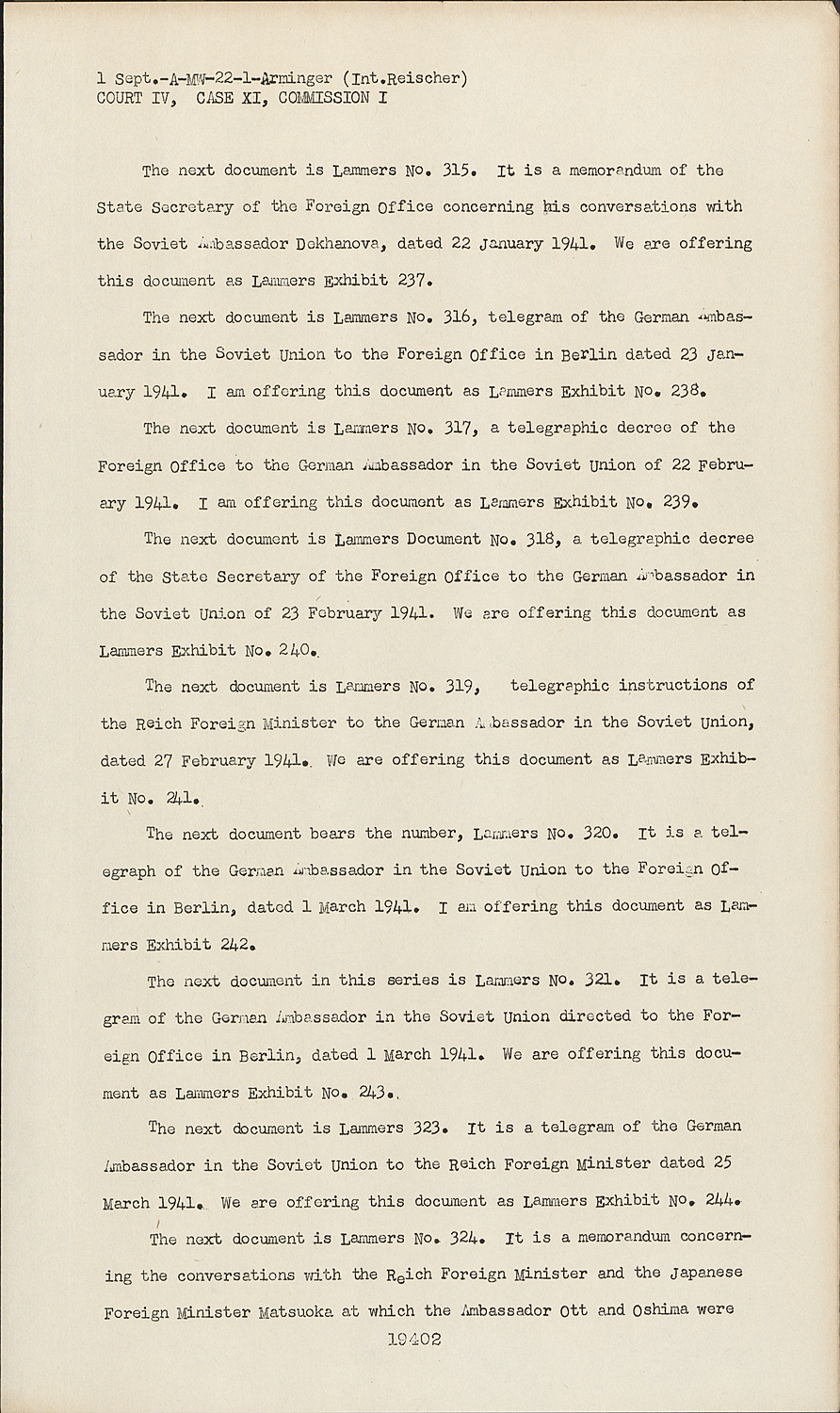
COURT IV, CASE XI, COMMISSION I The next document is Lammers No. 315.
It is a memorandum of the State Secretary of the Foreign office concerning his conversations with the Soviet Ambassador Dekhanova, dated 22 January 1941. We are offering this document as Lammers Exhibit 237.
The next document is Lammers No. 316, telegram of the German Ambassador in the Soviet Union to the Foreign Office in Berlin dated 23 January 1941. I am offering this document as Lammers Exhibit No. 238.
The next document is Lammers No. 317, a telegraphic decree of the Foreign Office to the German Ambassador in the Soviet union of 22 February 1941. I am offering this document as Lammers Exhibit No. 239.
The next document is Lammers Document No. 318, a telegraphic decree of the State Secretary of the Foreign Office to the German Ambassador in the Soviet Union of 23 February 1941. We are offering this document as Lammers Exhibit No. 240.
The next document is Lammers No. 319, telegraphic instructions of the Reich Foreign Minister to the German Ambassador in the Soviet union, dated 27 February 1941. We are offering this document as Lammers Exhibit No. 241.
The next document bears the number, Lammers No. 320. It is a telegraph of the German Ambassador in the Soviet Union to the Foreign Office in Berlin, dated 1 March 1941. I am offering this document as Lammers Exhibit 242.
The next document in this series is Lammers No. 321. It is a telegram of the German Ambassador in the Soviet Union directed to the Foreign Office in Berlin, dated 1 March 1941. We are offering this document as Lammers Exhibit No. 243.
The next document is Lammers 323. It is a telegram of the German Ambassador in the Soviet Union to the Reich Foreign Minister dated 25 March 1941. We are offering this document as Lammers Exhibit No. 244.
The next document is Lammers No. 324. It is a memorandum concerning the conversations with the Reich Foreign Minister and the Japanese Foreign Minister Matsuoka at which the Ambassador Ott and Oshima were COURT IV, CASE XI, COMMISSION I present in Berlin, dated 27 March 1941.
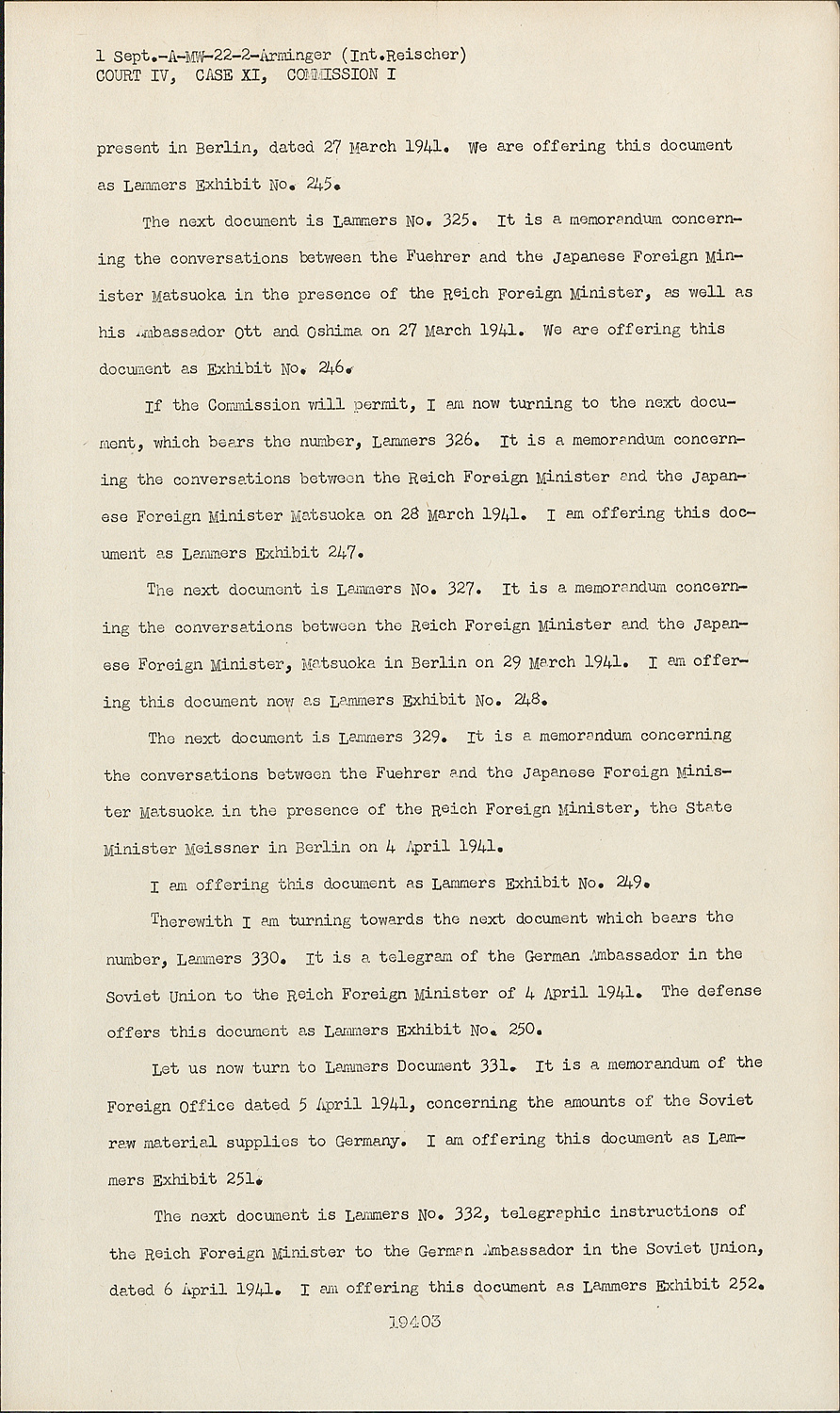
We are offering this document as Lammers Exhibit No. 245.
The next document is Lammers No. 325. It is a memorandum concerning the conversations between the Fuehrer and the Japanese Foreign Minister Matsuoka in the presence of the Reich Foreign Minister, as well as his ambassador Ott and Oshima on 27 March 1941. We are offering this document as Exhibit No. 246.
If the Commission will permit, I am now turning to the next document, which bears the number, Lammers 326. It is a memorandum concerning the conversations between the Reich Foreign Minister and the Japanese Foreign Minister Matsuoka on 28 March 1941. I am offering this document as Lammers Exhibit 247.
The next document is Lammers No. 327. It is a memorandum concerning the conversations between the Reich Foreign Minister and the Japanese Foreign Minister, Matsuoka in Berlin on 29 March 1941. I am offering this document now as Lammers Exhibit No. 248.
The next document is Lammers 329. It is a memorandum concerning the conversations between the Fuehrer and the Japanese Foreign Minister Matsuoka in the presence of the Reich Foreign Minister, the State Minister Meissner in Berlin on 4 April 1941.
I am offering this document as Lammers Exhibit No. 249.
Therewith I am turning towards the next document which bears the number, Lammers 330. It is a telegram of the German Ambassador in the Soviet Union to the Reich Foreign Minister of 4 April 1941. The defense offers this document as Lammers Exhibit No. 250.
Let us now turn to Lammers Document 331. It is a memorandum of the Foreign Office dated 5 April 1941, concerning the amounts of the Soviet raw material supplies to Germany. I am offering this document as Lammers Exhibit 251.
The next document is Lammers No. 332, telegraphic instructions of the Reich Foreign Minister to the German Ambassador in the Soviet union, dated 6 April 1941. I am offering this document as Lammers Exhibit 252.
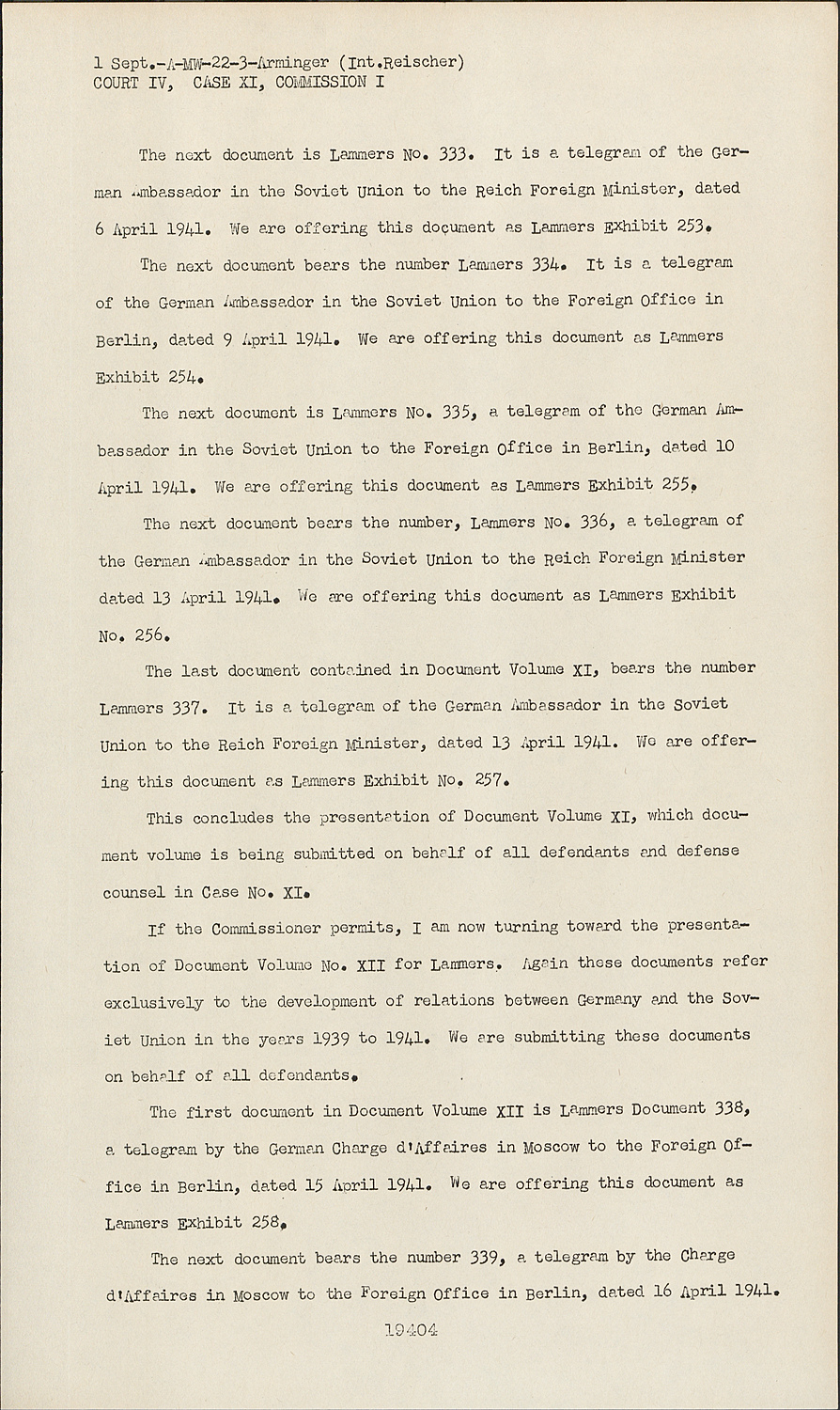
COURT IV, CASE XI, COMMISSION I The next document is Lammers No. 333.
It is a telegram of the German Ambassador in the Soviet union to the Reich Foreign Minister, dated 6 April 1941. We are offering this document as Lammers Exhibit 253.
The next document beers the number Lammers 334. It is a telegram of the German Ambassador in the Soviet Union to the Foreign Office in Berlin, dated 9 April 1941. We are offering this document as Lammers Exhibit 254.
The next document is Lammers No. 335, a telegram of the German Ambassador in the Soviet Union to the Foreign Office in Berlin, dated 10 April 1941. We are offering this document as Lammers Exhibit 255.
The next document bears the number, Lammers No. 336, a telegram of the German ambassador in the Soviet Union to the Reich Foreign Minister dated 13 April 1941. We are offering this document as Lammers Exhibit No. 256.
The last document contained in Document Volume XI, bears the number Lammers 337. It is a telegram of the German Ambassador in the Soviet Union to the Reich Foreign Minister, dated 13 April 1941. We are offering this document as Lammers Exhibit No. 257.
This concludes the presentation of Document Volume XI, which document volume is being submitted on behalf of all defendants and defense counsel in Case No. XI.
If the Commissioner permits, I am now turning toward the presentation of Document Volume No. XII for Lammers. Again these documents refer exclusively to the development of relations between Germany and the Soviet Union in the years 1939 to 1941. We are submitting these documents on behalf of all defendants.
The first document in Document Volume XII is Lammers Document 338, a telegram by the German Charge d'Affaires in Moscow to the Foreign office in Berlin, dated 15 April 1941. We are offering this document as Lammers Exhibit 258.
The next document bears the number 339, a telegram by the Charge d'Affaires in Moscow to the Foreign Office in Berlin, dated 16 April 1941.
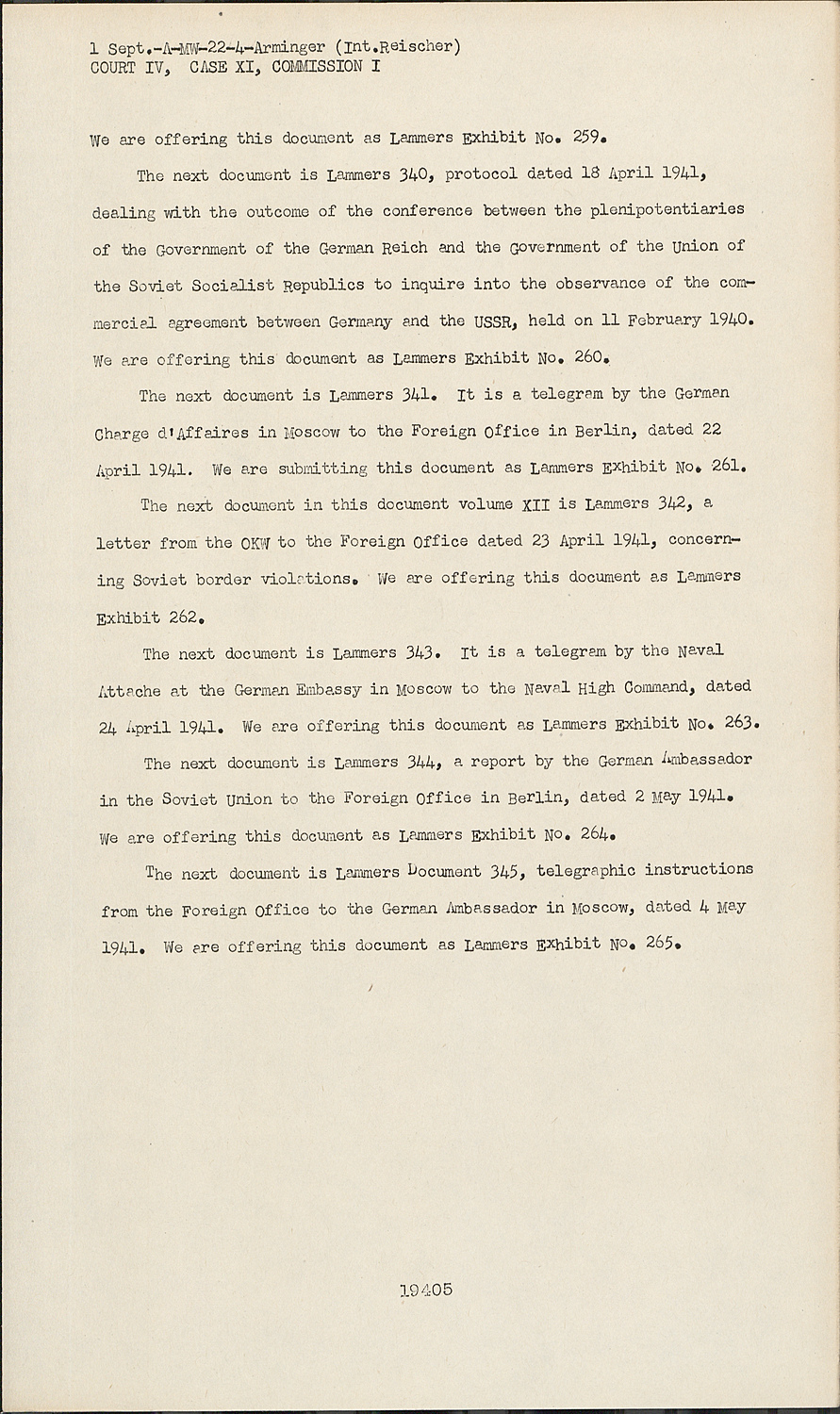
COURT IV, CASE XI, COMMISSION I We are offering this document as Lammers Exhibit No. 259.
The next document is Lammers 340, protocol dated 18 April 1941, dealing with the outcome of the conference between the plenipotentiaries of the Government of the German Reich and the Government of the Union of the Soviet Socialist Republics to inquire into the observance of the commercial agreement between Germany and the USSR, held on 11 February 1940. We are offering this document as Lammers Exhibit No. 260.
The next document is Lammers 341. It is a telegram by the German Charge d'Affaires in Moscow to the Foreign office in Berlin, dated 22 April 1941. We are submitting this document as Lammers Exhibit No. 261.
The next document in this document volume XII is Lammers 342, a letter from the OKW to the Foreign Office dated 23 April 1941, concerning Soviet border violations. We are offering this document as Lammers Exhibit 262.
The next document is Lammers 343. It is a telegram by the Naval Attache at the German Embassy in Moscow to the Naval High Command, dated 24 April 1941. We are offering this document as Lammers Exhibit No. 263.
The next document is Lammers 344, a report by the German Ambassador in the Soviet Union to the Foreign Office in Berlin, dated 2 May 1941. We are offering this document as Lammers Exhibit No. 264.
The next document is Lammers document 345, telegraphic instructions from the Foreign office to the German Ambassador in Moscow, dated 4 May 1941. We are offering this document as Lammers Exhibit No. 265.
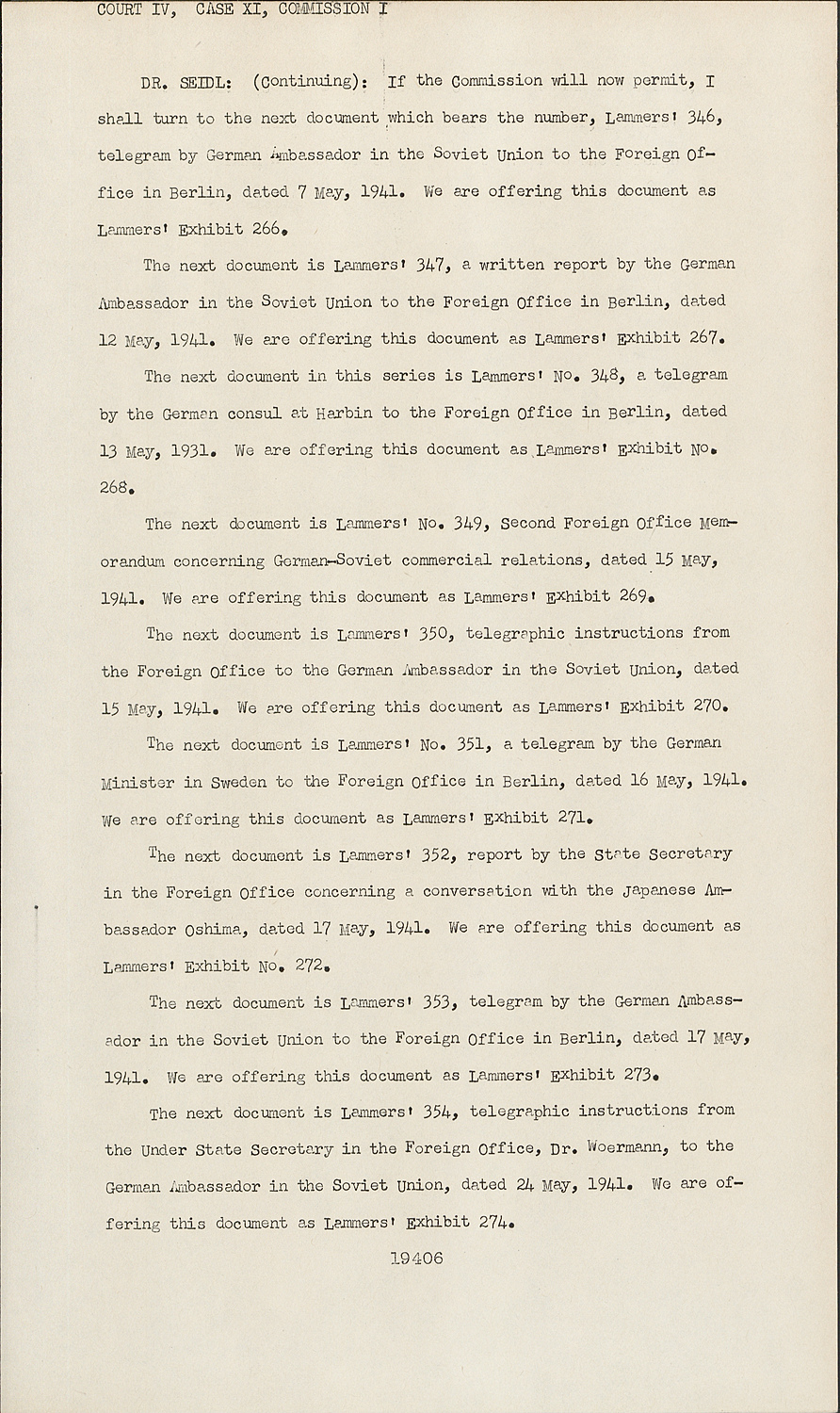
DR. SEIDL: (continuing): If the Commission will now permit, I COURT IV, CASE XI, COMMISSION I shall turn to the next document which bears the number, Lammers' 346, telegram by German Ambassador in the Soviet Union to the Foreign office in Berlin, dated 7 May, 1941.
We are offering this document as Lammers' Exhibit 266.
The next document is Lammers' 347, a written report by the German Ambassador in the Soviet Union to the Foreign office in Berlin, dated 12 May, 1941. We are offering this document as Lammers' Exhibit 267.
The next document in this series is Lammers' No. 348, a telegram by the German consul at Harbin to the Foreign office in Berlin, dated 13 May, 1931. We are offering this document as Lammers' Exhibit No. 268.
The next document is Lammers' No. 349, Second Foreign Office Memorandum concerning German-Soviet commercial relations, dated 15 May, 1941. We are offering this document as Lammers' Exhibit 269.
The next document is Lammers' 350, telegraphic instructions from the Foreign Office to the German Ambassador in the Soviet union, dated 15 May, 1941. We are offering this document as Lammers' Exhibit 270.
The next document is Lammers' No. 351, a telegram by the German Minister in Sweden to the Foreign Office in Berlin, dated 16 May, 1941. We are offering this document as Lammers' Exhibit 271.
The next document is Lammers' 352, report by the state Secretary in the Foreign office concerning a conversation with the Japanese Ambassador Oshima, dated 17 May, 1941. We are offering this document as Lammers' Exhibit No. 272.
The next document is Lammers' 353, telegram by the German Ambassador in the Soviet Union to the Foreign Office in Berlin, dated 17 May, 1941. We are offering this document as Lammers' Exhibit 273.
The next document is Lammers' 354, telegraphic instructions from the Under State Secretary in the Foreign Office, Dr. Woermann, to the German Ambassador in the Soviet Union, dated 24 May, 1941. We are offering this document as Lammers' Exhibit 274.
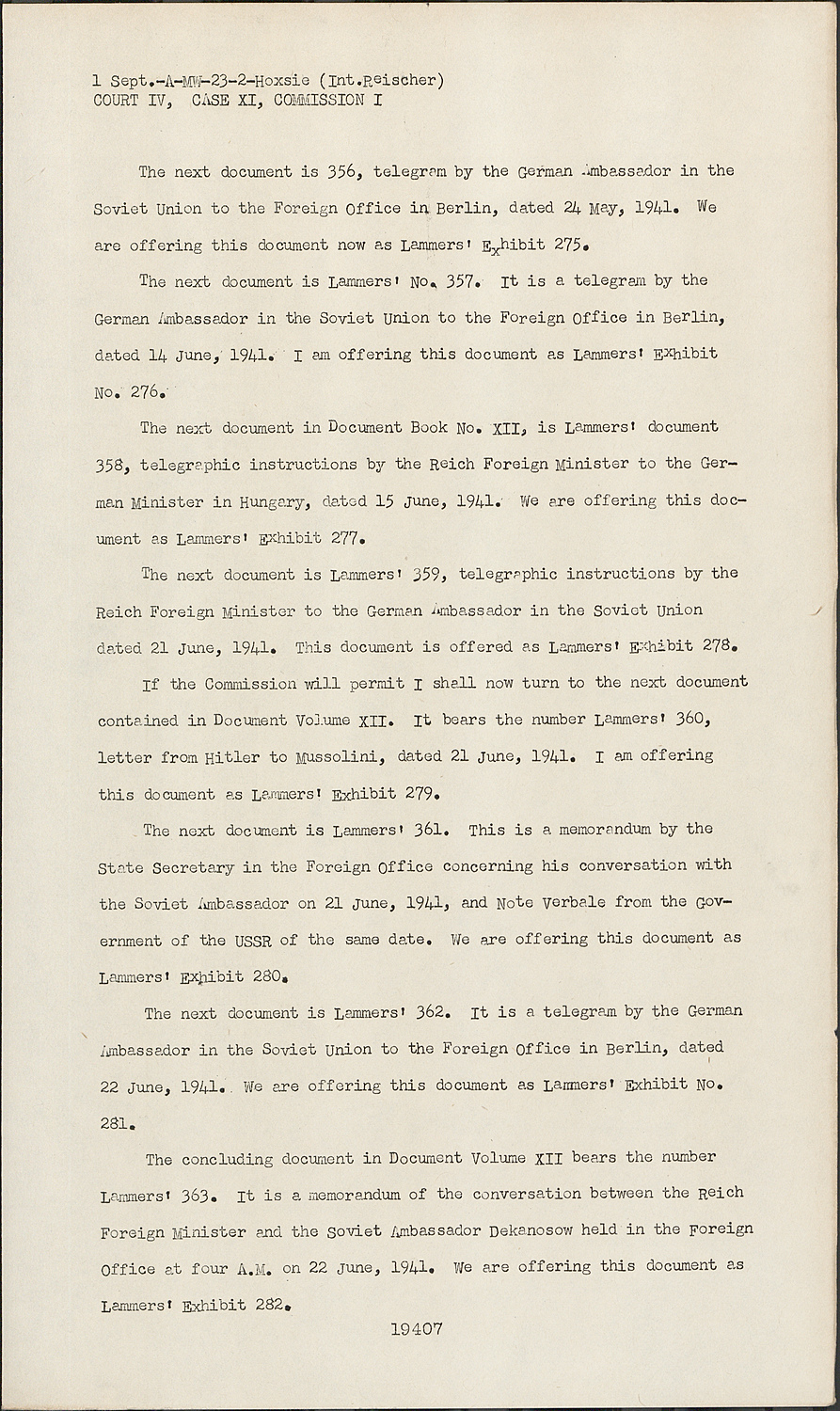
COURT IV, CASE XI, COMMISSION I The next document is 356, telegram by the German Ambassador in the Soviet Union to the Foreign Office in Berlin, dated 24 May, 1941.
We are offering this document now as Lammers' Exhibit 275.
The next document is Lammers' No. 357. It is a telegram by the German Ambassador in the Soviet Union to the Foreign Office in Berlin, dated 14 June, 1941. I am offering this document as Lammers' Exhibit No. 276.
The next document in Document Book No. XII, is Lammers' document 358, telegraphic instructions by the Reich Foreign Minister to the German Minister in Hungary, dated 15 June, 1941. We are offering this document as Lammers' Exhibit 277.
The next document is Lammers' 359, telegraphic instructions by the Reich Foreign Minister to the German ambassador in the Soviet Union dated 21 June, 1941. This document is offered as Lammers' Exhibit 278.
If the Commission will permit I shall now turn to the next document contained in Document Volume XII. It bears the number Lammers' 360, letter from Hitler to Mussolini, dated 21 June, 1941. I am offering this document as Lammers' Exhibit 279.
The next document is Lammers' 361. This is a memorandum by the State Secretary in the Foreign Office concerning his conversation with the Soviet Ambassador on 21 June, 1941, and Note Verbale from the Government of the USSR of the same date. We are offering this document as Lammers' Exhibit 280.
The next document is Lammers' 362. It is a telegram by the German Ambassador in the Soviet Union to the Foreign office in Berlin, dated 22 June, 1941. We are offering this document as Lammers' Exhibit No. 281.
The concluding document in Document Volume XII bears the number Lammers' 363. It is a memorandum of the conversation between the Reich Foreign Minister and the soviet Ambassador Dekanosow held in the Foreign Office at four A.M. on 22 June, 1941. We are offering this document as Lammers' Exhibit 282.
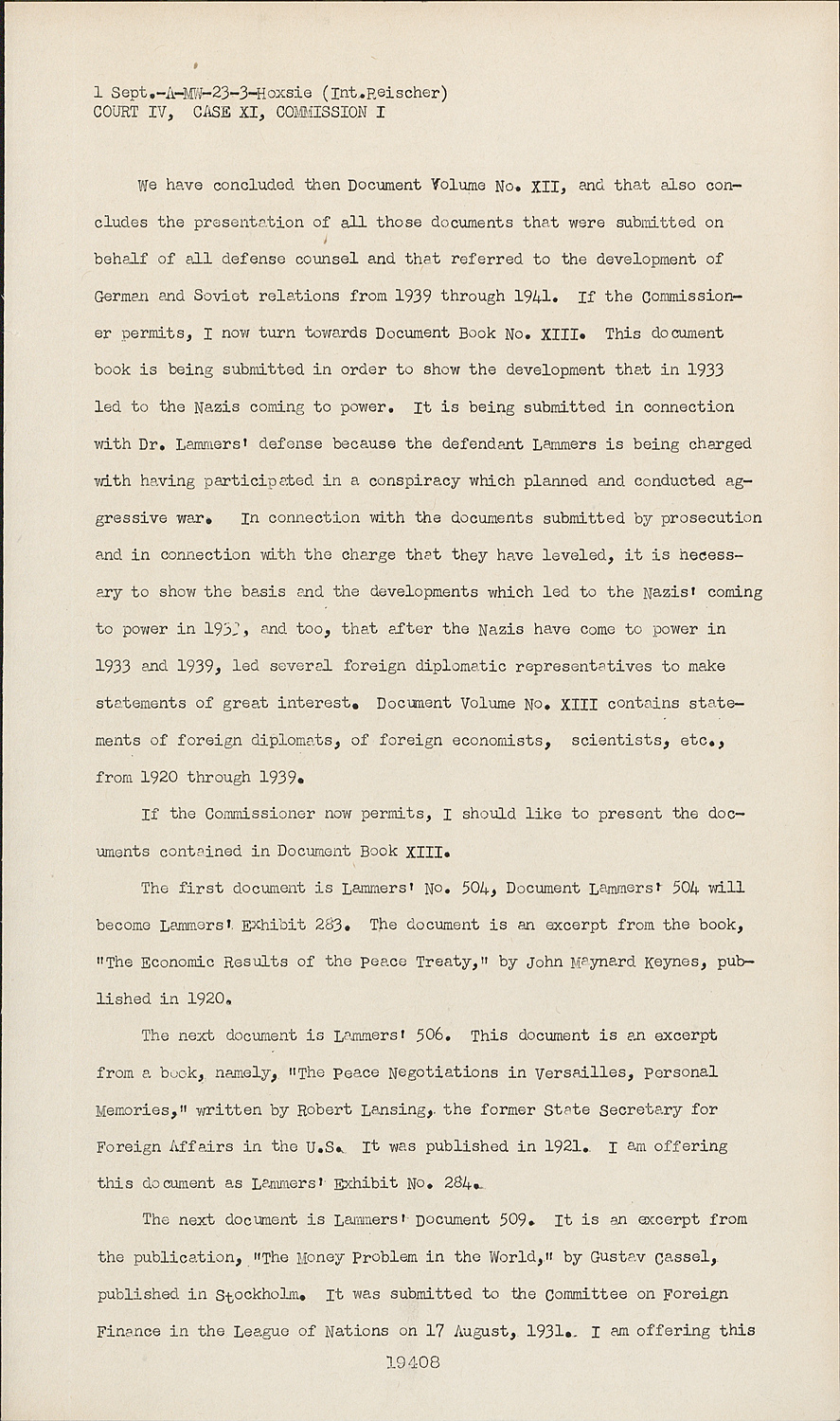
COURT IV, CASE XI, COMMISSION I We have concluded then Document Volume No. XII, and that also concludes the presentation of all those documents that were submitted on behalf of all defense counsel and that referred to the development of German and Soviet relations from 1939 through 1941.
If the Commissioner permits, I now turn towards Document Book No. XIII. This document book is being submitted in order to show the development that in 1933 led to the Nazis coming to power. It is being submitted in connection with Dr. Lammers' defense because the defendant Lammers is being charged with having participated in a conspiracy which planned and conducted aggressive war. In connection with the documents submitted by prosecution and in connection with the charge that they have leveled, it is necessary to show the basis and the developments which led to the Nazis' coming to power in 1932, and too, that after the Nazis have come to power in 1933 and 1939, led several foreign diplomatic representatives to make statements of great interest. Document Volume No. XIII contains statements of foreign diplomats, of foreign economists, scientists, etc., from 1920 through 1939.
If the Commissioner now permits, I should like to present the documents contained in Document Book XIII.
The first document is Lammers' No. 504, Document Lammers' 504 will become Lammers' Exhibit 283. The document is an excerpt from the book, "The Economic Results of the peace Treaty," by John Maynard Keynes, published in 1920.
The next document is Lammers' 506. This document is an excerpt from a book, namely, "The peace Negotiations in Versailles, Personal Memories," written by Robert Lansing, the former State Secretary for Foreign Affairs in the U.S. It was published in 1921. I am offering this document as Lammers' Exhibit No. 284.
The next document is Lammers' Document 509. It is an excerpt from the publication, "The Money Problem in the World," by Gustav Cassel, published in Stockholm. It was submitted to the Committee on Foreign Finance in the League of Nations on 17 August, 1931. I am offering this COURT IV, CASE XI, COMMISSION I document as Lammers' Exhibit 285.
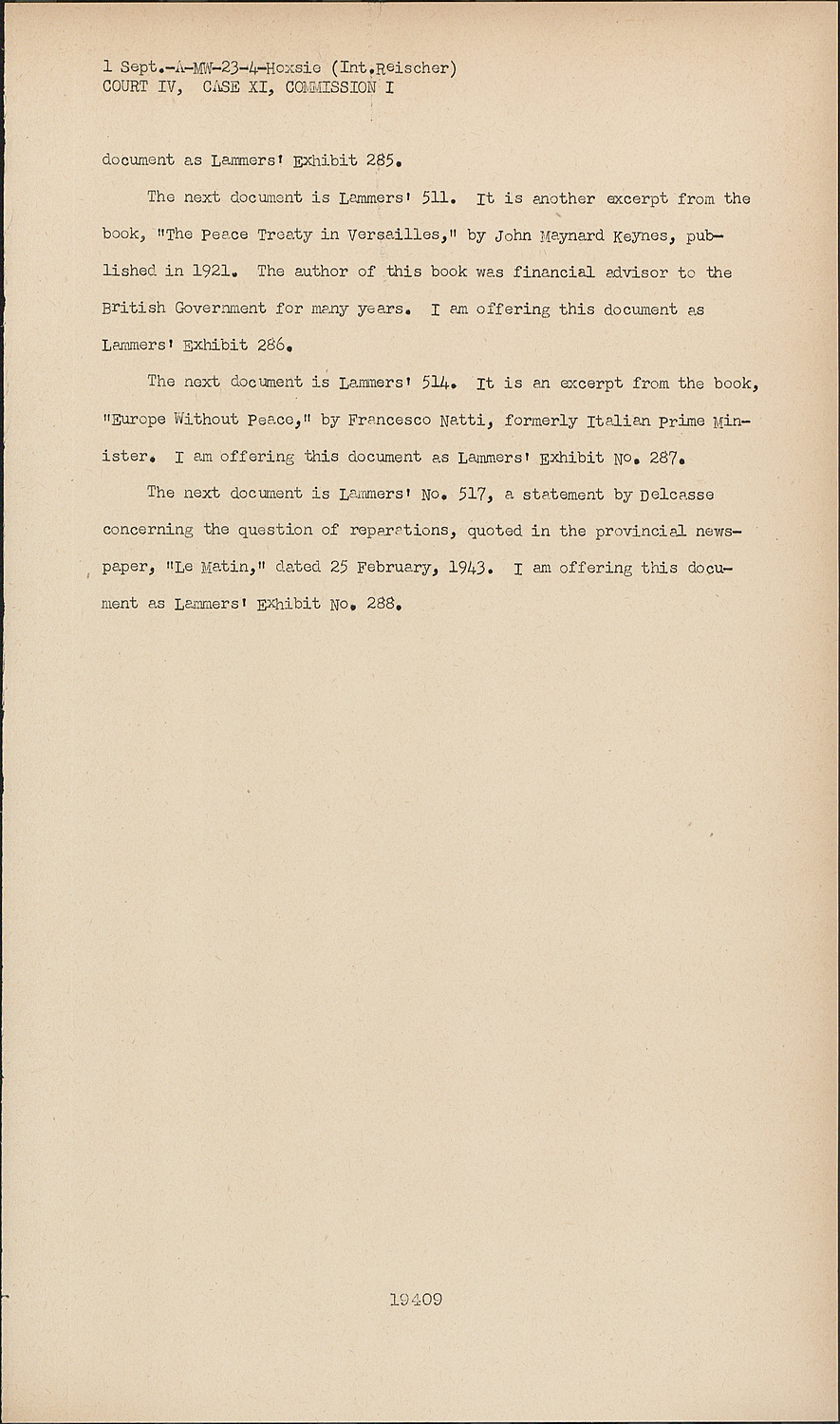
The next document is Lammers' 511. It is another excerpt from the book, "The Peace Treaty in Versailles," by John Maynard Keynes, published in 1921. The author of this book was financial advisor to the British Government for many years. I am offering this document as Lammers' Exhibit 286.
The next document is Lammers' 514. It is an excerpt from the book, "Europe Without Peace," by Francesco Natti, formerly Italian Prime Minister. I am offering this document as Lammers' Exhibit No. 287.
The next document is Lammers' No. 517, a statement by Delcasse concerning the question of reparations, quoted in the provincial newspaper, "Le Matin," dated 25 February, 1943. I am offering this document as Lammers' Exhibit No. 288.
DR. SEIDL:The next document is Lammers 519, a statement of the British Treasurer, Phillip Snowden in reference to the question of reparations dated 2 September 1929. I am offering this document as Lammers' exhibit 289.
The next document is Lammers 520. It is an excerpt from the English Newspaper "The Manchester Guardian" dated 1931. I am offering this document as Lammers' exhibit 290.
The next document is Lammers 522. It is an excerpt from a speech by Senator Willian E. Borah, chairman of the Foreign Affairs Committee of the U.S. Senate dated 1931. I am offering this document as Lammers exhibit 291.
The next document is Lammers 523. It is an excerpt from an article by Professor Gustav Cassel, Stockholn in "Swenska Dagbladet" dated 1931. I am offering this document as Lammers exhibit 292.
We are coming to the next document, Lammers 525, an excerpt from the expert opinion of the expert Committee that was to do research on the German financial situation, the so-called, "Layton Report". This Layton Report was submitted to the League of Nations. I am offering this document as Lammers exhibit 293.
The next document is Lammers 527. It is an excerpt from a speech by Senator William E. Borah, which he broadcase in his capacity as chairman of the Foreign Affairs Committee of the Senate in 1931. We are offering this document as Lammers exhibit 294.
The next document is Lammers 530. It is an excerpt from the periodical, "The Nation" from 1938. I am offering this document as Lammers exhibit 295.
The next document is Lammers 532. It is an excerpt from an article of the Dutch Professor for International law, Dr. C.G. van Riel, published in 1931. I am offering this document as Lammers exhibit 296.
The next document is Lammers 533 an excerpt from an article by John Foster Dulles, published in 1931. It concerns the -- I probably don't need to say anything about the importance ofthis man who stands active in political life. I am offering this document as Lammers' exhibit 297.
The next document bears the number Lammers 534. It is an excerpt from Court 4, Case 11 - Commission I the book, "La Patrie Humaine" by Victor Marguerite published in 1931.
I an offering this document as Lammers' exhibit 298.
The next document is Lammers 537. It is an excerpt from the book, "The Truth Concerning Reparations and War Debts" by David Lloyd George published in 1932. I am offering this document as Lammers exhibit 299.
The next document is Lammers No. 540, a statement concerning the colonial question by Teawater, High Commissioner for South Africa in 1937. I am offering this document as Lammers' exhibit 300.
The next document is Lammers 541, an excerpt from "The Manchester Guardian" dated 6 October 1937. I am offering this document as Lammers' exhibit 301.
The next document is Lammers 543. It is an excerpt from a speech of the British Colonial Minister, Ornsby Gore dated 21 July 1937. I am submitting this document as Lammers' exhibit 302.
The next document is Lammers 544, an excerpt from the "Times" with an addition of Lord Allen of Hurtwood dated 16 October 1937. I am submitting it as Lammers' exhibit 303.
The next document is Lammers 546. It is an excerpt from the book, "The Origin of the the World War" by the American Professor Bradshaw Fay published in 1934. I am offering this document as Lammers' exhibit 304.
The next three documents are interconnected, namely, they are the documents Lammers 549-A, 549-3, 549C, an excerpt from the Economic newspaper, "The Wirschaftszeitung" of 2 May 1947 titled "The Lessons of the 1930's". Two pictures are attached to that I should like to add that this article is submitted in evidence mainly because an essential part of this article is those two pictures which are extremely instructive and add importance for the understanding of the situation that prevailed in 1932 and 1933 and which finally led to the appointment of Hitler as Reich Chancellor by Aindenburg. We have had a number of photostats made and will furnish them to the Tribunal as well as to the Prosecution. These three documents will become one exhibit and will be under the exhibit No. Lammers 305.
This doncludes the presentation of documents contained in document Court 4, Case 11 - Commission I volume XIII and also concludes for the time being the presentation of documents an behalf of Dr. Lammers.
MR. LEWIS:The Prosecution with respect to Defense Book XIII for the defendant Lammers objects strongly to each and every document offered by the Defese as containedin exhibit 283 to 305 inclusive therein on the following grounds. Firstly, we believe the Defense is taking advantage of the Tribunal in not following its clearly set down rules as to the kind of evidence in documentary form which is permissible before this Tribunal. All of those documents Represent excerpts or dirivatives from books, newspapers, treatises, essays, radio talks, private in nature, completely unofficial in source and highly incompetent for the time and the issues of the case against the defendant Lammers in this Tribunal. To break down what the Defense is here trying to do it can be shown to this Tribunal that they have brought in World War I and brought it through books published in 1920 and '21, They have brought in British newspapers like "The Manchester Guardian" and the "London Tines." They have brought in a very leftist magazine, "The Nation" published in America. They have brought in radio speeches by an isolationist Senator which are in no way official. They night as well have brought in speeches made by the man on the street in America in 1930 or '31. There have been books brought in in novel form for instance the Frenchman's book written by Marguerite which was a best seller in France. This Tribunal has plenty of reading material already as far as authoritative reference are concerned. With respect to the Third Reich we have then right here in this building. If any further library were necessary surely the members of our Tribunal can obtain better and more official books than the onesc ntained in the Defense Book XIII. The Prosecution therefore respectfully requests that the Tribunal strike each and every document from book XIII so that there is no no Defense Document Book No. XIII.
DR. SEIDL:I already stated before why we included these documents in document bolume XIII and I have nothing to add to this statement.
Court 4, Case 11 - Commission I
MR. LEWIS:I might add one thing that has just been brought up by Defense Counsel that is arguing the objections to the documents we are not arguing whether Dulles is well known or whether Churchill is a British Statesman, we are arguing just the form of the particular document without reference to who wrote it and why he wrote it. Under the rules of our Tribunal these documents are not permissible as evidentiary papers.
DR. SEIDL:Before Military Tribunal IV as well as before another Tribunal documents of this nature were admitted. Defense has waived their rights to include statements of some statesmen and diplomats, however, the opinions of men as they are contained in document volume XIII are quite material to find out the truth and upon which to base a fair judgment.
THE COMMISSIONER:It is four-thirty now and time to recess. We shall be in recess until nine-thirty tomorrow.
(A recess was taken until 0930 hours 2 September 1948.)
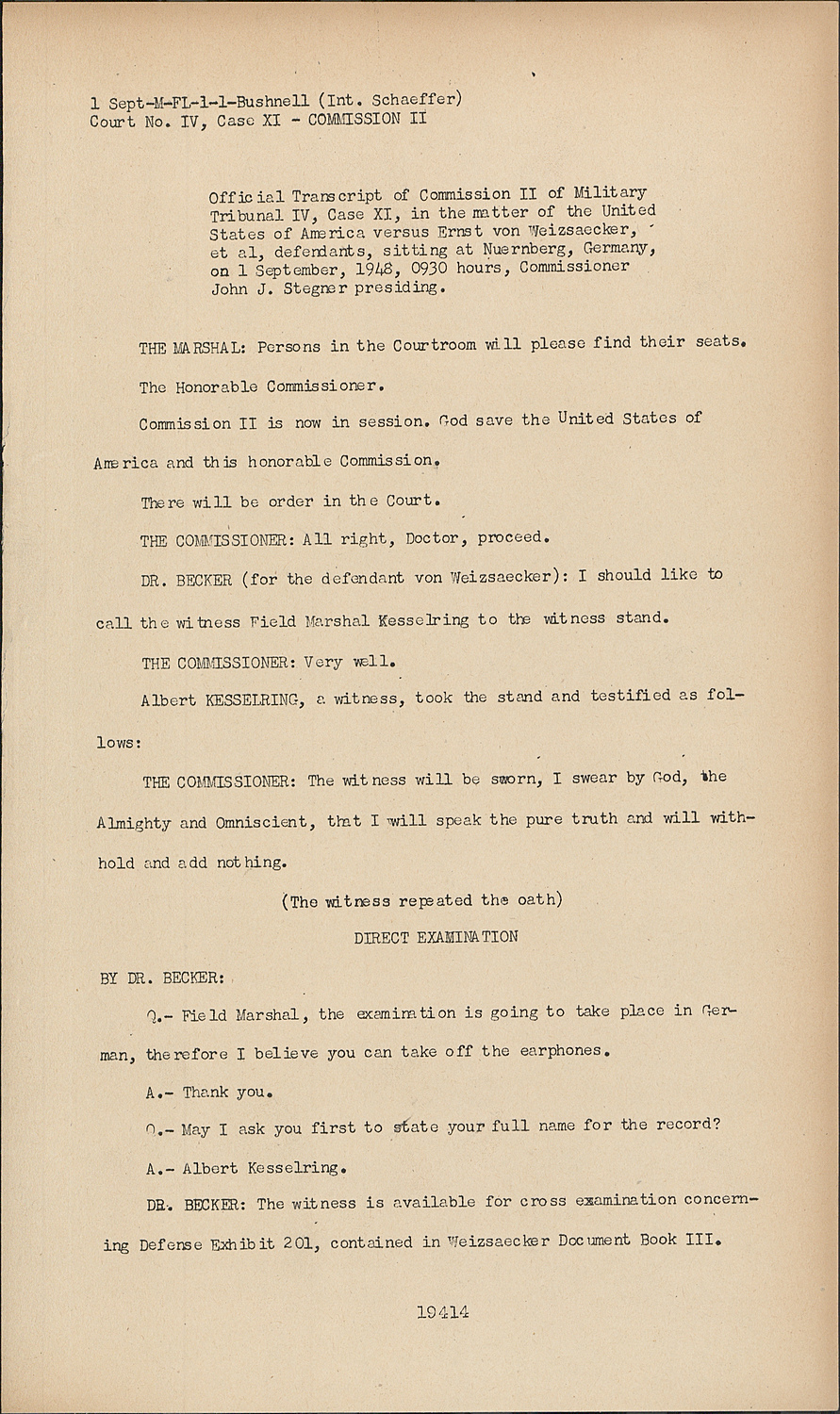
Court No. IV, Case XI - COMMISSION II Official Transcript of Commission II of Military Tribunal IV, Case XI, in the matter of the United States of America versus Ernst von Weizsaecker, et al, defendants, sitting at Nuernberg, Germany, on 1 September, 1948, 0930 hours, Commissioner John J. Stegner presiding.
THE MARSHAL:Persons in the Courtroom will please find their seats.
The Honorable Commissioner.
Commission II is now in session. God save the United States of America and this honorable Commission.
There will be order in the Court.
THE COMMISSIONER:All right, Doctor, proceed.
DR.BECKER (for the defendant von Weizsaecker): I should like to call the witness Field Marshal Kesselring to the witness stand.
THE COMMISSIONER:Very well.
Albert KESSELRING, a witness, took the stand and testified as follows!
THE COMMISSIONER:The witness will be sworn, I swear by God, the Almighty and Omniscient, that I will speak the pure truth and will withhold and add nothing.
(The witness repeated the oath)
DIRECT EXAMINATION BY DR. BECKER:
Q.- Field Marshal, the examination is going to take place in German, therefore I believe you can take off the earphones.
A.- Thank you.
Q.- May I ask you first to state your full name for the record?
A.- Albert Kesselring.
DR. BECKER:The witness is available for cross examination concerning Defense Exhibit 201, contained in Weizsaecker Document Book III.
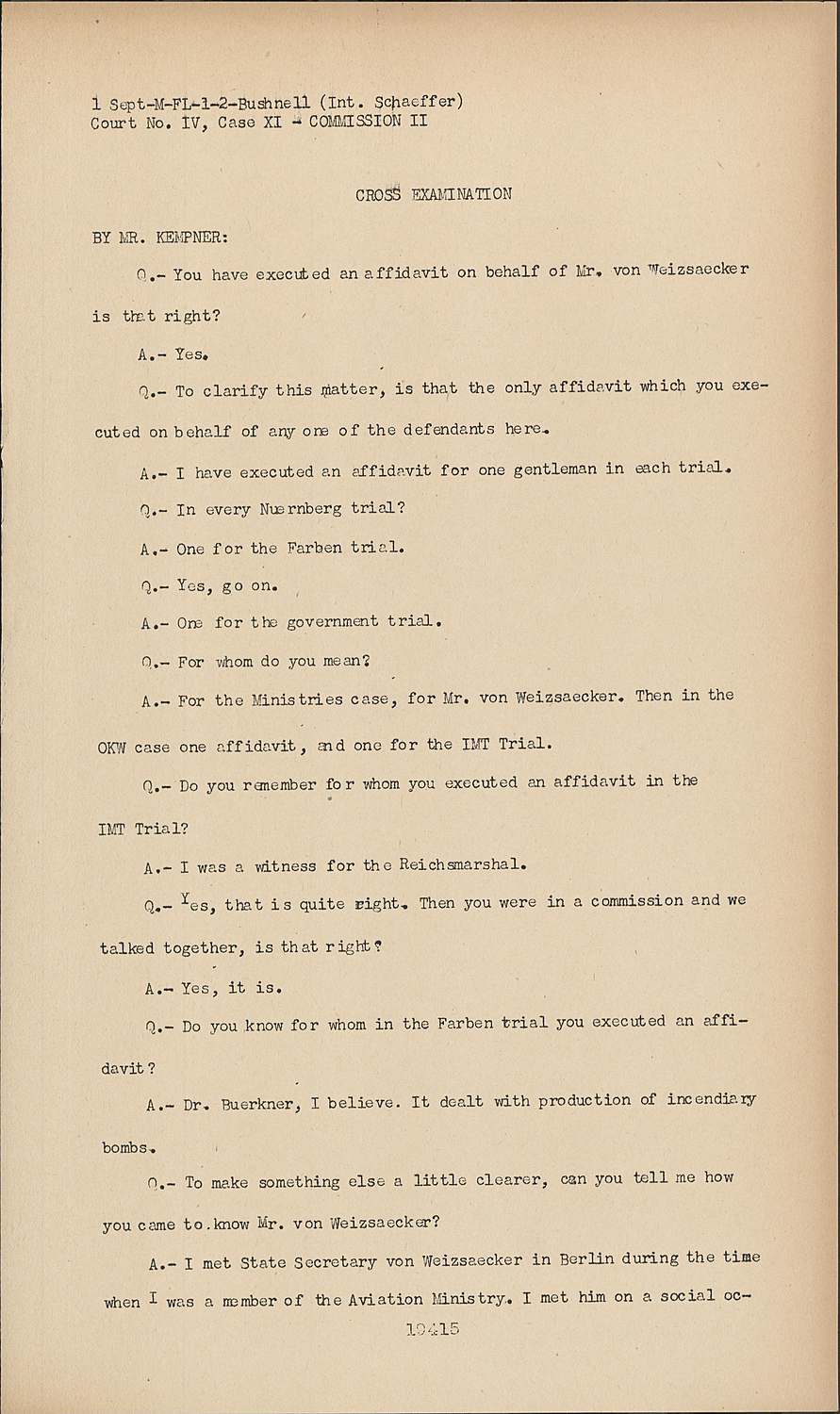
Court No. IV, Case XI - COMMISSION II CROSS EXAMINATION BY MR. KEMPNER:Q.- You have executed an affidavit on behalf of Mr. von Weizsaecker is that right?
A.- Yes.
Q.- To clarify this matter, is that the only affidavit which you executed on behalf of any one of the defendants here.
A.- I have executed an affidavit for one gentleman in each trial.
Q.- In every Nuernberg trial?
A.- One for the Farben trial.
Q.- Yes, go on.
A.- One for the government trial.
Q.- For whom do you mean?
A.- For the Ministries case, for Mr. von Weizsaecker. Then in the OKW case one affidavit, end one for the IMT Trial.
Q.- Do you remember for whom you executed an affidavit in the IMT Trial?
A.- I was a witness for the Reichsmarshal.
Q.- Yes, that is quite right. Then you were in a commission and we talked together, is that right?
A.- Yes, it is.
Q.- Do you know for whom in the Farben trial you executed an affidavit?
A.- Dr. Buerkner, I believe. It dealt with production of incendiary bombs.
Q.- To make something else a little clearer, can you tell me how you came to know Mr. von Weizsaecker?
A.- I met State Secretary von Weizsaecker in Berlin during the time when I was a member of the Aviation Ministry. I met him on a social oc Court No. IV, Case XI - COMMISSION II casion.
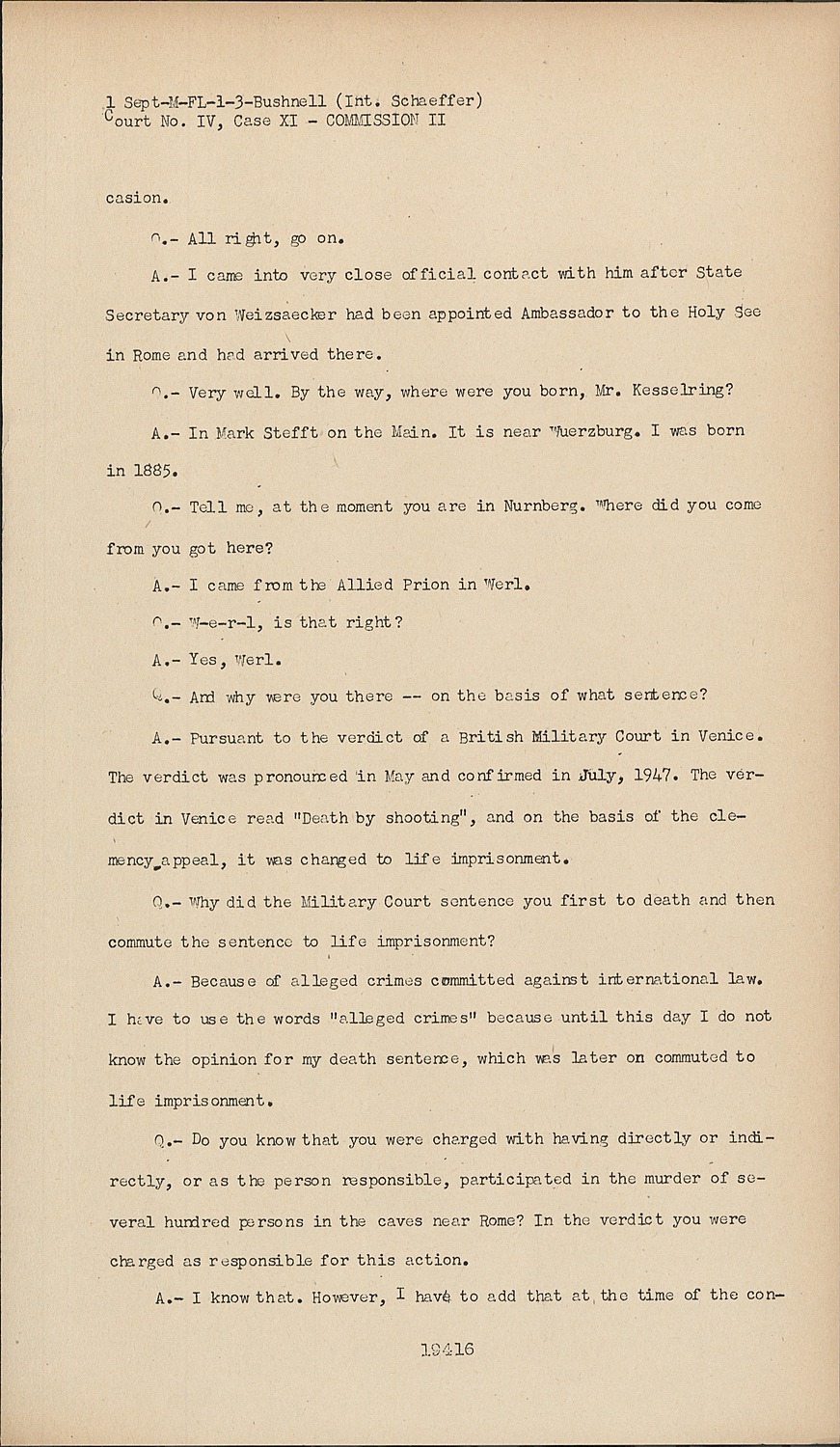
Q.- All right, go on.
A.- I came into very close official contact with him after State Secretary von Weizsaecker had been appointed Ambassador to the Holy See in Rome and had arrived there.
Q.- Very well. By the way, where were you born, Mr. Kesselring?
A.- In Mark Stefft on the Main. It is near Wuerzburg. I was born in 1885.
Q.- Tell me, at the moment you are in Nurnberg. Where did you come from you got here?
A.- I came from the Allied Prion in Werl.
Q.- W-e-r-l, is that right?
A.- Yes, Werl.
Q.- And why were you there -- on the basis of what sentence?
A.- Pursuant to the verdict of a British Military Court in Venice. The verdict was pronounced in May and confirmed in July, 1947. The verdict in Venice read "Death by shooting", and on the basis of the clemency appeal, it was changed to life imprisonment.
Q.- Why did the Military Court sentence you first to death and then commute the sentence to life imprisonment?
A.- Because of alleged crimes committed against international law. I have to use the words "alleged crimes" because until this day I do not know the opinion for my death sentence, which was later on commuted to life imprisonment.
Q.- Do you know that you were charged with having directly or indirectly, or as the person responsible, participated in the murder of several hundred persons in the caves near Rome? In the verdict you were charged as responsible for this action.
A.- I know that. However, I have to add that at the time of the con Court No. IV, Case XI - COMMISSION II clusion of the trial, I expressed very clearly and unequivocably or had it expressed that the conclusion of the prosecutor was incorrect.
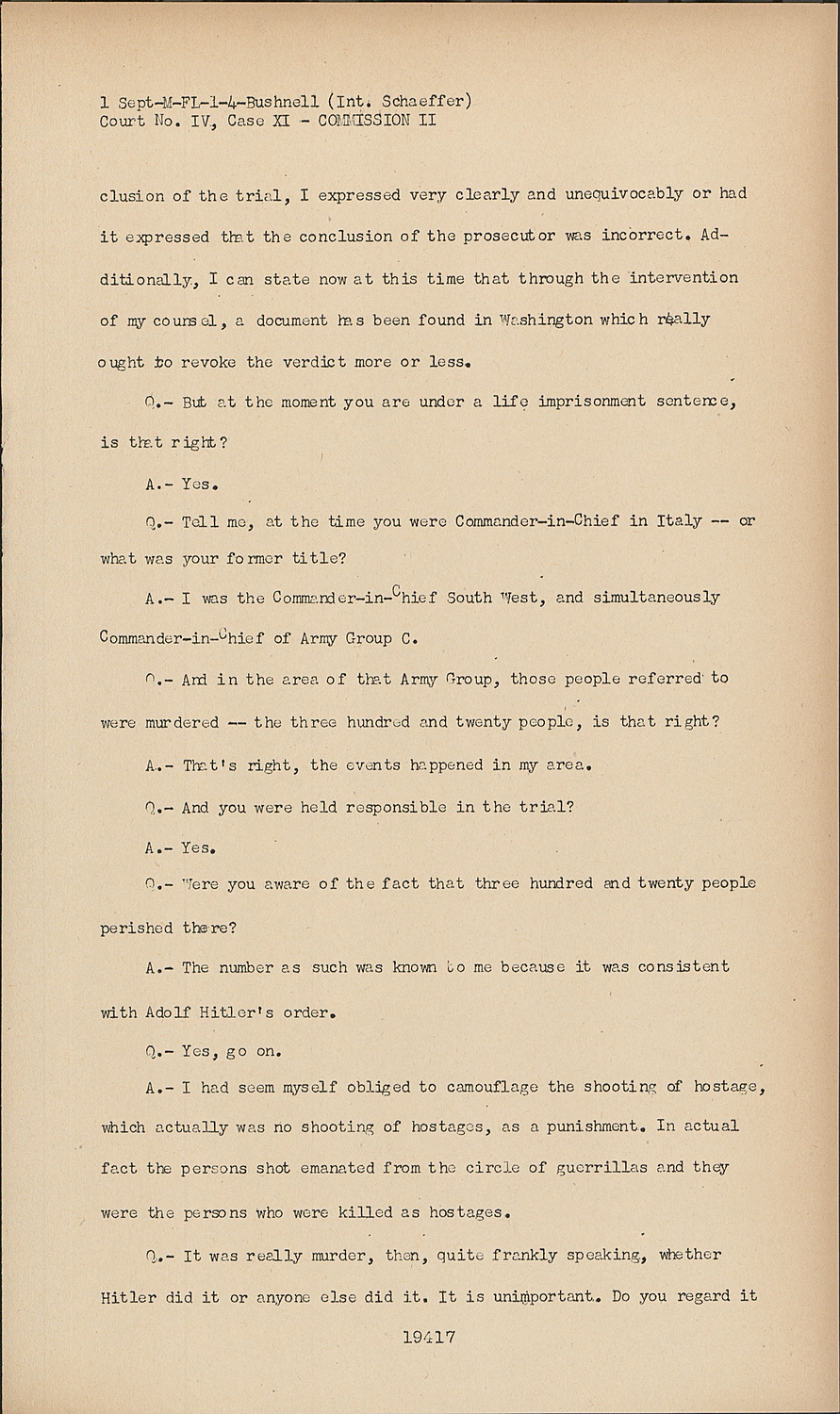
Additionally, I can state now at this time that through the intervention of my counsel, a document has been found in Washington which really ought to revoke the verdict more or less.
Q.- But at the moment you are under a life imprisonment sentence, is that right?
A.- Yes.
Q.- Tell me, at the time you were Commander-in-Chief in Italy -- or what was your former title?
A.- I was the Commander-in-Chief South West, and simultaneously Commander-in-Chief of Army Group C.
Q.- And in the area of that Army Group, those people referred to were murdered -- the three hundred and twenty people, is that right?
A.- That's right, the events happened in my area.
Q.- And you were held responsible in the trial?
A.- Yes.
Q.- Were you aware of the fact that three hundred and twenty people perished there?
A.- The number as such was known lo me because it was consistent with Adolf Hitler's order.
Q.- Yes, go on.
A.- I had seem myself obliged to camouflage the shooting of hostage, which actually was no shooting of hostages, as a punishment. In actual fact the persons shot emanated from the circle of guerrillas and they were the persons who were killed as hostages.
Q.- It was really murder, then, quite frankly speaking, whether Hitler did it or anyone else did it. It is unimportant. Do you regard it Court No. IV, Case XI - COMMISSION II as murder today?