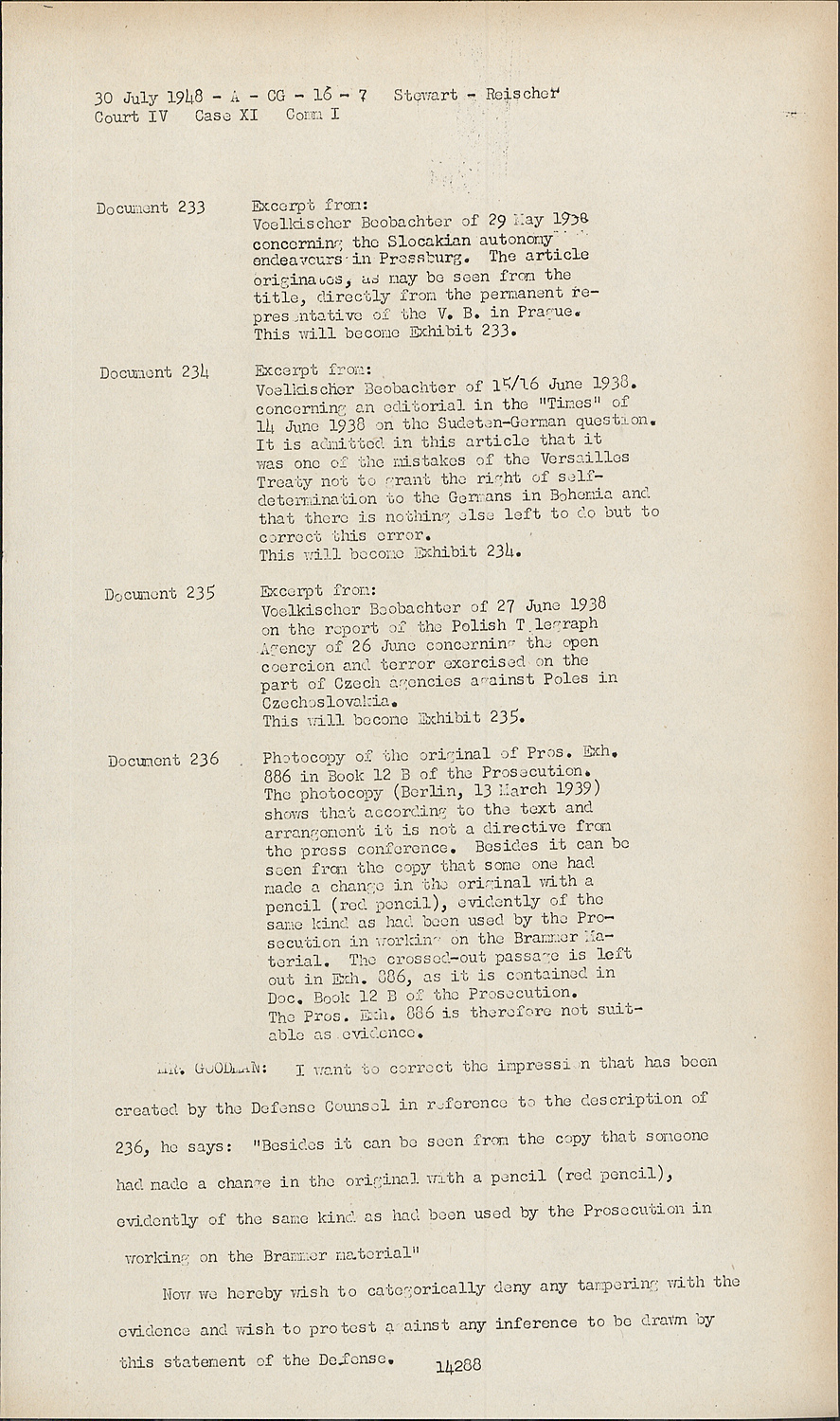
Court IV Case XI Comm I Document 233 Excerpt from:
Voelkischer Beobachter of 29 May 1958 concerning the Slocakian autonomy endeavours in Pressburg.
The article originates, as may be seen from the title, directly from the permanent re presentative of the V. B. in Prague.
This will become Exhibit 233. Document 234 Excerpt from:
Voelkischer Beobachter of 15/16 June 1938.
concerning an editorial in the "Times" of 14 June 1938 on the Sudeten-German question.
It is admitted in this article that it was one of the mistakes of the Versailles Treaty not to grant the right of self determination to the Germans in Bohemia and that there is nothing else left to do but to correct this error.
This will become Exhibit 234. Document 235 Excerpt from:
Voelkischer Beobachter of 27 June 1938 on the report of the Polish Telegraph Agency of 26 June concerning the open coercion and terror exorcised on the part of Czech agencies against Poles in Czechoslovakia.
This will become Exhibit 235. Document 236 Photocopy of the original of Pros. Exh.
886 in Book 12 B of the Prosecution.
The photocopy (Berlin, 13 March 1939) shows that according to the text and arrangement it is not a directive from the press conference.
Besides it can be seen free the copy that some one had made a change in the original with a pencil (red pencil), evidently of the same kind as had been used by the Pro secution in working on the Brammer ma terial.
The crossed-out passage is left out in Exh.
886, as it is contained in Doc.
Book 12 B of the Prosecution.
The Pros. Exh. 886 is therefore not suit able as evidence.
MR. GOODMAN:I want to correct the impression that has been created by the Defense Counsel in reference to the description of 236, he says: "Besides it can be seen from the copy that someone had made a change in the original with a pencil (red pencil), evidently of the same kind as had been used by the Prosecution in working on the Brammer material" Now we hereby wish to categorically deny any tampering with the evidence and wish to protest against any inference to be drawn by this statement of the Defense.
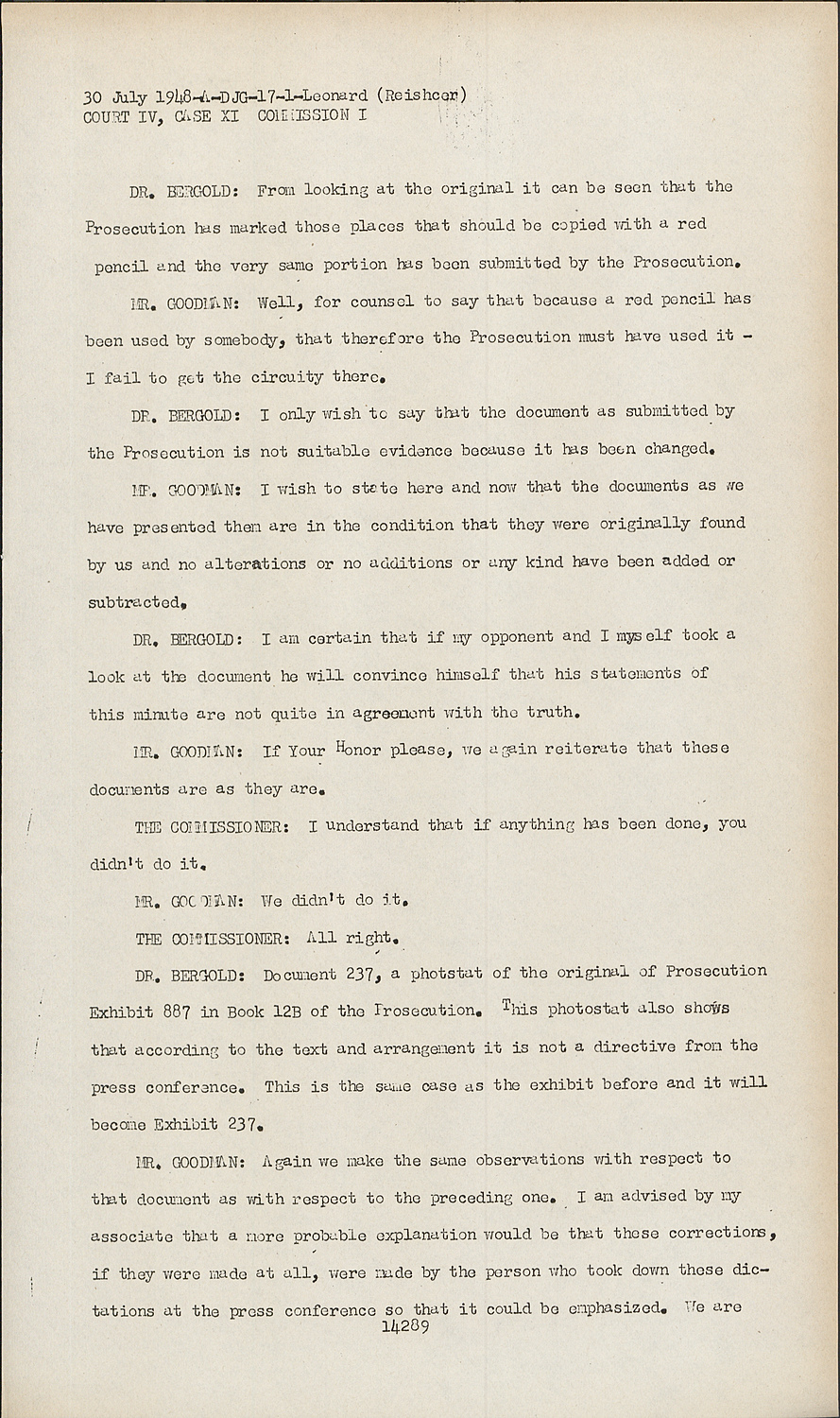
COURT IV, CASE XI COMMISSION I
DR. BERGOLD:From looking at the original it can be seen that the Prosecution has marked those places that should be copied with a red pencil and the very same portion has been submitted by the Prosecution.
MR. GOODMAN:Well, for counsel to say that because a red pencil has been used by somebody, that therefore the Prosecution must have used it I fail to get the circuity there.
DR. BERGOLD:I only wish to say that the document as submitted by the Prosecution is not suitable evidence because it has been changed.
MR. GOODMAN:I wish to state here and now that the documents as we have presented then are in the condition that they were originally found by us and no alterations or no additions or any kind have been added or subtracted.
DR. BERGOLD:I am certain that if my opponent and I myself took a look at the document he will convince himself that his statements of this minute are not quite in agreement with the truth.
MR. GOODMAN:If Your Honor please, we again reiterate that these documents are as they are.
THE COMMISSIONER:I understand that if anything his been done, you didn't do it.
MR. GOODMAN:We didn't do it.
THE COMMISSIONER:All right.
DR. BERGOLD:Document 237, a photstat of the original of Prosecution Exhibit 887 in Book 12B of the Prosecution. This photostat also shows that according to the text and arrangement it is not a directive from the press conference. This is the same case as the exhibit before and it will become Exhibit 237.
MR. GOODMAN:Again we make the same observations with respect to that document as with respect to the preceding one. I am advised by my associate that a more probable explanation would be that these corrections if they were made at all, were made by the person who took down these dictations at the press conference so that it could be emphasized. We are COURT IV, CASE XI COMMISSION I using that term argumentatively, it is true, but that's our best belief under the circumstances.
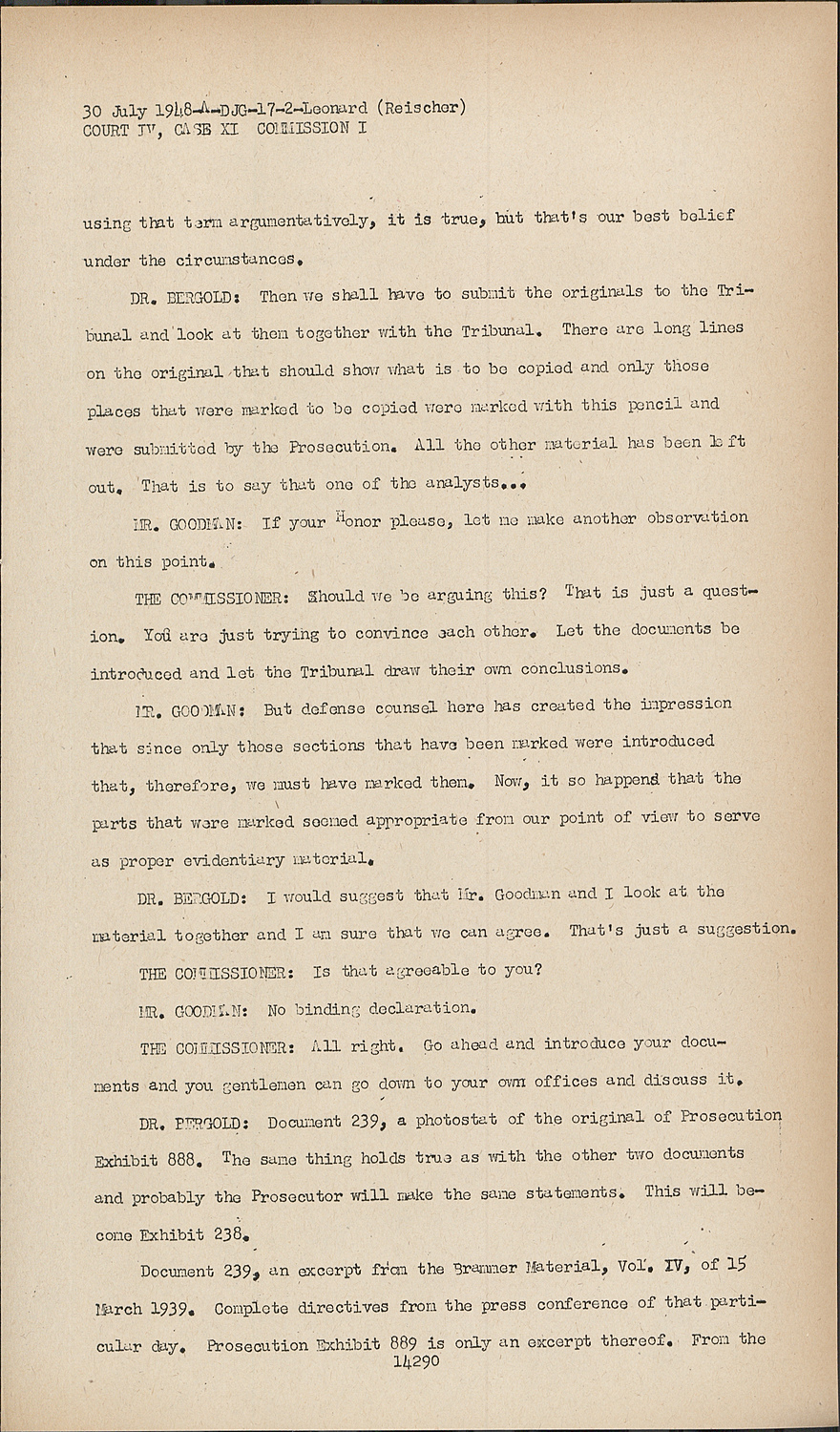
DR. BERGOLD:Then we shall have to submit the originals to the Tribunal and look at them together with the Tribunal. There are long lines on the original that should show what is to be copied and only those places that were marked to be copied were marked with this pencil and were submitted by the Prosecution. All the other material has been left out. That is to say that one of the analysts...
MR. GOODMAN:If your Honor please, let me make another observation on this point.
THE COMMISSIONER:Should we be arguing this? That is just a question. You are just trying to convince each other. Let the documents be introduced and let the Tribunal draw their own conclusions.
MR. GOODMAN:But defense counsel here has created the impression that since only those sections that have been marked were introduced that, therefore, we must have marked them. Now, it so happens that the parts that ware marked seemed appropriate from our point of view to serve as proper evidentiary material.
DR. BERGOLD:I would suggest that Mr. Goodman and I look at the material together and I am sure that we can agree. That's just a suggestion.
THE COMMISSIONER:Is that agreeable to you?
MR. GOODMAN:No binding declaration.
THE COMMISSIONER:All right. Go ahead and introduce your documents and you gentlemen can go down to your own offices and discuss it.
DR. BERGOLD:Document 239, a photostat of the original of Prosecution Exhibit 888. The same thing holds true as with the other two documents and probably the Prosecutor will make the same statements. This will become Exhibit 238.
Document 239, an excerpt from the Brammer Material, Vol. IV, of 15 March 1939. Complete directives from the press conference of that particular day. Prosecution Exhibit 889 is only an excerpt thereof. From the COURT IV, CASE XI COMMISSION I complete document it may be seen that this concerns directives signed by Dertinger.
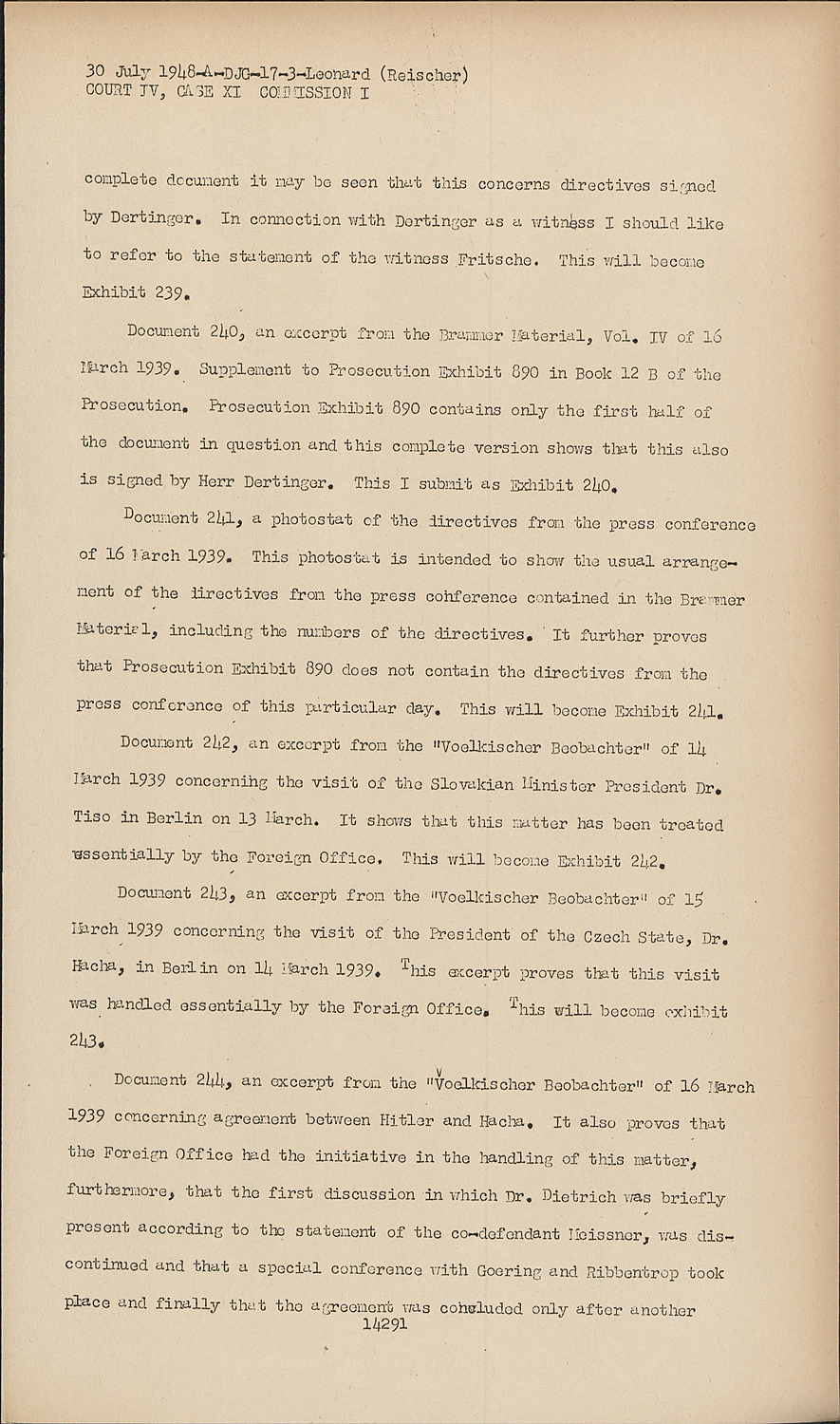
In connection with Dertinger as a witness I should like to refer to the statement of the witness Fritsche. This will become Exhibit 239.
Document 240, an excerpt from the Brammer Material, Vol. IV of 16 March 1939. Supplement to Prosecution Exhibit 890 in Book 12 B of the Prosecution. Prosecution Exhibit 890 contains only the first half of the document in question and this complete version shows that this also is signed by Herr Dertinger. This I submit as Exhibit 240.
Document 241, a photostat of the directives from the press conference of 16 March 1939. This photostat is intended to show the usual arrangement of the directives from the press conference contained in the Brammer Materiel, including the numbers of the directives. It further proves that Prosecution Exhibit 890 does not contain the directives from the press conference of this particular day. This will become Exhibit 241.
Document 242, an excerpt from the "Voelkischer Beobachter" of 14 March 1939 concerning the visit of the Slovakian Minister President Dr. Tiso in Berlin on 13 March. It shows that this matter has been treated essentially by the Foreign Office. This will become Exhibit 242.
Document 243, an excerpt from the "Voelkischer Beobachter" of 15 March 1939 concerning the visit of the President of the Czech State, Dr. Hacha, in Berlin on 14 March 1939. This excerpt proves that this visit was handled essentially by the Foreign Office. This will become exhibit 243.
Document 244, an excerpt from the "Voelkischer Beobachter" of 16 March 1939 concerning agreement between Hitler and Hacha. It also proves that the Foreign Office had the initiative in the handling of this matter, furthermore, that the first discussion in which Dr. Dietrich was briefly present according to the statement of the co-defendant Meissner, was discontinued and that a special conference with Goering and Ribbentrop took place and finally that the agreement was concluded only after another COURT IV, CASE XI COMMISSION I conference with Hitler.
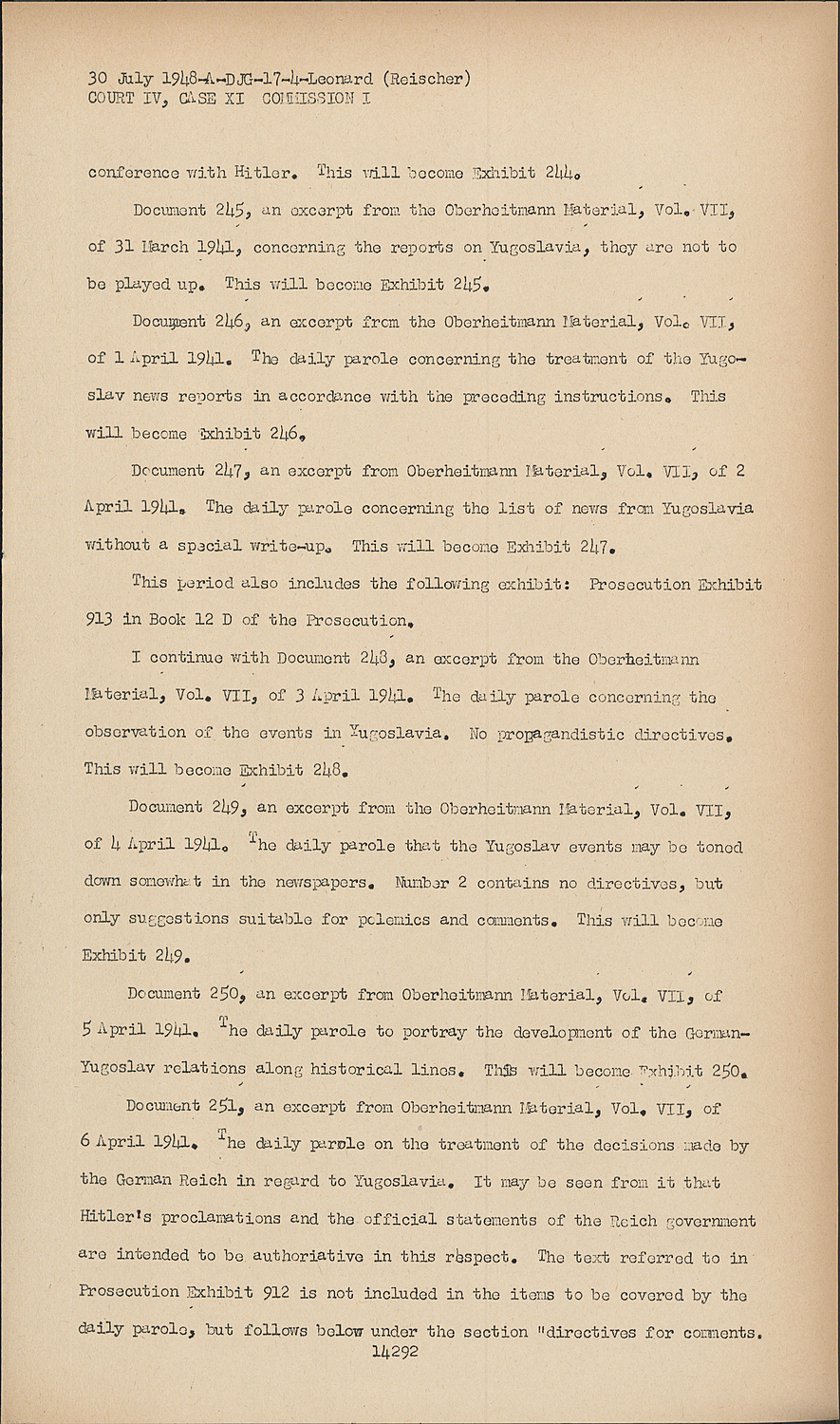
This will become Exhibit 244.
Document 245, an excerpt Iron the Oberheitmann Material, Vol. VII, of 31 March 1941, concerning the reports on Yugoslavia, they are not to be played up. This will become Exhibit 245.
Document 246, an excerpt from the Oberheitmann Material, Vol. VII, of 1 April 1941. The daily parole concerning the treatment of the Yugoslav news reports in accordance with the preceding instructions. This will become Exhibit 246.
Document 247, an excerpt from Oberheitmann Material, Vol. VII, of 2 April 1941. The daily parole concerning the list of news from Yugoslavia without a special write-up. This will become Exhibit 247.
This period also includes the following exhibit: Prosecution Exhibit 913 in Book 12 D of the Prosecution.
I continue with Document 243, an excerpt from the Oberheitmann Material, Vol. VII, of 3 April 1941. The daily parole concerning the observation of the events in Yugoslavia. No propagandistic directives. This will become Exhibit 248.
Document 249, an excerpt from the Oberheitmann Material, Vol. VII, of 4 April 1941. The daily parole that the Yugoslav events may be toned down somewhat in the newspapers. Number 2 contains no directives, but only suggestions suitable for polemics and comments. This will become Exhibit 249.
Document 250, an excerpt from Oberheitmann Material, Vol. VII, of 5 April 1941. The daily parole to portray the development of the GermanYugoslav relations along historical lines. This will become Exhibit 250.
Document 251, an excerpt from Oberheitmann Material, Vol. VII, of 6 April 1941. The daily parole on the treatment of the decisions made by the German Reich in regard to Yugoslavia. It may be seen from it that Hitler's proclamations and the official statements of the Reich government are intended to be authoriative in this respect. The text referred to in Prosecution Exhibit 912 is not included in the items to be covered by the daily parole, but follows below under the section "directives for cements.
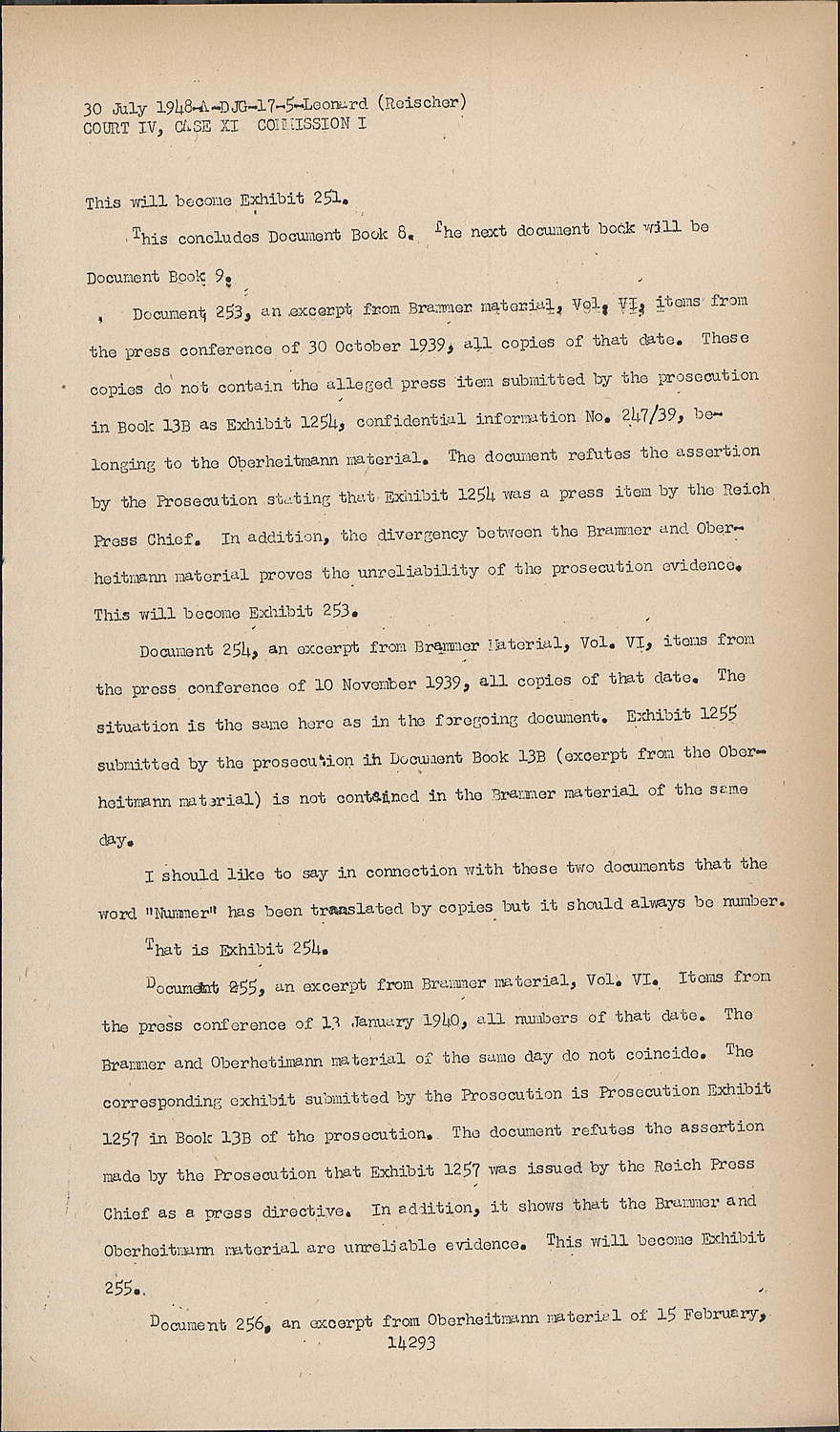
COURT IV, CASE XI COMMISSION I This will become Exhibit 251.
This concludes Document Book 8. The next document book will be Document Book 9.
Document 253, an excerpt from Brammer material, Vol. VI, items from the press conference of 30 October 1939, all copies of that date. These copies do not contain the alleged press item submitted by the prosecution in Book 13B as Exhibit 1254, confidential information No. 247/39, belonging to the Oberheitmann material. The document refutes the assertion by the Prosecution stating that Exhibit 1254 was a press item by the Reich Press Chief. In addition, the divergency between the Brammer and Oberheitmann material proves the unreliability of the prosecution evidence. This will become Exhibit 253.
Document 254, an excerpt from Brammer Material, Vol. VI, items from the press conference of 10 November 1939, all copies of that date. The situation is the same here as in the foregoing document. Exhibit 1255 submitted by the prosecution in Document Book 13B (excerpt from the Oberheitmann material) is not contained in the Brammer material of the same day.
I should like to say in connection with these two documents that the word "Nummer" has been translated by copies but it should always be number.
That is Exhibit 254.
Document 255, an excerpt from Brammer material, Vol. VI. Items from the press conference of 13 January 1940, all numbers of that date. The Brammer and Oberhetimann material of the same day do not coincide. The corresponding exhibit submitted by the Prosecution is Prosecution Exhibit 1257 in Book 13B of the prosecution. The document refutes the assertion made by the Prosecution that Exhibit 1257 was issued by the Reich Press Chief as a press directive. In addition, it shows that the Brammer and Oberheitmann material are unreliable evidence. This will become Exhibit 255.
Document 256, an excerpt from Oberheitmann material of 15 February, COURT IV, CASE XI COMMISSION I 1940, all items of this day.
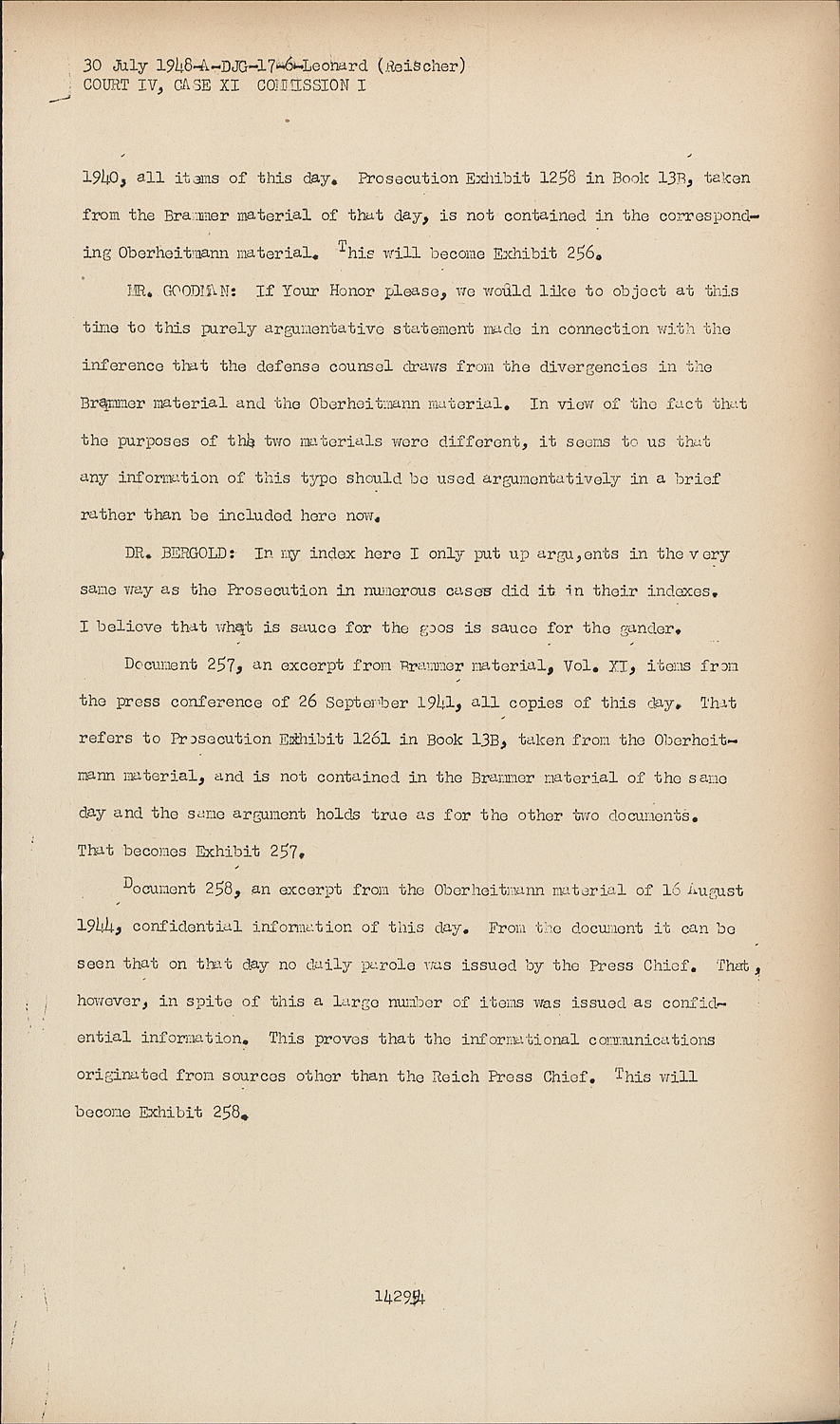
Prosecution Exhibit 1258 in Book 13B, taken from the Brammer material of that day, is not contained in the corresponding Oberheitmann material. This will become Exhibit 256.
MR. GOODMAN:If Your Honor please, we would like to object at this time to this purely argumentative statement made in connection with the inference that the defense counsel draws from the divergencies in the Brammer material and the Oberheitmann material. In view of the fact that the purposes of the two materials were different, it seems to us that any information of this type should be used argumentatively in a brief rather than be included here now.
DR. BERGOLD:In my index here I only put up arguments in the very same way as the Prosecution in numerous cases did it in their indexes. I believe that what is sauce for the goes is sauce for the gander.
Document 257, an excerpt from Brammer material, Vol. XI, items from the press conference of 26 September 1941, all copies of this day. That refers to Prosecution Exhibit 1261 in Book 13B, taken from the Oberheitmann material, and is not contained in the Brammer material of the same day and the same argument holds true as for the other two documents. That becomes Exhibit 257.
Document 258, an excerpt from the Oberheitmann material of 16 August 1944, confidential information of this day. From the document it can be seen that on that day no daily parole was issued by the Press Chief. That, however, in spite of this a large number of items was issued as confidential information. This proves that the informational communications originated from sources other than the Reich Press Chief. This will become Exhibit 258.
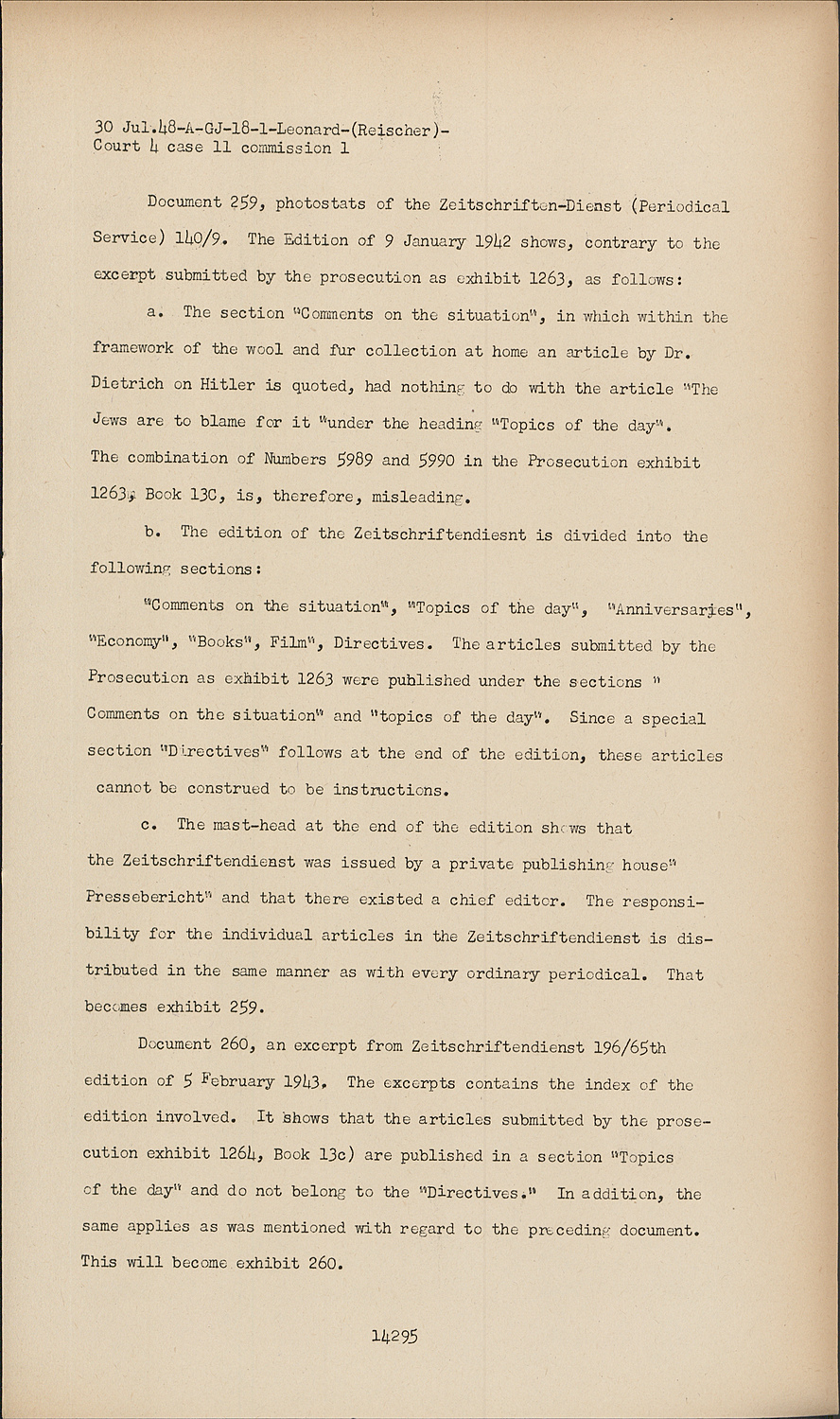
Court 4 case 11 commission 1 Document 259, photostats of the Zeitschriften-Dienst (Periodical Service) 140/9. The Edition of 9 January 1942 shows, contrary to the excerpt submitted by the prosecution as exhibit 1263, as follows:
a. The section "Comments on the situation", in which within the framework of the wool and fur collection at home an article by Dr. Dietrich on Hitler is quoted, had nothing to do with the article "The Jews are to blame for it "under the heading "Topics of the day". The combination of Numbers 5989 and 5990 in the Prosecution exhibit 1263, Book 13C, is, therefore, misleading.
b. The edition of the Zeitschriftendiesnt is divided into the following sections:
"Comments on the situation", "Topics of the day", "Anniversaries", "Economy", "Books", Film", Directives. The articles submitted by the Prosecution as exhibit 1263 were published under the sections " Comments on the situation" and "topics of the day". Since a special section "Directives" follows at the and of the edition, these articles cannot be construed to be instructions.
c.The mast-head at the end of the edition shows that the Zeitschriftendienst was issued by a private publishing house" Pressebericht" and that there existed a chief editor. The responsibility for the individual articles in the Zeitschriftendienst is distributed in the same manner as with every ordinary periodical. That becomes exhibit 259.
Document 260, an excerpt from Zeitschriftendienst 196/65th edition of 5 February 1943. The excerpts contains the index of the edition involved. It shows that the articles submitted by the prosecution exhibit 1264, Book 13c) are published in a section "Topics of the day" and do not belong to the "Directives." In addition, the same applies as was mentioned with regard to the preceding document. This will become exhibit 260.
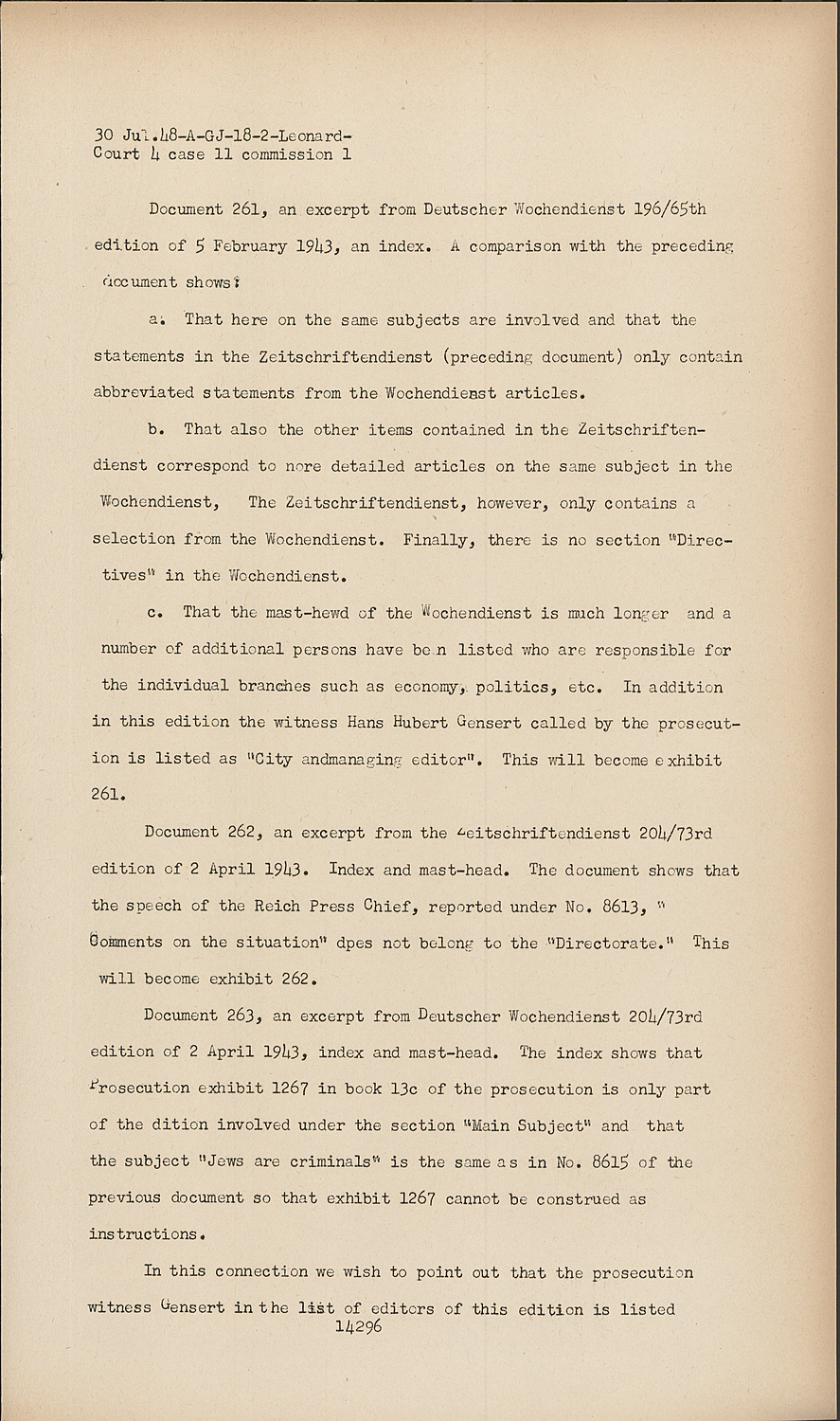
Court 4 case 11 commission 1 Document 261, an excerpt from Deutscher Wochendienst 196/65th edition of 5 February 1943, an index.
A comparison with the preceding document shows:
a. That here on the same subjects are involved and that the statements in the Zeitschriftendienst (preceding document) only contain abbreviated statements from the Wochendienst articles.
b. That also the other items contained in the Zeitschriftendienst correspond to more detailed articles on the same subject in the Wochendienst, The Zeitschriftendienst, however, only contains a selection from the Wochendienst.
Finally, there is no section "Direc tives" in the Wochendienst.
c.That the mast-hewd of the Wochendienst is much longer and a number of additional persons have been listed who are responsible for the individual branches such as economy, politics, etc.
In addition in this edition the witness Hans Hubert Gensert called by the prosecution is listed as "City andmanaging editor". This will become exhibit 261.
Document 262, an excerpt from the Zeitschriftendienst 204/73rd edition of 2 April 1943. Index and mast-head. The document shows that the speech of the Reich Press Chief, reported under No. 8613," Comments on the situation" does not belong to the "Directorate." This will become exhibit 262.
Document 263, an excerpt from Deutscher Wochendienst 204/73rd edition of 2 April 1943, index and mast-head. The index shows that Prosecution exhibit 1267 in book 13c of the prosecution is only part of the dition involved under the section "Main Subject" and that the subject "Jews are criminals" is the same as in No. 8615 of the previous document so that exhibit 1267 cannot be construed as instructions.
In this connection we wish to point out that the prosecution witness Gensert in the list of editors of this edition is listed Court 4 case 11 commission 1 on the mast-head as City and Managing Editor.
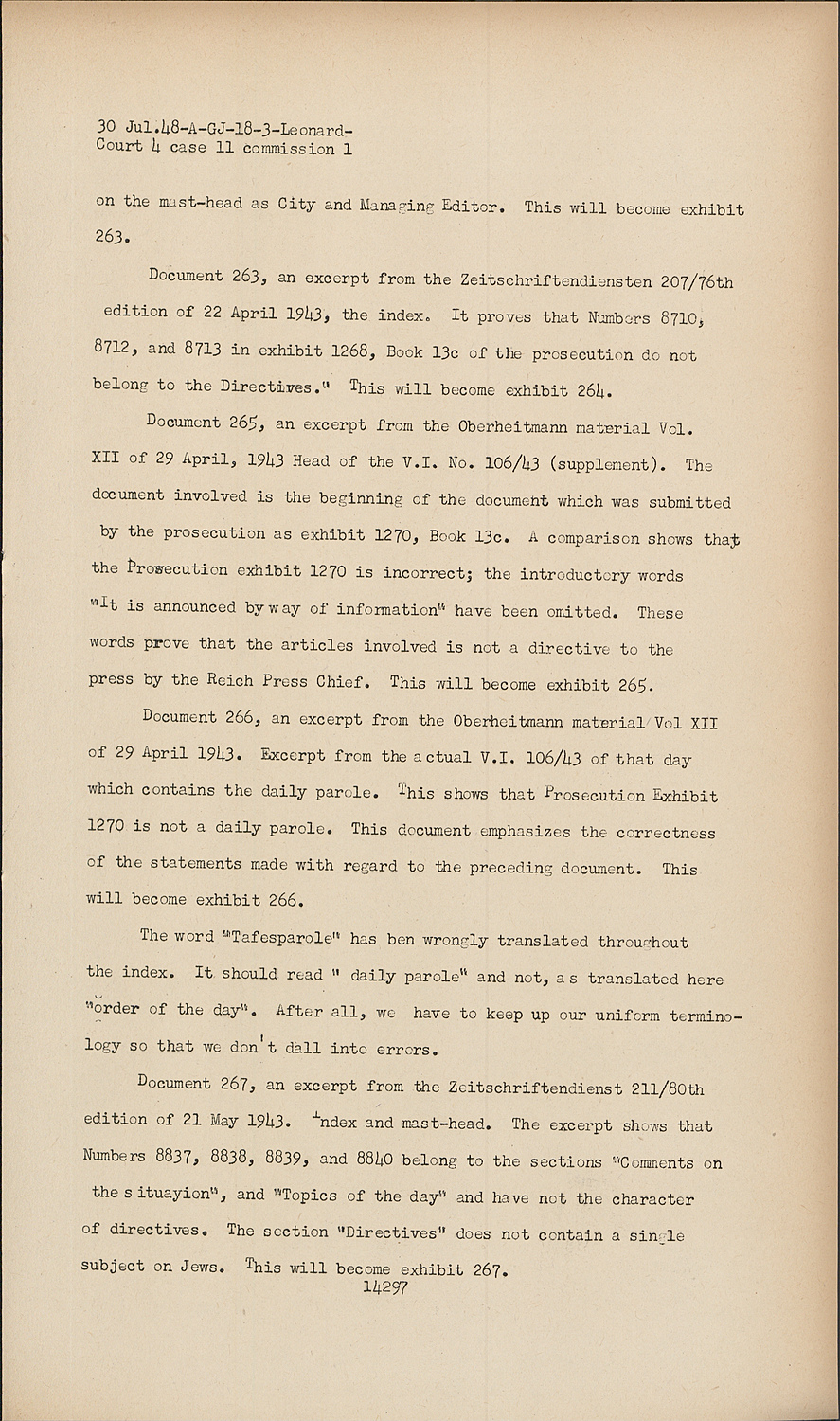
This will become exhibit 263.
Document 263, an excerpt from the Zeitschriftendiensten 207/76th edition of 22 April 1943, the index.
It proves that Numbers 8710, 8712, and 8713 in exhibit 1268, Book 13c of the prosecution do not belong to the Directives." This will become exhibit 264.
Document 265, an excerpt from the Oberheitmann material Vol. XII of 29 April, 1943 Head of the V.I. No. 106/43 (supplement). The document involved is the beginning of the document which was submitted by the prosecution as exhibit 1270, Book 13c. A comparison shows that the Prosecution exhibit 1270 is incorrect; the introductory words "It is announced byway of information" have been omitted.
These words prove that the articles involved is not a directive to the press by the Reich Press Chief. This will become exhibit 265.
Document 266, an excerpt from the Oberheitmann material Vol XII of 29 April 1943. Excerpt from the actual V.I. 106/43 of that day which contains the daily parole. This shows that Prosecution Exhibit 1270 is not a daily parole. This document emphasizes the correctness of the statements made with regard to the preceding document. This will become exhibit 266.
The word "Tafesparole" has ben wrongly translated throughout the index. It should read " daily parole" and not, as translated here "order of the day". After all, we have to keep up our uniform terminology so that we don't dall into errors.
Document 267, an excerpt from the Zeitschriftendienst 211/80th edition of 21 May 1943. Index and mast-head. The excerpt shows that Numbers 8837, 8838, 8839, and 8840 belong to the sections "Comments on the situayion", and "Topics of the day" and have not the character of directives.
The section "Directives" does not contain a single subject on Jews. This will become exhibit 267.
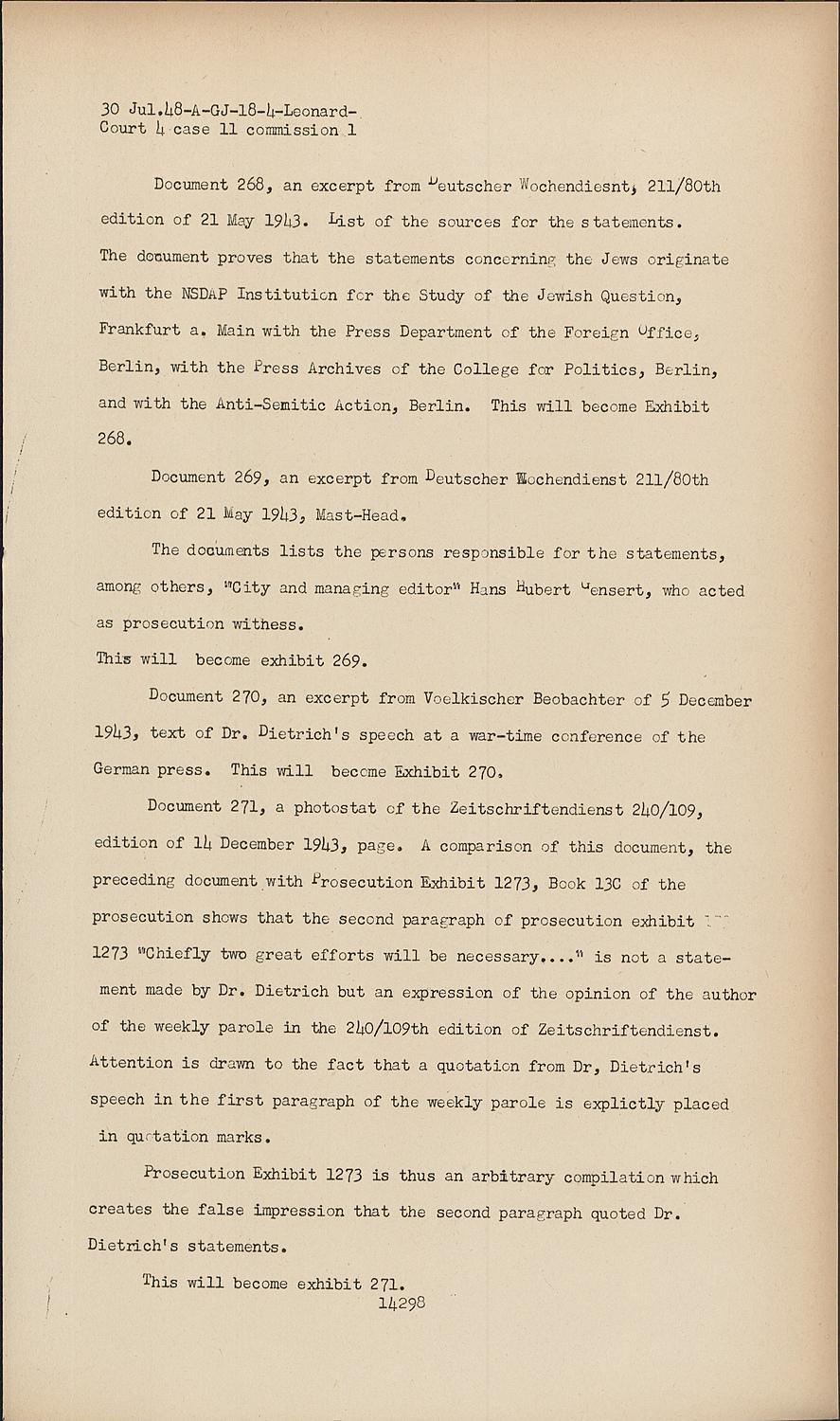
Court 4 case 11 commission 1 Document 268, an excerpt from Deutscher Wochendiesnt, 211/80th edition of 21 May 1943.
List of the sources for the statements. The document proves that the statements concerning the Jews originate with the NSDAP Institution for the Study of the Jewish Question, Frankfurt a. Main with the Press Department of the Foreign Office, Berlin, with the Press Archives of the College for Politics, Berlin, and with the Anti-Semitic Action, Berlin. This will become Exhibit 268.
Document 269, an excerpt from Deutscher Wochendienst 211/80th edition of 21 May 1943, Mast-Head.
The documents lists the persons responsible for the statements, among others, "City and managing editor" Hans Hubert Gensert, who acted as prosecution witness. This will become exhibit 269.
Document 270, an excerpt from Voelkischer Beobachter of 5 December 1943, text of Dr. Dietrich's speech at a war-time conference of the German press. This will become Exhibit 270.
Document 271, a photostat of the Zeitschriftendienst 240/109, edition of 14 December 1943, page. A comparison of this document, the preceding document with Prosecution Exhibit 1273, Book 13C of the prosecution shows that the second paragraph of prosecution exhibit 1273 "Chiefly two great efforts will be necessary...." is not a state ment made by Dr. Dietrich but an expression of the opinion of the author of the weekly parole in the 240/109th edition of Zeitschriftendienst.
Attention is drawn to the fact that a quotation from Dr, Dietrich's speech in the first paragraph of the weekly parole is explictly placed in quotation marks.
Prosecution Exhibit 1273 is thus an arbitrary compilation which creates the false impression that the second paragraph quoted Dr. Dietrich's statements.
This will become exhibit 271.
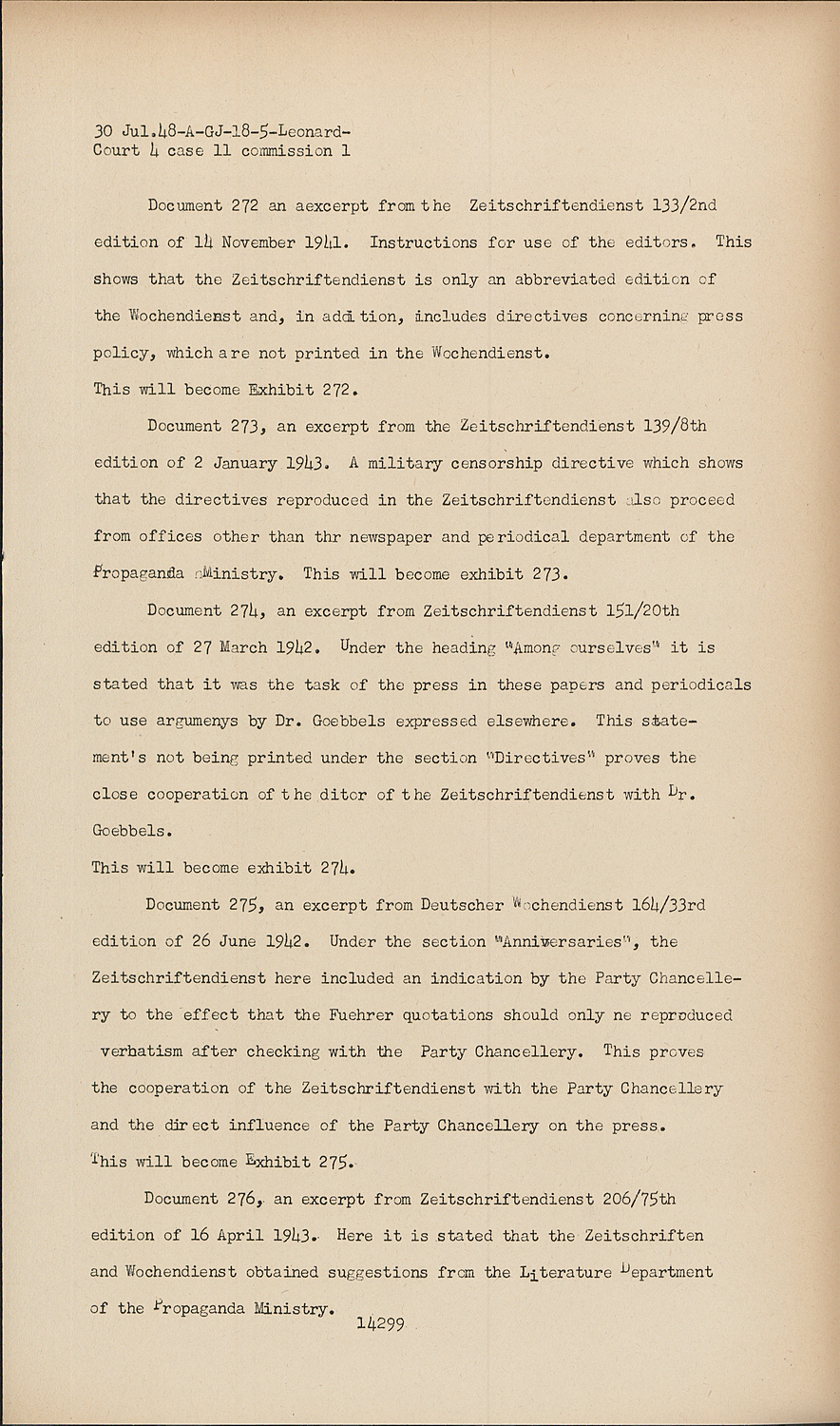
Court 4 case 11 commission 1 Document 272 an aexcerpt from the Zeitschriftendienst 133/2nd edition of 14 November 1941.
Instructions for use of the editors. This shows that the Zeitschriftendienst is only an abbreviated edition of the Wochendienst and, in addition, includes directives concerning press policy, which are not printed in the Wochendienst. This will become Exhibit 272.
Document 273, an excerpt from the Zeitschriftendienst 139/8th edition of 2 January 1943. A military censorship directive which shows that the directives reproduced in the Zeitschriftendienst also proceed from offices other than thr newspaper and periodical department of the Propaganda Ministry. This will become exhibit 273.
Document 274, an excerpt from Zeitschriftendienst 151/20th edition of 27 March 1942. Under the heading "Among ourselves" it is stated that it was the task of the press in these papers and periodicals to use argumenys by Dr. Goebbels expressed elsewhere. This statement's not being printed under the section "Directives" proves the close cooperation of the ditor of the Zeitschriftendienst with Dr. Goebbels. This will become exhibit 274.
Document 275, an excerpt from Deutscher Wochendienst 164/33rd edition of 26 June 1942. Under the section "Anniversaries", the Zeitschriftendienst here included an indication by the Party Chancellery to the effect that the Fuehrer quotations should only me reproduced verbatism after checking with the Party Chancellery.
This proves the cooperation of the Zeitschriftendienst with the Party Chancellery and the direct influence of the Party Chancellery on the press. This will become Exhibit 275.
Document 276, an excerpt from Zeitschriftendienst 206/75th edition of 16 April 1943. Here it is stated that the Zeitschriften and Wochendienst obtained suggestions from the Literature Department of the Propaganda Ministry.
Court 4 case 11 commission 1 Dietrich was not in charge of this department.
This proves the cooperation of the Dienst with offices of which Dr. Dietrich was not in charge. This will become Exhibit 276.
This concludes Document Book 9. I am now turning to the last document book, Document Book 10.
Document 277, an affidavit of Nikolaus von Buelow, Hitler adjutant of 10 April 1948. This will become exhibit 277.
Document 278, an affidavit of Karl Jesko von Puttkammer, Hitler's naval adjutant, dated 23 May 1948. This will become exhibit 278.
Document 279, an affidavit of Julius Schaub, Hitler's SS adjutant dated 8 June 1948. This will become exhibit 279.
Document 280, an affidavit of Wilhelm Bureckner, Hitler's SA adjutant, dated 8 June 1948. This will become exhibit 280.
Document 281, an affidavit of Nikolaus von Buelow, Hitler's adjutant, dated 10 April 1948. This will become exhibit 281.
Document 282, an affidavit of Martin H. Sommer fieldt, journalist and temporary Wehrmacht liaison officer to Dietrich, dated 4 June 1948. This will become exhibit 282.
Document 283, an affidavit by Hans Rechenberg, journalist and press referent, dated 4 June 1948. This will become exhibit 283.
Document 284, an affidavit of Guenther d'alquen journalist and Goebbel's special mission staff officer, dated 22 April 1948. This will become exhibit 284.
Document 285, an affidavit dated 22 June 1948 by Erich Schneyder journalist and manager of the Transocean News Agency or Europapresse G.m.b.H. This will become exhibit 285.
Court 4 case 11 commission 1 Document 286, an affidavit by Henrich Hansen, writer and referent for publications at the NSDAP Reich Office, dated 10 July 1948.
Exhibit 286.
Document 287, an affidavit by Karl Hederich, deputy chairman of the official Party Review Commission, dated 9 July, 1948. Exhibit 287.
Document 288, an affidavit by Eugen Maier, journalist, dated 10 December 1947. Exhibit 288.
Document 289, an affidavit by Dr. Alfred Detig, journalist, of 3 July 1948, exhibit 289.
Document 290, an affidavit by Ewald Beckmann, journalist, of 3 July 1948, exhibit 290.
And the la t document, 291, an affidavit by Udo von Woyrsch, SSObergruppenfuehrer, dated 15 May 1948, will become exhibit 291.
This concludes my presentation of documents books.
MR HARDY:I'd suggest that the defense will be able to produce each one of the affiants who gave given an affidavit of affidavits contained in Book 10, so that the prosecution may cross examine them. We will submit a list of those we wish brought here in due course.
DR. BERGOLD:Yes, that is agreable.
THE COMMISSIONER:Are both the prosecution and defense finished?
MR. HARDY:I didn't hear you, I am sorry.
THE COMMISSIONER:You are both finished?
MR. HARDY:Yes, finished.
THE COMMISSIONER:All right. I think the witness we had for this *---* not to be called. For some rea on the Court sent word up not to put him on today, so we will have to recess until 930 in the morning. We will have one tomorrow.
MR. HARDY:Mr. Kaufman has a statement to make to you concerning that witness, your Honor.
Court 4 case 11 commission 1
MR. KAUFMAN:Your Honor, we have not been informed yet that the witness will not be called. Have you got some information?
THE COMMISSIONER:What is his name?
MR. KAUFMANN:Kaufmann.
THE COMMISSIONER:What is your witness' name?
MR. KAUFMAN:It is supposed to be a witness for the defense.
THE COMMISSIONER:His name is von Normann, N-o-r-m-a-n-n-.
THE COMMISSIONER:Judge Christianson sent the Marshal up and said to to hear him today. I don't know why.
MR. KAUFMANN:Then we shall have to wait until further notice.
THE COMMISSIONER:I guess they can tell you down there. I think for some reason he was going to testify for several defendants, and they couldn't all be here.
MR. KAUFMANN:All right, we will have to wait until further notice. Thank you very much.
THE COMMISSIONER:So, we will be in recess until 9:30 tomorrow morning. We have a witness to morrow.
(The Commission recessed until 0930 hours, 31 July 1948.)
Court Ministries Commission I Official Transcript of a Hearing Before a Commissioner in the matter of the United States of America against Ernst von Weizsaecker, et al, Defendants sitting at Nurnberg, Germany, 31 July 1948, at 0930 Hours, Commissioner Johnson T. Crawford presiding.
THE MARSHAL:The Commission for Tribunal IV is now in session.
DR.BERGMANN (for the Defendant Koerner): I would like to call the witness von Naumann into the witness stand.
COMMISSIONER CRAWFORD:The Marshal will call the witness.
(The witness Hans Henning von Naumann took the stand and testified as follows:)
The witness will raise his right hand and repeat after me:
I swear by God, the Almighty and Omniscient, that I will speak the pure truth and will withhold and add nothing.
(The witness repeated the oath.)
You may be seated. Counsel, you may proceed with the examination of the witness.
DIRECT EXAMINATION BY DR. BERGMANN:
Q.Mr. Witness, will you please give us your name?
A.My name is Hans Henning von Naumann.
Q.And your personal data, when were you born?
A.I was born in 1903 and I am now residing in Berlin.
Q.Herr von Naumann, what was your professional career? Would you please tell us something of your professional training? What did you study?
A.I was a law student in Goettingen and Marbur, and subsequently I took the State Exam. I was taken over into the general Prussian administration in December, 1932, I was appointed Regierungsassessor and Assistant to the Prussian State Ministry in Berlin.
Q.How long did you remain there?
Court Ministries Commission I
A.Until 1945, up to the capitulation. At the end, from 1939 on, I had the rank of Ministerialrat.
Q.Mr. Witness, I have a few questions to put to you concerning the Prussian State Ministry. Just what is the meaning of this expression, the Prussian State Ministry?
A.This term has two meanings. On one hand it included the Prussian State Government as such. That is to say the group of Prussian ministers, including the Prime Minister who headed them. On the other hand, the Prussian State Ministry was also the term used to designate the office of the Prussian Prime Minister. It consisted of an exceedingly small staff. As far as I remember, when I entered the service, there were, apart from the State Secretary and Ministerial Director, four or at the most five so-called referents.
Q.Mr. Witness, will you please also tell us the following. Now, in this State Ministry you include the State Ministry and the office of the Minister President. What was the position of the Minister President himself, in relation to the body of Ministers themselves and his whole office?
A.Within the State Ministry, that is to say, within the whole assembly of officers, he was primus inter pares and besides, he had a whole row of duties that resulted from the Prussian Constitution. Now, in relation to his office, he was the head of this small organization and his actual office manager, so to speak, was the State Secretary. That was the situation which had already been prevalent under the Prussian Minister President, Dr. Otto Braun, who had been in office for a decade or more, and it was the same situation that prevailed under Goering and Koerner and which was maintained by them when these two gentlemen in April, 1933, took over their Prussian offices.
Q.Mr. Witness, you were speaking about the functions of the office of the State Ministry. Did this office have a special connection Court Ministries Commission I with the body of Ministers?
A.I had a connection insofar as it had to coordinate Legislative Drafts. That is to say, it had to examine the significance of any law for the Prime Minister, and it also had to forward the draft of the law to the various ministers, ask them for their comments on behalf of the Minister President, and then process them in the usual manner.
Q.Is it correct to say that this office was responsible to see that if decrees were issued, those offices were contracted, which had to be contacted according to the provisions?
A.Yes, that's correct.
Q.Mr. Witness, did the State Ministry also have an administrative basis? Did it have subordinate offices?
A.No, the State Ministry was not a so-called department of the Ministry with its own subordinate offices with the exception of relatively unimportant offices as, for instance, the Prussian Archives Administration which was directly subordinate to the Minister President. There was also the court which had to decide on disagreements about jurisdiction which was also under the State Ministry.
Q.You have already described the extent of this State Ministry. You told us that it was a very small office, headed by the State Secretary in the State Ministry. Did this State Secretary within the State Ministry now have functions that could be compared to the position of the State Secretaries in the Ministries and, in particular, to what extent, was the State Secretary and in the State Ministry the Deputy of the Prussian Minister President?
A.The State Secretary of the Prussian State Ministry had a dual special function with formally more reduced privileges than enjoyed by other State Secretaries. In general, a State Secretary could deputize for his Ministers, that is, his superiors. This was impossible in the case of deputizing for the Prussian Minister President.
Court Ministries Commission I
Q.Well, who deputized for the Prussian Minister President in his capacity as head of the Body of Ministers?
A.The Prussian Minister President who, according to the constitution, was also the Prussian Head of State, could only be deputized for by another Prussian Minister. This would generally be the senior Minister. I can, for instance, remember Dr. Poppitz who, after 1933, deputized for Goering in many cases in his capacity as Prussian Minister President.
Q.Mr. Witness, if the Prussian Minister of Finance, Poppitz, deputized for the Minister President, then you mean thereby that the State Secretary in the State Ministry could not do that. One could possibley make the following comparison. Could the Minister of Finances, if he himself was unable to appear in the council of Ministers, be deputized for by his State Secretary?
A.Yes.
Q.And could this State Secretary then make legally binding statements on behalf of his Minister?
A.Yes, I think that is a matter of course.
Q.That is correct, then, that the position of the State Secretary within the State Ministry has nothing in common with the position of a State Secretary in a Ministry, and cannot be compared with it? I want you to answer the following question:
Was the State Secretary in the State Ministry the representative of the Minister President? Was the State Secretary within the State Ministry, was he the possible deputy for the Minister President? That is to say, could he, on his own initiative, deputize for his Minister President without consulting him and could he make any statements on his own initiative?
A.No. I don't know under what conditions he could have done that because after all, we found out what the State Secretary could not deputize for the Minister President in the same way as the Court Ministries Commission I other state secretaries could for their other ministers.
Besides, and I would like to answer your question now, the State Ministry had no sub-departments. Consequently, the State Secretary could not pass on instructions to subordinate offices nor could he, as deputy, sign Laws and Decrees.
Q.Mr. Witness, was what you have just described true before 1933 us well as after 1933?
A.I would say yes. As far as I remember, Goering did not make any changes on this point. During the first years several things were changed in Prussia which, of course, resulted from the general loss of power by the German individual states. Until about 1934, there still were the traditional Prussian Ministries in existence, and after this period, most of them, with the exception of the office of the Minister President and the Prussian Minister of finances, were coordinated with the Reich Ministries which corresponded to them.
Q.Mr. Witness, that would mean that the so-called current business of the State Ministry was reduced to a minimum after 1934 if the Prussian Ministry no longer met and Prussian decrees no longer had to be issued and everything had been regarded as a matter for the Reich to decide?
A.Yes, that's correct. The State Ministry was then only a source of information for the Minister President.
Q.Mr. Witness, I am now turning to the Four-Year Plan. As you know, Goering received full power for the Four Years Plan from the Fuehrer in October, 1936. Do you know in what capacity Goering received this duty. Did he receive it in his capacity as Prussian Minister President?
A.Goering received this commission on a personal basis; that is, exclusively because of his personality.
Q.Now, concerning the decrees that were issued when the Four Years Plan was established. They mentioned that Goering, in the Court Ministries Commission I Four Year Plan and in its current business, was to be deputized for by Koerner.