Even after the second order to attack had been given by the Fuehrer, he immediately went to see Hitler again in order to try to make him change his mind. I happened to see that event because I was with Goering at the time. He went to see the Fuehrer and asked me to wait in his office until he got back. When he came back he seized me by the arm, drew me into the study, sat down in his chair, laid his arms on the table and his head on his arms, and again and again just repeated the words, "It's dreadful. Nothing can be done. Hitler's gone crazy. It's the only thing that I can imagine, that he must have gone crazy." In this scene which I myself witnessed one sees quite clearly what Goering's attitude was to war and that he definitely did not do anything to prepare for such a war on his own account.
QI would like to say for the benefit of the Tribunal that the witness Goernert will testify that the defendant Koerner has reported in exactly the same way earlier without in any way being connected in this case because this is testimony which is of great historical importance.
JUDGE MAGUIRE:What is the name of that witness?
DR. KOCH:Goernert is the witness. He will testify that, and concerning Hitler's no peace assurances quite a few of which were believed, I would like to refer to my book 1-B, identification number 60, which is a long compilation, and concerning Hitler's secrecy, the impossibility of foreseeing his decisions, in particular concerning the Polish campaign, I would like to refer to my book 1-B, identification numbers 61 to 71 and 72 to 75. Concerning the immediate preliminary history of the outbreak of war, the witnesses Milch and Halder will testify.
Q (Continued) Now, in connection with war of aggression I really should now pass to the attack against Russia but since the Four Year Plan is finished as far as the economic side is concerned, I would first of all like to pass to the organization of the Four Year Plan because the position of Herr Koerner in this organization is also connected with the COURTIV, CASE XI Russian campaign.
Herr Koerner, before coming into the details of your own position please tell the Tribunal what rights Goering himself had in his capacity as Plenipotentiary for the Four Year Plan?
AAs a result of the Fuehrer decree of 18 October 1936 which led to the inception of the Four Year Plan, the general right to give instructions in all economic matters, both to all ministers and all Party agencies.
QYou say right to give instructions. Of what account were those powers?
AWell, I think you can say on the one hand Goering had the right to give orders in individual instances and on the other hand the right to issue general orders or decrees.
QAnd concerning the contents of these individual or general decrees or orders which he could give, was there any limitation imposed on Goering?
ANone whatsoever in the economic sphere.
QAnd such a power to give orders that Goering had, was that something usual in the Third Reich or something out of the ordinary?
A.It was something quite unusual. It was an unique order of Hitler's. All rights which Hitler possessed himself could now, in the economic sphere, also be exercised by Goering.
Q.You yourself, Herr Koerner, were State Secretary in the Four Year Plan?
A.Yes.
Q.And what powers did you have in that position?
A.I was Goering's deputy in all current affairs concerning the Four Year Plan.
Q.I would like to draw the Tribunal's attention to Document Book 117, page 11 of the English, Exhibit 925. I myself will produce in my Book 6 all the documents relevant to the matter.
JUDGE MAGUIRE:Are all the documents in that book addressed to this particular subject?
DR. KOCH:No, Document Book 117 contains all the personal data, and my Book 6 contains everything concerning not only the Four Year Plan, but Koerner's position all around.
JUDGE MAGUIRE:It will facilitate the Tribunal's work, Doctor, if when you make citation to a defense document book you give the particular exhibits, if that book contains other subjects than the one to which you make reference, because we don't want to have to read the whole book in aspect to this particular matter or a particular matter.
DR. KOCH:Unfortunately I do not have them here, but I will let you have them the first thing on Monday morning.
JUDGE MAGUIRE:All right.
Q.Herr Koerner, what do you understand by "current affairs" which are mentioned there?
A.Current affairs includes everything connected with decisions already taken by Goering, in contrast to the decisions themselves. I myself had to see to it that questions on which decisions were to be made were submitted; that orders on issues which had teen decided were prepared and published, and I also had to prepare Goering's decisions insofar as on the Council of the Four Year Plan I was Chairman, as deputy of Goering.
Q.Had Goering issued any orders were you able to deputize for him?
A.Yes, if a matter was already under way and Goering had already decided it, and subsequently individual orders became necessary then I could. That was current business.
Q.And could you make basic decisions?
A.No.
Q.Did you make basic decisions?
A.I never did that in any case.
Q.Did you have the right to issue orders, general instructions in the sphere of the Plenipotentiary for the Four Year Plan on your own initiative?
A.No, certainly not. No more than I could issue any fundamental individual orders, and in no case did I issue any order on my own initiative.
Q.But there is a whole series of orders which you signed "IV". "In Vertretung"; that is, as deputy. You name is signed underneath.
A.Goering had already issued such orders internally, and it was only a case of the actual signature. These signatures I affixed in each case at Goering's express orders. I will come back to that later, in the case of each individual order which is essential.
MR. GANT:Defense counsel cites in German, "IV", I don't think that comes through in the translation. I would like to check how the translator translates these abbreviations.
INTERPRETER LUND:I said "as deputy".
DR. KOCH:Counsel for the Prosecution would like to know how these letters IV were translated?
INTERPRETER LUND:They were translated as "deputy".
DR.KOCH: "As deputy"? Very well.
THE PRESIDENT:Mr. Gant, is that an acceptable translation?
MR. GANT:Yes, sir. That is very satisfactory.
DR. KOCH:There is a certain difference. "As Deputy" means at the same time that the person concerned is a representative generally in some way or another. "IV", in "in vertretung" only means that in this specific instance he is exercising the function of a deputy, but for that he does not need to be a deputy in any other sense. So in that respect "as deputy" does not completely coincide with "IV". It does not imply a position of deputy, but the function is emphasized.
JUDGE MAGUIRE:May I ask a question there. I thought that the German of the term "IV" meant "By order of".
DR. KOCH:Yes, that is about right, but it is like this. "By order of" means that there must he an order preceding. At least, I imagine that is what it means, but by "IV" it does not mean that there was a specific order given in the specific instance. There may have been, but it need not have.
MR. GANT:I disagree on that. "IV" means "as deputy", and Dr. Koch has stated it correctly. "I*" means by order", but "IV" by itself does not mean "By order" at all, but I believe that is why I interjected my questions before. I think it is a rather important point, and neither by asking Dr. Koch or myself can this question be cleared. I believe it will be necessary lateron to have some expert witness to testify on this point, to make it entirely clear. There has been some testimony to this effect already in the record, as to what these particular expressions mean.
JUDGE MAGUIRE:The reason I asked the question: the last two or three days I ran into a piece of that testimony and I thought that the longer term, which I will not attempt to pronounce meant signing as a deputy, the shorter one meant that there was an express order in a particular instance. Do I have that confused?
DR. KOCH:It does not correspond entirely, but I will certainly try to make use of the Prosecution's suggestion right away. Unfortunately, at this moment, without the presence of either myself or defendant Koerner, the witness Normann is just being heard before the Commissioner. He is an expert inconstitutional law and a very old civil servant from th** before the Third Reich. Perhaps Dr. Rauschenbach would be kind enough to tell them over there to ask this question. I am sure he will be able to give you all the data.
JUDGE POWERS:Counsel, is there any controversy here but what Koerner was a general deputy?
DR. KOCH:Yes, it is a very important question in the relationship between Koerner and Goering, that Koerner was not able to deputize generally for Goering, but only in current business. Would you be kind enough to tell me how you translated that?
INTERPRETER LUND:In current matters - current business.
DR. KOCH:Current business, yes.
JUDGE POWERS:Was there any question but what signing a letter is current business?
DR. KOCH:No, that is current business, but of course you can imagine. By and large, Herr Koerner, I think described it quite clearly just now. He said that when Goering had already made the fundamental decision -- when a basic decision had been reached -- anything that was done based upon this decision was current business. You can describe it best with "current matter" if it was already under way; then it was "current". If it still had to get going, then It was not current.
THE PRESIDENT:In other words, when the policy was made by Goering, it became current business for Koerner to carry through. In other words, when the policy had been embarked upon Goering, it became current business later on for Koerner to carry through?
DR. KOCH:Not if a general line of policy had been ordered, but if one definite, concrete, specifically tangible position had already been taken, if Goering said, "Let's loot Russia", then anything done as a result of that was not current business, but if Goering said, "One hundred thousand tons of grain are to be fetched from Russia", then what had to be done in order to get the grain was "current business".
JUDGE POWERS:Well, that fits your argument.
JUDGE MAGUIRE:Let me ask the witness a question on that particular line. Your argument is interesting, but it is hardly testimony, Doctor. Taking the example that counsel gave, suppose Goering did give an order to remove all machinery, industrial machinery, from the city of Lublin, and that had been decided upon. Did not you, as his deputy, have authority to implement that by giving the specific instructions with regard to the removal of that machinery: Whether it should go by barge, whether it should go by rail, whether some machinery was of no value at all? Things of that kind?
AYour Honor, the implementation of the details, as you have given them, did not lie in my hands but in the hands of the subordinate agencies. Let's say the companies which had this machinery at their disposal or in the departments. In this case it might have been the Ministry for Economic Affairs, or the Ministry for Armaments which would give corresponding orders on the basis of a decision first taken by Goering. I myself in such case would, to all intents and purposes, have taken no steps at all.
DR. KOCH:May I add one thing? I draw the comparison between Chief of General Staff, and there in the official instructions is also talk of current business, and there, from old experiences, it is laid down through generations of experience. I will examine General Halder on the subject, who, as I know, has already once testified on this subject in Case 12. I think that will help clear matters up.
JUDGE MAGUIRE:Just before we leave this, let me say to counsel that it is inconceivable to me, as presently advised, that Goering would have to be consulted after a basic decision was made as to every particular step in carrying it out. If he had anything else to do with his time. Unless he would deputize someone to make the necessary specific orders and take the actions for the implementing and carrying out of the basic decision of policy. Now it may have been that he did that, but that is what I am interested in, but it seems a most extraordinary situation if that was done.
DR. KOCH:I think we have misunderstood each other. The opinion of the witness, I think, is much more in line with that of the court than you just assumed. Herr Koerner, would you comment on Judge Maguire's question?
AYour Honor, of course Goering could not bother at all about such details. If he had done so, he would never have been able to fulfill all the tasks assigned to him. I have already said that, as a matter of course Goering made the basic decisions, and then the execution lay in the hands of the subordinate agencies, and I gave the examples of the Ministry of Economic Affairs or Ministry for Armaments.
Of course, in other cases it may have been other departments. These would now base themselves on the basic decision made by Goering - an order, decree or instruction and would then execute the matters that they thought they must issue in order to execute the basic order.
QIf I understand you correctly you, yourself, are of the opinion that the individual instructions which had to be given after Goering had made a fundamental decision could be issued by you yourself?
AYes, naturally.
QTo make this absolutely clear, I would like to refer to one document in Book 118-A, page 119 of the English, 196 of the German. It is a decree concerning another subject and it concerns the reconstruction of the Reich Ministry of Economic Affairs and the work of the Four Year Plan, NIG 13629, and in this decree it says, and I quote page 119 of the English: "My permanent deputy remains State Secretary Koerner." From that Herr Koerner, one might gather that suddenly you had become the general deputy, and not only deputy restricted to current affairs. Oh, just wait a moment until the Judges have it.
THE PRESIDENT:You are now referring to 953.
JUDGE MAGUIRE:No, 952.
DR. KOCH:Herr Koerner, from this formulation one might conclude that you are no longer deputy only in current affairs, but general deputy. How about it?
ANo, that certainly doesn't mean that at all. The formulation arose because it was intended to make clear the fact that I was the superior of State Secretary Neumann and was to remain so. Neumann had shortly before been promoted from Ministerial director to Second State Secretary, but the situation in itself was in no way changed. That is also shown by the unchanged practical handling of the matter.
QVery well, but it still be that the practical handling diverged from your actual powers, and that these actual powers might have been more extensive?
How about that?
AThat was certainly not the case. I have to come back once again to the nature of Goering's authorization, and that is all that matters here. The authorization was unique. I have already stated that. At that time Goering had quite generally, towards the outside world, too, been made to appear as the most important person next to Hitler. Therefore, the idea that I, as Goering's deputy, was to have the same powers, is completely untrue. I certainly believe that I would have been certified insane or would have been ridiculed had I tried to assume such powers. I would like to know, for instance, what the Minister of Finance, Mr. Korsigk, would have said if I, on behalf of Goering, had given him orders. It is quite unthinkable.
QWitness, if I may put that in legal language, you are claiming that Goering's powers were not transferable. Is that what you mean?
AAbsolutely not transferable.
QNow, in that connection I would like to refer to a document which we have already discussed; that is Donner's memorandum, Exhibit 974, Document Book 118-B, English page -- just a minute, please -- 317. That was the memorandum concerning the question of the organization of the Four Year Flan, and in that it says quite expressly that you have been appointed Goering's deputy for all questions of the Four Year Plan, which is not the same as what you said just now.
THE PRESIDENT:Excuse me, that is Prosecution Exhibit 974.
DR. KOCH:No, 974. 973 for Neumann; 974 for Donner. And now we are dealing with 974 Donner.
THE PRESIDENT:Very well.
QNow, Herr Koerner, there is a certain contradiction, if you will comment on that.
AI can only say that what it says there is completely false. This description is absolutely contrary to all the fundamental decrees, and in particular to my factual powers.
What is much more important, contrary to my actual actions. For the rest, this is a document which I never even saw, and if I hid seen it, I would certainly not have approved it. Donner was a statistician in the Four Year Plan and in the main dealt with economic history.
QBut I may point out here that the questions being dealt with by the witness at the moment are also being discussed by the witness von Normann, who is being examined today; Ministerial Councillor von Normann, and by Ministerial Director Marotzke, who has also been mentioned before. They are discussing that in detail.
THE PRESIDENT:That is von Normann or von Normann?
QVon Normann. Herr Koorner, in the Four Year Plan there were agencies and there were plenipotentiaries. What was your position with regard to those agencies of the Four Year Plan?
AThe business groups and the plenipotentiaries-general were not subordinate to me, but directly to Goering. For example, Goering was the superior of Krauch in his capacity as Plenipotentiary-General for Chemistry, which I was not. It was exactly the same with the Plenipotentiary-General for Iron Rationing, General von Hannokon, and in this case it was brought particularly clearly to the light of day. Von Hannokon was in the Reich Ministry of Economic Affairs, with the status of State secretary, and he also kept his old title of Plenipotentiary-General for Iron, which in 1937 had been given him by Goering, and what I said applies to all the other business groups, whether for Food, the head of which was State Secretary Bucke of the Reich Food Ministry. The business Group, Labor Assignment, headed by the State Secretary of the Ministry of Labor, Dr. Syrup.
A. (Continued) What I said applies to all other business groups whether for food, the head of which was State Secretary Backe of the Reich Food Ministry, the business group labor assignment headed by the State Secretary of the Ministry of Labor, Dr. Syrup.
Q.According to what you say the agencies of the Four Year Party Plan were subordinate only to Goering. You for your part in the deputizing for Goering on current Affairs within the Four Year Plan, did you have any other work?
A.Yes, it was my task to co-ordinate the various agencies insofar as this was possible without special orders being issued. This adjusting position as I think you might call it, I exercised in particular on the General Council of the Four Year Plan.
Q.Details about the General Council too I will discuss with the witnesses I have mentioned. Here are some more important questions for the benefit of the Tribunal. What was the General Council?
A.An assembly of representatives of all economic agencies and all business groups and Plenipotentiaries General of the Four Year Plan.
Q.What do you understand by economic agencies?
A.In the main the so-called economic ministries that is ministries handling economic questions for instance of economic affairs, this includes in particular the Reich Minister of Economic Affairs and also the Reich Minister for food.
Q.Now, did the ministers who headed the ministries you just mentioned also appear on the General Council.
A.No, no ministers ever appeared at this General Council. The General Council was a meeting of the State Secretaries level and the special plenipotentiaries of the Four Year Plan. If the ministers had been there it would not have been possible for me as State Secretary to be chairman of this committee.
Q.What powers did the General Council have?
A.No powers at all. The General Council was an advisory committee which also for the purpose of mutual -- which also served to inform all the various agencies of the Reich in the economic sphere. The Four Year Plan in particular tried to adjust mutual interests and differences wherever possible so that wherever possible the decisions of Goering should become superfluous because if the men assembled in this committee whose agreement Goering no longer needed had to be consulted.
Q.And if the men did not agree what happened then?
A.If a decision had to be taken and the committee could not agree then Goering had to give a decision.
Q.On the General Council itself was not vote taken?
A.I said advisory committee which does not have votes. Only imagine the composition of this Council as the documents clearly shor, if the State Secretaries on this committee for instance had taken a vote and the majority decision had been binding then the ministers of these State Secretaries would have been bound which is quite unthinkable.
Q.Then do I understand you correctly that on this General Council the coordinating adjusting work which you mentioned was the actual purpose of the meetings of the General Council?
A.Yes, absolutely.
Q.I have prepared a little plan to show the Tribunal of most complex and interlaced construction.
I would like to the Page and to pass to the Tribunal three copies and a fourth for the record. At the same time I would like the witness to be permitted with reference to a large plan to explain what still had to be said here. Let us keep ourselves to absolute essentials as the witnesses can go more into detail.
THE PRESIDENT:Do you, Counsel, do you intend to offer this as evidence as an exhibit?
DR. KOCH:Yes -
THE PRESIDENT:Perhaps you should have it marked.
DR. KOCH:May I have number It 410.
THEPRESIDENT: 410 and is this part of one of your document books?
DR. KOCH:Well, it is only just being prepared. I will include it in the supplementary volume.
THE PRESIDENT:Supplementary volume?
DR. KOCH:Yes, but it will be submitted almost simultaneously.
THE PRESIDENT:You are not offering it now but will at that time, is that is -- is that the idea, when you have your book ready?
DR. KOCH:Well, it might be quite a good thing to have it identified by the number I intend to give it later, 410 and the Court will find it -
THE PRESIDENT:It will be marked 410 for identification.
DR. KOCH:Yes.
Q.Herr Koerner, first of all would you please explain to the Tribunal the significance of the various little compartments, what means what?
A.Well, M means Minister. The top one is Goering.
THE PRESIDENT:Just a minute. Page, will you take the microphone around to the front of the stand so when he speaks into that while he discusses this exhibit.
Q.Now, Herr Koerner, may I ask you first -
THE PRESIDENT:You are walking away from the microphone. That is better.
A.Now, at the top we have Goering. From Goering we have a direct line to me, K; K that is me, Koerner. Then we have a little wavy blue line running from me to the business groups, R. Plenipotentiaries General of the Four Year Plan who belong to Goerings agency and therefore R is connected by a red line to Goering but indirectly.
The dotted line includes the so-called committee of the General Council.
Q.Perhaps you would show where it runs.
A.All around here and up to the top and inside this dotted outline I sit as deputy. As I said just now, not only the plenipotentiaries General and business groups of the Four Year Plan but also the economic ministers' represented by the State Secretaries attended. Ministers also attended this who were heads of business groups or who were plenipotentiaries General and they are stuck directly to their minister here or to their ministry. Everything that lies outside here are representatives of other agencies, ministries who were interested as far as I remember the Reich Chancellory, the OKW representative usually that was Thomas and I didn't hear what the last one was.
Q.Party Chancellory and Reich Chancellory.
A.Yes, Party Chancellory and Reich Chancellory.
Q.Would you please explain the meaning of the red line and the black line to the Tribunal?
A.I have already said everything that is red is an agency or a plenipotentiary belonging to the Four Year Plan, that is, Goering's agency. Black or rather dark blue are agencies or ministries to whom Goering could give instructions on the basis of his General authorization.
Q.I think that that together with the inscription of this plan that makes the organization clear to the Tribunal. Perhaps I may point out that the three little boxes described as M representing ministry on the lefthand side - perhaps Herr Koerner would show it with his finger, these of course are just examples in one specific case where the ministry has nothing to do for the Four Year Plan. The second case is where the ministry has a State Secretary who is at the same time head of a business group and the third case where a ministry has a plenipotentiary general in the Four Year Plan.
All details in so far as they still seem necessary will be found by the Tribunal in the testimony of the witnesses Normann and Marotzke and now I think we can finish with the organization of the Four Year Plan. Now I intend to pass to the war against Russia and I don't know if the Tribunal would like me to start on that now.
THE PRESIDENT:You might commence.
MR. LYON:I would merely like to ask a question for clarification. I was not clear whether Dr. Koch stated this was an extemporaneous document or was based on one or whether on the other hand it was designed as a check to aid expedition.
THE PRESIDENT:Just a chart as I understand to aid expedition, isn't that true?
DR. KOCH:That is it.
Q.Herr Koerner, now we pass to the alleged participation in the so-called war of aggression against Russia. Do you know anything about the reasons which may have caused Hitler to undertake this attack on Russia? Please tell us only what you know from your own experience.
A.The assembly of large masses of Russian troops along the Polish territory newly seized by Russia and in particular troop assemblies along the Roumanian frontier were of course most unwelcome to the Fuehrer. This Russian massing of troops started as early as 1939 and in the fall of 1940 there was a lot of talk about it. The dispatch of German training divisions to Roumania was believed to be expected with that although these training divisions were in the mainland were intended as a counter-measure against surprise attacks possibly from the area of Greece into the Roumanian oil fields.
THE PRESIDENT:Does that conclude the answer to that question?
THE DEFENDANT KOERNER:Yes.

THE PRESIDENT:Well then, at this point we had better take our recess. We will now recess until one-thirty.
(A recess was taken).
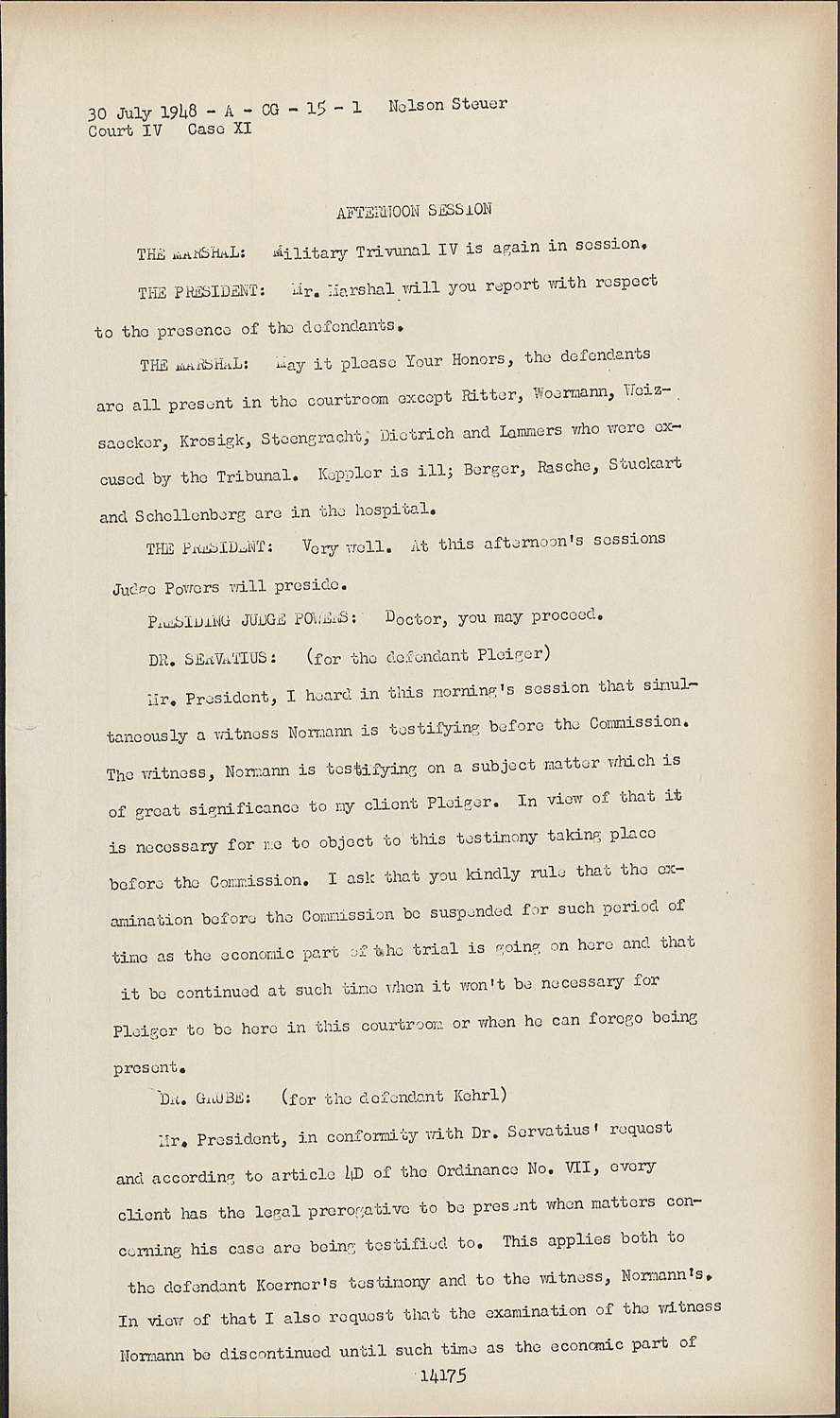
AFTERNOON SESSION
THE MARSHAL:Military Tribunal IV is again in session.
THE PRESIDENT:Mr. Marshal will you report with respect to the presence of the defendants.
THE MARSHAL:May it please Your Honors, the defendants are all present in the courtroom except Ritter, Woermann, Weizsaocker, Krosigk, Steongracht, Dietrich and Lemmers who were excused by the Tribunal. Keppler is ill; Berger, Rasche, Stuckart and Schellenberg are in the hospital.
THE PRESIDENT:Very well. At this afternoon's sessions Judge Powers will preside.
PRESIDING JUDGE POWERS:Doctor, you may proceed.
DR.SERVATIUS: (for the defendant Pleiger) Mr. President, I heard in this morning's session that simultaneously a witness Normann is testifying before the Commission.
The witness, Normann is testifying on a subject matter which is of great significance to my client Pleiger. In view of that it is necessary for me to object to this testimony taking place before the Commission. I ask that you kindly rule that the examination before the Commission be suspended for such period of time as the economic part of the trial is going on here and that it be continued at such time when it won't be necessary for Pleiger to be here in this courtroom or when he can forego being present.
DR.GAUBE: (for the defendant Kohrl) Mr. President, in conformity with Dr. Servatius' request and according to article 4D of the Ordinance No. VII, every client has the legal prerogative to be present when matters concerning his case are being testified to.
This applies both to the defendant Koerner's testimony and to the witness, Normann's. In view of that I also request that the examination of the witness Normann be discontinued until such time as the economic part of the trial shall have taken place.
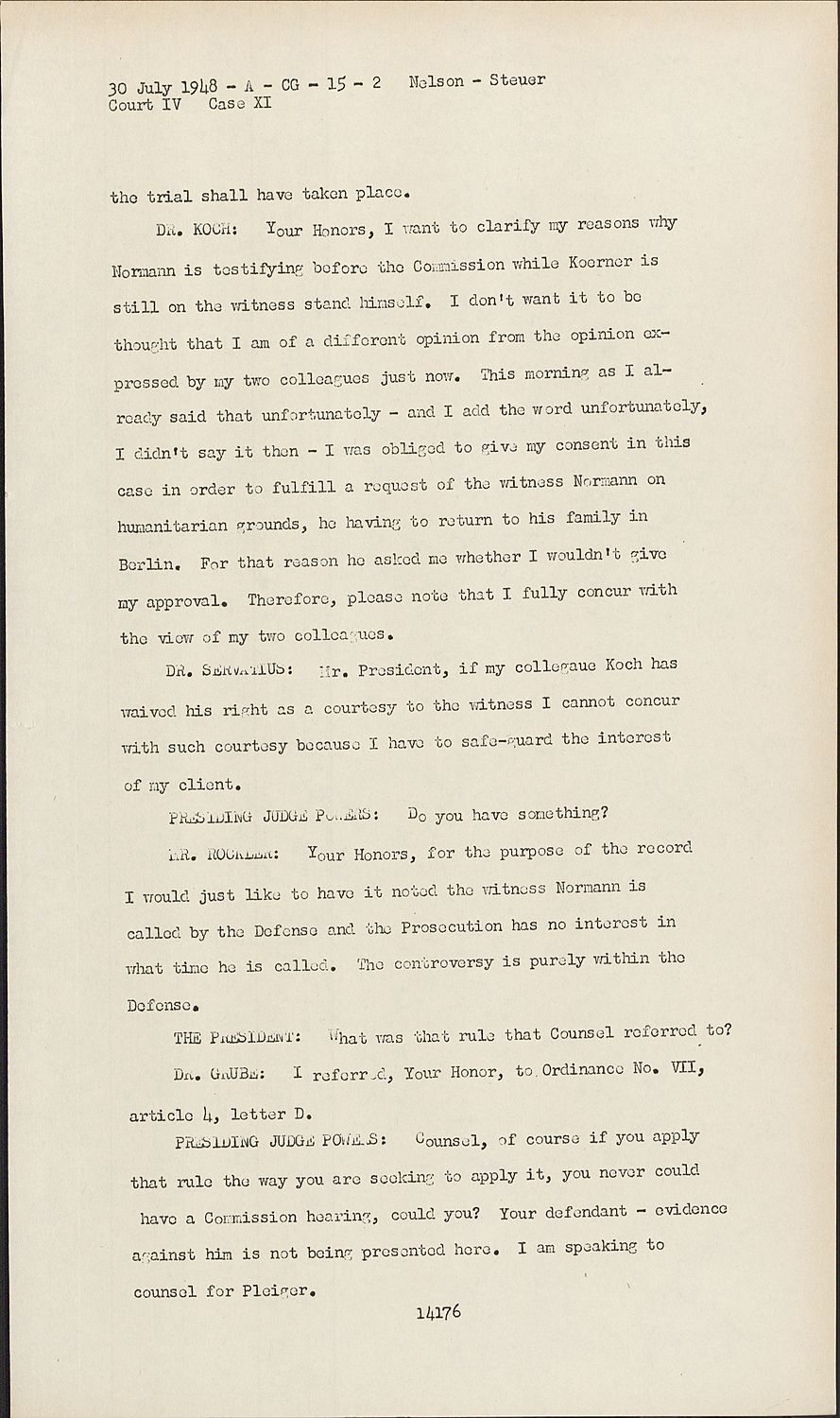
DR. KOCH:Your Honors, I want to clarify my reasons why Norman is testifying before the Commission while Koerner is still on the witness stand himself. I don't want it to be thought that I am of a different opinion from the opinion expressed by my two colleagues just now. This morning as I already said that unfortunately - and I add the word unfortunately, I didn't say it then - I was obliged to give my consent in this case in order to fulfill a request of the witness Normann on humanitarian grounds, he having to return to his family in Berlin. For that reason he asked me whether I wouldn't give my approval. Therefore, please note that I fully concur with the view of my two colleagues.
DR. SERVATIUS:Mr. President, if my collegaue Koch has waived his right as a courtesy to the witness I cannot concur with such courtesy because I have to safe-guard the interest of my client.
PRESIDING JUDGE POWERS:Do you have something?
MR. ROCKLER:Your Honors, for the purpose of the record I would just like to have it noted the witness Normann is called by the Defense and the Prosecution has no interest in what tine he is called. The controversy is purely within the Defense.
THE PRESIDENT:What was that rule that Counsel referred to?
DR. GRUBE:I referred, Your Honor, to Ordinance No. VII, article 4, letter D.
PRESIDING JUDGE POWERS:Counsel, of course if you apply that rule the way you are seeking to apply it, you never could have a Commission hearing, could you?
Your defendant - evidence against him is not being presented here. I am speaking to counsel for Pleiger.
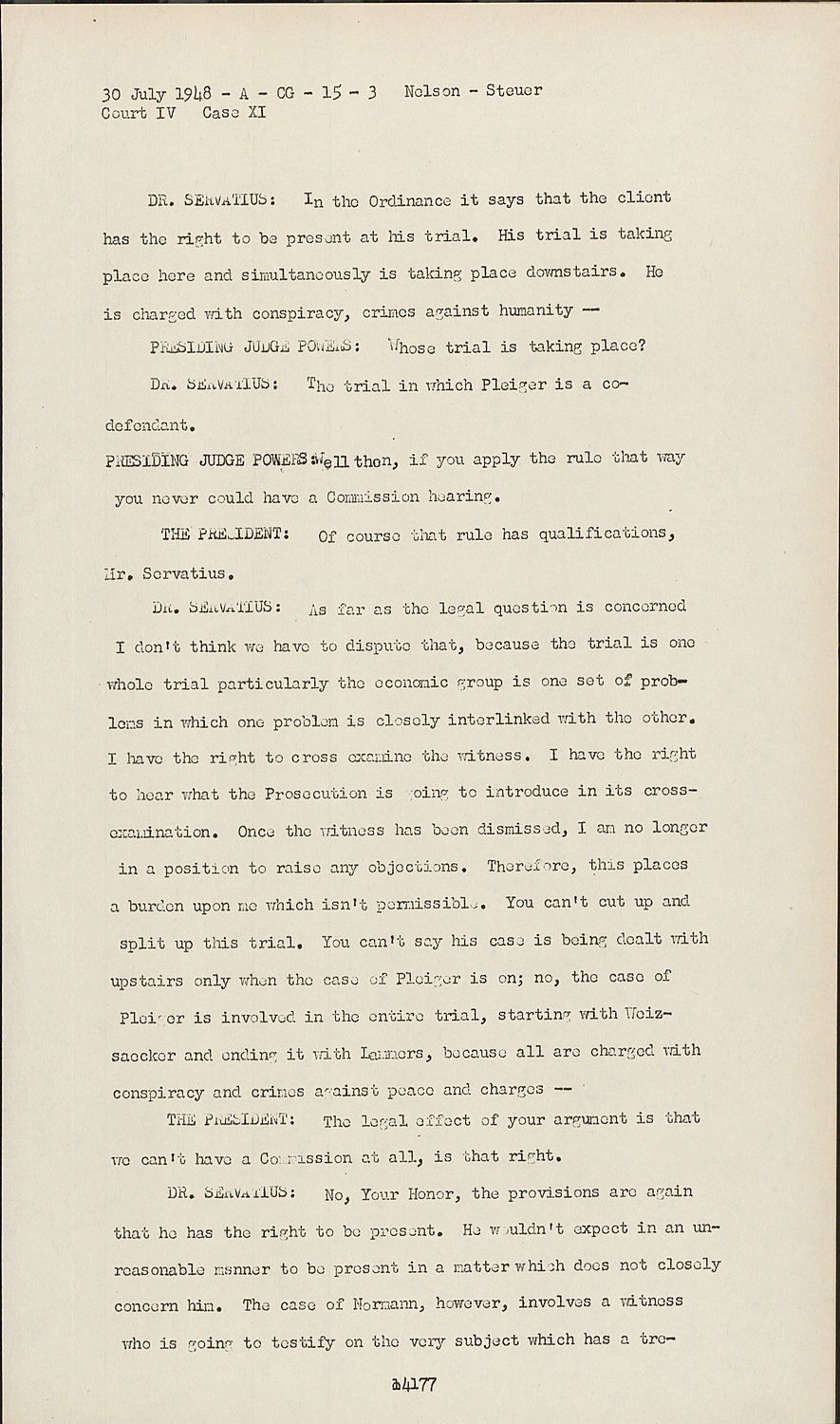
DR. SERVATIUS:In the Ordinance it says that the client has the right to be present at his trial. His trial is taking place here and simultaneously is taking place downstairs. He is charged with conspiracy, crimes against humanity -
PRESIDING JUDGE POWERS:Whose trial is taking place?
DR. SERVATIUS:The trial in which Pleiger is a codefendant. PRESIDING JUDGE POWERS: Well then, if you apply the rule that way you never could have a Commission hearing.
THE PRESIDENT:Of course that rule has qualifications, Mr. Servatius.
DR. SERVATIUS:As far as the legal question is concerned I don't think we have to dispute that, because the trial is one whole trial particularly the economic group is one set of problems in which one problem is closely interlinked with the other. I have the right to cross examine the witness. I have the right to hear what the Prosecution is doing to introduce in its crossexamination. Once the witness has been dismissed, I am no longer in a position to raise any objections.
Therefore, this places a burden upon me which isn't permissible. You can't cut up and split up this trial.
You can't say his case is being dealt with upstairs only when the case of Pleiger is on; no, the case of Pleiger is involved in the entire trial, starting with Weizsaecker and ending it with Lemmers, because all are charged with conspiracy and crimes against peace and charges -
THE PRESIDENT:The legal effect of your argument is that we can't have a Commission at all, is that right.
DR. SERVATIUS:No, Your Honor, the provisions are again that he has the right to be present. He wouldn't expect in an unreasonable manner to be present in a matter which does not closely concern him. The case of Normann, however, involves a witness who is going to testify on the very subject which has a tre in mondous significance for my client;/the case of the economic groups all questions touched upon are of most vital interest.