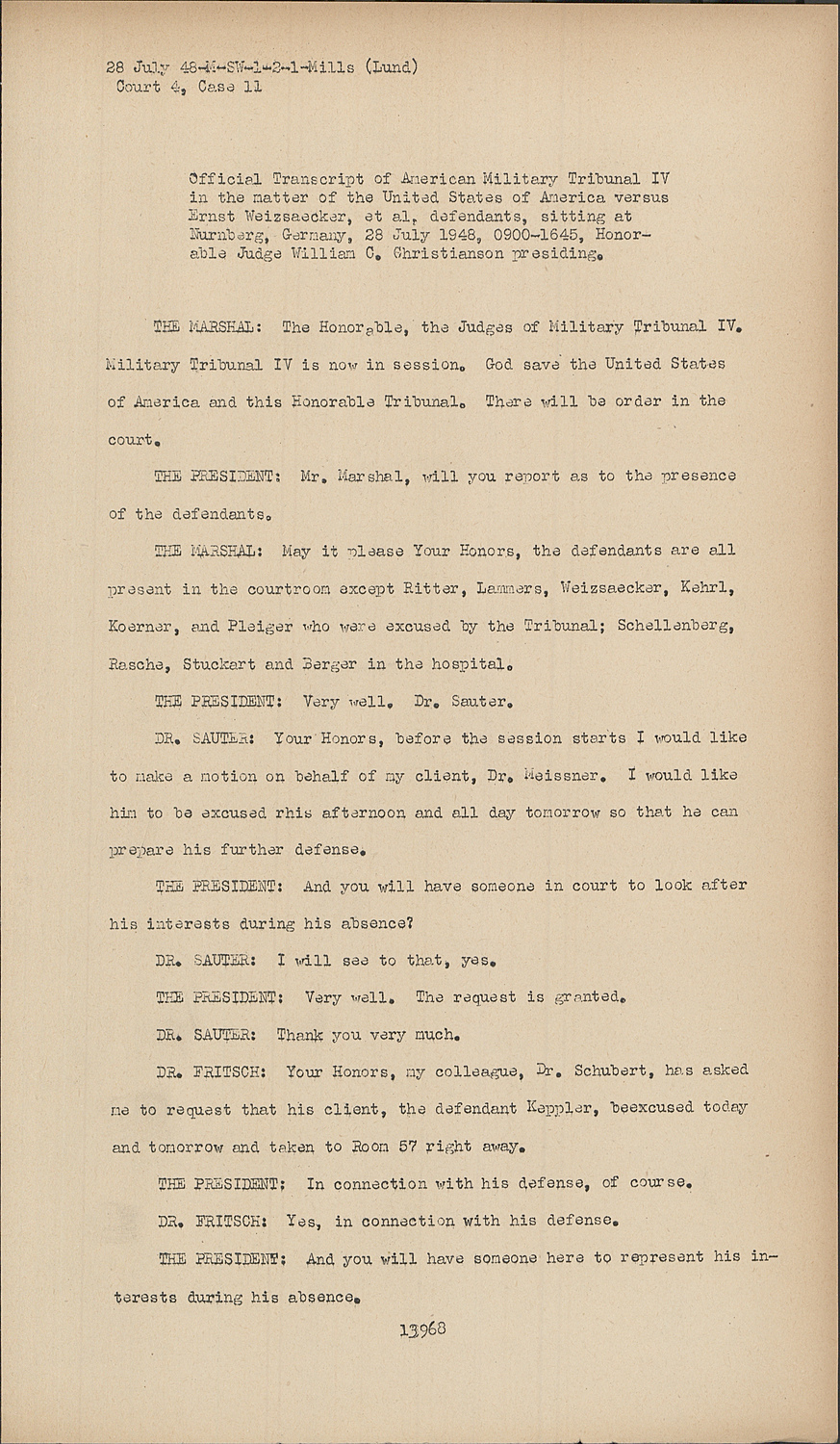
Official Transcript of American Military Tribunal IV in the matter of the United States of America versus Ernst Weizsaecker, et al, defendants, sitting at Nurnberg, Germany, 28 July 1948, 0900-1645, Honor able Judge William C. Christianson presiding.
THE MARSHAL:The Honorable, the Judges of Military Tribunal IV. Military Tribunal IV is now in session. God save the United States of America and this Honorable Tribunal. There will be order in the court.
THE PRESIDENT:Mr. Marshal, will you report as to the presence of the defendants.
THE MARSHAL:May it please Your Honors, the defendants are all present in the courtroom except Ritter, Lammers, Weizsaecker, Kehrl, Koerner, and Pleiger who were excused by the Tribunal; Schellenberg, Rasche, Stuckart and Berger in the hospital.
THE PRESIDENT:Very well. Dr. Sauter.
DR. SAUTER:Your Honors, before the session starts I would like to make a notion on behalf of my client, Dr. Meissner. I would like him to be excused this afternoon and all day tomorrow so that he can prepare his further defense.
THE PRESIDENT:And you will have someone in court to look after his interests during his absence?
DR. SAUTER:I will see to that, yes.
THE PRESIDENT:Very well. The request is granted.
DR. SAUTER:Thank you very much.
DR. FRITSCH:Your Honors, my colleague, Dr. Schubert, has asked me to request that his client, the defendant Keppler, be excused today and tomorrow and taken to Room 57 right away.
THE PRESIDENT:In connection with his defense, of course.
DR. FRITSCH:Yes, in connection with his defense.
THE PRESIDENT:And you will have someone here to represent his interests during his absence.
DR. FRITSCH:Yes, Your Honors.
THE PRESIDENT:The request is granted and he may be taken to Room 57 as requested, Dr. Bergold , are you ready to resume your examination.
DR. BERGOLD:Yes, Your Honors.
DR. KEMPNER:Defense Counsel Bergold just informed me that he might not be able for a short while to go on sometime around this morning. If that is so, around eleven o'clock I will be glad to put in some of these remaining documents of Veesenmayer's, if necessary, to fill up the time of the court.
THE PRESIDENT:Between now and noon.
DR. KEMPNER:Yes, sometime.
THE PRESIDENT:Well, we will take that up when we arrive at that point.
DIRECT EXAMINATION (Continued) WERNER STEPHAN BY DR. BERGOLD:
Q.Witness, at the end, yesterday, we were talking about the relationship between Dietrich and Ribbentrop and you told me it was not very good. Was Dietrich in close touch with anybody apart from Ribbentrop so that he was able to get all the information he needed from that.
A.As far as I know he was not in touch with senior officials of the Foreign Office. Concerning his relationship with Hewel I can give no accurate judgment.
Q.Is it not true, witness, that Minister Dr. Karl Paul Schmidt, at the daily parole conference, would tell you or Dietrich about secret military plans which you could pass on to Dietrich then?
A.Herr Schmidt was not very talkative at the daily parole conference insofar as it contained the long range aims of politics. He restricted himself to giving information about the politics of the day which was necessary in connection with working out the daily parole.
Q.After Fritzsche had became head of the German press, did Fritzsche work closely with Dietrich, or was there friction between Fritzsche and Dietrich because Fritzsche approached Goebbels.
A.The relationship between Dr. Dietrich and Fritzsche was never vary good. I think that Fritzsche believed he was superior to Dietrich. Moreover in my opinion he admired Dr. Goebbels, and joined very closely with him.
Q.Do you know to whom, during the war, the press chiefs of the occupied territories were subordinate?
A.If you want to use the name press chiefs for that, which I think is not correct, these men were undoubtedly subordinate to the military commanders, and the military commanders would hardly have tolerated any instructions from civilians.
Q.Did Dietrich participate in the persecutions of the Christian churches?
A.No. Dietrich was brought up as a Catholic and never left me in any doubt that in suite of his membership in the SS he still had definite ties with the Catholic church. I had the impression that, in particular, the persecution of the Church newspapers was something that he particularly disliked. He did quite a number of things to prevent the continuation of the persecution of the Church newspapers.
Q.Witness, can you tell me what instructions Dietrich gave to the press concerning Church matters? That is, whether the press was to support the attacks of the Party on the churches, or whether it was to keep out of that quarrel.
A.He wanted to press to keep out of the quarrel with the Church.
Q.Did he give instructions to that effect?
A.Yes, he also gave instructions to that effect.
Q.Did you hear of cases where Dr. Dietrich intervened on behalf of persecuted persons and people who had been arrested. Can you give me examples of that?
A.Yes. In many cases Dr. Dietrich intervened on behalf of politically persecuted persons. I remember people like Dr. Dietrich, Sommerfeld, Benngiesen and Dovifat of the "Frankfurter Zeitung," Attorney Schneider in Munich, Professor Boemer who has been repeatedly mentioned here. But the list could he lengthened if one attached importance to that.
Q.How did Dr. Dietrich behave when he received applications on behalf of half-Jews or journalists married to Jews, asking for a special permit to allow then to go on working for the press?
A.He was inclined to sign applications of that kind. In such a case, the applications had to come from the publishers themselves. In such cases he was in the habit of saying, "The publishing houses need these men, then they must be given a chance of leaving then in office."
Q.On the basis of such an experience, can you give me any verdict as to whether Dietrich was a radical or moderate anti-Semite.
A.Well, if my moderate anti-Semitism you mean this form of what I might call reactionary anti-Semitism which, unfortunately, was prevalent at German universities and in the German Wehrmacht, even before the First World War, very much to our disadvantage as it later turned out, then I would assume that he can bedescribed as a moderate anti-Semite. Anyway, he did not have the prejudices expressed about the Jews. Anyway, he was not a radical or rabid anti-Semite.
Q.Can you say anything about his relationship with the newspaper "Der Stuermer."
A.As a man of taste and aesthetic feeling he found this paper repulsive like every sensible human being.
Q.Did Dietrich write any articles about the racial question as such or the Jewish question as such?
A.Not that I remember.
Q.Now, you will remember that the daily paroles also contain antiSemitic tendencies. Do these come from Dietrich's initiative?
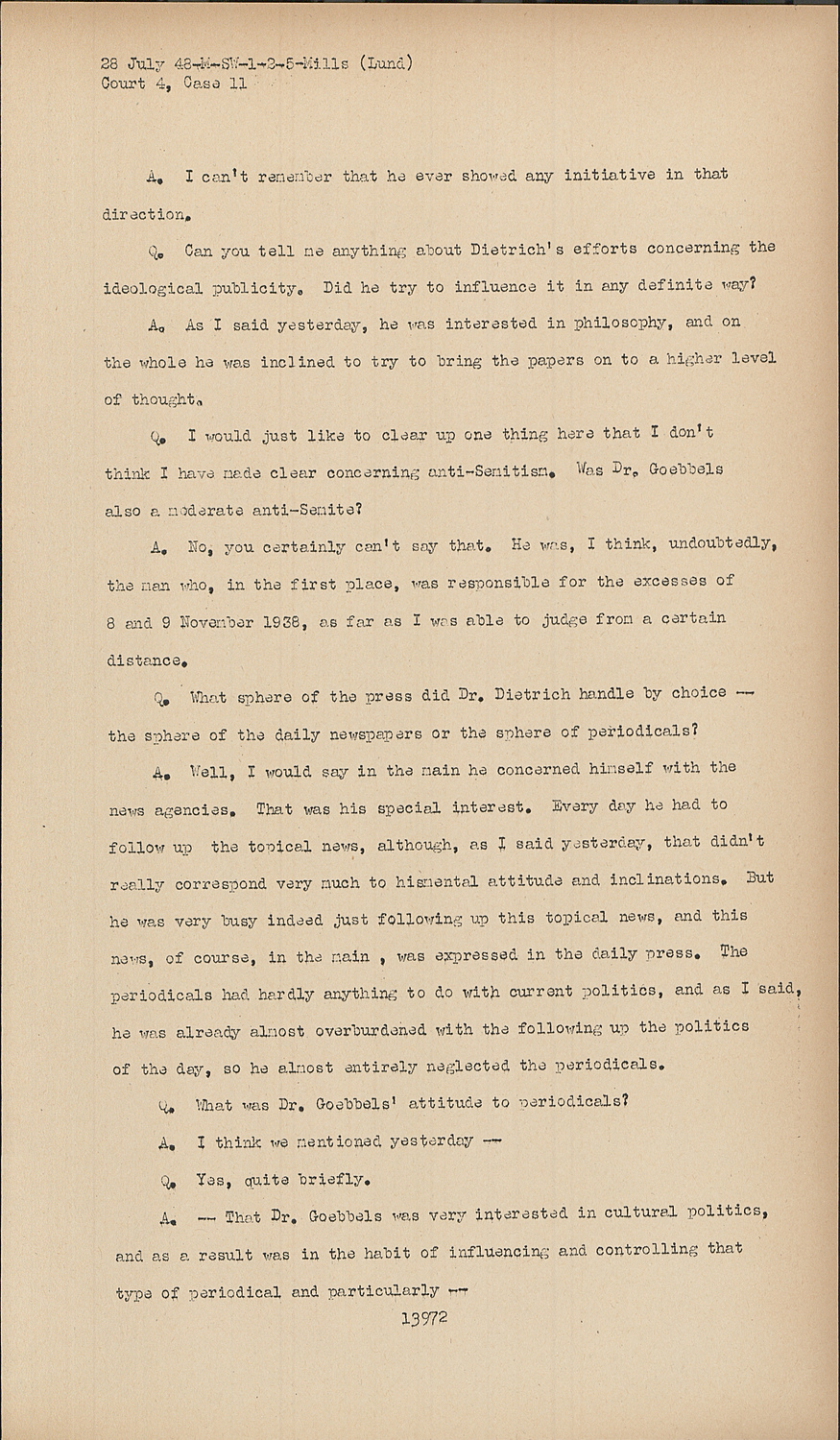
A.I can't remember that he ever showed any initiative in that direction.
Q.Can you tell me anything about Dietrich's efforts concerning the ideological publicity. Did he try to influence it in any definite way?
A.As I said yesterday, he was interested in philosophy, and on the whole he was inclined to try to bring the papers on to a higher level of thought.
Q.I would just like to clear up one thing here that I don't think I have made clear concerning anti-Semitism. Was Dr. Goebbels also a moderate anti-Semite?
A.No, you certainly can't say that. He was, I think, undoubtedly, the man who, in the first place, was responsible for the excesses of 8 and 9 November 1938, as far as I was able to judge from a certain distance.
Q.What sphere of the press did Dr. Dietrich handle by choice -the sphere of the daily newspapers or the sphere of periodicals?
A.Well, I would say in the main he concerned himself with the news agencies. That was his special interest. Every day he had to follow up the topical news, although, as I said yesterday, that didn't really correspond very much to his mental attitude and inclinations. But he was very busy indeed just following up this topical news, and this news, of course, in the main, was expressed in the daily press. The periodicals had hardly anything to do with current politics, and as I said he was already almost overburdened with the following up the politics of the day, so he almost entirely neglected the periodicals.
Q.What was Dr. Goebbels' attitude to periodicals?
A.I think we mentioned yesterday -
Q.Yes, quite briefly.
A. -- That Dr. Goebbels was very interested in cultural politics, and as a result was in the habit of influencing and controlling that type of periodical and particularly -
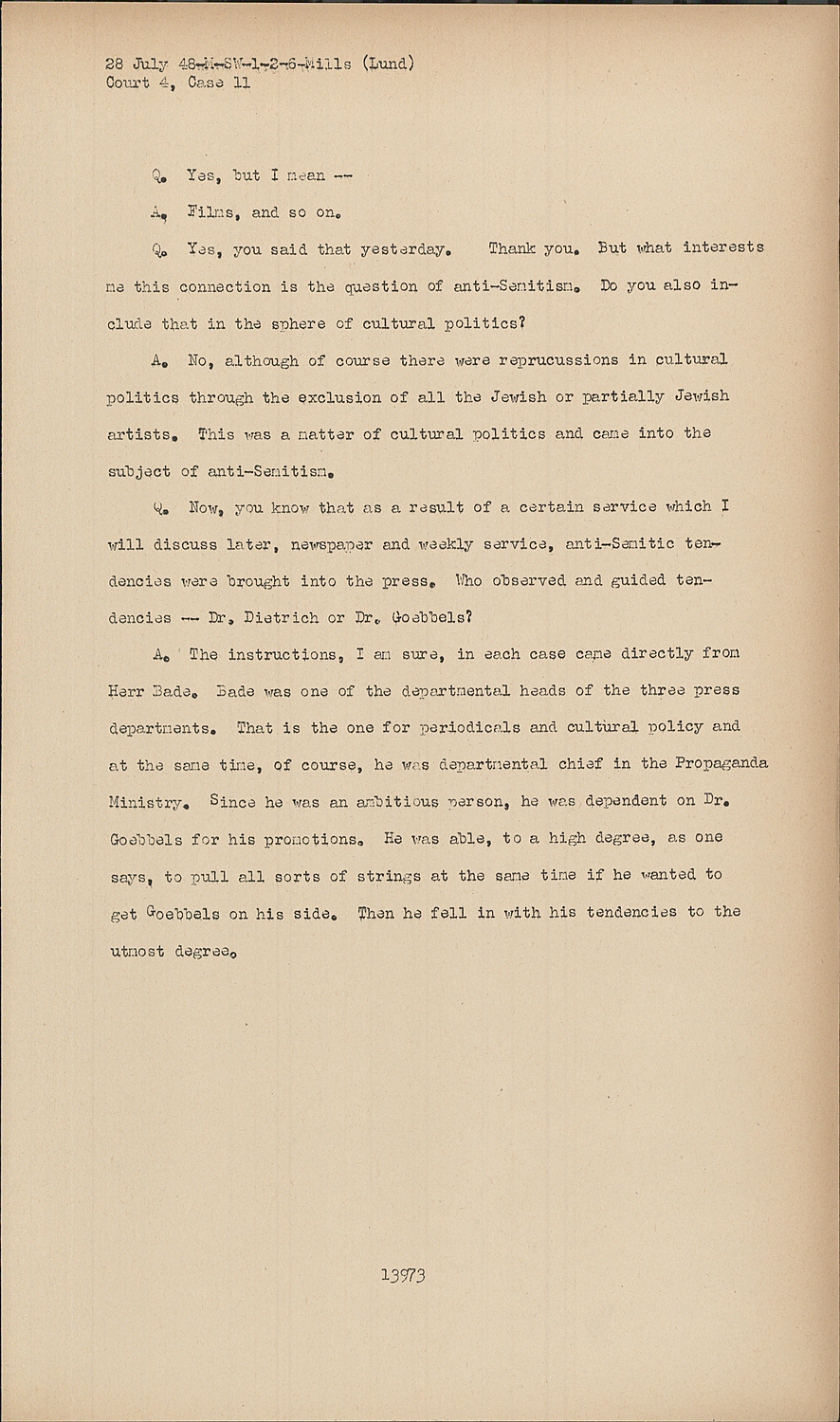
Q.Yes, but I mean -
A.Films, and so on.
Q.Yes, you said that yesterday. Thank you. But what interests me this connection is the question of anti-Semitism. Do you also include that in the sphere of cultural politics?
A.No, although of course there were reprucussions in cultural politics through the exclusion of all the Jewish or partially Jewish artists. This was a matter of cultural politics and came into the subject of anti-Semitism.
Q.Now, you know that as a result of a certain service which I will discuss later, newspaper and weekly service, anti-Semitic tendencies were brought into the press. Who observed and guided tendencies -- Dr. Dietrich or Dr. Goebbels?
A.The instructions, I am sure, in each case came directly from Herr Bade. Bade was one of the departmental heads of the three press departments. That is the one for periodicals and cultural policy and at the same time, of course, he was departmental chief in the Propaganda Ministry. Since he was an ambitious person, he was dependent on Dr. Goebbels for his promotions. He was able, to a high degree, as one says, to pull all sorts of strings at the same time if he wanted to get Goebbels on his side. Then he fell in with his tendencies to the utmost degree.
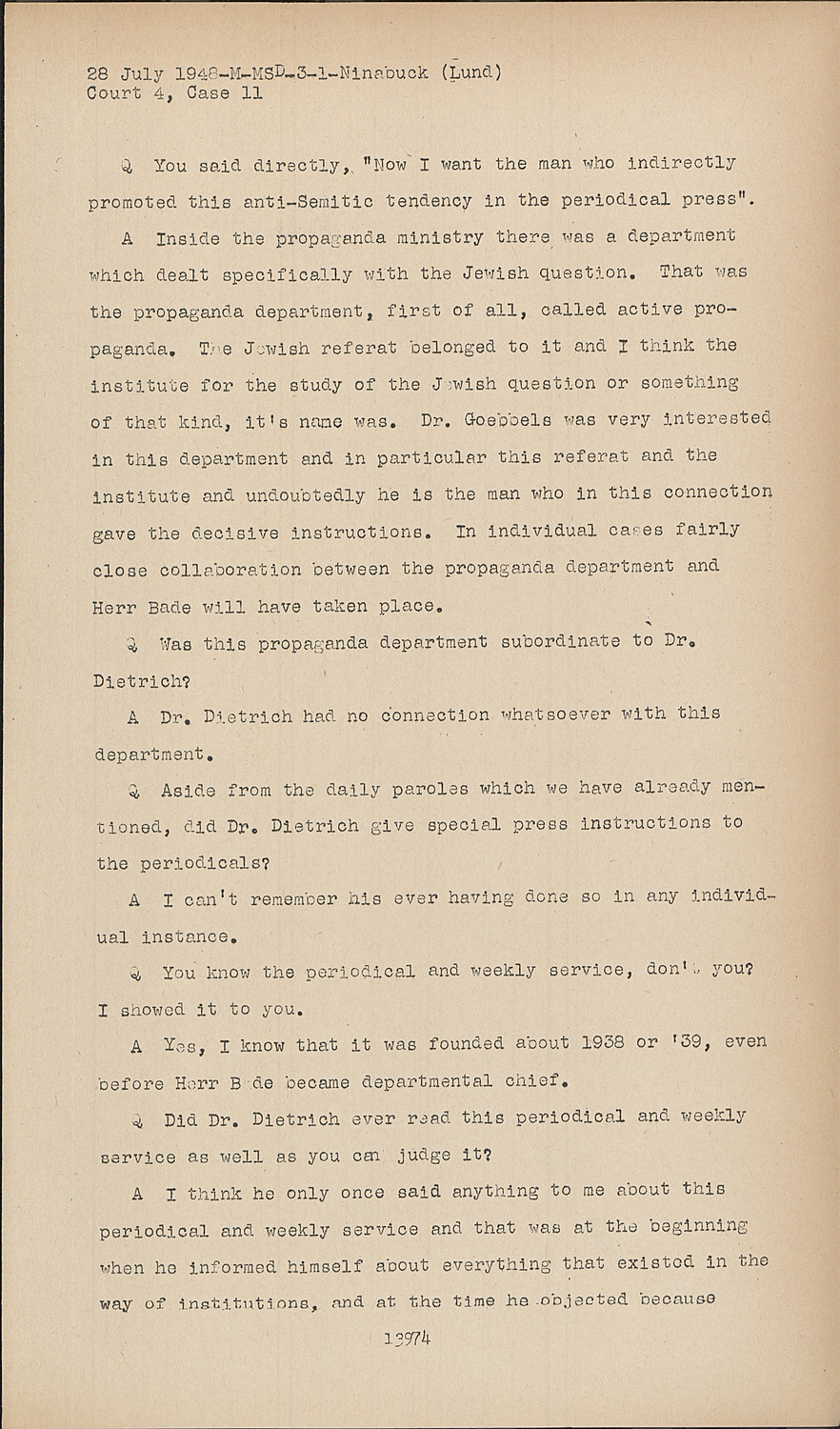
QYou said directly, "Now I want the man who indirectly promoted this anti-Semitic tendency in the periodical press".
AInside the propaganda ministry there was a department which dealt specifically with the Jewish question. That was the propaganda department, first of all, called active propaganda. The Jewish referat belonged to it and I think the institute for the study of the Jewish question or something of that kind, it's name was. Dr. Goebbels was very interested in this department and in particular this referat and the institute and undoubtedly he is the man who in this connection gave the decisive instructions. In individual cares fairly close collaboration between the propaganda department and Herr Bade will have taken place.
QWas this propaganda department subordinate to Dr. Dietrich?
ADr. Dietrich had no connection whatsoever with this department.
QAside from the daily paroles which we have already mentioned, did Dr. Dietrich give special press instructions to the periodicals?
AI can't remember his ever having done so in any individual instance.
QYou know the periodical and weekly service, don't you? I showed it to you.
AYes, I know that it was founded about 1938 or '39, even before Herr B de became departmental chief.
QDid Dr. Dietrich ever read this periodical and weekly service as well as you can judge it?
AI think he only once said anything to me about this periodical and weekly service and that was at the beginning when he informed himself about everything that existed in the way of institutions, and at the time he objected because information to the press was issued, as you might say, for payment and obviously would have preferred that the entire service was dropped altogether.
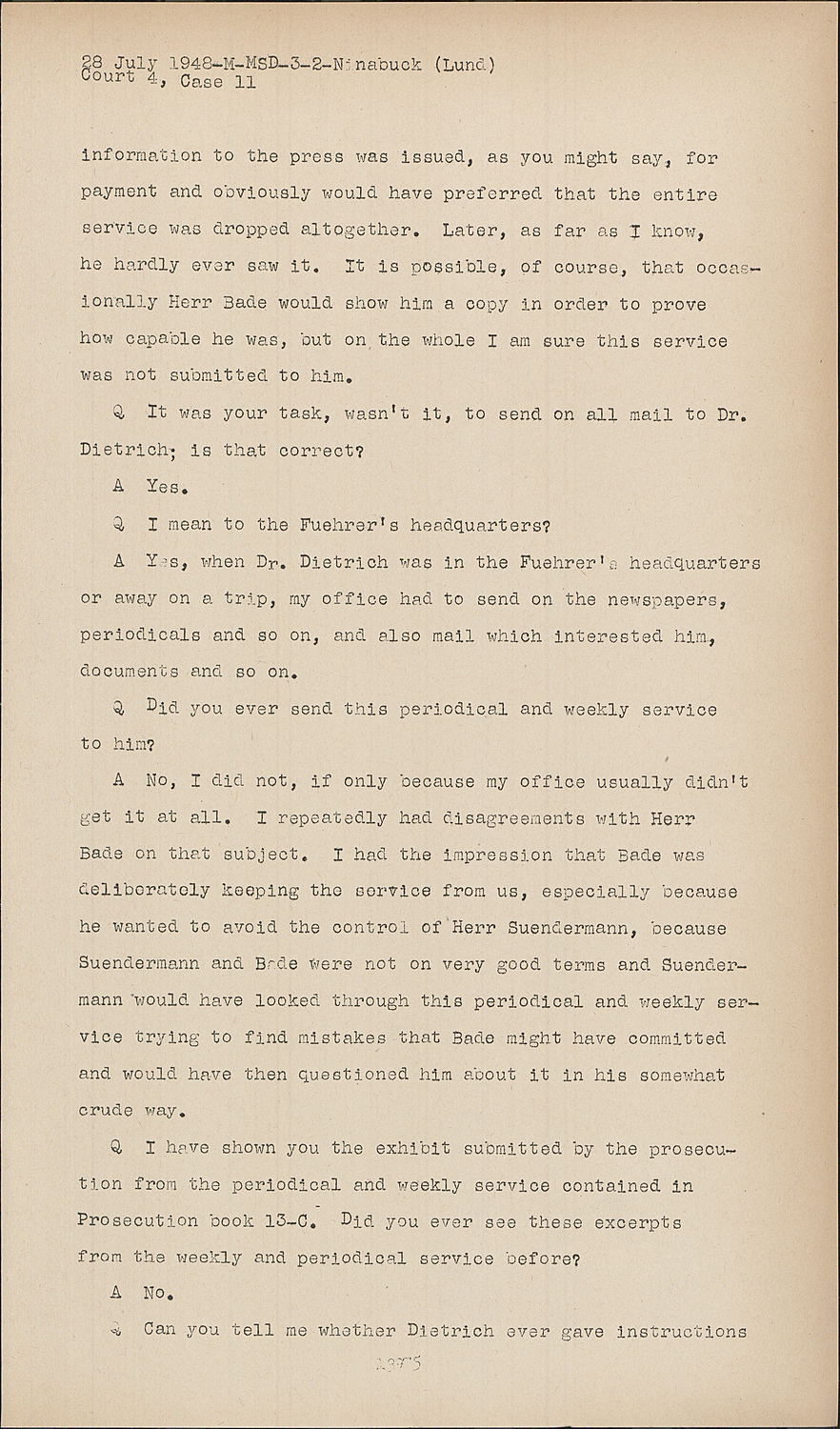
Later, as far as I know, he hardly ever saw it. It is possible, of course, that occasionally Herr Bade would show him a copy in order to prove how capable he was, but on the whole I am sure this service was not submitted to him.
QIt was your task, wasn't it, to send on all mail to Dr. Dietrich; is that correct?
AYes.
QI mean to the Fuehrer's headquarters?
AYes, when Dr. Dietrich was in the Fuehrer's headquarters or away on a trip, my office had to send on the newspapers, periodicals and so on, and also mail which interested him, documents and so on.
QDid you ever send this periodical and weekly service to him?
ANo, I did not, if only because my office usually didn't get it at all. I repeatedly had disagreements with Herr Bade on that subject. I had the impression that Bade was deliberately keeping the service from us, especially because he wanted to avoid the control of Herr Suendermann, because Suendermann and Bade were not on very good terms and Suendermann would have looked through this periodical and weekly service trying to find mistakes that Bade might have committed and would have then questioned him about it in his somewhat crude way.
QI have shown you the exhibit submitted by the prosecution from the periodical and weekly service contained in Prosecution book 13-C. Did you ever see these excerpts from the weekly and periodical service before?
ANo.
QCan you tell me whether Dietrich ever gave instructions of the kind included here, for instance, that the Jews are compared with major criminals and that their complete elimination is described as an action equivalent to a death sentence or security impirsonment for habitual criminals?
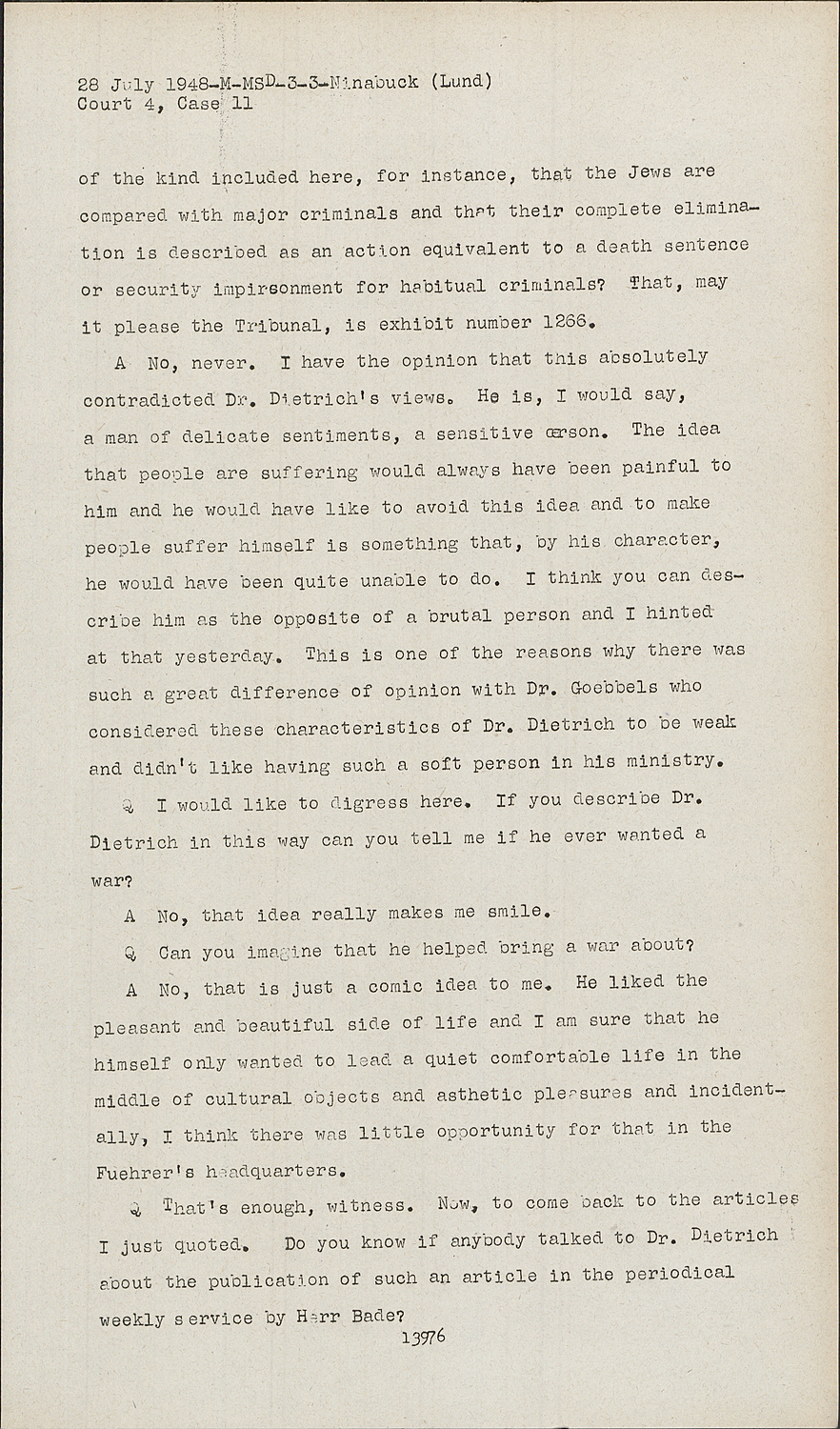
That, may it please the Tribunal, is exhibit number 1266.
ANo, never. I have the opinion that this absolutely contradicted Dr. Dietrich's views. He is, I would say, a man of delicate sentiments, a sensitive person. The idea that people are suffering would always have been painful to him and he would have like to avoid this idea and to make people suffer himself is something that, by his character, he would have been quite unable to do. I think you can describe him as the opposite of a brutal person and I hinted at that yesterday. This is one of the reasons why there was such a great difference of opinion with Dr. Goebbels who considered these characteristics of Dr. Dietrich to be weak and didn't like having such a soft person in his ministry,
QI would like to digress here. If you describe Dr. Dietrich in this way can you tell me if he ever wanted a war?
ANo, that idea really makes me smile.
QCan you imagine that he helped bring a war about?
ANo, that is just a comic idea to me. He liked the pleasant and beautiful side of life and I am sure that he himself only wanted to lead a quiet comfortable life in the middle of cultural objects and asthetic pleasures and incidentally, I think there was little opportunity for that in the Fuehrer's headquarters.
QThat's enough, witness. Now, to come back to the article I just quoted. Do you know if anybody talked to Dr. Dietrich about the publication of such an article in the periodical weekly service by Herr Bade?
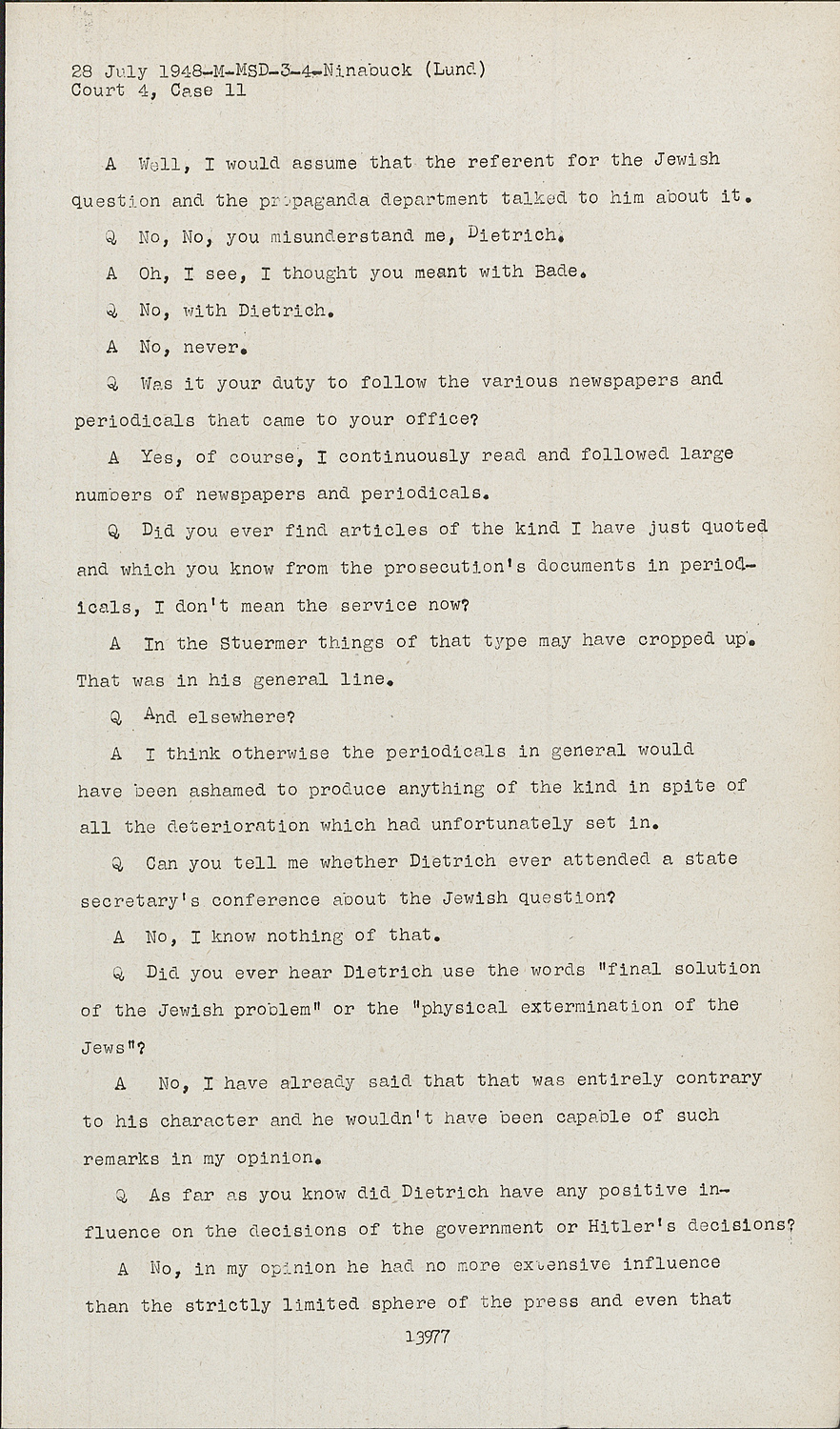
AWell, I would assume that the referent for the Jewish question and the propaganda department talked to him about it.
QNo, No, you misunderstand me, Dietrich.
AOh, I see, I thought you meant with Bade.
QNo, with Dietrich.
ANo, never.
QWas it your duty to follow the various newspapers and periodicals that came to your office?
AYes, of course, I continuously read and followed large numbers of newspapers and periodicals.
QDid you ever find articles of the kind I have just quoted and which you know from the prosecution's documents in periodicals, I don't mean the service now?
AIn the Stuermer things of that type may have cropped up. That was in his general line.
QAnd elsewhere?
AI think otherwise the periodicals in general would have been ashamed to produce anything of the kind in spite of all the deterioration which had unfortunately set in.
QCan you tell me whether Dietrich ever attended a state secretary's conference about the Jewish question?
ANo, I know nothing of that.
QDid you ever hear Dietrich use the words "final solution of the Jewish problem" or the "physical extermination of the Jews"?
ANo, I have already said that that was entirely contrary to his character and he wouldn't have been capable of such remarks in my opinion.
QAs far as you know did Dietrich have any positive influence on the decisions of the government or Hitler's decisions?
ANo, in my opinion he had no more expensive influence than the strictly limited sphere of the press and even that many people tried to deny him.
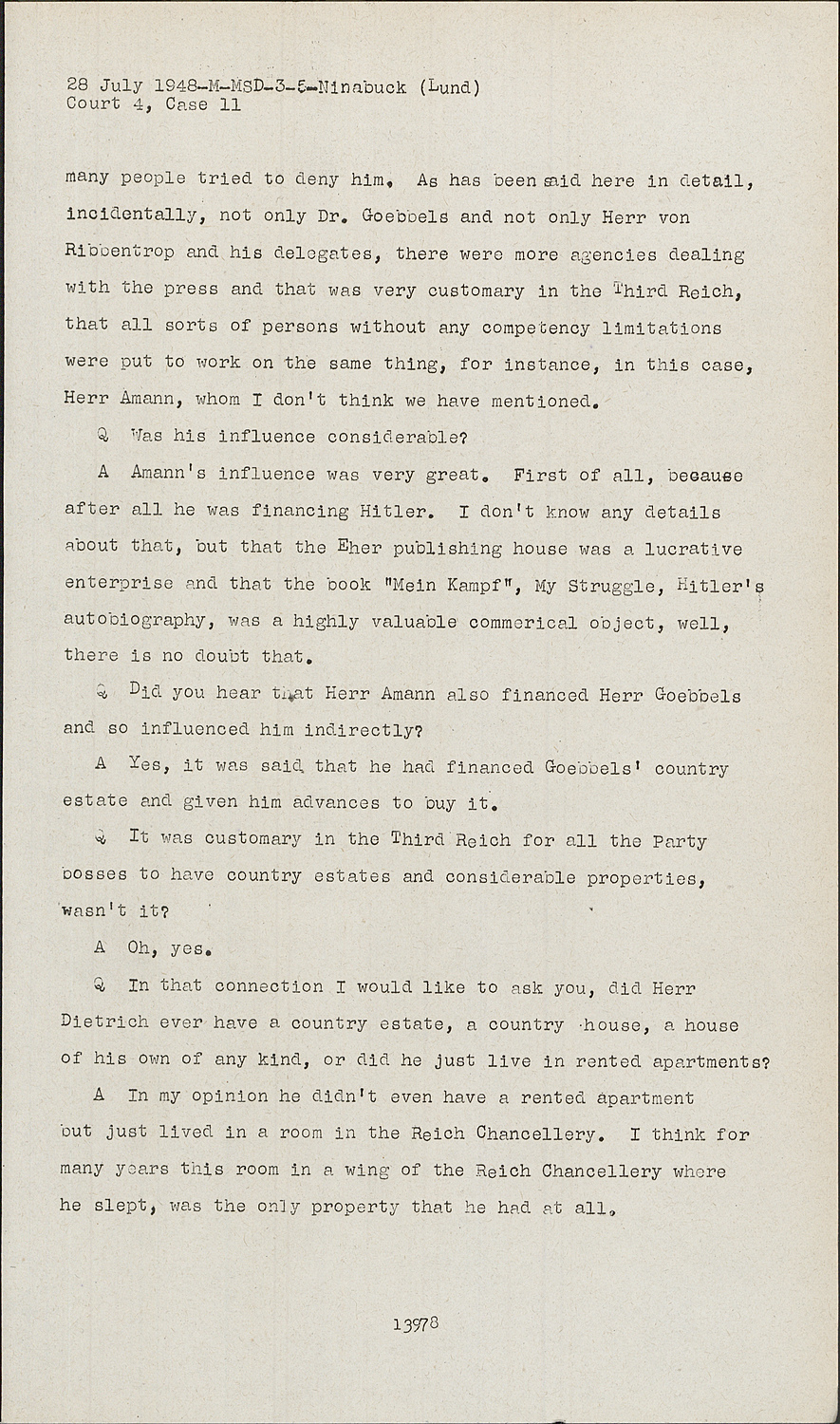
As has been said here in detail, incidentally, not only Dr. Goebbels and not only Herr von Ribbentrop and his delegates, there were more agencies dealing with the press and that was very customary in the Third Reich, that all sorts of persons without any competency limitations were put to work on the same thing, for instance, in this case, Herr Amann, whom I don't think we have mentioned.
QWas his influence considerable?
AAmann's influence was very great. First of all, because after all he was financing Hitler. I don't know any details about that, but that the Eher publishing house was a lucrative enterprise and that the book "Mein Kampf", My Struggle, Hitler's autobiography, was a highly valuable commerical object, well, there is no doubt that.
QDid you hear that Kerr Amann also financed Herr Goebbels and so influenced him indirectly?
AYes, it was said, that he had financed Goebbels' country estate and given him advances to buy it.
QIt was customary in the Third Reich for all the Party bosses to have country estates and considerable properties, wasn't it?
AOh, yes.
QIn that connection I would like to ask you, did Herr Dietrich ever have a country estate, a country house, a house of his own of any kind, or did he just live in rented apartments?
AIn my opinion he didn't even have a rented apartment but just lived in a room in the Reich Chancellery. I think for many years this room in a wing of the Reich Chancellery where he slept, was the only property that he had at all.
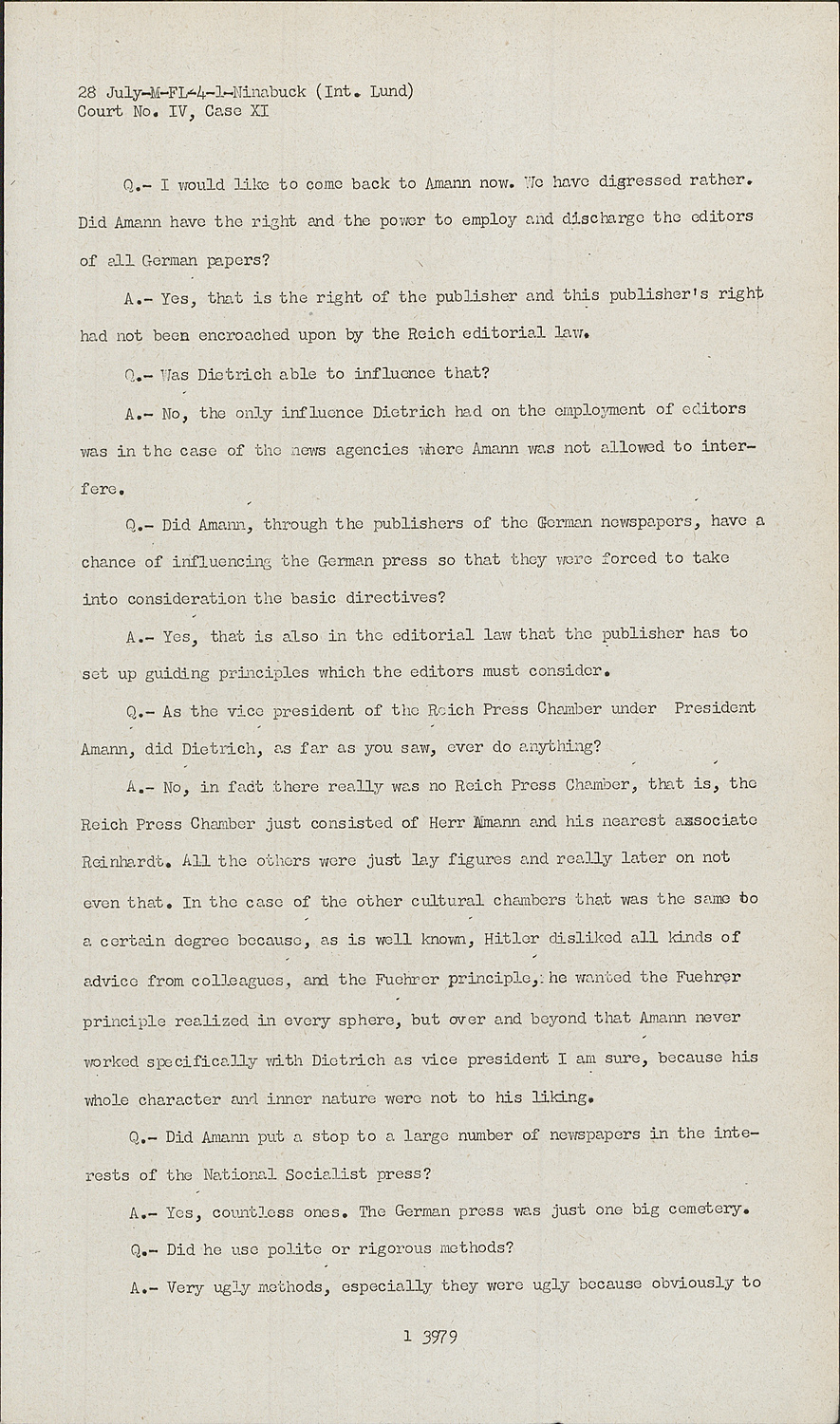
Q.- I would like to come back to Amann now. We have digressed rather. Did Amann have the right and the power to employ and discharge the editors of all German papers?
A.- Yes, that is the right of the publisher and this publisher's right had not been encroached upon by the Reich editorial law.
Q.- Was Dietrich able to influence that?
A.- No, the only influence Dietrich had on the employment of editors was in the case of the news agencies where Amann was not allowed to interfere.
Q.- Did Amann, through the publishers of the German newspapers, have a chance of influencing the German press so that they were forced to take into consideration the basic directives?
A.- Yes, that is also in the editorial law that the publisher has to set up guiding principles which the editors must consider.
Q.- As the vice president of the Reich Press Chamber under President Amann, did Dietrich, as far as you saw, ever do anything?
A.- No, in fact there really was no Reich Press Chamber, that is, the Reich Press Chamber just consisted of Herr Amann and his nearest associate Reinhardt. All the others were just lay figures and really later on not even that. In the case of the other cultural chambers that was the same to a certain degree because, as is well known, Hitler disliked all kinds of advice from colleagues, and the Fuehrer principle, he wanted the Fuehrer principle realized in every sphere, but over and beyond that Amann never worked specifically with Dietrich as vice president I am sure, because his whole character and inner nature were not to his liking.
Q.- Did Amann put a stop to a large number of newspapers in the interests of the National Socialist press?
A.- Yes, countless ones. The German press was just one big cemetery.
Q.- Did he use polite or rigorous methods?
A.- Very ugly methods, especially they were ugly because obviously to some extent they were dictated by financial considerations.
Q.- What was Dietrich's attitude to that?
A.- Dietrich tried with his weak powers to avoid these matters to some extent but as that contradicted the general tendency, including the tendency of Hitler, this work was not very successful.
Q.- Was Dietrich's position with Hitler not better than Amann's because he was closer to Hitler, or was Amann's position stronger?
A.- Amann's position was quite definitely incomparably stronger, among other things because of the reasons I gave just now, but the character of the two men, of course, also played a part.
Q.- And what about Goebbels? It was claimed that Dietrich had been more powerful than Goebbels because he was always sitting next to Hitler's ear.
A.- Goebbels was incomparably more powerful than Dietrich. Whether you consider Goebbels a diabolic or a demoniac, personally he was at any rate an exceedingly powerful effective person and as soon as he want to see Hitler one could assume that he would get his way. All the same I won't deny there were individual cases where Dietrich obtained decisions in his favor contrary to Goebbels' wishes. I am thinking, for instance, of the appointment of Suendermann, of the introduction of the daily parole, the dismissal of Fritzsche and his replacement by Fischer, and a number of other cases. Of course, I often asked myself how it was possible that so weak and ineffective a person as Dr. Dietrich could yet in individual cases inflict those decisions on Dr. Goebbels in his turn. The explanation I found for myself was that when Dietrich was in a position to exploit a favorable mood with Hitler, he was able to bring those decisions about and Dr. Goebbels probably couldn't go running there afterwards reproving Hitler about it.
Q.- But were those fundamental questions, questions of principle, I mean concerning the general matters?
A.- No, more questions of personnel policy and in the case of the daily parole, a matter I would say of the business routine, but as far as the internal structure of the press department went, they were, of course, of a certain importance.
Q.- Witness, did Dietrich ever have the press urge for the lynching of Allied fliers as far as you know?
A.- No, I have no doubt that he would have abhored that too.
Q.- Can you tell me anything as to whether, during the war, Dietrich stoop up for adhering to international law in time of war or not?
A.- Yes, undoubtedly he did, and I think I remember that the final conflict into which he got with Hitler concerned such matters.
Q.- You always attended the ministers' conference and we have heard in an affidavit that you often left this conference early in order to remonstrate personally with Dr. Goebbels about it. Is that correct or is that the result of some mistake?
A.- Of course I disliked being called out of this conference as it was embarrassing quite generally speaking to have to make a demonstration in a fairly large circle. At least, I think it is embarrassing for an old civil servant, but orders of that kind were often brought me into the ministers' conference and I had to follow them.
Q.- You were called up by Dr. Dietrich?
A.- Yes, an office messenger would come in and bring me a slip of paper.
Q.- Well, witness, do you know anything as to whether Dr. Dietrich had journalists or editors assigned to the so-called Einsatzgruppen Kommandos?
A.- Journalists cannot possibly have belonged to this Einsatzgruppen because it was certainly the desire that no reports should be made about their activities so I can hardly imagine what purpose the assignment of journalists there would have served. What happened in the SS Sector, of course, I have no idea.
Q.- But your office or your agency which would have had to handle that did not do such a thing?
A.- Absolutely out of the question.
Q.- I now submit to you Document Book 13-C of the Prosecution, and I refer to Exhibit 1269, page 28 of the English and 20 of the German.
A.- I am sorry, but I am not very practiced at finding these things.
Oh yes, I see it.
Q.- Book 13-C. That is a daily parole of 28 April 1943, which concerns the so-called Katyn murders. Can you tell me who was the originator of this daily parole?
A.- I can't state that of this daily parole in particular. I can, however, say some tiling about the general tendency of this daily parole. When the graves of Katyn were discovered, Dr. Goebbels issued the parole that this was a wonderful opportunity to split up the allies. After some days, however, to my surprise -- and I think to the surprise of father people too -- he issued the line that the Jews were to be made responsible for the murder of the Polish officers. That surprised me because this cancelled out the previous line of Goebbels', and its effectiveness in allied countries was annulled. Dr. Goebbels, however, stuck to this line and, for the benefit of the press who were unable to see the use of the new line, he tried to force the press to carry it out, and one expression of this changed line is this daily parole. I have no doubt whatsoever that it was ordered by Dr. Goebbels.
Q.- Now I have two more questions, witness. The witness Gaensert described Dietrich as the responsible editor-in-Chief of all German papers. Is that a correct description?
A.- No, excuse me, but there again I must smile. I think especially the nervous strain of Dr. Dietrich, as well as his working power and his general survey of the situation as a whole, would not have sufficed to make him even editor-in-chief of a single big newspaper. As for being editor-in-chief of all German daily papers, that, I think, is very far from his nature.
Q.- Is it possible, as the witness Gaensert did, to compare the posi tion of Dietrich with that of the famous American newspaper magnate Hearst?
A.- I would say that it is an insult to Mr. Hearst because, after all, Mr. Hearst existed for the purpose and was able to carry out the purpose of getting his papers out and making them into organs of world importance, while the work of the Press Chief of the Reich Government, with the best will in the world -- which Dr. Dietrich undoubtedly had -- only served, as is the way in a totalitarian state, to hemper the press by countless instructions and to exclude it from fulfilling its normal functions, as well as to restrict its effect on public opinion. I say that this was not Dr. Dietrich's intention. I believe, rather, that his intentions were of the best, but his functions and the effect of his position were undoubtedly of that kind. It was no different in Herr Funk's time. He was a man of the press, just like Dr. Dietrich. He too had good intentions with regard to the press, but Hitler's desire for uniformity and Goebbels' propagandistic tendencies -- Goebbels saw in the press only a function of propaganda -- prevented the possibility of achieving any positive aims.
DR. BERGOLD:That finishes my direct examination of this witness.
THE PRESIDENT:Are there any other members of defense counsel who are desirous of questioning the witness?
(No response.)
If not, the Prosecution may cross-examine, if it so wishes.
CROSS EXAMINATION BY MR. HARDY:
Q.- Dr. Stephan, were you drafted into the Wehrmacht on 3 November 1939?
A.- Yes, I was.
Q.- Did you go to the front?
A.- No, I was a member of the staff of the Wehrmacht War reporters.
Q.- Where were you located?
A.- In Potsdam.
Q.- How often did you get to Berlin?
A.- I was in Berlin every day, unless I was making trips to the front.
Q.- And you were nearly always available to perform your function for Deitrich, is that correct?
A.- Yes, you can say that. I think I was away roughly once every three months, and these trips would last one to two weeks. Anyway, they lasted two long for Dr. Dietrich; he often objected about it to me.
Q.- Now, regarding the Tagesparole conference, when Dietrich was in the city did he preside over the Tagesparole conference?
A.- Yes, he presided.
Q.- In his absence Suendermann?
A.- Yes, Suendermann, and before Suendermann was appointed it was the head of the German Press Department, that is, Herr Fritsch at that time.
Q.- Herr Fritsche was a subordinate of Dietrich's, wasn't he?
A.- Yes, he was directly subordinated to Dietrich, and Goebbels was enthroned above them.
Q.- Now, when Suendermann was not in Berlin and Dietrich was not in Berlin, you presided over the Tagesparole conference, didn't you?
A.- You.
Q.- Well, who did, Bade?
A.- No, the head of the German Press Department.
Q.- Bade or Stephan never presided?
A.- I didn't understand; Bade or Stephan?
Q.- Bade or Stephan never presided over the Tagesparole conference?
A.- I can say positively that Bade never did. Of course, it is possible that I might have presided occasionally, once or twice.
Q.- Where is Bade today?
A.- He was definitely captured by the Russians. Agencies which ought to know said that he was seen in the camp at Frankfurt on the Odor.
Q.- Any reports that he is dead?
A.- No.
Q.- But you have never seen him since the end of the war, is that right?
A.- Yes.
Q.- Now, these Tagesparoles of the Reich Press Chief -- they were sent to all newspapers, were they not, every day?
A.- Yes.
Q.- The larger newspapers had their representatives at the conference, and the smaller newspapers got them through the Gau Offices, is that right?
A.- That is exactly right.
Q.- And all directives of the daily Tagesparoles of the Reich Press Chief were cleared through Dietrich, were they not?
A.- No daily parole was allowed to be issued without Dr. Dietrich having approved it. As long as there was a daily parole, he was responsible for it.
Q.- Now, every newspaper received these Tagesparoles; am I to assume also that Streicher's Der Stuermer also received them?
A.- Yes, it certainly did.
Q.- Now,witness, you stated that to your knowledge no journalists worked with the Einsatzgruppen. I want to submit to you a document -
MR. HARDY:Which unfortunately, your Honors, I have not had processed which is dated 12 December 1941, and I will mark it for identification as Prosecution Exhibit 3721.
THE PRESIDENT:It will be given the identification number 3721.
MR. HARDY:The Dust exhibit was 3719, and I have another document that I have already marked 3720, so I would like to mark this 3721, so I won't have to remark the other one.
THE PRESIDENT:If that is the correct sequence -
MR. HARDY:That is correct according to our records, your Honor.
THE PRESIDENT:Very well; it will be given Prosecution Exhibit No. 3721 for identification. BY MR. HARDY:
Q.- Will you kindly look at that document, Herr Stephan, and tell me whether or not that indicates that journalists and editors were sent by the Propaganda Ministry to work with the Einsatzgruppe?
MR. HARDY:Dr. Bergold, I only have one copy; why don't you go up and look at it with the witness.
DR. BERGOLD:Thank you. BY MR. HARDY:
Q.- Now, is it correct from that document that Propaganda Ministry men, journalists, were with the Einsatzgruppe; isn't that correct?
A.- Yes, the document shows that clearly, that it was an SS matter. The letter is addressed to State Secretary Brigadefuehrer Gutterer.
Q.- That is right.
A.- Concerning the assignment, the SS ranks of these various persons are expressly mentioned. Quite a large number of the men were not journalists either, as is shown quite clearly by the document.
Q.- But quite a lot of them were, though, is that right?
A.- Some of them were; however, obviously they were not selected in their capacities as journalists, but as SS members.