Document 121 is a report of the German Counsel General in Danzig about Polonization attempts of the Poles to authorize the Danzig economy. This is to become exhibit No. 49.
The following documents pertain to the activity and the assignment of the defendant Veesenmayer in August 1939 at Danzig. Document No. 74 is an affidavit by Felix Stravtmann. The affiant states that Dr. Veesenmayer only did informational work in Danzig without having any political missions or powers or authority. This document is to become exhibit No. 50.
Court 4, Case 11 Commission I
DR. THIELE FREDERSDORF:Document No. 232 is an affidavit by Wilhelm Loebsack dealing with Dr. Veesenmayer's activity as information liaison official in Danzig. This is to become exhibit No. 51.
Document 148 is an affidavit by Freiber von Doernberg about the entry of Dr. Veesenmayer in Danzig after the Polish --intervention on behalf of the Polish interests. It will become document No. 52.
The next document deals with the war on the Balkans. Document 138 is an excerpt from a list of the French General Weygand in which he pleads for an opening of a new front in the Balkans. This will become exhibit No. 53.
Document No. 24 is the copy of list of questions of the French General Staff to the French Military and Air Attache in Athens of the 15th of December 1939 from which it becomes evident that the French General Staff had prepared a military drive through Greece, Albania and Yugoslavia. This will become exhibit No. 54.
Document No. 25 is the copy of memorandum of the French General Gamelin about the contact of the French General Staff with regard to Allied intervention on the Balkans with the Greek and Yugoslav army. This will become exhibit No. 55.
Document No. 22 is an excerpt from a sketch of the French General Gamelin about French plans of intervention of the Balkans. This will become exhibit 57.
Document No. 140 is a report of the French Military Attache in Belgrade about secret military collaboration with Yugoslav ministry of war. This is to become exhibit No. 58.
Document No. 21 is a report of the French secret service of the year 1940 about a unsuccessful attempt by the British military secret service to interrupt the traffic on the Danube through Roumanian territory by sabotage enterprise. This will become exhibit No. 59.
Document 141 is a report of the French Military Attache in Belgrade of the 11th of June 1940 about statements of the Yugoslav for Court 4, Case 11 Commission eign ministers who violated the neutrality.
This will become exhibit No. 60.
Document No. 26 is an excerpt of the sketch of the British Minister for India, Amery, in which he pleads for an Allied intervention in Balkans through Greece. This is to become exhibit No. 61.
Document 144 is a German note to the Yugoslav government on the 25th of March 1941 which shows that Germany did not desire an extension of the war to the Balkans. This document will become exhibit No. 62.
Document 145 is a German note to the Yugoslav government of 25 March 1941 which confirms that Germany does not intend to draw Yugoslavia into the war. This document will become exhibit No. 63.
Document 146 is an excerpt from Hitler's sketch of the speech before the Reichstag of 4 May 1941. This will become exhibit No. 64.
Document 142 is and excerpt from Sven Heidin's book about the struggle of the continent. the author shows or tells us about the activities of the American secret service in the Balkans. This will become exhibit No. 65.
MR. BUCHTHAL:I object to exhibit 65 because this is a private pro-German war time publication.
DR. THIELE FRENDERSDORF:I shall refer to that matter in my written brief.
Document 110 is a documentary report of the foreign office on the 24th of June 1941 about the agitation which was carried out by the Soviet Union against Germany. This will become exhibit No. 66.
Document 111 is a captured document from the Soviet embassy in Belgrade of the 13th of April 1941 which shows the Soviet intention to attack Germany at the proper moment. this is to become exhibit No. 67.
Document 112 is a report of the Yugoslav Military Attache in Moscow about Soviet preparation for war against Germany. This document will become exhibit No. 68.
Court 4, Case 11 Commission Document 107 is an excerpt from the book, "Documents of German Politics". It pertains to the prior history of the German-Yugoslav war.
This will become exhibit No. 69.
Document 108 is the official statement of the Reich government of the 6th of April 1941 and it contains documentary material about Yugoslav provocations against Germany. This is to become exhibit No 70.
Document 114 is an excerpt from the book, "Documents of German Politics", with regard to violations of neutrality toward Germany. This will become exhibit No. 71.
Document 228 is a resolution of the Croatian Refugees in Germany of the 10th of April 1948 and the establishment of and independent Croatia is based on the Historical rights of Croatian people and n not upon the instigation of Germany. This document which the Defense also has in the original language will become exhibit No. 72.
MR. BUCHTHAL:I object to 72. This is a recent newspaper article of no probative value.
DR. THIELE FREDERSDORF:I shall refer to this also my written brief.
The next document 210 is an affidavit by Barbara Hacke about Dr. Veesenmayer's assignment in Agram. It confirms that neither Dr. Veesenmayer nor he himself knew that when Veesenmayer left Berlin for Agram that Hitler was planning aggressive war against Yugoslavia, and did not know that Hitler had ordered it. This will become exhibit No. 73.
This concludes my presentation of document book No. III of the Veesenmayer document and I shall now come to document book No. IV. I shall begin with 1898 which was offered by the Prosecution in the trial against the Southwest Generals. This document contains a description of the situation in Yugoslavia at the end of the campaign and this is a description which the Prosecution considered authentic Court 4, Case 11 Commission in the course of their trial.
From this description it becomes evident what the actual conditions were in those areas and also who had the special competencies and authority. This document will become exhibit No. 74.
Document 131 contains an excerpt from the Judgment of the Military Tribunal V in case VII in the case against the Southwest Generals. In this Judgment it is emphasized that an occupation authority will only start to shoot hostages when all their means have failed to obtain peace and order and this Judgment also emphasizes that all other means have to be tried first. The judgment further fixes the responsibility on the military commander for the measures of the Occupation powers in Occupied territory. This document is to become exhibit No. 75.
The next document 208 is an affidavit by Barbara Hacke of the 25th of May 1948. The affiant who was Secretary of the defendant Dr. Weesenmayer, describes the mission of the foreign office to Dr. Veesenmayer prior to his trip to Agram. The affiant emphasized the attempts of the German Ambassador Benzler and Dr. Veesenmayer to hold or mitigate the brutal measures of policies and to introduce a smooth policy to pacify the country without carrying on these brutal measures. The affiant further states that the defendant, Dr. Veesenmayer and the German Ambassador Benzler suggested that a number of the Belgrade Jews should be evacuated in order in this way to prevent brutal measures like the shooting of hostages. Document 208 will become exhibit No. 76.
The document no. 75 is an affidavit of Franz Rademacher who worked in Referat D III, Department Inland of the Foreign Office. Rademacher states that during his time of work in this department Veesenmayer never work for this department or in this department. The affiant further states that he had never heard prior to the end of the war that the defendant Veesenmayer carried on any task or Court 4, Case 11 Commission mission with regard to the Jewish question.
As far as he knows the defendant Weesenmayer had the mission to Counter Partisan warfare through political measures in order to prevent military power from being put into effect.
MINISTRIES COMMISSION I Affiant further states that for technical reasons this suggestion of Ambassador Benzler, to limit the measures by evacuation some Jews from Belgrade, could not be carried out.
Document No. 75 will become Exhibit No. 77.
Document 134 is and affidavit of Eberhard von Thadden, who describes the circumstances of Veesenmayer's inclusion in the dealing with the question of the Slovakian Jews in 1943. The affiant states that at that time he was very suspicious about Veesenmayer's assignment, because of the fact a Jewish adviser was already present. Here affiant further describes the dissension between Veesenmayer and the Higher SS Police leader Winkelmann, and others, at Budapest, as well as the circumstances surrounding the assignment of Hetzinger and Dr. Grell in Hungary, in Budapest.
Document 135 will become Exhibit No. 78.
Document 171 is an affidavit by Horst Wagner. Wagner was the chief of the Department II in the Foreign office and he states that the form and the execution of the assignment of the Defendant, Veesenmayer in the Slovakian Jewish question did not come to his attention, except that Himmler strongly objected to the possibility of Dr. Veesenmayer having any inclusion as Ambassador Plenipotentiary in Hungary in the field of Veesenmayer, and he emphasizes the lack of force of Dr. Veesenmayer towards the SS Agencies of Himmler.
Document 171 will become Exhibit No. 79.
Document 209 is and affidavit of Barbara Hacks, about the mission and activities of Dr. Veesenmayer in Hungary and in Slovakia. She testifies that Dr. Veesenmayer in order to camouflage his intelligence work, received special missions without actually having to work on them, in order to carry out his real assignment. The Czechoslovakia camouflaged mission was the discussion of the Jewish question there. The affiant further testifies that Exhibit 1813 of the Prosecution, a severe change of Ribbentrop's relations with Dr. Veesenmayer is brought out.
MINISTRIES COMMISSION I Document 209 will become Exhibit 80.
Document 150 is an excerpt copy from the minutes of the transcript of the IMT interrogation of the Prosecution witness, Wisliceny, about the deportation of Jews from Czechoslovakia. Wisliceny states that from August, 1932, until September, 1944, no Jews were deported from Czechoslovakia.
Document 150 will become Exhibit No. 81.
Document 134 is and affidavit by the Arch Duke Josef Von Hapsburg, dated 4 May, 1943 about the position of Horthy as the head of the State of Hungary, with regard to the legislation there, and further about the institution of the crown council is mentioned in the Hungarian Constitution and about the position of Dr. Veesenmayer in the SS agencies.
Document 134 will become Exhibit 82.
Document No. 79 is an affidavit of Volkmar Sindel, of the 26th of April, 1948, about the measures published against the Jews in Hungary in the years 1938, 1940 and 1942. This was clearance of laws.
This document will become Exhibit No. 83.
Document No. 90 is an affidavit by Barbara Hacks, about the pester Lloyd article which was published in the Institute for Foreign public Law and International Law at the University of Hamburg, the first implementation for the laws against the Jews in Hungary; the draft of the law regarding the limitation of the position of the Jews in public economic laws, and finally, the DNB article, the "Hungarian Law Against the Jews".
This document No. 90 will become Exhibit No. 84.
Document No. 94 is an affidavit by Barbara Hacke, abort newspaper material of the year 1938 until 1943, which deal with the Jewish question in Hungary.
This Document will be Exhibit 85.
Document No. 200 is an excerpt copy form the Voelkischer Beobachter of the 1st of January, 1943, pertaining to the Jewish questions in Hungary. The figures of the Voelkischer Beobachter are an official publication about the legal Hungarian measures in the Jewish questions and the MINISTRIES COMMISSION I implementation by the Hungarian Authorities.
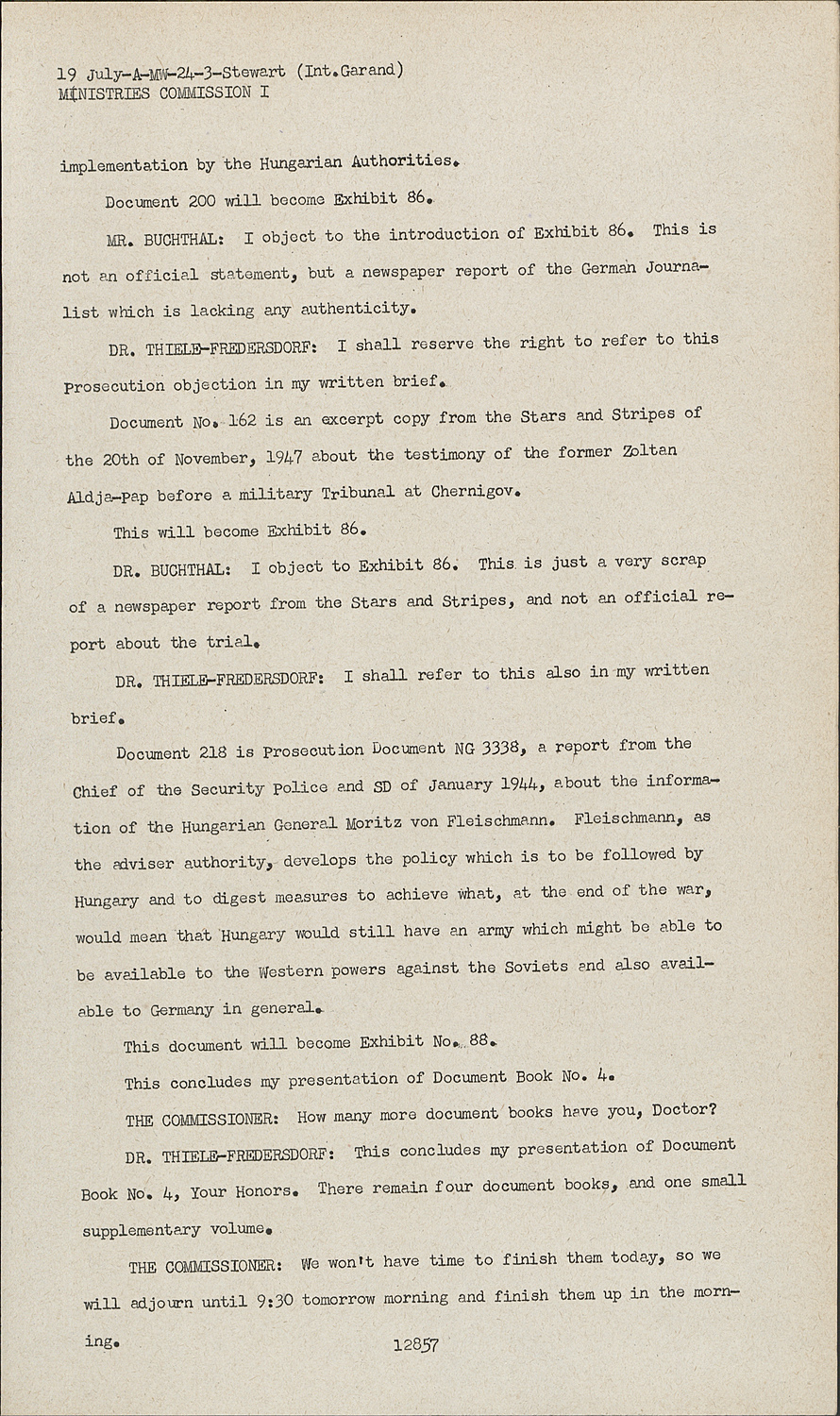
Document 200 will become Exhibit 86.
MR. BUCHTHAL:I object to the introduction of Exhibit 86. This is not an official statement, but a newspaper report of the German Journalist which is lacking any authenticity.
DR.THIELE-FREDERSDORF: I shall reserve the right to refer to this Prosecution objection in my written brief.
Document No.162 is an excerpt copy from the Stars and Stripes of the 20th of November, 1947 about the testimony of former Zoltan Aldja-Pap before a military Tribunal at Chernigov.
This will become Exhibit 86.
DR. BUCHTHAL:I object to Exhibit 86. This is just a very scrap of a newspaper report from the Stars and Stripes, and not and official report about the trial.
DR.THIELE-FREDERSDORF: I shall refer to this also in my written brief.
Document 218 is Prosecution Document NG 3338, a report from the Chief of the Security police and SD of January 1944, about the information of the Hungarian General Moritz von Fleischmann. Fleischmann, as the adviser authority, develops the policy which is to be followed by Hungary and to digest measures to achieve what, at the end of the war, would mean that Hungary would still have an army which might be able to be available to the Western powers against the Soviets and also available to Germany in general.
This document will become Exhibit No. 88.
This concludes my presentation of Document Book No. 4.
THE COMMISSIONER:How many more document books have you, Doctor?
DR.THIELE-FREDERSDORF: This concludes my presentation of Document Book No. 4, Your Honors. There remain four document books, and one small supplementary volume.
THE COMMISSIONER:We won't have time to finish them today, so we will adjourn until 9:30 tomorrow morning and finish up in the morning.
MINISTRIES COMMISSION I
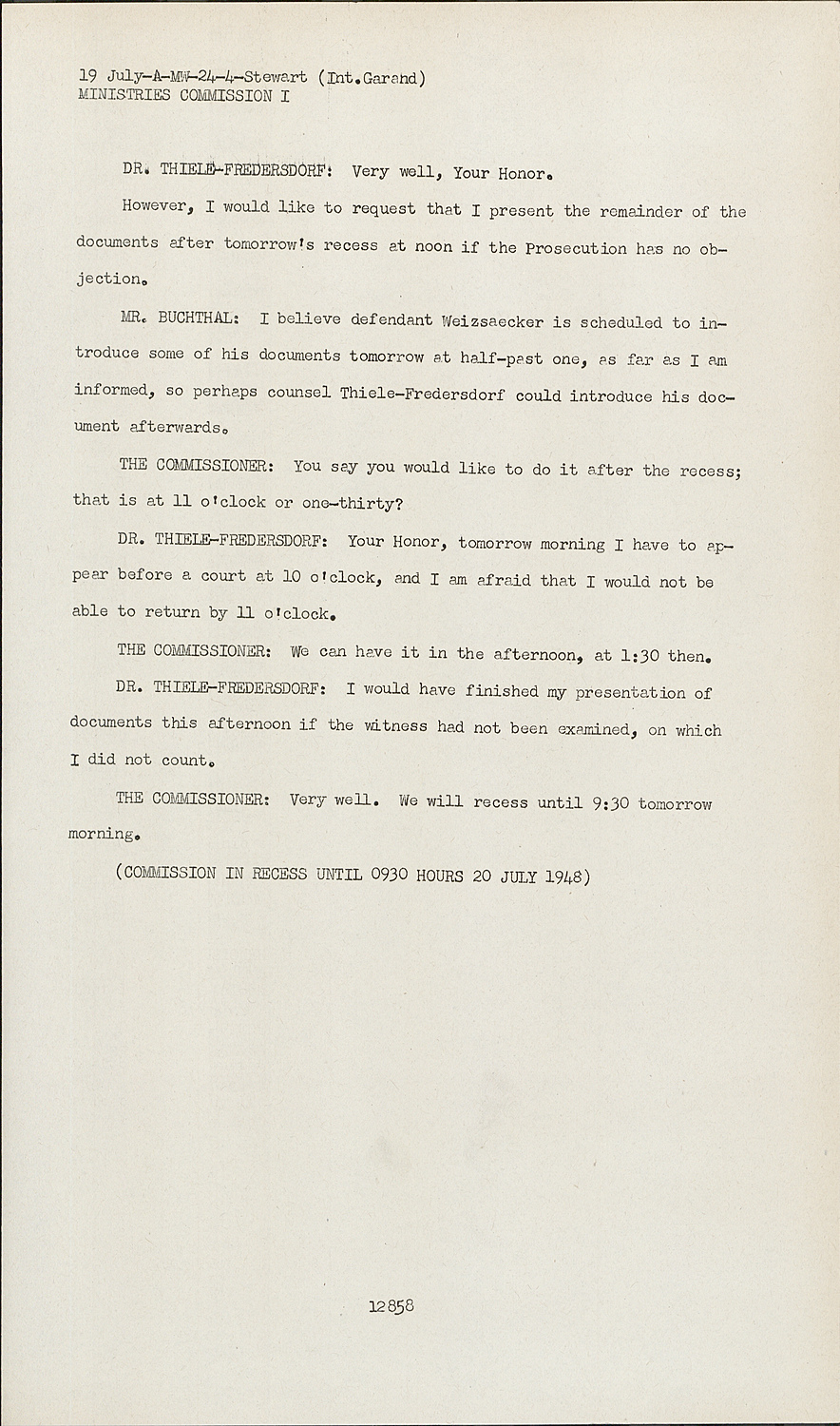
DR.THIELE-FREDERSDORF: Very well, Your Honor.
However, I would like to request that I present the remainder of the documents after tomorrow's recess at noon if the Prosecution has no objection.
MR. BUCHTHAL:I believe defendant Weizsaeker is scheduled to introduce some of his documents tomorrow at half-past one, as far as I am informed, so perhaps counsel Thiele-Fredersdorf could introduce his document afterward.
THE COMMISSIONER:You say you would like to do it after the recess; that is at 11 o'clock or one-thirty?
DR.THIELE-FREDERSDORF: Your Honor, tomorrow morning I have to appear before a court at 10 o'clock, and I am afraid that I would not be able to return by 11 o'clock.
THE COMMISSIONER:We can have it in the afternoon, at 1:30 then.
DR.THIELE-FREDERSDORF: I would have finished my presentation of documents this afternoon if the witness had not been examined, on which I did not count.
THE COMMISSIONER:Very well. We will recess until 9;30 tomorrow morning.
(COMMISSION IN RECESS UNTIL 0930 HOURS 20 JULY 1948)
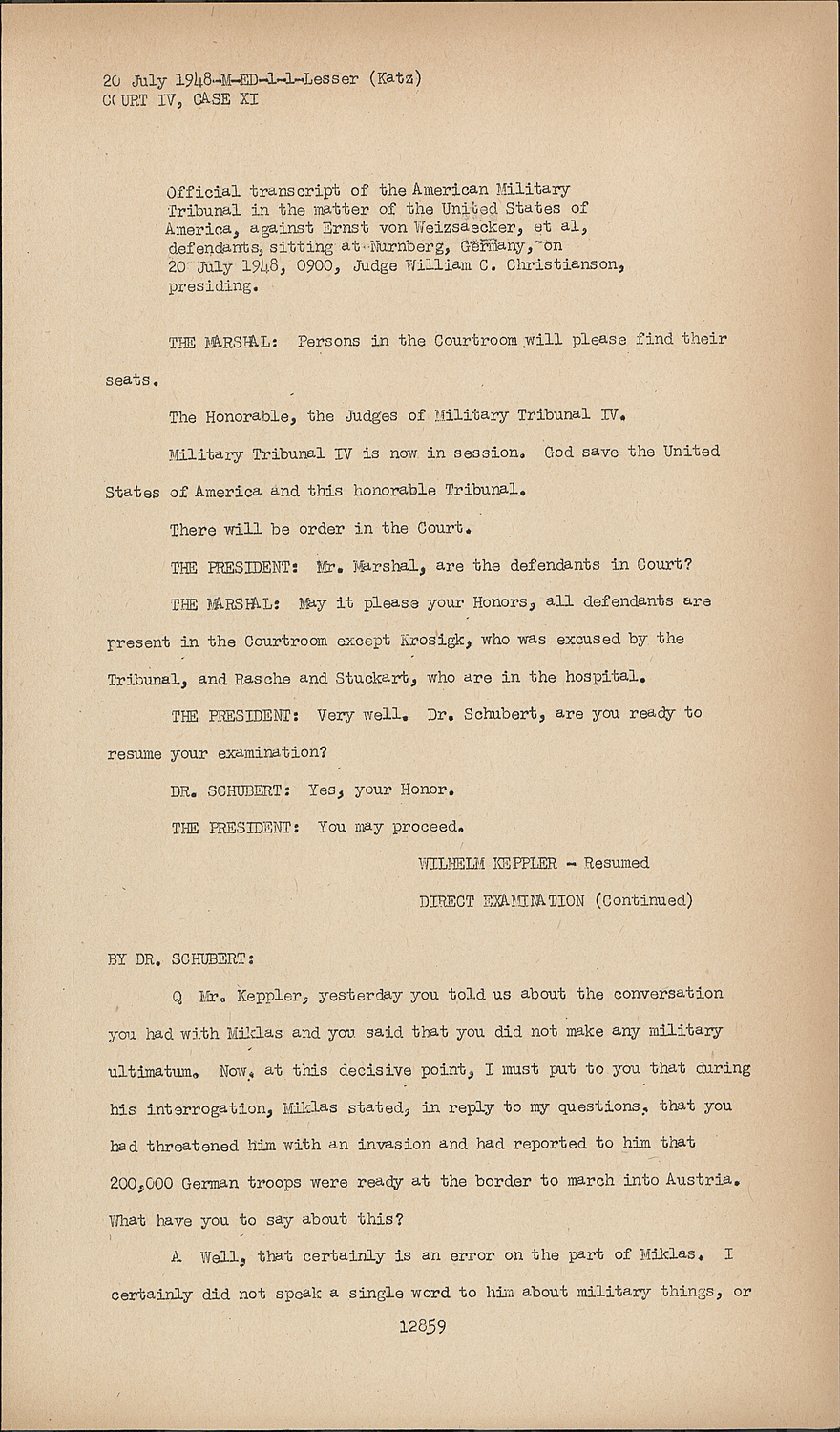
Official transcript of the American Military Tribunal in the matter of the United States of America, against Ernst von Weizsaecker, et al, defendants, sitting at Nurnberg, Germany, on 20 July 1948, 0900, Judge William C. Christianson, presiding.
THE MARSHAL:Persons in the Courtroom will please find their seats.
The Honorable, the Judges of Military Tribunal IV.
Military Tribunal IV is now in session. God save the United States of America and this honorable Tribunal.
There will be order in the Court.
THE PRESIDENT:Mr. Marshal, are the defendants in Court?
THE MARSHAL:May it please your Honors, all defendants are present in the Courtroom except Krosigk, who was excused by the Tribunal, and Rasche and Stuckart, who are in the hospital.
THEPRESIDENT; Very well. Dr. Schubert, are you ready to resume you examination?
DR. SCHUBERT:Yes, your Honor.
THE PRESIDENT:You may proceed.
WILHELM KEPPLER - Resumed DIRECT EXAMINATION (Continued) BY DR. SCHUBERT:
QMr. Keppler, yesterday you told us about the conversation you had with Miklas and you said that you did not make any military ultimatum. Now, at this decisive point, I must put questions, that you had threatened him with an invasion and had reported to him that 200,000 German troops were ready at the border to march into Austria. What have you to say about this?
AWell, that certainly is an error on the part of Miklas. I certainly did not speak a single word to him about military things, or make an ultimatum to him.
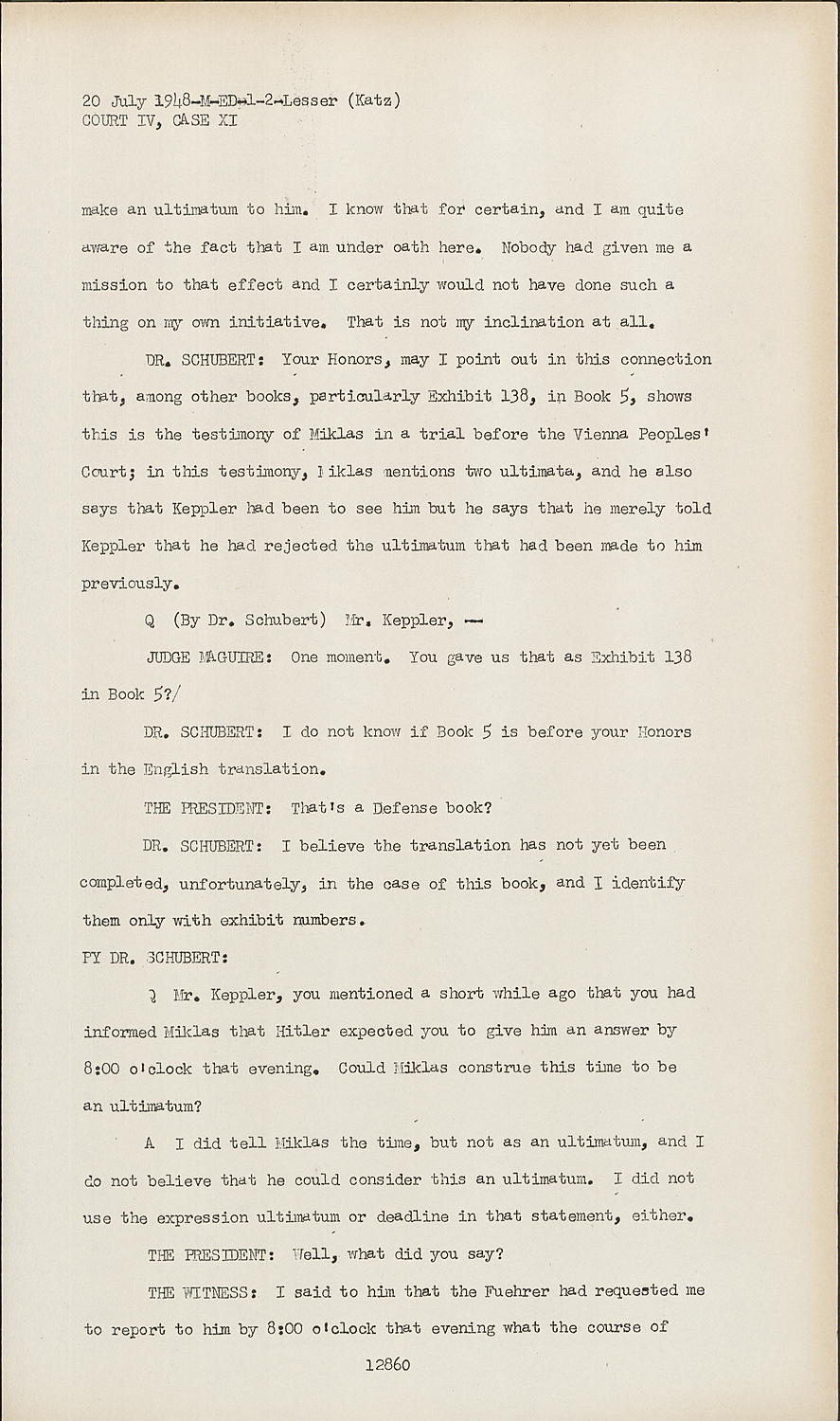
I know that for certain, and I am quite aware of the fact that I am under oath hare. Nobody had given me a mission to that effect and I certainly would not have done such a thing on my own initiative. That is no my inclination at all.
DR. SCHUBERT:Your Honors, may I point out in this connection that, among other books particularly Exhibit 138, in Book 5, shows this is the testimony of Miklas in a trial before the Vienna Peoples' Court; in this testimony, Miklas mentions two ultimata, and he also says that Keppler had been to see him but he says that he merely told Keppler that he that rejected the ultimatum that had been made to him previously.
Q (By Dr. Schubert) Mr. Keppler, -
JUDGE MAGUIRE:One moment. You gave us that as Exhibit 138 in Book 5?/
DR. SCHUBERT:I do not know if Book 5 is before your Honors in the English translation.
THE PRESIDENT:That's a Defense book?
DR. SCHUBERT:I believe that translation has not yet been completed, unfortunately, in the case of this book, and I identify them only with exhibit numbers. BY DR. SCHUBERT:
QMr. Keppler, you mentioned a short while ago that you had informed Miklas that Hitler expected you to give him an answer by 8:00 o'clock that evening. Could Miklas construe this time to be an ultimatum?
AI did tell Miklas the time, but not as an ultimatum, and I do not believe that he could consider this an ultimatum. I did not use the expression ultimatum or deadline in that statement, either.
THE PRESIDENT:Well, what did you say?
THE WITNESS:I said to him that the Fuehrer had requested me to report to him by 8:00 o'clock that evening what the course of events was; and I said to him he should consider the entire matter and that I was available to him at any time if he wanted to speak to me; otherwise, I said, I woud again see him shortly before 8:00.
THE PRESIDENT:Very well. Go ahead.
Q (By Dr. Schubert) Did you make any observations during you conversation, that Miklas was under the impression of an ultimatum or a threat, Which Muff had previously made?
AThat certainly was the case and that is why I think Miklas made that statement here. We only spoke on peaceful terms together. MR. GANTT: Your Honors, I move that that answer by stricken from the record. The witness cannot testify as to the thought and opinions of Miklas. We heard the witness Miklas to that effect.
THE PRESIDENT:Well, your objection has some merit, but under the rules of evidence as we have applied them here, we have been very indulgent about letting them give their opinion as they get it from observations. It has doubtful probative value at times, but we have been allowing it. We don't want it to be carried too far, however, because it doesn't mean to much a lot of times. It amounts to figuring out what another man thought. We should be a little circumspect in allowing what time it would take in discussing that. It is very difficult. I think you appreciate that, Counsel.
BY DR. SCHUBERT:
QFor what length of time did your conversation last with Miklas?
AIt was very short, lasting only several minutes. I had no reason desire to discuss or dispute with him. I just told him I was going to visit him once more, later.
QIn Prosecution's Exhibit No. 32, in Book 2, on page 141 of the English, there is another statement of Rainer, who makes the assertion that Richard Schmitz, then Lord Mayor of Vienna, had been present during the conversation between you Miklas, and he said that you had treated this Richard Schmitz so badly, and had shouted at him in such a manner that he finally took off. What have you to say about that?
AThat is also an error. Fortunately, during his trial in Vienna, Guido Schmidt rectified this affair and stated there that it was not I who had done this, but it was General Muff who had done that.
QIt wasn't you, then?
ANo.
QFrom the telephone note, which is Prosecution Exhibit 33, in Book 2, on page 166 of the English, one can see that after the conversation with Miklas you once more got on the wires; that was the telephone conversation that had been conducted with Goering; before the conversation began?
AYes; as can be seen, I told him the report of my conversation and then Goering asked that Seyss-Inquart step to the phone right away.
QDid you then once more go to Miklas?
AYes, as I advised him, I went to see him once more, shortly before 8:00 o'clock. Miklas again rejected. But at any rate he had already fluctuated in his opinion. There would not have been any use if I had first given him an ultimatum.
QFrom the Prosecution's document, and in particular Exhibit 36, in Book 2, on page 188 of the English, we know that in the evening the Austrian Federal Chancellor, Schuschnigg, addressed the Austrian people in a farewell message over the radio. From the document we also know that this farewell message was delivered at 7:45 in the evening. In order to clarify the period when your second conversation took place with Miklas, was this before or after this farewell ` of Schuschnigg's?
ASchuschnigg probably spoke on the radio during the time I saw Miklas for the second time, for hardly had I returned from Miklas when Federal Chancellor Schuschnigg came to me and said, "I have lost this battle. I just announced my resignation over the radio." And then he said to me, and I remember this particularly well, "It will be you task now to do something to prevent chaos here." He said his last official act had been and order to the Austrian troops not to resist the marching in of the German troops. This remark struck me very strangely for what did he mean by saying that I should now undertake steps to prevent chaos in Austria? I had the impression that Schuschnigg was very much concerned when he said that, and I had the impression that Schuschnigg really desired the marching in of the German troops because he was worried about the further developments. I replied to Schuschnigg that Seyss-Inquart was just speaking over the radio and it was he, Seyss-Inquart, who would remain, in his position as Minister of the Interior, and that SeyssInquart was asking that people to observe peace and order. Then I spoke some more to Schuschnigg, saying to him that I was very sorry for the courst of events, as far as his own person was concerned. I said to him that he apparently had not sufficiently believed my repeated statements to him that I wanted peace at any price and I told him that I could assure him that only a few days ago Hitler had given me that same instruction and had requested me to establish a particularly good relationship with him, Schuschnigg.
After these words we said good-by to each other.
QHow did the situation in the Federal Chancellor's office in Vienna develop in the meantime?
AIt had become more vivacious in the Federal Chancellor's office; and after the broadcast addresses of Dr. Schuschnigg and Seyss-Inquart, the population of Vienna went out into the streets. In a short while a tremendous mass of people gathered before the Federal Chancellor's office, some of them already wearing swastika brassards; even the police already wore the swastika brassards to a large extent; and one saw already some swastika flags. The air in the Federal Chancellor's office became more militant because -
QYou will have to repeat the last sentence.
AI said that in the Federal Chancellor's office the air became more martial, because a large part of the guard regiment moved into the office, heavily armed, particularly with machine guns. Later, a large number of Party people appeared on the scene. This problem has already been discussed here, in the IMT, when the cases of Seyss-Inquart and Kaltenbrunner were discussed. I personally did not participate in this at all. It is perhaps very characteristic for that time that the chief of this guard regiment that was stationed in the Federal Chancellor's building, in my presence, approached Seyss-Inquart and said to him that he was completely at his disposal. This happened several hours before Seyss-Inquart was appointed as Federal Chancellor.
QHerr Keppler, you have to speak more slowly. Did you participate in any conversations about the formation an structure of the Seyss-Inquart cabinet?
ASeyss-Inquart concerned himself with the formation of a new cabinet and, together with a few other Austrian gentlemen, and particularly Dr. Guide Schmidt and Dr. Jury, he took up contact; and he then also discussed this question with me.
QIn the two documents in which Rainer describes the events, (Exhibits 15, in Book 2 of the Prosecution, on page 63, and Exhibit 32 on page 141 of the same book) he describes these things by saying that the seizure of power Austria was, for the most part, the work of the Austrian Nazi party; we heard from Reinthaller yesterday that with the exception of the Austrian Federal Government, the offices of the executives in the provinces were already staffed before the with the exception of the Austrian Federal Government, the offices of the executives in the provinces were already staffed before the Austrian Government was formed. In these documents Rainer also says that you had been a brake against a few of the stormy efforts of the party people. Can you go into this a little more
AIt is fact that the party tried to seize power and as Rainer in this case correctly states, I did counteract these endeavors and I always hoped that I would be able to fulfill my mission and to achieve a completely peaceful solution of the problem. I had to object to these endeavors but it is a fact that a certain amount of power was seized already. I know, for instance, that the radio building was occupied by Party people and, furthermore, it is true that in the various capitols of the provinces, the government was actually turned over to Party people. but that was carried out everywhere without any incidents and, so to speak, it was the overripe apple that dropped from the tree.
QIn this connection, Rainer mentioned in these two documents, that you had made the statement that the Fuehrer was only lacking an excuse for marching in. did you make such a statement?
AI can't recollect it. It is possible that I said it, for the Party did urge all the time, and I wanted to calm these people down, and it is quite possible that I said something like this.
QHerr Keppler, you really haven't answered my question, at least not exhaustively. Rainer's statement must be understood that the Fuehrer still has not the reason for an invasion and that such a reason must be created.
Did you say something like this?
AI did not say quite definitely that a reason for an invasion must be created. I exercised a calming influence upon these people.
THEPRESIDENT; Try to speak a little more slowly, Herr Keppler. They are having a little difficulty at the interpreter' desk.
THE WITNESS:Yes, your Honor, I shall try.
Q (By Dr. Schubert) During the period 20:48 and 20:54 another telephone conversation took place between you and Goering. The Prosecution submitted that conversation as part L of Exhibit 33 in book 2 on page 169 of the English. Initially in this conversation you report about the lack of success you second visit with Miklas had had, and you mention - I quote now - "We now have the government." Was that to be understood, Mr. Keppler, to mean that at that time already the Seyss-Inquart government had been formed?
ANo, that wasn't so at all, and it probably didn't take place that directly either. However, Seyss-Inquart had informed me that the government had not resigned, had not abdicated, but that they had agreed that they would not exercise any function in the future and that they would let the matters take their course, and, of course, the Party automatically moved into this vacuum that was this created. Q During this situation when the government was not going to exercise their tasks, wasn't there a considerable danger that bloodshed might occur?
AIn the immediate vicinity of the building of the Federal Chancellery everything was peaceful. However, reports came in conand particularly in the so-called Rote Wache area where such difficulties usually cropped up, and then reports came particularly from Wiener Neustadt, a smaller industrial suburb near Vienna. The fact that weapons had been distributed was well known and this situation did cause quite a bit of concern.
QIn this telephone conversation that we have just mentioned Goering informed you that the march into Austria had now been ordered. That can be seen from prosecution's exhibit 35 in book 2 on page 187 of the English, according to which at 8:45 p.m. Hitler signed the order to march in. Goering requested you, during that conversation over the phone, that Seyss-Inquart should send a telegram to the that the Austrian government for the maintenance of peace and order in Austrian directed a request, an urgent request to the German government, that German troops be sent into Austria as son as possible.
What did you do as result of Goering's request?
AI, of course, informed Seyss-Inquart of it and Seyss-Inquart liked that just as little as I. Seyss-Inquart rejected this request, and the reason he gave was that in his capacity as Minister of the Interior he could not undertake such a step for that was not part of the function of a Minister of the Interior by any means, and he put me off and said if I would be appointed Federal Chancellor, then the would talk about it again.
QPart M has been submitted by the prosecution in Exhibit 33 on page 171 of the English. This is the text of another telephone conversation where this telegram is again mentioned. Did you in the meantime conduct any further telephone conversations about this telegram?
AI was called on the phone quite a bit during the meantime but unfortunately they were not incorporated into this document book about telephone conversations, and during these calls I was told expressly that it was the decided request of the Fuehrer to receive such a telegram. I was told that he, the Fuehrer, had various reports according to which armed groups of people were massing in the area and that he, the Fuehrer, wanted to avoid any bloodshed in his homeland. I was told that I should have to prevail upon Seyss-Inquart and urge him send such a telegram unless, they said, I was personally ready to assume responsibility that no bloodshed would occur. However, I couldn't assume such responsibility under the circumstances and I talked about this repeatedly to Seyss-Inquart. I was urged again and again from Berlin.
QCan you explain why these further telephone conversations which took place in the meantime were not incorporated in the notes of the research department of the Air Ministry in Berlin?