Dr. Knobloch shall communicate our impressions to the Ger man Navy and shall propose that the Ger man Navy exercise a certain pressure on Mr. Wortelboer.
.....Maybe Mr. Wortelboer shall then weaken and find himself ready to sell.
.."
During the last phase of the German occupation of Holland, in 1944 and 1945 when the German industrial area of the Ruhr was undergoing heavy air attacks and was threatened by the allied armies, the German inaugurated an even more ruthless program of plunder entitled the "RuhrhilfeAktion". These confiscations of Dutch machinery and tools for removal to the Ruhr were carried out by open force and constituted plain plunder. Krupp took part in the RuhrhilfeAktion, particularly in the plundering of large Dutch factories in Hilversum, Rotterdam, Dordrecht, and Gorinchem.
Soviet Union German plunder in the Soviet Union, in contrast to the somewhat more devious techniques utilized in the west, was conducted with complete openness and with no attempt to comply, even superficially, with the requirements of international law.
Indeed, the Third Reich flatly took the position that the Hague Conventions were not applicable at all. At the time of the attack on the Soviet Union, the government of the Third Reich issued a general directive concerning the administration of the occupied Soviet territories which stated, in part:
"The regulations of the Hague Convention on land warfare which concern the admin istration of a country occupied by a foreign belligerent power are not appli cable, since the USSR is to be consider ed dissolved, and therefore the Reich has the obligation of exercising all governmental and other sovereign functions in the interests of the country's inhabi tants.
Therefore, any measures are per mitted which the German administration deems necessary and suitable for the execution of this comprehensive task."
These unlawful policies were not kept secret, but were proclaimed from the housetops. On 17 July 1941, Hitler publicly stated:
"On principle, we have now to face the task of cutting up the giant cake accord ing to our needs in order to be able firstly to dominate it, secondly to administer it, and thirdly to exploit it."
The following year, on 20 May 1942, Goering issued a decree setting forth the economic methods by which the occupied territories of the Soviet Union were to be exploited:
"Property still to be sequestrated or already sequestrated became available for the struggle against Communism in conseq uence of the commitment of the entire German people.
It is therefore to be treated as the marshalled property (Sonder vermoegen) of the Reich.
The proceeds aris ing from a subsequent disposal of this pro perty shall be applied to the account of war expenditures."
Paralleling this decree of Goering, Reichsminister Rosenberg promulgated the regulation that:
"The entire movable and immovable pro perty of the USSR, its member states, corporations, associations, and socie ties which have served the purposes of economy, shall constitute within the occupied eastern territories, which are subject to the jurisdiction of the civil administration, a marshalled property property marshalled for national economy."
(Wirtschafts-Sondervermoegen)
To summarize, there can, we believe, be no argument upon the point that the German economic program in the Soviet Union and its execution were openly and avowedly in violation of the laws of war and the Hague Conventions. It is also clear that the German program for exploitation of the Soviet Union constituted an integral part of the planning and waging of aggressive war against that country. As the International Military Tribunal stated:
"The plans for the economic exploitation of the USSR.
.....were all part of a care fully prepared scheme launched on 22 June 1941 without warning of any kind and with out the shadow of legal excuse.
It was plain aggression."
The government of the Third Reich set up a variety of quasi-governmental agencies and "monopoly organizations" to carry out the program for the exploitation of the Soviet economy. One of these agencies, the Bergund Huettenwerke Gesellschaft Ost (commonly known as the BHO), was entrusted -------------------------1 Vol. I, Trial of the Major War Criminals, p. 215 with "the task of managing, in the interest of the German war economy and Russian coal and iron industry, as well as the mining of iron ore". The BHO was established in August 1941; its articles of incorporation and the general decrees under which it was established clearly set forth the unlawful results which it was designed to achieve.
And it was through the BHO that the Krupp firm effected some of its more important spoliation acquisitions in the Soviet Union.
In August 1942, a meeting was held in the office of the defendant Loeser for the purpose of discussing the administration, by Krupp, of important factories in the Ukraine which had been allocated by the Reich to the Krupp firm. The defendant Korschan was empowered to establish policies in these Ukranian plants, supervise distribution of raw materials, and decide financial matters. That the defendants had in mind ultimate acquisition of the Russian plants is clear from a note in the Krupp files dated August 20, 1942, which stated:
"After a discussion with Dr. Loeser and Dr. Janssen of August 19th in Berlin, Mr. Engelking and a member of our plant, perhaps Mr. Muth, will be sent immediate ly to Russia with the object of securing from the military authorities of the occupied territories the appointment of Krupp-Stahlbau in one of the larger steel construction factories.
Thus an accom plished fact would exist and the plants are to be allocated later on."
A few weeks later, in September 1942, at a meeting attended by the defendants Alfried Krupp, Loeser, Pfirsch, and Eberhardt, there was further discussion of plans for the production of munitions in the Ukranian factories.
It was decided that Krupp would form a new corporation to which the Reich would transfer the Ukranian plants for the purposes of operation and management. Still later, in October 1942, the defendant Eberhardt met with officials of the BHO and reported to the other defendants the wish of the Reich Government that Krupp should administer certain factories in the Ukraine at Marivpol as "a department Krupp within the BHO", but on an "independent" basis.
The consummation of Krupp's plans for the seizure of industrial resources in the Soviet Union was frustrated by the expulsion of German troops from Soviet territory and Germany's defeat in the war. As the German armies were driven back across Soviet territory, some of the seized Soviet factories were destroyed as part of a ruthless program of devastation and others were systematically looted. An example of the latter type of industrial pillage is contained in a letter of 20 September 1943 from the defendant Erich Mueller, which came to the attention of the defendants Janssen, Houdremont, Korschan, and Eberhardt. In this letter Mueller reported that a number of freight cars full of machinery seized from the Ukranian plants administered by Krupp during the occupation of Soviet territory had arrived at Auschwitz in Poland. The letter went on to suggest certain arrangements which should be made to insure that the machinery so seized could be secured for the Krupp enterprises within the Reich.
* * * * * * * * * * * * * * Alfred Krupp and the other defendants named in Count Two knew that they were violating international law by parti cipating in the ruthless exploitation of the conquered territories.
On 2 August 1943, the Verbindungsstelle Eisen fuer Schrifttum und Presse, Berlin, an organization which provided important Nazi industrialists with confidential and secret information, and for which Friedrich von Buelow was the Keupp liaison officer, transmitted to Alfried Krupp an article from the British paper, The Financial News, of 15 July --- --------- ---1943.
This article, translated for Alfried into German and captured after the war is a confidential folder of Alfried Krupp, reads in part:
"Sooner or later, the Allies will have to draw their lists of war criminals.
While those who are responsible for ex ecutions and tortures, for acts of un provoked aggressions, will be dealth with first, it is to be expected that those who have ordered or executed looting of all sorts will not be over looked.
-- It is an undisputed principle that participation in spoliation of occupied territories is considered to be a war crime."
With the permission of the Court I will hand over the reading to Mr. Russell Thayer.
MR. RUSSELL THAYER:May it please the Tribunal. COUNT THREE: DEPORTATION, EXPLOITATION, AND ABUSE OF SLAVE LABOR Under Count Three of the indictment, the defendants are charged with crimes which are recognized as such not only under international law, but by the ordinary penal laws of all civilized nations.
The Hague and Geneva Conventions contain numberous applicable provisions with, respect to the treatment of prisoners of war and the civilian population of occupied countries.
The definitions of "war crimes" and "crimes against humanity" in Article II of Control Council Law No. 10, specifically prescribe "murder, ill treatment or deportation to slave labor or for any other purpose, of civilian populations from occupied territories, murder or ill treatment of prisoners of war" and "extermination, enslavement, deportation, imprisonment" and "other inhumane acts committed against any civilian population, or persecution on political, racial, or religious grounds". The evidence under this Count relates primarily to the use and abuse of prisoners of war, and the enslavement and deportation to slave labor and mistreatment of many thousands of civilians in and from the counties occupied by Germany and concentration camp inmates.
The slave labor program of the Third Reich was the revolting offspring of the aggressive wars which it planned and waged. It was designed to keep the German war machine rolling at the frightful expense of the freedom and lives of millions of persons. The tyranny and brutality of Nazi conquest was felt by them not only in their own homelands of France, Belgium, Holland, Russia, Poland, Czechoslovakia, and Denmark. Hundreds of thousands suffered the additional misery of being torn loose from homes and families and shipped to Germany into slavery and often to a miserable and premature death.
An important section of German war production was that which these defendants primed with thousands of slave workers -- prisoners of war, concentration camp inmates, Italian military internees and foreign civilians from occupied lands. These crimes are no greater nor worse, perhaps, than others charged in the indictment; but here in the documents and testimony the human factor is more sharply defined; the harsh bark of the oppressor and the sharp cry of pain of the individual victim will be heard.
During the early years of the war, there was unquestionably a large number of workers who, faced with a choice between work at plants in Germany or withdrawal of ration cards and starvation, or hunting by the Gestapo at home, chose to work in Germany. It requires no deep perception to see that these were not free men; and not even the Nazi slave drivers pretended very vigorously that these were voluntary workers.
The prosecution in this case does not believe that any end of justice requires an exact determination of the percentage of voluntary foreign workers who actually, of their own free will and not simply in making an unlawfully required choice between the lesser of two or more evils and unlawful alternatives, chose to work in Germany. Moreover, the question of involuntariness of foreign workers is dependent not only upon the original method of recruiting, but also upon the methods whereby these workers were kept at their jobs in Germany. The involuntariness, by and large, is unquestioned; and has been determined by the International Military Tribunal is judgment.
In respect to concentration camp inmates, the SS practice, until 1942, was one of extermination by relatively quick means. At that time, a decision was made to exploit, also, the labor resources of these victims; and in such a way as to get a life-time of work out of a man in a few short months. This was a policy combining work and extermination through work. The International Military Tribunal said of treatment, in general, of civilian slave labor in Germany:
"Theoretically, at least, the workers were paid, housed, and fed by the DAF, and even permitted to transfer their savings and to send mail and parcels back to their native country;but restrictive regulations took a proportion of the pay; the camps in which they were housed were unsanitary; and the food was very often less than the minimum necessary to give the workers strength to do their jobs."
--------------------1. Vol. I, Trial of the Major War Criminals, p. 246 A long time has passed since slavery was common in the civilized world.
The term "slave labor" is a convenient abbreviation adopted by the International Military Tribunal, both for the several closely related crimes connected with employment and charged as offenses against persons, and, also, for describing the several groups of persons against whom these offenses were committed. Enslavement is only one of the offenses charged against these defendants under Article II, sections B) and c) of Control Council Law No. 10.
Military Tribunal II, in its judgment in Case No. 4, characterized slavery in these words:
"Slavery may exist even without torture. Slaves may be well fed and well clothed and comfortably housed, but they are still slaves if, without lawful process, they are deprived of their freedom by forceful restraint.
We might eliminate all proof of ill treatment, overlook the starvation and beating and other barbarous acts, but the admitted fact of slavery.
....compulsory uncompen sated labor.
....would still remain. There is no such thing as benevolent slavery.
Involuntary servitude, even if tempered by humane treatment, is still slavery."
Prisoners of war may be fairly regarded as slave labor when forced to labor subject to conditions or treatment forbidden specifically by written law or the laws of humanity. The Geneva Convention of 1929 plainly forbids the use of prisoners of war in labor directly related to war operations, in the manufacturing and transporting of arms or munitions of any kind, or in dangerous work or places. This Convention sets out in some detail the minimum standards of treatment for prisoners of war.
Foreign civilians in or from occupied territories and prisoners of war are both protected by the Hague Conventions of 1907, to which Germany was a party. They represent a codification of the determination of civilized men to value human life and difnity and to lessen suffering; so far as possible even during war. The Conventions did not foresee these recent reversions to barbarism, nor spell out the prohibitions against the crimes which the Third Reich and these defendants devised, Nevertheless, the Convention does prohibit such excesses of occupying military forces. Article 46 requires respect for "family honor and rights, the lives of persons and private property, as well as religious convictions and practice.
.." Article 52 provides:
"Requisitions in kind and services shall not be demanded from municipalities or inhabitants except for the needs of the army of occupation.
They shall be in proportion to the resources of the country, and of such a nature as not to involve the inhabitants in the obligation of taking part in military operations against their own country."
It is clear that deportation, enslavement, and exploitation in Germany were impositions of services upon the inhabitants of an occupied country which were neither for the needs of the army of occupation, nor in proportion to the resources of the country. When married persons or children were so treated the rights of the family were certainly violated.
Law No. 10 and the Hague Conventions are, of course, only a part of the law which prescribes the crimes here charged. Deportation, enslavement, and brutal mistreatment are crimes under the general principles of international law and under the domestic laws of all civilized nations.
The progressive draining of Germany's manpower resources caused labor to become the main bottleneck in production and manpower became the key to the problem. The defendants Alfried Krupp, Loeser, Houdremont, Ihn, and Buelow, through the RVK, the RVE, and other industrial associations, addressed themselves vigorously to its solution. These associations brought the combined pressure of the industries concerned to bear on all agencies involved in the recruitment and allocation of slave labor. The representatives of the RVK and the RVE joined with representatives of the Wehrmacht and the SS in the forcible procurement of workers. In his capacity as deputy chairman of the RVE, the defendant Alfried Krupp represented the RVE on numerous occasions, at meetings of the Central Planning Board, and was referred to by Albert Speer as one of the "three wise men" of the RVE.
At these meetings, the representatives of the RVK and the RVE submitted their demands for manpower, and participated actively in the criminal planning and demands of the Board for the procurement and allocation of slave labor.
On 22 July 1942, the defendant Alfried Krupp, representing the RVE, attended a session of the Central Planning Board together with Speer, Sauckel, Milch, Koerner, and others, in the course of which it was decided to impress 45,000 Russian civilian workers into the steel plants, 120,000 prisoners of war and 6,000 Russian civilians into the coal mines, and to place the medical standards for recruiting prisoners of war lower than those required of Germans employed in coal mines.
The defendant Alfried Krupp attended with regularity the meetings of the RVE, and was given full reports of meetings which he missed. Circular letters, reports, and other documents, issued by the RVE on the treatment of foreign workers, reveal his knowledge of and responsibility for the labor program as adapted to the iron industry. On 4 October 1943, the RVE issued a confidential letter, signed by Roechling, addressed to all member plants, concerning the treatment of foreign workers. After referring to "breaches of contract" by such workers, Roechling declared:
"Improper conduct on the part of the workers is immediately to be called to attention and severely punished; if necessary, by confining to concentration camps.
Repeated and serious misconduct by foreigners, especially disappearing from work must be reported by the plants without delay to the Gestapo."
Another confidential letter from the RVE, dated 21 October 1944, and addressed to defendant Buelow, advised him to "immediately report to the Gestapo all unreliable foreign workers". The letter contains marginal notes from Buelow to Wilshaus to the effect that "this order can only induce us to take more severe measures in such cases than we have done up to the present".
The extent of the slave labor program in Krupp's own plants can be measured only approximately; complete central records have not been found. Records at Essen, however, reveal that on one date about 75,000 slave workers were being utilized in Germany by Krupp. Other records and testimony which the prosecution will present bring the total to about 100,000 persons exploited as slaves by Krupp in Germany, in countries alien to them and in concentration camps.
The proportion of such labor at Krupp plants in Germany averages around 40 per cent of the total work rolls; at the Bertha Works and Auschwitz it was about 80%. When it is considered that records are missing and that there was a rapid turnover from deaths, escapes, abandonment of old and establishment of new plants, the total number of Krupp slave workers must have been far greater. The vast number of foreign workers exploited in their own countries, and placed under restrictions frequently bordering upon slavery, are not included in these figures.
Krupp plants in Germany employed at least 70,000 foreign civilian workers from the countries under German occupation; first Poles, then French, Belgians, Danish, Hollanders, Luxembourgians, Czechs, Slovaks, Russians, Ukranians. Lithuanians, Yugoslavs, Greeks and Italians loyal to the Badoglio Government. The Krupp plants also employed at least 21,000 French, Russian, and Yugoslav prisoners of war; over 2,000 Italian Military Internees, who were regarded nominally as prisoners of war until 1944; and over 5,000 concentration camp inmates and socalled political prisoners of many nationalities. Nearly every Krupp plant in Germany employed involuntary foreign labor. We have evidence concerning foreign slave workers in over 76 plants in Germany and three in France; of the unlawful employment of prisoners of war in about 58 plants in Germany and the occupied countries; and of concentration camp inmates in at least five plants in Germany, at a plant in France and another at the infamous Auschwitz in Poland; and of the use or proposed use of concentration camp inmates elsewhere in Poland and in the Sudeten area of Czechoslovakia.
It is not to the credit of these defendants that they did not personally deprive families of their ration cards; nor that the iron hand which reached into the kitchen or the public hall in every occupied country of Europe and actually grabbed the man by the scruff of the neck was a soldier, Gestapo, SD, or other government agent. Ordinarily the defendants left this dirty work to the Gestapo, SD, and the Labor Offices, using the defendants Buelow and Lehman as intermediaries.
They obtained forced labor from Czechoslovakia for Essen and later shipped 1,000 Czechs across Germany to Markstaedt; they continually moved, slave labor about according to their whims.
In reports from the Elmag plant in late 1944, the defendants Alfreid Krupp, Heudrement, Mueller, Eberhardt, and Ihn, among others, were regularly informed of Krupp transfers of Eastern workers from France to the Krupp Suedwerke in Nuremberg and vicinity. A Krupp document, dated 24 April 1942, is headed "Holland-Operation Sauckel" and urges shipment to Essen of 1,300 Dutch metal workers.
These defendants cannot say that they believed that this labor was voluntary. The defendant Lehmann, in December 1942, made reports to the defendants Alfried Krupp, Loeser, Mueller, and Ihn referring to the levy of French workers about to be made at the demand of Sauckel. The defendant Alfried Krupp was so informed -- not for the first time -- by a distant Dutch relative who turned up as a forced worker in another Essen plant. They knew of the forceful recruiting and the deportations. Later they saw the contracts forcibly extended and leaves for bidden so that, had there been free workers, they were so no longer.
From the beginning the defendants saw Poles, then Russians and other Eastern workers imprisoned in camps enclosed by barbed wire; forbidden to leave the camps, except under guard; marched long miles to work wearing their badge of special persecution - "Ost". After Sauckel finally ordered removed, for morale purposes, some of the outward indicia of the slavery in Germany of Eastern workers -- the barbed wire around their camps -- it required a personal inspection at Essen, and a personal order to the defendants, before that order was complied with by the Gusstahlfabrik. They saw enemy nationals doing work for a hated and aggressive Germany which only traitors would have done voluntarily -- and they know from their constant efforts to punish so-called "loafing" that not many of these enemies were eager to work for Germany and for Krupp. The statistics alone show that foreigners did not come voluntarily in any number. There were 95 French civilian workers at the Gusstahlfabrik on 1 January 1942. In September 1942, the Sauckel-Laval Decree providing for forced labor in Germany from Frenchmen went into effect; and in December 1942 there were 4,823 French civilian workers at the Gusstahlfabrik.
Large numbers of prisoners of war who had no proper training as miners were sent into the mines. The defendants even went beyond the requests of party and military commanders; and when German workers were demanded from Krupp to labor on the West Wall fortifications, Krupp answered that Germans could not be spared, but Italian Military Internees would be sent instead.
A report by the chief camp physician to persons including the defendants Ibn and Kupke states in part:
"The prisoner of war camp in the Noeggerathstrasse is in a frightful condition.
...Krupp is responsible for housing and feeding......
It is astonishing that the number of sick is not higher than it is, and it moves between 9 and 10%."
AKrupp file note of the Cast Steel Works, Gusstahlfabrik 15 October 1942 concerns a "telephone call by Oberst (colonel) Breyer of the Supreme Command of the Armed Forces, Dept. Prisoners of war Berlin" for the defendant Buelow:
"Oberst Breyer who wanted to talk to Herr von Buelow, requested me to pass on the following to Herr von Buelow:
"The Supreme Command of the Armed Forces has lately received from their own offices and recently also in anonymous letters from the German population, a considerable number of complaints about the treatment of POW's at the firm Krupp (especially that they are being beaten, and furthermore that they do not receive the food and time off that is due to them.
....) None of these things occur anywhere else in Germany.
The Supreme Command of the Armed Forces has already requested several times that full food rations should be issued to the prisoners."
The usual Krupp camps for foreign workers and prisoners of war were in many respects prisons, but Krupp also maintained jointly with the SS or Gestapo actual concentration camps in Essen and at several of its plants. In 1944, the defendant Lehmann went to Gelsenberg concentration camp to pick out slave workers. Other Krupp employees involved in picking concentration camp inmates at Gelsenberg reported to Krupp that the women inmates were unfit for the work in prospect at Essen. Nevertheless, the SS negotiated with the defendant Ihn, and Krupp provided German women employees to train as SS guards.
When the SS sent to Essen 520 Hungarian Jewish women and girls, some of them only 14 years old, the defendants established the Labor Commando Krupp, Essen of the Buchenwald Concentration Camp. They were shorn of their hair, dressed in ragged concentration camp clothes, and almost barefoot. The defendants treated them abominably while they were under their care; and they forced them to do hard labor, including carrying great leads of stone up three stories. They were forced to live in unimaginably bad conditions -- without sanitation, part of the time in an unheated cellar. As the Allied armies approached, and they needed their labor no longer, several of the defendants -- including Janssen, Lehmann and Houdremont -- discussed a report that these women were to be slaughtered by the SS. They decided to abandon the women to the SS, and followed the defendant Houdremont's instructions to get them out of Essen. Four of the girls escaped beforehand, but the others cannot be traced beyond the Concentration Camp Bergen-Belsen. At least one of the four who escaped will testify before the Tribunal.
At a Special Labor Allocation Officers discussion, in January 1944 reported to the defendants Alfried Krupp, Houdremont, Mueller, Janssen, Ihn, Eberhardt and Lehmann - the defendant Buelow took the floor for a lecture about combatting of idlers. I quote from the report:
"Foreigners must be treated with greater severity and strictness.
For them, punishment away from work is especially suitable.
Dechenschule will become a penal camp for Eastern workers and Poles, under the supervision of the Gestapo.
They are to be cared for by the Main Administration for the Workers Camps and Works Security Police.
Special Labor Allocation officers are invited to enumerate especially difficult and dirty work for which these foreigners may be used in groups of 50-60.
Reports to be made to Herr v. Buelow."
The defendant Buelow was the principal overseer of this camp for Krupp; but it had been designated by the defendant Ihn; and was under the administration of the Ober-Qagerfuehrer, the defendant Kupke. To fill the requirements of Krupp for labor, there were fed into this camp (besides the Eastern workers and Poles) political prisoners picked up in raids in other countries. Krupp guards and trucks participated in the deportations. Some of the inmates of this camp -- and a similar camp of Krupp's at nearby Rheinhausen -- who had been seized by the Gestapo as hostages, or simply as available manpower in Belgium and Holland, will testify to their seizure, deportation, and the heavy work and vile treatment in Krupp plants and the deaths of many of their, comrades.
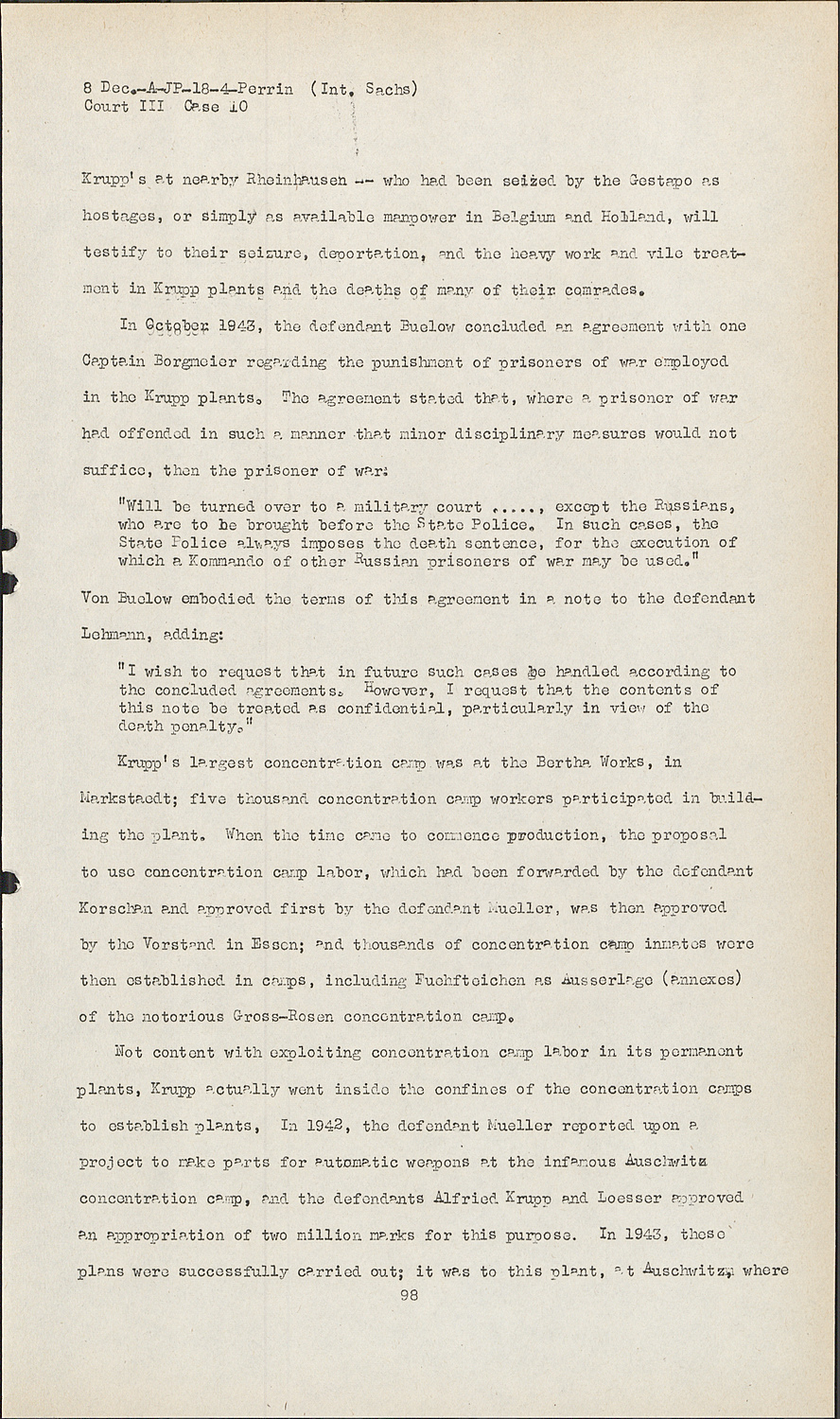
In October 1943, the defendant Buelow concluded an agreement with one Captain Borgmeier regarding the punishment of prisoners of war employed in the Krupp plants. The agreement stated that, where a prisoner of war had offended in such a manner that minor disciplinary measures would not suffice, then the prisoner of war:
"Will "be turned over to a military court ....., except the Russians, who are to be brought before the State Police.
In such cases, the State Police always imposes the death sentence, for the execution of which a Kommando of other Russian prisoners of war may be used."
Von Buelow embodied the terms of this agreement in a note to the defendant Lehmann, adding:
"I wish to request that in future such cases be handled according to the concluded agreements.
However, I request that the contents of this note be treated as confidential, particularly in view of the death penalty."
Krupp's largest concentration camp was at the Bertha Works, in Markstaedt; five thousand concentration camp workers participated in building the plant. When the time came to commence production, the proposal to use concentration camp labor, which had been forwarded by the defendant Korschan and approved first by the defendant Mueller, was then approved by the Vorstand in Essen; and thousands of concentration camp inmates were then established in corps, including Fuehfteichen as Ausserlage (annexes) of the notorious Gross-Rosen concentration camp.
Not content with exploiting concentration camp labor in its permanent plants, Krupp actually went inside the confines of the concentration camps to establish plants, In 1942, the defendant Mueller reported upon a project to make parts for automatic weapons at the infamous Auschwitz concentration camp, and the defendants Alfried Krupp and Loesser approved an appropriation of two million marks for this purpose. In 1943, these plans were successfully carried out; it was to this plant, at Auschwitz, where the greatest and most horrible exterminations of all time occurred, that these defendants arranged with the Speer Ministry to transfer some 500 Jews who had been working in or near Berlin.
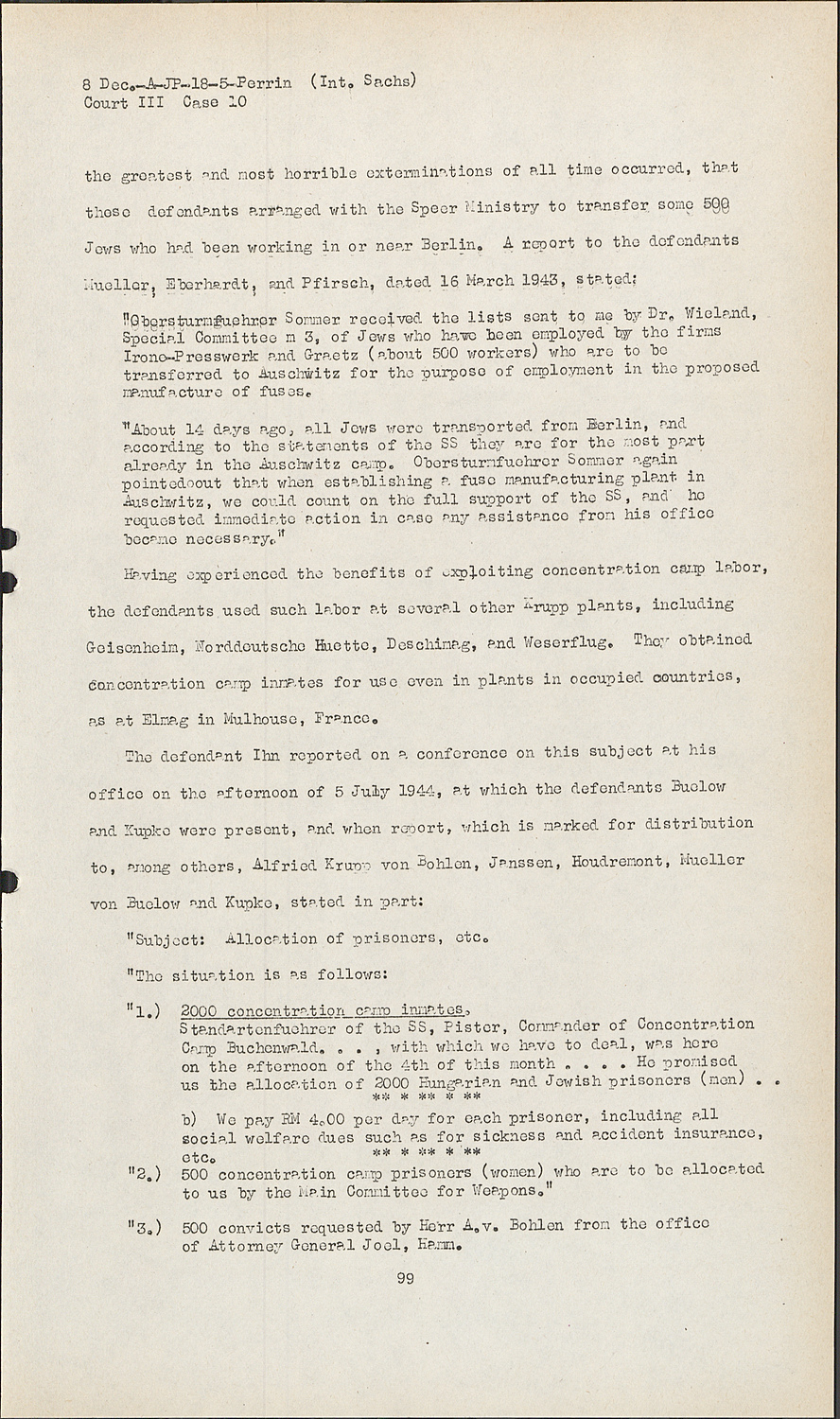
A report to the defendants Mueller, Eberhardt, and Pfirsch, dated 16 March 1943, stated:
"Obersturmfuehrer Sommer received the lists sent to me by Dr. Wieland, Special Committee m 3, of Jews who have been employed by the firms Irone-Presswork and Graetz (about 500 workers) who are to be transferred to Auschwitz for the purpose of employment in the proposed manufacture of fuses.
"About 14 days ago, all Jews were transported from Berlin, and according to the statements of the SS they are for the most part already in the Auschwitz camp.
Obersturnfuehrer Sommer again pointed out that when establishing a fuse manufacturing plant in Auschwitz, we could count on the full support of the SS, and he requested immediate action in case any assistance from his office became necessary."
Having experienced the benefits of exploiting concentration camp labor, the defendants used such labor at several other Krupp plants, including Geisenheim, Norddeutsche Huette, Deschimag, and Weserflug. They obtained concentration camp inmates for use even in plants in occupied countries, as at Elmag in Mulhouse, France.
The defendant Ihn reported on a conference on this subject at his office on the afternoon of 5 July 1944, at which the defendants Buelow and Kupke were present, and when report, which is marked for distribution to, among others, Alfried Krupp von Bohlen, Janssen, Houdremont, Mueller von Buelow and Kupke, stated in part:
"Subject: Allocation of prisoners, etc.
"The situation is as follows:
"1.) 2000 concentration camp inmates.
------------------------------
Standartenfuehrer of the SS, Pister, Commander of Concentration Camp Buchenwald.
. . , with which we have to deal, was here on the afternoon of the 4th of this month . . . . He promised us the allocation of 2000 Hungarian and Jewish prisoners (men) . .** * ** * **
b) We pay BM 4.00 per day for each prisoner, including all social welfare dues such as for sickness and accident insurance, etc.
** * ** * ** "2.) 500 concentration camp prisoners (women) who are to be allocated to us by the Main Committee for Weapons."
"3.) 500 convicts requested by Herr A.v. Bohlen from the office of Attorney General Joel, Hamm.
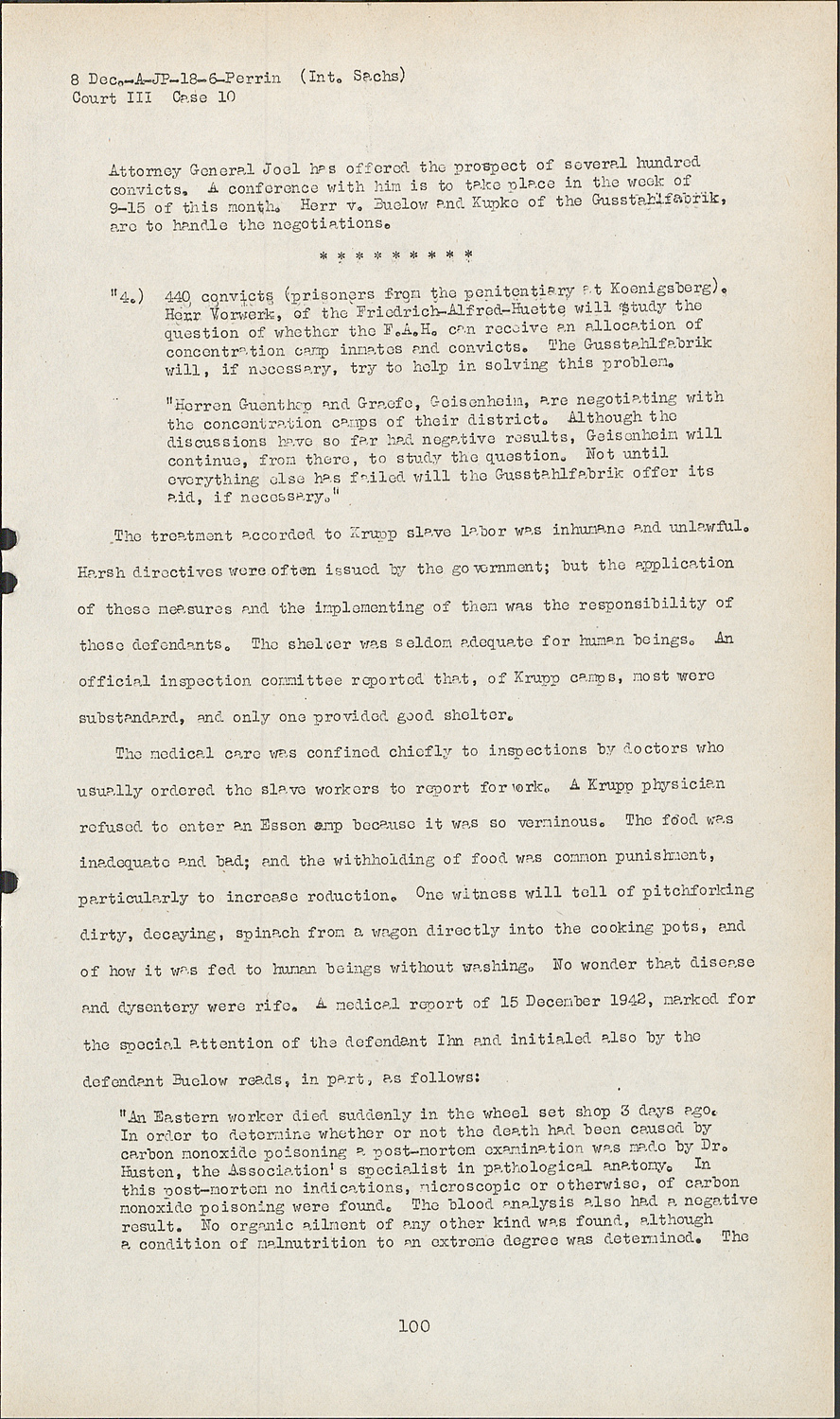
Attorney General Joel has offered the prospect of several hundred convicts.
A conference with him is to take place in the week of 9-15 of this month.
Herr v. Buelow and Kupke of the Gusstahlfabrik, are to handle the negotiations.
* * * * * * * * * "4.) 440 convicts (prisoners from the penitentiary at Koenigsberg).Herr Vorwerk, of the Friedrich-Alfred-Huette will study the question of whether the F.A.H. can receive an allocation of concentration camp inmates and convicts.
The Gusstahlfabrik will, if necessary, try to help in solving this problem.
"Herren Guenthep and Graefe, Geisenheim, are negotiating with the concentration camps of their district.
Although the discussions have so far had negative results, Geisenheim will continue, from there, to study the question.
Not until everything else has failed will the Gusstahlfabrik offer its aid, if necessary."
The treatment accorded to Krupp slave labor was inhumane and unlawful. Harsh directives were often issued by the government; but the application of these measures and the implementing of them was the responsibility of these defendants. The shelter was seldom adequate for human beings. An official inspection committee reported that, of Krupp camps, most were substandard, and only one provided good shelter.
The medical care was confined chiefly to inspections by doctors who usually ordered the slave workers to report for work. A Krupp physician refused to enter an Essen amp because it was so verminous. The food was inadequate and bad; and the withholding of food was common punishment, particularly to increase roduction. One witness will tell of pitchforking dirty, decaying, spinach from a wagon directly into the cooking pots, and of how it was fed to human beings without washing. No wonder that disease and dysentery were rife. A medical report of 15 December 1942, marked for the special attention of the defendant Ihn and initialed also by the defendant Buelow reads, in part, as follows:
"An Eastern worker died suddenly in the wheel set shop 3 days ago.
In order to determine whether or not the death had been caused by carbon monoxide poisoning a post-mortem examination was made by Dr. Huston, the Association's specialist in pathological anatomy.
In this post-mortem no indications, microscopic or otherwise, of carbon monoxide poisoning were found.
The blood analysis also had a negative result.
No organic ailment of any other kind was found, although a condition of malnutrition to an extreme degree was determined.
The fat tiddue had disappeared from the entire organism and only a so-called gelatinous atrophy was left.