After they joined the Krupp firm in 1926 and 1927, respectively, the defendants Houdremont and Korschan dealt with the selection of types of steel and steel alloys to be used in the manufacture of gun barrels. Korschan also visited the Borfors plant in December 1932 or January 1933 to discuss the development of machine gun barrels.
The departure of the Inter-Allied Control Commission also signalized the revival of Krupp work in connection with the design of tanks. In the early correspondence on this subject between Krupp and the Reich Defense Ministry, the tanks were referred to as "tractors". Besides tanks, other types of military vehicles and self-propelled gun carriages were also developed. One interesting letter, written in November 1927 from the Ministry of Defense to the Krupp firm, set forth the specifications for an "artillery power tractor" which, according to the specifications, was to be of such a size "as to enable the tractor to be shipped on an ordinary open railroad car, considering the smallest Belgian and French loading capacity." A Krupp memorandum written in 1942 tells us that "with the exception of the hydraulic safety switch, the basic principles of armament and turret design for tanks had already been worked out in 1926."
We have now outlined the general nature of Krupp's policies and activities with respect to the Treaty of Versailles during the era of the Weimar Republic. The immediate significance of these acts is clear enough. Krupp deliberately decided, in conspiracy with the German military and political leaders, to violate the Treaty in every possible way and to lay the groundwork for the rearmament of Germany. And I quote again: "Germany must again fight to rise". These acts and decisions constituted preparation to enable Germany to wage war by means forbidden by the Versailles Treaty. And, as we have shown, these acts violated not only international law but German domestic law as well.
But these events have a much deeper significance for this case. One can for convenience divide recent German history into the period of the Weimar Republic and of the Third Reich. But there was no impermeable barrier between the two; the one flows into the other, and Hitler's dictatorship was conditioned by the history of the preceding Republic. Weimar Republic and Third Reich had many common denominators, and one of them was the Krupp firm. What the Krupp firm accomplished under the Republic was a vitally important part of the process of German rearmament for aggressive war. This fact will become increasingly clear as we examine the development of the conspiracy under the Third Reich. The seeds planted during the Republic will now come to flower.
Christmas 1932 was the last under the Weimar Republic, and already Hitler's shadow loomed large. For millions of people, abrupt and terrible changes were only a few months in the future. For some few, the change was neither terrible nor abrupt. On December 28 , 1932, Colonel Zengauer, a department chief in the German Army Ordnance Inspection Office, wrote a note of New Year's greeting to the Krupp firm. It was polite*---*but not a message of peace and good will to men. It said:
"I wish to express our thanks for the excellent support which you and your staff have again given us in our development work during the past year.
The department is convinced that thanks to your active cooperation and valuable advice, our armament development in 1932 has made considerable progress, which is of great significance to our intent of rearming as a whole.
It gives me special satisfaction that the firm, in reviewing the year 1932, may take credit for a substantial material success in the decision reached in your favor concerning the light field cannon."
There could be no better example of the link which the German Army and the Krupp firm constitute between the Weimar Republic and the Third Reich.
I now come to Krupp and the Establishment of the Third Reich.
The facts concerning Gustav Krupp von Bohlen's participation in Hitler's seizure of power have, by now, become matters of public record in other proceedings, and we may pass over them very briefly. Hitler's selection by Hindenburg as Reich Chancellor on 30 January 1933 grew out of a conference earlier in January between Hitler and von Papen which had been arranged by the Cologne banker, von Schroeder. But Hindenburg's appointment of Hitler as Chancellor did not constitute or assure the Nazi seizure of power; a majority of the members of the Reichstag were members of other parties, and the leaders of other parties were included in the cabinet which Hitler headed. Indeed, despite Hitler's appointment, the situation of the Nary party was not, in all respects, promising. The Nazis, at the election of November 1932, and their representation in the Reichstag had fallen from 230 to 196 seats. On 8 December 1932, Joseph Goebbels had noted, in his diary:
"Deep depression is prevailent in the organization, financial worries prevent any constructive work... He were all very discouraged particularly in the fact of the present danger that the entire party may collapse and all our work be in vain. We are now facing the decisive test."
Accordingly, Hitler's appointment as Chancellor some two months later was an opportunity, but not a fulfillment. Now elections were scheduled for the month of March, and the Nazi party was in desperate need of support, financial and otherwise, to insure such a measure of success as would continue Hitler in office and make possible the completion of the Nazi drive to dictatorship. -------------------------------------1. Case No. 5, United States v. Friedrich Flick, et al.; Case No. 6, United States v. Carl Krauch, et al.
In this critical situation, on 20 February 1933, Goering invited about twenty leading German bankers and industrialists to his home, in order to obtain financial support for the Nazis in the coming election. Hitler appeared and delivered a long speech. Among those in attendance was Gustav Krupp von Bohlen, who made notes summarizing Hitler's speech, which will be offered in evidence. Hitler said in part:
"Private enterprise cannot be maintained in the age of Democrary; it is conceivable only if the people have a sound idea of authority and personality. Everything positive, good, and valuable, which has been achieved in the world in the field of economics and culture, is solely attributable to personality. When, however, the defense of this existing order, its political administration, is left to a majority, it will irretrievably go under."
* * * ** "Life always tears up humanity.
It is, therefore, the noblest task of a leader to find ideals that are stronger than the factors that pull the people apart. I recognized.... that one had to search for new ideas conducive to reconstruction. I found them in Nationalism in the value of personality, in the denial of reconciliation between nations,....."
* * * * * * * "Now we stand before the last election.
Regardless of the outcome, there will be no retreat even if the coming election does not bring about a decision. One way or another, if the election does not decide, the decision must be brought about even by other means. I have intervened in order to give the peoples once more the chance to decide their fate by themselves."
* *** * * * * ** * "For business, I have the one wish that it go parallel with the internal structure to meet a calm future.
The question of restoration of the Wehrmacht will not be decided at Geneva, but in Germany, when we have gained internal strength through internal peace."
* * * * * "There are only two possibilities, either to crowd back the opponent on constitutional grounds, and for this purpose once more this election, or a struggle will be conducted with other weapons, which may demand greater sacrifices.
I would like to see them avoided.
I hope the German people thus recognize the greatness of the hour.
It shall decide over the next 10 or probably 100 years."
Thereafter, Goering addressed the meeting and again stressed the importance of the coming election: "We must penetrate with our SA men into the darkest quarters of the cities". Goering then brought up the matter of financial contributions, and concluded his solicitation with the comment that:
"The sacrifices asked for surely would be so much easier for industry to bear if it realized that the election of March 5th will surely be the last one for the next ten years, probably even for the next hundred years."
One other man spoke at this meeting, and that was Gustav Krupp von Bohlen, who expressed to Hitler "the gratitude of approximately 25 industrialists present for having given us such a clear picture of the conception of his ideas." Krupp also stated, on behalf of all the industrialists, that it was high time "to finally clarify the questions pertaining to domestic policies, in Germany" and "that only in a politically strong and independent state could economy and business develop and flourish." Krupp concluded by pledging 1,000,000 marks or more on behalf of the Ruhr industries.
Eight days after this meeting, at which Hitler received the support of Krupp and other industrialists, the Reichstag building was set on fire, and on the same day Hitler and his cabinet, utilizing the fire as a pretext, promulgated a decree suspending the constitutional guarantees of freedom. By this decree, certain sections of the German constitution were indefinitely suspended and, as the decree went on to state:
.....restrictions on personal liberty, on the right of free expression of opinion, including freedom of the press, on the right of assembly and the right of association, and vio lations of the privacy of postal, telegraphic, and telephonic communications, and warrants for house-searches, orders for confiscations as well as restrictions on property, are also permissible beyond the legal limits otherwise prescribed."
This was the first act of Hitler and the Nazi party after receiving the subsidy which Krupp had so generously provided. The decisive election was held with the constitutional guarantees in a state of suspense one week later; the Nazi party received seventeen million votes out of thirty-nine million cast, and 288 Reichstag seats out of a total of 647. Still lacking a majority, Hitler applied the "other methods" which he had threatened to use in his speech on the 20th of February. Opposition members in the Reichstag were taken into "protective custody" and in their enforced absence the Reichstag on 24 March 1933 passed the Enabling Act which gave Hitler full legislative power, including the power the deviate from the constitution. Thus perished democracy and liberty in Germany.
Soon after the elections of March 5, Gustav Krupp von Bohlen had taken upon himself the leadership in rallying German industry behind the Nazi dictatorship, The day before the Reichstag passed the Enabling Act, he convened a meeting of the Praesidium of the Reich Federation of German Industries, to discuss the political situation; on 25 March, the day after the Reichstag decree, a resolution of the Federation supporting the Nazi government was transmitted to Hitler.
During the remaining months of 1933, the grip of tyranny grew even tighter. The independence of the judiciary was fatally undermined, special political courts were established, and the concentration camp made its appearance. Jews were eliminated from the civil service and otherwise persecuted, the trade unions were strangled, and the Hitler Youth was organized on military lines. Joseph Goebbels established the Ministry of Peoples' Enlightenment and propaganda to insure distortion and suppression of the truth. Germany withdrew from the International Disarmament Conference and from the League of Nations.
In the industrial field, Gustav Krupp supported and participated in this brutal course of dictatorship step by step. In April 1933, Hermann Goering founded the Gestapo. In the same month, the Reich Association of German Industry, through Gustav Krupp as its chairman, submitted to Hitler a plan for the reorganization of German industry according to the "Fuehrer-Prinzip" or "Leadership Principle". The documents which we will offer make it clear that this plan was developed by Gustav Krupp in close collaboration with and after numerous conferences with Hitler himself. In transmitting the plan, Gustav Krupp stated:
"The turn of political events is in line with the wishes which I myself, and the Board of Directors, have cherished for a long time.
.....In reorganizing the Reich Association of German Industry, I shall be guided by the idea of bringing the new organization into agreement, with the political aims of the Reich government.
...."
In May 1933, the old German trade unions were suppressed and replaced by the compulsory Nazi labor organization, the Deutsche Arbeits Front (DAF); in June 1933, Baidur von Schirauch became the youth leader of the German Reich, and soon thereafter most of the preexistent youth organizations were dissolved. During these same months, Gustav Krupp was organizing the so-called Adolf Hitler Spende, or Adolf Hitler Fund. This was a fund collected annually from every circle of German industry, including banking and agriculture. The proceeds were put at the disposal of Hitler and various Nazi party organizations, including the SA, the SS, and the Hitler Youth, Gustav Krupp remained chairman of the organization which raised this fund until about 1942, when his son, the defendant Alfried Krupp took over this function.
While Gustav Krupp was devoting his energies to the consolidation of the Nazi dictatorship within Germany, he did not fail to note the importance of concealing its true character from the world abroad. After a conference with Alfred Rosenberg, then Chief of the Bureau of Foreign Politics of the Nazi party, he arranged for funds to be put at Rosenberg's disposal in order "to counteract" by "counter-propaganda" the "misunderstandings" which were being created abroad "by ill-meaning circles ".At numerous public meetings and conferences, Gustav Krupp continued to carry the torch for Adolf Hitler and the Nazi Party.
He complied willingly with a request from Goebbels for an article in support of Hitler to be used for the so-called "plebiscite" of November 1933. After the Anschluss with Austria, in March 1938, he paid tribute to the "statesmanship" of Hitler and hailed the "victory of Germanism in central Europe ".
No useful purpose would be served by further recital of the many occasions on which Gustav Krupp demonstrated, publicly and practically, his wholehearted support of the dictatorship of the Third Reich and of its accomplishments. We will, in due course, suggest some of the reasons which determined this course of action. We may first, however, more profitably examine the policies and activities of the Krupp firm and of these defendants between the birth of the Third Reich and the seizure of Austria in 1938.
F. KRUPP AND THE THIRD REICH: THE PREWAR YEARS
(1933-38)
The support which Krupp gave the Nazi Part was dictated, in part, by very practical considerations of self interest. The development orders which the firm received from the Weimar Republic, while valuable in that they preserved the position and connections of the firm, could not possibly return Krupp's capital investments in armament production. For that a large scale armament production program, unhampered by the restrictions of the Versailles Treaty, was necessary. It was precisely this which the Nazis promised. By aiding their accession to power, Gustav Krupp was simply collecting on the gamble taken in 1918. In a Germany pledged to rearmament, Krupp would again flourish as the "Weapons Forge" of the Reich. The period of losses would be over.
Such indeed proved to be the case. The Krupp Board of Directors were able to report for the business year following the Nazi seizure of power that "The business, for the first time after three years of losses, yielded a profit". The report reads:
"The upward trend of German economy which marked the past year was visibly reflected in our plants.
The measures of the Reich Government designed to promote the national work have given a vigorous impulse to the entire industrial life of our people.
A strong, new,national will to work, founded upon a national basis, has superseded the class struggle and found free ex pression in new legal forms.
The economic revival of the German iron industry which set in with the National Revolution has gradually extended to almost all our spheres of operation from the production of raw materials to the manufacture of the finished products."
The character of "the measures of the Reich government designed to promote the national work" responsible for the "improved market position" which the Board of Directors took so much pleasure in reporting is indicated by a later report of Krupp's Grusonwerke, referring to this period:
Immediately after the seizure of power, the Navy, as the most powerful part of the Wehrmacht, began with us to equip and expand our factory installations for the production of war materials.
In view of our location in the heart of the Reich, favorable from a military point of view, the production of especially important Wehrmacht equipment was entrusted to us from the very outset and plant facilities for a much greater As the program of rearmament, which was started immediately after the seizure of power was accelerated, the returns to Krupp rose proportionally.
In 1935, the net profits of the firm after taxes, gifts, and reserves, were approximately 57 million Reichsmarks; in 1933, they were 97 million; in 1940, 111 million. This increase in the profits of the Krupp firm was the direct result of the tremendous armament program launched under the Third Reich.
From the time of the Nazi seizure of power until the defeat of Germany, the relations between Hitler and the Krupp firm were exceedingly close. Hitler often visited Krupp to inspect the progress of particular projects; he consulted with its members, particularly the defendants Alfred Krupp and Erich Mueller, on armament problems; he participated in planning its expansion; and almost every project of any size worked on by Krupp was on Hitler's personal order. The work done by Krupp reflected this close relationship. It followed every turn of the development of the Nazi plans of aggression.
After the seizure of power, Hitler's first concern was an immediate strengthening of the German armed forces in all respects. This was a necessary preliminary to repudiation of the Versailles Treaty and re-occupation of the Rhineland, both of which had to be accomplished before more ambitious steps could be taken. Equipment of all types was needed, and needed quickly. At this point, the value of the secret development work which Krupp had been doing proved itself. Large-scale production of tanks, artillery and, in due course, submarines, of the most advanced and modern type, could be started immediately. Krupp subsequently had occasion to remind the Reich of those facts:
"Owing to the fact only, that the firm, acting on its own initiative and believing in a revival, has since 1918 retained at its own expense its employees, practical knowledge and workshops for the manufacture of war material, was it in the position not only to produce war material in its own plants as soon as called to do so, but to initiate other firms which were not familiar with the manufacture of war material, and therefore contribute to the enlargement of the armament capacity.
This has shown particular results as regards the heavy field artillery which is the backbone of the army."
During the period after the First World War, Krupp had worked on producing a mount for the 8.8 anti-aircraft gun, developed during that war for naval use, which would make it suitable for the Army. This work had been completed by 1933. In consequence, mass production of the gun which was to become famous in the Second World War was started in 1933 at the Grusonwerke. To meet the requirements of the Army for motors and howitzers, the defendant Korschan found it necessary, as early as June 1933, to submit a request for the enlargement of one of the principal gun shops.
Like the initial mass production of medium and heavy artillery, the first two tank programs also rested on Krupp designs. A Krupp memorandum relates:
"The firm of Friedr. Krupp played a pioneering role in the development of combat vehicles in Germany since the earliest beginnings in 1926.
After the preliminary experiments with the "Heavy Tractor", "Light Tractor", and the L.S.K., the LaS (Panzer 1) was developed and built in series by the firm of Friedr.
Krupp as the first German armored combat vehicle (alternatively equipped with air-cooled Friedr.
Krupp engine or water-cooled Maybach engine).
Four subcontractors built the LaS to our designs and specifications and were enabled thereby to work out their own designs for new types of armored combat vehicles."
The first large scale tank program initiated by the Nazis called for the production of one hundred tanks by March, 1934; the second, for six hundred and fifty by March, 1935. It is worth observing that the Versailles Treaty, under which all tanks were forbidden, was not formally repudiated by Germany until May, 1935. Krupp contributed the design for these programs and shared in their execution.
These illegal programs were camouflaged by calling the tanks "laS", the abbrevation for the German words meaning agricultural tractor. The choice of name completely epitomizes the inverted scale of Nazi values; swords rather than plowshares, tanks rather than agricultural tractors. During the period of extensive but necessarily secret rearmament, which immediately followed Hitler's accession to power, the Navy could play only a subordinate role to the Army. Tanks and artillery can be kept hidden more readily than submarines and battleships. The Navy could and did prepare, however, for the moment when the Treaty of Versailles would be openly repudiated. In this it received the full cooperation of Krupp. By October, 1934, the Germania shipyards had received orders to build six submarines. Two months before Germany unilaterally denounced the Versailles Treaty, the keels of these boats were laid. Two months later, the first one was delivered. The design for these boats was the product of the I.V.S. The value of the work done prior to 1933 thus proved itself again.
Raeder, the Commander-in-Chief of the Navy, was preparing as early as 1934 to oppose England. Hitler considered it vital that the Navy be increased, "as no war could be carried on if the Navy was not able to safeguard the ore imports from Scandinavia." To enable Krupp to meet the demands of the Navy arising out of this program of expansion, two interest-free loans were made; one in January 1934, the second in December 1934. Both loans were made in "mefo" bills. This was the device by which Germany, both before and after repudiation of the Versailles Treaty, concealed the vast sums going into rearmament.
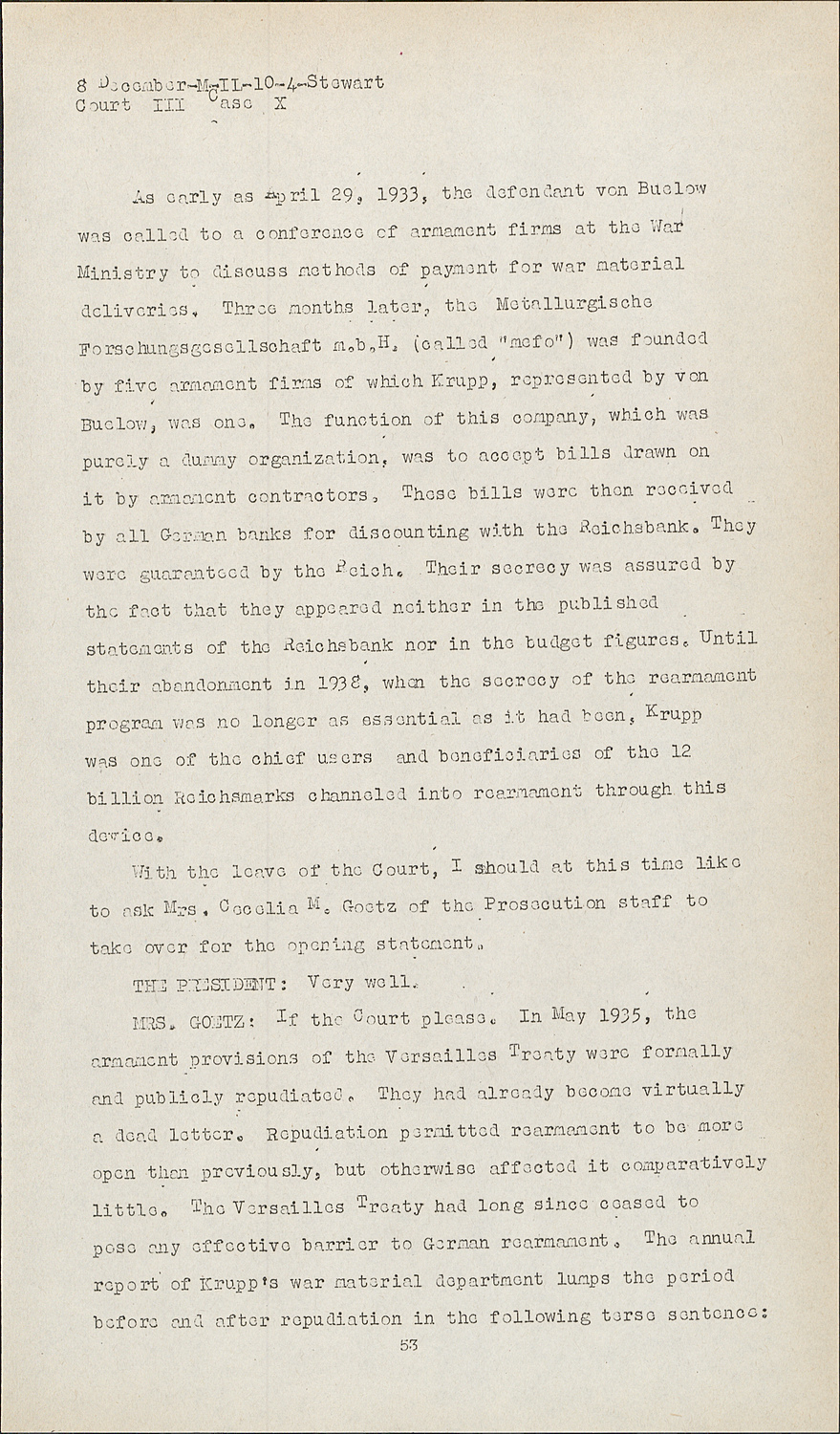
As early as April 29, 1933, the defendant von Buelow was called to a conference of armament firms at the War Ministry to discuss methods of payment for war material deliveries. Three months later, the Metallurgische Forschungsgesellsohaft m.b.H. (called "mefo") was founded by five armament firms of which Krupp, represented by von Buelow, was one. The function of this company, which was purely a dummy organization, was to accept bills drawn on it by armament contractors. These bills were then received by all German banks for discounting with the Reichsbank. They were guaranteed by the Reich. Their secrecy was assured by the fact that they appeared neither in the published statements of the Reichsbank nor in the budget figures. Until their abandonment in 1938, when the secrecy of the rearmament program was no longer as essential as it had been, Krupp was one of the chief users and beneficiaries of the 12 billion Reichsmarks channeled into rearmament through this device.
With the leave of the Court, I should at this time like to ask Mrs. Cecelia M. Goetz of the Prosecution staff to take over for the opening statement.
THE PRESIDENT:Very well.
MRS. GOETZ:If the Court please. In May 1935, the armament provisions of the Versailles Treaty were formally and publicly repudiated. They had already become virtually a dead letter. Repudiation permitted rearmament to be more open than previously, but otherwise affected it comparatively little. The Versailles Treaty had long since ceased to pose any effective barrier to German rearmament. The annual report of Krupp's war material department lumps the period before and after repudiation in the following terse sentence:
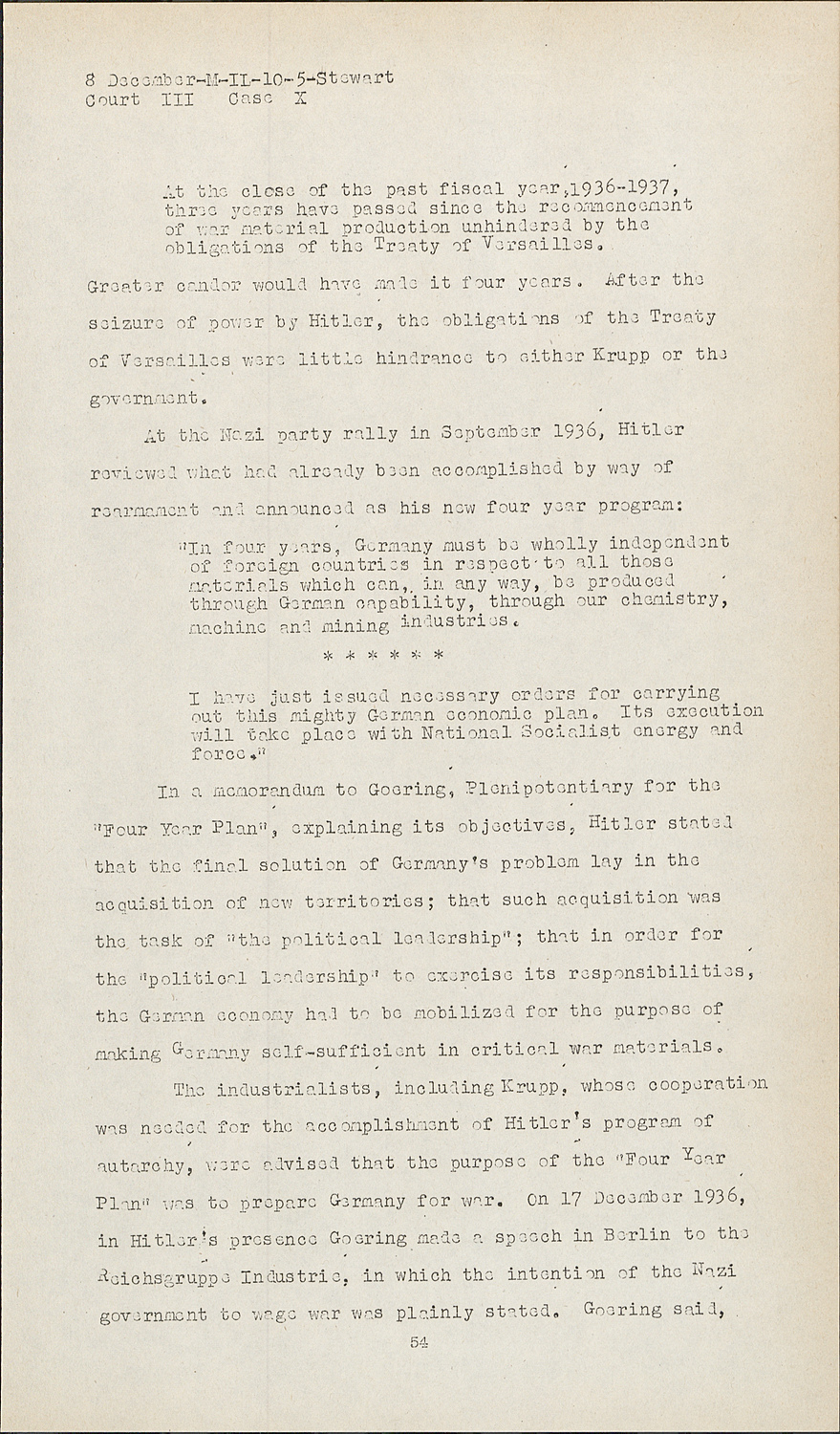
At the close of the past fiscal year, 1936-1937, three years have passed since the recommencement of war material production unhindered by the obligations of the Treaty of Versailles.
Greater candor would have made it four years. After the seizure of power by Hitler, the obligations of the Treaty of Versailles were little hindrance to either Krupp or the government.
At the Nazi party rally in September 1936, Hitler reviewed what had already been accomplished by way of rearmament and announced as his new four year program:
"In four years, Germany must be wholly independent of foreign countries in respect to all those materials which can, in any way, be produced through German capability, through our chemistry, machine and mining industries.
* * * * * * I have just issued necessary orders for carrying out this mighty German economic plan.
Its execution will take place with National Socialist energy and force."
In a memorandum to Goering, Plenipotentiary for the "Four Year Plan", explaining its objectives, Hitler stated that the final solution of Germany's problem lay in the acquisition of new territories; that such acquisition was the task of "the political leadership"; that in order for the "political leadership" to exercise its responsibilities, the German economy had to be mobilized for the purpose of making Germany self-sufficient in critical war materials.
The industrialists, including Krupp, whose cooperation was needed for the accomplishment of Hitler's program of autarchy, were advised that the purpose of the "Four Year Plan" was to prepare Germany for war. On 17 December 1936, in Hitler's presence Goering made a speech in Berlin to the Reichsgruppe Industrie, in which the intention of the Nazi government to wage war was plainly stated. Goering said, among other things:
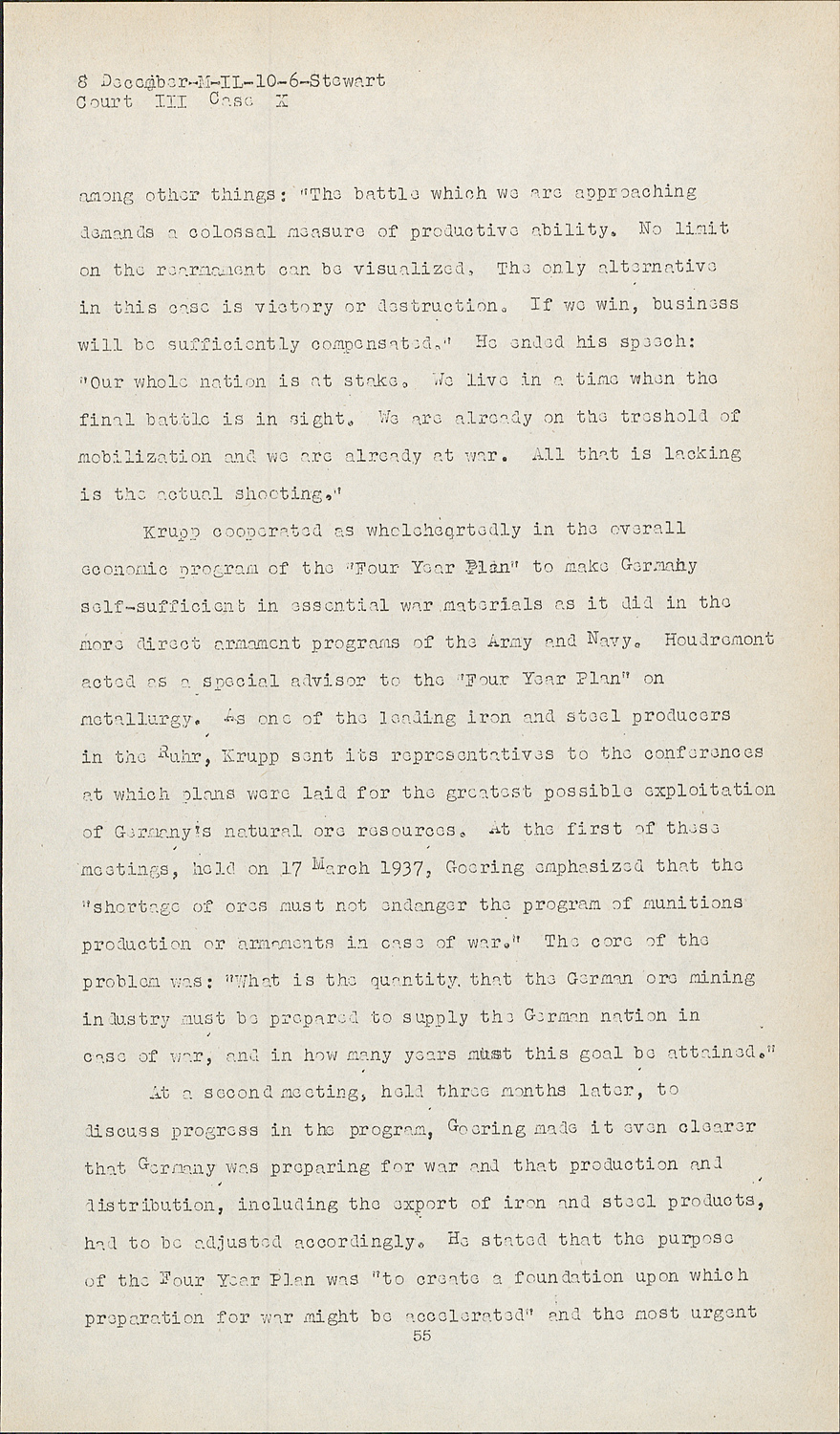
"The battle which we are approaching demands a colossal measure of productive ability. No limit on the rearmament can be visualized. The only alternative in this case is victory or destruction. If we win, business will be sufficiently compensated." He ended his speech: "Our whole nation is at stake. We live in a time when the final battle is in sight. We are already on the treshold of mobilization and we are already at war. All that is lacking is the actual sheeting."
Krupp cooperated as wholeheartedly in the overall economic program of the "Four Year Plan" to make Germany self-sufficient in essential war materials as it did in the more direct armament programs of the Army and Navy. Houdremont acted as a special advisor to the "Four Year Plan" on metallurgy. As one of the leading iron and steel producers in the Ruhr, Krupp sent its representatives to the conferences at which plans were laid for the greatest possible exploitation of Germany's natural ore resources. At the first of these meetings, held on 17 March 1937, Goering emphasized that the "shortage of ores must not endanger the program of munitions production or armaments in case of war." The core of the problem was: "What is the quantity that the German ore mining industry must be prepared to supply the German nation in case of war, and in how many years must this goal be attained."
At a second meeting, held three months later, to discuss progress in the program, Goering made it even clearer that Germany was preparing for war and that production and distribution, including the export of iron and steel products, had to be adjusted accordingly. He stated that the purpose of the Four Year Plan was "to create a foundation upon which preparation for war might be accelerated" and the most urgent necessity was to increase iron production.
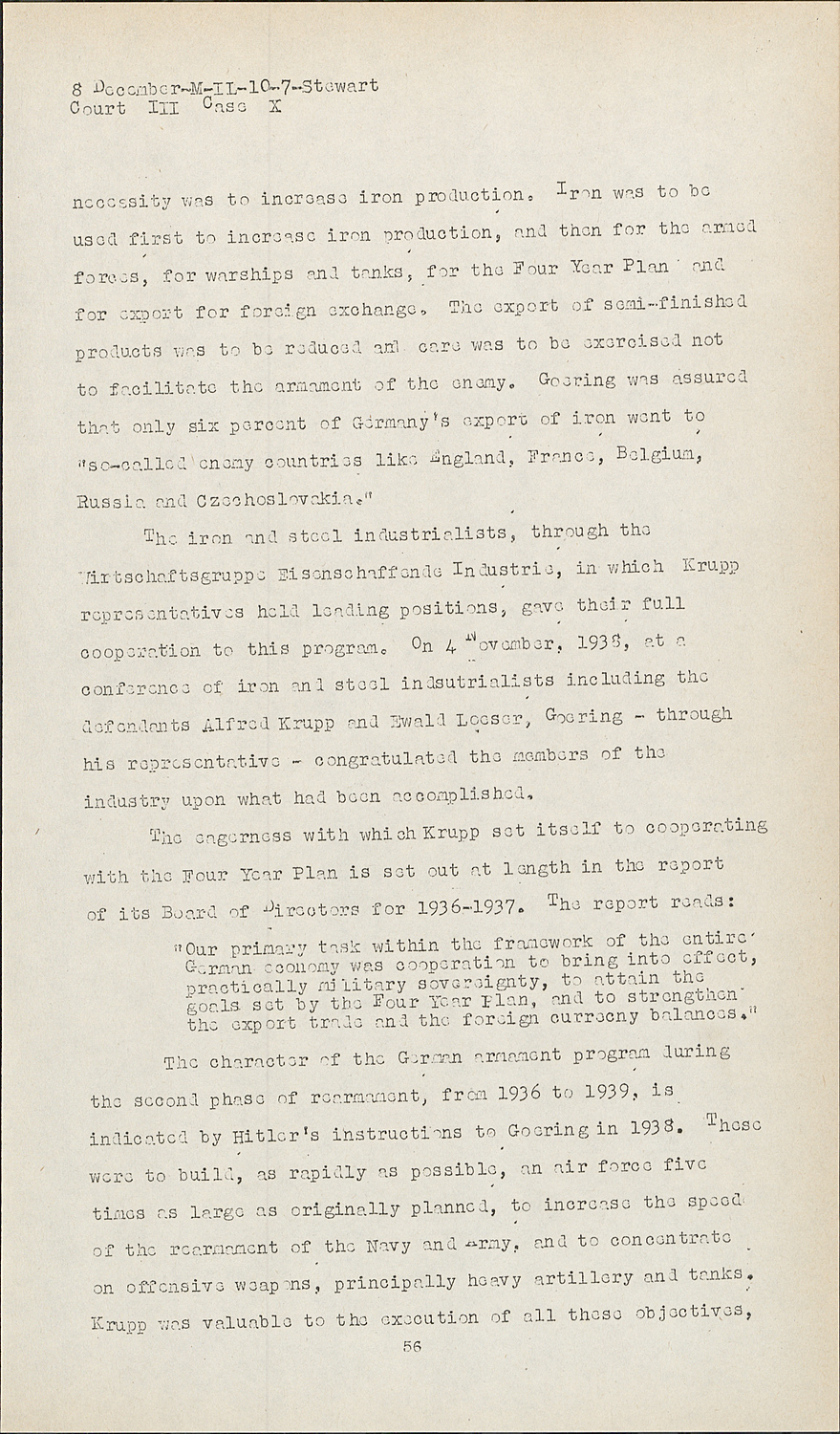
Iron was to be used first to increase iron production, and then for the armed forces, for warships and tanks, for the Four Year Plan and for export for foreign exchange. The export of semi-finished products was to be reduced and care was to be exercised not to facilitate the armament of the enemy. Goering was assured that only six percent of Germany's export of iron went to "so-called enemy countries like England, France, Belgium, Russia and Czechoslovakia."
The iron and steel industrialists, through the Wirtschaftsgruppe Eisensehaffende Industrie, in which Krupp representatives held leading positions, gave their full cooperation to this program. On 4 November, 1938, at a conference of iron and steel indsutrialists including the defendants Alfred Krupp and Ewald Loeser, Goering - through his representative - congratulated the members of the industry upon what had been accomplished.
The eagerness with which Krupp set itself to cooperating with the Four Year Plan is set out at length in the report of its Board of Directors for 1936-1937. The report reads:
"Our primary task within the framework of the entire German economy was cooperation to bring into effect, practically military sovereignty, to attain the goals set by the Four Year Plan, and to strengtnen the export trade and the foreign currecny balances."
The character of the German armament program during the second phase of rearmament, from 1936 to 1939, is indicated by Hitler's instructions to Goering in 1938. These were to build, as rapidly as possible, an air force five times as large as originally planned, to increase the speed of the rearmament of the Navy and Army, and to concentrate on offensive weapons, principally heavy artillery and tanks. Krupp was valuable to the execution of all these objectives, and, to some of them, indispensable.
During these years Krupp had a virtual monopoly of the design of heavy artillery and of tank turrets. Any ormament program involving these required its cooperation for success. Every effort was made, at Hitler's personal request, to achieve the maximum output of the 21 cm mortar, a heavy gun used for shelling fortifications. Heavy howitzers continued to be produced in large numbers. In addition to increased production, Krupp made available to other firms its designs and "know-how". A Krupp report states:
"From the beginning of the rearmament program, we have, to a great extent, placed our experience, free of charge, at the disposal of sub-contractors, both with regard to the necessary installations and production factors, and with regard to the production of guns, in order to permit rapid re-armament on a broad basis.
We considered the request to surrender all data which Would serve to increase the armament industry's capacity, c.g., also in the metallurgical field, to be justified in the interests of the life and death struggle of the German people, and we considered the fulfillment of this request to be a matter of course."
The value of Krupp designs to Germany is indicated by the following extract from a report written in 1940, after the start of the war:
"The guns, developed by us such as heavy 15 cm field howitzers, heavy 10 cm and 15 cm guns, 8.8 cm anti aircraft guns, 21 cm howitzers, and railway guns, represent the main body of the medium artillery of --------------------------------our present Armed Froces."
Court No. III, Case No. X.
In the field of tanks and combat cars, the debt of the German Army to Krupp was nearly as great.
In addition to these orthodox developments, Krupp, at the personal suggestion and request of Hitler, embarked on the design and execution of a monster 80 centimeter railway gun, eventually named the "Big Gustav", which was beyond doubt the largest gun ever constructed. Its specifications required that it penetrate armor plate one and a half meters thick and cement ceilings three and a half meters in depth. Because of its huge size, it represented a radical departure from all conventional gun construction and would have bean beyond the competence of almost any firm other than Krupp. Its first test firing in December, 1941, was attended by all the top executives of the firm as well as by high Army officials. The defendant Erich Mueller and a team of Krupp men personally supervised its use at the seige of Sevastopol in May and June 1942. According to a Krupp report, it was "fired 53 times in all, sometimes with the most successful results against fortified targets. After the fort was captured, opportunity was given to study the good aiming and also the exceptional effects of the semi-armour-piercing shells on fortifications".
Krupp's chief importance to the rearmament program lay, however, in its value to the Navy. In recognition of the importance of the activities of the defendants Alfried Krupp, Loeser, Houdremont, Korschan, Mueller, Janssen and Pfirsch to the rearmament of the Navy, they were all designated "War Economy Leaders" (Wehrwirtschaffsfuehrer) and charged with the responsibility of preparing and carrying out the mobilization of the armament industry and of directing it in time of war. Each of them was required to submit, in connection with the acceptance of this position, a so-called "Declaration of Political Attitude" in which he stated:
I herewith declare that I stand by the National Socialist conception of the State without any reserve and that I have not been active in any way against the interests of the people.
* * * * * Court No. III, Case No. X.I am aware that in case of any expressions or actions of mine in the future which might be understood as an offense against the National Socialist conception of the State, I must expect, in addition to a legal prosecution, my dis missal from the post of Wehrwirtschaftsfuehrer.
THE PRESIDENT:I don't understand that.
MISS GOETZ:Each of these men upon accepting the post of Wehrwirtschaftsfuehrer was required to submit this declaration. It was a condition precedent to appointment.
(Continuing) Plans for extending Krupp facilities to meet the requirements of an expanded Navy program were first discussed at Berchtesgaden with the defendants Alfried Krupp and Erich Mueller, in May 1937. These plans crystallized a year later under the name of the "E-Program", pursuant to which Krupp was to receive approximately 180 million Reichsmarks as an interest-free loan to use for expansion. It was Hitler's intention to build a navy to match that of England. Eventually, it was planned to build three battleships a year. The extension of Krupp's facilities was necessary to meet the demand this would create for armor plate and guns. These plans were to have been substantially completed in 1944, and the outbreak of war with England necessitated revision; consequently, the "E" program was never fully realized as originally intended. Nevertheless, Krupp contributions to the Navy were by no means minor. It produced the guns for the pocket battleships "Scheer" and "Graf Spee", for the battle cruisers "Scharnhorst" and "Gneisenau", the battleships "Bismarck" and "Tirpitz", and for the cruisers "Bluecher", "Admiral Hipper" and "Seydlitz". The cruiser "Prinz Eugen" was not only armed by Krupp, but built as its yard in the Germaniawerft. This yard, which had been the cradle of German submarine construction, continued to play a leading role in their design and construction.
In addition to building up the striking power of the German armed forces, Krupp was also vitally important in the construction of the West Wall, which was equally as essential to the accomplishment of the Naxi plan of aggression. Like the Four Year Plan, the West Wall Court No. III, Case No. X.was first projected in 1936 when fortification of the West was first made possible by the militarization of the Rhineland.
As one German officer later stated, the West Wall, and I quote:
"in contra-distinction to the Maginot Line, was not a measure based on debility and resignation, but one intended to afford rear cover for an active policy in the East."
Immediately upon the reoccupation of the Rhineland, Krupp which, as early as 1933, had begun working on fortifications, was asked to take a substantial part in its construction. According to documents in the Keupp files, construction of the West Wall would not have been possible without its assistance:
Fortifications for the border defense line (cupolas and -------------casemates) of latest construction were first developed by Krupp after the war.
The experience gained thereby served as a basis for the organization of the present system of fortification.
It would have been impossible to carry out the required tasks had Krupp not been able to fall back upon its experience in the manufacture of armor plate and upon its foundries.
In 1938, after five continuous years of rearmament, Hitler personally advised Alfried Krupp that there was still no end in sight. By this time, the aggressive intentions of the Nazis were beyond ques tion.
In that year, German armed might brought about the seizure of Austria and the Sudetenland. The Krupp firm shared in the spoils of conquest.
We now take up the invasion and occupation of Austria.
On 12 March, 1938, Germany invaded Austria. This move was, as the International Military Tribunal found, a "premeditated aggressive step", but its timing was not planned in advance. On the contrary, it was precipitated, unexpectedly even to Hitler, by Schusnigg's announcement on 9 March of aplebiscite on thee question of Austrian independence.
Long before the German invasion of Austria, the Krupp firm had coveted -- and coveted in vain -- the Bernderfer Metallwarenfabrik, the most important Austrian metals enterprise. The Berndorfer firm, located near Vienna, had itself been established by a Krupp -- Arthur Krupp, a great granduncle of Alfried Krupp - in 1843.
By the time the Krupp firm became interested in the acquisition Court No. III, Case No. X.of Berndorfer, 85% of the Berndorfer shares were owned by one of Austria's principal banks, the Austrian Kreditanstalt.