THE PRESIDENT:Certainly. If that is within the power of the Tribunal to be done, it will be done. Now, I don't know just what -I should say this. The schedule or rather the arrangements for the celebration of what we know as Army Day, I understand, are rather extensive. I don't know to what extent the personnel in the prison will be involved, but you may be assured that insofar as we can accomplish it that will be done. Now, I just want to make this further statement about this matter. The Tribunal has every reason to believe that the defense counsel are going to cooperate fully just as they assured us they would. T hey have given every indication of that, and we don't have any doubt whatever that that is going to be done. Now, we have some matters, Dr. Pohle, the Tribunal has, that are of considerable importance that we feel obliged to discuss this morning before we proceed with this witness. If it should occasion any loss of time to the defense why we will undertake to compensate that, so we are going to be obliged to recess until one-thirty o'clock.
DR. POHLE:This may notbe possible, your Honor, because of the noon meal. We are only fed from twelve-thirty - from twelve-thirty to onethirty. After one-thirty we cannot eat any more.
THE PRESIDENT:May be you misunderstood me. Did I say one thirty?
DR. POHLE:One-thirty.
THE PRESIDENT:Well, that is the usual time that we have the noon recess, isn't it?
JUDGE DALY:We come back from recess at that time.
THE PRESIDENT:No, no, I didn't mean that. I didn't so state it. I meant that we would recess now until one thirty. Did you understand it? Is there any objection? We certainly don't want to deprive you of your meal by any means, but we just have some very important matters that we are to confer about, and we would like to utilize the time between now and one-thirty o'clock to confer about it.
DR. POHLE:It was a misunderstanding then, Your Honor.
(A recess was taken until 1330 hours.)
AFTERNOON SESSION ------------------(The Tribunal reconvened at 1330 hours, 5 April 1948)
THE MARSHAL:The Tribunal is again in session.
DR. POHLE:May it please the Tribunal -
THE PRESIDENT:Dr. Pohle, before you proceed.
DR. POHLE:With the permission of the Tribunal, I'd like to interrupt the interrogation of the witness Flick at this point.
THE PRESIDENT:Before you proceed with the other witness, Doctor, we desire to dispose of a motion that has been made. On March 12 last, the defendants filed a joint motion for an acquittal on the charges of crimes against the peace. We construe this to be a motion for a judgment of not guilty on Counts I and IV of the indictment on the ground that the evidence is insufficient as a matter of law to warrant a judgment against them on those counts.
After a careful consideration of this motion, the Prosecution's reply thereto, and the briefs and the evidence, we have come to the conclusion that the competent and relevant evidence in the case fails to show beyond a reasonable doubt that any of the defendants is guilty of the offenses charged in Counts I and IV. The motion accordingly is granted and for the reasons stated the defendants are acquitted and adjudged not guilty on Counts I and IV of the Indictment. An opinion, stating in more details the reasons of our conclusion, will be filed at a later date.
Now, we don't know to what extent this will interfere with the plan the Defense has for the presentation of its evidence as to the other counts. Now, what have you gentlemen to suggest?
DR. POHLE:May it please the Tribunal, I would suggest we have a very short recess so that I can confer with my colleagues and find out what our position is after this announcement just made by the Tribunal.
THE PRESIDENT:Well, now, we make this suggestion, Dr. Pohle, that tomorrow is a holiday, as you know, and we will not be in session because of it as we have already stated; and if we could before we leave this afternoon arrive at a specific date on which to reconvene, why we would like to do so rather than deferring that until Wednesday.
We had understood that the Defense had prepared its case with reference to the aggressive war counts first and that your documents and so forth had been prepared along that line and that you are operating on somewhat of a schedule, that is, in a manner of speaking, you had allowed so much time for those counts and so much for the others. So, we take it that you would want to have some conference about the matter, especially in view of the translation difficulties in that matter, but we would, if you gentlemen can confer this afternoon and determine for certain when you'd be able to take up the other phase of your case, we'd like to do it.
Now, how long a recess would you suggest?
DR. POHLE:Your Honor, when I asked for the recess, I was thinking of a time of a few minutes so that we could discuss the matter. I think I would suggest that we reconvene at 3 o'clock in order to tell the Tribunal what possibilities we have to take up the Defense on the other counts.
JUDGE DALY:May I say this, Judge Anderson. The only suggestion I would make to that is that we have an indefinite recess, and that during that recess if counsel wanted to confer on that matter with the members of the Tribunal, we wouldn't be tied down, and we'd be here all afternoon anyway. That way, you may take as much time as you want.
THE PRESIDENT:I think that is a good suggestion. That is a good suggestion. You take as much time as you want, and we will be in our chambers during the afternoon and you can consult with us about it when you want to take it up.
(The Tribunal recessed without date.)
THE MARSHAL:The Tribunal is again in session.
THE PRESIDENT:I understand that the decision on the motion this morning, as anticipated, requires a modification of plans of the defense counsel to proceed with the defense, and that is quite understandable. In a conference with representatives of the defense counsel they have requested that we recess until nine o'clock on Monday morning April 19th next, in order to give time and opportunity to revise the schedule and prepare to proceed with the presentation of their case as to the remaining two counts of the indictment, and we are going to grant that request.
We desire at this time to express the hope that defense counsel will, as I am sure they will do, utilize that time to the best advantage in view of getting the case in shape so that we can go right along with it when we recenvene. It is needless to mention again the difficulties of translation and the necessity of getting the documents that have to be translated into the defense center at the earliest possible time.
JUDGE WILKINS:Dr. Wecker isn't here today, Dr. Pohle?
DR POHLE:May it please the Tribunal, Dr. Wecker is not present today.
THE PRESIDENT:Well, we will recess now until nine o'clock on Monday, April 19th next.
(The Tribunal adjourned until 19 April 1948, at 0900 hours.)
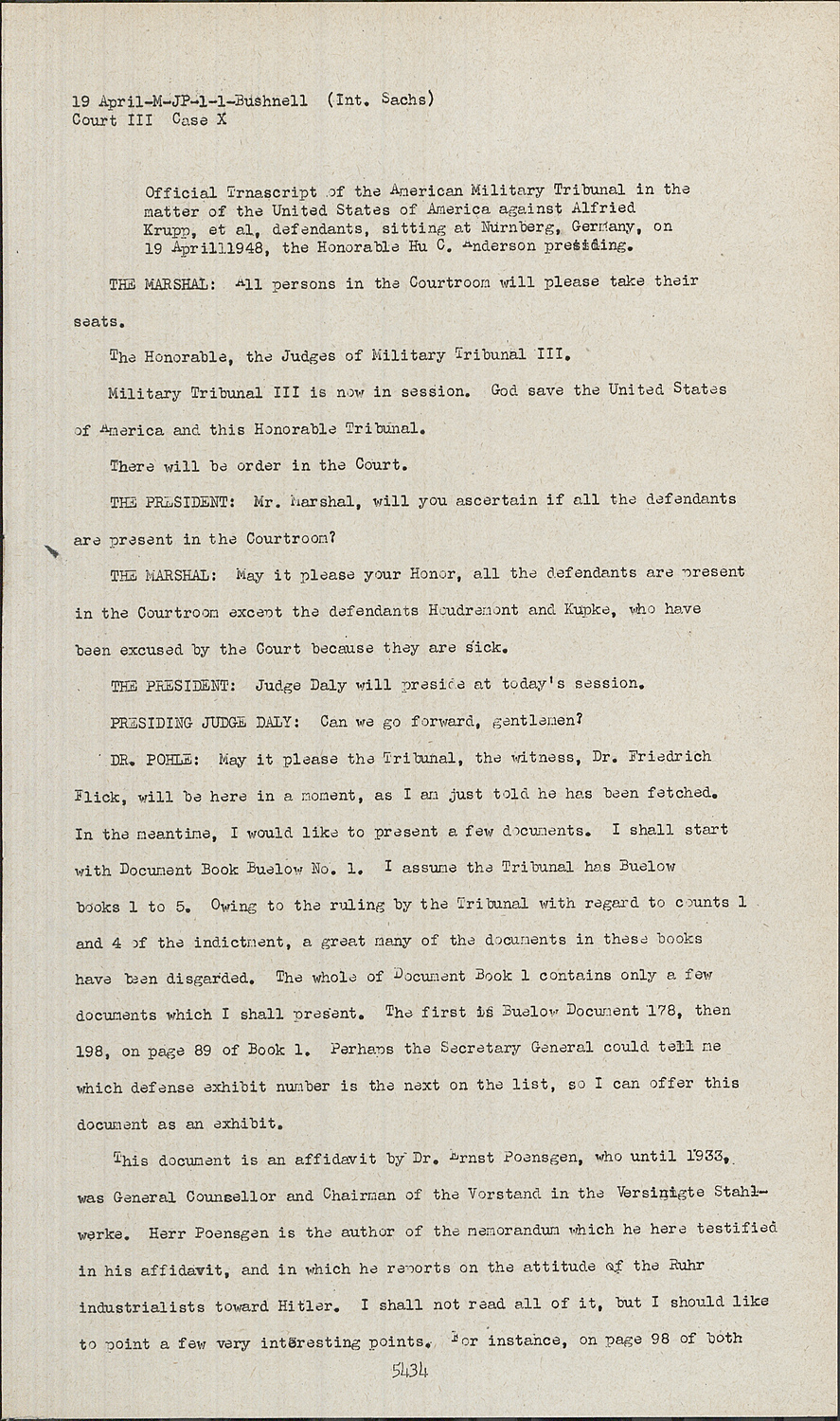
Official Trnascript of the American Military Tribunal in the matter of the United States of America against Alfried Krupp, et al, defendants, sitting at Nurnberg, Germany, on 19 April 1948, the Honorable Hu C. Anderson presiding.
THE MARSHAL:All persons in the Courtroom will please take their seats.
The Honorable, the Judges of Military Tribunal III.
Military Tribunal III is now in session. God save the United States of America and this Honorable Tribunal.
There will be order in the Court.
THE PRESIDENT:Mr. Marshal, will you ascertain if all the defendants are present in the Courtroom?
THE MARSHAL:May it please your Honor, all the defendants are present in the Courtroom except the defendants Houdremont and Kupke, who have been excused by the Court because they are sick.
THE PRESIDENT:Judge Daly will preside at today's session.
PRESIDING JUDGE DALY:Can we go forward, gentlemen?
DR. POHLE:May it please the Tribunal, the witness, Dr. Friedrich Flick, will be here in a moment, as I am just told he has been fetched. In the meantime, I would like to present a few documents. I shall start with Document Book Buelow No. 1. I assume the Tribunal has Buelow books 1 to 5. Owing to the ruling by the Tribunal with regard to counts 1 and 4 of the indictment, a great many of the documents in these books have been disgarded. The whole of Document Book 1 contains only a few documents which I shall present. The first is Buelow Document 178, then 198, on page 89 of Book 1. Perhaps the Secretary General could tell me which defense exhibit number is the next on the list, so I can offer this document as an exhibit.
This document is an affidavit by Dr. Ernst Poensgen, who until 1933, was General Counsellor and Chairman of the Vorstand in the Versinigte Stahlwerke. Herr Poensgen is the author of the memorandum which he here testified in his affidavit, and in which he reports on the attitude of the Ruhr industrialists toward Hitler. I shall not read all of it, but I should like to point a few very interesting points. For instance, on page 98 of both English and German books.
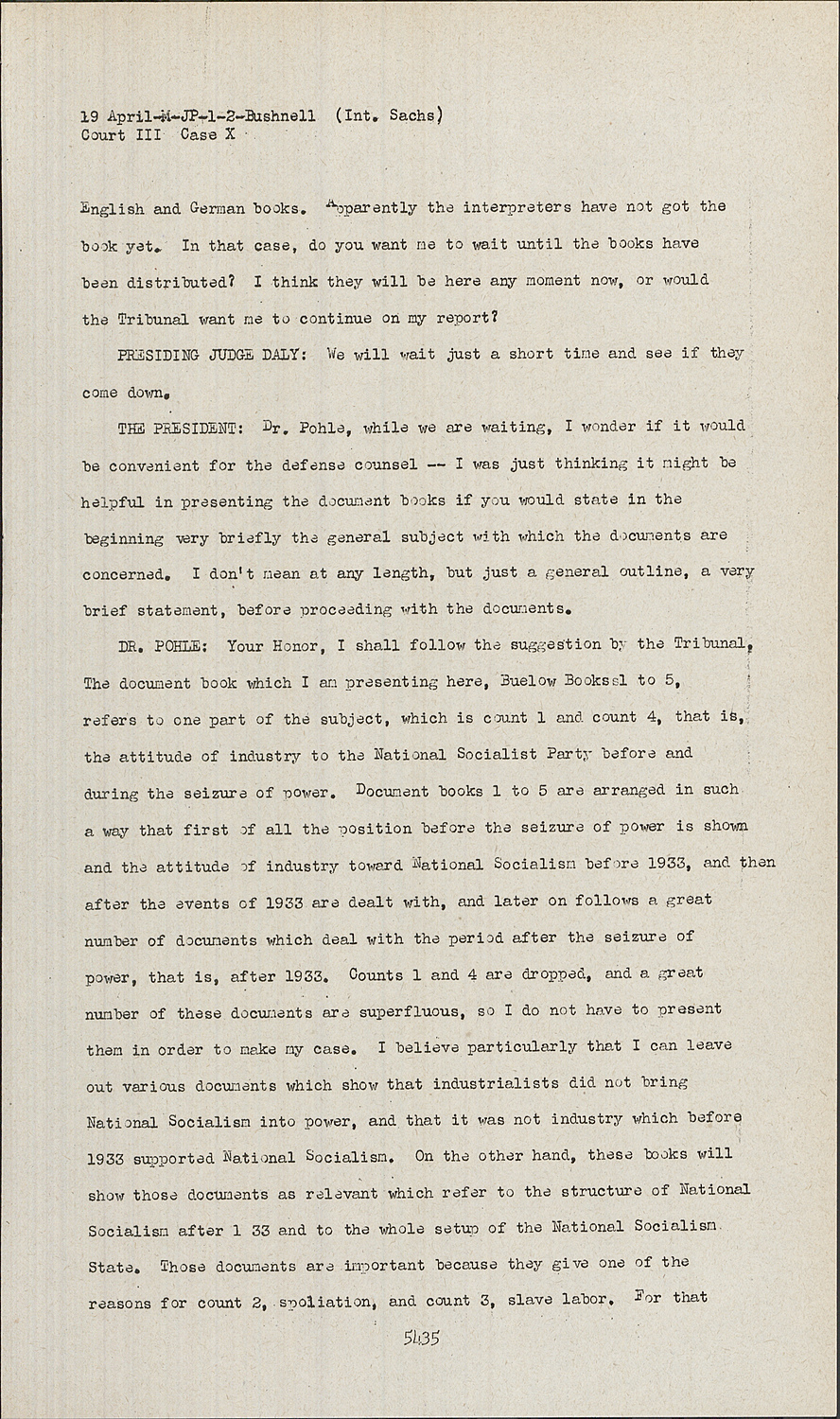
Apparently the interpreters have not got the book yet. In that case, do you want me to wait until the books have been distributed? I think they will he here any moment now, or would the Tribunal want me to continue on my report?
PRESIDING JUDGE DALY:We will wait just a short time and see if they come down.
THE PRESIDENT:Dr. Pohle, while we are waiting, I wonder if it would be convenient for the defense counsel -- I was just thinking it might be helpful in presenting the document books if you would state in the beginning very briefly the general subject with which the documents are concerned. I don't mean at any length, but just a general outline, a very brief statement, before proceeding with the documents.
DR. POHLE:Your Honor, I shall follow the suggestion by the Tribunal. The document book which I am presenting here, Buelow Books 1 to 5, refers to one part of the subject, which is count 1 and count 4, that is, the attitude of industry to the National Socialist Party before and during the seizure of power. Document books 1 to 5 are arranged in such a way that first of all the position before the seizure of power is shown and the attitude of industry toward National Socialism before 1933, and then after the events of 1933 are dealt with, and later on follows a great number of documents which deal with the period after the seizure of power, that is, after 1933. Counts 1 and 4 are dropped, and a great number of these documents are superfluous, so I do not have to present them in order to make my case. I believe particularly that I can leave out various documents which show that industrialists did not bring National Socialism into power, and that it was not industry which before 1933 supported National Socialism. On the other hand, these books will show those documents as relevant which refer to the structure of National Socialism after 1 33 and to the whole setup of the National Socialism State. Those documents are important because they give one of the reasons for count 2, spoliation, and count 3, slave labor. For that reason I intend to pick out those documents in books 1 to 5 which also refer to the question I just mentioned, whereas the large part of these documents which refer to the seizure of power as such can to a great part be omitted.
I just notice that the Marshal has distributed the books, and therefore, I think I can now continue my presentation of documents.
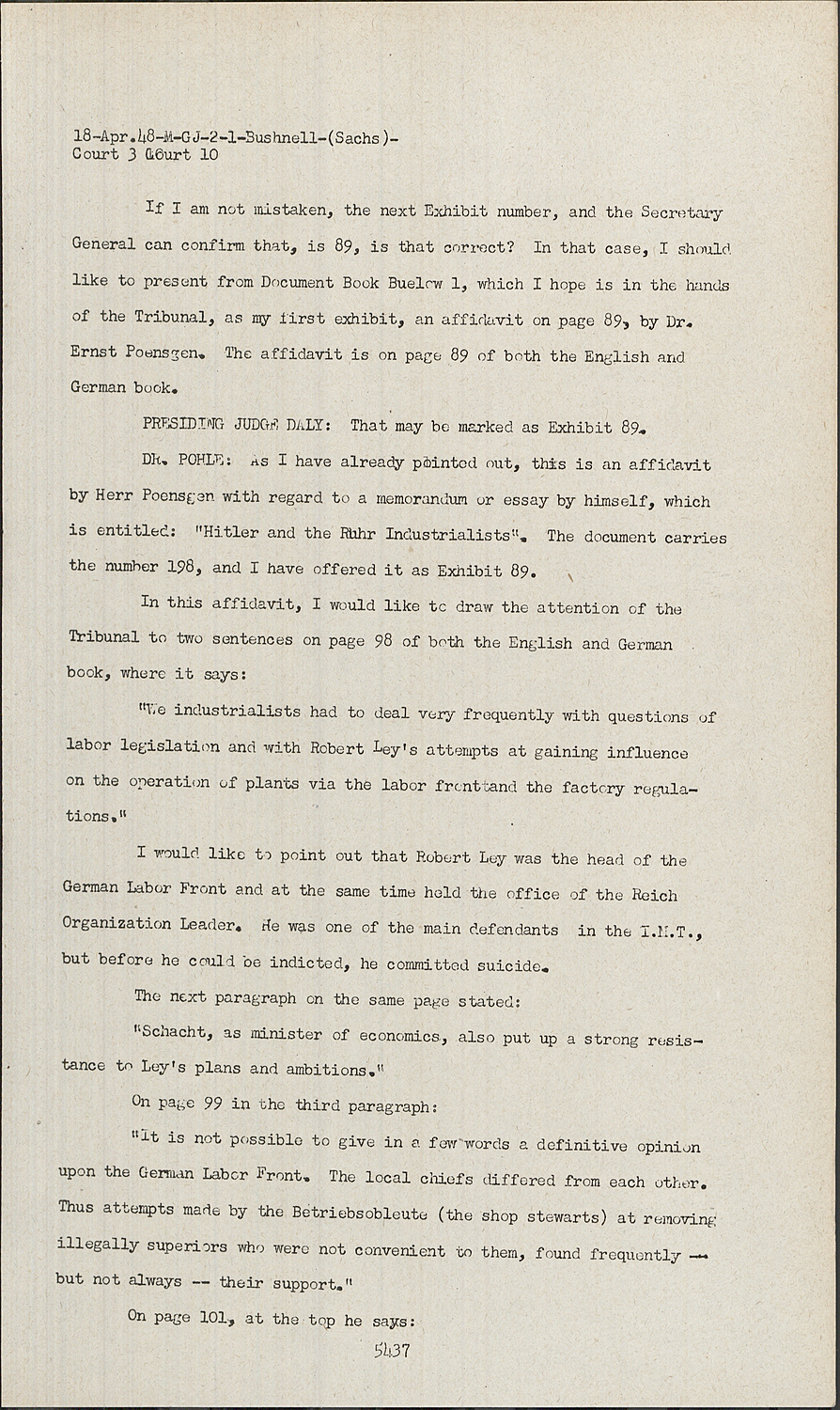
If I am not mistaken, the next Exhibit number, and the Secretary General can confirm that, is 89, is that correct? In that case, I should like to present from Document Book Buelow 1, which I hope is in the hands of the Tribunal, as my first exhibit, an affidavit on page 89, by Dr. Ernst Poensgen. The affidavit is on page 89 of both the English and German book.
PRESIDING JUDGE DALY:That may be marked as Exhibit 89.
DR. POHLE:As I have already pointed out, this is an affidavit by Herr Poensgen with regard to a memorandum or essay by himself, which is entitled: "Hitler and the Ruhr Industrialists". The document carries the number 198, and I have offered it as Exhibit 89.
In this affidavit, I would like to draw the attention of the Tribunal to two sentences on page 98 of both the English and German book, where it says:
"We industrialists had to deal very frequently with questions of labor legislation and with Robert Ley's attempts at gaining influence on the operation of plants via the labor front and the factory regulations."
I would like to point out that Robert Ley was the head of the German Labor Front and at the same time held the office of the Reich Organization Leader. He was one of the main defendants in the I.M.T., but before he could be indicted, he committed suicide.
The next paragraph on the same page stated:
"Schacht, as minister of economics, also put up a strong resistance to Ley's plans and ambitions."
On page 99 in the third paragraph:
"It is not possible to give in a few words a definitive opinion upon the German Labor Front. The local chiefs differed from each other. Thus attempts made by the Betriebsobleute (the shop stewarts) at removing illegally superiors who were not convenient to them, found frequently -but not always -- their support."
On page 101, at the top he says:
"The Ruhr industrialists after the outbreak of the war, did everything in our power to increase the armament production in quality and quantity. - * * * * Here it was everybody's duty to do this duty for the fatherland".In the next paragraph it says:
"Of the events which took place in the concentration camps we did not hear until today, after the end of the war, and heard of their extent and their horror through the Allied broadcasts."
Poensgen then goes into detail of the setting up of the Hermann Goering Works, the foundation of the organization. This foundation is a particularly significant example because even at that time, that is in 1936 or 1937, it shows the extreme State coercion which could be felt in all parts of industry. It was particularly the foundation of the Hermann Goering Works and the methods which were employed which consituted a particularly significant example at that time of pressure.
On page 104, Poensgen says, toward the middle of the page:
" * * * * in June, 1937, out of a clear sky, the founding of the Hermann Gearing Works was announced and the private iron industry was sharply attacked. At the same time the major part of the Salzgitterfelder was expropriated for the benefit of the Hermann Goering Works."
The Ilsedore ore mine deposits are in the center of Germany, in the Harz Mountains.
Two sentences further on Poensgen says:
"The founding of the Hermann Goering Works was an open challenge to the private iron industry and was recognized and discussed as such in public. All foundries then were forced to buy stocks of the Reich works, which were later resold at a loss."
Poensgen then refers to an interlude in which Schacht took a certain part . He described the doubts he had himself about the foundation of the Hermann Goering Works, and on page 105 he says that he had a conversation with Schacht on the subject, and that he was convinced that this conversation, which lasted about an hour, was recorded secretly and passed on to Goering.
He then says that he wrote an essay against the foundation of the Hermann Goering Works, that he discussed this essay with almost all of the large works, that there was a meeting in Duesseldorf, and the great surprise of Peonsgen, 90% of the Works represented in this meeting fell out and let them down, without giving any valid reason, and refused to sign. On page 106, Poensgen then reveals what actually happened during these events. He says:
"I was to learn of the reasons behind these events almost 8 weeks later, when we discussed them in a smaller circle of friends. On that occasion, Kloeckner remarked that, naturally, he could not sign any longer after receiving Goering's secret telegram. Voegler and I were speechless," so Poensgen says, "we had not known of any telegram".
According to this, what happened was that the heads of the various enterprises received a telegram from Goering which threatened that they would be punished if they signed that essay which was set up, and was to be submitted by the Ruhr industrialists against the Hermann Goering Works. The telegram had the following wording. You find that on page 106:
"Request you do not sign the written statement by the United Steel Works, which amounts to sabotaging the Hermann Goering Works." Signed "Goering". You find that on page 106:
"Request you do not sign the written statement by the United Steel Works, which amounts to sabotaging the Hermann Works." Signed "Goering".
Then Peonsgen comes to discuss the Alpine Montan Company, which is to be found on page 107. Here again he gives an example of pressure under which, even at that time, all the works had to carry out their business. In the last paragraph on page 107 he says:
"After the annexation of Austria, Goering demanded of us the majority shares of the Alpine Montan Company for his works. Impressed with the seriousness of his thread, we at first declared ourselves ready to agree to a 50-50 basis with equal participation in the Aufsichtsrat."
Then it speaks of a 30 gears contract. He then left the Ansichtsrat of the A.G. Works.
On page 108 Poensgen describes the difficulties which were always met because of the iron deliveries of the Reich Works. This led to a very pointed correspondence in which the Ruhr industrialists are accused of sabotaging the war effort.
That brings us to the end of this essay, of which there is only one point which I want to bring out, and that is found on page 110, and I would like to read that out:
"The London radio has lately been demonstrating in a series of talks entitled behind the Curtain of the Third Reich , that no German -------------------------------------could have dared to give a negative vote during the election.
The same applies to the contributions for the Adolf Hitler fund. No plant could avoid it."
This is all I want to say here about this memorandum and affidavit by Peonsgen. The other documents from this book are Buelow 158, on page 131, and leave out the two documents in between 67 and 126. This document, Buelow 158, is on page 131 of the English book. It should become Exhibit No. 90. This is an affidavit by Dr. Wilhelm Steinberg. He was a member of the Vorstand of the Vereinigte Stahlwerke, and for many years business manager of the District Group Northwest, of the Economic Iron Producing Industry.
You will remember, Your Honors, that the Economic Group Iron Producing Industry was one of those associations against which, in connection with Control Council Law No. 10, the Prosecution have raised charges. The affiant says, on Page 138, towards the end, in the English book, Page 138-A, at the top, "By order of the Reichs Ministry for Economics, district groups of the National Estate of the German Industry -- later called Reichs Group Industry -- were formed in all districts of the Reich, for Westphalia (province Westphalia and Government District Duesseldorf) the District group Westphalia, which the industrial firms were to be compelled to join. Such a compulsory organization did not find the approval of the leading gentleman in the West. Ernst Poensgen, as director of the district group Westphalia, fought unceasingly but without avail for a free industrial self-administration and for the maintenance of the voluntary principle in the industrial organizations."
So much for the affidavit then of Steinberg. I am leaving out Buelow document 72 and I come to Buelow document No. 171. That is the whole group of documents which is supposed to show the attitude of National Socialist leadership towards industry, and also towards the intellectual circles.
PRESIDING JUDGE DALY:Excuse me, Dr. Pohle, but the exhibits you were talking about, 158, beginning on Page 181, may be marked Exhibit 90.
DR. POHLE:Thank you, Your Honor. I offer Buelow document 171, as Defense Exhibit No. 91, it is an excerpt from the book "Mein Kampf" by Hitler. Such excerpts have on various occasions been submitted also by the Prosecution, but the excerpts which I am submitting will show the whole rejecting attitude of National Socialist Leadership towards the intelligentsia and the personal attitude of Hitler towards such people. It says there, "The so-called 'intelligentsia' always looks all the same" . . . "To this 'educated' the greatest nincompoop, if he has to show a sufficient number of certificates" . . . "So I could well imagine how this 'educated' world would confront me and in this I was deceived only insofar as I yet considered men even better than most of them are unfortunately in reality."
COURT III CASE X A similar remark is on the next document, Buelow 172, which I offer as Exhibit No. 92. This is also an excerpt from the book, "Mein Kampf," and shows the attitude of National Socialism to industry. "To what extent the bad administration of the German people had succeeded is best shown by the fact that after the war at least, one of the leading heads of German industry, and above all, of commerce, could voice the opinion, The economy as such alone would be in position to rebuild Germany," It is possible that he was referring to Warthenau, but it is also possible that he meant Stinnes, the industrialist, because in the last but one sentence, he says, "This utterance which was made by men like Stinnes caused the most incredible confusion, for it was immediately taken up and became with astounding speed the leit motif of all those quacks and praters who since the Revolution had been let loose as statesmen in Germany." A particular light is thworn on this subject by Hitler's speech of the 10th of December 1940 in which -- that is the next document, which is Buelow No. 203 and which is offered as Exhibit No. 93.
PRESIDING JUDGE DALY:Excuse me. The document 171 may be marked Exhibit 91. Document 172 may be marked Exhibit 92.
DR. POHLE:Buelow document 203, which I am just offering, has been introduced in the Flick case as Weiss Document 4. It is a speech of Adolf Hitler to armament workers and refers to dividends and the Aufsichtsrat. It is so-called to Aufsichtsrat speech which shows a surprising lack of any understanding for anything that the leading officers in industry are really achieving. In this second sentence, Hitler says, "In this world of capitalistic democracies the most important principle of economy is this: The people are an instrument of the economy. - And we have now reversed this principle, namely: the capital is an instrument of economy, and economy is an instrument of the people," But they, he goes on to say, are not interested in dividends. "I have no doubt that such a thing is impossible in our state, nay, even prohibited. We have set limits to that. You can immediately hear the objection: 'That is the COURT III CASE X trouble with you' You are curtailing liberty'" But then, "Yes, we do curtail it if it is abused at the expense of the community.
In this case we put a stop to it." Hitler then says that dividends should no longer be paid or should be cut down. On Page 146, towards the end of the top paragraph, he says, "The individual has not the right to dispose at will of what must be invested in the interest of the community. If he personally disposes of it in a reasonable way, all right. If not, the National Socialist State will take a hand." The next paragraph refers to the activities of the Aufsichtsrat. He abuses the Aufsichtsrat and their reputation in the eyes of the worker. He said they only travel around without doing any work, and he says, "Of course, we have done away with all this nonsense," and the whole thing was nothing but a means of bribing other people.
On Page 147, he still refers to the same subject, that is cheap demagogy. He says, "I don't think that we can support that a man should toil and sweat for a whole year in order to get a ridiculously low wage for his work, while another one attends a meeting once in a while and gets enormous salaries for doing so. He says, "And now, you see, I could continue these examples indefinitely. These are two worlds which oppose each other, and they are quite right in England when they say: 'We can never reconcile ourselves to that world.' How could such a capitalist agree with my principles'. It would be easier for the devil to go to a church and use holy water, than for these people to come to an understanding with the ideas which today are accepted by us as a matter of course." So there you have the attitude of Hitler towards heavy industry.
PRESIDING JUDGE DALY:The last document, No. 203, may be marked Exhibit 93.
DR. POHLE:This brings us to the end of Document Book Buelow No. 1, and in Document Book No. 2, I am referring to the subject of the strengthening of the power of the National Socialist Government. However, I am just informed that the witness Dr. Friedrich Flick is now available. The other day, we had to interrupt the examination of Herr Flick, and today COURT III CASE X I shall restrict myself to put only such questions which in the opinion of the Tribunal are relevant.
But before I start on Document Book 2, I would ask the permission of the Tribunal to call Dr. Flick to continue his testimony.
DR. FRIEDRICH FLICK - Resumed DIRECT EXAMINATION - Continued
Q.Dr. Flick, the other day we were talking about the questions in connection with the meeting of February, 1933. We had mainly dealt with that point at the end, and we had just came to the subject of donations and contributions to funds. You had told us that even before 1933, you had paid considerable contributions to other political parties and organizations apart from the National Socialist Party, because it was the usual thing for large industrial enterprises to make such donations and also necessary. Now, did I understand you correctly to say that to make a donation did not necessarily mean that it was supporting the political ideas of that party?
A.Yes, that is correct; in order to overcome and to prevent any further difficulties with such a party, it seemed easier to make a donation and to have peace and order to work and follow your profession. It would be wrong for any businessman to consider the making of a contribution a support of a system and to label him thereby as a follower of National Socialism.
Q.Now, generally speaking, what was the attitude of the Party organizations and the ministries to these large combines of Economy, which were also called concerns?
A.The Party, the ministries, etc., did not all hold the same opinion. For instance, Reich Minister of the Economy Funk, who before the seizure of power had been an economist and knew the attitude of industry in contrast to many other agencies of the Party knew the difficulties of industry and had a considerable understanding of them. He was the man of liberal ideas. I can confirm that. I knew him, but against this struggle for power for Party and SS, he could not maintain COURT III CASE X his opinion and attitude, and these other organizations were, generally speaking, against the large combines, but during the war Funk, who opposed to a certain extent the further enlargement of combines by promulgating several decrees which, however, to a great extent, had only internal character.
Some of them, of course, also took the form of a law.
Q.Well, in other words, the anti-combine attitude of the State offices was not only the effect of a theoretical view, but was also put into practice? Can you give us some examples for that?
A.Yes, I can do that. For instance, my group possessed 70 percent of the stock of another company. Now, it was my endeavor to raise this participation to 75 percent, and that seemed quite understandable because to possess 75 percent of the holding would put the share holder into the rank of holders of certain advantages which ore not attached to a 70 percent holding. Our repeated demands to give us permission to obtain the 5 percent which we needed were constantly refused by the Ministry of Economy.
Q.Dr. Flick, I don't think we have to go into details for this. I think it is sufficient to show what was the policy of the Government. Now, would you say that the industrialists could in any way refuse to take part in donations or in providing election funds? Was that possible in a National Socialist State?
A.Without regard to the consequences, I think he could have done so, and it may be imagined that if a director who did not want to fall in and go the whole line could have got away with it, but I don't think in the long run he would have felt the better for it. As I have already stated in my first testimony, the matters were quite different with regard to such industrialists which held a leading position and whose name was known to the general public. If those people had refused to answer such demands for funds, it would have been considered as a challenge to the new system. I have already mentioned that the Party as such was suspicious of industry right from the start, but, after all, the Party had the power and it was an established fact that they had got this power in a legal manner. Even if at the beginning it hadn't been a dictatorship in this sense, as it developed during the later years, even at the beginning there was sufficient indication that the Party had its mind to it, to exercise their power not with gentle hands but with an armed fist, against those people who would have dared to oppose the new power. Now, the heavy industry, which anyway did not enjoy the best friendship in the Party circles and whose action would have been considered a challenge, had to be particularly careful.
Q.Now, in connection with your answer, perhaps you can tell me more definitely with regard to this very last sentence you said, Was it possible in the National Socialist State to refuse to fall in with the quotas which were set?
A.No, that was not possible, but I would like to add that immediately after the seizure of power, there was no need to refuse production quotas, because at that time it was not so necessary to set definite quotas, because the production then was active to capacity but that changed in the course of years; later on the Government was making the rules and everybody else had to obey.
Q.Now, this tendency towards increased quotas, did that increase even more during the war?
A.Yes, definitely. During the war, this tendency towards quotas increased considerably. Any industrialist, even if he was against the war as such, could not avoid to maintain his quota which was given him, and he even considered it his duty to help the Fatherland to produce whatever he could after the war had started, even if it was against his better judgment. Generally speaking, the development of matters was such that the lack of material on our part and this reality of material on the part of our enemies, not only immediately after the war but even more so after America had come into the war, made itself feld in Germany in a decreasing manner. Now, of course it was necessary to find scapegoats, and these were found in industry. Hitler's slogan, "I do not know the word impossible," was used in order to make demands to industry for production which were quite nonsensical. In fact, it was quite Impossible to produce such quantities. That was shown, for instance, when the Reich Association Iron was founded. The State demanded that this Association should bet set up, in connection with some assertions that the German steel industry was not working to full capacity. We were constantly told about the terrific steel production of the United States, and we were always asked why the Germans could not reach similar figures.
There was no lack of threats.
Q.Can you give us some examples of such threats which were uttered against industrialists?
A.I learned the case of the railway engine producer Hentsche who was one of the largest producer of Germany and even Europe. One day he was told to come to Hitler, and when he told Hitler that if even more workers were to be drafted his production would go back, Hitler just turned his back on him, and soon afterwards Hentschel, who was the sole dues and owner of his factory, was dismissed from his post. I also know examples from my own group, my own firm.
QWhat is the example from your own concern?
AFor instance, the main Deputy Chief Sauer from the Armament Ministry ordered me and my associates to attend a conference on a Sunday in the Spandauer Steel Industry. On that occasion he dealt very much with regard to our production which he considered insufficient and he used that slogan of Hitler's which I have already mentioned, "I do not know the word impossible." This seemed to play the main part in the discussions. He threatened us too and the following day we tried to complain, but the Chief of the Armament Ministry to whom we wanted to complain advised us very strongly against it because the consequences would be extremely disadvantageous for us. He also added that considering what Sauer usually did, the conference we had had with him was comparatively satisfactory, but the production pressure exerted by the Staff which was also under Herr Sauer's leadership was quite unbearable. In that case every one at the plants connected with aircraft production was ordered to be members of the Jaegerstab who were entitled to give direct instructions to the engineers and the draftsmen without going via the business management. At the same time members of the Jaegerstab were employed who would spy on the members of the Directorium every day, every hour. They were exercising a constant terror with all kinds of threats and the threat of putting a person into a concentration camp was one of the mildest.
Alltogether I think I can say that the whole atmosphere for every industrialist was extremely uncomfortable and that any smallest signs of indicating that he did not want to fall in with the production quota had to be strictly avoided by him.
QDid Hitler himself also utter such threats?
AWell, I think I can give you a definite example of that. His remark, "In order to show an example, one industrialist will have to be shot and I mean by that one of the well-known ones," -- well, this remark of Hitler's I think throws enough light on the attitude of Hitler toward this problem.