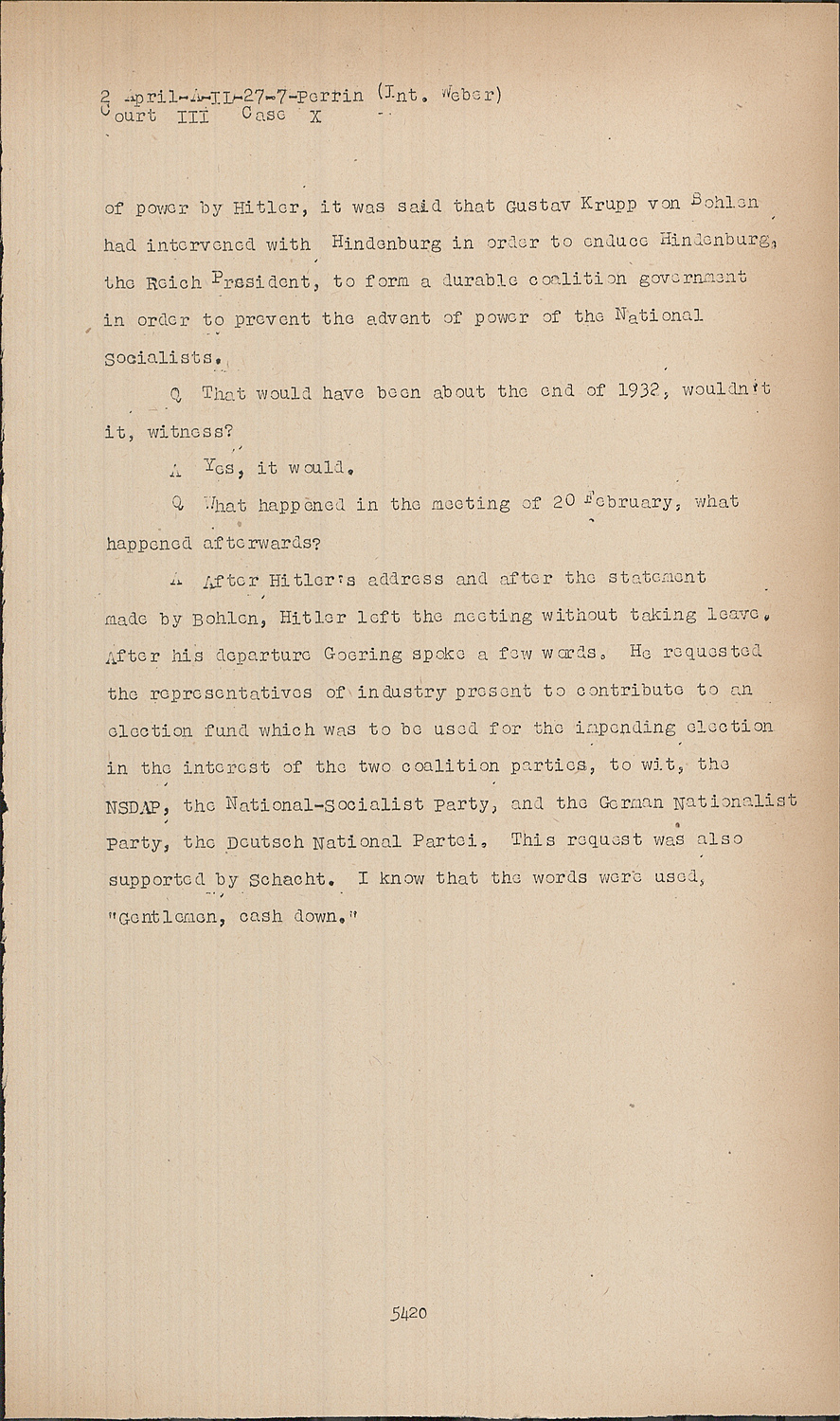
QThat would have been about the end of 1932, wouldn't it, witness?
AYes, it would.
QWhat happened in the meeting of 20 February, what happened afterwards?
AAfter Hitler's address and after the statement made by Bohlen, Hitler left the meeting without taking leave. After his departure Goering spoke a few words. He requested the representatives of industry present to contribute to an election fund which was to be used for the impending election in the interest of the two coalition parties, to wit, the NSDAP, the National-Socialist Party, and the German Nationalist Party, the Deutsch National Partei. This request was also supported by Schacht. I know that the words were used, "Gentlemen, cash down."
Court No. III, Case No. X.
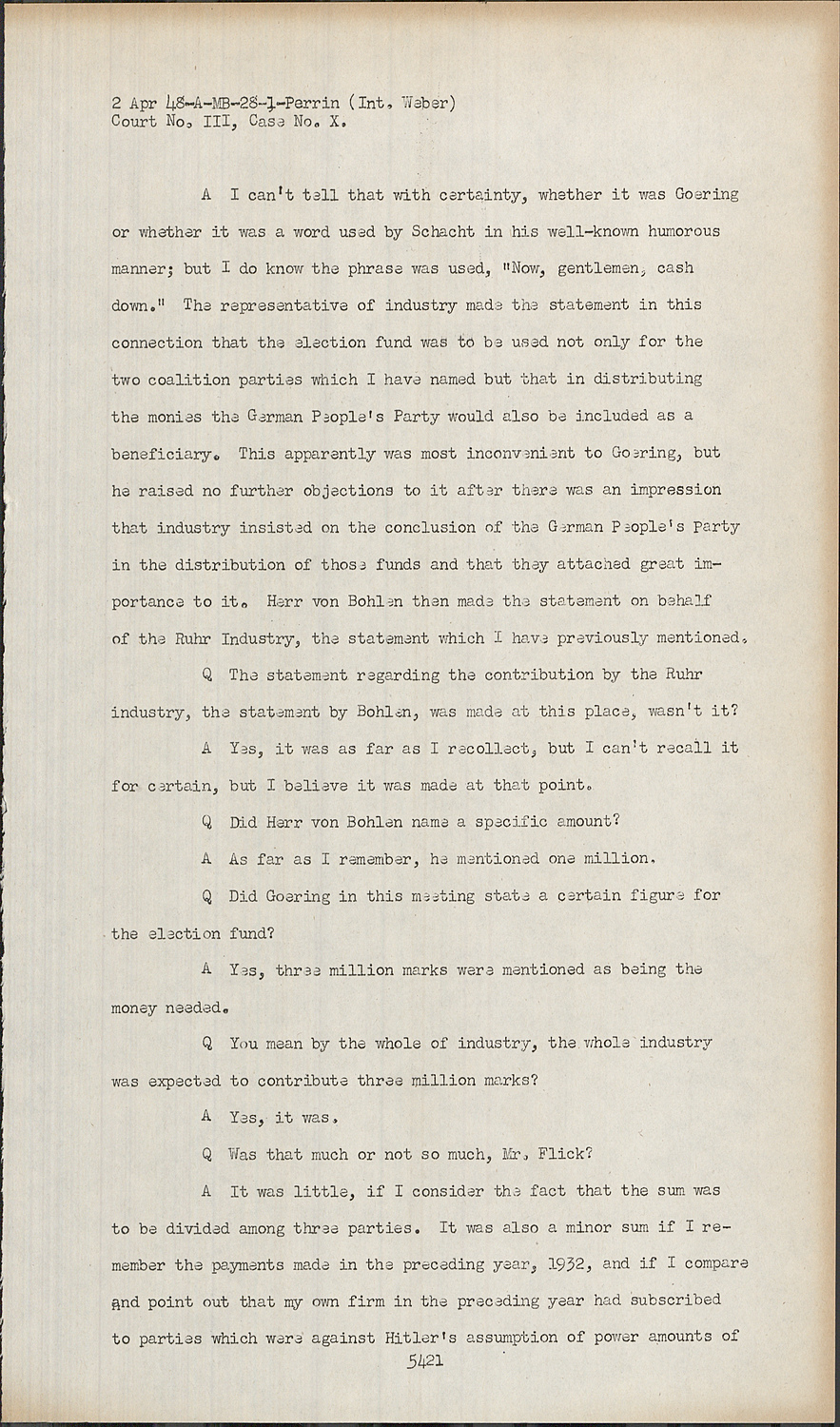
AI can't tell that with certainty, whether it was Goering or whether it was a word used by Schacht in his well-known humorous manner; but I do know the phrase was used, "Now, gentlemen, cash down." The representative of industry made the statement in this connection that the election fund was to be used not only for the two coalition parties which I have named but that in distributing the monies the German People's Party would also be included as a beneficiary. This apparently was most inconvenient to Goering, but he raised no further objections to it after there was an impression that industry insisted on the conclusion of the German People's Party in the distribution of those funds and that they attached great importance to it. Herr von Bohlen then made the statement on behalf of the Ruhr Industry, the statement which I have previously mentioned.
QThe statement regarding the contribution by the Ruhr industry, the statement by Bohlen, was made at this place, wasn't it?
AYes, it was as far as I recollect, but I can't recall it for certain, but I believe it was made at that point.
QDid Herr von Bohlen name a specific amount?
AAs far as I remember, he mentioned one million.
QDid Goering in this meeting state a certain figure for the election fund?
AYes, three million marks were mentioned as being the money needed.
QYou mean by the whole of industry, the whole industry was expected to contribute three million marks?
AYes, it was.
QWas that much or not so much, Mr. Flick?
AIt was little, if I consider the fact that the sum was to be divided among three parties. It was also a minor sum if I remember the payments made in the preceding year, 1932, and if I compare and point out that my own firm in the preceding year had subscribed to parties which were against Hitler's assumption of power amounts of Court No. III, Case No. X.1.3 to 1.5 million marks; and, of course, of this amount, a sum of one million marks was subscribed to the Hindenburg election.
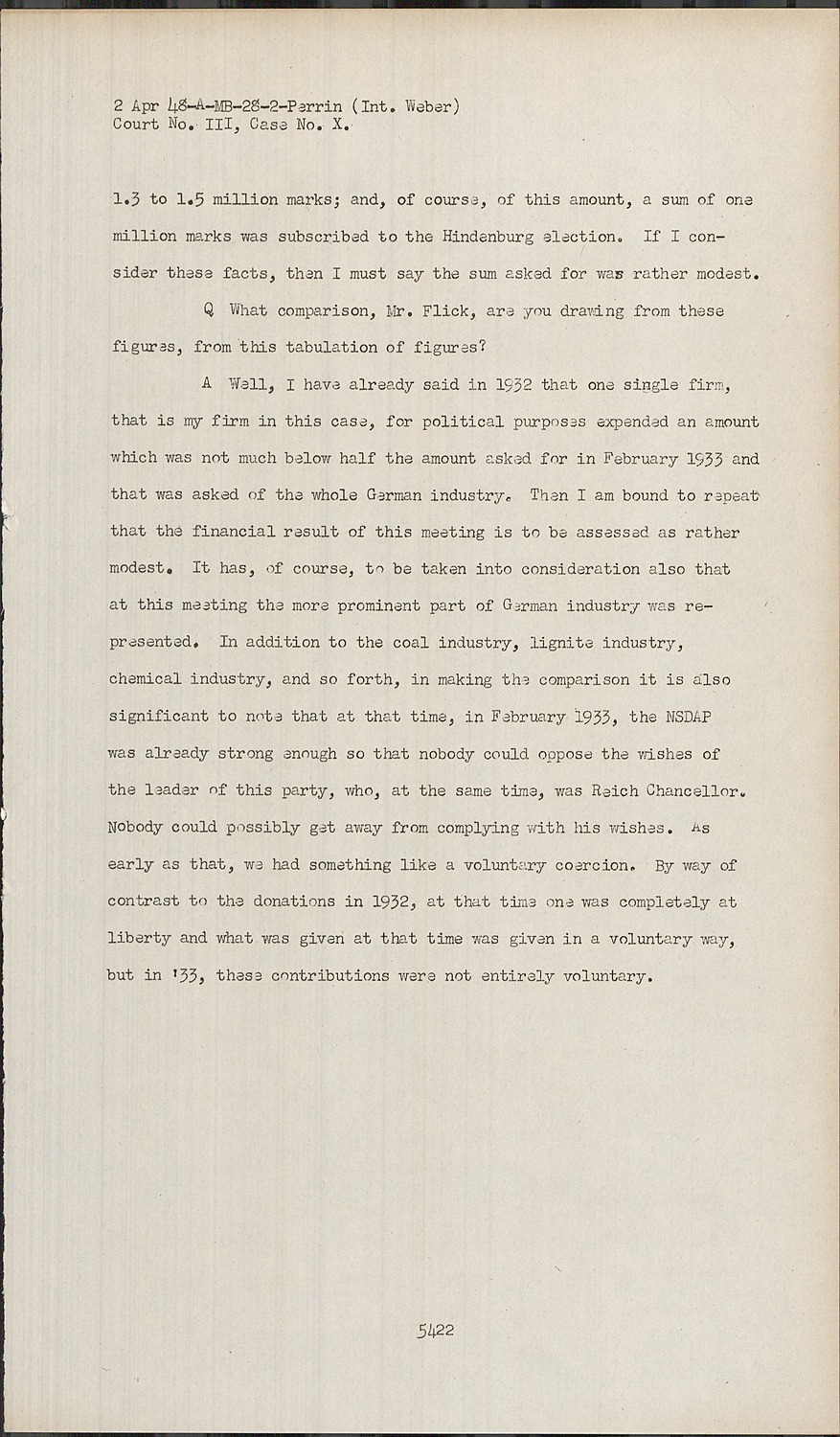
If I consider these facts, then I must say the sum asked for was rather modest.
QWhat comparison, Mr. Flick, are you drawing from these figures, from this tabulation of figures?
AWell, I have already said in 1932 that one single firm, that is my firm in this case, for political purposes expended an amount which was not much below half the amount asked for in February 1933 and that was asked of the whole German industry. Then I am bound to repeat that the financial result of this meeting is to be assessed as rather modest. It has, of course, to be taken into consideration also that at this meeting the more prominent part of German industry was represented. In addition to the coal industry, lignite industry, chemical industry, and so forth, in making the comparison it is also significant to note that at that time, in February 1933, the NSDAP was already strong enough so that nobody could oppose the wishes of the leader of this party, who, at the same time, was Reich Chancellor. Nobody could possibly get away from complying with his wishes. As early as that, we had something like a voluntary coercion. By way of contrast to the donations in 1932, at that time one was completely at liberty and what was given at that time was given in a voluntary way, but in '33, these contributions were not entirely voluntary.
Court No. III, Case No. X.
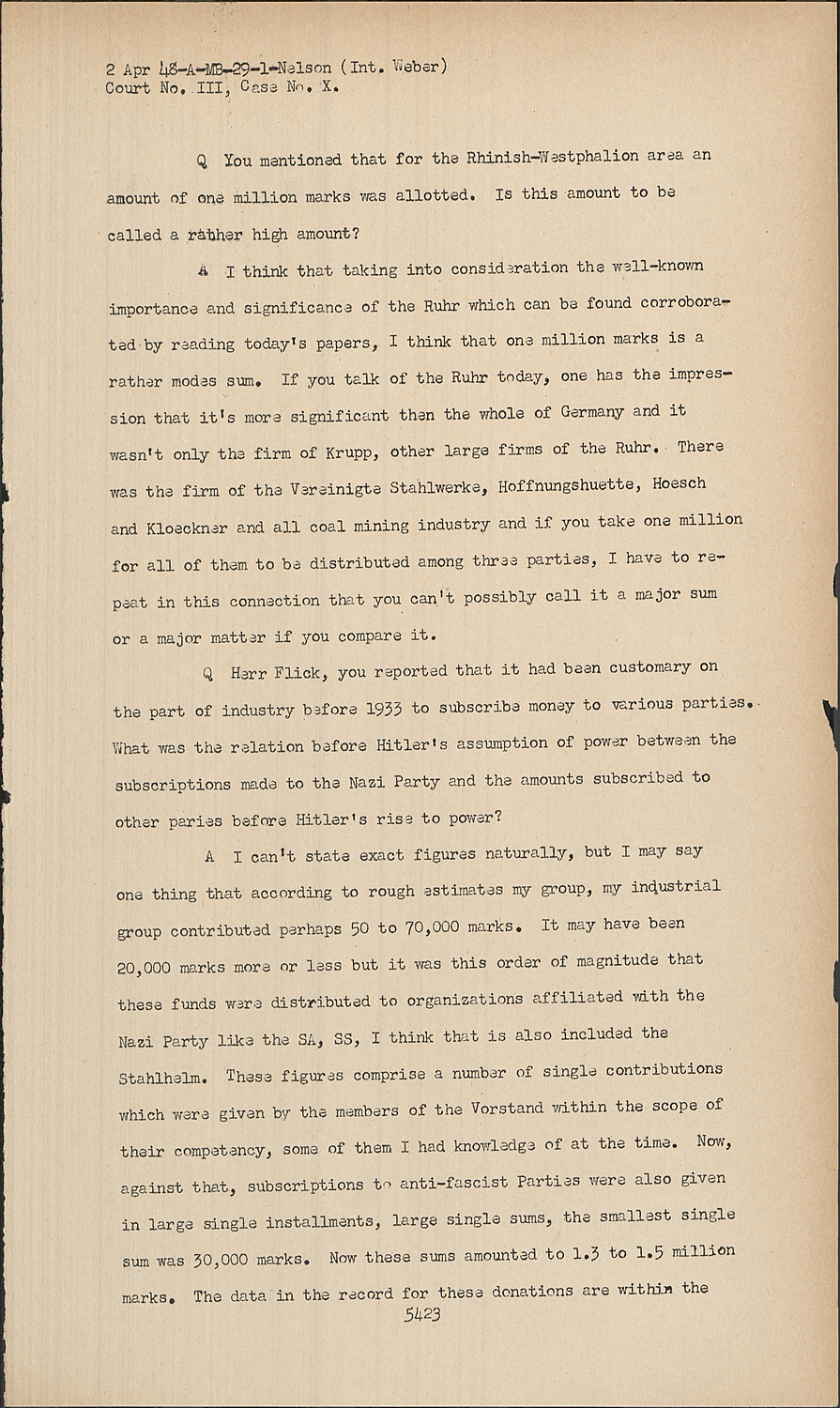
QYou mentioned that for the Rhinish-Westphalion area an amount of one million marks was allotted. Is this amount to be called a rather high amount?
AI think that taking into consideration the well-known importance and significance of the Ruhr which can be found corroborated by reading today's papers, I think that one million marks is a rather modes sum. If you talk of the Ruhr today, one has the impression that it's more significant than the whole of Germany and it wasn't only the firm of Krupp, other large firms of the Ruhr. There was the firm of the Vareinigte Stahlwerke, Hoffnungshuette, Hoesch and Kloeckner and all coal mining industry and if you take one million for all of them to be distributed among three parties, I have to repeat in this connection that you can't possibly call it a major sum or a major matter if you compare it.
QHerr Flick, you reported that it had been customary on the part of industry before 1933 to subscribe money to various parties. What was the relation before Hitler's assumption of power between the subscriptions made to the Nazi Party and the amounts subscribed to other paries before Hitler's rise to power?
AI can't state exact figures naturally, but I may say one thing that according to rough estimates my group, my industrial group contributed perhaps 50 to 70,000 marks. It may have bean 20,000 marks more or less but it was this order of magnitude that these funds ware distributed to organizations affiliated with the Nazi Party like the SA, SS, I think that is also included the Stahlhelm. These figures comprise a number of single contributions which were given by the members of the Vorstand within the scope of their competency, some of them I had knowledge of at the time. Now, against that, subscriptions to anti-fascist Parties were also given in large single installments, large single sums, the smallest single sum was 30,000 marks. Now these sums amounted to 1.3 to 1.5 million marks. The data in the record for these donations are within the Court No. III, Case No. X.files of my case.
Payments were also made to other parties for instance the Social Democrats received money, not vary large amounts but they also got money.
QMay I ask one concluding question. Were you a Social Democrat, Mr. Flick? Because you subscribed to the Social Democrat Party.
ANow, you can't expect me to be a Social Democrat, could you? I think if I would affirm this question it would, I think it would rather impune my credibility, don't you think so?
DR. POHLE:May I now suggest that we have a recess.
PRESIDING JUDGE WILKINS:Yes, it is now five o'clock and we have run over thirty minutes. I think that will make up for the time we have lost.
We will adjourn until Monday morning.
(The Court adjourned until 0900 hours, 5 April 1948.)
The Official transcript of Military Tribunal III, in the matter of the United States of America against Alfried Krupp, et al, defendants, sitting at Nurnberg Germany, 5 April 1948, 0955-1630 hours, the Honorable Hu C. Anderson presiding.
THE MARSHAL:The Honorable, the Judges of Military Tribunal Number III. Tribunal III is now in session.
God save the United States of America and this honorable Tribunal.
There will be order in the courtroom
THE PRESIDENT:Are all the defendants present?
THE MARSHAL:May It please your Honor, all the defendants are present in the courtroom except the defendant Kupke who has been excused by the Court.
THE PRESIDENT:Dr. Pohle.
DR. POHLE:May I continue?
THE PRESIDENT:No, before you proceed, please, we have taken up an hour of your time by a conference which was necessary. You lose nothing by that. Before going ahead with this witness, Judge Wilkins would like to make a statement.
JUDGE WILKINS:Dr. Pohle, we are sorry that Mr. Robinson isn't here. I wanted to refer to the incident that occurred last Friday and have the record show the comments I desire to make, and I trust that you will tell him inasmuch as he is not present.
I wanted to correct a statement that I did make on Friday which was to the effect that if for some unforseen circumstances -- I think that is the way it occurred with Mr. Robinson -- the Defense would be held to their schedule of time. Now, since then I have read the transcript of the record that has been furnished to me, and Judge Anderson and Judge Daly have both told that they felt that the statement was incorrect in view of the fact that something unforeseeable could happen that would be well beyond the control of the Defense or Defense counsel; and, of course, in that case, we couldn't expect the Defense to hold to their schedule, and so I do want to withdraw that statement and frankly admit that I was wrong in it, and I am inclined to agree absolutely with the statement of Judge Anderson and Judge Daly that if an unforeseen event does occur over which the Defense have no control, of course, they would not be held responsible for it.
THE PRESIDENT:Now, I want to take advantage of this opportunity to make a statement of my personal position for the benefit of the record about this matter. I am very glad to hear Judge Wilkins' statement. I think it is quite proper. I have never understood that it was the intention of the Tribunal to fix any unalterable or irrevocable time limit on the defendants for the presentation of their case. When this matter came up Judge Wilkins volunteered to have a conference with the defense counsel with a view of ascertaining whether or not some mutually satisfactory arrangement could not be made with respect to the time. That was entirely proper, entirely usual. The record very clearly reflects the result of that conference. I don't think there could be any dispute about that. I understood, and the record shows Dr. Pohle, on behalf of the defense counsel, made what I conceded to be very proper and very reasonable reservations with respect to that date, that date of June the 5th, and I think that is the understanding -- was the understanding and is the understanding of all of the members of the Tribunal, and I feel justified in saying this, that if when that time comes the defendants or their counsel have not had - by the exercise of reasonable diligence have not had an adequate opportunity or proper opportunity to adequately present their defense, why then I shall be in favor of extending that time such reasonable length of time as shall be necessary to do so for them to accomplish that end. I have no reason to believe that any extention will be necessary, that is no reason so far, but it has been stated here by Dr. Pohle and by Judge Wilkins this morning, no one can anticipate what is going to happen in the trial of a case. Those matters are to be considered at the proper time, but certainly there won't be any arbitrary restrictions on the time limits so far as I am concerned.
Now, one matter. I feel that it is essential to a fair trial that a defendant be assured through his counsel of reasonable and proper attention with respect to all matters that are material to his defense.
In the interest of an expeditious trial, the rules provide, in effect, that motions must be reduced to writing.
The Tribunal invites and welcomes briefs, written briefs, in support of all motions. As far as I am personally concerned, I think they are far more effective than oral arguments, and the Tribunal must reserve to itself the right to determine whether discussion of motions or any other matters in addition to written briefs will be helpful, because we must supervise the use of the time in the interests of the defendants in this case. That is for us to determine and it is necessarily so, whether discussions of that kind will be helpful.
Now, one further point -- Or before I finish on that other point, if in that connection, with a motion or any other matter, the Tribunal thinks that an oral discussion of it will be helpful to the Tribunal in reaching a determination with respect to the particular matter, why we will so state and invite the oral discussion.
Now, the third matter is this. Some apprehension was expressed by Mr. Robinson, I believe, as to whether motions, written motions filed, would be considered a part of the record unless they were read into the transcript here in open court. I have taken it upon myself to make some inquiry and investigation about that, and that has confirmed my impression that I believe I stated to Mr. Robinson in chambers, that unless stricken by a written order of the Tribunal , all motions filed with the Secretary General or that go to the archieves are just as much a part of the record as the daily proceedings here, and just as much as if they were written into the record - I mean read into the record here in open court, and by a previous custom and practice, the transcripts of records that have been certified to the United States heretofore have been compiled in that way. That is to say they include not only this daily transcript that is made up of what transpires here in open court, but also every motion on file in the archives of the court. Now, if counsel -- or rather it is quite understandable, especially to American lawyers, how counsel would be apprehensive about that, because the practice in the United States is very technical with respect to what goes into the record, of the technical record, what is properly in there and how it is gotten in and so forth and so on.
Perhaps you gentleman wouldn't have to deal with such technicalities, but we quite understand why Mr. Robinson is apprehensive about it, and we want to allay any misgivings on that score. Now, if any misgivings are still entertained, the Tribunal is prepared, and it has full authority to do so, to put down a written order on the record that every motion and every document filed with the Secretary-General, or placed in the archives under this system we are working under here, unless stricken by written order of the Tribunal, of which due notice will be given, shall be and constitute a part of the record just as much as what occurs here in open court. If such an order as that is desired it may be obtained. I don't think it is necessary. In fact what is stated here this morning ought to suffice.
Now, unless there is something further, were you about to proceed with this witness, Dr. Pohle?
DR.POHLE(For defendant Von Buelow): I thank the court for its statement just now made, and I only want to repeat that my colleagues of the defense and I shall do the utmost to finish by the deadline set for June 5. As your Honors yourselves remarked, some of the conditions are that the technical machinery here is working, for instance, the timely presentation of document books, no unforeseen days without sessions, and then the duration of cross-examination which we cannot influence.
These are a few examples. However, I believe we are fully in agreement with your statements.
THE PRESIDENT:Well, I - I beg your pardon.
DR. POHLE:Now, I have one technical matter. I should appreciate it if we were given on opportunity tomorrow to talk with out clients because tomorrow is no session, but we would appreciate it if we could use tomorrow -- I am speaking for my own person - to speak with my client . I found out yeterday that is not impossible, and I would appreciate it if the court could use its influence to enable us to do so tomorrow.
THE PRESIDENT:Certainly. If that is within the power of the Tribunal to be done, it will be done. Now, I don't know just what -I should say this. The schedule or rather the arrangements for the celebration of what we know as Army Day, I understand, are rather extensive. I don't know to what extent the personnel in the prison will be involved, but you may be assured that insofar as we can accomplish it that will be done. Now, I just want to make this further statement about this matter. The Tribunal has every reason to believe that the defense counsel are going to cooperate fully just as they assured us they would. T hey have given every indication of that, and we don't have any doubt whatever that that is going to be done. Now, we have some matters, Dr. Pohle, the Tribunal has, that are of considerable importance that we feel obliged to discuss this morning before we proceed with this witness. If it should occasion any loss of time to the defense why we will undertake to compensate that, so we are going to be obliged to recess until one-thirty o'clock.
DR. POHLE:This may notbe possible, your Honor, because of the noon meal. We are only fed from twelve-thirty - from twelve-thirty to onethirty. After one-thirty we cannot eat any more.
THE PRESIDENT:May be you misunderstood me. Did I say one thirty?
DR. POHLE:One-thirty.
THE PRESIDENT:Well, that is the usual time that we have the noon recess, isn't it?
JUDGE DALY:We come back from recess at that time.
THE PRESIDENT:No, no, I didn't mean that. I didn't so state it. I meant that we would recess now until one thirty. Did you understand it? Is there any objection? We certainly don't want to deprive you of your meal by any means, but we just have some very important matters that we are to confer about, and we would like to utilize the time between now and one-thirty o'clock to confer about it.
DR. POHLE:It was a misunderstanding then, Your Honor.
(A recess was taken until 1330 hours.)
AFTERNOON SESSION ------------------(The Tribunal reconvened at 1330 hours, 5 April 1948)
THE MARSHAL:The Tribunal is again in session.
DR. POHLE:May it please the Tribunal -
THE PRESIDENT:Dr. Pohle, before you proceed.
DR. POHLE:With the permission of the Tribunal, I'd like to interrupt the interrogation of the witness Flick at this point.
THE PRESIDENT:Before you proceed with the other witness, Doctor, we desire to dispose of a motion that has been made. On March 12 last, the defendants filed a joint motion for an acquittal on the charges of crimes against the peace. We construe this to be a motion for a judgment of not guilty on Counts I and IV of the indictment on the ground that the evidence is insufficient as a matter of law to warrant a judgment against them on those counts.
After a careful consideration of this motion, the Prosecution's reply thereto, and the briefs and the evidence, we have come to the conclusion that the competent and relevant evidence in the case fails to show beyond a reasonable doubt that any of the defendants is guilty of the offenses charged in Counts I and IV. The motion accordingly is granted and for the reasons stated the defendants are acquitted and adjudged not guilty on Counts I and IV of the Indictment. An opinion, stating in more details the reasons of our conclusion, will be filed at a later date.
Now, we don't know to what extent this will interfere with the plan the Defense has for the presentation of its evidence as to the other counts. Now, what have you gentlemen to suggest?
DR. POHLE:May it please the Tribunal, I would suggest we have a very short recess so that I can confer with my colleagues and find out what our position is after this announcement just made by the Tribunal.
THE PRESIDENT:Well, now, we make this suggestion, Dr. Pohle, that tomorrow is a holiday, as you know, and we will not be in session because of it as we have already stated; and if we could before we leave this afternoon arrive at a specific date on which to reconvene, why we would like to do so rather than deferring that until Wednesday.
We had understood that the Defense had prepared its case with reference to the aggressive war counts first and that your documents and so forth had been prepared along that line and that you are operating on somewhat of a schedule, that is, in a manner of speaking, you had allowed so much time for those counts and so much for the others. So, we take it that you would want to have some conference about the matter, especially in view of the translation difficulties in that matter, but we would, if you gentlemen can confer this afternoon and determine for certain when you'd be able to take up the other phase of your case, we'd like to do it.
Now, how long a recess would you suggest?
DR. POHLE:Your Honor, when I asked for the recess, I was thinking of a time of a few minutes so that we could discuss the matter. I think I would suggest that we reconvene at 3 o'clock in order to tell the Tribunal what possibilities we have to take up the Defense on the other counts.
JUDGE DALY:May I say this, Judge Anderson. The only suggestion I would make to that is that we have an indefinite recess, and that during that recess if counsel wanted to confer on that matter with the members of the Tribunal, we wouldn't be tied down, and we'd be here all afternoon anyway. That way, you may take as much time as you want.
THE PRESIDENT:I think that is a good suggestion. That is a good suggestion. You take as much time as you want, and we will be in our chambers during the afternoon and you can consult with us about it when you want to take it up.
(The Tribunal recessed without date.)
THE MARSHAL:The Tribunal is again in session.
THE PRESIDENT:I understand that the decision on the motion this morning, as anticipated, requires a modification of plans of the defense counsel to proceed with the defense, and that is quite understandable. In a conference with representatives of the defense counsel they have requested that we recess until nine o'clock on Monday morning April 19th next, in order to give time and opportunity to revise the schedule and prepare to proceed with the presentation of their case as to the remaining two counts of the indictment, and we are going to grant that request.
We desire at this time to express the hope that defense counsel will, as I am sure they will do, utilize that time to the best advantage in view of getting the case in shape so that we can go right along with it when we recenvene. It is needless to mention again the difficulties of translation and the necessity of getting the documents that have to be translated into the defense center at the earliest possible time.
JUDGE WILKINS:Dr. Wecker isn't here today, Dr. Pohle?
DR POHLE:May it please the Tribunal, Dr. Wecker is not present today.
THE PRESIDENT:Well, we will recess now until nine o'clock on Monday, April 19th next.
(The Tribunal adjourned until 19 April 1948, at 0900 hours.)
Official Trnascript of the American Military Tribunal in the matter of the United States of America against Alfried Krupp, et al, defendants, sitting at Nurnberg, Germany, on 19 April 1948, the Honorable Hu C. Anderson presiding.
THE MARSHAL:All persons in the Courtroom will please take their seats.
The Honorable, the Judges of Military Tribunal III.
Military Tribunal III is now in session. God save the United States of America and this Honorable Tribunal.
There will be order in the Court.
THE PRESIDENT:Mr. Marshal, will you ascertain if all the defendants are present in the Courtroom?
THE MARSHAL:May it please your Honor, all the defendants are present in the Courtroom except the defendants Houdremont and Kupke, who have been excused by the Court because they are sick.
THE PRESIDENT:Judge Daly will preside at today's session.
PRESIDING JUDGE DALY:Can we go forward, gentlemen?
DR. POHLE:May it please the Tribunal, the witness, Dr. Friedrich Flick, will be here in a moment, as I am just told he has been fetched. In the meantime, I would like to present a few documents. I shall start with Document Book Buelow No. 1. I assume the Tribunal has Buelow books 1 to 5. Owing to the ruling by the Tribunal with regard to counts 1 and 4 of the indictment, a great many of the documents in these books have been disgarded. The whole of Document Book 1 contains only a few documents which I shall present. The first is Buelow Document 178, then 198, on page 89 of Book 1. Perhaps the Secretary General could tell me which defense exhibit number is the next on the list, so I can offer this document as an exhibit.
This document is an affidavit by Dr. Ernst Poensgen, who until 1933, was General Counsellor and Chairman of the Vorstand in the Versinigte Stahlwerke. Herr Poensgen is the author of the memorandum which he here testified in his affidavit, and in which he reports on the attitude of the Ruhr industrialists toward Hitler. I shall not read all of it, but I should like to point a few very interesting points. For instance, on page 98 of both English and German books.
Apparently the interpreters have not got the book yet. In that case, do you want me to wait until the books have been distributed? I think they will he here any moment now, or would the Tribunal want me to continue on my report?
PRESIDING JUDGE DALY:We will wait just a short time and see if they come down.
THE PRESIDENT:Dr. Pohle, while we are waiting, I wonder if it would be convenient for the defense counsel -- I was just thinking it might be helpful in presenting the document books if you would state in the beginning very briefly the general subject with which the documents are concerned. I don't mean at any length, but just a general outline, a very brief statement, before proceeding with the documents.
DR. POHLE:Your Honor, I shall follow the suggestion by the Tribunal. The document book which I am presenting here, Buelow Books 1 to 5, refers to one part of the subject, which is count 1 and count 4, that is, the attitude of industry to the National Socialist Party before and during the seizure of power. Document books 1 to 5 are arranged in such a way that first of all the position before the seizure of power is shown and the attitude of industry toward National Socialism before 1933, and then after the events of 1933 are dealt with, and later on follows a great number of documents which deal with the period after the seizure of power, that is, after 1933. Counts 1 and 4 are dropped, and a great number of these documents are superfluous, so I do not have to present them in order to make my case. I believe particularly that I can leave out various documents which show that industrialists did not bring National Socialism into power, and that it was not industry which before 1933 supported National Socialism. On the other hand, these books will show those documents as relevant which refer to the structure of National Socialism after 1 33 and to the whole setup of the National Socialism State. Those documents are important because they give one of the reasons for count 2, spoliation, and count 3, slave labor. For that reason I intend to pick out those documents in books 1 to 5 which also refer to the question I just mentioned, whereas the large part of these documents which refer to the seizure of power as such can to a great part be omitted.
I just notice that the Marshal has distributed the books, and therefore, I think I can now continue my presentation of documents.
If I am not mistaken, the next Exhibit number, and the Secretary General can confirm that, is 89, is that correct? In that case, I should like to present from Document Book Buelow 1, which I hope is in the hands of the Tribunal, as my first exhibit, an affidavit on page 89, by Dr. Ernst Poensgen. The affidavit is on page 89 of both the English and German book.
PRESIDING JUDGE DALY:That may be marked as Exhibit 89.
DR. POHLE:As I have already pointed out, this is an affidavit by Herr Poensgen with regard to a memorandum or essay by himself, which is entitled: "Hitler and the Ruhr Industrialists". The document carries the number 198, and I have offered it as Exhibit 89.
In this affidavit, I would like to draw the attention of the Tribunal to two sentences on page 98 of both the English and German book, where it says:
"We industrialists had to deal very frequently with questions of labor legislation and with Robert Ley's attempts at gaining influence on the operation of plants via the labor front and the factory regulations."
I would like to point out that Robert Ley was the head of the German Labor Front and at the same time held the office of the Reich Organization Leader. He was one of the main defendants in the I.M.T., but before he could be indicted, he committed suicide.
The next paragraph on the same page stated:
"Schacht, as minister of economics, also put up a strong resistance to Ley's plans and ambitions."
On page 99 in the third paragraph:
"It is not possible to give in a few words a definitive opinion upon the German Labor Front. The local chiefs differed from each other. Thus attempts made by the Betriebsobleute (the shop stewarts) at removing illegally superiors who were not convenient to them, found frequently -but not always -- their support."
On page 101, at the top he says:
"The Ruhr industrialists after the outbreak of the war, did everything in our power to increase the armament production in quality and quantity. - * * * * Here it was everybody's duty to do this duty for the fatherland".In the next paragraph it says:
"Of the events which took place in the concentration camps we did not hear until today, after the end of the war, and heard of their extent and their horror through the Allied broadcasts."
Poensgen then goes into detail of the setting up of the Hermann Goering Works, the foundation of the organization. This foundation is a particularly significant example because even at that time, that is in 1936 or 1937, it shows the extreme State coercion which could be felt in all parts of industry. It was particularly the foundation of the Hermann Goering Works and the methods which were employed which consituted a particularly significant example at that time of pressure.
On page 104, Poensgen says, toward the middle of the page:
" * * * * in June, 1937, out of a clear sky, the founding of the Hermann Gearing Works was announced and the private iron industry was sharply attacked. At the same time the major part of the Salzgitterfelder was expropriated for the benefit of the Hermann Goering Works."
The Ilsedore ore mine deposits are in the center of Germany, in the Harz Mountains.
Two sentences further on Poensgen says:
"The founding of the Hermann Goering Works was an open challenge to the private iron industry and was recognized and discussed as such in public. All foundries then were forced to buy stocks of the Reich works, which were later resold at a loss."
Poensgen then refers to an interlude in which Schacht took a certain part . He described the doubts he had himself about the foundation of the Hermann Goering Works, and on page 105 he says that he had a conversation with Schacht on the subject, and that he was convinced that this conversation, which lasted about an hour, was recorded secretly and passed on to Goering.
He then says that he wrote an essay against the foundation of the Hermann Goering Works, that he discussed this essay with almost all of the large works, that there was a meeting in Duesseldorf, and the great surprise of Peonsgen, 90% of the Works represented in this meeting fell out and let them down, without giving any valid reason, and refused to sign. On page 106, Poensgen then reveals what actually happened during these events. He says:
"I was to learn of the reasons behind these events almost 8 weeks later, when we discussed them in a smaller circle of friends. On that occasion, Kloeckner remarked that, naturally, he could not sign any longer after receiving Goering's secret telegram. Voegler and I were speechless," so Poensgen says, "we had not known of any telegram".
According to this, what happened was that the heads of the various enterprises received a telegram from Goering which threatened that they would be punished if they signed that essay which was set up, and was to be submitted by the Ruhr industrialists against the Hermann Goering Works. The telegram had the following wording. You find that on page 106:
"Request you do not sign the written statement by the United Steel Works, which amounts to sabotaging the Hermann Goering Works." Signed "Goering". You find that on page 106:
"Request you do not sign the written statement by the United Steel Works, which amounts to sabotaging the Hermann Works." Signed "Goering".
Then Peonsgen comes to discuss the Alpine Montan Company, which is to be found on page 107. Here again he gives an example of pressure under which, even at that time, all the works had to carry out their business. In the last paragraph on page 107 he says:
"After the annexation of Austria, Goering demanded of us the majority shares of the Alpine Montan Company for his works. Impressed with the seriousness of his thread, we at first declared ourselves ready to agree to a 50-50 basis with equal participation in the Aufsichtsrat."