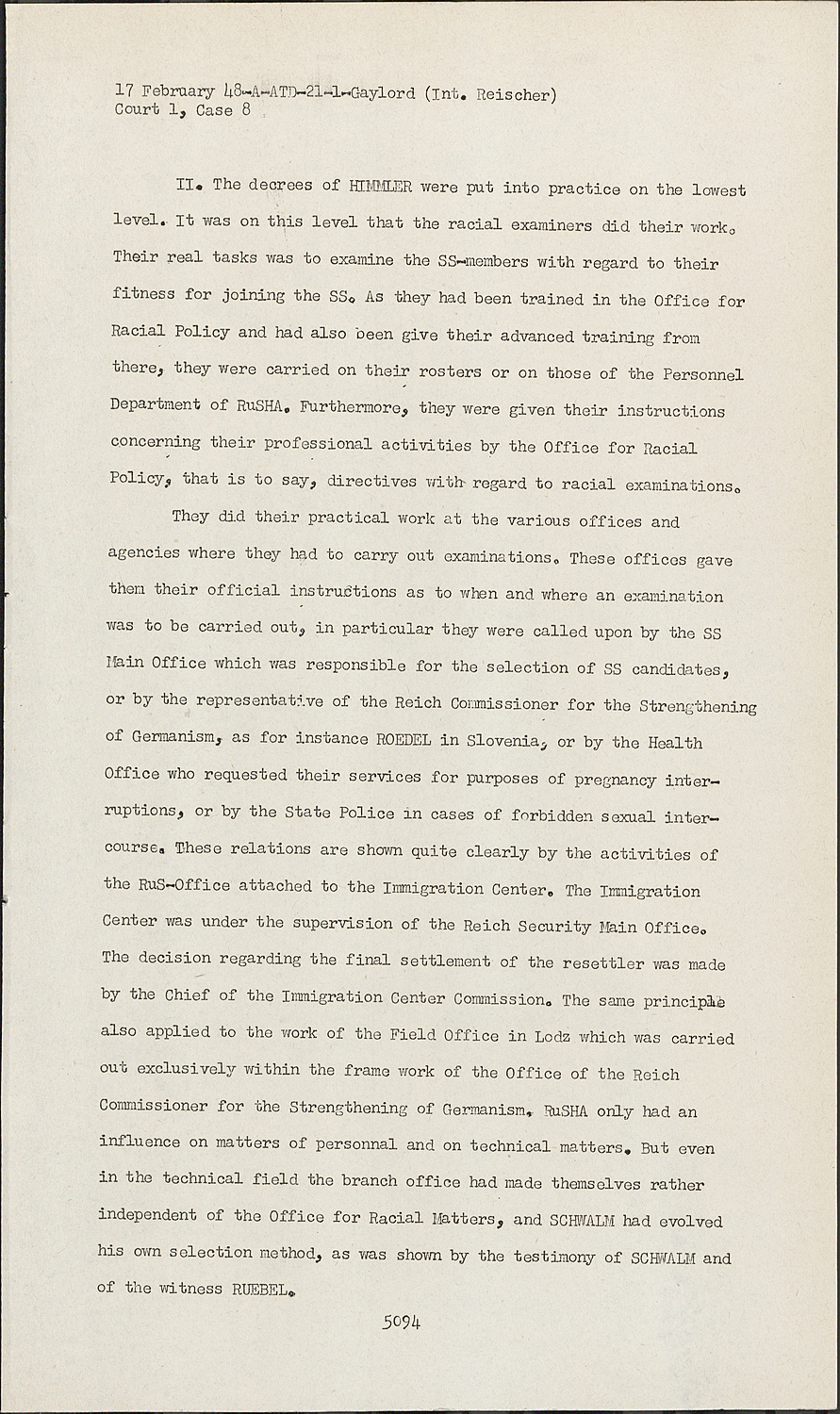
II.The decrees of HIMMLER were put into practice on the lowest level. It was on this level that the racial examiners did their work. Their real tasks was to examine the SS-members with regard to their fitness for joining the SS. As they had been trained in the Office for Racial Policy and had also been give their advanced training from there, they were carried on their rosters or on those of the Personnel Department of RuSHA. Furthermore, they were given their instructions concerning their professional activities by the Office for Racial Policy, that is to say, directives with regard to racial examinations.
They did their practical work at the various offices and agencies where they had to carry out examinations. These offices gave them their official instructions as to when and where an examination was to be carried out, in particular they were called upon by the SS Main Office which was responsible for the selection of SS candidates, or by the representative of the Reich Commissioner for the Strengthening of Germanism, as for instance ROEDEL in Slovenia, or by the Health Office who requested their services for purposes of pregnancy interruptions, or by the State Police in cases of forbidden sexual intercourse. These relations are shown quite clearly by the activities of the RuS-Office attached to the Immigration Center. The Immigration Center was under the supervision of the Reich Security Main Office. The decision regarding the final settlement of the resettler was made by the Chief of the Immigration Center Commission. The same principle also applied to the work of the Field Office in Lodz which was carried out exclusively within the frame work of the Office of the Reich Commissioner for the Strengthening of Germanism, RuSHA only had an influence on matters of personnal and on technical matters. But even in the technical field the branch office had made themselves rather independent of the Office for Racial Hatters, and SCHWALM had evolved his own selection method, as was shown by the testimony of SCHWALM and of the witness RUEBEL.
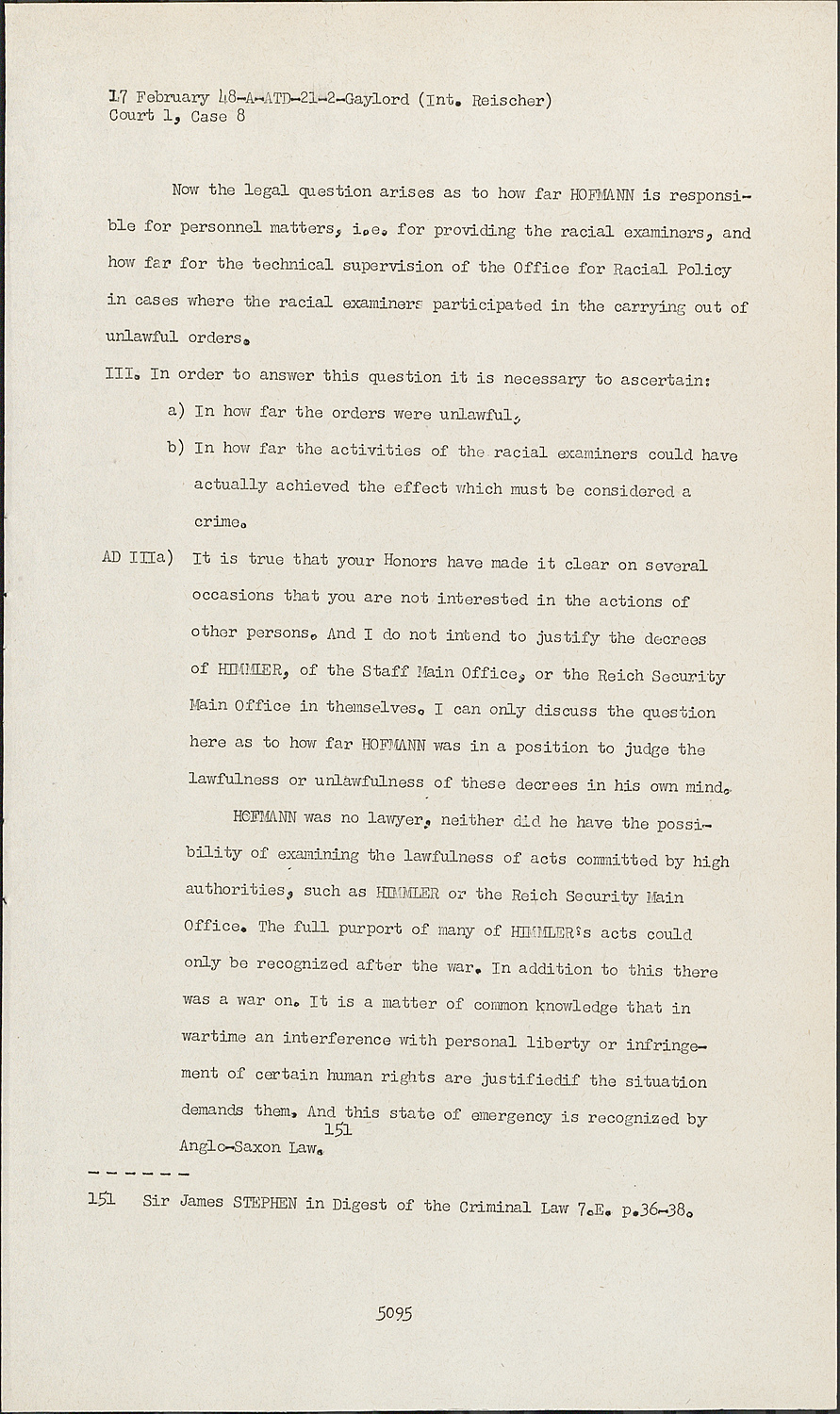
Now the legal question arises as to how far HOFMANN is responsible for personnel matters, i.e. for providing the racial examiners, and how far for the technical supervision of the Office for Racial Policy in cases where the racial examiners participated in the carrying out of unlawful orders. III. In order to answer this question it is necessary to ascertain:
a) In how far the orders were unlawful.
b) In how far the activities of the racial examiners could have actually achieved the effect which must be considered a crime.
AD IIIa) It is true that your Honors have made it clear on several occasions that you are not interested in the actions of other persons.
And I do not intend to justify the decrees of HIMMLER; of the Staff Main Office, or the Reich Security Main Office in themselves.
I can only discuss the question here as to how far HOFMANN was in a position to judge the lawfulness or unlawfulness of these decrees in his own mind.
HOFMANN was no lawyer, neither did he have the possi bility of examining the lawfulness of acts committed by high authorities, such as HIMMLER or the Reich Security Main Office.
The full purport of many of HIMMLER's acts could only be recognized after the war.
In addition to this there was a war on.
It is a matter of common knowledge that in wartime an interference with personal liberty or infringe ment of certain human rights are justifiedif the situation demands them.
And this state of emergency is recognized by Anglo-Saxon Law.
151 - - - - - 151 Sir James STEPHEN in Digest of the Criminal Law 7.E. p.36-38.
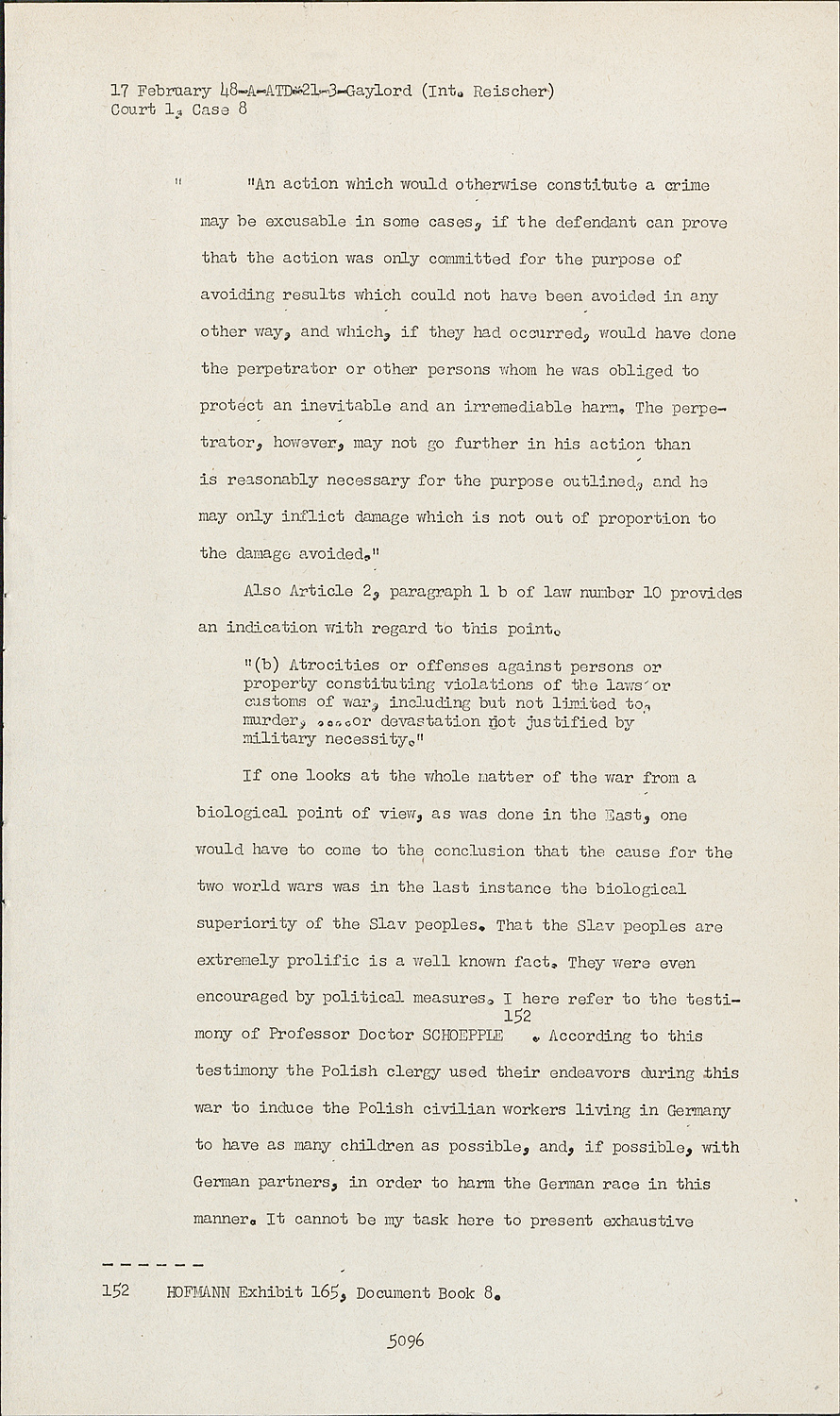
" "An action which would otherwise constitute a crime may be excusable in some cases, if the defendant can prove that the action was only committed for the purpose of avoiding results which could not have been avoided in any other way, and which, if they had occurred, would have done the perpetrator or other persons whom he was obliged to protect an inevitable and an irremediable harm.
The perpe trator, however, may not go further in his action than is reasonably necessary for the purpose outlined, and he may only inflict damage which is not out of proportion to the damage avoided."
Also Article 2, paragraph 1 b of law number 10 provides an indication with regard to this point.
"(b) Atrocities or offenses against persons or property constituting violations of the laws or customs of war, including but not limited to, murder, ....or devastation not justified by military necessity."
If one looks at the whole matter of the war from a biological point of view, as was done in the East, one would have to come to the conclusion that the cause for the two world wars was in the last instance the biological superiority of the Slav peoples.
That the Slav peoples are extremely prolific is a well known fact, They were even encouraged by political measures, I here refer to the testi mony of Professor Doctor SCHOEPPLE152.
According to this testimony the Polish clergy used their endeavors during this war to induce the Polish civilian workers living in Germany to have as many children as possible, and, if possible, with German partners, in order to harm the German race in this manner.
It cannot be my task here to present exhaustive - - - - - 152 HOFMANN Exhibit 165, Document Book 8.
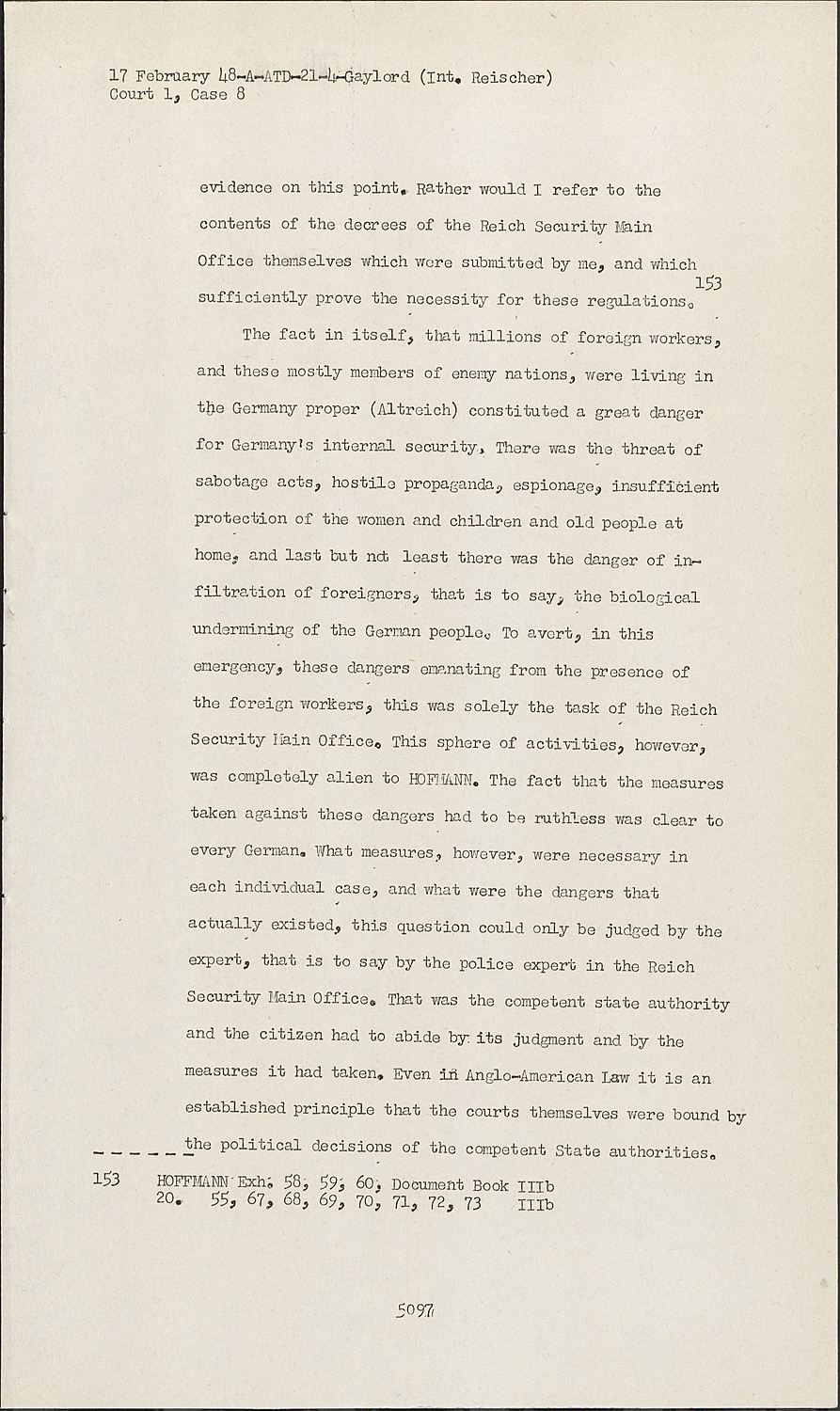
evidence on this point. Rather would I refer to the contents of the decrees of the Reich Security Main Office themselves which were submitted by me, and which sufficiently prove the necessity for these regulations.
153 The fact in itself, that millions of foreign workers, and these mostly members of enemy nations, were living in the Germany proper (Altreich) constituted a great danger for Germany's internal security, There was the threat of sabotage acts, hostile propaganda, espionage, insufficient protection of the women and children and old people at home, and last but neb least there was the danger of in filtration of foreigners, that is to say, the biological undermining of the German people.
To avert, in this emergency, these dangers emanating from the presence of the foreign workers, this was solely the task of the Reich Security Main Office.
This sphere of activities, however, was completely alien to HOFMANN.
The fact that the measures taken against these dangers had to be ruthless was clear to every German.
What measures, however, were necessary in each individual case, and what were the dangers that actually existed, this question could only be judged by the expert, that is to say by the police expert in the Reich Security Main Office.
That was the competent state authority and the citizen had to abide by:
its judgment and by the measures it had taken.
Even in Anglo-American Law it is an established principle that the courts themselves were bound by the political decisions of the competent State authorities.
- - - - - 153 HOFFMANN Exh. 58, 59, 60, Document Book IIIb 20.
55, 67, 68, 69, 70, 71, 72, 73 IIIb I will not quote the quotes I have put down there and will continue with Page 57.
This applies even more to a dictatorship, under which a criticism of State measures cannot be tolerated. This is one of the characteristics of a dictatorship.
May I refer in this connection to a treatise in the American Journal of International Law of July 1947, page 586 156) , according to which the relations between occupying power and inhabitants of the occupied territory may be subject to the laws of war. Furthermore, I refer to No. 288 of the Basic Field Manual, according to which the occupying force is entitled to issue such new laws and regulations as the military situation demands, as also new laws against crimes and offenses, which may be necessary for the protection of the armies during a state of war.
HOFMANN, in any case, had to rely on the fact that the racial examiners were working for a purpose which the State considered necessary. So far, at any rate, it must be denied on the grounds of limited knowledge that HOFMANN was criminally responsible by reason of his providing the personnel and supervising the technical activities of the Office for Racial Matters.
Add III b Beyond this, however, it can be shown that the activities of the racial examiners were not at all such as could achieve the result which the prosecution has charged as criminal.
In this connection it must be examined which is the result that must be regarded as relevant from the viewpoint of penal law.
- - - - - 156) HOFMANN Exhibit 168 VIII.
Let us take the case of the forbidden sexual inter course:
In the case of the result of the racial examinations being negative HIMMLER personally could pronounce a judgment, by which the delinquent could be sentenced to death by hanging, concentration camp etc.
, if the other constitutent elements, such as criminal facts like rape for instance or the behavior of the perpetrator, or the health examination etc.
, were also unfavorable.
I want to stress in particular that the sexual intercourse between the foreign workers themselves, for instance, was not prohibited; this shows that not their procreation was to be prevented, but that it was only intended to counter the dangers recognized by the Security Police157).It must further be taken into consideration that the foreign workers had to sign a statement saying that they had been instructed about the prohibition.
Thus they acknowledged this regulation and were aware of the consequences if they not adhere to the prohibition.
The prohibition of sexual intercourse was necessary for reasons of military security on theone hand, as it is well known that sexual intercourse presents most opportunities for espionage and thus considerably endangers the military interest.
The soldier at the front, furthermore, must be sure that his dependents at home, such as sweethearts and wives, will refrain from all sexual intercourse with members of a nation which he considers as an enemy.
On the other hand, there were reasons of national policy, as it had become apparent, that a mixing of German and Slav nationals would lead to new frictions and finally to an infiltration of foreigners in the old Germany (Altreich) itself, by reason of the biological superiority of the Slav peoples.
The reasons - - - - - - - 157) Hofmann Exhibit 72, Document Book IIIA Hofmann Exhibit 65, Document Book IIIA Hofmann Exhibit 160, Document Book VIII.
and misgivings were partly the same as those which have induced other States as well to forbid sexual intercourse between members of their race and nationality and people of a different kind.
Thus, for instance, a number of states of the U.S.A. have issued laws forbidding marriages between Whites and Negroes, which are considered and punished as offenses and even as crimes.158) In the South African Union every intercourse between Whites and Negroes outside of marriage is punishable by imprisonment on the basis of the so-called Immorality Act No. V 159) In the same way the Allies, England and the U.S.A., have issued so-called fraternization laws 160). There is a well known case in which a German Prisoner of War in England was punished by imprisonment for having offended against this law161).
If the Court reaches the conclusion that this whole procedure, as laid down in the general collected decrees, or the threatened punishment, must be regarded as measures exceeding the actually necessary security measures, then the result is undoubtedly unlawful. If, however, the racial (examiner's answer was positive, the delinquent was usually saved from these unlawful consequences. If his other circumstances, in particular the examination of his whole family, showed that he was of German decent, that, therefore, the dangers of sabotage etc., and in particular the biological danger of infiltration of foreigners, did not exist in his case, then he was included in the Re-Germanization procedure, provided that he declared his willingness. In this case, these people were treated as Germans. They received a considerably better treatment than the other foreign workers. Apart from this, I refer in this connection to the statements of my colleague, Dr. Heim, who will deal with the lawful ness of the re-Germanization procedure. I therefore suggest that this result was not unlawful.
In point one, No. 8, of the indictment, the following conclusion has been reached:
"Since negative results of racial investigations and examinations led to the extermination or imprisonment in concentration camps of the individuals concerned, the Main Staff Office, as well as VOMI, RuSHA and Lebensborn, acted in close cooperation with the SS-Reich Main ---------------------------158) Hofmann Exhibit 61 Document Book III a 159) Hofmann Exhibit 62-63 " " III a 160) Hofmann Exhibit 81 " " III a 161) Hofmann Exhibit 75, 83 " " III a Security Office (SS-Reichssicherheitshauptamt, commonly known as the "RSHA"). The RSHA imposed capital punishment and imprisonment in concentration camps upon individuals designated by RUSHA, after examination.
....."
The Prosecution, therefore, also only considers the final result, represented by the security police measures, as criminal. To prove the correctness of their deductions, the prosecution has submitted affidavits or reports which bear out these deductions.162) The questions of the prosecution in the cross-examinations were mostly on the point as to whether the examinations of the racial examiners had been decisive for the negative result. In contrast to this, we have the testimonies of the prosecution witness, Breder163), of the defendants Hofmann, Hildebrandt, and Schwalm, according to which the opinion of the racial examiners was decisive for the re-Germanization procedure and thus prevented further penal proceedings.
The argumentation of the prosecution, however, must necessarily fail, as it misses the crux of the matter. It is based on deductions of witnesses who could not help following the arguments of the prosecution, as was, for instance, stated by Vietz on the witness stand.164) Their testimonies are, therefore, without value, as they are not based on their own observation.
A testimony on that point is not possible at all, as it is a question of a deduction. One can only use the laws of logic for that purpose. The personal reports submitted by the prosecution are equally unsuitable as documentary evidence, as they, also constitute deductions. These reports are misleading, anyway, as they were made for quite a different purpose, and from quite a different angle, than that suggested by the prosecution post factum. If they mention the decisive importance and the decisive part played by the individual Nationals, this does not mean that the racial examiner alone ------------------162) Affidavit VIETZ Prosecution Document No. 5126 Affidavit SPOERING, Exh.
494, Document Book IX Affidavit PROKSCH, Exh.
537, Document Book XI Testimony of witness BACH, Transcript page 400 of the English.
163) Transcript page 775, 777 of the English wording 164) Transcript page 3776 of the English wording.
had to make the decision concerning the fate of the resettler or the person suitable for re-Germanization. This was actually impossible, if for no other reason than because the scientific knowledge in this field was not yet sufficiently far advanced, and also because the number of experts available (about 50 to 80) was quite inadequate for dealing with the millions of people concerned. The word "decisive" could only mean in this connection that in doubtful cases, i.e., in cases where the records as to descent, such as language, political attitude, cultural and political connections with Germany, were not irrefutable, the opinion of the racial examiner could turn the scales one way or the other.
Thus the cases in question were doubtful ones, borderline cases, which therefore required an additional criterion. Greifelt also stated that these racial examinations were confined to a minimum. The total number of persons selected as fit for re-Germanization, amounting to about 20,000, within five years, also shows how negligible was the effect of the racial examinations in comparison to the millions of people inhabiting the border territories of the East, and just how "decisive" they were.
Those words, so often used, and perhaps just for this reason no longer consciously used in their true meaning, can only be reasonably interpreted in this way. For how could a racial examiner pronounce a decision by giving his opinion? The decision could only be made by a State authority, such as the State Police, or Himmler, in case of forbidden sexual inter-course, or the Consulting Office of the Reich Medical Association in cases of abortions, or the representative of the Reich Commissar for the Strengthening of Germanism in cases of re-Germanization of children within the framework of regulation 67/1, as also in cases of children born of foreign female workers in Germany proper -- the Reich proper. In cases of resettlement or deportation there was from the very start no question of any decisions by racial examiners, or by officials of the Field Office Lodz, as they only came into the picture after the deportation had already been carried out. In this case it was only a question of whether the person concerned was to be included in the re-Germanization procedure or not.
In order to achieve a practical evaluation from the point of view of penal law, one must consider the purpose of the racial examinations. Their aim was in every case to determine whether the person concerned was suitable for being included in the re-Germanization procedure, or not. The technical directives given by the Office for Racial Policy only referred to that point. If the question was answered in the affirmative, then the security measures which had been laid down on principle, were not carried out, nor were the usual measures affecting all female Eastern workers, if it was a case of children born of female Eastern workers. If the question was answered in the negative, the result of the racial examinations did not provide any new facts, nor did they have any consequences. In this case the causal chain with regard to the fundamentally fixed measures against foreigners was not broken.
In this connection, too, the clear borderline between the spheres of activities of RuSHA on the one hand, and the Reich Security Main Office on the other hand, becomes apparent, as it is also stressed again and again in the official documents. In particular, I refer to Himmler's speech concerning the purely positive tasks of RuSHA and the negative ones of the Reich Security Main Office 165), and to the clearly outlined agreement between Kaltenbrunner, the Chief of the Reich Security Main Office, and the defendant Hildebrandt 165).
The work of the racial examiners was purely that of positive selection. From the very start they had been given the task of selecting from the number of SS-candidates those who were tallest, strongest, and came nearest to the average German specimen. ------------------165) Hofmann Exhibit 159 Document Book VIII 165a) " " 127 Document Book VI.
This can never be regarded as a criminal task, for the reason, say, that the non-selected SS-candidates had thus been left to their fate. On the other hand, the activities of the racial examiners within the sphere subordinated to the Reich Commissar for the Strengthening of Germanism were such that they could prevent the Security Police measures. On no account, however, were they causal. They did not constitute a conditiosisine qua non, as far as these measures were concerned, as these measures would have ensued, anyway, without the activities of the racial examiners. If, however, there is no causal chain leading up to a criminal action, then the examination of guilt or responsibility is of no interest.166)
DR. SCHWARZ:I will not read my comments concerning the point of abortions, the DVL, the spoliation, and persecution of Jews.
I will continue with the membership in the SS, on page 105 of my plea. It is the bottom half of that page.
I have tried so far in my arguments to demonstrate that the defendant Hofmann does not bear any penal responsibility to be judged by this Tribunal.
DR. SCHWARZ:I beg your pardon. It is the lower half. In the course of this trial it has been shown that various findings of the IMT judgement cannot be substantiated, particularly as far as RuSHA is concerned:
"The main organization of the SS was composed of 12 main offices, the most important were:
RSHA, WVHA, RuSHA, together with auxiliary offices for the resettlement of racial Germans (VOMI)."The evidence has shown conclusively that not all of Himmler's organizations are to be considered as components of the SS.
For instance, RSHA was a state agency and did not have any other connection with the actual SS offices, such as SS Main Office, RuSHA, Personnel Main Office than the fact that Himmler was the head of all of them.
Likewise, the Main Police Office, the Staff Main Office and VOMI were state agencies. They were main offices of the Reichsfuehrer SS Himmler, but not of the SS organization. Unfortunately, the defense could not produce, during the trial, the required evidence. General Wolff, who was put on the witness stand in the course of the present trial, and who, as Himmler's personal aide and chief of his staff had the very best knowledge of conditions, was not heard then. Furthermore, the IMT findings which follow have been shown as being incorrect:
"Through the control of the police organization, particularly of SIPO and SD, the SS was implicated in all those crimes which have been outlined in the chapter of this judgment dealing with Gestapo and SD."
As stated above, RuSHA, was a separate state agency. The SS rather was supervised by the police than the contrary. In the course of this trial it has doubtlessly been proved that the following findings of the IMT have been rebutted:
"RuSHA of the SS, jointly with VOMI, was active in the carrying our of germanization plans in the occupied territories, in unison with the racial principles of the Nazi party and, furthermore, in the deportation of Jews and other foreign nationals."
Furthermore, the witnesses Wolff, Schallermeier and von Eberstein have rebutted the following findings:
"The SS was eminently active in the persecution of Jews. The SS was directly implicated in the occurrences of 10 November 1938."
The persecution of the Jews was the sole affair of RSHA, office Eichmann, thus of a police office and not of the SS. Accordingly, the following findings of IMT cannot be substantiated:
"The evacuation of Jews from the occupied territories was carried out, according to the directives issued by the SS, with the help of SS police units.
The extermination of the Jews was carried out under the leadership of the SS central offices."
A large part of the erroneous findings were caused, as stated by the witness Wolff, by the fact that an outsider could hardly distinguish between the uniforms of a member of the SS and of a member of the RSHA.

If some individual criminal acts have actually occurred, they have been committed by various small units of the SS, as e.g. the excesses of some Waffen SS units, the activity of the Einsatzgruppen and of certain concentration camp commanders and guards. The activity of these small selected groups was so secret that only specially informed people could be in the know.
I have already stated that the notorious Posen speech has no evidential value in this connection.
It is contrary to the principle that all penal guilt should be a personal one, if Hofmann is made responsible for the activities of those criminal SS groups, although he did not know anything about them. Nor can this knowledge be replaced by his position as a SS-Obergruppenfuehrer, chief of a SS main office, by construing an assumption that, in such positions, he must have known about those activities.
Rather, his activity as chief of RuSHA within the SS was actually quite unobjectionable. It remained so insofar RuSHA had to deal with war assignments ordered by the state. The aim always was to preserve life, not to destroy it. Himmler's words, when transferring RuSHA to Pancke, are significant:
"I transfer RuSHA to you, as it is the most beautiful, office which the SS can confer; indeed, it has purely positive tasks, whereas RSHA has the negative ones.
While RSHA has to combat evil, RuSHA has to promote good and valuable things, wherever this is possible."
The defendant Hofmann has interpreted his activity in the same sense. Neither was he implicated in criminal activities of the SS, nor has he held any knowledge thereof. Insofar he had known of the persecution of the Jews through RSHA, this knowledge is not criminal within the meaning of Law No. 10, as such knowledge did not exceed what every German knew, and as, moreover, this activity was not carried out by the SS, but by the police. Rather, Hofmann was involved, since 1932 already in a violent conflict with Streicher, one of the auctores spirituales of the persecution of the Jews.47) Neither had he anything in common with him, nor did he read his rag "Der Stuermer". I request, therefore, to declare the defendant Hofmann not guilty within the meaning of the - - - - - - - - - - 47) Hofmann Exh. 112, Doc. Book V.
indictment. If the Tribunal should, nevertheless, pass sentence, I would request to take into consideration the following personal cir cumstances:
Hofmann joined the SS only for idealogical reasons. In the course of the general rapid rise of the NSDAP and of the SS, he rose uncommon ly fast.
But his activity was exercised above all in the positive sphere of Race and Settlement, viz.
family genealogy matters (Eugenics Sippenpflege). If he was appointed later on HSSPF, this did not mean by any means a police duty.
The tasks of the HSSPF have been described by the witnesses von Eberstein, Paulus, Ebrecht and Wolff.
The affi davit of Bomhardt, the competent official in the Police Main Office, seems to be clinching.
48) It results therefrom that Hofmann did not possess any executive police authority.
In fact, he did not have any training for such a task.
In this connection, his activity was, above all, concerned with air-raid protection and welfare work.
He cared particularly for the foreign workers when the debacle was approaching, although he was not at all competent for this.
49) He helped where he could and when members of offices subordinated to him did something wrong, he intervened, as soon as heknew about it.
Thus, Amberger and Kasere were discharged from their posts owing to their having trans gressed their competencies.
The members of the Race Office, Prof.
Schulz and Harders, had stated plans vastly transgressing their com petencies.
These plans were not carriedout.
Rather, Hofmann considered as his duty to act through his own good example and not through the police bludgeon, his family life was ex emplary, as shown by various statements of witnesses.
He was a good comrade and was interested in the personal life of the least of his subordinates.
On the other hand, his relations with Himmler were not good.
Hofmann had obviously joined RuSHA through the intermediary of Pancke, who knew him from Hamburg, and had been appointed chief of Ru SHA owing to his seniority, at any rate, Hofmann and RuSHA had to be - - - - - - - - - - - -48) Hofmann exh.
12, doc. book III b.
49) Hofmann exh. 123, doc. book V.
reserved during the war, by an explicit order issued by Himmler, and he had been appointed chief only for the duration of the war.
Hof mann tried, therefore, to be active particularly in welfare work.
He remained true unto the last to the ideals of the SS, when he voluntari ly surrendered to the Allies.
50) He did this at a time when the SS was accused by newspapers and radio of the gruesomest crimes and called a criminal organization and when Montgomery stated that SS members would remain in captivity for 20 years.
He submitted a letter to General Eisenhower, which says at the end:
"If I surrender inthese days to the Military Government, Ido this because I cannot bear any longer to be in hiding somewhere, when many thousands of SS members are being detained, often , as I hear, under very severe conditions.
I am ready to share their fate.
But I also surrender because I am convinced that I can correct many prejudices against the SS and the party."
Like many other leaders, Hofmann felt himself responsible for the SS after Himmler's suicide.
He wanted to promote understanding, believ ing that the SS was a chivalrous enemy in battle.
It is no wonder that at last he became a victim of his good faith.
He was not equal to the methods of interrogation.
He only had the honest desire to give assistance to the interrogators in the investigation of crimes which had been committed, without being conscious of the fact that such material, particularly his own affidavits could be used hi self.
Nor is such a procedure known at all to German law.
As late as June 1947, he was denied an interview with defense counsel.
He was imprisoned for more than two years without being told for which acts he was detained.
He was interrogated concerning matters which he only knew from hear say.
Believing that things were as presented to him by the interroga tors, he signed affidavits, although he did not actually knot about the matters concerned.
Insofar, his affidavits which he signed and - - - - - - - - - - - -50) Hofmann exh.
3, doc. book V.
which have been presented here are devoid of value. Equally valueless is Hofmann's affidavit of 30 November 1945 presented in crossexamination. This affidavit was given under great moral pressure, Hofmann was not even permitted to make changes in the affidavit which he had to sign. He tried, nevertheless, by desiring to change, in chapter 7, "P.o.W.-camps" into "prisoner camps". But the interrogator has again voided this in the original. Further changes in the original have been made, which nobody has certified. Accordingly, the document has no value as evidence.
The interrogation transcript of 19 May 1947-52) submitted during the rebuttal is significant, per se, of the honest will of Hofmann to dear up the entire complex of problems, But various expressions stated there cannot be his own, as they are entirely outside his vocabulary, such as "Konferierung", page 3 of the original. In the transcript itself the protentous threats against Hofmann are missing. They ought to be there, about page 14. The transcript is by no means complete. Missing too is the signature of the registrar, being the author of the document. The correctness of the transcript has been certified by Dr. Schwenk and Mr. Wolff only on 6 January, 1948, thus more than 7 1/2 months after the interrogation and quite a short time after the examination of the defendant Hofmann on the witness stand. The prosecution has not offered for rebuttal the best evidence, viz. the sound track and the interrogation of the witnesses present at the interrogation at that time. When Hofmann could show initiative of his own, he has done good things. This was the case in the sphere of geneology and welfare in RuSHA, and in the sphere of the protection of the civilian population against aerial warfare, as HSSPF, and, later, as Senior Commander of P.o.W. matters. In this position he has given many - - - - - - - - - - - 51) Prosec. exh. 837. 52) Prosec. exh. 883.
proofs of his understanding of the lot of the P.o.W.s.53) I cannot find any better words than those of an American P.o.W., which I submit to the Tribunal:
"My personal experience with general Hofmann was that he was a godfearing humane and just man.
He could not have treated us better.
May God help him and guide his counsel in this trial. May justice be our goal!" 54)
THE PRESIDENT:The Tribunal will recess until 9:30 tomorrow morning.
(A recess was taken until 0930 hours 18 February 1948.) - - - - - - - - - - - - - - - - - - - - - - 53) Hofmann exh. 14, 119,120,121, doc. book V. 54) Hofmann exh. 122, doc. book V.
Official Transcript of the American Military Tribunal in the matter of the United States of America against Ulrich Greifelt, et al, defendants, sitting at Nurnberg, Germany, on 18 February 1948, 0930-1630, Justice Wyatt, Presiding.
THE MARSHAL:All persons in the court room will please find their seats.
The Honorable, the Judges of Military Tribunal I.
Military Tribunal I is now in session. God save the United States of America and this Honorable Tribunal.
There will be order in the court.
THE PRESIDENT:Mr. Marshal, will you ascertain if all the defendants are present in court?
THE MARSHAL:May it please your Honors, all the defendants are present in the court room.
THE PRESIDENT:Proceed with the next argument.
Mr. President, Your Honors:
Just before the conclusion of the case in chief, the prosecution in the session 2 February 1948 made the following statement: I quote: "We wish to have it clearly set forth in the record that for the period from 1 September 1939 until April 1943 the only charge against the defendant Hildebrandt is the Euthanasia charge contained in paragraph No. 22 of the Indictment. We make no other charges against him for that period when he was Higher SS and Police Leader and representative of the RKFDV in Danzig-West Prussia."