Q.Were these children who spoke German treated differently than you Czech children were?
A.The German children were treated differently than the Czech children.
Q.Were they treated better than you Czech children?
A.Yes.
Q.Do you remember the name of the person in charge of the children's Home in Puschkau?
A.Yes, I do.
Q.Would you give me her name, please?
A.Martha Hepfner.
Q.Do you remember any of the other names of the employees in the home in Puschkau?
A.Yes, I do.
Q.Would you state those names?
A.Otto, Lorenz, Wetzel.
Q.While you were at the home in Puschkau what did you do all day long?
A.We had to go to school, learn German, write, count, read, greet and we had to work too.
Q.What type of work did you do?
A.We worked in a garden.
Q.While you were at this home did you have any ceremonies where you had to give the Nazi salute and so forth?
A.There were festivities in Hitler Jugend.
Q.Were you forbidden to speak Czech while in the home in Puschkau?
A.Yes.
Q.Did you ever forget and speak Czech at any time?
A.No, I didn't.
Q.Well, if any of the children ever spoke Czech were they punished in any way?
A.They were not given any food and they were beaten.
Q.Did this at any time ever happen to you?
A.Yes, it happened to me and to my brothers too.
Q.In the home Puschkau would you say that most of your schooling was to learn German to speak and write German?
A.Yes.
Q.What did they tell you about Czechs in the home Puschkau?
A.They told us that we would be Germans; that we would probably never come back to Czechoslovakia; that we would become Germans.
Q.Did they ever say anything about Czechs being inferior, no good?
A.No; we never were told that.
Q.You were never told that?
A.No; we weren't.
Q.Not while you were in Puschkau?
A.Yes.
Q.Did you ever make any remarks about your father and what had happened to him; also your mother?
A.We never knew. No one ever told us.
Q.Did you ever try to write to your mother or father?
A.We tried to but we were not allowed to.
Q.Were you ever puntished for trying to?
A.No, I wasn't but we were not allowed to write.
Q.What did they say when you told them, if you ever did, that you wanted to go back home?
A.I was always told that we were not to go back and we were to stay in Germany.
Q.And after you left the home Puschkau where did you go?
A.Hepfner took me to a family.
Q.And where was this family? What was the name of this family?
A.This family was in Dessau and the name was Richter.
Q.But going back to Puschkau once more, witness, how long were you in Puschkau altogether before going to the Richter family?
A.There we stayed about a year.
Q.And by what name were you known in home Puschkau?
A.Hanf.
Q.How did you spell your name there? Was it H-a-n-f or H-a-n-f-f?
A.Two F's.
Q.When you went to Richter's house what name did you go under there?
A.Marga Richter.
Q.And you were never called Maria Hanf or Hanfova?
A.No.
Q.How did the Richters treat you?
A.Badly also.
Q.Did they ever say anything about being a Czech?
A.Yes, they did?
Q.What did they say?
A.That I am from Czechoslovakia and now I have to listen to Germans; that I will become a German; that I have to be against the Czechs.
Q.Did they say that you should be proud to become a German?
A.Yes; they told me that.
Q.What did you do while you were with the family Richter?
A.I had to go to a German school.
Q.Did you go to school with other German children?
A.Yes.
Q.How were you treated by these German children?
A.At the beginning it was bad because I was a Czech and I didn't belong among them. I also was given a German Hitler Youth uniform. I had to go to Hitler Jugend. Then, later on, when the children became more friendly to me, it was much better.
Q.Did you ever work while you were with the family Richter?
A.Yes.
Q.And you were always made to speak German while with the family Richter?
A.Yes.
Q.And if you did not, what happened?
A.I was told I never should talk Czech.
Q.Did anyone, witness, ever come around to inspect the home in which you were living while you were with the Richters?
A.Yes.
Q.What sort of questions did they ask you or Mrs. or Hr. Richter?
A.How they treated me and if I was a good girl.
Q.When did you return to Czechoslovakia?
A.On the 22 November, 1945.
Q.And who returned you to Czechoslovakia? How were you returned?
A.Two women found me.
Q.With whom are you now living?
A.With my father's sister.
Q.And you are living where in Czechoslovakia?
A.In Krocehlavy-Kladno.
Q.Is your sister living with you?
A.No.
Q.Where is she living?
A.On the frontier in Podmokli-Decin.
Q.Did she live in Germany during the war?
A.Yes.
Q.Do you know the family who she lived with?
A.Yes.
Q.What was the name of that family?
A.Straus.
Q.And where is your brother today?
A.Near where I live.
Q.Witness, in the beginning you named seven children who were separated with you in Litzmannstadt; also two other names: Spotova and Zelenka whom you met in Puschkau. Have you seen these children since you have returned to Czechoslovakia?
A.Yes.
QHave you talked with these children?
AYes.
QDid they all live in Germany during the war?
AYes.
QDid they seem to have the same general experiences which you have told us here?
AI cannot tell.
MR. NEELY:Thank you, witness. I have no further questions.
THE PRESIDENT:Any questions by the Defense? Let the witness retire from the stand.
(Witness excused)
MR. SHILLER:The Prosecution requests that the Tribunal now call the witness Marie Dolezalova.
MARIEDOLEZALOVA, a witness, took the stand and testified as follows:
THE PRESIDENT:The witness will raise her right hand and repeat after me:
I swear by God, the Almighty and Omniscient, that I will speak the pure truth and will withhold and add nothing.
(The witness repeated the oath.)
THE PRESIDENT:You may be seated. Go ahead.
DIRECT EXAMINATION BY MR. SHILLER:
QWitness, will you please state your name?
AMaria Dolexalova.
QHow old are you?
AFifteen.
QWhere were you born?
ALidice.
QWere you there on the 9 and 10 of June, 1942?
AYes.
QWith whom were you living at the time?
AWith my parents, my grandmother and my brother.
QDo you remember what happened in Lidice at that time?
AYes.
QWill you please tell the Tribunal what happened to you?
AOn the 9 of June, about ten o'clock in the evening, a Gestapo man came to us and they ordered us to take our papers and our money and that we have to go the schoolhouse for several days. When we took everything with us we were led to the Korak's farm. Here we stood for several hours.
THE PRESIDENT:I think these machines are making so much noise that it is impossible to hear the witness. I suggest that you get through taking the picures and then we will go ahead with the examination of the witness. Go ahead. BY MR. SHILLER:
QWill you please continue, witness?
AThen we were led to the schoolhouse and the Horak farm. In the schoolhouse they had taken our money and our gold and about five o'clock in the morning we were loaded in trucks and transported to Kladno Schoolhouse.
QWitness, how long did you remain in the Kladno schoolhouse?
ATwo days.
QWhat went on during those two days?
AWe slept on straw which was ready for us and we waited our fate.
QWitness, were you separated from your mother in Kladno?
AYes.
QWere you also separated from your brother?
AI saw my brother the last time in Kladno.
QWitness, after these two days in Kladno where were you taken?
AThe second day in the evening they took us to another room and registered us there. Then we put around our neck a tagewith a number.
QWhat happened next, witness?
AThen we were loaded into buses and transported to an unknown railroad station.
QWhere did you go from this railroad station?
AFrom this station we went to Litzmannstadt.
QWitness, while you were in Litzmannstadt were you over examined?
ANo.
QWere you ever examined in Kladno?
ANo.
QHow were you treated in Litzmannstadt?
ABadly.
QWill you please explain what you mean by "badly"?
AWhen we came there, there was a great big factory and they had two rooms ready there for us. Here we had to sleep on concrete. We were just given a little piece of bread for breakfast. For lunch we were given some soup which only consisted of water and here and there we found a piece of potato or a piece of bone. For dinner we were given again a little piece of bread. The little children were crying and we tried to hide the bread for them and German woman took it away from us and we were not given anything to eat.
We also asked about our parents but we didn't get an answer to that question. On the first floor there were some Polish women billeted. We asked them for some food and with what little they had they helped us out. Some of this we saved for the little children, for the infants.
Here we stayed about a week and then we came to Litzmannstadt and another camp.
30 Oct 1947_A_MSD_Sampson (Mandl) There were only Polish women who took care of us.
QWitness, when you went to the first camp in Litzmannstadt, were you together with all the other children or most of the other children from Lidice?
AYes.
QDid you stay together in that camp, witness?
AJust about a week.
QWere you separated from the other children?
AYes.
QHow many children were with you after that week?
AAll the children from Lidice were there.
QWitness, after you had been there for a week, were you and the other children separated from most of the others?
ASome of us were separated.
QWitness, do you know for what reason you were separated from the other children?
ANo.
QBefore you were separated from the other children, witness, did any one look you over, that is, give you some sort of an examination?
AWe were not examined. There were only three SS men who came in and asked our race and selected seven of us, and the second day a truck came and we were transported, to Litzmannstadt to another camp.
QWitness, these men, these SS men who selected the seven of you, how did they do it?
AThey just came and looked at us and just took our names.
QThank you. Witness, how long were you in this first camp Litzmannstadt?
AIn the first campt I was a week.
QAnd how long were you in the second camp in Litzmannstadt?
AA month.
QWhere were you taken to after the second camp in Litzmannstadt?
AThen seven of us were transported Puschkau.
30 Oct 1947_A_MSD_18_2_Sampson (Mandl)
QYou were taken to a children's home in Puschkau; is that right?
AYes.
QWhat other children were with you in Puschkau? Do you remember the names of them?
AEva Kubikova, Vera Vokata, Milka Frejova, Anicka Hannfova, Venousek Hauf, and me.
QWitness, do you remember the name of the person in charge of the camp Puschkau?
AMartha Hepfnerova, Liselotte Otto, Lorenz and Mueller.
QWitness, do you know which one of these people was in charge of the home?
AHepfner.
QAnd the others were employees; is that raight?
AYes.
QWhat did you do while you were at this home in Puschkau?
AWe had to go to school and then we had to work in the garden.
QWhat did you learn at school, witness?
AWe learned how to write, read German, count, and then we had gymnastics.
QWitness were you ever allowed to speak the Czech language?
ANo.
QDid you ever speak Czech at this home?
AIf we tried to speak it we were beaten and we were not given any food to eat for three days.
QWitness, were you allowed to correspond with your family?
ANo.
QHow long did you stay at the home Puschkau?
ANot quite a year.
QCan you give us the approximate date for the time when you left Puschkau?
A 11th June.
QWhat year?
30 Oct 1947_A_MSD_18_3_Sampson (Mandl) A 1943.
QAfter leaving Puschkau, witness, where were you taken?
ATo Poznan.
QWho took you to Posen, witness?
AThe family Schiller.
QWas this a German family?
AYes.
QWhile you lived with this family, witness, what was the name you had to use?
AInge Schiller.
QHow did the Schiller family treat you?
ABadly.
QWill you please explain what you mean by badly?
AI had to go to school and after school I still had to go and work; and then when I did something that they did not want me to do, they beat me.
QWitness, did any one ever come from Puschkau or elsewhere to see you while you were with the Schiller family?
AHepfnerova came to see me once.
QWhat did she want, witness?
AI don't know.
QDid you have to go to school while you were with the Schiller family?
AYes.
QIn this school, witness, were you allowed to speak Czech?
ANo.
QWere you allowed to speak Czech at home with the Schillers?
ANo.
QWere you allowed to correspond with your family while you lived with the Schiller family?
AI had no address.
QWitness, did you ever have to join the Hitler Youth Movement?
30 Oct 1947_A_MSD_18_4_Sampson (Mandl)
AWhen I was in Puschkau I had too but with the Schillers I didn't.
QWitness, were you ever sick while you were in the home at Puschkau?
ANo.
QWere you ever sick while you lived with the Schiller family?
AOne day when I came from school Schiller to k me to the hospital and I was operated on. Why, I don't know. Now at home I was X-rayed but no doctor could find out why I was operated on. The cut is about fifteen centimeters long.
QWitness, will you indicate to the Court approximately where this scar is at the present time? (Witness stood up and indicated). Witness, when did you return to Czechoslovakia?
AOn the 8th of October, 1946.
QWho took you hack to Czechoslovakia?
AAt Berlin the Czech office. The papers in Berlin wrote that they were looking for children which were given for education to families. Schiller went with me to Berlin, and in Berlin they showed me pictures from Lidice which I immediately recognized. They left me there and then the major from Prague took me to Czechoslovakia.
QWitness, where do you live now?
AKrocehlavy.
QWith whom do you live now?
AWith my aunt.
QWhat is your aunt's name, witness?
ARuzena Petrakova.
MR. SHILLER:The Prosecution has no further questions.
THE PRESIDENT:Any questions by the Defense? Let the witness retire from the stand.
The Tribunal will recess for fifteen minutes.
(A recess was taken.)
THE MARSHAL:The Tribunal is again in session.
THE PRESIDENT:Proceed for the Prosecution.
MR. LAMB:My it please the Tribunal, the Prosecution now offers in evidence the documents contained in book 5-E.
The Prosecution first offers in evidence the document shown on page 1, being document No. NO-4222, it being a copy of a letter from RKFDV to the Gauleiter and Pberpraesident of Upper Silesia, dated 16 January 1943, as Exhibit 310 for the Prosecution.
The Prosecution next offers the document shown on page 4, being document No. NO-1397, a memorandum from the head of tie Race and Settlement Office, dated 21 December 1940, as Prosecution's Exhibit 311.
The Prosecution next offers the document shown on page 6, being document No. NO-3181 (a) and (b), a cover letter dated 19 May, 1943, and the report attached thereto by Greifelt, dated 12 May 1943, as Exhibit 312.
The Prosecution next offers the document shown on page 21, being document No. NO-3688, a statistical report on settlement dated 15 November 1941, as Prosecution's Exhibit 313.
The Prosecution next offers the document shown on page 38, being document No. NO-3222 (a) and (b), a cover letter from Greifelt to Himmler covering a report on settlement and resettlement dated 3 August 1942, as Prosecution's Exhibit 314.
The Prosecution next offers the document shown on page 63, being document No. NO-3570, being a report on resettlement by the office of RKFDV up to January 15, 1942, as Prosecution's Exhibit No. 315.
The Prosecution next offers the document shown on page 78, being document No. NO-3568, being a report on resettlement of persons dated January 1944, as Prosecution's Exhibit 316.
The Prosecution next offers the document shown on page 86, being document No. NO-3098, copy of a telegram sent by Creutz to Brand on resettlement, dated 7 August 1943, as Prosecution's Exhibit 317.
The Prosecution next offers the document shown on page 88, being document No. NO-3726, being a memorandum from Rosenberg, as Minister of the Occupied Eastern Territories, to Hitler, dated August 27, 1941, as Prosecution's Exhibit 318.
The Prosecution next offers the document shown on page 89, being document No. NO-3220, instructions from Himmler on the treatment of families of men escaping from internment camps in Silesia, dated 21 September 1942, being Prosecution's Exhibit No. 319.
The Prosecution next offers the document shown on page 91, document No. NO-3086, being a notice on expulsion by Hofmann, dated 24 May 1941, as the Prosecution's Exhibit 320.
The Prosecution next offers the document shown on page 93, document No. NO-4281, copy of a certificate of release by Schathauser, Chief of the Himmelberg Camp, dated 24 February 1943, as Prosecution's Exhibit 321.
The Prosecution next offers the document shown on page 94, being document No. NO-4282, being a letter from Krelitz of VOMI headquarters in Berlin to VOMI in Bayreuth, dated 30 September 1943, as Prosecution's Exhibit 322.
The Prosecution next offers the document shown on page 96, being document No. NO-4283, being a copy of a letter from Altena of VOMI headquarters in Berlin to VOMI in Bayreuth, dated 1 February 1943, as Prosecution's Exhibit 323.
The Prosecution next offers the document shown on page 97, being document No. NO-4280, being a letter from Krelitz of VOMI to RKFVD, re relatives of partisans shot in Lower Styria, dated 23 September 1943, as Exhibit 324.
The Prosecution next offers the document shown on page 99, being document No. NO-4291, a letter from Winzer, Chief of Baumgarten Camp, to VOMI in Bayreuth, dated 14 December 1942, as Exhibit 325.
The Prosecution next offers the document shown on page 100, being document No. NO-4391, being a letter from the Camp Commander Seeberger to the Branch Office of VOMI in Bayreuth, dated 29 May 1943, as Exhibit 326.
The Prosecution next offers the document shown on page 101, being document No. NO-4390, copy of a letter by Altena to VOMI in Bayreuth, concerning relatives of partisans shot in Lower Styria, dated 14 April 1943, as Exhibit 327.
The Prosecution next offers the document shown on page 103, being document No. NO-4292, list by woman named Fischer, Secretary of Camp Marianum, containing names of relatives of partisans shot in Lower Styria, dated 27 April 1943 as Exhibit 328.
We next offer the document shown on page 109, being document No. NO-4294, copy of letter by Altena of VOMI to VOMI in Bayreuth, dated 28 January 1943, as Exhibit 329.
We next offer the document shown on page 110, being document No. NO-4397, copy of a letter by Krelitz of VOMI to VOMI in B ayreuth, dated 8 September 1943, as Prosecution's Exhibit 330.
We next offer the document shown on page 111, being document No. NO-4675, copy of letter by Vogt, Commander of SIPO and SD in Lower Styria, to Resettlement Section D of VOMI with RKFDV, dated 2 December 1943, as Prosecution's Exhibit 331.
The Prosecution next offers the document shown on page 113, being document No. NO-4698, letter by Panzer to VOMI at Metten, concerning relatives of partisans shot in Lower Styria, dated 24 February 1943, as Exhibit 332.
The Prosecution next offers the document shown on page 115, being document No. NO-5040, copy of a circular from Himmler by Greifelt re the deportation of individuals of alien blood, dated 7 July 1941, as Exhibit 333.
The Prosecution next offers the document shown on page 116, being document No. No-4266, teletype by Panzer to RKFVD dated 7 July 1943, as Exhibit 334.
We next offer the document shown on page 117, being document No. NO-4261 (a), (a) and (b) of this document number being introduced as one exhibit, and being a letter from the VOMI official Blattner dated 10 October 1942, and an undated standard form of cable to be used by VOMI camp leaders for reporting escaped Slovenes to the Gestapo, as Prosecution's Exhibit 335.
That is all of the documents in document book 5-E, and we will now go to document book 6-A.
In this document book 6-A, the first document in this book, being document No. NO-4689, has already been introduced in evidence as Prosecution's Exhibit No. 104, and is contained in document book 4-A.
We next offer the document shown on page 4, being document No. NO-4687, a circular letter by RKFDV with attached copies of OKW orders concerning the drafting of resettlers into the German armed forces.
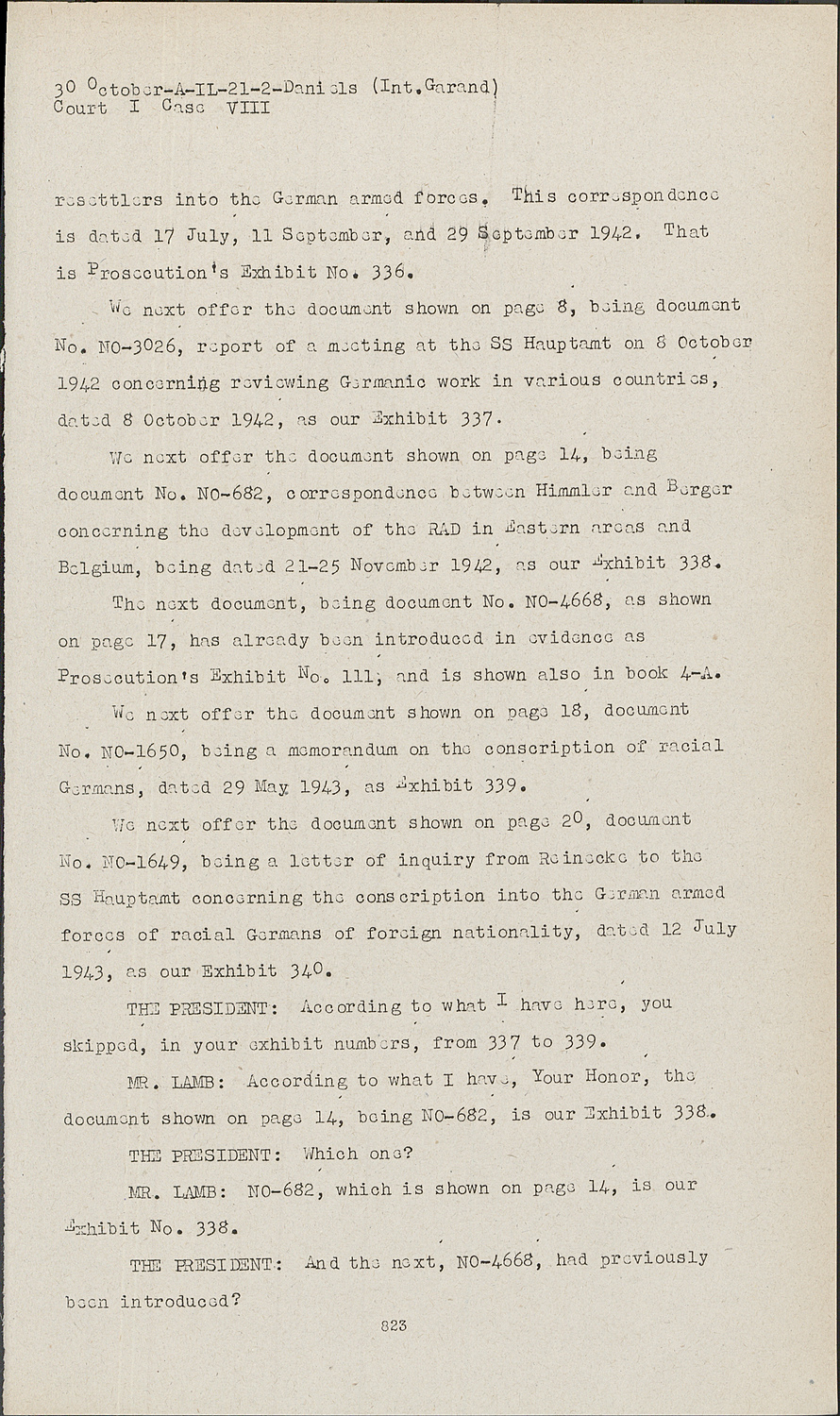
This correspondence is dated 17 July, 11 September, and 29 September 1942. That is Prosecution's Exhibit No. 336.
We next offer the document shown on page 8, being document No. NO-3026, report of a meeting at the SS Hauptamt on 8 October 1942 concerning reviewing Germanic work in various countries, dated 8 October 1942, as our Exhibit 337.
We next offer the document shown on page 14, being document No. NO-682, correspondence between Himmler and Berger concerning the development of the RAD in Eastern areas and Belgium, being dated 21-25 November 1942, as our Exhibit 338.
The next document, being document No. NO-4668, as shown on page 17, has already been introduced in evidence as Prosecution's Exhibit No. 111, and is shown also in book 4-A.
We next offer the document shown on page 18, document No. NO-1650, being a memorandum on the conscription of racial Germans, dated 29 May 1943, as Exhibit 339.
We next offer the document shown on page 20, document No. NO-1649, being a letter of inquiry from Reinecke to the SS Hauptamt concerning the conscription into the German armed forces of racial Germans of foreign nationality, dated 12 July 1943, as our Exhibit 340.
THE PRESIDENT:According to what I have here, you skipped, in your exhibit numbers, from 337 to 339.
MR. LAMB:According to what I have, Your Honor, the document shown on page 14, being NO-682, is our Exhibit 338.
THE PRESIDENT:Which one?
MR. LAMB:NO-682, which is shown on page 14, is our Exhibit No. 338.
THE PRESIDENT:And the next, NO-4668, had previously been introduced?
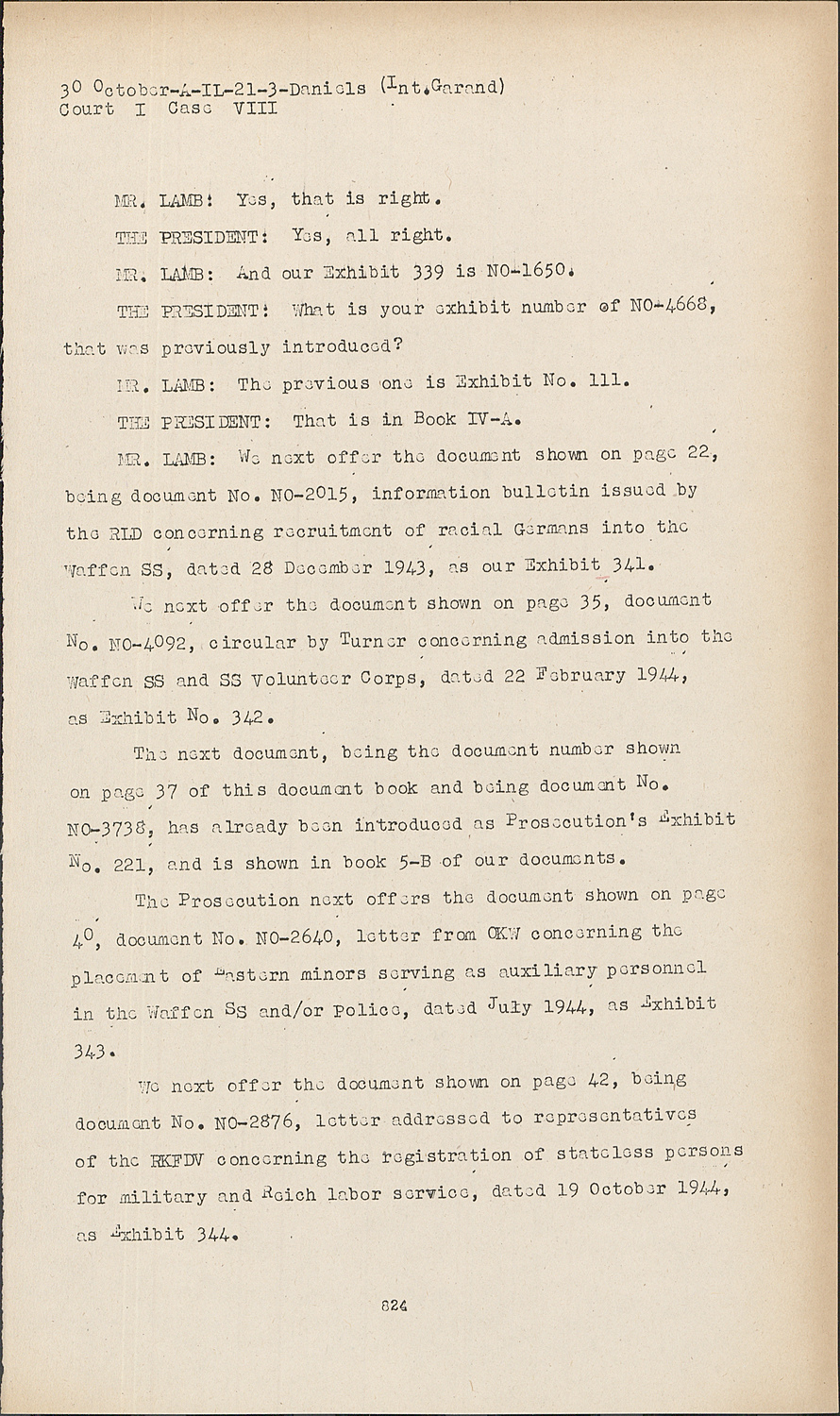
MR. LAMB:Yes, that is right.
THE PRESIDENT:Yes, all right.
MR. LAMB:And our Exhibit 339 is NO-1650.
THE PRESIDENT:What is your exhibit number of NO-4668, that was previously introduced?
MR. LAMB:The previous one is Exhibit No. 111.
THE PRESIDENT:That is in Book IV-A.
MR. LAMB:We next offer the document shown on page 22, being document No. NO-2015, information bulletin issued by the RLD concerning recruitment of racial Germans into the Waffen SS, dated 28 December 1943, as our Exhibit 341.
We next offer the document shown on page 35, document No. NO-4092, circular by Turner concerning admission into the Waffen SS and SS Volunteer Corps, dated 22 February 1944, as Exhibit No. 342.
The next document, being the document number shown on page 37 of this document book and being document No. NO-3738, has already been introduced as Prosecution's Exhibit No. 221, and is shown in book 5-B of our documents.
The Prosecution next offers the document shown on page 40, document No. NO-2640, letter from OKW concerning the placement of Eastern minors serving as auxiliary personnel in the Waffen SS and/or Police, dated July 1944, as Exhibit 343.
We next offer the document shown on page 42, being document No. NO-2876, letter addressed to representatives of the RKFDV concerning the registration of stateless persons for military and Reich labor service, dated 19 October 1944, as Exhibit 344.
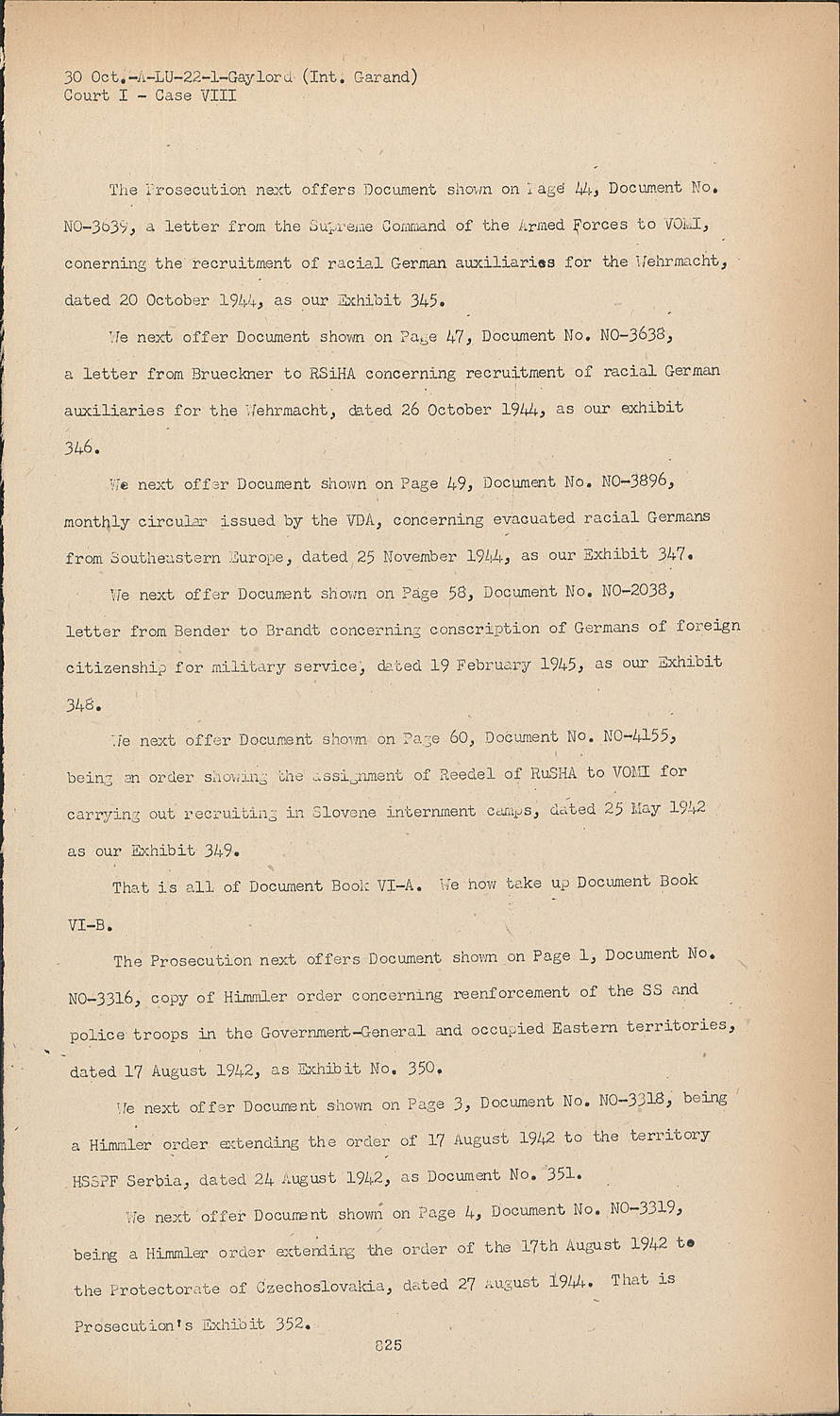
The Prosecution next offers Document shown on Page 44, Document No. NO-3639, a letter from the Supreme Command of the Armed Forces to VOMI, conerning the recruitment of racial German auxiliaries for the Wehrmacht, dated 20 October 1944, as our Exhibit 345.
We next offer Document shown on Page 47, Document No. NO-3638, a letter from Brueckner to RSiHA concerning recruitment of racial German auxiliaries for the Wehrmacht, dated 26 October 1944, as our exhibit 346.
We next offer Document shown on Page 49, Document No. NO-3896, monthly circular issued by the VDA, concerning evacuated racial Germans from Southeastern Europe, dated 25 November 1944, as our Exhibit 347.
We next offer Document shown on Page 58, Document No. NO-2038, letter from Bender to Brandt concerning conscription of Germans of foreign citizenship for military service, dated 19 February 1945, as our Exhibit 348.
We next offer Document shown on Page 60, Document No. NO-4155, being an order showing the assignment of Reedel of RuSHA to VOMI for carrying out recruiting in Slovene internment camps, dated 25 May 1942 as our Exhibit 349.
That is all of Document Book VI-A. We how take up Document Book VI-B.
The Prosecution next offers Document shown on Page 1, Document No. NO-3316, copy of Himmler order concerning reenforcement of the SS and police troops in the Government-General and occupied Eastern territories, dated 17 August 1942, as Exhibit No. 350.
We next offer Document shown on Page 3, Document No. NO-3318, being a Himmler order extending the order of 17 August 1942 to the territory HSSPF Serbia, dated 24 August 1942, as Document No. 351.
We next offer Document shown on Page 4, Document No. NO-3319, being a Himmler order extending the order of the 17th August 1942 to the Protectorate of Czechoslovakia, dated 27 August 1944. That is Prosecution's Exhibit 352.
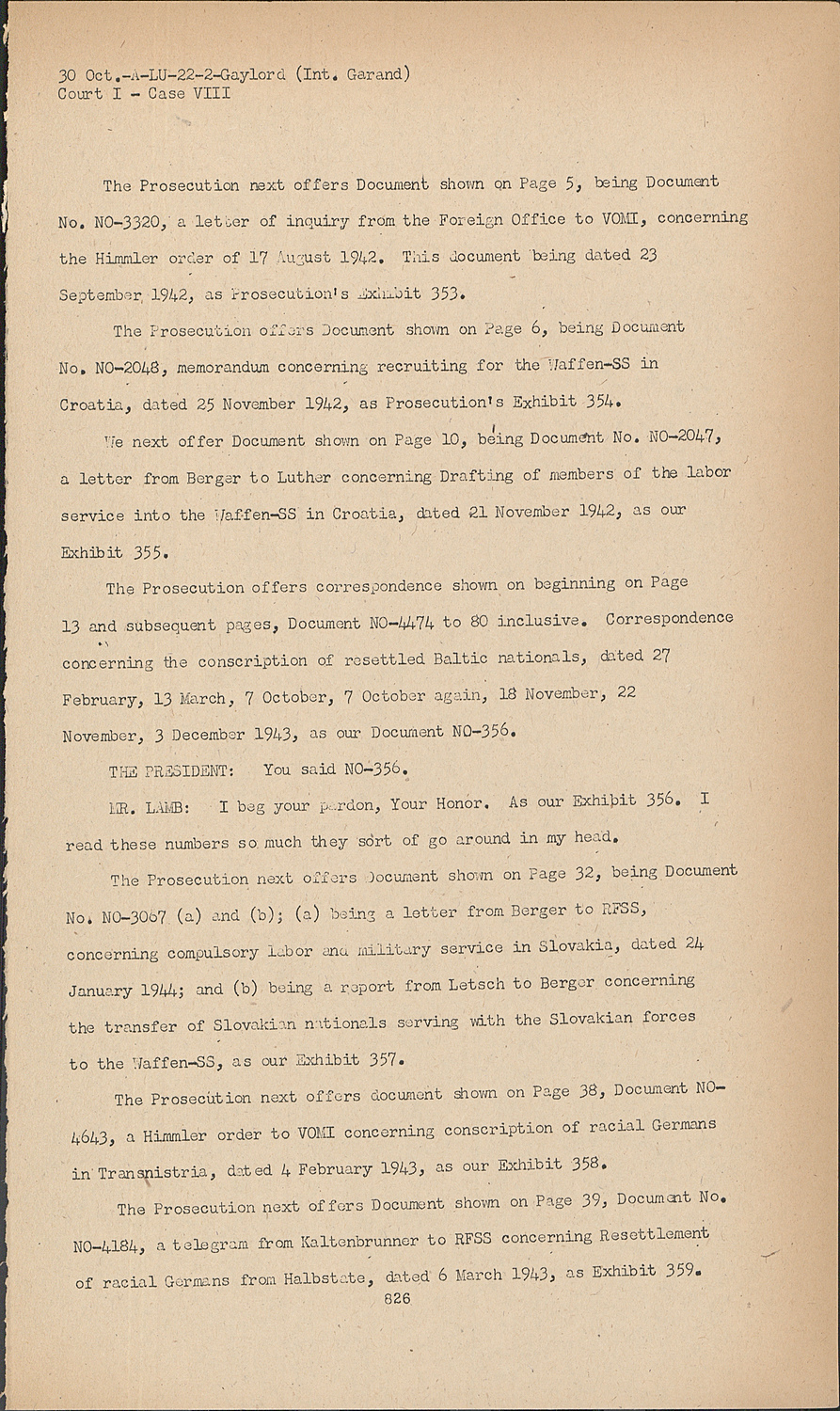
The Prosecution next offers Document shown on Page 5, being Document No. NO-3320, a letter of inquiry from the Foreign Office to VOMI, concerning the Himmler order of 17 August 1942. This document being dated 23 September 1942, as Prosecution's Exhibit 353.
The Prosecution offers Document shown on Page 6, being Document No. NO-2048, memorandum concerning recruiting for the Waffen-SS in Croatia, dated 25 November 1942, as Prosecution's Exhibit 354.
We next offer Document shown on Page 10, being Document No. NO-2047, a letter from Berger to Luther concerning Drafting of members of the labor service into the Waffen-SS in Croatia, dated 21 November 1942, as our Exhibit 355.
The Prosecution offers correspondence shown on beginning on Page 13 and subsequent pages, Document NO-4474 to 80 inclusive. Correspondence concerning the conscription of resettled Baltic nationals, dated 27 February, 13 March, 7 October, 7 October again, 18 November, 22 November, 3 December 1943, as our Document NO-356.
THE PRESIDENT:You said NO-356.
MR. LAMB:I beg your pardon, Your Honor. As our Exhibit 356. I read these numbers so much they sort of go around in my head.
The Prosecution next offers Document shown on Page 32, being Document No. NO-3067 (a) and (b); (a) being a letter from Berger to RFSS, concerning compulsory labor and military service in Slovakia, dated 24 January 1944; and (b) being a report from Letsch to Berger concerning the transfer of Slovakian nationals serving with the Slovakian forces to the Waffen-SS, as our Exhibit 357.
The Prosecution next offers document shown on Page 38, Document NO4643, a Himmler order to VOMI concerning conscription of racial Germans in Transnitria, dated 4 February 1943, as our Exhibit 358.
The Prosecution next offers Document shown on Page 39, Document No. NO-4184, a telegram from Kaltenbrunner to RFSS concerning Resettlement of racial Germans from Halbstate, dated 6 March 1943, as Exhibit 359.